It’s the start of a new story arc in Detective Comics #1006, and the creative team of Peter J. Tomasi and Kyle Hotz aren’t shying away from the dark content here.
A grisly, cult-like execution in a Gotham alley calls down perhaps the DC Universe’s most lethal enforcer, The Spectre. In the ensuing chaos, the entity’s host goes missing. The disappearance forces The Spectre to turn to none other than the world’s greatest detective for help.
The Writing
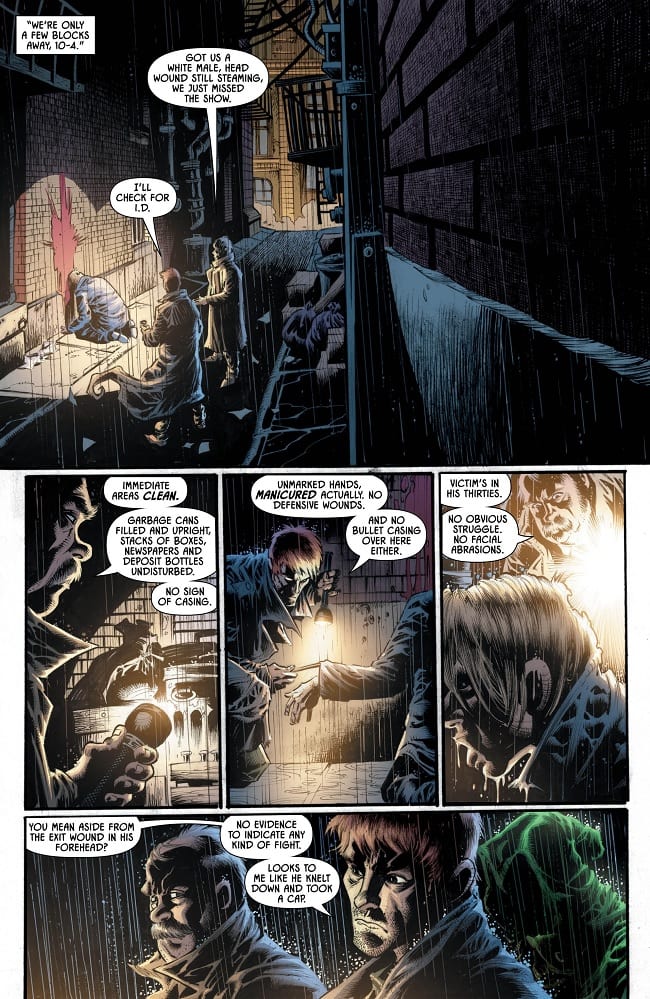
As mentioned above, Tomasi doesn’t shy away from the darker tone of Detective Comics #1006. The story opens on a pretty grim sequence, and only pushes it further from there.
The crux of the mystery hinges on this strange cult group. They appear to be devotees of The Spectre, though the entity itself has little affection for them. One, after spilling blood to summon his master, begs The Spectre to “unleash his terrible wrath” on him. With this following up on our previous arc, the paramilitary zealots seem to be a recurring trend in Tomasi’s run.
That said, the primary tension in the story doesn’t focus on the cultists. Rather, it lies in the conflict between Batman and The Spectre’s methods and ideologies. The former, of course, abhors killing, while The Spectre describes his approach as “eye for an eye.” Of course, even that description may too generous, given he basically reduces his victim to a puddle of viscera. Like I said, the writer’s not afraid to get dark with Detective Comics #1006.
Overall, the writing in this issue is a strong opening to the new arc. Tomasi builds suspense, laying out an intriguing mystery without tipping his cards. The darker tone is unlike the stories we’ve seen in recent Detective Comics issues, setting up what could be a pretty twisted ride.
The Artwork
Hotz provides some moody, stylized artwork for Detective Comics #1006. Batman’s design harkens back to the ‘90s in many regards; the longer ears, the angular face, and the flowing, ragged-looking cape. It’s a fun throwback, and it fits the darker tone of the story well.
The artist delivers some striking imagery in this book. One could easily see numerous images pulled from the pages of Detective Comics #1006 and blown-up to print size. However, the consistency does falter from time to time. The way Hotz frames select panels can make it difficult to distinguish what’s happening at first glance. Overall, there’s far more which works than which doesn’t, though.
David Baron turns in solid work in the color department as well. The shadowy, noir tones of the book contrast with rich colors and occasional neons that seem to glow with a radioactive characteristic. It’s a unique look, and it works well here.
Final Thoughts
Detective Comics #1006 is a promising start to this new arc. The darker thematic elements and appealing artwork are a change from what we’ve seen in the book lately, but not an unwelcome one.
Nearly seven months after the last installment, Batman: Damned #3 finally closes out Brian Azzarello and Lee Bermejo’s saga. It’s been an abstract and meandering ride, overshadowed somewhat by the controversy around the first issue’s withdrawal from shelves. Now, though, we finally crossed the finish line.
After being rescued from entombment by Swamp Thing, Batman goes off to confront the harsh truth of his situation. By the issue’s end, he learns what really happened on that bridge.
The Writing
Batman: Damned #3 is the strongest of the three books in this series in terms of storytelling. The first two were largely a surreal journey through a dark Gotham nightscape, producing many questions—and questionable plot decisions, like Harley attempting to rape Batman—with few answers. Batman: Damned #3 is effective at taking much of what was presented and contextualizing it. In context, we see the book’s end foreshadowed throughout.
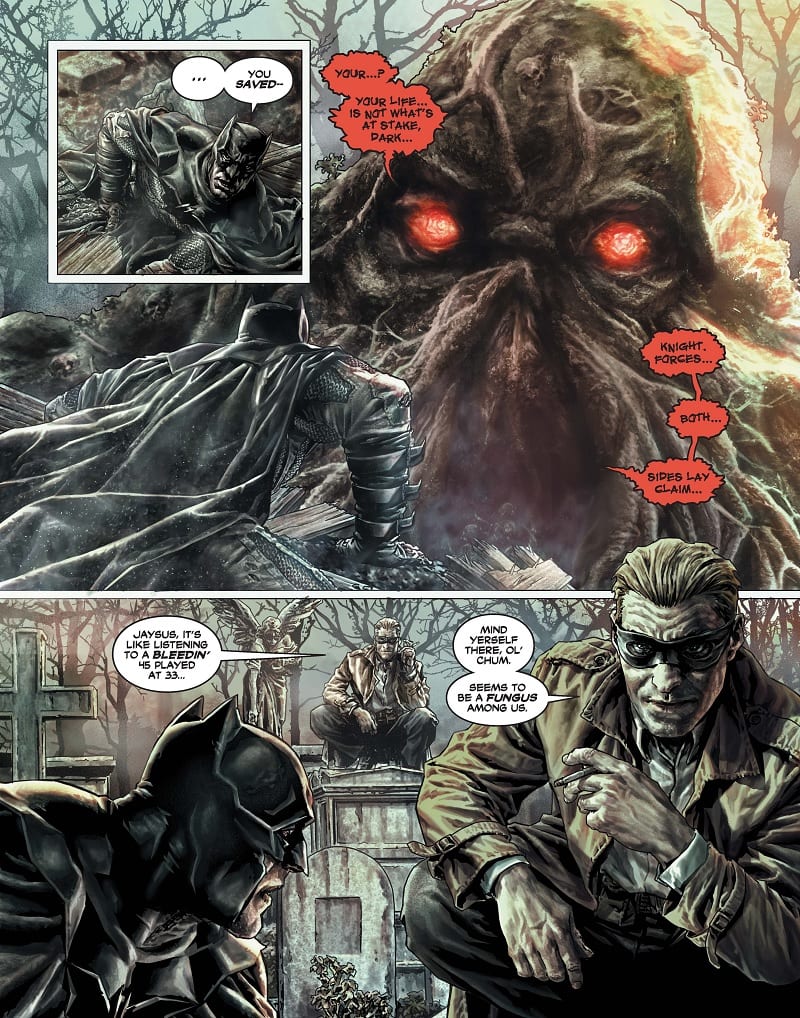
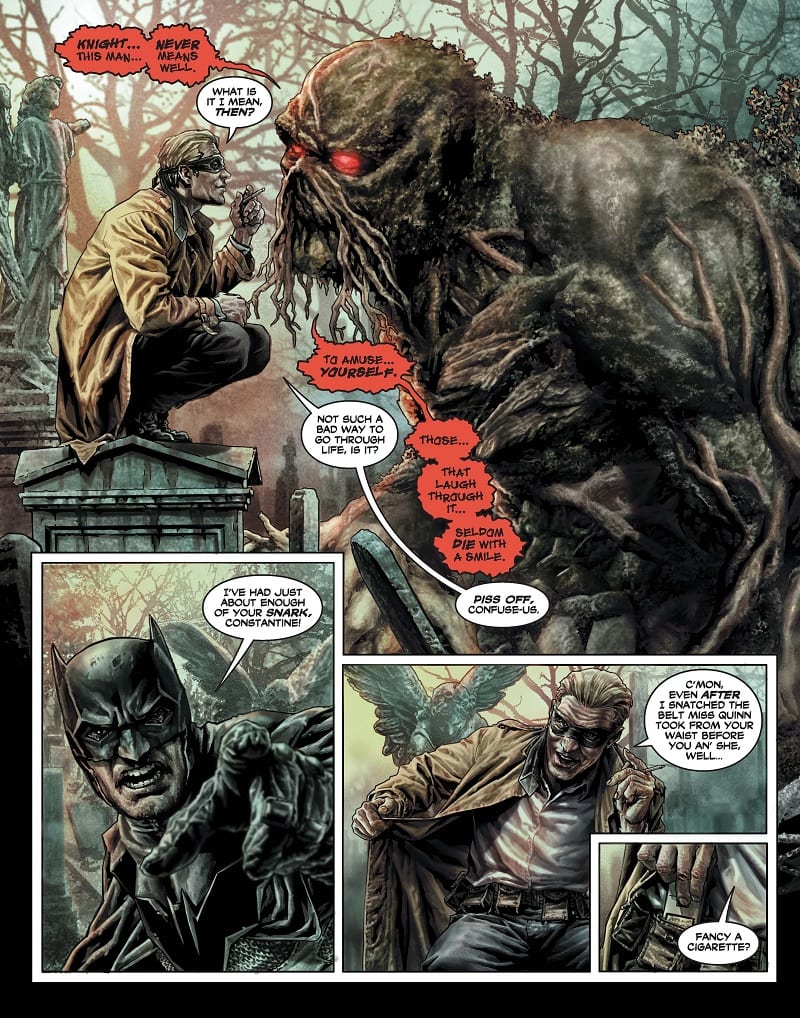
One of the book’s highlights is the interaction between Batman, Swamp Thing, and Constantine. The latter provides the same sardonic, glib commentary he has throughout the series. The former two, in response, voice their disdain for him. Their interaction provides a rare bit of comic relief in a narrative that tends toward an overwhelming grimdark tone.
While this is a Batman book, it hinges more on Constantine to drive the narrative. Although providing the same gallows humor commentary, his dialogue takes on a different context. Here, we see he’s less of a passive commentator, and more like Batman’s spirit guide. In moments, he even reveals compassion for the Dark Knight, trying to stave off the revelation of a harsh truth at the book’s climax.
Batman: Damned #3 provides a complete arc to the story. That said, one of the book’s core plotlines—that of Thomas Wayne’s infidelity—doesn’t seem to go anywhere by the end. It takes up a not-insignificant portion of the previous issue. However, Azzarello seems to drop the thread, rather than tie it into the narrative in a clear, coherent manner. This is not the only underdeveloped element of the narrative, but it’s the most glaring omission.
The Artwork
Again, Bermejo’s artwork is the real show stealer here. There’s incredible attention paid to detail; backgrounds are painstakingly finished, while incidental objects from the gnarled tree bark to the grime on a tombstone’s face are presented with painterly attention.
He does an excellent job of conveying motion and a sense of liveliness through the art. Even in the quieter moments of Batman: Damned #3, the images on the page carry vivacity and a dramatic weight. Though the writing can tend toward being overdramatic at times, the art manages to sell it. As with previous installments, the art alone could make this book worth buying.
The colors are suitably moody. The work is meticulously detailed, but with a consistent grimy, dingy, and cold impression. Throughout the book, the readers feels like they’re viewing the world as a place devoid of life…an effect which works incredibly well alongside the other elements.
Final Thoughts
Overall, Batman: Damned #3 provides a satisfying ending to the miniseries. Not every element falls into place, but it effectively caps-off a dark narrative with a consistent mood and tone.
Following the fantastic “HUNTED” arc, AMAZING SPIDER-MAN #24 begins to show us a bit more of this mysterious new villain that’s been lurking in the shadows. Nick Spencer is joined by artist Ryan Ottley once again to begin the next chapter of the duo’s top-notch series.
***SPOILERS LIE AHEAD***
Peter and MJ spend some quality time together, but the fallout from Kraven haunts our web-headed hero. Mysterio gets psychiatric treatment that turns into a horrifying introduction to our newest Spidey villain–Kindred.
This is a much quieter transition issue after such an explosive previous arc. Nick Spencer spreads the reader’s attention to all the appropriate corners to progress forward in Spidey’s web. We needed to see some of Pete and MJ being together, or else what’s the point of them being together, right?
Our beloved Peter Parker is taking the vision and consequences of his tangle with Kraven very poorly. Spencer has a perfect grasp on Peter’s voice and morale compass, Ottley illustrates a concerned and tortured Pete flawlessly.
The heart of Amazing Spider-Man #24 is Mysterio’s therapy session. Starting with his delusions of himself as he recounts his recent events, Spencer does so with charm and plenty of flair. We then start to dig more into the pain of Quentin Beck and how he dealt with death and resurrection.
Spencer’s script executes the story perfectly, and at the proper pace. I’m not usually a fan of when Mysterio’s helmet is anything but a blank fish bowl, but that’s not the case here. Ottley wisely chose to show Beck’s shadowy face in order to show his emotion and reactions during a long scene of two character sitting down talking.
The more we explore Mysterio’s pain, the more this new villain peaks his head out. Spencer has been slowly teasing this mysterious horror show in the background since Amazing Spider-Man #1 in the classic comic book way.
Now that we’re finally starting to get face time with him, there’s a heavy amount of hype that’s been earned. It also doesn’t hurt that we’re treated to Ryan Ottley’s art as we get our first long look at this menacing foe.
“Kindred” is the name that he shares with Peter as he makes the wall-crawler watch him brutally murder Mysterio in a dream. We still have no clue who this Kindred is but he’s clearly got some personal history and connection with Peter underneath the Spider-Man mask.
Spencer and Ottley are a dream duo for Amazing Spider-Man. Colorist Nathan Fairbairn also continues to prove he’s a perfect match for deepening the effectiveness of Ottley’s pencils. Issue #24 is another excellent Spider-Man comic book. A quieter, slow-burning issue like this makes it feel all the more like the classic tales we hold in such high esteem.
BOOKS OF MAGIC #9 shifts the spotlight from the young wizard Timothy Hunter to the friend he’s searched for tirelessly: Ellie. Readers of the series will remember her imprisonment inside of a book at the hands of their school librarian Mr. Davies. With Tim and Ms. Rose no where to be found, Ellie must navigate the confines of her literary prison alone. Fortunately for her, another prisoner’s predicament may be the motivation she needs to escape.
An Enchanting Story of Self-Liberation
Kat Howard, through Ellie, begins this tale by featuring a quick trip down memory lane. We learn the young wizard enjoyed magic from a very young age, which is made clear by a scene of her at a magic show put on by none other than the DC hero Zatanna. This helps readers understand the optimistic attitude toward Ellie fostered within herself before learning to harness her powers. And it makes it that much more disheartening when all of those hopes shatter after reliving her traumatic imprisonment.
While bemoaning her fate Ellie meets Kip, an elderly wood creature who claims to have once been a prophetic tree. His brief origin story is reminiscent of the classic children’s book The Giving Tree, only this tale was more sinister. Kip was chopped up and placed in the paper bound prison many years ago.
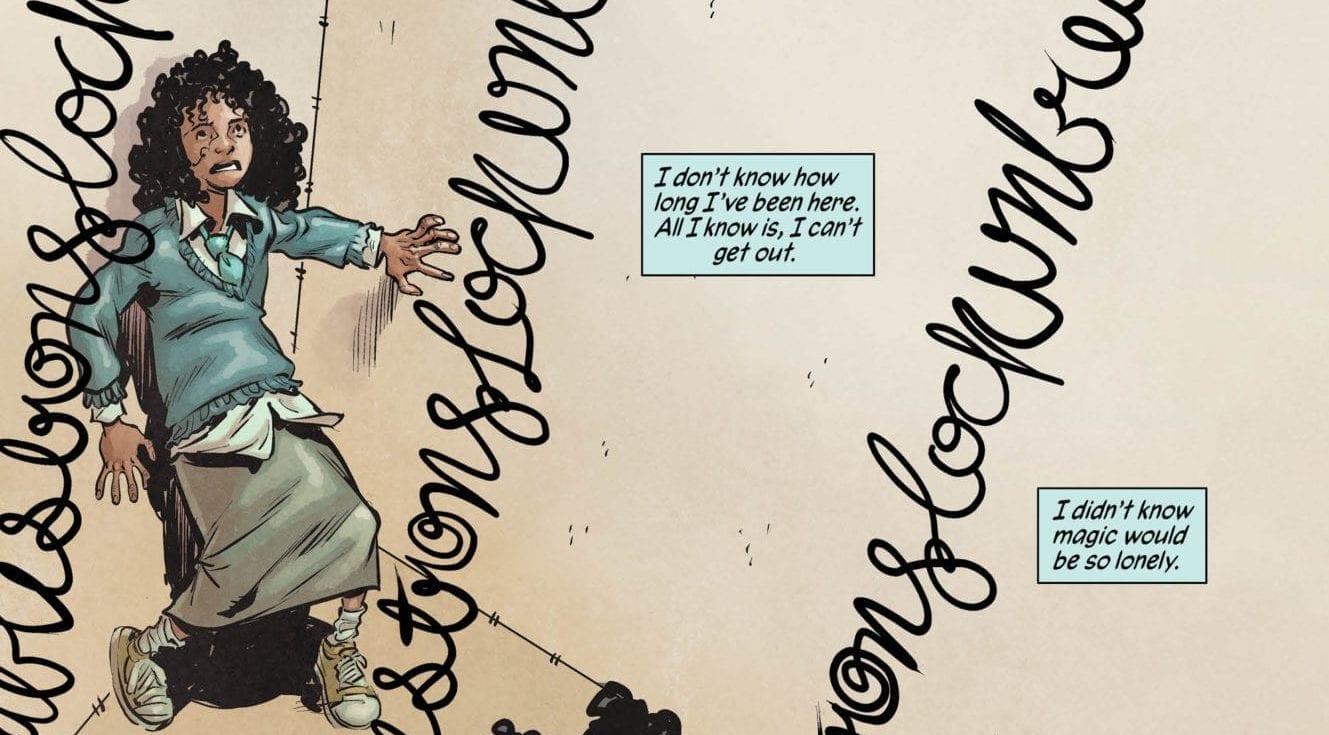
Through a combination of desperation and care for Kip, Ellie musters up the courage necessary to tackle the bars of ink imprisoning them. But will her magic be enough? Readers will be inspired by Ellie’s self-liberating attempts to free both herself and Kip from this dungeon of words.
Magical Illustrations
Tom Fowler’s pencils, Brian Churilla’s inks, and Jordan Boyd’s colors astound once again, showcasing their ability to conjure up fantastical landscapes most people only see in their wildest dreams. The artist finds a way to bring the interior of Ellie’s book prison to life by fashioning the tome’s cursive letters into bars of a cage. These letters match her frizzy hair to show how much a part of the book she’s become.
Todd Klein is equally fantastic in this issue. He gives each dialogue box details related to their corresponding characters such as Kip’s wood-like background with pieces missing as if park of the bark broke off.
The Comic Cover
Kai Carpenter’s main cover artwork is designed to look just like a fairy tale book. But it features Ellie banging on a window from inside the cover to show that her experience is the exact opposite of the fantastical escapism these books provide.
Conclusion
BOOKS OF MAGIC #9’s bring much-needed attention to Ellie after sidelining her for a few issues. But finally revealing her fate is well-worth the wait as we see her come into her own.
What did you think of Ellie’s experience in the book? Let us know in the comments below!
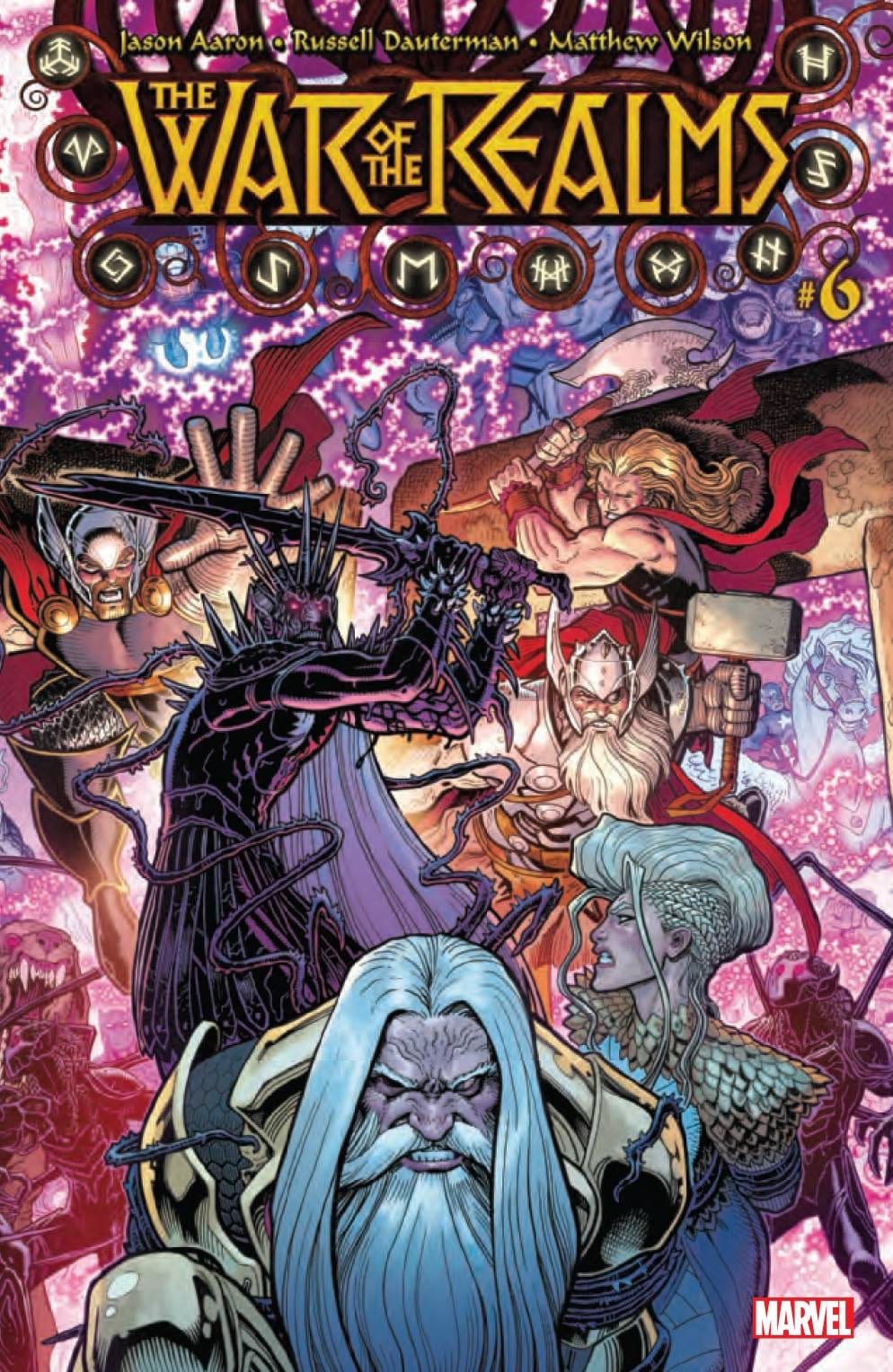
Jason Aaron’s massive epic, WAR OF THE REALMS, comes to a close with issue #6. It all comes down to the multiple Odinson’s to stop Malekith’s reign of terror.
***SPOILERS LIE AHEAD***
It’s been said over and over again, but we’ll say it one more time. Jason Aaron has been writing this Thor story for a very long time and it’s been a fantastic journey. War Of The Realms is very much a culmination of everything that he’s written before. This was a story eight years in the making.
With that kind of groundwork having been laid, the final siege against Malekith being lead by the many Thor’s of Aaron’s long run is extremely satisfying no matter how long you’ve been following along.
While the Thor Collective takes Malekith on, Earth’s Mightiest heroes dispatch his allies on Midgard. Each and every scene of triumph and interaction between our heroes is memorable and unique to this story. Jason Aaron utilized the advantages of crossover epics like no other creator has since Civil War. Incorporating all of the 616 into this fight for our realm where everybody gets a moment to shine.
War Of The Realms #6 has quick and easy payoffs for almost every character. Things that were set up and developed throughout this main story and all it’s tie-ins. There’s a connected tapestry here where all the different creators were on the same page that we sadly don’t get much of anymore.
Russel Dauterman had quite a task with this series and he’s truly delivered. War Of The Realms was a much larger scale and cast than he’s ever been handed. There were very few blemishes. Every bit of epic that Jason Aaron provided for this story was taken to a new level through Dauterman’s talent.
The surprise of Mjolnir being forged is a wonderful moment. Thor’s trusty hammer sidekick gets a beautiful redesign and the scene in which it drops is effectively heavy as the hammer itself. We get major closure on “Gorr was right” and Thor becomes the God Of The Unworthy–a brilliant development by Jason Aaron.
As All-Father looks on in awe of how great a god his younger self was, the reader witnesses another step in Aaron’s grand evolution for the character. Along with all that Aaron has accomplished with this cast of characters and all these stories, he’s solidified himself as an all-time great Thor creator.
Matthew Wilson’s layering and contrast of colors really elevate Dauterman’s art. Battle scenes come to life through Wilson’s color. Laufey’s last stand is a masterpiece. Bloodier moments, like Carol’s fire-sword decapitation, burn right into your memory thanks to the vibrant and imperative statement the coloring and contrast provides.
Character iterations exclusive to this War Of The Realms story are iconic and memorable thanks to Dauterman and Wilson. We will forever remember Daredevil The God Of Fear and Malekith merged with the Knull symbiote. These are the kinds of things we read comic book events for.
One major strength of War Of The Realms as a whole is the moments it provides–issue #6 is no different. Even moments that we can see coming from a mile away, like Loki’s return, are still every bit as entertaining as they’re intended.
Malekith’s final farewell is a bloody and brutal one. One would hope this isn’t the last we see of him as he’s clearly Thor’s become Thor’s greatest foe. He’ll likely spend some well earned time on the shelf.
The crawl out from the fallout begins, full of exciting new directions for the major players. That final page is a big one, Odin bowing to his son as the new All-Father Thor is absolutely stunning. We are officially in a new era for both Thor and the Marvel Universe.
War Of The Realms is everything a crossover should be. Marvel Comics are going to be in a good place so long as Jason Aaron is heavily involved.
In Fantastic Four #11, a new adversary threatens to vanquish the heroes once and for all. The team must face the menacing threat of… a driving test. The Fantastic Four has stared down Doctor Doom without blinking. They’ve defeated Galactus. They’ve dealt with Mole Man and Namor, too. But could be this foe be the one that takes the First Family down?
In Fantastic Four #11, the team meets its most scariest threat yet: a driving test!
Artists: Paco Medina, Kevin Libranda, Paolo Villanelli & Juanan Ramírez
Color artist: Jesus Aburtov
Letterer: VC’s Joe Caramagna
STORY
Throughout writer Dan Slott’s run on Fantastic Four, Franklin Richards has been a tough pill to swallow. Slott had Franklin and his sister Valeria return to the Marvel Universe as teenagers early in the series; since then, both Richards children have been prone to episodes of A.T.S.: Annoying Teenager Syndrome. Franklin, in particular, has consistently been a jerk. Last issue, he was especially obnoxious and he bragged about his godlike powers. This previous installment ended with some hints of progress but, here, Franklin is back to where he started.
Thankfully, Johnny Storm corrects one of the mistakes the family previously made when dealing with Franklin’s attitude; Johnny tries to talk to the troubled teen. (Last issue, nobody reached out to him.) Of course, Franklin blows him off but it’s the thought that counts, right? Plus, Franklin isn’t as insufferable this go-around; in fact, he uses his Annoying Teenager Syndrome to help save the day.
Franklin makes an unconventional pitch to Gargantua.
“Your kid used his disgruntled teen powers for good,” Johnny Storm succinctly tells Reed and Sue Richards. That’s right; when Gargantua (an unimpressive villain of the week in limited action) threatens to violently replace the main Marvel Universe with the Microverse, Franklin simply shows her some pictures of Earth on his phone and trashes the world Gargantua covets. Compared to the spectacular Microverse, Franklin says the main dimension “sucks” and asks the villain, “why would you trade one second of this–for the world I’m gonna be stuck with for the rest of my stupid life?” Under Slott’s guidance, Franklin remains a somewhat static character and it’s getting harder to use the virtue of patience as an excuse for this lack of progress. Still, at least for now, let’s appreciate that Slott found a way to make Franklin’s off-putting attitude legitimately useful.
Of the two Richards siblings, guess who failed the driving test?
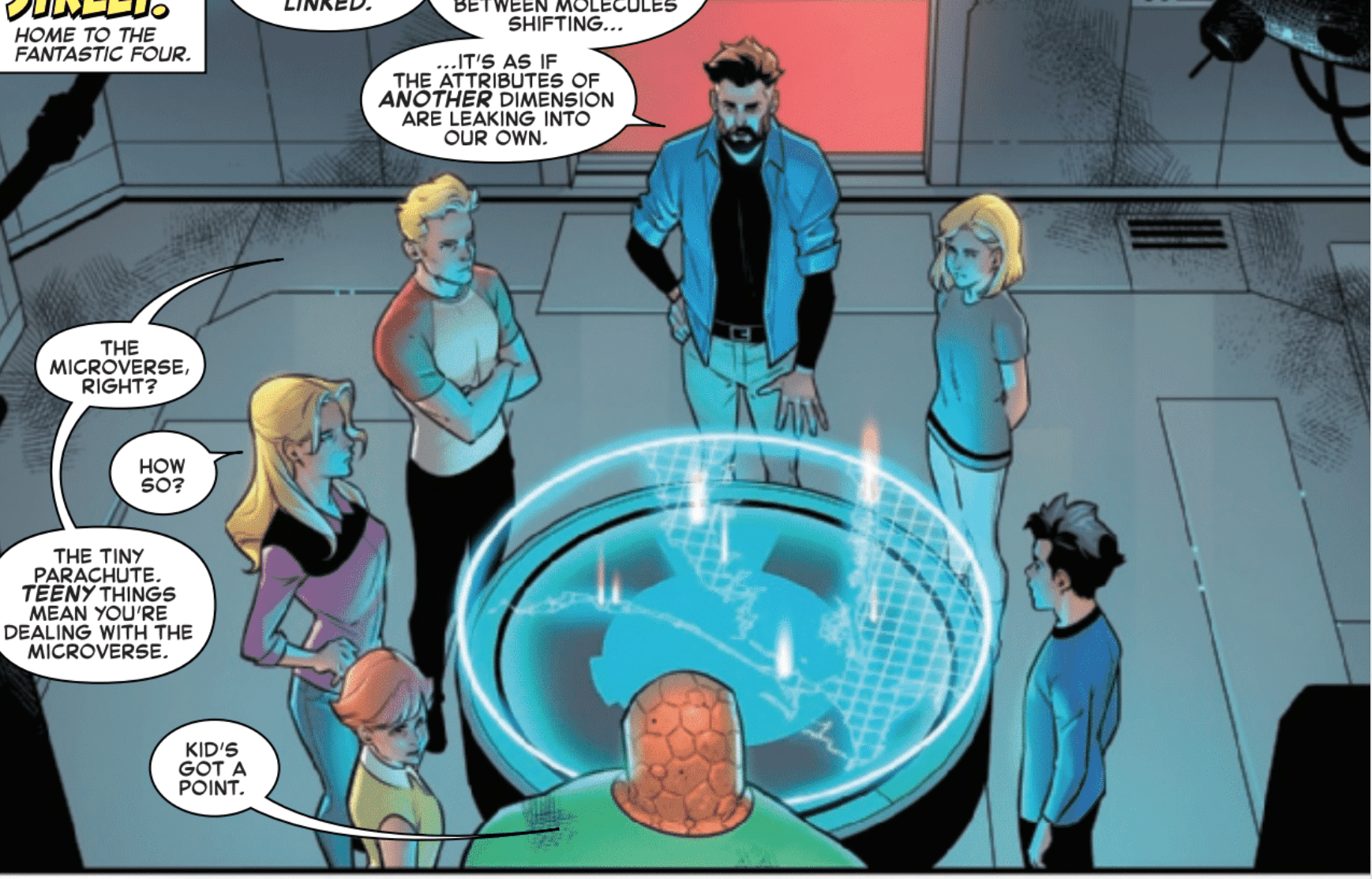
In the traditional sense, Gargantua is the villain in this issue. But when Franklin and Valeria have to take a driving test, it’s clear what the real antagonist is. Harriet Underhill and Tobias Cobb of the Department of Extranormal Motor Vehicles invade Yancy Street and tell the Fantastic Four that the Richards siblings won’t be allowed to drive the team’s amazing vehicles until they pass the test. To prepare the siblings for the exam, Johnny and Ben Grimm try to teach Franklin and Valeria how to drive in a montage-like sequence that’d fit perfectly in an ’80s-movie. (Is that “Eye of the Tiger” in the background?)
Slott sets up a fairly predictable outcome and turns it on its head. Valeria wipes the floor with Franklin in these training sessions. But, when the duo gets roped into Gargantua’s battle with the Fantastic Four, Valeria fails to practice safe driving. “Talking on a communicator, operating complex apps and performing scientific experiments…while piloting a vehicle?,” Underhill asks the team. “Why, that’s worse than driving while texting!” By comparison, Franklin pulls over and, before he enters the fray, he ensures that his passenger is safe. As a result, Franklin passed the test while Valeria failed. Even if he loses his powers, as Slott continues to suggest, Franklin has a guaranteed role on the team as its wheelman.
ART
Gargantua wasn’t impressive in this issue but the artists made the most of her involvement.
Slott’s run on Fantastic Four is eleven issues deep and, more often than not, the writing and the art combine to give the reader exactly what you’d expect in a story featuring the team. This time around, the team of Paco Medina, Kevin Libranda, Paolo Villanelli & Juanan Ramírez and color artist Jesus Aburtov make the most of Slott’s script and its lackluster villain (Gargantua.)
Sometimes, it’s the little things that make the difference. Using vibrant, electric blues and purples, the art team makes the Microverse come alive. The bright lightning-like bursts of energy make the reader feel like Gargantua’s dimension is actually expanding into the main Marvel Universe; the artists successfully convey the sense of motion.
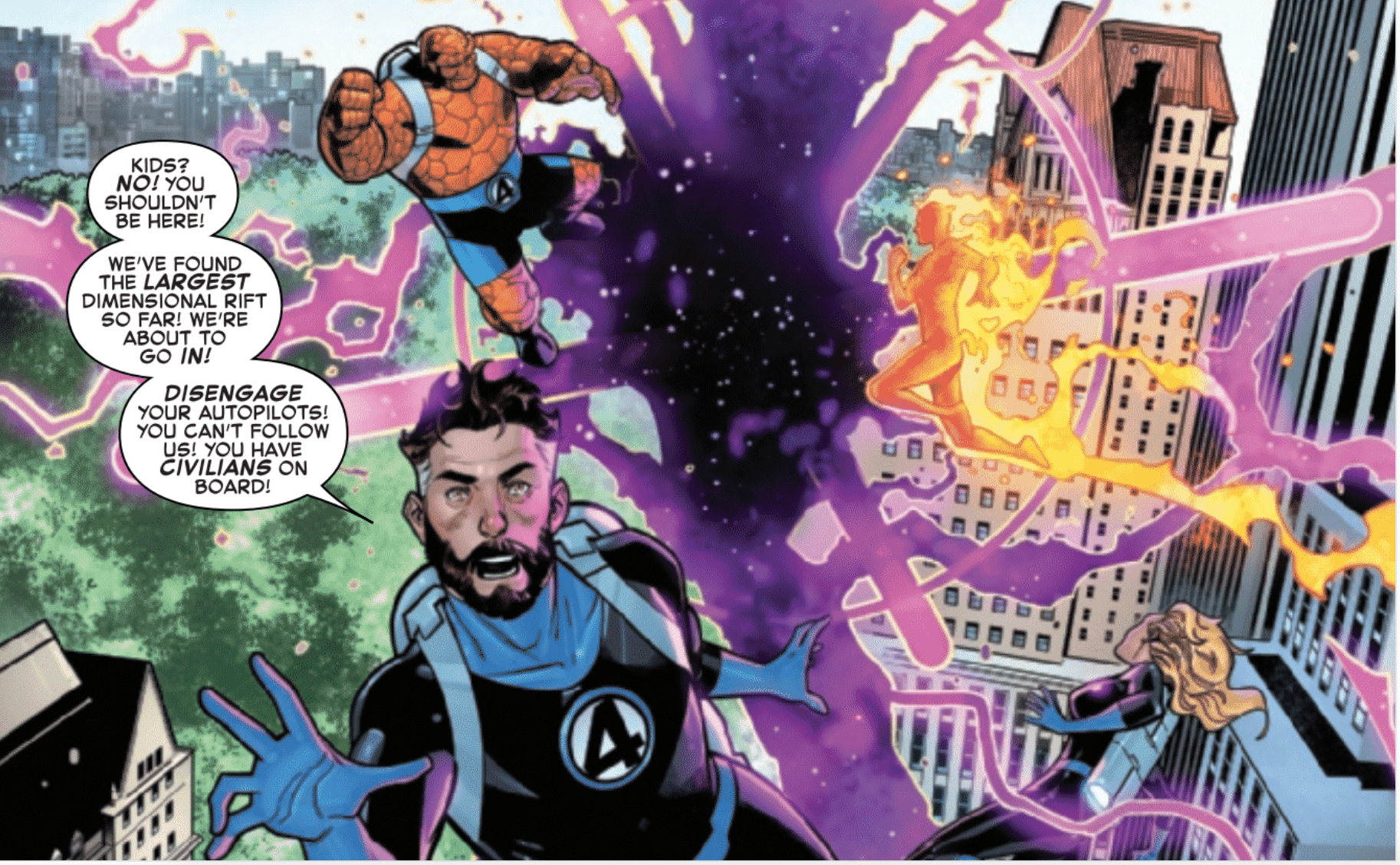
It’s not a black hole but these dimensional rifts still look intimidating.
Similarly, when the Fantastic Four investigates some subspace tears, the art team makes the scene feel like a classic story featuring Marvel’s First Family. The dimensional rift isn’t as menacing as a black hole but, using dynamic, ominous purple tendrils, the rift still seems dangerous. In a Fantastic Four story, every time the art complements the science fiction elements of the plot, it has to be considered a success.
As with other issues of Slott’s run, this installment focuses on the Fantastic Four’s family dynamic first and foremost. As long as Slott continues to do so in an enjoyable way, fans can consider the writer’s take on the First Family as a solid series that explores common domestic issues.
What’d you think of Fantastic Four #11? How do you feel about Franklin Richards’ attitude?
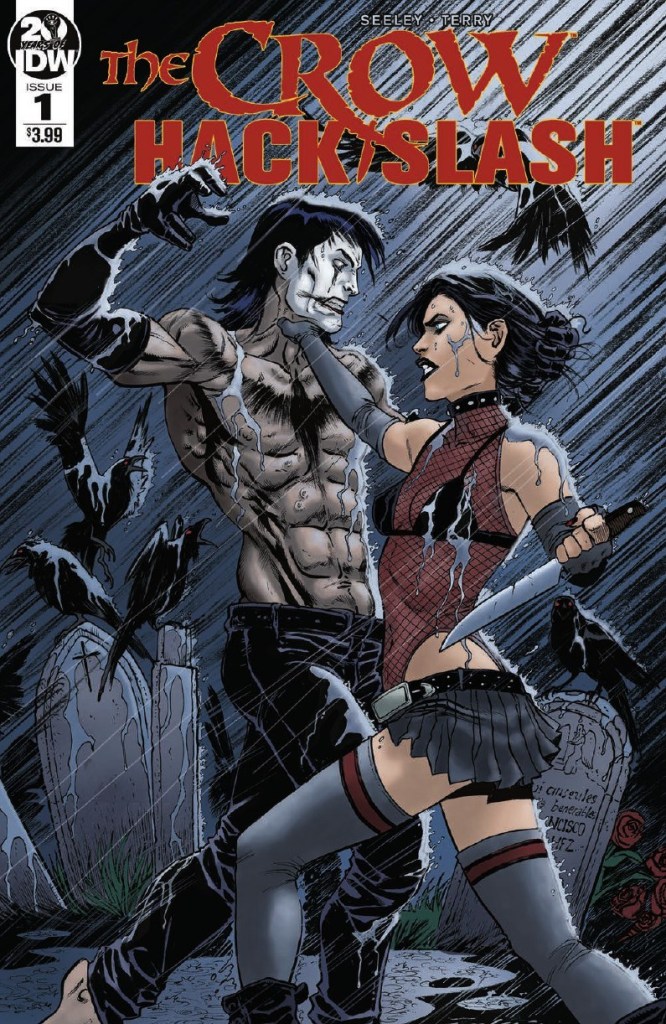
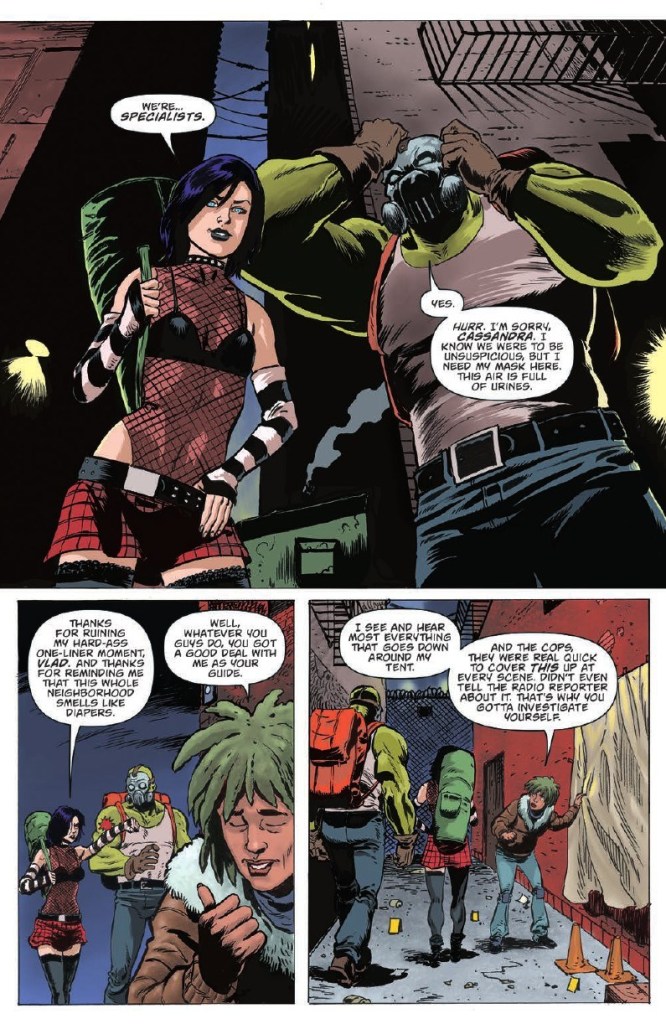
The Crow Hack/Slash #1 by Tim Seeley, Jim Terry and Neil Uyetake brings everyone’s favorite slasher hunters, Cassie Hack and Vlad face to face with cult-comic property The Crow.
A soul is brought back. But something is wrong.
Angeles Cero won’t stop killing on her quest for revenge, and the bodies are piling up. Now, slasher hunter Cassie Hack and her monstrous partner Vlad are on the trail of the Crow Killer, assuming her to be one of the masked murderers they’ve hunted for years. But they aren’t the only force trying to make the universe right again.
The Crow Hack/Slash #1 Scripts & Layouts: Tim Seeley Art by: Jim Terry Letters by: Neil Uyetake
Story
To comic readers of a certain time period, The Crow was a seminal comic. The property never really went away, always being resurrected, with expanding mythology along with it. With its theme of undead killers seeking revenge (not to mention it’s ‘goth’ look), it’s no surprise Tim Seeley saw the possibilities in crossing over The Crow with Hack/Slash. This first issue delivers on those possibilities enough to create a genuine interest in what is going on.
Both The Crow and Cassie Hack fans will find much to like here; the Crow mythology is being played with (spoiler alert: there are TWO Crow killers on the loose this time) and Cassie and Vlad’s relationship (one of the best aspects of Hack-Slash) is also front and center.
There’s also all the action, gore and humor Hack-Slash has always had, with true pathos sprinkled on as well. It’s a book that reads fast and fun, a plot that draws you in and a concept that is just great.
Art
Jim Terry, with layouts by Seeley, brings a lot of energy to the pages. The coloring is also slick and vibrant. But it’s not over polished, as there is true grit and a jaggedness to some of the art that is a direct echo to The Crow comics of the past (especially with the look of the Crow killers, all thin and pale). It’s a good looking book from beginning to end.
Conclusion
Hack/Slash crossovers have always been a fun read, but this one is out of the grave starting to feel just a little bit different. The Crow angle brings in a new vibe and some unique nostalgia. If you are a fan of either property, pick this book up at your local comic book shop.
The first season of Killing Eve was one of the biggest shows of 2018. It became known for its memorable characters and dark, twisted humor. It earned numerous awards and praise for its stars, so the new showrunner had a lot to live up for the second season.
The second season picks up 30 seconds after the first season left off. Villanelle (Jodie Comer) has been stabbed and is hiding from the cops and The Twelve. Eve Polastri (Sandra Oh) gets rehired by MI6 to investigate another set of murders believed to be committed by a woman. With Eve’s mind on other things, Villanelle becomes paranoid that the American-accented British agent is no longer interested in.
The showrunner of the first season, Phoebe Waller-Bridge, left to make the second season of Fleabag. The reins were handed to actress/novelist Emerald Fennel. Because of the new showrunner, there were some changes to the series.
The most notable change was the plot expanded beyond the cat-and-mouse game between Eve and Villanelle. In this season Eve goes on the hunt for another assassin known as The Ghost and discovers a tech company might have partaken in illegal activities. The season was split into three distinct sections within the overarching plot: the first being Villanelle escaping from the Twelve, second being Villanelle trying to get Eve’s attention and the third was Eve and Villanelle teaming up. It builds up the world and shows there are more threats than just Villanelle.
The second season saw an increase in violence. Many of the deaths were more bloody than in the previous season. The most memorable was in the opening of the fourth episode where Villanelle kills a man in Amsterdam’s red light district. People get disemboweled, have their throats slit, or stabbed with different instruments, and it will please gorehounds.
A smaller but still notable change was the music. Throughout the season more songs were being used. This gave the season a different style from the first.
The second season kept what worked from the previous season – the character dynamics and the humor. The core of Killing Eve is the relationship between Eve and Villanelle and how they are drawn to each other. Villanelle is an attention seeker, and it drives her up the wall when she’s ignored while her dark side tempts Eve. This season puts Villanelle in a vulnerable state because of her injury and gets held captive by a handler from The Twelve. Villanelle’s still resourceful but physically weaker and lacks control in the first three episodes. Villanelle is unpredictable and does some reprehensive things which push Comer’s charm as the character to the limit.
Vulnerability is a great description of Villanelle’s role at times. The end of the fourth episode shows Villanelle at her lowest ebb – she is a dark place because her ego can’t handle not getting what she wants. Villanelle faces her match when faced against someone equally as cruel and psychopathic as she is. The sixth episode exposed Villanelle’s weaknesses – she gets called out for lying, and her own laziness and arrogance puts her in danger. Killing Eve has razor-sharp dialogue. There are hilarious lines and reactions through the season. Some personal favorites were when Carolyn (Fiona Shaw) reveals why she looks so good and an incident with an ax. The key actors have great comedic timing. There were also some clever subversions like when Villanelle meets the Quartermaster – going into more detail will spoil the joke.
Killing Eve is one of the most inventive shows currently on TV. It works both as a thriller and a comedy and second season carries on the great work of the first. I binge-watched the second season over the course of two days – it was a breezy watch.
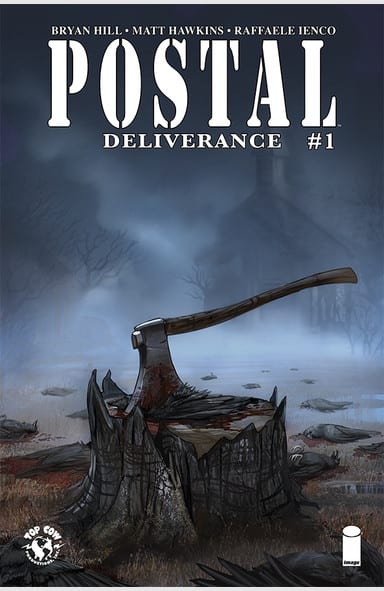
On 3rd July the Top Cow imprint of Image Comics will release the first issue of the new arc of Postal. Writers Matt Hawkins and Bryan Hill will be reuniting for the first issue in over a year since the epilogue Postal: Laura was released in March 2018.
The new run is due to pick up directly from where the previous run left off, however the writer and creator Matt Hawkins has stated on Twitter that ‘you don’t actually have to read the first one to read this.’ This is good news for newbies to the comic but what have you missed?
Set in the town of Eden, a haven for criminals, the first arc introduces the characters and setting. It also has a well-constructed storyline that evolves the central characters through a series of moralistic dilemmas. The comic is packed with twists and turns and gob smacking moments. Here are five of the best bits from the initial Postal run.
Warning: The following contains Spoilers for the initial run of Postal
Postal Deliverance #1 Cover Credit: Top Cow
Bonding Over Violence
In the initial storyline, the town mailman and son of the Mayor, Mark Shiffron, is given a severe beating. Mark has Asperger’s syndrome, a weakness in his mother’s eye, and as such he is resigned to the mail house; put out of the way to keep him busy. Postal is primarily about Mark’s rise to power in the town of Eden and the character he is to become all stems from a confrontation in issue 4.
After being beaten by the followers of Isaac Shiffron (a much larger story) Mark asks for help from Maggie, a local waitress and pawn of the FBI. Together they confront his torturers. Mark lures the five people to a barn and confronts them, asking for an apology. They laugh in his face and threaten him with more violence. In steps Maggie, shotgun in hand, as protector and saviour.
This sequence is instrumental to the plot of the first arc because it lays the building blocks for Mark and Maggie’s relationship. From this moment onwards they are as thick as thieves. Hawkins/Hill manoeuvre the characters through the previous 3 issues, leading them to this exact moment. It portrays Mark’s inner strength and contrasts the way that he is seen with the way that he behaves.
It also demonstrates Maggie’s commitment to Mark. She is only just getting to know him but already she is willing to kill for him. She can see the future he has and is making a statement by being by his side.
This moment is a pivotal moment in their relationship but also cements their positions within the town of Eden.
Postal #4 Page Art Credit: Top Cow
I’m A Fire Starter
A number of the issues of Postal deal with difficult moral issues, often relating to horrible crimes. In issue 8 Maggie dispenses what she believes to be justice against a man accused of child murder. This issue revolves around the spread of rumours and the unjust corruption used to protect the guilty even at the risk of the innocent. Maggie is shown to be a violent fighter for the cause of innocence.
Johan is an ex-convict whose crime was theft however, when he was caught the body of a child was found buried in his garden. The authorities were never able to prove Johan had anything to do with the murder and he was adamant he didn’t kill the child. This didn’t stop the rumours or the constant beatings he received in prison.
When he was released he found sanctuary in Eden where Mayor Shiffron protects him, partly because that’s what Eden was designed for but also because she needs him to create a town wide surveillance network.
In issue 8 Maggie convinces Mark that Johan doesn’t deserve the protection of the Mayor or the town. This storyline further advances the relationship between Maggie and Mark. She pushes his boundaries to see just how much he will do for her. She is directing his actions which will lead, ultimately, to a confrontation with his mother.
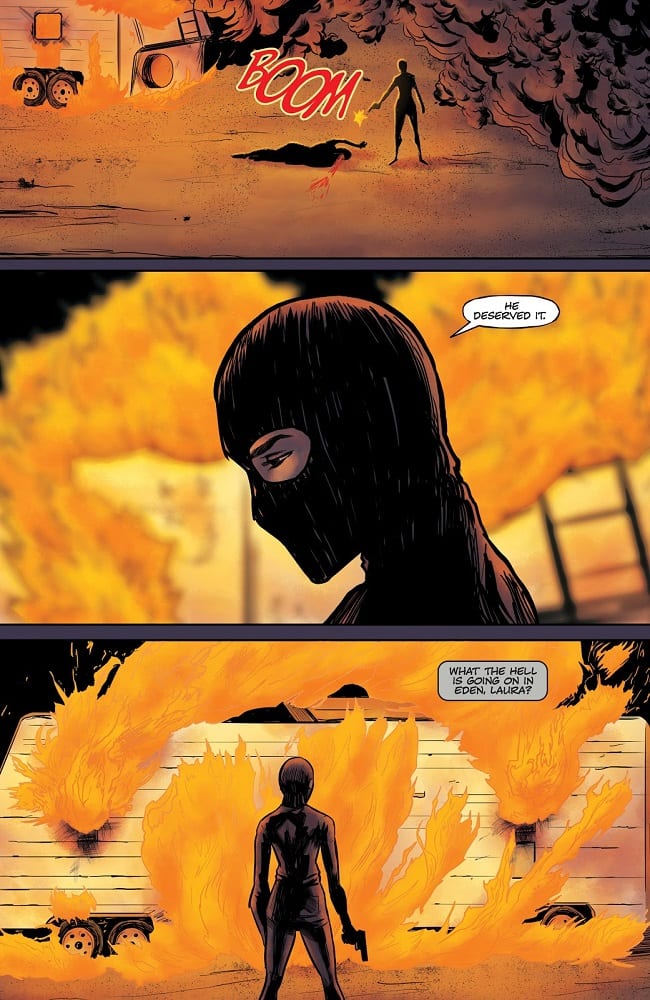
But this issue also highlights Maggie’s staunch belief in right and wrong. The extreme’s that she goes to for justice, locking Johan in his caravan while she sets it on fire, demonstrate the strength of her beliefs. The writers want the reader to see what kind of world these characters live in. It is a world of protection and violence where one person’s ideas can mean life or death for others.
There is one panel in issue 8, drawn by Isaac Goodhart and colored by Betsy Gonia, that illustrates this concept perfectly. It is a headshot of a masked Maggie, surrounded by the flames of the caravan. She is cast mostly in shadow and she stares coldly at a body which is out of panel. The speech balloon hangs in the air behind her, a stark statement in the chaos: “He deserved it” she says with conviction. There is no reason to doubt her as she is portrayed steadfast within her belief.
Postal #8 Page Art Credit: Top Cow
This Is Your Home Now
As a companion piece to issues 4 and 8, issue 12 examines the lengths that Mark will go to in order to protect Maggie. A new resident to Eden causes trouble but just like Johan she is protected by the Mayor. The reasons for this protection are made clear to Mark but after the newbie, Molly, beats up Maggie to prove a point, Mark devises a plan to entrap her. The result is that Molly becomes locked in a cage, in a disused mine.
The contrast to the way that Mark deals with people and the way that Maggie, or his mother, deals with people is highlighted in this issue. Most of the town resort to violence to make their point or stake their claim but Mark is much more controlled and devious. He thinks about the big picture and crafts complex traps for people. The result is that he gets what he wants with the minimal amount of consequences. The moment in issue 12 where Mark locks Molly in the cage while distantly explaining her future life is a perfect snapshot of who Mark is.
Postal #12 Page Art Credit: Top Cow
Rowan
Issue 13 sees the start of a storyline where Eden goes to war against a white supremacist group. It is a violent, nasty war that results in a number of deaths. The introduction of the story however is an examination of redemption. The central character is Rowan; a once violent racist who severed time for manslaughter after dragging a young African American boy by a chain behind his truck.
On paper, Rowan is a nasty piece of work. However, Bryan Hill manages to get the reader to empathise with Rowan. Throughout the issue Rowan’s story is revealed and he receives a range of reactions from the other characters. Hatred, anger, indifference and pity. These emotions flood the comic as Hill forces the reader to question the notion of forgiveness and redemption. Who has the right to be forgiven and who can do the forgiving?
Issue 13 of Postal is a powerful look at hate crime and the everlasting consequences. It is one of the best issues of the entire run and worth reading. Hill and Goodhart deal with a very difficult subject in a mature and thought provoking way.
Postal #13 Page Art Credit: Top Cow
This Is The End?
The final monumental moment of the first arc comes at the very end, almost. Issue 25 picks up after the final confrontation of the Shiffron’s and sees Laura reveal her final secret to Mark. The series started with the death of Marks sister and it ends with him finding out about the death of a brother he knew nothing about. The story, involving human sacrifice, illustrates the insanity at the heart of Eden and how it affected Laura from the very beginning. She knows that she has done wrong but can’t get passed the hope that what she did was, ultimately, worth it.
In the final sequence of the comic Laura passes the baton of responsibility for Mark to Maggie then leaves Eden. As she ventures into the empty land around the town the color fades from the landscape, a bright, yellow light fills the horizon and Laura puts a gun to her head.
The atmosphere created by K. Michael Russell’s colors is outstanding. It produces a sense of a new dawn: as if the long night has finally ended and something new is coming. It is symbolic of Laura’s decision to commit suicide and leaver her son, Mark, to take over. The sequence has a warming glow but it doesn’t quite reach Laura who is drained of color. She sits in a field, alone and determined.
On the final page Mark makes an appearance and almost begs for Laura to stop. They have come so far; their relationship has changed dramatically because of the violence surrounding them. But at the end, it comes down to a son asking his mother to stay with him.
The scene is touching yet tense. Even in the final panel where all the color has faded, and the landscape is fading to white, the reader does not know the outcome of their meeting. Does Laura killer herself or not? At this point the answer is irrelevant. The moment is about the change, about the dawn of a new day and about the growth of Mark. He is no longer the helpless boy introduced in the first issue.
Postal #25 Page Art Credit: Top Cow
Postal: Deliverance picks up after these moving scenes with the next chapter in Marks life. He is running the town of Eden and must face new problems and dilemmas. Where the series will go is anyone’s guess but one thing is for certain, based on the first arc, anything is possible. With Postal expect action, violence, character, and drama but also be prepared for your beliefs to be challenged.
Postal takes risks. This is one of man reasons to read it when it returns.
Did you have any favourite moments from the first run of Postal? Why not let us know in the comments below.
Cinematographer Adrian Peng Correia followed the life of a Muslim-American in Ramy on Hulu and an American Princess running off to find her dreams (or escape reality), but now he’s faced with the gorgeous ladies of wrestling or GLOW, the Netflix series based on the late 80s wrestling show.
GLOW centers around an ensemble cast lead by Alison Brie. All the women of the show face adversity while seeking a better life. That better life may or may not be provided by a strange but burgeoning television that flips the wrestling of the day on its head. GLOW is part comedy, but mostly a drama about finding your place in the world, finding friends, and freeing yourself from a life you didn’t want to begin with.
PopAxiom spent some time talking to Adrian Peng Correia about becoming a cinematographer, his favorite cameras and making GLOW shine bright.
Visions of Light
Throughout the 100 year history of film, the projects have added many roles. Today, the average Hollywood production coordinates the efforts of nearly 600 people. Directors, actors, and composers seem to get all the attention, though. “It wasn’t until I was in my early 20s and I watched a documentary called Visions of Light that I really understood there was something else. A whole world behind the camera.”
Like the average viewer, Adrian, “… understood there was a director and through cultural osmosis people like John Williams.”
“But that documentary was the first time I thought, someone is responsible for the photography of a film … and I understood the nature of that role.”
Visions of Light planted a seed. “That doc started the process of me learning about cinematography then investigating it more and then an obsession.”
Alison Brie as Ruth “Zoya the Destroya” Wilder
Getting The Glow
Before signing on to the second season of GLOW, Adrian worked on many other projects running the gamut of genres. Talent and connections create opportunities. For Adrian, he was friends with Reed Morano who “… knew Jesse Peretz [director of the season one pilot].”
Peretz mentioned to Moran that, “GLOW needs a new DP,” and, “Reed recommended me.”
Adrian shares the moment the call came in. “I was visiting my mother in law who was convalescing with a broken hip. So you’re talking about this quiet medical facility with tons of people who are trying to heal and rehab. I get this tremendously good news and want to scream. Instead, I just calmly walked through these hallways and got to an exit and started screaming with excitement.”
Then And Now
Adrian was award of the new GLOW series, “I knew the series. I was a big fan of Christian’s work.”
Adrian grew up right at the time to enjoy the original series too. “Growing up, I was a wrestling fan. I’d seen the premiere of GLOW pilot.”
Adrian notes, “It was an interesting contrast. Wrestling back then was kind of serious. They had some comedy moments, but it was treated as a very serious sporting event. Along comes GLOW and it’s effervescent, almost a variety show kind of feel.”
About GLOW
GLOW on Netflix is a wonderful mix of comedy and drama driven by characters. “One of the things I loved about the show was how serious they played it. There wasn’t any winking. It’s serious, but it’s also very sweet and intimate.”
What’s the process like taking over the DP reigns on a TV show? “Christian and I operate on the opposite ends of how we expose and shoot. So I wanted to know exactly why he chose what he chose and what things he’d like to see carried over.”
Coming into season two, there’s a remarkable balancing act. “You want to keep consistency in the show, but you don’t want to be a robot. So you try to hold on to some things the previous DP did. The way stuff is lit, for instance.”
Season two expands the show-within-a-show as the GLOW series within the series gets off the ground. “A lot of the episodes of this drama comes from the conflict between these women as people and these women as personas. Their personalities in the ring kind of double-back on them and affect them in the real world.”
Adrian, “… wanted to straddle the world stylistically by bringing some of the theatrically into the real elements and toning down the glamour at certain moments during the wresting and other bits so that some of the stuff that is more bombastic in style could still survive on a realistic level.”
GLOW mixes genres and visual style. “The interplay of tone is critical. There are dramatic and comedic elements competing on a scene-by-scene, episode-by-episode basis.”
“I found that kind of photographic interplay between reality and the show life to be fascinating.”
The Look
Every era seems to have this certain look to it. 70s films have a yellow tint to them that eventually shifts into the neon of the 80s. However, the change is subtle. “For our show, there is a bit of yellow in our mid-tones. So, a bit of that is built into the look of the show and finessed in post.”
Talking more about that ‘look’ of an era, Adrian thinks, “A lot of it is the work of set designers, makeup, costumes, the art department, the right locations, that set that feel.”
He continues, “Photography is photography. The world is built around what these departments give to the cinematographer. Your job is to interpret that world with light and shadow, lenses, and cameras.”
To date, GLOW’s received two dozen nominations, including a win for the Production Design team. “When you’re batting fourth, and you have a murderers row of players around you it’s not hard to succeed.”
RED, SONY. Blackmagic?
What’s Adrian’s camera of choice? “I have no camera of choice. I used to be a big RED guy. I shot with that camera from 2008 to 2015.”
Like many up-and-coming cinematographers, Adrian would bring his own camera to low budget projects that couldn’t afford better equipment. “Eventually, I got to a point where that wasn’t necessary.”
“For me now, a lot of cameras shoot beautiful imagery. It’s just a question of what tools are you offered that you feel most comfortable with.”
Filmmaking is the ultimate creative team effort. “If I have a great colorist and the lenses I want, I’m camera agnostic.”
Wrapping Up
The talk shift to influences. Adrian lists six cinematographers, past and present, who subconsciously influence his work. “Gregg Toland. The fact that he was using techniques in a way that were unique. Fake candle lightening in Grapes of Wrath. The use of movement and light in Citizen Kane. He’s amazing.
Number two: “Stanley Cortez was a huge influence on me because he bounced around so many genres. The dramatic realism and gothic drama of The Magnificent Ambersons or the fairytale aspects of the Night of the Hunter. Even his b-movie stuff like Shock Corridor. I loved his versatility.”
Three and four: “Conrad Hall and Gordon Willis for their creativity and, frankly, guts. They embodied breaking out of the confines of the studio system and established photography. Embracing things like intentional mistakes with lens flares or underexposure.”
Five and six: “More modern it’s gotta be Chivo [Emmanuel Lubezki] and Darius Khondji. They delve into genres … in profound and meaningful ways.”
“Those six cinematographers are ones I think about often.”
If Adrian could be DP on a remake, what movie would he want that to be? “Michael Mann’s first feature is Thief with James Caan. I think that movie would be a fantastic movie to remake for a couple of reasons. One, it’s got this beautiful style, this expressionistic use of dark and that kind of movie was made for the kind of underexposure digital cameras can do now. It could be really beautiful. Two, I think the thematic elements about the American dream are so relevant today.”
What’s next? “I’m right on the edge of something really great, but I don’t want to talk about it.” Loose lips sink ships.”
Thanks to Adrian Peng Correia and Impact24 PR
for making this interview possible.
Want to read more interviews like this? CLICK HERE.