Midsommar, Ari Aster’s sophomore feature re-released this past weekend in select theaters with thirty minutes of additional footage. If the original cut that was released this July wasn’t uncomfortable enough for you, Midsommar’s extended cut is certainly going to provide several more moments to make audiences feel uneasy, and disgusted with themselves.
Just like the theatrical cut, Midsommar follows a group of graduate students that travel to Sweden for a festival that occurs every ninety years, but they find themselves caught in the ritualistic practices of a pagan cult. Written and directed by Aster, the film stars Florence Pugh, Jack Reynor, William Harper, Will Poulter, and Vilhelm Blomgren. At the center of this pagan cult film are Dani (Pugh) and Christian (Reynor), two people involved in a very toxic relationship. Everything that unfolds in Midsommar feels like some weird drug trip, which is what Aster intended.
Similar to his previous hit Hereditary, Aster has written a very detailed film that requires the viewer to pay attention in order to fully understand what is occurring. The screenplay for Midsommar purposely illustrates what will unfold, but many will overlook these details until they view it for a second time. The film also gives an intense look into grief and mental instability, just like Hereditary. Dani, the film’s heroine spends most of the runtime struggling to cope with a tragic event and Christian, her uncaring boyfriend, doesn’t make the situation any better. In fact, Christian is illustrated as more of an awful boyfriend and a jerk in this extended cut. There is an additional scene in the Swedish village that showcases just how toxic Dani and Christian are for one another.
Pugh’s performance as the distraught protagonist Dani is amazing to witness, as she undergoes nearly every emotion possible until the film’s final shot. It’s made apparent early on that Dani is very clingy, and she has a bit of a history with mental issues, which are just a few reasons why Christian wants out of the relationship. Pugh perfectly embodies the pain and grief Dani is enduring, and while her co-stars do what they can, none of them stand out like Pugh. In fact, outside of Dani and Christian, most of the characters aren’t fully developed to get invested in what happens to them.
Aster has crafted a visually stunning film and this extended cut is more rewarding in many regards. Midsommar is more of a discomforting treat with this extra footage and it is still going to leave several viewers pondering on what they just witnessed. The cinematography by Pawel Pogorzelski is stellar and a visually satisfying component that brings the horrific nightmare to life. This extended cut nearly reaches three hours, but it never overstays its welcome. The pacing is very well done and every moment in this deeply dark film will have you invested in the madness unfolding.
(Center) Isabelle Grill. Photo by Csaba Aknay, Courtesy of A24.
By the time the credits roll, an emotional catharsis will come for both the viewers and Dan, as we are all finally released from our conflicting emotions. As a follow-up to Hereditary, Midsommar showcases just how talented Aster is as both a writer and director. It is apparent that he takes his work very seriously, and while this extended cut offers a lot more, many other moments Aster wanted to leave in are still missing.
Midsommar’s extended cut is just as entertaining as the previously released theatrical cut, but this version offers more context for the relationship that is going to hell between Dani and Christian. If you weren’t prepared for the bizarre activities that ensued during the first release of Midsommar than don’t expect this trip to be any different.
Due to Disney buying 20th Century Fox the X-Men and all the mutants are coming to the Marvel Cinematic Universe. Which means some of the most popular Marvel characters are going to be in the same cinematic world as The Hulk, Thor, and Captain Marvel. But the world of the X-Men is extensive, and the series is known for its social commentary. There would be a logistical problem for the MCU to introduce so many superpowered characters suddenly. If there is a will, than there’s a way; here are a few possibilities to bring the X-Men into the MCU.
11. The Memory Wipe
An idea that has been suggested by some fans is that mutants have always existed in the MCU but Charles Xavier has wiped the world’s collective memory about them. To me, this is one of the worst of ideas to introduce mutants into the MCU and should only be used as a last resort. But let’s humor the idea because any story idea could work with imagination and good writing.
If the MCU did use this idea, it would turn the X-Men into the Marvel version of Men in Black. In this scenario Charles Xavier would find out about mutants around the world, tries to recruit them and whatever the outcome he would erase the memories of the people would have seen mutant power use – whether it’s blowing up a water tower or freezing a school. Or the MCU could go down a similar route as Heroes where a shadowy organization finds and track mutants and erases the minds of ordinary people who were exposed to them. Claire Bennett’s mother always had her memory erased.
The risk of this story is it would act as a big retcon in the MCU, leading to questions like why didn’t the X-Men or mutants get involved when Loki invaded New York City or Thanos snapped half of life out of existence. Plus for the story to work the numbers of mutants are small up until the start of the MCU X-Men movie and the press would have been involved in any cover-up.
Weapon X
In the Ultimate Comics series it was revealed that mutants were actually created through genetic experimentation. In the comics Nick Fury Sr. and James Howlett were arrested for looting when on tour during the Second World War and experimented on to recreate the Supersoldier formula. Howlett ended up becoming the first mutant, getting his healing factor and adamantium claws, and the experiment ended up causing more mutants to be created. The US and Canadian government covered up their involvement.
Like the Memory Wipe, using this idea would be the nuclear option: it could only be used if there are no other story ideas. One of the big themes of the X-Men franchise is that people are discriminated against because of a quirk of nature, something that naturally happened. This would be lost if it turned out that mutants were just the result of science run amok.
9. Storm in Wakanda and Other References
A backdoor way to introduce mutants would be to use one character to appear in a non-X-Men film. One of the most obvious candidates would be Ororo Munroe AKA Storm. Storm has a history with Black Panther: she even marries him in the comic. Black Panther 2 could find a place for her, even if it’s just a cameo or reference to a teenage girl or a woman in Wakanda who can control the weather. This idea could even snowball to other references in other films like reports of a Canadian soldier during the Second World War who had rapid healing abilities, or a news story about a teenager with extraordinary powers.
8. The Snap
Another popular suggestion from fans is that The Snap caused the creation of mutants. At the end of Avengers: Endgame the Avengers were able to reverse The Snap and bring 3.5 billion people back to life. Because of the stress of being resurrected the X-gene gets awakened in people and unlocks their mutant powers. The idea would be influenced by the first Deadpool movie where Wade Wilson is tortured so that his mutant powers would be activated. It could be stated in a news report, similar to the opening of Spider-man: Far From Home and allow any MCU X-Men film to jump straight into the action.
7. TheMultiverse
Marvel is clearly building up the idea of the multiverse. In Avengers: Endgame The Ancient One stated that if a past event changes then it would create a new timeline and Mysterio said he was from another alternative Earth. One of the films in Phrase Four is titled Doctor Strange in the Multiverse of Madness. Because of this, the multiverse could be used as a way for the X-Men and mutants as a whole coming into the MCU. They could either be in their own universe and through a bit of inner-dimensional travel are about to travel to the MCU or seek refuge in the MCU.
The Multiverse could act as a backdoor for the MCU to keep the 20th Century Fox cast, particularly James McAvoy, Michael Fassbender, and Hugh Jackman. Sure, Jackman has retired from the role of Wolverine but don’t underestimate Marvel’s powers of persuasion. The Multiverse could also be used to explain the timelines within the X-Men film series.
Within the comics characters from alternative futures have joined the X-Men. Bishop and the Old Man Logan version have both ended up in the main comic series.
6. Wanda and Magneto
In the comics, Magneto was the father of Scarlett Witch and Quicksilver. This wasn’t the case in the MCU because the franchise didn’t have the movie rights for Magneto and other mutants. This has obviously changed now Disney has bought Fox.
In Avengers: Age of Ultron Wanda and Pietro were orphans who harbored hatred toward Tony Stark because they blamed him for their parents’ deaths. This could change with a simple retcon and Wanda finding out her birth father was really Magneto. It could be done because it has been established in other media that Magneto had children out of wedlock and never raised the children himself. It was done in X-Men: The Animated Series and Fox’s prequel films.
Marvel would have two-story possibilities if Marvel decides to use Magneto as a way to introduce mutants. The first would be a revenge story because Magneto would go on the warpath if he finds out his daughter was experimented on by a secret Nazi cult. It could be a way for Marvel to create its own version of the proposed X-Men Origins: Magneto story and modernize his ideology and background.
The other would be Magneto showing more villainous/selfish intends because he uses Wanda’s powers or the research that was done on her as a way to find mutants or awaken the X-gene in people around the world.
5. Rise of the Sentinels
Within the Marvel Cinematic Universe, there have been some examples of amazing technology like helicarriers, nanobots and robotic suits. There are also greater threats in the form of aliens and beings with superpowers. In this scenario, the US government or an alliance of nations may look to take their security in their own hands – especially after the loss of The Avengers. A way they would do that is to use Bolivar Trask to lead the Sentinel Initiative which would fend off any threat.
This base idea could go two ways. The first would be Trask arguing that the Sentinels could be used to face a new but growing threat: mutants. The other is the Sentinels gain self-awareness and see mutants as a threat to the public, so go on the offensive. The driving force could be a rogue mutant launch a terrorist attack which The Sentinels stopped, but this action would lead to a crackdown against mutants and force the X-Men into action.
The problem with this story is that it has similarities to Age of Ultron and Civil War.
4. Avengers vs. X-Men
The “Avengers vs. X-Men” was a huge crossover event back in 2012. In that storyline, the Avengers and X-Men go to war because the X-Men were protecting Jean Grey/The Phoenix while the Avengers see her as a threat that is too great for the world. As evident in that description that storyline sounds similar to Batman vs. Superman: Dawn of Justice and MCU would be foolish to use the Phoenix in their first film, so the film should just use the title and some basic ideas like what happened with Avengers: Age of Ultron and Captain America: Civil War.
In the comics, various cartoons, and the Fox movies Charles Xavier has taken in scared runaways who have been rejected by their family and friends, trains them up, gives them uniforms, and gets them to act as a paramilitary force. From the outside looking in, Xavier could look incredibly dodgy as he is amassing an army of superpowered teens and The Avengers believe he needs to be stopped.
The other way this story could work is simple and more personal. During a mission to stop a supervillain, Captain Marvel ends up getting her powers taken by Rogue, leaving her crippled or in a coma. Xavier would offer Rogue refuge which leads to Avengers and X-Men towards a headlong collision.
The risk with this storyline is Marvel has already done it with Captain America: Civil War. The sudden introduce the X-Men could lead to the MCU having their own Batman vs. Superman, by having two sets of heroes into conflict so early on.
3. Messiah Complex
One of the biggest impacts in Marvel’s “House of M” storyline was mutants were nearly eradicated and only 300 remained. The “Messiah Complex” was a major storyline published from October 2007 to January 2008. In that storyline, the first mutant child is born since the event, and the various mutant factions set out to be first to find him/her.
For this story to be adapted for the MCU, it could be stated that mutants were a phenomenon that was born for a few generations, but none had been born for years. It could be used as a way to explain mutants were in the MCU in say the ‘70s or ‘80s but retreated because the sudden decline in birth numbers. When it’s discovered a mutant child is born and the X-Men race to find it before Mister Sinister, Anti-Mutant extremists or the US government.
For the story to work in the MCU, it would require reducing the number of characters and factions. This story would be the Marvel version of Children of Men where the X-Men have to protect the hope for mutantkind, which would be awesome because Children of Men was a great film. The risk of this story is 2017’s Logan had similarities to Children of Men.
2. Reverse House of M
One of the most popular suggestions on how to introduce the X-Men into the MCU is to do a reverse “House of M” story. In Brian Michael Bendis’ “House of M,” Scarlett Witch uses her reality-warping powers to create a perfect timeline for mutants. When Scarlett Witch puts the world back to normal, she utters the words ‘No more mutants,’ and with one fell swoop, she depowered most of the mutants in the 616-universe. This storyline aimed to reduce the number of mutants in the comics because they got so big.
The Reverse “House of M” story would obviously bring about an explosion of mutants. There a few ways to bring about this event. One could be Magneto reveals himself to be Wanda’s birth father and gets to awaken the mutant gene in people. If Marvel Studios wants to save Magneto they could come up with another event like a genetic discovery that awakens the mutant genre. This could be similar to Y: The Last Man where Dr. Mann impregnates herself with a clone, leading to the sudden death of male mammals around the globe.
This sort of storyline has been explored in other shows. In the third season of The Legend of Korra people suddenly became airbenders after the Harmonic Convergence, leading to the rebirth of the Air Nation. And in Heroes characters gained their powers after an eclipse.
If the MCU went down this route, it could lead to an exciting look at the impact on society if thousands of people suddenly gained superpowers and a new group gets discriminated against.
1. A small but growing mutant population
One of the most organic ways to introduce mutants into the MCU is simply the mutant population is small but growing. It would prevent Marvel from needing to have a major retcon or event to explain the sudden appearance of mutants.
For this scenario to work the number of mutants around the world would be no more than a few thousand. And most of these mutants would be in their teens. Because of the growing numbers, there would be news reports of people with extraordinary powers, scientific studies, and a growing sense of unease towards younger people.
There would still be older mutants like Xavier and Magneto and legends like of a being known as Apocalypse. Because of the presence of Xavier, he would seek out and protect mutants by offering them places at his school for Gifted Youngsters.
In AfterShock Comics’ Midnight Vista #1 (on sale September 4,) writer Eliot Rahal takes the alien abduction trope and revitalizes it by adding new emotional layers. Rahal and the art team present the reader with a book that looks and feels like a remastered 1950’s B-movie and has the potential to offer fresh possibilities for the classic storyline.
Midnight Vista #1 Writer: Eliot Rahal
Artist Clara Meath
Colors: Mark Englert
Letters: Taylor Esposito
On the surface, Midnight Vista #1 is straightforward; Oliver Flores, a young boy, gets abducted by aliens and returns to his home in Bernalillo County 17 years later. But the strongest flavor in this issue comes from the details. By honing in on several of the brief narrative moments, it’s easy to see that they transform the comic from a fairly standard introduction to an alien story to a layered story that offers several possibilities for the next steps of the plot.
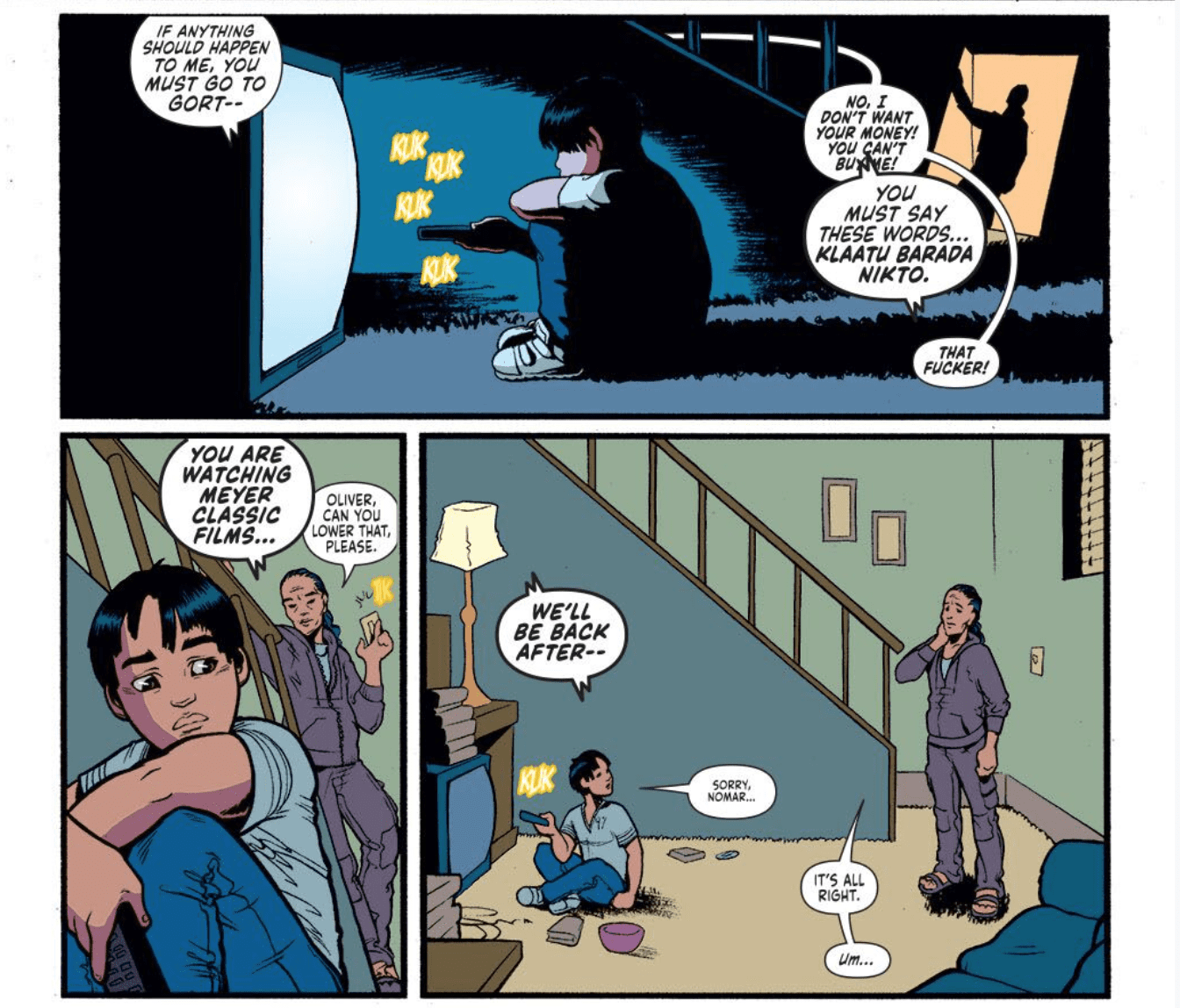
It’d be too easy to have Oliver come from a perfect life at home; instead, Rahal presents the reader with a child who’s sandwiched between two newly divorced, argumentative parents. In the first scene, Oliver hides and watches TV while parents loudly argue on the phone. Here, the most powerful detail is also one of the most subtle choices; as Oliver flips through the channels and his parents keep fighting, he rapidly increases the volume of the TV to drown them out. Rather than saying anything, crying or running away, Oliver simply sits there and tries to drown out the drama and lose himself in the TV. The entire art team works together to maximize the impact of the moment.
The subtle artistic choices in this scene maximize its impact.
First, Meath draws Oliver sitting in the dark, with the TV acting as the only source of light in the room and Englert complements this contrast by practically drowning Oliver in the darkness. Finally, Esposito’s lettering acts as the cherry on top, as the sound of Oliver clicking the remote, paired with the increasing size of the speech bubbles for the TV and the parents’ argument, makes it clear that the boy is desperately trying to ignore the yelling. Each component of the art builds off another one and, altogether, it shows the successful level of collaboration that’s unique to comic books.
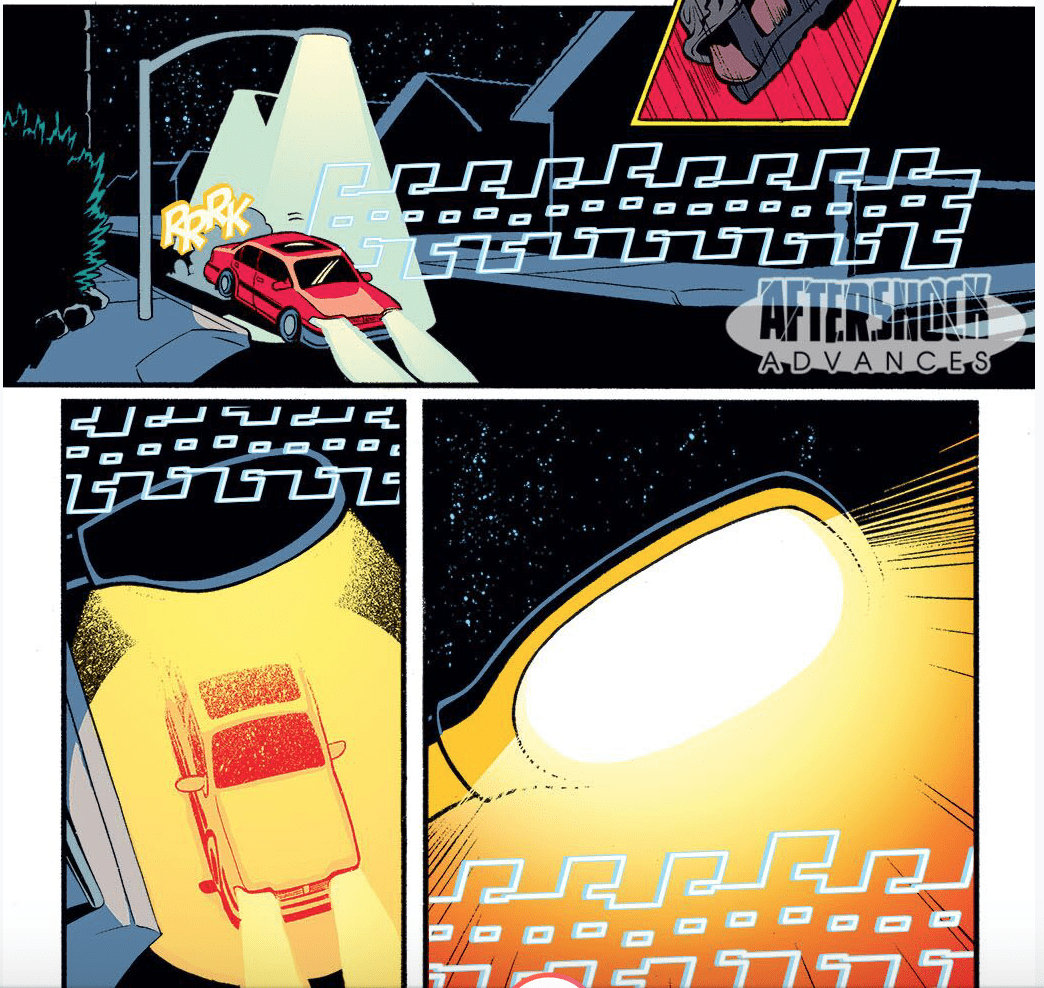
Of course, Midnight Vista #1 is also an alien abduction story and, goodness gracious, the whole team nails the tone of this genre. From the sight of Oliver getting beamed up to the alien spaceship to the jarring reveal of the aliens, a sense of extraterrestrial dread fills the issue. Meath’s aliens are based on the typical stereotype with freakishly large eyes and a slitted nose placed on a similarly oversized head. But, though the creatures’ appearance isn’t a new sight, both the story and the art team still make them grotesque and creepy.
From the start, Midnight Vista #1 creates a dreadful mood.
The first time the reader sees the aliens, they’re dissecting Oliver; they’re holding the boy’s intestines in their hands. The creatures coldly tell Oliver to remain calm and one of the aliens mind-controls the boy as they shoot something into his nose. Plus, when the aliens, posing as humans, ask a police officer for help in their quest to find Oliver, one of the creatures literally says, “Small talk, small talk, small talk.” The aliens are masquerading as humans and the combination of their stilted dialogue and their deformed disguises, the charade is unsettling.
Though Midnight Vista can’t be completely evaluated because the story just began, the first issue successfully draws the reader in. Rahal raises enough questions that makes the next installment mandatory reading for hooked readers.
What did you think of Midnight Vista #1? Where do you hope to see the story go from here?
Taking a turn from intrigue into supernatural horror, the final issue of Descendent from AfterShock Comics is released this week. Tying up loose ends and bringing character arcs to a close, Stephanie Phillips has a difficult job on her hands holding everything together.
However, with the majority of the secrets already revealed, the stage is set for a disturbing confrontation. In order to save lives, David and his fellow conspiracy hunters must face the enemy head on but none of them are prepared for what awaits them.
Descendent #5 Credit: AfterShock Comics
Written In Fire
In order to set up the final piece of the puzzle, Phillips starts this issue off with another flash back. This time to Massachusetts 1692 and the start of it all. This sequence cleverly sets up both the villain and the motives behind everything that has happened in previous issues.
The decision to take the narrative away from the murky realms of the ‘uncertainty in the supernatural’ that kept the X-Files going for 11 seasons, allows Phillips to end the series on an exciting high note. The shift from F.B.I drama to almost The Wicker Man standards of horror provides the narrative with a shocking twist but also a speedy conclusion to many of the story threads.
The central characters are forced by the confrontation to face various aspects of their personalities, with varying degrees of satisfaction. The conclusion to David’s character arc is especially interesting. He has been a man obsessed from the very beginning but has never had to face his obsession. Phillips walks the character into the very thing he has been searching for his entire life but how do you deal with something like that? David has moments of weakness and his fear and trepidation affects his actions.
For the final issue of a series, Descendent has an ending that is fitting and satisfying for the reader. The journey to this point, and through this issue, has been a roller-coaster of a ride for the characters and the readers alike. Police procedural, family drama, and supernatural horror have all played their part with Phillips blending each part of the story together wonderfully. There has been a strong narrative thread through all five issues, feeding the characterisation and the drama.
Descendent #5 Credit: AfterShock Comics
Drawn From Blood
In earlier issues of Descendent Evgeniy Bornyakov demonstrated an aptitude for bringing conversations to life through his art work. In this final issue he finally gets a handle on the action scenes. With the characters performing much more physical acts in this issue, Bornyakov has needed to pack the panels with more dynamism. Altering the shape of the panels has helped greatly in producing the fast paced motion required. Bornyakov has focused on the characters and their placement within a panel, favouring an almost empty background for most of the action.
In turn, Lauren Affe has picked up establishing the scene with her colors. The twilight hours are pictured beautifully with simple background lighting and the choking atmosphere created from a burning pyre dominates the panels and pages as the fight escalates. The increase in tension is reflected by the growing clouds of grey/brown smoke that begins to take over the page.
Affe’s lighting is especially effective on the characters during the final confrontation sequence in this issue. She highlights the characters faces, picking out their expressions and relaying emotional states which are instantly recognisable for the reader. As a consequence, the emotional journey of the characters becomes easier to follow.
The emotional state of the characters is also picked up through Troy Peteri’s lettering. The subtle changing of font size within speech balloons adds nuances to the speech. So does the visual depiction of the speech balloon’s themselves. Throughout, Peteri gives the villain a slightly different boarder to her speech balloons, this highlight’s not only her speech but also the speech in the panels surrounding her. The reader can instantly see the that there is a difference between them; a constant reminder of the villain’s origins.
Descendent #5 Credit: AfterShock Comics
Descendent Conclusion
Over the five issues, Descendent has been an interesting read with highs and lows in both script and art. The ending however is a combination of the best from both. The plot is well paced with a decent combination of humour and horror. The art work is more consistent throughout the issue and captures the tone of the script on every page.
In some respects, the ending has come too quickly with the switch from investigative drama to supernatural horror being a bit sudden. The build-up has plenty of scope for a much longer series with the twist coming at a much later date. However, this final issue is a triumphant and a pleasure to read. It has satisfying conclusions to a number of the character and plot arc’s leaving the reader with a sense that this chapter is complete.
Hopefully this team will get the chance to work together on future comics because, by the end, each aspect of the comic was working fluidly together to tell the story.
Are you interested in journalism with a bite, if so then you need to check out Dynamite’s newest ongoing Vampirella Red Sonja #1 hitting your local comic book store on September 4, featuring the classic characters of Vampirella and Red Sonja, as they team up to figure out why the bikini-clad warrior is in the wrong timeline.
Vampirella Red Sonja #1 begins in the year 1969, the same year Vampirella herself debuted in the comics world. In this canon, she becomes a journalist to investigate supernatural mysteries. The storyline is a perfect fit for Vampirella, as she is on the search for answers for a slew of murders on Dyatlov Pass in Russia. While attempting to solve the mystery, Vampirella runs into Red Sonja. That’s about as spoiler-free as you’ll get!
Jordie Bellaire puts her spin on Vampirella, giving her a new occupation as this new story beat is what drives the plot well.
Love this Variant Cover by Leonardo Romero!
Before we learn of her new job letterer Becca Carey hints at it amazingly with Vampirella’s narration boxes. Instead of having her usual red box with the black bat, Carey has it as a plain black box, but with a record, play, pause and stop button. At first, this may seem confusing, but once you see her using a recorder, it makes sense and comes off quite smart.
Another unique visual in Vampirella Red Sonja #1 is Drew Moss’ paneling. Throughout Vampirella Red Sonja #1 Moss uses 3-5 rectangle panels for the pages, thus keeping the paneling simple. While this happens for multiple pages, Moss adds in a few different square panels throughout and two full-page layouts. This may sound simple, but it seems that’s what the team of creators was aiming for; plain and simple to help draw in readers that are new to comics. With how much Vampirella Red Sonja #1 relies on characters talking and dialogue bubbles this works best.
The colors by Rebecca Nalty are bright and lively throughout with backgrounds and characters having a palette that catches the eyes, but at times these make the characters faces seem flat. These moments of flat faces look like color-work from the early 2000s.
Another beautiful Variant Cover, this time by Babs Tarr!
A Clash of Titans (Vampirella and Red Sonja of Course) (Conclusion)
Vampirella Red Sonja #1 works best as an introduction to the new universe in a way that any long-term fan or newcomer would appreciate.
Memorable Quote: “Sometimes the literal irony of humans really gets to me.” – Vampirella
You and me both!
Dear Blood-Sucking Readers
If this is your first time reading either of these characters, let us know what you thought! Or if you’re a long-time fan, how does it compare to others? No matter which one you are, make sure to stop by your local comic shop and pick it up!
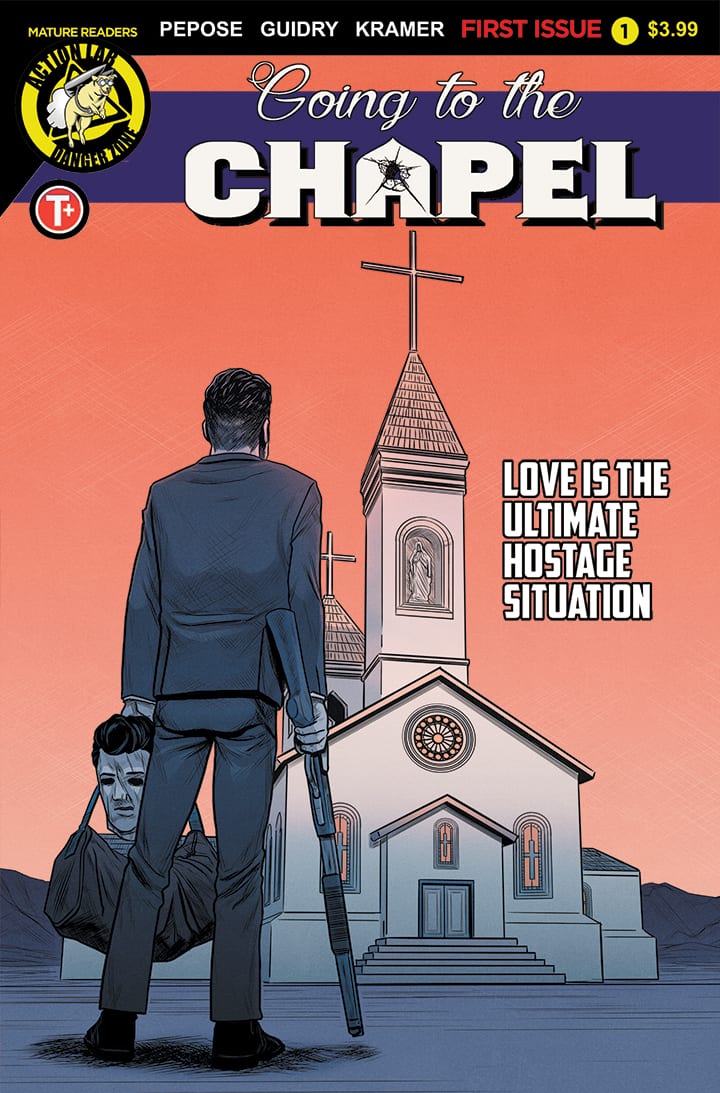
Going to the Chapel #1 is out this week from Action Lab: Danger Zone, and it gives a whole new meaning to “wedding crashing.”
Emily Anderson is having second thoughts about getting married, but her troubles quickly worsen when her wedding is hijacked by a gang of Elvis-themed bank robbers. With her dysfunctional family on one side and the thieves on the other, Emily has to try and take control of her own hostage situation and maybe get out of walking down the aisle at the same time. The series is by writer David Pepose (Spencer & Locke) and artist Gavin Guidry (The Death Defying), with colors by Liz Kramer and lettering by Ariana Maher.
We actually got the chance to speak with Pepose a few months back about Chapel if you’re interested in how the series came together. It’s the author’s take on the rom-com, a genre he feels gets a bad rap. As he said in a different interview, “I think rom-coms are just as flexible of a genre as crime or science fiction. And so I wanted to write something that I thought I would really like to read, that both men and women would enjoy and have a lot of fun reading.”
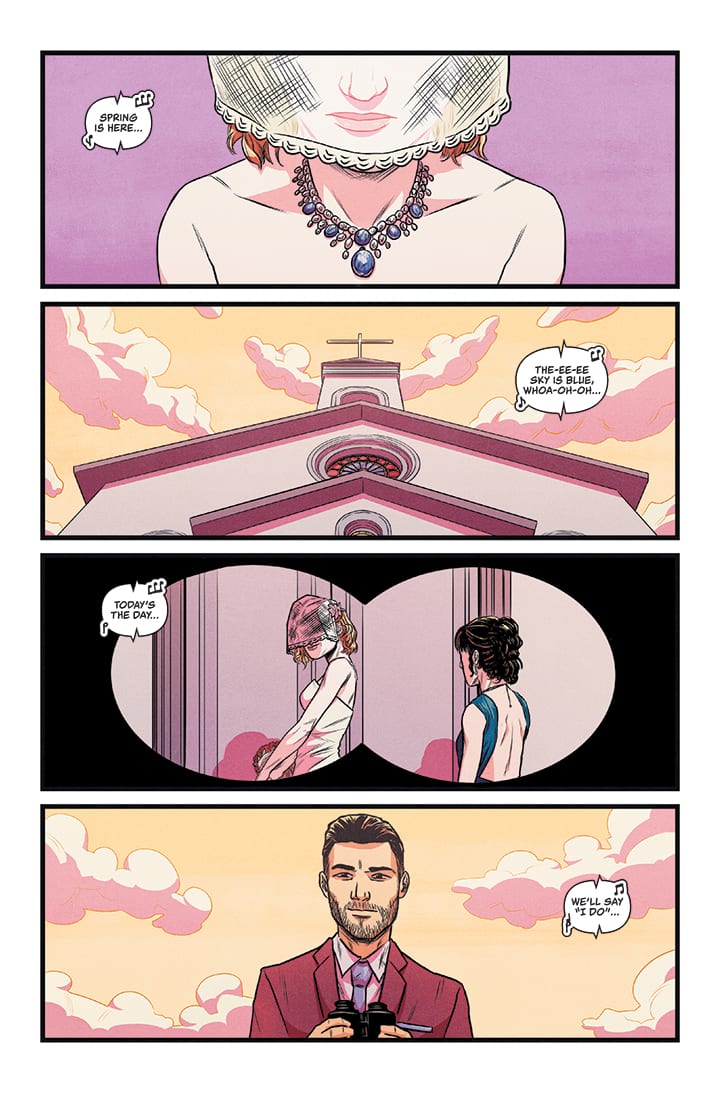
The comic reads a lot like a Tarantino story, with its unique and eccentric characters and neo-western setting. Going to the Chapel takes place almost exclusively in the titular church, and the single setting gives the story a sense of claustrophobia and heightened tension. It feels very cinematic, especially with the way Guidry frames the shots. Most of these panels could easily be torn directly from page to screen (if a film were to ever happen).
This hostage situation isn’t all grim and gritty, though. Chapel is actually a pretty lighthearted and fun comic, which you can feel between Guidry’s cartoony style (not in the “Sunday Funnies” kind of way, but just simple, not heavily-detailed linework), Maher’s big sound effects, and Kramer’s pastel color palette. There are a lot of pinks, purples, and yellows throughout this comic to drive home the romance element, which is interesting when coupled with the action happening on the page. This juxtaposition tickles your brain and draws you further into the story.
Pepose infuses Going to the Chapel with plenty of absurd comedy as well. There’s absurdity inherent to the plot, sure, but the real humor comes from the family dysfunction element. The Andersons make the Bluth family look tame by comparison and they’ll have you laughing out loud, especially Grandma Harriet (stick around to the end of this review to get some of grandma’s advice firsthand in an extended preview).
Through all the crime and craziness, though, this is a comic with lots of heart. Don’t let the Elvis masks fool you. It ultimately is a love story. It’s about relationships, family, happiness, and way more. Just like he did with Spencer & Locke, Pepose is a master at lowering your guard with some zany antics and then smacking you upside the head with some “feels.”
And then the team drops a few bombs that adds a whole new element to this series: mystery. You’ll turn the last page and your brain will start turning with all sorts of theories that won’t go away until you get your hands on issue two. The key to comics – to any kind of entertainment, really – is “never be boring.” Always keep your audience engaged and wanting more. This creative team understands that.
Going to the Chapel has already drawn comparisons to Die Hard, Runaway Bride, and Arrested Development. Don’t you think you owe it to yourself to get in on such a unique and fun reading experience?
Are you looking forward to Going to the Chapel? Did you already get your hands on a copy at a convention? Sound off in the comments with your thoughts!
Are you tired of interstellar travel that somehow always starts a war with aliens? Or any of the weirdly obscure adventures the Fantastic Four go on? Well, Fantastic Four 4 Yancy Street is right up your street. Out now at your local comic shop.
Fantastic Four 4 Yancy Street is more of a one-shot than the start of anything; or as Marvel says, “the first in a series of regular essential release.” Taking place in between the ongoing (reviews here), the Fantastic Four now reside on one of the most famous streets in Marvel history—Yancy Street. This street means a lot to the Fantastic Four, but the most to Ben Grimm (The Thing), who this story primarily revolves around.
Retelling of Ben Grimm’s childhood, with art by Greg Smallwood
Ben’s love for Yancy Street runs deep, he has fond memories of his older brother, until said brothers death. Writer Gerry Duggan and artist Greg Smallwood use three pages to retell Ben’s troubled childhood. They use a newspaper print look and simplistic art style/paneling. The three pages even have the small colored box on the top of its page. This art is beautiful and works best for the flashback, with Smallwood then changing his style to reflect the present. This style change comes with the popularly used white paper, while Smallwood opens his panels to breath more.
The present by Greg Smallwood
With his troubled past now retold, Ben stumbles upon graffiti on the youth center dedicated to his older brothers memory. Wanting to “clobber” the urban artist Ben makes his way home asking Reed for help on finding the suspect. The moment inside the Fantastic Four’s house Smallwood starts to open his panels more until he goes full Kirby structures. When Reed enters the frame, Smallwood graces the reader with a full-page filled with devices Kirby would have loved.
As the pace quickens, Smallwood returns to the simple square panels, now with six per page helping Duggan’s story keep the flow. Then, all the sudden, Mark Bagley takes over. For the battle between Ben and The Terrible Trio, Bagley makes the panels huge. As great as Bagley’s art is, it was such a vast departure from Smallwood’s that its jarring, in a negative way.
Mark Bagley starts the action!
Then, before you know it, Luciano Vecchio and Pere Pérez are the artists on the book. This shift in style doesn’t hit as hard as the previous since Vecchio and Pérez’s style art similar to Bagley, but the change still feels awkward.
A great call back to the artistic history of the Fantastic Four is the way letterer VC Joe Caramagna plays around with the font size and colors. Anytime a character yells Caramagna makes sure you know with boisterous lettering that screams off the page. The conversations are very stylized. This old-school technique is refreshing and fits perfectly.
The Fantastic Four On Yancy Street (Conclusion)
Fantastic Four 4 Yancy Street is a fun Ben Grimm story that keeps the Fantastic Four grounded. Yancy Street acts as a standalone story that those not reading any current Fantastic Four stories can enjoy.
The art my take a hit each time it changes artist, but for the most part, it works quite well. 4 Yancy Street would’ve benefited by staying with just one artist. Smallwood’s art is the highlight of the issue.
Memorable Quote: “I don’t smash–I CLOBBER!” – The Thing
Yeah, because then your catchphrase would be, “It’s smashin’ time!” Which sounds weird and inappropriate!
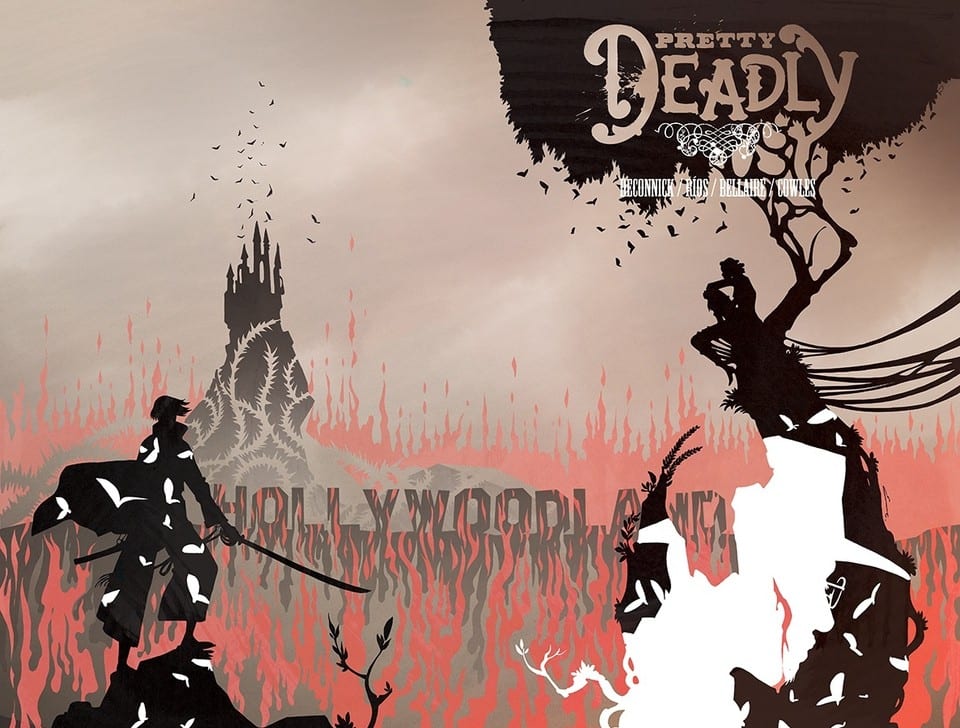
Bones Bunny and Butterfly return to regale you with more Pretty Deadly tales from the creative minds of Kelly Sue DeConnick, Emma Rios, Jordie Bellaire and Clayton Cowles. Released by Image Comics on 4 September, The Rat is the third volume in the Pretty Deadly series and moves the action to 1930’s Hollywoodland.
Pretty Deadly The Rat #1 Credit: Image Comics
Pretty Tales
As the rain falls hard upon Hollywoodland, the body of Clara Fields is found in the mountains. The police trace the next of kin, her uncle Frank: The Conjure-Man, and so begins a murder mystery attended to by Death herself.
This new volume of Pretty Deadly has the same framing elements as the previous two arcs. The mystical characters, Bones Bunny and Butterfly, lead the reader back into DeConnick’s magical-realist world. The opening pages bleed in to the main story, setting the tone and preparing the reader for the adventure that is to follow.
Each volume of Pretty Deadly is drawn from a particular genre, the first was a western and the second was a war comic. This third volume comes out of the expressionist movies of the 1920’s and the influence that they had on American noir movies of later decades.
DeConnick’s narrative pacing follows the structure of an early crime movie; the body, the investigation, and the need for revenge. She uses the tragedy of Clara Fields, who the reader knows nothing about at the start, to introduce the other characters into the plot. The grief and anger that Frank feels is evident in his speech but also his desperate actions. These actions lead the reader through the darkness of Hollywoodland as DeConnick slowly reveals Clara’s character via the debris of her life left behind.
There are stories within stories with linking themes weaving through them all. It is a highly complex and poetic tale unfolding in front of the reader. DeConnick gives the story a theatrical essence from the opening and this is followed up throughout. The reader sits and watches this magical tale play out, lost in time with these characters.
Pretty Deadly The Rat #1 Credit: Image Comics
Deadly Art
Emma Rios’ art is perfect for this type of story. She creates magical images even out of the most mundane or grotesque things. Her fluid drawing style and highly detailed images produce a total immersive experience for the reader. It is impossible not to fall into this world completely. The beauty and horror are mixed together with no visible joins so that it becomes difficult to separate the two. This is the visual equivalent of Frankenstein, a gothic/romantic horror.
The influence of 1920’s movies is evident on each page. The abstract nature of some of the panel layouts and the metaphorical use of imagery creates a magical world similar to a Fritz Lang movie. Rios manipulates the standard notions of comic book layouts, breaking the rules as often as she can to produce extraordinary visuals. Gutters break into the panels helping to establish mood; collections of images are stacked to produce complex representations of characters; The very boarders of the panels shatter to break the wall between worlds.
All of this outstanding art work is colored beautifully by Jordie Bellaire, proving why she is one of the best in the business. The depression of the era flows through the muted colors surrounding Frank as he investigates his niece’s death. As Clara’s life is revealed to the reader, Bellaire floods the pages with brightness and life. The dreams and stories take on a life of their own, so much larger than the reality of Franks existence. Scenes of passion are expressed with red washes, while greed and obsession have their own hues.
Leading the reader through this dreamland is Clayton Cowles lettering, holding it all together. The change in fonts and caption box design signpost to the reader which part of the many realities the action is taking place in.
The narrative flow is controlled by the sweeping lines of the artwork and the smart placement of the lettering. The character’s emotional states are also displayed in the same way. Frank’s arrogance, grief and finally anger is there in his speech, the words, the text and the balloons all working together to create an emotional state. Broken speech balloons, balloons that are small and cramped with only a few words, and large balloons with heavy boarders and bold text, give the comic it’s drama and creates the character’s stage presence.
Pretty Deadly The Rat #1 Credit: Image Comics
Conclusion
Pretty Deadly is a spectacular read. It’s like sitting in a theatre and disappearing into a magical, dramatic world. The narrative flows thanks to clever writing and beautiful artwork that breaks conventional comic book rules. Everything from the opening page to the stunning final moments of this issue are mind blowing. It is the best entry so far in this planned five volume collection.
If you are a fan of The SandmanUniverse or classic experimental Hollywood movies, then Pretty Deadly is for you. It is magical realism realised in the most exemplary fashion. If Pretty Deadly doesn’t stimulate your imagination, then nothing will.
The Plot #1 is out this September from Vault Comics, and it’s a chilling horror story wrapped up in a compelling family drama, perfect for fans of Locke & Key and The Haunting of Hill House.
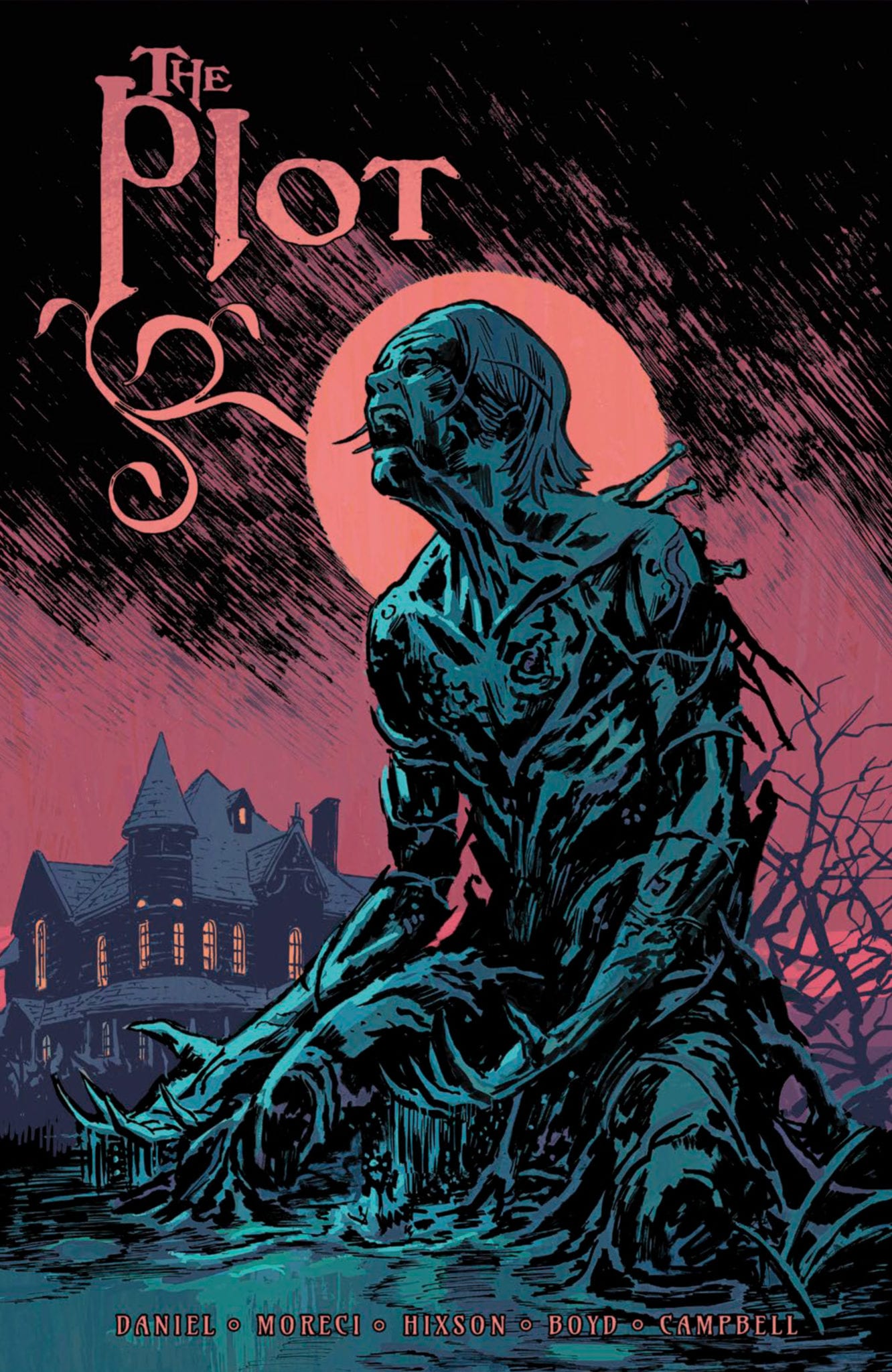
When his estranged brother and sister-in-law are murdered, Chase Blaine becomes guardian to his niece McKenzie and nephew Zach. The three move back to the 200-year-old Blaine family house in Cape Augusta, Maine, but something spooky and supernatural awaits them there. The series is by writers Michael Moreci and Tim Daniel, and artist Joshua Hixson, with colors by Jordan Boyd and letters by Jim Campbell. The Plot will be the inaugural title for Nightfall, Vault’s new annual horror imprint.
Yes, this is another “dysfunctional family moves into an old, haunted mansion in the secluded corners of Maine” story, but there’s a reason this plot structure works so well. It allows creators to tell deep, complex, and – most importantly – uniquely personal stories. The Plot may share some key themes with the aforementioned Lock & Key and Hill House, but still it doesn’t feel like anything you’ve read before.
Like most successful horror stories, this is a very character-driven narrative. Daniel and Moreci understand that in order for the scares to be effective, the stakes have to feel real, and for the stakes to feel real, you have to be connected to the players. The Plot is ultimately a story about family, and the Blaine family feels like a family you know. It may even be your family. Their struggles and their conflicts are understandable. They have secrets in their past that they try to bury, things they’re ashamed of. You relate to them as a reader, because whose family doesn’t have secrets, and so when those secrets start crawling out of the woodwork, the dread hits home hard.
If you read Shanghai Red, you know that Josh Hixson is a star on the rise. His art is grim and atmospheric, especially when coupled with Boyd’s soft and muted color palette. This team is a match made in horror heaven. They capture small moments perfectly, like a hand reaching out to pick up the phone and pulling back at the last second. You can feel the tension here; horror lives in these moments. The Blaine family home comes alive through the art. If you ever heard the expression “the setting is a character in itself” and questioned what that means, The Plot is your answer. Every hallway oozes impending doom. Every shadow harbors a devastating secret. Reading this comic is a claustrophobic experience; you feel trapped within this house alongside these characters, unable to escape the terrors that lie within.
And that’s ultimately what The Plot is all about, the things we can’t escape. Our pasts. Our families. The monsters that live in the bog behind our ancestral family homes. It’s about having to face our demons, both literal and figurative, which is about the scariest thing any of us can do. Again, that’s what makes this comic so effective. It’s taking all of those abstract things we’re terrified of in real life and bringing them to life.
Jim Campbell is a letterer at the top of his game here. This is a first issue, so there’s a decent amount of exposition (no worries, Moreci and Daniel never make it feel heavy-handed), but the way Campbell letters the dialogue, you’re able to navigate the monologues and conversations with ease. This comic flies by, which is shocking when you consider all that happens. That’s largely thanks to Campbell’s handiwork. And then there are the horrifying sound effects, which Campbell kindly acknowledged were done by Hixson. Every “KRAK” is bone chilling; every “WHUD” hits with the impact of a brick to the head. Even everyday sounds like a phone ringing or a dog barking seem scarier here.
The Plot is comics’ next great horror masterpiece. It’s clearly a very personal project for all of the creators; you can feel the passion and care put into every panel. You have until this Monday (September 2) to order it at your local comic shop, so get on it!
Just sit right back and you’ll hear a tale… Well, it’s a tale of Batman, some billionaires, an assassin, and a couple of long-lost castaways on a South Pacific island in Detective Comics #1010, out this week from DC Comics.
Bruce is separated from the rest of the survivors after their plane crashes on a seemingly-deserted island. He’s rescued by some unexpected residents, but the rest of the party remains under Deadshot’s command. For now, it’s up to Batman to try and rescue the captives, even if help is still thousands of miles away.
The Writing
Detective Comics #1010 delves into many of the tropes of “stranded on an island” stories. We have man-eating animals, surprising locals, perseverance against adversity, man’s inhumanity to man…it’s all here. The tone is part Lost¸ part Gilligan’s Island, a fact that Deadshot himself lampshades at one point. Writer Peter J. Tomasi is able to take those clichés and do something interesting with them, though.
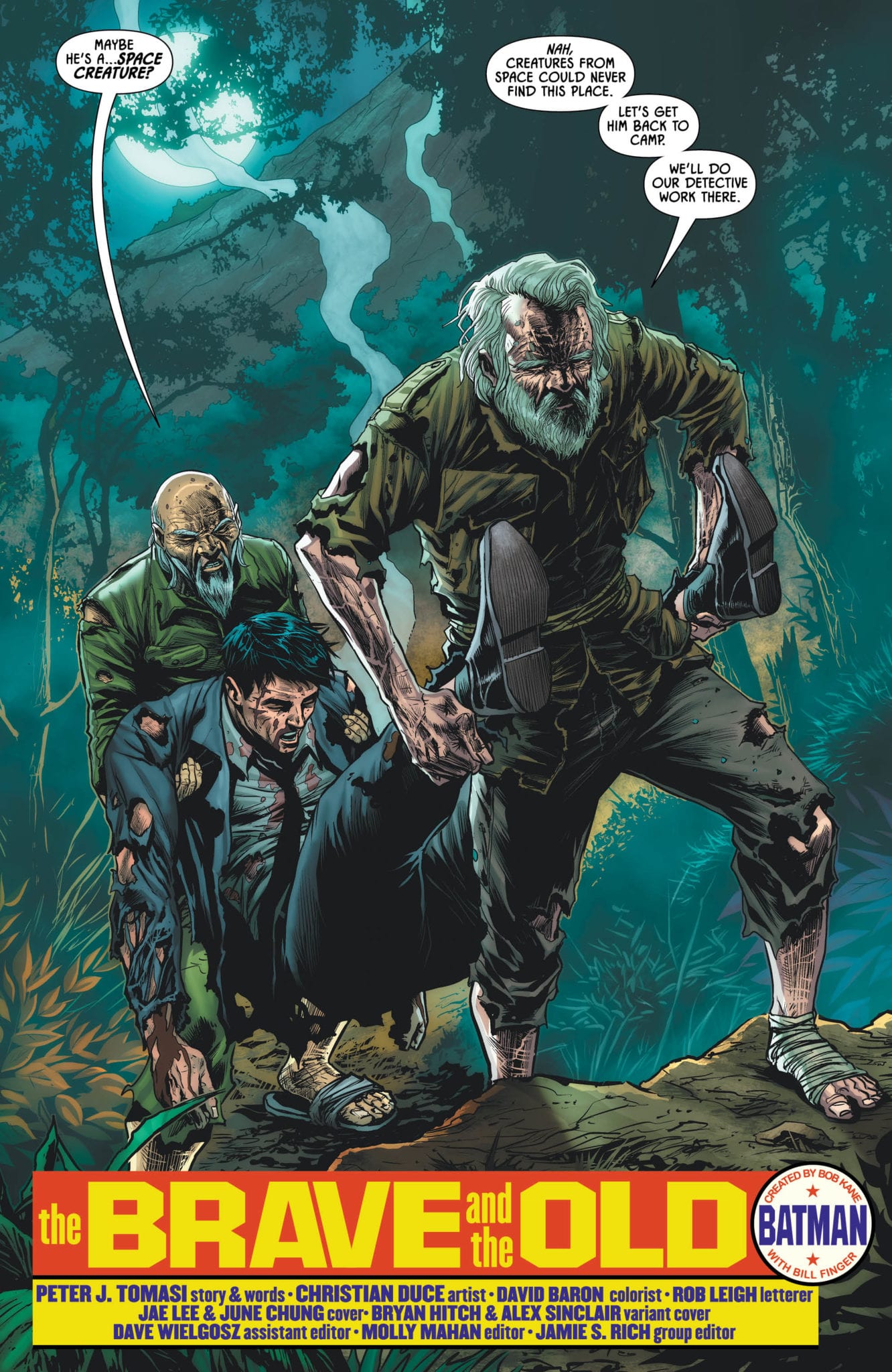
Bruce spends a large chunk of the issue swapping stories with two castaways stranded on the island since World War II. This twist is likely inspired by real-life stories of soldiers hiding out in the jungle for decades, unaware of the war’s end. The men, Clarence and Hiroshi, have an interesting and charming tale to tell, and will presumably return in successive issues. Former enemies, they eventually learned to trust one another and survive. This theme of enemies-turned-allies seems to echo the issue’s official synopsis on DC’s website, despite the narrative not really progressing to that point in the story just yet.
Most of the book’s action is contained within the last few pages. Detective Comics #1010 builds to a suspenseful ending, hooking the reader and ensuring we come back for the next issue.
The book lays a mystery regarding who paid Deadshot to kidnap the people. We’re yet unsure of how this plays into a larger narrative, but the character’s statements suggest there’s much more at play than just what we see here. It’s quality writing all things considered.
The Artwork
Artist Christian Duce is back for Detective Comics #1010. He brings many of the same strengths to the table we saw in our last issue, blending expressive and exaggerated elements alongside more grounded images.
Duce generally sticks to a very meat-and-potatoes approach here. No elements of the work leap out as exceptional, but on the flipside, everything is firmly respectable. There’s no shame in that; as a visual storyteller, one doesn’t need to mystify the reader on each page. The work hits the narrative beats well, forming a cohesive final product.
David Baron provides colors for Detective Comics #1010, bringing a vibrant and varied palette to the table. From the lush, bluish greens of the jungle to the fiery reds and yellows of Deadshot’s blaster, Baron meshes nicely with his fellow artists on a stylistic level. He even embraces a sepia tone at one point, which was a nice stylistic touch given the subject at hand.
Final Thoughts
Detective Comics #1010 is a great chapter in Tomasi’s ongoing story. It’s Batman by way of a WWII-era Howling Commandos comic, so if that catches your attention, you’ll find plenty to like here.




 An idea that has been suggested by some fans is that mutants have always existed in the MCU but Charles Xavier has wiped the world’s collective memory about them. To me, this is one of the worst of ideas to introduce mutants into the MCU and should only be used as a last resort. But let’s humor the idea because any story idea could work with imagination and good writing.
 In the Ultimate Comics series it was revealed that mutants were actually created through genetic experimentation. In the comics Nick Fury Sr. and James Howlett were arrested for looting when on tour during the Second World War and experimented on to recreate the Supersoldier formula. Howlett ended up becoming the first mutant, getting his healing factor and adamantium claws, and the experiment ended up causing more mutants to be created. The US and Canadian government covered up their involvement.
 A backdoor way to introduce mutants would be to use one character to appear in a non-X-Men film. One of the most obvious candidates would be Ororo Munroe AKA Storm. Storm has a history with Black Panther: she even marries him in the comic. Black Panther 2 could find a place for her, even if it’s just a cameo or reference to a teenage girl or a woman in Wakanda who can control the weather. This idea could even snowball to other references in other films like reports of a Canadian soldier during the Second World War who had rapid healing abilities, or a news story about a teenager with extraordinary powers.
 Another popular suggestion from fans is that The Snap caused the creation of mutants. At the end of
  Marvel is clearly building up the idea of the multiverse. In Avengers: Endgame The Ancient One stated that if a past event changes then it would create a new timeline and Mysterio said he was from another alternative Earth. One of the films in Phrase Four is titled Doctor Strange in the Multiverse of Madness. Because of this, the multiverse could be used as a way for the X-Men and mutants as a whole coming into the MCU. They could either be in their own universe and through a bit of inner-dimensional travel are about to travel to the MCU or seek refuge in the MCU.
 In the comics, Magneto was the father of Scarlett Witch and Quicksilver. This wasn’t the case in the MCU because the franchise didn’t have the movie rights for Magneto and other mutants. This has obviously changed now Disney has bought Fox.
 Within the Marvel Cinematic Universe, there have been some examples of amazing technology like helicarriers, nanobots and robotic suits. There are also greater threats in the form of aliens and beings with superpowers. In this scenario, the US government or an alliance of nations may look to take their security in their own hands – especially after the loss of The Avengers. A way they would do that is to use Bolivar Trask to lead the Sentinel Initiative which would fend off any threat.
 The “Avengers vs. X-Men” was a huge crossover event back in 2012. In that storyline, the Avengers and X-Men go to war because the X-Men were protecting Jean Grey/The Phoenix while the Avengers see her as a threat that is too great for the world. As evident in that description that storyline sounds similar to Batman vs. Superman: Dawn of Justice and MCU would be foolish to use the Phoenix in their first film, so the film should just use the title and some basic ideas like what happened with Avengers: Age of Ultron and Captain America: Civil War.
 One of the biggest impacts in Marvel’s “House of M” storyline was mutants were nearly eradicated and only 300 remained. The “Messiah Complex” was a major storyline published from October 2007 to January 2008. In that storyline, the first mutant child is born since the event, and the various mutant factions set out to be first to find him/her.
 One of the most popular suggestions on how to introduce the X-Men into the MCU is to do a reverse “House of M” story. In Brian Michael Bendis’ “House of M,” Scarlett Witch uses her reality-warping powers to create a perfect timeline for mutants. When Scarlett Witch puts the world back to normal, she utters the words ‘No more mutants,’ and with one fell swoop, she depowered most of the mutants in the 616-universe. This storyline aimed to reduce the number of mutants in the comics because they got so big.
 One of the most organic ways to introduce mutants into the MCU is simply the mutant population is small but growing. It would prevent Marvel from needing to have a major retcon or event to explain the sudden appearance of mutants.