One-hundred-plus years of filmmaking provides a long, rich, and deep history to look back on. Retro reviews and analysis of old films are practically necessary full-time specialties. Month after month, films release, vying to make as much money and grab as much attention as possible. Some rise, some fall, but regardless of financial success, the lasting effect of a film in popular culture is unpredictable.
So, where does that leave past box office champs? Let’s take a look back ten, twenty, and thirty years ago at the biggest movies released in April.
1990 • Ernest Goes To Jail • 25 million
March 1990 was full of hits, but April of that year was a bizarre cocktail of mostly forgotten films. Ernest Goes To Jail is the fourth film (of nine!) in the Ernest series that sends the titular character to a state penitentiary. The Ernest films were quite a thing back in the late 80s and early 90s. The role of Ernest P. Worrell was played by Jim Varney, and the entire franchise (a TV series included) spawned from a series of commercials in the early 80s.
Following Ernest is The First Power starring Lou Diamond Philips. The neo-noir horror film isn’t great but features an interesting concept that’s maybe due for a re-imagining. In third is a film featuring Joaquin Phoenix and Keannu Reeves called I Love You To Death. The Guardian, directed by William Friedkin (The Exorcist), made its way into fourth after a troubled production. Right behind it was a science fiction comedy called Spaced Invaders about a group of incompetent Martians trying to take over Earth.
2000 • U-571 • 77 million
April 1990 wasn’t pretty, and ten years later, things aren’t much more interesting in the month. The winner in 2000 was submarine thriller U-571 starring Matthew McConaughey and featuring rocker Jon Bon Jovi and Bill Paxton. Things weren’t alright, alright, alright, though as the film received backlash from the British government for distorting history too far.
Another military drama, Rules of Engagement, trailed U-571 by 16 million, taking in 61 million at the domestic box office. The film starred Tommy Lee Jones and Samuel L. Jackson and was directed by William Friedkin. Horror film Frequency, a science fiction thriller starring Dennis Quaid came in third. Comedy-drama 28 Days with Sandra Bullock took fourth followed closely by Edward Norton’s directorial debut, the romantic-comedy Keeping the Faith.
2010 • Clash Of The Titans • 163 million
The 2000s have certainly seen a monumental shift in the film industry. The burgeoning overseas market has ramped up the numbers, but also the way return on investment is considered. Clash of the Titans took in nearly 500 million worldwide despite mostly negative reviews against a 125 million dollar production budget and many million more spent on advertising. The film earned two Golden Raspberry nominations too.
The champ from just ten years prior would fall into a distant third in 2010. The second-place winner, Date Night starring Steve Carell and Tina Fey, made nearly 100 million domestically. The Nightmare on Elm Street remake came in third closely followed by Tyler Perry’s Why Did I Get Married Too? In last place is probably the best-known film of the bunch, Kick-Ass, which spawned a sequel.
April 2020
Well, this is a tough one to write. Due to COVID-19, theaters across the world are shut down for safety. However, had things not gone globally haywire, this April would’ve seen Daniel Craig’s last go-around as James Bond in No Time To Die go head-to-head against Marvel’s (sort of?) The New Mutants. As of now, No Time To Die is pushed back to November, and that’s a best-case scenario kinda thing. The New Mutants has been in release limbo for a long time now, and so this is just more of the same for the ill-fated film.
My prediction …
No predictions. Things are weird. The most important thing right now is that everyone stays safe and healthy. Watch movies at home for now.
BATMAN: THE DARK KNIGHT RETURNS #1, published in 1986 by DC Comics, is considered part of one of the greatest comic book masterpieces of all time. Written by Frank Miller, and illustrated by Miller, Klaus Janson, Lynn Varley, and John Costanza, this history-making story showed the wider public that superhero comics could be a medium for adult themed stories. Fans of the Dark Knight will find this tale darker than many modern Batman comics, following Bruce Wayne after putting up the cowl ten years prior.
Story
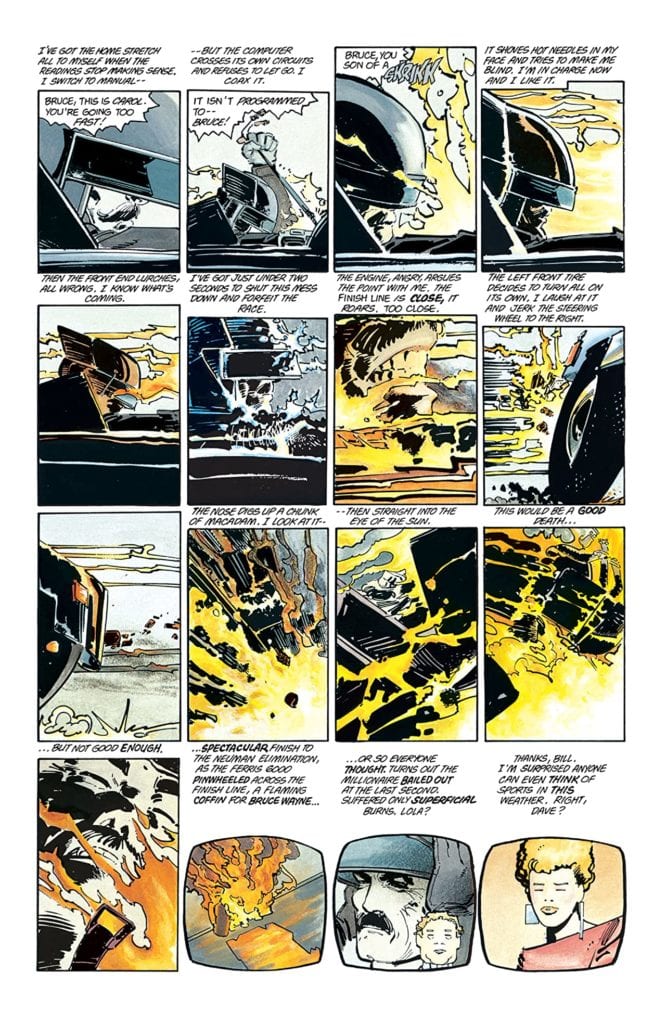
The inaugural issue opens with an unknown middle-aged driver speeding down a track. A group of similar race cars flank him on either side, eventually leading to an unexpected crash. The driver, narrowly escaping death, is revealed to be an older Wayne who’s clearly craving any form of excitement in his now “normal” life.
The narrative proceeds to reintroduce readers to Gotham, a city in the midst of Cold War panic and an ever-increasing crime rate. Unsurprisingly, the news reports are full of despair. But one piece of news takes use by surprise: it is the tenth anniversary since the last sighting of “the Batman.”
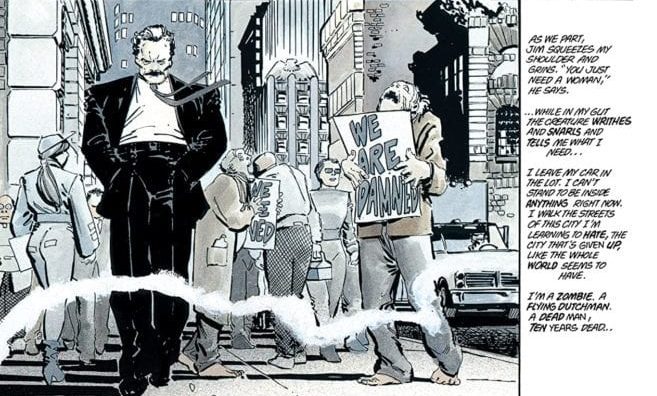
Wayne spends an evening with Jim Gordon who attempts to relive the “old days” to no avail. The Commissioner tries to cheer him up, going to far as to recommend he “find a woman.” But Wayne knows his melancholic feelings stem not from loneliness, but a deep hunger for the war he ended years ago.
This issue sits both in Wayne’s future and his past. Miller’s script portrays a man who is stuck in the aftermath of his war on crime, wishing he could fill his passion once more. Wayne’s inner monologue is a jumbled mass of regrets, fears, and hopes, much like those within ourselves. Miraculously, we are able to find a commonality with this larger-than-life figure.
Readers soon find that the newest threat to plague Gotham may be enough to bring the former superhero out of retirement. And when Two-Face and the Joker plan to reintegrate into society, the Dark Knight finds the stakes to be higher than ever.
Artwork
Miller’s pencils add to the cohesiveness of the comic’s illustrations. Backed by Janson’s ink work, the art embodies a unique style that was rare in Batman comics before this issue’s release. The characters are often depicted with a simplicity that conveys complex emotions. In addition, Lynn Varley’s coloring does a fantastic job of placing the readers’ focus on the action by using brighter colors for the active characters in each scene.
As beautiful as the illustrations are in this book, Costanza’s lettering is what adds the most intrigue. The fonts are interspersed all around the illustrations and panels, but take nothing away from the action. On the contrary, they enhance it. These frame the scenes when needed and seem to join in the scenes as independent acting agents.
Comic Cover
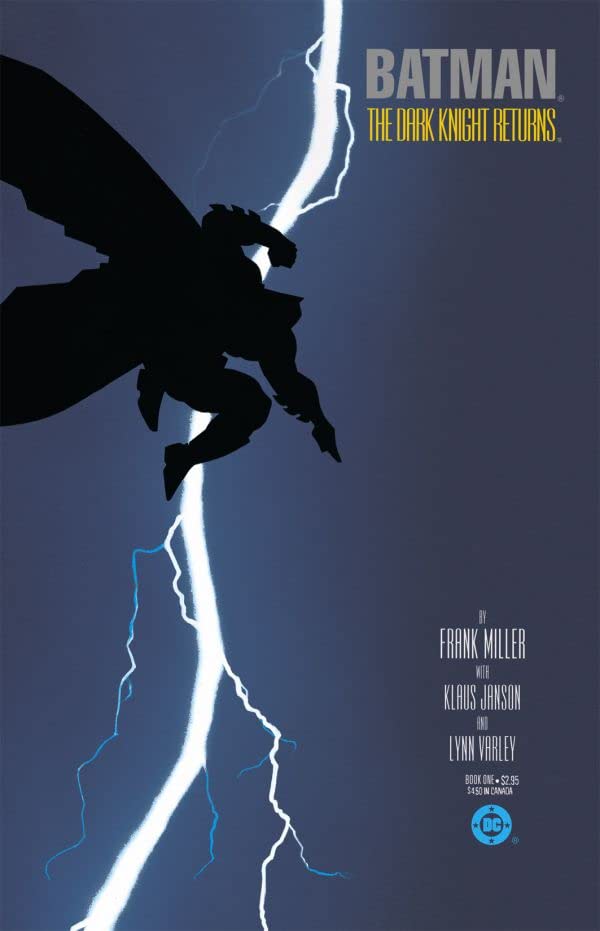
The comic cover, illustrated by Miller, shows the Dark Knight leaping into action with a flash of lighting. This readies readers for the action sure to come.
Conclusion
BATMAN: THE DARK KNIGHT RETURNS #1 launched a new era of comics and is referenced by creators as the standard for many darker stories. We highly recommend picking this up and experiencing the Dark Knight’s reawakening.
What do you like best about this ground-breaking story? Let us know in the comments below!
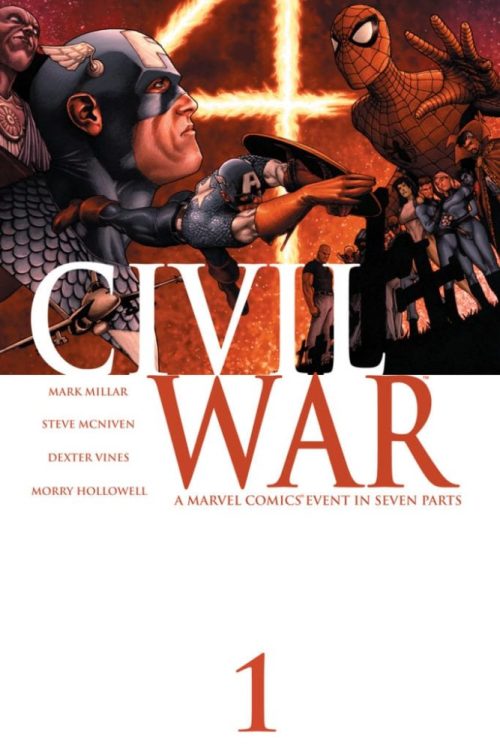
CIVIL WAR #1, a Marvel Comics Event, rocked the comic book world when it was released on May 3rd, 2006. Written by Mark Millar and illustrated by Steve McNiven, the story pits fan favorites heroes Captain America and Iron Man against one another in one of the most topical dichotomies: freedom and security. A line is about to be drawn between heroes and the public alike. Which side are you on?
Story
The story opens up with the New Warriors, a young group of heroes who are seeking fame while crime-fighting. Their latest exploit takes place in Stamford, Connecticut—their plan is to charge into a supervillain hideout. However, the brash team fails to account for the human bomb Nitro, and the elementary school filled with children near door.
Nitro sets off an explosion that kills the hundreds of the students in the blink of an eye. The only things left are dust, ashes, and those who managed to cling to life.
Following this horrific event, readers witness an inevitable fallout between superheroes and the public at large. Many call for the ban of all heroics, while others lobby for governmental restrictions on “capes.” Even the superhero community finds themselves on opposite sides of the issue. Iron Man and many of the top-level heroes believe it’s high time they register so they may be held accountable to the people they serve. Others—street-level heroes like Luke Cage and Daredevil—refuse to consider registering on account of their liberties being violated.
The climax of the issue hits when we’re taken to Captain America as he prepares to give Maria Hill his opinion on the matter. We see the pain the Avenger has undergone while contemplating the issue. It’s clear even the best heroes have doubts about what is “right.” But he soon makes his position clear, and he’ll stop at nothing to uphold his conviction.
Millar’s script is a perfect parallel to events in our own society, both past and present. The public faces choices between freedom and security almost every day. We try to find the perfect balance, but our convictions often place us on polarized sides. And as readers will see, the Marvel heroes fair no better than the divided world we know.
Artwork
McNiven’s penciling, along with McKniven, Dexter Vines, Mark Morales, John Dell, and Tim Townsend’s ink work, captures the true essence of our favorite Marvel heroes. Each character is fully fleshed out in exquisite detail, from Captain America’s boot cuffs to the fused pieces of Iron Man’s suit.
These and the rest of the illustrations are expertly colored by Morry Hollowell, who contrasts the warm colors of the explosion’s aftermath with subdued, cool colors for the stricken heroes. In addition, the lettering from VC’s Chris Eliopoulos helps readers feel the emotions from each character through well-placed bold letters.
Comic Covers
Main Cover
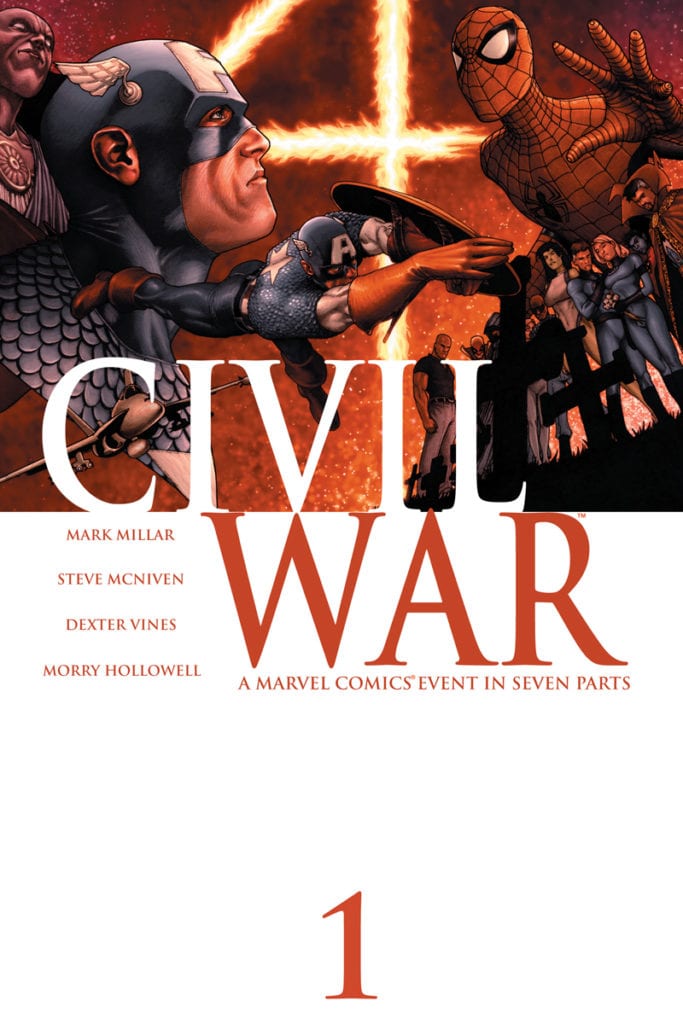
McNiven’s cover illustration shows Captain America facing Spider-Man and the rest of the Marvel hero line-up. We get the sense he’s about to do something that will leave the rest of them in disarray.
Aspen Variant Cover
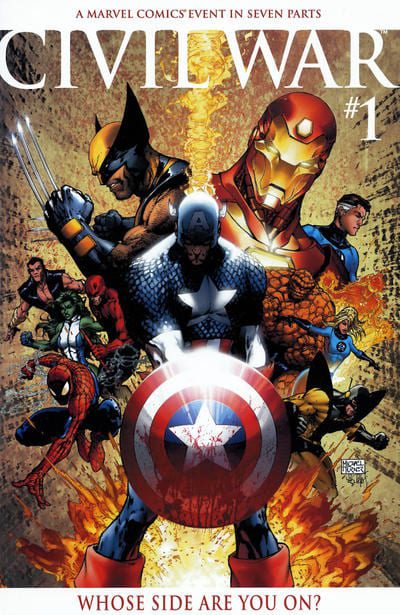
Michael Turner and Peter Steigerwald’s variant cover features three of the big players in this conflict: Captain America, Iron Man, and Wolverine. What’s more, the cover is divided, showing the anti-registration heroes on Wolverine’s side and the pro-registration hero on Iron Man’s. One might think Captain America, positioned directly on the line, will be the equalizer in this conflict. But his downtrodden face suggests otherwise.
Conclusion
The story laid out in CIVIL WAR #1 continues to amaze readers far and wide. Few comic books can bridge the gap between fantasy and reality. We highly recommend revisiting this tale.
What parallels do you see in CIVIL WAR #1 to events in our own world? Let us know in the comments below!
For more than a decade now, Tom Taylor has been bringing us to tears with his comics. He writes the kind of scripts that frankly shouldn’t work. A zombie apocalypse in the DC Universe, a tyrant Superman taking over the world. His premises are full of tragedy, and if his scripts were just that, it would all become old hat fast. Instead, Taylor fills nearly every page with heartwarming connections and side-splitting laughter. It’s his pension for levity that makes Taylor a master of the tragic.
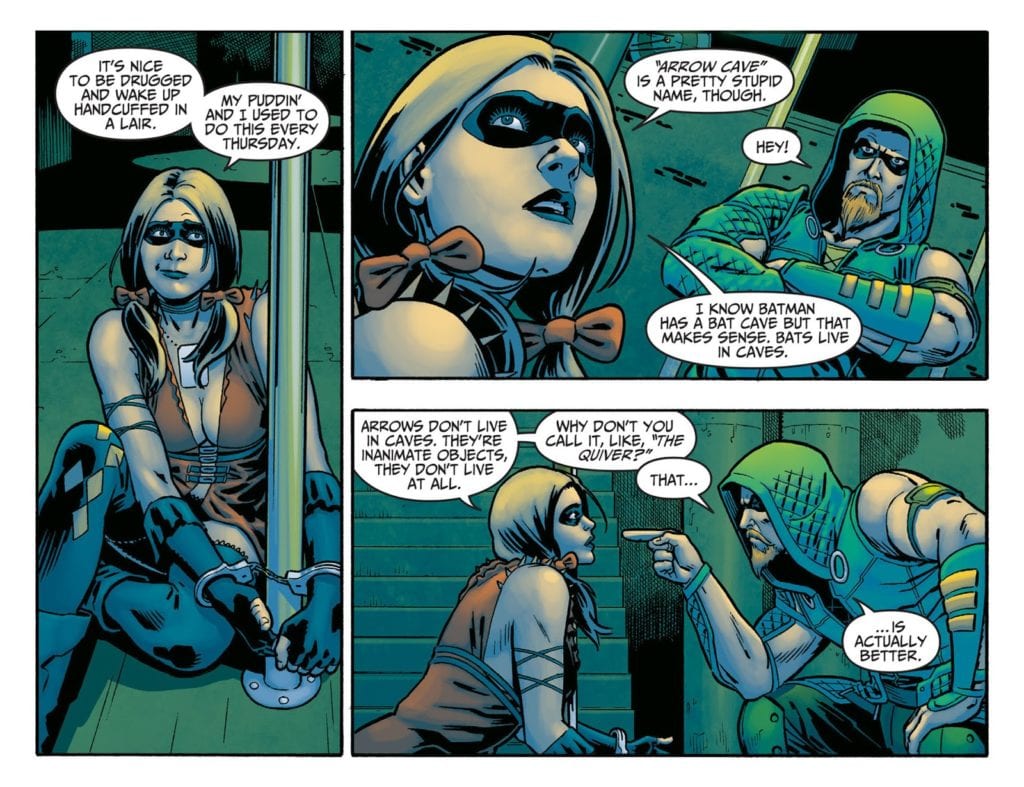
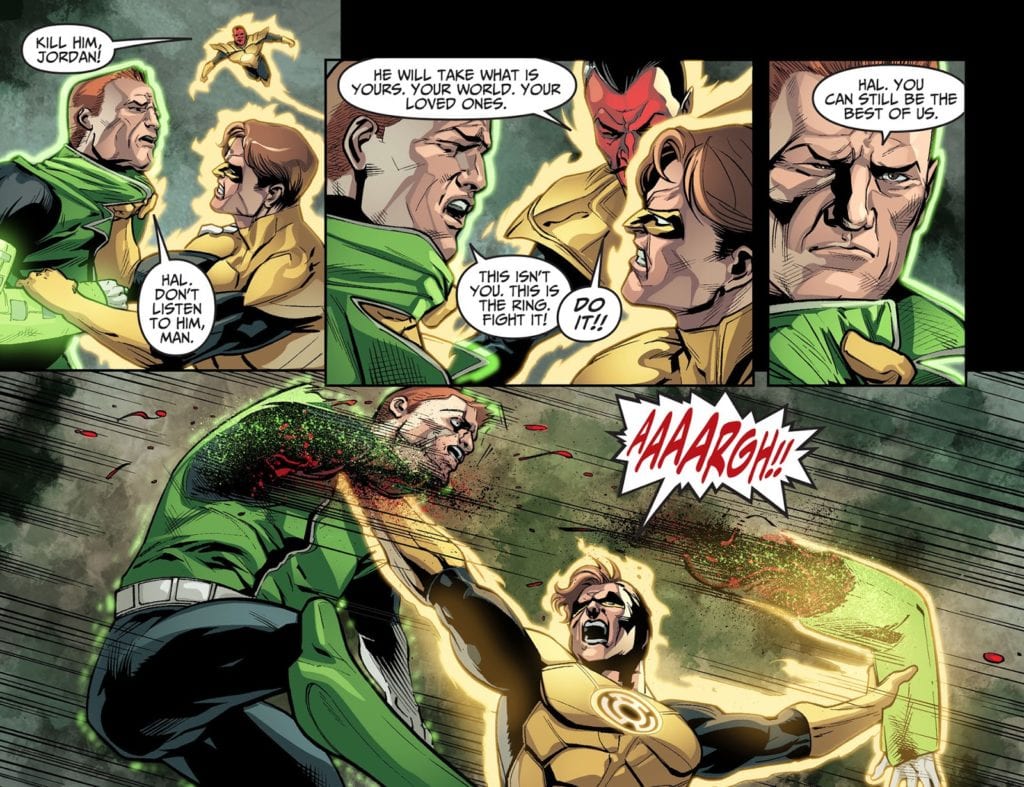
INJUSTICE #5. Art by Bruno Redondo. A prime example of the kinds of jokes/connections Taylor creates in the midst of tyranny.
What is the purpose of filling a tragedy with jokes and levity? It would seem that that would be working against the grain of what that piece of art is trying to achieve. But the fact is, characters who stare gloomily out windows aren’t all that interesting. It’s not long before you’re looking at your watch and wondering, “When will this guy die already?” If the characters aren’t given much of a life to begin with, we often find we don’t care that it’s over for them.
The best example of someone who employs humor effectively in tragedy is Shakespeare. Many of Shakespeare’s plays (like Taylor’s comics) work on a level of dramatic irony. We know the end is nigh from the beginning. Romeo & Juliet begins with the Chorus coming out and telling us, in not so many words, “Don’t get too attached; these guys are headed for the chopping block.” But then suddenly the stage is filled with the kinds of characters that we care about: characters that don’t know they’re going to die.
INJUSTICE YEAR 2 #23. Art by Bruno Redondo and Xermanico, colors by Rex Lokus. This moment would come off as melodramatic or cheesy if not for the overall tone of this series. Instead, with context, the scene is heart wrenching.
Taylor brings this approach to the superhero medium brilliantly. After all, what are superheroes other than characters that don’t think they’ll die or lose? They can repel bullets; they’ve saved planets, why should they be worried? They always find a way to come out on top. In a true act of kismet, in some of Taylor’s more recent projects, like Injustice and DCEASED, DC has handed Taylor the keys to the house. And so these characters that have so often been protected by fandoms and continuity are suddenly fragile.
Nearly every issue of Injustice has a heartbreaking death scene. For DCEASED, it’s almost every page. And the thing that keeps it from being grueling is that there are still characters out there who believe they can come out on top. Whether it’s Harley renaming the Arrow Cave or Lobo not wanting to talk about his feelings, life just goes on for such characters. They don’t wait at the window for death. They have a good laugh about how everything is falling apart.
Taylor has found something profound and seemingly contradictory in his comics. The things we connect to in a character are the things that make them human. But one of the things that make us the most human is that we think of ourselves as immortal. We don’t wait at the window. Most writers would think quite the opposite and wouldn’t tap into that shared humanity we have with immortal superheroes. Thank God Tom Taylor isn’t most writers.
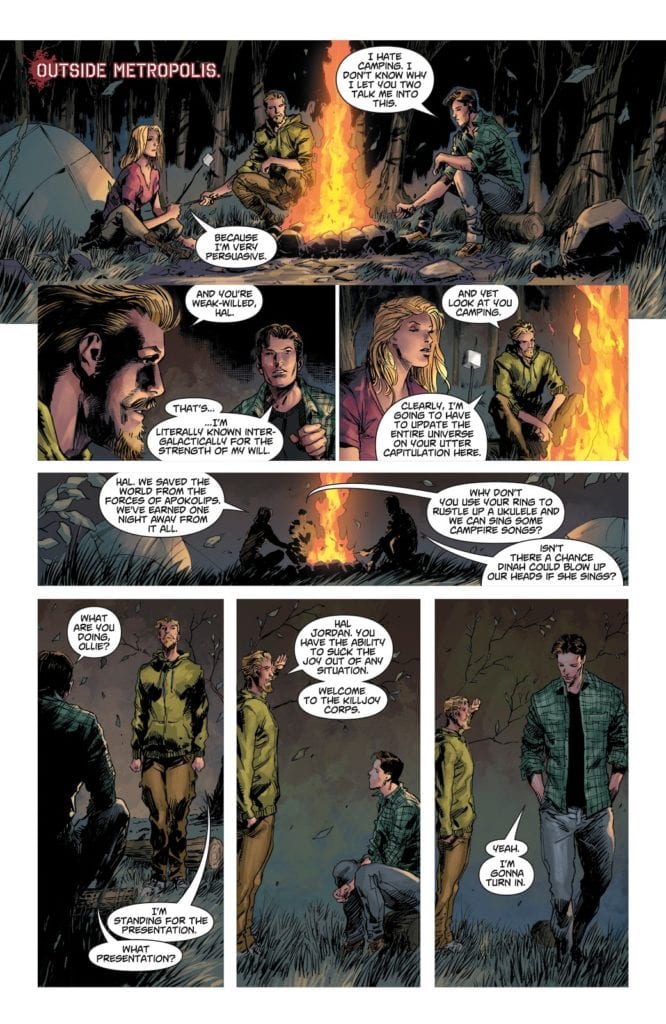
DCEASED #1. Art by Trevor Hairsine and Stefano Gaudiano. Dinah and Ollie give Hal Jordan a hard time. You kind of love them for it though.
In an interview with MFR, Taylor said: “I’ve made lots of people cry in public, and that’s always one of my favorite things.” It’s good he likes doing it, because he does it well. Taylor is aware of the fact that if you want lows in a story, lows that a reader cares about, you must first have highs. We have to laugh with a character if you want us to care that they lost. He puts a human face on apocalypses and makes us care about the slog to the end of the world. So if you want to cry in public, Tom Taylor is your man.
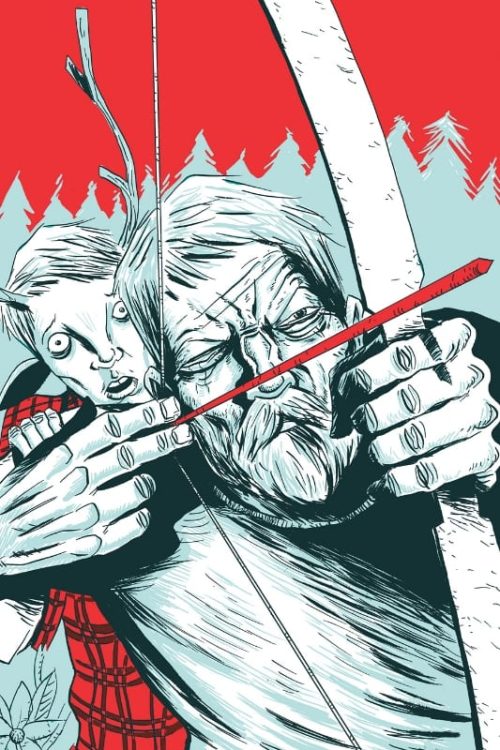
In the time surrounding the year 2010, the post-apocalypse story setting was near beaten to death by the mainstream horde of apocalyptic fiction. Television, film, games, and comics were swarming with stories of varying quality of people surviving in the ruins of our society. This oversaturation undoubtedly caused many to become fed up with the entire post-apocalypse subgenre and dismiss it entirely for several years. In that time though, there were a few standout tales that have stood out from the deluge to become modern classics. One of these is Jeff Lemire’s folk-style comic tale, Sweet Tooth. Lemire’s expert handle on dialogue, characterization, and pacing over a long-form story works in concert with his unmistakable art style and original concepts. As a result, Sweet Tooth stands as not only a gem of post-apocalyptic storytelling but as one of the most memorable comic stories in recent decades.
Writing & Plot
Sweet Tooth begins in a cabin in the woods in the midwestern United States. Gus, a hybrid boy (half-human, half-deer in this case) lives in hiding with his father after a cataclysmic plague wipes out most of humanity, leaving the rest to fend for themselves in often brutal manners. Gus’s father advises him to never leave the safety of the woods, or else the remaining “sinners” will capture and kill him. Unfortunately, the plague reaches all humans at some point, and one night Gus’s father dies of the illness. As Gus ventures out for more supplies, he is found by a pair of “hybrid hunters,” people who capture hybrids and take them to military researchers in hopes of finding a cure for the plague. See, hybrids, which started being born in place of normal humans at the start of the pandemic, are immune to the plague. However, Gus is saved by a hardened survivor by the name of Jeppard. The grizzled fighter offers to take Gus to a place of safety, and the main body of the story begins. On the road, they meet a cast of villains and supporting characters of all manner, origin, and cross-species DNA that color this comic’s world.
One of Lemire’s great strengths as a storyteller is his ability to take familiar tropes and combine them with wildly original concepts (see Black Hammer). This post-apocalypse already holds many genre-familiar sights, such as human brutality and desolation. The main character pairing, with the young boy Gus under the protection of the experienced older survivor Jeppard is reminiscent of many other “on the road” stories. The story itself is laced not only with the fantastical nature of the hybrids, but with questions of religion versus science and the humanity’s relationship with nature. The story is just as much about Gus growing out of his father’s single-minded mentality and learning to see the good in the people that have it – and to do what is necessary against the evil. The development and pacing of Gus’s character guided is with a patient hand. His innocence contrasts with Jeppard’s – and the entire world’s – brutality. He acts as a beacon of hope for so many, even as he learns how to navigate this new world without losing what makes him such an endearing character.
Lemire practices characterization via dialogue to an expert degree. Each character has their own style of delivery based on the context of their character. Gus was raised by a poorly educated father and so his use of simple colloquialisms and sloppy grammar are fitting. Bobby, a groundhog hybrid, received almost no education, so he refers to himself in the third person and uses “am” instead of “is.” There are so many more examples of this; from Jeppard’s “less is more” vocabulary to Dr. Singh’s distressed intellectualism. The individual dialogue is so well composed that even without the artwork, it would be easy to decipher who was speaking just from reading the lines.
Art Direction
Speaking of artwork, Lemire’s is admittedly a bit hard to comment on. The visuals are purposefully lo-fi, and a combination of almost amateurish and expert skills. His art in Sweet Tooth can go from meticulous facial detailing in one moment, to looking like a hastily scribbled sketch in the next. This is in no way an insult. Lemire constantly shifts style and detail based on the context of the current scene. The less detailed and messier sequences are usually dreams or visions, drawn to represent a foggy distance from the story’s reality. At the same time, Lemire’s attention to detail in character moments and action sequences is still fantastic. He portrays wide ranges of emotional expression and turmoil on a single page. Lemire’s pencils are aided by Jose Villarrubia’s fantastic colors, which dip into the surreal at times (watercolored purple and gold skies, at one point) but stay fitting to the context of whatever is going on in the plot. Villarrubia managed to match exactly the stylistic touch Lemire was after, creating an aesthetic that is folky and unpolished but also gorgeous and perfect for the kind of comic being made.
Verdict
Jeff Lemire’s Sweet Tooth does what a great post-apocalypse story should by transcending the shackles and tropes of its genre. The brilliantly unique plot, cast of loveable (and hateable) characters, unforgettable art and one of the most touching endings in modern storytelling culminate in one of the most outstanding comics in recent decades. To quote one of the passages: “This is a story of a little boy with antlers and a big man with guns who found each other and learned there was still some good left in the world…this is a story of fear and friendship…of passage and rebirth…of sacrifice and redemption…of hatred and love…of innocence and age.”
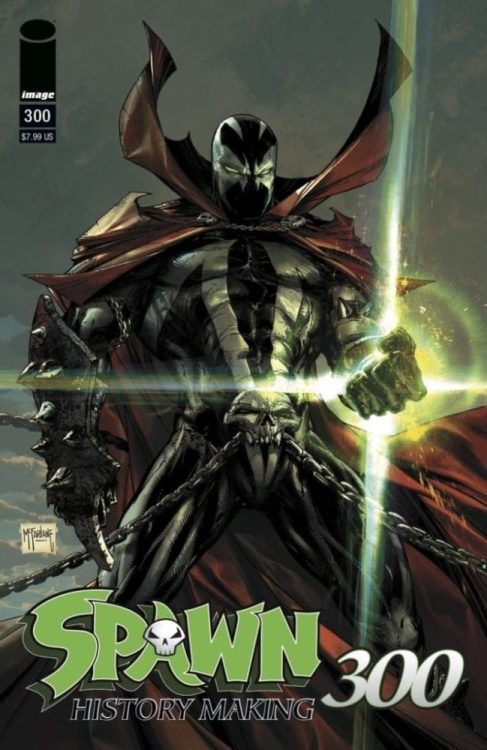
Spawn is a character that needs very little introduction. He’s the character who puts Image Comics on the public radar thanks to the cultural zeitgeist. But that hasn’t been apparent in twenty years. Part of it has to do with a number of lawsuits that creator Todd McFarlane was involved in. But with Spawn’s appearance in Mortal Kombat 11 and a movie with some troubling productions, Al Simmon’s is back in the public consciousness. But how does it come to this? This is the research from the gutters.
The Spawn Zeitgeist
Roughly 20 years before this article, Spawn was at the height of his popularity. With an Emmy winning adult TV animation along with some quality action figures, nobody escapes McFarlane’s grasp. Well, among other less notable reasons like the Michael Jai White movie and the Spawn Armageddon video game. Spawn even stars in a number of crossovers like with DC’s Batman and even a guest appearance in Soul Caliber II. The comics meanwhile reach well over 100 issues.
And It’s Screeching Halt
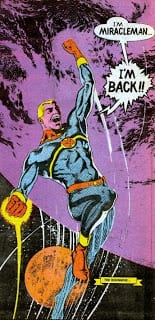
Technically Gaiman just wanted the rights to Miracleman.
Unfortunately, all of that comes to a screeching halt when McFarlane gets into some legal trouble. The most notable of which is with Neil Gaiman, co-creator of Angela and Medieval Spawn. McFarlane’s wanted to cut off Gaiman from his share of the royalties, so he and Gaiman get into a civil suit. McFarlane tries everything to keep his stance, but all end up rejected. So Gaiman takes ownership of some of these characters like Angela and the Man of Miracles and sells them to Marvel. This, along with another lawsuit involving a character’s likeness to a hockey player, cost McFarlane millions. So for the next twenty years, McFarlane tries everything to recover from his losses.
Spawn In-Universe Fallout
With Gaiman winning the lawsuit, McFarlane tries everything to remove his influence over more legal matters. The iconic Armageddon and Endgame stories, for example, make heavy use of the Man of Miracles. Giving Spawn to other writers sporadically, McFarlane’s quality and success start to shift around. He even gives the Spawn mantle from Al Simmons to someone else by killing Al off. All to increase sales while trying to find some new ideas. McFarlane’s plans for a new TV series meanwhile are stuck in development hell. But whether that that can resurrect like the comics are up for debate.
Resurrection
After a few years, McFarlane pulls a retcon to remove all of Gaiman’s influence from Spawn. All while setting up a new status quo and keeping things simple. Spawn Resurrection and Satan Saga Wars are essentially a new take on the above two stories. It even removes Al Simmons’ more controversial status as a wife-beater from Armageddon. With some fans already complaining about how Spawn depicts a problematic superhero for reveling in killing a child molester, this was a welcome change. Afterward, Spawn goes through a journey to reconnect with the world around him. This naturally includes his now late wife’s daughter, Cyan Fitzgerald.
For McFarlane, however, this is about reconnecting with his audience on their level. All through Spawn surrendering a significant portion of his power. Because when you’re on top of the world, everything looks small and insignificant, a mistake McFarlane will not make again. Al’s veteran status is on much greater display instead of relying on his usually absurd powers. Not just for his ability to fight off enemies with machine guns but the respect he gives other soldiers. All while still dealing with trust issues after many past betrayals. Despite this, Al gets allies like a new She-Spawn because he knows he can’t do it all alone. For McFarlane, it’s opening up to others and showing respect to other creators who helped Spawn get to where he is.
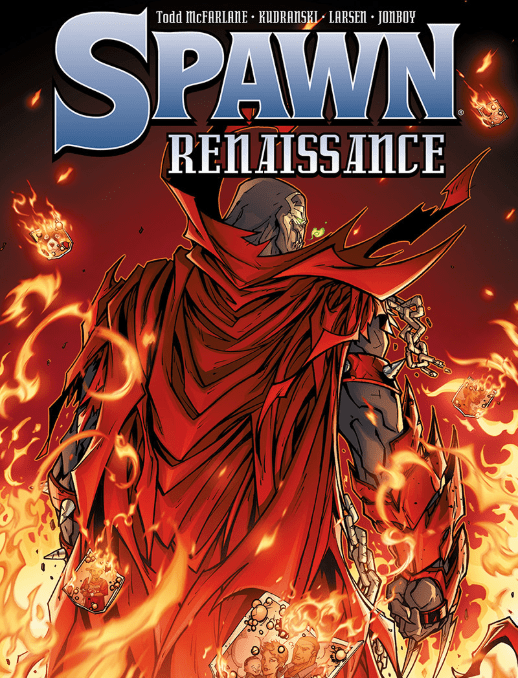
Spawn Renaissance
Now Spawn is back in the public consciousness as Image Comics’ poster boy. After 20 years of lawsuits that held him and McFarlane back, Todd goes back to why Spawn is so great. Not just for the humanity in the character but appreciating all who help get them to this point. Now, if only that Spawn movie can come out without any more troubles.
What do you think of Spawn and Todd McFarlane? Leave your thoughts in the comments.
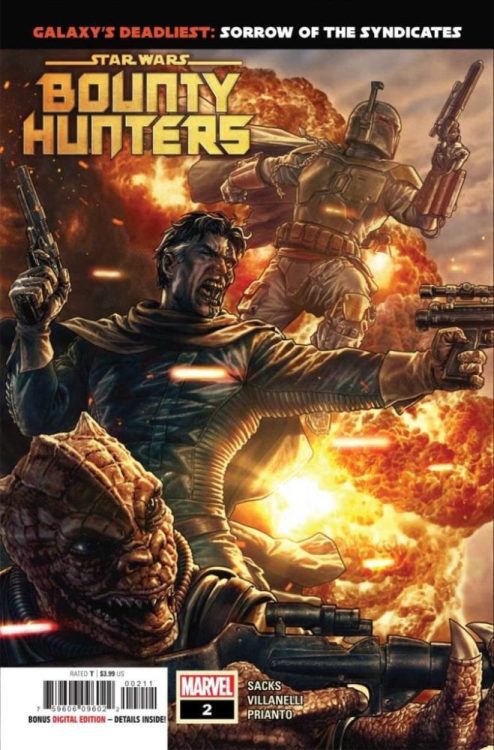
STAR WARS BOUNTY HUNTERS #2 jumps right into the action with the competing bounty hunters racing to be the first to find Nakano Lash. Will they kill each other before they get to Nakano? Let’s find each out?
How did we get here?
In issue #1, a group of bounty hunters disbands and scatter throughout the galaxy after one of their own (Nakano Lash) seemingly betrays them and kills the gangster who hired them. (Click here to read the review of Star Wars Bounty Hunters #1). Many years later, Nakano Lash has resurfaced, and the bounty hunters, each with a score to settle, race to be the first one to find her.
Cover
Lee Bermejo turns in another stellar piece of work with the cover. Bermejo’s composition is dynamic, and his textures are painted with precision. Every detail, from the laser blasts whizzing by to the folds on Boba Fett’s cape, are painstakingly rendered. I’m a stickler for lighting and shadows, and Bermejo captures the effect of the background explosion expertly.
Writing
Ethan Sacks picks up the story almost immediately where the last issue left off. Each bounty hunter picks through clues and follows trails using their own, often violent and brutal, methods. Sacks’ approach cleverly gives each bounty hunter a bit of personality when he shows how differently they each go about chasing down the same prey.
There’s lots of action in this issue. The bounty hunters kill off anyone who gets in their way, and there’s a bit of a bonus with a flashback scene showing how Valance the cyborg first joined up with the team.
Sacks doesn’t address two plot points that have been missing since the first issue: Why did Nakano Lash kill the gangster who hired them? Why does T’onga blame Nakano Lash for her brother’s death?
Without those answers, there’s a lack of emotional weight to the chase. Nakano Lash killed the boss for a reason, so if that reason is not clear to the audience, the revenge chase comes across as unearned. Sacks must answer those questions soon to keep the reader engaged with this series.
Coloring
Arif Prianto does an excellent job on coloring duty. As with Bermejo’s cover, Prianto pays a lot of attention to using shades of color to create texture and depth. Sometimes, Prianto can get a little carried away with the shading such that you can’t tell where the light is coming from, making the scene look a little busy.
Also, Prianto uses a lot of muted earth tones in this issue. That works when giving most scenes a dusty, dirty feel, but it lacks pop, and surfaces tend to blend. Prianto could improve this by using less neutral colors.
Overall, these are minor quibbles with the coloring, and the issue is generally beautiful.
Lettering
Travis Lanham covers lettering with this issue and does something a less capable artist struggles with. Lanham knows how to get out of the way.
The issue has easily 5 to 6 panels per page. For each panel to work, the art has to come through WITH the lettering without getting crowded out BY the lettering. That’s not an easy thing to do when there are so many small panels, some overlapping others. Lanham’s lettering compliments each tightly packed panel instead of overpowering it to let the art shine through.
Pencils/Inks
There’s not much to really say about Paolo Villanelli’s artwork. Each character looks like it’s pulled straight from a Star Wars film. Each droid is authentic to the setting. Every ship looks like something you’d see in a Star Wars battle. Villanelli could improve the artwork just a little more by pulling back on some of the panels. There’s an awful lot of panels packed onto each page, which helps to move the eye long quickly, but it can look a little crowded at times. Again, this is a minor quibble.
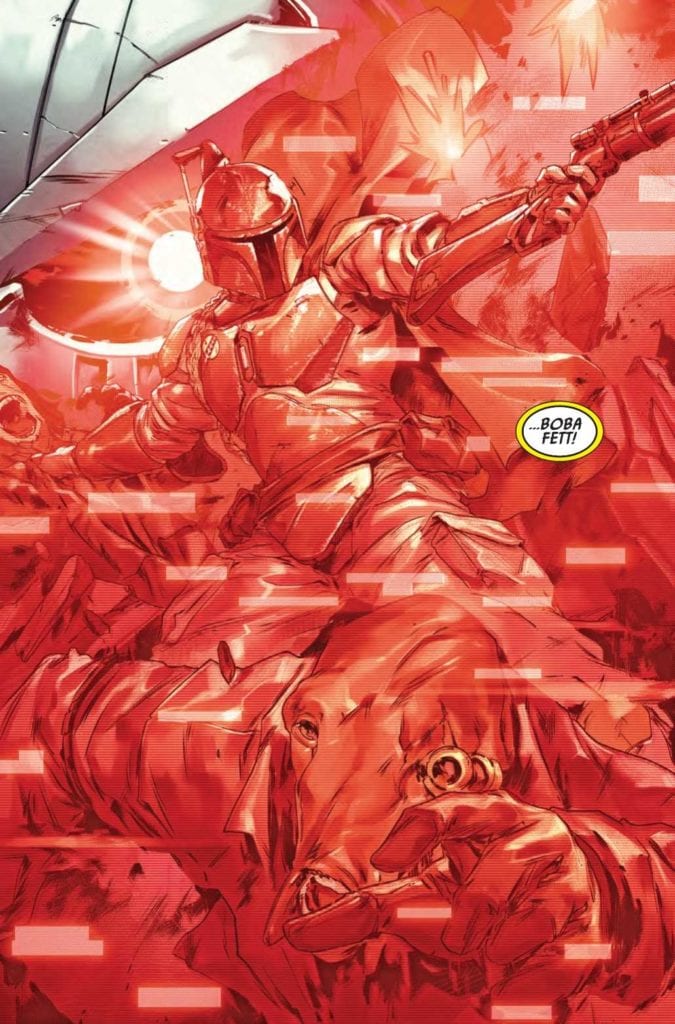
Favorite panel/page: Page 11 is the winner for this issue for its sheer difficulty. It’s an infrared drawing of Boba Fett in a firefight. In less capable hands, the scene would be completely washed out with all the reds. Here, the image is clear and exciting. A testament to the entire art team working together for maximum results.
Conclusion
STAR WARS BOUNTY HUNTERS #2 is a solid entry in this story arc. The pages are action-packed, and each bounty hunter gets to show off their skillsets. There are still some lingering plot questions that diffuse the emotional weight of the story that Sacks needs to address, but otherwise, this is a great issue.
Writer’s Note: Local Comic Shops (LCS) are going through a tough time right now with the pandemic outbreak of COVID-19. Comics fans of every flavor that care about his or her LCS should try to do what they can. So, here’s my part:
If you’re in Northern Delaware, South East Pennsylvania, or Southern New Jersey area, please take a moment to visit Captain Blue Hen Comics in Newark, DE. Say ‘hi,’ pick up a book, order a book (they’re on Comichub.com), and let them know you support them.
If you’re nowhere near that area, please find YOUR LCS using Comic Shop Locator and lend your support.
MARVELS SNAPSHOTS FANTASTIC FOUR, available from Marvel Comics on March 25th, is part of a series of one-shots that looks at a slice of life with the Fantastic Four. This is not your typical FF adventure story, so is it worth the price of admission? Let’s find out.
Cover
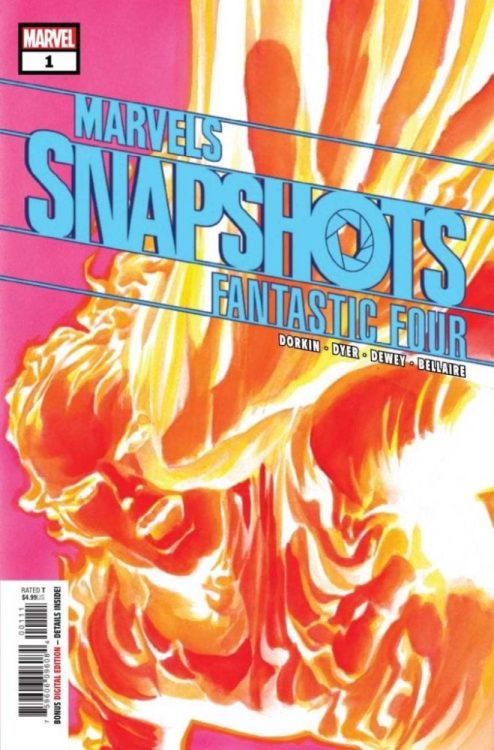
Alex Ross painted the cover showing the Human Torch. If you’re an Alex Ross fan, you will instantly recognize his hyper-realistic style. Ross’ technique makes you believe you can see these fantastical (no pun intended) heroes and villains appear in the street right in front of you.
Where the cover doesn’t work is in the extreme closeup. Johnny Storm flying through the air, is a sight to behold. By zooming in so tightly, the spectacle overwhelms the cover to the point that you can’t appreciate the wonder of it. To be fair, I believe this was an editing misstep and not necessarily on the cover artist. This cover would have been better if the frame was zoomed out more.
Writing
Evan Dorkin and Sarah Dyer have writing credits on this issue. The pacing starts slow, and the story gets a little ugly just past the halfway point, but there’s a surprising twist in the last third that shows me something I’ve not seen before. Let’s set expectations a little bit (without spoilers).
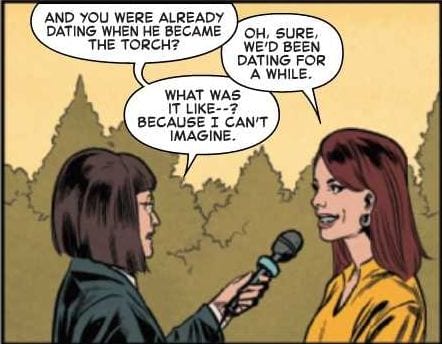
Despite the title, this is not a Fantastic Four story. It’s a story about Johnny Storm/Human Torch attending his 10-year High School reunion. Further still, it’s less about Johnny Storm and more about the civilians who have known Johnny Storm in High School and the years since graduation. Nearly the entire issue is told from the perspective of a news crew covering the event, so you have a lot of Q&A and remembrance storytelling. It’s a unique approach to a superhero title, but again, very little to do with a superhero and mostly people just talking about the superhero. These interviews before the reunion take up the entire first half of the book, which is hard on the pacing. Dorkin and Dyer could improve the story by tightening some of the interviews and shortening to a third of the book.
The reunion is uncomfortable and awkward, so the writers nailed it. Some attendees get drunk and make fools out of themselves. Other attendees either hate Johnny Storm, or they fawn over him like cut-rate groupies. You’re given the impression that Johnny Storm is a conceited jerk, and the town, while appreciative of the fame he brought them, doesn’t like him very much. I was increasingly uncomfortable reading this section, so Dorkin and Dyer succeeded in giving you an authentic reunion experience.
Then, there’s a turn in the last third of the book that starts poorly but sticks the landing. Without spoiling it, the news crew notices something is off. Marcia’s (the reporter) explanation about what she sees feels forced and comes out of nowhere. Dorkin and Dyer could have improved this setup by dropping a few more cues for the reader. That aside, the news crew follows the trail, and they discover a surprise that I did not see coming. It was a pleasant and exciting surprise.
If Dorkin and Dyer could tighten up the interviews in the first half, this would be a more satisfying read. Perhaps, move some of the Q&A interviews into the reunion itself while Johnny is milling about in the background.
Coloring
Jordie Bellaire is the colorist for this book. The colors are bright but extremely flat. Bellaire uses almost no shading or gradient of any kind, and it gives the entire book a 2-D newspaper comic strip look. Bellaire could do more by adding textures and gradients to each surface.
Lettering
Joe Caramagna’s lettering is very good in isolation. If you looked at the lettering by itself, it’s clean, clear, and easy to read. However, the lettering doesn’t match the art because it’s sharper and stands out more, than the artwork it supports. Caramagna’s lettering could be improved if he integrated with the panel’s art more organically. In this issue, it looks like stickers slapped onto the panels.
Pencil/Inks
Benjamin Dewey handled the artwork here, and it’s the weakest part of the entire issue. You can tell the art was digitally drawn because you can see lines are clearly pixelated in several panels. In addition, Dewey draws some panels where the characters are clear and expressive. In other panels, Dewey draws backgrounds and characters with such low detail that they don’t look much better than colored blobs. For the price tag, the quality of the art is lacking.
Conclusion
MARVELS SNAPSHOTS FANTASTIC FOUR is a novel story with an interesting, surprise twist at the end. Unfortunately, the story is almost ten pages too long, and the artwork is sub-par. This book is not worth the $5 price, and it should be given out for free as a digital strip on Marvel’s website or as a supplement on Free Comic Book Day.
Writer’s Note: Local Comic Shops (LCS) are going through a tough time right now with the pandemic outbreak of COVID-19. Comics fans of every flavor that care about his or her LCS should try to do what they can. So, here’s my part:
If you’re in Northern Delaware, South East Pennsylvania, or Southern New Jersey area, please take a moment to visit Captain Blue Hen Comics in Newark, DE. Say ‘hi,’ pick up a book, order a book (they’re on Comichub.com), and let them know you support them.
If you’re nowhere near that area, please find YOUR LCS using Comic Shop Locator and lend your support.
As the flow of new comic books begin to dry up we’ve all started to revert to older material. Whether it’s catching up on the series that we’ve been stockpiling or pulling out those old comics that haven’t been read in a few years: back issues are being consumed in great numbers.
The best thing about re-reading, more so than the comforting nostalgia, is the small surprises that the comics can hold.
Recently I introduced my children to the delights of the Alien and Predator franchises via the Aliens Vs Predator movie. All the way through the film I kept thinking “I haven’t read the AvP comics in years” so after the kids had gone to bed I went searching.
I collected the Titan Comics, then the Dark Horse Publication, UK Reprints of the American titles. They started around 1990 and contained a mix of comics and articles relating to the joint franchises. Aliens, Predators, Aliens Vs Predators. They were perfect fodder for a young comic and movie fan.
Some of the comics that they reprinted are still among my favourite reads: the precursor to Aliens: The Female War and Peter Milligan’s Aliens: Sacrifice. There is also a beautiful short drawn by Simon Bisley called The Reapers that has an ending that has forever been etched in my mind.
Sole Survivors Credit: Dark Horse Comics
Hidden Pages
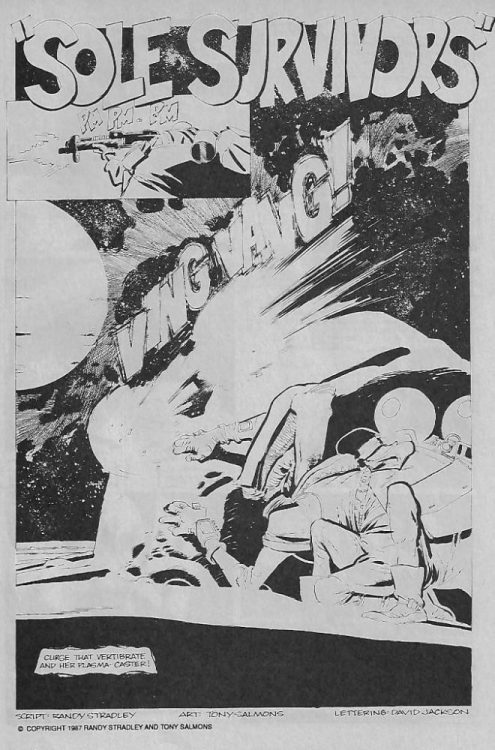
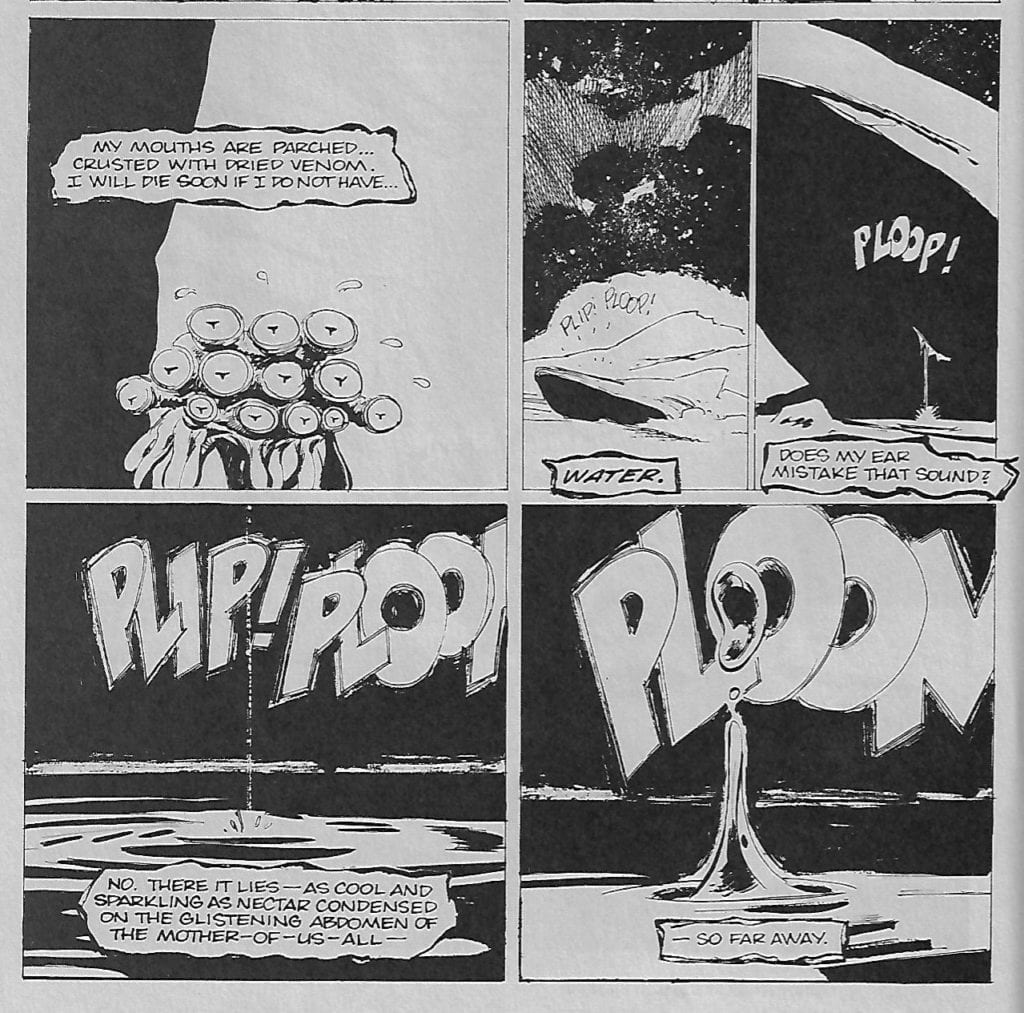
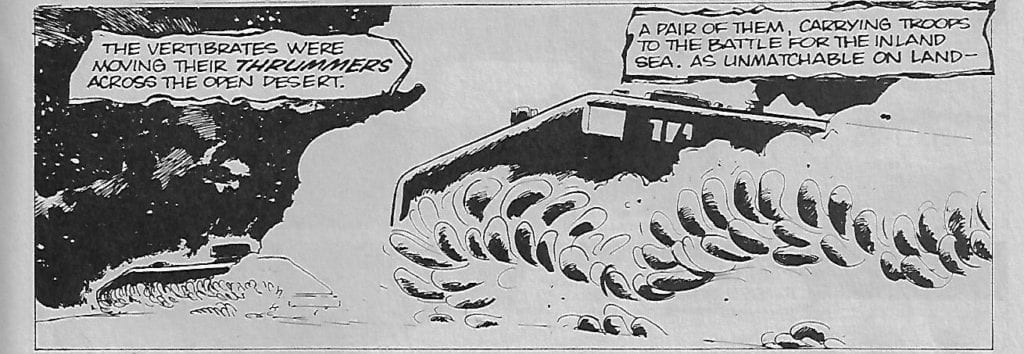
However, in Volume 2 Issue 2 there was a free black and white comic that had nothing to do with the Aliens franchise. Until my current read through I had completely forgotten it was there. The small eight page comic is called Sole Survivors and was written by Randy Stradley, art by Tony Salmons, and letters by David Jackson. It is a wonderful example of modern comic book storytelling, turning a rather run of the mill story idea into something more magical and impressive.
But what makes it so outstanding, especially surrounded by the great Aliens stories reprinted in the comic? It is the simplicity of the idea mixed with the, often, abstract nature of the presentation. The comic was originally created in 1987 and it draws on all of the Science-Fiction tropes popular at the time. It then merges them with an older comic book tradition: the trick or surprise ending most famously used by EC in the 1950’s.
Sole Survivors plays up to all of the 1980’s gung-ho machismo while sneakily subverting it. The central character is a strange, insect-like alien who is difficult for the reader to identify with. Remember, this was the 80’s, the science fiction world was packed with bulging muscles, monosomic heroes, and an array of heavy weaponry. Oh, so many massive guns.
The ideal hero was an ultimate, pumped up version of ourselves and when this finally took hold in Comics we got what we got in the 90’s. Stradley and Salmons, however, are challenging that idea of a hero even before it has become the mainstream in comics. To complicate this, or perhaps to highlight it, they make the protagonist, the villain, more recognisably human.
Sole Survivors Credit: Dark Horse Comics
Subtly Subversive
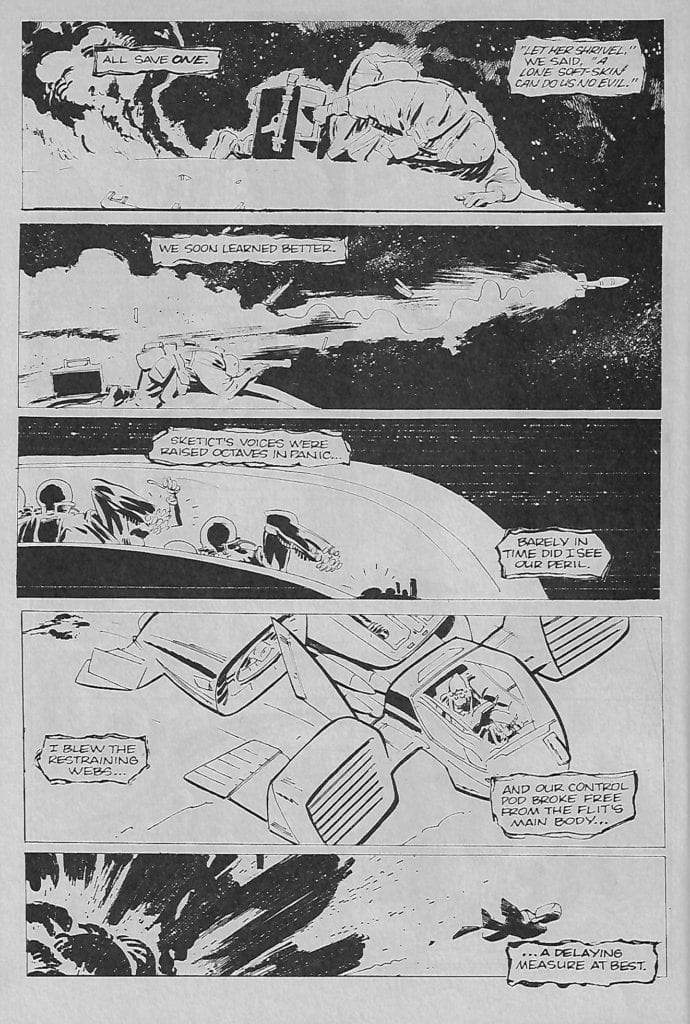
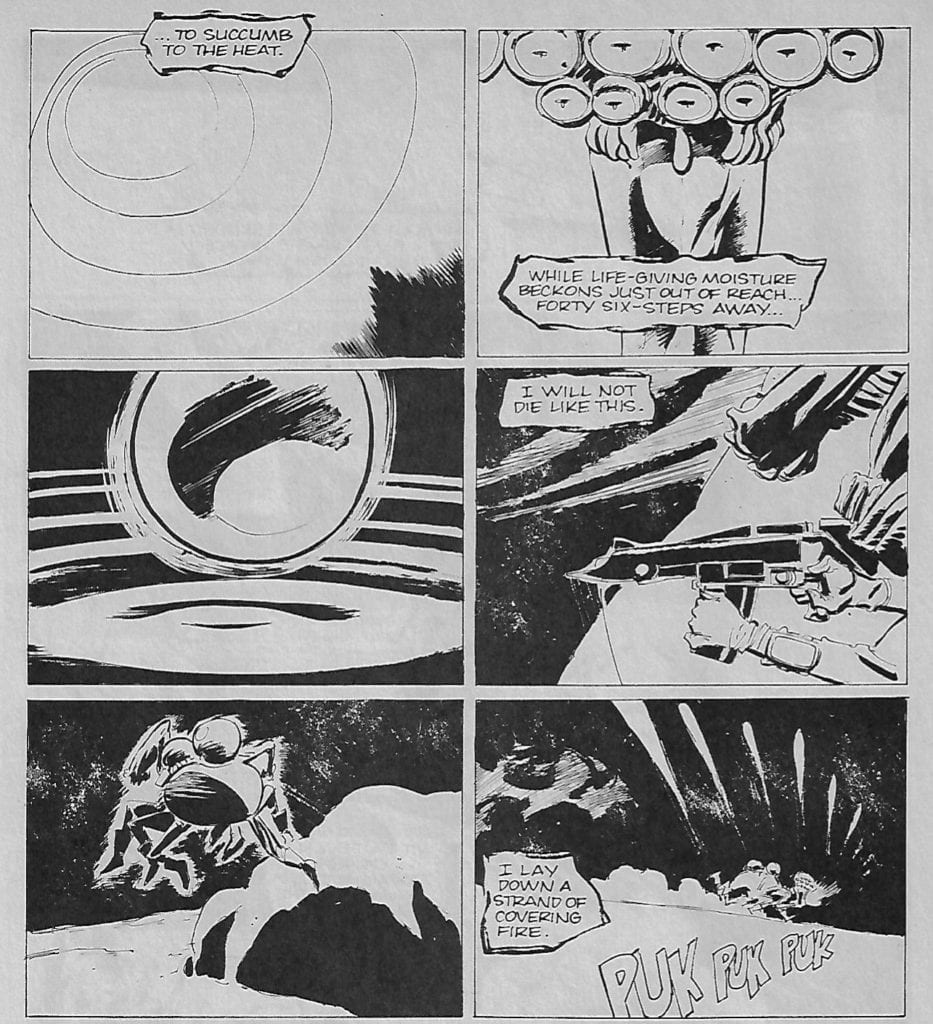
During the standoff in the plot, and the inevitable conflict, we the readers root for the alien: the character who is least like us. This unusual concept is reflected by the abstraction within the art. The panel transitions build emotional responses and challenge the reader to really consider the situation and the two characters. A slow, monotonous dripping of water is contrasted against the life and death struggle as two columns create a tick tock pace in the story.
The Aspect to Aspect jumps heighten the tension while the minimalist element of one side of the page forces the audience to pay closer attention to the other side. The narrative beat away from the character enforces the character’s predicament. It creates an urgency, reiterating the death struggle that is happening.
There is also no consecutive form to the pages. There is a switch between four and five rows of panels per page. The number of panels, and the layouts, also change from page to page not allowing a formal structure to lead the story. This is another contrast to the type of stories that Sole Survivors is referencing.
Sole Survivors Credit: Dark Horse Comics
Distracting Style
At this point it is worth mentioning the lettering by David Jackson. His hand-drawn, scratchy and uneven caption boxes and sound effects give the eight pages of comic a self published look. Especially as it was printed on off-white, newsprint type paper.
Jackson mimics the panel layouts, leading the reader across the page often in an unconventional manner. Silent panels and strategically places caption boxes create verbal gaps or hoops of speech that circumnavigates certain images. This creates a challenging reading experience, not something that you would be expecting from such a comic strip.
The sequels to movies like Alien and Terminator, that fed into a number of comics at the time, were all formulaic. Pleasing and simple structures that helped to make them successful. The presentation of Sole Survivors is not formulaic which allows Stradley’s trick ending to work. Just like an episode of the BBC’s Inside No. 9, the creators lull the reader into a false sense of security by making the build up in the story something out of the ordinary. This acts as a distraction so that they can spring the ending, without the audience having had a chance to guess what’s coming.
By subverting the genre and making the readers question the idea of who, or what, the hero of a story can be, the ending of Sole Survivors shocks you as intended. It is a masterpiece of narrative timing. Everything about it, the Art, the page size, even the paper it is printed on, makes you think it’s a cheap page filler. A gimmick by the publisher. Instead, you have a sophisticated, thoughtful piece of art that challenges the crass commercialism of the larger publication it is a part of.
Sole Survivors Credit: Dark Horse Comics
Subverted Conclusion
The entire creative team were working in ways that undermine the mainstream. At a time when comics were becoming cleaner in appearance, more defined and straight forward, Sole Survivors challenged that notion by resembling underground, self published comics. It has more in common with the weekly 2000AD comic than it does the Dark Horse reprints it was published with.
With a wall of commercialism, sequels, and franchises springing up in the cinemas and moving into comic books, Stradley, Salmons and Jackson are already challenging the tropes the audience were just getting to know. This eight page comic in the middle of a blockbuster tie-in contains more depth and genre critique then any of the chest pounding comics that surrounded it.
I enjoy the Aliens and Predator comics. They formed a large part of my early teenage collection and I still read them with some enjoyment today. However, on this current read through, the most enjoyable part has been rediscovering the majestic Sole Survivors and it’s very modern subversion of science fiction tropes.
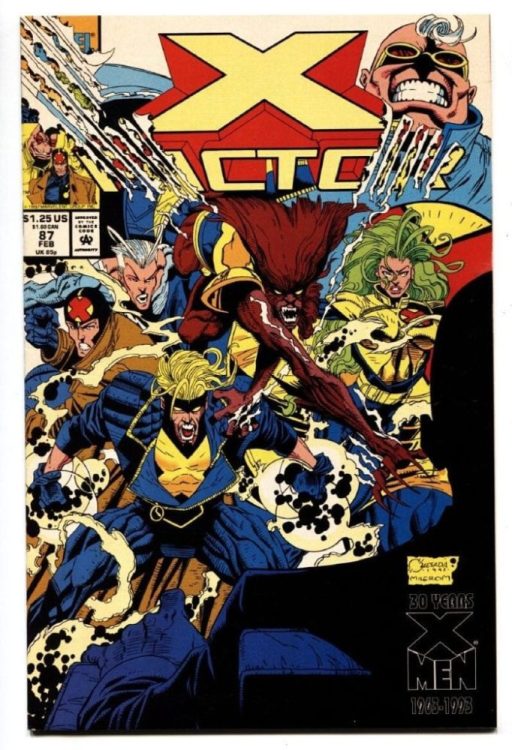
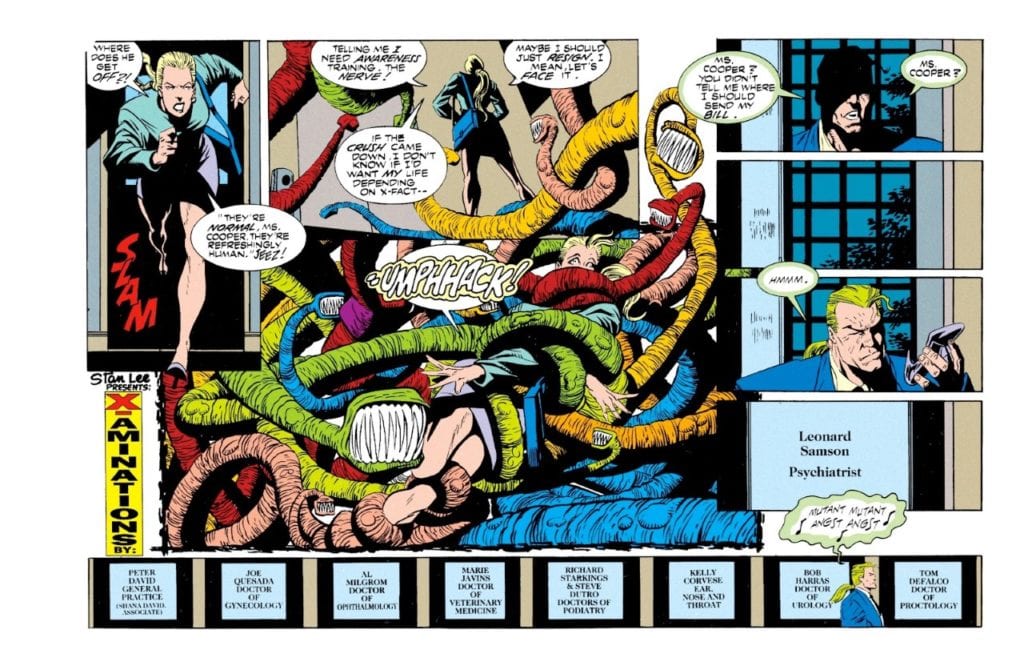
Comics from the ’90s gets a bad rep; rightly so in some cases. Much like any era, it has its fair share of hits and misses. It just so happens its misses where the shape of insanely muscle-bound (roided out) leading men, and scantly clad hourglass figured Femme Fatales. Granted, X-Factor #87 has both of those. Yet there are some ’90s hidden gems found in single issues and some fan-favorite runs. One such run was Peter David’s X-Factor, which he went back to years later. In this, David answered a question that may not have been on everyone’s mind but should’ve; what do heroes do after a large crisis? Yeah, others have tried to write a story about heroes going to a therapist, yet David perfected this in the ’90s.
Pencils by Joe Quesada. Inked by Al Milgrom. Colors by Marie Javins. Letters by Richard Starkings and Steve Dutro.
X-FACTOR X-AMINATION
Enter: X-Factor #87 X-amination. Hell, even the name is a great X-title play on the subject. The name’s one of the many great factors in the story, granted we have to go a little back. Not too far back, but to the big X-crossover that ran in a few titles—X-Cutioner’s Song. Going over the whole event would hurt you more than it hurts me. If you thought crossovers were bad now, the ’90s would like to speak to you.
After the big battles, confusing plots, and around the world flight, the X-Factor team needed a breather. Or what the Government mandated them to have; therapy lessons. Any comic can have an issue where the team goes to therapy, and it’s done and over, no lasting impact, add in some humor, grand breaking regulations, and you have yourself a quick issue. The thing is, David used this moment to showcase how each team member felt, how their Government liaison portrayed them, all while adding humor his run is known for. Nonetheless, that isn’t the only factor that makes X-Factor #87 so amazing and one of my favorite X-titles.
Pencils by Joe Quesada. Inked by Al Milgrom. Colors by Marie Javins. Letters by Richard Starkings and Steve Dutro.
David made the issue matter. How so? Every revelation and character development pushed the series further. It was even later revealed to all be a way to get to the team’s secret. Almost like D.C. Comics’ JLA: Tower of Babel.
Not only did it push the series further, but it also gave insight into the team and their personal problems. X-Factor #87 is one of the most important issues in David’s run and X-Factor in general. Plus, David didn’t just pluck the problems that were plaguing the team out of thin air. Throughout his run, he had moments that built towards this. But alas, we can’t speak of build-up or how it changed the series if we don’t go over what transpired.
WHEN IT RAHNES, IT POURS FOR X-FACTOR
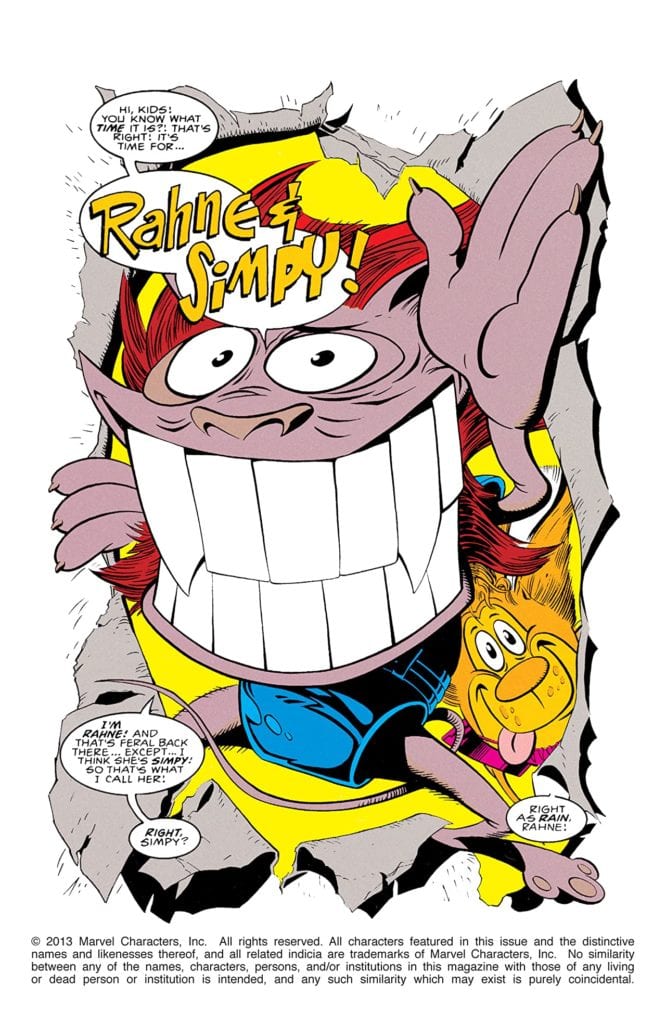
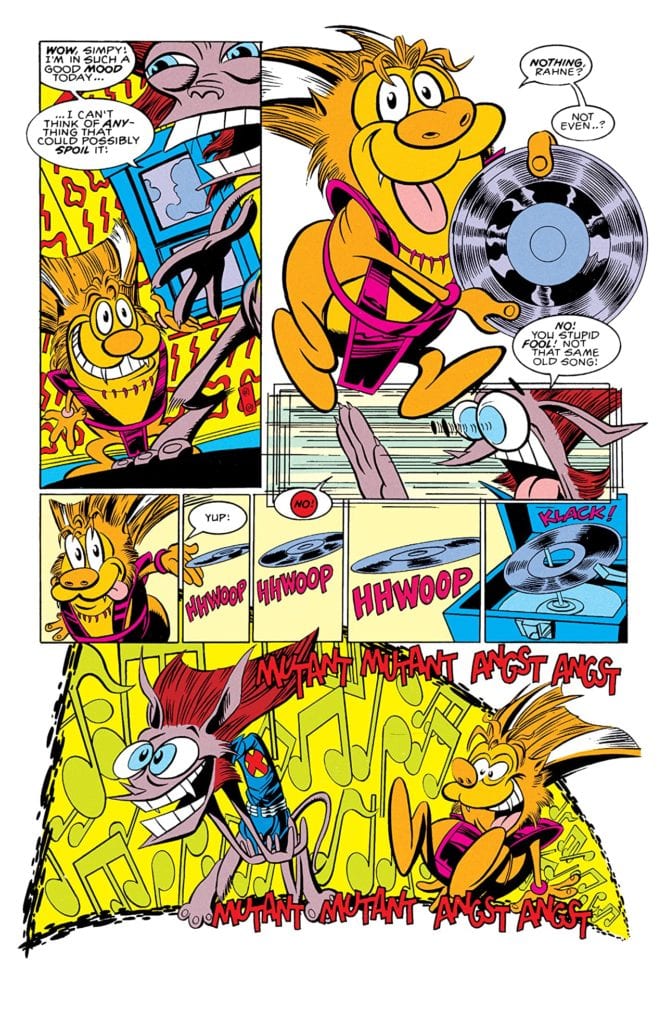
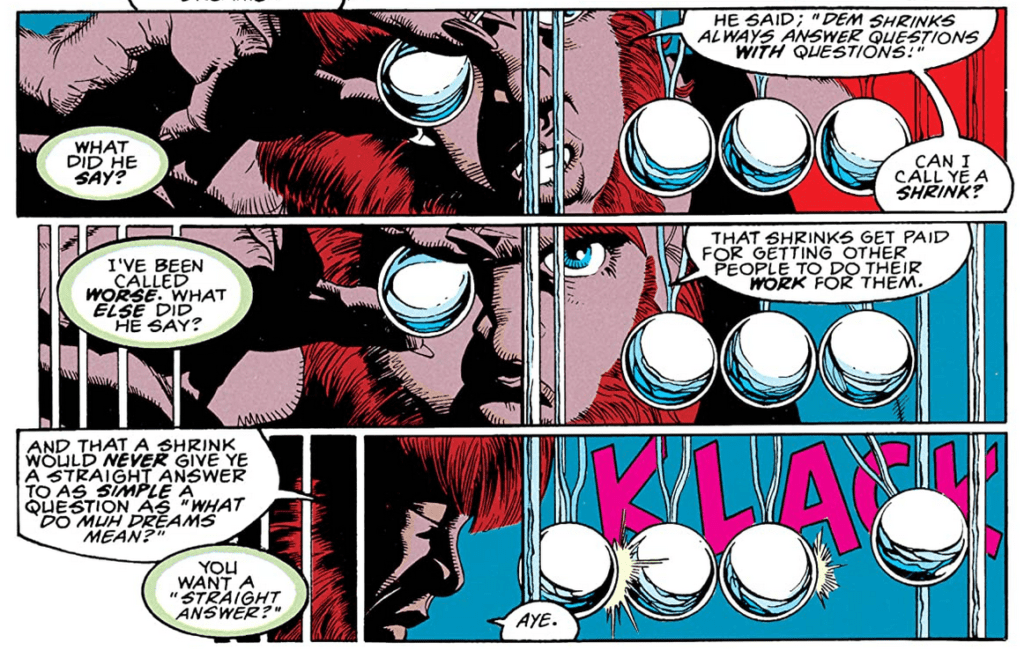
David opens X-Factor #87 with a brilliant Ren & Stimpy nod titled—Rahne & Simpy. Even including a Mutant version of Happy, Happy, Joy, Joy (try getting that out of your head). This isn’t used just for laughs, as it’s a look inside of Rahne Sinclair’s (Wolfsbane) head, via her dreams. In her dreams, she plays out media including herself with Rahne’s World, and Rain Man, as she fell asleep watching it. This transitions into her echoing Guido Carosella’s (Strong Guy) words,” Dem shrinks always answer questions with questions.”
The (Strong) Guy does have a point.
Pencils by Joe Quesada. Inked by Al Milgrom. Colors by Marie Javins. Letters by Richard Starkings and Steve Dutro.
Nonetheless, that pushes the Therapist (we’ll say who later) to prove him wrong by telling Rahne what he thinks. Per usual, it isn’t pretty. Hell, most of the stuff he says is true, while being a little meta. Essentially that she draws characters from T.V./Movies and changing shoes when it looks “good and fits.” This carries into her respect for authority figures and her feelings towards them. Yet when talking about her past Reverend (Reverend Craig) and saying Rahne’s want for love by authority figures is due to the Reverend’s hatred, it hits a nerve.
The thing is, everything the Therapist says hits the nail on the head. It must be hard to have a “sense of self” when you can turn into a literal animal while trying to gain the love from every authority figure. Yet this issue explores Rahne like none other has while showing how her psyche has never been delved into. For someone that can read minds, Xavier is kind of dense if he couldn’t evaluate her as such.
THE PIETRO MAXIMOFF SYNDROME
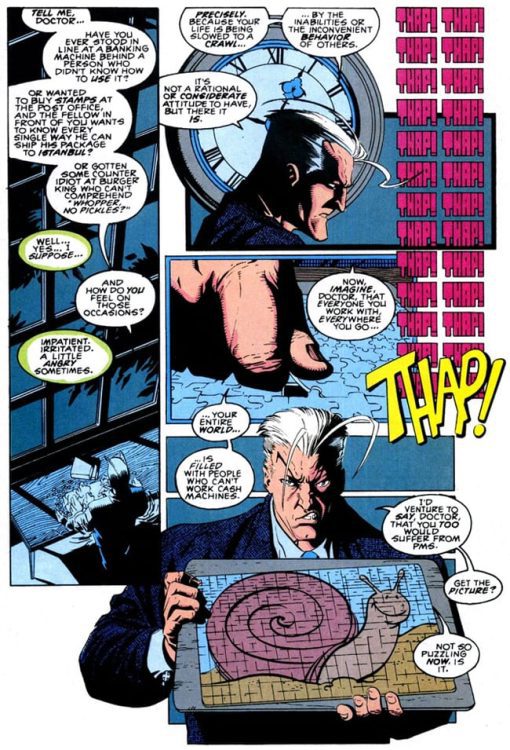
The pages for Pietro Maximoff (Quicksilver) therapy float around often, as it is one of the best deconstructions of him and speedsters in general. Pietro’s analysis in X-Factor #87 changes the way you perceive speedsters while explaining the character’s shitty attitude. Out of all the changes and character development Pietro has gone through the years, this is one of the best, while drastically changing him. Pietro starts the session as he would any, high and mighty. Yet this is where a great term is born—PMS, The Pietro Maximoff Syndrome.
Government liaison Valerie Cooper (Val) coined the term due to Pietro’s “uncontrollable urge to be high-handed and arrogant.” Honestly, it’s a pretty spot-on fit. This leads to the discussion of how Pietro sees others and himself. He doesn’t find himself “superior”, it’s that he holds himself to impossibly high standards that no one comes close to. Following this is one of the best interpretations of superspeed and an amazing visual joke.
Pencils by Joe Quesada. Inked by Al Milgrom. Colors by Marie Javins. Letters by Richard Starkings and Steve Dutro.
Once Pietro receives the puzzle, a constant THAP is lettered throughout courtesy Richard Starkings and Steve Dutro. During the puzzle making, Pietro compares his speed to being in “line at a banking machine behind a person who didn’t know how to use it.” To this, the Therapist replies that that would make him, “Impatient. Irritated.” Pietro proclaims this is due to your life being slowed to a crawl by the inability/inconvenient behavior of others. That this is constantly how he feels where ever he goes. Holding up the puzzle, it is revealed to be a snail with Pietro making a witty response.
Yet, this isn’t the only colossal character changing moment for him, as much like Rahne (and the others); its the beginning of a vast plot.
LORNA’S WEIGHT LOSE PROGRAM
Lorna Dane’s (Polaris) session starts out much like the last two, her showing disdain towards what they’re doing. Yet, unlike the others, she stays the same throughout, while even coming back later on. Continuing to set her side apart from others in X-Factor #87, her problems at first seem superficial. Throughout her first session, she can be seen eyeing the candy on the table with little panels interjected showing them. Alas, she never touches them. This is due to her obsessing over the fact she has lost weight, 15 pounds, to be exact.
Later she claims she was losing weight before her broken jaw, yet in the beginning, she claimed the jaw helped a lot. Her first meeting revolved heavily around this theme of losing weight until she mentions the Therapist “getting into my head.” Trying to dig further, he asks her what exactly she means, to which she breaks down due to all the mind control she has been under. Following this and a few choice words from the Therapist, she leaves, yet later on returns.
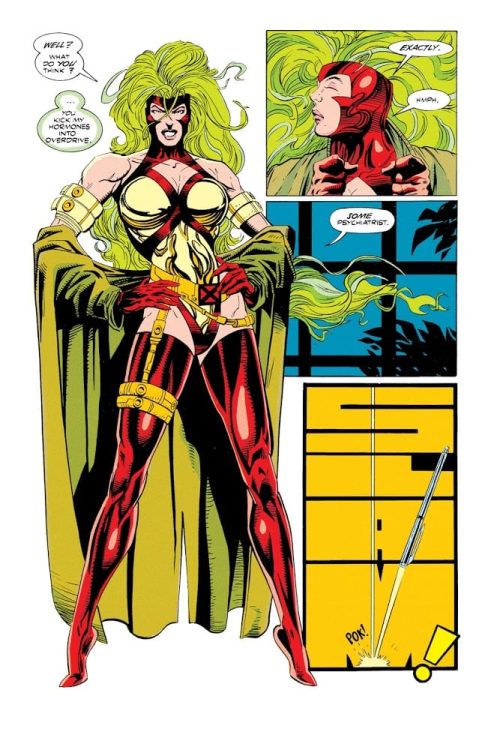
When returning, she mentions that she isn’t repressed, self-conscious, or repulsive; things the Therapist never mentioned. Yet, following is one of the most 90’s outfits reveals that “helps” show off her recent weight loss. After getting the reaction, she desires she storms out. Aside from some of the art and pop culture references, her outfit is the most ’90s thing about the issue. Nonetheless, it feels like she is saying something about the state of over sexualizing woman and their costumes in the era.
Pencils by Joe Quesada. Inked by Al Milgrom. Colors by Marie Javins. Letters by Richard Starkings and Steve Dutro.
Plus, the Therapist’s response is hilarious.
STRONG GUY, STRONG FEELINGS
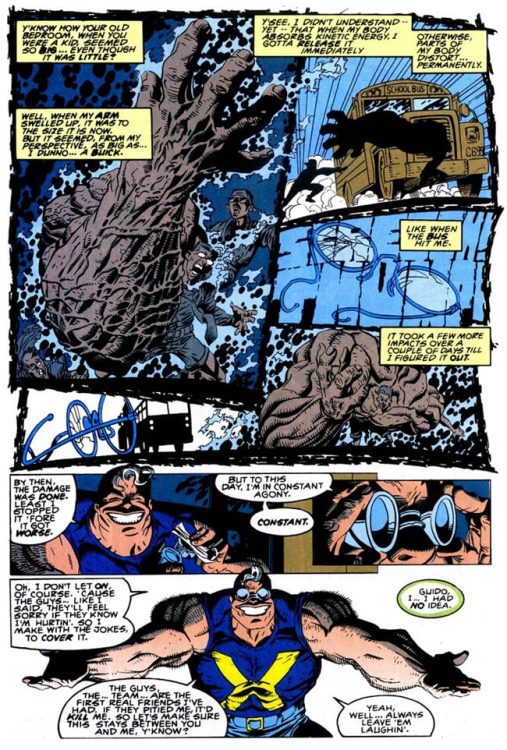
Guido may be one of my favorites. Keeping his usual cool, sophisticated, devil may care attitude, Guido tells the Therapist about the day his powers surfaced. Yet, it turns out his persona may be all a facade. Having been the smartest in class, Guido was hated. But, like every other kid, he wanted to fit in, this caused him to act out. But alas, that didn’t change anything, and after an unfortunate encounter with other kids, he gets jumped. To make matters worse, his mutant powers kick in.
Guido is able to absorb kinetic energy then enhance his physical strength to above normal limits. The thing is, once absorbed, he has to release it in 90 seconds, or the body part would permanently stay like that. Yet, he has no way of knowing this, and while his arm grew to the size of a “Buick,” he was hit by a bus. Thus creating the mountain, we see today. If you’ve ever wondered why his body was so disproportioned, that’s why. Yet, he continues to smile throughout and follows his story with one of the saddest quotes:
But to this day, I’m in constant agony. CONSTANT. Oh, I don’t let on, of course. ‘Cause the guys… Like I said. They’ll feel sorry if they know I’m hurtin’. So I make with the jokes. To cover it. The guys. The…team…are the first real friends I’ve had. If they pitied me, it’d kill me. – Strong Guy
BIG GUY, BIG SMILE
Guido’s story hits hard. Hard enough that throughout the Therapist stays quite. While reading it you may think it’s just another funny story; then you realize he may be telling the truth. Guido may be one of the most fascinating characters. He is a huge strong guy that everyone looks to and is astonished by how big and manly he is. But, deep down, he is continuously struggling, feeling like he has to hide behind a funny face and a near-constant smile. Even his exterior features show his imperfections; what other hero wears glasses when saving lives/fighting due to being near-sighted? He is a character that deserves a more in-depth look at in a new series.
Pencils by Joe Quesada. Inked by Al Milgrom. Colors by Marie Javins. Letters by Richard Starkings and Steve Dutro.
ALONE WITH HIMSELF
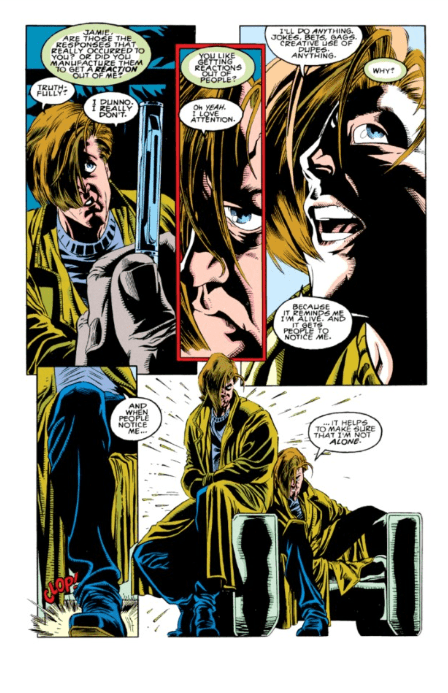
Jamie Madrox (Multiple Man) is a man with multiple problems. Although David introduces the readers to one of Jamie’s greatest fears, they don’t play into future issues as much. That’s due to him secretly dealing with the Legacy Virus. Nonetheless, his problem of being afraid of being alone is one many people deal with. Yet, you’d expect a man that can make dupes wouldn’t feel this way. Afraid of being alone, Jamie needs constant attention. To get this, he constantly jokes, gags, and has his dupes do silly things. Much like Guido, he has a facade.
Nonetheless, this fear of being alone for a man that can make multiple dupes is fascinating. Do you know what isn’t fascinating about him? The damn haircut. Talk about emo Peter Parker from Spider-Man 3. The other thing of note is how his session is only two pages, whereas others are longer. Only his, Alex Summers (Havok), and Val are contained to two pages.
Pencils by Joe Quesada. Inked by Al Milgrom. Colors by Marie Javins. Letters by Richard Starkings and Steve Dutro.
FAMILY PROBLEMS
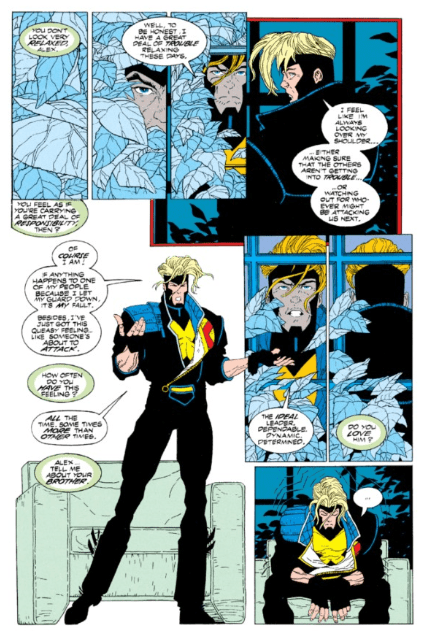
A leader’s job is hard, especially when you’re a leader for a Government sanctioned Mutant team. Albeit, that’s not all Alex deals with. As his last name entails, he is brother to Scott Summer (Cyclops), the “great” X-Men leader. This fact is one of many that bogs down his mind. How could you ever measure up to a bigger brother like Scott? That and the fact he constantly feels like he has to babysit his team. Knowing the team, this makes complete sense.
Whereas Scott “seems to command respect”, Alex has to “work my butt off.” Out of the whole X-Factor team, Alex has one of the harder jobs with leading them, yet Scott’s presence makes matters worse. This is dealt with later on in multiple factors. One specific moment being when Alex confronts Scott and tells him this. This leads to Scott laying out some of his insecurities, thus helping Alex develop into a stronger leader.
Pencils by Joe Quesada. Inked by Al Milgrom. Colors by Marie Javins. Letters by Richard Starkings and Steve Dutro.
YOU KNOW NOTHING VAL
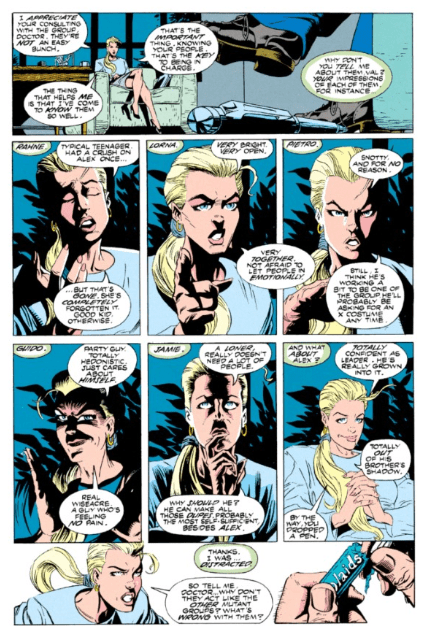
X-Factor #87’s final therapy session is the most damning on its character. In this case for Val, their Government Liaison. The Therapist questions her about everybody on the team. Unsurprisingly Val gets every single one wrong. Instead, she says the exact opposite of what the team members have said. Thus showing how little she cares or how she only cares about how they work. It’s a great two page dive in just how little she knows.
This also shows how you can be around a group (or person) and truly never know them. She supposedly spends so much time with them and knows so much about them. Albeit, it’s truly hard to ever really know someone. It’s beautiful how David writes her responses being the polar opposite. Nonetheless, the most important part of her story happens at the end when she gets abducted.
Pencils by Joe Quesada. Inked by Al Milgrom. Colors by Marie Javins. Letters by Richard Starkings and Steve Dutro.
GUESS WHO
Did you guess who? The therapist all along was Leonard Samson! If you guessed right, congratulations. Sadly Marvel’s website and others spoil this reveal.
THE FUTURE
X-Factor #87 was a pillar for future stories. Rahne’s love for Havok and other authority figures came to ahead. While other head traumas arise. Pietro tried to rekindle his marriage while taking life slowly. Throughout future issues, he can be seen doing hobbies and acting nicer. Lorna seemed to stop caring about her weight while fairly getting over the mind control PTSD. Guido’s past came to haunt him in X-Force Annual #8, while others seemed to notice his facade.
Unlike the others, Jamie’s problem isn’t brought up anytime soon, as he dies from the virus. Plus, he has multiple other problems. Alex gains further development later on when Forge (new Government Liaison) questions the leader on his team. Unlike Val, he is able to assess each member, explaining why they’re needed. This not only shows how different he is from Val but how he has evolved these last issues.
Val’s future plot isn’t as great, as it seems the later writers had no idea what to do. She starts to become “evil” while purposely screwing up the team. Then it’s revealed she was mind-controlled in a very dull moment. It did help her exit; nonetheless, it could’ve been handled better.
Pencils by Joe Quesada. Inked by Al Milgrom. Colors by Marie Javins. Letters by Richard Starkings and Steve Dutro.
X-FACTOR IN TEAM THERAPY
What David did with X-Factor #87 was a huge feat that impacted the rest of his run and others. Not only did he use themes and plots showcased throughout the issue, so did Scott Lobdell and J.M. DeMatteis. What David did with the characters was unprecedented at the time and added layers to the individuals and team. Each member was put under a lens and looked at in a manner that at the time wasn’t usual, and still isn’t.
In the following issues, David, Lobdell, and DeMatteis kept the threads woven here throughout. The following issues revolved around different plots, yet all contained personal stories happening in the background from X-Factor #87 that would continue to shape the characters. Years later, David revisited the idea with X-Factor (VOL.3) #13.
As we close on X-Factor #87, know even superheroes are flawed and need a therapist. It could easily be debated this is when they’re at their best written. Nonetheless, much like heroes need to take care of themselves, so do we.








 After a few years, McFarlane pulls a retcon to remove all of Gaiman’s influence from Spawn. All while setting up a new status quo and keeping things simple. Spawn Resurrection and Satan Saga Wars are essentially a new take on the above two stories. It even removes Al Simmons’ more controversial status as a wife-beater from Armageddon. With some fans already complaining about how Spawn