Home Blog Page 276

Review: THE DREAMING: THE WAKING HOURS #1 – More Things On Heaven and Earth…

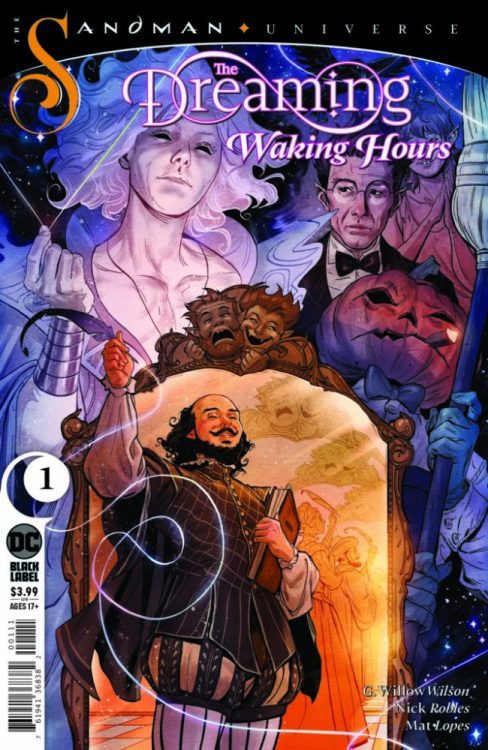
The newest chapter of the Sandman Universe is here, with “The Dreaming: The Waking Hours” #1 from writer G. Willow Wilson (Invisible Kingdom, Cairo) and artist Nick Robles (Euthanauts).  With the help of returning co-creators Mat Lopes and Simon Bowland on colors and letters respectively, this first issue of a new Sandman story is a compellingly written and character-focused opening with incredible artwork that is sure to please both old fans and newcomers alike.

“One of Dream’s heaviest responsibilities is the creation of nightmares-the beings that haunt our sleep and turn our thoughts toward darkness. In the form of Ruin, the nightmare of catastrophic failure, Dream was certain he’d built his next masterpiece…but Ruin can’t help but live up to his name, sending every situation into a spiral of unexpected consequences. Unfortunately, Shakespearean scholar (and exhausted new mother) Lindy has dreamed of Ruin…and in the process, she’s delivered him unto the waking world!”
Writing & Plot

Writer G. Willow Wilson has the unenviable job in “The Dreaming: The Waking Hours” #1 of both following up Si Spurrier’s stellar  The Dreaming run that ended earlier this year, as well as adding to the legacy of Neil Gaiman’s original Sandman. It seems from this first issue however that she is very much up to the task. This is a well-focused issue that bears down on its characters and their struggles, while also reiterating the lore of the Sandman Universe without ever wading into needless exposition. Both protagonists, the struggling intellectual single-mother Lindy and struggling young nightmare Ruin, are instantly compelling and easy to relate to as characters, and both for totally different reasons. Willow’s blending of a simple, character-driven plot and fantastic dialogue sensibilities keep this an easily enjoyable read that still has all the mystery and fantasy needed in a  Sandman tale. The only issue I ever had with Spurrier’s work on  The Dreaming was his reliance on the original  Sandman for his plot. Being well-versed in Gaiman’s original work didn’t make this a personal issue for myself, but it could easily have been overwhelming for anyone stepping into this universe for the first time. Wilson’s work here improves upon that aspect with a plot that is easy to follow and compelling for readers with little-to-no  Sandman knowledge but filled with enough references and easter eggs for classic fans (such as myself) to be satisfied. The succinct, compelling script here make for a fantastic start to this new chapter in the Sandman Universe.
Art Direction

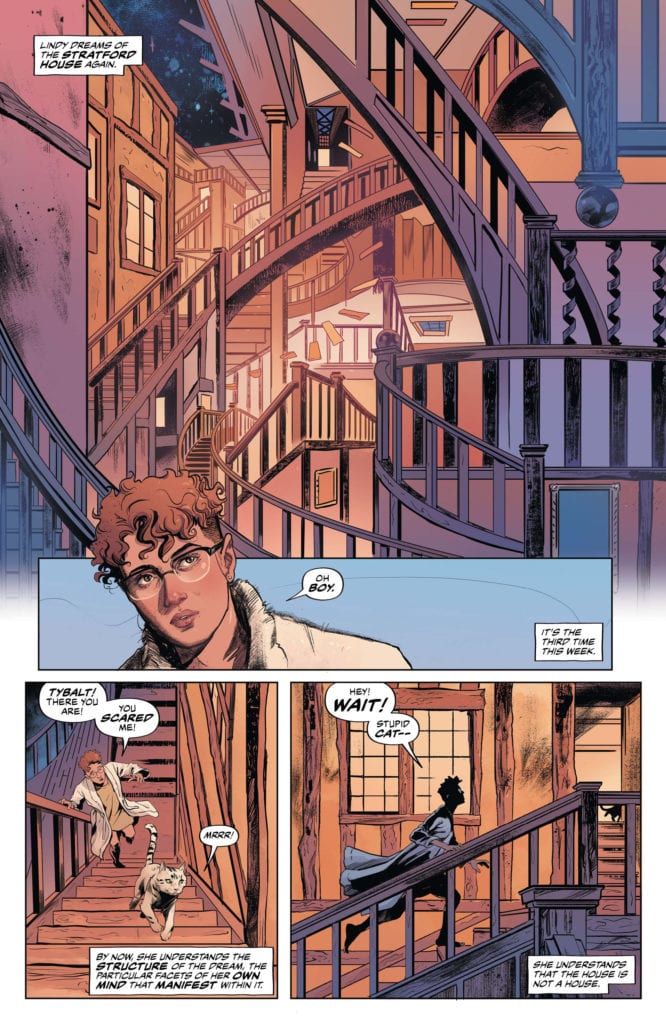
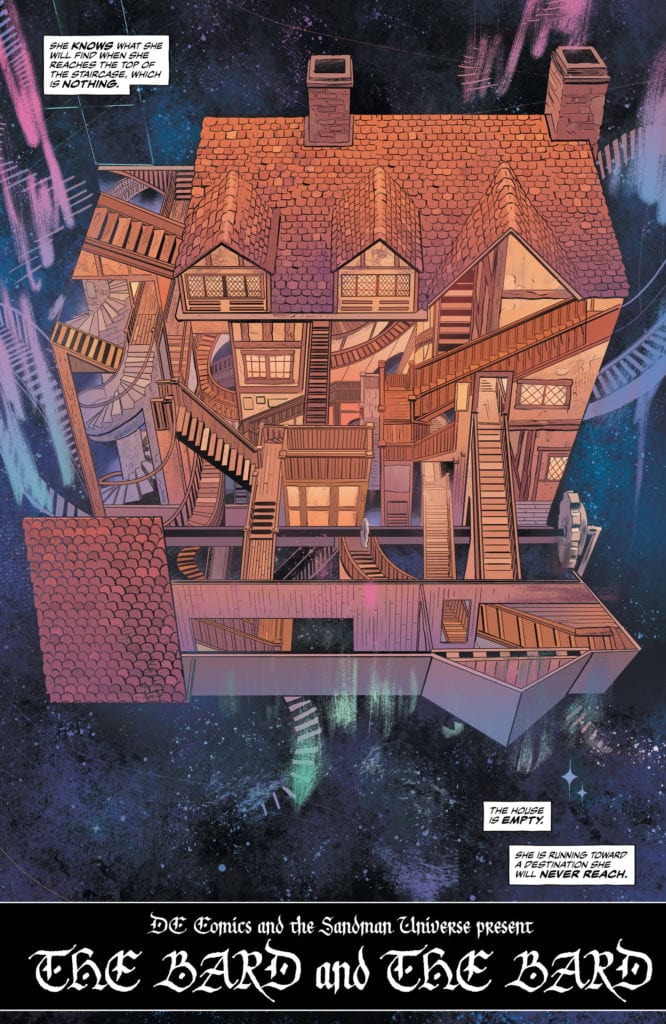
As imposing a position as Wilson has, artist Nick Robles has massive shoes to fill as well. Robles steps in after the Eisner-nominated phenom Bilquis Evely’s work on The Dreaming for this first issue of “The Dreaming: The Waking Hours.” Fortunately, Robles proves more than ready for this task. “The Waking Hours” looks every bit as stunning as its predecessor, in terms of character design, direction, and the necessary fantastical visualizations. Robles’s animations on each character are stunning, bringing each of them to life with blossoming vibrancy. His detailed environments, from Lindy’s cramped apartment to the mazes crafted in The Dreaming, are immaculate in their construction. Robles is such a fitting successor to Evely not just for his unique talent, but also because his style is strikingly similar to the prior artist. This is in no way a detraction from his talent, it’s very much a compliment. Robles’s ability to match the style of one of the best artists currently in the industry while maintaining his own visual mark makes him one of the most promising new artists in comics. This all being said, Robles is helped out by returning  Dreaming colorist Mat Lopes, who also colored Evely’s pencils on the prior series. The matching aesthetic of both the former series and “Waking Hours” is primarily owed to his outstanding work, with one of the most expansive palates seen in recent comics. There’s a considerable detailed finesse in his work as well, with carefully selected shades revolving around specific characters and the context of their scenes. Also returning is letterer Simon Bowland, whose expressive and character-specific fonts give this comic the proper  Sandman reading experience as has been done for decades now. Visually, “The Waking Hours” is almost as good as it gets in the world of comics.
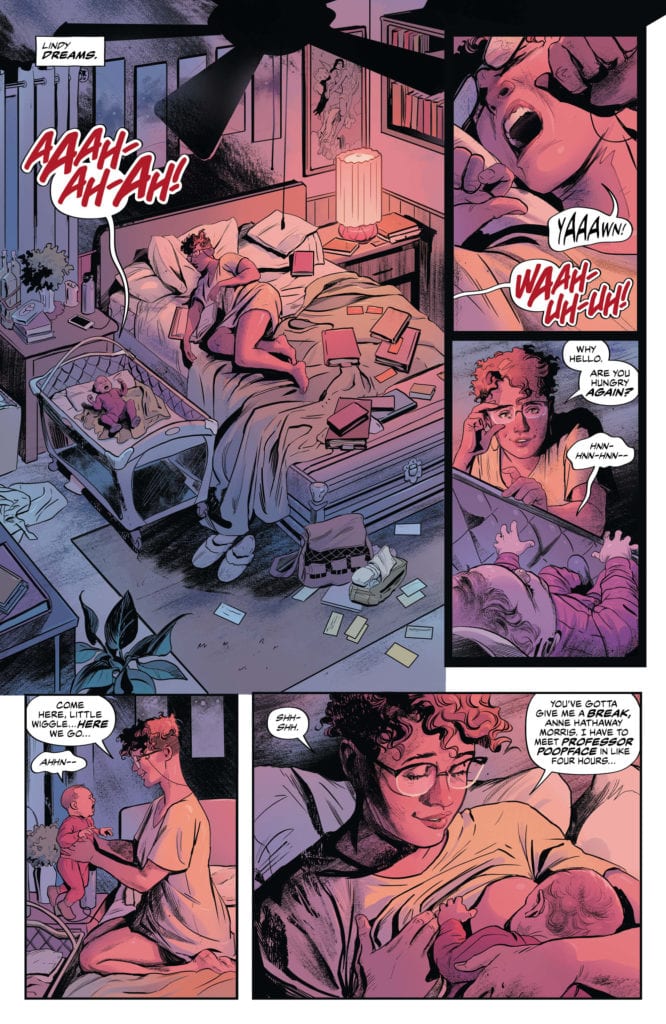
“The Dreaming: The Waking Hours” #1 is a focused and brilliantly interesting start to this new saga in the Sandman Universe. G. Willow Wilson’s script is full of thoughtful character writing and intelligent but easy-to-follow fantasy. The visual work of Nick Robles and Mat Lopes is some of the best done in the whole of  Sandman’s history, and a fitting continuation of the prior series’s aesthetic. This comic is an easy recommendation to both veteran  Sandman fans and new readers alike. Be sure to grab this debut issue when it arrives at your local comic shop on 8/4!
 

Monkeys Fighting Robots Youtube

Review: GIANT-SIZE X-MEN – FANTOMEX #1 – Welcome to the World…Again. And Again.

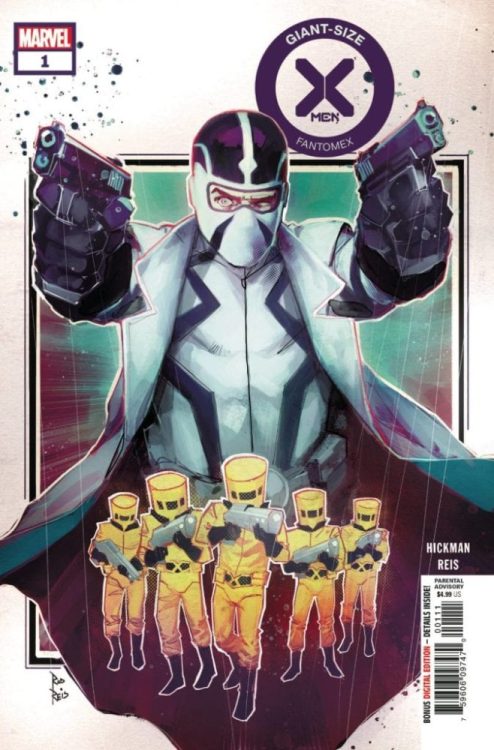
Fantomex takes center stage in Giant-Size X-Men – Fantomex #1, on sale from Marvel Comics this week. Writer Jonathan Hickman and artist Rod Reis, with letterer VC’s Ariana Maher, weave a tale, looking at the history of the character and a previously unknown relationship.

To speak of Hickman as “writer” and Reis as “artist” doesn’t quite tell the full story. Comic artists might appreciate that the two men are credited as working on “story and words” and “story and art.” I don’t know if Hickman, as Head of X, is planning on starting a new trend of acknowledging that the artist is as much a storyteller as the writer, but it’s a nice sentiment.

Writing or “Story and Words”

For readers hoping to find out the details of how Fantomex got his own body back from Xavier, who thought that that pre-Hickman plot point would be explored in any way, this story is not for you.

What Hickman creates instead is a historical, cyclical narrative with some cool cameos and references to previous stories, all while exploring a relationship set up in the opening pages of the issue.

It isn’t a bad story, and it is a more personal story for the title character than the Nightcrawler and Magneto issues were, but it is unclear how this might fit into his larger Krakoan narrative. Or is this just Hickman’s chance to writer individual character stories that don’t fit into that narrative? Given the high concept nature of “the World,” which Fantomex attempts to break into multiple times throughout the issue, a sci-fi writer like Hickman may have simply wanted to play around with the idea.

Art & Colors or “Story and Art”

Reis’s art is beautiful in this issue. Given Fantomex’s multiple break-ins to the World, Reis is able to make each one of those encounters look unique. Not only is Reis’s character work on normal characters gorgeous in this issue, but the continually reimagined threats in the world are given unique designs, ranging from cartoony to monstrous, while the environment of the World is rendered increasingly abstract and esoteric.

Again, one wonders if Hickman and Reis just wanted to tell a story that takes advantage of the sometimes zany and high concept sci-fi nature of the World. While the plot of the story could be a little hard to follow at times, the art makes up for it.

Lettering

Maher does a good job lettering the story. The lettering doesn’t overwhelm the page and supplements Reis’s art perfectly. In one scene, when two characters are upside down, Maher’s letters add to the visual effect, complementing and accenting the scene well.

Unlike a lot of the X-titles, this issue lacks any propose pages, and even the character intro page at the beginning is pretty sparse on details. This might’ve been the one issue where an expositional prose page might’ve come in handy, but Hickman, Reis, and Maher tell a very visual story, a rare feature in the Dawn of X.

Conclusion

As with most of these Giant-Size issues, I keep expecting to see character stories that focus on how the title character is adjusting to the new post-Krakoa world and maybe even addressing any lingering plot points about the transition between the pre-Hickman X-era and the current one. The purpose that these one-shots serve to the overarching narrative is unclear still, but Hickman does play a long game, and details that one thinks they can ignore early on sometimes pay big dividends.

What did you think of Giant-Size X-Men – Fantomex #1? Tell us in the comments below!

Monkeys Fighting Robots Youtube

Review: DISASTER INC #2 Is A Modern Horror For A Modern World

Disaster Inc #2
Disaster Inc #2 Credit: AfterShock Comics

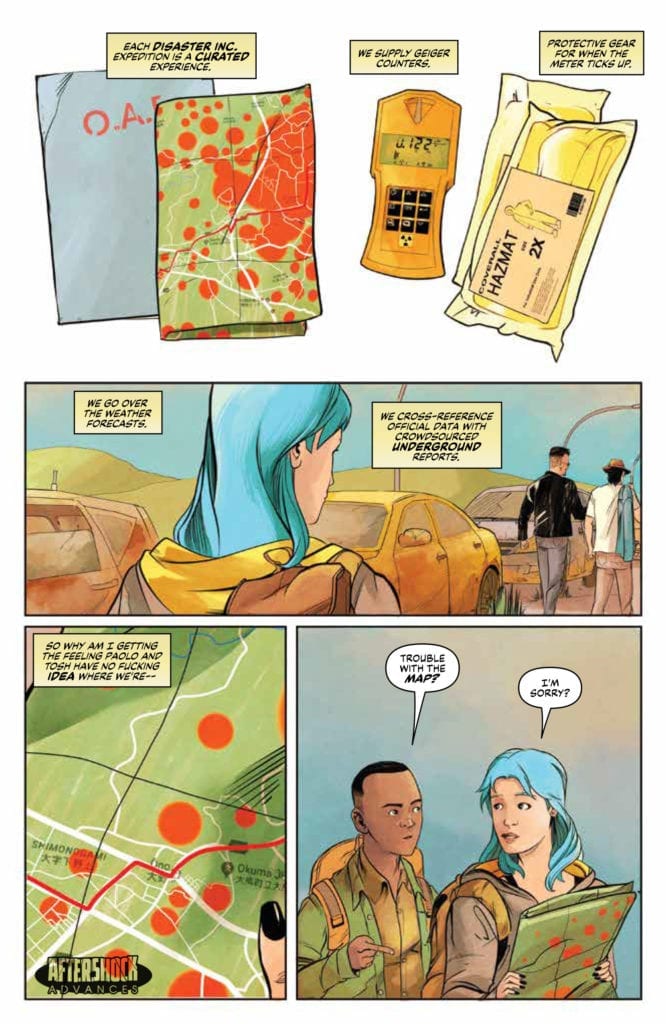
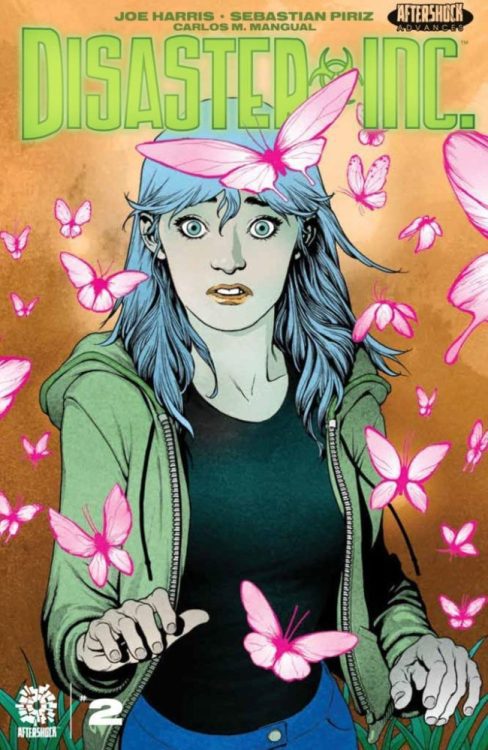
All good holidays should contain an element of learning and Disaster Inc #2, released from AfterShock Comics this week, is no different. Where the first issue introduced the characters, the second takes a look at the larger world that the underground holiday makers are entering. Expect excitement and danger as warriors from history start to catch up with the tourists of today.

Disaster inc #2
Disaster Inc #2 Credit: AfterShock Comics

Entering Fukushima

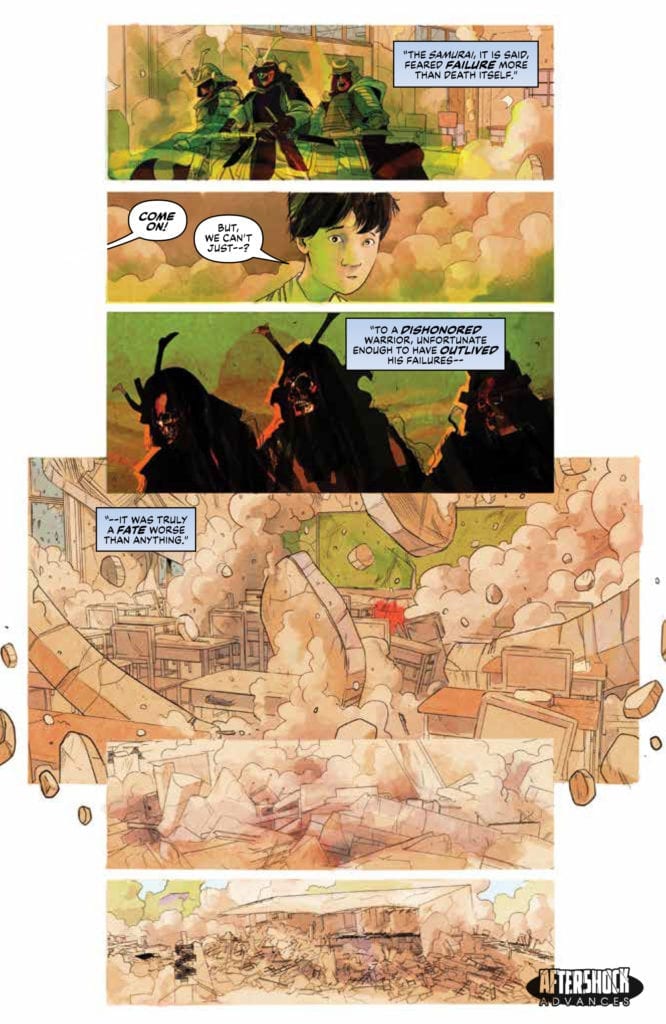
Joe Harris opens the second issue of the series with a story within a story. Flashback sequences set the scene before returning the reader to the group of Danger Tourists. These scenes are cleverly crafted to explain several elements of the narrative in one enjoyable cut away segment. The recent past merges with ancient history to inform the present. It’s as if there is a single, direct line running through time like the blade of a samurai sword.

The youthful innocence of the Fukushima children is contrasted against the ancient warrior cast and the self centred, thrill seekers of the present. Harris is able to comment on elements of modern society through the characters he has created. They are archetypes of the modern world and, like the cast of a good slasher movie, there are a few the audience are just waiting to be knocked off.

This second issue of Disaster Inc is as steadily paced as the first issue with a strong flow of plot and character development. For each ‘cannon fodder’ member of the party there is another that Harris is slowly fleshing out, creating layers to their personalities, such as the Disaster Inc employee Amorina. She has a history briefly hinted at and a healthy paranoia which creates a larger mystery in the narrative. The writer deliberately shows the reader the other characters through Armorina’s eyes so that they all appear to be hiding something.

As the narrative progresses, the sense of danger increases and the comic draws the reader forward expectantly. Recurring visuals and plot elements build up the overall story with a tension and excitement that was promised in the first issue. Harris knows exactly how much to feed the reader to keep them interested without stuffing it down their throat. This is similar to AfterShock Comics other horror themed title Bad Reception. They both share an obsession with horror tropes but also a devotion to great characters.

Disaster Inc #2 Credit: AfterShock Comics

Drawing Disaster

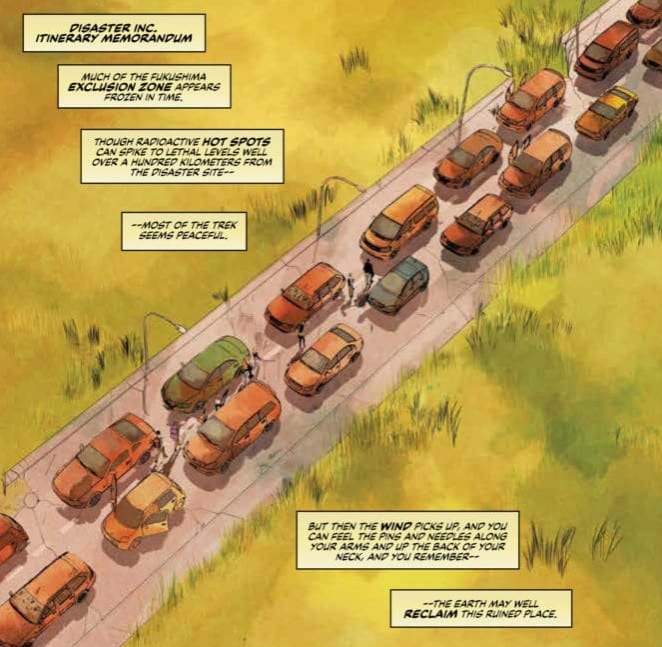
One of the most noticeable elements of this comic is Sebastian Piriz’ delicate line work and light coloring. For a horror based comic it is surprisingly bright. The majority of the action takes place during the daylight with a backdrop of clear blue skies. Piriz uses the light to pick out all of the details of the characters and their surroundings. It is only when danger looms that shadows creep in and darkness is allowed to prevail.

By creating such an open, inviting world, Piriz is able to control the atmosphere and the readers expectations. The landscape of Disaster Inc is eerie but natural, a curiosity to be wary off but not feared. It is only when the colors become more expressionist and the supernatural element is present that a sense of threat takes over. As with Harris’ pacing of the plot, the artwork draws you in under an air of safety before trapping you in a dangerous place.

Whereas the plot and art pull and push the reader through various states of fear and wonder, it is the lettering by Carlos M Mangual that adds the emotion to the comic. Mangual uses a number of clear, easy to interpret techniques to express the reactions of the characters to each other and the situations they are in.

Tense conversations are punctuated with split or stacked word balloons. These break the speeches up into pointed remarks rather than exposition overloads. There is a natural flow of conversation with plenty of back and forth. It is through Mangual’s lettering that the humour is brought out of the script and also the fear of the central cast.

Disaster Inc #2
Disaster Inc #2 Credit: AfterShock Comics

Conclusion

Disaster Inc is a very modern horror. It has a visual style that seems to contradict classic horror comics, lacking the eerie shadows and swathes of darkness, instead opting for a clearer, cleaner aesthetic. It owes more of a debt to a movie like Midsommar by Ari Aster than it does Tales from the Crypt or the Tomb of Dracula. There is a beauty to the visuals that belies the menace within the narrative. When the violence comes it will feel more shocking as a stark contrast to the bright, clear images Piriz has been feeding the reader.

The concept is fascinating, especially as there are such organisations that provide the kind of service offered in Disaster Inc. This adds to the modernity of the work, especially as the cast are a collection of twenty first century stereotypes. We can see the real world and it’s population reflected in the faces of the characters on the page. Harris is showing us the horrors that we, as a race, have created both physically and spiritually. What happens when we disrespect the past and make a sport of tragedy? Disaster Inc deals with such questions and ideas; ideas that are very relevant to the modern world.

Monkeys Fighting Robots Youtube

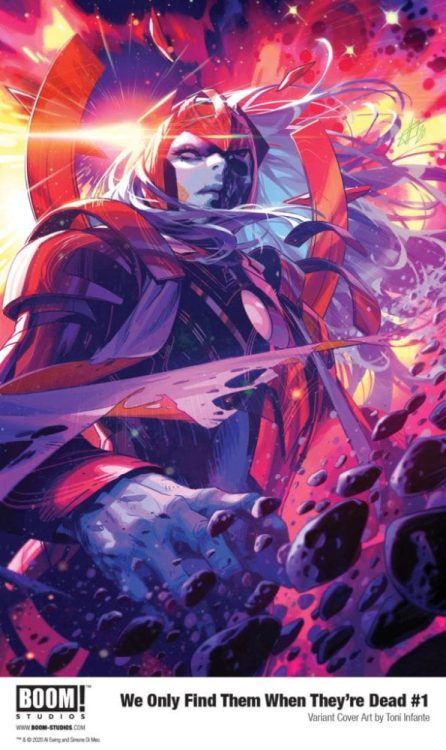
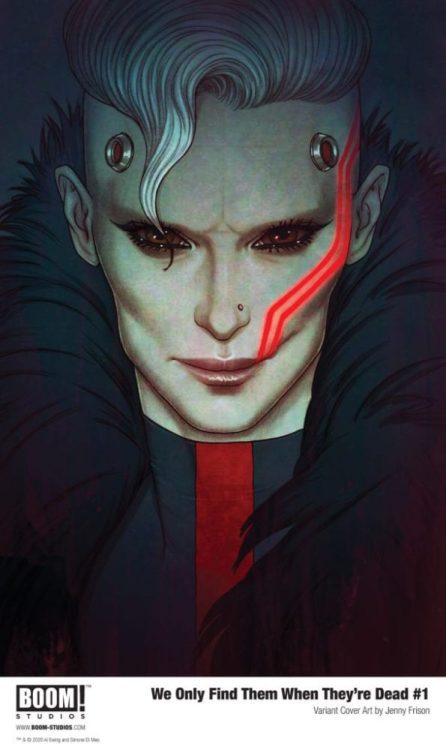
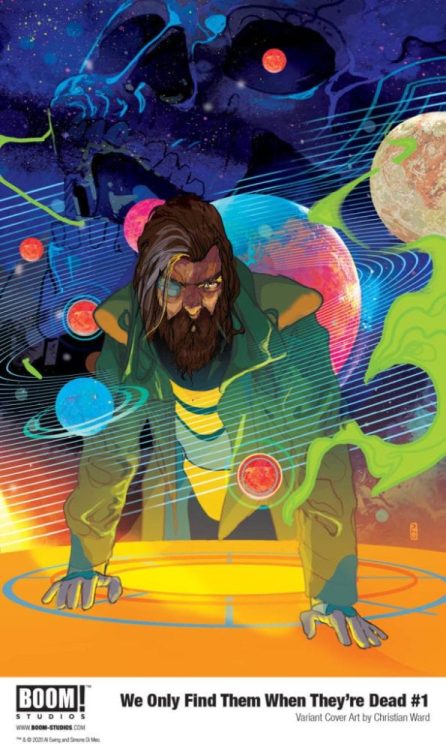
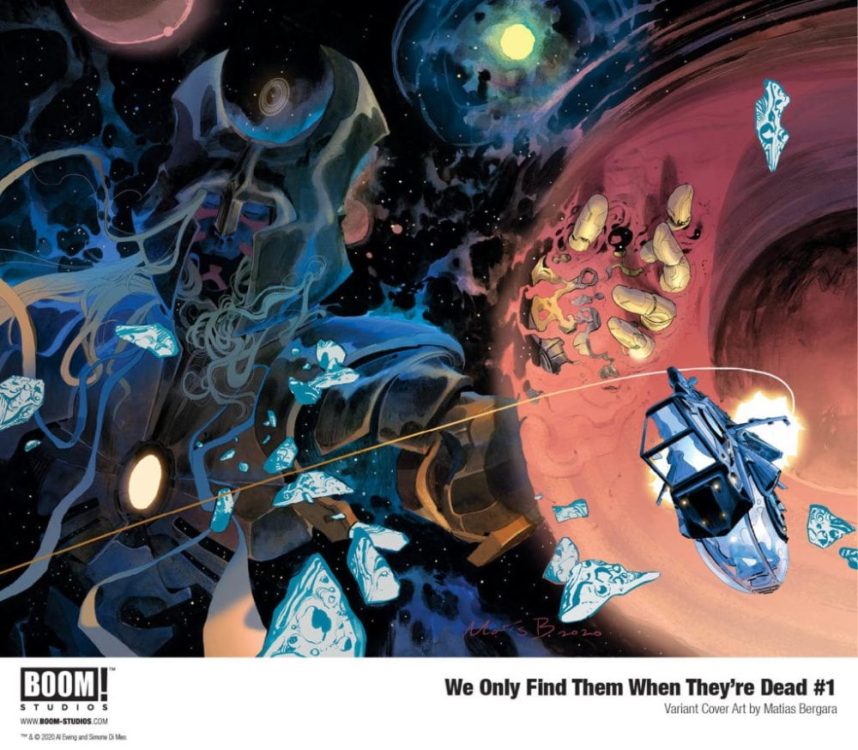
BOOM! Preview: Space Gods And Scavengers In WE ONLY FIND THEM WHEN THEY’RE DEAD #1

We Only Find Them When They're Dead #1, Di Meo cover

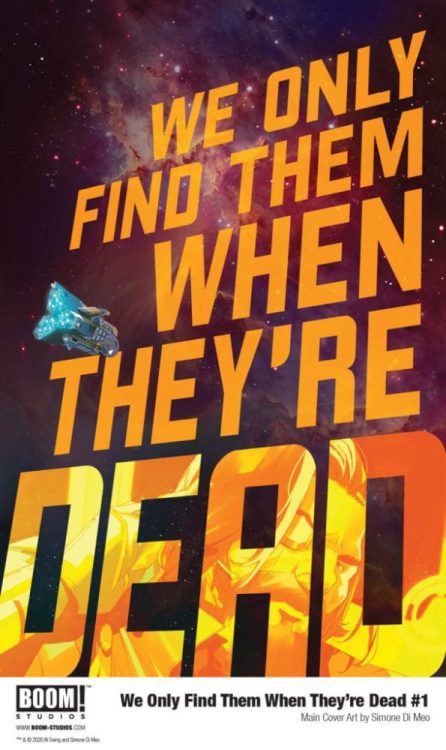
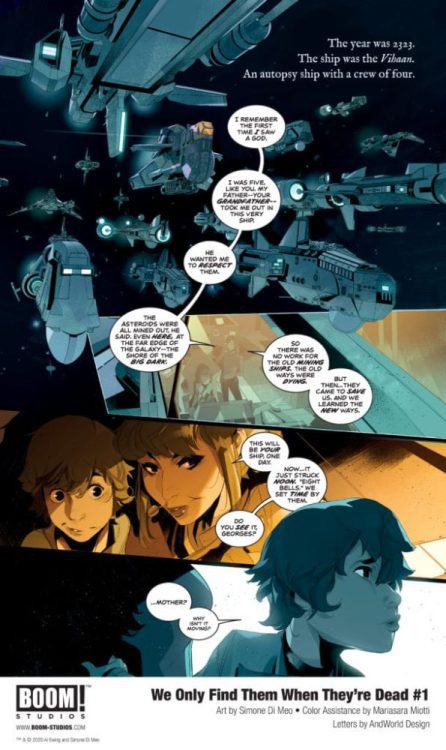
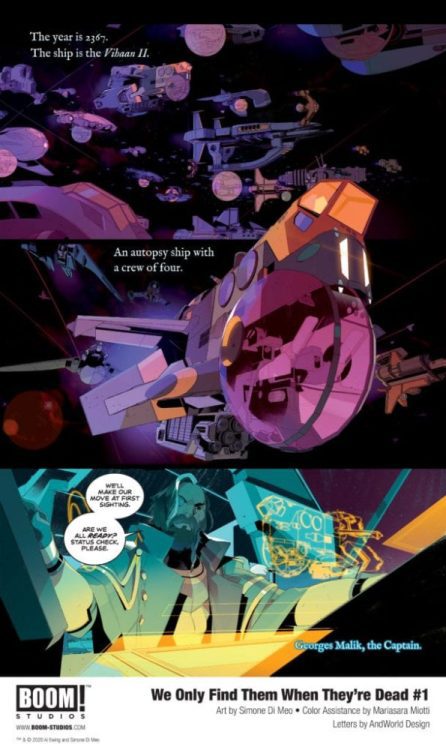
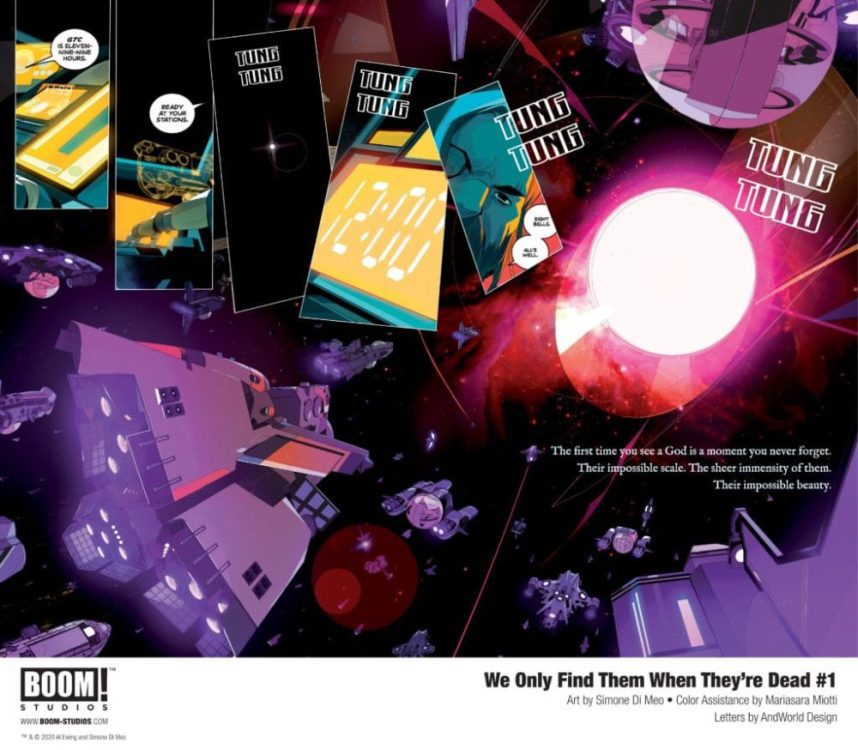
What happens when the interstellar Gold Rush of the future relies on the corpses of gigantic space gods? BOOM! Studios has just such a story for you in their early preview of WE ONLY FIND THEM WHEN THEY’RE DEAD #1, available through retailers on September 2nd.

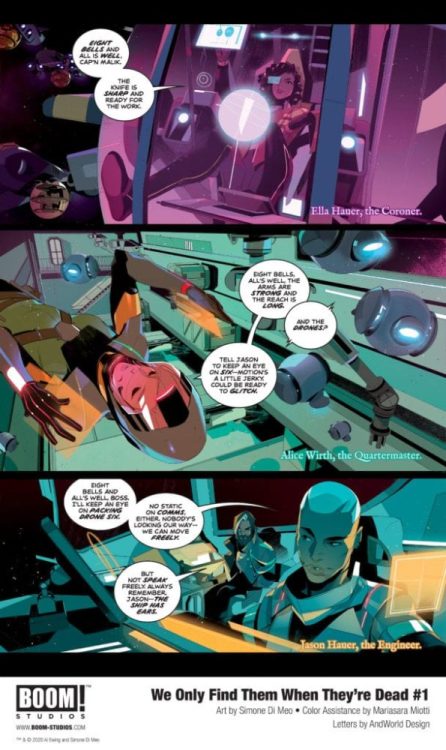
Written by Al Ewing and drawn bu Simone Di Meo, WE ONLY FIND THEM WHEN THEY’RE DEAD #1 follows “Captain Malik and the crew of the Vihaan II [as they] harvest resources from the giant corpses of alien gods found on the edge of human space. While other autopsy ships race to salvage the meat, minerals, and metals that sustain the human race, Malik sees an opportunity to finally break free from this system by being the first to find a living god.”

You can check out a collection of preview pages and get the full synopsis in BOOM!’s official press release below.

Are you interested in sci-fi comics? Does this new title from BOOM! interest you? Let us know what you think in the Comments section, and please share this post on social media using the links below.

Your First Look at WE ONLY FIND THEM

WHEN THEY’RE DEAD #1

From BOOM! Studios
 
 “A thing to provoke awe, fear, and wonder.” – Kieron Gillen, ‘Once & Future’

“Sign me the hell up.” – Jason Aaron, ‘Thor’

LOS ANGELES, CA (August 3, 2020) – BOOM! Studios today revealed a first look at WE ONLY FIND THEM WHEN THEY’RE DEAD #1, a new sci-fi epic from Al Ewing (Immortal Hulk), Simone Di Meo (Mighty Morphin Power Rangers) with color assistance by Mariasara Miotti and letters by AndWorld Design, about one man’s unrelenting quest throughout space to discover the truth—no matter where it takes him. Available in stores September 2, 2020.

Captain Malik and the crew of the Vihaan II harvest resources from the giant corpses of alien gods found on the edge of human space. While other autopsy ships race to salvage the meat, minerals, and metals that sustain the human race, Malik sees an opportunity to finally break free from this system by being the first to find a living god. But Malik’s obsession with the gods will push his crew into danger at the darkest reaches of space—unless the rogue agent on their trail can stop them first…

WE ONLY FIND THEM WHEN THEY’RE DEAD #1 features main cover art by series artist Simone Di Meo (Mighty Morphin Power Rangers) and variant covers by fan favorite artists Toni Infante (Mega Man: Fully Charged, The Red Mother), Christian Ward (Invisible Kingdom), Matías Bergara (Coda), and Jenny Frison (Something is Killing the Children).

WE ONLY FIND THEM WHEN THEY’RE DEAD is the latest release from BOOM! Studios’ eponymous imprint, home to critically acclaimed original series, including Once & Future by Kieron Gillen and Dan Mora; Something is Killing the Children by James Tynion IV and Werther Dell’Edera; Faithless by Brian Azzarello and Maria Llovet; The Red Mother by Jeremy Haun and Danny Luckert; Alienated by Simon Spurrier and Chris Wildgoose; King of Nowhere by W. Maxwell Prince and Tyler Jenkins; Wynd by James Tynion IV and Michael Dialynas; and Seven Secrets by Tom Taylor and Daniele Di Nicuolo. The imprint also publishes popular licensed properties including Joss Whedon’s Firefly from Greg Pak and Dan McDaid; Buffy the Vampire Slayer from Jordie Bellaire and David López; Angel from Bryan Edward Hill and Gleb Melnikov; and Mighty Morphin Power Rangers from Ryan Parrott and Daniele Di Nicuolo.

Print copies of WE ONLY FIND THEM WHEN THEY’RE DEAD #1 will be available on September 2, 2020 exclusively at local comic book shops (use comicshoplocator.com to find the one nearest you) or at the BOOM! Studios webstore. Digital copies can be purchased from content providers like comiXology, iBooks, Google Play, and Madefire. 

For continuing news on WE ONLY FIND THEM WHEN THEY’RE DEAD and more from BOOM! Studios, stay tuned to www.boom-studios.com and follow @boomstudios on Twitter. 

Monkeys Fighting Robots Youtube

INTERVIEW: Inside THE KISSING BOOTH With Cinematographer Anastas Michos

Netflix has no shortage of hit series and movies on its streaming platform, and in 2018, The Kissing Booth became one of its most viewed movies thanks, in part, to cinematographer Anastas Michos.

The Kissing Booth and The Kissing Booth 2 are fun, energetic teen romantic comedies that tell the story of Elle Evans (Joey King) as she navigates life during high school with lifelong best friend Lee Flynn (Joel Courtney). Their friendship becomes strained when Elle and Lee’s older brother Noah (Jacob Elordi), a senior, start falling for each other. That is in the first movie anyway. A sequel, The Kissing Booth 2, released on Netflix on July 24, 2020, and there may be more on the way.

PopAxiom spoke with Anastas about his career as a camera operator turned cinematographer.

Defining Emotion

Anastas is a first-generation American, born to a Greek father and Russian mother. Movies weren’t a focus initially for him. “It was not until my late teens or early 20s,” he said, “that I thought about the people who made movies, and there must be a way for me to do so.”

Fortunately for Anastas, his immediate community yielded the first step toward a life in showbiz. “I had a next-door neighbor who was a documentarian. I was a young man of 22 years old, and he needed help pulling cables.”  The rest, as they say, is history.

Soon after, Anastas got involved with a television station as an editor and camera person shooting news stories. “I enjoyed that kind of storytelling,” he said.

Anastas elaborates on the knowledge gained from his experience as a newsman. “That kind of practice of shooting your own story, editing it, and getting it on air was great training for ultimately narrative type of work.”

Anastas made a friend early on, Garrett Brown, the inventor of the steadicam. “He became a mentor.” Anastas learned to operate the steadicam and co designed some aspects of the skycam and segued his way into feature films first as camera operator and then as a Director of Photography.

Anastas’ filmmaking education was heavily “hands-on.” “A lot of it was reading, and a lot of it was looking at films. I didn’t go the traditional film school route, but that is not to say I wasn’t surrounded by huge mentors that I could emulate and who took me under their wing.”

Having an interest and passion in a subject is important, but understanding a craft on as many levels as possible is essential. “I read every book that anybody ever wrote about film,” said Anastas, “and because of that, I had a background in the knowledge and theory, not just the practical.”

Anastas didn’t limit his education to just the camera or cinematography. He read books on directing, writing, editing; the entire process. “I think to be a cinematographer, you need to be a filmmaker, and to be a filmmaker, you have to understand the juxtaposition of images.”

Making movies for Anastas is much like music for him in that they are both “defining emotion over time.”

kissing booth-film-netflix

About The Kissing Booth

Perusing Anastas’ filmography reveals an eclectic body of work. He’s worked on projects like Eddie Murphy: Raw, Man on the Moon with Jim Carrey, Mona Lisa Smile with Julia Roberts, ABC’s hit TV show Quantico, and the terrifying Purge film franchise (The First Purge, The Purge: Election Year). How did he become part of the team for The Kissing Booth? “I was in South Africa, shooting a movie called The Empty Man. It’s a very dark film. One of the things that affect me as a filmmaker is the subject material. You go to work every day dealing with dark subjects … it affects you.”

For Anastas, “If you’re not affected emotionally, then it means that you’re not connected emotionally.”

In Africa, Anastas met up with an old friend. “Michele Weisler, a producer I have known for many years, happened to be in South Africa,” said Anastas. “We had dinner and she mentioned this teen movie that she was doing. I thought ‘Oh, my God, a romantic comedy, how great is that? Sign me up!’”

Michelle didn’t believe Anastas at first, but he insisted and met the director, Vince Marcello, “… in Cape Town, where we had the closest version to Thanksgiving Dinner that we could. We got along very well. Our sensibilities were the same. Our humor was the same.”

Anastas read the script for The Kissing Booth and chatted with Vince, who then offered him the gig.

Pucker Up

After a short Christmas hiatus, Anastas went back to South Africa to shoot “this little film” [The Kissing Booth]. “We had two cents to rub together, and we put out a sweet movie. Little did we know it would become this international phenomenon,” he said.

The Kissing Booth is one of Netflix’s most-watched movies on the platform, alongside hits like Birdbox with Sandra Bullock and Extraction with Chris Hemsworth. “One might dismiss films of that kind as cake-walks,” said Anastas, “but Vince and I had the same sensibilities, and if you’re invested in it, you raise the work to the level of everything else you do.”

Anastas admits teen rom-coms are not his genre, but as filmmakers, the job entails telling a story. Anastas attributes the success of The Kissing Booth to that fundamental fact. “That’s why I think it’s so popular because it holds up as storytelling.”

Anastas’ career put him behind the camera for many franchise films such as The First Purge and Texas Chainsaw (2013). What is the mindset going into sequels? “To some degree, there’s always a desire to change things up. But they are franchises for a reason. People respond to the first one in a certain way. Rather than change for change’s sake, I think what Vince and I did was ask ‘What worked?’ and how can we improve that?”

City Lights

Anastas is a veteran in the film industry with a few decades under his belt operating cameras. He discusses two critical changes over time. The first is obvious “… technology …” but Anastas brings up another key factor.  “The environment has changed. When I was growing up, cities were not orange. We had white streetlights. When you came out of warm incandescent indoor lighting into that white light, everything shifts blue,” he said.

However, the seldom discussed technology of city lighting evolved. “The advent of sodium vapor light changed the color of our cities to orange. If you look at a map of the world, you’ll see that most of it is orange lights.”

The evolution continues, and new technologies change. “Now, LA has gone to LED lighting, which is now cold. So, you try to shoot a classic, noir scene outside, WITH blue or green fluorescent light coming out of the industrial windows gives the lack of orange contrast gives it a different look.”

Anastas brings up another factor that affects the way cinematographers create. “It’s also cultural. If you look at a film from Mexico or Brazil, they hit the United States with a color palette that we’re not used to, this orange-y, gold with a lot of green in the blacks. If you look at a film that came out of China in the the early 2000s, Crouching Tiger, Hidden Dragon or Raise the Red Lantern for example, the sudden reds contrasting against pale whites, and the golden and the golden ambers in the practical lights created a palette that we had not seen.

anastos michos-kissing booth-film-netflix

Wrapping Up

Coming up as a camera operator, Anastas worked under many supremely talented cinematographers who he credits as being part of his creative DNA. “Sven Nykvist (Sleepless In Seattle, Cries, and Whispers), Haskell Wexler (61*, Bound For Glory), Philippe Rousselot (The Nice Guys, Sherlock Holmes), and John Seale (The English Patient, Mad Max: Fury Road) are some of the DPs I have worked with.”

Anastas draws on those past working relationships as a DP today. “Every situation is a complex puzzle that needs to be solved to make things look a certain way and be consistent.”

Even with decades of experience, Anastas continues to seek new challenges to push his creativity to new places. “I’d love to do a boat movie. I’ve never done something like that before; something shot on the water. That would be a fun challenge. A western would be a challenge in a completely different way.”

The Kissing Booth 2 is out now on Netflix, and a third installment is set to come out in 2021. So, what’s next for Anastas? “There’s a film by the name of The Empty Man directed by David Prior with James Badge Dale. It’s a very dark story which is part of the Boom! Studios comic book franchise.”

Is The Kissing Booth 2 on your watch list?

Thanks to Anastas Michos and Backlight Public Relations
for making this interview possible.

Want to read more interviews? CLICK HERE.

Monkeys Fighting Robots Youtube

Exclusive Interview: Jason Howard Talks BIG GIRLS #1

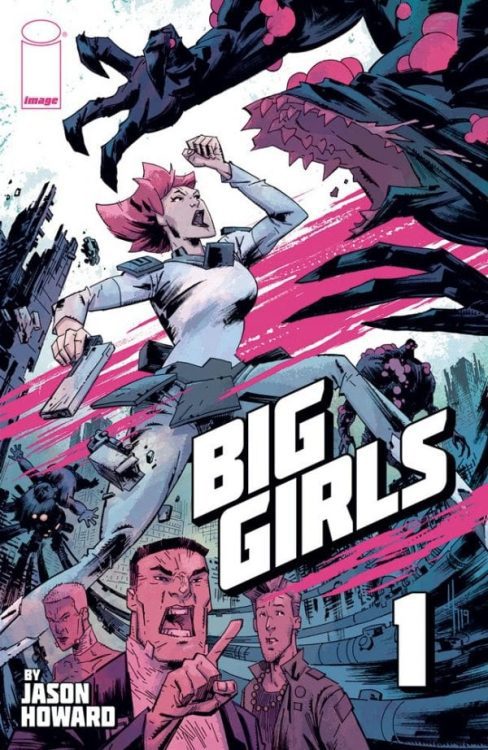
BIG GIRLS #1 hits your local comic book shop on August 12, but thanks to Image Comics, Monkeys Fighting Robots was able to chat with the artist and writer of the series, Jason Howard.

About the book:
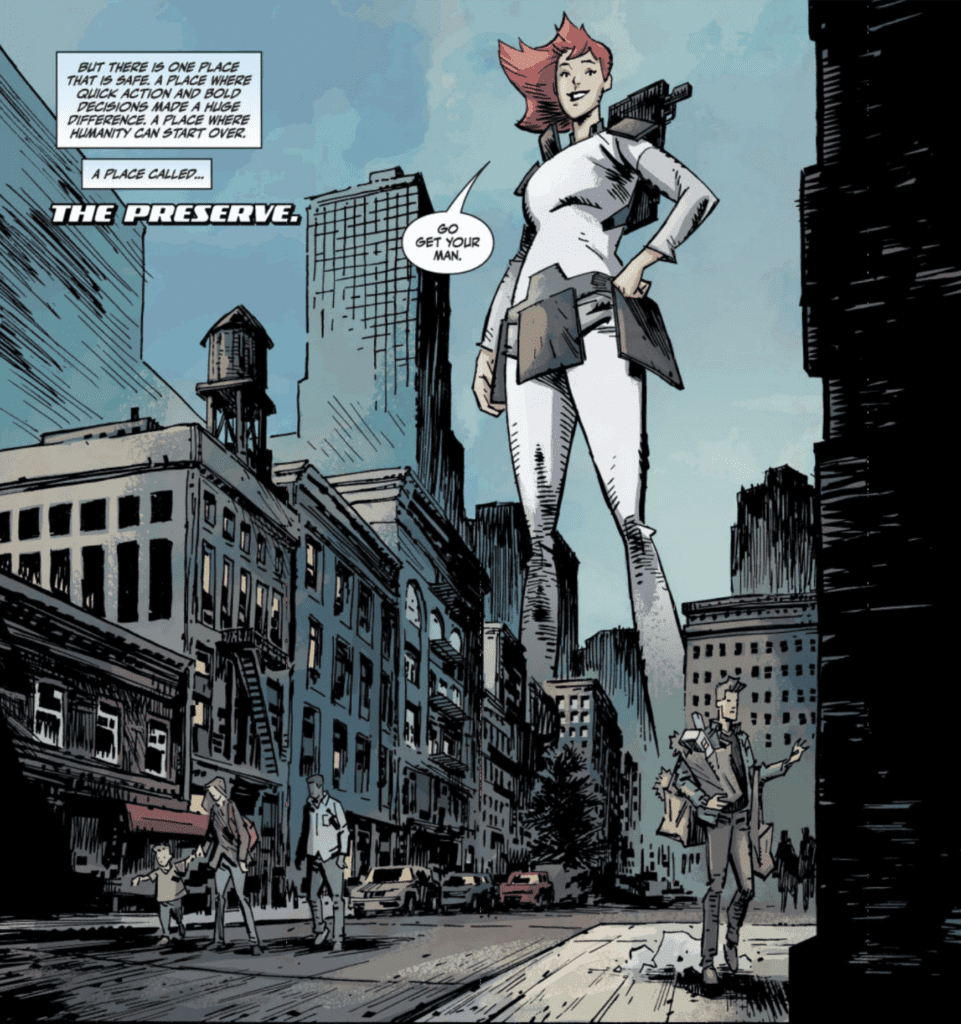
When men become giant monsters hellbent on destroying the world, only girls can stop them—BIG GIRLS. Meet Ember—she writes poetry, loves to read, and she’s a 300-foot-tall full-time monster killer! She and the other big girls are all that stand in the way of our world’s complete annihilation!

BIG GIRLS #1 is insane in all the best ways, check out our advance review BIG GIRLS #1 is a Colossal Good Time and OPED article BIG GIRLS And Relatable Monsters.

Exclusive Interview: Jason Howard Talks BIG GIRLS #1

MFR: In the first two pages, you establish the back story of BIG GIRLS, how much world-building was involved to flush out the story and characters?

HOWARD: Quite a bit. I developed the whole backstory and how the world became as it is. Early drafts had more of this backstory, but I cut most of it as the story I wanted to tell was not HOW the world became this way, but rather to use the setting to explore a character living in this kind of world. As the series continues, more of the history might be touched on, but just like real people don’t always know the reasons how or why the world is the way it is, the characters in Big Girls don’t necessarily know everything.

MFR: What was the process like creating the monsters of the BIG GIRLS Universe?

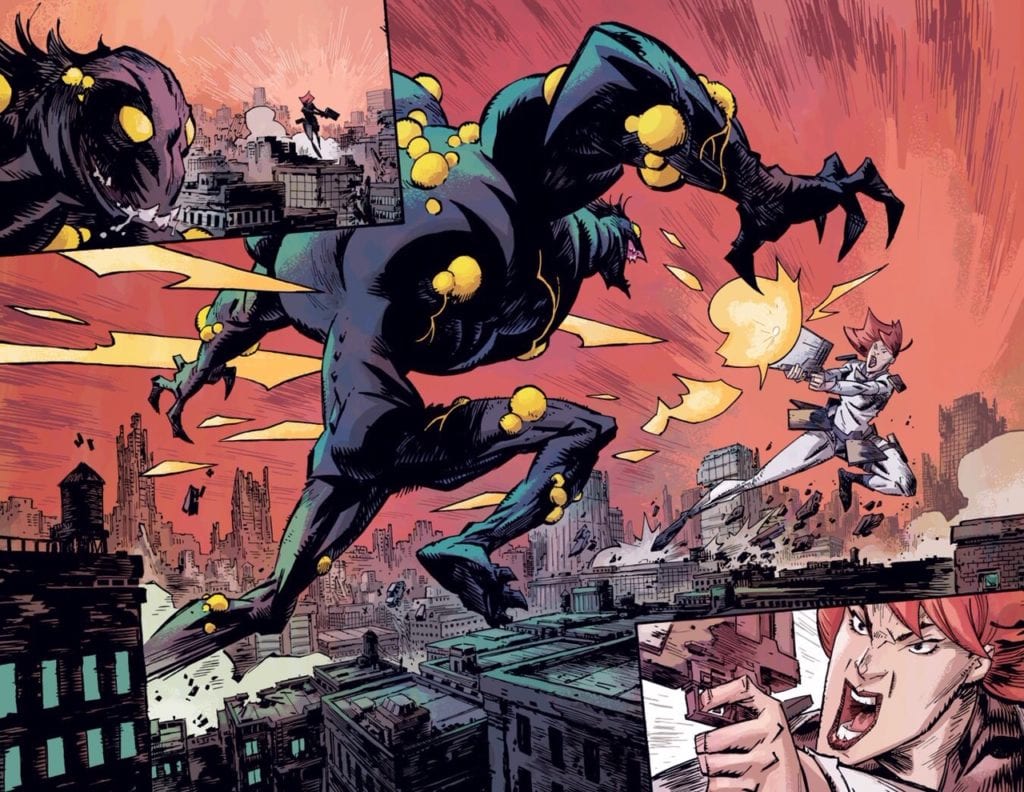
HOWARD: A tried several directions for the look of the monsters, so the process was mostly a lot of sketching and then swearing when things didn’t turn out right away. Eventually, I swore my way to a look I was happy with from a design place and would be something fun to draw. My goal was to find a look that contrasted against the design of the Big Girls. So while the Girls’ uniforms are based on square shapes, the monsters’ design theme is a circle. Keep it simple!!

MFR: BIG GIRLS is a book that the reader can go as deep as you want with thematic elements and meaning. How do you balance keeping the book genuine with a message and not becoming too preachy?

HOWARD: I don’t know. For me, it’s been about balancing my artist and writer sides. As an artist, I really just want to draw cool stuff! So giant women battling monsters and huge destruction satisfies that. But from a story place, I want to have a little more meat and meaning, so asking questions about some of the bigger issues in the world satisfies that. I try to bring it all together in a satisfying way, and my hope is that a reader can enjoy both parts of the story. But ultimately, this is a comic book first and my intent to entertain!

MFR: I have twins that a little over two-years-old. After reading page 11 of the first issue, I wanted to punch you in the face, not really, but you made me angry. When you set up a compelling scene like that, do you think about the reader’s emotional impact?

HOWARD: Sorry… It was a tough scene to write. I do think about the readers, but my main concern is with the characters’ emotional impact. I hope readers connect with the story, but if I second guess story choices too much, I don’t think I would be able to write honestly. Some of my favorite stories have bad things happen to characters, and the appeal to me is not that a bad thing happened, but how those characters react and the journey those big events set them on.

MFR: When you deal with large scale characters, how does that change your panel design?

HOWARD: That was a big appeal of this idea for me as an artist and a fun aspect of drawing the book. Trying to find a way to use the size of the characters to make events feel big is something I try to bring to each page. It affects the panel design because I want every page to be a double-page splash! I didn’t do that, but I do try to use my big panels and splash pages in a way that takes advantage of the characters’ size.

Exclusive Interview: Jason Howard Talks BIG GIRLS #1

MFR: I didn’t realize how much I would notice the sky in BIG GIRLS #1, the blue sky transitioning to a red/orange sunset worked really well. Can you talk about the color palette for the first issue?

HOWARD: Thanks. Color design is something I’ve always felt is important; I’m glad it worked for you. Color is a big part of storytelling, and it can really create a sense of place and mood. For example, when the colors shifted to the red/orange scheme, I wanted to show two things. First, to give a sense that some time had passed since the events previously in the issue. Second, because we are moving into an action scene, I wanted a color combination that felt more dynamic and energetic. I dislike the dull, ‘realistic’ coloring that is sometimes used in comics. I much prefer coloring that prioritizes design, mood, and storytelling.

MFR: My favorite page from the first issue is the double-page spread battle scene; there is movement and emotion. What techniques did you use to make that happen?

HOWARD: I wanted that spread to represent the visual hook of the series, a giant soldier woman fighting a giant monster in a ruined city. So capturing the energy of their fight and scale was my priority. And if you like that spread, just wait for issue 2!

MFR: There are so many options fighting for our entertainment attention, how important is it to hook the reader with the first issue?

HOWARD: Pretty important!! Let’s be honest; if no one buys the book it will make it hard for me to continue telling this story. 🙂 As a life long comic book fan I feel a responsibility to do the best work I can, I think this is a series that has a lot of surprises and will be an exciting, entertaining book. Probably everyone should just cancel their Netflix today! Big Girls has you covered!

MFR: Your panel design goes back and forth with white borders and full-bleed. What message are you trying to convey with the white space?

HOWARD: Often, it’s more about the visual impact that the bleeds can have. Really I just try to have fun with the layouts, and I like to use white space to make things pop, and the bleeds to give the impression of density or things “too big for the page.” Or I might use them if a location changes within a page, anything to help the reader feel like they are in a different place.

MFR: Godzilla is mentioned in the marketing material for BIG GIRLS #1, what is your first memory of Godzilla and how much of an impact did it have on you?

HOWARD: Godzilla has always been a favorite, but what I really loved was big robot animated shows like Voltron, Transformers, Robotech, and Evangelion. While there may not be giant robots in Big Girls, those visuals and ideas are built into the stuff that I find to be cool, and a definite influence on the series.

MFR: Thank you for your time and best of luck with BIG GIRLS #1.


Will you add BIG GIRLS to your pull list? Comment below with your thoughts.

Big Girls #1 Cover
Big Girls #1 Credit: Jason Howard/Image Comics
Monkeys Fighting Robots Youtube

Marvel Preview: Shang-Chi Takes On All Comers On The Cover Of SHANG-CHI #1

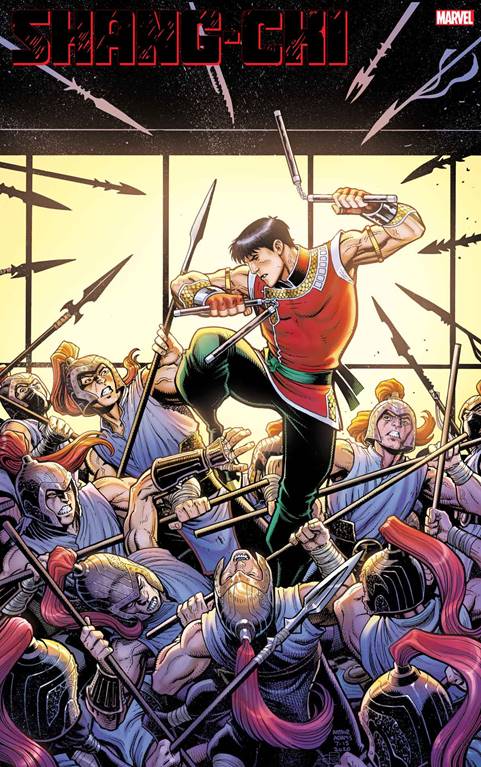
Shang-Chi #1, Adams cover

With production resuming shortly on the Shang-Chi film, Marvel Comics is anxious to build anticipation for the titular character. Now, Marvel released an early look at the cover for SHANG-CHI #1 by artist Arthur Adams to get fans hyped for the in-production film.

Says Marvel of the series due out this September: “Shang-Chi returns this September in a brand new series written by Eisner Award-winning writer Gene Luen Yang (American Born Chinese) with incredible art by Dike Ruan (Spider-VerseBlack Cat) and Philip Tan (Uncanny X-Men).”

You can check out the new cover and read all about the series in the official Marvel press release below.

Are you a fan of Shang-Chi? Does this cover, showcasing a new uniform, get you excited for the character’s return in a new series? Let us know what you think in the Comments section, and please share this post on social media using the links below.

THE MASTER OF MARTIAL ARTS BATTLES AN ARMY IN ARTHUR ADAMS’ SHANG-CHI #1 COVER!

New York, NY— July 27, 2020 — Shang-Chi returns this September in a brand new series written by Eisner Award-winning writer Gene Luen Yang (American Born Chinese) with incredible art by Dike Ruan (Spider-VerseBlack Cat) and Philip Tan (Uncanny X-Men). This all-star creative team will take Marvel’s greatest fighter on an epic tale of family, betrayal and justice as they launch an exciting new chapter in the legend of Shang-Chi. To commemorate Shang-Chi’s latest adventure, industry legend Arthur Adams has turned out a stunning cover depicting the longtime Avenger bravely facing off against a horde of warriors single-handedly! Outfitted in his new costume designed by superstar artist Jim Cheung, this action-packed cover is just a taste of the fight scenes you can expect as Shang-Chi embarks on a quest to discover long-hidden truths about himself, his family, and the secret society he thought he could leave behind… Check out Arthur Adams’ cover below and don’t miss SHANG-CHI #1 when it hit stands this September! For more information, visit marvel.com.

Shang-Chi #1, Adams cover

Monkeys Fighting Robots Youtube

HaKashaph: The Witchy Jewish Potential of BtVS: WILLOW #1

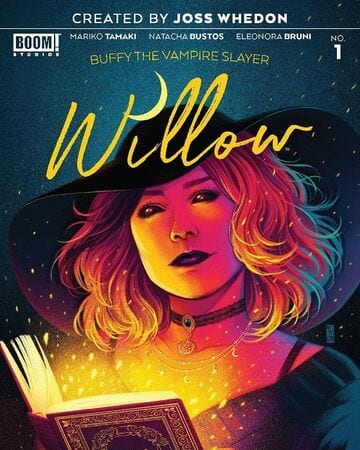
Issue Cover

Joss Whedon has created myriad iconic female characters throughout his career and yet, besides Buffy, I would defy anyone to find a Whedonverse character more beloved than Willow Rosenberg. She’s the ideal friend and sidekick; she’s loyal, loving, intelligent, and physically strong in her own right. It’s easy to fall under the spell of this red-haired lesbian (or bisexual?) Jewish witch.

It’s been seventeen years since Buffy the Vampire Slayer ended, and still, fans obsess over the nerdiest member of the Scooby Gang. While the enduring conversation about Willow revolves around her addiction storyline and gayness, an understated yet key aspect of the character is her Jewishness.

In the new spin-off series from BOOM! Studios, the creators can and should mine Willow’s Jewish identity. Mining her identity would not only bolster representation but broaden the character, taking her in a new direction. After all, Buffy was not created in a culturally-unaware vacuum. It was both sub-textually and textually feminist in correspondence with political movements of the period.

Furthermore, the series premiered during a new epoch of Jewish representation on television. Comedies like Seinfeld and The Nanny exposed folks from all over the world to Jews and Judaism. So, with or without the influence of producer and Jew Gail Berman, Willow Rosenberg’s Jewishness was most likely a deliberate response to the zeitgeist.

Singularly Jewish

Similar to television, the world of comics has always had a prominent Jewish presence behind the scenes. Unfortunately, this presence did not transfer to the comic book characters themselves until around ten years ago when writers such as Dan Slott (The Thing) and G. Willow Wilson (Ms. Marvel) created religious Jewish heroes.

Whedon himself said that Willow’s Jewishness and sexual orientation weren’t big issues. I’ve interpreted this statement as expressing a desire to normalize queerness and Jewishness on TV. But Willow is not presented as a religious Jew either in the show or the comic books. Can one normalize or even claim to represent a culture or belief without showing a character practicing and otherwise participating in it?

As Lisa Liebman noted in her article for Vanity Fair, a recent trend in Jewish television grew in response to a rise in anti-Semitic hate crimes across America. What’s interesting about the trend is that while there are shows representing secular Jews (Crazy Ex-Girlfriend), we have more shows than ever before representing religious Jews (Unorthodox, Shtisel). I don’t know whether the creators of these shows had any specific intent to normalize Orthodox Jews, but they found a way to make what’s “singularly Jewish [into something] broadly appealing.” Comic book writers have the same opportunity.

Jewitch

Willow does not necessarily need to be ret-conned as a Chassid or a committed socially-conscious Reform Jew to check off some representation box. Nonetheless, her Jewishness must go beyond a few quips about not “worshiping Santa.” Consider this: there is a movement called Semitic Neopaganism made up of “Jewitches.” According to Witchipedia, Jewitchery is either the “practice of witchcraft by a Jewish person or the integration of Wiccan spirituality with Jewish culture.” What if Willow took to some Jewitchery, or met a self-described Jewitch?

Witchcraft and Judaism go way back, anyway. Parts of the Bible unequivocally condemn witchcraft (mahashefah), yet Moses and Aaron do some things that would qualify as spells or magic. Thus, an exploration of Judaism and witchcraft could yield plenty of conflict and questions about identity.

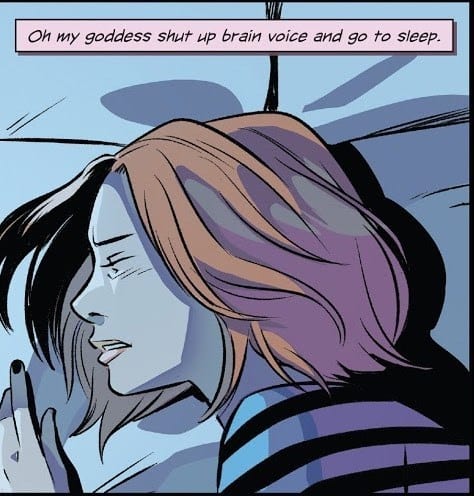
Willow isn’t at peace in England.

As Willow #1 is the beginning, no Jewishness or much witchcraft has been brought up. Willow has left Sunnydale to study abroad in England, a move motivated by the heartbreaking events of the Buffy the Vampire Slayer: Hellmouth arc. She’s on a solo journey of self-discovery and freedom from literal hell. Will her journey lead her to a discovery of Jewitches? Only Mariko Tamaki and Boom! Studios’ creative team can tell.

Universal And Particular

By incorporating the religion and culture in Willow’s arc in some way, the writers can normalize a certain kind of Jewishness without compromising other aspects of the character. Religious folklore, ritual, and holidays may also serve the plot.

For example, in Issue #8 of The Thing‘s Idol of Millions arc, Ben Grimm gets the bar mitzvah he never had. Errors in representing the tradition notwithstanding, the issue uses Judaism to explore emotional backstory that perhaps previously wasn’t addressed. Most importantly, this coming-of-age ritual connects his adaptation to life as The Thing to a religious transition. What’s more, none of this comes at the expense of the character’s trademarks. Slott proves here that religion can “bolster storytelling and… identity”, to use the words of G. Willow Wilson.

I believe that many non-Jewish or simply non-religious creatives are too scared even to try developing anything seriously religious because they don’t think such a story is universal. They may also fear their project being labeled Jewish/Christian/Muslim, which would then somehow beholden them to cater to that demographic.

But these concerns prevent comic book creators from interpreting religion for plot and character. Even in the Year of Our Lord 2020, when politics and fiction have entered into a toxic Spike/Buffy relationship, Willow can be made Jewish (or a Jewitch) without the burden of social commentary.

Monkeys Fighting Robots Youtube

Review: BROKENLAND #2 Is A Heaping Pile Of Surreal Entertainment

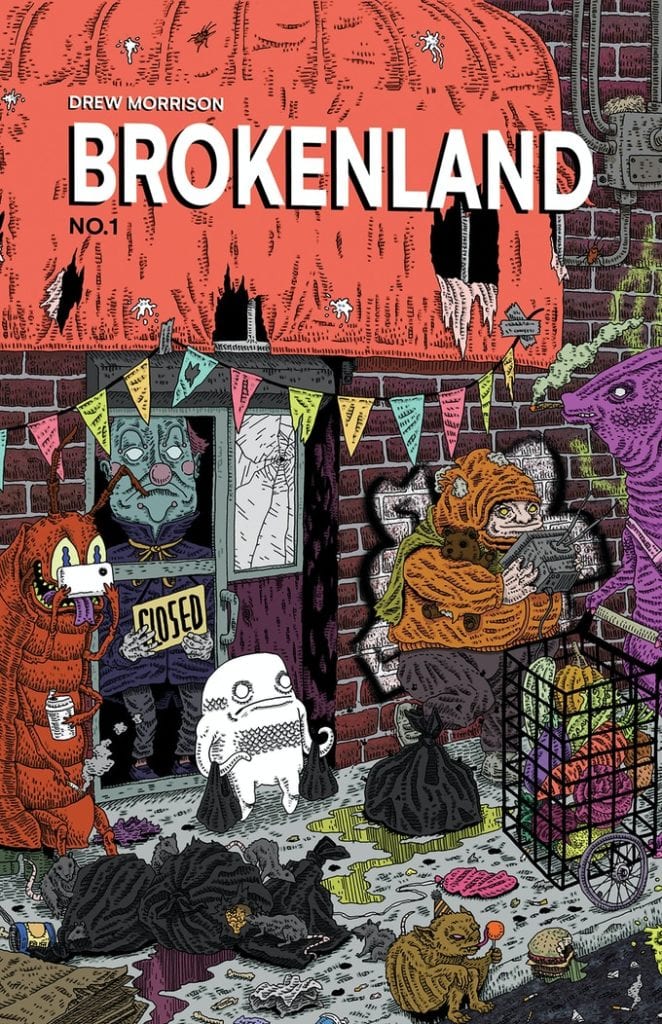
What is Brokenland, you ask? It’s a world that’s just a little off, filled to the brim with trash and muck and grime. It’s home to a variety of creatures (Beings? Monsters?) of varying shapes, sizes, and colors. It’s all unsettling. And it all hits a little too close to home.

Brokenland #2 is written, illustrated, and colored by Drew Morrison. The book is currently being funded on Kickstarter.

brokenland 1 cover

Story

BROKENLAND is a dialogue-free series written, drawn, and colored by Drew Morrison. It is a comedic story of growth, change and the growing waste problem. It takes place in a tough city populated by all manner of weirdos and centers around Meeso, a timid creature whose intentions often go overlooked. Meeso would like to do some good but isn’t sure where to start. In this first issue, several events offer a path.

The first thing you’ll notice when skimming the first few panels of Brokenland is the lack of dialogue, or text for that matter. ‘Lack’ is probably the wrong choice of words, however, as the story is anything but.

There’s a lot going on in this book, both in the calamitous world being displayed, as well as in what message writer Drew Morrison is trying to convey. In the middle of it all is Meeso, a pale, amorphous character who is trying to fit into the world around him, by literally changing its form to adapt to any given scenario. Meeso serves as the reader’s vessel, roaming through the upheaval, attempting to bring some optimism to the peculiar beings it comes across via sweet treats.

Though you’re not getting any dialogue or captions here, you’re able to pick up on the narrative and Meeso’s intentions fairly easily, which is a testament to Morrison’s skill as a visual storyteller.

Art

Morrison relies solely on his artwork to tell the story of Meeso in Brokenland — and he sticks the landing. But the artwork tells way more than simply the narrative. On the surface, the pages just seem cluttered and ridiculous with oblong creatures, and grime-laden backdrops. It’s an array of absurd colors and textures that can easily come across as overwhelming, and downright disturbing.

But as mentioned earlier, it all hits a little too close to home. Meeso is trying to navigate through this calamity depicted in the artwork. It’s very much a surreal interpretation of scrolling through a Twitter feed nowadays. And Morrison was able to capture that anxiety into compelling artwork with layers of context.

Conclusion

You can support Morrison and Brokenland #2 by helping fund the Kickstarter. For more information, visit the Brokenland website, or follow Drew on Twitter and Instagram.

Are you an indie creator with a recently published comic book, or one that you’re crowdsourcingLet us know!

Monkeys Fighting Robots Youtube

Box Office Flashback: August – Near Death, Cowboys In Space, And Other Guys

Ten years ago, some other guys dominated the box office. Ten years prior, it was a bunch of cowboys in space, and ten years before that, students attempt to demystify death.

Like nearly everything on planet Earth, the box office is continually evolving. One-hundred-plus years of filmmaking provides a long, rich, and deep history to look back on. Retro reviews and analysis of old films are practically necessary full-time specialties. Month after month, films release, vying to make as much money and grab as much attention as possible. Some fall, but regardless of financial success, the lasting effect of a film on popular culture is unpredictable.

So, where does that leave past box office champs? Let’s take a look back ten, twenty, and thirty years ago at the biggest movies released in August.

1990 • Flatliners • 61.4 million

flatliners-film-1990

Kiefer Sutherland, Julia Roberts Kevin Bacon joined forces with director Joel Schumacher to explore death in the thriller Flatliners. The late film director’s signature style is all over this tense, supernatural thriller that made a respectable amount of money though likely disappointed bean counters considering the star power. Sure, Schumacher still wasn’t the guy who put nipples on the bat-suit, but he’d already made waves with The Lost Boys (starring Sutherland) and St. Elmo’s Fire. Roberts was hot off of Pretty Woman, not to mention Steel Magnolias and Mystic Pizza. Bacon was already a household name and even starred in another cult hit earlier the same year, Tremors. Sutherland had hits like The Lost Boys, Stand By Me, and Young Guns under his belt. Flatliners ultimately spawned a sequel in 2017 that even brought Sutherland back to reprise his role in a cameo.

Sutherland was so hot in 1990 that he had the #1 and #2 biggest money-making movie released in August of that year. Young Guns 2 rode off its predecessor’s success, but the wave of making westerns younger and hipper didn’t last long. Following Young Guns 2 is Darkman, a comic book-esque movie directed by Sam Raimi and starring Liam Neeson before he had those skills from Taken. Mel Gibson and Robert Downey Jr. flew planes during Vietnam for the comedy-drama Air America. Filling out the top five earners is The Exorcist III, arguably the best film in the franchise after the first one directed by the original novel’s writer William Peter Blatty.

2000 • Space Cowboys • 90.1 million

space cowboys-2000-box office

Ten years after Keifer Sutherland dominated August, his father, Donald Sutherland, took the top spot as part of an ensemble cast of legends in Space Cowboys. The film featured Sutherland alongside star and director Clint Eastwood, Tommy Lee Jones, and James Garner as four ex-test pilots sent into space to repair an old Soviet satellite. In a field dominated by big budget blockbusters and horror films, Space Cowboys was a drama comedy aimed at an older audience.

Hollow Man, the invisible man movie from Paul Verhoeven starring Kevin Bacon and Elizabeth Shue, took second place and spawned a sequel. Arguably the most memorable film from this year, Bring It On, took third place. The cheerleader battle film, starring Kirsten Dunst and Gabriel Union, is the stuff of pop-culture legend. Jennifer Lopez starred in the fourth place film, The Cell, a psychological thriller with incredible visuals from director Tarsem Singh. In the final spot is Coyote Ugly, a movie about sexy female bartenders who dance on the bar.

2010 • The Other Guys • 119.2 million

Will Ferrell-adam mckay-film-box office

Ten years ago, soon-to-be Oscar-nominated director Adam McKay directed the buddy cop comedy The Other Guys. At this point and time, anything starring Will Ferrell was box office gold and alongside him was an equally bankable star in Mark Wahlberg. The Other Guys is the fourth of five collaborations between Ferrell and McKay and the third collaboration between Ferrel and Wahlberg.

On the heels of yet another successful pairing of Ferrel and McKay was the first of three The Expendables films (so far). August 2010 proved to be a month showcasing quite a range of successful films. The power of Julia Roberts drove Eat Pray Love, a romantic drama, to third place ahead of action thriller Takers starring the late Paul Walker and Matt Dillon. Audiences danced their way to cinemas to land Step Up 3D in fifth place.

August 2020 & Predictions

COVID-19 continues to wreak havoc on industries around the world. In the US, most cinemas are closed, and drive-in screens are keeping new film releases alive. Soon, Tenet, the new action film from Christopher Nolan will light up movie screens across the world but not in the US. There’s no doubt that whenever Tenet releases it’ll be a massive hit and add another fantastic entry into the Oscar-winning directors filmography. For now, enjoy the drive-in and streaming and keep yourselves healthy and safe.

Which of these films do you still watch today?
Leave your thoughts in the comments below!

Read more from Ruben R. Diaz!

Don’t go! There’s so much more on PopAxiom!

Monkeys Fighting Robots Youtube