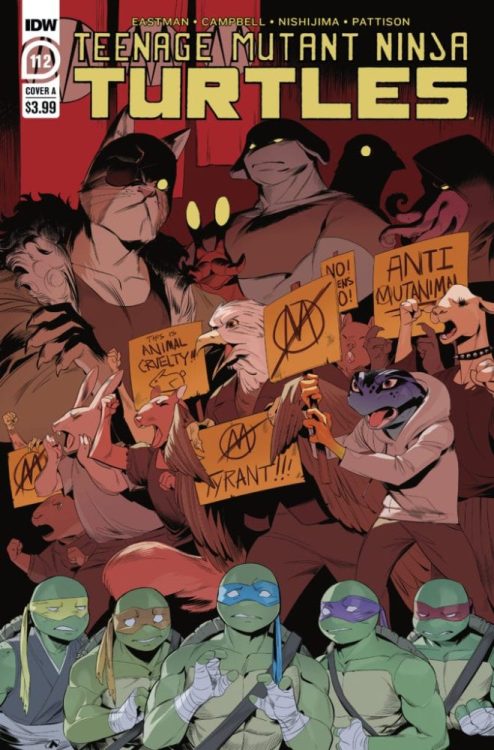
TEENAGE MUTANT NINJA TURTLES #112, available in comic book stores on Wednesday, December 9th, takes readers on a tour of the inner workings of Mutant Town’s community. Previous issues focused largely on action and espionage, so it’s refreshing to see a change of pace. We find that the people of Mutant Town want to take organizing action to address their grievances. And what ensues is a debate over what sort of political choices they will take going forward.
Story
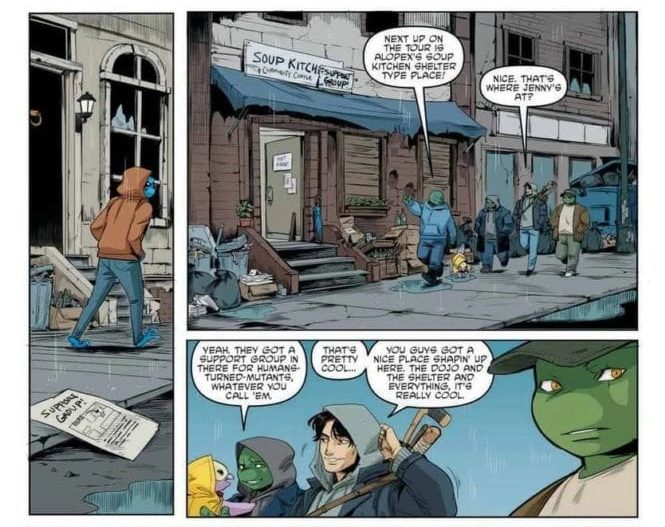
Rather than jumping into a fight scene from the get-go, writer Sophie Campbell shows readers what Mutant Town has “morphed” into over the past arc: a community for the disenfranchised. The Turtles, Alopex, Sally, and other have taken it upon themselves to develop a true community for the mutants.
We then see a mutant visitor arrive in search of the support group meeting. This individual, “Jay,” is shown to be skeptical over the community’s effectiveness, but nonetheless decides to visit.
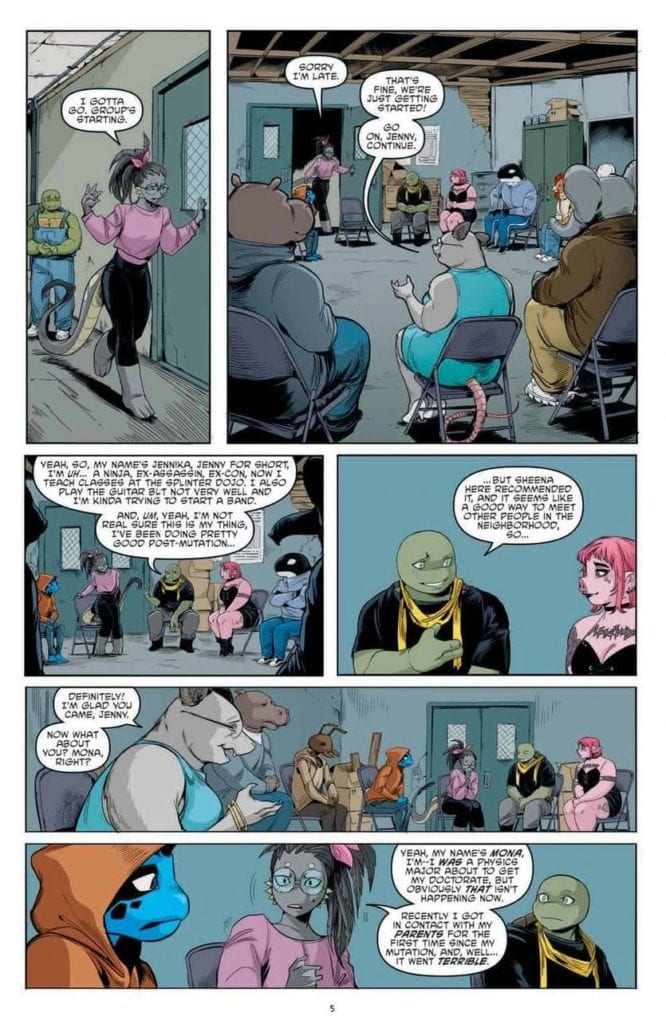
Campbell gives Mona, Jennika, and the newcomer Jay realistic personalities, allowing readers to invest more deeply into the characters. Each character’s grievance is both personal and communal—speaking to the experience of marginalized groups in our own world. We also find their organizing efforts relatable to their real life counterparts, which includes both the comradery and sharp disagreements.
Artwork
Jodi Nishijima’s penciling and ink work, Ronda Pattison’s coloring, and Shawn Lee’s lettering crafted engaging illustrations for this issue. The personified animal styling of the mutant citizens reveal emotions, showing how characters don’t always need to be human to convey feelings. We also enjoyed the variety of colors used for each individual, showing how they each retain their own style and preferences post-mutation. And the font styles used for each character helped express their emotions through the use of bolded words to emphasize particular powerful parts of their dialogue.
Conclusion
TEENAGE MUTANT NINJA TURTLES #112 is a great template for what community dialogue should look like. We’re excited to see how the differing groups reconcile their differences and move forward together.
Do you think the mutants will find a path forward? Let us know in the comments below!
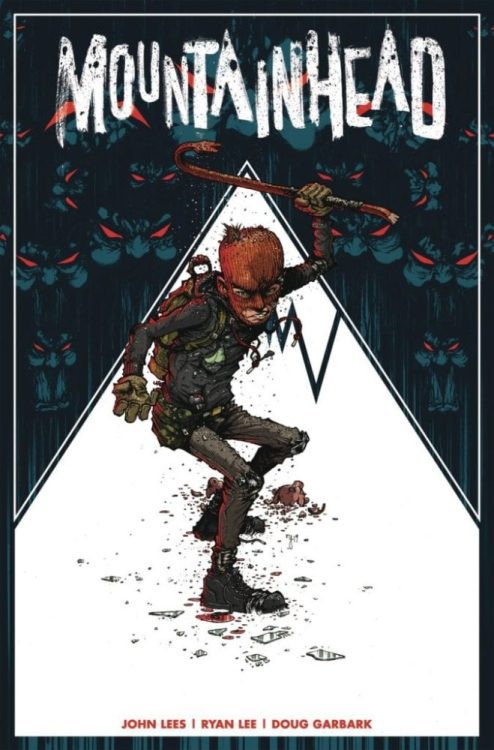
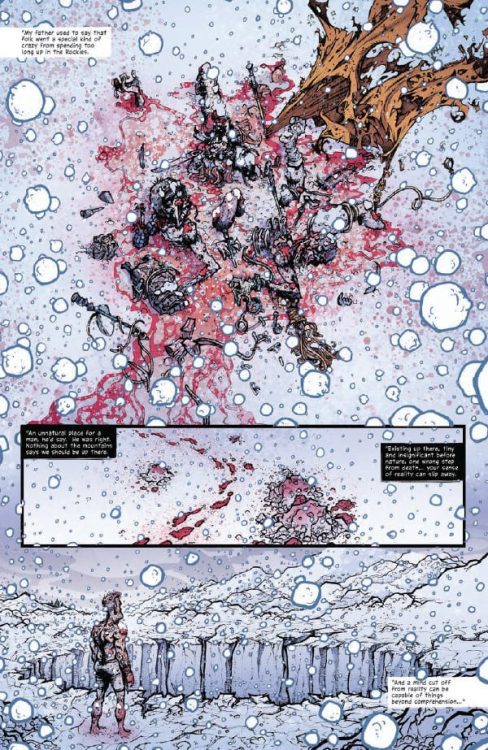
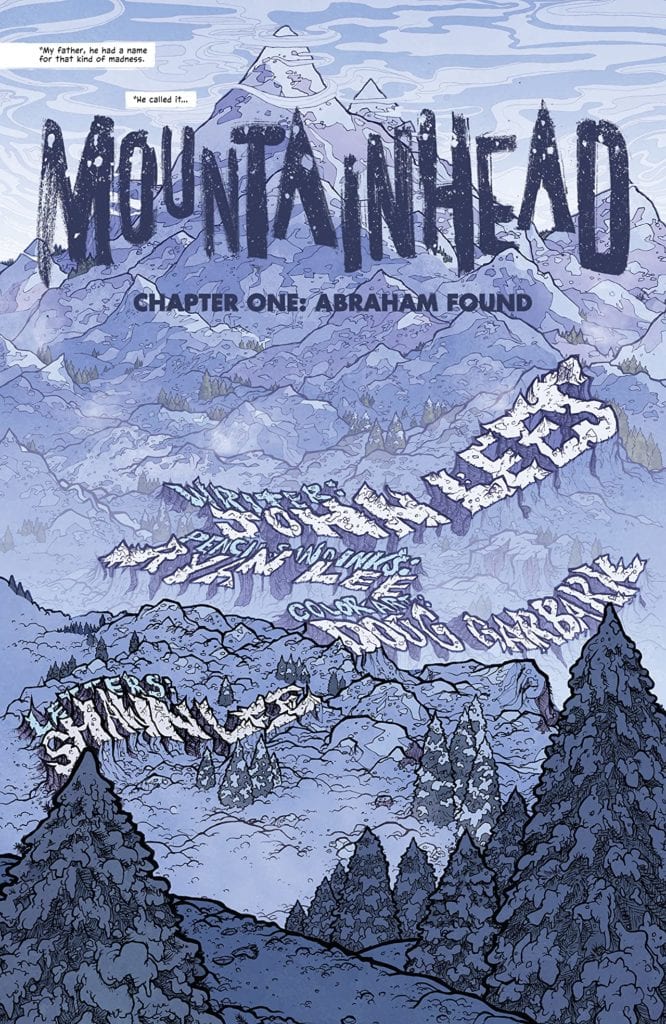
MOUNTAINHEAD VOL. 1 out January 13, 2021, from IDW Publishing, is the first collected edition of the horror series by writer John Lees, artist Ryan Lee, colorist Doug Garbark, and letterer Shawn Lee. The seriesis the perfect combination between profound, emotional character arcs and a truly horrifying tale.
About the series:
Abraham Stubbs and his father Noah roam America in a nomadic existence. Convinced sinister government forces are pursuing them, Noah has them living off the grid, burgling houses to survive. Elsewhere, on Mount Rector, the lone survivor of a climbing expedition staggers homeward, covered in blood. Both are on an inevitable collision course with the picturesque Canadian resort town of Braeriach. Massive storm clouds are brewing. The animals are running. Something else is on its way.
Writing
Lees knows exactly how to craft a beautiful, engaging horror story. Every aspect of his writing works in this book and makes you fall in love with Mountainhead a little more. Each character talks like a real person would talk. The brilliant jump scares wakes up the reader, and right from the very start of this comic, they could easily tell through everything going on in the background and in the front: something messed up is about go down. When the messed up stuff does start happening, the reader is already so invested in the characters and their journey that they’ll accept anything Lees throws at them.
But, what I’d truly want to give high praise for is the way Lees handles Abraham, the main character, and his character arc. The reader instantly falls in love with this brave, scrawny kid and understands each choice he makes throughout the story. Abraham may be broken in more ways than one, but because of that, it’s all the easier to connect with him. All the readers can see a little of Abraham in them. But, especially, his character arc ends up being incredibly satisfying to the reader. It truly feels like something has changed about Abraham forever.
Art
Ryan Lee’s artwork in this book is phenomenal. His unique, highly-detailed art style never ceases to amaze the reader. Somehow, it even resembles the works of Tim Burton. The acting looks and feels real and manages to convey the character’s emotions beautifully. There are actually a few instances in this book where a character starts monologuing over a full page, and Lee chooses to draw the panel with only one “shot type” and angle throughout the entire page. But, this never feels boring to look at. With each new panel, small changes further engage the reader in the monologue and tell them more about those characters.
Although, what really catches the eye in Mountainhead Vol. 1 is Lee’s stunning panel layouts. Some layouts are ordinary for a reason. Lee wants us to feel comfortable while reading these pages. He almost wants us to feel complacent. But, when the horrifying, grotesque things happen, Lee goes all out with his layouts and present the reader with some of the most imaginative panel layouts I’ve personally seen in a very long time.
Coloring
Garbark’s colors pair beautifully with Lee’s art. Garbark often masterfully contrasts between the cold blues and the bold, bright reds to fit the feeling of Lees’ terrifying, poignant tale. Whenever vomit, blood, or spit takes place in the panels, the colors look highly saturated and bright which elevate the feeling of discomfort when looking at these moments. Garbark’s colors always direct the reader’s eye effectively to the most important thing in each panel. Brilliant work from Garbark.
Lettering
Shawn Lee’s lettering is a sight to behold. It both fits the art style and the writing’s eerie mood, but it also goes out of its way to present the reader with a great lettering style that, on its own, could be dissected for hours. The placement of the word balloons guides the reader’s eye well. The lowercase font pairs well with Ryan Lee’s art, and some of the sound effects leap out the page beautifully. Each sound effect has a different style and font, making the reading experience all the more interesting, engaging, and fun.
Conclusion
Mountainhead Vol. 1 will keep you awake at night for two main reasons. Firstly, it is an awfully terrifying comic that constantly keeps you on your toes. Secondly, the work by all the creators involved is so masterfully done; you can’t help but think about all the ingenious ways in which these creators made you feel so incredibly nervous and frightened when reading it.
The first volume hits local comic book shops on January 13th, with the final order due December 21st. Do yourself a favor and please pre-order or pick up this trade paperback.
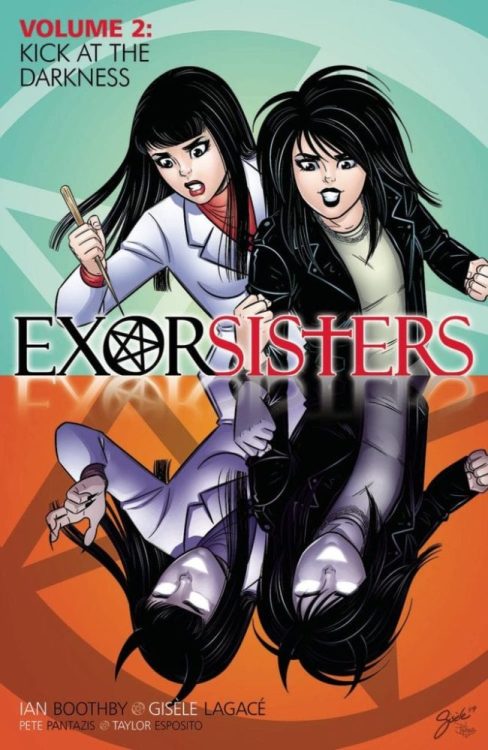
Exorsisters Volume 2 finishes an ironic humor series Image Comics collects on October 28. Writer Ian Boothby works with Pixie Trix Comix artist Gisèle Lagacé to close out this supernatural action-comedy. Joining them are colorist Pete Pantazis and letterer Taylor Esposito.
Background
Exorsisters follows the titular characters Cate and Kate Harrow, “twin” exorcists who literally go to Hell and back for a paycheck. Except Kate’s actually Cate’s soul, it’s complicated. What’s not as complicated is that there’s a primordial evil who wants to annihilate existence. Wouldn’t you know it, these two are all that stand between this “First Shadow” and his goal, which brings us to the plot of Exorsisters Volume 2.
Exorsisters Volume 2: Kick At The Darkness
Exorsisters Volume 2 is new reader friendly by giving the reader an outline of the main characters’ backstory. All while showing Cate’s and Kate’s character. Neither of them would prefer to live in ignorance and bliss of paradise. To the reader, their backstory shows an empathetic angle, allowing them to share Cate’s refusal of a retcon attempt. It’s also a treat for returning readers who reward them for paying attention to the details. Naturally, the sisters are always at a disadvantage in their situations, but they use it to their advantage throughout the series. That’s the essence of action-comedy, using whatever’s available to use as reactionary forces against an antagonist.
It also shows a duality between horror and comedy. The main antagonist, the First Shadow, is by all accounts holding the cards, so everything looks helpless. But thanks to the reader empathetically connecting to the sisters, they become part of the way to defeat him. How? Because Ian Boothby systematically introducing the reader to plot elements of Exorsisters Volume 2 to clue them in to the big finale, one that feels very satisfying.
Why So Serious?
Gisèle Lagacé has a relaxing art style that befits the comedic elements of Exorsisters Volume 2. Like how can you take some things seriously when an old-timey cartoonish fly is in a panel, which benefits things by quite a lot when scary looking shadow hands are in the same panel. That doesn’t mean things don’t get serious; claw marks on Kate still look serious even if most pain is transmitted to the antagonist.
Pete Pantazis’ colorwork decorates Exorsisters Volume 2 with plenty of detail to make emotional moments flashier. Sometimes flames benefit from brightness, while exaggerated faces have a red background with rising lines to further utter terror. On that note, Taylor Esposito’s letter work does whatever is necessary to enhance the visuals. That look of utter terror, for example, has an empty wordmark to emphasize screaming from the face. Otherwise, lettering is minimal so that it doesn’t take away from the humorous art of Lagacé.
Exorsisters Volume 2 Gives You A Good Time
Exorsisters Volume 2 brings the reader a good time by being both new reader-friendly and contrasting a bleak situation. When facing the end of the world, it might be best to have fun while doing it. Laughter really can be the best medicine when facing insurmountable odds.
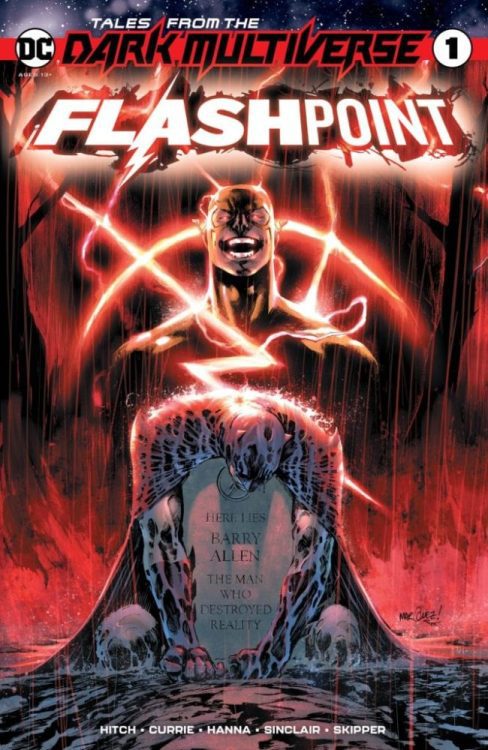
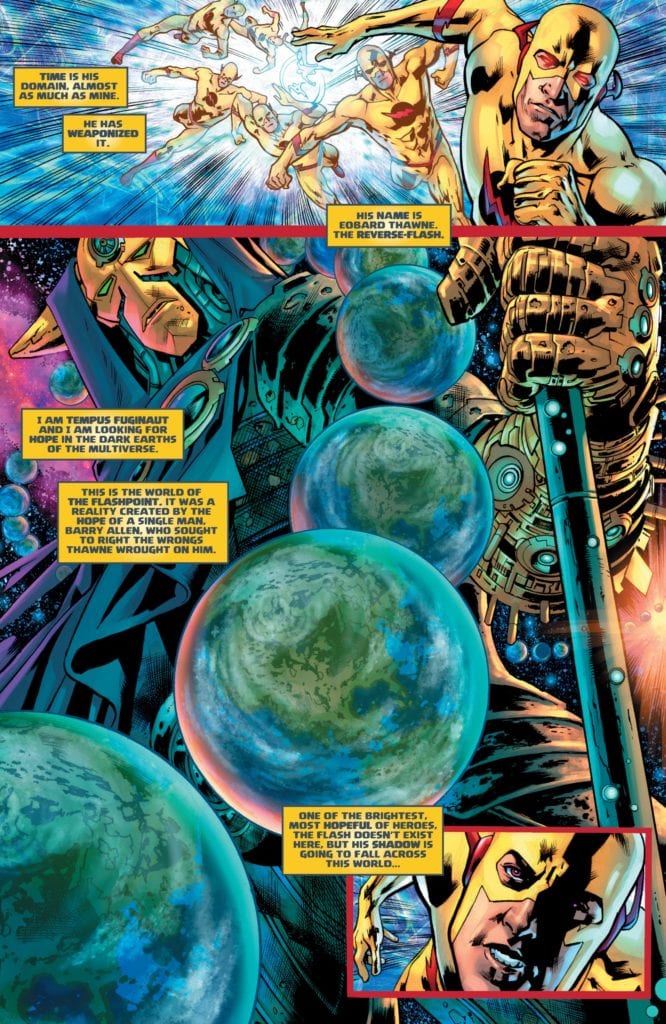
TALES FROM THE DARK MULTIVERSE: FLASHPOINT #1 hits comic book stores on Tuesday, December 8th, turning one of the DC Comic’s most pivotal stories on its head. Originally, Barry Allen traveled back in time during Flashpoint to prevent Eobard Thawne from murdering his mother, losing his powers temporarily in the process. But what would happen if Thawne thwarted the Scarlet Speedster’s plans? That is what this issue explores in an equally engaging story.
Story
Unlike the Flashpoint event of the main multiverse, this dark version provides readers with a narrator in Tempus Fuginaut. Drawing similarities to Allen, the god-like being describes his purpose as being opposite that of Thawne. Fuginaut and Allen cross the halls of time in service of hope; the yellow-garbed villain serves nothing but despair.
This narrative choice sets the tone by providing context while dipping out just in time for Thawne to shine. He’s the “star,” but a number of moving pieces make their mark in this issue as well.
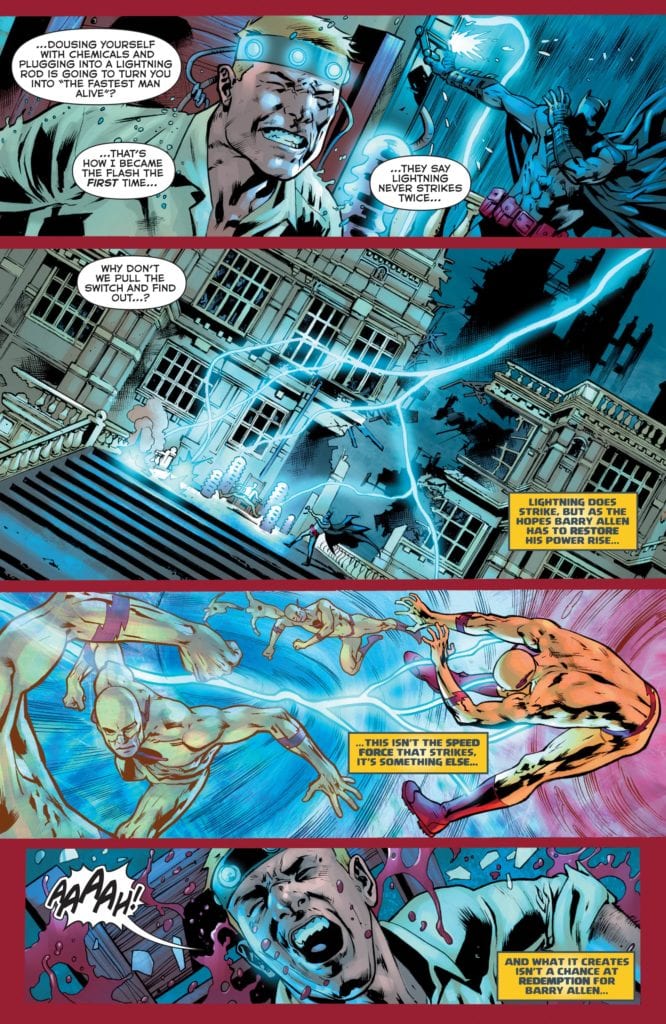
Longtime fans of Flashpoint will soon find Allen and Thomas Wayne’s Batman of this Earth in a familiar setting, waiting for the catalytic bolt of lightning to bring back the hero’s powers. But the foretelling of Fuginaut and Thawne’s sudden appearance usher in the breaking point of this alternate story.
The beauty of this issue lies in its ability to deviate while maintaining the tone of the original. Bryan Hitch’s writing speaks to readers as if they’re a part of the narrative themselves. His pacing is also particularly effective when unveiling new dark dimensions in this alternate world.
Artwork
Pencils and Inks
Hitch’s penciling, along with Andrew Currie and Scott Hanna’s ink work, craft stunning images in much the same style as those from the original Flashpoint story. The character of Thawne seems to bristle with so much energy, one might believe he’s ready to jump off of the page.
Colors
Alex Sinclair and Jeremiah Skipper’s coloring does a great job of emphasizing Thawne’s otherworldly powers. Each bolt of red lightning emanating from him contrasts with the more mundane background shades.
Letters
Rob Leigh’s lettering helps distinguish between each form of dialogue—whether it be Fuginaut’s narration, Thawne’s gloating, or Wayne’s contemplating. The differences in color and font style help readers focus on who’s speaking.
Conclusion
This issue’s thrilling, alternate Flashpoint will be remembered as a work of genius. TALES FROM THE DARK MULTIVERSE: FLASHPOINT #1 commemorates one of DC’s fan favorite stories with an engaging an twist.
Do you like Thawne-focused stories like this? Let us know in the comments below!
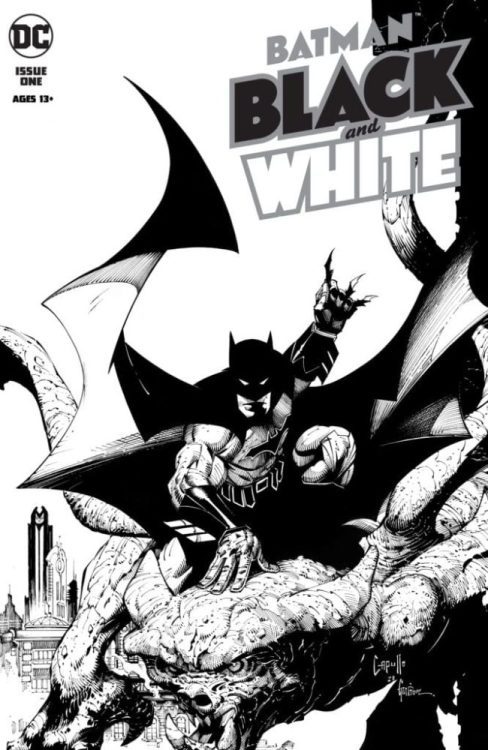
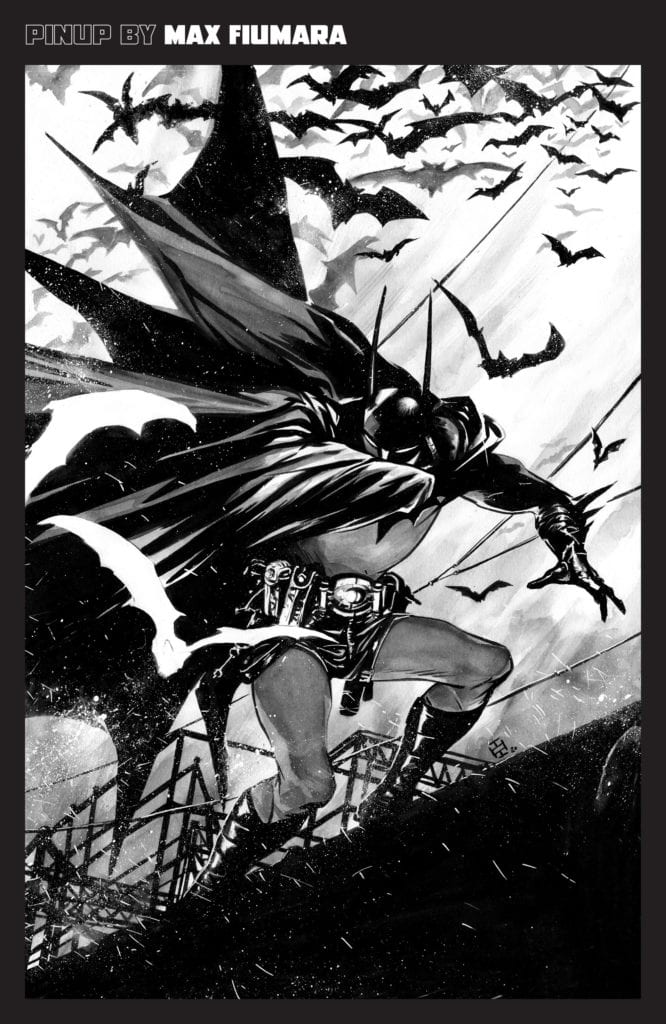
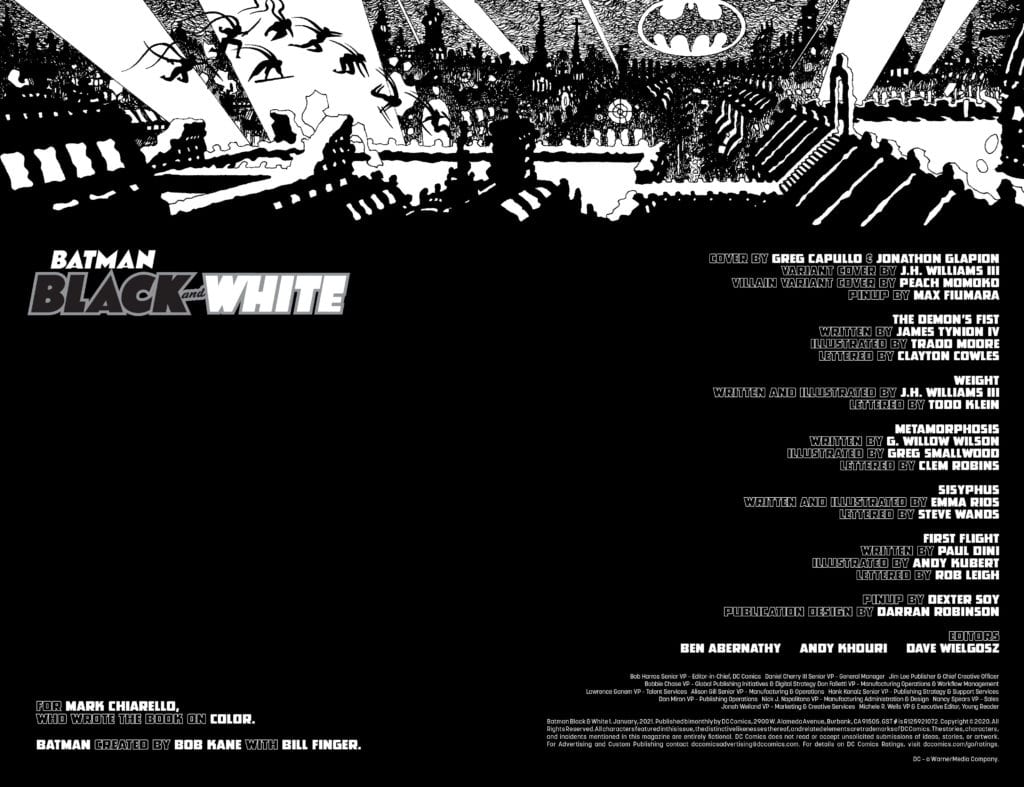
Batman: Black and White #1is DC Comics’ celebration of one of their biggest characters. It features stories full of ninjas, bats, and pearls. All the ingredients for a good Batman story. While some of these stories struggle to stand out from DC Comics’ other celebrations of the character, one story in particular shines.
“The Demon’s Fist”
Overall: 3.7/5
Writing: 3.5/5
Art: 4/5
Lettering: 3.5/5
James Tynion IV writes “The Demon’s Fist,” with Tradd Moore on art and Clayton Cowles on letters. Tynion’s stories are typically chock full of exposition. Characters in his scripts tell the readers exactly how they feel, with little room for interpretation. But “The Demon’s Fist” is different. Not only does Tynion dodge over-explaining, he completely removes all dialogue. Relying heavily on Moore’s dynamic, intricate art pages, Tynion allows the art to do the talking. It’s a great example of a writer trusting his collaborators. And Moore’s art really is spectacular. Cowles pushes every text box to the corners and edges of the page to give as much room as possible to Moore’s detailed fight scenes.
“Weight”
Overall: 3.8/5
Writing: 2.5/5
Art: 5/5
Lettering: 4/5
JH Williams III writes and draws “Weight,” with Todd Klein lettering. The script is simple and a little on the nose. But the script isn’t the point. This story could almost exist without any of the words. It’s a tour of Batman’s career, with gorgeous splash pages showing all the characters we know and love. Williams blends his own art style with those of Batman manga or Batman: The Animated Series. Klein uses every blank space on the page. Often, Klein’s lettering sticks close to Batman himself. It reminds us that Batman is an action hero whose inner monologue is constantly blaring inside his own head.
“First Flight”
Overall: 3.7/5
Writing: 2/5
Art: 4.5/5
Lettering: 4.5/5
Paul Dini writes “First Flight,” with Andy Kubert on art and Rob Leigh lettering. Dini, usually a master of stories big and small, stumbles in this short story. The story itself draws from the mythology of Grant Morrison’s run on Batman. And so Dini becomes a slave to showing readers how his story ties in. Dini unfortunately spends the whole time tying this story to someone else’s, instead of telling his own story. Kubert’s art also already did all that work for Dini. It’s so reminiscent of Morrison’s era, as Kubert was one of the major artists throughout that period, that it immediately acts as a window into the past. Kubert puts these characters in stances and positions we’ve seen before, to send us back. Leigh’s lettering is brilliantly “comicbooky.” His small variations in dialogue make each line jump of the page. And Leigh’s simple choice to give caption boxes teared edges sends us back to the days of Batman and the Black Journal.
“Sisyphus”
Overall: 3.8/5
Writing: 3.5/5
Art: 4/5
Lettering: 4/5
Emma Rios writes and draws “Sisyphus,” with Steve Wands lettering. Rios doesn’t try and make logical sense in this story. It’s not even fully clear which character(s) the story is talking about. But Rios is deliberately shirking off the idea of a “Batman situation” being her short story. She’s not just going to write Batman in a typical Batman-type scene. No, Rios wants to talk about what makes the character the character. Wands mimics Rios’ own logic and flow by twirling the lettering through the pages. It’s through Wands that we see how Rios wants us to see her work. Wands sets the road, we follow it through the images that blend together into intricate splash pages.
“Metamorphosis”
Overall: 5/5
Writing: 5/5
Art: 5/5
Lettering: 5/5
G. Willow Wilson writes “Metamorphosis,” with Greg Smallwood illustrating and Clem Robins lettering. “Metamorphosis” is, hands down, the highlight of Batman: Black and White #1. Wilson also fights the expectation to just “set Batman up in a Batman-type scene,” but she does so in a wildly different way. She takes a typical Batman scene and flips it on its head. Smallwood’s art is mesmerizing. His brilliant attention to detail, the tiny changes in a character’s expression from one panel to the next, speaks volumes. Robins has just as much a stake in making this story beautiful. Whether it’s the lyrics to a song on the radio curling down the hallways, or the “SLAM” of a head through a wall, Robins makes every moment count. “Metamorphosis” is one of the strongest Batman short stories I’ve ever read, though it’s charmingly unassuming about its own brilliance.
DC Comics’ Batman: Black and White #1 is fun. If you like Batman, you’ll definitely like this issue. If you want a reason to pick this issue up, “Metamorphosis” is that reason. The other stories do a wonderful job of peeling back the layers of what makes the Bat. But “Metamorphosis” is a surgical knife, applying dangerous amounts of pressure to Bruce Wayne’s heart. Pick up Batman: Black and White #1, out from DC Comics December 8th, at a comic shop near you!
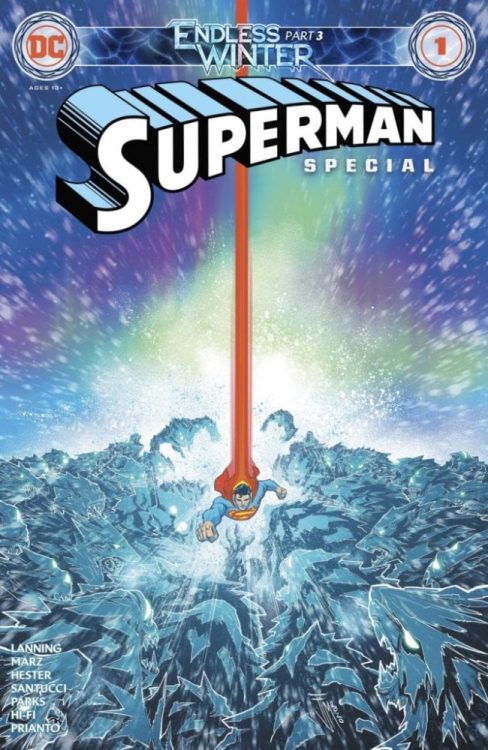
All-Star DC writers Andy Lanning and Ron Marz team with artists Phil Hester, Andre Parks and Marco Santucci to deliver a comforting Superman one-shot in the midst of a wintry crossover event. “Superman: Endless Winter” uses its platform and context within its desperate world’s situation to remind readers to keep moving ahead during our own trying times. With a grounded script and some great superhero artwork, this one-shot special is a nice reminder that even The Man of Steel needs encouragement sometimes.
“Superman finds himself at the center of an epic battle as the Frost King’s hordes of ice monsters come to life. Is this frozen onslaught too much for the Man of Steel, or can he stop it before it rampages across the chilling wasteland the world is becoming and reaches civilization? The answer to this question comes from an unlikely source close to Clark Kent’s earthly roots!”
Writing & Plot
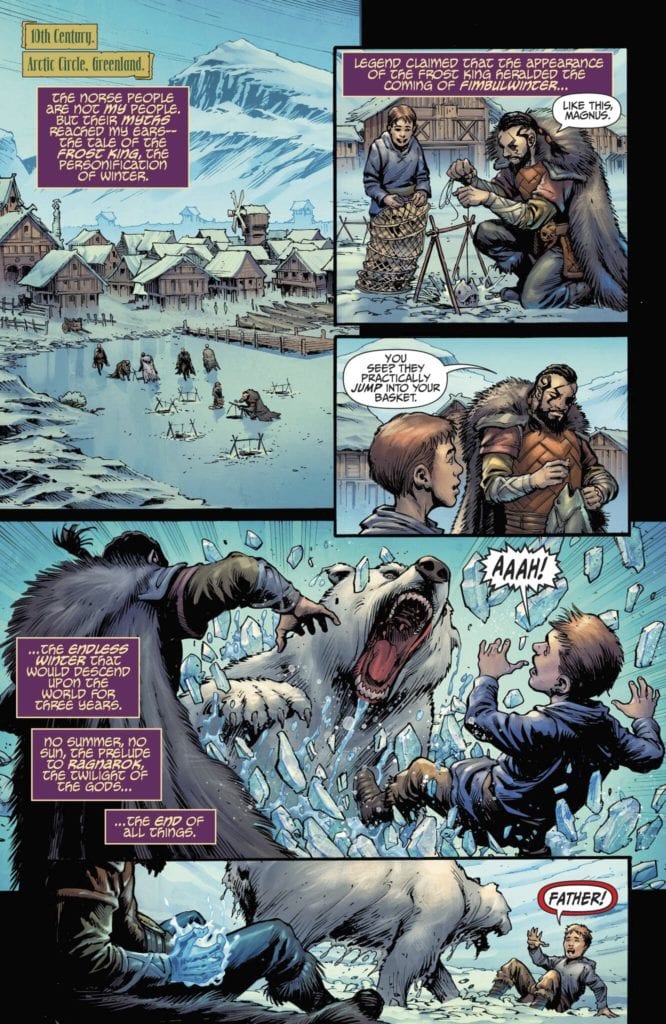
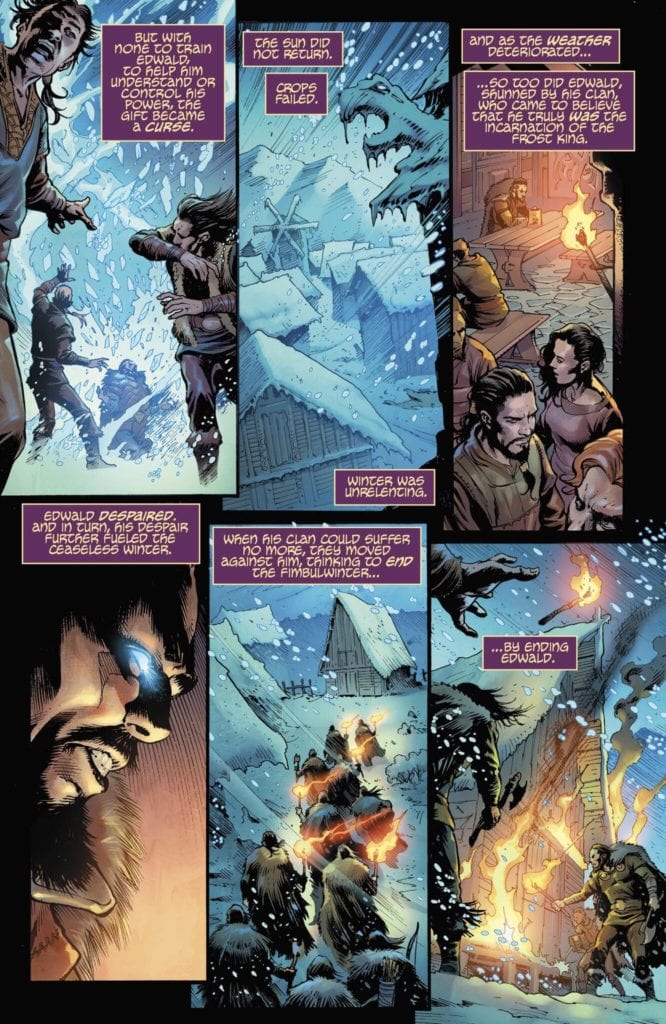
This comic can be broken up into three parts: a flashback building on the story of the Endless Winter event, the main chunk involving Superman, and the final pages that tease where this event is headed next. Marz and Lanning do a sold job of making this comic feel consistent in terms of style and subject despite there being two main focuses in this one-shot. The focus on the Endless Winter event itself doesn’t overpower the heart of the story with Superman, but it’s also given the time and effort to still obviously be important. The flashback at the beginning of the comic is especially awesome, utilizing the span of only a few pages to create an effective and tragic narrative for this event’s big villain. The final pages are the most forgettable – scientists doing stuff in labs they shouldn’t be with objects they shouldn’t be touching – not bad, but nothing terribly exciting. The meat of this comic however is obviously about what Supes is doing during this insane global occurrence and how he’s handling it both personally and as a hero. This part of the comic is simple and a little bit cheesy to be sure, but it’s still surprisingly effective. It’s blatantly obvious that the script is talking to us about our experience during this dreadful year while also assuring us that even the most powerful hero in comics has it rough once in a while too. Both Superman’s struggle against the global blizzard and his worry about his loved ones will likely hit home for a lot of people during this pandemic. Lanning and Marz even address the mental stresses of the public as a whole by way of this issue’s newspaper article narrative delivery (written of course by Lois Lane). Seeing Superman’s worries and struggles validates our own troubles, and watching him be comforted and assured by the people closest to him is one of the oldest but most effective tricks in the DC book. Reading the main chunk of this comic felt like wrapping a blanket around myself and eating a bowl of soup. That’s what a great Superman story does, I think.
Art Direction
The combined work of artists Phil Hester, Andre Parks, and Marco Santucci create the vivid (and cold) world that “Superman: Endless Winter” #1 has fallen into. Santucci covers the opening flashback sequence while Hester and Parks cover the main book. The former’s art is a clean and fantastic blockbuster comics style. Santucci utilizes a heavily penciled and highly detailed aesthetic akin to the work of David Finch or Jason Fabok, with considerable cross-hatching and inking. It looks outstanding and works brilliantly for the story being told in this flashback. What else works brilliantly is the art in the main Superman story. Hester and Parks use a neat and clean approach with think lines that exude a style that is somewhere between the Golden Age Superman and the Supes of the Bruce Timm and Paul Dini animated universe. Their style exudes a sort of light-hearted friendliness that makes the reader feel right at home in the comic’s messaging. The Hi-Fi colors are as professionally neat and pristine as can be had in any mainstream hero book, adding a variety and depth of visual fidelity that can only be found in a big budget superhero tale.
“Superman: Endless Winter Special” #1 is a simple but effective one-shot that manages to have its own message while still allowing itself to be a solid piece of the crossover event puzzle. Ron Marz and Andy Lanning use their combined experience to create a solidly paced and emotionally therapeutic short story that is some admittedly cliched but still warranted reassurance during our own turbulent times. The intensely detailed visuals Marco Santucci in the flashback and the classically-minded work of Andre Parks and Phil Hester in the main story all craft a stellar looking comic fit for a tale about The Man of Steel. Be sure to grab this one-shot when it hits shelves at your local comic shop on 12/8!
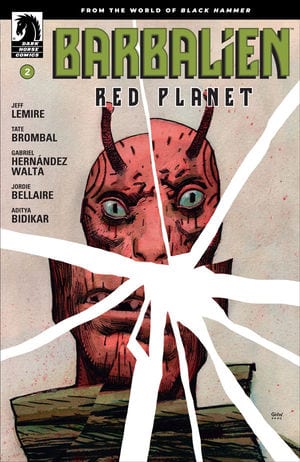
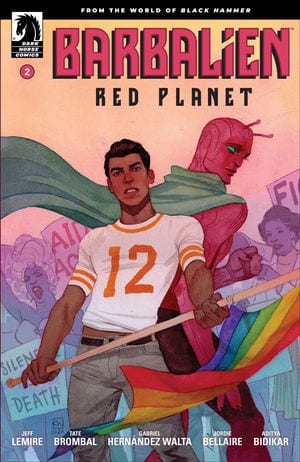
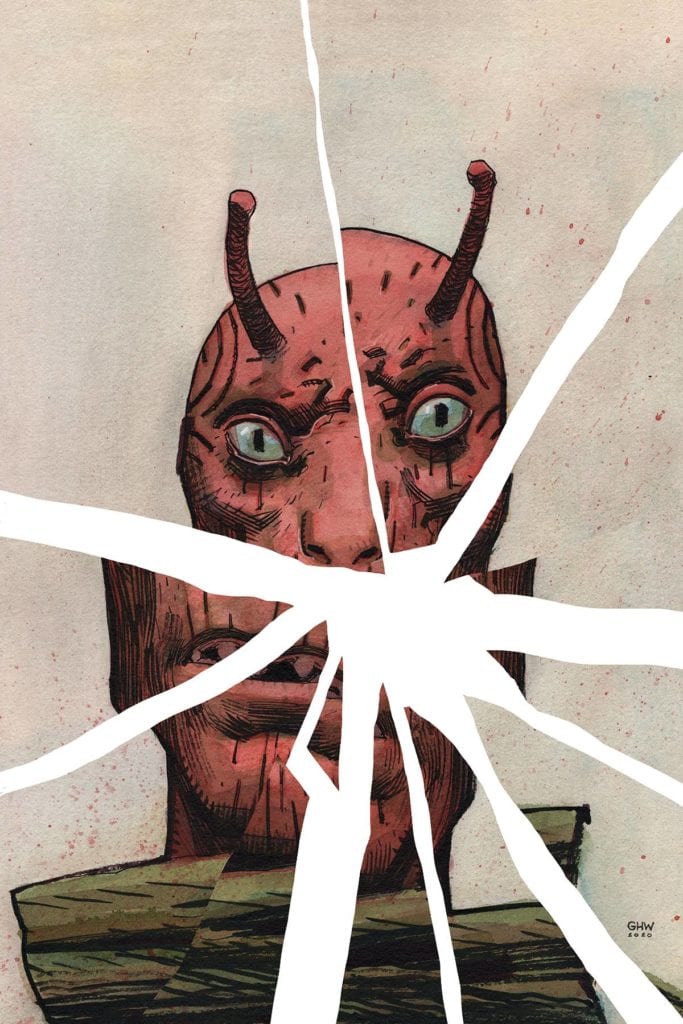
It’s tough writing a series that’s about something so black and white. Dark Horse’s Barbalien: Red Planet is one of those series. It’s about the struggle between cops and the gay community during the AIDS crisis. There’s not much room for interpretation there. The cops were bad guys, beating people for being different. But that didn’t stop writers Tate Brombal and Jeff Lemire, artist Gabriel Hernandez Walta, colorist Jordie Bellaire, and letterer Aditya Bidikar from giving us a nuanced, layered, human story about a man stuck in the middle, in their first issue. Unfortunately, Dark Horse’s Barbalien: Red Planet #2loses a lot of that nuance and subtlety.
Writing
There’s an aspect to Brombal and Lemire’s lack of subtext that works. Miguel represents the Uninhibited Person. He’s got his guard completely down, and he’s willing to say the truth when no one else is. This works particularly well when he’s shouting through a bullhorn or yelling in a cop’s face. Miguel also acts as a kind of “Beatrice,” or guide, through the underground gay “Paradise” Markz has stumbled upon. He explains the ins and outs of their scene, asks cutting questions, and provides no judgements. But when Miguel is in his personal life, there’s little room for interpretation. Any and all interrelational things that are happening, in every scene, is fully on the table. If Miguel is embarrassed, scared, or lonely, he lets us know. Each time he does, it strikes as a line that should be left unsaid. They’re the moments that were already communicated in the pauses and glances. It’s as though Lemire and Brombal are so passionate about this project, they’re tripping over their shoelaces to make sure everything they want to communicate gets through. It does get through, they just need to trust their readers more.
Art
Part of what makes Brombal and Lemire’s script frustrating at times, is that Walta’s art is already telling such a clear story. We don’t need Miguel to tell us he’s terrified. Walta shows it all over his face. And Markz waking up to stare at his police badge speaks more of his inner turmoil than him mixing up who he should be recognizing. Walta gives us every cue we need to connect the silent dots. Even if it’s just Miguel appearing in front of or above Markz in each scene. Walta shows us how Markz looks up to Miguel, through mere character placement. We see how Markz thinks of Miguel as a role model, someone who is as comfortable in their own skin as he would like to be. Walta’s implied storytelling is so efficient, much of the dialogue becomes unnecessary.
Coloring
Bellaire also helps us see Markz’s identity crisis. Early on in the issue, the soft purples and pinks of the nightclub give way to a bright red. It’s the red of the police lights and it’s accompanied by violence. But the red is familiar. It’s the same shade and color as Barbalien’s skin. This leaves us to wonder, does Barbalien feel like being a cop has become a part of his identity? But as the issue goes on, Bellaire brings in another familiar color. We see a dangerous green that follows Boa Boaz everywhere he goes. This is a similar green to the green of Barbalien’s cape. It’s these aspects to Barbalien’s identity that seem to be ripping him apart. Is he a Martian or is he a policeman? And while Markz knows he’s gay, the nightclub scenes are colored in foreign colors. It’s as though we’re watching other identities pull Barbalien away from accepting his sexuality. Things that feel ingrained in him. But as he boldly ventures in to explore, he’s still scared and feels like it’s a world that’s not familiar to him.
Lettering
Bidikar does something interesting in this issue. He keeps nearly every line of dialogue in one word balloon. Instead of dividing dialogue up, to give it a sense of rhythm, Bidikar delivers each line in one big chunk. What this means is, the moments with stacked word balloons stand out. “Yeah. Peace is great…” is in one word balloon, conjoined to another with “But my parents taught me survival.” If this line were written like every other line, it might be missed. Instead, Bidikar interrupts our reading to focus us in. Because Bidikar does this sparingly in the issue, we don’t become used to stacked word balloons. We notice each one that comes our way, and give special attention to each of those important lines.
Dark Horse’s Barbalien: Red Planet #2 falters. But it falters because of its creators’ passion. They have important things to say, things they feel strongly about, and their passion overrides their subtlety. This story is important, and if this creative team can dial back on the dialogue and exposition like they did in their first issue, it can also be great. I, for one, expect great things from future issues. Pick up Barbalien: Red Planet #2, out from Dark Horse comics December 16th, at a comic shop near you!
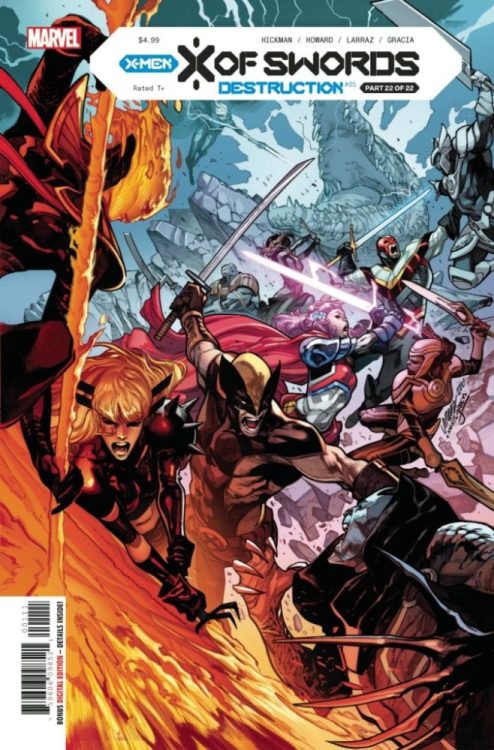
X of Swords – Destruction #1 brings to a close the long, drawn-out event which altered the status quo of the X-books moving forward, and laid the groundwork for future plots and developments. This event meandered at times and relied a bit too much on fake-outs, people standing around talking, and anti-climactic challenges to move its plot forward, but it ends with a bang!
As I read this final issue, something about it seemed familiar, and then it hit me: Hickman, Howard, and company are going for an Avengers: Endgame vibe!
Maybe that wasn’t their intention, but that’s what this event feels like. Here are four reasons why X of Swords – Destruction is like Avengers: Endgame.
1. Mediocre parts and an explosive ending.
I should note that I am a fan of the MCU, but I’m an honest fan. I can acknowledge that large swaths of the MCU are inconsistent in quality, and that for years, it seemed like very little plot development could occur in the MCU movies because they had a twofold task of a) keeping the story going, and b) keeping enough things the same until their dramatic culmination in Infinity War and Endgame, all while telling a mega-story with multiple writers and directors.
This means that some franchise movies were “filler,” “just ok,” or became weighed down managing multiple MCU plotlines (i.e., Thor: The Dark World, the first Ant-Man, Avengers: Age of Ultron, etc.) while others were “more meaty” and became the pulsating heart and backbone of the MCU (i.e., Winter Soldier and Civil War). But it all culminated with Endgame, an explosive finale that provided closure to the Infinity Saga while setting up a new status quo.
I’ve noted in earlier entries about what I’ve come to think of as the mediocrity of at least parts of the X of Swords event, like dinner parties and conversations that last 2-3 issues while I waited for a tournament to begin, which then consisted of contests portrayed in only one panel, all drawn out across multiple X-titles until it finally culminated in X of Swords – Destruction.
This event, however, was not without its gems. Wolverine’s title was consistently top-notch, while Storm’s fight with Death highlighted her character’s strength and ingenuity. There’s a reason why she was the X-Men’s leader for so long during Chris Claremont’s run!
Of course, despite my problems with this event, the multiple writers and artists made it read as a consistent narrative across the X-titles, for an event whose culmination will hopefully cause this event to be greater than the sum of its parts when read as a whole.
2. Dramatic arrival of back-up.
There are two notable “F@ck yeah!” moments split between Infinity War and Endgame (well, three if you count “Thunder Cap,” but I’m not dealing with that here). The first is during the Battle of Wakanda with the arrival of Thor, Rocket, and Groot.
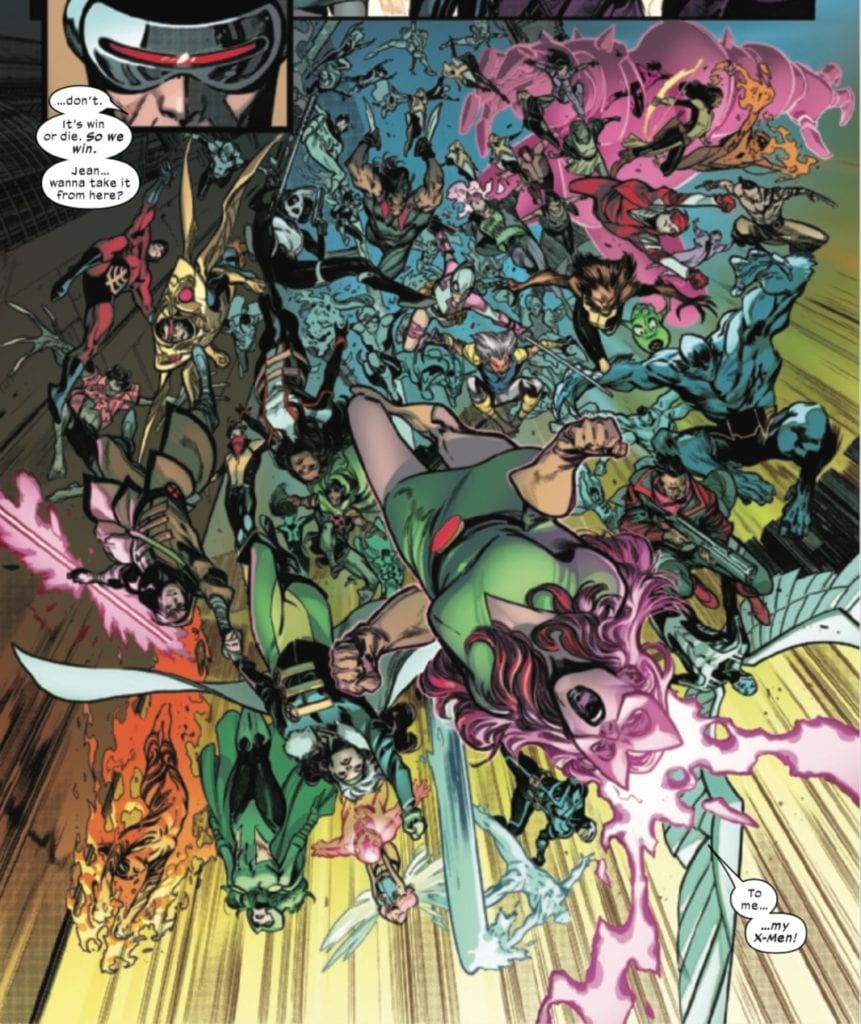
X of Swords – Destruction has its own “arrival of Thor” moment with the return of the Captain Britain Corps! Tell me the following image doesn’t look a little “bi-frosty.”
Mystical back up arriving in a stream of light to fight a terrifying, faceless army? I’ve seen this move before. But I still like it.
But this is only one of the “F@ck yeah!” moments in this issue. The other, and much more “Endgame-y” moment arrives in the form of every X-Man ever showing up to save the day.
This wouldn’t be the first story to try to copy the Endgame formula of having the calvary, consisting of multiple characters and cameos, show up and save the day. Rise of Skywalker tried this (to far less fanfare) with the arrival of Lando Calrissian in the final act of that movie, but I think it works better here in X of Swords – Destruction. And like Endgame, the arrival of back-up, while a cool moment, doesn’t guarantee success, but only with the sacrifice of a champion, for the sake of both his world, and his family.
3. A main character takes possession of an ultimate weapon to save the day.
Robert Downey, Jr.’s Tony Stark was the heart and soul of the MCU for eleven years. His death by taking the Infinity Gauntlet from Thanos dealt the final blow to the Mad Titan and his army. Likewise, X of Sword‘s main protagonist (arguably), Apocalypse, was able to win only by taking the source of his wife’s power to control the Amenthi army, the Annihilation mask.
By taking the mask and surrendering, Apocalypse is able to bring the battle to an end, and while he must join his wife and children in Amenthi, he saves Krakoa.
4. The story is brought to an end and sets up a new status quo.
While Avengers – Endgame brought a certain amount of closure to the MCU, it was far from a true ending. Certain character arcs were concluded, but a new status quo was set up in the MCU. People would have to live with the consequences of “the Blip.” Sam Wilson became Captain America, and Thor abdicated his throne and left Valkyrie in charge of Asgard. Endgame left us a world without Tony Stark or Steve Rogers. Plus it set up a bunch of new Disney+ Marvel shows.
Likewise, the status quo of the X-titles was changed by the conclusion of X of Swords – Destruction. We are now out of the “Dawn of X” era and into “The Reign of X.” Apocalypse joins his wife and children in Amenthi, and Arakko and its mutants have joined Krakoa, thus altering the dynamics of the mutant nation. The Quiet Council has experienced a dramatic shift. The X-Men have been restored as a team, and now run the former S.W.O.R.D. base, with Al Ewing launching a new title centered around it.
Of course, every comic event by its nature changes the status quo of a universe somewhat, some more than others. X of Swords – Destruction definitely alters the X-Men’s status quo moving forward, even though the entire event plodded along a bit aimlessly sometimes. House of X/Powers of X gave us a hint at where the future of the X-titles is heading, even as Dawn of X laid the groundwork of the new status quo while setting up the first big event in Hickman and company’s run. X of Swords – Destruction gives us some idea of what lies in store, providing an opportunity for some truly unique X-stories, while hopefully avoiding the sometimes-plodding pace of this event.
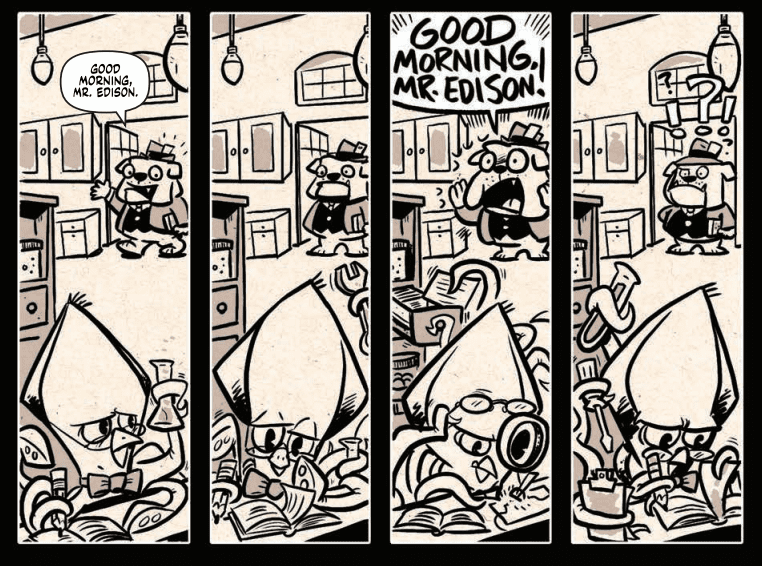
The Comic Book History of Animation Credit: IDW Publishing
Comic books are very adaptable and are able to tell many different types of story in a wide range of styles. It is for this reason that the format is useful for educational purposes with the image and text relationship better at engaging readers quickly and more memorably. This makes the medium perfect for something like IDW Publishing’s new series The Comic Book History of Animation, part one of which is released on 9 December 2020.
Promising to cover the entire spectrum of animation history, the first issue starts in the roots of illustration and searches for the seeds of animation. Fred Van Lente and Ryan Dunlavey have chosen a very informal style of both presentation and narration, firmly establishing a child friendly environment. A quick read through highlights that there is something for everyone on these pages.
The Comic Book History of Animation Credit: IDW Publishing
Start at the Beginning
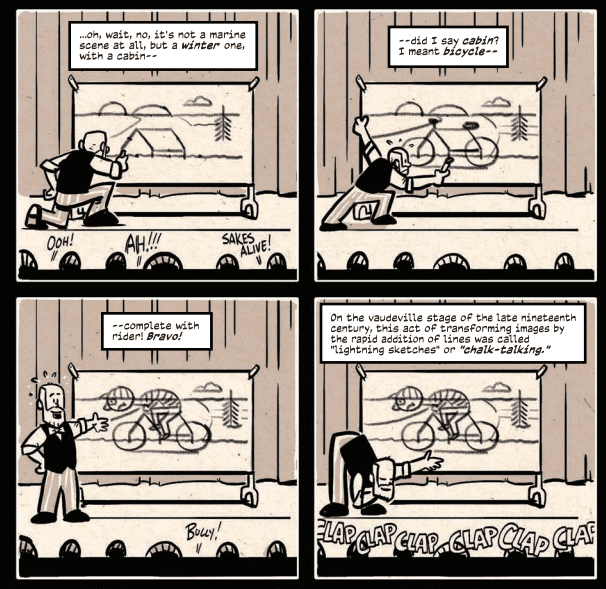
Following in the footsteps of Scott McCloud and his Understanding Comics, The Comic Book History of Animation (known as simply History for this point on) reaches into the past to help cement the historical timeline of ‘moving cartoons’. Animation didn’t spring into the world fully formed and Van Lente/Dunlavey have cherry picked moments that led to the creation of the form as it is understood today. These moments focus on the creation of the Art work; performance drawing and Chalk-Talking, which in the modern world would be better understood in relation to an educational environment.
The focus on the act of drawing does two things for the reader. Firstly, it instantly creates a parallel between Comics and Animation which is a theme that flows through History, even if not explicitly stated. The second thing it does is allow Van Lente to build his narrative from a specific point of view, one that is inherently American. Very little is mentioned of the European advancements in animation technology such as Charles-Emile Reynold’s animation machine which predates any of the narrative in History.
Obviously no-one expects a full account of everything that happened but this point about bias is worth making because of the narrative that unfolds. The question of the author’s reliability is raised and the reader should keep this in mind throughout the rest of the comic. The problem of ‘history’ in a broader term is something that McCloud also had to contend with in his books and some of his work is now being critiqued more closely, opening up the field of Comics. The same should be done with History, with the reader using this comic as a starting point for their own education.
The Comic Book History of Animation Credit: IDW Publishing
Presentation and Audience
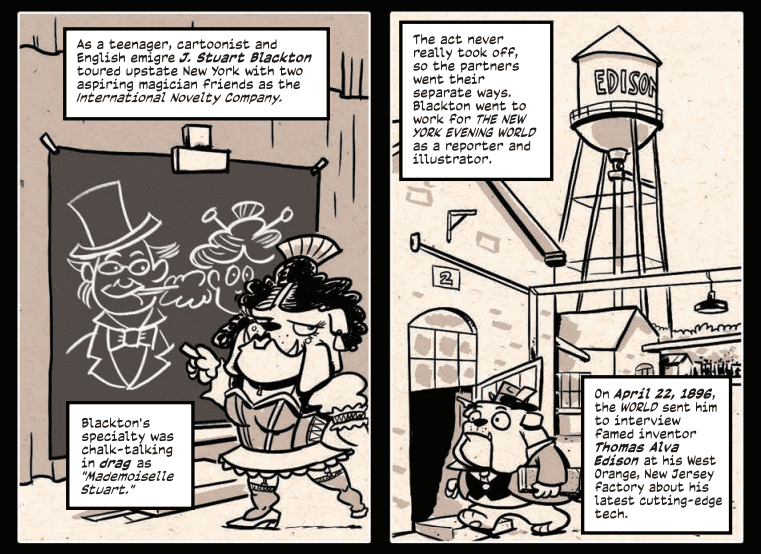
Dunlavey has adopted a ‘Funny Animals’ style for the comic, invoking a rich tradition in both comics and animation. The Funny Animal approach allows him to distance the characters in the narrative from the real historical figures just enough for over the top humour and caricature which is an essential element of this comic. For example, Richard Outcault is depicted as his Yellow Kidcharacter both invoking the comic strip and the creator in one simple drawing. And Walt Disney is drawn with the famous Micky Mouse ears making him instantly recognisable throughout.
Subtle changes in the artwork give the reader an indication of what the animation styles were like, enhancing the narrative element in the caption boxes. This works to the advantage of the comic, making it obvious that there is more going on than a parody of famous animators. The continuous use of the caption boxes as a narrator is also a telling creator choice. Instead of using an avatar to guide the reader through History, Van Lente has chosen a more disconnected voice, reducing the fingerprint of the writer. It makes it easier to sell the narrative, and comic, to a wider audience without a visual lecturer. The voice could come from a peer, a teacher, or even a friend, which makes it more accessible.
One of the failings of the comic, however, is this lack of direction regarding the intended audience. Animation, just like comics, has a reputation for being ‘childish’, often being branded with the moniker ‘just for kids’* and texts like this comic are attempting to escape that.
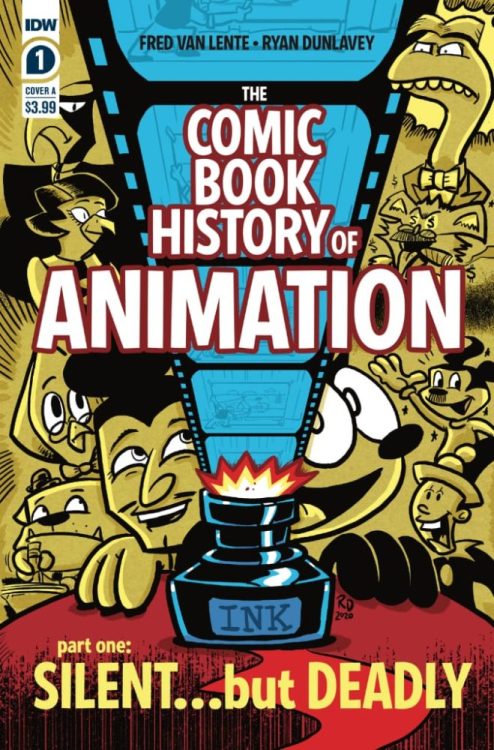
Unfortunately, there is a mixed message within this comic as it is both for kids and for adults but not in the perfectly merged way of a Pixar movie. The title of this first chapter is Silent… but Deadly which is a juvenile joke that sets the tone for the comic; it is after all printed on the cover. Further such gags are scattered throughout which will bring a smile to your face if you are so inclined to that humour. However, there are also more adult themes blatant within the text. The comic touches on alcoholism, corporate bullying, and pornography. Unlike Horrible Histories, a wonderful series of books that wallows in the murky, but more appropriate, side of history, Van Lente’s comic sways between childish and adult, flipping the reader from funny caricature high jinx into an almost dismissal of the misogyny buried deep within the industry. This makes it difficult to draw the line between farce and reality. Again, the problem in History comes down to the concept of Authorial Integrity.
From a reading experience point of view, there’s little to dislike about History. The artwork is engaging and often more challenging than you might expect. Dunlavey places the heavy textual element comfortably into the panels and creates a pleasant flow for the narrative. In places the images do feel more illustrative than storytelling but then other pages are the complete reverse.
The design of the layouts work especially well for easy accessibility which is surely a requirement as some of the target audience for this comic may not be ‘comics’ fans. This accessibility is also reflected in the Funny Animal motif Dunlavey uses, constantly reminding the reader of the Animation, and Comic, aspect of the historical narrative. History has a style which is used from cover to cover to sell the product in a particular way, to a particular audience.
The Comic Book History of Animation Credit: IDW Publishing
Conclusion
The cover of The Comic Book History of Animation is fun and that sense of enjoyment travels throughout the pages. Van Lente and Dunlavey have curated a fascinating look at the history of American Animation and presented it in a fun way that draws on lofty Comics traditions of representation and biographical narrative. Scholarly work such as Understanding Comics, and influential comics like Maus are obvious influences and these creators are clearly telling a story that is close to their hearts.
Everyone who reads History will get something out of it and learn something new. The best way to look at this is as an introduction into the history of animation, as if Van Lente is opening the door and beckoning you to go through. Once on the other side it is up to you to discover the greater history of the medium and expand your education.
Most importantly, the art style suits the narrative, even if some of the contrasting tones make it difficult to know who this is aimed at. It will be interesting to see how the series develops, especially from an artistic point of view: will Dunlavey incorporate modern animation styles as the story progresses? Will it become less Funny Animal and more realist or expressionist? Either way, it will definitely be worth checking out.
The Comic Book History of Animation Credit: IDW Publishing
*There is a much wider discussion around this point in both comics and animation. People argue so vigorously against comics/animation being a children’s medium and yet it is an often overlooked fact that this is exactly how the industries viewed themselves. The ‘kids’ market was, and is, instrumental to the success of both media.
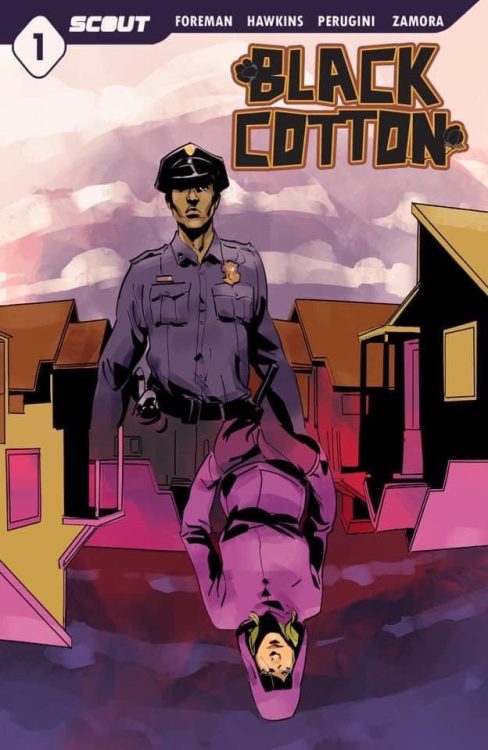
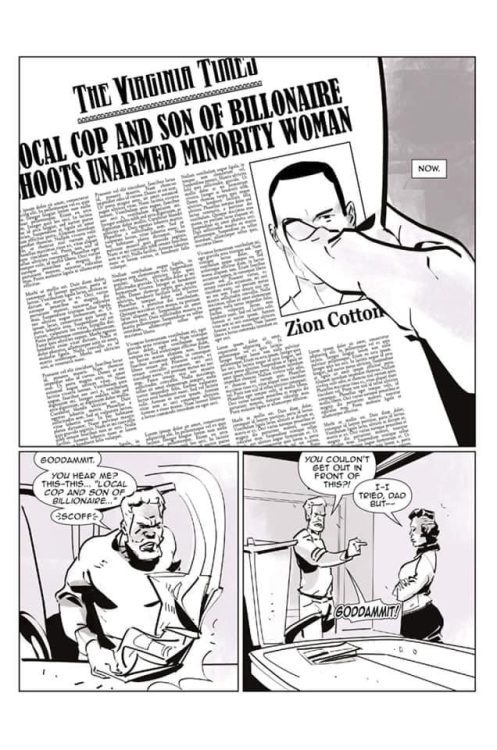
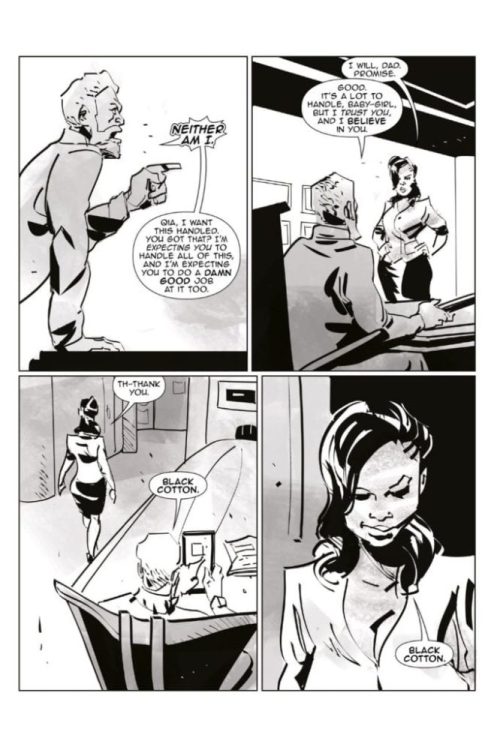
Black Cotton is an alternate reality series coming out this February from Scout Comics. The series is by co-writers Brian Hawkins and Patrick Foreman, artist Marco Perugini, letterer Francisco Zamora, and graphic designer Jerry Nilsson. Monkeys Fighting Robots got the chance to speak with the co-writers about the new series.
About the series:
Set in an alternate reality where the social order of “white” and “black” is reversed, an elitist family, the Cottons, are rocked by a tragic shooting that begins to unravel long-standing family secrets that could not only destroy the family but also divide the fragile social climate of the world.
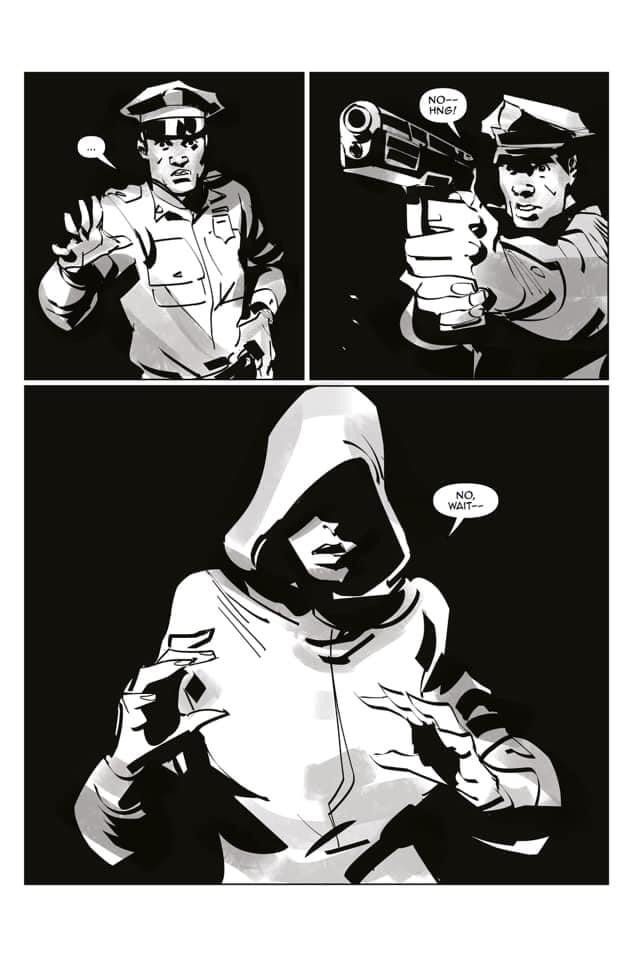
MFR: At first glance, the most noticeable aspect of this comic is it is in greyscale. What inspired this choice? Was it intentional, even at the writing stage of this comic?
Brian Hawkins:I’m definitely a fan of grayscale. That goes back to The Walking Dead for sure. But the choice for black and white/grayscale for Black Cotton was definitely story-based. We talked about it early, the grittiness of it, and since it is a story about black and white, i.e., “color,” to take color out of it — seemed poetic and right — also, it allows you to focus on the characters and to see them “without color” for who they are through the lens of social order in this universe.
Patrick Foreman:Absolutely. We talked about trying to remove people’s implied bias or preconceived perceptions. After talking about it out for hours, we both thought the best way to accomplish it would be to simply remove the colors.
MFR: What was the collaborative process like? Did you encounter any obstacles when trying to create the story and its world?
HAWKINS:No obstacles at all! Patrick and I really complement each other well. He’s a consummate collector and has been for years, and I’m definitely a comic book enthusiast. We bring a lot of the same ideology to the table but also a healthy difference, and that creates a great balance. As far as the process goes — we talk on the phone; we have weekly zoom meetings to craft story while also talking about the business side of comic book creation and how to build the Black Cotton brand. Once we’ve outlined the story, I would then script.
FOREMAN:None. Brian and I work great together. We both have a high level of respect for each other and our creative ideas. Brian is a seasoned veteran with several books under his belt. Throughout this process, he has shared so much knowledge with me. I will forever be grateful for his guidance. Black Cotton would not be a reality if he had not taken me under his wing with this collaboration. It has been great, and I am sure it will be great 10 years from now too.
MFR: I think it’s safe to say that Black Cotton deals with significant, current issues. But, what was the idea behind the choice to set the story in an alternate reality?
HAWKINS:We wanted the freedom of having a world like ours but not ours. We didn’t want the same sordid history that we actually have as a bedrock in the real world to be the same foundation for this story.
So in Black Cotton, we see a world that is like ours, but not reversed in many ways, but not just reversed in a lot of ways — also different. The similarities that we see as readers, we are taking into the story with us from our world, and what we have to deal with is our own implicit bias, but the Black Cotton Universe/Reality isn’t a world where things diverged to make the reality different– it’s actually a reality where Africans never came to America as slaves. And White Americans were never slaves either, so it’s not a reverse as in a flip-flop.
It’s a holistic reversal, truly another perception of reality to challenge how we perceive this reality, ultimately to bring about a higher level of understanding of the human condition. So, in the Black Cotton Universe, we are dealing with a reality where oppression has taken place without slavery- so we see some of the same horrible mentalities and ills and brutality even without slavery having ever been present.
FOREMAN:I believe it all began with the famous and one of the most asked questions; “What if…” Once you start there, then it is easy to go down a rabbit hole with the right topic. With all of the events that have happened just over the past 10 years, more and more people are secretly asking questions such as “if that happened to..”, “If they were…”, “If they could only see it from…” Many times conversations are hard to have because the participants do not feel they are in a safe zone to partake in the dialog. We wanted to create a masterpiece that people would enjoy while also creating a safe environment where readers could walk in other people’s shoes. We want people all around the world to start engaging in fresh, new conversations.
MFR: What can you tell us about the Cottons, this series’ protagonists?
HAWKINS:They are a family of immense wealth. As far as fictional billionaires go, think Carringtons from the TV show, Dynasty. The Cottons are an elitist family, what would be considered in our world as being part of the One Percent. They are historically wealthy, dating as far back as over 400 years (which is purposely stated as four hundred year because it parallels our real-world history of slavery). The Cottons were immigrants from Africa, among other African immigrants, who ended up settling in the Americas. No one took from the Native Americans or any original settlers, but instead bargained and, in some instances outwitted, there were various and different ways and methods by which the African immigrants came into power aka the ruling class of America — but that’s a different story that we will delve into later.
So, when the story starts here — the Cottons are a strong family unit that rallies around their own mantra of “Black Cotton,” which is a mindset for them as a family as well as how they made their money… Literally manufacturing black cotton. The family dynamic consists of Elijah Cotton, the patriarch, Jaleesa Cotton, the matriarch, Zion Cotton, the oldest brother and also a police officer, Qia Cotton, the only daughter and also COO of Black Cotton Ventures, and Xavier Cotton, the youngest brother and teenager. We will explore that Black Cotton mindset throughout the comic… This segues perfectly into the next question…
MFR: At the press release for the series, Brian Hawkins noted that “Black Cotton” is a comic, but it’s also a mindset; it’s a mindset that’s being explored in a comic. Could you both elaborate on this quote?
HAWKINS:Black Cotton as a mindset is about love, honoring familial bonds, kinship, empowerment, encouragement, edification, enlightenment, and most definitely self-reliance. “Black Cotton” represents tenets that are rooted in the essence of what makes a person a full human being, perfect in the sense of existing as a human being that can mature and grow as you’re supposed to, understanding that there is no separation between individual and group, that one is a part of the other; it takes individuals to make a group, to form a whole, and they have to strive for the best version of themselves to better not only themselves but others. That’s Black Cotton.
FOREMAN:Black Cotton Mindset is going back to the beginning before perception occurs. Black Cotton Mindset is color blind and curious like newborn babies’ minds are. It is there that people are able to cross the implied stereotype boundaries we have unknowingly developed over the years.
MFR: Do you have any piece of advice for comic book writers or comic creators, in general?
HAWKINS:Work on your craft first — if you’re a writer, write and really understand the storytelling structure as it pertains to comic book writing. The same goes for artists — even though I cannot speak directly to that as a writer — but I can as an editor; I know that the artist has to be telling the same story as the writer; their canvas is just a different part of that whole (that goes back to the Black Cotton mindset of individuals = the whole, right?).
So, craft, again — how do I tell this story through art? How do I bring it to life? There’s a method to that which goes along with vision. This is where the second part comes in, collaboration. Comic book writing and creating as a whole is about collaborating and thus, communication and openness is a necessity. You have to go into that willingly. Again, the individual becomes the group, to make the whole (that’s Black Cotton again!)
Last, is limitation. Ideas can be vast, and most creators want to just create, create, create, but it takes limiting yourself to focus, to really bring something to life. You have to embrace the idea that you have time and that you do not have to do it all now to be a creator. It took me a while to learn that and then even longer to put it into practice. Presently, I have a few projects coming out, finally coming to life, but it isn’t because I’ve just been on a rampage of creating — I began to limit myself years ago, focusing on project by project, saying ‘no’ to myself a lot of times when I wanted to start something new without finishing what I’d already started and now some of those projects are coming to fruition. It’s the simplest lesson but the hardest to grasp: Less is more.
FOREMAN:Always have a Mentor. Having a mentor helps you continue to grow and get better with your craft. Never lose your vision. Write your vision down, and then build your team around that vision. The team will determine how far you can go. The Black Cotton team is truly special and operates as one. This makes the whole process enjoyable. It is within that type of environment that legendary masterpieces are created.
MFR: Thank you for taking the time to talk with us, and best of luck with Black Cotton.
You can pre-order the first issue in December or pick it up when it hits local comic book shops this February from Scout Comics.