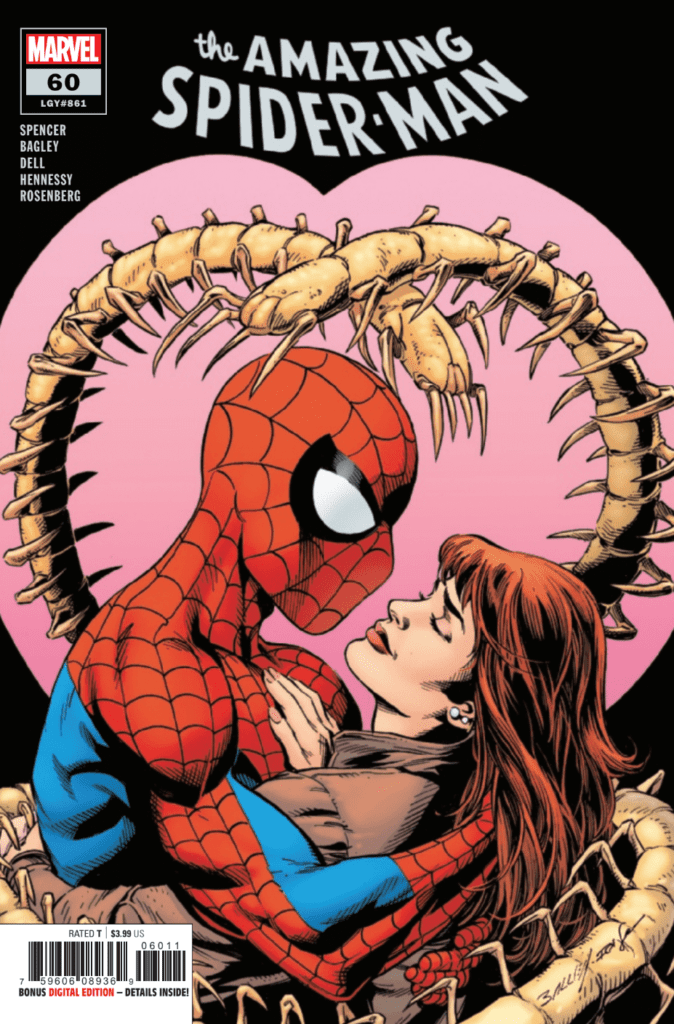
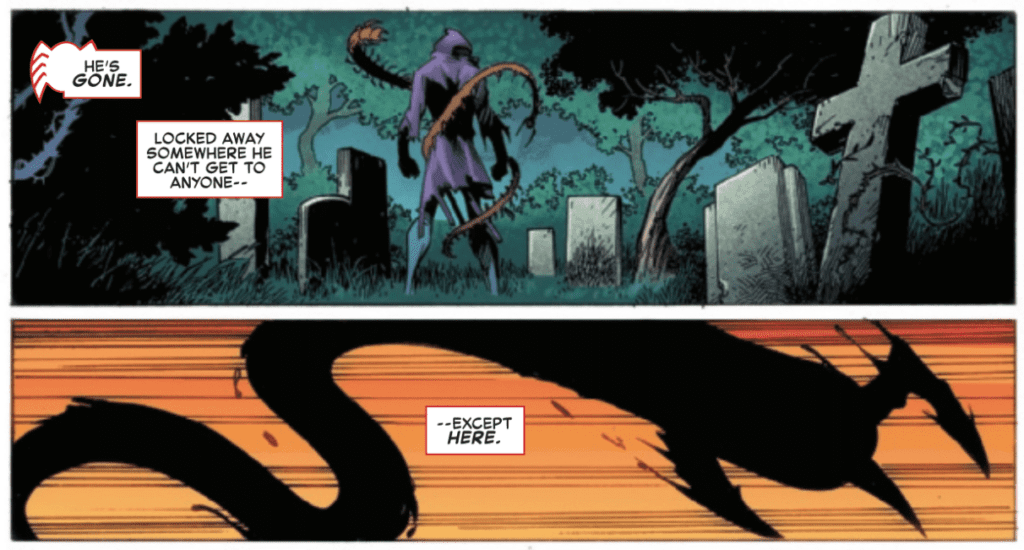
The Amazing Spider-Man #60, out now from Marvel Comics, is an intense, emotional issue that heavily delves into the inner turmoil that Peter Parker faces.
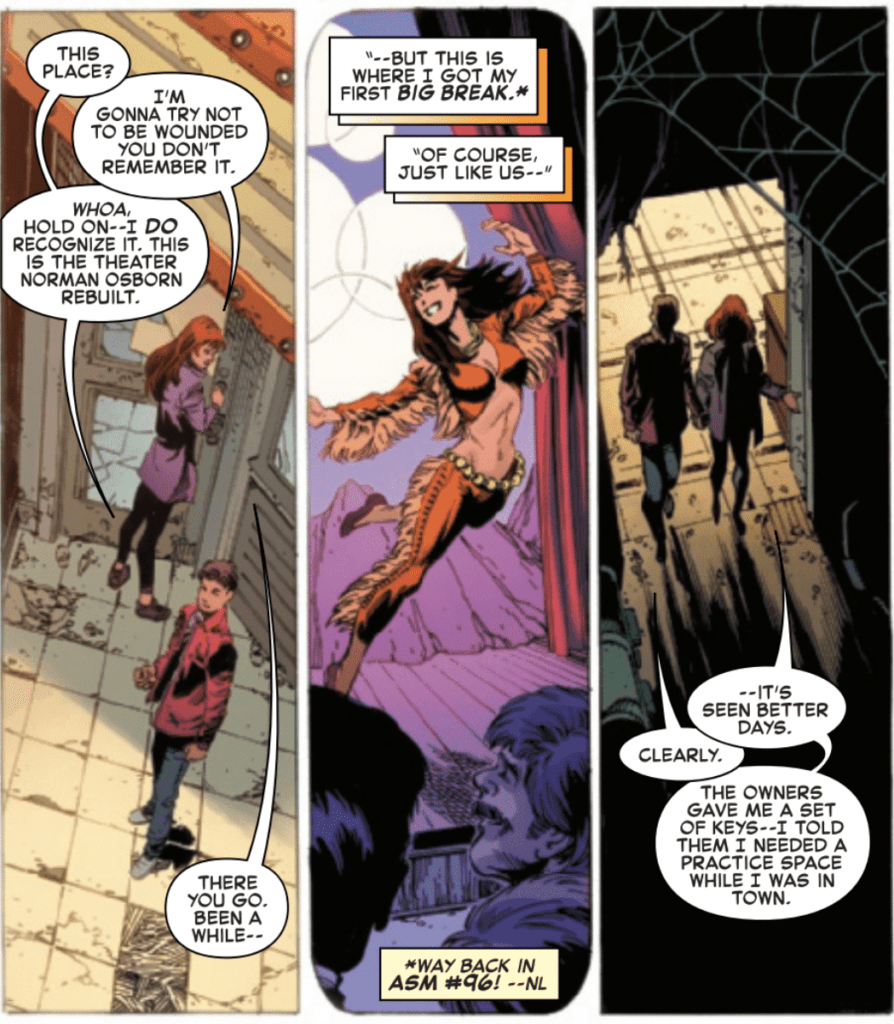
The Amazing Spider-Man #60 is an intriguing issue, to say the least. Most superhero comic book series are focused heavily on action and portraying a visual spectacle, but Nick Spencer takes an entirely different route in this issue. Mary Jane takes Peter to a theater stage she has been using to practice and guides Peter through a therapeutic exercise to work through the emotions he has been experiencing recently. Spencer’s dialogue is powerful, touching, and helps make what Peter has been struggling through in recent issues more evident. The raw emotion that is shown more than makes up for the lack of action in the issue. Spencer also employs techniques such as showing flashbacks and what the characters are imagining to prevent the entire issue from being nothing but images of Peter and Mary Jane’s faces.
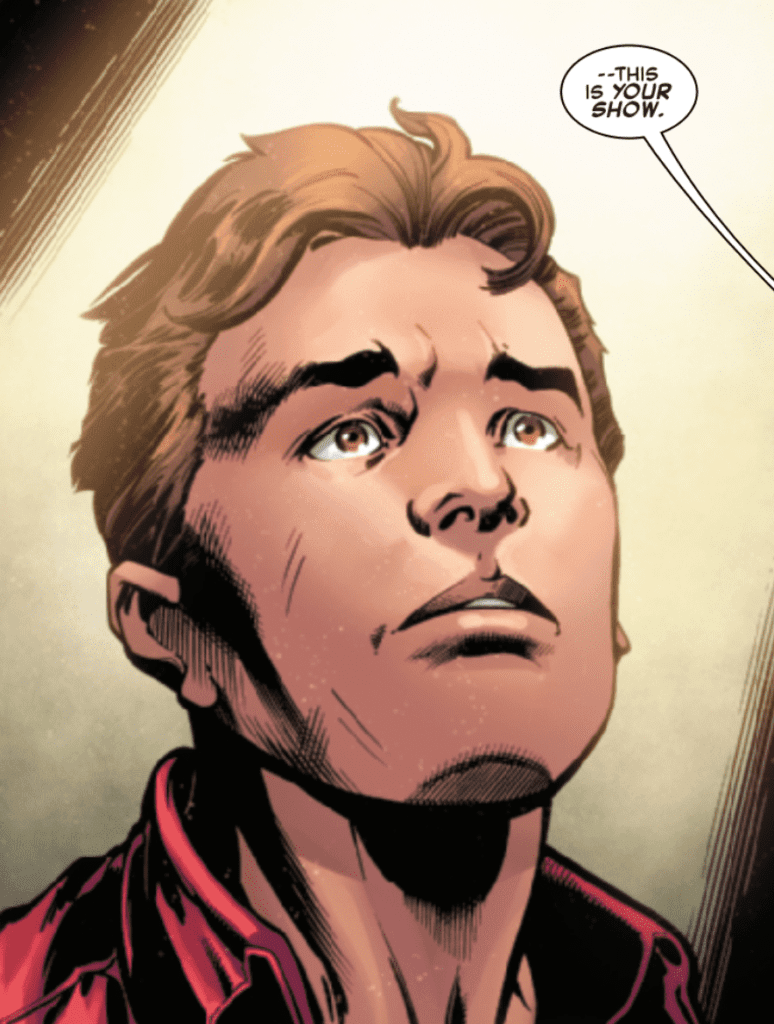
It is difficult to make an issue composed of little action and lots of facial expressions visually appealing. Yet, Mark Bagley, John Dell, and Andrew Hennessy are able to accomplish this and then some. With Bagley’s pencils and Dell and Hennessy’s inks, TheAmazing Spider-Man #60 is a beautiful issue. Peter’s facial expressions and body language pair spectacularly with the accompanying dialogue and make the issue tug on your heartstrings. Silent panels say more than words could ever, and it’s thanks to the magnificent art from this creative team.
While the pencils and inks weren’t necessarily hampered by Spencer’s choice to set most of the issue in one location (since different poses and angles could vary the art), the coloring definitely was. When the source of light does not change, the colorist is left with very few options. This causes the scene taking place on the stage to be stagnant in terms of the palette. Still, Rachelle Rosenberg delivers some absolutely stunning colors for the other scenes in The Amazing Spider-Man #60. One panel of Spider-Man swinging across the city is especially beautiful and reflects the classic Spider-Man tone that we know and love.
VC’s Joe Caramagna’s lettering in The Amazing Spider-Man #60 does wonders to help the issue’s emotionally tense moments get across. The placement of speech bubbles is perfect and never once interferes with the flow of dialogue, which helps immerse readers in the story. Caramagna also uses techniques such as emphasizing certain words and giving some otherworldly characters a unique font and speech bubble. These both give readers more information on how dialogue is spoken, which is critical in a purely visual medium.
The Amazing Spider-Man #60 is a very different issue than what superhero fans expect — and that’s a good thing. The writing gives us an in-depth look at Peter’s emotional state, which is much needed after the traumatic events he has recently experienced. Bagley, Dell, and Hennessy create some gorgeous facial expressions that work phenomenally with the dialogue. The coloring also sets the right mood for the extended scene, even if variety in the color palette isn’t possible.
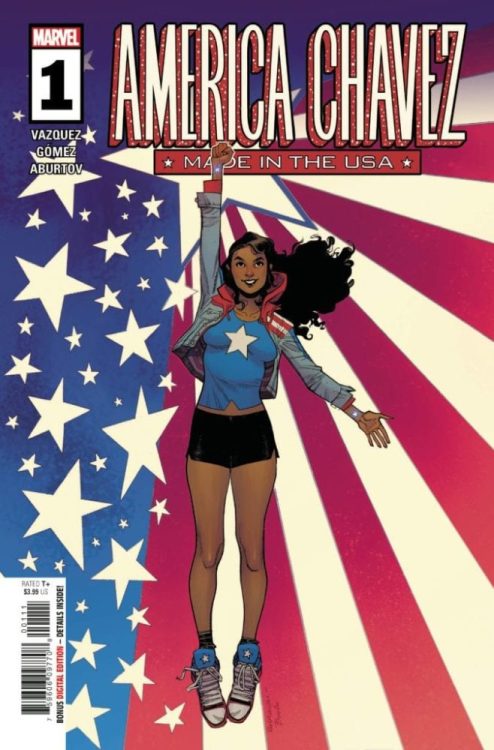
America Chavez #1 begins a new chapter for the titular character from Marvel Comics on March 3. TV screenwriter Kalinda Vazquez of Prison Break and Nikita fame dives into America’s more personal angles. Artist Carlos E. Gomez illustrates with plenty of dark inking and body language the title character’s personal stakes. Because while the flashy colors by Jesus Aburtov are eye-catching, America’s superhero life doesn’t hold much importance. Travis Lanham’s lettering makes a special use of captions from an outside perspective by the series antagonist.
Who Is America Chavez #1?
Vazquez gives America Chavez #1 an attitude and character of its own. Instead of giving all of the narrative weight to America or a mysterious narrator, the plot takes command. The opening page is a flashback sequence that looks at America’s encounter with her foster family. In juxtaposition, the narrator explains their feelings towards America in these moments. For America, this is a point more important than the nature of her powers or her home reality. It’s a feeling the narrator shares by explaining their envy of the happy life America found.
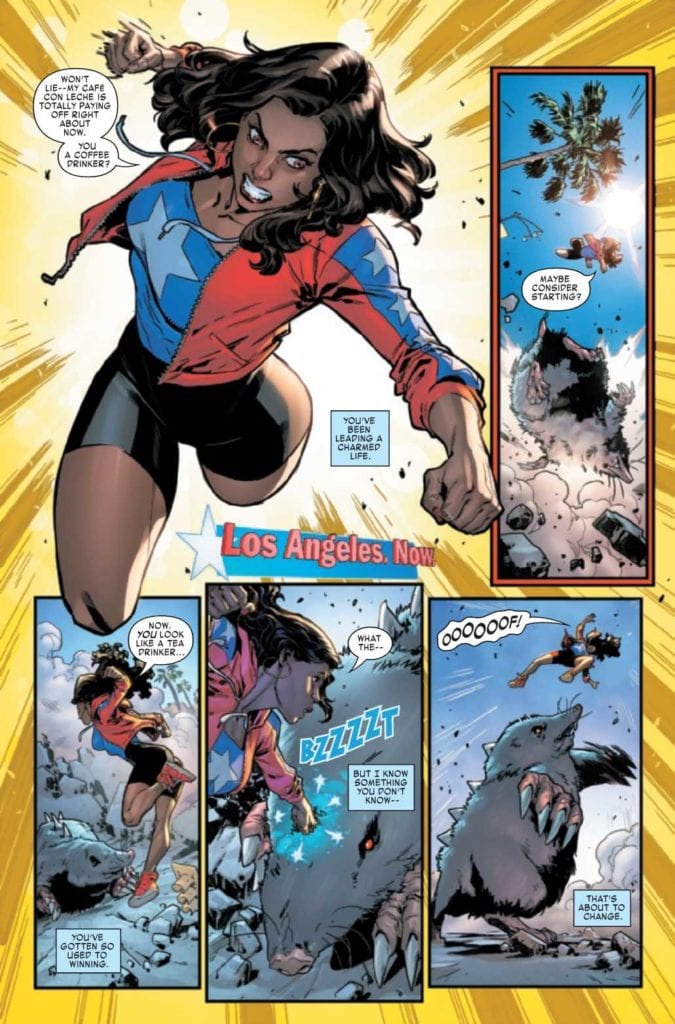
Further into the issue, the reader seems to share this feeling when looking at America’s superhero life. A fight with mutant moles is absurdly charming, especially with friends and admirers. So what happens when the superpowers and life get boring? Throughout the issue, I found myself more engaged with looking at America’s life with her adoptive family (the Santanas) than anything else. Funny enough, a Chavez admire feels the same way when bringing that up. It’s a sign of the plot pushing Chavez to confront her history to expand her character. After developing America Chavez’s powers and personality, this new phase is welcome.
Perspective Art
Gomez’s illustrations give America Chavez #1 a look evoking classic mainstream superhero pin-ups. Where this art style really shines is in what the body language and inking outlines focuses on. When America’s soon-to-be adoptive brother Berto’s outline emboldens, it shows the power he has in directing his family towards something almost out of focus. The outline of the young America Chavez’s wrist and her star mark is what tells a reader who this story is about. Provided they are already familiar with her for a better experience.
The colors by Aburtov show off the flashier parts of America Chavez #1. Most of them come from America’s powers, like when stars spark off her fists and feet. There’s an energy to them that makes every move mean something. Like when her blue star-shaped portal punches a hole in a giant purple barrier.
VC’s Lanham decorates the issue with the mundane and flashy elements within America Chavez #1. The captions that showcase a time and place look very basic yet have a stylization fitting America’s color scheme. Another caption has a very stylized look to it, like introducing America to a wide audience. That one instance is a demonstration of the life America has after her humble beginnings with the Santanas. So when she is thrust into meeting up with them, the basic stylization takes over as no amount of flashy sequences take away the down-to-earth moments that people find warmth in.
Try America Chavez #1
America Chavez #1 opens the series with a sense of interest towards its title character. Whether its readers who follow America’s journey or just getting into her story, they should stick around for more developments. Because Chavez is well on her way to being a classic character with an appearance in the coming Doctor Strange movie.
DC Comics’ villainess Veronica Sinclair, who goes by the alias “Roulette,” became more widely known after she appeared in the season two episode “Survivors” of Supergirl in 2016. She made another appearance in the episode “Supergirl Lives,” directed by Kevin Smith. But Veronica Sinclair first appeared years before in the comic book JSA Secret Files #2 in 2001. Although she does not have such a long and illustrious history as many other DC Comics villains, Roulette has become one of the most appealing female baddies of the DC universe. Let’s take a closer look at why she is so popular among comic book fans.
Veronica “Roulette” Sinclair’s Appearances
Geoff Johns and Derec Aucoin created the character of Veronica Sinclair. After her initial appearance in JSA Secret Files #2, Roulette made several appearances in other comic books, including Formerly Known as the Justice League and One Year Later. She also appeared in the animated series Justice League Unlimited and an episode of season nine of Smallville.
Who is Veronica “Roulette” Sinclair?
From Australia to Japan, people love playing カジノルーレット (casino roulette), so it is no wonder Veronica Sinclair’s supervillain name is named after a game that is so popular the world over. But she is not called Roulette without reason. The daughter of Debra Sinclair, who was an adversary of Mister Terrific, Veronica Sinclair owns a gambling establishment called The House. Using teleporter technology, she captures superheroes who must fight against each other in a superhuman gladiatorial arena as supervillains watch and place bets on the outcome.
Why is Veronica “Roulette” Sinclair so appealing?
Unlike most other villains and villainesses in the DC Comics world, Roulette is lacking in the superpowers department. In fact, she does not have any. But that is one reason why she has become so popular among comic book fans. Like Batman, she has to rely on her strength, wits, martial arts knowledge, and technology to defeat her foes. Although she is adept at hand-to-hand combat, and very handy with her hairpin that doubles as a dagger, it is Roulette’s intellect that makes her such a formidable opponent. After all, she managed to catch some of the world’s most powerful superheroes and pit them against each other, without the use of superpowers.
Roulette is an evil genius, and she knows all there is to know about gambling and probability calculations. With her tricks, traps, security devices, and robotic dog guards, she is always ready to take on the likes of such adversaries as Supergirl. She is also willing to apply the most horrible outcomes to losers in The House. For instance, she once forced Mister Terrific and Doctor Mid-Nite to go head-to-head in a game of chess in which the loser was electrocuted. Another time, she made Sand and Hawkman try to save Hawkgirl while infected with a fast-acting lethal virus. Later, after Supergirl closes down Roulette’s fighting ring, Roulette becomes involved in the intergalactic slave market, proving that she is truly an evil villainess. But it is undoubtedly Veronica “Roulette” Sinclair’s fighting ring that makes her stand out from the villainess crowd. After all, if there is one thing comic book fans love, it is seeing their favorite superheroes battling against each other.
Veronica “Roulette” Sinclair may not have appeared in many story arcs, but her appearances always bring some of the most challenging and dangerous circumstances to the superheroes she goes up against.
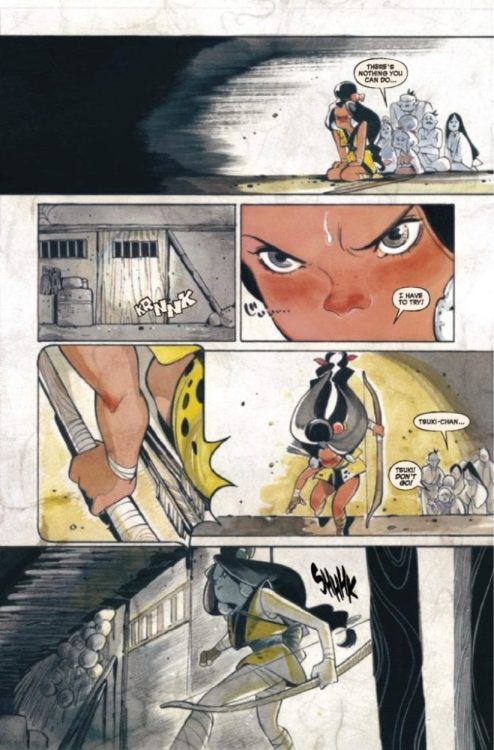
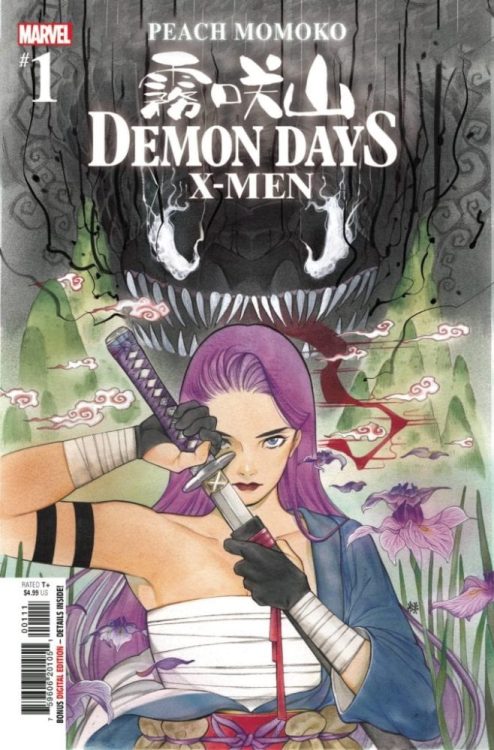
Demon Days X-Men begins a What If? take on Marvel Comics characters on March 3. Under the pen of artist and writer Peach Momoko, three of the X-Men (Mirage, Psylocke, and Wolverine) fight Yokai in a floating world. Adapting the original Japanese story into English is Zack Davisson with Ariana Maher as letterer.
Demon Days X-Men: Floating Fan-Fiction
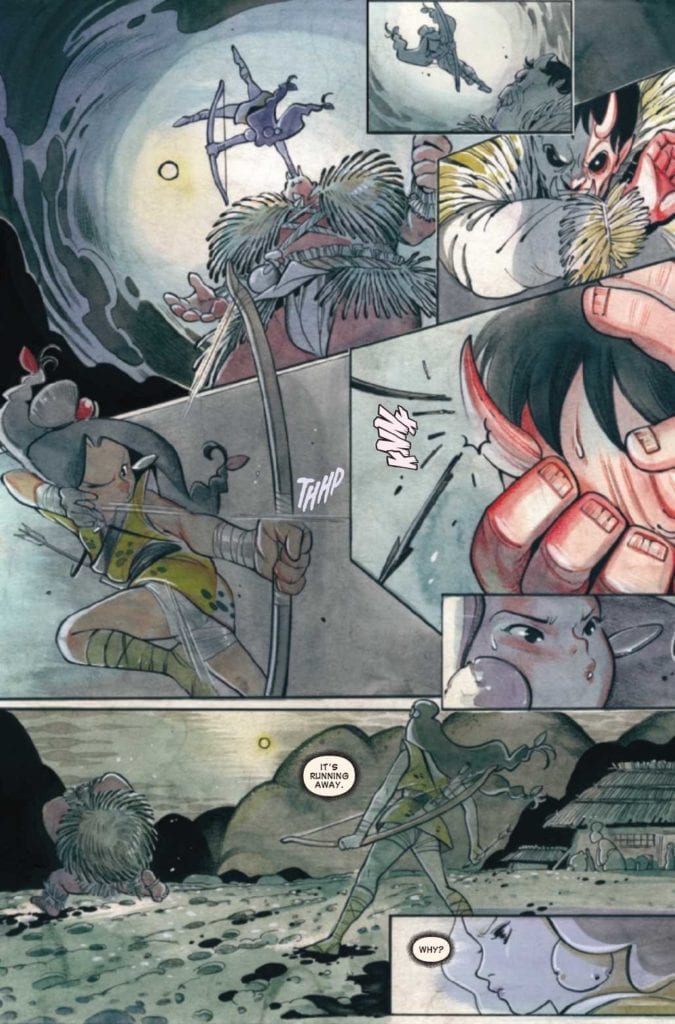
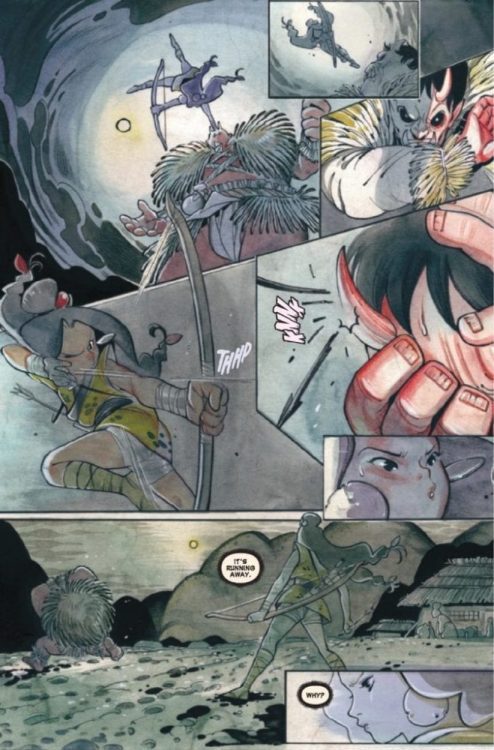
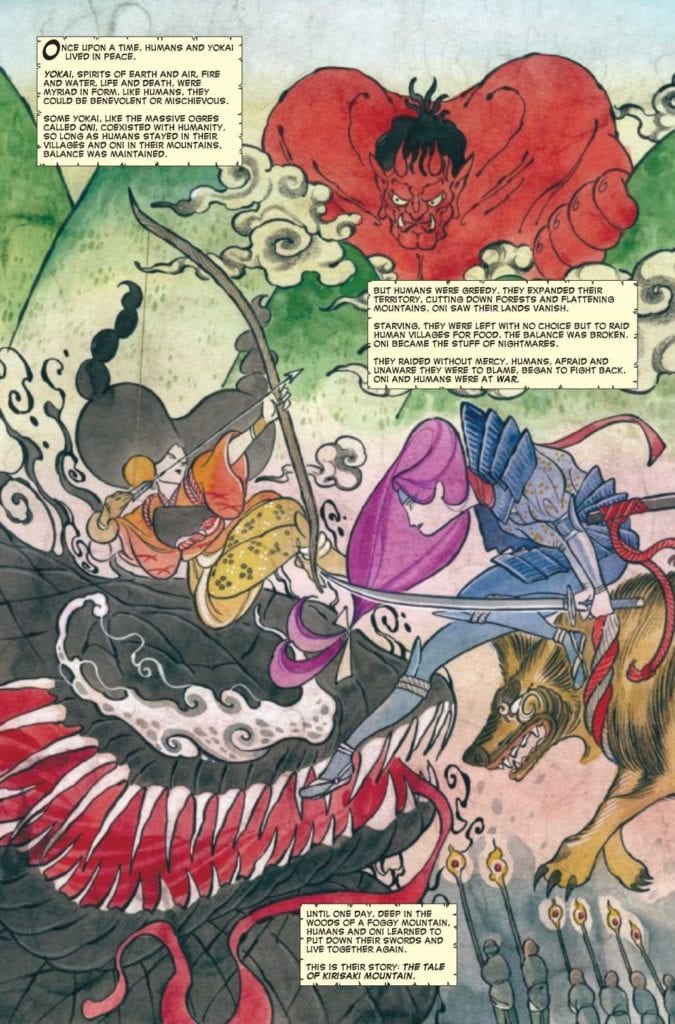
Peach Momoko’s artwork is the main attraction to Demon Days X-Men. Just the opening page presents the title characters as larger than life legends in the style of Ukiyo paintings. The rest of the art has a similar stylization that is much less stiff to make the bodily and facial expressions more pronounceable. Perhaps the most expressive character is the one who never changes his facial features, Hulkmaru. The noh mask-like face with how it is angled displays a great range of emotion. Hulkmaru’s face tilting on an upper angle displays fear, unlike a later time when tilting downwards displays anger and mistrust. The full use of Japanese art displays a range of different styles synergizing like a kabuki play.
All of the above is necessary as the story of Demon Days X-Men is average. Momoko takes inspirations and tropes from samurai stories as well as recognizable folktales. Sai (Psylocke) takes the role of a wandering ronin helping out a village in trouble with a dog version of Wolverine at her side. The trouble in this case is trying to make peace with the oni Hulk…maru who is raiding the village gardens to survive after the village colonized oni lands. Then there comes another story about the village in danger from a yokai Venom interlocks with the previous struggle, and not in a very organic fashion. It really looks like plots resolve for their own sakes instead of going to the root of the problem.
Some Gaijin’s Translation
Between Momoko’s original design and the translations by Davisson, there some noticeable differences. Demon Days X-Men does have some noticeably striking visuals in the SFX by VC’s Maher. Unlike the Japanese SFX that Momoko designs to resemble perfectly etched brushwork, the placements have marginal matches. Some of the Maher’s SFX, like the hissing sound of Venom, look perfect in how it contrasts yet still looks like an extension of him. Others like Hulkmaru’s smash SFX look like they were pasted on from a saved image. Unlike his earlier actions that have a red coloring, this action sound is purple. Frankly, while the overall presentation is fine, it makes me more interested in seeing Momoko’s unfiltered design.
Check Out Demon Days X-Men
Demon Days X-Men is an artistically appealing start to a five-part epic. While the story and direction come up short by combining two unlike stories, the efforts to evoke many Japanese art styles is phenomenal. Peach Momoko is certainly earning her place as a featured artist, with how she portrays her enthusiasm as a Stormbreaker.
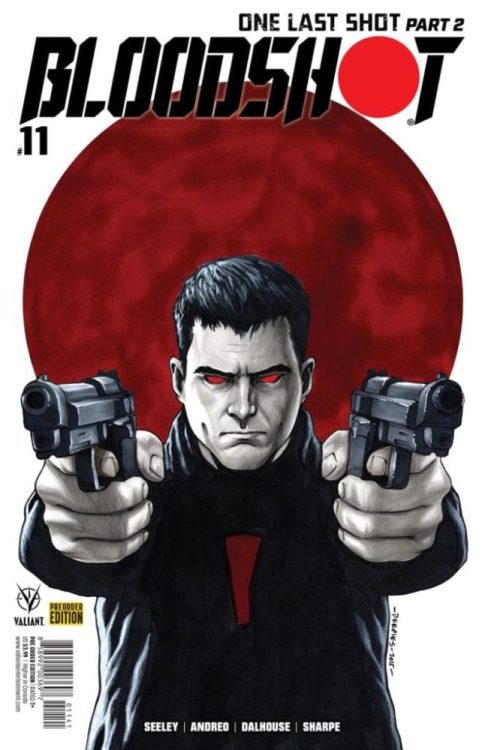
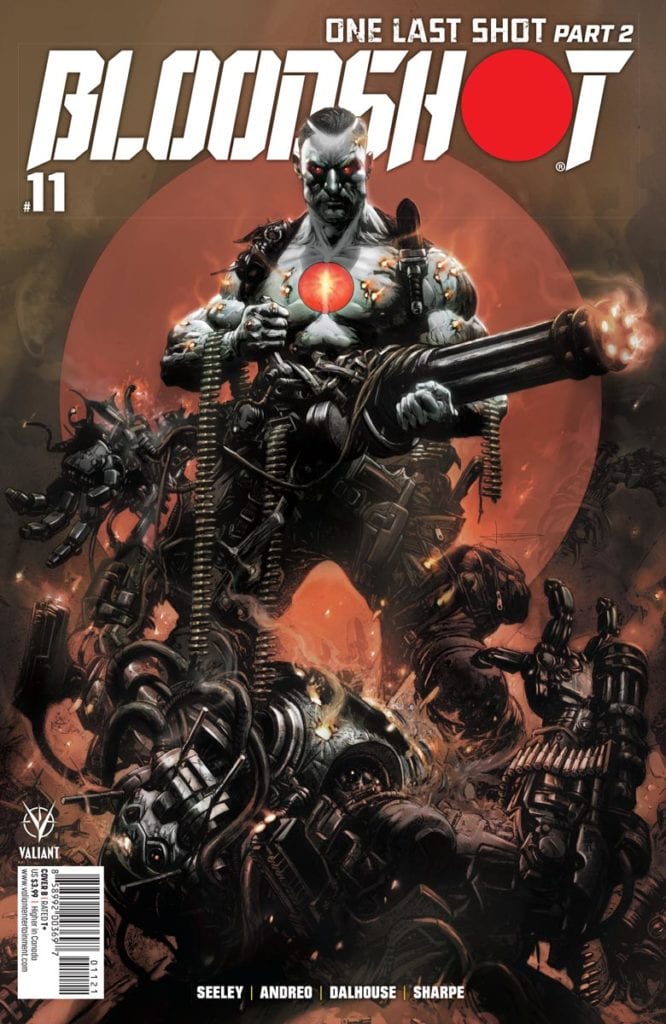
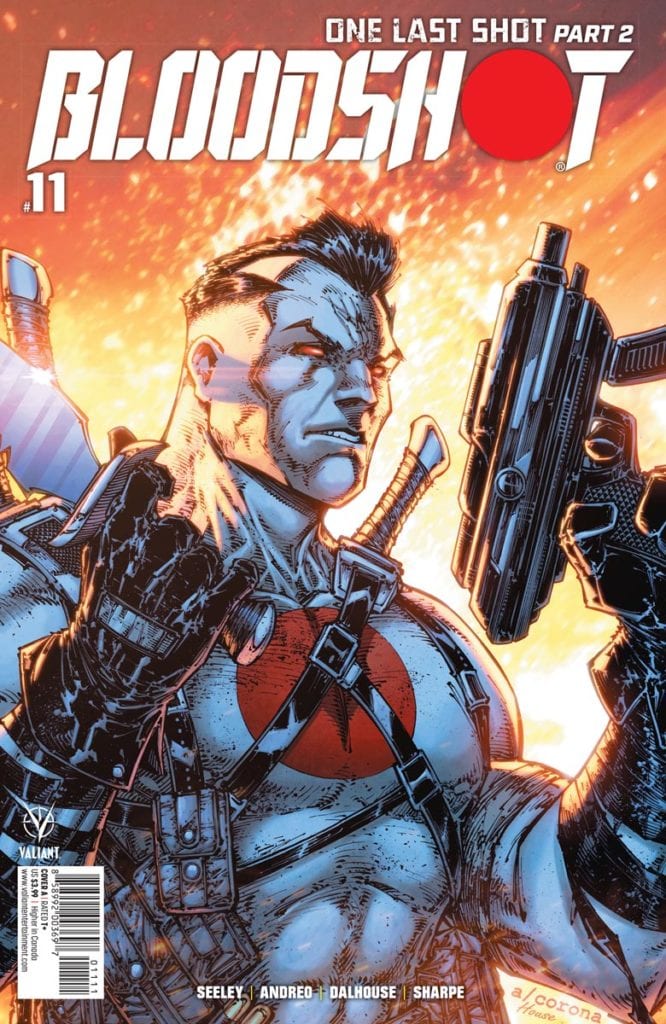
Bloodshot #11 hit your local comic book store this past Wednesday with some scenes that are reminiscent of the post-election political climate. Thanks to Valiant Entertainment, Monkeys Fighting Robots spoke with the book’s editor Lysa Hawkins and artist Pedro Andreo about all the chaos in the issue. There will be spoilers, so turn back now if you have yet to read Bloodshot #11.
Enjoy the interview with Lysa Hawkins and Pedro Andreo below.
MFR: Pedro and Lysa, thank you for taking the time to speak with me.
HAWKINS:Thank you very much for taking the time to ask the questions! ANDREO:Absolutely! Thank you for this interview!
MFR: Lysa, Bloodshot #11 was written before January 6th of this year. After the riot at the Capital, did the creative team think about changing the issue?
HAWKINS:Yes, I read the first draft of Bloodshot #11 nearly a year ago now! We actually did change a bit of the content following the election. As much as life imitates art and vice versa, I didn’t think it was too close for comfort. Our protesters in Bloodshot #11 weren’t there to storm the Capital, just to speak their minds, which is a very American thing to do.
MFR: Pedro, looking back at the issue and the events that happened in the United States, how do you feel about the pages in Bloodshot #11 depicting the political divide and Donald Trump?
ANDREO:The script and the issue were finished long before the events of January (heck, if not for the delay caused by the pandemic, this issue should have been the June 2020 issue, if I’m not mistaken). We kept the events and the likeness of the President on Bloodshot purposely vague for a reason because I don’t think it depicts these events specifically. I really believe that there’s been an escalation of conflict and division throughout the world, and the pandemic has only increased that and I think there’s a great cautionary tale in these pages and what Seeley’s trying to get across about totalitarianism, freedom of speech, and the state of the world we’re living in. In any case, I’m just a dude from Spain (and we have our fair share of sh*t to deal with, politically and otherwise), so my opinion on a political landscape I’m not familiar with nor part of shouldn’t be taken into account on this.
MFR: Pedro, my favorite part of the issue is the battle against Zealot. Can you talk about the artistic elements involved in creating a thrilling fight sequence?
ANDREO:Thanks a lot! There is lots going on in that scene, so I tried to make everything as clear as possible and not clutter the panels too much with information that was not needed. The design of Zealot was made almost on the spot, and I had lots of fun drawing him. There’s lots of artistic freedom when you have a killer cyborg that can split into several killer robots a-la-Voltron! I used diagonal lines between panels, tilted camera angles, and lots of kinetic lines to give more power and speed to the fight and the reading process. I think it came out really nice in the end!
MFR: Lysa, Bloodshot #11 had several plot points come together for a wicked cliffhanger. Was Tim Seeley’s script perfect out of the gate, or did you have to work with him to build the tension?
HAWKINS:Tim Seeley is a big Valiant fan. He loves Bloodshot and has been reading him for years as you can tell by how he writes the scripts, BUT, issue #11 needed a lot of revisions. NOT because it wasn’t terrific. It was, but Tim originally put characters into the script that we were off-limits, and I’d have to go back to him and say, “it’s great, but change it.” In the end, all that fine-tuning really paid off and, I think it made #11 even stronger. It became one of my favorite issues.
MFR: Pedro, Andrew Dalhouse always seems to have one color pop off every page. What’s the best part of Dalhouse coloring your work?
ANDREO:He’s great at using that one color to guide the eye and reinforce the storytelling, right? He’s great to work with. I always feel safe after finishing my go at a page because I know he’s gonna kick ass on the color process. Sometimes I use some lighting effects and such to tell Andrew how I imagine the scene to be, and he always makes it 10 times better.
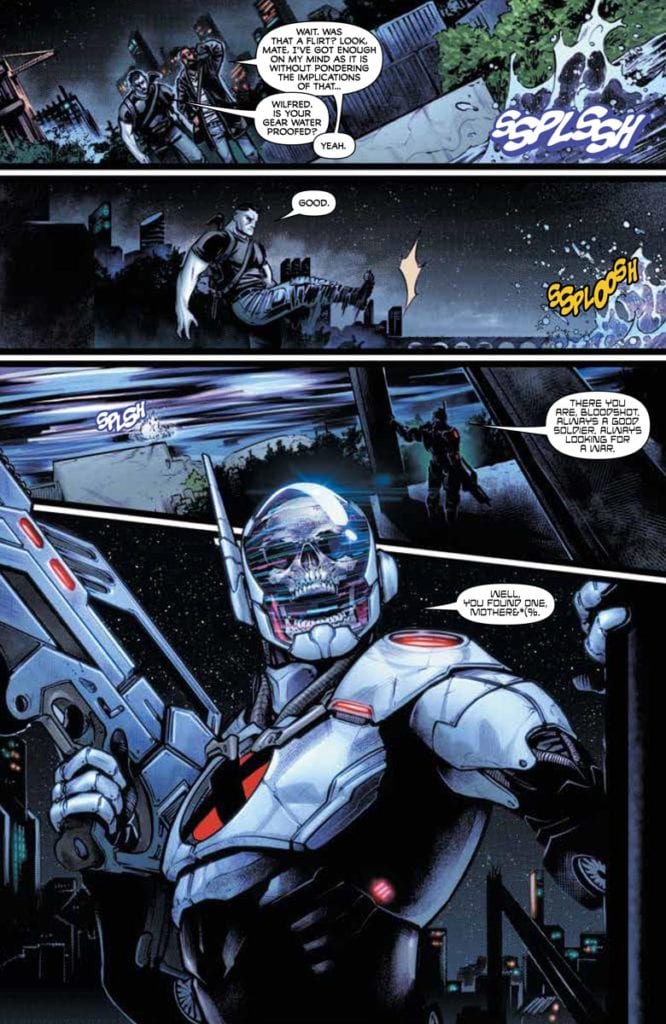
MFR: Pedro, the page that stood out to me is the first time we see Zealot. The word balloons and empty space guide your eye in this nice rounded arc – and then your eyes hit this skull and a hard 90-degree angle of the gun that stops your gaze on Zealot. Can you talk about how you set up this page?
ANDREO:Glad you like it! I purposely did the thing with the gun, so you have to look at that menacing skull every time your eye wanders around the page! The construction beams, the antenna, and other elements are placed the same way, so you go back to Zealot’s weird holographic screen helmet. I wanted to give a lot of space on the first two panels for the dialog and a sense of calm on the third, so the shadow lurking there steals the spotlight, and then BLAM! the big reveal of the big villain of the issue! (Or so we want you to think!)
MFR: Pedro and Lysa, thank you for your time, and best of luck with the story arc!
HAWKINS:Thank you so much! Stay Valiant!
Bloodshot #11 is out now.
Written by TIM SEELEY
Art by PEDRO ANDREO
Colors by ANDREW DALHOUSE
Letters by DAVE SHARPE
Cover A by ADELSO CORONA, ANDREW DALHOUSE
Cover B by LEONARDO MANCO
Preorder Variant Cover by BRENT PEEPLES
“One Last Shot” fires away as Bloodshot and his crew hunt down the resurrected Project Rising Spirit!
The Vigil serves up a refreshing premise that is held back due to its narrative, and bizarre disconnect with certain plot elements. Religions utilization in recent horror films continues to influence many filmmakers. For a debut outing, The Vigil does enough to make this director someone to look out for in the future. Its narrative discrepancies don’t diminish its redeemable qualities.
Jewish religion being placed at the center of this film makes it stand out because it’s a departure from the tired use of Christianity. The Vigil could be compared to The Autopsy of Jane Doe in ways, but it doesn’t include a pair of doctors being taunted by a corpse. Directed and written by Keith Thomas, The Vigil stars Dave Davis, Menashe Lustig, Malky Goldman, Lynn Cohen, Fred Melamed, and Ronald Cohen. The film follows Yakov Ronen (Davis), a man drenched with guilt over a recent accident, who decides to do a favor for his former Rabbi, Reb Shulem (Lustig). Yakov comes from a Jewish community and he has been asked to be a Shomer, he will be watching over the newly deceased Rubin Litvak (Cohen) to protect the body from evil spirits. However, upon arriving at the house it becomes clear that Yakov is not alone.
Dave Davis as Yakov Ronen in The Vigil
The Vigil’s short runtime makes it difficult to grow fully attached to Yakov, but Thomas provides enough depth to the character for him to be a likable protagonist to follow. He has been struggling financially, emotionally, and decides to assist an old ally one night to make easy money. Yakov is not very sociable and seems more interested in his solitude at the moment. Thomas makes it easy to grow sympathetic towards Yakov but doesn’t connect certain plot elements in the best way. It appears that Yakov has medical issues stemming from his trauma and it is made to feel important until it’s thrown away as the film progresses. Also, Yakov isn’t alone in this household while he takes on the duties of being a Shomer.
Litvak’s wife, Mrs. Litvak (Cohen) attempts to get Yakov out of the house the minute he arrives. Of course, a demon is present in the house and it has been eating away at the Litvak’s for many years, especially Rubin Litvak. Thomas ties in the torment Yakov has been enduring emotionally with the methods of this demon, which assist in our protagonist learning to cope and grow from his previous mistakes. There seems to be an underlying message about the problems that could arise from not dealing with personal demons before they manifest into physical ones. Jump scares make an appearance in The Vigil, but Thomas understands to not overdo it and opts in for sparking fear through establishing a growing sense of dread. However, the script does seem formulaic and cliched at times.
Lynn Cohen as Mrs. Litvak in The Vigil
Davis is a great lead, the expressions on his face help highlight the torment Yakov is experiencing. These expressions of guilt and heartache allow Yakove to be an easy protagonist to get behind and Davis’ performance is solid overall. Yakov is forced to come out of his shell once the situation at the Litvak’s residence becomes dire. Davis’ ability to demonstrate Yakov’s antisocial reservations along with his forced behavior adjustments is wonderful to watch. Thomas keeps the film energetic by building the tension every time Yakov makes movements around the house. The shots that linger on certain areas of the house assist with letting fear settle in and Michael Yezerski’s score that blares throughout the film only adds to the terror.
The Vigil introduces a unique premise but then strays away a bit by not offering a unique approach beyond that. Thomas’ efforts here still resulted in a decent horror film that could be considered a mix of The Conjuring and The Autopsy of Jane Doe. The Vigil stops being fresh after Jewish religion is placed at the center, but the film doesn’t drop the ball that much and is still an adequate haunted house story with an important message.
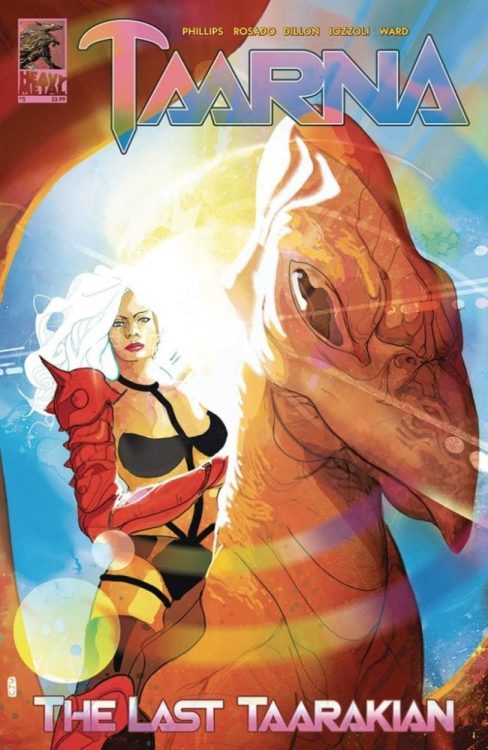
Writer Stephanie Phillips is joined by artist Christian Rosado for this third monster and bloodshed-filled issue of “Taarna: The Last Taarakian” #3. This newest chapter in the Heavy Metal published comic series starring the cult classic heroine is an entertaining but completely predictable read in terms of its cosmic-fantasy script, but it’s held aloft by its incredible visual work and some really rad concepts. With colors from Jessica Kholinne and letters by Marshall Dillon, “Taarna” #3 is a relatively forgettable but still completely entertaining affair.
“The beginning of Act Two where Taarna, the lone protector of the multiverse, and her new ally are pushed to their limit to save a plnaet from destruction, while the chaotic leader called Urcuss takes his army to destroy everyone standing between them and the ultimate weapon for their lord and master, Kako! This is the story of a millenia-old battle between godlike beings, with all sentient life caught in the path.”
Writing & Plot
It’s obvious how much Stephanie Phillips is drawing from her influences in “Taarna” #3, and I don’t necessarily mean this as a bad thing. Both in terms of plot and characterization, this comic feels like a mix of Gail Simone’s Wonder Woman and the classic Conan The Barbarian sword and sorcery stories. Taarna is most definitely inspired by the classic comics Amazon, albeit without the diplomacy and more willingly brutal. The story itself here is pretty formulaic; Taarna is hunting the trail of giant monsters and picks up a hapless survivor of a vicious attack by an army controlled by what we can only guess is a super powerful deity. The merciless march Urcuss’s army and Taarna’s first contact with them really reminded me of moments from Kurt Busiek’s run on Conan, which was cool but also a bit disappointing. I couln’t get through this book without thinking “I’ve read all this before.” The pieces are freshly assembled and on the board, but it’s just been a bit of a process getting to the height of the game. Phillips clearly understands how this medium functions fortunately, as her script stays out of the way with minimal dialogue and narration. Most speech bubbles consist of simple commands, questions, or declarations made up of few words. Instead, Phillips focuses much of this comic’s time on the regular sway of kinetic action that often takes up almost entire pages. This is a comic that plays into its strengths, using its 22-page runtime to quickly run through it entertaining but cliched story to focus on the grandiose moments that make it stand out.
Art Direction
The cosmic and kinetic visual show that this comic has had thus far continues in “Taarna” #3, this time with artist Christian Rosado at the helm on pencils. Rosado replaces artist Patrick Zircher, whose detailed and outstanding style crafted the visuals in the first two issues. Fortunately, Rosado has proven up to the task here, as this book looks just as outstanding as the last two did. Rosado’s thicker lines and more shadow-heavy accents distinguish his style plenty from Zircher’s but still look proper for this comic. There’s still an immense amount of character detail and momentum in the action sequences to carry this comic. His visual direction is spot on as well, with the sweeping and grandiose fight scenes looking like they’re moving at the speed of light on every panel. The fight choreography is simple, but the grace with which it’s portrayed makes this wildly impressive. So much of this beauty is brought to life by Jessica Kholinne’s deep and vivid colors. Her work here sells the alien environments with an endless array of staggering tones, with thick shades of color on every panel. Everything from the tangles fauna to the scorched dry lands of these distant planets looks like it could be walked on, and the way Kholinne handles movement, especially the movement of basically a deity, is full unlike anything I’ve seen in other comics. Kholinne pushes the idea that Taarna is almost bending reality as she fights, with arrays of color shooting past her. The lettering from Marshall Dillon is a dynamic and modern font that is easy to read and carries the narrative and dialogue in this comic very well. In visual terms, this continues to be an absolute standout series.
“Taarna: The Last Taarakian” #3 is a solidly entertaining and gorgeously drawn comic that suffers from a derivative plat that seems to be spinning its wheels. The script feels like it’s putting all of the pieces together and bringing all the cards to the table, but it’s taking its time in really taking off. The visual work is once again an outstanding display however, and is a reason to buy this issue on its own. If you’re a fan of the cult classic Heavy Metal heroine, then pick up this latest chapter when it hits shelves on 2-24!
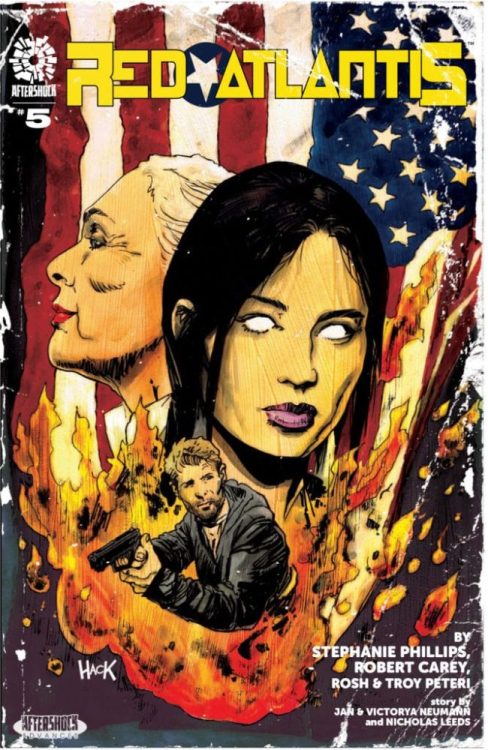
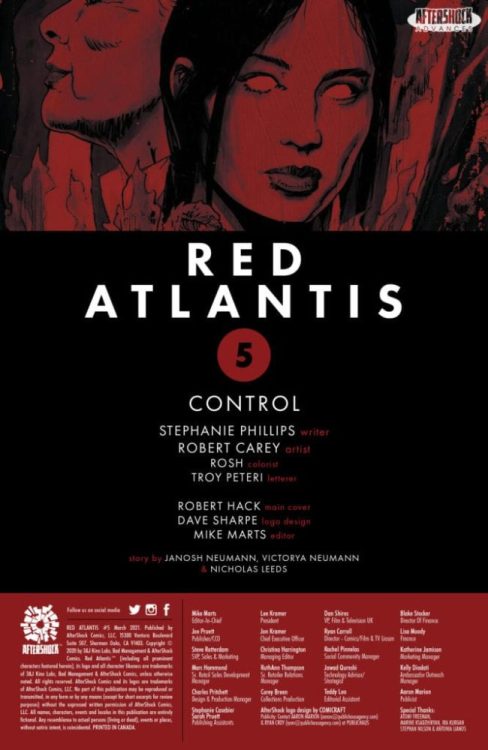
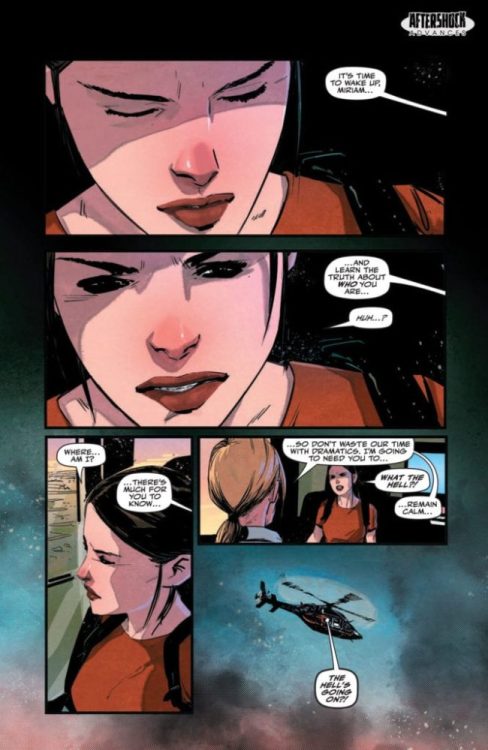
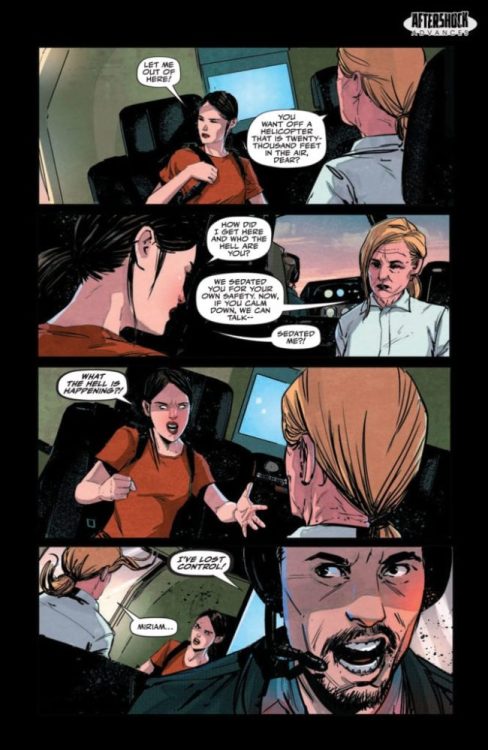
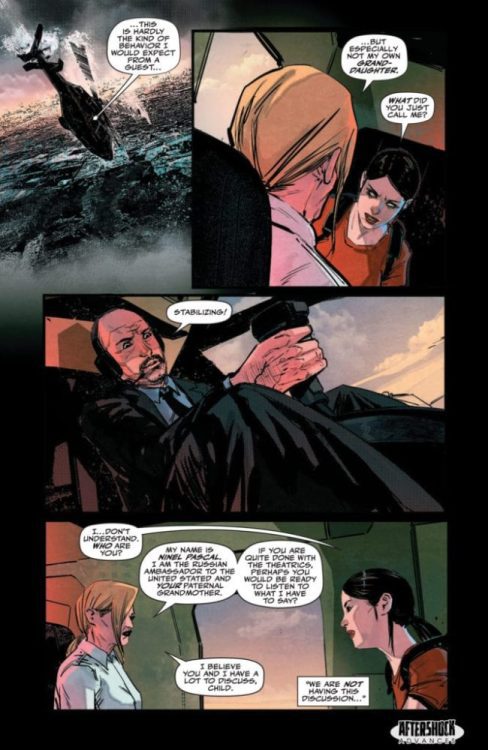
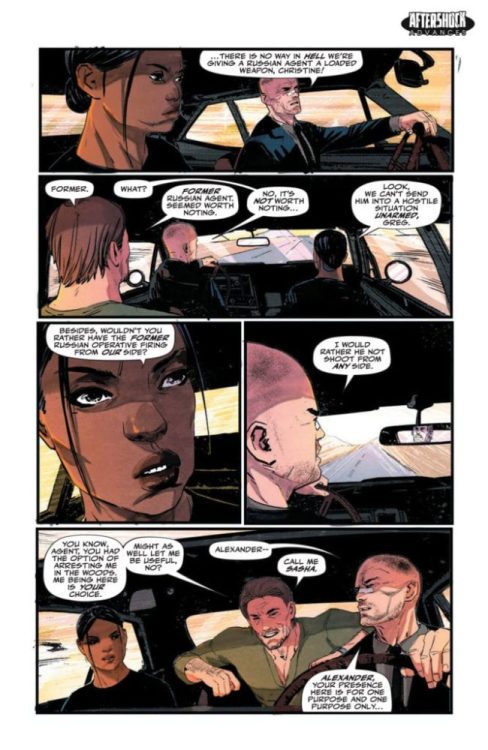
RED ATLANTIS #5 hits your local comic book shop on March 17, but thanks to AfterShock Comics, Monkeys Fighting Robots has an exclusive five-page preview for our readers.
The book is written by Stephanie Phillips, with art by Robert Carey, Rosh drops the color, and you will read Troy Peteri’s letter work.
About RED ATLANTIS #5: A week ago, Miriam Pascal was a college student worrying about exams. Now, she’s trying to harness new-found supernatural powers and stop a secret Russian organization known as Red Atlantis from infiltrating the US government. International espionage and long-buried family secrets clash head-on as Miriam races to save the world.
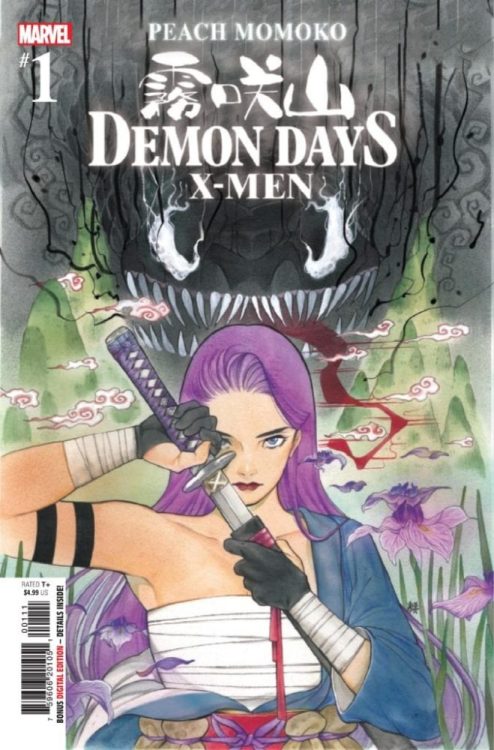
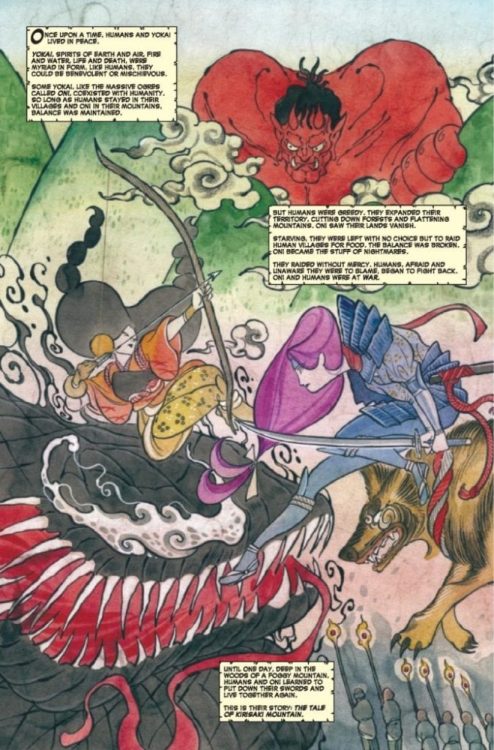
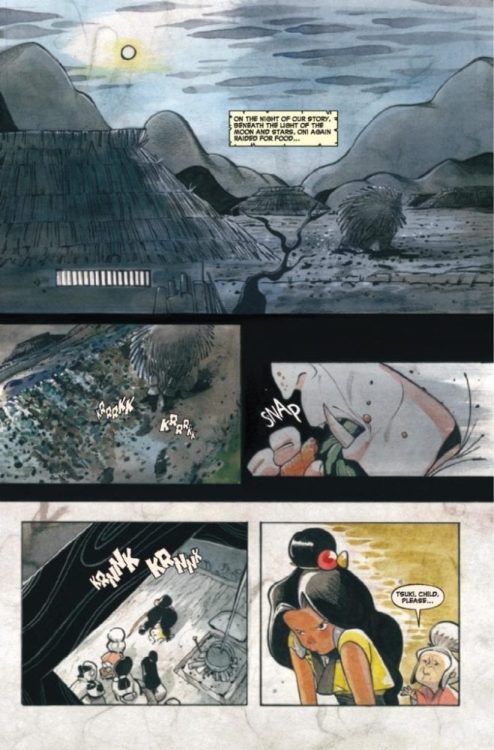
DEMON DAYS X-MEN #1 hits your local comic book shop next week, but thanks to Marvel Comics, Monkeys Fighting Robots has a five-page preview for our readers.
The story and art are by Peach Momoko, Zack Davisson adapted the story to English, and Ariana Maher lettered the English version.
About DEMON DAYS X-MEN #1: From STORMBREAKER PEACH MOMOKO comes a Marvel story unlike any you’ve ever seen before! A wandering swordswoman with a psychic blade arrives at a village that’s being targeted by demons. One demon is black and white with a terrifying red tongue, and another may be the strongest demon there is! In the stunning kick-off issue of this prestige quarterly story, you’ll see a revolutionary reimagination of the Marvel Universe that could only come from Peach Momoko. Ready your katana and enter a mysterious world of demons, monsters, mutants, and magic! Book ONE of FIVE of the DEMON DAYS saga!
Passing from first-time director Rebecca Hall stars Tessa Thompson (Thor: Ragnarok, Creed) and Ruth Negga (The Town, The Gift) in a period drama that wraps its story in a loving musical embrace thanks, in part, to music supervisor Alexandra Eckhardt.
In Passing, Thompson plays Irene “Rene” Redfield, a light-skinned African American woman living in Harlem with her family during the 1920s. Irene’s life is comfortable and convenient, but that changes when she runs into an old friend, Clare Kendry, played by Negga. Clare lives a carefree life, choosing to racially “pass” as white without mention of the black half of her ancestry. The two women are fascinated by the juxtaposing paths each other has taken, and it begins a journey into more profound questions about identity and racial passing.
PopAxiom sat down with Alexandra Eckhardt to discuss becoming a musician, what exactly is a music supervisor, and the making of Passing.
Work Out
“Both of my parents are musicians, bass players, as am I, as you can tell.” Alex points to a collection of bass guitars behind her.
Alex does not know a life without music. “I’ve grown up playing music and listening to music. It’s a huge part of my life.”
Fast-forward through many lessons, gigs, tours, and a lot of work behind-the-scenes on Broadway. “Rebecca Hall and I have played in a band for a few years. We get together with friends and play music as a creative outlet when we’re in town working on various projects. She has super eclectic taste and is a fantastic singer. We’d play Arctic Monkeys, Bjork, and Nina Simone. We’d work out arrangements in Brooklyn.”
About Passing
Rebecca told Alex about her directorial debut that was in the works. Alex said, “I approached her about it and asked if she had anyone on her music team yet. That’s how I became a part of the team, working directly with her and creating a musical soundscape for the film.”
“Passing is a very personal story for Rebecca,” she says. “It’s based on a 1929 novel by Nella Larsen that explores racial passing and identity. It was important to capture the history, culture, and evolving musical landscape of that era.”
Taking place during the Harlem Renaissance, Alex said “I became obsessed with researching periodicals and Cotton Club bills with Duke Ellington or female jazz singers like Alberta Hunter and Ethel Waters who are semi-forgotten now.”
Making Passing “was fun” for Alex, especially “doing deep-dive research and talking with Rebecca about how she wanted to portray the characters living in this world.”
Being A Music Supervisor
A movie or TV production includes many people doing a lot of jobs that aren’t entirely understood. “A music supervisor for film oversees all aspects of anything music-related,” said Alex. “We help with composer selection, working with the composer and acting as a translator between the production and creative sides; we pitch source cues for certain scenes; licensing music, clearing music, and doing the whole legal component.”
“For this film, because it was based in the 1920s, I wanted to utilize as much public domain music as I could,” she explains. “We had an indie budget, so I was creative and resourceful. I quickly learned the nebulous nature of public domain music, but it’s interesting to understand all the different laws.”
Passing uses public domain music during “an on-camera performance where a jazz combo plays in a speakeasy scene. I contracted two amazing musicians and two actors to be featured on-screen, and a 4-piece band of some of the best NYC jazz musicians to play the pre-records prior to filming.”
Rebecca’s direction for this scene included filming the trumpet and clarinet players with “very, very close camera work where you can see all their fingerings on the instruments and breathing.”
Finishing the film faced a big challenge. “Post-production happened remotely as we were at the start of the pandemic. We had to do some re-records for the on-camera performance tracks all remotely, which was insane. I produced the sessions from home by creating custom musical arrangements adapted to the picture edit and had the musicians record individually. The final cut was already there; we had to reverse-engineer the audio to fit the video. Chad Birmingham is an amazing music editor and we worked together to bring out the musicality of this scene and highlight its improvisatory tone.”
“We’re thrilled with how it all came out.”
Emahoy
“When Rebecca and I first talked about the film, she expressed that she could not see the film without having this Ethiopian nun pianist be a great part of the score,” Alex explains.
The pianist is Emahoy Tsegué-Maryam Guèbrou. “Emahoy is 96 years old currently and lives in Jerusalem. She escaped religious persecution in Ethiopia then became this prolific pianist. She made one album in the 60s then gave it up to join a monastery.”
“Emahoy’s rights owners were very concerned about the material because it had to align with her religious values,” Alex says about working to clear Emahoy��s songs. “Rebecca wanted to weave her music throughout the film, in addition to the work of composer Devonté Hynes. It was an interesting patchwork.”
Will viewers hear Emahoy’s music in the final film? “Luckily, Emahoy’s team loved it,” she happily answers. “They couldn’t be happier. It all worked out beautifully. Her music underscores the inner dialogue of the characters and heightens the tone and tension of the film.”
Pet Peeve
Alex shares one last story about Passing. “There’s a cool scene where there’s a Cotton Club style dance hall, and we had a huge band of background actors.”
“Talk about the different responsibilities of the music supervisor,” she says, “I gave each actor mini-lessons on how to hold the trombone the right way or how to hold drumsticks.”
Actors playing instruments wrong is, understandably, one of Alex’s “biggest pet peeves. I wanted to avoid that at all costs. I can think of so many movies where it’s off.”
So, what’s a movie that gets it right? “Soul. I could not believe how they animated the notes that are being played. Also That Thing You Do, The Commitments, and Amadeus all portrayed live performances so authentically.”
Wrapping Up
Alex’s musical journey has seen her play with many incredible artists. She mentions one that she adores. “I’ve been lucky to play with Sara Bareilles. We played on Colbert together but also at the Museum of Natural History in that room with the huge whale. We played directly under it.”
On music she grew up with, Alex says, “When I was little, I had these bizarre mixtapes that would go from Stevie Wonder to Green Day to Brazilian Tropicalía to Eartha Kitt to, man, just everything.”
Passing premiered at Sundance and soon after was acquired by Netflix. “It’s one of the ten pieces in the US Dramatic Competition. It’s super-exciting. I’m ecstatic to be a part of it.”
Alex is in the works to become the music supervisor for several upcoming projects. “As a musician, I’m looking forward to restarting rehearsals for a Broadway show at The Public Theater called The Visitor, based on the 2007 Tom McCarthy film.”
Is Passing on your watch list?
Thanks to Alexandra Eckhardt and Lumos PR
for making this interview possible.


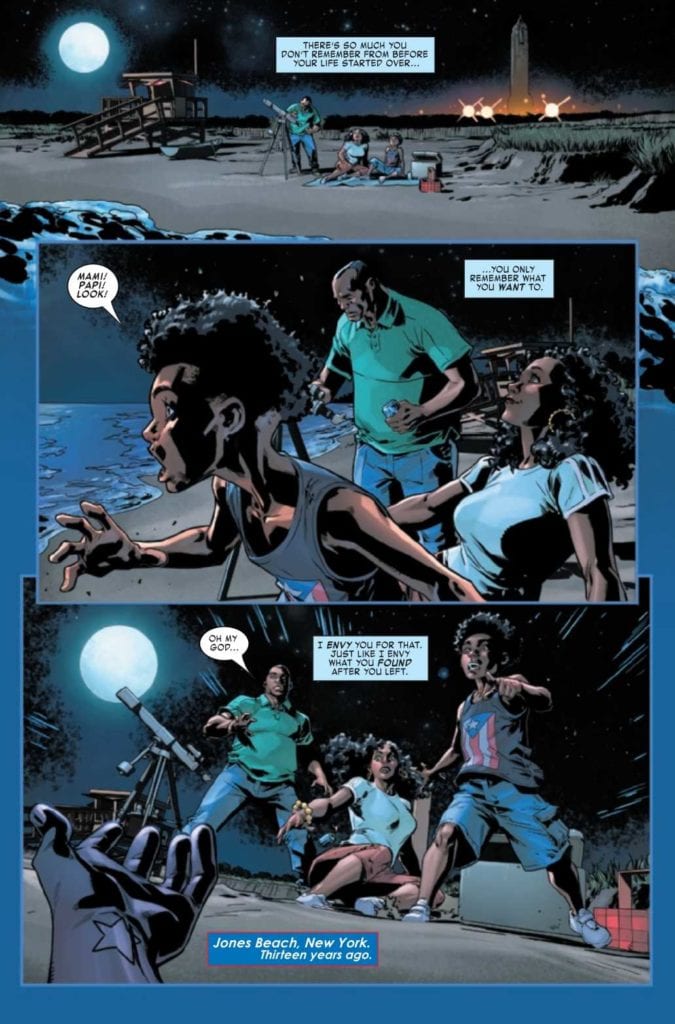 Vazquez gives America Chavez #1 an attitude and character of its own. Instead of giving all of the narrative weight to America or a mysterious narrator, the plot takes command. The opening page is a flashback sequence that looks at America’s encounter with her foster family. In juxtaposition, the narrator explains their feelings towards America in these moments. For America, this is a point more important than the nature of her powers or her home reality. It’s a feeling the narrator shares by explaining their envy of the happy life America found.
 Gomez’s illustrations give America Chavez #1 a look evoking classic mainstream superhero pin-ups. Where this art style really shines is in what the body language and inking outlines focuses on. When America’s soon-to-be adoptive brother Berto’s outline emboldens, it shows the power he has in directing his family towards something almost out of focus. The outline of the young America Chavez’s wrist and her star mark is what tells a reader who this story is about. Provided they are already familiar with her for a better experience.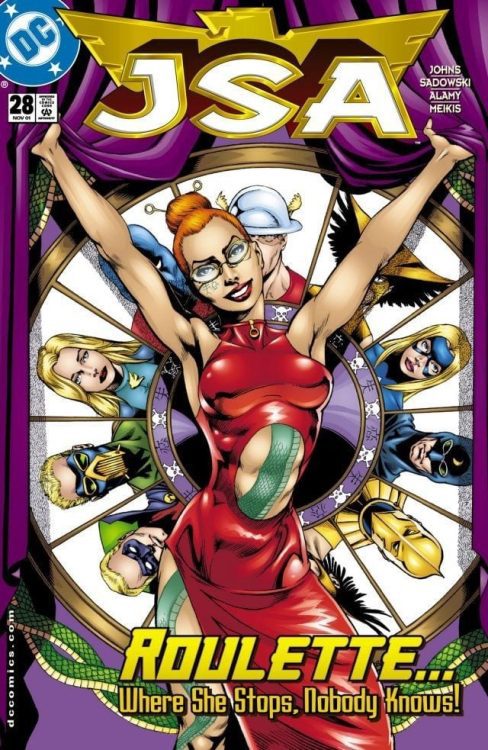
 Peach Momoko’s artwork is the main attraction to Demon Days X-Men. Just the opening page presents the title characters as larger than life legends in the style of Ukiyo paintings. The rest of the art has a similar stylization that is much less stiff to make the bodily and facial expressions more pronounceable. Perhaps the most expressive character is the one who never changes his facial features, Hulkmaru. The