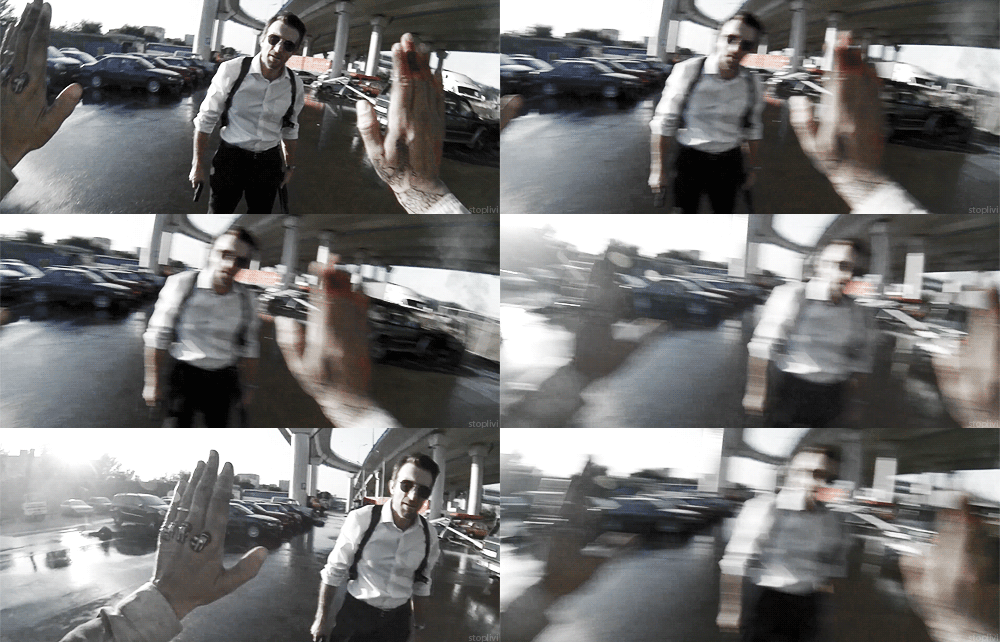
No Holds Barred, Hardcore Henry Delivers Exactly What It Promises.
When you go into a 1st-person action movie, you know exactly what you’ll be getting…utter insanity. That’s what ‘Hardcore Henry‘ brings to the screen; the film throws all logic to the wind & thrust you into their strange world. The audience is treated to an abrasive movie that’s basically an homage to video games. I’m still surprised a film like this made it into American cinemas. The experimental film has polarized critics & pissed off some movie-goers.
STX Entertainment hopes that the viewers will be curious enough to see the movie. ‘Hardcore Henry‘ is the newest film from the studio that has released recent sleeper hits like ‘The Gift‘ & ‘The Boy‘. Unlike the more tradition horror elements of their other films, ‘Hardcore‘ is unlike out right now; this is a total niche film that somehow caught the eye of Hollywood. Seemingly made for freaks, I can appreciate for how unapologetically nuts it is.
There isn’t all praise. The story & paper-thin character weighs down the film. With a gimmick this extreme, it can wear thin very quickly. That seems to be the problem here. If you backed up all your style with a bit more substance, I believe this could have been the exact “action re-invention” it claimed to be. I’m glad the experience was unique but we needed a solid film to shake up the norm.
‘Hardcore Henry‘ won’t go down as cinema history but it will be remembered in the underground cult film community. The inventive style is notable but I’m interested to see if someone else will take it and make a strong film with it. Will you be seeing the film this weekend or is this too much gimmick?
‘Hardcore Henry‘ comes out April 4th; the film is directed by Ilya Naishuller and stars Sharlto Copley.
The Invitation, Karyn Kusama’s incredible psychological thriller, begins with a jolt and never looks back. Will (Logan Marshall-Green) and his new girlfriend, Kira (Emayatzy Corinealdi), are on their way to a dinner party hosted by Will’s ex-wife and her new lover. Almost immediately they hit a coyote, and Will has to finish the job on the suffering animal. This, like everything in The Invitation, means something.
Will’s ex is Eden, played by Tammy Blanchard. Her new man is David (Michiel Huisman). They’ve invited all their old friends back for a dinner party, and none of these friends have seen each other in two years while Eden and David have apparently been living in Mexico. There was a tragedy in the past informing this film, shaping the current lives of everyone, and as soon as Will steps back into the home he once shared with Eden – high in Laurel Canyon – that heartbreak comes flooding back.
He’s also the only one who seems to think this dinner party is super weird. Eden and David are aloof, inundated with some New Age way of thinking and speaking. They have a “presentation” for everyone. Choi, one of the friends in the group, is extremely late, and there are two outsiders lurking at the party: Pruitt (John Carroll Lynch), and Sadie (Lindsay Burdge), a twitchy young girl who appears to have hopped a ride with Eden and David from Mexico to Los Angeles. And wouldn’t you know it, there’s no cell service in the Canyon. And the two hosts sure are pushing this wine on everyone.
No, things are not right, and Will cannot relax.
The Invitation settles into the strangest dinner party I can remember. Will spends the majority of his time scanning the house in which he used to live, plagued with idyllic memories of his former life, going outside for air, and growing increasingly paranoid of secret conversations and strange behavior. Tension hangs thick in the air, and Kusama and Musician Theodore Shapiro make no bones about impending dread with Shapiro’s prickly, unnerving score. And the camera, gliding though the warm yellows and browns of this mini modern-art mansion, capture perfect angles and just the right reveals along the way. The film may push towards an end we can all probably see coming, but the journey is brilliant. Will has a one-on-one conversation with just about every person at the party, old friends who disappeared after the tragedy. The conversations build the history of these characters and their relationship to Will through mundanity and familiarity. Until everything begins falling apart.
The unraveling isn’t quick, but it’s there from the very beginning. The final act of The Invitation explodes, and the final shot will knock you flat. Marshall-Green, who has the unfortunate (or fortunate?) disadvantage of looking exactly like Tom Hardy, has delivered solid work in his career. But nothing he has ever done in the past is as powerful as the bottled-up intensity on display here. Will has retreated from his old life, sadness consuming him, and that sadness may or may not be manifesting itself in the form of growing suspicion. Marshall-Green nails it. Everyone plays their part and plays it with a pitch-perfect ear for the rhythm of Kusama’s film.
What’s most surprising about The Invitation is the emotional weight it carries through this house of psychological horrors. In the end, these characters have been sold to us as real, and they feel real. The consequences are that much more intense in the end because, no matter how strange and tragic things have been, we manage to empathize and maybe even understand a little. There are no clear-cut roles when all is said and done. It’s a testament to Kusama’s direction and her ability to balance masterful tension with honest human emotion. The film is better because of it.
The Invitation is at the Alamo Drafthouse in Austin today, and available on iTunes. Seek it out.
If you haven’t caught up with last week’s episode, then:
SPOILERY MCSPOILSTERS GALORE AHEAD SPOILER!
Lincoln is still deader than Jon Snow and Octavia is looking for vengeance. Upon being reunited with Bellamy, she exacts a little bit of that against his face. The tenth episode of this season, “Fallen”, deals with everything that has fallen-out over Lincoln’s death: Raven neglecting the shiny City of Evil… sorry, City of Light, Bellamy’s flip-flopping, Ontari’s unfair usurping of the Heda-ship, Jasper’s rebelliousness, Pike’s evil ways, etc. In short, “Fallen” deals with a lot of the same stuff.
First, what I liked:
1. Pike’s capture.
It came very abruptly and in the middle of a series of switcharoos which took away the impact of finally giving over a major character (who we still have no reason to care about other than the fact that he’s been mustache-twirling evil) to presumably die. However, that moment allowed Bellamy and Octavia to come to terms with each other over their actions. Bellamy’s 27th flip of the season was grating but it was the right choice and one which will heal the pain of Lincoln’s death as Bellamy’s fault in Octavia’s eyes. When Kane then asks Bellamy if he did it because of Octavia or because it was the right thing we, as an audience, want to say both. Bellamy simply responds with, “You’re welcome.” That’s the character. He’s thinking about his choices but ultimately he’s probably being a little selfish in merely protecting his sister. Also, this capture gives us that moment of tension which is earned when Kane suggests he join the Grounders back to Polis with Pike in tow. He doesn’t know what the situation is like over there but we understand his choice even though it’s likely to not turn out pretty. These are the kinds of decisions the show makes which make it a cut-above.
2. Murphy waking up in the filthy BDSM dream he has always wanted.*
What I didn’t like:
1. Everything else.
From Jaha continuing A.L.I.E.’s nefarious plot by wanting to take away free will from everyone to Monty and Mommy Monty having a forced moment in Arkadia, “Fallen” was stilted, rushed and illogical. The reason and logic the characters are always spouting made no sense here as their actions dictated otherwise.
We’ve never liked Monty’s Mom. We can’t be expected to be emotionally moved when she tries to warningly warn Monty that he needs to leave because she gave him up. Nope.
It was never a fully realized idea that Jaha is another A.L.I.E. automaton. From everything the series told me, I believed he had some sort of filter between his true self and the AI and was only given such a buffer because he was batshit crazy enough to actually believe in this stuff. But when you take the character so far as to want to take away all of the free will of his people, I’m off the train. Jaha simply has to be an automaton at this point because we’ve seen nothing that suggests the character would submit the souls of everyone he knows for a shiny image of a city. The progression wasn’t there.
Raven’s torture should have had zero effect on Abby and Jasper’s plan to get to the bracelet. If A.L.I.E. is so hellbent on obtaining control of Raven, I get her focus to this area but that should’ve allowed Jasper the time to collect the bracelet. Plus, why wouldn’t A.L.I.E. just get Jasper first, since he could very well be the undoing of her entire plot to control Raven? I believe this is more of a directorial thing as the scenes where Raven was tortured with her past pains and the one where Jasper finally comes across the bracelet aren’t cut together like they should have been, thusly negating all tension they could wring from the situation.
Here’s my theory after a string of questionable episodes this season:
Maybe The 100 is better when they’re just trying to keep the wheels on? I’m not saying all the great character work and surprises were haphazardly thrown together in previous seasons. I’m saying the show was better when it had nothing to lose. Now there’s an expectation. With this, moves and decisions are provoked that haven’t come from the same headspace as it once did. That’s fine. Shows blow up in the popular conscience and evolve as a result all the time. The 100 is simply not handling what it’s become with much aplomb. And stories like Ricky Whittle’s bullying claims by that of showrunner and creator, Jason Rothenberg, also give me pause when trying to defend the show’s choices. Of course, this could all be untrue but Whittle speaking out against a show (although he does say to still support it because of its diversity and the cast he loves) with an ardent fan base and a general lack of a good response from Rothenberg makes me question the writers’ room all the more. Now, I do think The 100 is a show where the fans love the characters themselves more than the story so I can see questionable decisions like these actually coming back to hurt the show rather than strengthening its defenders.
Maybe success was the worst thing to happen to The 100?
I’m still on board but I’m now extremely cautious each time the show leaves me feeling like it’s about to move on, instead choosing to run more circles around itself.
“You’re dead to me.” – Octavia
*In all seriousness, that bit was kind of fun but it couldn’t have really happened. I mean, I know it did. The show isn’t pulling a fantasy sequence on us but nothing about what happened in Polis in “Fallen” rang true and Murphy is the only character we have connection with and he so clearly wants something like this to happen to him that it’s all I have to go on.
Check out my reviews of previous episodes of ‘The 100’ here:
The past seven days were epic for pop culture, ‘The Walking Dead’ on AMC introduced Negan, Shane McMahon destroys WrestleMania, and Lucasfilm released the first trailer for ‘Rogue One: A Star Wars Story.’
EJ Moreno and Matt Sardo have different opinions on the season finale of ‘The Walking Dead,’ the duo examines the mainstream popularity of WrestleMania, and gush over ‘Rogue One.’
Do you have a question that you would like answered during the show?
Email your questions to matt@popaxiom.com.
If you are looking to sponsor the podcast email matt@popaxiom.com as well.
Never heard of Matt Sardo?
For starters, he made the Kessel Run in less than 11 parsecs. Prior to that, he gave Doc Brown the idea for the flux capacitor and led the Resistance to victory over SkyNet – all while sipping a finely crafted IPA. As a radio host, he’s interviewed celebrities, athletes and everyone in between. He’s covered everything from the Super Bowl to Comic-Con.
Who is EJ Moreno?
Is he a trained physician? No. Is a he a former Miss Universe contestant? Possibly. But what we know for sure is he’s a writer, filmmaker, and pop culture enthusiast. Since film school, EJ has written & directed several short films. He’s used his passion of filmmaking to become a movie critic for MonkeysFightingRobots.com.
As the world is in the middle of an industrial revolution, a monster appears that cannot be defeated unless its heart, which is protected by a layer of iron, is pierced. By infecting humans with its bite, the monster can create aggressive and undead creatures known as Kabane. On the island Hinomoto, located in the far east, people have built stations to shelter themselves from these creatures. People access the station, as well as transport wares between them, with the help of a locomotive running on steam, called Hayajiro. Ikoma, a boy who lives in the Aragane station and helps to build Hayajiro, creates his own weapon called Tsuranukizutsu in order to defeat the creatures. One day, as he waits for an opportunity to use his weapon, he meets a girl named Mumei, who is excused from the mandatory Kabane inspection. During the night, Ikoma meets Mumei again as he sees Hayajiro going out of control. The staff on the locomotive has turned into the creatures. The station, now under attack by Kabane, is the opportunity Ikoma has been looking for.
You can find Kabaneri of the Iron Fortress streaming on Amazon Prime.
Episode Review
I think It’s high time we start using the word zombie is less of a monster and more like a monster class. While I wouldn’t really call the Kabane from Kabaneri of the Iron Fortress zombies, they share a lot of traits that zombies have. But that’s beside the point, does the incorporation of the zombie class in Kabaneri of the Iron Fortress make it for another dull Walking Dead or Attack On Titan clone? Maybe. But that doesn’t mean you shouldn’t sit your ass down and watch the freaking show.
It’s clear this show has some influence from Attack On Titan. Heck, even the art style and color palette seem to be pretty similar. But I don’t want to go into how much like Attack On Titan this is. I’ll just say, “If you like Attack On Titan, you’ll like this.”
While watching Kabaneri of the Iron Fortress I noticed that it excelled in the things that make a first episode to an action series so important. It instantly made me understand the world and grounded me in its premise. Plus it didn’t convey this through minutes of info dumping like other shows. It respected my intelligence for the most part and let me learn through the show, which is the best way. Kabaneri of the Iron Fortress, also has a great way of shooting something “in media res” and not making it confusing, but still mysterious. There are still a lot of questions from the first episode but nothing that hinders the enjoyment of the first episode. What I’m saying is that the show isn’t relying on the promise of it getting good or interesting later. Its great right off the bat.
Since the first episode is void of plot we don’t really get many character moments aside from our main hero Ikoma, who is instantly likable and dare I say it relatable. I assume since this world has to take on shitty morales to survive, he’s going to be a beacon for doing whats right regardless. I just hope it doesn’t turn out whiny like another certain protagonist *cough cough* Eren Jeager. I mean the guy clearly shows resolve as he impales his arm and nearly chokes himself to death trying to stop the Kabane infection. He’s hardcore in his beliefs and actions and has a tragic back story to boot. That coupled with his gifted talents as an engineer make him for a compelling character in my book. As for the kimono girl Mumei is a badass who I need more information on right now. She seems rather callous towards the world but I hope there’s more to her character than that. I’ll give her the benefit of the doubt since she only had like four speaking lines in this episode.
This episode instantly hooked me as well with other I imagine. Accompanied with its premise and its thematic and thrilling directing courtesy of Tetsuro Araki (Death Note, Attack On Titan), This show could certainly be the most entertaining and gripping shows this season. The only concern I have is that we haven’t really seen the script strut its stuff yet because of that explosive opening. Having a script by, Ichiro Okouchi, the guy who wrote Code Geass, Guilty Crown, and Valvrave the Liberator concerns me but I’m sure he’s gotten better by now…right?
By now you’ve seen the new trailer for Rogue One: A Star Wars Story. Chances are—if you’re like those of us at Monkeys Fighting Robots– you’ve seen it a couple dozen times. And why not? There’s a lot to like here. This is Disney’s first attempt to show there’s more to the galaxy far, far away than just the Skywalkers, Solos and Kenobis.
WHAT WE KNOW
Anyone with an internet connection know Rogue One is intended to be a bridge between Episode III: Revenge of the Sith and Episode IV: A New Hope. But we still learned a few new details.
The trailer introduces us to Jyn Erso (Felicity Jones) a rebellious ass-kicking young woman who is sent on a mission to steal the plans for the original Death Star. This is shaping up to be basically an intergalactic heist movie.
We also know this movie will capture the look and feel of A New Hope. We see classic stormtroopers, Imperial AT-AT Walkers, X-Wings and X-Wing pilots, and the Death Star. I also now know that the alarms at a rebel base give off an awful sound.
WHAT WE THINK WE KNOW
Here’s a list in no particular order:
Forrest Whitaker appears to be talking to Jyn, warning her about losing herself if she takes on this mission.
There will be an X-wing pilot who looks a lot like Poe Dameron, but isn’t because he’s clearly a different actor and the movies are separated by like 30 years.
The Death Star is nearly complete which could mean this movie literally goes up to the point of the start of A New Hope.
Ben Mendelsohn plays a new villain who may or may have a light saber on his belt.
Karate masters exist in the Star Wars universe
There’s going to be some pretty sweet battles.
Darth Vader makes an appearance. Sort of, maybe. (More on this in a second)
WHAT WE DON’T KNOW
Pretty much everything else. This trailer like all the trailers for The Force Awakens tries to keep as many details shrouded in mystery as possible. It’s what makes this trailer awesome; recognize I know some stuff about the plot, but then remind me that, like Jon Snow, I know nothing.
THE VADER QUESTION
So the big question is will we see Darth Vader in Rogue One and if so how much? In the trailer you see a figure in a dark cloak, hood pulled up. The only time we’ve ever seen Vader in a cloak was when he was still called Anakin Skywalker. The lack of the Vader helmet coupled with the fact that the cloak with the hood pulled up is more of an evil emperor’s fashion choice makes it clear to me that’s not Vader.
But between the Imperial Guard and this looking like Vader’s chamber I’d say he’s definitely in this movie. So, how much? I’d think his dark-side presence will loom over the entire thing. However I wouldn’t be surprised if we don’t actually see him until the very end as he takes over the hunt for the stolen death star plans.
While having Vader around is needed for fan appeal if Disney really wants to expand the Star Wars universe than having a heavy Vader presence makes little sense.
Melissa McCarthy’s latest, The Boss, directed by her husband and writing partner Ben Falcone, hits theaters this weekend. The Boss will remind everyone a great deal of Tammy (also written by McCarthy, her husband, and Steve Mallory) in that it is nothing more than a vehicle to highlight McCarthy’s comedic prowess. However, when the focus isprimarily on just one character then the rest of the movie implodes.
Now, don’t misinterpret these thoughts on The Boss as some condemnation of every project Melissa McCarthy does. McCarthy does many wonderful films from the ensemble Bridesmaids, St. Vincent, to last year’s hit, Spy. The biggest difference between these three movies and The Boss is McCarthy didn’t have a hand in writing the screenplay. Bridesmaids is extremely balanced, and everyone was equally featured comedically. The same is true about Spy (which gives me hope about Ghostbusters because Paul Feig knows how to construct a comedy). In The Boss, the film is so hyper focused on Michelle Darnell that the rest of the movie is lazily constructed.
Is the idea behind The Boss a terrible one? Not really. The film’s based on the character McCarthy created at LA’s Groundlings Theatre, Michelle Darnell. The character is a motivational financial guru who does not censor her thoughts and limitless confidence. The character is a strong one but not strong enough to build a whole film around. They certainly attempted to develop the best script possible. In a recent interview on The Howard Stern Show, McCarthy said The Boss script underwent 11 rewrites over the years before being greenlit for production. Maybe they should have shot for a 12th?
In the film, Michelle Darnell rises from a childhood riddled with rejection and extended stays at an orphanage to become a financial guru who loves the finer things in life. Darnell gets arrested for insider trading after she’s turned in by a former lover played by Peter Dinklage (whom I am assuming just doesn’t say no to any project he’s offered). Darnell is sentenced to a few months in Jail and is broke. She tries to re-enter society and rebuild her reputation. Darnell reaches out to her former assistant Claire (Kristen Bell) and hopes that she will be allowed to stay at their apartment until she can get on her feet. Darnell begins to help Claire out and takes her daughter to a Dandelion meeting, a fictional version of Girl Scouts. During the meeting, she has an epiphany that they should start their version of the Dandelions and start selling Claire’s brownies for a profit.
The Boss meanders all over the comedy landscape. There are moments where the film works quite blue, especially when Michelle (McCarthy) incites a street fight between two rival troupes over sales. The film also has moments of slapstick as Michelle tries to assimilate into Claire’s lifestyle. When she sits on the couch bed for the first time, she gets thrown into the wall. Groan.While it is easy to admire McCarthy for her comedic talent, writing is certainly not her strength.
The Boss will certainly make money this weekend at the box-office but don’t take that as a sign that this film is close to a good one. This is just another example of a bad Melissa McCarthy film that was released at the exact right time.
It’s hard to write a review for a wholly generic comedy, especially one as unenthused as The Boss. The latest from husband and wife duo Melissa McCarthy and director Ben Falcone, it’s an earnest but uninspired shrug of a movie, one that comes from a good place but doesn’t know how to amount to anything worth the time and effort of everyone involved. Much like their first film together, 2014’s Tammy, it settles on mediocrity without deciding — or, perhaps, caring — how it can be elevated beyond such nimble intentions.
What results is a wishy-washy fail-safe of a mainstream comedy that resorts to course language, excessive vagina jokes and half-hearted set pieces to desperately gain some easy laughs at the expense of McCarthy’s tired, overly-familiar, slapstick-heavy shtick. Despite being called The Boss, this yuk-less bore might be among the least-directed mainstream comedies I’ve seen in a little while. And in an age of listless, Judd Apatow-inspired improv-fests, that’s saying something.
Falcone’s sophomore feature centers on Michelle Darnell (McCarthy), a tough-luck child who decided, after years of being rejected from foster homes, to denounce family and make her own fortune instead. Now the 47th wealthiest woman in America, her best-selling self-help advice sells out stadiums — ones where she comes armed with flashing lights, back-up dancers and fire blasting as she raps with T-Pain and tells everyone they, too, can get rich quick. Once a rejected nobody, she’s a capitalist mogul who, carried by her ever-supportive assistant Claire (Kristen Bell), will do everything in her power to make sure her past is long behind her. But Michelle’s troubles are merely ahead of her when Renault (Peter Dinklage), a fellow millionaire and former flame, returns into her life.
After Renault confesses her insider trading to the feds, Michelle finds herself with a five-month prison sentence, her stock options dried up, her property seized and her bank account dry. And with nowhere to go and no friends to turn to, Michelle slinks her way onto the couch of her former assistant and her young, precocious daughter Rachel (Ella Anderson). Depressed by everyone’s overwhelming rejection, Michelle soon finds her sense of purpose rejuvenated when, taking Rachel to her troop meeting, she discovers she can make a heavy profit and a small fortune from these girls’ cookie-selling dexterity and Claire’s irresistibly delicious brownies. Together, she, Claire, Rachel and several other neighbor girls form Darnell’s Darlings, and it takes the town by storm. But just when it seems like things are going well for Michelle, she finds a way to make things take a turn for the worst, yet again.
Much like Tammy, it’s evident McCarthy, Falcone and fellow screenwriter Steve Mallory wrote a character over a story with their newest film. Rather, they envisioned the image of a character over anything else. Michelle’s short, stark red hair and excessive fashion sense are the only things that are truly defined with her personality. Beyond her enormous wealth and prickly attitude, there’s nothing really to her, and her band of supporting characters only fair worse. Each one is more one-note than the next, and it’s evident they’re just there to help tell Michelle’s story — which wouldn’t be bad, if there was something funny or interesting about her. But the screenwriters often take the simplest and most direct routes with her arc, never choosing to explore her backstory in-depth or provide any social commentary regarding her fluctuating social status.
More than anything else, this is what makes The Boss so boring and plain. Michelle is defined more for how many times she falls down or how many f-bombs she can fit in a sentence than anything original or worthwhile. Hardly ever do they take advantage of her rise-and-fall, and often the pacing feels too rushed to accommodate any of the laughs this movie might’ve had. Falcone often seems in a hurry to get to the next joke or the next set piece, and in the few moments he does slow the film down, it only makes it become more treacherous and disinteresting. It’s a bit of a lose-lose battle, in that sense. The Boss becomes more comically sterile as a result, and it doesn’t help that the filmmakers run out of juice before the 30-minute mark.
There’s an underlining heart to The Boss that’s undermined by Michelle’s unlikable demeanor. Similar to the equally ill-fated The Incredible Burt Wonderstone a few years back, Falcone and his team mistakenly believe a hastily-placed sad-sack child backstory will make the uninviting main character more appealing, but it doesn’t work that way. Not only is McCarthy’s character unsavory and unrelatable, she’s simply poorly defined. Her growth is murky from the on-set, and it’s never clear why other characters go along with her plans — beyond her persistently demeaning attitude and her wealth when she had it. More so than in some of McCarthy’s other comedies, there’s effort made to make Michelle feel more human and sympathetic, but they don’t track a lot of friction. They mostly feel through-the-motions, especially narratively, and they lack any believability or conviction.
Moreover, Bell wields a confused, mildly disorientated face throughout the entire proceedings as McCarthy’s right wing, unsure of how to elevate the material or do anything other than coast on her likable on-screen sweetness. Anderson is appealing enough, but she doesn’t get much to work with since the people behind-the-camera are too concerned with making her adorable than doing anything worthwhile with her character. And Dinklage starts out strong enough —as he’s clearly game to play ball with what’s he’s given — but after a while, much like his role in Pixels last year, it’s apparent his villainous turn is going nowhere fast, and this immensely talented actor is left to flounder with what amounts to little more than a wacky, undersexed, prissy weirdo with a Derek Zoolander voice. It’s sad to watch, not to mention a little embarrassing and downright degrading.
Meanwhile, fellow supporting cast members Tyler Labine, as Claire’s affable love interest Mike, Michael McDonald, as Michelle’s former co-worker Bryce Crean, and Kristen Schaal, as Scout Leader Sandy, are the only ones that earn any half-hearted smiles or light chuckles throughout this milquetoast affair. Kathy Bates does her best with what little she’s given as Ida Marquette, Michelle’s former mentor, but her sharply-tuned comedic skills are never rewarded in what ultimately amounts to five-minutes of screen time, if that. Margo Martindale, similarly, is utterly wasted as Sister Aluminata, Michelle’s former caretaker nun, and Cecily Strong peddles strong but goes nowhere with Dana Dandridge, Claire’s oddball new boss with an unhealthy obsession for her previous one. It’s a cast with a lot of miles but nowhere to drive.
At a reasonable 99 minutes, The Boss doesn’t meander as long as some of McCarthy’s other comedies like, say, the unbearable The Heat or the downright-intolerable Identity Thief. Nevertheless, it still feels fairly sluggish. Its consistently broad presentation, heightened by Falcone’s auteur blocking, overlit lightning and sitcom-esque camera staging, gives the entire film a vanilla flavor. There’s nothing palpable or charming about anything on-screen, and it makes the common mistake of assuming more foul language and sex jokes will give it some taste. Or, perhaps, some edginess among its comedy peers. But what results is a little more than tedious banality, one quite likely to be forgotten in due time. It never learns one of the most important rules of business: make a good impression. In fact, it never learns to make an impression at all.
This week’s episode of Marvel’sAgents of SHIELD featured the return of a few familiar faces. Among them were Dr. Garner/Lash and Neo from The Matrix, oh wait … that was Grant Ward again? Ugh. Although “Spacetime” contained some entertaining elements, such as the morbidly prescient Charles Hinton, good acting from Powers Boothe in his role as Gideon Malick, exceptional Hydra ass kicking from Daisy, and Grant Ward–er Hive–putting his powers to use by liquidating some of Malick’s business partners, I felt let down by this episode after the strength of the previous two. But before I get ahead of myself, for those who need one, here’s a refresher …
“Spacetime” – The Recap
I liked the mysterious opening scene and the slow revelation that the homeless man, Charles Hinton, was an Inhuman. Whenever Hinton touches someone, both he and whomever he touches see a vision of a death that will occur in the future. Before being scooped up by Hydra, Hinton touches Daisy and the two share a vision of what appears to be Hinton’s death. Daisy is convinced that she can change the outcome of the vision and save Hinton’s life but the team isn’t.
Fitz and Simmons insist that the outcome of future events can’t be changed because of 4th dimensional laws of physics. And, although Coulson agrees with Daisy that the outcome of her vision can be changed, he elects to take a pragmatic approach. He orders Daisy to stay at SHIELD headquarters, ordering May to carry out the mission Daisy saw herself involved in during her vision.
The baddies are cooking something up as well, though. After capturing Hinton, Hive and Malick put him to use as part of a bargaining tactic. Malick, under instructions from Hive, calls a meeting with the board of directors of Transia Corporation, the private company that designed Coulson’s prosthetic hand, in order to buy the company’s controlling shares. Hinton is forced to show the CEO of Transia the future deaths of his fellow board members. After seeing a vision of the wholesale disintegration of the board, the CEO frantically agrees to the sale, signing the company over to Malick. Of course, Hive kills them anyway.
The hostile takeover complete, Hive tells Malick that Malick’s quest for power won’t be complete until Malick holds the power of life and death in his hands as Inhumans do. To this end, Hive tells Malick to wear a mechanical exoskeleton, provided by Transia, that will give him super-strength. Malick does so and in his first act of super-powered cruelty he crushes the head of Transia’s former CEO.
Dr. Garner won’t be seeing many patients now that he’s permanently transformed into Lash
Things get even more unexpected when Dr. Garner shows up at SHIELD headquarters wanting to make peace with May before he turns into Lash forever. This makes May’s going on the mission out of the question and Daisy must go instead, just as her vision predicted. Sadly, after a heartfelt goodbye with May and a futile injection of Simmons’s experimental vaccine, Lash takes over Garner’s body.
Unfortunately, Daisy’s vision apparently didn’t go over the part where she got her ass handed to her by Gideon Malick wearing a Lex Luthor suit. Luckily, just as Malick is about to do Daisy in, Hinton touches Malick giving Daisy the opening she needs to incapacitate him. Unfortunately, Hinton suffers a mortal wound for his efforts. As Daisy and Hinton lie beside each other resting in the post-battle afterglow, Hinton begs Daisy to look after his daughter. Daisy agrees and as the two accidentally touch one last time before Hinton’s death, Daisy sees a vision of a SHIELD agent dying in space.
The final check-in with Hive, Malick, and Giyera show that things may not be going too well for Malick. Although he managed to escape capture, the audience is left to wonder whose death Malick saw when he and Hinton touched. Based on his agitated state and his phone call to Giyera ordering him to be at his side at all times, though, one wonders if Malick witnessed his own death. Giyera, with Hive in the background, ignores Malick’s order replying that he is right where he should be. We see a noticeably disturbed Malick take a very shaky-handed drink.
“Spacetime” – My Critique
Hive: “I am smiling!”
There were lots of interesting elements in this episode. First, I liked finally getting to see the bad guys flex their muscles. Even though I don’t think that Brett Dalton is a very good actor, I’m not overly concerned with Hive so Dalton’s lackluster performance is no big loss for me from a Marvel comics fan perspective. It’s just that Brett Dalton doesn’t seem to have the chops to be any show’s main villain. The problem with Ward wasn’t just that he was Grant Ward, a character that had never appeared in a Marvel comic, it was that Brett Dalton is a one-noted performer. Coulson first appeared inIron Man and he’s the best part of Agents of SHIELD. Coulson’s a good character because of Clark Gregg‘s good portrayal of him. The same can’t be said of Ward or Hive.
Also, when did we learn that Zombie-Ward is Hive? I think Malick may have mentioned it before Agents of SHIELD’s three-month hiatus but I’m not sure. Either way, both wikipedia and the MCU wikia have identified this character as Hive so I guess he’s Hive.
As I mentioned before, it was good to see Powers Boothe show some emotional depth in his portrayal of Gideon Malick, which evolved perceptibly in this episode. Once a leader simmering with intensity and self-confidence, Malick becomes an old man frightened of his own death. It was also good to see Boothe show his dark side both when he crushed his business rival’s head and when he kicked Daisy’s butt on the rooftop.
What was lacking in this episode wasn’t good ideas: it was strong execution. Strong execution lies in the details, such as: the viewer being given an opportunity to understand who the bad guy is aside from his being an alien, having an actor with emotional range play the bad guy, and having good dialogue for the actors to perform.
One bit of dialogue that particularly stuck out for me was the inevitable dumbing-down lines that followed Fitz’s remarkably easy-to-follow description of 4th dimensional physics. He used a flip-book to illustrate it for God’s sake! Unless Coulson has the intellectual capacity of a 7-year old or, more aptly, a person who’s not really paying attention to a network TV show, his line about being barely able to understand what Fitz was saying came off as formulaic more than anything.
After much talk of an American adaptation of the popular manga and anime series Death Note, a new company has stepped up to finally give the project the attention it deserves. Netflix is in talks to get the film by Adam Wingard (The Guest) added to its ever growing plethora of titles aimed at the geek market.
The original manga followed a student named Light Yagami who obtained a book called the Death Note which could kill a person by simply writing their name in its pages. Light was aided by a Shinigami (God of Death, think the grim reaper) name Ryuk and began to use the book to deliver his own brand of justice onto the world. His actions gathered the attention of a recluse detective known only as L who set out to bring the perpetrator of the killings to justice.
The series garnished a huge fan following with fans siding with Light, L, and sometimes both of them through the vast discussion of whose justice was right. The manga resulted in a 37 episode anime, three live action films in Japan, and just last year, a TV series. In, 2009, Warner Brothers announced they were working on their own adaptation. Due to studio restaffing, the film was left in pre-production for many years.
The film will star Nat Wolff (Paper Towns) and Margaret Qualley (HBO’s The Leftovers). Netflix has not disclosed a release date but given their track record of other adaptations including Daredevil and Jessica Jones, fans may finally be able to breath easier about this series coming to America.