Picking up from the last page of the previous issue, Detective Comics #998 provides a twist in the story of the mysterious attacks against Bruce’s past mentors.
Batman confronts Hugo Strange, accusing the mad scientist of masterminding the attacks. That lead proves to be a dead end, though, as Batman is summoned to aid Jason Blood. Donning the Hellbat suit, Bruce rushes to rescue another member of his inner circle.
The Writing
One of Tomasi’s strengths as a storyteller is misdirection. He sets up a breadcrumb trail, leading you down a narrative path before flipping the situation on its head. This is a talent he showcases well in Detective Comics #998.
The monster attacks fit Strange’s M.O., but he’s not the culprit; the creations are too sophisticated for his abilities. Later in the issue, a situation involving another of Bruce’s close confidants proves to be a trap. None of the twists are completely without setup, though, so they never come off as unearned or like he cheats the reader.
It feels like Tomasi may try to condense too much into this one book, though. As a result, Batman’s interactions with both Strange and Blood feel somewhat stilted. The main issue: while the writing in Detective Comics #998 is high-quality overall, Batman’s attempt to rescue Etrigan is ultimately tangential to the story. Their interaction serves only to redirect Bruce to the payoff at the issue’s end. Thus, while it fits thematically, most of the book reads like a diversion from the broader narrative.
He seems to try and inject some profundity into the work with the explanation of the creature attacking Blood. By the book’s end, though, it doesn’t really pay off, leaving that as more confusing than enlightening.
The Artwork
Doug Mahnke’s pencils, with assistance on inks courtesy of Jaime Mendoza and Mark Irwin, are impressive as always here. He captures the mood well; the fight to rescue Etrigan is filled with hellfire and power in tightly-packed illustrations that open up to explosive splashes. The slower sequences pull back for wider views, relying on dynamic angles to keep the tension up. Each panel is vibrant, and radiates with energy.
Mahnke divides each page differently in Detective Comics #998, though there are arrays of panels that make recurring, regular appearances. This gives the book a nice flow through the chaotic action sequences.
Colorist David Baron captures the right tones for Mahnke’s line work. We get fire-lit shadows for Strange’s lab setting, compared to the bright, unnatural tones for the fight against Etrigan’s attacker.
Final Thoughts
Detective Comics #998 is a well-written, engaging story. It’s a shame that the central conflict of the book’s plot distracts from the ongoing narrative, though.
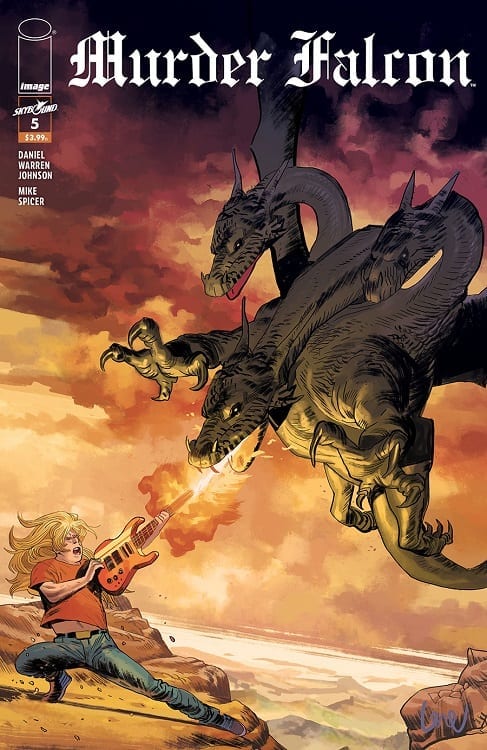
Murder Falcon, published by Image Comics, is now onto its fifth issue and all the jokes about it being ‘turned up to 11’ have already been made. With this latest issue, Daniel Warren Johnson has pushed it way passed 11 and he’s heading for stadium level noise.
The end of the world; a difficult reconciliation; an amazing discovery of legendary proportions; all this and a potential new band member. Murder Falcon has no intention of slowing down.
Writing/Story
This issue starts with Magnum Khaos watching over his hoard of Veldar demons as they are vomited into the world. Luckily a mighty band stand to face them down and save the human race. All praise Whisperwood!
As the fight rages on Jake faces a much harder task: confronting his estranged wife Anne.
Johnson has made Murder Falcon a success by balancing the outrageous with the emotionally heart breaking. The opening of this issue is as bombastic as they come, with a whole new cast of characters where you would expect to see the heroes. This serves two purposes: firstly, to show the power of Magnum Khaos and secondly to allow time for Jake and Anne’s meeting to play out.
The contrast between the two sequences is sublime. It’s like listening to Slayer’s Reign In Blood followed by Joy Division’s Closer. Both are arguably good but the change from one to the other is extreme. And this is how it feels when Whisperwood’s fight draws to a close and the reader is thrown back to the doorstep of Anne’s house. The physical violence is replaced by a greater emotional pain.
It is a jarring transition but Johnson pulls it off by writing a naturalistic and honest conversation between the two estranged lovers. As a reader you drop out of the excitement into a family drama without a break. The change in pace and tone is instant but the narrative leads you along so that you don’t get pulled out of the story. Across the two pages the two characters share some wonderfully written, intimate dialogue that speaks directly from the heart.
Murder Falcon #5 Credit: Image Comics
Murder Falcon has some of the most tragic yet heroic characters in any comic being published at the moment. Jake is the epitome of the everyman; he has a desperate need to be a hero but his life decisions have been anything but heroic. Johnson recognises that people are not always what they want to be and he is using this forum to explore the consequences of decisions made in difficult times. Physical illness also affects mental wellbeing but this aspect is often overlooked, Johnson makes it front and centre of his ongoing plot; portraying the damaging effects on Jakes life when he shuts himself off from those around him.
All of this plays out against some of the craziest, over the top, action sequences ever committed to paper.
Art
The design work for the characters and the various creatures that inhabit the world of Murder Falcon are outstanding and highly detailed. From the Metal band Whisperwood to the Veldar that stomp across the landscape, every aspect of their design is intricate and beautifully realised on the page. Who would ever have imagined that they’d ever get to see Kiss fighting giant blue Spider demons? And for it to make perfect sense within a narrative? This is the beauty of Murder Falcon’s world; the more ridiculous something is, the more it fits with the narrative.
Johnson uses very fine inked lines to define his characters and the space they inhabit. This approach allows him to fill each panel with extremely detailed images giving everything a strong physical presence. This occasionally becomes chaotic as full page spreads or large panels take over but this is all part of the narrative that Johnson is telling. When needed to Johnson’s tunes it all back, in some instances dropping the background altogether. This creates a stark contrast between the emotional scenes and the action scenes, heightening the impact of both.
Mike Spicer has a difficult job coloring all of this but he manages to pull it out of the bag each issue. To match Johnson’s inks, Spicer tones the coloring up or down to meet the needs of the narrative. Jumping from excessive, prime colors on one page to muted, understated colors on the next. Separating the different aspects of the comic like this enhances the reading experience.
Murder Falcon #5 Credit: Image Comics
Rus Wooton works extra hard to keep the lettering in line with the style of Murder Falcon. A straight forward approach would stand out a mile on top of everything that is going on in this comic. So, to fit in, Wooton makes the speech bubbles and sound effects as outlandish as possible; after all, why fight them when you can join them?
Magnum Khaos, for example, has speech bubbles with thick, jagged black outlines that are filled with a crimson color denoting the demonic presence that he is. As with everything else, the lettering is simplified for the more touching sequences. Wooton has a wonderful hand-drawn effect for most of his speech balloons and they tend to drop at the bottom. This creates a short hanging effect, like a pause for breath or an awkward silence. This works especially well in Jake and Anne’s conversation near the beginning.
Conclusion
For a comic that sounds almost impossible to realise, from a pitching point of view, Murder Falcon is a roaring success. Johnson is crafting a story of contrasts that is impressive on numerous levels. Both emotionally touching and outrageously verbose, Murder Falcon hits every aspect of storytelling at full pelt. Everyone else on the team has to push themselves above and beyond just to keep up with Johnson and his Metal inspired ideas.
If you’re not reading Murder Falcon it isn’t too late to join the gig. This issue, like each previous one, is easily accessible for new readers. And once you’ve read one issue you’ll be hooked.
The next chapter in the AGE OF X-MAN is here with NEXT GEN. Ed Brisson and Marcus To show us what the students of this mutant utopia are getting themselves into.
***SPOILERS LIE AHEAD***
Writer Ed Brisson and artist Marcus To put the focus on the mutant kids. They’re all training and being educated for their future role in the mutant utopia. Some of them will be X-Men, some will be support or Department X, and some will be revolutionaries.
It may be very early in the Age Of X-Man still, but the Stepford Wives-type horror underneath has been peeking it’s head out. Ed Brisson successfully taps into the landscape that Zac Thompson and Lonnie Nadler have planned out.
The story Brisson is crafting is one of conflict and terror as the future X-Men class slowly start learning the truth behind Nate Grey’s false haven. It’s a story we have seen before, but putting these kids through it provides a fresh, new shine. X-Men fans cherish these kids, especially Glob Herman.
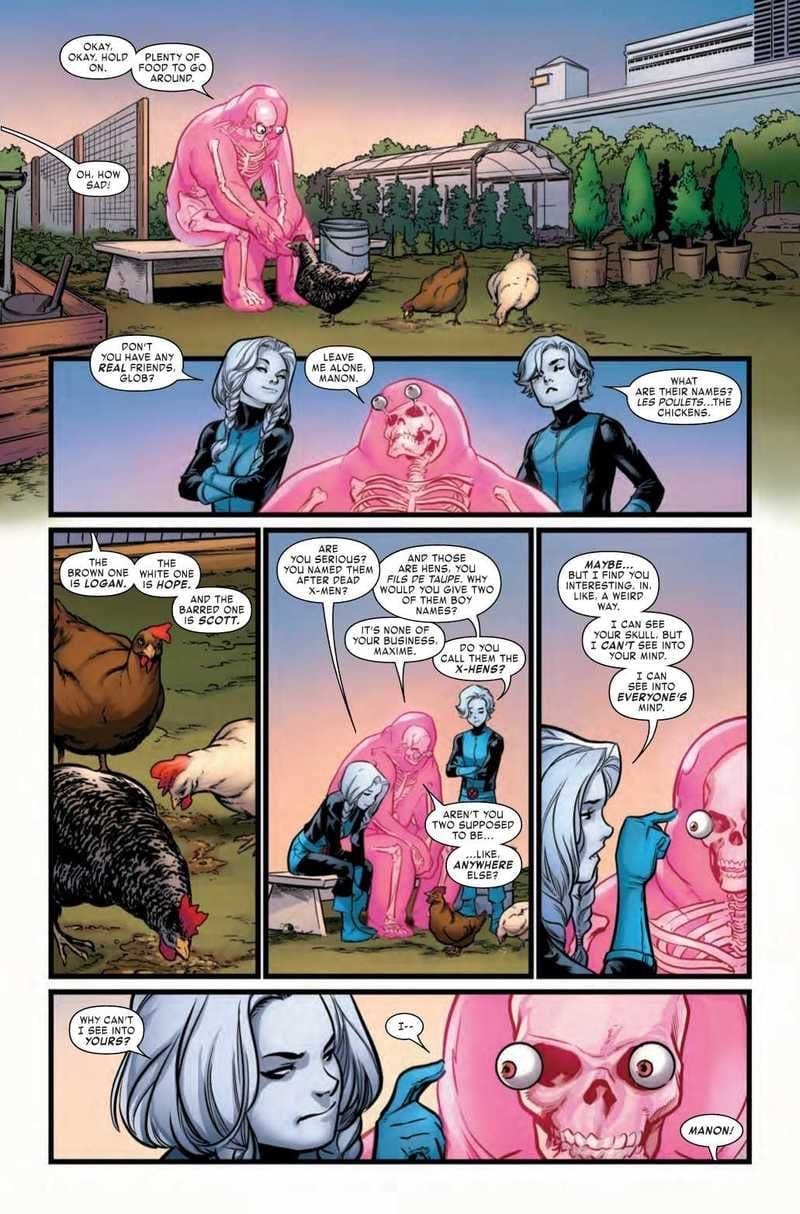
In Age Of X-Man: Alpha we saw that our beloved Glob had really seen some sh*t as he zones out while feeding his chickens. He’s the central focus of this story as he’s the only one who knows the truth and manages to keep from being mind-wiped.
Glob Herman has been around since Grant Morrison’s New X-Men run, but we haven’t gotten enough of him as the driving force of a story. This Next Gen tale could finally give us the story we all want–the story where Glob Herman is the MVP hero of all mutants.
Our tour through the various classes and divisions shows us the education and training the future X-Men are receiving. The slick transitions and dialogue bleeding into each page turn is clever and effective.
All the subtle details give this issue a ton of character. Whether it’s the high school teasing, a quick hallway interaction, or the round of snap-applause the students give Psylocke. There’s a ton of charm and unique personality that makes this an enjoyable read.
Longtime readers will appreciate not having to sit through introductions of all of these young mutants, the story jumps right in and keeps a fast pace. It’s also very accessible for new readers, we spend enough time with each of the students to get a detailed picture of what they each bring to the table.
Marcus To and color artist Jason Keith do a wonderful job bringing these students and their various learning facilities to life. There’s so many unique and interesting characters filling each page. To doesn’t waste backgrounds with faceless human shapes.
The tension and unease that develops once things start to unfold is palpable. A lot of story happens in the eyes of each character, especially our beautiful Glob Herman. Hipster Blob (wearing Wolverine’s costume from New X-Men) is another delightful redesign for this Age Of X-Man.
Age Of X-Man: Next Gen #1 gets us started in a big way. The kids are probably not alright, but it’s going to be one hell of a ride. Ed Brisson and Marcus To paint a clear picture, one with a straight-up horror show just beneath the surface.
The time has finally come for one of the best X-Men characters of all-time to take center stage. Perhaps for a short while, we enter the Age Of Glob Herman rather than X-Man. All hail Glob Herman, our beloved hero.
Hit-Girl Season 2, Issue #1 finds new incoming writer Kevin Smith (you know him!) and animation veteran Pernille Ørum (DC Superhero Girls, Blush, Coral) continuing the pint-sized assassin’s world tour of bad-guy killing by taking her and her arsenal straight to Hollywood!
Hit-Girl Season 2 #1
‘Hollywood’ Part 1 Written by: Kevin Smith Art by: Pernille Ørum Colors by: Sunny Gho Letters by: Clem Robins Cover by: Francesco Francavilla
Our favorite adolescent assassin tears Tinsel Town a new one when she realizes her life’s being dramatized for the silver screen. Hit-Girl storms sets, wages war on fat-cat movie bosses, and lures old enemies out of hiding in this Californian bloodbath.
Writing
As it has been since this new Hit-Girl series began, a new arc finds both a new writer and a new artist taking the reigns. Sitting behind the keyboard is pop-culture podcaster and filmmaker Kevin Smith. It’s no surprise to his fans that Smith is writing a comic book. He is a huge fan of the medium and has written comics before (most notably runs on both Daredevil and Green Arrow that did much to bring both characters back into prominence). What will be a shock to fans is the amount of dialogue in this issue; there is literally only one line of ‘spoken’ word (one word balloon) in the entire thing and that comes on the last page. The bulk of the issue is one well-choreographed long action scene that sees Hit-Girl take on two school shooters in her usual gruesome and effective manner. While taking down her latest enemies, Hit-Girl comes to find out someone in Hollywood is making a movie about her violent exploits. And so the high-concept takes off. It’s a great idea for the character and creates some strong possibilities.
Making this issue mostly ‘silent’ is a wise choice. It gives it an excellent, swift pace and it also proves Smith, whose detractors tend to critique his use of dialogue as a crutch to lean on, does indeed have a keen understanding of what makes story-telling work in sequential art. Even if this your first time reading Hit-Girl, Smith shows you enough to be able to understand what is going on. It’s efficient writing but not boring at all.
Art
Pernille Ørum’s comes from the world of animation, and it shows in the fluid nature of the linework, layouts and slight manga/anime influence on faces and expressions. This cartoony vibe allows the violence to be less disturbing, which over-all helps the concept of a teenage killing machine. The thick lines also look bold and crisp. When you add in the pastel palette of Sunny Gho, the entire artistic package has the feel of being animated. Every artist on this series has made Hit-Girl their own, and Ørum and Gho are no different.
Conclusion
These Hit-Girl books have been entertaining and fun, and have allowed for some great creators to leave their mark and tell their stories. This new ‘season’ seems to aim to do the same, and starting with a team like Kevin Smith, Pernille Ørum and Sunny Gho is a great way to set a new standard.
Image Comics has announced a new fantasy series Fairlady — written by Brian Schirmer with art by Claudia Balboni and colors by Marissa Louise — to debut in April. What sets the book apart from standard fantasy storytelling is the inclusion of film noir and detective elements alongside the magical ones. The writer-artist team previously worked on Image’s Black Jack Ketchum.
In Fairlady, after posing as a man to join the army, Jenner Faulds returns home to The Feld for a new start as a “Fairman”—a specially licensed private investigator. But sexism didn’t end on the battlefield, and as the only “Fairlady,” Jenner gets stuck with the cases nobody else wants. Hitting the streets to solve The Feld’s overlooked mysteries, Jenner finds that the smallest cases hide the biggest secrets.
Fairlady blends the procedural case-solving of Magnum, P.I. and Fables, but set in a vibrant, Rat Queens-like high fantasy world. This debut issue and each following issue will feature a complete 30-page story.
According to Schirmer, the initial idea for Fairlady came from the absence of something in the marketplace:
“I realized that there wasn’t a fantasy series that focused on a female private detective, and then I realized how much I needed that to be a thing. I took a love of ’70s and ’80s shows like Magnum, P.I. and The Rockford Files, poured that into a big bowl of Middle Earth, and added dashes of China Miéville, Michael Moorcock and Mignola, and Barbarians Conan and Thundarr. Then we dropped in a tough outsider in the form of our protagonist, Jenner Faulds, the land’s only female private investigator. Let the limitless stories begin!”
“It was nice to visualize an entire city and give it life. I am always happy to work with Brian because his descriptions make it much easier to get a picture of what he has in his crazy mind. We have a perfect synergy, which is the ingredient that everyone wants during a creative process. I never designed something like this, and this project gave me the opportunity to explore some new horizons.”
Schirmer summed up his initial thoughts on the story dynamics of Fairlady:
“I’d never read a fantasy story with a female P.I. as the lead, just as I’d never read a surrealist Western about a historical figure. It’s also fun to blend the various genre elements. How might someone fake their death in a high fantasy setting? How might magic play into a murder investigation? What does sexism look like in such a world, and how does it impact the life of our protagonist in ways both similar and different to our world? Asking and answering questions like these is what gets me out of bed in the morning as a writer.”
Fairlady #1 arrives with two covers: Cover A is by Balboni and Louise, Cover B is by Tula Lotay. Both will be in comic stores Wednesday, April 10.
Does Fairlady sound like an interesting blend of genres? Will it fill the hole left by the end of Fables? Leave us a comment!
Tales of Monkeys Fighting Robots hits the web every Sunday. The war between monkeys and robots has raged on for eons; these are the stories that have survived. With art by Jamie Jones and the occasional words by Matt Sardo.
The Monkeys Fighting Robots comic was created by Matthew Sardo, Ruben Diaz, and Vanessa Cardinali.
Tales of Monkeys Fighting Robots hits the web every Sunday. The war between monkeys and robots has raged on for eons; these are the stories that have survived. With art by Jamie Jones and the occasional words by Matt Sardo.
The Monkeys Fighting Robots comic was created by Matthew Sardo, Ruben Diaz, and Vanessa Cardinali.
As part of their ‘Read Dangerously’ campaign, AfterShock Comics are releasing a series of new, genre challenging titles. Stronghold #1 is one of them. It has the essence of several familiar stories woven together to form a new and exciting take on the ‘super powered alien trapped on Earth’ trope. With a stellar creative team, Stronghold has the makings of a massive hit.
Writing/Story
Michael works in insurance and is surrounded with the after effects of death. His waking world is made up of statistics and indifference. However, when he witnesses an accident and the life of a child is in danger, an urge deep within him forces him to take a leap of faith. Somehow he knows that he will survive despite the odds.
Elsewhere, from within a secret organisation known as The Stronghold, Michael is under constant surveillance. One of its member’s is about to take a leap of faith of her own but the outcome will threaten the safety of the entire world.
There are some very big concepts at play in the first issue of Stronghold. Writer,Phil Hester, does an outstanding job of juggling both the out of the world elements and the grounded characters. He’s no stranger to big concepts, after all he drew Warren Ellis’ Shipwreck series for AfterShock, and he proves here that he can write them as well as draw them.
By concentrating on the two central characters, Hester pulls the reader into the story on a relatable level. Just like Michael, everyone has worked that bland job and wondered what more there can be. And, just like Claire, everyone has taken time out to try to find themselves leading them to question their upbringing.
By introducing the reader to the two characters in two separate story-lines which merge in the middle of the comic, Hester is able to give each of the characters their own voice and personality. He is then able to compare and contrast these personalities in the latter half of the comic. This raises questions about who they really are and what they are really capable of.
Hester makes parallels to other, famous, comic book creations. Most notably Men In Black and, of course, Superman, the original stranded super powered alien. Hester introduces secret societies, cultist religion and super powered beings all in this single issue without over cramming the pages. The flow of the narrative is surprisingly steady for so much action. And by the end Hester leaves many questions still dying to be answered
Stronghold #1 Credit: AfterShock Comics
Art
Ryan Kelly is an established artist who, like Hester, is used to working on large concept comics. Cry Havoc was an ingenious supernatural horror which used specific comic book traits to help tell the story. With Saucer Country, and the follow up Saucer State, Kelly was responsible for giving a complex alien conspiracy story a human, relatable face. In Stronghold he brings both of these things together to make sure the reader can traverse the narrative successfully.
The characters design makes them instantly recognisable from page to page, even in the shadows or choreographed fight scenes. The emotional performances that the character’s give are also extremely impressive. It is this aspect of the art that really captivates the reader and draws them in to the story. The parallels that Hester wants to draw only work because the characters are depicted as real as possible, emotionally at least. Comics like DC’s Watchmen only have the impact they have because the characters are fully rounded. Kelly brings out the best in Hester’s scripting and dialogue by portraying emotionally real people in spiralling situations.
One aspect of the art work that is becoming identifiable with Kelly’s work is the use of gutters. In a number of comics that Kelly has worked on the panel gutters are emphasised, usually by color, so that they have a much greater impact on the reader. In Stronghold the gutters are almost color coded to signify various aspects of the narrative. The colors change mid page to illustrate the move from one location to another. They are even used to highlight the change in emotional reactions between characters. At one point Dee Cunniffe, the colorist, changes the gutter from a warming purple to an ice cold blue as the characters go from being on an awkward date to creeping around in the underground.
Throughout the rest of the comic, Cunniffe uses the color as an emotional signifier. Occasionally he picks out a single element or character in a panel and colors them differently to the rest of the panel, drawing the reader to that aspect of the panel. At other times he coats the page in a single colour only picking out subtle shades to create an unsteady atmosphere.
The lettering, which often finds itself a stark white against a full colored page, adds an extra layer to the narrative structure. For the most part Simon Bowland’s speech balloons are uniform with the dialogue following suit. This allows the reader to become used to the speech and begin to accept its presence without breaking the illusion of reality that the comic is trying to produce. But then Bowland will alter something, just slightly, to make you aware of its existence. This instantly draws attention to a particular panel or aspect of the narrative, subconsciously forcing you to pay closer attention.
Stronghold #1 Credit: AfterShock Comics
Conclusion
In the same way that Alan Moore and Dave Gibbons questioned what the world would be like if ‘superheroes’ really existed in Watchmen, Stronghold investigates the notion of a how a super powered alien would fit into society. Hester questions how people would react and draws on the cultist nature of the human race. Religion, media and straight forward emotional reactions such as ‘love’ all have a part to play in the wide reaching web of narrative.
The creative team superbly handle the complexities of the narrative to produce an exciting page turner of a comic. The visual flair and technical craft give the reader a realistic environment for an out of this world story. Everyone is bringing their A game to this title.
This first issue of Stronghold is one of the most interesting and exciting comics to be released so far in 2019. If it continues at this rate it will deservedly be making the ‘best of’ lists at the end of the year.
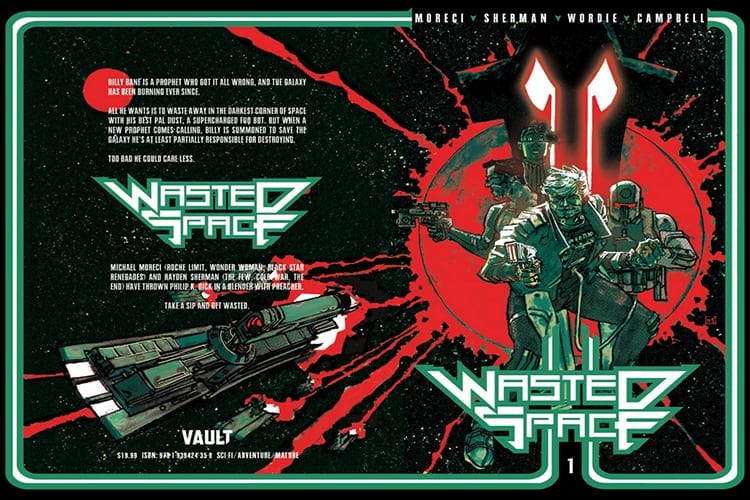
Science fiction has always been a vehicle for exploring interesting themes and concepts. It’s a genre with inherent flexibility that lends itself to constant interpretation and re-interpretation. Some opt to focus on the philosophical opportunities that science fiction presents. Indeed, the expansive nature of the universe and the insignificance of the little space that we occupy within it has been the subject of choice for creatives in this field for decades. Equally, science fiction has been used as the setting for wonderfully pulpy romps where roguish captains rebel against tyrannical empires as often as they try to con their way into small fortunes. In this area, the genre has permeated itself into the popular conscientiousness. Both approaches are valid offering lasting depth and cultural resonance. Both contribute to a truly an ever-evolving body of work that caters to a wide range of tastes. Wasted Space from Vault Comics is that rare book that attempts to walk between those two worlds and succeeds.
My first encounter with Wasted Space was shortly after the publication of the second issue. The cover caught me straight away invoking the feel of an old Star Wars poster if it had been feed through a neon-graffiti fueled filter. Flipping through those first few pages, we find our protagonist: Billy Bane, former prophet turned vagabond whose last attempt to save the galaxy led to the rise of a despot. Now persona non grata in most civilized worlds, he spends most of his time looking for his next fix while attempting to outrun those after the huge bounty on his head. And that’s how it the book lures you in at the start. It begins by offering this promise of a Guardians of the Galaxy-esque adventure full of wit and spectacle featuring morally dubious characters just trying to get by. At the same time, however, it quickly embarks on a treatise about late capitalism, free will, and our relationship with the divine. What’s so refreshing about the approach taken by the team of Michael Moreci (writer), Hayden Sherman (artist), Jason Wordie (colorist), and Jim Campbell (letterer) is how seamless the pulp and profundity compliment each other.
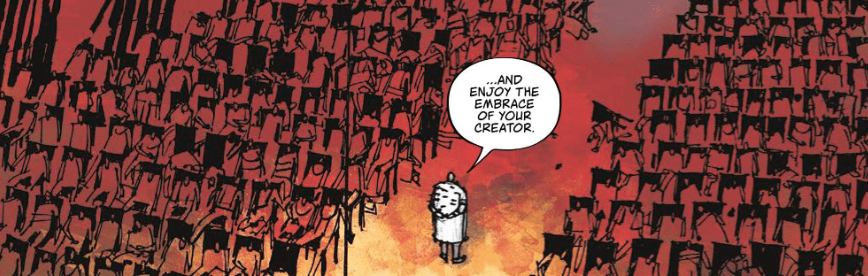
The world we currently occupy is one that seems to be a twisted version of itself. Zealots hold sway over some of the great historical powers. The right is on the rise as the gap between rich and poor ever-widens. Reason has lost its resonance. In such a world it’s very attractive to consider this the handiwork of some other force, be it in foreign agents or the cruel act of an uncaring god. Wasted Space takes that idea and runs with it. Billy’s rejection of his role as “The Voice of the Creator” comes from the revelation that he’s been had, used as a pawn in a greater game. The notion that this all part of the “plan,” necessary for the common good (whatever that means), is bandied about as if that acts as a cure-all to relieve Billy of all responsibility for his part in the great lie that allowed the dictatorial Yam to take power. No matter how much the Creator hopes to convince him otherwise, Billy’s refuses to accept this narrative and absolve himself. This is what allows him to retain a semblance of self-worth even as he attempts to trick himself and the universe into thinking otherwise during his descent into a drug-induced oblivion. The willingness to admit responsibility is such a rare thing these days that it’s understandable why we begin to empathize with Billy as much as we do. I’ve written at length on this site about comics that invoke the feeling of helplessness that punctuates much of our discourse but Wasted Space distinguishes itself by taking a look at one of the orchestrators that brought it about and how one lives, or doesn’t, with that knowledge. Do you like revel in having gotten away with it, like Yam? Do you justify it, like the Creator? Or do you let the guilt eat away at who you were, like Billy? The book illustrates just how easy it is to give into the existential dread that would happily consume us while re-iterating to the need to rebel against same and fight for a return to normality.
Normality is, however, relative when it comes to Wasted Space. This is to be expected really when the book channels Firefly as much as it does Preacher. The cast is full of oddballs which help what might otherwise seem like heavy subject matter. Among the crew is Dust, an ex-mercenary android turned “fuq-bot,” who acts as the ship’s pilot and breadwinner as well as being one of the few willing to put up with Billy’s shit. He serves very much as the straight man of the group notwithstanding that his line of work often leads to him saving the day shortly after being found in a compromising position. The other member of the crew is Molly Sue, another potential prophet known as “The Vision of the Creator,” whose foresight convinces her that Billy is the only one capable of preventing a pan-galactic war. Molly Sue’s ability is that she can force people to see glimpses of their future, be it good or bad. Naturally, this means she’s picked up a few enemies along the way. Her ploy to act as the group’s conscience is helped by the fact that she also just happens to be the daughter of the despot Billy helped to install. The trio all bounce off each other personality-wise leading to the character clashes that you’d expect from such a romp but done in ways that reveal the festering tragedies and scars lying beneath the surface. They are each broken people trying desperately to put themselves, and the universe, back together. It’s an old theme, but it’s only that never ceases to speak true.
As Billy and company gallivant across the galaxy, they are pursued by the mysterious hulking being known only as Legion: a homicidal embodiment of the biblical parable who ostensibly seeks to prevent deviations from “the plan”. This lethal enforcer of some divine entity’s will is somehow endearing with a deadpan humor reflective of the unflinching black and white morality that such religions present. The nature of Legion is certainly up for debate with his appearance being a somewhat strange mix of organics and technology. Legion is quite unlike any depict of angels or demons you’ve ever seen, and the otherworldly quality that Campbell adds to his speech balloons certainly emphasizes that. It’s an absurd universe but one that merely reflects the absurdity of our times. In Wasted Space it’s the politics that is wrong rather than the multitude of increasingly bizarre characters, worlds, and scenarios featured.
All of the humor, heart, and is extenuated by Wasted Space‘s art. Sherman has a strong sense for storytelling, each line filled with purpose and intent. Stylistically, however, he might be described as unconventional in a comics landscape where realism in the mode of the day, Sherman opts for the impressionistic. In re-reading the book for this article, it strikes me how much Sherman excels at capturing the essential quality of each local and making the world feel lived in. When combined with Wordie’s colors, the result is a book that at times invokes the spirit of Sienkiewicz while retaining its own distinct, psychedelic identity. There is tangibility to the artwork, and if you didn’t know better, you might think the ink and paint would rub off on your fingers as you flick through its pages. There simply isn’t a book on the shelves that looks quite like this.
As Wasted Space begins its second arc with issue six the series is only getting weird and all the better for it. The success of the book can be seen not only its critical reception but in its becoming Vault Comics’ first ongoing series. Why is that? What sets it apart from other titles on the racks? Perhaps it’s because it acts as a much-needed reminder that thought-provoking science fiction doesn’t have to be inaccessible. It turns out that it’s a “fuq’d” galaxy, so let’s keep it that way. Wasted Space is anything but wasted time.
Wasted Space is published by Vault Comics and the first collected volume is available in all good comics shops. You can download the first issue for free here.
The Mister Miracle trade paperback is out this week, making this the perfect time to re-read the seminal series…or read it again…or gift it to a loved one.
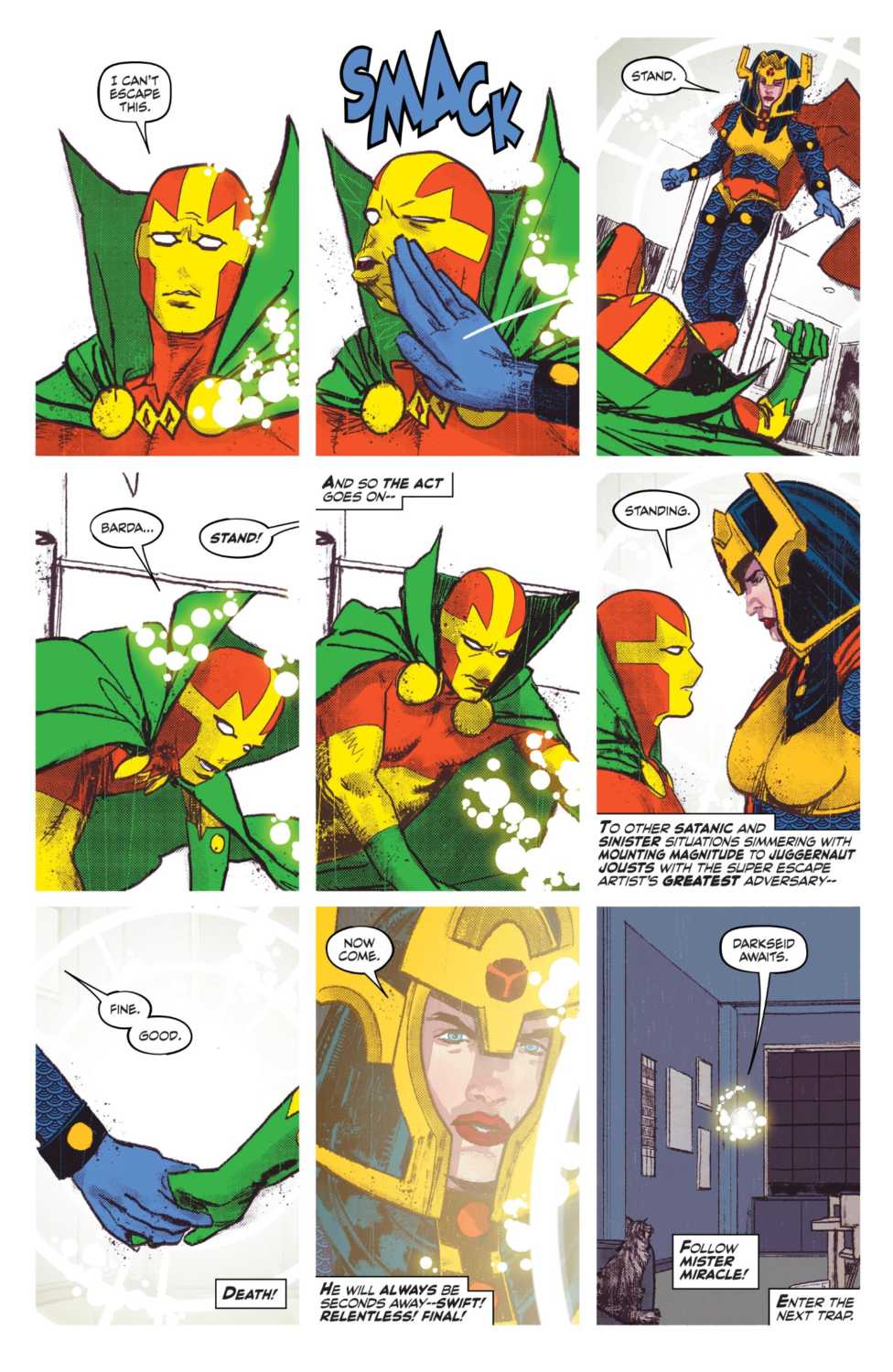
Mister Miracle is going to go down as one of the most important series of all time, joining the ranks of Saga of the Swamp Thing, Green Lantern/Green Arrow, and Watchmen. Tom King, Mitch Gerads, and Clayton Cowles have redefined what a comic can be, which is an astonishing feat at this point in the industry’s history. Scratch that – it’s an astonishing feat at ANY point, but it’s especially impressive today. Mister Miracle is a beautiful, poignant, and strangely uplifting tale about depression, anxiety, love, and family. It’s inspirational in a way that no other superhero comic is.
Now, superheroes are inspirational in nature. They show us what we can be. Superman and Captain America are ideals to strive towards. But Scott Free – at least King and Gerads’ Scott Free – inspires us by showing us what we are.
This isn’t a superhero comic. Yes, the protagonists are New Gods, and they’re locked in an epic galactic war, but that’s all just in the background. It’s set dressing. The actual story is about a man on the edge. He’s a person – same as you and me – who’s struggling to find answers in this crazy, messed up world we live in, and who’s just looking for a way out.
And does he find answers? Well you’ll have to read the story to find out, but consider this: does it matter? Mister Miracle isn’t a book about finding answers, or finding a way out of the craziness. It’s about learning to cope with it, and about finding meaning in what truly matters.
Granted, this isn’t the first relatable superhero comic, and nobody’s claiming it is. Spider-Man’s whole brand is built on being relatable. But there’s something about this Mister Miracle that connects to readers on a different level. Even when Spider-Man’s being relatable, he’s still a strong, moral character that you look up to. He takes the high road. He’s a hero. Scott, on the other hand, takes the low road plenty of times in Mister Miracle. He doesn’t feel like a hero. Gerads doesn’t really draw him like a hero either. He just looks and feels like a guy trying to get through life, by any means necessary.
So no, Mister Miracle doesn’t inspire readers by giving them a role model to admire. Instead, it holds up a mirror and says “This is you. You’re a mess. The world’s a mess. You’re full of rage, and sadness, and anxiety, and you’re going to succumb to those feelings sometimes. There are no real answers to life, but you can get through it. It won’t be easy. You’ll have missteps along the way. But you’ll get through it. And you don’t have to do it alone.”
That’s perhaps the most inspirational lesson from Mister Miracle: “you don’t have to do it alone.” Scott’s relationship with Big Barda is at the heart of this series, and Barda absolutely steals the show. Their marriage shows the importance and power of having a support system in your life. Through all the action, and intrigue, and mystery, this is a love story. Not a sappy love story either – a real one. One where the wife will literally slap some sense into her husband when he needs it. So often, we think of ourselves as solitary beings, and that we have to overcome obstacles without any help in order to be strong. This story reminds us that is not the case, and that the opposite is actually true.
If you haven’t read the series yet, pick up the collection. And spread the word. Recommend it to your friends and family. Buy it for them as a gift. It’s perfect for dads, moms, husbands, wives, anyone in a loving relationship of any kind, or anyone who’s struggling to find sense in the world or meaning in their life. This truly is a comic for everyone.
“This book challenges everything you know about comics.”
“Sit on the edge of your seat and enjoy the existential dread and anxiety as you ponder your entire existence.”
“Sometimes life beats you down and you feel powerless, but in the true grand scheme of things, that doesn’t matter. The bad feelings are going to come and go; there’s no stopping them, and there’s probably no answer. What matters is the here and now, being with the people you love and enjoying it while you can. Maybe that’s an overly simplistic view of things, but it’s what the series said to me, and I can sleep better with that.”
“Fulfilling in every sense of the word.”
“It’s beautiful in the saddest way. Welcome to Mister Miracle.”