Sabrina The Teenage Witch has gone through a number of iterations in and out of comic books since her debut in 1962. From the wholesome, yet mischievous teen in 1960’s and 70’s cartoons, to the 90’s-era family/high school sitcom, to her darker turn in The Chilling Adventures of Sabrina. Much like superhero comics, Sabrina and her Archie counterparts have been able to endure for decades, changing with the times to reflect the culture of the era.
The most recent take on Sabrina is a concoction of the versions the character and her world had taken for nearly sixty years.
**Some Spoilers Below**
Story
BRAND NEW SERIES! Sabrina is a teen witch who’s struggling with balancing the double life of high school and her burgeoning powers. Newly relocated to Greendale with her aunts Hilda and Zelda (also witches), Sabrina is trying to make the best of being the new girl in town which so far includes two intriguing love interests, an instant rivalry, a couple of misfits that could turn into BFFs, and trying to save the high school (and maybe the world) from crazy supernatural events. NBD!
Sabrina the Teenage Witch #1 is very much an amalgam of the wholesomeness of the character’s debut, the family comedy and teen romance of the sitcom, and even a dose of the terrors from last year’s Chilling Adventures. Writer Kelly Thompson has successfully captured this in a single issue.
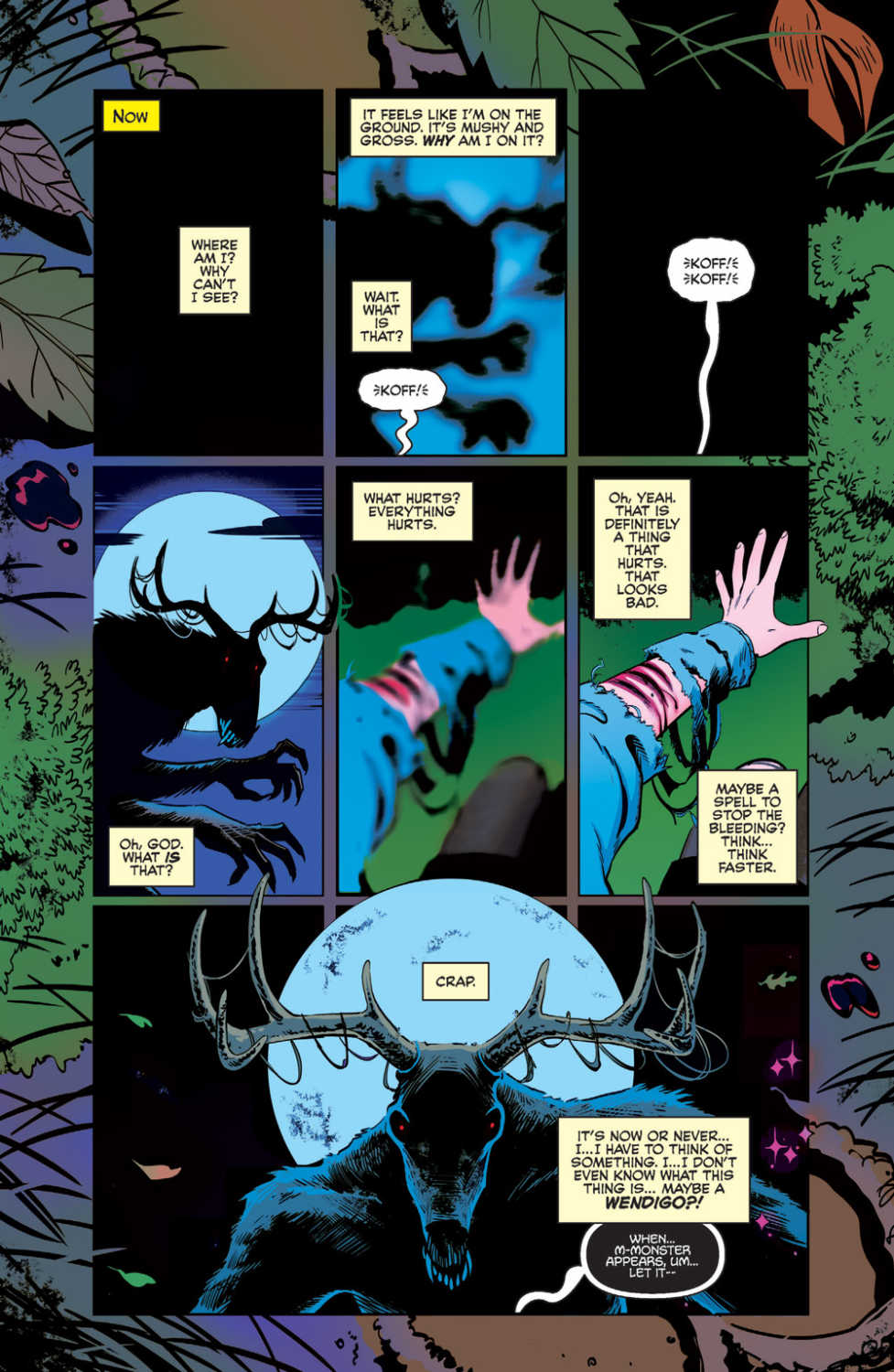
The first page reads as if it will be another version of Chilling Adventures, when the next few pages shifts the tone and reads like a sitcom. We are treated to comedic banter between Sabrina and Salem, followed by an introduction to her Aunties Zelda and Hilda. Then we go along with Sabrina on her first day in a new school. There, she encounters potential friends, probable love interests, and definite bullies. This is all before the story returns to the situation Sabrina found herself in on the very first page.
What Thompson has done exceptionally well is her use of Sabrina’s inner monologue. It is constantly going and filled with curiosity, sarcasm, confidence and angst. These are qualities most people identify with, particularly on their first day in a new school.
Art
Artists Veronica Fish and Andy Fish give the characters and world of Sabrina a quirky, yet somewhat grounded look. The illustrations are light and charming, but not overly cartoonish, like what is found in a classic Archie comic. The coloring also works well, with a bright, pastel palette. Those pages are contrasted by darker shades in the chilling moments that bookend the comic.
Conclusion
Sabrina The Teenage Witch #1 is a well-told reintroduction, blending sitcom humor, teen romance, high school drama, and a dash of horror.
What did you think of Sabrina The Teenage Witch #1? Let us know in the comments!
For too brief a time in the late 1980s, The Storyteller showcased relatively obscure folktales for television audiences worldwide. Though the show only went on for 13 episodes (including the sequel series Greek Myths), its legacy lives on to this day. This includes a television reboot currently in the works, and a novel adaptation. There is also a set of graphic novel miniseries’, each an anthology featuring a particular creature of fairy tales and mythology. So far, the series has covered Witches, Giants, Dragons, Fairies, and most recently, Sirens.
**Some Spoilers Below**
Story
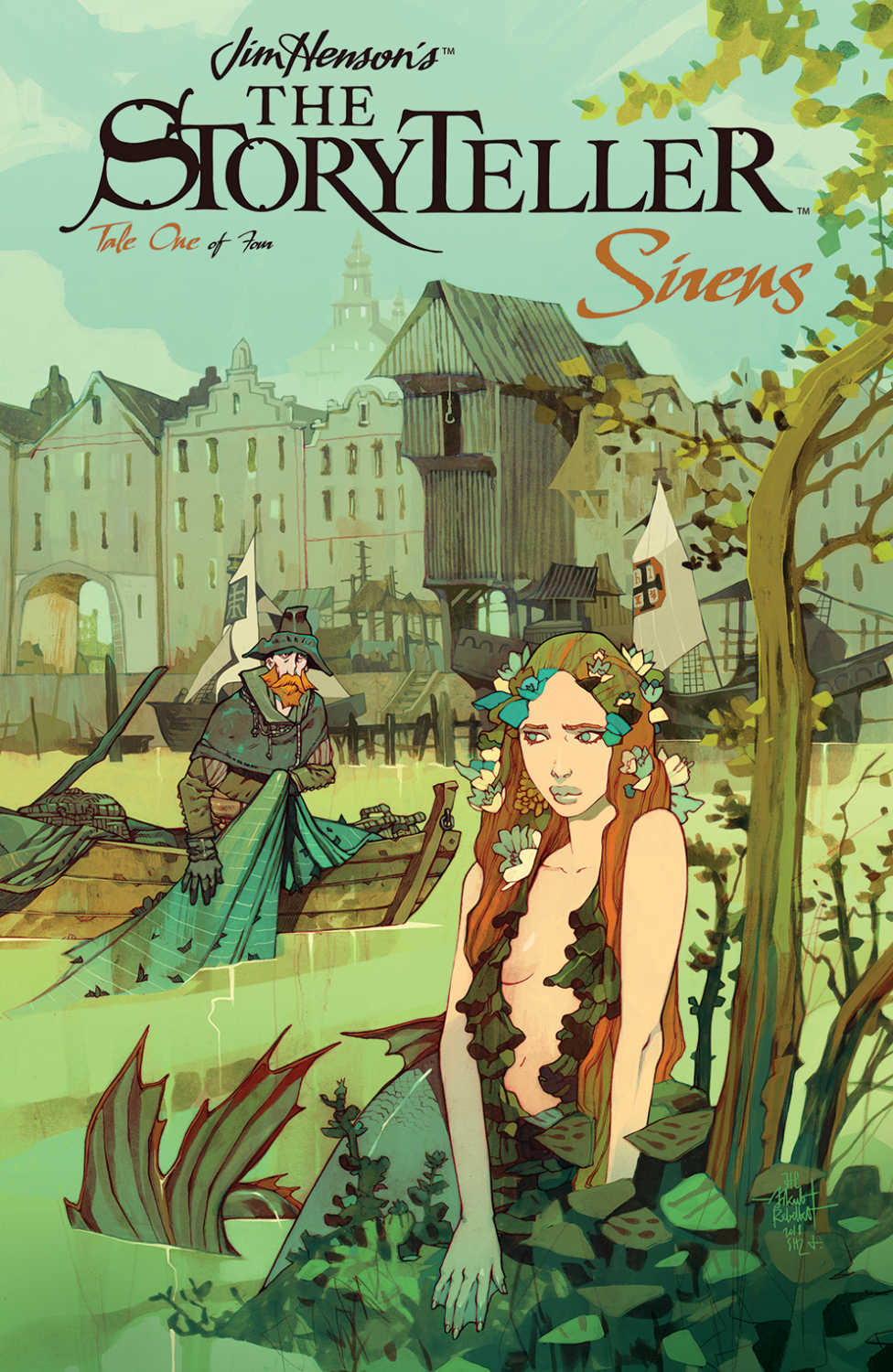
The critically acclaimed Jim Henson’s The Storyteller celebrates four mythic tales of Sirens, inspired by folklore from around the world and told in the spirit of Jim Henson’s beloved television series. In this first issue, Polish writer Sztybor Bartosz teams with artist Jakub Rebelka (Judas) to reimagine the classic Polish folktale “The Fisherman and the Mermaid”. The fisherman is not happy with his life. He works all the time, struggling to make ends meet rather than spending time with his wife and their daughter. One day, while fishing, he hears a mermaid singing and the song overwhelms him with joy. He can’t stop thinking about this song so he captures the mermaid and imprisons her.
In the first of four stories from Jim Henson’s The Storyteller: Sirens, writer Sztybor Bartosz does solid work in setting the tone right from the beginning. Once the story moves from the introduction by the Storyteller, and into the tale itself, it’s a somewhat rigid structure, reading more like storyboards than a graphic novel.
The story is a much more toned down version of its source material, but still manages to maintain its message. The fisherman longs for happiness, but cannot find it in his work, nor in his family. When he finds the siren, he is captivated by her singing, so much so that he puts her under lock and key, so that only he hear her song whenever he wanted. It brings him some joy, but at a cost. Bartosz captures themes of obsession, gluttony, and taking things for granted, all in a 20 page comic geared toward children. The ending in particular will tug at the heartstrings, no matter the age of the reader.
Art
Like the writing, the artwork isn’t the most innovative. Jakub Rebelka’s work might been more effective if he had taken some creative liberties. He could have used a more fantastical approach to the visual storytelling and worldbuilding, as opposed to simply illustrating it word-for-word. The characters have a distinctive look, like something out of a children’s book, with long faces and oversimplified expressions.
What stands out in the artwork of The Storyteller: Sirens is the coloring, with each panel tinted in shades of blue and green. It gives the story a wet and dreary undertone as the fisherman struggles to find happiness. This is contrasted by the warm red and orange tint in the Storyteller’s den, feeling as if we are right there next to him by the fire as he shares his tale.
Conclusion
For fans of the original series, Jim Henson’s The Storyteller: Sirens #1 is great for the kids and for the inner-child. It’s simplistic, but worth a look.
Are you ready to dive back into the tales of The Storyteller? Share in the comments!
In Justice League #21, the stakes have never been higher for the team. In the previous issue, the Leaguers were getting a taste of a Utopian future, courtesy of their older selves. However, a telling truth was bubbling up to the surface. Now, with the truth of this pristine multiverse revealed, they must make a choice that affects everyone and everything.
**Some Spoilers Below**
Story
The Justice League pulls back the curtain on their futures and learns that not everything is what they’ve seen. The team goes to confront the Justice League of Tomorrow for the truth, but can they handle it? Meanwhile, with his powers waning, Superman struggles to remain hopeful on a world with no sunlight.
This story is simply exciting. And big. It just feels so massive. Scott Snyder and Jorge Jimenez have taken Justice League and made it the tent-pole comic book that it deserves to be. For twenty-one issues, the story has escalated and escalated, always offering answers but never without revealing new twists. This particular arc is nearly perfect thus far, besting even the current DC event series’ Heroes in Crisis and Doomsday Clock.
As grand and cosmic a tale as this is, Snyder still manages to inject a good amount of heart and humor into Justice League #21. One of the more standout moments from this issue is Batman relishing in the glistening New Gotham City with the older Dick Grayson. It’s a future where even Batman has found peace. Unfortunately, that doesn’t last too long. When Batman comes to terms with the reality of this future, he loses all hope in, well, hope.
Jarro is a standout once again in Justice League #21, with hilarious one-liners and proving himself as the hero we never knew we needed to fight alongside the League. Another great moment of levity is when the Flash asks The World Forger to slow down to better understand the situation.
It’s great to see Snyder experiment with these characters and situations. The story is fun and epic, and just keeps getting more exciting with each issue.
Art
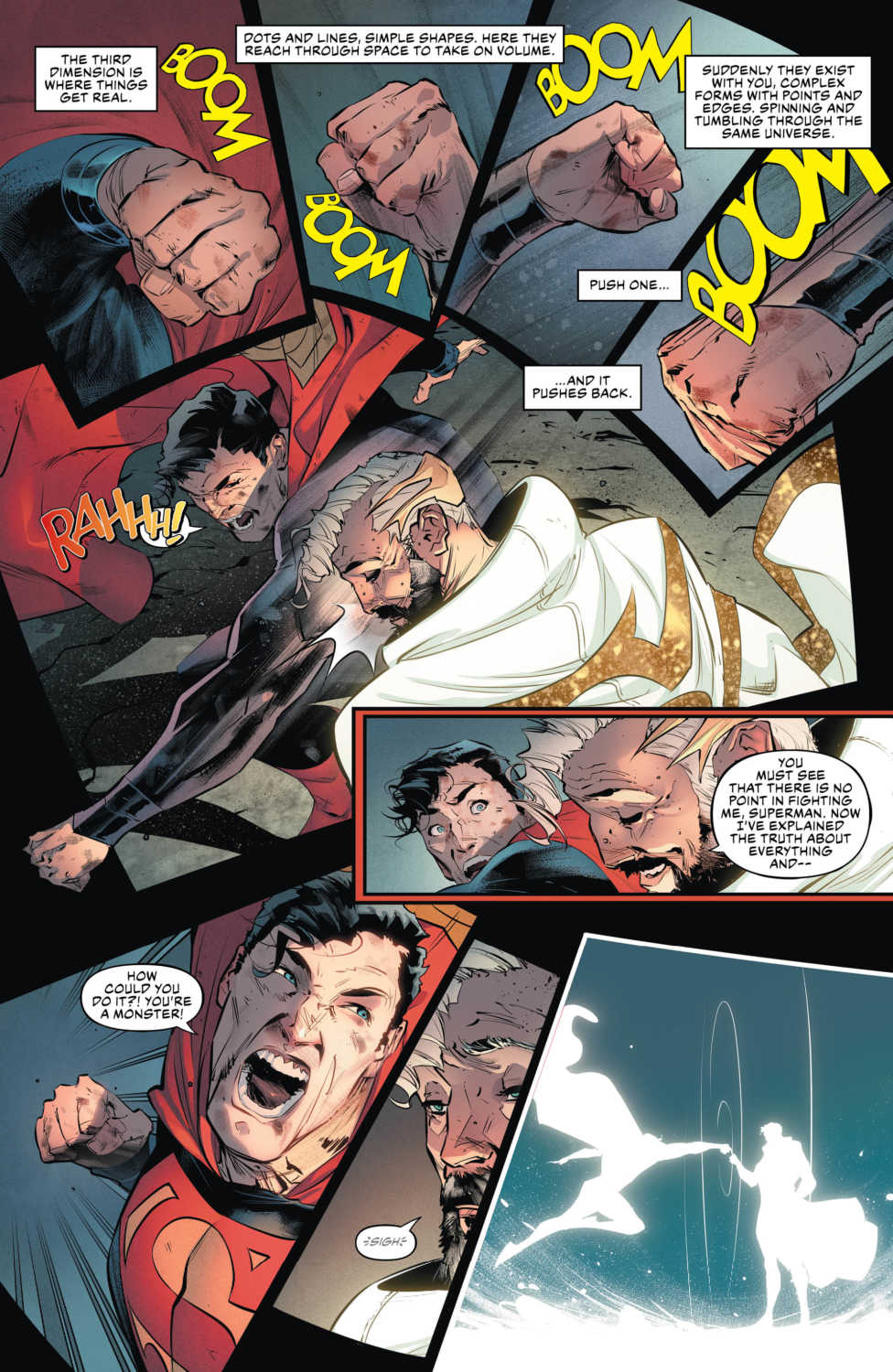
Jorge Jimenez has a very clean style that works in just about every setting. Each panel has so much character and life in it. Jimenez is a master of the kinetic style. A unique visual enhances the motion, such as a glow around the characters or vivid light trails.
Jimenez also adds so much expression in the eyes of the characters. This is particularly seen on Shayne, the son of future J’onn J’onzz and Kendra Saunders. There is a genuine energy to his work in Justice League. His art features a striking glow around the characters that make the book feel that much more ethereal.
It’s hard to talk about this most recent run of Justice League without mentioning the fantastic splash pages, and this issue is no different. This time, Jimenez crafts an ingenious meta page when Mxyzptlk begins to ‘unimagine’ reality.
Conclusion
Scott Snyder, Jorge Jimenez, and the rest of the art team are making Justice League one of the best comic books currently on shelves, in terms of a grand, fulfilling story and unmatched visuals.
What did you think of Justice League #21? Let us know in the comments!
Readers who grew up in the 90’s will undoubtedly remember the classic Nickelodeon cartoon Rocko’s Modern Life. The off-kilter show generated a cult following, facilitating the creation of its first comic line back in 1994. Now KaBOOM!, an imprint of BOOM! Studios, is making more waves with ROCKO’S MODERN AFTERLIFE #1, which centers around an unexpected influx of zombies into Rocko’s home of O-Town.
Story
The story brings the reader into the average day of Mr. Bighead, Rocko’s antagonistic neighbor. We see him rattling off his opinions on a “Buttfeed” article as Rocko passes him on the street. Bighead then proceeds to list off the reasons things haven’t gone his way in life, attributing his struggles to wallabies and Millennials. But disaster strikes when a zombie attack interrupts his rant.
Anthony Burch’s story is in many ways a cultural commentary on our society’s addiction to technology. The story makes its point by showing people transforming into zombies after spending an inordinate amount of their time plugged in. Rocko serves as an example of the ideal mindful individual, seeking meditation and tranquility in lieu of the instant gratification our gadgets bring.
But Rocko’s routine is disrupted when the zombie takeover begins to affect his friends. He must decide whether to stay in his technology-free bubble or venture into the post-apocalyptic wasteland of the undead.
Art
Mattia Di Meo and Francesco Segala craft artwork reminiscent of the animated series. Meo’s details hit their mark, from the wrinkled lines on Rocko’s brain as it pops out of his head to the extreme expressions given to Heffer as he tells wild stories. Segala brings these characters to life with transitions from the bright colors of the main characters to the dull grays of their zombified counterparts. Jim Campbell ties all of the elements together with thin lettering that almost blends in with the illustrations.
Ian McGinty’s main cover brings to mind classic zombie films, showcasing the protagonists as they fend off the undead. And Joven Paul’s dark purple shades set the tone of this horror-themed work.
Joey McCormick and Jorge Corona also provide wonderful illustrations in their preorder connecting cover and unlocked retailer variant cover, respectively. McCormick’s cover illustrates the chaos devastating effects on O-Town, complete with fires and wreckage. And Corona’s version brings the carnage closer to home by crafting zombified versions of the protagonists.
Conclusion
KaBOOM! and Nickelodeon have concocted an entertaining expansion upon the Rocko’s Modern Life franchise. This issue brilliantly uses the metaphor of a zombie apocalypse to unpack the theme of modernity’s addiction to technology.
Did you think this issue kept with the quirky tone of the television series? Let us know in the comments below!
Grant Morrison left Hal Jordan in quite a pickle at the end of THE GREEN LANTERN #5. Countess Belzebeth charged with the final Blackstar initiation task of murdering his colleague Adam Strange, Rann’s hero and protector. Will Hal succumb to the demands of the militia and kill an innocent man? Or will he manage to escape Controller Mu’s grasp?
Story
The story picks up with last issue’s intense staredown between Hal and Adam. The former Green Lantern requests a fair fight, so Belzebeth takes the two to an open field and offers Adam his weapon. One is reminded of the American and European duels from ages past as the two warriors stand back to back and take their ten paces.
Morrison does a fantastic job of providing space for the reader’s anticipation to build. We watch as Adam pleads for his life and family, even hearkening back to their lasting friendship as members of the Justice League. But the line that hits the hardest is his wife Allana’s indictment of Hal’s status as their policeman, sworn to protect Rann’s people. This inevitably conjures up real world incidents of police brutality and corruption in the reader’s mind.
How are the people supposed to trust anyone when their own protectors turn on them? What happens when we can no longer trust these protectors?
Readers will be on the edge of their seat as Hal attempts to make an impossible decision. They will finally see if he rejects his status as the universe’s protector or succumb to the demands of Mu.
Art
The main cover for GREEN LANTERN #6 showcases the best of Liam Sharp’s penciling and Steve Oliff’s coloring. Both Hal and Adam are drawn with incredible detail, highlighting each hero’s toned muscles and sleek battle equipment. And Oliff’s coloring makes these characters pop off the page with the bright red, yellow, and green inks.
Lucio Parillo’s variant cover focuses solely on Hal and the cosmic nature of his quest, surrounding the Green Lantern with celestial bodies.
Sharp, Oliff, and Steve Wands pair amazing artwork with Morrison’s equally amazing writing. Sharp’s penciling gives definition to the characters across the ever-changing landscapes across Rann. At the same time, Wands’ lettering helps frame these characters, using font styling adjustments to distinguish each character’s speech. And Oliff’s coloring, much like the main cover, highlights the brilliance of the warriors’ dazzling light-fueled weapons.
Conclusion
This issue takes readers right into the heart of Mu’s empire, wondering if Hal can find his way out of this duel with Adam and somehow topple the Blackstar order. If not, the former Green Lantern might be walking down a road with no return.
Did you like Adam Strange’s appearance in this issue? Let us know in the comments below!
Resurrecting a series killed-off before its time—and doing it well—isn’t easy. It helps to have the same creative team behind the relaunch, as is the case with Section Zero #1, though.
The series about a globetrotting group of supernatural investigators debuted back in 2000. However, the run ended after just three issues when its imprint, Gorilla Comics, folded. After a lengthy campaign to revive the series, creators Karl Kesel and Tom Grummett finally got their shot back at Image Comics.
The Writing
The book is billed as “Jack Kirby-does-The-X-Files.” While Section Zero #1 doesn’t seem particularly Kirby-esque, the sentiment’s not unfair. It does take a more outlandish, “comic book” approach to many of the same secret government organization tropes. The book reads like a ‘90s story in that regard.
There’s plenty of action throughout, and the book doesn’t waste much time getting into the thick of it. We have enough exposition to keep us up-to-speed, but Kesel paces it well.
It’s fun, and it has notes of intrigue from a storytelling standpoint. Where we fall flat in Section Zero #1, though, is characterization. We’re introduced to five primary characters, each of whom ticks a box on the checklist of clichés. We have the lone-wolf rogue who wears sunglasses at night, the calculating and jaded operative, the childish waif, the father figure, and the newcomer thrown into an uncomfortable new scenario. However, we don’t really get much in terms of actual character outside of those prescribed roles. That’s a problem given the book is primarily character-driven.
Characters don’t feel motivated and, in essence, they read like cardboard cutouts, rather than unique individuals in their own regard. That, and the decision to snatch a newbie out of the field and throw him into secret agent work with no vetting feels unrealistic.
The Artwork
The artwork in Section Zero #1 is respectable, though Kesel and Grummett definitely play it safe. Perhaps “utilitarian” would be a good way to describe it. The line work is bold and well-detailed, and they make it easy to follow along and interpret the action on the page. Figures are dynamic, and do a great job of conveying energy and movement.
That said, the creators don’t take many risks from a visual standpoint. Given the “out-there” concept behind the series, it would have been interesting to see them embrace the weirder side here and there. Instead, the artists stick to pretty conventional framing, design, and layout.
The colors tend to be more muted compared to contemporary works. However, the artists employ a wide color palette, giving the work a nice, vibrant look.
Final Thoughts
Section Zero #1 is a decent introduction to this long-in-the-works revival. If the creators can work out the kinks in differentiating their characters, they may have something great on their hands.
The God of Thunder himself, Jason Aaron, brings us his massive Marvel crossover story. WAR OF THE REALMS finally begins and assumes control of Marvel’s 616 universe.
***SPOILERS LIE AHEAD***
Jason Aaron first began spinning his massive Asgardian tale back in Thor: God Of Thunder #1 in November of 2012. He’s had an ongoing Thor series ever since. War Of The Realms is an awesome culmination of all his Thor work as it clashes with his current Avengers work at the forefront of Marvel’s universe.
Along this almost-seven year long journey, we’ve seen Malekith develop from a beaten villain buried in a dark hole to the dastardly villain garnering the attention of every major Marvel hero. Malekith’s development throughout Aaron’s run has been highly entertaining and should firmly plant him atop the list of Thor’s gallery of rogues.
Malekith has been on a rampage, waging war on all ten realms. The only one left standing is that of Earth. Once the dark forces start invading New York, it’s a magnificent display. Russel Dauterman makes this a moment to remember as our favorite heroes come face-to-face with dark elves and trolls for the first time.
This kind of epic crossover hasn’t happened in a long time for Marvel. Giving stories this huge a break for a while did wonders to raise the level of anticipation for this event. The scale and stakes War Of The Realms presents are immediately engaging and deeply enthralling.
Throwing a bunch of mystical sh*t into the middle of New York and have all our heroes throw a bunch of science and punches at it is the classic Marvel way. It may have taken a lot longer than promised, but War Of The Realms is the moment that we were promised when Marvel Legacy launched; with it’s mission statement being focused on delivering this exact kind of story.
Jason Aaron extracts exactly what he needs to from every character moment and interaction. From Spidey meeting Freya to Punisher diving out of a window to shoot at Frost Giants, every page is loaded with comic book gold. Every opportunity for banter is flawlessly executed. Jason Aaron is a fully-formed comic book rock star.
It’s loud, it’s messy, it’s colorful and beautiful. There’s plenty of memorable action headed our way and plenty of surprises. Loki owns the first shocking moment of War Of The Realms, although it’s probably the fourth or fifth time we’ve seen him “die” in the last two years. Regardless, the moment provides a satisfying shock and allows Dauterman to unleash some of his most gruesome artwork.
There’s also a great deal of really amazing panel layouts and transitions throughout this issue. The lettering by Joe Sabino makes it’s presence known as well, exploding off the page more than a few times. Colorist Matthew Wilson proves why he’s one of the best in the business with his rushes and waves of color literally pouring into your brain and spilling out of the pages.
Jason Aaron has himself a top notch creative team once again to tell quite possibly his most spectacular tale. This issue will satisfy those who have been reading along since 2012 and those who have just come on with any of the more recent Marvel relaunches.
War Of The Realms is here to burn your face off with all the elements that made Marvel’s epic events matter in the first place. Strap yourself in and enjoy the ride!
As mentioned in the review of this series’ debut issue, leaning into homage and tropes can be a great, so long as it’s done to tell an interesting story. Fortunately, Astro Hustle #2 does not disappoint on that front.
The book picks up right where issue one left off. Chen and the pirates make a mad dash to escape the authorities and save their skins. In the process, we learn a little more about Chen, and about the madcap world he inhabits.
The issue ends with a bonus story, Halloween Eagle #0, introducing a new concept from Jai Nitz and Luke Parker. As Nitz explains, “If Astro Hustle is my love letter to the Disco sci-fi of the ‘70s, Halloween Eagle is my love letter to Hellboy and Dr. Strange.”
The Writing
The writing in Astro Hustle #2 is fast-paced and full of action. A good portion of the issue features Chen’s internal monologue, providing context and exposition for the story that we didn’t have in issue one. However, it’s presented concurrent with air chases and plenty of other action, which prevents readers from being turned off by an info-dump.
This issue relies heavily on pirate tropes, but plays with them to present a unique twist on the old clichés. The book enthusiastically embraces the zaniness of pirate planets and ships crewed by anthropomorphic animals. That’s proving to be the series’ strongest point: taking convention and playing with it to provide something immediately familiar, but still totally unique.
Any complaints about Astro Hustle #2 are largely nitpicks. For example, Chen’s brother—the president of the galaxy—comes up again in this issue. However, it’s still not clear how that point’s relevance will take shape later on. We don’t know their dynamics, so it’s unclear how much that matters at this point.
The Artwork
The artwork is again excellent in in Astro Hustle #2. The work is detailed and vibrant, brimming with energy on every page. It’s all suitably weird and brilliantly inventive from a design standpoint, drawing on a thousand different influences and references.
The colors add a vital dimension to the work, bringing everything to life. Neon tones mesh with darker, rich colors, driving home the “disco sci-fi” aesthetic.
Final Thoughts
Astro Hustle #2 is a great follow-up to an excellent debut. This is definitely a series worth reading.
Barnstorm is a special effects company founded by Cory Jamieson and Lawson Deming who created Nazi America in Amazon’s Man in the High Castle, brought to life Philip K. Dick’s Electric Dreams, and made time-travel possible in Outlander.
FX studios aren’t generally household names, but they should be. The upcoming Avengers: Endgame boasts 3000 effects shots. That’s a 20 percent increase over Infinity War. To complete these great feats of effects, many studios work on the same project. It’s insane coordination, and the industry doesn’t receive enough recognition for their work.
For Barnstorm, they’re a more boutique effects house which focuses on quality over quantity, even though there is plenty of quantity as they work for dozens of clients on an increasing number of projects as the streaming services continue to unleash new content.
PopAxiom spoke with Barnstorm Co-Founder Lawson Deming about his work making imagination a reality, the great debate of practical versus digital, and bringing the Third Reich to America.
Mario Paint
Lawson’s love for filmmaking got off to a fast start “Very early on I realized that movies were a job that I could have. My grandfather was an actor, and my father worked in television, in the news mostly but also some narrative. So it was not weird to me that movies were something that people made.
Growing up with movies gave Lawson a vivid imagination but also made him a harsh critic of his own work “I always liked make-believe as a kid, but I always felt it was not good enough. That’s what movie-making is, a bunch of adults working really hard to make believable make-believe. That’s what I wanted to do.”
Growing up in the 80s meant technology was making it easier to be creative “I have videos of things that I made when I was 10 or 12 years old. I got into computers early on and made these animations using Mario Paint.”
Inspiration
Lawson points to a few names that inspired the future FX designer to make better make-believe “The person who had the most impact on me growing up was Stan Winston. Also, Denis Muren was a VFX supervisor on some groundbreaking stuff.”
Lawson elaborates on what inspired him growing up “One of the shows I grew up watching was Star Trek: The Next Generation … they were on the cusp of digital filmmaking. The FX supervisor was Dan Curry who is now the VFX Supervisor on The Gifted.”
From Oregon to Los Angeles
Lawson’s road to founding a premiere visual effects studio was a winding path “I self-taught myself computer graphics when I was young. I really wanted to get into visual effects. I’d watch behind-the-scenes and try to do things my own way. I used computers for visual effects from a very early age. That was around the time that computers were starting to supplement effects.”
Hollywood’s love for CG proliferated and “… in the late 90s there was a glut of CG heavy movies before CG was ready for that amount of work.”
In high school, Lawson was a bit jaded by the rise of CG and “… shifted my interest into photography. I started learning more about the filmmaking process. I got really into photography and stop-motion animation …”
Stop-motion was the key phrase from the paragraph above “I grew up near LAIKA [makers of Coraline and more] and was able to take classes with them and interned there.”
Whether it was FX, cinematography, stop-motion, or lighting, Lawson loved being part of the filmmaking process “I ended up going to film school at USC with the idea of focusing on cinematography. I shot some films during that time for friends.”
After school, Lawson “… worked on a lot of low-budget features. About that time, a friend of mine was opening a post-production company. He knew I had a background in visual effects. I found that there was much more demand for FX than there was for photography.”
Work as a freelance VFX designer “… just took off.”
The work kept coming for Lawson “… and then I met my now business partner Cory on Ugly Betty.”
Lawson and Cory started Barnstorm in 2011 and since then “The growth has been really meteoric.”
About Man in the High Castle
Fans of Man in the High Castle would likely be surprised by the amount of CG in the show. The simple answer for the prevalence of CG “It streamlines and reduces the cost. It increases the speed of almost every aspect of filmmaking. Everything has visual effects now.”
Of course, the Statue of Liberty giving the Nazi salute (see header image) is beautifully detailed CG work. But what are some of the pitfalls of digital “There are so many things that can throw it off. A lot of the work we do is compete against those things that can distract viewers.”
For Lawson, and many cinephiles the world over “The invisible stuff is very impressive.” And Man in the High Castle, while full of dazzling stuff that’s clearly the work of digital artists, it’s also chockfull of the invisible stuff and watching a behind-the-scenes is as captivating as the show itself.
Making Movie Magic
Barnstorm takes great care in creating its seamless and richly detailed FX, but Lawson elaborates on what can go wrong “Shooting something under the wrong lighting. You may have a plate or a background that’s shot with light coming from a different direction.
The coordination of any film or television project is key “There’s only so much we can do when things are not shot properly. But often people react to that mishmash of the layers. ”
Visual effects pose a common problem for those creating it, and that’s the viewpoint of the audience. While there is clearly some lousy FX out there, a lot of is excellent, much of it invisible, and some of it isn’t an effect at all “The client said, ‘That building looks fake,’ but the building is real. We didn’t do anything to it. It’s actually there.” And that’s the power of perception.
Growing Demand
The upcoming Avengers movie from Disney features more than 3000 VFX shots throughout a three-hour run time. That’s a lot of work for digital artists to create, so the Mouse House often has a dozen studios around the world working on a film. Is there a breaking point where the work needed exceeds the capabilities of the talent at hand? “In a way, we’ve already reached that breaking point.” Lawson points to Exhibit A “… a handful of high profile FX studio bankruptcies.”
The FX maestro explains a bit more of the problem “Deadlines are constantly getting shorter and as fast as we can advance the technology we have to take time to retrain everyone on how to use it.”
Lawson explains what doing FX work is like in the age of non-stop content “Doing visual effects work is like being a painter and you’re painting on a canvass, but it gets faster and faster and now five painters are working on the same canvass. Every single shot is being worked on by more people and faster. It’s incredibly difficult.”
Still Practical?
I know many don’t like to hear it, but the golden age of practical effects is long behind us “Often practical versions of effects are unfeasible. One of the reasons for the rise of digital effects, and it’s a blessing and a curse, is that it allows people to change their minds.”
We discuss a scene from James Cameron’s Aliens where a combination of a miniature and camera tricks makes it look like the Space Marines are walking into a large, otherworldly cavern “What you can’t do at all is that you can’t move the camera. That shot only works the way it was done. The advantage with digital is that you can shoot things a lot of ways and decide later how you want it.”
Of course, Lawson doesn’t want to make it sound that easy either “The best thing you can do with visual effects is to plan ahead. Don’t lean on the fact that you can change things. Things that are planned ahead always turn out better.”
Thanks to Lawson Deming and Impact24 PR for making this interview possible.
Avengers: No Road Home #8 is out April 3, but thanks to Marvel Comics, Monkeys Fighting Robots has an exclusive five-page preview to share with you.
The book is written by Al Ewing, Mark Waid, and Jim Zub, and drawn by Carlo Barberi. The cover is by Yasmine Putri.
No Road Home is Marvel’s follow-up to last year’s Avengers: No Surrender, written by the same team. The series is currently introducing Conan the Barbarian to the mainstream Marvel Universe.
About the comic: THE ALL-NEW WEEKLY AVENGERS EVENT CONTINUES! Team Hulk vs. Nyx, Queen of Night! Team Herc vs. Oizys, Creature of Misery! One Avenger faces the supreme test – and one Avenger falls!
Check out the full preview:
Are you reading Avengers: No Road Home? Comment with your thoughts!