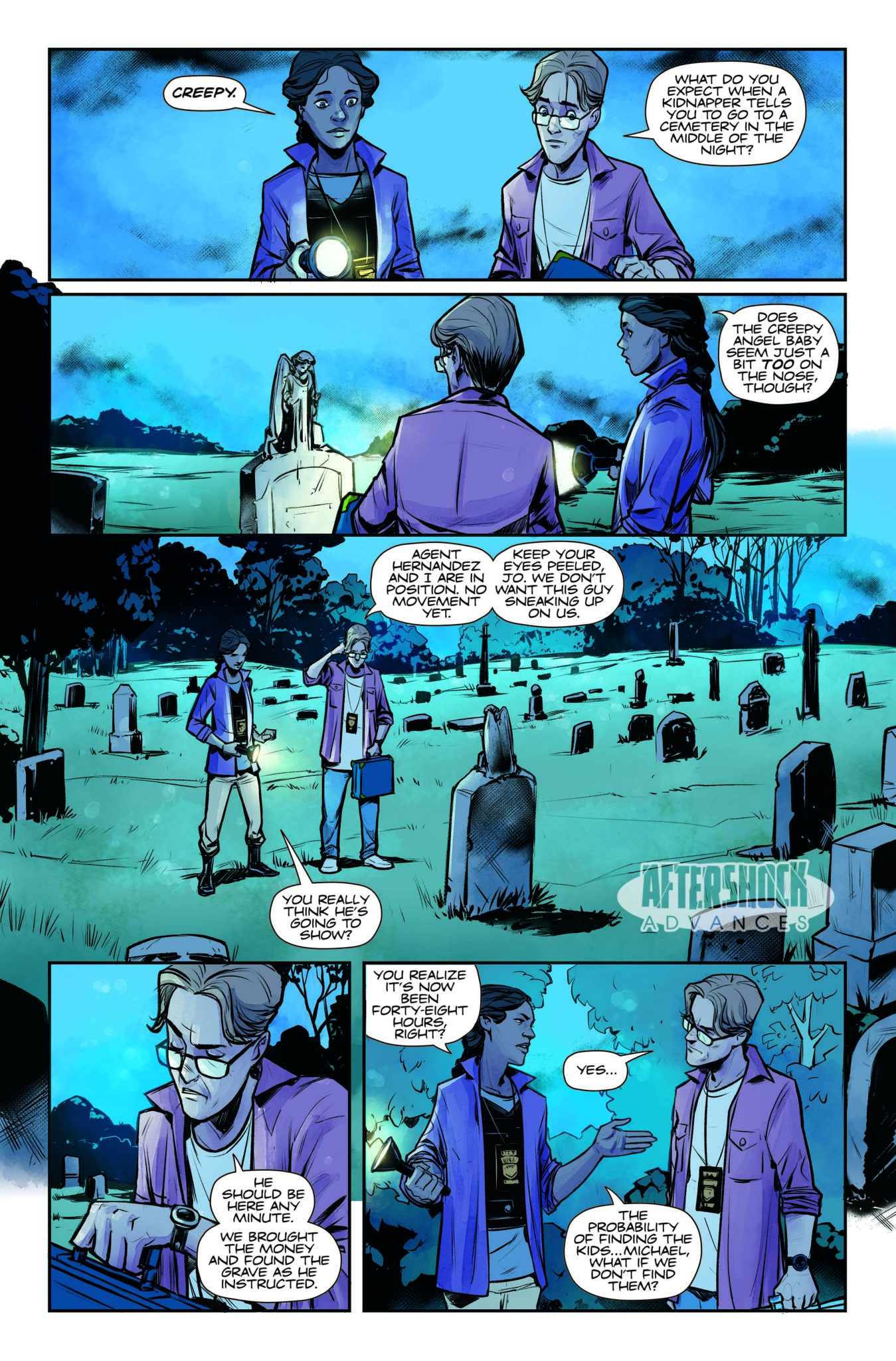
DESCENDENT #2 hits your local comic book store on June 5, but thanks to AfterShock Comics, Monkeys Fighting Robots has a seven-page preview of the issue written by Stephanie Phillips (Devil Within, Kicking Ice) with art by Evgeniy Bornyakov (Meteora, Ziggy).
Comic Book Critic Darryll Robson’s take on the first issue: The new AfterShock comic, Descendent, draws on American history and the love of a good conspiracy. Elements of true stories are mixed in with the fictional adventure to create a gripping, challenging read. It is an intelligent comic which doesn’t spoon feed the reader but instead allows the reader to interact with it on whatever level they want to.
About DESCENDENT #2: Missing kids, a mysterious cult, and one furious ex-wife—seems like a typical Tuesday for conspiracy theorist David Corey. While David appears crazy to most, he might be the only chance the FBI have of finding the missing kids and solving a centuries-old mystery. Will FBI agent Joanna Hernandez learn to trust David before it’s too late?
Troy Peteri lettered DESCENDENT #2 with colors by Lauren Affe (Stranger Things, Spider Gwen), Juan Doe worked on the cover.
Did you read the first issue? Comment below with your thoughts.
Since the Fantastic Four triumphantly returned to the Marvel Universe, the iconic team has kept to itself. But Fantastic Four #10, a “War of the Realms” tie-in, thrusts Marvel’s First Family into the middle of the most dire threat Earth-616 has seen in several years.
Story by Dan Slott, art by Paco Medina with Kevin Libranda, color art by Jesus Aburtov, letters by VC’s Joe Caramagna, cover by Esad Ribić.
Reed Richards, Sue Storm, Johnny Storm and Ben Grimm have been focusing on their own adventures and the resurgence of Doctor Doom. But, with Malekith’s forces laying waste to New York City, “War of the Realms” has come to the Fantastic Four’s backyard, so they have to get involved.
Writer Dan Slott strikes a mostly effective balance between a Fantastic Four story and a useful companion to Marvel’s latest all-encompassing event. The family’s dynamics still drive the narrative along. In the aforementioned vacuum Richards and Co. have found themselves in, this tone usually works; Slott delivers down-to-Earth stories about Reed and Sue’s struggles to raise their exceptional children. Here, these predictable story beats detract from the bigger picture.
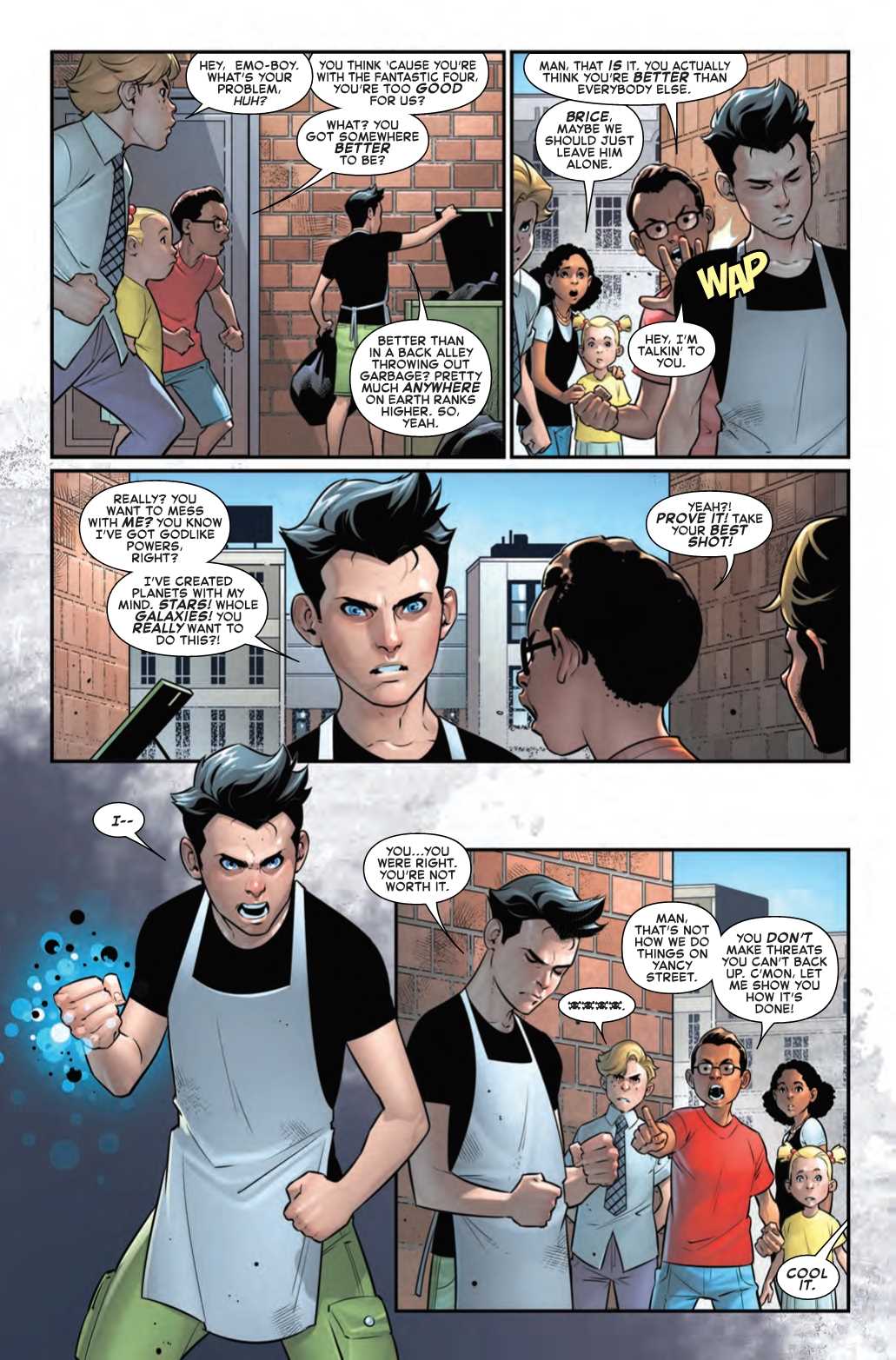
Throughout the issue, Franklin Richards seems like a stereotypical teenager. He whines when Reed makes him help out at the Grimm Youth Center. The majority of Franklin’s lines might as well be pulled from a caricature of an angsty teen. At various points, he says, “this is so unfair” and “whatever.” He also dismisses Alicia’s advice by muttering “whatever.” Plus, when an attitudinal Yancy Street resident hassles Franklin, Reed Richards’ son says, “You know I have godlike powers, right?” The characterization of Franklin Richards is problematic for a few reasons; Slott relies on tired tropes of annoying teenagers rather than diving into the heart of Franklin’s emotional turmoil.
It’s hard to like Franklin Richards when he’s acting like this.
Most of Slott’s run on Fantastic Four has been building to the possibility that Franklin might lose his powers. Every time the young hero uses his abilities, he depletes his power source. In this issue, it’s clear this impending loss weighs heavily on Franklin. His behavior ranges from bitter outbursts to somber lines about how much he values his powers. Eventually, Franklin pushes past his struggles and willingly sacrifices some of his powers in the Fantastic Four’s battle against the Frost Giants. Though this should have been an impactful moment, the payoff was lackluster because Slott makes the reader want to groan every time Franklin opens his mouth.
Improving this narrative thread could be as simple as a brief exchange between Franklin and one of his family members. It could be as easy as having Reed ask his son why he’s behaving in such a crude way. Instead, nobody acknowledges the possibility that his attitude could be caused by anything other than the idea that “teenagers will be teenagers.” As a result, Franklin is left to struggle on his own for the duration of the story.
This issue doesn’t exclusively focus on Franklin. Valeria has a confrontational meeting with Moon Girl and, while they initially don’t get along, the brilliant heroines put aside their differences and use their combined intellect to gain momentum in the battle against the Frost Giants. It’s refreshing to see these two young women play an instrumental role in the outcome of the story. The end of the issue suggests that Moon Girl might be here to stay and she’d fit right in with the Future Foundation.
Beyond the arcs of these characters, the pacing of the story is uneven. The first chunk of the issue focuses on the Fantastic Four’s return to Yancy Street after their recent adventure in Latveria. Valeria laments the lack of excitement in New York City, which seems absurd considering that the sky is always falling in Earth-616’s version of the Big Apple.
Valiera Richards thinks New York is boring. In just a few pages, she’ll see that she couldn’t be more wrong.
Of course, as Thor would say, all Hel quickly breaks loose, so the story shifts into an action-packed battle while it maintains its focus on Franklin’s and Valeria’s individual narratives. The resolution is disappointingly abrupt but it sets the stage for the next few issues of the series by splitting the family apart (again.) This decision will likely polarize some fans but allowing the teenagers some time to shine on their own could pay dividends to their legitimacy as individual characters.
Artists Paco Medina and Kevin Libranda capture the domesticity seen in the first portion of the issue; they both focus on the character’s facial expressions, which complements Slott’s family-focused story. In these scenes, the lack of explosive action is replaced by these emotions, and the artists’ attention to detail allows them to shine. The reader can feel Franklin’s frustration in every panel because he always looks miserable. Meanwhile, when Reed isn’t scolding his son, he looks like he’s at peace and happy to be home. These facial expressions allow the reader to pick up on some of the story’s subtext. Slott doesn’t explicitly discuss the emotions of his characters but the artists show the reader how Marvel’s First Family is feeling.
Of course, when the Frost Giants inevitably attack, Medina, Libranda and color artist Jesus Aburtov portray the devastation fantastically. The rapid shift to the creatures’ arrival features an explosion of vibrant colors that looks like the wildest rainbow imaginable. Bright shades of pink and purple clash with the monstrous Giants, which fits the story’s juxtaposition of a mostly tranquil block party and the sudden arrival of these horrifying beasts. Meduna, Libranda and Aburtov take Slott’s story to another level because the art elevates the rapid jump from the Fantastic Four’s downtime to their latest adventure as superheroes.
Fantastic Four #10 brings “War of the Realms” to the titular team’s doorstep but the story still focuses on Marvel’s First Family. The characterization of Franklin Richards makes it difficult to call this issue a success but it’s a self-contained tie-in to Marvel’s hottest event in years.
What do you think of the way Franklin Richards is portrayed in this issue? Let us know in the comments below!
As the Doomsday Clock ticks towards midnight, the superheroes of Earth go after Doctor Manhattan. With the Justice League taking point, the superheroes barely stand a chance against the omniscient doctor. The reason why is due to the Trinity being out of commission. While Wonder Woman works to defuse the Russian/Firestorm situation at the United Nations, Superman is recovering with Batman. While the other costumed vigilantes from the Watchmen universe are in the wind, Manhattan watches the world. The real question, however, is why he watches the world?
**Some Spoilers Below**
Story:
Doctor Manhattan explains what he has been up to since the end of Watchmen. After leaving his universe, Manhattan teleports himself to the prime earth of the DC universe in April of 1938. He befriends an actor named Carter Colman, who he uses to readjust his powers of future seeing. As Manhattan gets it settled, however, he hears of a man who stopped a car and lifted it over his head. The omniscient doctor teleports to the location and sees Superman for the first time. He begins to observe the Man of Steel’s timeline in hopes understand him better. After realizing Superman is the very heart of costumed superheroes, Manhattan decides to start experimenting with it.
This is the explanation readers have been waiting for, and it does not disappoint. With Doctor Manhattan narrating, we see a history of the DC universe and Superman’s role in it. It takes into account every detail about how Superman affects the timeline. From the Justice Society to the Legion of Superheroes, this issue makes readers feel the weight Superman has on the timeline. It’s also cool to see how the timeline shifted after each crisis. Even the framing device of Carver Colman, an actor we’ve seen in the background, is an exciting part of the book. What was originally a background a character grew into a deep story within itself. The only complaint I can think of is a lack of progression in the present. The ending in the present was the same as last issue, but with a final panel that will no doubt get readers excited for the next issue. If you’ve been reading up to this point, this issue will not disappoint.
Art:
Gary Frank and Brad Anderson continue to show why they’re the best art team for Doomsday Clock. They can make each panel feel grounded, as seen in the Carver story, but also fantastical when with Manhattan. I’ve praised this team in the previous nine issues, and I don’t think this will stop any time soon.
Conclusion:
This comic was well worth the wait. Doomsday Clock continues to be the mind-blowing, reality-shaking story it was announced as. The art matches the weight and epicness of the story at every turn. I highly recommend this issue as well as the series up to this point.
In ASCENDER #1 Mila met Bandit, the pet robot her father Andy lived with when he was a child. But with the outlaw on technology, she knows she’ll have to keep him hidden from the planet Sampson’s overlords as well as Andy. Will she be able to learn where this mysterious machine came from while also keeping his existence hidden from the all-powerful Mother’s watchful eyes?
Story
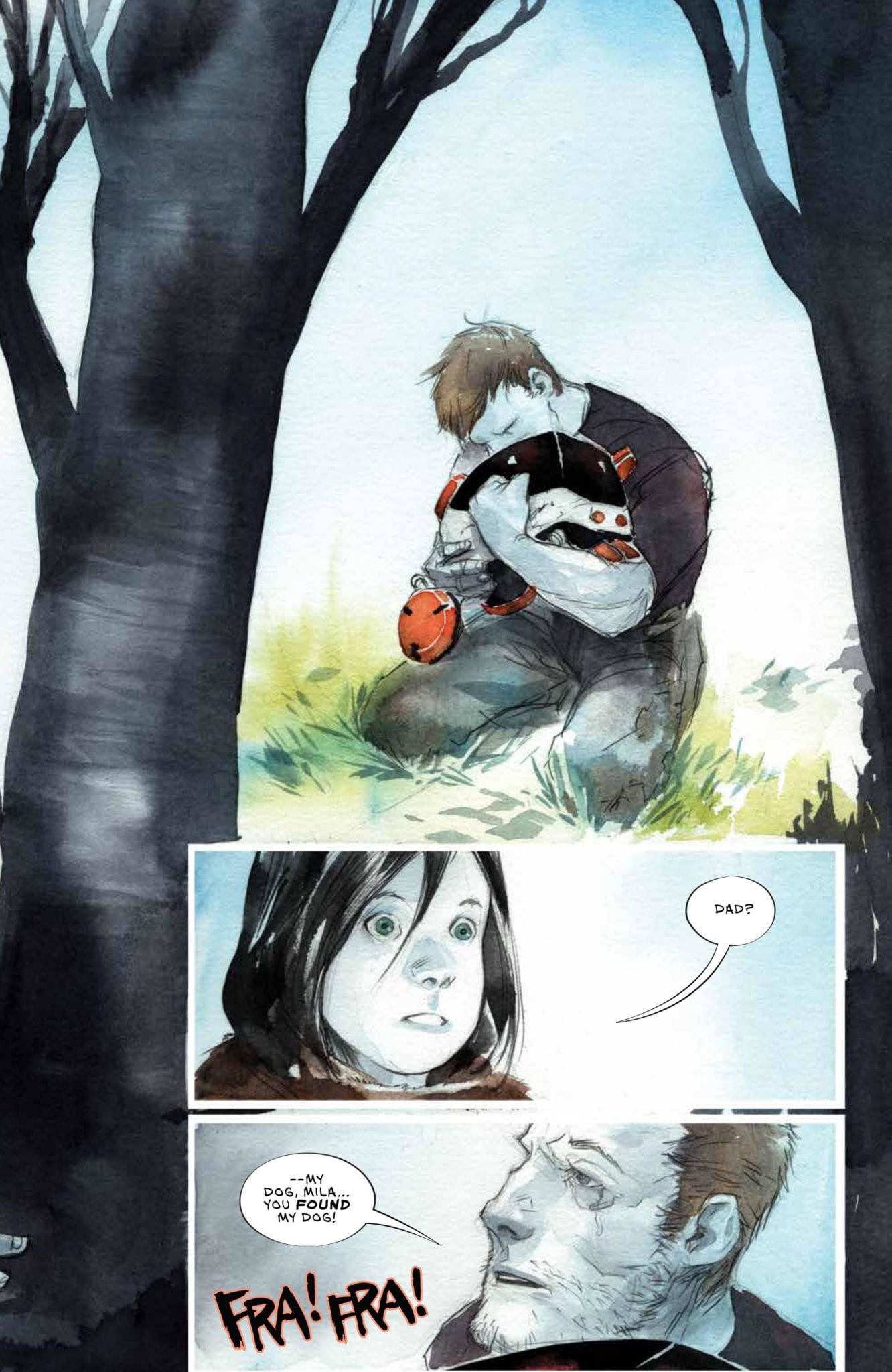
ASCENDER #2 begins with an emotionally-charged scene that grips the reader immediately. Mila realizes Bandit is searching for someone on her planet, a person she learns too late is her father. But to her surprise, Andy exclaims, “–My dog, Mila…You found my dog!”
This beautiful scene shows readers the true heart behind this series. This isn’t a tale of heartless humans hungering for soulless technology; it’s a cry to embrace all that life gives us. And in this story, the vampiric overlord Mother is the force who will stop at nothing to squeeze the life out of all the universe’s technology.
To that end, Mother has enlisted help from the race of aliens who built the Scrappers from the Descender prequel series. She plans to use their resources to wipe out the rest of the galaxy’s technology, leaving one of her eyes behind in a gruesome creature to ensure the job gets done.
Art
Dustin Nguyen’s artwork, both within the issue and for the cover, is beautifully fitted for this story. His penciling and coloring is smooth and clean, making it easy for readers to follow along with each illustration. But there’s also a sophisticated level of detail, such as his depiction of the weapons and Bandit; these show that there’s still plenty of technology in this universe despite appearances to the contrary.
Steve Wands’ lettering is particularly effective when showing Mila’s thoughts. Just as in issue #1, this font looks like a child’s handwriting to show just how innocent she is despite the horrific events happening around her.
Conclusion
This issue personalizes the goals and purpose we were introduced to back in #1. We easily find our allegiance to Mila, Andy, and Bandit, hoping their luck holds out against the vampiric forces of Mother.
Do you think the protagonists have any chance of escape from Sampson? Let us know in the comments below!
Bruce Banner is still on the run; Shadow Base has been in hot pursuit of the physicist since his destructive activities in Las Vegas. The previous issue saw Banner’s Joe Fixit persona takeover his body, and Banner must keep up this hustler image less someone connects him with the Hulk. But an unwelcome visitor arrives just as he checks into his hotel, one whom could wreck Hulk and his ultimate goal of destroying human society.
Story
Al Ewing shows an ability to seamlessly transition between the different personalities within Banner. Now in control of his body, readers see an all-too human reaction to his predicament. It’s easy for one to see its similarities to a blackout from an all-night drinking session and waking up to an unfamiliar situation.
In addition to these plot points focusing on Fixit, Ewing dives into the absolutely tragic storylines of two monsters Banner knows quite well. The first is met by reporter Jackie McGee at the Banner’s place of residence and the second, a new version of the Abomination, crashes into Fixit’s hotel. These creatures’ pain and suffering is enough to make the toughest of readers quake in their boots.
Ewing’s ambitious goal of bringing themes of horror back into the Hulk’s story is going along swimmingly, to say the least. This story continues to upend our expectations
Art
THE IMMORTAL HULK #18 features gloriously gruesome works fitting of any high-quality horror comic. Joe Bennett’s penciling and Ruy José’s inking captures the essence of the Hulk and other monsters’ horrific natures by crafting highly detailed veins, claws, teeth, and even extra appendages. And Paul Mounts’ fully-realized range of colors complement these illustrations beautifully.
In addition, VC Cory Petit’s lettering successfully shifts font styles between the monsters and humans to reflect both their distinctions and mental states.
Alex Ross’ main cover features a close-up view of the Hulk’s angry face, representing the monster inside of not only Banner but the other characters as well. Jong-ju Kim’s variant edition, on the other hand, changes direction completely with a depiction of the Hulk Buster armor, which may serve to represent the Hulk’s enemies’ desire to destroy him.
Conclusion
THE IMMORTAL HULK #18 brings with it a whole new level of horror that shocks even those familiar with Ewing’s current storyline. His narrative successfully employs the Joe Fixit focus to reinvigorate the Shadow Base plot that’s been behind every event of the run so far.
What did you think of the shocking details revealed in this issue? Let us know in the comments below!
Black Science is coming to an end within a few issues for Image Comics. Grant McKay and the gang face off against the evil inter-dimensional witch Doxta in a dramatic march towards the final chapter.
***SPOILERS LIE AHEAD***
The McKay family and all of their many allies make a final stand against Doxta and her forces to save existence. Grant faces all he fears and regrets to save those that he loves and put the universe back on the right track.
It all seems to work out with the destruction of Doxta. That doesn’t actually happen to be the case in an absolutely brutal twist when we go from the happy ending to Grant foaming at the mouth seeing this false vision of the end. He comes to surrounded by the slaughtered bodies of his family and friends and a smiling Doxta.
Grant has failed one more time, Doxta has prevailed and plans to torture our beloved, damaged hero for eternity. In another huge twist, Grant wasn’t the final obstacle in Doxta’s way. In our cliffhanger ending, Kadir emerges to face the evil witch.
Black Science #40 is full of twists and brutal turns that deliver and effectively lead the reader where they’re intended to. As with the entire series thus far, Matteo Scalera’s art is phenomenal. So much emotion and weight in not only the dramatic moments, but the quieter and lighter moments as well.
Doxta has been established as one of the most brutal and punishing villains of recent memory. The landscape our characters have to navigate is one of both nightmares and wonder. Scalera has done forty brilliant issues of art that everyone should be paying attention to.
Rick Remender’s skill for long-term plotting and development is best on display in Black Science. The journey we’ve gone on with these characters, through the literal Eververse, has been satisfying and brutally honest. It’s amazing that such realistically tragic figures can exist and interact so effectively in a book this insanely imaginative. Remender and Scalera should do comics together forever.
Every step this series has taken in a new direction, with every new chapter that starts, it continues to develop in ways that keep us on our toes. Black Science is pure science-fiction imagination come to life and delivered to readers in a beautiful package that isn’t easy to predict.
Grant McKay is far from the hero we’re all accustomed to in comic books and Black Science is far from what is to be expected from comic book stories. It’s a shame that the end is near but it’s going to be a hell of a ride getting there.
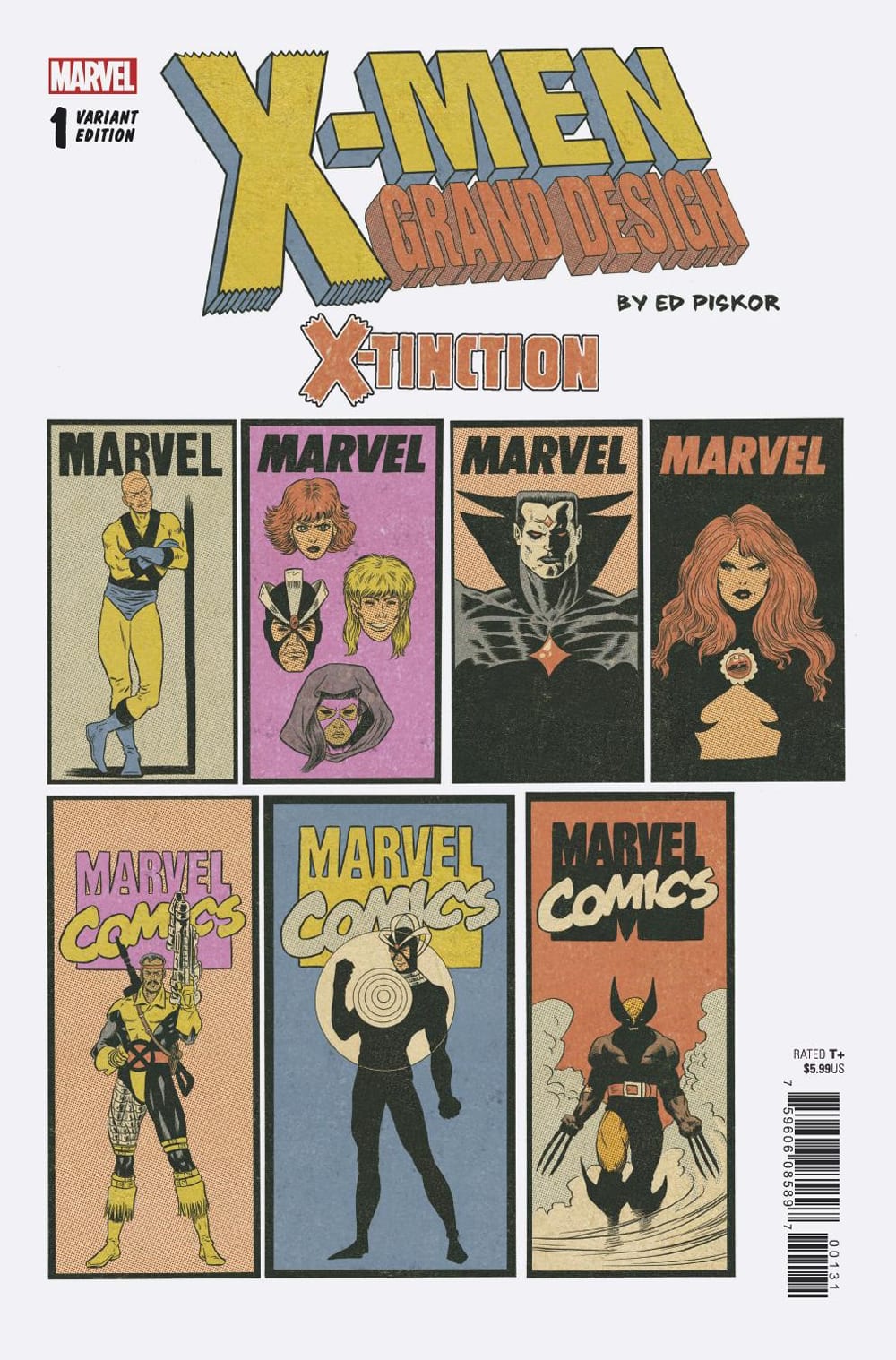
X-MEN GRAND DESIGN ‘X-TINCTION’ finds Ed Piskor returning with another gorgeous, detailed, and lovingly created distillation of another chapter in the classic X-Men Saga, including ‘Mutant Massacre’ and ‘The Fall of the Mutants’ and appearances by fan-favorites Longshot, Cable, and The Marauders!
X-Men: Grand Design– ‘X-Ticntion’ #1 Story, Art and Letters: By Ed Piskor Published by: Marvel Comics
Writing
X-Men: Grand Design is a unique concept. Reviews (and even the solicits) call it a re-telling, but it’s much more than that. Piskor has been doing more than re-telling. He has been distilling; those are two different things. X-Tinction’, which brings GD right up to the late ’80s, makes this more evident as this is the era where X-Men lore began to get extremely convoluted and complicated. We’re talking Mr. Sinister here. Yet Piskor is able to deep dive (20,000 fathoms deep) without getting lost in it. He does this by using the overall story as a narrative tapestry, highlighting moments both small (character arguments, thoughts) big (insert classic X-Men epic moment. There are MANY) and weaving them together smoothly.
Another excellent narrative trick is the on-going use of Uatu, the Watcher, as a narrator. It’s not a new trick, but in Piskor’s hands the Watcher narration takes on a certain amount of gravitas that is classic Marvel. It adds a ‘documentary’ feel to the way the comic unfolds (much like Piskor’s Hip Hop Family Tree books if you have read them. If you haven’t you REALLY should).
A mention has to also be said for Piskor’s use of old-school tools like thought balloons. Not enough of those floating around on comic pages these days.
Art
Piskor’s art is refreshing, his indie comics roots are definitely in place. This book has a handcrafted feel missing from far too many pages and panels these days. The art here is miles away in style and tone from the original, yet it fits marvelously thanks to Piskor’s confident and passionate drawings. You can also feel and see a texture to the pages (this is helped by the paper stock used, which has a nice, strong and solid matte feel to it). The art looks great in digital format, but this is something to see on the page for sure.
Conclusion
A project like X-Men: Grand Design doesn’t come often. This is absolutely a comic for obsessive fans of the medium by someone who is equally obsessed. This is also a comic meant to be physically held and read by turning pages. In other words, this comic is meant to be experienced. And that’s what X-Men: Grand Design is. So jump in on this experience with ‘X-Tinction’ because Piskor’s ride is almost over (we have just one more issue left).
Nick Spencer’s Amazing Spider-Man epic “HUNTED” concludes this week. Kraven puts Spidey in a classic hero dilemma, forcing him to make a tough decision that might change him forever.
***SPOILERS LIE AHEAD***
Kraven’s final play is revealed, forcing Spider-Man to kill him in battle if he wants to save the lives of both Black Cat and Billy Connors. These life or death scenarios are nothing new for Peter Parker, but that doesn’t make this one any less challenging!
Hunters and the hunted is all Kraven sees the world as and tries to convince Spider-Man that this is the only way to protect those he loves. Spidey overcomes his trickery and proves that what Kraven perceives as weakness is actually what makes people strong, to rise above ideals such as his.
Spidey overcoming Kraven, he realizes that he is “the beast” and destroyed all of his own family to prove an invalid point. In a truly shocking twist ending, Kraven honors the sacrifice of “the spider” by once again donning the Spidey suit and having his clone-son murder him.
The final punctuation mark on this “HUNTED” story is a tragic and bold one. As far as the story goes, it’s a wonderful wrap-up to Kraven’s longstanding arc. As far as continuity goes, Nick Spencer just masterfully reloaded the Kraven The Hunter role with his clone-son’s new hatred for Spider-Man as he’ll most likely blame Peter for the murder he just committed.
Nick Spencer crafted a story that’s much more than heroes punching villains. This has lasting consequences, major growth and development, and a heartbreaking finale. “HUNTED” is all-in-all a fantastic Amazing Spider-Man story.
This was a show-me effort for anyone doubting Spencer’s ability on this Amazing Spider-Man run. He’s a master at short, contained stories. He has a talent for slow-burning background developments. Now we all see that he is more than capable of crafting a larger scale epic that delivers from beginning to end. This one doesn’t fizzle out, that’s for sure.
Humberto Ramos does another fantastic job penciling and inking this major finale. The animal-istic side of these characters and their actions are illustrated in such a way that exposes the primal point that Spencer was trying to convey. That final page is a total heart-breaker and leaves the right sour taste in your mouth for the final chapter of Kraven.
“THE HUNTED” did a lot of things right for both Spider-Man and his cast of villains and support. Vulture should come out of this in a very interesting place of prominence. Nick Spencer proved that he can juggle a ton of threads and keep pushing the world of Spider-Man forward into places that readers are going to want to go.
I’ve said it before and I’ll definitely say it again, Amazing Spider-Man is in very good hands.
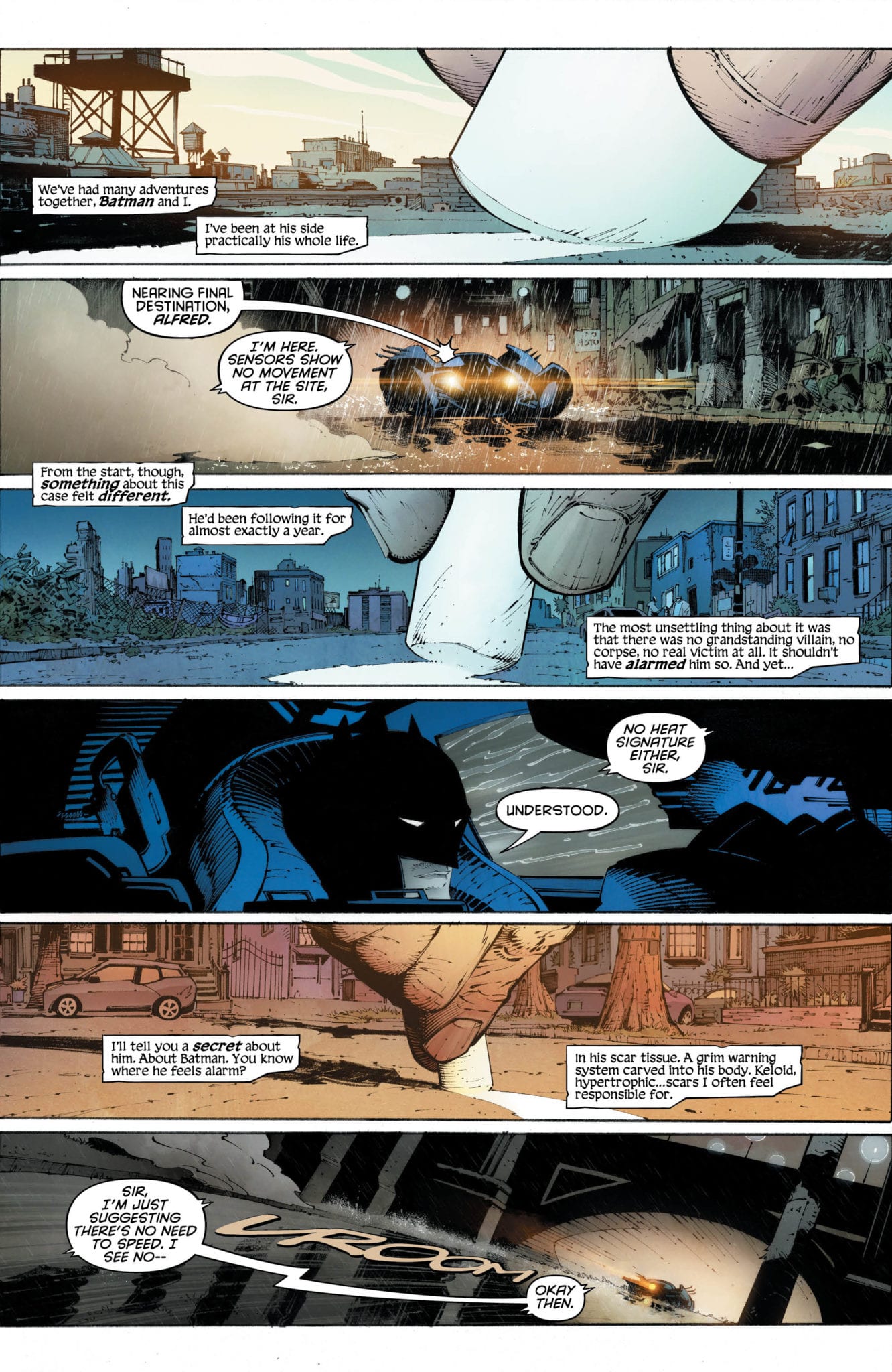
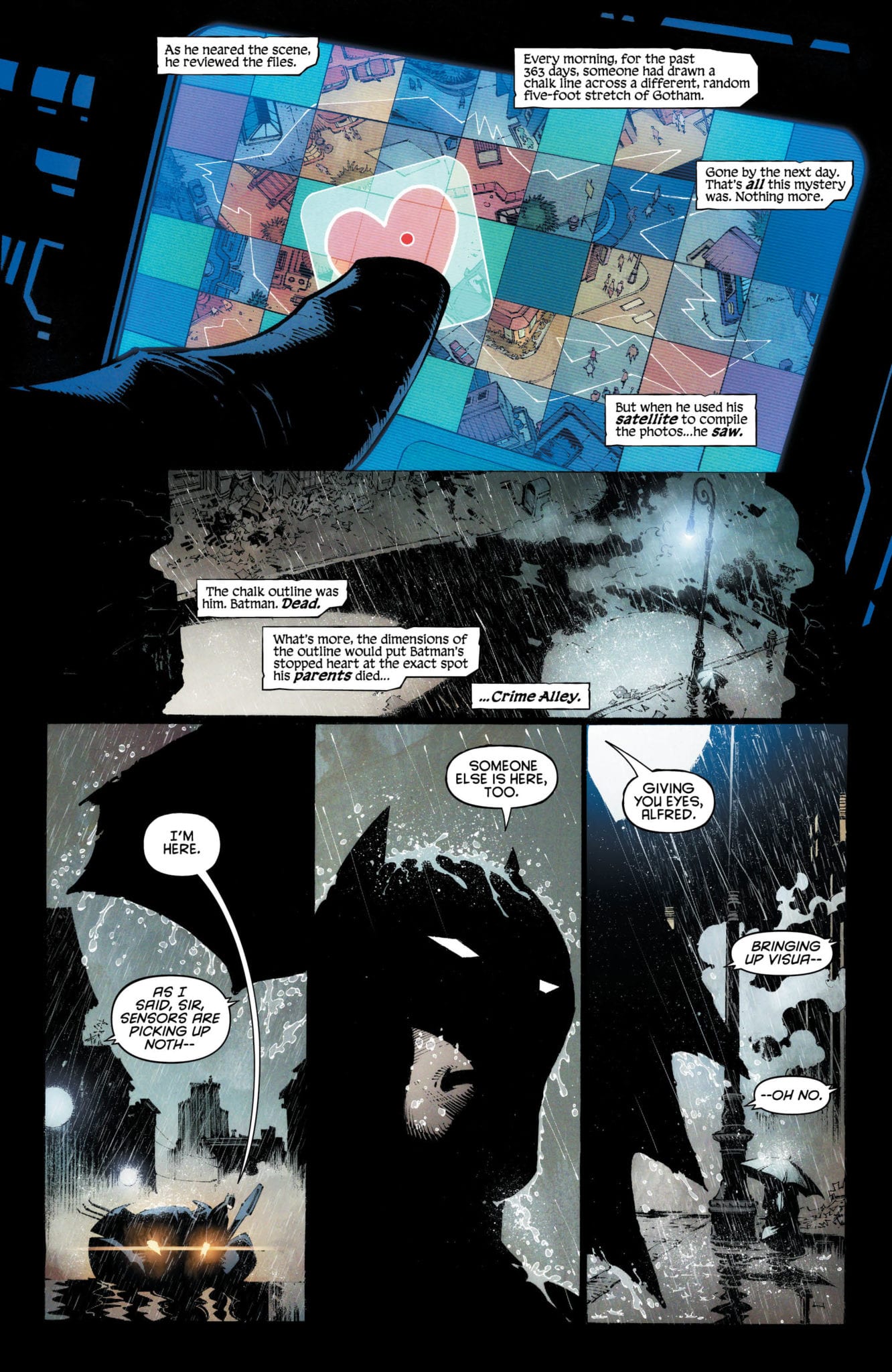
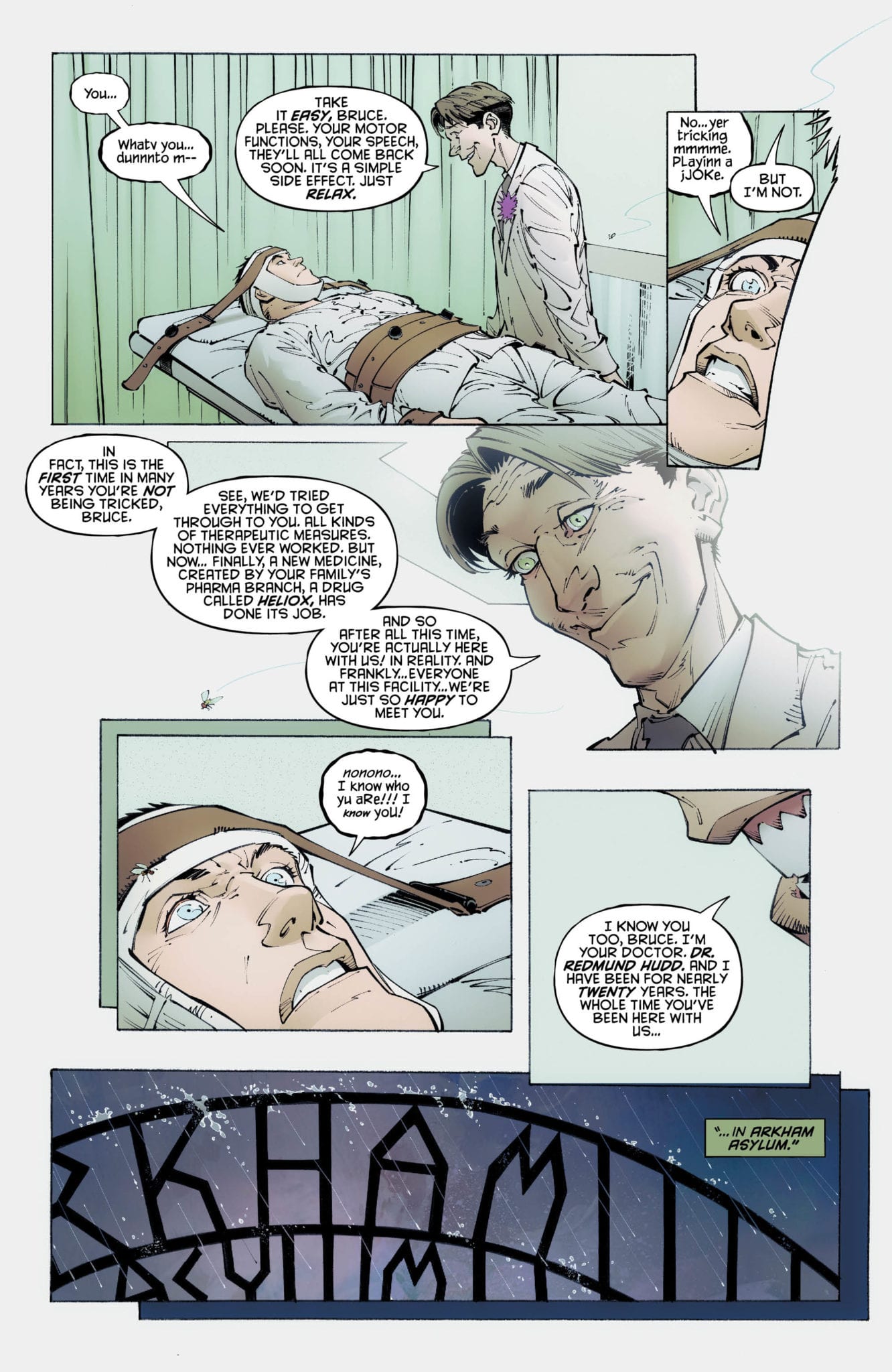
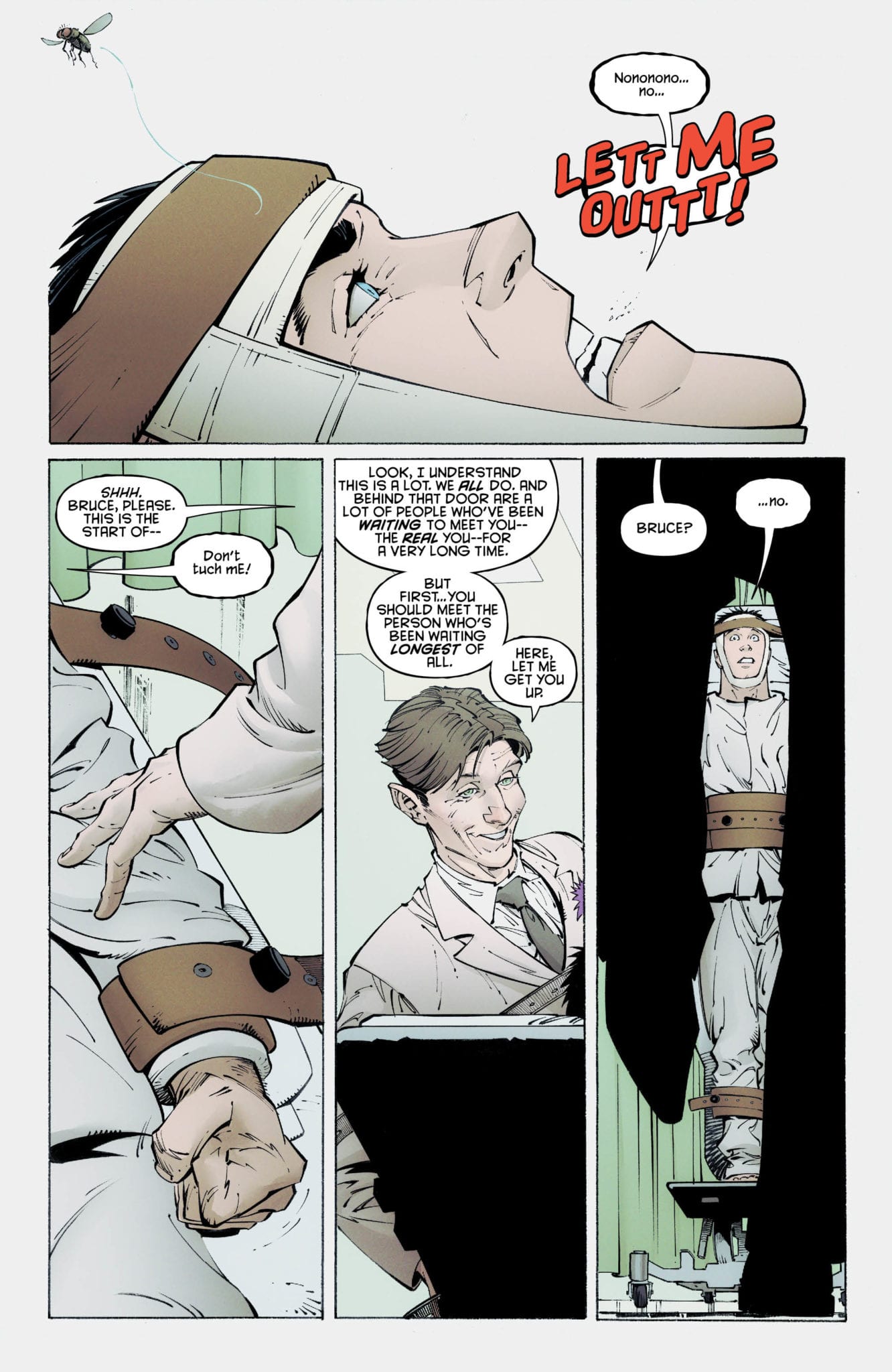
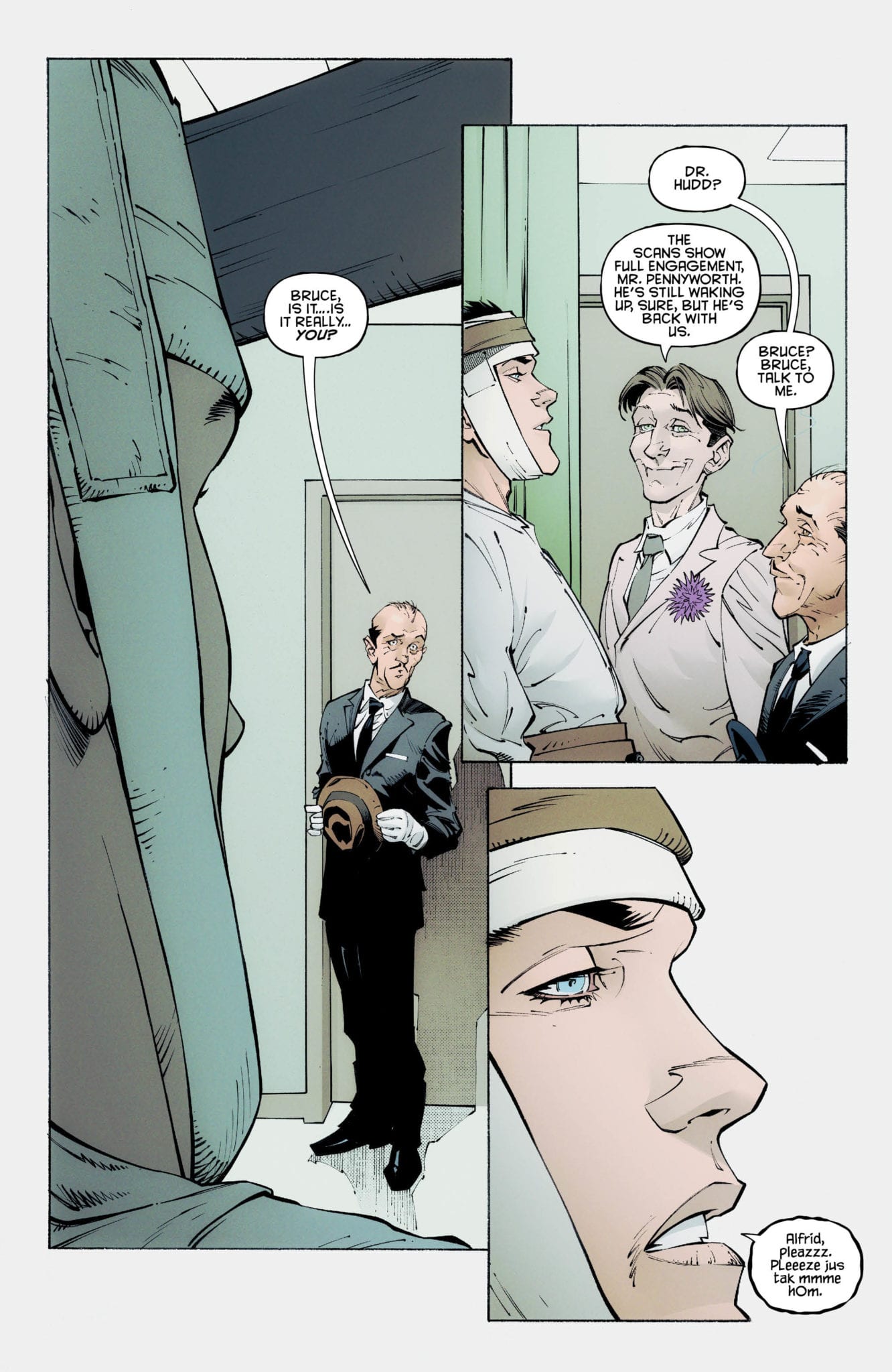
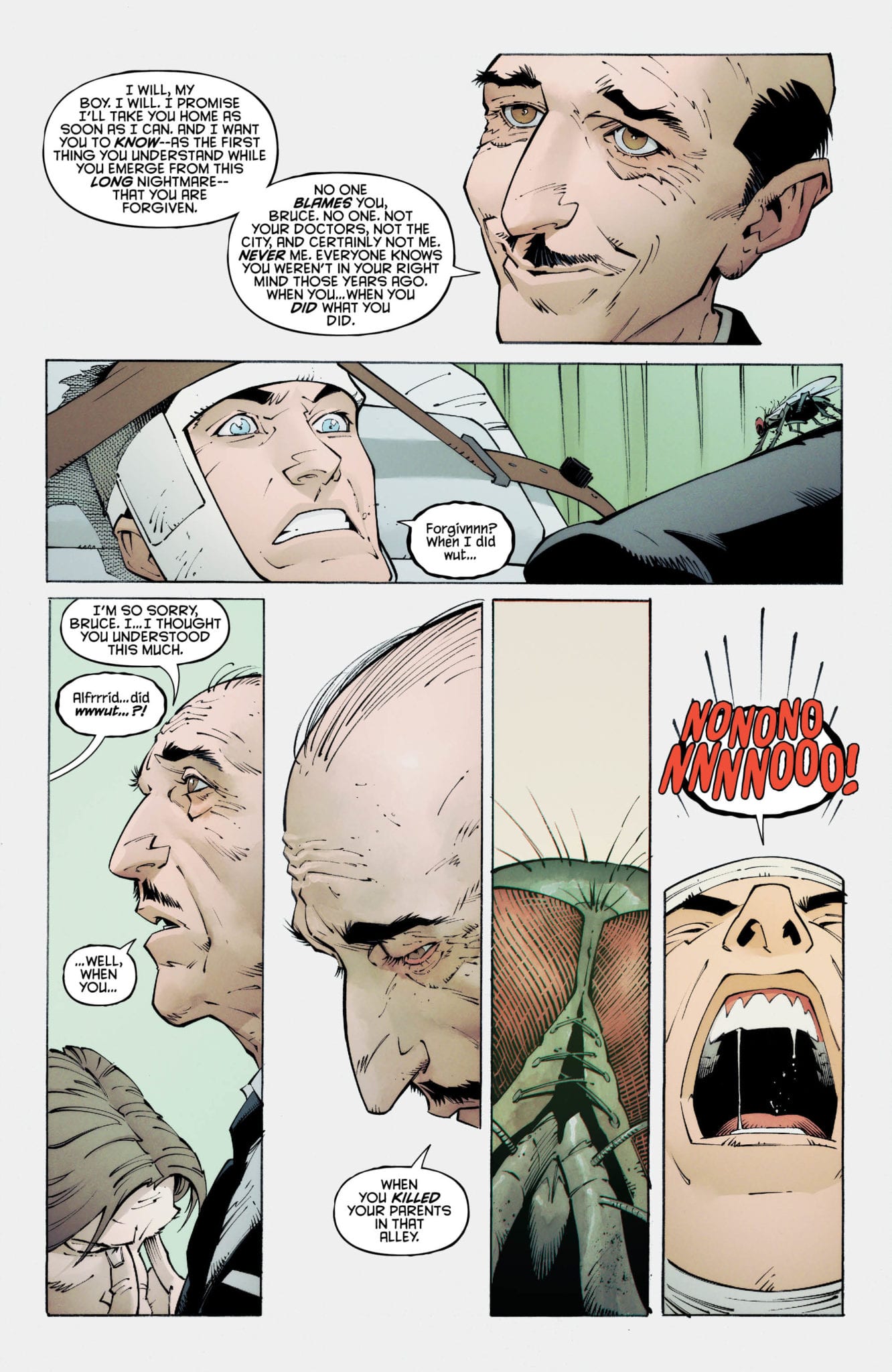
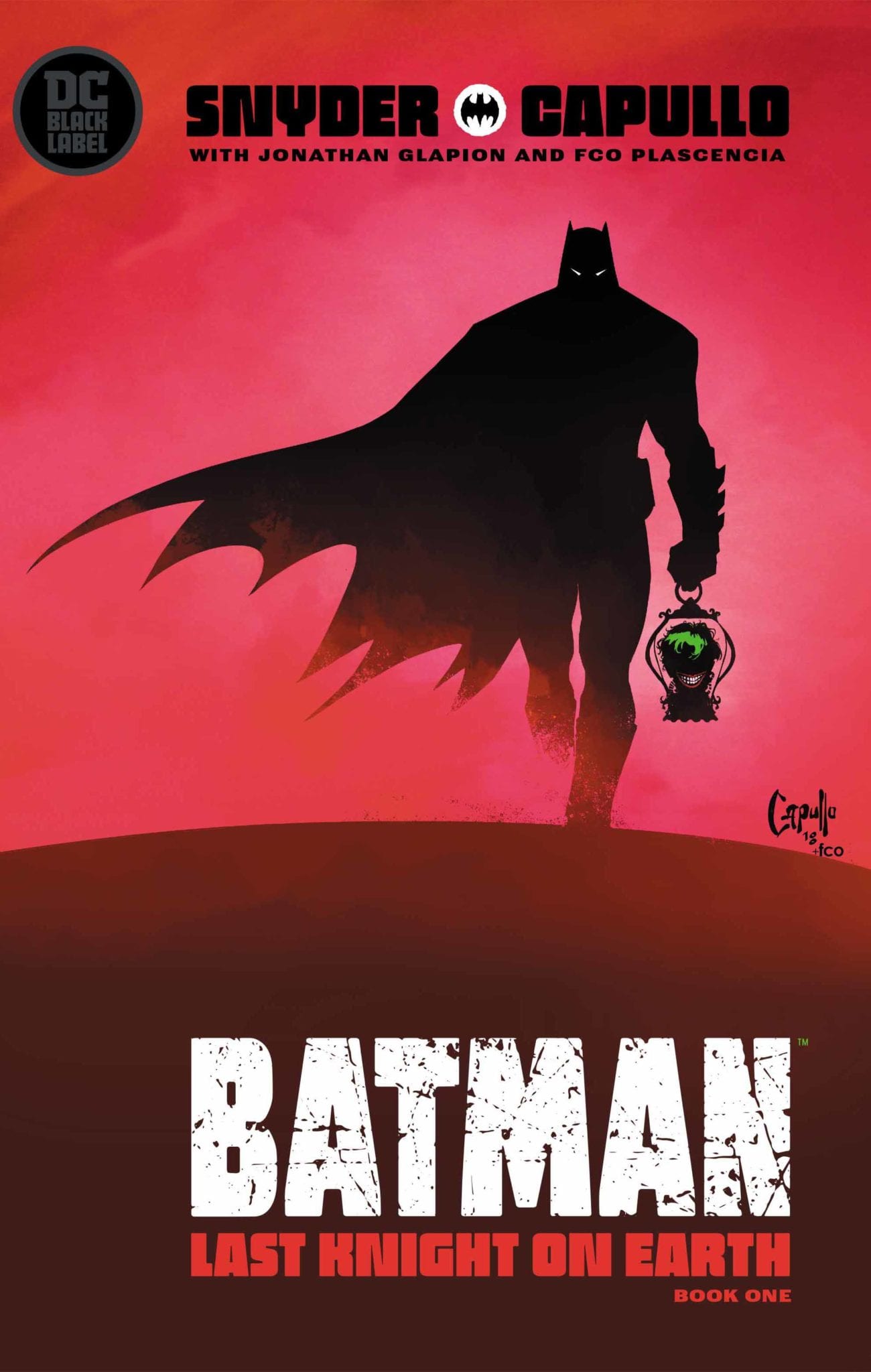
Batman: Last Knight On Earth #1 (of 3) hits your local comic book store today, and the 56-page book written by Scott Snyder with art by Greg Capullo is so insanely epic that it will melt your face off.
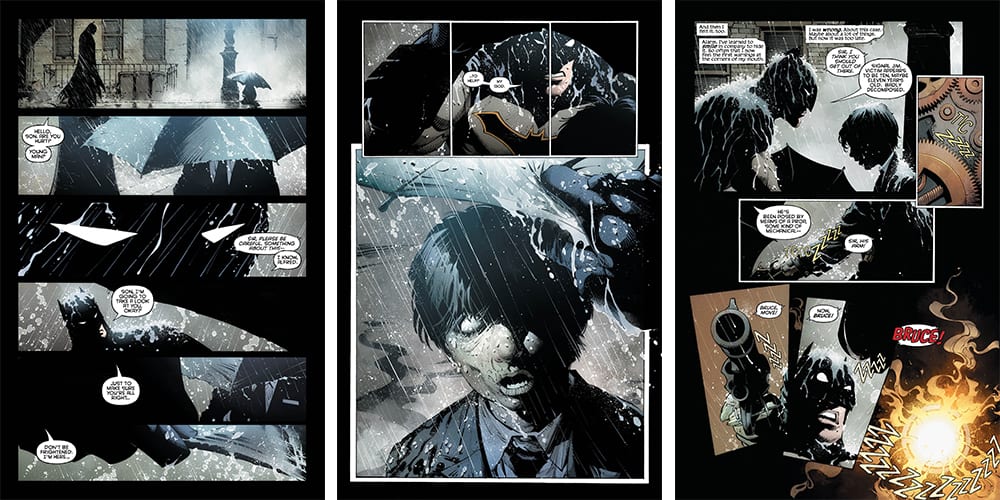
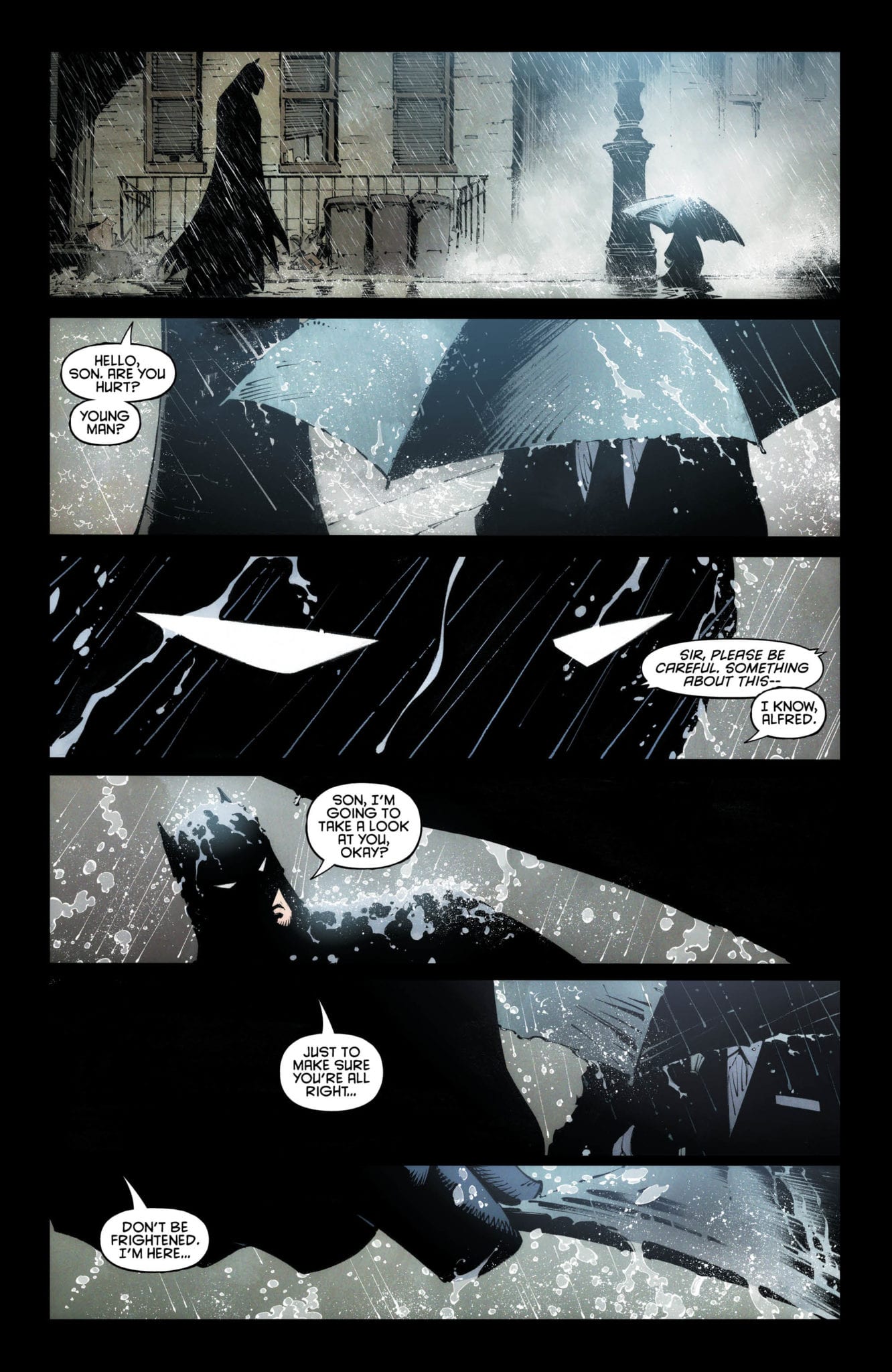
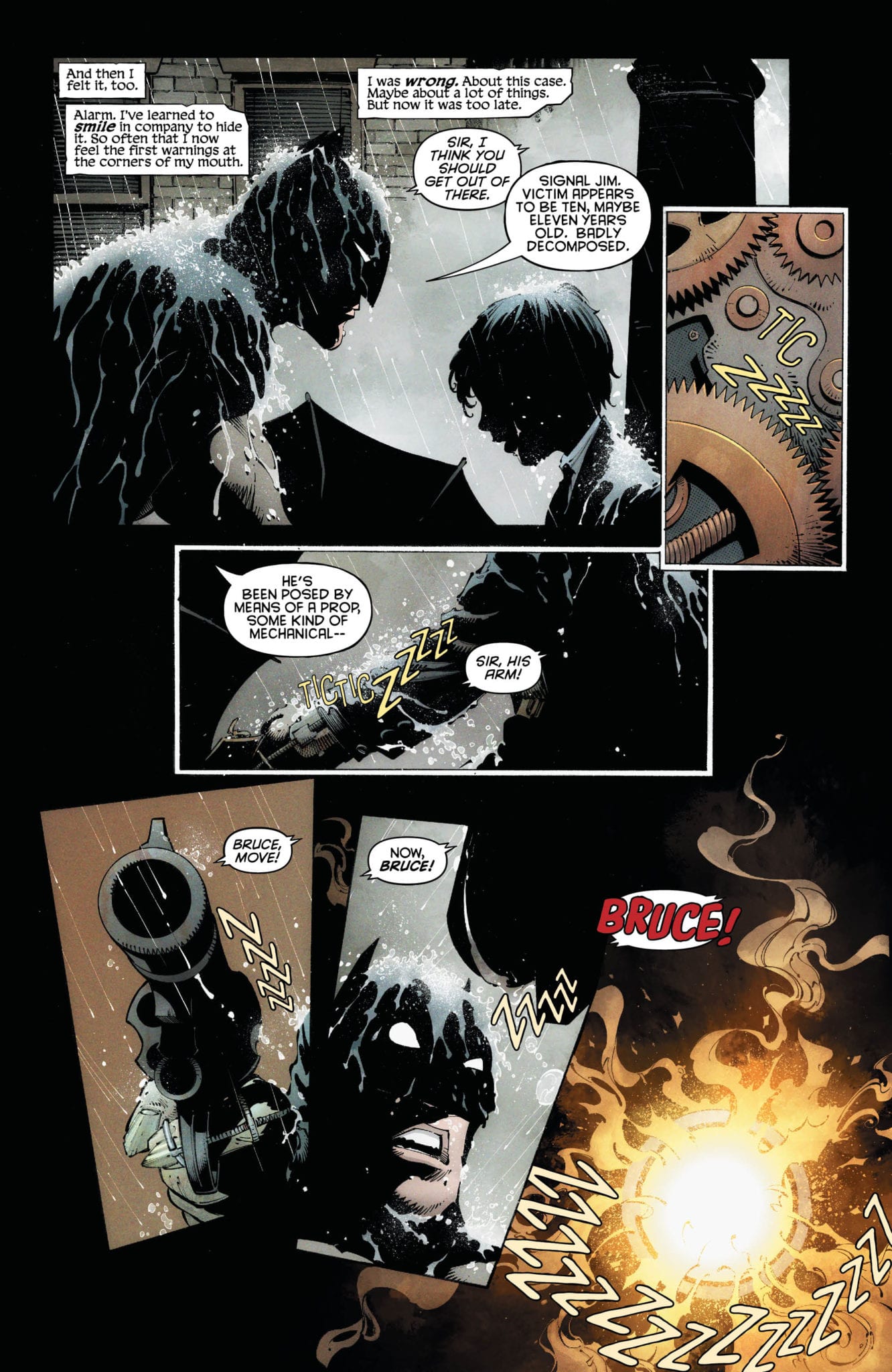
The creative team of Capullo on pencils, Jonathan Glapion on inks, and FCO Plascencia on colors absolutely crush every single panel. The book has grounded gritty moments that have texture and emotion. There is true horror and sadness in the eyes of the characters in the first chapter. Then when the insanity of the world is unleashed on Bruce Wayne, the action sequences have movement, clarity, and excitement. The book has several epic panels that have shock value and give you goosebumps, but the most bone-chilling panel is early on in the book.
SPOILER ALERT – When discussing the art and the writing of Batman: Last Knight On Earth #1 (of 3) spoilers may seep their way into the conversation. If you haven’t read the book yet turn back now.
The panel is of a boy who looks like Bruce Wayne from Crime Alley, with a monotone panel that is layered with rain and the point of view makes direct eye contact with the reader. The reveal and panel have a Walking Dead vibe that sends shivers down your spine. The proportion of Batman’s hand pulling up the umbrella is almost life-size and it emphasizes the POV even more. The panel knocks you and Batman off balance. The two pages involved in this scene are a “how-to” guide for visualizing horror in a comic book.
Snyder’s writing is on full-throttle. Batman: Last Knight On Earth #1 holds nothing back and has a grand scope that feels like a finale. Everyone who is anyone in the DC Universe is involved, but not shoe-horned in just to make an appearance. Snyder has everything planned out and Batman is on a hero’s journey like no other. The narration of the first issue is what stands out when it comes to Snyder’s writing, as there is compassion, friendship, and a bit of mystery to the narrator. Snyder’s use of narration builds the intensity of moments like a musical score.
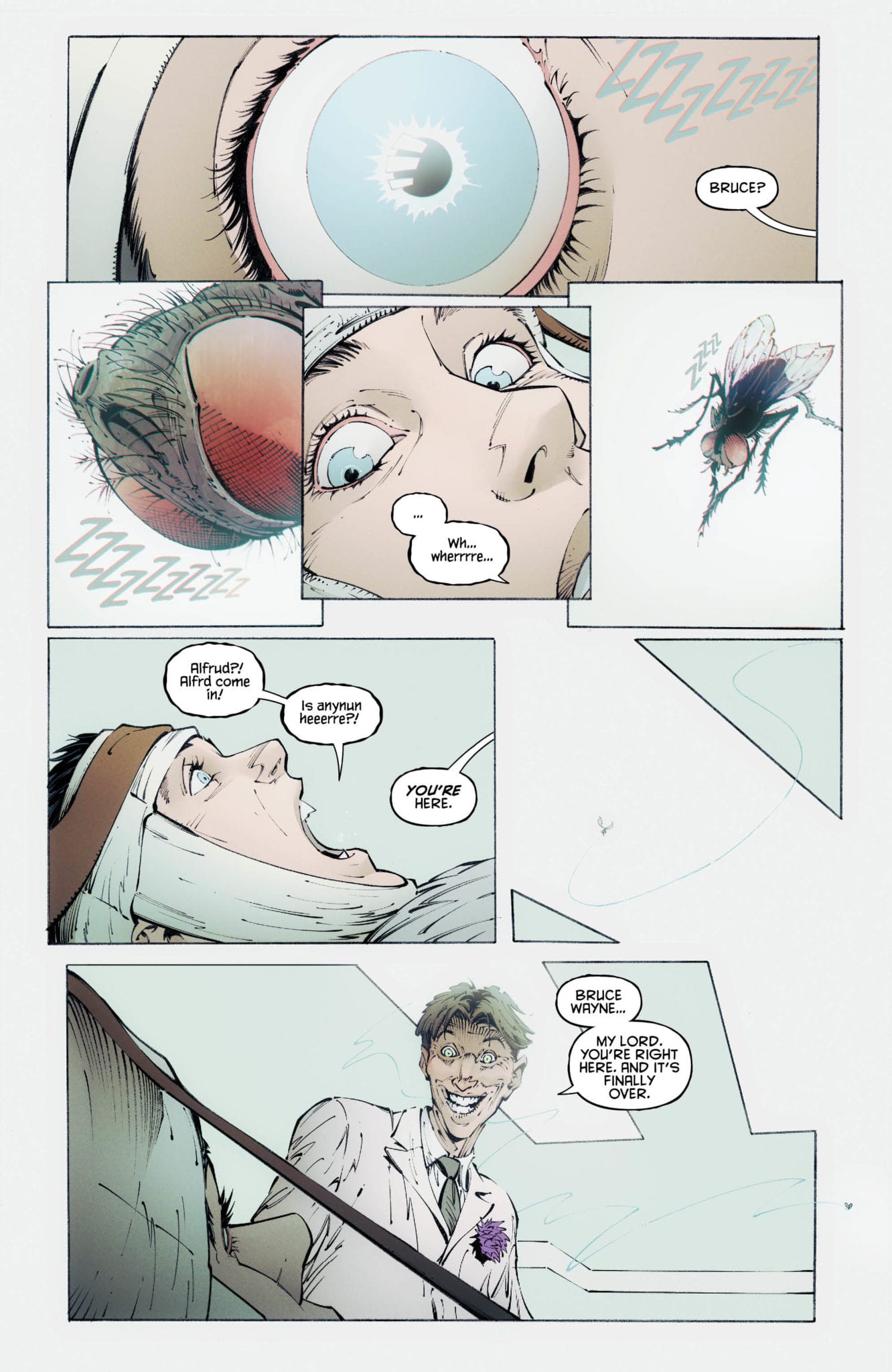
If you look closely at Tom Napolitano’s lettering work you will notice subtle changes to Bruce Wayne’s word balloons. This had me questioning myself and Batman as to what was real and what was fake. It’s this attention to detail that takes a good book and makes it great.
Overall, Batman: Last Knight On Earth #1 is the most fun you will have reading a comic this month. Snyder and Capullo are focused on delivering a Batman tale that rivals the feelings you got watching Avengers: Endgame.
Do you have Batman: Last Knight On Earth on your pull list? Check out the 10-page preview below.
About BATMAN: LAST KNIGHT ON EARTH #1
Bruce Wayne wakes up in Arkham Asylum. Young. Sane.
And…he was never Batman.
So begins this sprawling tale of the Dark Knight as he embarks on a quest through a devastated DC landscape featuring a massive cast of familiar faces from the DC Universe. As he tries to piece together the mystery of his past, he must unravel the cause of this terrible future and track down the unspeakable force that destroyed the world as he knew it…
From the powerhouse creative team of writer Scott Snyder and artist Greg Capullo, the team that reinvented Batman from the emotional depths of “Court of Owls” to the bombastic power of DARK NIGHTS: METAL, DC Black Label is proud to present the bimonthly, three-issue miniseries BATMAN: LAST KNIGHT ON EARTH, published at DC’s standard comic trim size.
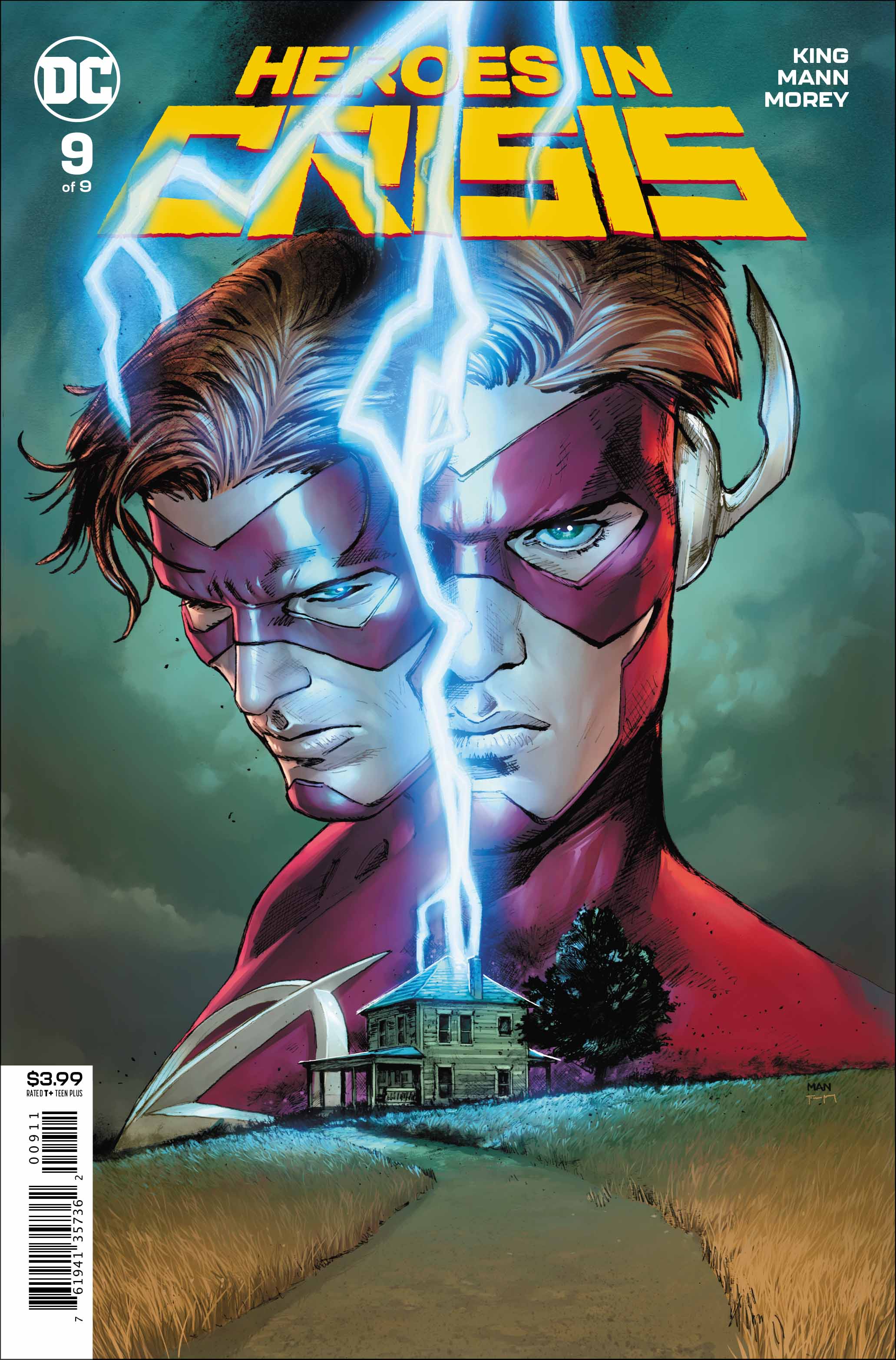
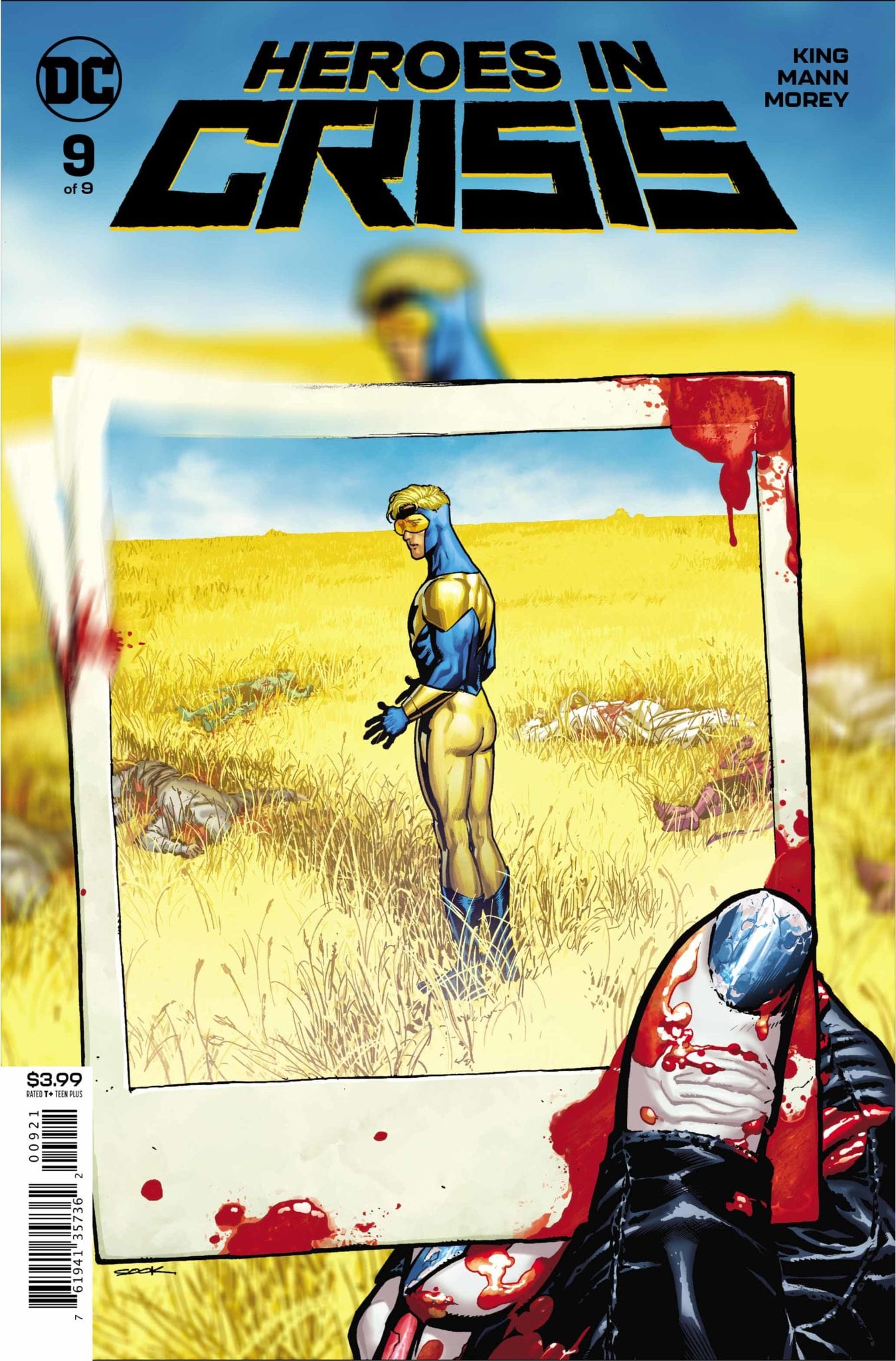
Heroes In Crisis #9 hits your local comic book store this week, and writer Tom King pulls off the impossible by concluding the series with such emotion that you carefully turn each page to see what’s next, and there is a sober excitement for the future of the main characters in the book.
SPOILER WARNING – When discussing the art and the writing of Heroes In Crisis #9 spoilers may seep their way into the conversation. If you haven’t read the book yet turn back now.
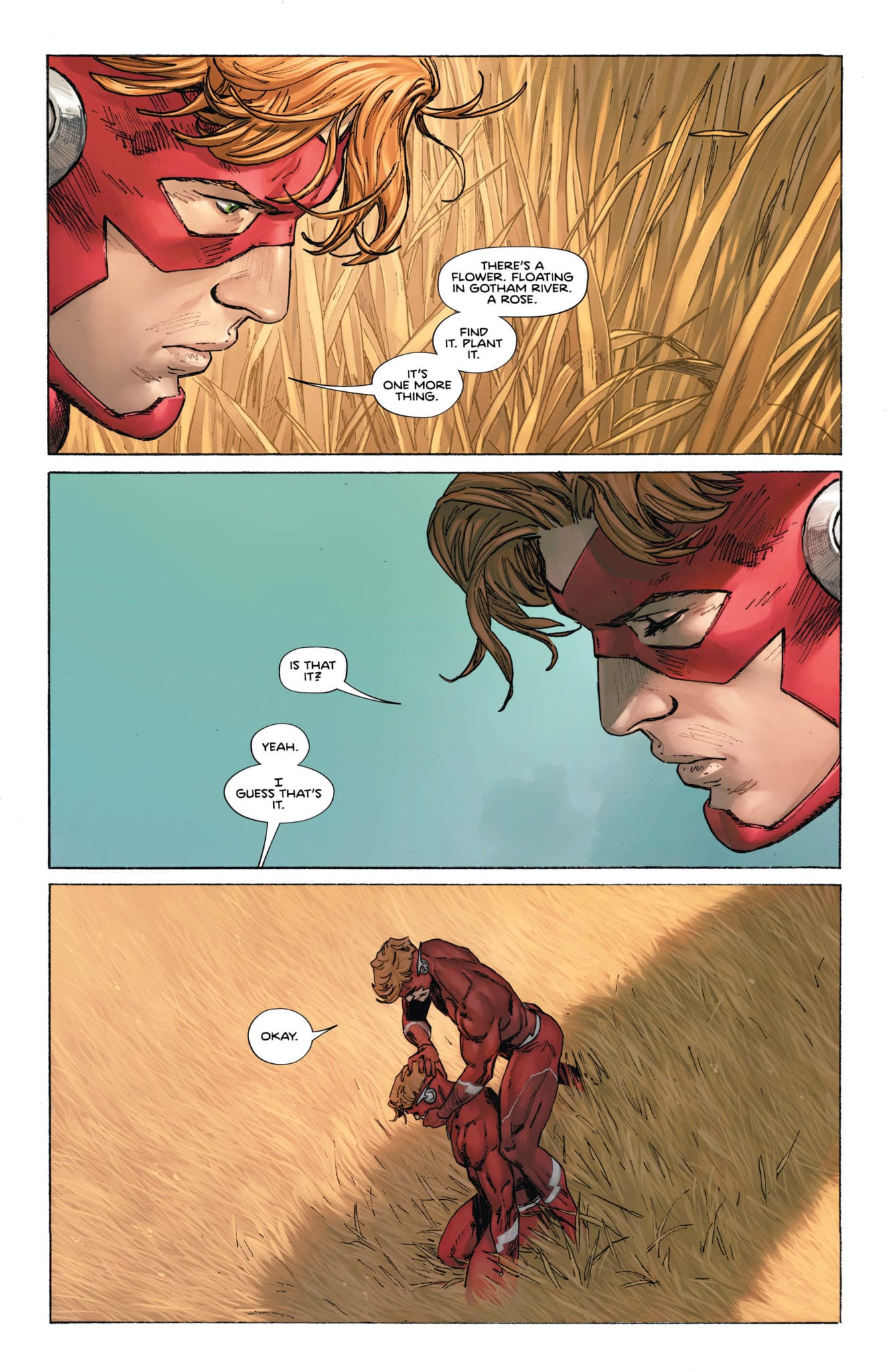
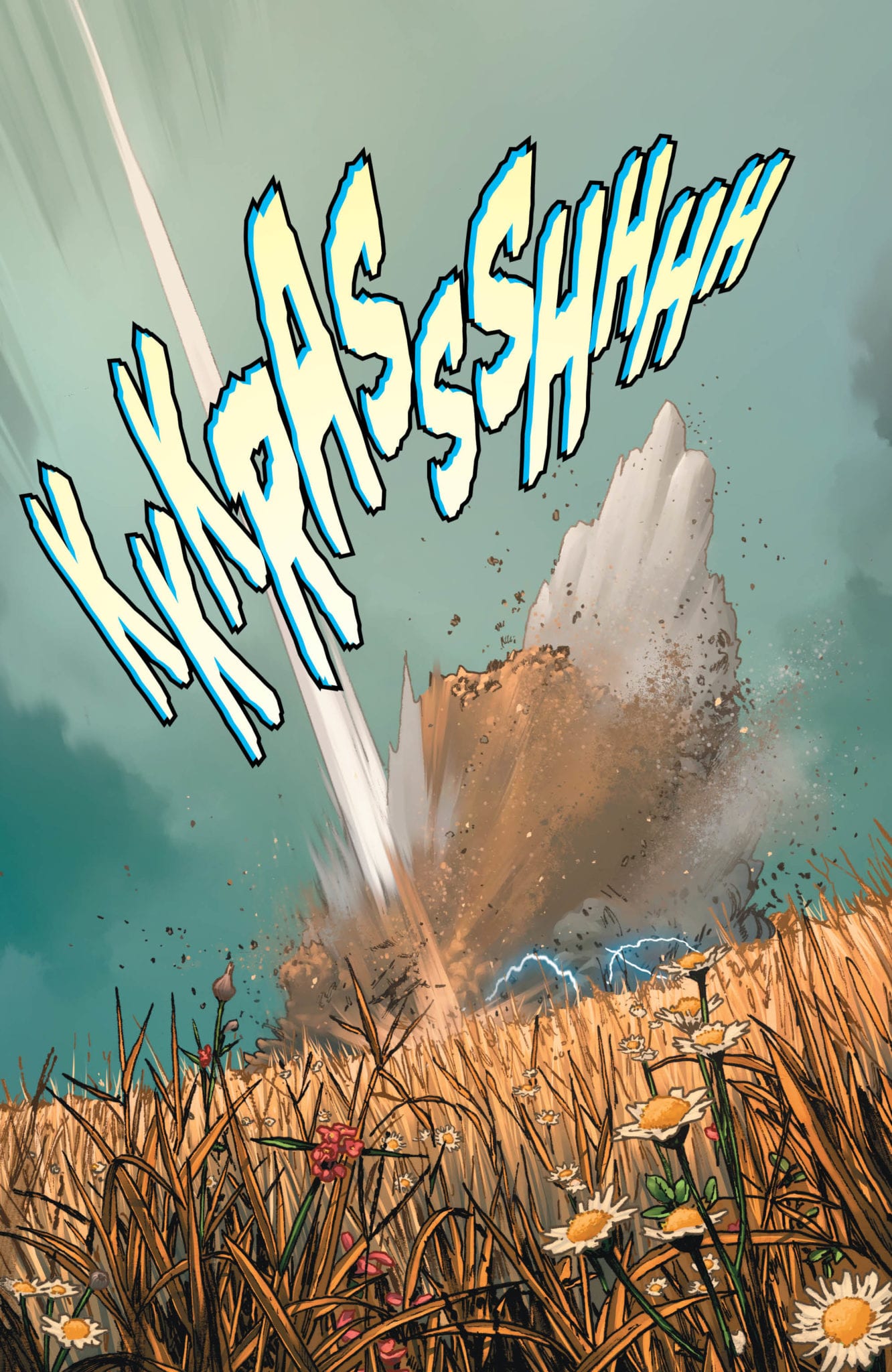
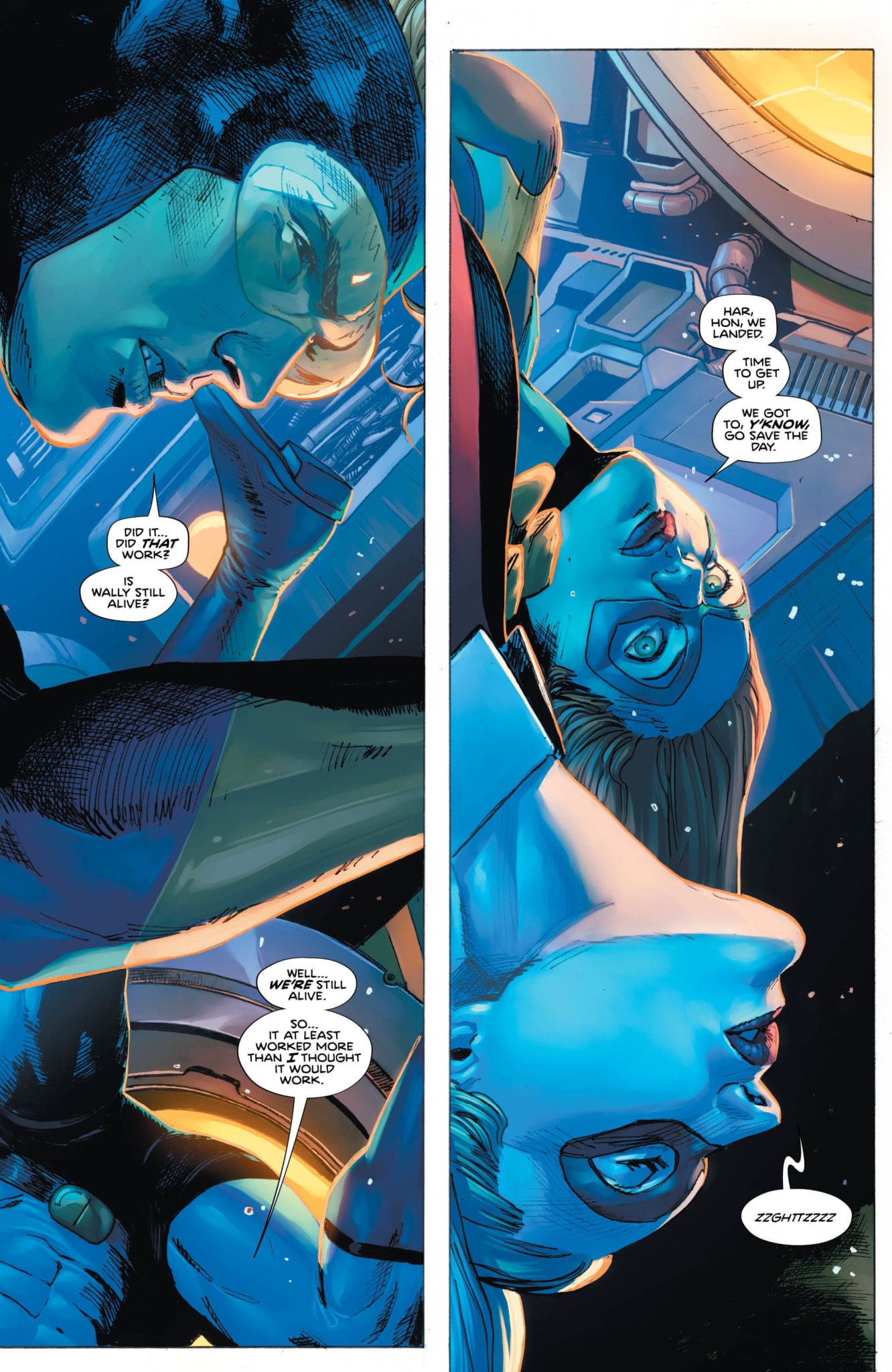
Clay Mann handles all the art in the finale and the script is tailor-made for epic panels that leave you in awe. The final issue is full of raw emotion from every character involved and Mann is tasked with bringing that intensity to each panel. The book feels like a film in the way the camera angles are worked. Every panel conveys emotion and has a purpose. There are seven panels involving Harley Quinn that are cinematic gold. I’ve never had a static image emotionally squeeze me as hard as Mann’s work did in the finale. Tomeu Morey’s colors assist Mann’s pencils as the background colors bring the characters out of the page. Morey also gives certain panels a soft background blur that keeps the conversation serious but heartfelt.
Clayton Cowles has to stack a ton of King’s dialogue in the book, and it flows. The lettering in the book directs your eyes very well, and Cowles excels at framing the artwork to increase an emotional response from the reader. The final two pages of the book have a gentle ‘S-motion’ to the lettering that gives momentum so that the final word on the page is exciting and inspirational.
As mentioned before, Heroes In Crisis is about the raw emotion of being a superhero. Superman’s speech from issue five is probably the best moment from the series, but the final issue is where it all connects. King’s writing shines when it comes to unpacking the complexities of Wally West’s emotional state. There is a level of compassion in the writing that gets under your skin and resonates. Wally, Booster Gold, Batgirl, Harley Quinn, Poison Ivy, and Blue Beetle are all damaged goods to a certain degree, but you care deeply about the characters because of the little details that King puts into his story. What elevates the book, even more, is the ending had me excited for what comes next.
Overall, Heroes In Crisis was an up and down story but was definitely worth the price of admission.
What did you think of Heroes In Crisis? Check out a six-page preview below.