Home Blog Page 309

INTERVIEW: Composer Devin Burrows Creates Terrifying Tones For THE WRETCHED

The Wretched is a supernatural horror movie featuring failed marriages, angsty teenagers, and witches. To bring the world to life through the score is composer Devin Burrows.

In The Wretched, John-Paul Howard (Midnight, Texas) is Ben, a teenager living with his father while his parents get a divorce. Ben starts meeting locals, including Mallory, played by Piper Curda (I Didn’t Do It). Soon, things go from weird to spooky to terrifying as Ben must stop the evil actions of a child-stealing witch.

PopAxiom and Devin Burrows spoke about his life of making music, the unique get togethers he’s had with directors Brett and Drew Pierce, and making music for the horror film The Wretched.

Teachers

Devin’s musical training started early. “I took up the guitar at about age 12. I had a great teacher who was into everything from classical to jazz to fusion. At that age, you’re a sponge, and he got me excited about lots of musical possibilities.”

Music was a vital part of Devin’s life, but so were movies. “I used to go over to hang out with friends. We’d watch movies. My friends Brett and Drew (aka directors of The Wretched, the Pierce Bros.), their dad worked on the practical FX for Evil Dead. He had this amazing collection of movies at his place. That’s where we got our education in film. That helped establish my appreciation for film music.”

Devin continued his musical education through high school and well beyond. “In my 20s, I got really into classical music and studied the greats. In 2011, I got to score a film called Deadheads. I loved it.”

About The Wretched

The Wretched is receiving strong reviews, including an RT score of 74 percent. In limited release, playing mostly at drive-in cinemas, it’s become the first movie since Black Panther to win the box office five weekends in a row. “The cast and crew went to see it at the drive-in. There were a lot of people there.”

Devin’s involvement with The Wretched is via a longtime friendship. “I worked with Brett and Drew on Deadheads. We have a lot of similar interests and work great together.”

About the directing siblings, Devin says, “It’s always a treat to work with them. They have high expectations and challenge me. I always find a way to do something new and interesting with them.”

More often than not, composers read a script and watch a mostly-finished movie by the time they start their work. However, Devin’s relationship with the Pierce Brothers made The Wretched a much more intimate project. “We started working together very early during the script writing phase. They would send me drafts, and I would create themes or ideas and send those back. We went back and forth like that for a while. It was this good, creative energy … feedback loop.”

What did the directors want from the score? “I remember them saying they wanted the tone of the film to be varied. A lot of horror films can be dark and dour in tone. But for this film, they wanted a lot of character development. They wanted to be more Spielberg-like, varied in tone … like Jaws.”

For the creators, the varied tones make viewers “… more invested by the time the crazy, scary stuff happens.”

For cinephiles, Devin says, “Music-wise, the film is influenced by Poltergeist, Psycho, The Others … to name a few.”

Strange Instruments

During that close-knit early process, the directors visited their composer for an unusual meeting. “Brett and Drew came over to my place pretty early on. We did a sort of musical instrument casting. I spread out a bunch of instruments. Among them was the Indian Sarangi and Bowed Psaltery.”

Several instruments made the final cut. But one, in particular, stood out. “As soon as they heard the Sarangi, they were like ‘We want that!’”

By Devin’s admission, “I’m no Sarangi virtuoso. I was able to play it enough to get the types of effects that I wanted.”

Playing the instrument required dusting off some old skills. “I played violin at a very young age, so I have a very rusty bowing technique. It required a little experimentation and practice. It’s used in kind of an experimental way in the film too to give these woods … a specific sonic signature.”

After knocking off the rust, technology played its part. “Digitally … I made some changes to it so that it has a dry, throaty sound.”

Devin’s Sarangi isn’t merely an exotic instrument. It’s also a little spooky. “It’s covered in goatskin. It has this sort of animal-like quality when you play it. Deer play a sort of role in The Wretched, and this had that quality that worked well with the film.”

Wrapping Up

Devin shares a few composers who make up his creative DNA. “Ravel … writes such beautiful music. Stravinsky … The Rite of Spring … it’s a ballet about ritual sacrifice. It’s ideal for horror.”

Devin believes influences come from all over the place. “I listen to a lot of contemporary classical music, jazz fusion … all of that influences, and you put your musical stamp on things.”

That spark of inspiration can come anywhere and anytime. “I use my voice memo app all the time to record sounds when I have an idea. I’ll wake up in the middle of the night or be at the grocery store and be like, ‘Oh, I need to try this idea.’”

What remake would Devin love to compose? “The Others is one. I would be highly interested in getting the gig for The Others. Poltergeist too.”

The Wretched is available on your favorite streaming platforms and is also playing around the United States at local drive-ins. As productions have slowed to a crawl due to the pandemic, Devin’s shifted focus. “I’m focused on creative projects of my own and will probably release some music that way. I have a few collaborations in the works.”

Is The Wretched on your watch list?

Thanks to Devin Burrows and Impact24 PR
for making this interview possible.

Want to read more interviews like this? CLICK HERE.

Monkeys Fighting Robots Youtube

The 2020 Eisner Award Nominations Are In, And…

Eisner Award Nominee logo

Comic-Con International has announced the 2020 Eisner Award nominees, and Image leads the publishers with 17 total nominations. Dark Horse takes the 2nd place spot with 14, and Fantagraphics leaps ahead of last year’s showing to tie DC for 3rd place with 12 nominations.

The entire nominee list is below:

Best Short Story


Best Single Issue/One-Shot

  • Coin-Op No. 8: Infatuation, by Peter and Maria Hoey (Coin-Op Books)
  • The Freak, by Matt Lesniewski (AdHouse)
  • Minotäar, by Lissa Treiman (Shortbox)
  • Our Favorite Thing Is My Favorite Thing Is Monsters, by Emil Ferris (Fantagraphics)
  • Sobek, by James Stokoe (Shortbox)

Best Continuing Series

  • Bitter Root, by David Walker, Chuck Brown, and Sanford Greene (Image)
  • Criminal, by Ed Brubaker and Sean Phillips (Image)
  • Crowded, by Christopher Sebela, Ro Stein, and Ted Brandt (Image)
  • Daredevil, by Chip Zdarsky and Marco Checchetto (Marvel)
  • The Dreaming, by Simon Spurrier, Bilquis Evely et al. (DC)
  • Immortal Hulk, by Al Ewing, Joe Bennett, and Ruy José et al. (Marvel)

Best Limited Series

  • Ascender, by Jeff Lemire and Dustin Nguyen (Image)
  • Ghost Tree, by Bobby Curnow and Simon Gane (IDW)
  • Little Bird by Darcy Van Poelgeest and Ian Bertram (Image)
  • Naomi by Brian Michael Bendis, David Walker, and Jamal Campbell (DC)
  • Sentient, by Jeff Lemire and Gabriel Walta (TKO)

Best New Series

  • Doctor Doom, by Christopher Cantwell and Salvador Larocca (Marvel)
  • Invisible Kingdom, by G. Willow Wilson and Christian Ward (Berger Books/Dark Horse)
  • Once & Future, by Kieron Gillen and Dan Mora (BOOM! Studios)
  • Something Is Killing the Children, by James Tynion IV and Werther Dell’Edera (BOOM! Studios)
  • Undiscovered Country, by Scott Snyder, Charles Soule, Giuseppe Camuncoli, and Daniele Orlandini (Image)

Best Publication for Early Readers

  • Comics: Easy as ABC, by Ivan Brunetti (TOON)
  • Kitten Construction Company: A Bridge Too Fur, by John Patrick Green (First Second/Macmillan)
  • The Pigeon HAS to Go to School! by Mo Willems (Hyperion Books)
  • A Trip to the Top of the Volcano with Mouse, by Frank Viva (TOON)
  • ¡Vamos! Let’s Go to the Market, by Raúl the Third (Versify/Houghton Mifflin Harcourt)
  • Who Wet My Pants? by Bob Shea and Zachariah Ohora (Little, Brown)

Best Publication for Kids

  • Akissi: More Tales of Mischief, by Marguerite Abouet and Mathieu Sapin (Flying Eye/Nobrow)
  • Dog Man: For Whom the Ball Rolls, by Dav Pilkey (Scholastic Graphix)
  • Guts, by Raina Telgemeier (Scholastic Graphix)
  • New Kid, by Jerry Craft (Quill Tree/HarperCollins)
  • This Was Our Pact, by Ryan Andrews (First Second/Macmillan)
  • The Wolf in Underpants, by Wilfrid Lupano, Mayana Itoïz, and Paul Cauuet (Graphic Universe/Lerner Publishing Group)

Best Publication for Teens

  • Harley Quinn: Breaking Glass, by Mariko Tamaki and Steve Pugh (DC)
  • Hot Comb, by Ebony Flowers (Drawn & Quarterly)
  • Kiss Number 8, by Colleen AF Venable and Ellen T. Crenshaw (First Second/Macmillan)
  • Laura Dean Keeps Breaking Up with Me, by Mariko Tamaki and Rosemary Valero-O’Connell (First Second/Macmillan)
  • Penny Nichols, by MK Reed, Greg Means, and Matt Wiegle (Top Shelf)

Best Humor Publication

  • Anatomy of Authors, by Dave Kellett (SheldonComics.com)
  • Death Wins a Goldfish, by Brian Rea (Chronicle Books)
  • Minotäar, by Lissa Treiman (Shortbox)
  • Sobek, by James Stokoe (Shortbox)
  • The Way of the Househusband, vol. 1, by Kousuke Oono, translation by Sheldon Drzka (VIZ Media)
  • Wondermark: Friends You Can Ride On, by David Malki (Wondermark)

Best Anthology

  • ABC of Typography, by David Rault (SelfMade Hero)
  • Baltic Comics Anthology š! #34-37, edited by David Schilter, Sanita Muižniece et al. (kuš!)
  • Drawing Power: Women’s Stories of Sexual Violence, Harassment, and Survival, edited by Diane Noomin (Abrams)
  • Kramer’s Ergot #10, edited by Sammy Harkham (Fantagraphics)
  • The Nib #2–4, edited by Matt Bors (Nib)

Best Reality-Based Work

  • Good Talk: A Memoir in Conversations, by Mira Jacob (One World/Random House)
  • Grass, by Keum Suk Gendry-Kim, translation by Janet Hong (Drawn & Quarterly)
  • Kid Gloves: Nine Months of Careful Chaos, by Lucy Knisley (First Second/Macmillan)
  • Moonbound: Apollo 11 and the Dream of Spaceflight, by Jonathan Fetter-Vorm (Hill & Wang)
  • My Solo Exchange Diary, vol. 2 (sequel to My Lesbian Experience with Loneliness), by Nagata Kabi, translation by Jocelyne Allen (Seven Seas)
  • They Called Us Enemy, by George Takei, Justin Eisinger, Steven Scott, and Harmony Becker (Top Shelf)

Best Graphic Album—New

  • Are You Listening? by Tillie Walden (First Second/Macmillan)
  • Bezimena, by Nina Bunjevac (Fantagraphics)
  • BTTM FDRS, by Ezra Claytan Daniels and Ben Passmore (Fantagraphics)
  • Life on the Moon, by Robert Grossman (Yoe Books/IDW)
  • New World, by David Jesus Vignolli (Archaia/BOOM!)
  • Reincarnation Stories, by Kim Deitch (Fantagraphics)

Best Graphic Album—Reprint

  • Bad Weekend by Ed Brubaker and Sean Phillips (Image)
  • Clyde Fans, by Seth (Drawn & Quarterly)
  • Cover, vol. 1, by Brian Michael Bendis and David Mack (DC/Jinxworld)
  • Glenn Ganges: The River at Night, by Kevin Huizenga (Drawn & Quarterly)
  • LaGuardia, by Nnedi Okorafor and Tana Ford (Berger Books/Dark Horse)
  • Rusty Brown, by Chris Ware (Pantheon)

Best Adaptation from Another Medium

  • Giraffes on Horseback Salad: Salvador Dali, the Marx Brothers, and the Strangest Movie Never Made, by Josh Frank, Tim Hedecker, and Manuela Pertega (Quirk Books)
  • The Giver, by Lois Lowry and P. Craig Russell, (HMH Books for Young Readers)
  • The Handmaid’s Tale: The Graphic Novel, by Margaret Atwood, adapted by Renee Nault (Nan A. Talese)
  • HP Lovecraft’s At the Mountains of Madness, vols. 1–2adapted by Gou Tanabe, translation by Zack Davisson (Dark Horse Manga)
  • The Seventh Voyage, by Stanislaw Lem, adapted by Jon Muth, translation by Michael Kandel (Scholastic Graphix)
  • Snow, Glass, Apples, by Neil Gaiman and Colleen Doran (Dark Horse Books)

Best U.S. Edition of International Material

  • Diabolical Summer, by Thierry Smolderen and Alexandre Clerisse, translation by Edward Gauvin (IDW)
  • Gramercy Park, by Timothée de Fombelle and Christian Cailleaux, translation by Edward Gauvin (EuroComics/IDW)
  • The House, by Paco Roca, translation by Andrea Rosenberg (Fantagraphics)
  • Maggy Garrisson, by Lewis Trondheim and Stéphane Oiry, translation by Emma Wilson (SelfMadeHero)
  • Stay, by Lewis Trondheim and Hubert Chevillard, translation by Mike Kennedy (Magnetic Press)
  • Wrath of Fantômas, by Olivier Bouquet and Julie Rocheleau, translation by Edward Gauvin (Titan)

Best U.S. Edition of International Material—Asia

  • BEASTARS, by Paru Itagaki, translation by Tomo Kimura (VIZ Media)
  • Cats of the Louvre, by Taiyo Matsumoto, translation by Michael Arias (VIZ Media)
  • Grass, by Keum Suk Gendry-Kim, translation by Janet Hong (Drawn & Quarterly)
  • Magic Knight Rayearth 25th Anniversary Edition, by CLAMP, translation by Melissa Tanaka (Kodansha)
  • The Poe Clan, by Moto Hagio, translation by Rachel Thorn (Fantagraphics)
  • Witch Hat Atelier, by Kamome Shirahama, translation by Stephen Kohler (Kodansha)

Best Archival Collection/Project—Strips

  • Cham: The Best Comic Strips and Graphic Novelettes, 1839–1862, by David Kunzle (University Press of Mississippi)
  • Ed Leffingwell’s Little Joe, by Harold Gray, edited by Peter Maresca and Sammy Harkham (Sunday Press Books)
  • The George Herriman Library: Krazy & Ignatz 1916–1918, edited by R.J. Casey (Fantagraphics)
  • Krazy Kat: The Complete Color Sundays, by George Herriman, edited by Alexander Braun (TASCHEN)
  • Madness in Crowds: The Teeming Mind of Harrison Cady, by Violet and Denis Kitchen (Beehive Books)
  • PogoVol. 6: Clean as a Weasel, by Walt Kelly, edited by Mark Evanier and Eric Reynolds (Fantagraphics)

Best Archival Collection/Project—Comic Books

  • Alay-Oop, by William Gropper (New York Review Comics)
  • The Complete Crepax, vol. 5: American Stories, edited by Kristy Valenti (Fantagraphics)
  • Jack Kirby’s Dingbat Love, edited by John Morrow (TwoMorrows)
  • Moonshadow: The Definitive Edition, by J. M. DeMatteis, Jon J Muth, George Pratt, Kent Williams, and others (Dark Horse Books)
  • Stan Sakai’s Usagi Yojimbo: The Complete Grasscutter Artist Select, by Stan Sakai, edited by Scott Dunbier (IDW)
  • That Miyoko Asagaya Feeling, by Shinichi Abe, translation by Ryan Holmberg, edited by Mitsuhiro Asakawa (Black Hook Press)

Best Writer

  • Bobby Curnow, Ghost Tree (IDW)
  • MK Reed and Greg Means, Penny Nichols (Top Shelf)
  • Mariko Tamaki, Harley Quinn: Breaking Glass (DC); Laura Dean Keeps Breaking Up with Me (First Second/Macmillan); Archie (Archie)
  • Lewis Trondheim, Stay (Magnetic Press); Maggy Garrisson (SelfMadeHero)
  • G. Willow Wilson, Invisible Kingdom (Berger Books/Dark Horse); Ms. Marvel (Marvel)
  • Chip Zdarsky, White Trees (Image); Daredevil, Spider-Man: Life Story (Marvel); Afterlift (comiXology Originals)

Best Writer/Artist

  • Nina Bunjevac, Bezimena (Fantagraphics)
  • Mira Jacob, Good Talk (Random House); “The Menopause” in The Believer (June 1, 2019)
  • Keum Suk Gendry-Kim, Grass (Drawn & Quarterly)
  • James Stokoe, Sobek (Shortbox)
  • Raina Telgemeier, Guts (Scholastic Graphix)
  • Tillie Walden, Are You Listening? (First Second/Macmillan)

Best Penciller/Inker or Penciller/Inker Team

  • Ian Bertram, Little Bird (Image)
  • Colleen Doran, Snow, Glass, Apples (Dark Horse)
  • Bilquis Evely, The Dreaming (DC)
  • Simon Gane, Ghost Tree (IDW)
  • Steve Pugh, Harley Quinn: Breaking Glass (DC)
  • Rosemary Valero-O’Connell, Laura Dean Keeps Breaking Up with Me (First Second/Macmillan)

Best Painter/Digital Artist

  • Didier Cassegrain, Black Water Lilies (Europe Comics)
  • Alexandre Clarisse, Diabolical Summer (IDW)
  • David Mack, Cover (DC)
  • Léa Maz��, Elma, A Bear’s Life, vol. 1: The Great Journey (Europe Comics)
  • Julie Rocheleau, Wrath of Fantômas (Titan)
  • Christian Ward, Invisible Kingdom (Berger Books/Dark Horse)

Best Cover Artist

  • Jen Bartel, Blackbird  (Image Comics)
  • Francesco Francavilla, Archie, Archie 1955, Archie Vs. Predator II, Cosmo (Archie)
  • David Mack, American Gods, Fight Club 3 (Dark Horse); Cover (DC)
  • Emma Rios, Pretty Deadly (Image)
  • Julian Totino Tedesco, Daredevil (Marvel)
  • Christian Ward, Machine Gun Wizards (Dark Horse), Invisible Kingdom (Berger Books/Dark Horse)

Best Coloring

  • Lorena Alvarez, Hicotea (Nobrow)
  • Jean-Francois Beaulieu, Middlewest, Outpost Zero (Image)
  • Matt Hollingsworth, Batman: Curse of the White Knight, Batman White Knight Presents Von Freeze (DC); Little Bird, November (Image)
  • Molly Mendoza, Skip (Nobrow)
  • Dave Stewart, Black Hammer, B.P.R.D.: The Devil You Know, Hellboy and the BPRD (Dark Horse); Gideon Falls (Image); Silver Surfer Black, Spider-Man (Marvel)

Best Lettering

  • Deron Bennett, Batgirl, Green Arrow, Justice League, Martian Manhunter (DC); Canto (IDW); Assassin Nation, Excellence (Skybound/Image); To Drink and To Eat, vol. 1 (Lion Forge); Resonant (Vault)
  • Jim Campbell, Black BadgeCoda (BOOM Studios); Giant DaysLumberjanes: The Shape of Friendship (BOOM Box!); Rocko’s Modern Afterlife  (KaBOOM!); At the End of Your Tether (Lion Forge); Blade Runner 2019 (Titan); Mall, The Plot, Wasted Space (Vault)
  • Clayton Cowles, Aquaman, Batman, Batman and the Outsiders, Heroes in Crisis, Superman: Up in the Sky, Superman’s Pal Jimmy Olsen (DC); Bitter Root, Pretty Deadly, Moonstruck, Redlands, The Wicked + The Divine (Image); Reaver  (Skybound/Image); Daredevil, Ghost-Spider, Silver Surfer Black, Superior Spider-Man, Venom (Marvel)
  • Emilie Plateau, Colored: The Unsung Life of Claudette Colvin (Europe Comics)
  • Stan Sakai, Usagi Yojimbo (IDW)
  • Tillie Walden, Are You Listening? (First Second/Macmillan)

Best Comics-Related Periodical/Journalism

  • Comic Riffs blog, by Michael Cavna, www.washingtonpost.com/entertainment/comics/
  • The Comics Journal, edited by Gary Groth, RJ Casey, and Kristy Valenti (Fantagraphics)
  • Hogan’s Alley, edited by Tom Heintjes (Hogan’s Alley)
  • Inks: The Journal of the Comics Studies Society, edited by Qiana Whitted (Ohio State University Press)
  • LAAB Magazine, vol. 4: This Was Your Life, edited by Ronald Wimberly and Josh O’Neill (Beehive Books)
  • Women Write About Comics, edited by Nola Pfau and Wendy Browne, www.WomenWriteAboutComics.com

Best Comics-Related Book

  • The Art of Nothing: 25 Years of Mutts and the Art of Patrick McDonnell (Abrams)
  • The Book of Weirdo, by Jon B. Cooke (Last Gasp)
  • Grunt: The Art and Unpublished Comics of James Stokoe (Dark Horse)
  • Logo a Gogo: Branding Pop Culture, by Rian Hughes (Korero Press)
  • Making Comics, by Lynda Barry (Drawn & Quarterly)
  • Screwball! The Cartoonists Who Made the Funnies Funny, by Paul Tumey (Library of American Comics/IDW)

Best Academic/Scholarly Work

  • The Art of Pere Joan: Space, Landscape, and Comics Form, by Benjamin Fraser (University of Texas Press)
  • The Comics of Rutu Modan: War, Love, and Secrets, by Kevin Haworth (University Press of Mississippi)
  • EC Comics: Race, Shock, and Social Protest, by Qiana Whitted (Rutgers University Press)
  • The Peanuts Papers: Writers and Cartoonists on Charlie Brown, Snoopy & the Gang, and the Meaning of Life, edited by Andrew Blauner (Library of America)
  • Producing Mass Entertainment: The Serial Life of the Yellow Kid, by Christina Meyer (Ohio State University Press)
  • Women’s Manga in Asia and Beyond: Uniting Different Cultures and Identities, edited by Fusami Ogi et al. (Palgrave Macmillan)

Best Publication Design

  • Grunt: The Art and Unpublished Comics of James Stokoe, designed by Ethan Kimberling (Dark Horse)
  • Krazy Kat: The Complete Color Sundays, by George Herriman, designed by Anna-Tina Kessler (TASCHEN)
  • Logo a Gogo, designed by Rian Hughes (Korero Press)
  • Madness in Crowds: The Teeming Mind of Harrison Cady, designed by Paul Kopple and Alex Bruce (Beehive Books)
  • Making Comics, designed by Lynda Barry (Drawn & Quarterly)
  • Rusty Brown, designed by Chris Ware (Pantheon)

Best Digital Comic

  • Afterlift, by Chip Zdarsky and Jason Loo (comiXology Originals)
  • Black Water Lilies, by Michel Bussi, adapted by Frédéric Duval and Didier Cassegrain, translated by Edward Gauvin (Europe Comics)
  • Colored: The Unsung Life of Claudette Colvin, by Tania de Montaigne, adapted by Emilie Plateau, translated by Montana Kane (Europe Comics)
  • Elma, A Bear’s Life, vol. 1: The Great Journey, by Ingrid Chabbert and Léa Mazé, translated by Jenny Aufiery (Europe Comics)
  • Mare Internum, by Der-shing Helmer (comiXology; gumroad.com/l/MIPDF)
  • Tales from Behind the Window, by Edanur Kuntman, translated by Cem Ulgen (Europe Comics)

Best Webcomic

Monkeys Fighting Robots Youtube

Review: BIRDS OF PREY #1 Has Unused Potential

Birds of Prey 1 cover

The Birds of Prey are Back?

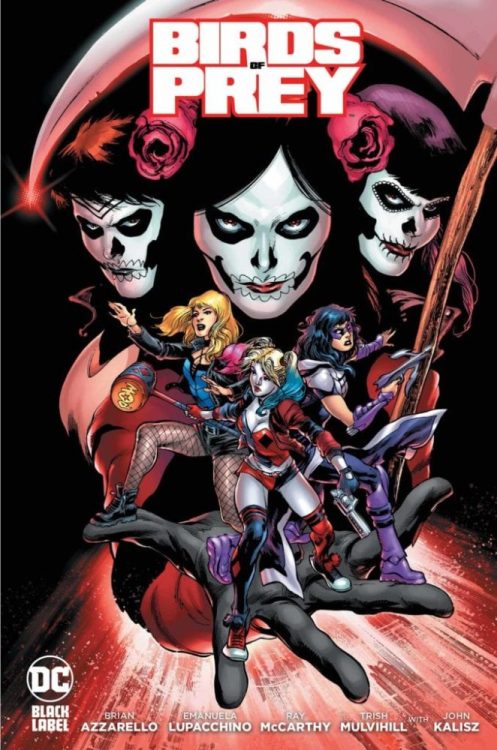
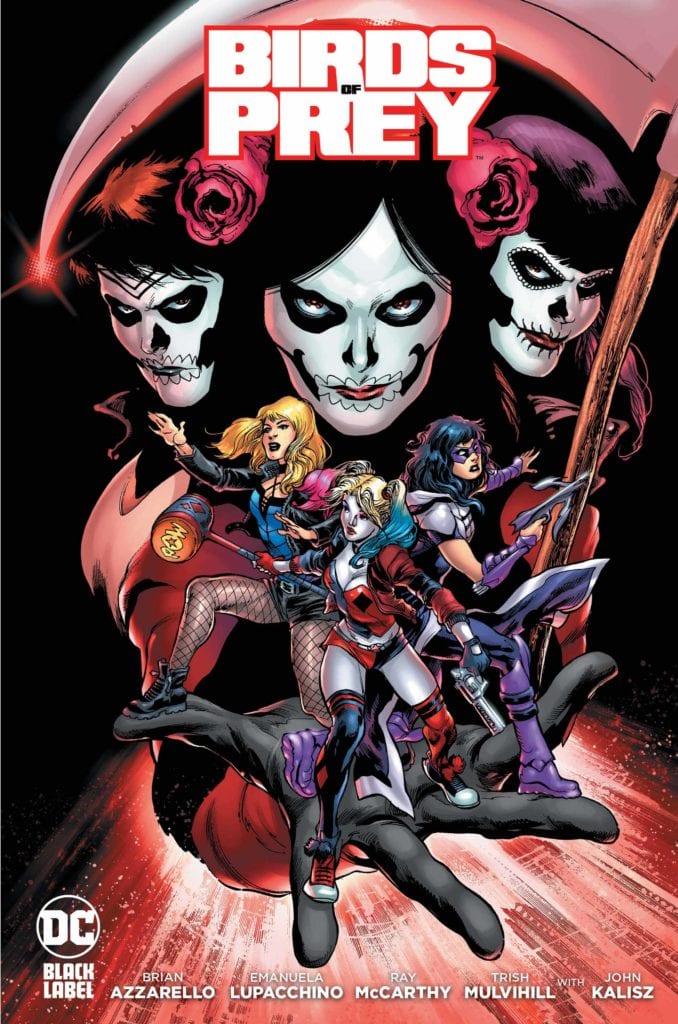
The Birds of Prey have recently stepped back into the spotlight thanks to the movie a few months back. Since then, two titles were announced. One by Amanda Conner and Jimmy Palimot and another by Brian Azzarello and Emanuela Lupacchino. The latter was announced to make a full Birds of Prey series while the former would make a one-shot.. As time went on, the popularity of the female team came and went. DC began to think a whole series wouldn’t be profitable and cut it to a miniseries. More time passed, and soon that miniseries became a one-shot Black Label book. Even after all that, it was pushed back even further due to world events. Now that it’s out, can Azzarello deliver a good story that was cut down twice?

Birds of Prey 1 cover

**Some Spoilers Below**

Story:

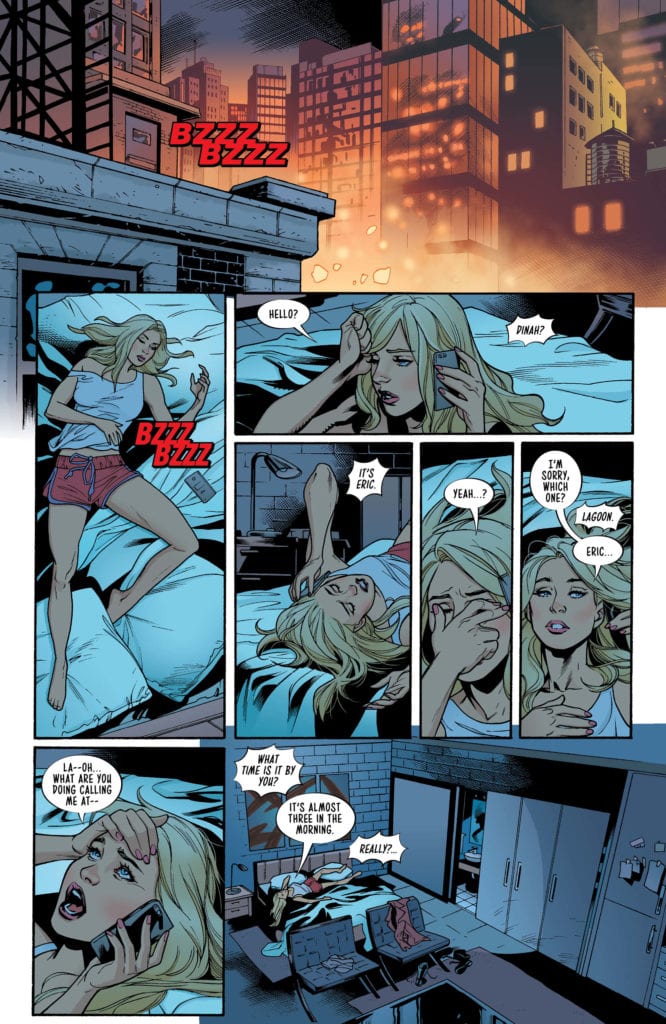
Early one morning, Black Canary gets a call from a man she worked with. He warns her that a new threat is coming before being murdered by a gang. At the same time, Harley Quinn arrives back in Gotham. She has been taken off the Suicide Squad as well as left the Joker. She now seeks a new purpose in life. Finally, we have Renee Montoya meeting up with Huntress to discuss crime. The detective has been sending Huntress down paths that she is not allowed to go on. With all four players in place, the gang begins to descend on Gotham to wreak havoc.

Birds of Prey 1 p1

It’s obvious that this had to be cut down for the one-shot format. The problem is the way it’s cut, it’s done in such a way that the flow is all over the place. It starts slow, doing a good job setting up the characters and their motivations, then proceeds to hop all over the place. We focus on Black Canary, then Harley, then Huntress and round and round. Black Canary doesn’t even meet up with Huntress and Harley till the back half of the book. Then there’s the non-ending which only irritated me. We end on not one but two cliffhangers. Did the Birds escape? Did Harley end up killing the Joker? We don’t know and never will!

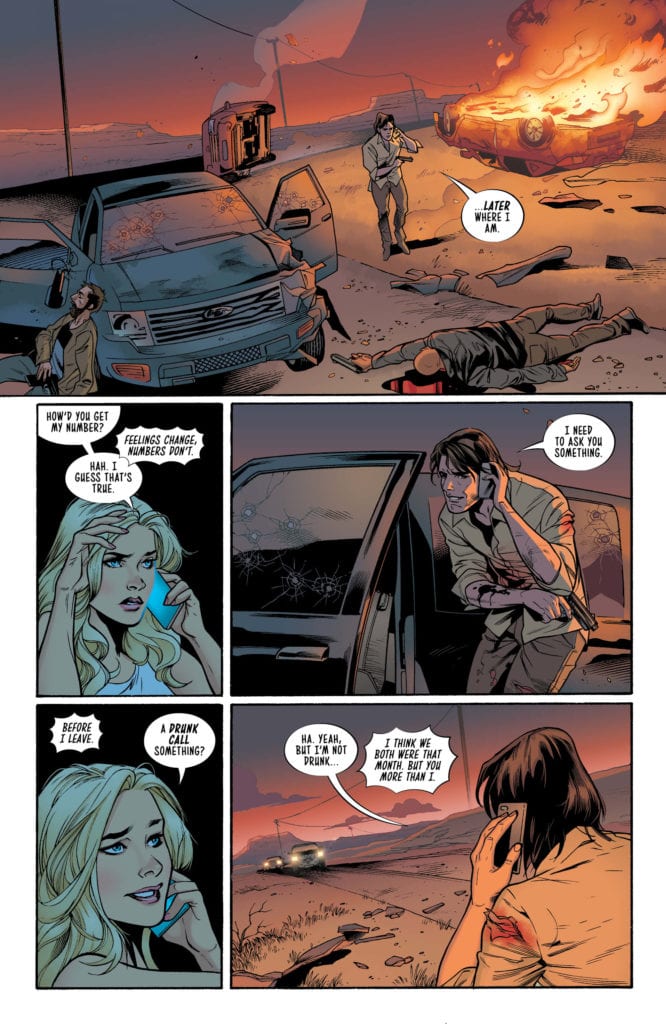
That said, Black Canary appears to have gotten the most attention out of our four members. The man at the beginning had enough connection to send Dinah into a depressive episode. Before she’s even cleared, she loses someone else: Byron from her 2015 Series. These deaths affect her and put her in the game. Black Canary ends up having an actual personal stake and wants vengeance. It fleshes her out a whole lot more than the other members and makes me want to read Dinah’s story more.

Birds of Prey 1 p2

Art:

While I had plenty of issues about the story, I have no problem with the art. Emanuela Lupacchino has done excellent work over the years, and this comic is no exception. All the characters look great, especially the gang that comes into Gotham. They have a Dia de Los Muertos style, and it’s cool. I want to see this gang show up outside the one-shot, but only if she’s illustrating. The colorwork compliments Lupacchino’s art but providing darker, grittier colors for the action but also bright ones to have characters pop. It’s just a fantastic looking book.

Conclusion:

Overall, this issue is a beautiful looking mess. While the artwork is fantastic, the editing to try and cram the whole series into 100 pages brings the entire thing down. Granted, Black Canary’s development in this is the highlight, but the jumping around fails to keep the readers’ attention. The pieces are all there. Anyone can tell that there are great ideas within these pages. There’s just not enough space to save the idea as a one-shot. I hope the team can get a do-over; The Birds of Prey deserve it.

Monkeys Fighting Robots Youtube

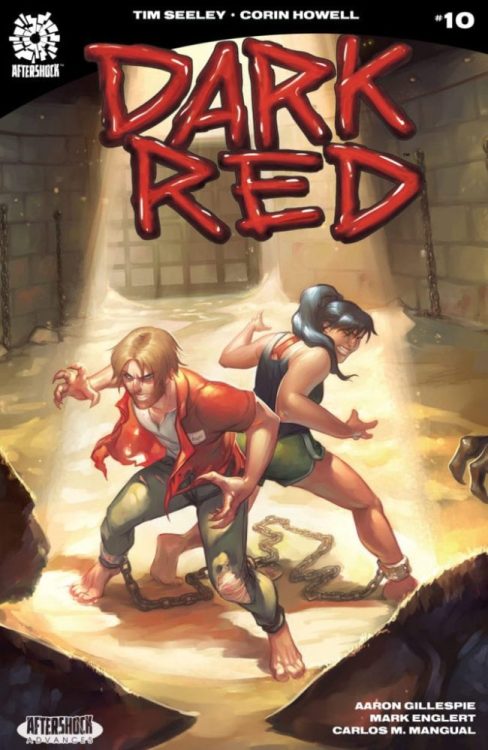
Exclusive AfterShock Preview: DARK RED #10 – It’s Bloodbath

Exclusive AfterShock Preview: DARK RED #10

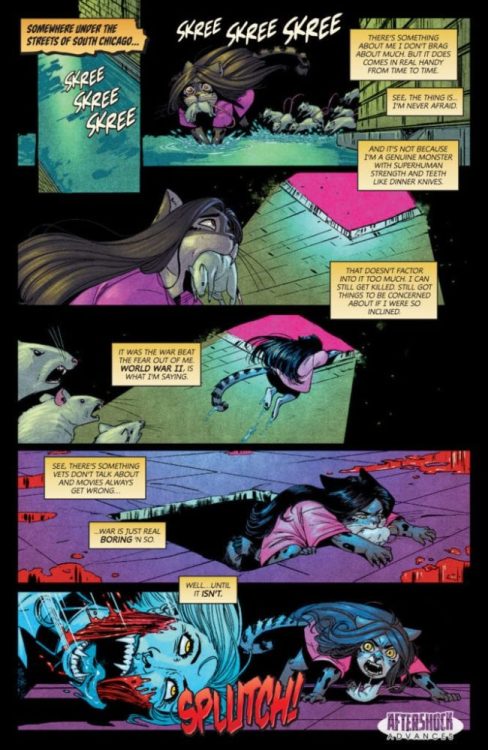
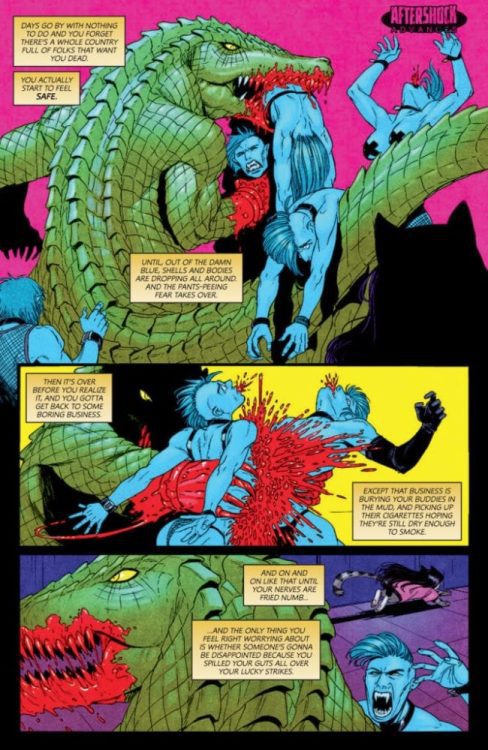
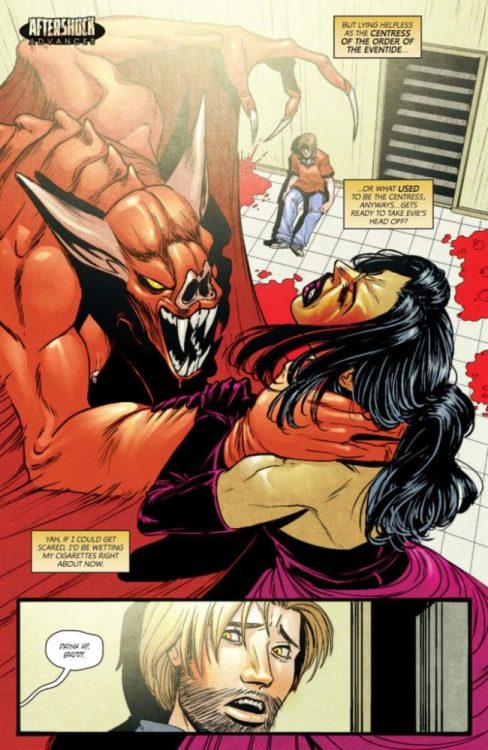
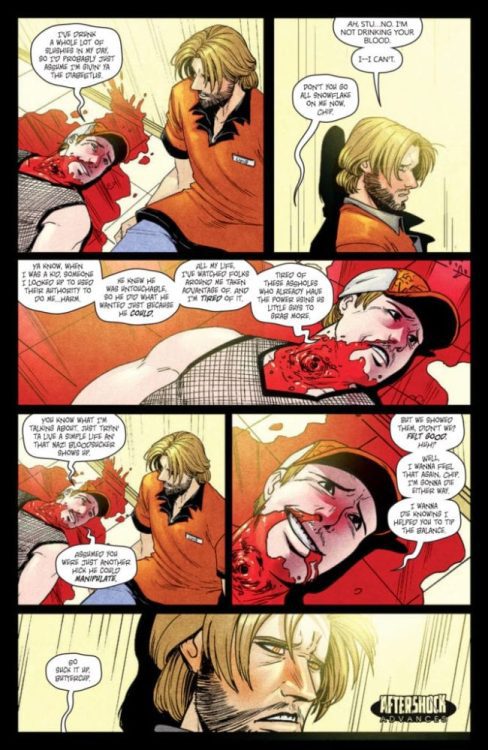
Dark Red #10 hits your local comic book shop on July 1, but thanks to AfterShock Comics, Monkeys Fighting Robots has an exclusive four-page preview of the contemporary and horrifying tale of vampirism in the heart of America.

About the book:
The epic conclusion of the controversial second story arc. Can Chip return to the world he left behind? And if he does, will he have anyone left to return to? The tale of the city, the country — and the monsters in between.


Dark Red #10 is written by Tim Seeley, with art by Corin Howell, Mark Englert dropped some color, you will read Carlos Mangual’s letters, and Meghan Hetrick created the cover.

Check out the DARK RED #10 preview below:

The series uses vampires as a way to talk about the isolation of Middle America and the political divide our nation is facing. You can read Monkeys Fighting Robots’ review of the first issue by clicking here.

Monkeys Fighting Robots Youtube

Get Lost in 70’s Grindhouse-Noir with a BLACKING OUT Playlist

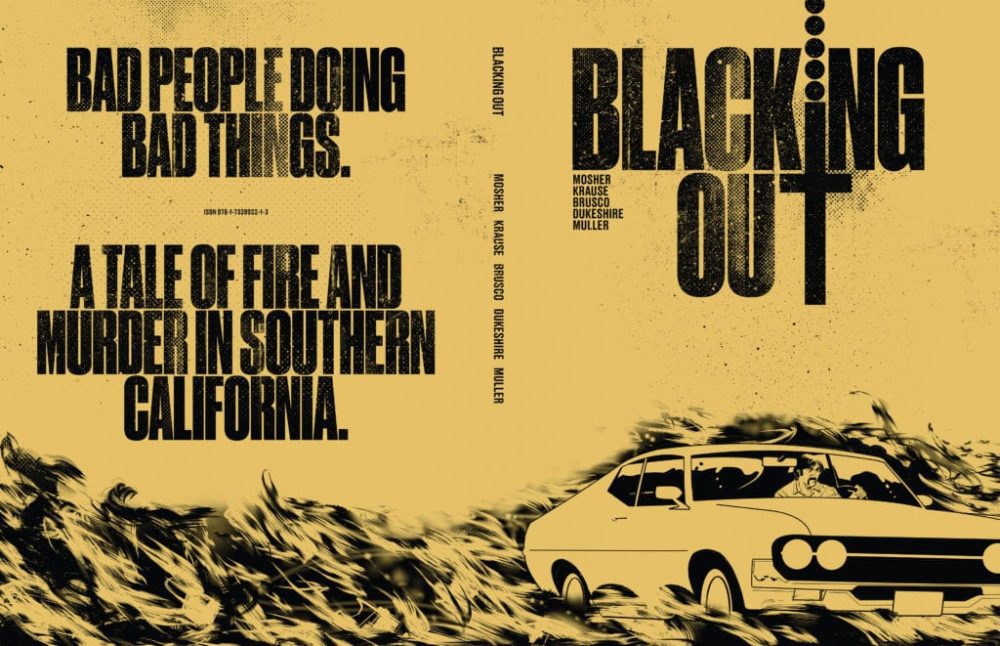
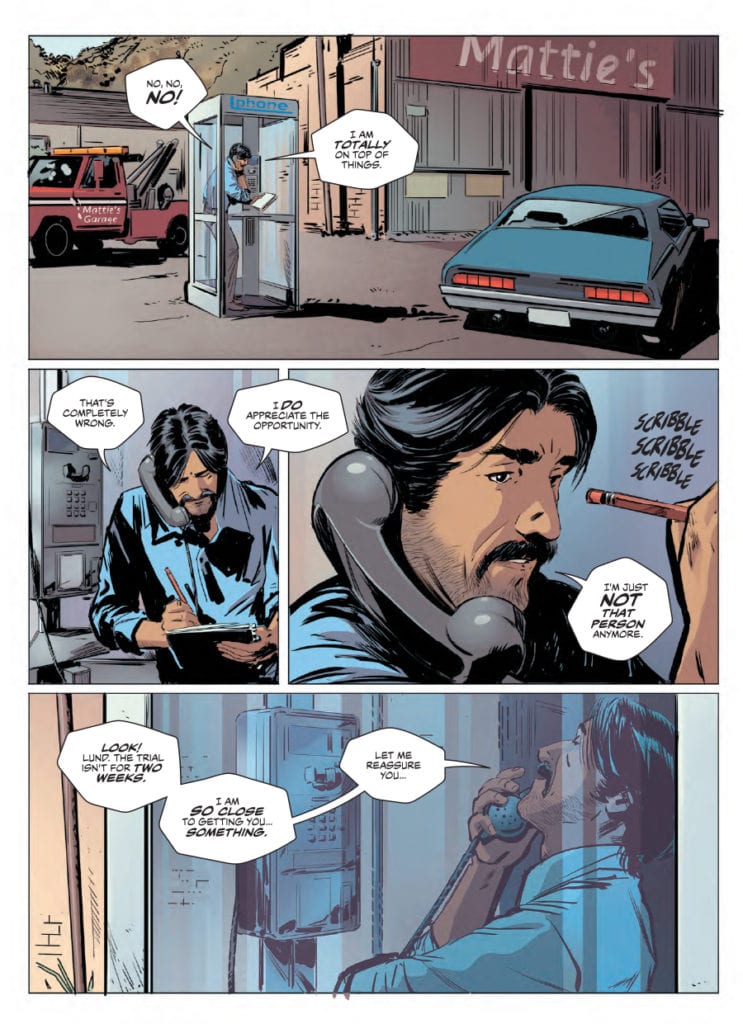
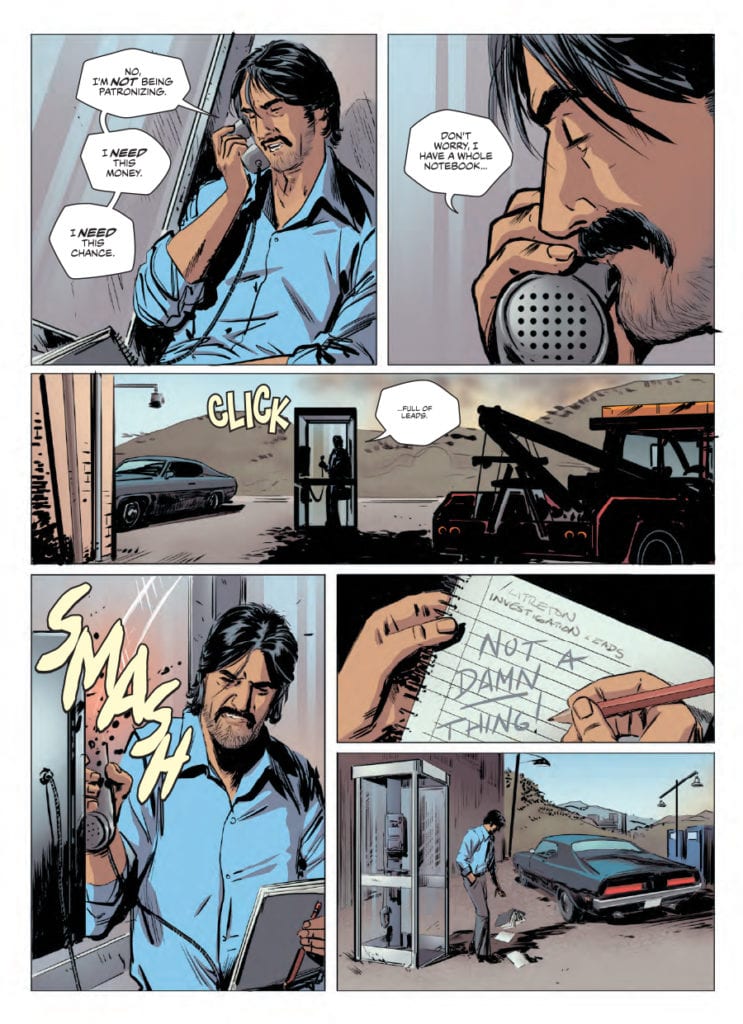
Writer Chip Mosher and artist Peter Krause’s Blacking Out is an original graphic novel available to be backed on Kickstarter, and Mosher came up with a playlist to enhance your reading experience!

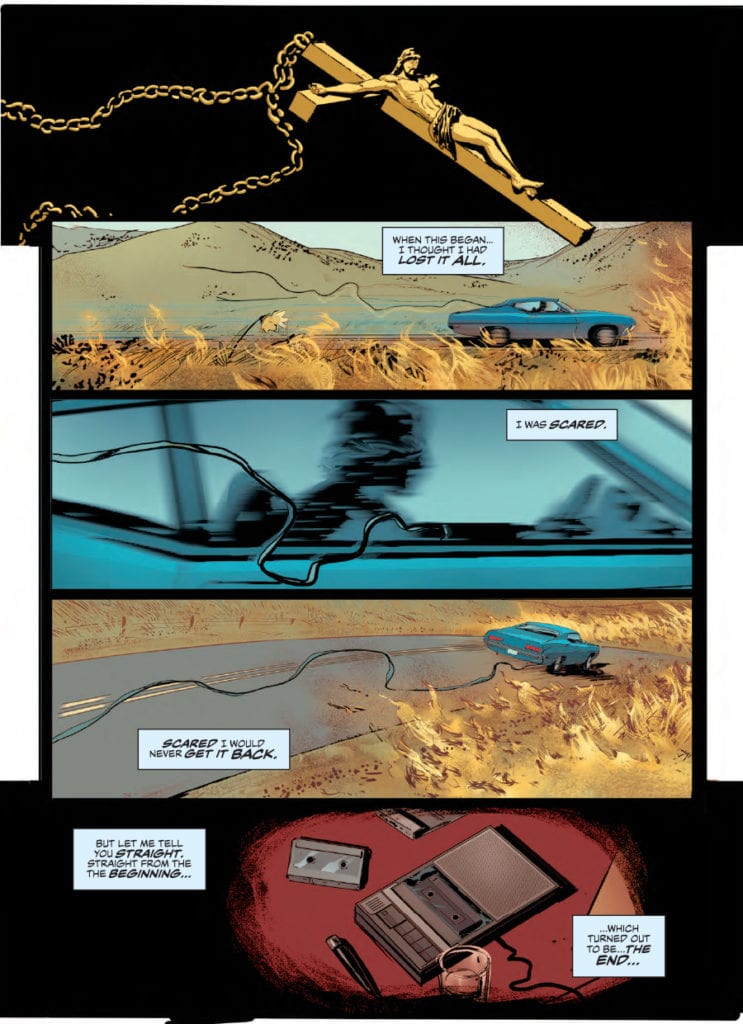
BLACKING OUT follows a drunk ex-cop looking for redemption as he attempts to solve a murder during the Southern California fire season.

Comics industry veteran and writer Chip Mosher and legendary artist Peter Krause (The Power of Shazam!, Irredeemable) present BLACKING OUT, a 56-page graphic novel presented in a deluxe oversized hardcover in the European album tradition. BLACKING OUT also showcases the amazing talents of colorist Giulia Brusco (Scalped, Django Unchained), letterer Ed Dukeshire (Buffy the Vampire Slayer, Mighty Morphin Power Rangers), and designer Tom Muller (X-Men).

Blacking Out is as dark as the smoky California skies that fill its pages. And like smoke, this noir clings to you. Redemptive, surprising, & bleak.” – Brian Azzarello (100 Bullets, Moonshine)

This graphic novel was crafted with music in mind, so Mosher put together an awesome playlist full of classic rock, jazz, and soul tracks to pull you into the pages. Here he lists out and explains his thoughts on each track:

It’s funny. When I wrote Blacking Out, I listened, almost exclusively to Interpol’s Antics on repeat. I’d start with track four or five, “Take Me On A Cruise” or “Slow Hands,” and then put the album on repeat. Antics has a real trance-like effect on me and it offered Neo-noir white noise that let me enter the world of Blacking Out.

But when I was thinking about a soundtrack for the comic, none of those songs seemed right. With what Pete did with the visuals, grounding the story in a ‘70s aesthetic, it was important to find stuff from that era, but that didn’t sound like it. I wanted to find obscure tracks that felt out of time and remained timeless.

“Maggie M’Gill,” The Doors
I love the opening bass on this track. The Doors recorded this song in an empty club right before they did a live show. Maggie M’Gill was one of their lesser tracks, but I think this bassy and jazz’ed up version elevates the song to the level it should be sonically and really sets the mood…it’s dirty. It’s a song that’s drunk on itself.

“Ladytron,” Roxy Music
I feel like when you hear this song from Roxy Music’s debut album, it’s like entering another world. It doesn’t feel like 1972, but also doesn’t feel like the musical future it predicts. It’s kind of the sonic equivalent of the 1939’s World’s Fair futuristic cars… I think of this as the song that Conrad is hearing when he enters the bar to get his swerve on.

“Coming Down Again,” The Rolling Stones
Great song off of a masterful Stones album. I was told by a friend who’s a Stones aficionado that Keith Richards doesn’t even remember recording this album. Think about this backing Conrad as he wakes up at Anita’s.

“I Got Nothin’,” Iggy Pop and James Williamson
Feels like Conrad’s theme song as he starts to investigate the case. Great song from the mid-‘70s that was frequently bootlegged, but not officially released until decades later.

“Sunshine of Your Love,” Ella Fitzgerald
I was at this Northern Soul club in Leeds with the Thought Bubble crew when this track hit the air. Holy shit. I love this song and this version by Ella Fitzgerald is amazing. It had to go in the Blacking Out playlist.

“The Seeker,” The Who
A bit on the nose regarding Conrad, but hey, sometimes you want a song that really tells you what the hell is going on…

As I ransack their homes
They want to shake my hand
Focused in on nowhere
Investigating miles
I’m a Seeker, I’m a really desperate man!

“A White Shade of Pale,” King Curtis
Another song that feels out of place in its era. King Curtis’s sax covers of any song are worth a listen, but I love this one and think it would be great background music on any scene.

“Kill City,” Iggy Pop and James Williamson
Another great post-Stooges composition by Iggy and James Williamson. Says it all. Feels like it could have come out last year—love the noir feel of this song. Conrad, Anita, Mattie, and Lund definitely live in Kill City.

“If There Is Something,” Roxy Music
I’m a huge Sisters of Mercy fan and their song “Some Kind of Stranger” is my favorite. I was struck when I heard this track about how much of the main melody of “Some Kind of Stranger” is taken from this Roxy Music track. In any case, as it pertains to Blacking Out, I think this song would be great on some of the later scenes with him and Anita. Maybe when they take the walk and talk…

“Achilles Last Stand,” Led Zeppelin
An unappreciated gem by Page, Plant, Jones, and Bonham. We’re ramping up here, getting ready to experience the big finale.

“In Every Dream A Heartache, Roxy Music
(Laughs) I’m not going to say much about these next three songs as anything I say would give it away… but …oh shit. It’s coming. Watch Out.

“Winter,” The Rolling Stones
Maybe some regrets. SPOILERS! We are going into the Wilderness here….

“Jump Into the Fire,” Harry Nilsson
Maybe… the end? Read and find out folks! (Tuning the bass mid-song is amazing.)

“Ghost Rider,” Suicide
This plays over the credits. The greatest song about a comic book character ever written. 1977. Can you believe it? Sounds amazing. It had to go over the credits. And fits a bit, but had to throw this in for fun. The Sisters of Mercy used to cover this track live… Yeah, I know. I love that stupid band. Shut up.

Listen to the playlist on Spotify here:

If this playlist hits your musical sweet spot and the preview piques your interest, be sure to back the Kickstarter here for your own copy of the oversize hardcover and extra perks like art cards and more!

Monkeys Fighting Robots Youtube

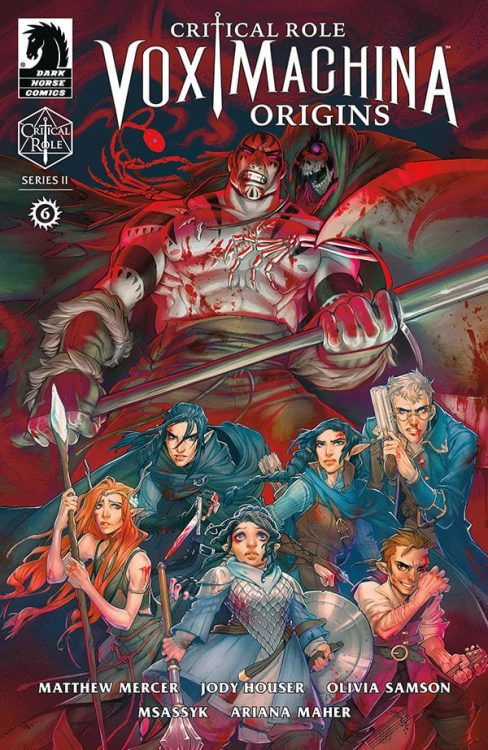
Review: CRITICAL ROLE: VOX MACHINA ORIGINS II #6 — The Exorcism Of Grog

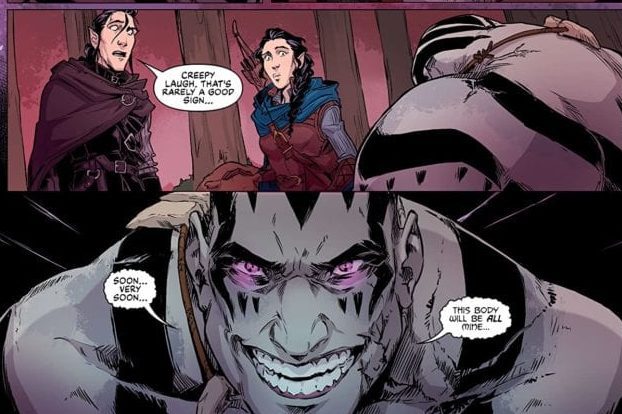
Vox Machina has finally found the necessary ingredients for a mystical exorcism that will save their beloved Grog. CRITICAL ROLE: VOX MACHINA ORIGINS II #6, available in comic book stores on Wednesday, June 3rd, concludes Volume II. Readers will be happy to find this issue brings Team Nightmare and Team Nymph Heart together in the chambers of the Realmseer, one of the most accomplished users of the arcane. But with the evil spirit inhabiting Grog making more frequent appearances, this adventure’s conclusion will be a real nail-biter.

Story

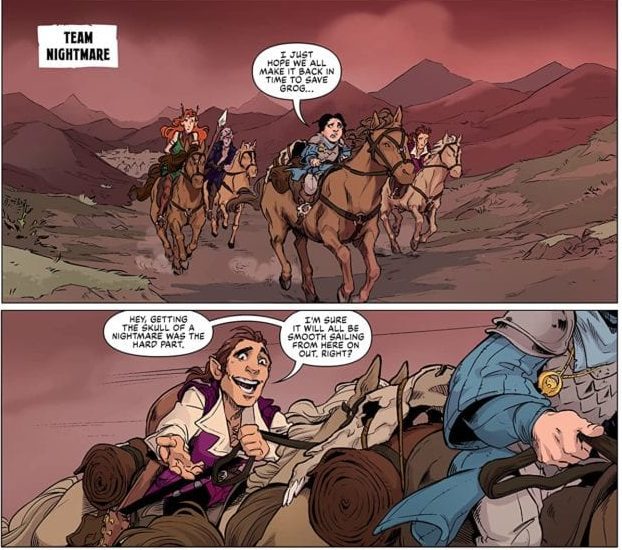
The race to save Grog is at its most crucial moment as our heroes travel to the Realmseer’s study for the ceremony. The ever deepening scar on Grog’s chest spurs the group to quicker action before his body is entirely controlled by Drath.

The heroes eventually arrive at the arcane master’s chambers and commence with the ritual. But the process isn’t as straightforward as one would have hoped. Drath fights back against the magic in brutal fashion, vowing to murder the lot of them.

Jody Houser’s script encapsulates everything readers love about Critical Role and the Vox Machina party. We’re enthralled by this band of heroes who offer quirky looks at their life despite the sobering conditions surround them. The strength of their personalities is only matched by the action-packed sequences.

Artwork

Olivia Samson’s penciling and ink work, Msassyk’s coloring, and Ariana Maher’s lettering offered the perfect tapestry for this issue. Readers get clear depictions of desperation on each hero’s face as they race across the sprawling landscapes, filled with greens, browns, and other earthy hues. We feel as if we’re inhabitants of this world and a part of the story. And the font styling adds to the high intensity of the situation, employing large and small sizing when applicable.

Conclusion

Dark Horse’s CRITICAL ROLE: VOX MACHINA ORIGINS II #6 is exactly the conclusion we were waiting for. We find an ending that closes one door and opens a dozen more.

Were you satisfied with the conclusion of Grog’s arc? Let us know in the comments below!

Monkeys Fighting Robots Youtube

How ALIENS: THE ORIGINAL COMICS SERIES Takes Advantage of Its Lack of Color

Aliens: The Original Comics Series 30th Anniversary Cover

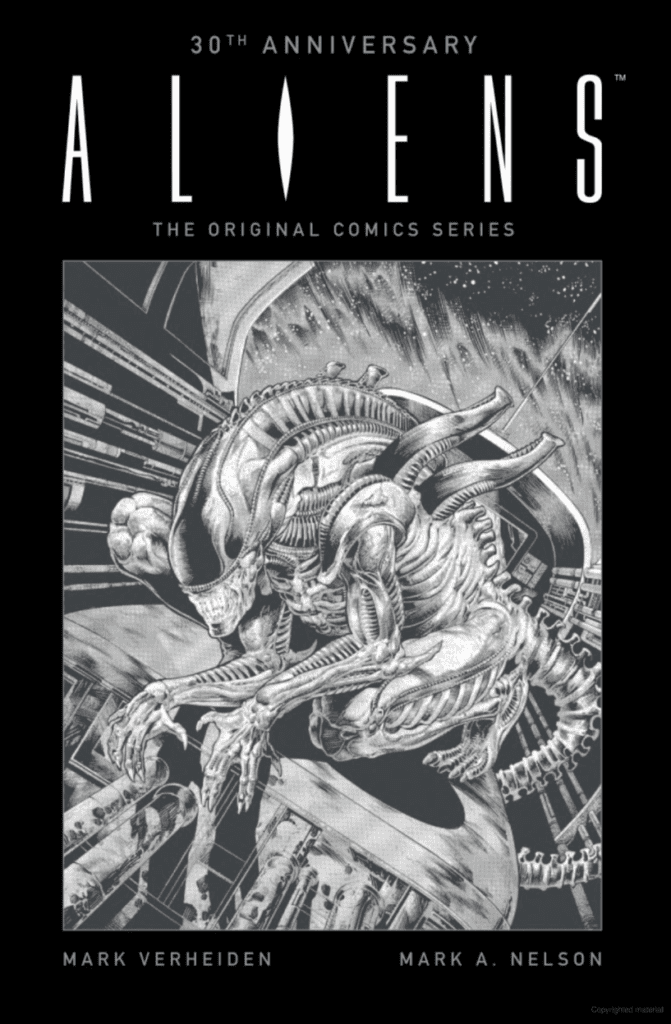
Most modern comic books make use of a colorist who plays a very significant role in the final art that a reader will see. However, Aliens: The Original Comics Series from Dark Horse Comics is composed entirely of black-and-white images, and uses this to its advantage.

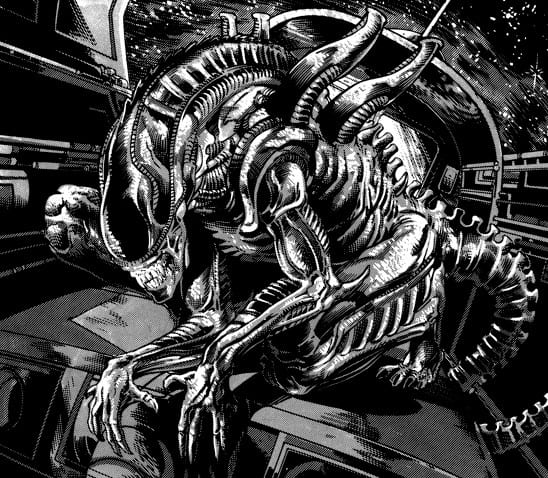
Aliens: The Original Comics Series was published in 1988 and 1989, and tells the story of the characters Newt and Higgs from the movies Alien and Aliens. The series was written by Mark Verheiden and illustrated by Mark A. Nelson. Nelson specialized in black-and-white art done using the now mostly unused Duoshade process. The process involved painting a chemical onto a specially treated paper, and allowed Nelson to create stunning and incredibly detailed illustrations. While other comic books rely heavily on the colorist to create an atmosphere in his or her stories, the black-and-white art of Aliens works heavily to its advantage.

Xenomorph from Aliens: The Original Comics Series

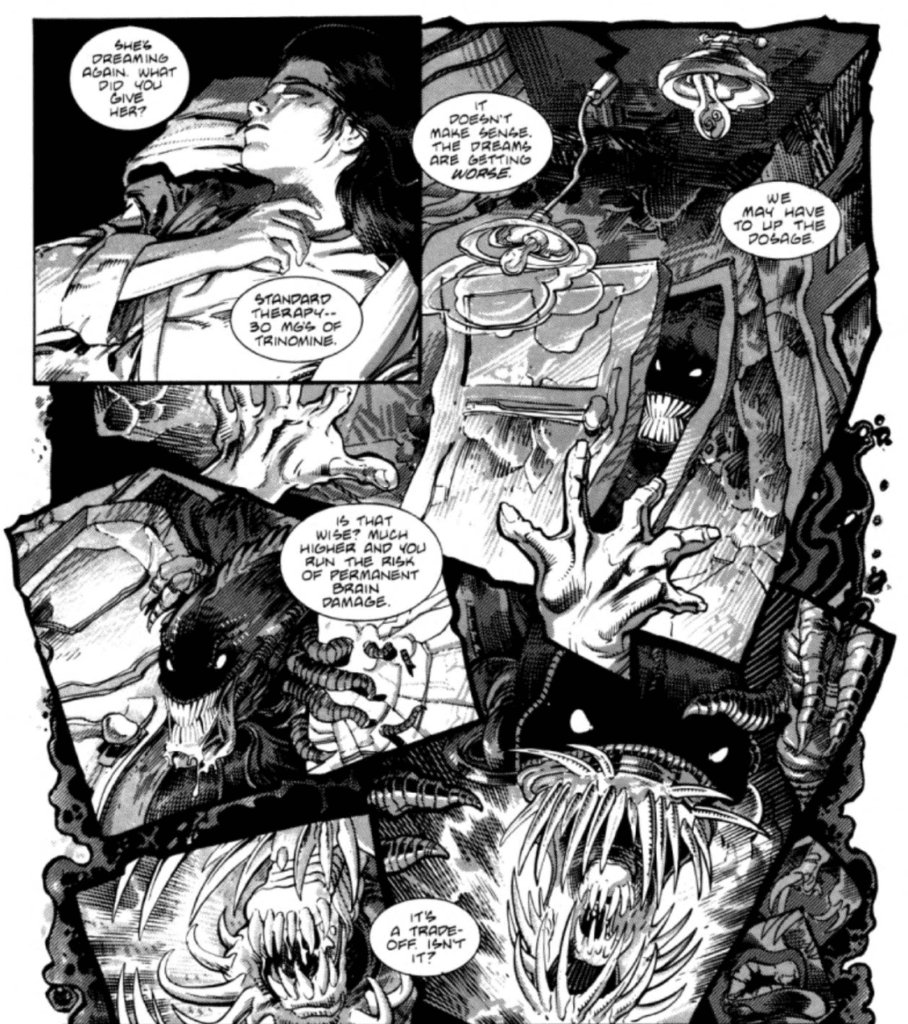
The most effective way that the colorless art helps Aliens: The Original Comics Series is through establishing tone and atmosphere. From very early in the series, it is clear that Verheiden intended the story to focus on the horror aspect of the franchise. By having a black and white color palette, the story is given new depth and allows for tones of fear and suspense to be prevalent throughout the series. For example, Newt experiences several nightmares in the beginning of the series that depict the Xenomorphs, or dream interpretations of the creatures. Due to the Duoshade process and how it allows for incredible detail using black, these dream sequences are drawn beautifully in heavy shadow, helping to make clear the terror that Newt is experiencing.

Newt's dream, showing an nightmare warped xenomorph and heavy shadows

The black-and-white color palette also assists in developing suspense in areas veiled in shadow, such as those in Newt’s dreams. Not only are many people afraid of the dark, but areas such as this leave the reader in suspense of what horrific beings could be lurking in the shadows.

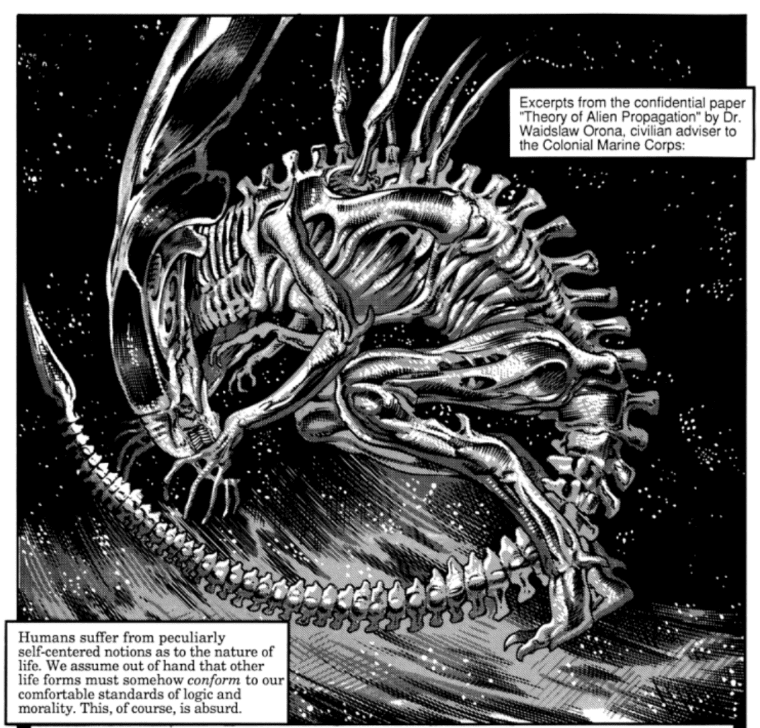
Perhaps the most important way that the black-and-white aesthetic serves Aliens: The Original Comics Series is through illustrations of the Xenomorphs themselves. As the title characters, it is essential that the Xenomorphs are drawn well, and through the Duoshade process, Nelson can bring the horrifying characters onto the page to life. Since the Xenomorphs in the movies are completely black, nothing is lost in the transition to the page. Also, since the Xenomorphs are black and the humans are illustrated with white and gray tones, they act as a foil of one another. The Xenomorphs represent evil, and humans represent the good. Although humans as good does not hold true for many of the characters in the series, this contrast between the Xenomorphs and the humans is an effective technique that would be impossible if the illustrator had chosen to portray the story in full color.

Xenomorph drawing in Aliens: The Original Comics Series

In all, Aliens: The Original Comics Series is an amazing read, telling the stories of Newt and Higgs after the events of the second Alien movie. While this story may have been removed from the official canon after the release of Alien³, it is worth a read by anyone who is a fan of the Alien franchise. Some may believe that color inherently makes a comic book better, but Aliens: The Original Comics Series quickly dismisses that claim.


Are there other black-and-white comic books that you are a fan of? Let me know in the comments below!

Monkeys Fighting Robots Youtube

Box Office Flashback: June – False Memories, Perfect Storms, And Living Toys

Summer for the movie season works like this: It heats up in May, gets broiling hot in June and July then starts to cool off only slightly in August before dropping off dramatically for the September cool down. Here we are in June, and 30 years of cinematic history reveals just how hot the silver screen gets this time of year.

One-hundred-plus years of filmmaking provides a long, rich, and deep history to look back on. Retro reviews and analysis of old films are practically necessary full-time specialties. Month after month, films release, vying to make as much money and grab as much attention as possible. Some rise, some fall, but regardless of financial success, the lasting effect of a film in popular culture is unpredictable.

So, where does that leave previous box office champs? Let’s take a look back ten, twenty, and thirty years ago at the box office hits released in June.

1990 • Total Recall • 119.3 million

totalrecall-arnoldschwarzenegger-film

The movie screen was a busy place in the summer of 1990. Taking the top spot at the box office was Total Recall starring none other than Arnold Schwarzenegger. The former Hercules in New York star was one movie away from reaching peak Arnold with Terminator 2: Judgement Day. Total Recall, based on the Philip K. Dick story “We Can Remember It for You Wholesale,” was a crossroads of talent at its finest. Co-stars of the film included Ronny Cox (RoboCop), Michael Ironside (The Perfect Storm), and Sharon Stone (Basic Instinct). Behind the camera was Paul Verhoeven, who was riding high off of RoboCop and was still years away from creating the timeless classic Starship Troopers.

It’s hard to write about 1990 and keep it short. Coming in second to Total Recall was Dick Tracy, the super-stylized comic strip turned film with a cavalcade of stars including Al Pacino (The Godfather), Dustin Hoffman (Hook), and Madonna (A League of Their Own). Tom Cruise-d into third with Top Gun on the ground Days of Thunder from director Tony Scott (True Romance). Eddie Murphy scored another hit with the sequel to 48 Hours, Another 48 Hours. RoboCop 2 from director Irvin Kirshner (Empire Strikes Back) came in last with 45 million, a marked decline from the previous film.

2000 • The Perfect Storm • 182.6 million

perfectstorm-georgeclooney-film

The year 2000 marked a peculiar June for the box office. Where 1990 cranked out a lot of pop culture gems still referenced to this day, ten years later, and the winner of June was The Perfect Storm starring George Clooney. It follows the crew of a commercial fishing vessel, directed by Wolfgang Petersen (Das Boot, NeverEnding Story) and based on the non-fiction book by Sebastian Junger. Called the Andrea Gail, the boat never returned after being caught in a weather phenomenon referred to as the “perfect storm” of 1991. Along for the ride with Clooney was Mark Wahlberg (The Happening), John C. Reilly (Step Brothers), and Michael Ironside (Total Recall).

The Perfect Storm is a fine film if a little lost to memory in the minds of most cinephiles. Following it at the box office is the mostly panned Big Momma’s House starring Martin Lawrence. The Patriot with Mel Gibson made 113 million closely followed by the animated Chicken Run. Gone in 60 Seconds with Nicholas Cage and Angelina Jolie rounds out the top five. June 2000 featured a tight numbers two through five, as an average of only four million dollars separated the four films.

2010 • Toy Story 3 • 415 million

toystory-pixar-box office

June 2000 was a little strange. But June 2010 was back to things as usual with a handful of big hits still resonating today. Taking the top spot is Toy Story 3 from Pixar, which delivered yet another fantastic story paired with stunning computer-generated visuals. New characters such as Jessie and Lots were born thanks in part to the wonderful vocal talents of Joan Cusack (Working Girl) and Ned Beatty (Rango).

Caption the number two spot is the third installment of The Twilight Saga, Eclipse. Kristen Stewart and Robert Pattison return for the vampire-werewolf-human love triangle. The reboot of The Karate Kid starring Jaden Smith (After Earth) and Jackie Chan (Rush Hour) beat Adam Sandler’s “comedy” Grown Ups for third place. Landing in the final spot is The A-Team starring Bradley Cooper about America’s favorite band of ex-soldiers on the run helping those in need.

June 2020 & Predictions

The box office is at a standstill now. Indie film The Wretched won the box office for several weeks. Christopher Nolan’s Tenet will likely be the next big film release, but as the pandemic continues, we’ve got new problems here in the United States to contend with too. So, who knows?! However, for those who are safe, healthy, and able, there’s plenty of content to consume on your favorite video viewing device through streaming channels across the interwebs.

Read more from writer Ruben R. Diaz!

Don’t go, there’s so much more on PopAxiom!

Monkeys Fighting Robots Youtube

How HAWKEYE VOL. 1 Bridges the Gap in Storytelling

Clint Barton is here to save the day - and create a bit more chaos.

HAWKEYE VOL. 1: MY LIFE AS A WEAPON originally released back in March of 2013. Yet it’s still a comic stuck in the minds (and hearts) of many. Myself included. It simultaneously was and was not like many other comics I’ve read.

Clint Barton is here to save the day – and create a bit more chaos.

Hawkeye is not a series afraid of humor. In fact, Hawkeye rather shines in that element. So it’s really no surprise that his entire series launches on a moment of tension and surprising humor. “Okay–This looks bad…”

Yet that isn’t the reason this series carried so much import and impact. Clint Barton is a superhero. He’s one of the Avengers for crying out loud. Yet he’s human. Very, very human. He has no powers to speak of. He’s flawed. He makes mistakes (sometimes a lot of them).

He’s also deaf. Now, this is an element that could easily have been thrown into the mix and then mostly left alone. But that is not what Hawkeye: Vol. 1: My Life As A Weapon did. No, it embraced everything about his deafness, from Clint learning ASL and lipreading to every other little detail you might think of.

It’s the first time I can recall seeing a hero that was anything truly outside of the ‘standard hero mold,’ so to speak. It was a moment, or series of moments, so flawlessly woven into the narrative. There was no major deal made about Clint’s deafness. He merely was. It was part of him.

Okay — This looks bad.

Since then, I’ve seen many heroes who deviated from that ‘standard hero mold.’ It’s been beautiful to see it happen. To see new heroes pop out, with new styles and new messages. Yet Clint Barton will always hold a special place in my heart, for being so perfectly who he is. No shame, no regrets. Just a man trying to save the day.

More to the point though, Hawkeye Vol. 1 (as well as the rest of the series) brought about one of my favorite variations of Hawkeye. A version I desperately keep hoping to see in the MCU, be it in the movies or his Disney+ series. Realistically, there are many fans out there rooting for this very thing as well.

Got yourself pretty banged up.

Hawkeye Vol. 1: My Life As A Weapon had a pretty stellar team behind the scenes. Maybe that was why it carried with it so much confidence. Matt Fraction was the writer for the project, with artists such as David Aja, Javier Pulido, Matt Hollingsworth, Annie Wu, Alan Davis, Francesco Francavilla, and Chris Eliopoulos all working alongside him.

Together they created something unique, and dare I say, fun. One of the best things about Clint Barton is that, as I’ve stated above; he’s human. He’s free to make mistakes. Sometimes major ones. He’s also perfectly capable of getting himself in messes that are way over his head – and yet somehow surviving it all.

Despite all of that and all of the other crap that life tends to dump on him, Clint has a fairly healthy outlook on life. Sure, he gets down sometimes (who doesn’t?). But he always gets back up. Best of all, he’ll almost always have a line or two to make his readers smile. Sometimes that alone can mean the world.

Nothing quite like causing traffic and destroying property to relieve your anger.

Hawkeye Vol. 1: My Life As A Weapon has one more reason for me to hold it near and dear to my heart. Kate Bishop. That amazing, sassy, and snarky girl. I adore her and everything about her. Including (especially) all of the ways in which she calls Clint out. Her inclusion in this series was absolute perfection, at least partially due to the important conversation(s) it started.

The fact that she’s able to keep up with Barton’s messed, and save the day a time or two herself is certainly another highlight of the volume. As is her constant snark and sass – she’s more like Barton than either of them realize.


All of these elements, and more, are the reason why Hawkeye Vol. 1: My Life As A Weapon will always be one of my top favorites. It’s a series I fall back into reading whenever I need a laugh or a bit of encouragement. Okay, sometimes I read it as a reminder that things can always be worse; after all, just look at the messes Barton gets into.

Monkeys Fighting Robots Youtube

A Chilling Beginning in THE RED MOTHER VOLUME 1

Daisy's life is about to be forever changed in The Red Mother Volume 1.

THE RED MOTHER VOLUME 1, available now from Boom! Studios is the beginning of a haunting and alarming tale. This is a brutal telling like no other, bringing the innocent to the forefront in hopes of solving their own mysteries.

Daisy’s life is about to be forever changed in The Red Mother Volume 1.

***SPOILER WARNING***

The Red Mother Volume 1 is arguably one of the most haunting and disturbing introductions around. This is a series intent to leave the readers with nightmares, courtesy of the graphic nature, and even more alarming implications.

Daisy was just a normal woman. She had her everyday concerns, but she had enough money to help her get through most of that. That is, until the day she was attacked. The day she lost her eye and her boyfriend.

Now she’s left with a mystery on her hands. A mystery that nobody else seems willing to acknowledge exists. After all, that would just make her life and the following horrors to easy to bear.

One note before we dive into the review; The Red Mother Volume 1 has several graphic elements, one of which revolves heavily around the loss of an eye. If this is the sort of thing that makes you squeamish, you should look away now.

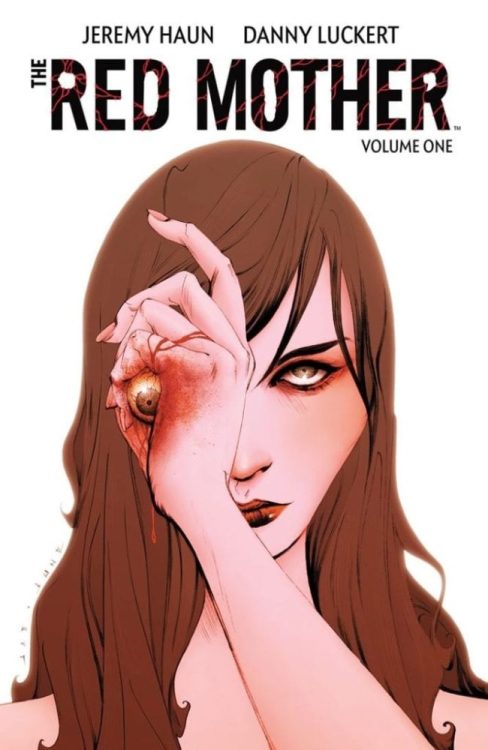
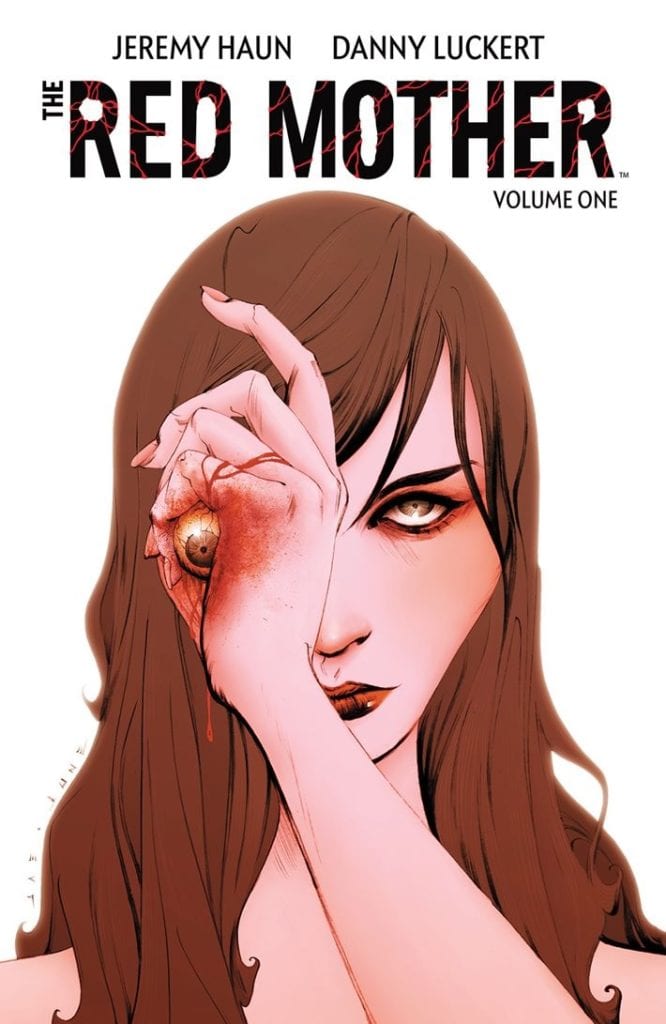
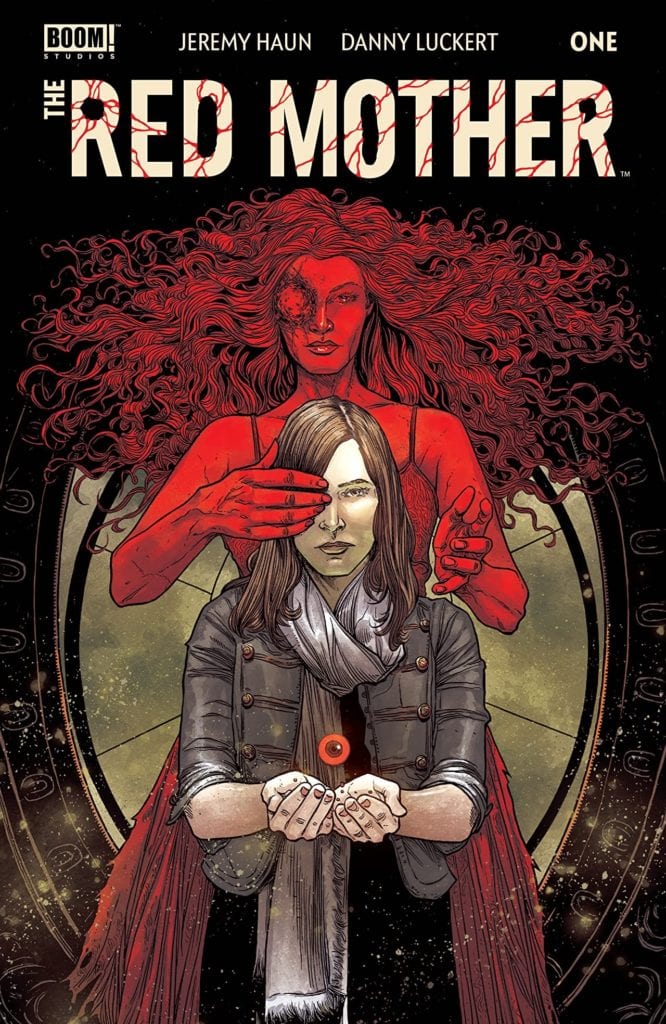
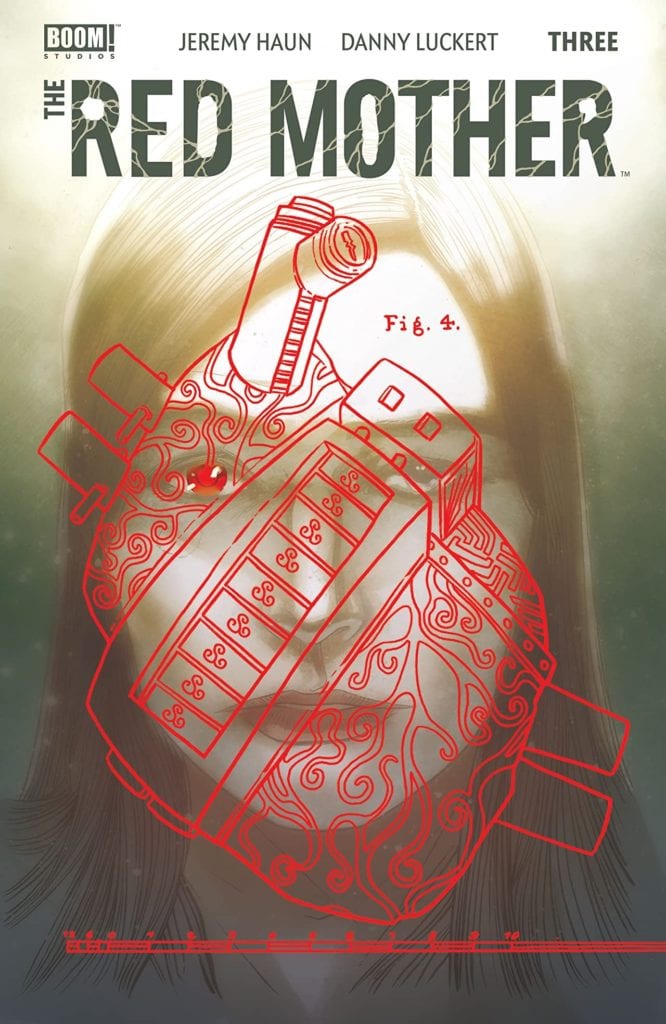
Daisy and The Red Mother are featured on this hauntingly beautiful cover.

The Writing

Jeremy Haun is the mind behind The Red Mother Volume 1, so if you wake up with terrors in the middle of the night, just go ahead and blame him for all of that. This series is already proving to be every bit as disturbing and graphic as promised.

There are a lot of ways to tell a horror story. But one of the most terrifying things a writer can do is make you fear the normal. By putting his horrors in plain sight, Jeremy Haun has given Daisy, and thus the readers, real reason to be terrified.

Blended with the horror of the unknown, and this tale gets fairly dark. Mercifully, it is balanced out with a healthy dose of intrigue. There are puzzles within this tale, and Daisy seems determined to solve them for us.

All of these elements work together to create something shockingly gripping and haunting. It’s safe to say that this is a tale you’re not going to want to look away from.

A monster in the darkness?

The Art

Where the writing of The Red Mother Volume 1 is haunting, the artwork is outright terrifying. The artists behind this project were not afraid to go graphic when needed. Likewise, they knew how to use the horror of their surroundings to excellent use.

Danny Luckert (artist) and Ed Dukeshire (letterer) worked well together here. They created something vibrant and alarming all in once. The covers are an absolute highlight, to be sure. They’re eye-catching, demanding that the readers pick up an issue and read more.

The artwork within the pages balances on a very fine line. There are lush details and color palettes, all of which can switch at a moment’s notice. There’s the normal, and then there’s the terrifying. At any given moment you can never quite know what to expect.

The mystery of a puzzle that has been dropped in one’s lap.

In Conclusion

The Red Mother Volume 1 is an intense and intriguing start to an all-new horror series. This is admittedly a series that can get graphic at times, and yet it still appreciates the subtle elements that can come with horror. The combination is where this series shines and will prove to be memorable.

Monkeys Fighting Robots Youtube