Home Blog Page 232

INTERVIEW: Dancer Turned Actor Aaron Dalla Villa Cracks Jokes In IMMORTAL

Immortal is a horror anthology film with four chapters featuring an all-star cast, including Tony Todd (Candyman), Dylan Baker (Hunters), Samm Levine (Inglourious Basterds), Mario Van Peebles (New Jack City), and Aaron Della Villa as a wise-cracking teenager.

The chapters of Immortal connect through the very title of the film. Life, death, and immortality are themes explored in each of the movies. Aaron plays Kyle in the opening chapter called “Chelsea” about a high school track star confessing to sexual misconduct with her coach. But Chelsea’s (Lindsay Mushett) admission may be too late.

PopAxiom spoke with Aaron Della Villa about going from dancing to acting, boy bands, and learning from those around you.

Tell A Story

Born in Suffolk, Virginia, Aaron was a “dancer before an actor.” He studied music and dance training at the prestigious Governor’s School for the Arts in Norfolk, Virginia, in classical ballet and classical modern dance. “I looked up to Mikhail Baryshnikov, Vaslav Nijinsky, and Roberto Bolle. I wanted to be the best dancer.”

However, an injury derailed those plans. “I had a severe case of shin splints. But that didn’t lead to acting. It was a stupid sprained ankle when I hopped a turnstile in Chicago.”

“I had a contract on the table to dance with a contemporary company in Chicago, which is no longer in existence,” Aaron explains. “I got that opportunity after I sprained my ankle.”

He recalls, “I was thinking, ‘What am I going to do with my life?’ So, I hopped on Craig’s List. I joined this dinner theater show that lead to me getting an agent, which lead to my first commercial, which lead to a manager from New York and me moving out to NYC.”

Was Aaron determined to stay in a profession centered around performance and entertainment? “100%! I thought, ‘I can’t just sit here waiting to recover; I got to make something happen. So, I said, F it, I’ll act!'”

“When one door closes,” Aaron makes clear his sense of determination, “I’m going to find a different door. And if that door closes, I’m going to break the door down.”

About the jump from dancing to acting, Aaron says, “Dancing is acting. At its highest form, it’s storytelling through movement. The ability to tell a story without any dialogue.”

immortal-film-horror-aaron dalla villa

About Immortal

Getting a showbiz gig comes about in a variety of ways. But Aaron says the way Immortal came about is the most common in his experience. “It was a personal connection. I auditioned for director Rob Margolies’ other feature film, Yes, and they ended up going with a bigger name for the role. But Rob said, ‘We loved your audition, and we want to offer you this other part of Kyle in Immortal.'”

The next step was reading the script, which Aaron did, and he “thought it was so much fun. I get to work with Rob and Dylan Baker, so I said ‘Absolutely!'”

Kyle is one of those short but sweet roles. It’s not a huge amount of screen time, but it leaves a lasting impression. “Rob told me that Kyle’s a class clown, a lot of energy, and a hilarious guy. So, it wasn’t that hard,” Aaron let out one of those kinds of laughs that you can’t help but laugh too. “I know how to be that guy. And I didn’t have to lose 30 pounds and live in the woods for three months to do it.”

Aaron says of his experience on Immortal, “I showed up on set and cracked jokes.”

Rituals

Aaron dives deep into roles. “I played a series lead for a show called Duels. It’s one of my favorite roles. It’s a guy who’s a marksman by the age of 19, killed his dad at 16, and is so full of rage. Dueling becomes famous because of Stand Your Ground in Florida and takes the world by storm. He becomes famous because he’s a marksman and he’s able to win in these duels. So, he’s this guy who was never given much in life and always joked on, picked on, and bullied. Now he’s famous and gets everything he’s always wanted.”

To become different characters, Aaron says he has “a ritual. There’s a specific song list I listen to. There are specific things that I eat. I am militant with this so that I make sure that I’m back in that headspace.”

“When I did Pledge,” Aaron shares, “I went full method. But I use music as a way to get into character.”

What’s on some of these playlists? “For Duels,” he says, “it was the soundtrack for Requiem for a Dream and Smokin’ Aces.”

Aaron adds about his process for Duels, “I did a whole meditation thing. A 45-minute meditation every morning in the hotel.”

“For Pledge,” he says, “I’d listen to stuff like Disturbed or Metallica to get that inner rage going.”

In Pledge, Aaron plays a character on edge. “If you look at Max, you can see it in his eyes, he’s got so much rage, but he hides it behind a thin veil of smiles and charm. He’s cracking underneath, and as the movie moves along, he’s cracking even more.”

Aaron thinks his ritualistic behavior is definitely from the dancing world. “Dancers are even more concerned with their rituals. We’re in front of the mirror eight hours a day. We’ve all got eating disorders and body issues and crazy rituals.”

tony todd-immortal-film

Wrapping Up

Aaron never took acting lessons as a dancer, but the lessons came after his turn toward acting. At the same time, he was already landing roles and learning hands-on from some legendary castmates. “I’ve learned a ton from the people I’ve worked with; Dylan Baker (Hunters), Lance Henriksen (Aliens), Tom Atkins (Night Of The Creeps), James Faulkner (Game Of Thrones). I’ve worked with Tea Loni (Deep Impact).”

“I’ve worked with some amazing freakin’ people. I’m blessed. It’s a dream.”

“I got close with James Faulkner,” Aaron says, “because I had a lot of scenes with his character in the movie All The Small Things.” Aaron’s proximity allowed for great study. “Seeing the way he works, seeing how much specificity, and how much he does with his eyes.”

There’s much more working and learning to do. “Actors I would love to work with are people like Viola Davis, Daniel Day-Lewis, DiCaprio, DeNiro, Edward Norton.”

What’s a dream remake that Aaron would love to star in? “Back to the Future. I know, it’s perfect, don’t touch it, please God! But, I gotta say, one of the movies I have coming up is Alpha Rift, and the director cast me because I reminded him of Marty McFly. Ferris Beuller’s Day Off or Footloose are two others.” Having spoken with Aaron, he gave Michael J. Fox energy vibes, and I’m all for #AaronToTheFuture!

“If they make a live-action Legend of Zelda too,” he adds to his list of dream projects, “I’d like to play a Skull Kid with Majora’s Mask, but Link would be cool too.”

What’s Next?

Immortal is available on a digital service near you, including for rent on YouTube. So, what’s next from Aaron? “Alpha Rift is a fan-boy turned action hero. It’s this guy who worships a comic book called Nobleman that turns out to be true. He’s part of this bloodline, and he has to accept his destiny and fight off a demon.”

All Those Small Things,” with James Faulkner, “where I play a Kanye West-Justin Bieber type, not so narcissistic and more endearing. He’s a mixer for jazz and hip hop music,” Aaron says of the character, which allowed him to flex his musical muscles, “and I got to write lyrics for two songs in the movie.”

Aaron’s got no shortage of projects on the horizon. “I have an untitled Aaron Della Villa documentary project from the director of Pledge. It’s an in-depth, gritty look at a New York City actor trying to make it. You see the struggle, the day in and day out grind, also the experience I had while being in a boy band called We R Nation. It was also called The Current and Fast Four. We had a couple of names.”

Fans of watching YouTube content will see Aaron pop up on their recommended viewing. “I’m in a web series as a character that I created called Tucci Badaducci. I met up with an actor friend of mine and Black Wolf Productions. We shot season one based around this character, eight episodes, about a struggling rapper who teams up with his low-key neighbor to fight back against another rapper’s diss track. It’s silly, funny, and ridiculous. We think people are going to enjoy it.”

Is Immortal on your watch list?

Thanks to Aaron Dalla Villa and Studio Matrix
for making this interview possible.

Want to read more interviews? CLICK HERE.
Monkeys Fighting Robots Youtube

I Don’t Dare Turn the Page – How Horror Works Within the Comics Medium

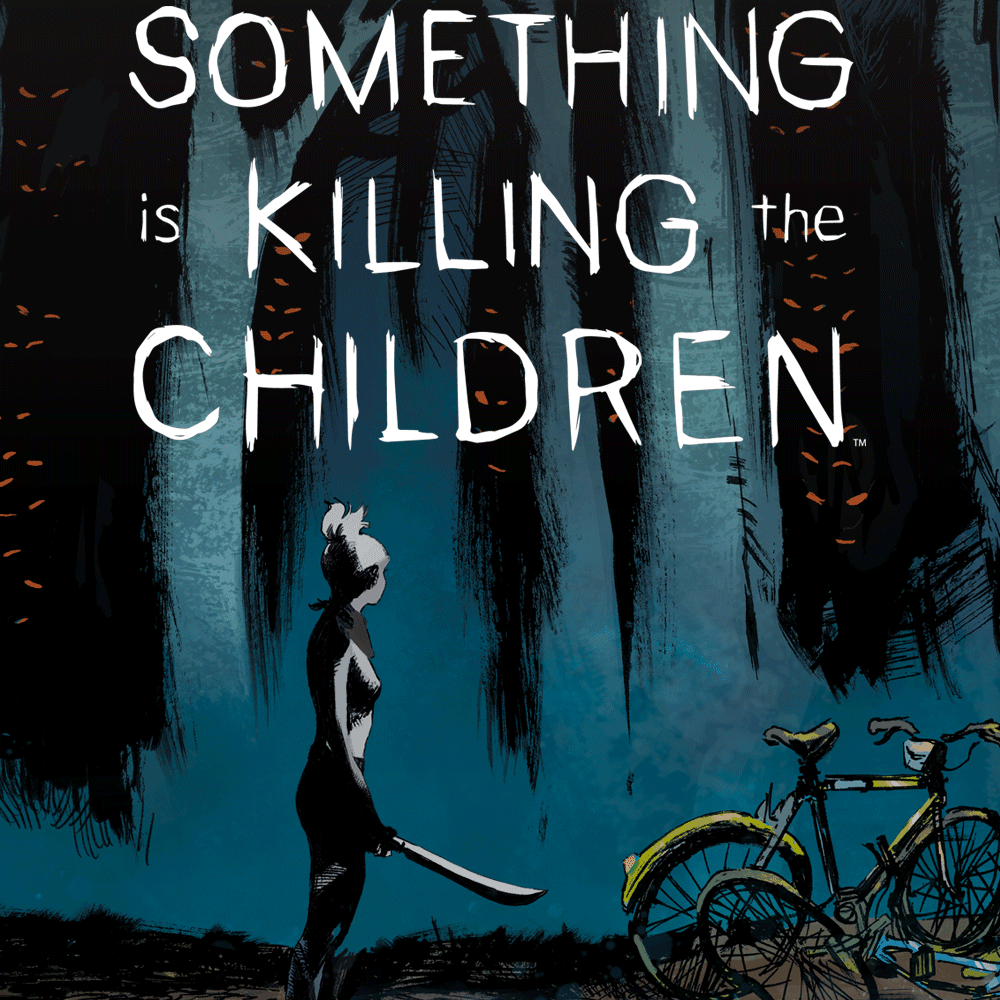
There is perhaps no genre of storytelling more satisfying than one that scares the hell out of us. Since the art of storytelling was created, the aim of warning us about the things that go bump in the night, the things unknowable, and even the people who may hunt us, has allowed people to experience fear and terror in a safe manner. Horror has become arguably the most widely beloved hard-genre in almost every medium, and with Halloween fast approaching I thought it would be appropriate to examine just how this genre works within the pages of comics and graphic novels. Horror has been a popular and prevalent genre since comics first appeared, but the past several years have seen what could almost be considered a horror renaissance for the medium. How do these comics work though? How do they keep an audience engaged in the way a great scary story does? The mechanics and methods unique solely to comics and graphic novels are utilized by creators to craft tales that are haunting, grotesque, frightening, and often unsettling, and are themselves the reason horror comics are thriving in the current era of the medium.

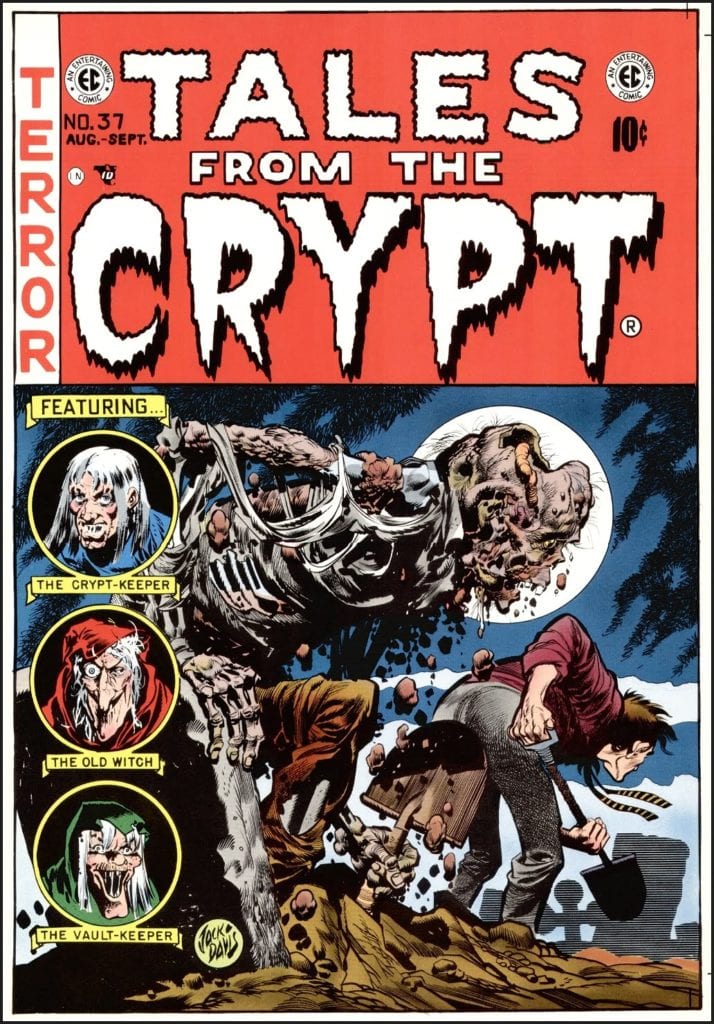
The earliest horror comics, often found in pulp strips and publications such as Eerie Comics and Tales From the Crypt, used a combination of the descriptive narration common to the era as well as the talent of the artists of that period. The narrative style in those comics was similar to that heard on radio shows of the time, but often without the bloated description, since the artist was performing much of that work. The illustrations within the panels would be bolstered by the writer’s adrenaline-inducing speech and narration bubbles that expanded upon the terror on the panel. Much of this narration is the lens from which the characters in the story are viewing the events, which in effect pulls the reader into that character’s perspective and has them feeling the full effect of the creators’ sadistic intent. This technique is still commonly used today, as it’s one of the easiest ways to get a reader immersed in a comic story. Think of it as a POV shot in a film. However, in the era of these early horror comics, film was still a relatively new medium, and comics were more plentiful and easier to obtain. The horror genre itself in popular culture was new as well, and these early comics made a shockwave in the entertainment industry and the minds of the collective consciousness for decades to come.

As decades have passed, censors have risen and fallen, and entire generations of comic storytellers have delivered their styles to the medium, it’s a bit off how horror comics have held onto their old conventions while still moving forward. Much like films, the longer the medium has existed, the more concepts and methods have been introduced with changing times. What’s so special about comics however when compared to film however is that, aside from their obvious differences as respective mediums, comics are less restricted than films are in terms of censorship. They took a bad hit when the Comic Code Authority came to power during the 1950’s and 60’s, a move that stifled the storytelling potential of horror, science fiction, and basically any non-superhero comic around at the time. However, this also forced creators to become more clever in how they presented their work. While they couldn’t be too forward with obvious gore, imagery, or subject matter, the writers and artists of horror comics in this period had to find subtle ways of getting their messages of terror across without setting off the censor’s alarms. Thus the art of “less is more” in horror comics was born. While grotesque and shocking imagery is certainly always fun, much of what makes horror scary is what the audience has to imagine. This approach works to the advantage that the comic medium uses which no other comic has, a mechanic that is wholly unique to comics and graphic novels: the page turn.

You’ve seen it before, or had it happen to you. The sense of tension in a scene or sequence builds along with the panels, alluding to a horror that has yet to be seen. The characters on the page then suddenly look off-panel towards something hidden on the other side of the paper, so you turn the page and –

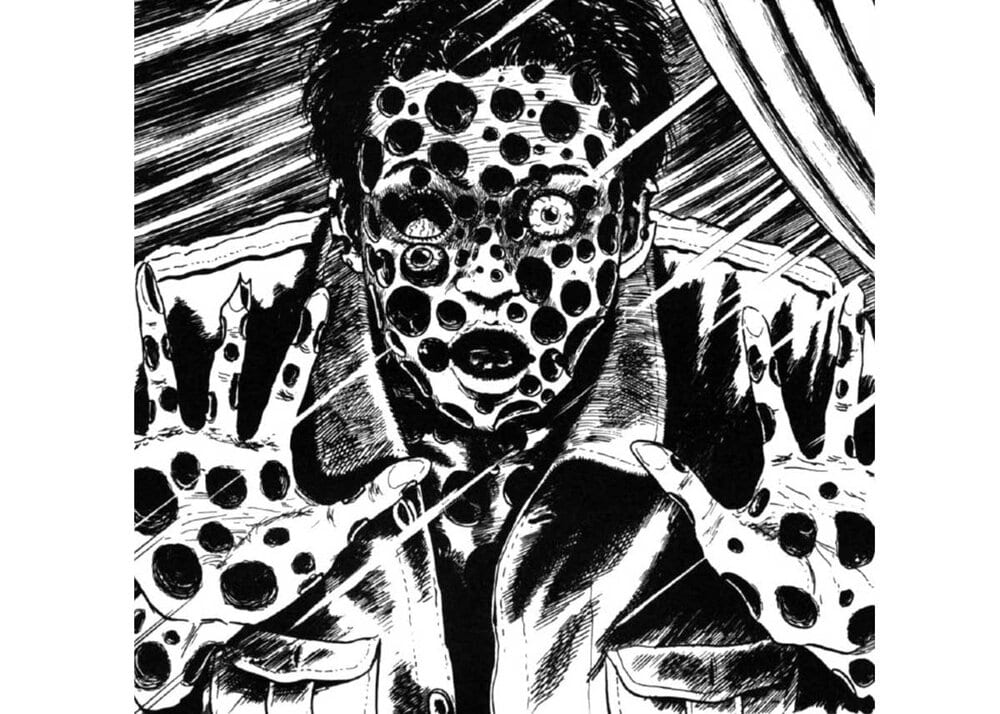
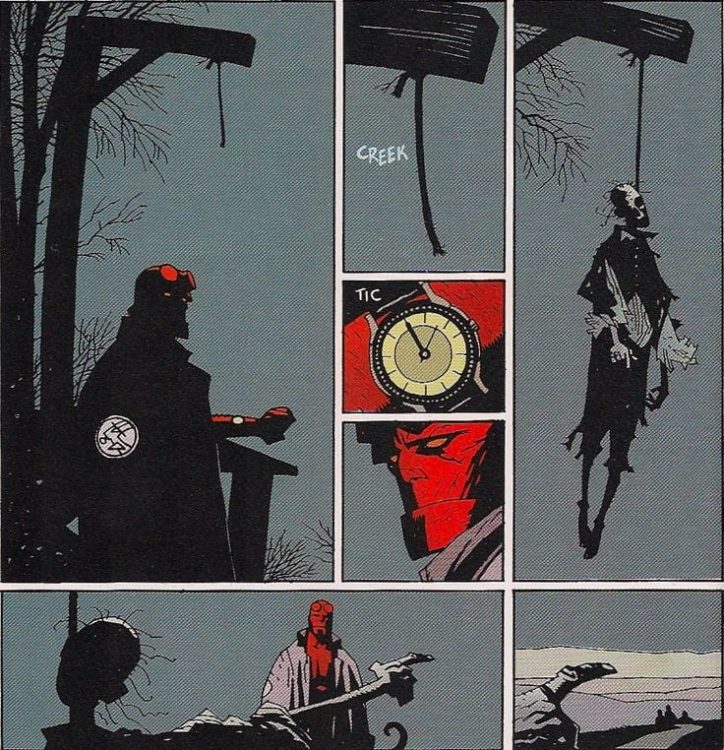
There’s a shock or rush that follows a great turn of the page scare or reveal that just can’t be done by films or prose. What makes it so effective is that you, the reader, do it to yourself. A film can be paused, or you can close your eyes before you reach a scare, but that undermines the medium. The director doesn’t intend for a film to be paused interrupted beyond its normal runtime. A novel’s frights creep up as the reader comprehends the words written on a page, making the reaction more of a slow burn rather than a jolt. A scare from a comic only happens because the reader makes it happen. Whether it be a slow build or a sudden spook, the reader guides their own experience through a comic or graphic novel, subconsciously picking how much time they spend on each page, panel, and image. The reader leads themselves through the climactic moments of a comic, and in a great horror comic they just so happen to scare the hell out of themselves in the process. Page-turn reveals are a common ploy in all of comics, used for delivering huge plot twists or breathtaking visual climaxes. The likes of Bernie Wrightson, Mike Mignola, Junji Ito, and many other brilliant creators have utilized this tactic for darker purposes.

Since the golden age, horror comics have covered every genre of horror imaginable; from slashers to monster tales, to supernatural terrors and unfathomable cosmic horror (a subgenre film consistently struggles with). This medium’s nature as a hybrid of written and visual storytelling, combined with the general creative freedom writers and artists are given with their work, makes for a seemingly endless wellspring of terrifying concepts to be explored. The vast amount of writers with varying influences and styles of plot deliver, along with artists all with completely different visual approaches, makes opening new horror comics an unexpected experience with each new series. The best horror, as with most genres, sets a foot in reality with commentary on events and situations in our own lives; from familial drama to socio-political commentary. Our current turbulent situation has made for a hotbed of poignant horror with something to say. With horror seemingly becoming more and more popular all the time, and with the comics medium itself seeing more success thanks to collected edition sales, there’s no telling what terrors the brilliant creatives who craft this genre will come up with on the next turn of the page.


Monkeys Fighting Robots Youtube

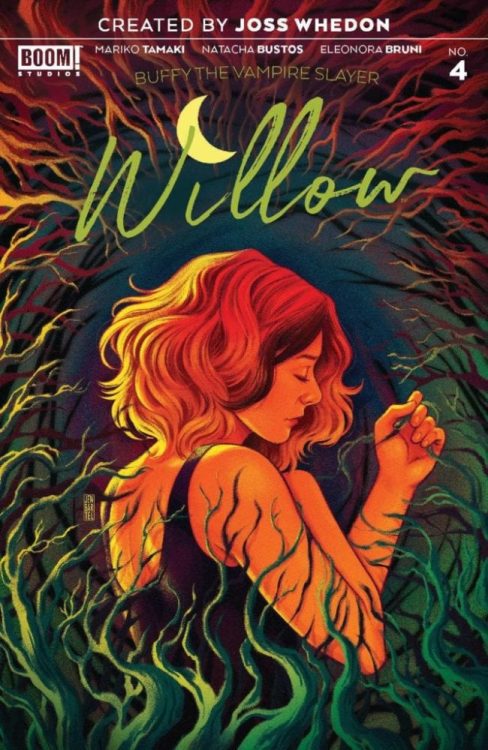
Review: BUFFY THE VAMPIRE SLAYER: WILLOW #4—Spellbound

Available now, writer Mariko Tamaki and illustrator Natacha Bustos begin to unravel their magical web in Buffy the Vampire Slayer: Willow #4. Featuring colors by Eleanora Bruni and lettering by Jodi Wynne, this penultimate issue in the limited series gives us the action we’ve all been waiting for.

One might think issue four is the perfect time to jump into some climactic action immediately. But again, mirroring Willow’s experience, we’re lulled into a false sense of security. The creative team does this by providing more interiority through narration, using more dialogue, and emphasizing moments.

In previous issues, Tamaki and Bustos have subtly manipulated us in the same way Aelara has manipulated Willow. I felt quite foolish when I reread the previous issues and realized just how much of the story had already been foreshadowed from the first issue. For example, when Aelara and Willow first met, Willow had a flashback to the Hellmouth events as soon as Aelara approached. If you’re like me, you may not have thought Aelara the cause of the flashback. After all, at this time, Willow didn’t know the extent of her power and struggled to control it. The flashback could have been a surge of power or simply psychological.

How Touching

However, there have been multiple moments like this first encounter. Recall in issue three when Aelara demonstrated how power flows through everything in Abhainn. She took Willow’s hand and touched it to the tree. Willow then transported herself and Aelara to a memory of Xander. This moment of touch directly mirrors their first encounter in composition.

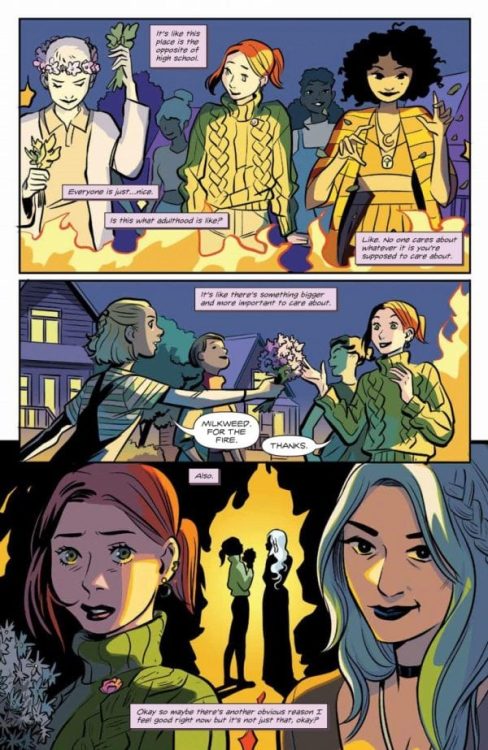
WILLOW FEELS FULLY INTEGRATED INTO THE ABHAINN COMMUNITY.

In issue four, the hand touching recurs inside a visual metaphor. The comfortable sweater Willow bought in the first issue has a loose thread. Aelara takes Willow’s hand and offers to fix the loose thread. Given Willow’s growing suspicion of Abhainn from the previous issue, the loose thread in this scene stands in for that suspicion which Aelara must rein in. It’s here where the manipulation became clear to me—and the moment when I felt betrayed by Aelara, whom I, like Willow, had trusted despite the red flags.

Moreover, Jodi Wynne’s FX lettering lends a sense of alarm to the issue. Every little noise is pointed out, seemingly disrupting the comfortable, delusional silence Willow has been enjoying up until now.

Escape

Overall, there’s more urgency to this issue. In the first half of the issue, Bruni’s colors were warm and almost no shadow in terms of inks. Then, in the latter half, as Willow and the character who is probably Tara planned their escape, the colors got colder and the shadows harsh. These choices, paired with the sound effects, contribute to the dread and increasingly urgent need to escape Abhainn.

Buffy the Vampire Slayer: Willow #4 is the most exciting issue yet. Tamaki and her collaborators have taken us down a magical yellow brick road. Now all that’s left is facing the woman behind the curtain.

Monkeys Fighting Robots Youtube

Review: NORSE MYTHOLOGY #2 – An Essential Norse Tale

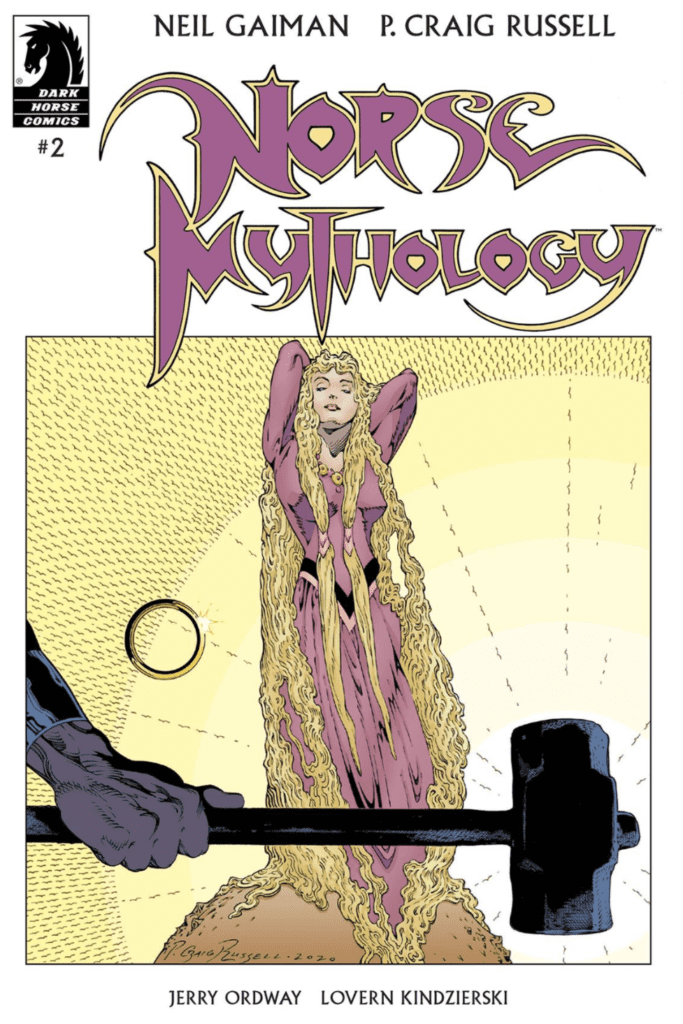
Norse Mythology #2 Cover

Norse Mythology #2, out November 4th from Dark Horse Comics, is another issue retelling classic tales complemented by some breathtaking art.

Norse Mythology #2″ Story

The choice of story for Norse Mythology #2 is clever for an issue so early in the series. The issue features many of the most popular Norse gods, including Thor, Loki, and Odin. By centering the issue around characters such as this, Neil Gaiman and P. Craig Russell can immerse new readers into the world of Norse mythology more easily. Readers who may not be well-versed in Norse myths are certainly still aware of most of the characters featured in this issue. They may not be familiar with the story, but they are with the gods, so the issue intrigues them as they attempt to learn more about such iconic characters.

Russell does an astounding job of adapting Gaiman’s novel, making the words of the novel transition seamlessly to the medium of comic books. Russell does this in Norse Mythology #2 by splitting sentences into fragments across multiple panels. This can be used to make sure a panel isn’t too word-heavy, but the main reason Russell uses this method is to allow the artist to make illustrations that don’t occur in the scene. When a character has a long sentence describing the many attributes of an object or place, splitting the sentence over many panels allows the artists to show the reader exactly what the character is describing. The story in this issue also has much of the plot occurring in one setting, so by having these panels that aren’t happening in the same place, there is more variety in location.

Norse Mythology #2 Variant Cover

Art

Once again, Jerry Ordway presents extraordinary art to go along with the classic tales. Norse Mythology #2 features some easily readable facial expressions that make all the characters seem alive. Whether someone is expressing arrogance or genuine fear, Ordway can recreate expressions on characters’ faces like no other. Ordway also puts incredible amounts of detail into his art. Even if a panel is small and usually glanced over, he puts time and effort to assure his art looks phenomenal. One particular panel in this issue, which showcased a boat upon the water, had some of the most complex waves I had ever seen in a drawing. On nearly every page of Norse Mythology #2, Ordway is sure to amaze you.

Lovern Kindzierski does great work in Norse Mythology #2. Even though the issue only has two main settings that it takes place in, Kindzierski gives each its own distinct tone, reflecting the nature of the scene. There is also a very nice variety in colors in Asgard, as the brighter colors that many Asgardians wear stand out against the cool colors of the buildings behind them.

The lettering of Galen Showman in Norse Mythology #2 is unlike that of many others. It is evident that Showman is unafraid to stray from the standard lettering practices found in most modern-day comic books, and it pays off immensely. Whether using unique fonts or arranging text interestingly, Showman’s unusual lettering style provides an enthralling experience for the reader.

Conclusion

Norse Mythology #2 is another delightful issue. Gaiman’s writing makes the issue so entertaining to read, and Russell adapts it perfectly. The work of Ordway and Kindzierski brings the words to life, and Showman’s lettering is the cherry on top of it all. If you are a fan of Norse Myths or even have the slightest interest in any of the characters from them, I would certainly recommend this issue.

Monkeys Fighting Robots Youtube

WATER WOMAN #1: The Potential Of CGI Liquid Effects

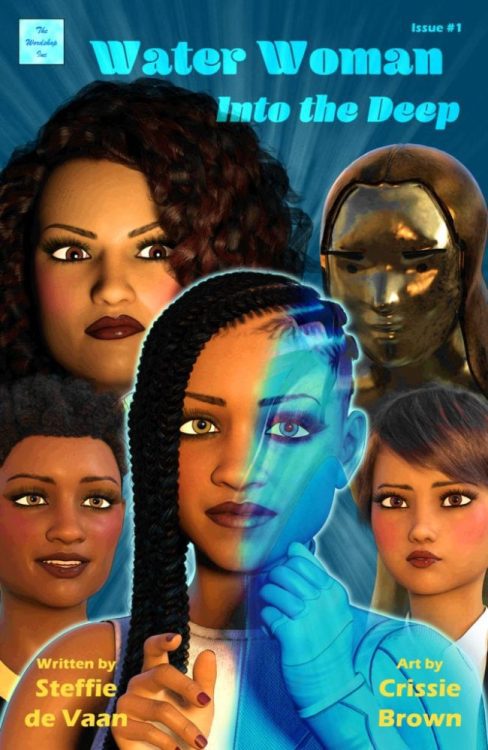
Water Woman #1 Cover

Water Woman #1 is a Kickstarter comic from Gail Simone’s Comic School alumni Steffie de Vaan and Crissie Brown.

What Is Water Woman #1?

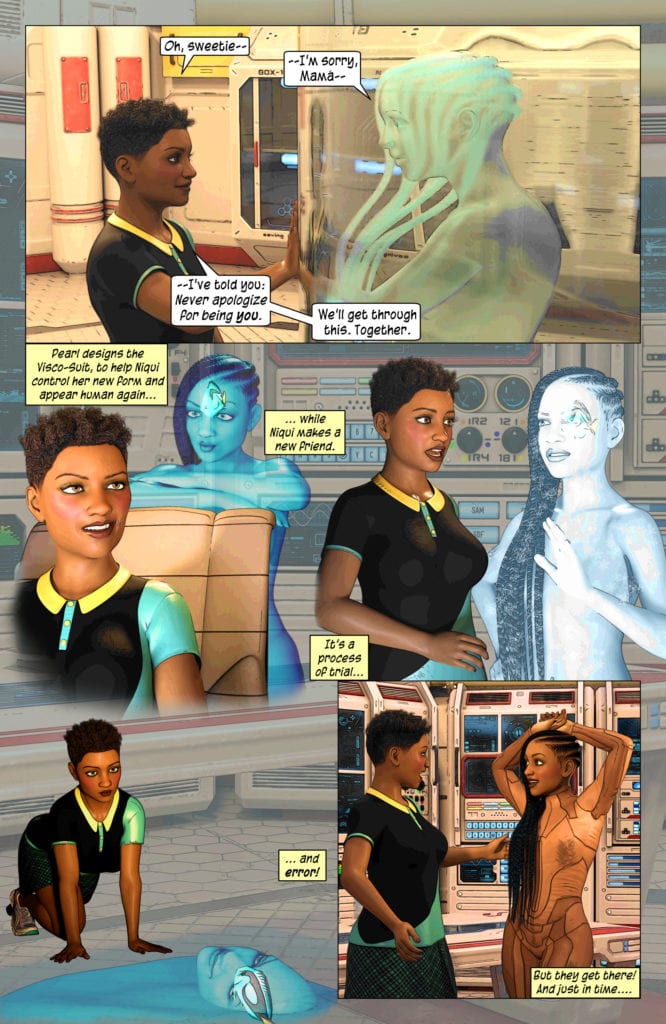
The Comic School by comic legend Gail Simone is an online set of classes teaching hopeful writers how to make a comic book. Brown has a background in theatre arts, so it’s not hard to see her wanting to write a comic book. Award-winning writer Tom Taylor has a background in theatre; even Stan Lee wanted playwright Václav Havel for adult-themed comics before Havel became a Czech president. As for Brown, her background involves the use of technology in traditional theatre. Brown uses CGI for various effects like backgrounds and fluid objects. But having all creative duties can be exhausting, so it’s good to have a friend like classmate Steffie de Vaan, especially if she has a background in Tabletop RPGs. This leads to the campy Water Woman #1.

A James Cameron Stylization

Water Woman #1 storyWhat makes Brown’s CGI art style stand out the most in Water Woman #1 is how she portrays the title character. Steffie de Vaan writes a proof-of-concept origin story about a superhero recovering from an abusive relationship. When Niqui Salinas-Aguado is knocked into the Bermuda Triangle by her money-laundering ex-girlfriend, Salinas-Aguado’s entire body becomes like liquid water. This is a great idea in terms of potential in story and utilizing still CGI’s full effect. It brings up similar ideas to James Cameron for Terminator 2 but in a new direction.
After a betrayal, Niqui can’t quite reform herself. Much like anyone recovering from a bad breakup with an abusive partner, it takes unconditional love to build Niqui back up. It’s quite literal in this case with the suit Niqui’s scientist mother designs. But even that won’t keep Niqui in one piece as the reminder of being in a relationship almost makes her turn back into liquid. It’s a pretty clever use of displaying character; despite trying to keep herself together, there are still complications Niqui has to face. Not least of which is dealing with that abusive ex’s crimes. Unfortunately, de Vaan and Brown have only scratched the surface with Water Woman #1.

Are You Thirsty For Water Woman #1?

Brown and de Vaan have an idea that has the potential. Check out their Kickstarter campaign for more details – https://www.kickstarter.com/projects/comicrissieb/water-woman-1-into-the-deep

Monkeys Fighting Robots Youtube

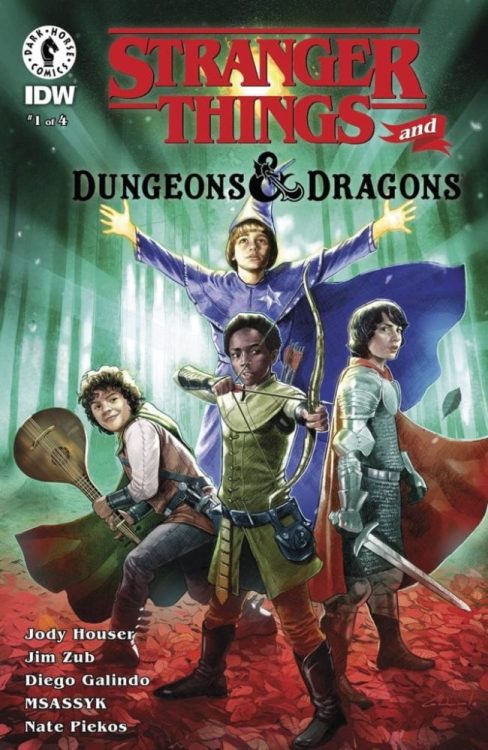
An Origin in STRANGER THINGS AND DUNGEONS & DRAGONS #1

A new adventure begins in Stranger Things Dungeons & Dragons #1.

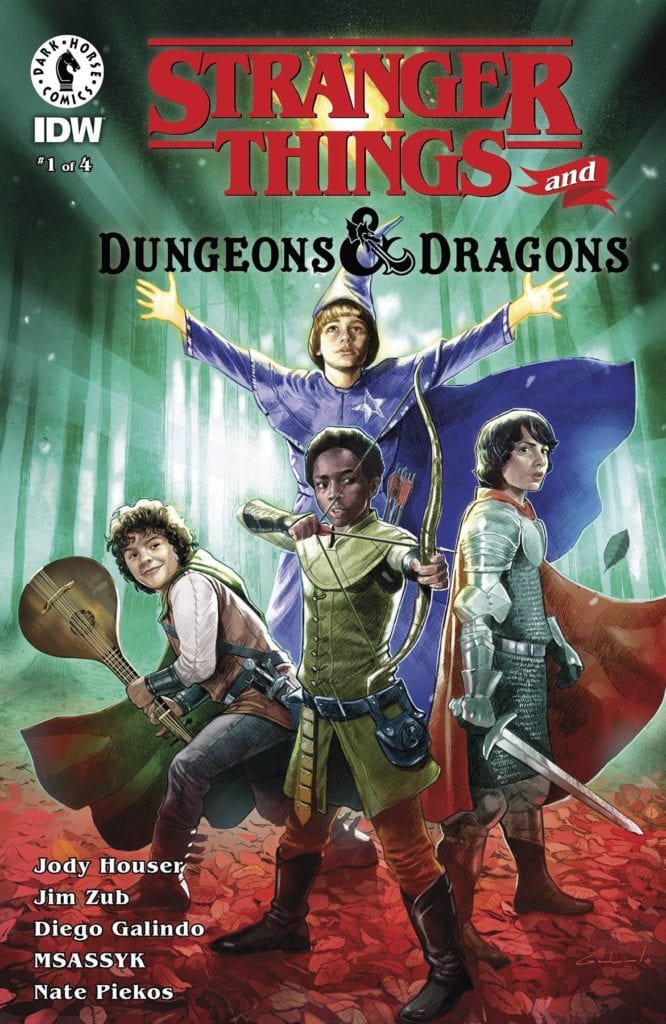
STRANGER THINGS AND DUNGEONS & DRAGONS #1, available November 4th from Dark Horse Comics, is the beginning of another adventure from the franchise that brought us the Upside Down.

A new adventure begins in Stranger Things Dungeons & Dragons #1.

Set before the events of the first season of Stranger Things, this is a tale about four boys, and the tabletop RPG that changed their lives. It’s a series that relishes the discoveries made in childhood, fun passions to friendship, and everything in between.

Stranger Things and Dungeons & Dragons #1 begins the series, and for at least one member of the group, their friendship. Not only is this series set before season one. But it all begins before they even ever heard of Dungeons and Dragons.

If you’re fond of the endearing nature of these four boys, even without all of the science fiction and horror elements that made the series so well known, then the odds are good that you might just enjoy this origin series.

The Writing

Stranger Things and Dungeons & Dragons #1 was written by Jody Houser and Jim Zub. Together they’ve woven a narrative about the Hawkins boys, and the adventures that they are about to embark on.

It’s tempting to say that this is a light and fun issue. An issue all about D&D and the fun they had. While that is certainly the case, there’s also a darker side to this story. This is a series that portrays just how bad the bullying was, even before El ever came onto the scene.

Think about your favorite fandom, and how quickly you fell in love with it. That is the feeling that has been bottled up and tucked into the pages of Stranger things and Dungeons and Dragons. Every moment speaks of their fondness for it, and how it changed their lives.

It was almost refreshing seeing an adventure like this. It was an origin story, in a way. Explaining how at least one new member found his way into the group because of the beloved game, and so much more.

The Art

Stranger Things and Dungeons & Dragons #1 is a vibrant issue, portraying a version of Hawkins that is bright with fall foliage – not to mention all of the fantasy elements that come with imagining D&D adventures.

Diego Galindo was the lead artist for this project. They blended the real and the fiction to an exceptional degree, making the world come alive with the imagination. It was wonderfully, fully infused with the creativity known to the series. Plus that classic aesthetic that only the ’80s can pull off.

The coloring was done by Msassyk, and there are lots of bold colors to be found, even in something as dull as the school hallway. In that way, the colors compliment their growing daydreams and the overall tone of the story.

Nate Piekos’ lettering was the final touch. It was perfection, giving voice to the four kids, as well as clearly implying when a DM voice had taken charge. That was merely one of the details provided thanks solely to the lettering.

Conclusion

Stranger Things and Dungeons & Dragons #1 is a fun and charming beginning to this miniseries. It’s an endearing adventure, allowing for a sneak peek into the world they lived in before everything turned so…strange.

Stranger Things and Dungeons and Dragons is one of two series actively updating at the moment. The other one is titled Stranger Things: Science Camp, and as the title indicates, it’s all about that mysterious time Dustin spent away at camp. Both showcase different sides of the same characters, and their adventures.

Monkeys Fighting Robots Youtube

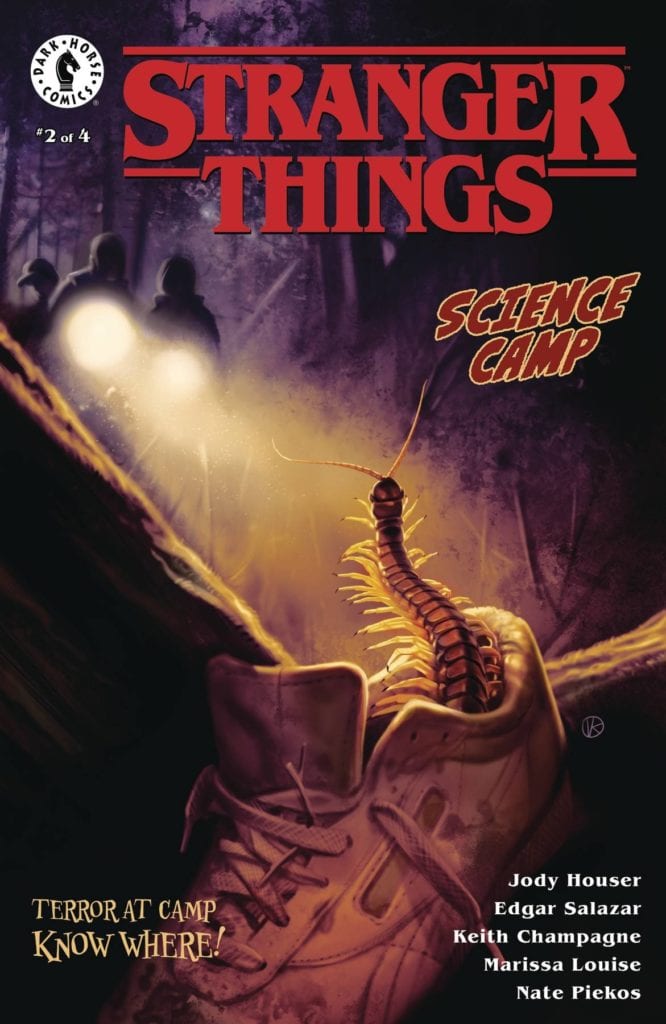
How He Flies Solo in STRANGER THINGS: SCIENCE CAMP #2

Dustin's solo adventure continues in Stranger Things Science Camp #2.

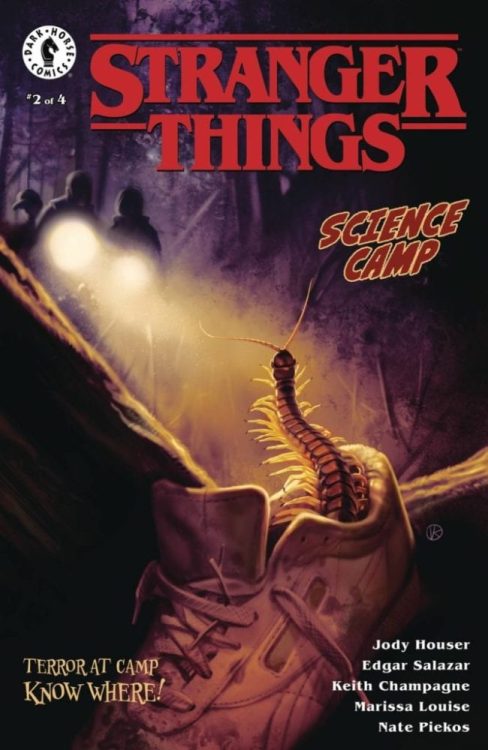
STRANGER THINGS: SCIENCE CAMP #2, available October 28th from Dark Horse Comics, continues the solo adventure of Dustin, and the time he spent at science camp. As it turns out, there is more to the story than Dustin had ever let on.

spoilers ahead

It’s easy to think of Dustin’s adventure at Science Camp as nothing more than a fun (and educational) summer. One that did result in Dustin getting isolated from the rest of his friends, but an otherwise calm and quiet series of events.

It’s probably also tempting to assume that Dustin’s story will be the calmest of the comic series so far. After all, there are completed series focused on past subjects from the lab (Stranger Things: SIX, Stranger Things: Into the Fire), and everything they had to go through.

As it turns out, one would be wrong to assume that. Besides the girlfriend bit, there is more to his time spent at camp than the young man let on. Now that the scene has been set. Stranger Things: Science Camp #2 is ready to dive back into that adventure.

Dustin’s solo adventure continues in Stranger Things Science Camp #2.

The Writing

Stranger Things: Science Camp #2 is a surprising read, but perhaps not for the reasons one might expect. Starting with the fact that Dustin did not play up his time there (fun fact: he was the cool kid at science camp!), to the horror lurking in the shadows.

The series is written by Jody Houser, who has been involved in many of the Stranger Things adaptations. Her experience in the world is showing through in this series, as she weaves Dustin’s story into something bigger than expected.

It’s a story full of subtleties as well. The horror elements are the slow-building side, with the series getting pretty far along before anything of depth happens. That’s not all there is to this tale, of course.

It is one of the few times that Dustin’s character has been given the main perspective. More than that, he’s been isolated from his group, and put into an entirely new surrounding. All of which is clear in this series, though admittedly not going as expected. It almost makes one wonder if this entire story really exists in Dustin’s mind or not…

The Art

Stranger Things: Science Camp #2 looks exactly like a comic set in the late 80s should. Throw in the camping elements, and there is a seriously strong vibe found here. Even the science elements aren’t strong enough to disrupt the memories sure to flood the reader’s mind.

Edgar Salazar (pencils), Keith Champagne (inks), Marissa Louise (colors), and Nate Piekos (letters) all worked together to bring Dustin’s story to the pages, and it shows. Dustin’s character is immediately identifiable, even in his new camp wardrobe.

His new friends, enemies, and counselors all seem fairly distinct as well, even if they’re less memorable than the leading cast. Though the fantastical elements pulled from Dustin’s mind do enhance several of the scenes, and understandably so.

The colors are a colorful blend of pure nostalgia. They practically sing campfire songs on their own. Then there’s the lettering, which is understated, yet exactly what the story itself called for. Altogether, it’s making Dustin’s story quite memorable.

Conclusion

Stranger Things: Science Camp #2 marks the halfway point for this series, and yet it already feels like so little time has passed. Dustin’s tale is charming, in an endearing way that only his character could manage.

The encroaching horror elements are certainly going to be ramping up in the next two issues, if the conclusion of this one is anything to go by. Here’s looking forward to seeing how it all unfolds.

Monkeys Fighting Robots Youtube

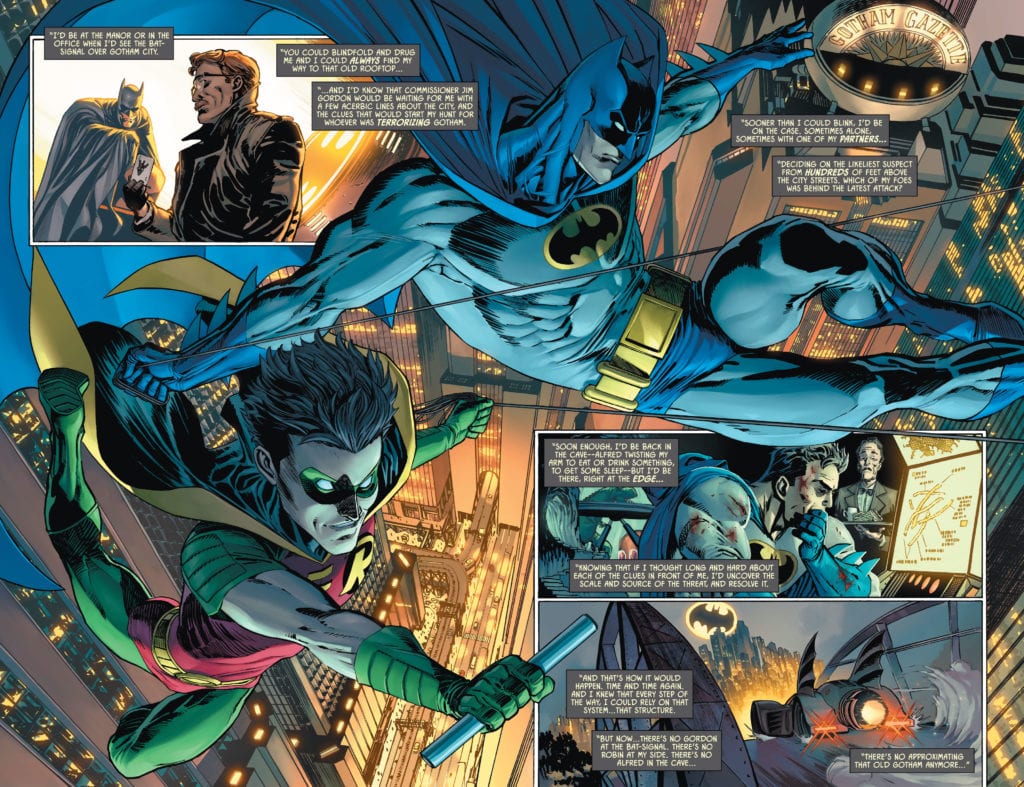
Review: BATMAN #101 Prepares For The Future in a Dull Way

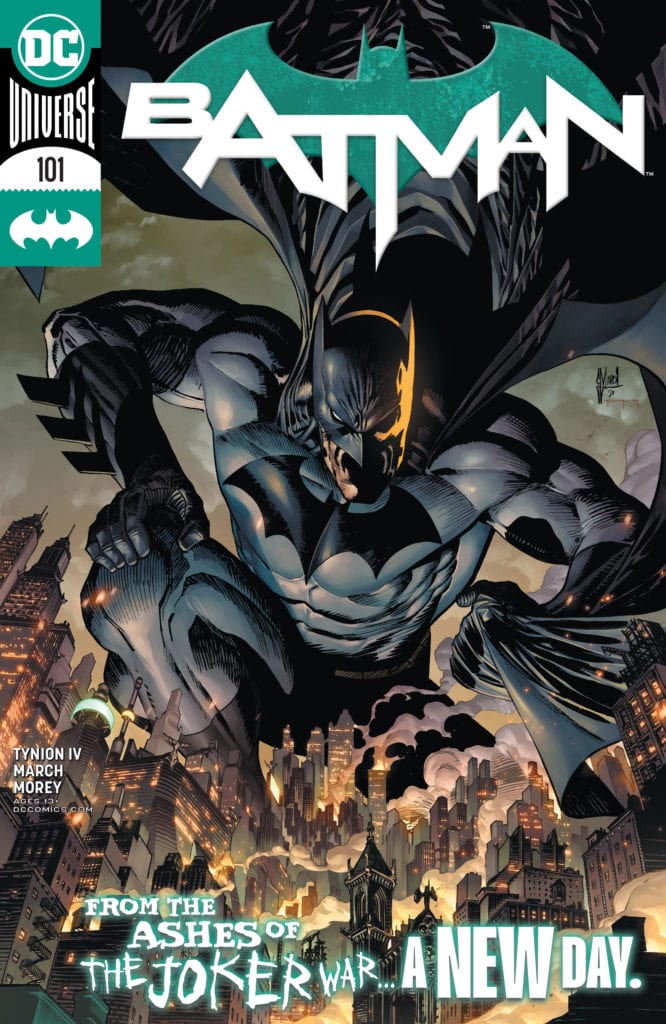
Batman 101 cover

Batman Picks Up The Pieces…

The Joker War is over, and all that’s left is the ashes. While Batman faced Joker, armed with a high tech bat suit, each member of the Bat-Family took apart the clown’s gang. Catwoman defunded Punchline, Nightwing lead the charge on the streets, and Batgirl became Oracle once more to run operations for both the GCPD and the family. Bruce ends up leaving Joker to fend for himself after Harley straps a bomb to him. Afterward, it’s revealed that Joker did survive while Joker’s gang members went into hiding in the two week time jump. Batman explains to Harley that besides the destruction, the status quo itself has changed. What else is different for the caped crusader?

Batman 101 cover

**Some Spoilers Below**

Story:

We open with Batman stating that Gotham has changed. Not physically, but the status quo has shifted and not in Bruce’s favor. It turns out Catwoman transferred Bruce’s funds to Lucius Fox for safekeeping. We learn this through flashback after Batman confronts Lucius after a fight with Grifter. While he is willing to return the money, Lucius points out that, after the implications of Wayne’s company being involved with Joker, the government is watching the money closely. Along with that, the board is removing Bruce from his position, only giving him a set annual amount. Essentially, Batman will now be defunded.

I was actually surprised in the direction Tynion IV has gone for this. In the past, whenever Batman had to change after a traumatic event, usually it involved an upgrade or a passing of the mantle. Here, we take a step back, leaning towards his intellect and strength than anything else. If that is the case, we might be getting something closer to Daredevil; a grittier vigilante that relies more on fists and detective work than technology. 

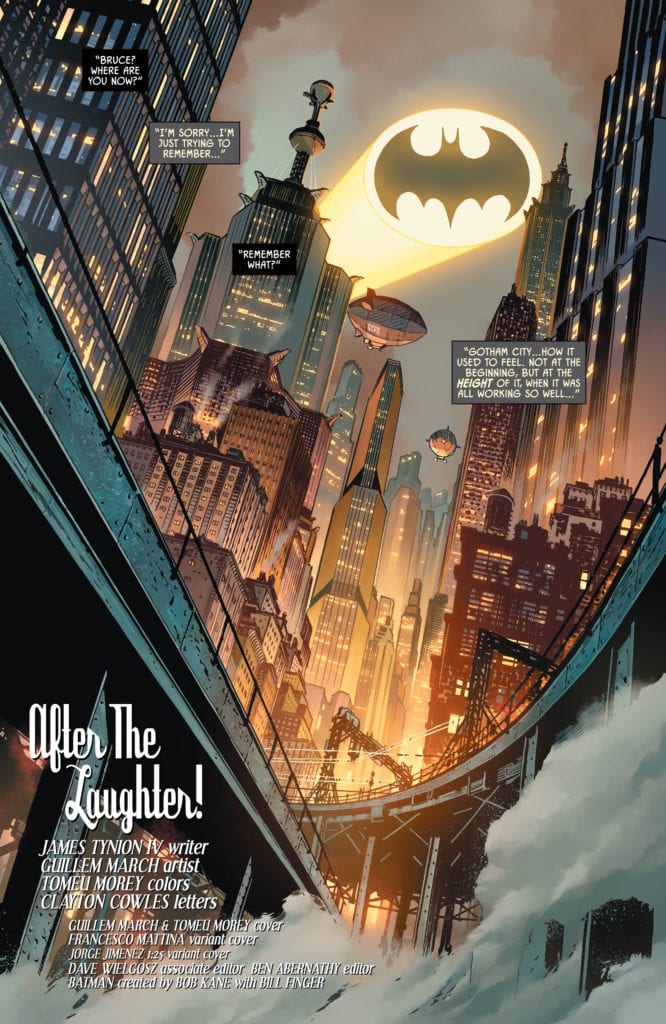
Batman 101 p1

While that does sound exciting, the way it’s presented here is rather dull. Most of the information presented is done through a conversation between Batman and Lucius. If we saw the Wayne Enterprises Executive Board approaching Bruce or the shutting down of the floor that creates Batman’s gear, that would have delivered the same message, if not better, enforce it. The only real excitement we get is the battle with Grifter, which doesn’t last for long. This style of the story is fine for an epilogue, but this reviewer expected more.

Art:

Guillem March returns as the main artist, and while I enjoyed Jimenez’s art, he does a fantastic job here. The way he designs his characters can show how much they’ve been through. His linework on Batman makes it appear Bruce is older and more grizzled. The same goes for Lucius, who now bears the scars of the War. Even if one were to jump in now and look at these characters, they would instantly be able to tell they’ve been through something traumatic. While this issue is incredibly exciting, we can’t say that it isn’t good to look at.

Batman 101 p2

Conclusion:

Despite the praises of the art, it’s not enough to save this dull issue. This is an epilogue that shows the current status quo for Batman. The way it was presented could have been so much more interesting. This isn’t to say what the epilogue is implying is going to be bad. On the contrary, it makes me excited for the next issue. The problem is we have to look at the current one, and as it stands, it’s a rather dull issue to usher in a new era of Batman.

Monkeys Fighting Robots Youtube

Review: STILLWATER #2 Reveals The Town’s Mystery

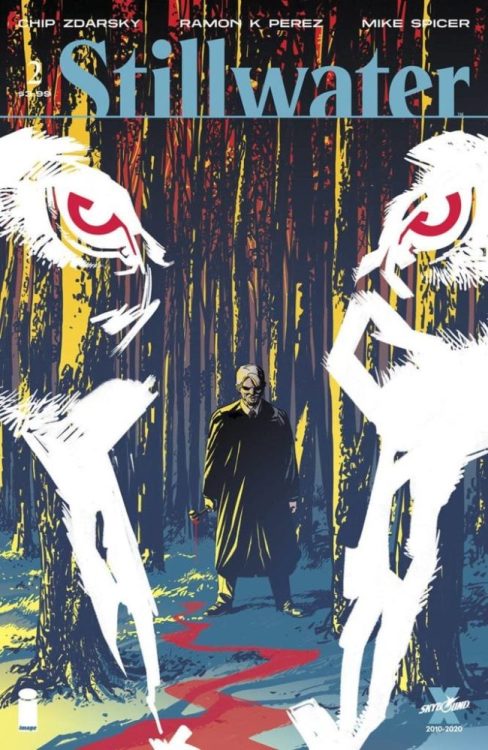
Stillwater #2, Perez cover

STILLWATER #2, available from Image Comics on October 21st, wastes no time dispelling the mystery surrounding the town’s secret power while Daniel faces judgment. Written by Chip Zdarsky and drawn by Rámon K. Perez, this latest chapter is an excellent character study about the extremes a community will go to protect its secrets.

Cover Art

Perez’s cover art gets high marks for successfully achieving literal and figurative visuals in one shot. The Judge and his bloody gavel embody the Judge’s frequently lethal decisions every time an outsider crosses Stillwater’s border. This issue is all about the Judge, and so, the cover does its job perfectly.

Writing

This second issue in the series is a mixed bag from Zdarsky.

Where the story works is in the speed with which the questions about the town get answered. The Judge quickly rattles off an explanation of the town’s power and metes out his appointed brand of “justice” against outsiders that violate the town’s borders. There are also a few tense scenes between individual pairs of characters that foreshadow a growing sense of dissatisfaction among Stillwater residents with the status quo.

Where the story doesn’t quite work is in its continuation of the primary flaw from the first issue (read the issue #1 review here)—namely, the story’s predictability. If a town suddenly discovered all its inhabitants were immortal and immune from all harm, Zdarsky has the opportunity to create a fresh take on an old idea but instead opted for established Twilight Zone-esque tropes. The Stillwater residents view their situation as a divine blessing that must be protected with cult-like zeal. There’s no plan. No ingenuity. No desire to discover the true source of the town’s power. Simply a consensus to exist and be thankful. You get the impression the townspeople are bored with life, and unfortunately, that boredom translates to the reading experience as well.

Pencils/Inks

Perez’s art style has a little more room to shine with this issue in the jarring and shockingly sudden acts of violence. A young boy leaps across the chasm separating builds on Main Street. The deputy takes a bullet to the face as a “warning.” A woman’s body gets tossed into a makeshift grave penalty box. These sporadic bits of action are well-executed and add some energy into an otherwise conversation-heavy issue.

Perez also adds some emotional energy to the issue with powerfully expressive faces. Characters grimace, frown, gasp, and scowl with tons of authentic emotion.

Coloring

Mike Spicer’s effectively uses color to punctuate the plot with specific transitions that pop. An early flashback scene is filtered with a light tone to add a veneer of age to the memory. The aforementioned gunshot scene practically explodes with yellow and red to amplify the sudden violence’s shock value. Spicer’s colors are a great example of filtering to augment the age or impact of a scene.

Lettering

Rus Wooton makes great use of selective bolding to emphasize the specific vocal cues in the dialog. This is a dialog-heavy issue, so Wooton’s choice to bold specific words give the conversations some rhythm and emphasis the reader can easily imagine, making the dialog more realistic. Great work by Wooton.

Conclusion

STILLWATER #2, available from Image Comics on October 21st, efficiently answers the first issue’s questions and establishes several points of conflict for future issues. Despite a largely predictable plot, the art is strong from the entire team.

Monkeys Fighting Robots Youtube

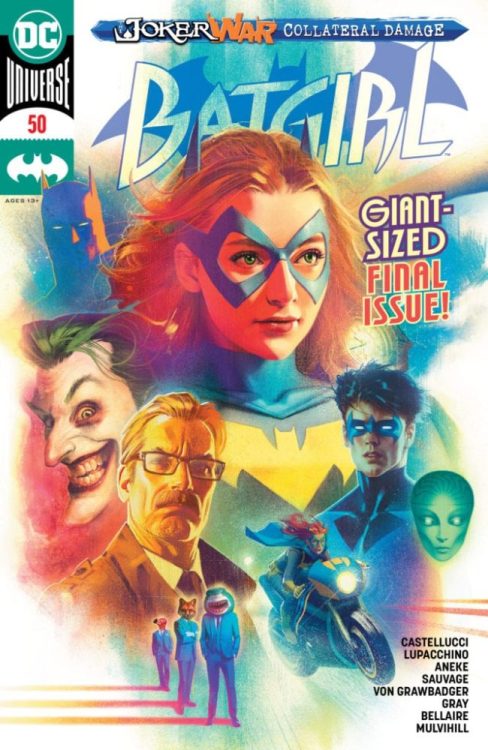
BATGIRL #50 Preview: Meet The New Batwoman

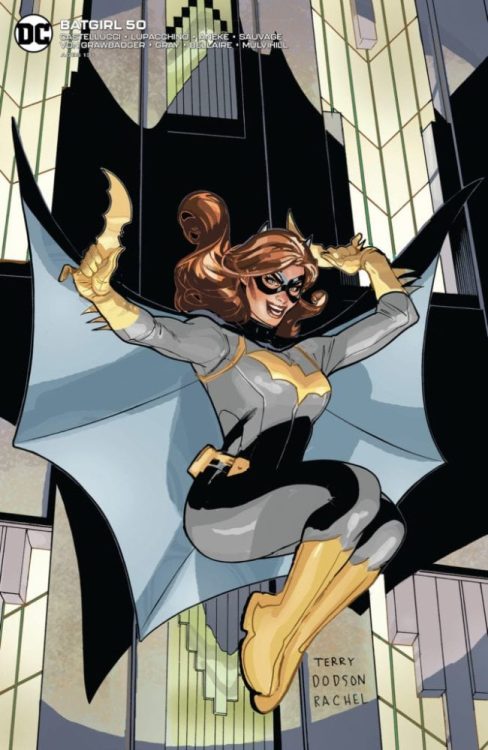
Batgirl #50

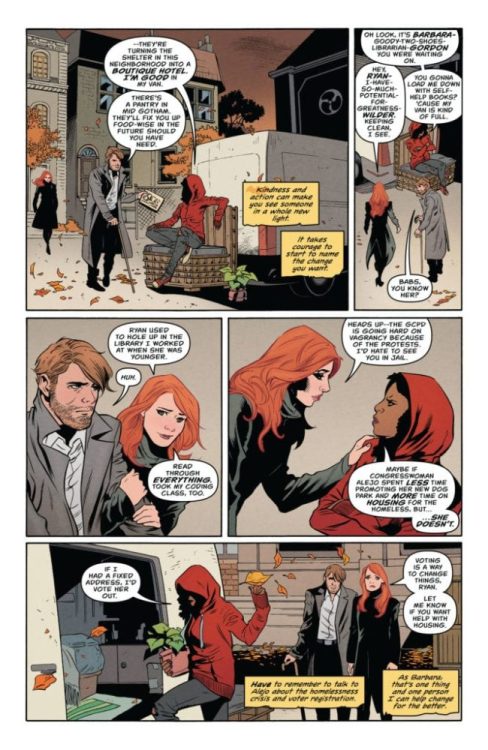
As the current Batgirl series heads for its conclusion, DC has announced that a new character will be making her debut in issue #50: Batwoman. While multiple characters over the years have used that name, this will mark the first comics appearance of Ryan Wilder — the same version about to be headlining the CW’s Batwoman series.

Here’s the official word:

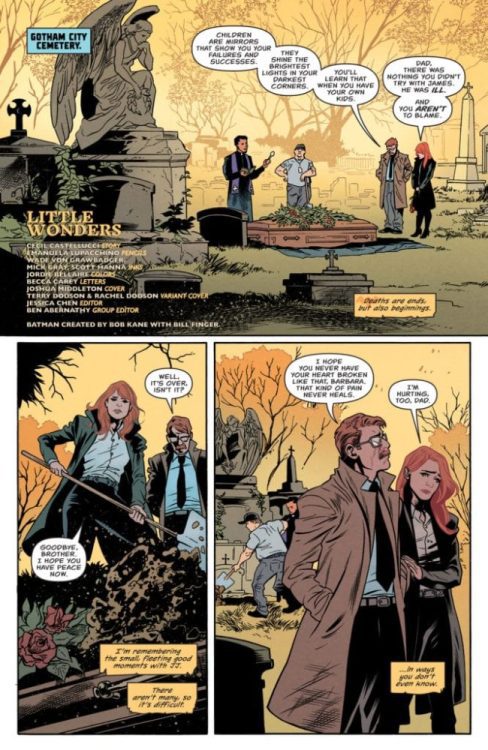
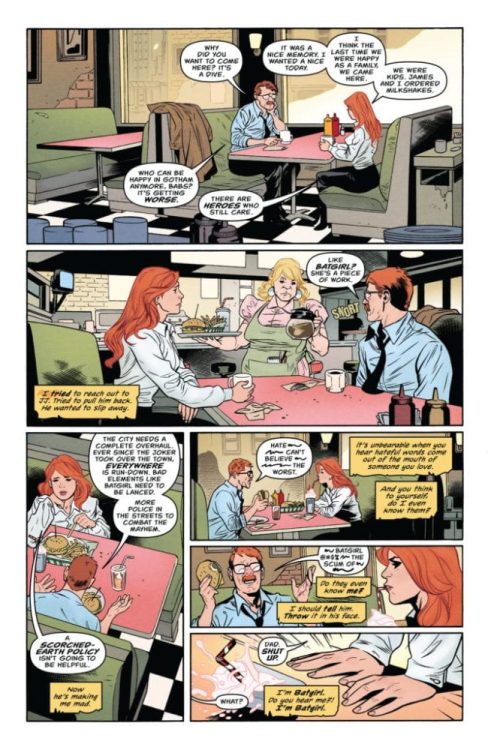
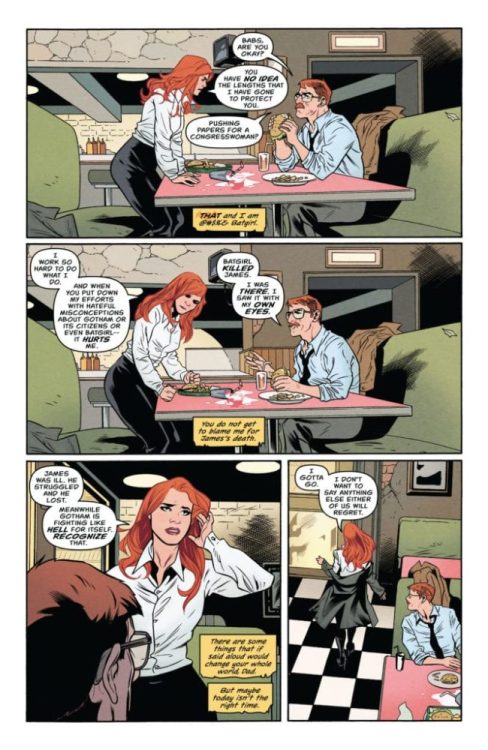
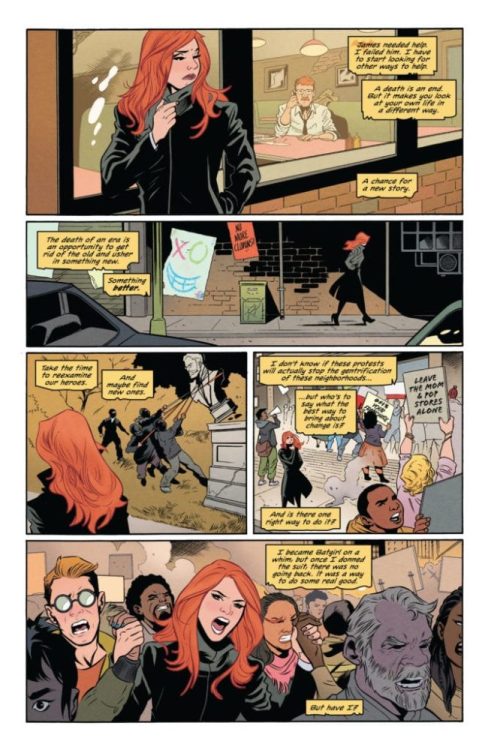
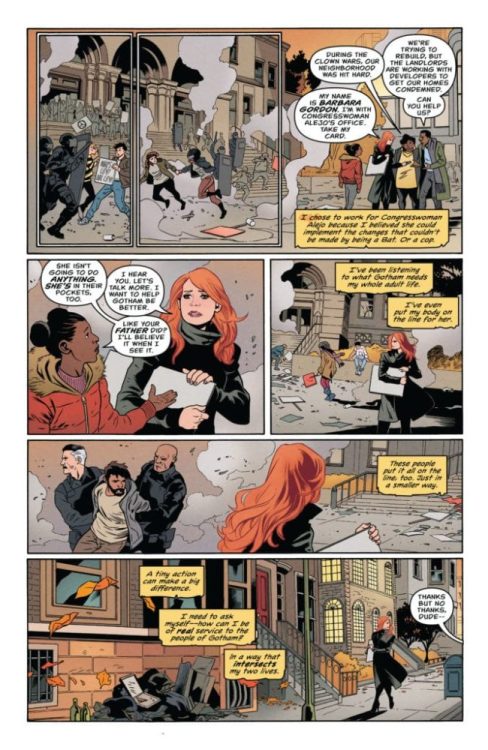
One thing ends, another begins. It’s hard to think of a better example of that old maxim than next week’s Batgirl #50, the extra-sized final chapter of Barbara Gordon’s ongoing series. Kicking off in 2016 as a part of DC’s line-wide “Rebirth,” Batgirl has seen its hero leapfrog from the high-tech, click-savvy world of Burnside (home of Barbara’s now-iconic purple and gold costume) back to the mean streets of Gotham proper, where she’s tangled with the likes of the Terrible Trio, KGBeast and her own former identity, Oracle. However, it’s been Batgirl’s two most recent confrontations that have been her most shocking. Having narrowly survived a second brutal attack by the Joker in the midst of his war on Gotham, Babs found herself once again at odds with her not-quite-rehabilitated brother—a confrontation that led to James Gordon, Jr’s death, seemingly at Batgirl’s hands.

We won’t know whether Barbara’s story ends happily until next week, but while hers nears its finish, another young hero’s story is just beginning. Ryan Wilder, an all-new DC character played by Javicia Leslie, will soon make her live action debut on The CW’s Batwoman as she takes on the title role after original Batwoman Kate Kane goes missing. However, if you’re curious when you might be seeing Wilder in the comics, the answer is…pretty much right now. You can catch the scrappy hero-to-be’s first comic book appearance in Batgirl #50—and in our exclusive first look at the issue. Drawn by the amazing Emanuela Lupacchino, Wilder comes out kicking—figuratively—as she let’s Barbara know exactly what she thinks of her boss, Congresswoman Alejo. It’s a powerful moment reminding us that even though Batgirl may be stepping out of the spotlight for a while, there are plenty of would-be heroes more than ready to meet this moment standing in the wings.

The extra-sized Batgirl #50 by Cecil Castellucci, Emanuela Lupacchino, Marguerite Sauvage and Aneke is in stores and available digitally on Tuesday, October 27.

Monkeys Fighting Robots Youtube