SEA OF SORROWS #1, available from IDW Publishing on November 18th, follows a salvage crew to the ocean floor, where they search for sunken treasure and find something worse. Written by Rich Douek, this first issue is a great story to a historical fiction epic with creepy monsters thrown in for good measure.
Cover Art
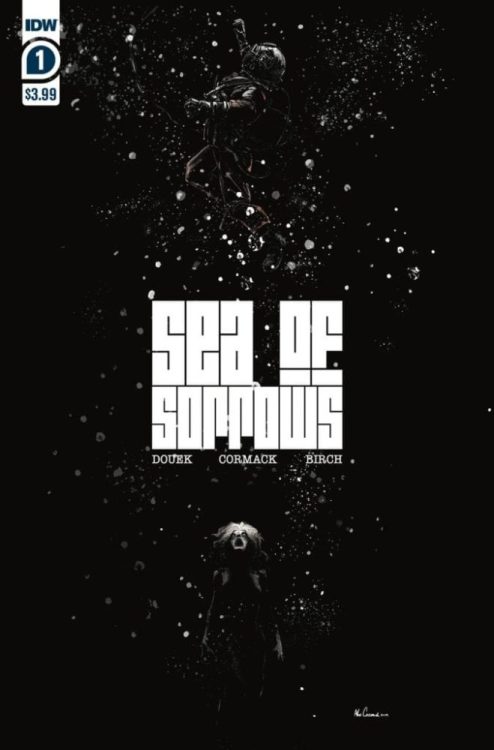
Alex Cormack’s cover sets the stage and the mood for the entire issue – the inky black unknown. Unfortunately, the cover spoils the mystery (it’s a mermaid), but the fear of unblinking, soulless monstrosities waiting in the dark speaks to a primal fear that’s hard to shake. There’s an almost Lovecraftian feel to the cover that I like a lot.
Writing
In the modern era of decompressed storytelling and forever on-going series, it’s nice to enjoy a story that has a clear setup and takes the reader somewhere. Douek establishes the characters as a rough, ragtag collection of privateers and gangsters on an expedition to recover a sunken U-Boat laden with Nazi gold. Douek’s story excels in how well the world is established, and backstories are told for several of the key players in a very short window. It’s effective, efficient storytelling at its finest.
Douek’s introduction of the main monster is also told with speed and efficiency that leaves you questioning whether or not she (it?) is a friend or foe. That simple question makes for a very clear cliffhanger that left me curious about what happens in the next issue.
Pencils/Inks
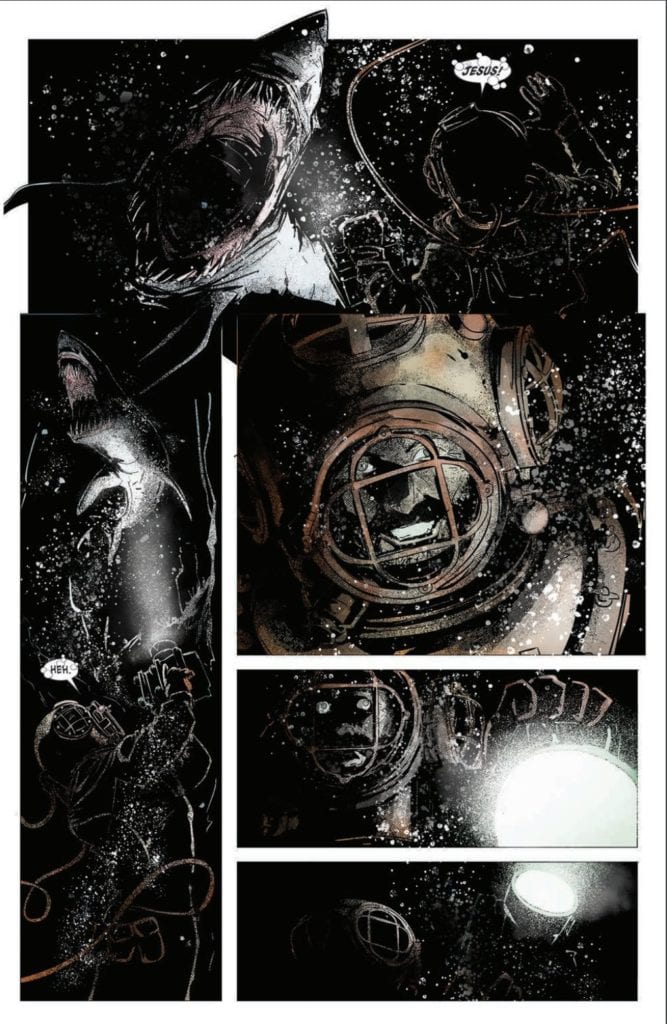
Alex Cormack carries the inky blackness from the cover all the way through the issue for maximum drama. Every character and setting is cast in deep, dark shadows – even during the day – to swath the issue in a constant state of dread. By turning up the darkness to an almost absurd degree, you feel like every character is about to do something wrong, has been wronged and carries the weight of it with them, or is about to have something terrible happen to them. Cormack’s use of shadow builds anticipation perfectly for a horror comic.
What about the mermaid? Yes, it’s a great design. The creepy, solid-white eyes give it the quality of a predator, indifferent to remorse or sympathy for its prey. There’s something shark-like in its empty stare that suits the horror style of this book well.
Coloring
Cormack’s coloring work is deceptively good in this issue. Except for a few bright spots, such as the briefly presented gold bars, the entire issue is almost entirely black and white. However, Cormack makes great use of tinting in flashbacks to reflect the nature of the threat. A WWI battlefield is illuminated with red signal flares at night. A disaster below decks tinges the air with green ammonia gas. In effect, every threat or element of danger pops with its own color to amplify its impact—great work here by Cormack.
Lettering
Justin Birch does an excellent job seamlessly integrating lettering into the art style. The book is heavily dependent on darkness and shadow, and Birch mutes and slightly darkens the fill in all the word balloons to give the lettering a hint of shadow. This is an excellent example of adjusting the style of lettering to match the art by Birch.
Conclusion
SEA OF SORROWS #1, available from IDW Publishing on November 18th, forces you to hold your breath while reminding you to be afraid of the dark. The art drowns you with a moody atmosphere, and the storytelling is brutally efficient. This is a must-buy for horror fans.
The Guardian Project aims to create a better online world by facing viral defamation and bullying in a reality show exposing the people who use the anonymity of the Internet to intimidate and belittle others.
The Internet is a ubiquitous space that creates a world where people are mostly free from real accountability. Anonymous accounts behind profile pictures say what they want, when they want, how they want, regardless of how it affects anything else in the world. This unchecked power is often used to bully others or defame people.
PopAxiom hopped on Zoom with Mark and Andrew to discuss their paths to the present and their union for The Guardian Project.
Drive
Mark Pellegrino is an actor best known for playing Lucifer/Nick on the long-running CW series Supernatural. But acting wasn’t his first goal.
Mark: “I grew up watching movies with my mom. But acting was never my gig. I wanted to grow up and save the world. I wanted to be a marine biologist.”
Andrew Rossow isn’t a face you’ll recognize because he works a gig that typically takes place behind the scenes and away from cameras.
Andrew: “Law has always been fascinating to me … I’ve grown up with technology like Napster, Limewire, Kazaa, and seeing how tech began to penetrate everything that my group of friends and colleagues interact with on a daily basis. I wanted to see how I could take tech and harmonize it with legal principles. I didn’t ever want to feel alone where I didn’t have a support system around me. I wanted to put myself in a position to help others through tech.”
Andrew: “Earlier this year, I had the privilege of meeting Mark through a Cameo request for my own anti-cyberbullying movement, #CYBERBYTE, only to immediately discover that we both had eerily similar upbringings and experiences with bullying. It was clear our interests aligned, which is fighting what seems the un-winnable. Minimizing harm that has such an effect on mental health. Being able to help the right person, pointing them in the right direction, and helping people not feel alone. That’s what drives me.”
Social Crutch
There’s a lot of debate about the best way to raise children. The term “helicopter parent” describes moms and dads who don’t give their kids breathing room to fail and succeed organically. It’s seen by many as contributing to larger problems.
Mark: “Going outside, playing, learning to resolve conflicts with your contemporaries, either by fighting or running or being snarky, you built up a moral immune system, just like your body builds up an immune system by being in contact with parasites and bacteria all the time.”
The same goes for facing challenging ideas, which is increasingly rare in an age of endless distractions. There was a time when one-third of the television viewing audience watched things like All In The Family, which boldly faced important and controversial topics.
Mark: “Seeing on the TV the relationship between ideas and prejudice fighting progressivism on-screen built up our debate immune system, our rational immune system, to be able to fight off prejudice because we dealt with them openly.”
Mark and many would agree that there’s a growing problem of people hiding in echo chambers.
Mark: “We’re isolating children who don’t play anymore. There’s a reason their bodies are hypoallergenic; they’re allergic to everything; they get sick easier, their immune systems are weaker, and they have no tolerance for difference and no means of coping with opposition. When I went out into the schoolyard, I probably punched friends I still have to this day in the face, and they punched me. I was a bully at times and got punched straight in the mouth and learned better. I protected kids. That comes from presenting a risk of accountability. Now, we have to bring that same kind of accountability into cyberspace.”
Andrew: “People are so used to being behind a screen that they forget how to interact face-to-face. What is hard about picking up a phone? We do it all the time. Someone leaves a voice mail, and we text them back. There are instances where time is of the essence, but when did we forget to stop communicating or see and feel emotions. The Internet’s become a crutch of sorts for how people act and behave.”
About The Guardian Project
Mark’s journey as an actor put him in front of the camera for roles like in Supernatural and 13 Reasons Why, a show which boldly faces many issues that most people want to run away from. Andrew was doing his part by running an organization meeting the online bullying threat head-on. How did the pair come together for The Guardian Project?
Andrew: “I’m grateful to be a part of Mark’s network, the Guardian Network. I reached out to Mark through Cameo. One of the many hats I wear is that of a journalist. I reach out to individuals and learn their stories. I’ve been running an independent social media movement called #Cyberbyte, which is trademarked. It is an anti-cyberbullying movement that I started after I passed the bar exam, which is designed to bridge the gap between Silicon Valley and Hollywood by bringing consumers and fans closer to these executives and public figures through storytelling. What I’ve learned through it is that everybody has a story.”
“I serve as a talent recruiter for Cameo,” Andrew explains, “so my job is to find individuals who serve as a model representation of positivity and inspiration. What they look for are people like Mark, who inspire and have a powerful message. I’ve used my personal Cameo account (not my talent recruiter) to request that individuals like Mark to join my #CYBERBYTE movement. All they would need to do is record a 30-60 second PSA about their story. What is their message on bullying? The communities that follow them might not know their story. People listen to Mark’s words, and if he could speak out, it would be powerful.”
Mark: “I did the Cameo, which was a very assertive attack on bullying.”
Andrew: Mark did the video, and it was one of the most inspiring videos I have seen. After watching it, I wanted to know more. I wanted to write about it. I reached out to him on Twitter and said I would love to speak with him about his story.”
Mark: “We did the interview, which went for about an hour. After the interview, we talked for another hour or so, and we had a very similar background and experiences with harassment and bullying. The way we grew up and being a step behind our peers which made us targets. That’s sort of the glue that stuck us together. We decided to form a business venture together and find ways to make people safer online.”
Andrew: “I think halfway through the interview, we realized we might be a missing piece for one another.”
Social Media Tool
A hammer is a tool and a weapon, and social media is no different.
Mark: “All technology brings with it good and bad. The good of all the accessibility is that everyone has a voice. The bad is that everybody has a voice, including sadistic, mean-spirited people, nihilistic people who just want to hurt.”
Mark asserts, “We want these people to think twice about doing what they’re doing.”
But the problem isn’t only the user but the platform.
Mark: “There’s a certain aspect of the medium that encourages this type of interaction because it sells and keeps people on the platform. Lies are more readily believed and spread more easily than the truth.”
Andrew: “Section 230 of the Communications Decency Act has shielded platforms since 1996. Today, it protects tech platforms from being held liable for users’ posts and allowing these platforms to moderate content in good faith, without repercussions. In many ways, this is a good mechanism to have. However, the question we must now ask is: at what point is there a line, or can there be a line drawn to where such hatred, libel, defamation, nihilism to where 230 no long protects a platform? Where objective harm is not part of Section 230 protection.”
“Especially if users like you and I are hitting that report button,” Andrew continues. “What good is a report button if it’s just an automated process that says ‘Thank you for reporting the violation.’”
Andrew: “Regulators are starting to get it because they have kids who themselves are being victimized. It’s a tough political climate right now, but it’s opened our eyes to some of the evils that our society has allowed to continue for years. Recently, Senator Ted Cruz called out Twitter’s Jack Dorsey on ‘who the hell made him king’ of such behavior?”
Mark: “I’m frightened by the political climate. But, who made Jack Dorsey king? We did. We solicited his product. Let us hold individual users accountable. These individual bullies or hordes of bullies need to be held accountable. We want to tie your identity to your handle so that if you get kicked off, you’re off.”
Andrew: “There’s no authentication or due diligence for users to be tied to an account; an email which can be a garbage email. For something like Twitter, they should submit information like a driver’s license or passport that ties them to the system. There’s got to be a way to track. The problem is right now, when someone is de-platformed or banned, what do they do? They make another account. In a very limited sense, Parler’s verification mechanism is a solution, requiring every user to submit a form of identification, like a driver’s license or passport, which gets them a “red verification badge,” indicating they are a REAL person. Other forms of verification badges for media networks, public figures, or other affiliate partners exist…this is okay. Why can’t this be done for Twitter, Facebook, Instagram, or TikTok?
Wrapping Up
The Guardian Project aims to strike hard with a show that protects and educates.
Mark: “We’re going to create a pitch platform for networks so that we can produce a reality show geared towards exposing victimizes and helping victims get justice. That’s the thumbnail sketch.”
Andrew: “It’s How To Catch A Predator meets Catfish. It’s not to entrap, but to bring to light the reality that cyber-bullying is real and does happen, every second of every day.”
Tackling any problem typically begins with erasing ignorance.
Andrew: “Many people still don’t believe that online bullying is a crime or should be a crime. States are still struggling with it. They all have a form of an electronic harassment law, but it’s a slap on the wrist. What happens when that harassment turns into another person harming themselves? We saw that with the Conrad Roy case. There are arguments on both sides. What that court did that was landmark was say, ‘Stick and stones is a lie,’ and it’s always been a lie. Words do hurt, and words do kill. If social media is used as a weapon, it creates a lot of problems. So, we want to make people aware that they have a platform to speak out and not feel isolated. They have a community.”
Often overlooked is the help that victimizers need. Andrew discusses just that. “On the flip side, it gives these aggressors a means to confront, if they choose, their actions and why they feel they have to act that way.”
Mark: “Words hurt. They can do objective damage to a person’s life. When you’re passing a false narrative, and it becomes viral, you’re hurting a person’s reputation. There are religions that consider the killing of someone’s reputation as equivalent to murder. And it is. If you prevent someone from getting a job because of the false narratives you put out about them … you’ve effectively stolen that person’s life. That’s objective damage, and those people who do that kind of thing need to be held accountable.”
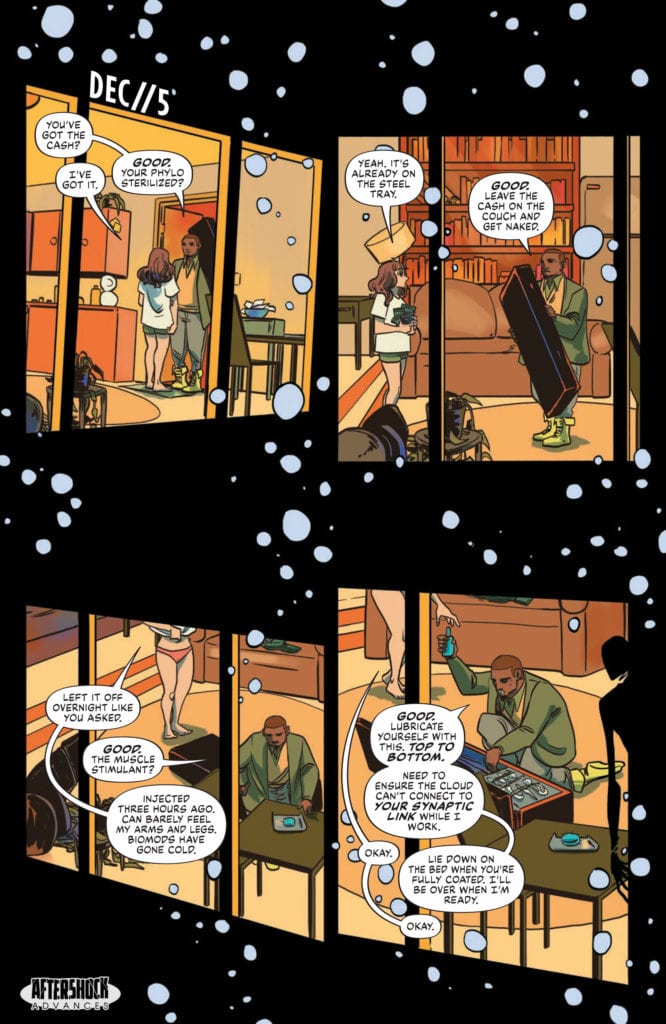
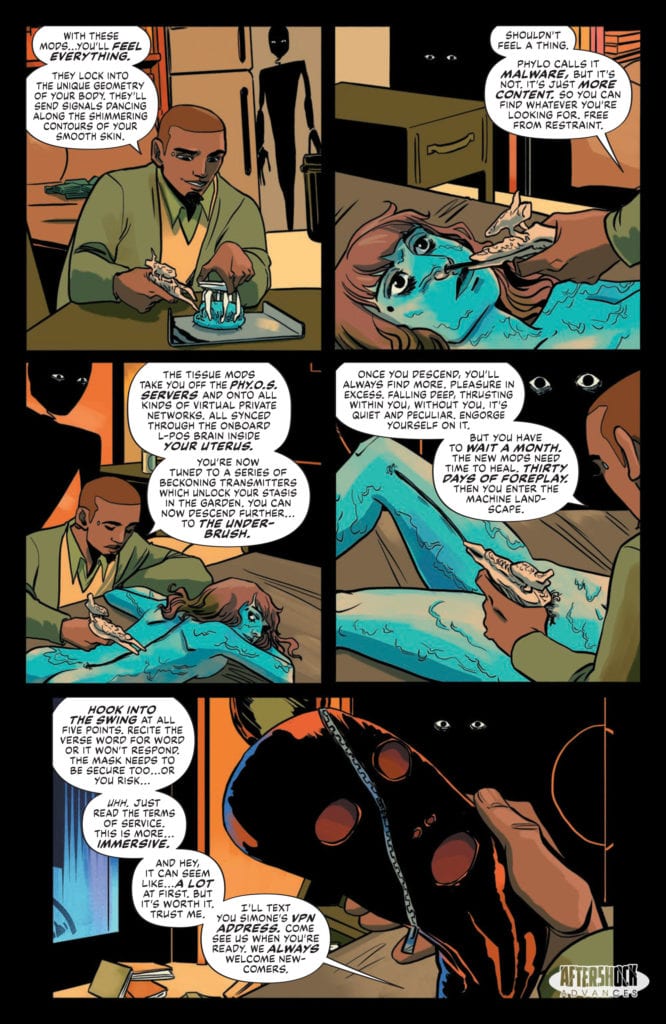
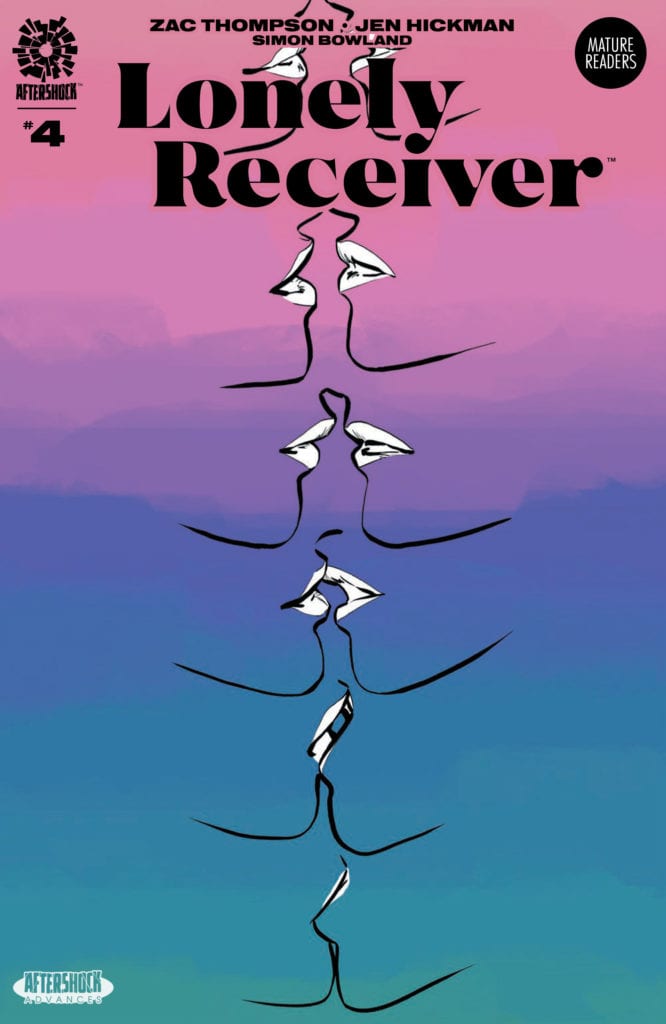
LONELY RECEIVER #4 hits your local comic book store December 9th, but thanks to AfterShock Comics, Monkeys Fighting Robots has an exclusive four-page preview for you.
About the issue: A horrific breakup story in five parts.
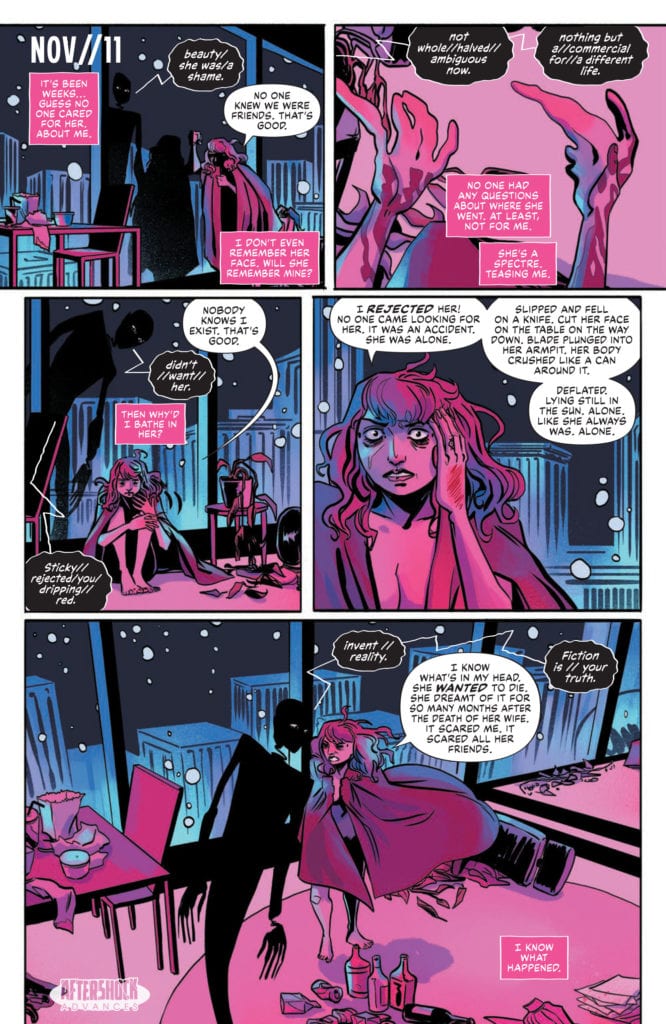
Catrin is truly alone and descending into madness. Lost with her thoughts, she finds herself reeling, falling deeper in love with her phone. But it refuses to love her back. So, she gives herself to it and becomes one with the machine landscape.
Reeling backward / and I’m changing // // Not myself / I evolve / spinning into the green above / Descending deep / I’m alone / spiraling into others / / Until I meet // the one I love.
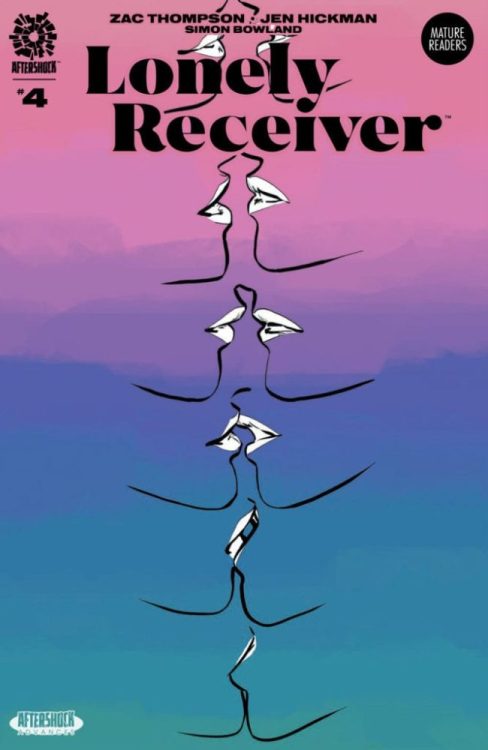
LONELY RECEIVER #4 is by writer Zac Thompson and artist Jen Hickman, with letters by Simon Bowland. The cover is by Hickman.
Check out the LONELY RECEIVER #4 preview below:
Are you reading LONELY RECEIVER? Sound off in the comments!
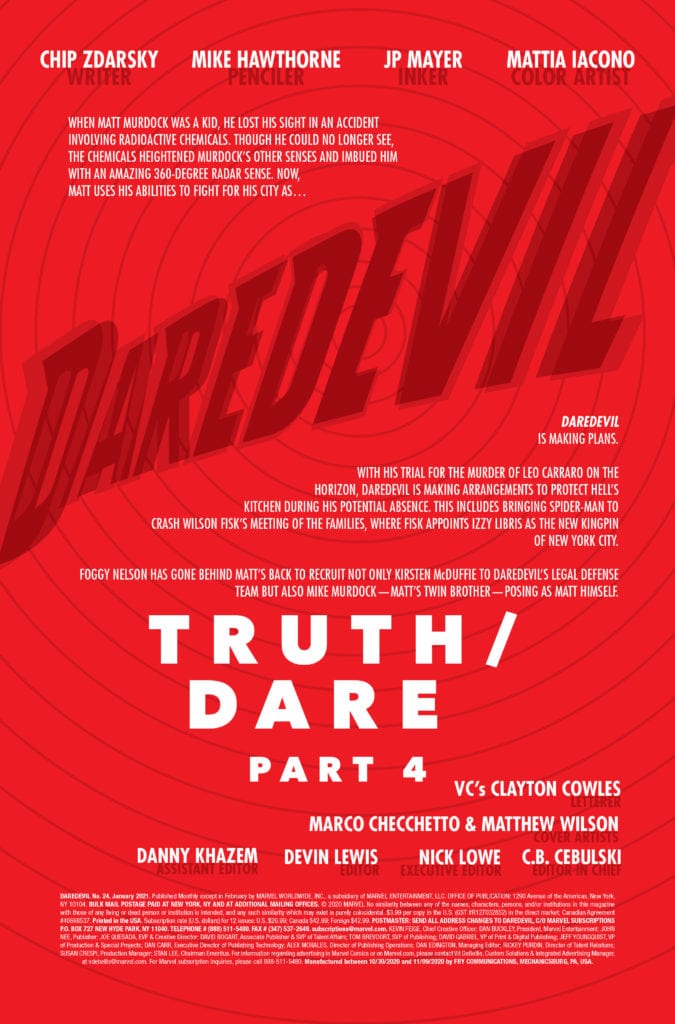
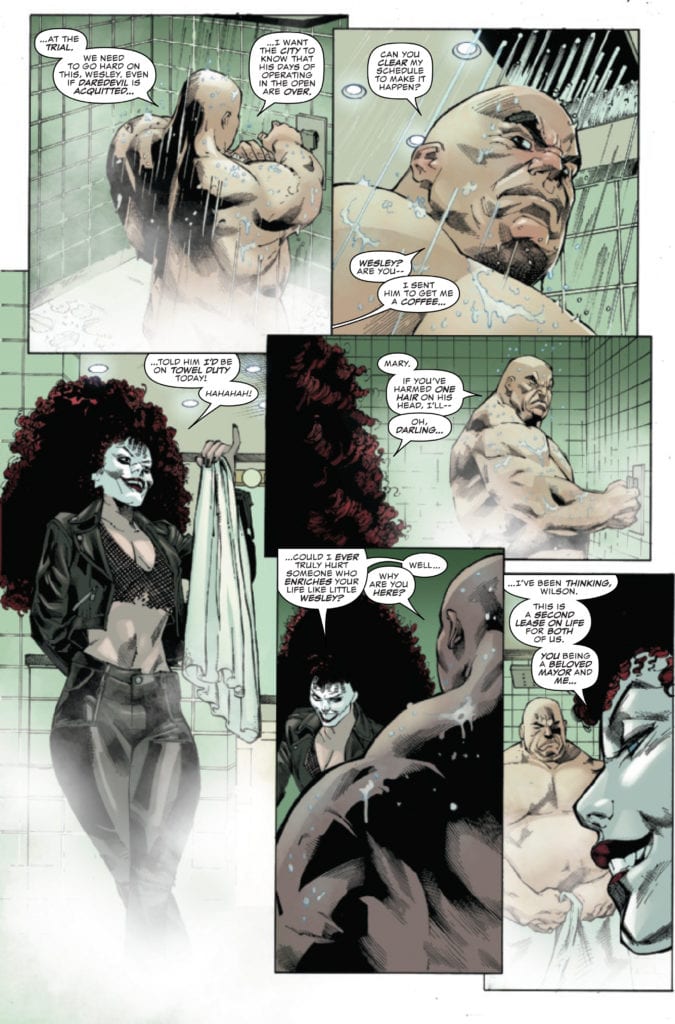
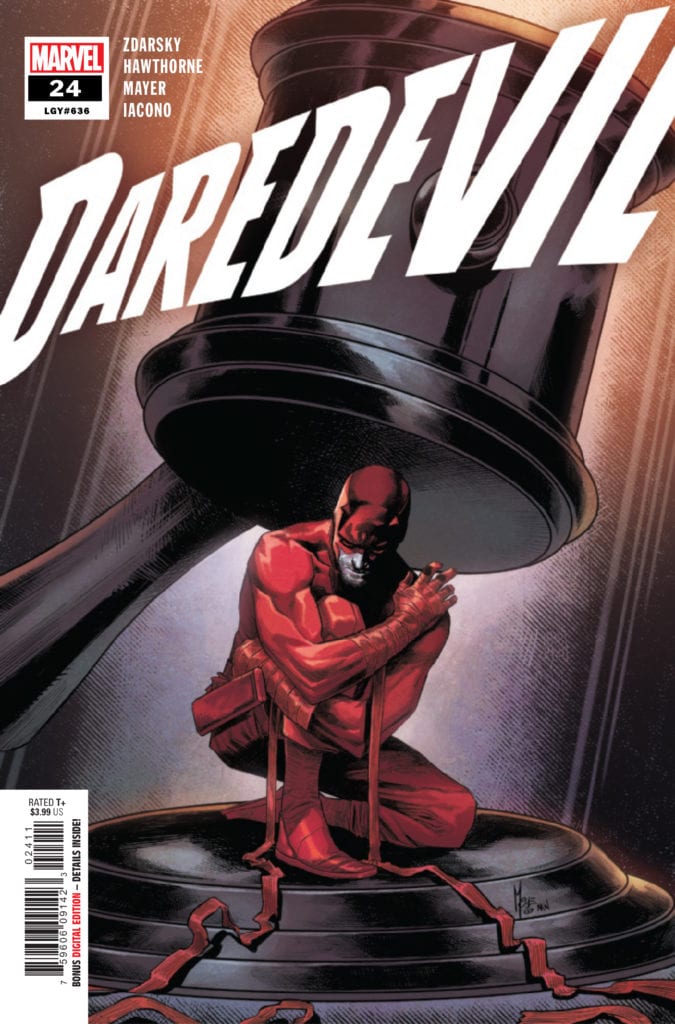
DAREDEVIL #24 hits your local comic book store November 25th, but thanks to Marvel Comics, Monkeys Fighting Robots has an exclusive four-page preview for you.
About the issue: THE VERDICT ON DAREDEVIL!
BACK IN RED, but for how long? As Hell’s Kitchen still reels from the chaos unleashed upon its streets by the Stromwyns, its citizens are looking for someone to hold accountable.
MEANWHILE, hizzoner Mayor Wilson Fisk, now a hero in the eyes of his citizens, sets his sights on a new venture – with a dangerous ally at his side.
DAREDEVIL #24 is by writer Chip Zdarsky and penciller Mike Hawthorne, with inks by JP Mayer, colors by Mattia Iacono, and letters by Clayton Cowles. The cover is by series regular artist Marco Checchetto and colorist Matthew Wilson.
Check out the DAREDEVIL #24 preview below:
Are you reading DAREDEVIL? Sound off in the comments!
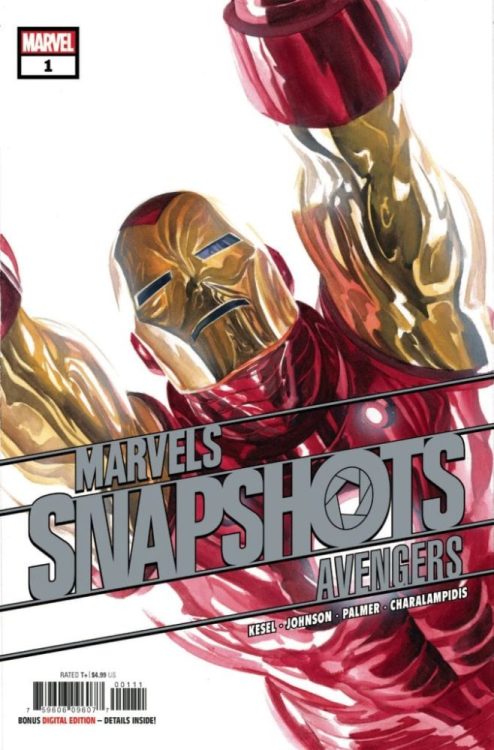
MARVELS SNAPSHOTS AVENGERS #1, available from Marvel Comics on November 18th, tells a slice of life story between two first responders against the backdrop of Avengers battles in the Big Apple. Written by Barbara Randall Kessel, this story looks at how the Avengers’ escapades affect the citizens around them.
Cover Art
Alex Ross produces another winner with his hyper-realistic depiction of Iron Man in flight. Although this is an Avengers title, a majority of appearances are with Iron Man/Tony Stark, so the cover subject is fitting for the content. Iron Man is a bold, singular figure against the plain white background, and you can almost imagine his trajectory pulling the reader along at hypersonic speeds. It’s a beautiful Ross painting.
Writing
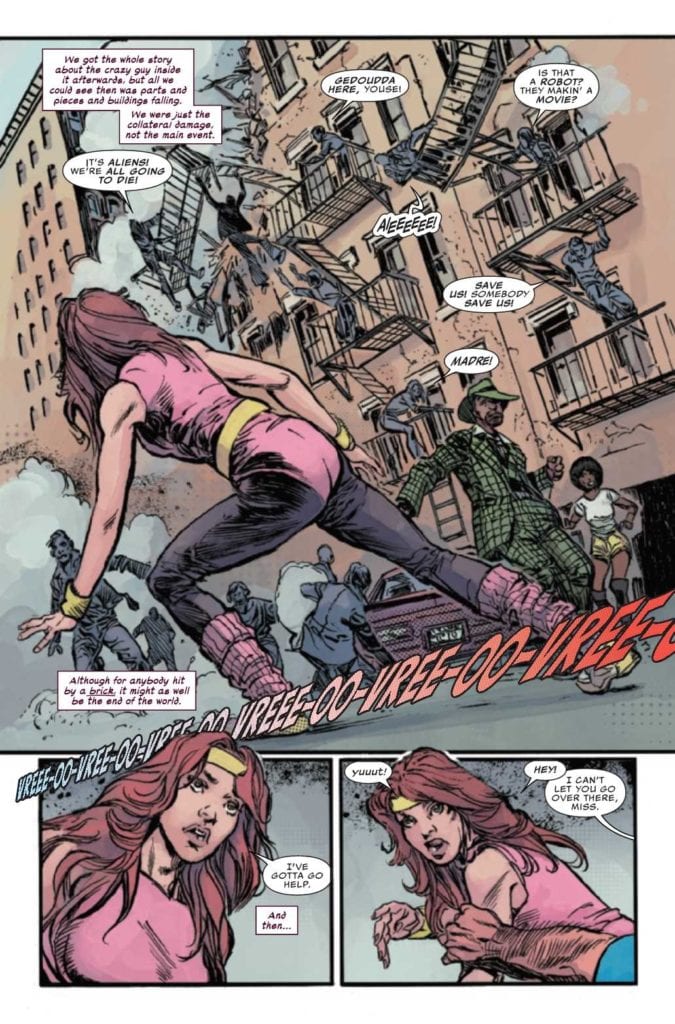
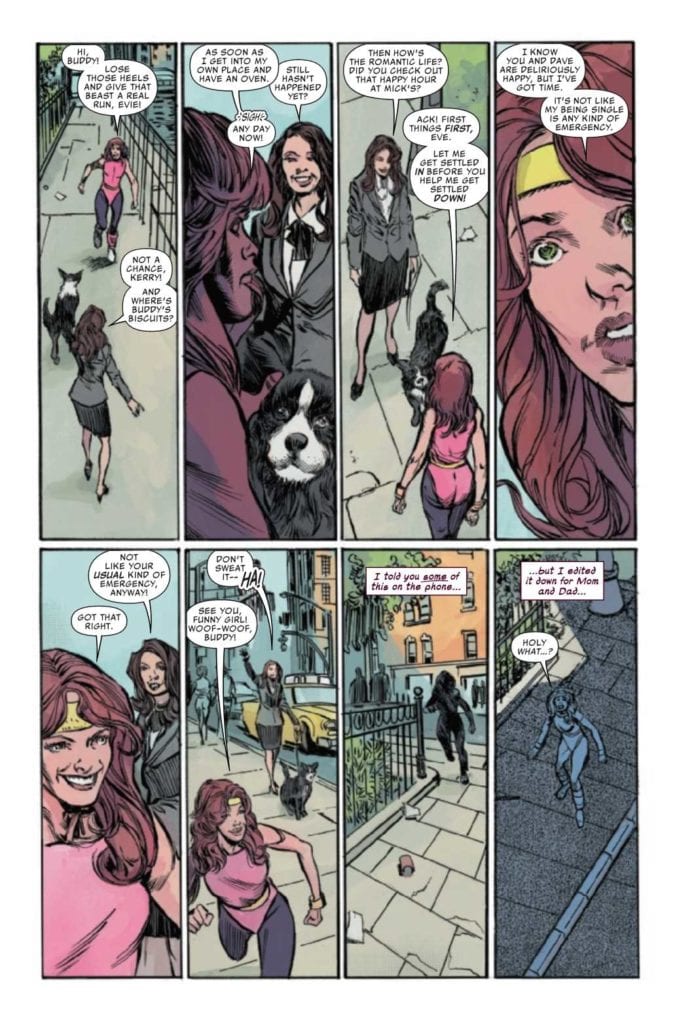
Kessel’s story, true to the intent of the Snapshots series, successfully looks at superheroes through a radically different lens. The main characters, Kerry and Jay, partner up to help wounded civilians in a bunker while an Avengers battle rages on the city streets above them.
This is a light-hearted romance story with a decidedly New York flavor to it. New Yorkers (speaking as a former Brooklynite) have an uncanny ability to roll with the punches, even in the most extreme or bizarre situation, and this issue reflects that quirk perfectly. I enjoyed the hometown (for me) sensibility, and the snappy banter between the lead characters felt as good as any comedic romance film, ala When Harry Met Sally.
Pencils/Inks
Staz Johnson’s pencil work hits the right tone by giving the main characters some action proportional to their role as first responders without going over the top. The visuals were good enough to hold my attention, but I didn’t feel like the movements were so exaggerated as to not make sense for who the characters were or what they were doing.
Tom Palmer’s inking work is mostly good with a few rough sports. Palmer uses a lot of thick lines to provide depth and contour to the surroundings well enough, but sometimes the line thickness looked sloppy on the page, especially when you have multiple pages with six grid layouts and higher. Also, the inking tended to distort faces, making them look droopy. Overall, the art’s good, but it needed some refinement.
Coloring
Jim Charalampidis’ colorwork is exceptional in this issue, specifically because this is a grid-heavy issue. Working within small, tight panels, Charalampidis’ added tons of clean, multi-layered shading to make each character distinctive without looking smudged or blotchy.
Lettering
VC’s Ariana Maher does a great job working within such a confined space to mix in copious amounts of narration captions and dialog. The art was never crowded out, and the words flowed smoothly.
Conclusion
MARVELS SNAPSHOTS AVENGERS #1, available from Marvel Comics on November 18th, works as a light-hearted romantic comedy in the unlikeliest of settings. The story is chock full of witty banter, and the art is fairly solid. This is a recommended buy.
JUGGERNAUT #3, available from Marvel Comics on November 18th, puts Cain Marko in the middle of a lawsuit for past damages while an old enemy comes calling for D-Cel. Fabian Nicieza’s writing establishes a solid redemption story for Juggernaut and teases a deeper mystery in store for the giant and his “agent.”
Cover Art
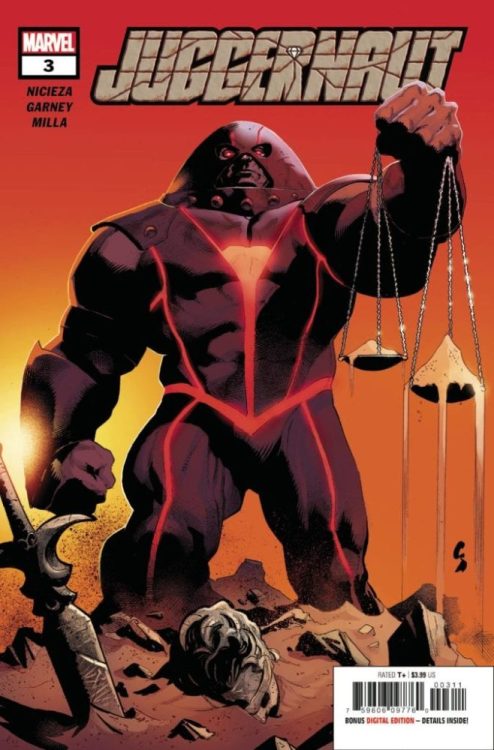
Geoff Shaw’s cover is as menacing as it is prescient. Juggernaut holds the scales of justice amidst the rubble, and his cold, glowing stare suggests an enemy underneath is pulling the strings. Shaw paints a powerful pose that brings your eye right to Juggernaut’s eyes in a magnetic way.
Writing
Nicieza picks up a short period after the events of issue #2 (read our review of Juggernaut #2 here) with the lawsuit well underway when a powerful villain interrupts the proceedings. During the ensuing chaos, we’re treated to some flashback scenes reminiscent of Batman Begins’ training scenes that explain how Marko got his new armor.
The mystical, magical, hard-earned explanation for the new armor works. It defines Marko as somebody who’s as tough on the inside as he is when wearing the Juggernaut armor on the outside. That toughness, and his increasing willingness to help people, turns Juggernaut into a former-villain that’s easy to root for.
Nicieza’s allusion to a big bad behind the scenes increases my anticipation and excitement for the next issue.
Pencils/Inks
Ron Garney’s rough style continues to match Juggernaut’s rough, blue-collar nature in a very organic way. He’s a character that’s not afraid to get his hands dirty, and Garney’s art is perfectly in line with that rough-and-tumble sensibility.
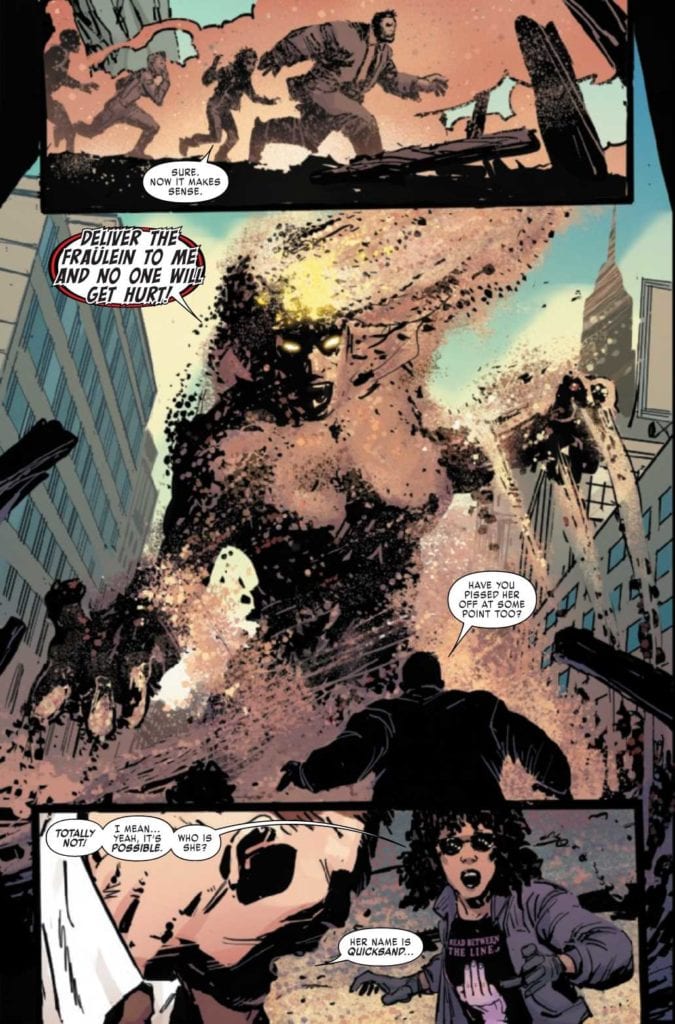
The rough style works even better in this issue because the guest villain, Quicksand, takes on a grainy, flowing anatomy that suits Garney’s work well.
Coloring
Matt Milla adds authenticity to this issue with great use of filters, specifically on the flashback scenes. It helps to delineate between panels in the present day and actions set in the past, and the coloring makes the flow of multiple timelines clear and easy to follow.
Lettering
VC’s Joe sabino executes a credible job with clean, clear, and concise lettering. The lettering is a little too clean as it doesn’t quite integrate with the art style naturally, but it carries the story through at a good pace.
Conclusion
JUGGERNAUT #3, available from Marvel Comics on November 18th, is an entertaining entry in a, so far, surprisingly good series. The art matches the characters and situations perfectly, and the story is far from predictable in the best possible way. I highly recommend this book.
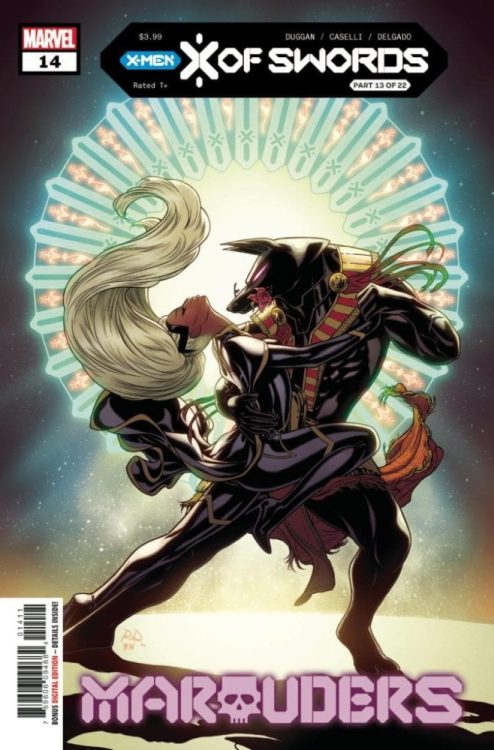
Per this issue’s gorgeous cover by Russell Dauterman and Matthew Wilson, Storm and Death take center stage in this issue.
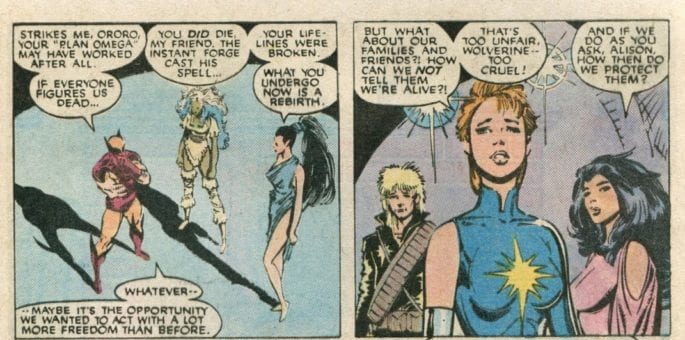
The conversation between the two is one of mutual respect and almost flirtation (although Storm makes it clear she does not desire Death). At one point, Death tells her, “The other sword bearers of your host have tasted death many times…in many ways…but not you.”
This is an interesting comment for him to make, and looking at Storm’s publication history, it is true that it is hard to find instances of her dying like many of her cohorts have. Wolverine famously died back in 2014 in The Death of Wolverine storyline. Magik died in Uncanny X-Men #303 from the Legacy Virus (she got better). Even Douglas Ramsey (Cypher) died all the way back in New Mutants #60 in 1988. The others, likewise, have similar death stories.
But not Storm, so Duggan, Percy, and Hickman are doing some serious foreshadowing here, especially given that Storm drew the Death tarot card in Stasis, which claimed not to be a reason for fear and promised a metamorphosis.
This is a deep continuity cut from the X-titles team to highlight Storm’s uniqueness of never having experienced “comic book death.”
However, there is one problem here.
Storm actually died in the Fall of the Mutants storyline back in 1988 (weirdly even, the same story in which Cypher dies). While the details of the story aren’t terribly important here, what matters is that all of the X-Men give their life-force to stop an enemy only to be immediately resurrected. But it is made clear in the text of Uncanny X-Men #227 that the X-Men DID die.
As Roma clarifies, the X-Men really did die (interesting side note: this scene also takes place on the Starlight Citadel).
Given that the X-Men are resurrected in the same issue and don’t disappear from publishing history for a few years, I suppose we can let this one slide.
Mirka Andolfo Partners with Executive Producer Erik Barmack and Wild Sheep Content for Sweet Paprika Animated Series; First Images Revealed
The former Netflix VP joins the comic creator alongside Director Gabriele Pennacchioli and production companies Grey Ladder Productions & Arancia Studio.
Internationally renowned comic creator Mirka Andolfo (Mercy, Unnatural) has partnered with executive producer Erik Barmack and his production firm, Wild Sheep Content, for Sweet Paprika, Andolfo’s debut animated series. Barmack joins Sweet Paprika following an eight-year run at Netflix where, among other positions, he served as the Vice President, Head of International Originals, where he spearheaded the development of series including The Witcher from Poland and the United States, La Casa de Papel from Spain, The Rain from Denmark, Dark from Germany, and Sacred Games from India, among others. Barmack has continued his mission of developing esteemed international programming through his own firm, Wild Sheep Content, which he founded in May 2019. The company has secured a number of high-profile projects since its inception, including the animated collaboration with French African artist Nicholle Kobi, Queens, as well as the live-action adaptation of the bestselling Yakuza video game series with Sega and 1212 Entertainment. To date, Wild Sheep Content has secured 12 projects into development with platforms, studios, and third party financiers.
“Mirka has the rare ability to enchant readers across the globe, and I couldn’t be more excited to help adapt her vision from page to screen with Sweet Paprika,” Barmack said. “It’s a charming, relevant, and hilarious foray into romantic comedy, and a project I couldn’t resist.”
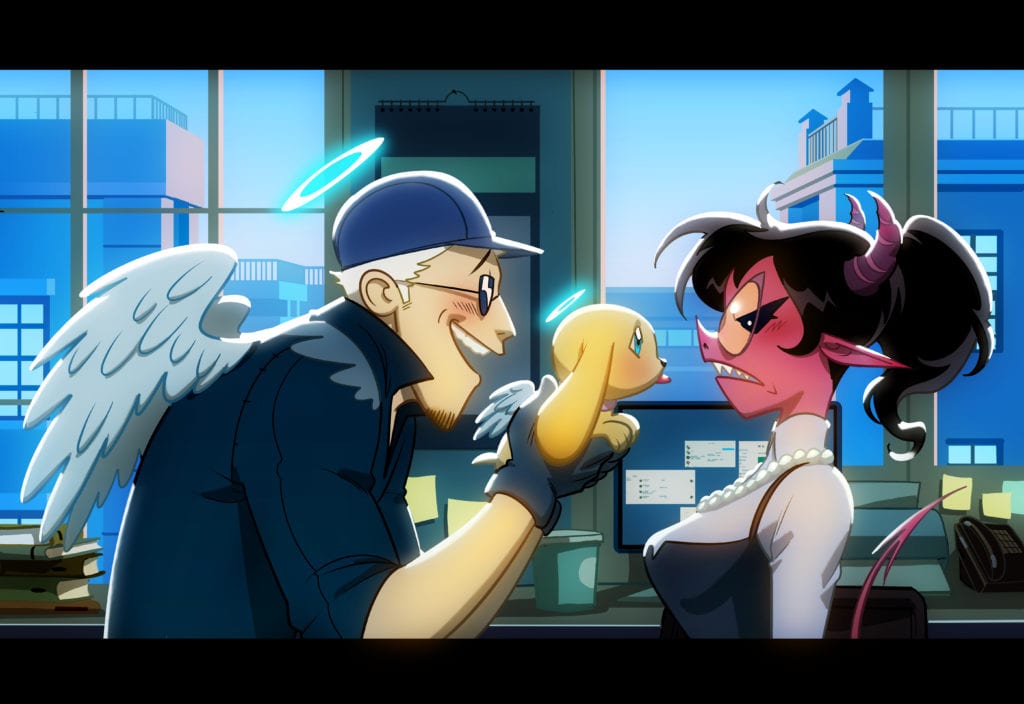
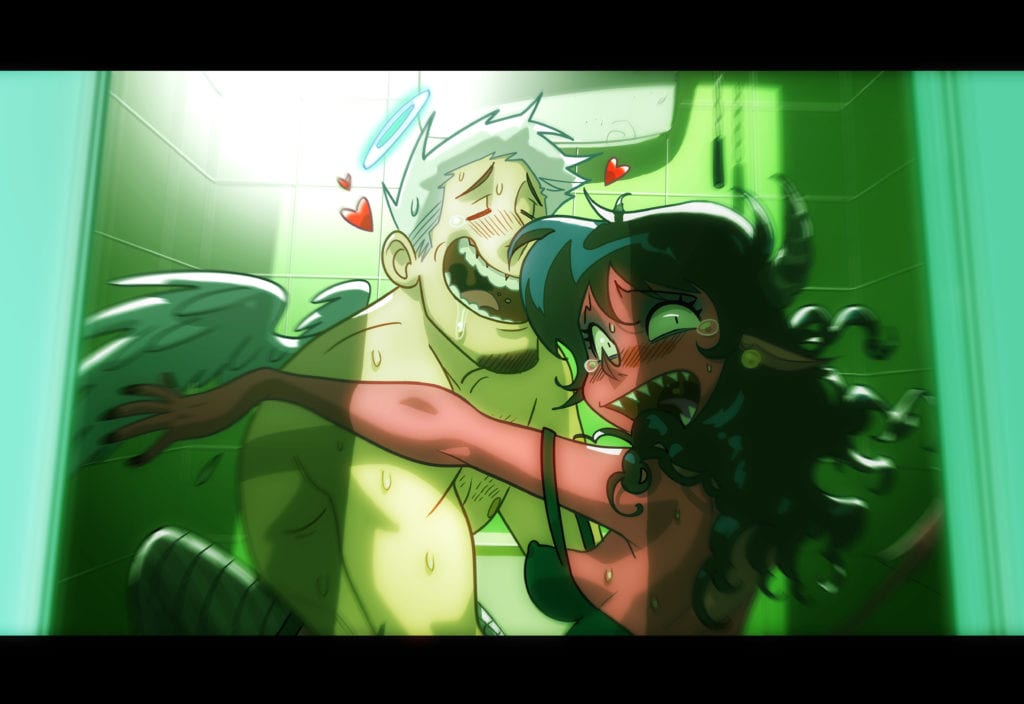
Announced last July, Sweet Paprika is an original idea from Andolfo that revolves around the erotic misadventures of a career-driven woman—Paprika—who reluctantly engages a charming, if immature, delivery boy named Dill. Consumed by her job at a major New York City publisher, Paprika learns to balance her own needs as she embarks on a frustrating, passionate romance with Dill. In October, Andolfo announced that she will also write and draw a Sweet Paprika comic book series, published by Image Comics beginning in July 2021, with Edizioni Star Comics releasing in Italy and Éditions Glénat in France. Arancia Studio is producing both the book and the animated project, with Grey Ladder Productions aiding the latter.
“Erik has been a pioneer in global storytelling, introducing the most vital international voices to the biggest audiences,” Andolfo said. “It’s an honor to have him collaborate on Sweet Paprika.”
Gabriele Pennacchioli, who received a 2019 Primetime Emmy Award for his role as Supervising Director on Netflix’s Love Death + Robots, will serve as Director. Pennacchioli has 25 years of experience in animated features, working on such films as Shark Tale, Shrek the Third, Kung Fu Panda, and How To Train Your Dragon, among others.
For more news and coverage of Sweet Paprika and more of Mirka Andolfo’s work, stay glued to Monkeys Fighting Robots!
FRANK AT HOME ON THE FARM #1, out today from Scout Comics, is the first issue of a 4-issue psychological horror miniseries. If you’re looking for a few good scares, and a mysterious, well-crafted plot, this is the perfect book for you.
About the issue:
Frank returns from the trenches of World War I expecting to be greeted by his loving family on their farm. What he finds instead is a dark mystery, his family missing, and only the animals there waiting for him.
Writing
As a psychological horror writer, there’s a thin line you walk between confusing and intriguing your reader. Fortunately enough, writer Jordan Thomas only manages to do the latter. Throughout the entire issue, there is so much mystery — so many unanswered questions, like “Where is Frank’s family?” or “What’s up with the weird animals in this town?” The reader can’t even get themselves to start questioning what the heck is going on. In this comic, all they can do is sit back and let the puzzling story creep up on them with the promise that it’ll eventually sweep them off their feet and answer every question they have.
One of the big answers in this series brilliantly arrives only at the issue’s last few pages. But when it arrives, the reader’s left so astonished and curious, their thirst to know more grows with each time they contemplate what they had just read. I’m personally really looking forward to learning more about this story’s weird world and characters. Exquisite work here from Thomas.
Art
Bint’s artwork pairs perfectly with Thomas’ creepy tale. His layouts tell a clear story, manipulating the reader’s feelings as Bint sees fit. The terrifying panels look well-detailed and convey real horror. The characters’ facial expressions look incredibly distressing and ugly to great effect. The grim, cold color palettes elevate the story’s uncomfortable vibes, and his use of natural light to add to the mystery and intensity works beautifully. But Bint’s most important feat comes with the paranoia he manages to convey in the pages’ panel gutters.
More specifically, there’s a scene where Frank, the main character, enters an old lady’s store and inquires about his family’s whereabouts. Upon realizing he’s just walked into a taxidermy store, Frank freaks out. The reader keeps getting the paralyzing notion that Frank’s being watched. If the reader doesn’t look close enough, they might miss it. But on a second look, the reader discovers that between the panels, the cold, prying eyes of all the dead animals at the taxidermy store were staring at them this entire time. These simple but clever choices Bint makes along the way never ceases to amaze the reader. After reading this issue, anyone will leave it wanting to see what Bint has in store for them next.
Lettering
There’s simply not a single flaw in LetterSquids’ wonderful, stylish lettering. The bolded words pop out, making the reader think they can almost hear the characters talking. The choice to not use any sound effects brings a new layer of gravitas. When the characters scream, LetterSquids masterfully makes it look realistic and dramatic. Each choice LetterSquids makes elevates the art to a whole new level of creepiness and suspense. It’ll be interesting to see how LetterSquids is going to handle the lettering once the story inevitably reaches its darker moments.
Conclusion
Frank at Home on the Farm #1 gives the readers everything they could’ve hope for, and then some. The story is a psychologically terrifying tale with many unanswered questions, and the art’s unique style further engages the reader in the story’s world and grabs them by the throat, refusing to let go. Strongly recommended for fans of The Shining and Animal Farm.
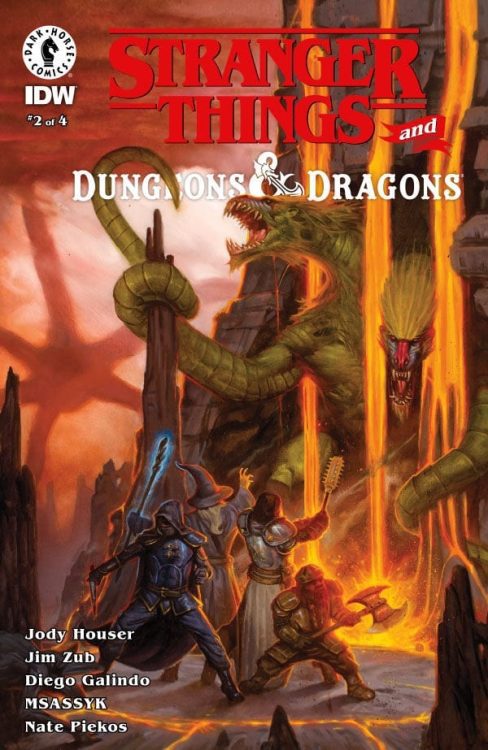
STRANGER THINGS AND DUNGEONS & DRAGONS #2, available December 2nd from Dark Horse Comics, continues the adventures of four boys and the Tabletop RPG they fell in love with. It’s so easy to forget just how much this game had a positive impact on their lives.
Heroes unite once again in Stranger Things and Dungeons & Dragons #2.
Easy to forget, that is, until a series like this forces us to see how it all connects. The last issue explained how the four friends came to be, and how they made one discovery that would forever change their lives. Now, it’s time to see more of those long-lasting changes and impacts, in Stranger Things and Dungeons & Dragons #2.
Honestly, there’s something so empowering in seeing how many positive changes were wrought by this discovery. There’s no doubting that D&D changed the lives of these characters for the better. Just look at how well they were able to cope during the Netflix series. They used terminology, confidence, and knowledge gained from that very game.
The Writing
The adventure of four kids in Hawkins continues in Stranger Things and Dungeons & Dragons #2. Written by Jody Houser and Jim Zub, this issue takes place after the events of the first season. Meaning that it happens after Will went missing — and was eventually saved. Not to mention everything else that happened in between.
While there are also two more seasons (at the moment) that take place after that point as well, the focus felt significantly different. This issue, the whole series, was intentionally written to showcase the changes made by D&D.
So naturally, one can guess the focus here: How four kids, damaged and hurting, once again learned coping mechanisms from something they have come to treasure so much. It was heartbreaking yet beautiful to see and read. One of those moments that many a reader can connect with. Even if they themselves are lucky enough to never have faced a Demogorgon in real life.
In many ways, this issue focused on the smaller moments that make up the series. In that way, what was written here felt very…human. Other than their past experiences (and their awaiting future), there was nothing larger than life or supernatural about it. Or how they were coping.
The Art
Stranger Things and Dungeons & Dragons #2 is a vibrant issue. One that struck a balance between comic art and the styles portrayed within the show. It’s an issue steeped in details of the time period — with D&D imagery to help flesh it all out.
Diego Galindo was the lead artist, portraying all of these little details, and then some. Galindo did an especially wonderful job showing the lingering trauma of events, making solid use of the imagery available to do so.
Msassyk’s colors really brought it all to life, while also sticking the issue firmly in the 80s. There’s no avoiding those specific hues, not without diving back into the Upside Down, that is. On that note, The Upside Down and its creatures felt even brighter than ever in this issue, thanks to the contrast.
Nate Piekos’s lettering is another detail worth mentioning. Much of the issue was an internal monologue, yet Piekos arranged it in such a way as to carry the imagery, rather than interfere. The two worked hand and hand, and created something new.
Conclusion
Stranger Things and Dungeons & Dragons #2 is a bittersweet issue, one that follows the events of the first season. Its success is in making the characters feel so very human, as they learn to cope with everything they have seen and survived.