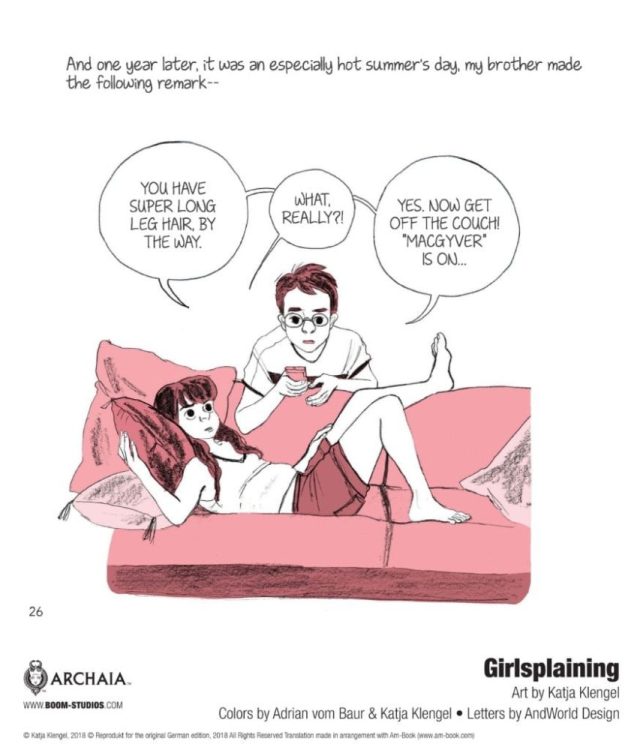
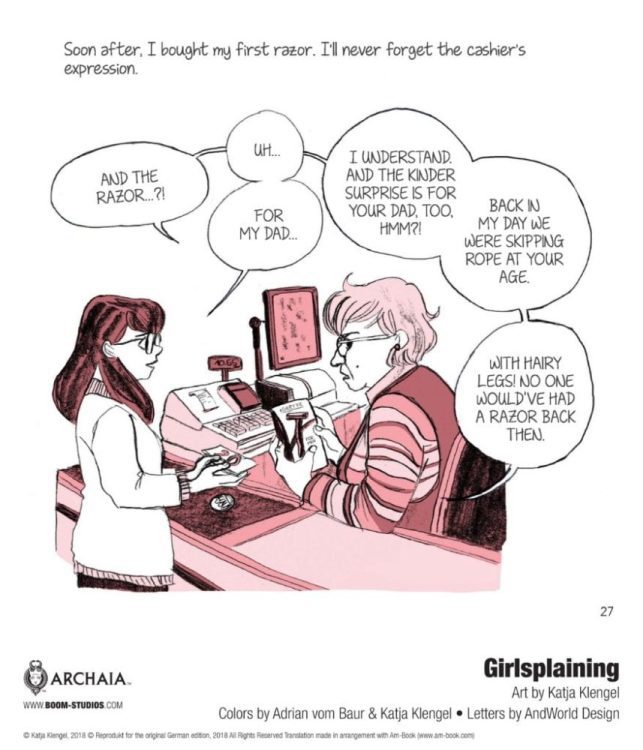
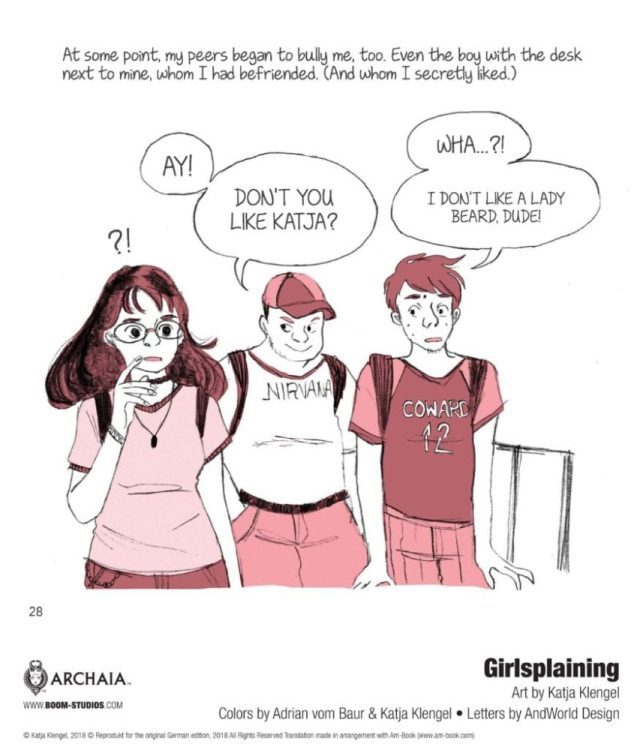
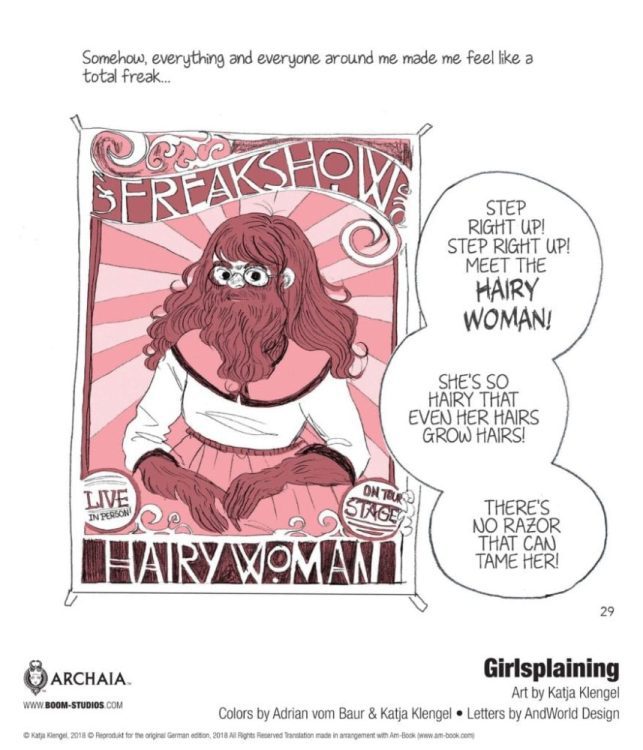
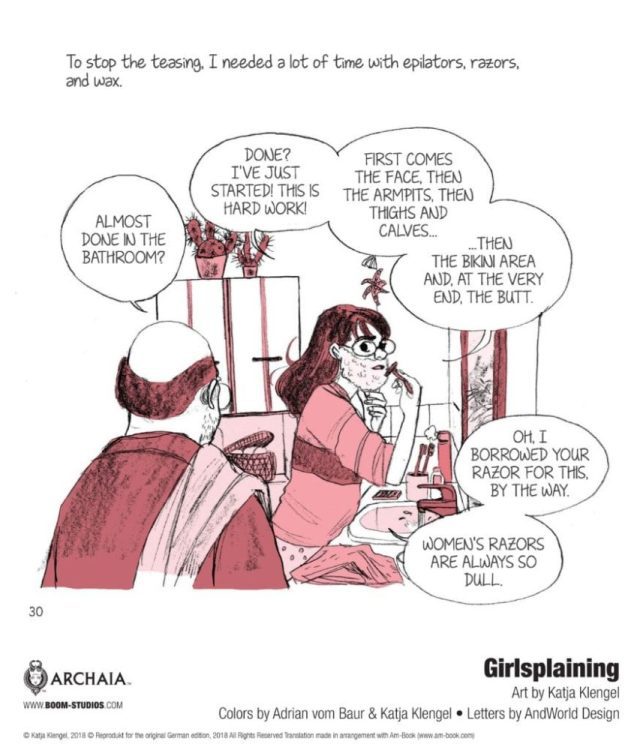
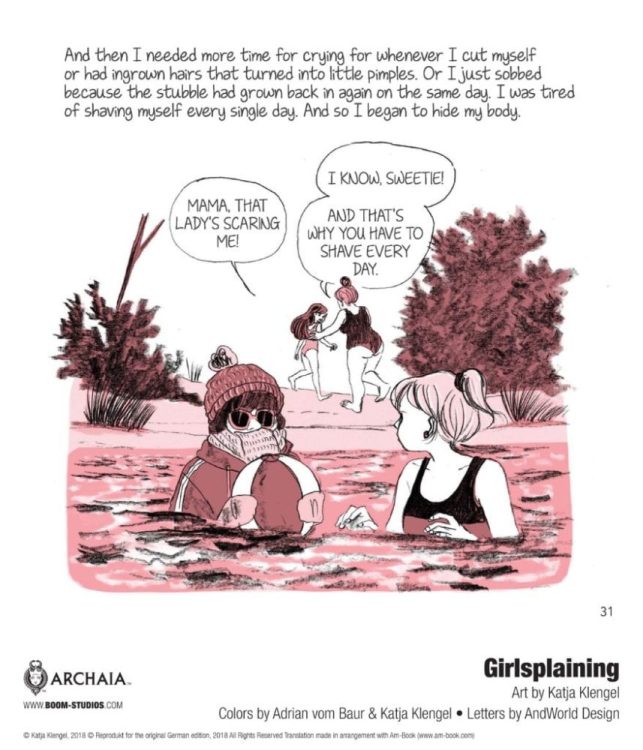
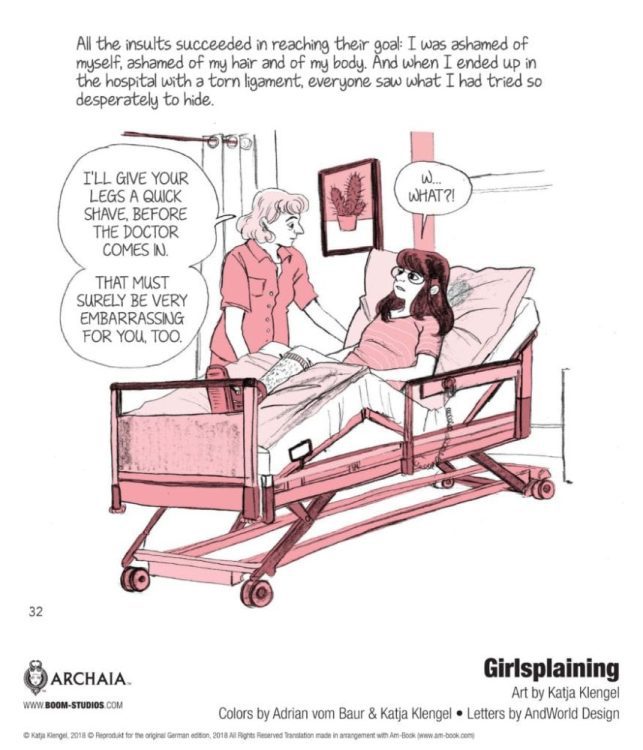
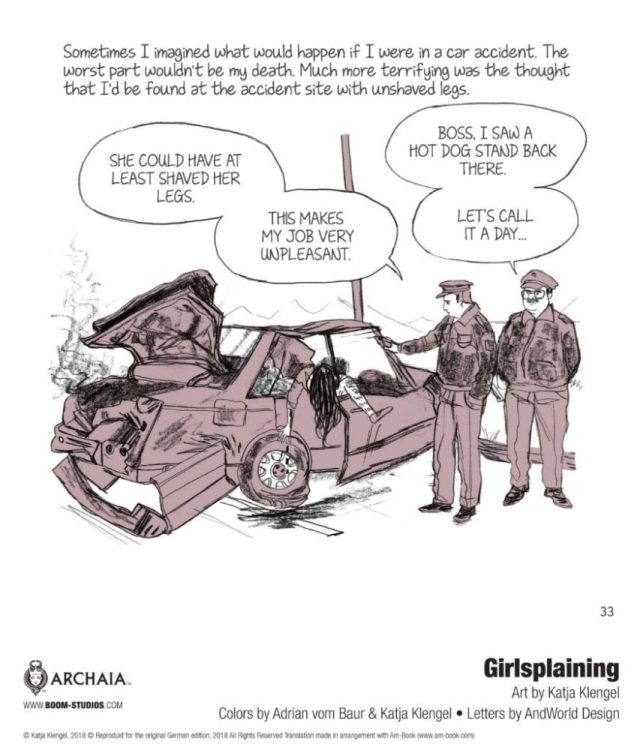
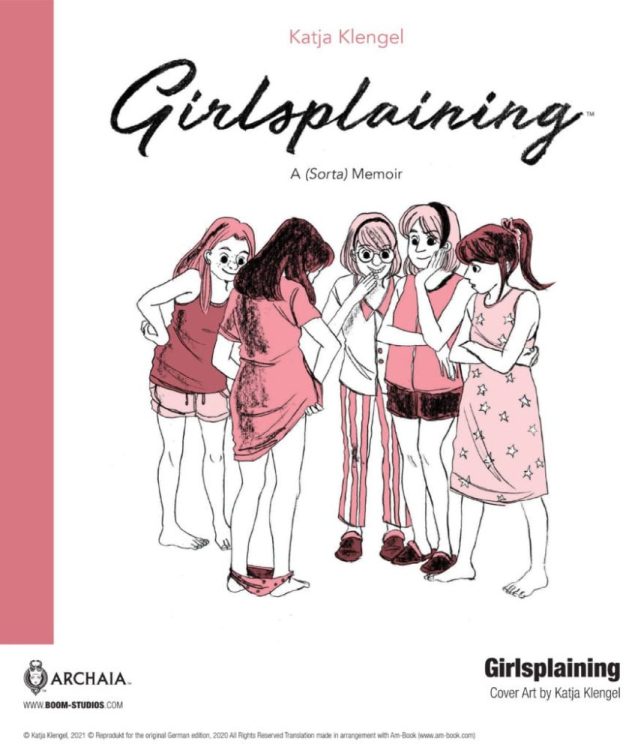
GIRLSPLAINING: A (Sorta) MEMOIR by German cartoonist Katja Klengel hits your local comic book store on March 3 and book stores on March 9, but thanks to BOOM! Studios, Monkeys Fighting Robots has an eight-page preview for our readers.
About the graphic novel: Why do we fear the word “vulva” so much? Do we really have to be ashamed of our body hair? Why do gender roles in children’s toys seem to be stuck in the ‘50s? With a healthy sense of humor, an open heart, and unsparing candor, Klengel looks back on her childhood through the lens of the popular culture that shaped her identity and examines what being a woman today means to her (and really, a whole lot of us!).
GIRLSPLAINING: A (Sorta) MEMOIR is drawn by Klengel, Adrain vom Bauer assists Klengel on colors, and AndWorld Design handled letter work.
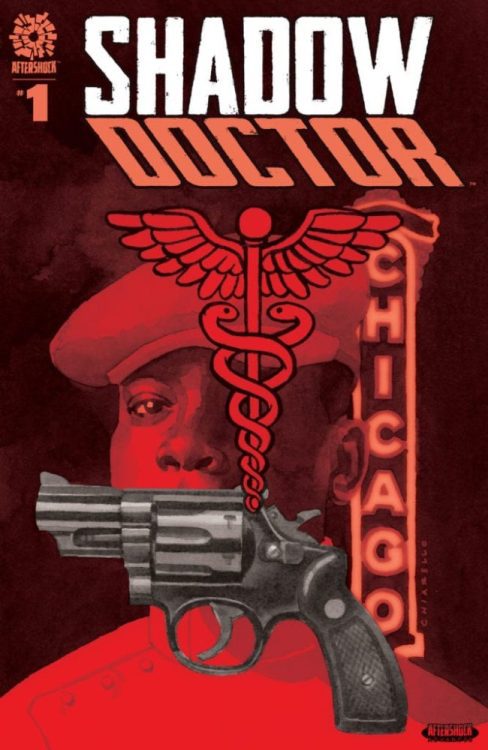
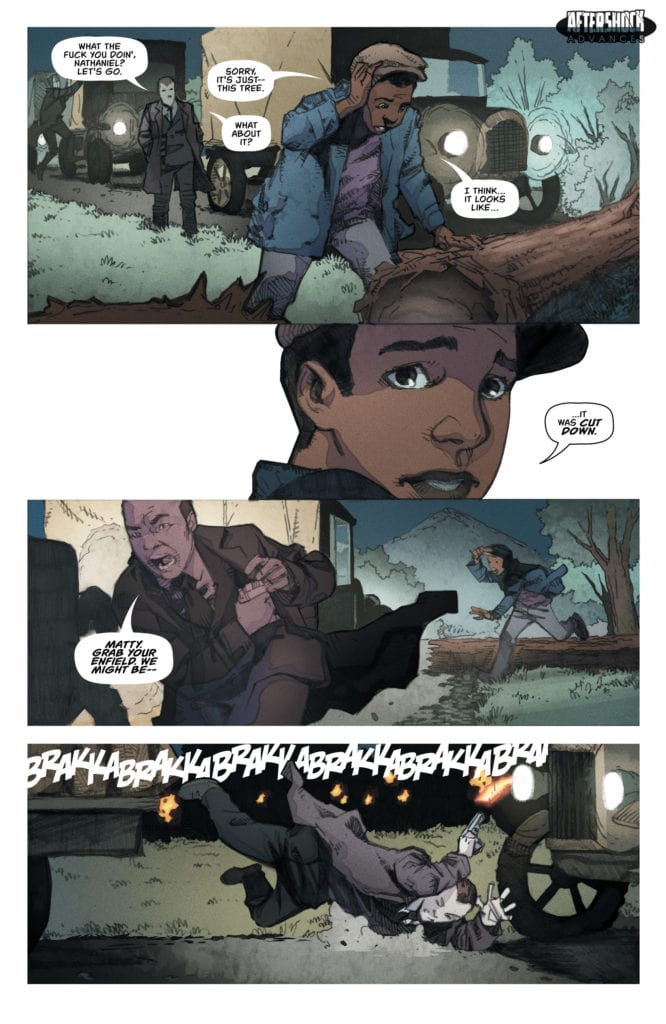
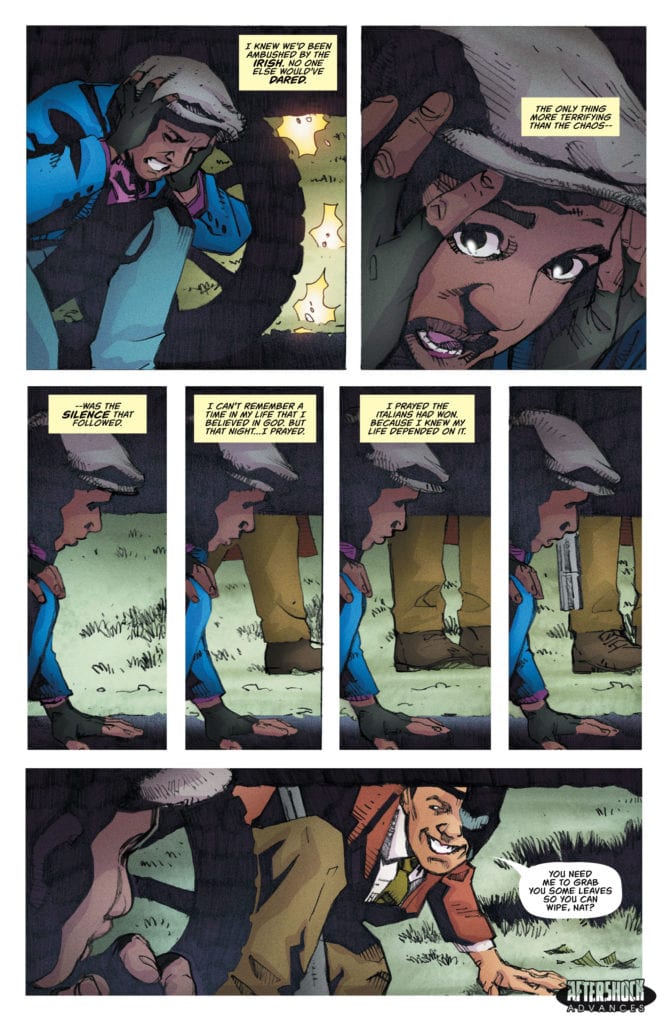
SHADOW DOCTOR #1 hits your local comic book store February 17th, but thanks to AfterShock Comics, Monkeys Fighting Robots has an exclusive four-page preview for you.
About the issue: Years in the making, this is the true story of writer Peter Calloway’s grandfather, Nathaniel Calloway, a Black man who graduated from medical school in the early 1930’s. Unable to get work at any Chicago hospitals because he was Black, and unable to secure a loan from a bank to start his own practice because he was Black, he turned to another source of money in Prohibition-era Chicago: the Mafia, run by none other than Al Capone.
SHADOW DOCTOR #1 is by writer Peter Calloway and artist Georges Jeanty, with colors by Juancho! and letters by Charles Pritchett. The main cover is by Mark Chiarello.
As Calloway himself says:
“On the one hand, his story represents the promise of America. On the other hand, it shows the worst of it.”
Check out the SHADOW DOCTOR #1 preview below:
Are you looking forward to SHADOW DOCTOR? Sound off in the comments!
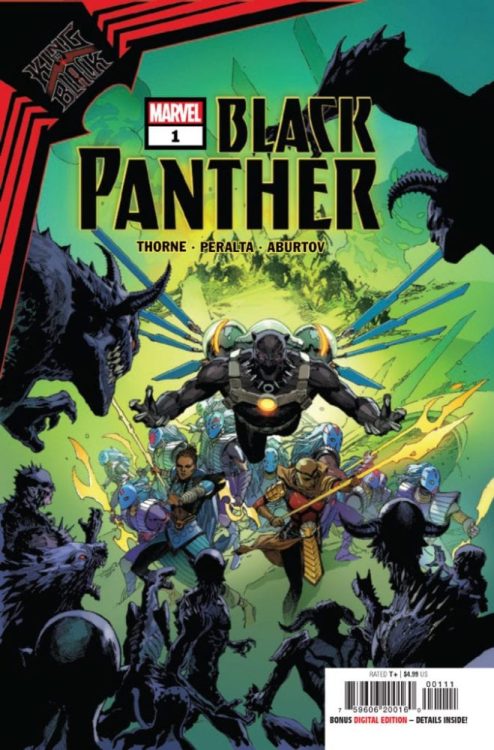
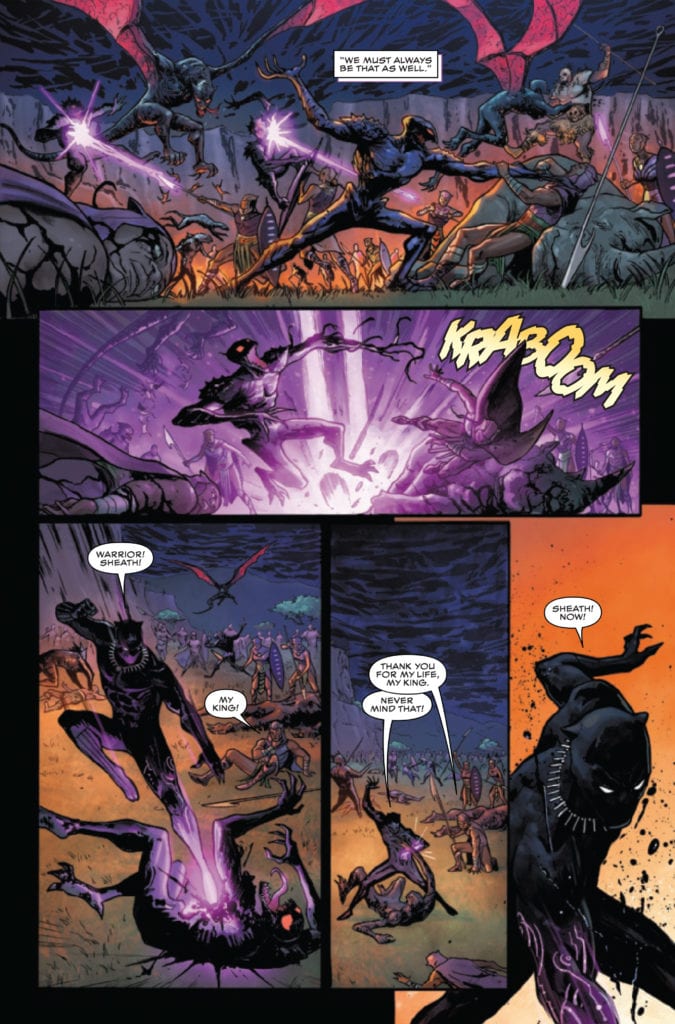
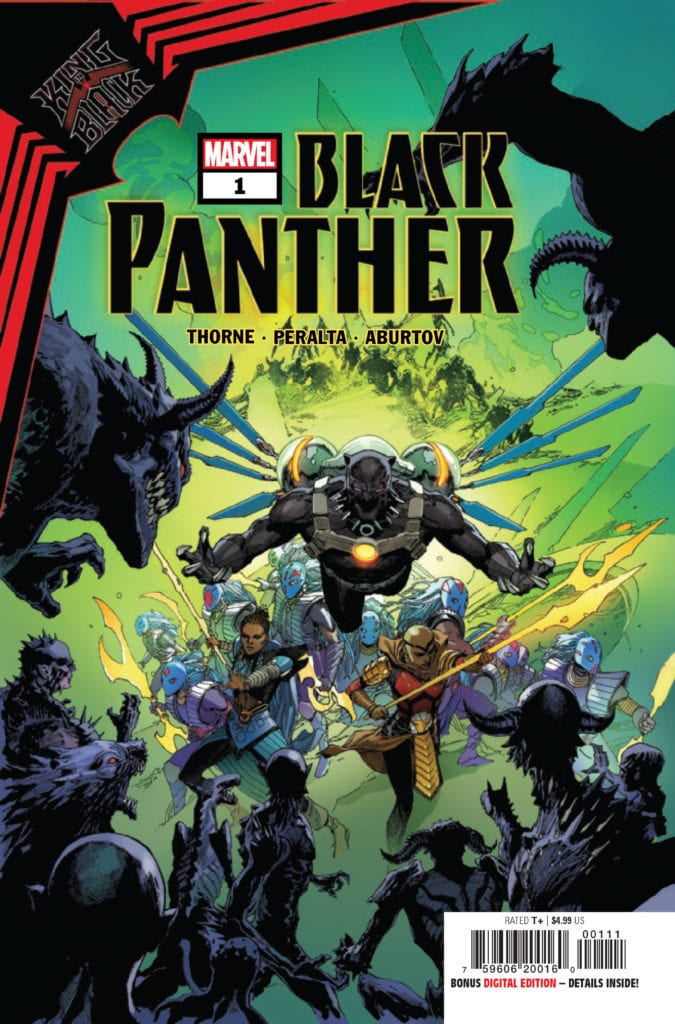
KING IN BLACK BLACK PANTHER #1 hits your local comic book store February 10th, but thanks to Marvel Comics, Monkeys Fighting Robots has an exclusive four-page preview for you.
About the issue: SYMBIOTES INVADE THE UNCONQUERABLE COUNTRY OF WAKANDA! T’Challa’s most treasured allies are lost in a storm of Knull’s making in this wild one-shot! Critically acclaimed writer, actor and producer Geoffrey Thorne explores a Wakanda gone dark – invaded by Knull’s massive symbiote army. Wakanda needs its king. It needs the Black Panther. But once again, the hero must choose between his role as an Avenger, his role as a king… and the yearnings of his heart.
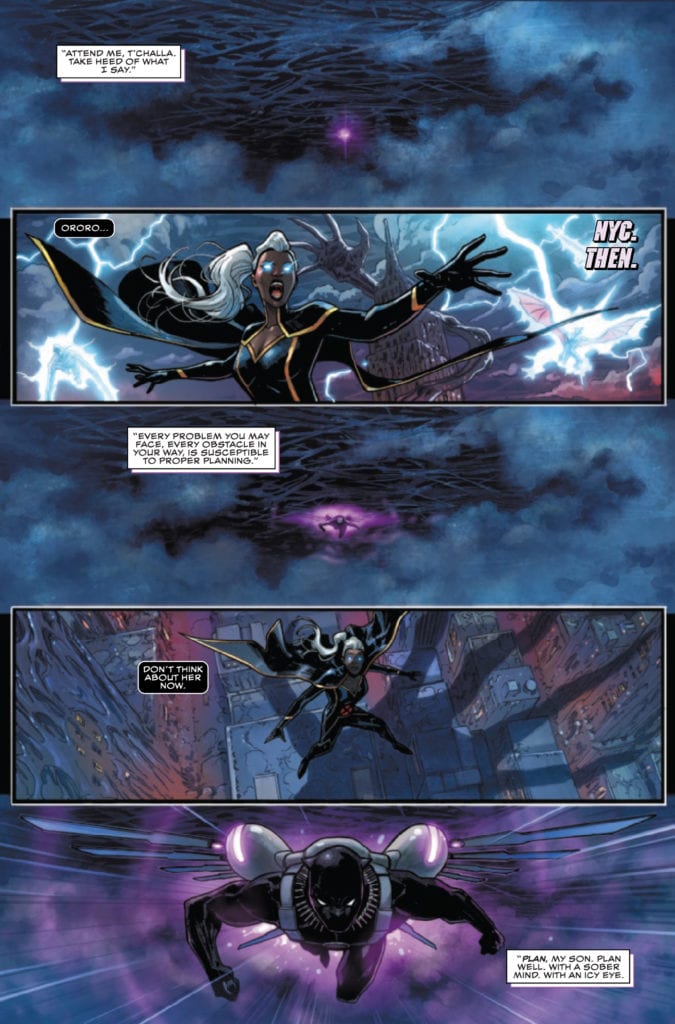
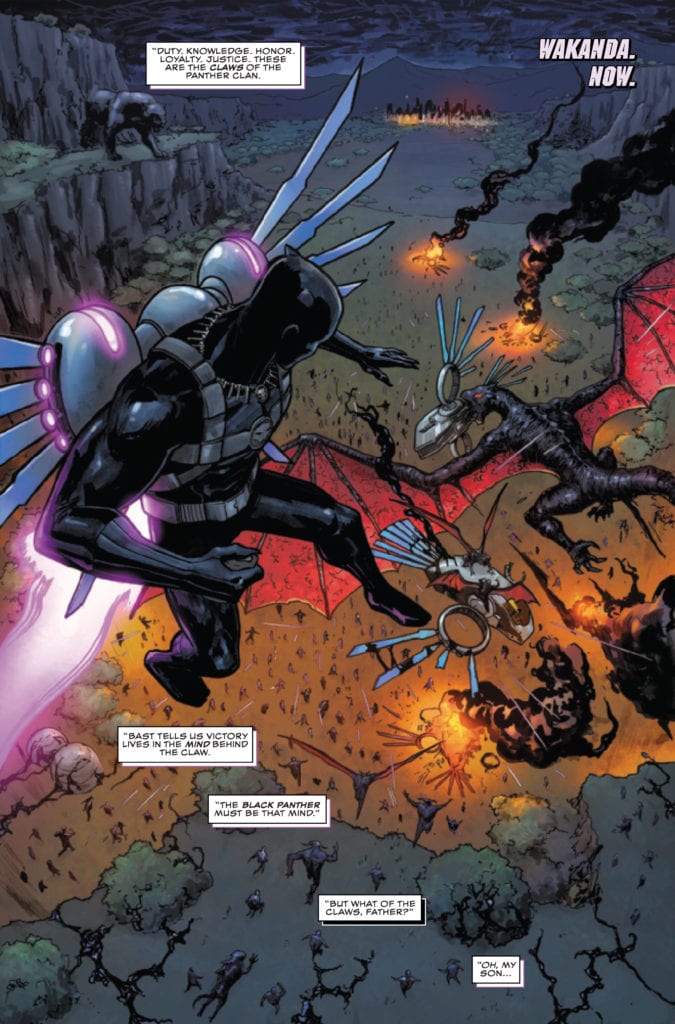
KING IN BLACK BLACK PANTHER #11 is by writer Geoffrey Thorne and artist German Peralta, with colors by Jesus Aburtov, and letters by Joe Sabino.
Check out the KING IN BLACK BLACK PANTHER #1 preview below:
What has been your favorite KING IN BLACK tie-in so far? Sound off in the comments!
Period. End Of Sentence is a 2019 Oscar-winning documentary short film about a quiet sexual revolution happening within India, and composer Giosuè Greco crafted a compelling score.
In 2019, Period. End Of Sentence beat out a field of strong contenders in the short film documentary category. The film draws inspiration from the life of Arunachalam Muruganantham, a social activist who is one of the women featured in the movie. Activists Shabana Khan, Gouri Choudary, Ajeya, and Anita make up the rest of the activist super-team covered in a dense and captivating 25-minute runtime.
PopAxiom and Giosuè spoke about becoming a musician and creating music for an Oscar-winning film.
Keep Writing
Giosuè’s grandfather was a saxophone player, “so we always had a saxophone lying around the house. I grew up in a family where music was very supported and started cultivating that passion.”
At “about 12 or 13,” he says, “I realized music is what I wanted to do. I started picking up different instruments, flute, guitar, piano.”
Giosuè went to a “music-centric high school where I could play in different bands and orchestras.”
Becoming a composer was still nowhere on Giosuè’s radar. “I didn’t study composing in school per se, but I studied classical music and had the fundamentals. I studied classical saxophone.”
“Playing saxophone,” he explains, “the only thing you can do other than playing classical is jazz. When I started Berklee, my idea was that I was going to play jazz forever, and I was going to be the greatest jazz saxophonist ever.”
Giosuè attended Berklee and completed the “music production engineering program.” After Berklee, he flew out to LA. “I wanted to try and be a music person. I wanted to do everything. I started interning at studios, but it’s not quite hands on. I started producing pop music and experimenting with sounds.”
“Film composition is something that I ended up doing in LA,” he admits. “I was lucky enough to cross paths with Dan Romer (Beast Of No Nation). At the time, he was looking for a tech person. We clicked immediately, and shortly after, he asked me if I wanted to do some additional writing for a score. From that moment on, I just kept writing.”
About Period. End Of Sentence
Giosuè became part of the Period. End Of Sentence team through Dan Romer. “They had some music temped in the cut that was a lot of dance music. They wanted to do an original score, and they contacted me because they knew I was working for Dan.”
“It was a very short period,” he says of the time spent creating the score for the short film. “ I think it took two weeks to record the project. It was one of those things I did and moved on, and kind of forgot about it.”
Giosuè thought the project “was great, but I was not expecting a nomination and then a win!”
“We didn’t have any formal spotting sessions for this film,” he reveals. Instead, the process was more organic. “I went with what I thought was appropriate for the scene. There’s a lot of wide shots and silent moments. So, I thought I’d take the most acoustic approach possible.”
Giosuè, like any modern-day composer, uses a lot of digital tools to make a score. But he says, “I always try to keep things as organic as I can, even if it’s a synthesizer.”
Wrapping Up
Talk of influence starts with one of the legends. “My dad was, I don’t want to say obsessed, but he loved Ennio Morricone. I’m convinced he’s the basis of anything I ever do musically. It’s so ingrained in my mind at this point.”
Giosuè is a massive fan of filmmaking icon Federico Fellini and mentions one of his films as a dream project. “Amarcord. I would love to work on a modern version of that film.”
Period. End Of Sentence is two years removed from an Oscar award, and Giosuè’s worked on a lot of projects since then. So, what’s next? “Not Going Quietly. It’s about Ady Barkan, a political American healthcare activist. The story takes place during 2015 as Ady continues his fight and ALS takes over his body.”
Is Period. End Of Sentence on your watch list?
Thanks to Giosuè Greco and Impact24 PR
for making this interview possible.
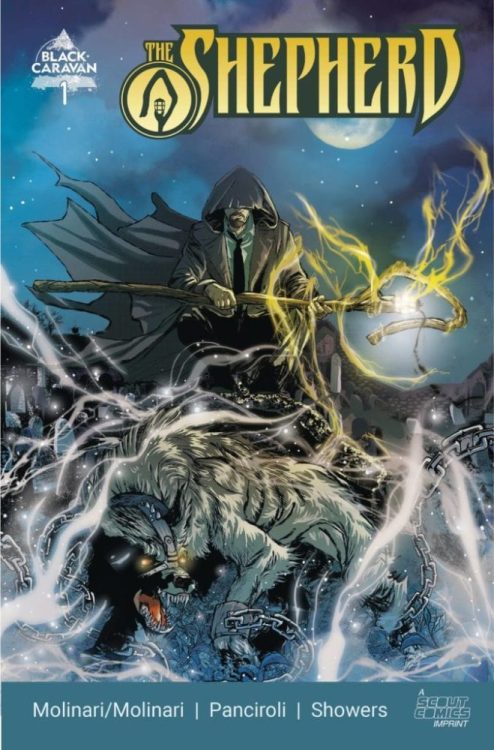
Shepherd #1 begins a new series from Scout Comic imprint Black Caravan on February 3. From the Molinari writing team comes a two-for-one story about the title character in his role and his origin. One art team focuses on the series’s mythic scales; the other shows the protagonist’s down-to-earth motivations.
Writing The Shepherd #1 Are…
Father-son writing team Andrea Lorenzo Molinari and Roberto Xavier Molinari show the ins and outs of the title character. The Shepherd #1 makes a grand first impression by introducing his role of guiding the recently deceased. What makes him stand out is his intelligence and empathy; he’s smart enough to identify fraudulent gods taking advantage of wayward souls and caring enough to see what weighs these ghosts down. The complementary story suggests this sense of empathy comes from a very personal place. So if the grand scale doesn’t get the reader hooked, the origin might.
Before the Shepherd comes a man, one who sees the good and bad of empathy. Lawrence Miller lives a mundane if fulfilling life with a family and job he loves. Has the reader ever had a family they love but get annoyed to a degree with? It’s perfectly normal to expect this as people can cruise through life without too much worry. Because if everybody follows some rules, that routine can make the most sense. When Lawrence ignores the rules he sets for himself because he connects (empathizes) with people, the reader empathizes with Lawrence when everything falls apart. Who doesn’t feel like they get punished by ignoring routine?
Two Sides Of Art
Shepherd #1 features two art teams for these sides of its lead.
The initial story “Do You Like Ghost Stories?” features art from Luca Panciroli, where the mythic scale is on display. The story setting’s architecture is not only mythic in Egyptian imagery, but the large size dwarfs the Shepherd. This makes him look vulnerable to threats inside; had it not be for colorist Pamela Poggiali providing the Shepherd with impressive-looking magic. This, when combined with SFX and a logo from letterer Joel Rodiguez makes the Shepherd as mighty a presence as the setting.
So what happens when “Origins” presents Shepherd #1 in a mundane light? Ryan Showers presents the Shepherd’s life as Lawrence as simple and orderly. The architecture, furniture, and plainer backgrounds are drawn in ways that don’t look important. The brown coloring that Heather Breckel provides in most scenes assist in this mundane atmosphere. A cold looking blue color, meanwhile, signifies a coming radical change. The captions from letterer Jacob Bascle give these empty feeling spaces weight with Lawrence’s thoughts. It all provides a real sense of being helpless as thoughts and emotions pile on top of one another.
Check Out Shepherd #1 For A Pre-Order!
Shepherd #1 has the makings of a surprise hit series. By displaying a character in action first and then showcasing his motivations, it provides a nice juxtaposition. A character so powerful and compassionate who comes from a place like anyone a chance to connect with. With a trade already scheduled for April and reading this, I am compelled to preorder to see where this all goes.
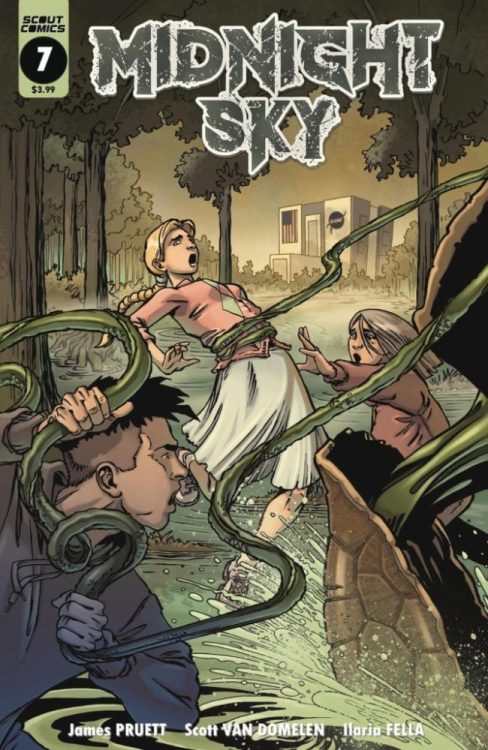
Midnight Sky #7 is a new arc from Scout Comics’ series, publishing February 3. Writer James Pruett dives right into the conflict of the effects war has on people, especially families. Artist Scott Van Domelen showcases these effects by going into expressive detail on characters. It’s something that colorist Ilaria Fella by showcasing a spectrum of colors depending on the situation.
Background
Midnight Sky follows Jennifer and her children Elita and Alejandro, dealing with an invasion of changelings. These shape-shifting fairies long replaced many people, including Jennifer’s husband, and have taken over some government powers. More or less, the purpose is to weaponize hybrids like Elita, who can use magic to make their blood lethal.
Midnight Sky #7: Writing Family War Dramas
Midnight Sky #7 does not hold hands when it comes to how it presents its conflicts, and that’s a good thing. Like any war story, going into a conflict with only a general idea doesn’t actually prepare readers for it. The intense emotions that the characters speak displays how much everyone has been through. While the reader will question where Alejandro is away from Jennifer and Elita, they already have a good idea of how much this war affects them. Everybody is scared, for themselves and the people they love. When the reader finds how all sides are getting desperate, they find an empathetic link from Pruett that hooks them in.
Expressing Conflict
Van Domelen enhances this conflict even further by showing how emotional these characters get. By showing how Elita gets angry at how scientists are drugging kids on tables in a sequence of facial differences, it leads to a splash page where Elita unleashes her power. This very power that the scientists were trying to gather is destructive, highlighted by a bright red light from Fella. Because once that act is over, she feels the fatigue and shock of her actions accented by muted greens. Just these pages of Midnight Sky #7 are a display of the overall conflict of the series. If the story wasn’t enough to get readers invested, they will be after this.
The lettering by Van Domelen(?) in the meantime act as even further extensions of the issue. The word balloons do more than guide the reader through panels; they showcase different conflicts happening at once. As one wide panel show two sides of a setting’s conflict, the reader can look at adjacent panels that split apart rather than focus on one conflict by following the word balloons. That is until the panel gets wide again when the conflict intersects.
Get Into Midnight Sky #7
Midnight Sky #7 is a fine way of getting into a conflict that goes beyond the core cast. It captures the essence of war that inspires the reader to have empathy among the characters. Because in a war where conflicts are never so simple, looking at how it affects people is what keeps the reader’s attention.
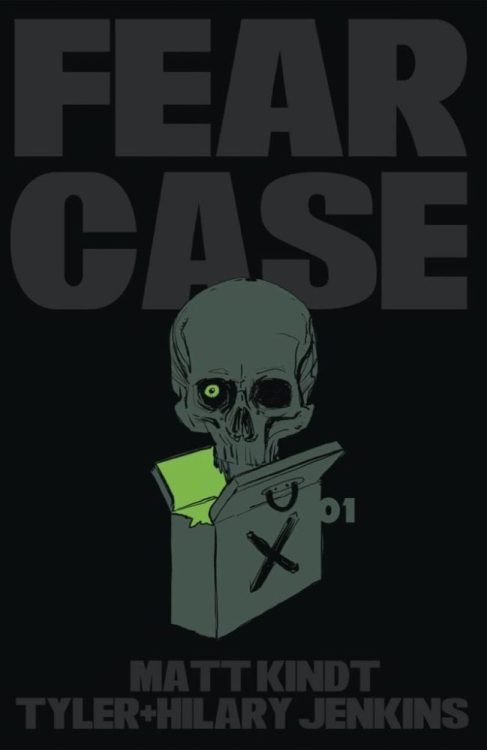
Fear Case #1 begins a new thriller from Dark Horse on February 3 by best-selling writer Matt Kindt. Kindt fans like myself will genuinely enjoy another mind-bending romp, especially considering this is a continuation of Bang!. Only instead of spy fiction, this series dives into Lovecraftian horror. Considering the effort, the creative team puts into the characters; there’s a genuine fear for them.
What’s The Fear Case?
Fear Case is about two Secret Service agents tasked with finding the titular item. The Fear Case in question has appeared throughout history, leaving disaster and tragedy in its wake. So dangerous, the agents have to find it in one week before passing the case to a newbie.
Fear Case #1 Weaponizing Ideas
Kindt’s main focus in Fear Case #1 is setting up and building characters enough to be likable. He does this by making the two main characters familiar with their genre settings.
Mitchum is very much the no-nonsense character common in buddy scenarios. If he were anywhere else, he’d be a hardboiled detective with a heart of gold. He values hard work and a good cup of coffee that helps him get through the day.
Then there’s Winters, a fan of pulpy novels by the writer Philip Verge from Bang!. He feels like a viewpoint to the reader, especially Kindt fans, since they would relate to him the most. Like the reader, Winters is driven to see the plot through and keeps an open mind about its absurdities.
Given the subject matter of the plot surrounding the titular MacGuffin, it might pay to be genre-savvy. Of course, with how Fear Case #1 presents the item in question, it might not be of any help. There is already a replacement ready and a culture of a time limit on the case.
Much like serializations that are planned ahead, there is already a replacement ready for Mitchum and Winters. This feels like the agents are in danger of being killed off. Which given how much time these partners show their quirks and how they appreciate one another’s company, this sense of danger feels outright tragic.
Atmosphere Thy Name Is Jenkins
Husband and wife team Tyler and Hilary Jenkins give Fear Case #1 an atmosphere of anticipation and reality distorting. Tyler on pencils gives most of the issue a sense of scale. On one page, when Mitchum and Winters confront a suspect, Tyler displays what’s at risk and how the agents work together. Mitchum gets the person’s attention while everyone stays focused on the knife she has. It’s what allows Winters to disarm her by getting out of everyone’s sight.
Hilary’s strengths lie within the surreal nature of the case. One page displays the carnage of past cases in bright but semi-muted color, presenting itself more like an absurdist painting than a record. In juxtaposition with Mitchum and Winters explaining the case to their replacement, it’s a warning that he’ll have to deal with the case if they fail. Considering the overly darkroom this newer agent is in after they leave, it already weighs heavy on him.
The lettering in the meantime by Tyler(?) displays the nature of conversations. The standard word balloons are extensions of in-the-moment talks of character, going from one panel seamlessly. Meanwhile, the text and word balloons in flashbacks are without outlines, acting like these words are detached from reality. It brings a real sense of discontent as we advance with the plot.
Get Your Printings of Fear Case #1
Fear Case #1 is a title that rightly deserves its reputation that sells out before appearing on shelves. Kindt and the Jenkins make this series out to be a blink-and-you’ll-miss event where the plot beckons the reader to follow along. Not only because of an intriguing plot but compelling characters the reader relates with. I know I’m hooked and paying attention to this series going forward. What about the rest of you?
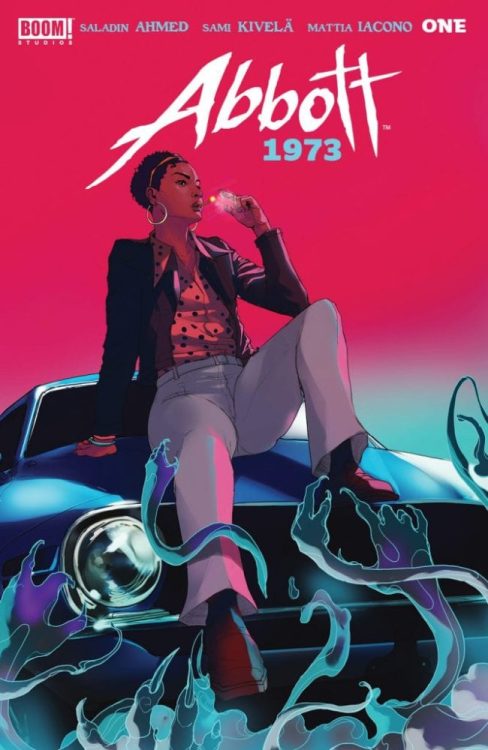
Available now from Boom! Studios, the titular Abbott returns in a new volume of supernatural crime-fighting. Writer Saladin Ahmed returns with illustrator Sami Kivela for Abbott: 1973 #1. Mattia Iacono provides colors, while Jim Campbell provides lettering.
In the previous volume, which was set in 1972, Elena Abbott discovered she was endowed with the powers of the Lightbringer. These powers make her a “chosen one’ if you will—the only one able to fight the forces of darkness called “the Umbra.” While working as a journalist for the Detroit Daily, she fought these forces and one Professor Bellcamp, who allied himself with the Umbra.
Believing she defeated the city’s evil, Abbott now works for a prominent Black newspaper, the Detroit Chronicle. She also lives in a house with her girlfriend, Amelia, and their dog, Princess. Elena Abbott clearly wants nothing more than to live a normal life, but the Umbra are determined to eliminate her.
Forgettable
Supernatural crime media are a dime a dozen these days. Once in a blue moon, something like Angel or Hellboy comes along to revive the genre with memorable characters and grounded storylines. Unfortunately, Abbott: 1973 falls into the forgettable category of supernatural crime.
Ahmed’s writing choices strongly contribute to the book’s forgettability. For example, inconsistent captioned excerpts from Elena’s articles, along with stilted dialogue, falls short of what is represented artistically. If there were more captions and more than just facts, they might have had a deeper emotional or story impact.
From my point of view, captions function similarly to voice over in movies. Voice over in movies contrast with the imagery and may provide character insight. However, as it stands, the captions get lost in the sauce, if you will, without augmenting the tone of the book or revealing character.
An Homage
Artistically, on the other hand, Kivela’s jagged, expressive line work alongside Iacono’s deep oranges, blues, and purples fill in the neo-noir flavor where Ahmed’s writing cannot. Abbott feels very much like an homage to the Silver Age of Comics while remaining quite contemporary. Furthermore, Campbell’s understated lettering and use of typewriter font help approximate the seventies.
Ultimately, this issue doesn’t make Detroit an enticing world, nor is Elena Abbott an enticing protagonist. She’s simply a Black, bisexual version of the same Chosen One hero trope we’ve seen in properties like Buffy and Superman. Besides, we see her doing mundane things and mostly reacting to events with few words or actions in this issue. With that said, I must acknowledge that representation does matter. Despite what I see as the story’s shortcomings, we need more characters like Elena Abbott.
Nonetheless, what is remotely interesting about Abbott: 1973 #1 is the Umbra’s plot to undermine the election of Detroit’s first Black mayor. It remains to be seen whether such a plot will be enough to keep readers’ attention for another four issues.
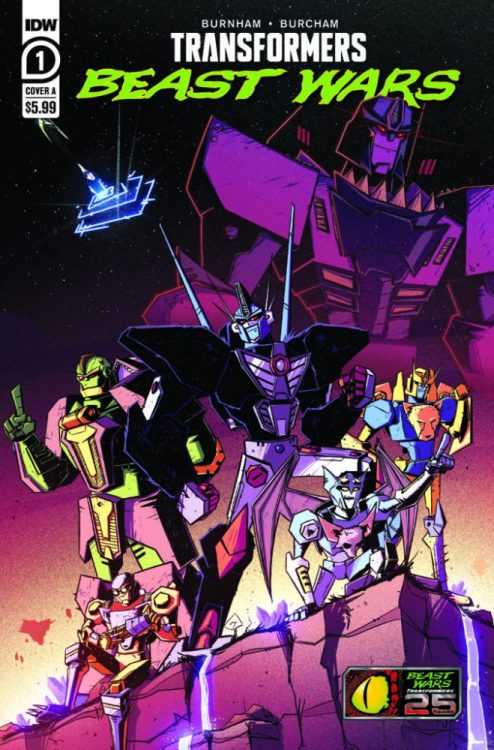
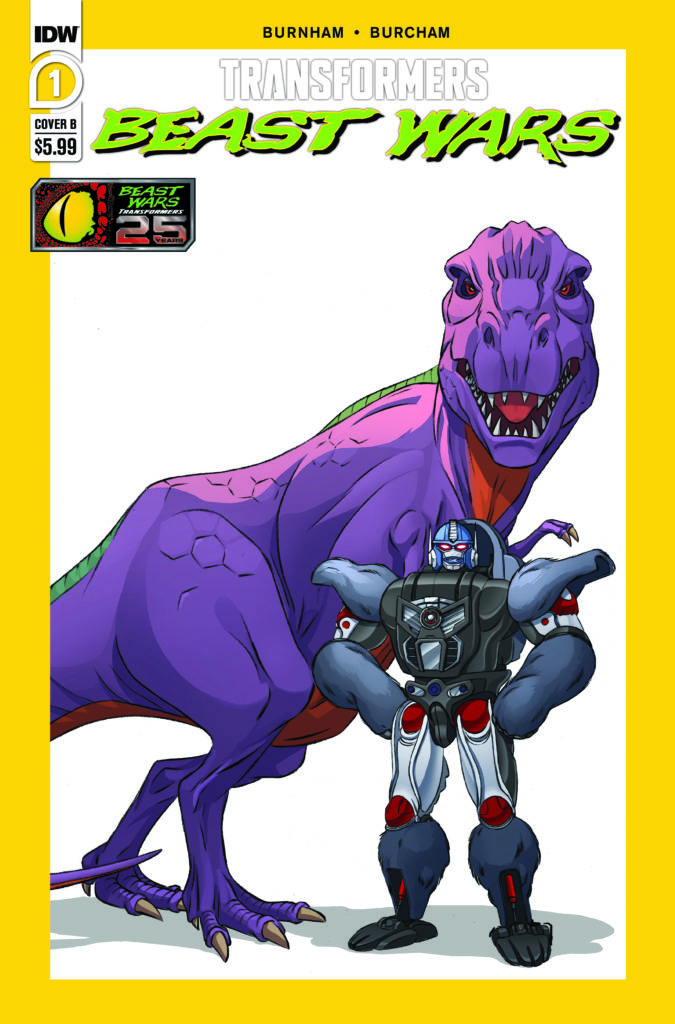
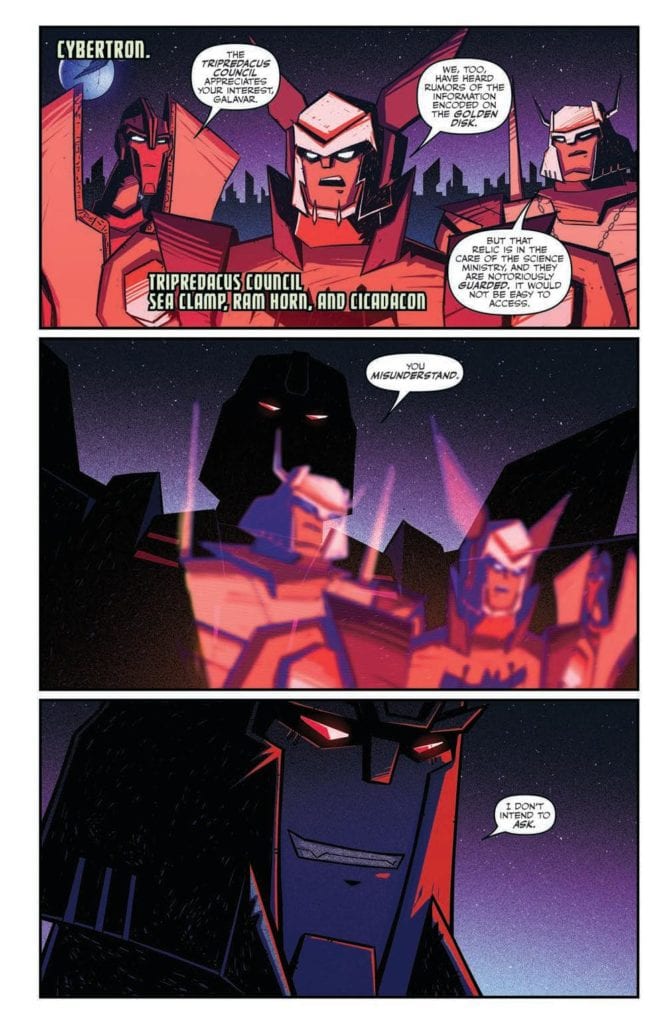
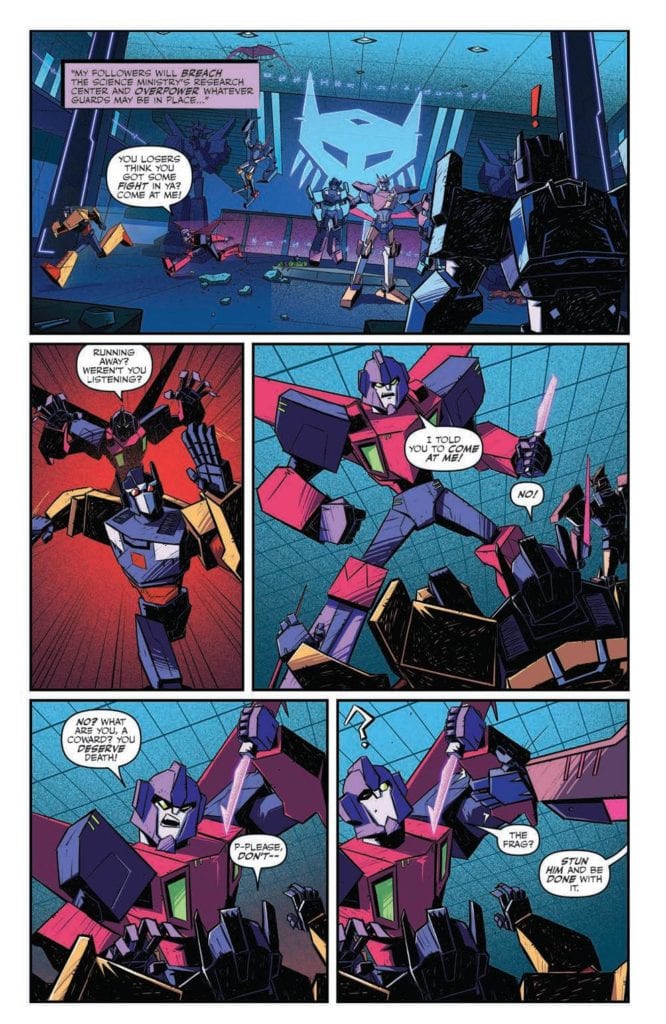
Transformers: Beast Wars #1 out this week from IDW Publishing reunites fans with some of their favorite characters from the original TV series. Thanks to new plot elements and characters it becomes apparent this will not be a simple retelling of the original show. This reimagining is made possible by Erik Burnham (writing), Josh Burcham (art), and Jake M. Wood (lettering).
When a crew of Predacons, led by the successor to the Megatron name, steal a golden disk and a ship capable of traveling through time, it’s up to Optimus Primal and his Maximal crew—Rattrap, Rhinox, Cheetor, and new character Nyx—to catch them!
Writing
Beast Wars: Transformers is hailed as one of the best Transformers series ever created. It’s more surprising than anything it took this long to get a full comic series based on the TV show. Writer Erik Burnham seems to be nailing the characters so far including showcasing Rattrap’s sarcastic personality and Dinobot’s honor-bound style of fighting.
The issue does offer new elements to the original story including new character Nyx who serves as the pilot of the Axalon. Though the issue has a good feel for the characters, it’s a bit slow with the need to reintroduce them. This is a small complaint but overall the issue sets up all the elements for an entertaining series moving forward.
Artwork
The art by Josh Burcham introduces designs of what the characters looked like in their original cybertronian forms. In the TV series characters were shrouded in shadows until they scanned DNA and got their alt forms. It shows the amount of planning and effort put into the creation of this series.
Burcham’s color work helps to add to the different action scenes. From the two ships traveling with the transwarp technology and their inevitable crash onto the planet, the use of colors makes these scenes striking.
The lettering by Jake M. Wood offers an auditory aspect to the comic. The different fonts and specific sound effects aid in helping the action scenes play out. Also, it’s interesting to learn the sound a ship makes as it enters transwarp is “FWASHHH.”
Conclusion
Transformers: Beast Wars #1 hits on a lot of elements found in the original TV series. It’s slow but the issue does deliver new aspects which will be interesting to see play out in the future installments. Fans of Beast Wars rejoice or at least don’t immediately dismiss this new series.
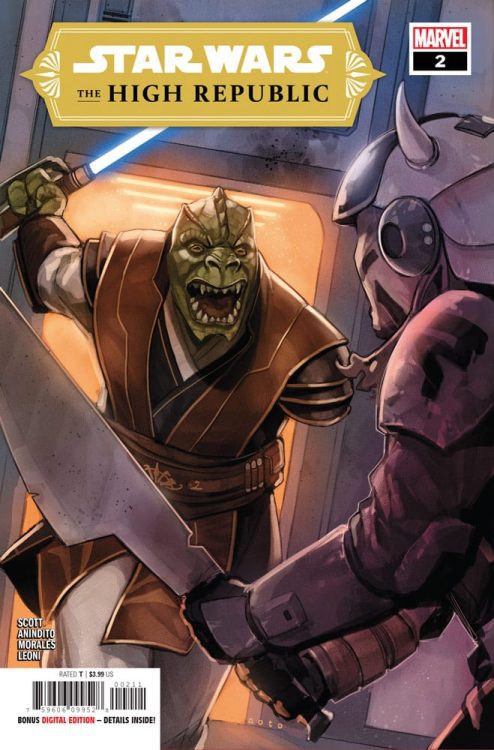
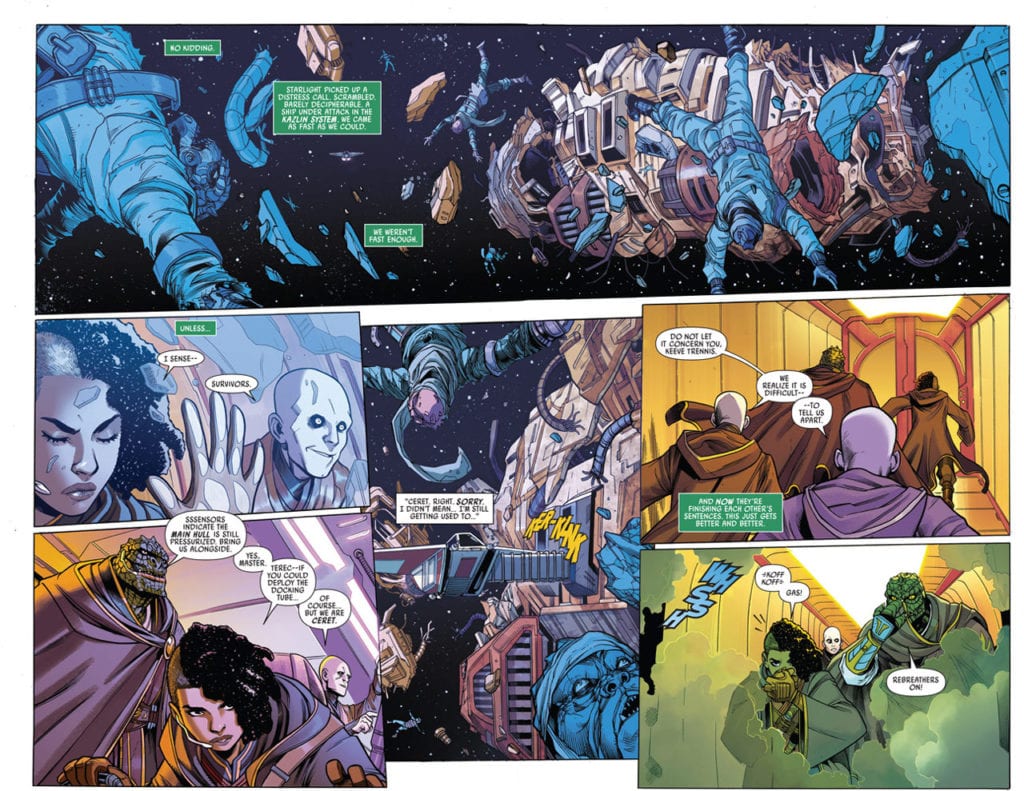
Writer Cavan Scott and artists Ario Anindito and Mark Morales, along with colorist Annalisa Leoni and letterer Ariana Maher bring us an intense follow-up issue in “Star Wars: The High Republic” #2. Having set the mood in the first issue, this chapter focuses on building some mystery in a suspenseful and atmospheric comic that takes Star Wars into a place it seldom travels: horror. With a tightly paced script with excellent plot development and more outstanding visual work, this is becoming more and more an absolute treat for comic and Star Wars fans alike.
“The Nihil strike! A ship found adrift in space, the crew brutally slaughtered and cargo stolen. What terror awaits the The Jedi of Starlight Beacon as they explore the wreck. Newly knighted Keeve Trennis must overcome her insecurity in the face of new teammates, but can she trust her closest ally?”
Writing & Plot
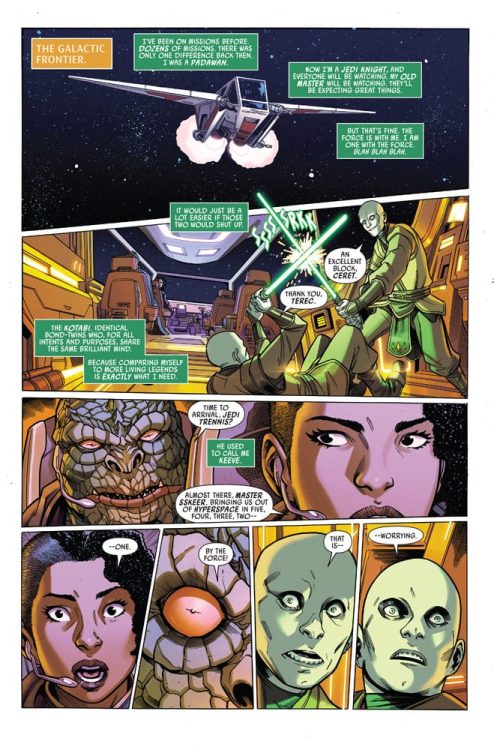
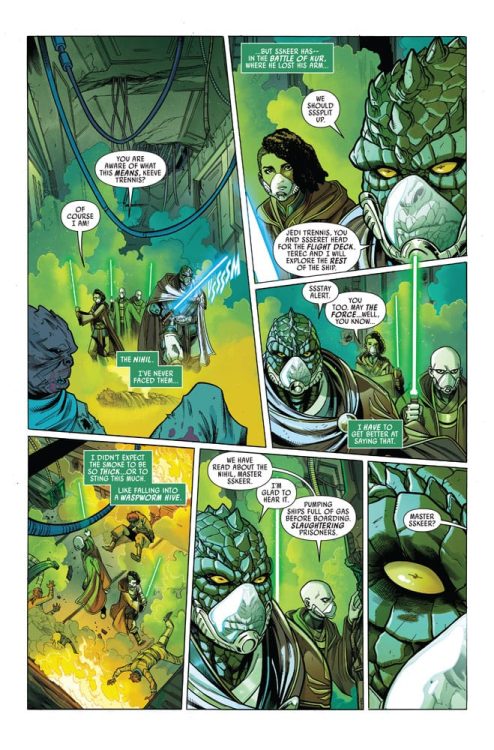
With the first issue, Cavan Scott effectively set up the inner working and dynamics of protagonist Keeve Trennis, her master Sskeer, as well as sampled the tone of the Star Wars universe in the time period. For “The High Republic” #2, Scott takes advantage of the new mystery of this uncharted time by placing these characters in an unnerving and tense situation. We don’t often get horror in canon Star Wars tales, so getting a nice derelict-ship chapter a la System Shock/Alien was a serious treat. The fact that Scott was able to write the hell out of the pacing and intensity makes me want to see him write a full horror series in the galaxy far far away. Even more engaging is how Scott exploits his characters’ weaknesses and insecurities to amp up the tension. Newly knighted Keeve Trennis’s confidence and cool-headedness are usurped by her uncertainty in new situations. Without getting into spoilers, Jedi master Sskeer’s noticable lack of emotional control makes him unpredictable and sometimes short sighted. This comic is elevated by the perfect combination of written elements that make for a highly engaging and riveting reading experience. Scott’s sense of dialogue and narrative are naturalistic but universe appropriate, and deviate wildly from character to character. There are moments of characters reciting technobabble and explaining the geopolitical landscape of outer rim colonies, and honestly it feels right. It’s modern Star Wars doing what it does. This issue once again reminds me of some of Filoni’s best work on The Clone Wars, as well as some of Dark Horse’s best Star Wars material – with a splash of Knights of the Old Republic. This is some of the best Star Wars material I’ve experienced in the past couple years, and it’s got me immensely excited to see where this story goes.
Art Direction
Star Wars comics have a long lineage of fantastic visual work, so it’s fortunate that “The High Republic” #2 has artists Ario Anindito and Mark Morales on hand to bring this universe to life. Anindito’s pencils are both stylistically inventive and faithful to the Star Wars aesthetic, providing designs that are largely familiar while differentiating themselves from the universe we know so well. From the dank hallways of a derelict ship, to the uniforms and lightsabers of our Jedi protagonists, everything has that definite “Yep, it’s Star Wars…” look while also saying “…but I’ve never seen it look quite like that.” The dimension and detail provided by Mark Morales’s inks furthers these positives, especially in the context of character expressions and lighting. The colors from Annalisa Leoni bring home the book’s aesthetic, as every panel is alive (or dead) with a huge array of varying tones. The lighting’s effect on each surface is probably the most impressive single feature, as no feature look the exact same in every scene, no matter how many times they appear. Of course the appropriate colors for this universe are all used to great length, but it’s the attention paid and the production value brought to this story that is so impressive. The pacing brought in by the panel direction and the choices of shots and what they decide to withhold and present at a given time make this comic a really special read. The opening sequence on the derelict craft is presented in a semi-traditional horror style, full of suspenseful reaction shots, plodding moments of tense exploration, and good ol’ “it’s right behind you!” ambush scenes. The letters from Ariana Maher are a bold and modern font that reads very easily and stays out of the way. On the other hand, the SFX lettering is perfectly set amongst the pages and brings the sound right to your ears in that synesthesia sensation only comics can bring. This is a brilliant looking comic, and among some of the most well drawn Star Wars comics ever put to page.
“Star Wars: The High Republic” #2 is an intense use of genre mixing and exploiting the strengths and weaknesses of a new cast to really let the audience see how they tick. Cavan Scott puts together a script that digs at the mental and emotional cores of its lead character, and through a cramped horror-esque setting explores character dynamics that will shape the plot for the rest of this story in unpredictable ways. The visual work of Ario Anindito, Mark Morales, and Annalisa Leoni makes for a gorgeous and high-production affair that does the job of setting the story’s pace and bringing this uncharted era of the Star Wars universe to life in spectacular fashion. Be sure to grab this newest chapter of Star Wars storytelling when it hits shelves on 2-3!