DC Comics held a panel at WonderCon on Saturday morning to announce the creative teams behind “Rebirth,” the company’s upcoming “don’t-call-it-a-relaunch” relaunch. The writers and artists proceeded to talk about what fans can expect in their respective books, including what characters they plan to use. Most of the DC icons were accounted for, but a few remain missing in action.
Now obviously not every character can get their own solo title, and not every one can be on a team. Was anyone really expecting someone like Elongated Man to be a part of “Rebirth?” It’s doubtful; his appearance would feel out of place. But there were several absent characters of note that fans actually want to see, and whose presence would make sense.
These characters may still appear in some capacity. Chief Creative Officer Geoff Johns said that a beloved character will return when “Rebirth” begins, and that another character will die; either of those characters could be on this list.
Plus there’s an upcoming Justice League of America book that’s being kept under wraps, and any number of the heroes below could be involved in that as well.
With all of that in mind, let’s look at the biggest names still missing from DC Comics: “Rebirth.”
Honorable Mention: Earth-2
When DC Comics put out their initial “Rebirth” press release, Earth-2 had its own “Rebirth” special and its own monthly series. But the book had no mention at the publisher’s WonderCon panel. Could this have something to do with the secretive Justice League of America book (which had no mention in that press release)?
Shazam
Shazam is prominently displayed on the cover of the DC Universe: Rebirth 80-page special, but he’s not mentioned in any of the books that come afterwards. Could Billy Batson be the casualty that Geoff Johns referred to?
Booster Gold
Booster Gold has been at the center of several multiverse shattering events, and yet he is no where to be found during “Rebirth.” How could DC bring back Ted Kord and not bring back Booster?
Martian Manhunter
J’onn is also on the DC Universe: Rebirth cover without being mentioned in any of the new books. His solo “New 52” title is currently ongoing, so is he just disappearing once “Rebirth” starts?
Bluebird
Cassandra Cain and Stephanie Brown will both be part of Batman’s team in Detective Comics, but their friend Harper Row seemingly won’t be. Since she’s a Scott Snyder original character, maybe she’ll pop up in All Star Batman instead?
Mister Miracle
Scott Free is currently playing a central role in “Darkseid War,” but he’s absent from “Rebirth’s” Justice League. Hopefully he isn’t being swept under the rug again.
Plastic Man
“Eel” O’Brian had a small cameo during Forever Evil, and fans hoped that it meant his superhero alter ego would soon be reentering the DCU. Was the cameo just a simple Easter Egg after all?
The Atom
The Atom is a fan favorite who was terribly underutilized during “The New 52.” DC should want him in a current book; he’s a major character on their Legends of Tomorrow TV show. Putting him in a comic book concurrently is just smart business.
Firestorm
Firestorm seemed to quietly fade away in “The New 52,” and now he’s been relegated to DC’s new anthology book. It’s strange, since he too is a main character on Legends of Tomorrow.
Beppo the Super-Monkey
#bringbackbeppo
—
Who else did you notice is missing from “Rebirth?” Let us know in the comments!
Michael Mann is a national treasure, one of the finest American filmmakers. He hasn’t necessarily collected the accolades or been on stage Oscar night, but that doesn’t take away from his incredible talent, his ability to tell stories about men and women who drift through their very formulated lives, reaching out at every turn for a connection. It’s the invisible connections between his characters, the aching longing that defines his films. Regardless of the subject matter, the films of Michael Mann all carry a connective tissue of desire and despair, of hard men who cannot shed the worlds they’ve cultivated for themselves.
Mann’s filmography is loaded with brilliance. Ranking his films feels like a lost cause, but it’s fun to try and rank unequivocal greatness. He’s directed only eleven feature films – with a few TV movies and series scattered in between – but his style and his impeccable perfectionism have singed a brand into modern auteur filmmaking. Ranking his films is comical because by the time you reach number seven or eight, you’re in the realm of true masterpieces, seemingly inseparable given their very specific motivations within what Mann finds compelling.
That being said, here is a personal ranking. There is no metric to measure the genius of Michael Mann in this list, and this list will undoubtedly differ from 90% of the people who scan it. And that, ladies and gentlemen, is what makes Michael Mann such an indispensable filmmaker.
11. The Keep – Here is the outlier in Mann’s directorial efforts, a poor 80s horror slog full of unidentifiable stock characters and nonsense. And one most people wouldn’t even remember belonged to Mann. It’s weird to even consider this is a Michael Mann picture, because it’s utterly ridiculous, devoid of any sort of characterization. Perhaps it was just Mann testing his limits on the heels of Thief.
Regardless of the motivation, The Keep is a dirty and forgettable film, laboring through genre tropes hoping to find a merciful end. A group of Nazis must turn to an old Jewish man to help them dispose of a demo they have released on the world. If the metaphors feel heavy handed in that description, just think about the movie itself.
10. Public Enemies –For all of its period perfection and slick design, there is something connectively absent in Mann’s story of John Dillinger. While it is perhaps the most accurate cinematic portrayal of Dillinger’s rise and fall (The Lady in Red wasn’t wearing a red dress, but an orange skirt), Public Enemies feels simultaneously claustrophobic and consistently at arm’s length. While Mann’s camera pushes in close on Depp’s Dillinger, there is a detachment to the man and his mission.
Perhaps it’s Johnny Depp as Dillinger. It’s been over a decade since Depp delivered something resembling a quality leading man performance, and here he doesn’t grab us the way we’d expect a hedonistic hood to grab us. The action in Public Enemies is not lacking, however, namely the Little Bohemia cabin assault in Wisconsin. But it’s not enough to rescue the picture’s cold delivery.
9. Last of The Mohicans – MichaelMann’s adaptation of James Fenimore Cooper’s historical novel sticks out among his catalogue for obvious reasons. For other reasons – men from different sides working together, the quiet connections among us, the doomed love – the film slides into his filmography rather well. This, and the next film, may be seen as the dividing line in Mann’s work, where he begins finding true greatness.
Daniel Day Lewis is predictably tremendous as Hawkeye, a trapper stuck between loyalties during the French and Indian War. Mann’s attention to detail and Day-Lewis’s persistent methodology work in concert here, creating a textured, believable colonial America. The romance between Hawkeye and Madeleine Stowe’s Cora (anyone else miss her in features?) is tangible, and the film builds slowly to a thrilling, heartbreaking showdown.
8. Manhunter – Mann was able to harness the white-hot masculinity that was mid-80s William Petersen in his adaptation of Red Dragon. Petersen would have been a bigger star than what he became, but here, in the 80s, there was nobody more hard-charged and charismatic than he. Petersen is Will Graham, the man who captured Hannibal Lector and has the scars to prove it. But he must work with the madman once again to bring in another serial killer. We know the story.
Manhunter is Mann in his comfort zone: the crime drama. And here, he injects the unsettling events with a static energy and steely-synth pop score. It’s strange to examine this film in a vacuum because, five years later, Hannibal Lector would be redefined forever by Anthony Hopkins’ performance. Brian Cox is interesting as Lector, make no mistake, but the power of his performance has been stolen away in the 25 years post-Silence of The Lambs.
7. Ali – When I first saw Ali, I wasn’t impressed. Then again, I was a 22 year old and I went to a late showing (undoubtedly under the influence of something) of a film that demanded my full attention. It didn’t go well. For years I dismissed Ali as a film with a great performance surrounded by slog. And then, after the fast-living years of my youth had passed me by, I revisited this comprehensive docudrama about one of the most legendary American figures of all time.
While it still lags at points, especially when Ali is in Africa, the film itself is at times revelatory. Will Smith deserved the Oscar for his seamless embodiment of the great Cassius clay turned Muhammad Ali. But as a whole, Mann taps into the psychology of the most famous athlete of the 20th Century, unwrapping a larger-than-life persona with surprisingly intimate scenes. Not once did I think I was seeing Will Smith in this role; he was Ali from the get go.
And just as brazenly as Muhammad Ali traversed his public life, so he navigated his personal life confused and a little frightened, finding women he was inexplicably drawn to over the years. Ali was attracted to women, and those women were attracted to his ego. But when the man didn’t match the public persona, trouble bloomed. And the cycle seemed to go on forever.
6. Blackhat – What a difference a year makes. Blackhat was dumped into the purgatory of January releases, and came and went without a whimper in 2015. But over a year later, what Mann was trying to achieve has congealed and come into focus. Blackhat may toggle convention, but that dedication to the plot-drven thriller is what Mann was aiming for all along, and it’s where the film excels. If you give it a chance.
What might have unsettled audiences was the opening act of Blackhat, an exposition-heavy table setting that sometimes loses sight of its very compelling characters. Look past the Adonis physique of Chris Hemsworth, forever Thor, and accept him as an infamous computer hacker. If you allow yourself to get past his build – which is explained in some early scenes – then the film moves along at a wonderfully kinetic pace. The plot is standard – a hacker is wreaking havoc and must be stopped by an even better hacker, who also happens to be in jail – but Mann reaches deep into his characters’ motivations. Beyond the need to end this plot, Hemsworth and Chen Lien, his love interest, seek a better existence than the one they currently occupy.
Hemsworth’s Nick and Chen Lien are the invisible connection at the heart of Blackhat. But beyond the emotional, this picture is rife with static action. A shootout here, a fight there, and they all mean something to these characters in the end. And let us not forget the performance of Viola Davis as, Carol Barrett, a dogged FBI agent desperately painted into a corner. She is the brightest of all the lights here.
5. Collateral – It seems these days Tom Cruise is perfectly fine churning out incredible stunts as Ethan Hunt, and there isn’t really anything wrong with that. But there was a time when Cruise was still seeking out different challenges in his acting. In Collateral, Cruise embodies a character altogether unique from his body of work. He is Vincent, a steely-haired contract killer whose disdain for the detachment of Los Angeles seems to fuel his inner turmoil. Vincent is a wolf, an animal adapting to the world around him moment to moment.
Vincent “hires” the impeccably ordered Max (Jamie Foxx, Oscar nominated), a cab driver fooling himself into thinking he has bigger plans on the horizon, into driving him around for the evening to collect five… ahem… signatures. It isn’t long before Max realizes Vincent is offing potential witnesses in a high-profile murder case, and he is in way over his head. Collateral then churns along mercilessly, balancing a cat-and-mouse thriller with real human drama between two men whose relationship is built strictly on chance.
All of Mann’s signatures are subtly interjected as these two men pull against each other while pushing towards the same end. Collateral is a sharp thriller with not an ounce of fat on it. And while the symmetry involving Jada Pinkett Smith’s lawyer may be just a but to convenient, by the time that realization comes around we are so invested in the methodically constructed tension, we buy in.
4. Miami Vice – Preconceived notions may have ruined this film before it ever even hit theaters. This Miami Vice is not pastels, alligators, and pop music. Though Michael Mann did create the wildly successful 80s police drama, a cultural watershed moment, he had different things in mind when he tackled the undercover world of Sonny Crockett and Ricardo Tubbs in 2006. Miami Vice is a film all about unspoken communication, and it deserves more credit than its received over the years.
Crockett and Tubbs (Colin Farrell and Jamie Foxx here) speak primarily in shorthand, because they don’t need to say more. This is an immersive picture about two men, and their team of vice officers, who are so ingrained in an undercover world of serious drug trafficking they don’t have time to explain things to each other. Or the audience. This is Mann working inside a story without the want or desire to lay things out for the audience. Whites why many felt it was too obtuse.
But Miami Vice is a pitch-perfect thriller about men whose lives begin to blur after so many years wallowing in the criminal elements of the world. It’s slick and often gorgeous, with Mann’s digital deep focus adding texture, and his signature character gazes are better here than just about anywhere else.
3. Thief – It’s hard to believe Thief was Michael Mann’s feature debut. Much of the DNA of Manhunter, Heat, Collateral, and Miami Vice can be found here, in the emotional tale of Frank, a career criminal who burns hot with the desire to escape his life of thievery. James Caan is all smoldering intensity and, ultimately, frustration once he finds himself under the thumb of a vicious gangster who forces him to pull off another heist.
Mann’s synth-pop energy was birthed in Thief, and the film hums with energy. What’s more, the humans at the heart of Thief are real humans who are often times glossed over in heist pictures. Caan is much more than a one-note bad guy trying to make good, and the best scene of the film is a conversation he has with Jessie (Tuesday Weld), the woman he loves. His story in this diner lays the groundwork for Frank, it explains everything we need explained, and it adds tremendous depth.
2. Heat – It’s strange how Heat came and went in the winter of 1995 without much fanfare or accolades. It simply existed back then. But this is one of Michael Mann’s two true, complete masterpieces, a story of cops and robbers and the thin line separating the two. Here is the story of cop Vincent Hanna (Al Pacino) and crook Neil McAuley (Robert De Niro), two career men whose line of work juxtaposes one another. While Vincent tries to navigate this world by engaging in all the standard human relationships – friends, family, a wife – he fails. Neil, on the other hand, eschews human connection because he knows he must; and yet, he fails. “There’s a flipped to that coin,” Neil tells Vincent in their famous diner conversation. These two men are the flipside of the same coin in life.
Beyond the team of Pacino and De Niro, still at the peak of their careers, is a full, vivid ensemble of fully-realized characters and career men who lend undeniable authenticity to the narrative. Heat also has one of the greatest shootouts of its kind in cinematic history, a deafening assault in the streets of Los Angeles.
1. The Insider – Mann’s 1999 film about whistleblower Jeffrey Wigand is a complex masterpiece about morality, the best film of his illustrious career. His ability to create a compelling thriller around such a seemingly mundane subject matter – corporate malfeasance – speaks to his craft as a storyteller. Russell Crowe plays Wigand with depth and truth; Wigand is not some moral martyr, but a complicated and flawed human whose drive to spill the beans about big tobacco comes from a very personal place.
The relationship between he and 60 Minutes producer Lowell Bergman (Al Pacino) evolves and devolves throughout the story, and as Wigand’s personal life begins to unravel, it’s Bergman who must keep him from falling off the cliff. Mann’s film is, much like his crime dramas, immersive and authentic beyond simple narrative notes; this is a picture about journalism that seems to fully understand the power and ultimate structural pollution of the occupation. The Insider pulls us into the world of Wigand and shows us his motivations, then pushes us to the brink with these incredibly honest human characters.
December 7th, 1941, a date which will live in infamy. The date when the Japanese Empire launched a surprise attack against the United States and their fleet in Pearl Harbor, forcing the United States into entering the Second World War. This event is what 1970’s Tora! Tora! Tora! sets out to tell.
Tora! Tora! Tora! was a Japanese-American co-production looking at both sides during the run-up to the attack and the attack itself – broadly focused on Admiral Yamamoto (So Yamamura) and the Imperial Japanese Navy’s preparation, the errors made by the American commanders at Pearl Harbor and Washington, plus the diplomacy between the United States and Japan and America’s intelligence efforts. Tora! Tora! Tora! is comparable to 1962’s The Longest Day – both were big international productions that had actors and directors from their respective nations and aimed to be as accurate as possible to real-life events. The movie aims to incorporate as much of the history as possible, having a huge cast that looks at the decisions of senior politicians and military officials to mid-ranking officers – who run specific parts of the operation for the Americans and the Japanese. As a history lesson Tora! Tora! Tora! is amazing with how much it covers and how many characters are in the movie. There are only a few inaccuracies, the main one being a plane crashing hanger which was an amalgamation of three events during the real attack. The movie aims to be as balanced as possible – there were mistakes made on both sides and that it was simply a battle of wits between the sides. The Japanese, particularly Yamamoto, were just following the orders of their government, he wanted to avoid war and is somber during and after the attack. The Americans were debating amongst themselves over what is the best course of action.
Tora! Tora! Tora! is a movie of two halves – the first being the preparations for the attack on both sides, the second being the attack itself. However, this makes Tora! Tora! Tora! very dry as we watch men walking around corridors and sitting in offices as they discuss their own plans and what they expect their enemy to do. It’s fine for history buffs as the men talk about the wider context of why Japan is pushed to go to war with the United States, the British attack on Taranto which shows a torpedo raid in shallow water can work and looking at the various military decisions both sides make – but this hardly makes for compelling cinema. The filmmakers could have cut some of the military figures out and found more interesting ways to explain the necessary information while still being faithful to history. At least, the Japanese half shows the Navy preparing for the attack, making it similar to the classic British war movie The Dambusters. The most exciting part of the American side is when Lt. Commander Kramer (Wesley Addy, distracting looking like soccer coach Alan Pardew) discovers an important communication from the Japanese embassy and races around Washington in the middle of the night trying to give it to one of his superiors.
The cinematic attack on Pearl Harbor was a tremendous feat. This section was directed by Richard Fleischer who had a varied career, making The Vikings, Doctor Dolittle, The Boston Strangler and Soylent Green – and his talent was best unitized for this section. For fans of war movies, this is the part that makes Tora! Tora! Tora! a marvel as it showcases the destruction of the harbor and use of real planes for the flying sequences and the dropping of tornados. The military action was fast, and it was great at capturing the confusion that the Americans on the ground suffered on that fateful day. It is one of the best aerial sequences in film history. However the back projection for scenes of pilots flying and the windows in Pearl Harbor offices is just dreadful and fake looking – even back in 1970, they were criticized.
Tora! Tora! Tora! is a movie for history buffs, it is detailed to a fault. However Waterloo, The Longest Day and Downfall have shown that a movie can be loyal to history and still be compelling to watch. The Japanese half of Tora! Tora! Tora! is the more interesting part of the movie and the bombing sequence still holds up today. It is a much better telling of the attack on Pearl Harbor than what Michael Bay and Randall Wallace achieved in 2001.
AMC Network released the first 90-seconds of the season six season finale of ‘The Walking Dead’ which introduces Negan to the show. AMC also released the official teaser trailer.
Last Day on Earth
“To save one of their own, Rick’s group must venture outside the walls; their experience changes their lives forever.”
IMDB had a different episode description than the official one from AMC.
Carol and Morgan come across new survivors. Meanwhile, Rick and the group rush to the Hilltop in a desperate attempt to save Maggie, as the threat posed by Negan and his Saviors grows higher.
Norman Reedus talked with Deadline about the season finale.
“Without a doubt, this whole season has been just completely ballistic. I will say that the Season 6 finale is the most hardcore finale we’ve ever done. It’s not the best episode we’ve ever done but I mean I saw a rough rough rough cut of it way back when and I was speechless for at least an hour. So hold on for the rest of this, because it gets real crazy,” said Reedus.
The finale to season six airs April 3 and will be 90-minutes instead of the traditional 60.
“To save one of their own, Rick’s group must venture outside the walls; their experience changes their lives forever.”
The finale to season six airs April 3 and will be 90-minutes instead of the traditional 60. ‘Last Day on Earth’ will introduce the new villain Negan, and if the series follows the comic book a fan favorite will be killed off in a brutal way.
What we know at this time is Carol has left Alexandria and Daryl has gone out to look for her. Either one or both could be Negan’s victim. The wildcard is Michonne, you can read that article here: Why Negan Has To Kill Michonne.
Ross Marquand talked about the season finale when they were filming the episode, and how emotionally charge the episode will be.
“This is the craziest thing ever. It’s the probably the most emotionally wrought and dark episode I’ve ever read. I’ve never read an episode that is so dark and compelling in my life (…) I had to stop reading this at three different times. It was just messing me up. It is so emotionally dark and twisted,” Marquand.
Get your first look at Negan with his trusty side-kick Lucille in the trailer below.
Muskoka Brewery Unfiltered Cream Ale – The Brewery
I’m generally not much of a cream ale drinker but with the multitude of IPA’s I’ve reviewed in the past I figured it was time for a change. Because of my love for IPA’s, Muskoka Brewery’s Unfiltered Cream Ale was a great choice for me. Although not by any means a hop forward beer, this cream ale’s strong hops flavour makes it unique among the cream ales I’ve had. Muskoka Brewery Unfiltered Cream Ale is an award-winning beer, having won Gold in the 2014 Ontario Craft Brewing Awards in the British Pale/Bitter category. Here’s what I thought of it …
Muskoka Brewery Unfiltered Cream Ale – First Sip
I’m surprised by the hoppy flavour of this cream ale as I take my first sip. Having only had pale cream ales in the past, I was surprised by its amber colour as I poured it into my glass. This cream ale’s colour accurately represents its strong flavour. Although its predominant quality is its surprising hoppiness, Muskoka Brewery Unfiltered Cream Ale manages to retain a strong undercurrent of malt. Its low carbonation level, described on the Muskoka Brewery website as English pub-style, allows the earthy flavour of this beer to present itself subtly. Its aftertaste is noticeable but it doesn’t stick around too long.
Muskoka Brewery Unfiltered Cream Ale – Last Sip
I usually warn against letting beer go warm but Muskoka Brewery Unfiltered Cream Ale is rightly described as an English pub-style ale, and as such enjoys the privilege of being consumed at room temperature should the drinker prefer it so. Its low level of carbonation and distinct flavour accentuate this beer’s creamy mouthfeel. Its honey-amber colour make it a brew that necessitates a pint glass. It’s unlikely that you’ll be able to fully appreciate Muskoka Brewery Unfiltered Cream Ale’s complex flavour straight out of the can or bottle.
Questionable character choices are abound in Batman v Superman: Dawn of Justice. The movie wastes no time changing basic history that it does so right in the opening credits. In an otherwise gorgeous series of shots, we are regaled again with the story of the death of Thomas and Martha Wayne. This does a couple of things: First, it tells us that this is definitively Batman’s movie. Second and most importantly, it shows that Thomas Wayne was about to fight back as he was staring down the barrel of that gun.
Small detail right? Thomas Wayne, facing his attacker (Is it Joe Chill? Does the movie ever tell us? Either way, he’ll just be “attacker” here.) and nobly standing between him and his family, clenches his fist which is holding back his young son, Bruce. We see Thomas begin to swing his arm up, presumably to connect with his attacker just before he is shot and falls to the ground. The rest of the sequence takes place as history dictates but that small gesture, a clenched fist about to be thrown from a disadvantageous position completely reframes Bruce’s loss and descent in becoming The Bat.
The problem with this small detail is that changing the way Bruce sees the murders to become an act of aggression completely entrenches the idea that Batman must force the world to bend in his direction at all costs. Bruce makes this an explicit statement later in the film as he literally says his parents taught him that to have the world the way he wants, he needs to force it to be so (bad paraphrasing, but those are the essentials). Batman also tells Superman during their battle that Superman “…isn’t brave. Men are brave.” The movie is directly telling us that this feeling comes from that moment just before Bruce’s parents were gunned-down. Thomas’s lasting impression on his son is a last ditch effort to stop the cruelty of the world. Is that a bad thing taken on its own? I don’t think it is but Bruce isn’t an average kid who learns average lessons. Bruce becomes a borderline fascist vigilante who does everything he can to not tip the scales and become a criminal himself.
It is a supremely concerning detail because Bruce Wayne’s history has taught us that he leans on the kindness and generous legacy of his father to help balance his anger. There are runs of the character (written by Frank Miller, which would be apt considering his influence on this film) that paint Thomas as a more gruff father who cared more about his patients than Bruce. Still, Thomas’s care for humanity around him constantly informs Bruce’s decisions as he lives his life behind a mask.
From an even more concerning angle, this almost-punch could have very well triggered the gunman to kill the Waynes in the first place! Would he have killed Thomas and Martha if not provoked by an act of violence? Yes, probably because this is Batman but it leaves the question completely open for interpretation.
The death of Bruce Wayne’s parents could have been provoked by Thomas Wayne almost punching a guy with a gun.
These details will be picked out by defenders of the movie as looking too deeply into a “fun movie” or hating on DC characters. By looking deeply into the choices of a filmmaker, we give them the respect they deserve as artists to believe that everything is on the screen for a reason. To just pass off a detail as something unimportant, you’re doing the movie and the artists behind it more discredit than by addressing the matter. These choices are purposefully made and, in good films, they uphold the characters and plot and reasoning behind it all. In bad films and in films detailing already established and beloved characters, choices like this contradict our understanding of a character’s journey and do a disservice to the story.
Characters deserve reexamining and even changing now and then. In this case, Thomas Wayne’s aggression is the film’s first transgression against a list of characters that mold Batman v Superman into something fans shouldn’t even recognize.
Today, at WonderCon, during the Rebirth panel, Justice League writer Geoff Johns and Jason Fabok dropped a bombshell announcement.
During the discussion, the topic of Justice League #42 came up. For those who don’t recall, this was the issue where Batman sat atop Metron’s Mobius Chair and asked it the true name of the Joker. The answer was so shocking to the Dark Knight that fans knew that if the story every got told, it would be epic.
Well, In Justice League #50, due out next month, that epic story is about to be told. As part of this discussion, a piece of teaser art was shown, featuring art from some different joker artists over the years.
What do you guys think about this? Do you think is a good for DC Comics or a terrible idea?
“I Don’t Think You’ve Ever Known A (Wonder) Woman Like Me.”
There was a wonderful moment during the press screening of “Batman v Superman” when the entire theatere clapped for Wonder Woman as she appears in full costume. The reaction to her character introduction was unlike anything I’ve seen before. Audiences have seen female superheroes but there has never been anyone like this. There was an aura around the character before the premiere and the hype slowly rose throughout the film.
But how did the warrior walk away from the film as one of its biggest stars?
Simple; the creators handled her character correctly. One of the biggest observations I’ve taken away from the first two movies in the DC Extended Universe are women will be playing a front and center role in all of the action. Lois Lane played a massive part in both “Man Of Steel” and “Batman v Superman“, Clark Kent’s mother Martha is a powerful role in his life, and now Wonder Woman joins them as another strong female & the most powerful hero.
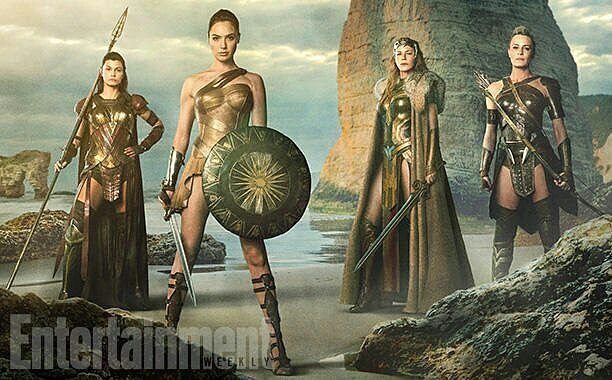
Maybe it was her theme song produced by Hans Zimmer & Junkie XL or maybe it was how she one upped Bruce Wayne in her first scene but Gal Gadot’sWonder Woman stole the entire show. Even after the “Dawn Of Justice” screenings, the first promotional image of the women of Themyscira was met with more praise than the movie. I also gushed about her performance in the Monkey Fighting Robotspodcastfollowing the release.
Diana Prince, also known as Wonder Woman, found herself playing a big part throughout the film. When she wasn’t joining the other heroes in a fight against Doomsday, she was appearing at fundraisers or at an auction. Those two events led to her having some interesting interactions with Bruce Wayne. While Batman tries to compare her to other women he has met before, she informs him that he has NEVER met anyone quite like her. Moments like that had the fans foaming out the mouth as Gadot effortlessly brings sass & grace to Wonder Woman.
The future looks bright for the Themysciran. Next year will bring possibly the biggest female superhero movie to the big screen and if “Dawn Of Justice” was anything to go by, Wonder Woman will be playing an important role in the creation of The Justice League for their 2017 film.
I believe that “Batman v Superman: Dawn Of Justice” helped solidify the public’s interest in the solo Wonder Woman project. Will the 2017’s “Wonder Woman” be the first watchable female superhero film? After upsetting blunders like DC’s “Supergirl” from 1984 & Marvel’s “Elektra” in 2005, we need our favorite Amazonian demigoddess to show us who runs the world!
DC Comics & Warner Brother’s “Wonder Woman” is currently filming, directed by Patty Jenkins and stars Gal Gadot, Chris Pine, and Connie Nielsen. They are aiming for a June 23, 2017 release date.
DC Entertainment debuted its plans for the DC Universe: Rebirth relaunch at WonderCon in Petree Hall in the Los Angeles Convention Center. More than 500 people attended the event.
Hosted by DC All Access co-host Tiffany Smith, a mix of DCE executives were on hand to give fans the lowdown on this brand new universe, along with a stellar lineup of writers and artists for the first wave of titles launching in June. DCE Co-Publishers Dan DiDio and Jim Lee greeted the audience with an overview of the major motivation and themes behind the Rebirth initiative; building on the accomplishments and fan appeal of The New 52 relaunch of 2011 and returning to the essence of the stories and characters that have made the DC Comics imprint a favorite of fans for the last 80 years.
DC Universe: Rebirth one-shot will be released on May 25.