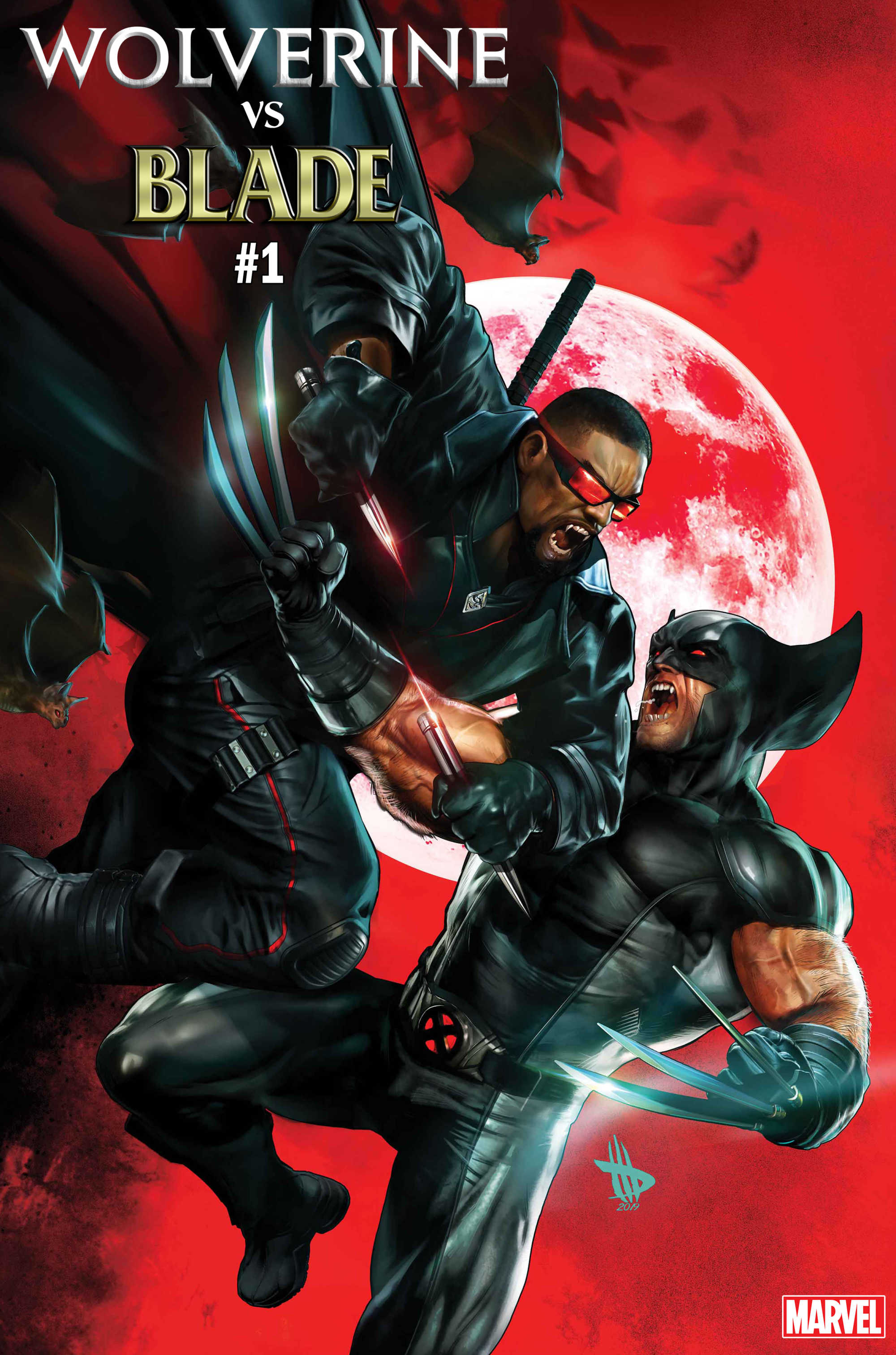
Marvel Comics announces a new one-shot for July, Wolverine Vs Blade Special #1. The book is written by Marc Guggenheim, who’s no stranger to writing battle royals.
“This is a book that’s been — not kidding — ten years in the making. I couldn’t possibly be more excited for it to finally see publication. I think it’s worth the wait,” said Guggenheim to Monkeys Fighting Robots.
Dave Wilkins is the artist on the book, with a variant cover by Matteo Scalera. Wilkins has mainly been a cover artist to date, but Wolverine Vs Blade Special #1 looks to be his breakout comic. Guggenheim admitted on Twitter he is very excited for Wilkins’ amazing art.
Guggenheim has previously written both Wolverine and Blade individually, so it will be interesting to see how He brings that knowledge and experience to a “versus” story. His writing credits span comics, novels, film, TV, and even video games, and he’s also a co-developer of the DC Comics shows Arrow and Legends of Tomorrow.
About the issue: Two of the deadliest hunters ever to have stalked the night face off! Wolverine vs. Blade — ’nuff said!
Check out a full-size version of the cover below:
It’s worth noting that Wolverine is in his X-Force costume on this cover, raising questions as to when this story takes place. Ol’ Logan was just recently brought back to life after a few years, while Blade has joined the Avengers.
Are you excited for Wolverine Vs Blade Special #1? Comment below with your thoughts.
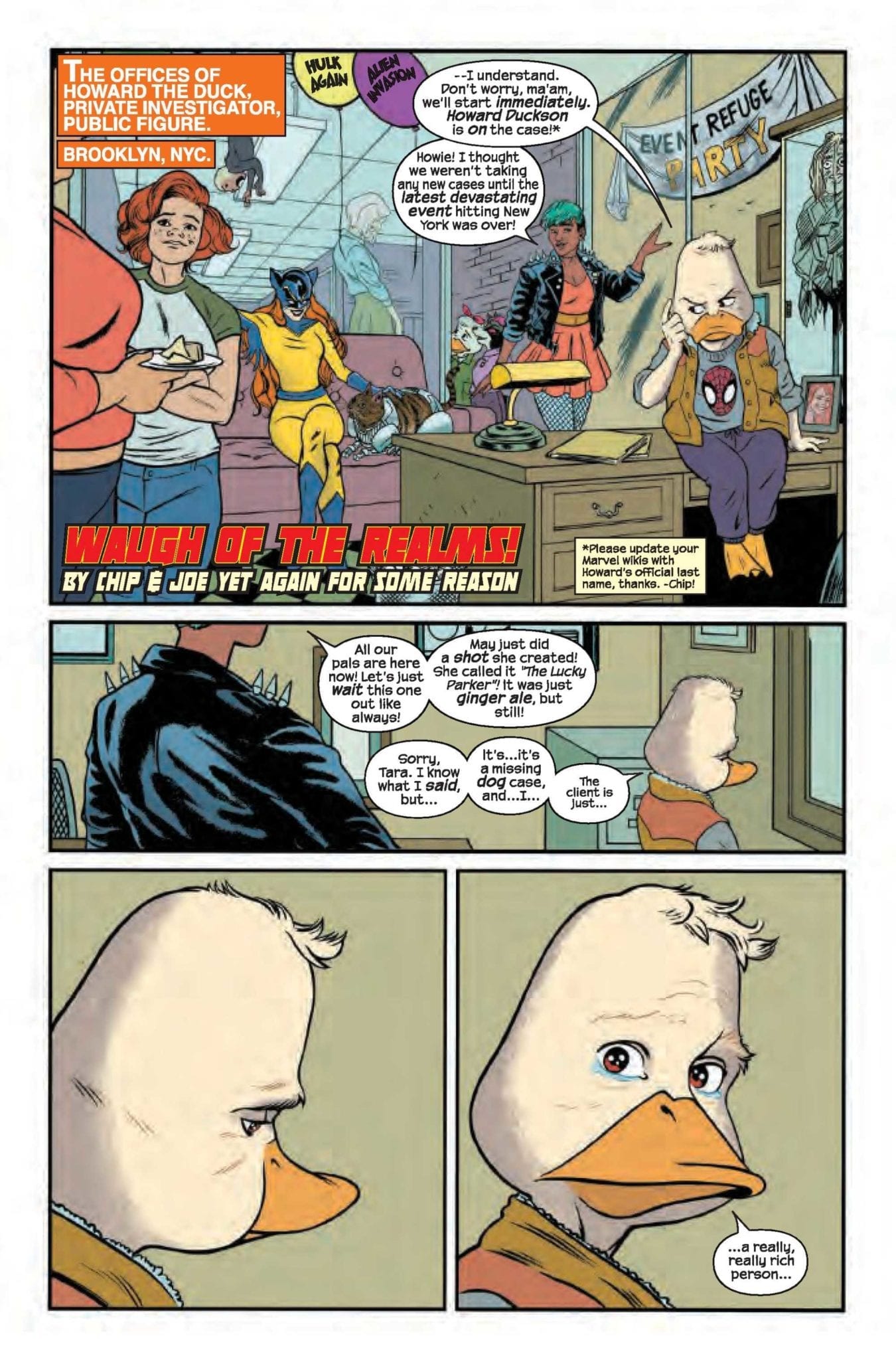
War Of The Realms: War Scrolls #1 of 3 hits your local comic book store on April 17, but thanks to Marvel Comics, Monkeys Fighting Robots has an exclusive five-page preview to share with you.
The 33-page book is written by Jason Aaron, Chip Zdarsky, Josh Trujillo, and Ram V. With art by Andrea Sorrentino, Joe Quinones, Ricardo Lopez-Ortiz, and CAFU. Alan Davis, Mark Farmer, and Matt Hollingsworth worked on the cover.
When Marvel says, “THE MUST-READ COMPANION TO WAR OF THE REALMS!” The publisher might be right with this tie-in. Daredevil is a unique character, and it could be interesting to see how Aaron uses Matt Murdock and what direction he sends the Man With Out Fear.
About the issue: Gifted the sight of the Bifrost, Daredevil watches all Midgard burn under Malekith’s invasion. How will the Guardian of Hell’s Kitchen…guard an entire Earth turned to Hell? Find out in a story by Jason Aaron & Andrea Sorrentino! All this and more (including a new Howard the Duck story by Chip Zdarsky & Joe Quinones!), straight from the battlefield of WAR OF THE REALMS!
Check out the full preview below:
Do you have War Of The Realms: War Scrolls on your pull list? Comment below with your thoughts.
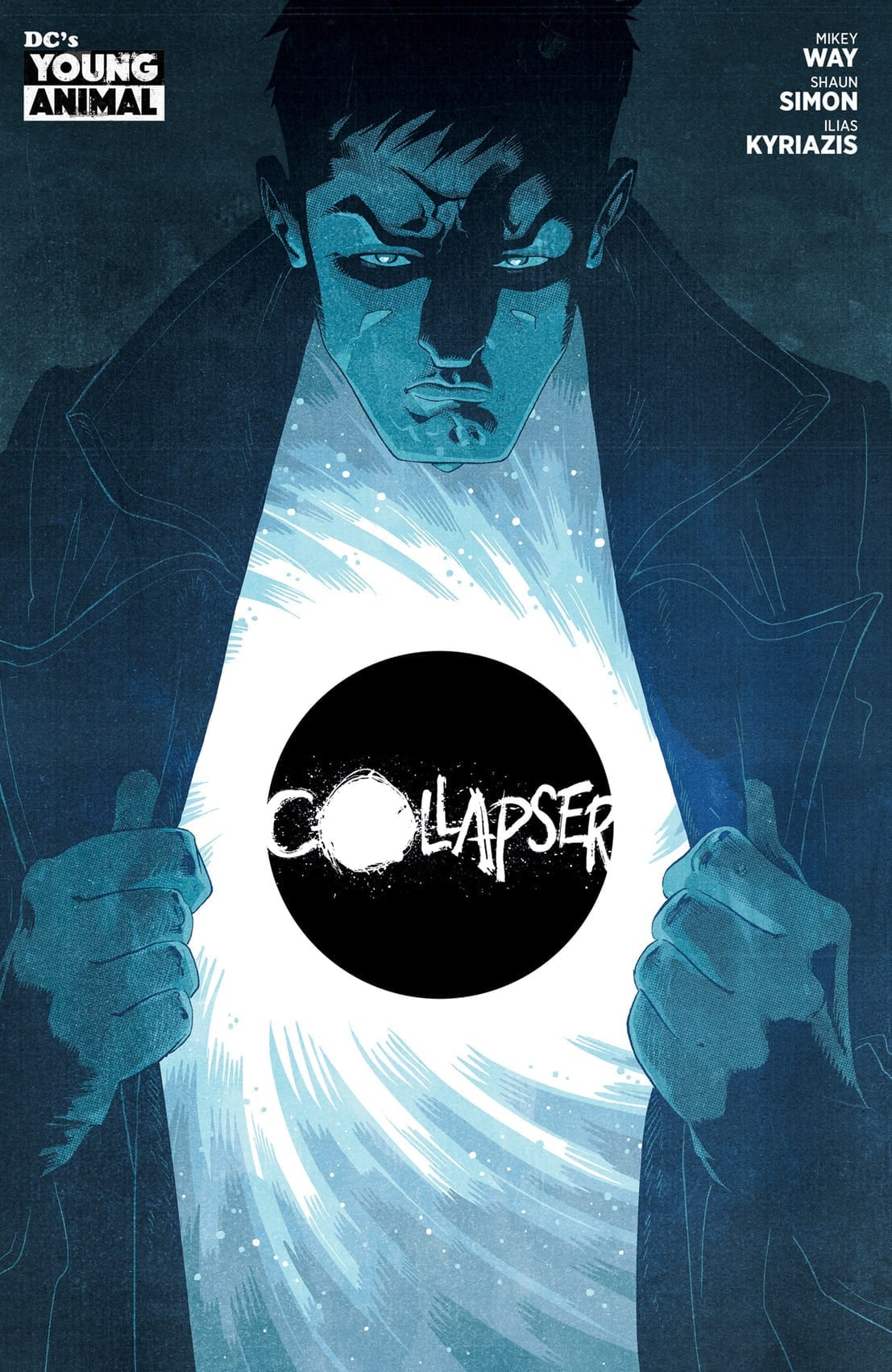
After DC’s four Young Animal series wrapped up last year, fans were left wondering if that was the end for Gerard Way’s pop-up imprint. The answer, it turns out, was a resounding “no” — the label returns this summer with three new series: Collapser, Far Sector, and Doom Patrol: Weight of the Worlds.
Way says,
“We are thrilled to revitalize DOOM PATROL, and to present both COLLAPSER and FAR SECTOR, two books that push the medium of comics and their respective genres through uncharted territory. Readers can expect everything from high doses of cosmic weirdness and positivity, to deep examinations of anxiety and emotions while wielding immense power, to sci-fi explorations of authority and control and what it means to be a guardian while a world hangs in delicate balance. More fantastic comics outside the norm, as only DC’s Young Animal can do.”
Weight of the Worlds will be the next volume in the ongoing Doom Patrol run, written by Way and Jeremy Lambert. After so many years of being almost strictly a cult item in the DC catalog, the Patrol will soon have a comic on the shelves in addition to their acclaimed series on the DC Universe streaming service.
Collapser will be co-written by Way’s brother and My Chemical Romance bandmate, Mikey Way. Far Sector not only marks the comics debut of a new Green Lantern character, but of bestselling science fiction author N.K. Jemisin (the Broken Earth series).
Cover art and official title descriptions are below:
DOOM PATROL: WEIGHT OF THE WORLDS
Written by: Gerard Way and Jeremy Lambert Art by: James Harvey followed by Doc Shaner, Nick Pitarra, Becky Cloonan and more Series debut: July 3, 2019
Gerard Way and the World’s Strangest Super Heroes return in an all-new series that takes them beyond the borders of time and space! The Doom Patrol will go on an epic road trip around the solar system, facing off against the unusual and bizarre including the fanatical fitness fiends of planet Orbius and the Marathon Eternal. Big changes are coming for these unusual heroes, including Robotman coming to terms with his new life as a human.
COLLAPSER
Written by: Mikey Way and Shaun Simon Art by: Ilias Kyriazis Series debut: July 17, 2019
Liam James is a wannabe DJ whose life goals are almost completely dashed by his crippling anxiety—until a package arrives in the mail containing a black hole that gives him amazing powers and draws him into a cosmic conflict far beyond anything he’d ever imagined. But Liam will discover that when it comes to life, love, mental health and superhero responsibilities, there’s no such thing as a quick fix, and that power comes with a cost.
FAR SECTOR
Written by: N.K. Jemisin Art by: Jamal Campbell Series debut: 2019
Newly chosen Green Lantern Sojourner “Jo” Mullein has been protecting the City Enduring, a massive metropolis of 20 billion people, for the past six months. The City has maintained peace for over 500 years by stripping its citizens of their ability to feel. As a result, violent crime is virtually unheard of, and murder is nonexistent.
But that’s all about to change.
This new series introduces a dizzying game of politics and philosophies as Jo discovers a brewing revolution in the City, aided and abetted by some of its most powerful citizens.
You can read DC’s entire Young Animal announcement here.
Were you reading the Young Animal titles last time around? Are you excited to see the label’s return? Let us know in the comments!
It looks like Mark Waid will be involved in not just one, but two high profile Marvel comics this summer.
History of the Marvel Universe was one of the titles announced at this year’s C2E2. All we knew then was that it would be six issue series by Waid, Javier Rodriguez, and Alvaro Lopez. Marvel also offered a glimpse of some artwork from the series.
Now, the publisher has provided the first issue cover by Steve McNiven, along with an update that sheds some further light on what the whole project is about. One of their key quotes promises that History of the Marvel Universe “will reveal secrets and shocking revelations while connecting every thread in the entire universe from past to present.”
In Waid’s own words,
“We’ve seen Marvel histories and Marvel encyclopedias and Marvel handbooks, and I love that stuff. I absorb them like Galactus absorbs planets. This is not that. There’s information here, but there’s also a story. The Marvel Universe is a living thing. It is its own story, and we’re trying to approach it with some degree of heart to find the heart in that story so it doesn’t read like 120 pages of Wikipedia.”
All of this comes on the heels of more Waid news: Sue Storm (aka The Invisible Woman) will be getting her very first solo series also debuting in July. Artist Mattia De Iulis will illustrate the project. Executive editor Tom Breevort says,
“In over fifty years, she’s never had her own title (or maybe she did and you just didn’t see it). Waid and De Iulis will be delving into what Sue Richards does—and even who she is—on her own time, apart from her famous family! It’s sure to surprise some—as will a few of the gestures-players who’ll be passing through the story!”
Here’s a look at the first issue cover by Adam Hughes:
Will you be checking out both of these books? What kind of stories do you hope Waid delivers? Leave us a comment!
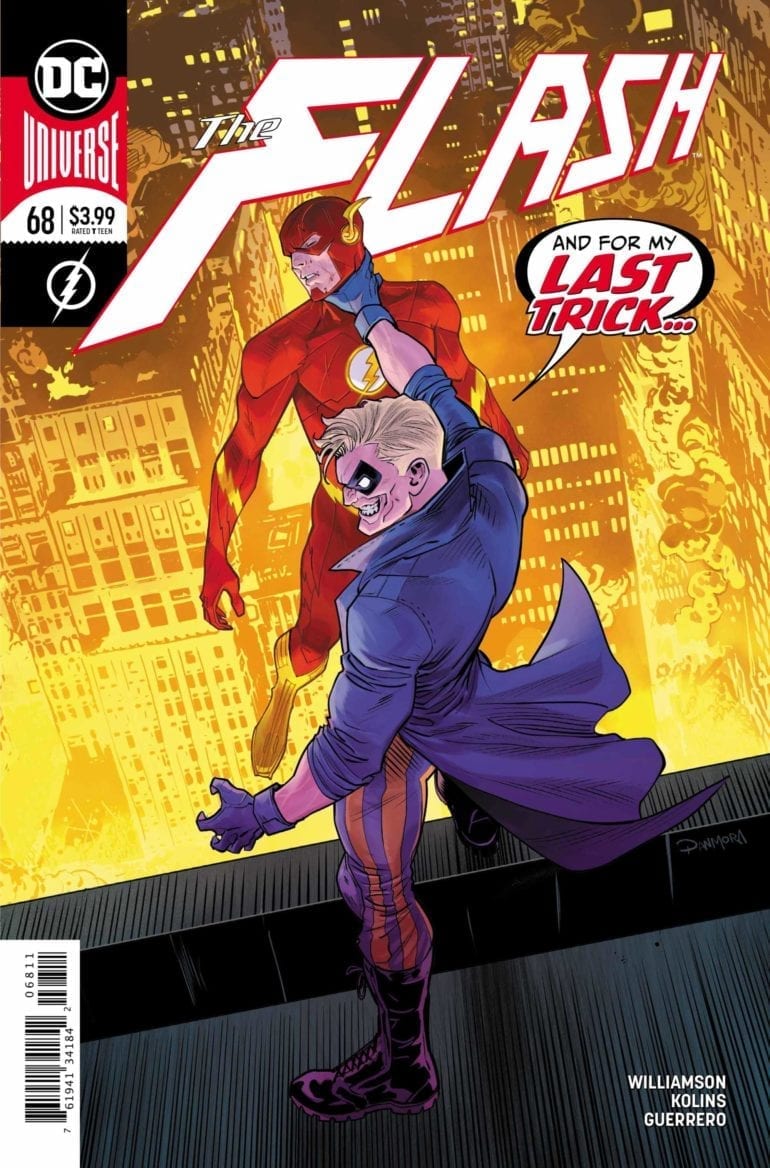
Flash has returned from his team up with Batman to a changed Central City. The entire city has smiles on their faces and pleasant attitudes. This wouldn’t be such a problem if not for the fact it’s clear they capture those who don’t smile. This is thanks to the brainwashing of the Trickster, who is planning his come back. Will James Jesse get the last laugh over the Scarlet Speedster?
**Some Spoilers Below**
Story:
We open to find James Jesse asking Commander Cold questions about the future. He hopes to learn that his name is remembered, especially after Warden Wolfe got rid of any evidence of his existence. After his search turns up nothing, James goes to happy-fy some civilians, including Barry. As he gets forced through the machine to brainwash him, Barry vibrates to get through unaffected. He quickly changes into the Flash and goes to find Cold. He frees the Renegade leaders down the pair team up to take on the younger Trickster. The Tricksters, however, have one last trick up their sleeve.
This is a great issue. There’s plenty of action when fighting the Tricksters as well as suspense. I won’t lie; I was nervous when the Trickster was revealed to be the next villain. Despite his history with the Flash, he isn’t exactly precisely an A-Class villain. This issue, however, shows he is indeed a force to be reckoned with. Just when Flash thinks he’s one step ahead, James reveals another trick to slip him up. Trickster has gone from being a knock off of the Joker to standing in the spotlight all his own.
The only part of the comic I wasn’t a fan of was the very dark cliffhanger ending. While it does cement the threat that is the Trickster, it was a step too far. The Flash isn’t afraid of delivering darker story elements, but this was a bit of a leap. There’s no doubt that this is just another trick, but I wasn’t a fan of this.
Art:
While I usually am not a fan of Scott Kolin’s style, it does fit the story exceptionally well. It allows the Trickster to look genuinely intimidating, yet colorful enough to keep his aesthetic. Every page walks that line of the lighter tones of the Flash and darker tones the Trickster’s plot promises. I am both terrified and excited to see where this art and the story go next.
Conclusion:
Overall this is a great issue of the Flash, and it’s all thanks to its villain. James Jesse is a great antagonist, and his actions in the story prove it ten times over. The art helps capture the style of the villain as well, making it both humorous and terrifying. While the cliffhanger might be a bit dark for this reviewer’s tastes, it’s another fantastic chapter to an already intriguing story.
Batman #68 brings us part six of the Knightmares storyline, Solitude.
Bruce is still trapped somewhere, forced to experience nightmare after nightmare as a form of psychological torture. As mentioned in the review for the previous chapter, a lot of Knightmares is starting to feel like filler. To be frank, this is a storyline that’s overstayed its welcome at this point.
The Writing
The contrasts between Bruce and Selina’s pre-nuptial partying drive our story. Lois and Selina trash the Fortress of Solitude while Bruce and Clark have an awkward, uncomfortable evening at home. There are a few chuckle-worthy moments here and there. Overall, though, the book reads largely like a passable sitcom episode, at least until the illusion of the dream is broken, only for it to go unremarked upon.
Characterization was also an issue in Batman #68. While most of the characters are awkward and uncomfortable, Lois actually comes across very cynical, even bitter at the state of her life.
The book’s core seems to be a representation of Bruce’s anxieties regarding what his life is outside of Batman. It’s natural for a character like Bruce to probe his own motivations, but the answers that turn up in Batman #68 don’t really sit right.
As one character explains it, “You hate being Batman. But you love that you have to be Batman.” The book suggests Batman derives his value from the fact that the world needs a Batman. However, that analysis doesn’t really seem to hold up. If anything, it seems antithetical to Bruce Wayne’s character; under all the gadgets and grimness, the defining trait which motivates Batman is compassion. It’s not a sense of masochistic responsibility. Thus, even if Knightmares is about probing into Bruce’s deepest anxieties, this one doesn’t feel especially motivated.
The Artwork
Amanda Conner takes on the bulk of the art duties for Batman #68. Her more wide-eyed, cartoonish style allows for a wide range of expression, driving a lot of the story. Conner also does a great job of laying out the pages to create a smooth transition between the two narratives.
The colors credited to Paul Mounts, John Timms, and Jordie Bellaire complement the art style. They’re bright and vibrant, which works alongside Conner’s rounded character designs. The colors also do an excellent job of defining the dual narratives, often matching the tone in a transition panel to the colors in the previous one.
Final Thoughts
The last several issues of the Knightmares story arc produced diminishing returns. The misses in characterization in Batman #68, plus the foreknowledge that it’s all a dream—let’s call it a “reverse-St. Elsewhere”—makes it pretty easy to skip.
Jon Kent has been busy explaining his recent troubling family issues to his parents. Traveling through space with grandfather Jor-El, who’s been undergoing a slight mental breakdown, wasn’t all it was cracked up to be. What’s worse, an unexpected appearance of a wormhole transported Jon into another dimension and held him there for years. And he’s ready to tell his parents the truth of what happened there.
Story
Jon’s recollection of his adventures is a particularly effective storytelling technique on Brian Michael Bendis’ part. It slowly reveals more and more pertinent details to explain the hero’s surprising predicament. This way readers are able to step into Clark and Lois Kent’s shoes as they nervously anticipate each shocking new story detail.
While traveling through space with his mentally unstable grandfather Jor-El, Jon describes being transported to an alternate dimension full of evil versions of his family. He narrowly escapes their clutches after years of imprisonment.
The interaction between Jon and his parents unleashes a whole host of emotions. One can sympathize with the parents’ sense of loss time. Missing out on so many years in their child’s life would be an unbearable experience. It’s enough to make a parent feel like a failure.
According to Jon, Jor-El arrived on the scene just in time. His time spent searching the multiverse for Jon paid off, but a sense of loss nonetheless accompanies the rescue. Jor-El, like Lois and Clark, must come to terms with the lack of presence in his grandson’s life. What’s more, an army of invaders from the alternate dimension has set its sights on the House of El. We’ll have to wait and see if the family can come together and resist falling apart under the weight of these problems.
Art
The artwork in this series installment is remarkable as always. Brandon Peterson and Ivan Reis provide action-packed fight scenes that the extent of Superboy’s powers, especially in his battle with the evil Lois. At the same time, Alex Sinclair uses a wide variety of colors to fully immerse the reader in the outer space setting.
The issue’s inking was performed by Oclair Albert and Joe Prado. Each artist finds a way to alternate between thick and thin lines to offer multifaceted and realistic illustrations.
Josh Reed’s lettering worked well with all of this artwork. His dialogue boxes do a great job of outlining the characters.
The issue’s main cover was created by Prado, Reis, and Sinclair, which depicts a fantastically illustrated fight between Kal-El and Jor-El that blends well with the interior artwork. Adam Hughes’ variant edition takes a different approach, using pastels to depict a version of Superman lost in thought while saving train passengers. This highlights his distress upon hearing of Jon’s troubles in space.
Conclusion
This was the issue readers have been waiting for, revealing the final stretches of Jon’s journey with Jor-El. It’ll be interesting to see how Clark, Lois, and Jor-El respond to their much-older son and confront the imminent threats posed by those who followed him back to Earth.
What did you think of Jon’s final details to his crazy adventure? Let us know in the comments below!
RONIN ISLAND #1 introduced us to Kenichi and Hana, two budding warriors training to become full-fledged samurais. But just as they’re undergoing initiation a samurai named Sato shows up and demands their allegiance to his Shogun and help them fight an army of zombie-like Byonin. Now the young warriors must join the fight and learn what it means to fight for a cause larger than Ronin Island itself.
Story
The community of displaced peoples on Ronin Island is in shambles. The Byonin are attacking villagers while a menacing army of samurais, lead by the General Sato, is forcing everyone to join their ranks. Elder Jin and Master Ito reiterate their community’s independence and free status, but Sato will have none of it. He believes they should be subjugated to his shogun, and he’ll use the Byonin threat as an extortion tool if necessary.
After fighting the Byonin, Elder Jin decides to give into Sato’s demands for the sake of her people. Thus, the once free Ronin Island warriors become subjects of the samurai and the unknown shogun. Hana and Kenichi, appalled at their people’s predicament, spend the next month plotting their escape from the island.
Elder Jin’s famous mantra “Together in strength,” emboldens Hana and Kenichi’s resolve to free their people. But while attempting to escape Sato makes a surprisingly heartfelt plea, reminding them that his shogun’s people need help just as much as they do.
Greg Pak poses an interesting moral quandary with this statement. Do the people of Ronin only care about their own community? Does working together only apply to people in your group? Readers will join Hana and Kenichi as they consider how far their compassion actually reaches, especially in the midst of difficult situations.
Art
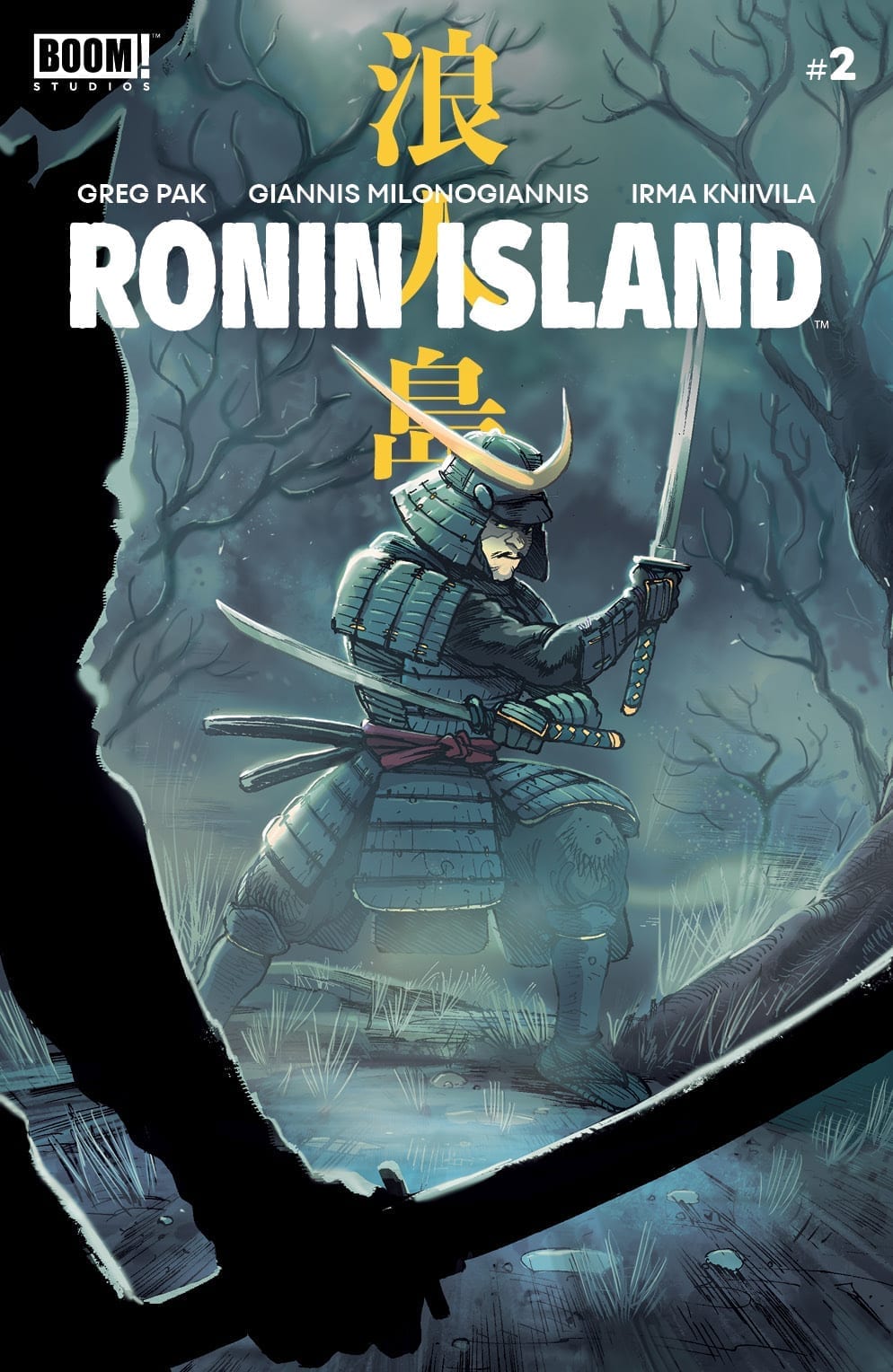
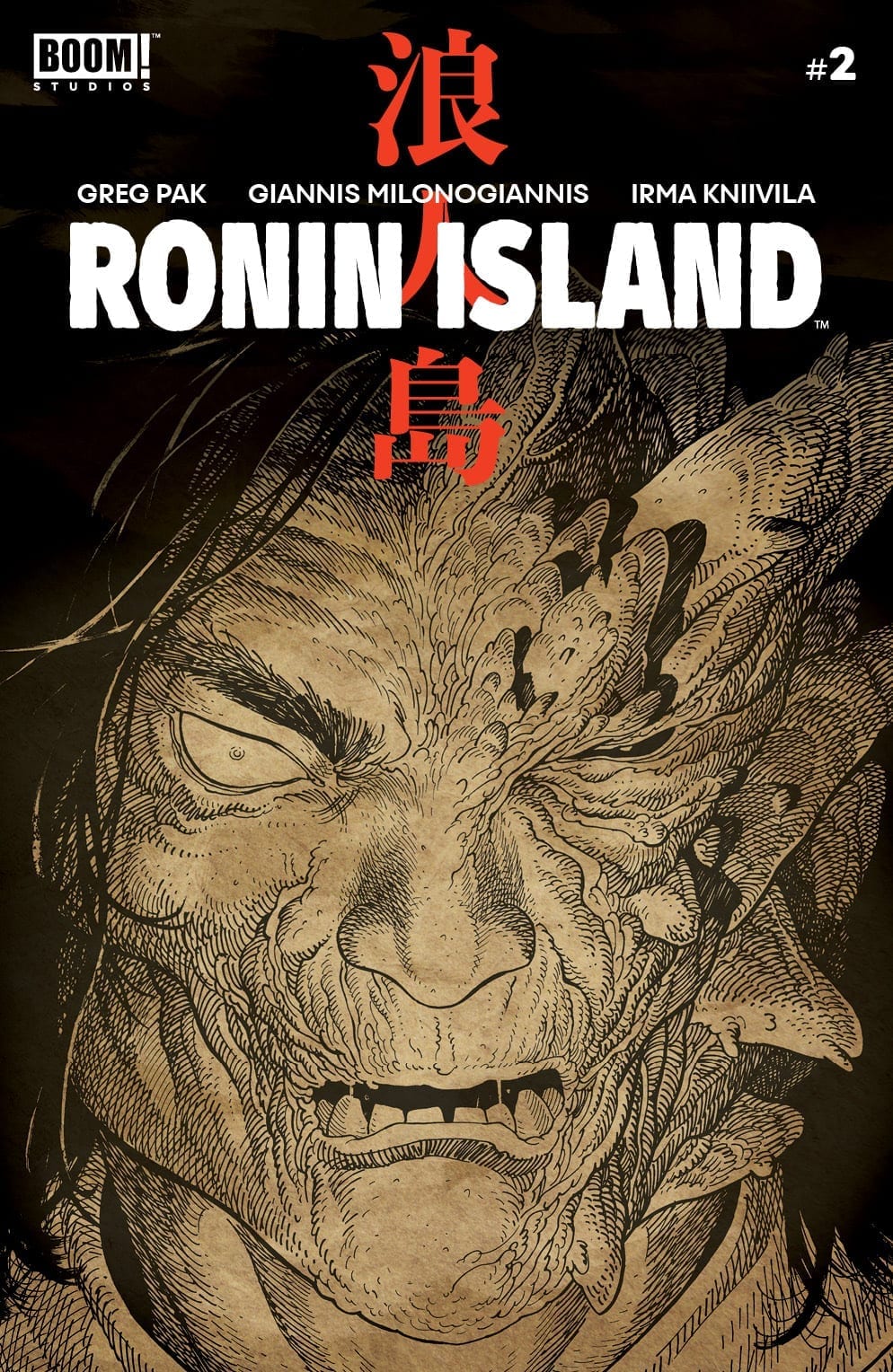
The three covers for RONIN ISLAND #2 place emphasis on a few of the more antagonistic figures in this series. Giannis Milonogiannis and Msassyk’s main cover and Kris Anka’s unlocked retailer variant cover both depict images of General Sato. The main cover shows the samurai in a defensive posture as a Byonin closes in. Anka’s Sato appears more menacing with his head tilted down and sword drawn. These covers show the different sides of Sato and emphasize how he’s become such a multifaceted character.
Ethan Young also lends his preorder cover to mix. His work features a close up view of the Byonin’s face, giving readers a closer look at the formerly-human creature.
The artists telling the story of Ronin Island take this issue’s illustrations to a new level of gruesomeness with their depictions of the Byonin. Giannis Milonogiannis’ penciling highlights every gory sword slash as the islanders resort to such brutal tactics for survival. Irma Knivila applies various shades of orange to the Byonin blood to show how far they’ve moved beyond their human forms.
Simon Bowland’s lettering does a great job of complementing Milonogiannis’ action scenes. He transitions font styles and sizes seamlessly to produce battle sounds and cries in reader imaginations.
Conclusion
RONIN ISLAND #2 shocks us, but not so as to drive one away. It’s a shock that, much like a doctor’s defibrillator, wakes us up to a world in pain. Compassion has no limits, and sometimes it takes a menacing General Soto to remind us.
What did you think of General Soto’s character development in this issue? Let us know in the comments below!
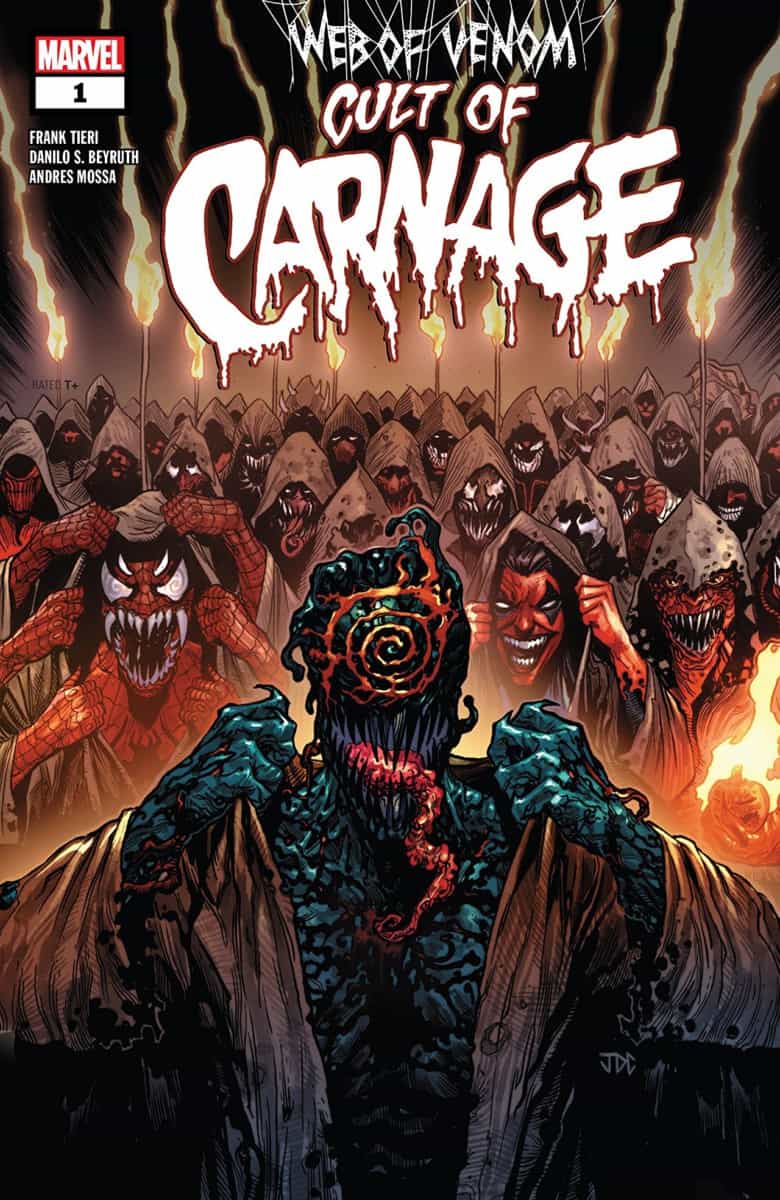
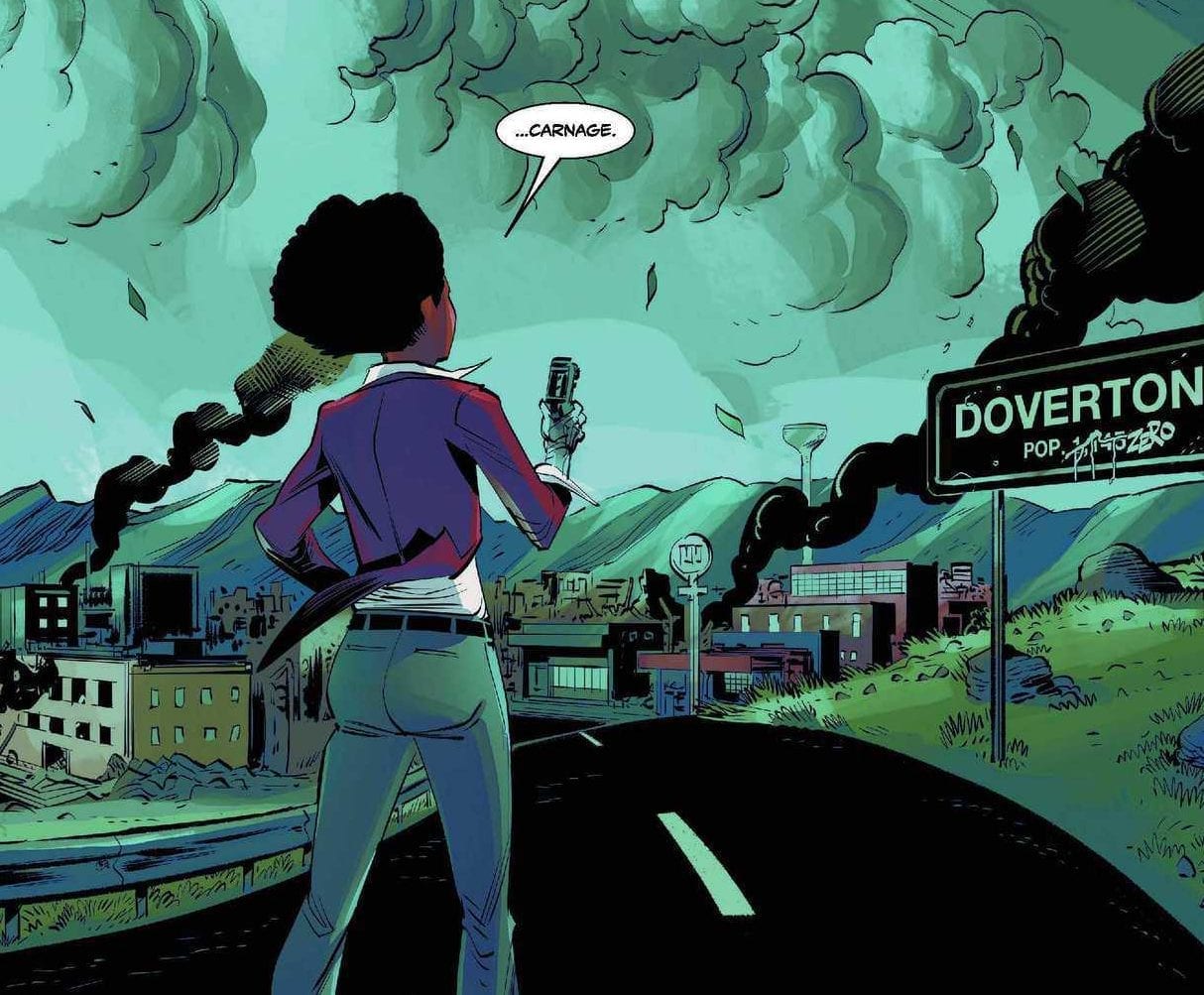
Web of Venom: Cult of Carnage by Frank Tieri, Danilo S. Beyruth, Andres Mossa and Clayton Cowles deftly continues to expand on the horror-tinged mythology the various symbiote books have been creating.
Web of Venom: Cult of Carnage Written by: Frank Tieri Art by: Danilo S. Beyruth Colors by: Andres Mossa Letters by: Clayton Cowles
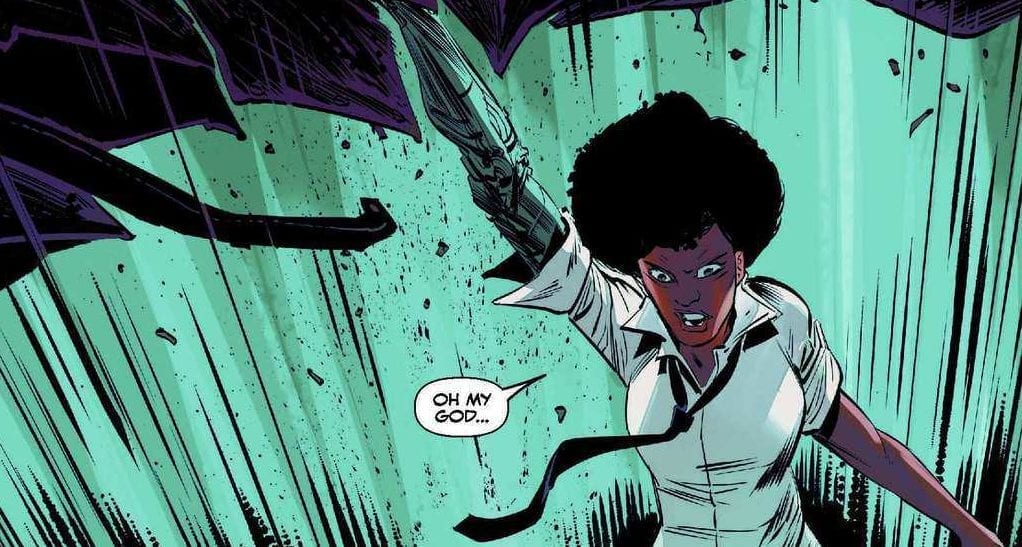
Misty Knight heads into Doverton, Colorado, where years ago the evil symbiote Carnage took over the entire population, slaughtering the rest. As Misty searches for the missing John Jameson (aka Man-Wolf), something sinister brews in the background. Dead bodies, missing their spines, begin to pile up. Just what is The Church of The New Darkness up to? And where is Carnage and the symbiote god Knull is coming!?
Writing
Frank Tieri is no newbie when it comes to horror, and that’s a good thing because Cult of Carnage is not a superhero book. It’s a straight-up horror story that continues the modern mythology of the symbiotes that Marvel has been building for years now. Using just a bit of exposition, Tieri is able to catch readers up and dive us into the heart of Cult of Carnage, and that is where the horror lies. The story includes robed cultists, dark rituals, and spines being ripped out. It also does not skimp on the blood and gore; it pushes that envelope farther than any other mainstream Marvel book.
Tieri also wisely uses some surprising characters. The protagonist here is Misty Knight. And we also quickly get John Jameson (who gets his origin explained briefly). There are two more characters that make an appearance, but that’s better left unsaid as old-school Carnage fans will want to turn the page on these two themselves.
Art
Danilo S. Beyruth and Andres Mossa create a deceptively light look at first. The line work feels loose and the colors are not the usual horror comic garish. There’s almost a Jeff Lemire quality in the faces and figures. But then they turn around and give us some truly horrifying images. It’s a balancing act that works and gives the story a nice vibe that makes it feel very unique.
Conclusion
Cult of Carnage is well worth checking out. Die-hards are going to dive right in, and even casual Marvel fans will find a neat little horror book set in their favorite universe. It’s a solid book and must buy.
Peter J. Tomasi cements the new era in Batman’s legacy with Detective Comics #1001. Picking up from his story in Detective Comics #1000, Tomasi introduces the Arkham Knight from the similarly-titled video game as the chief antagonist of his new story.
Batman investigates some strange bat-related phenomena occurring throughout Gotham. In the midst of this activity, though, the Arkham Knight and his army decide to strike.
The Writing
It’s worth noting that readers who haven’t played the Batman: Arkham Knight game can feel slightly lost from the outset. However, it’s nothing a few minutes on Google can’t fix.
Detective Comics #1001 effectively showcases the Arkham Knight as a genuine threat. The character has fanatical followers, powerful weapons, and incredible technology…all aimed at taking out Batman. It was interesting seeing Arkham Knight’s impression of the role Batman plays in Gotham in our last issue. Now, the scope of what the character seems to have planned is impressive indeed.
The storytelling in Detective Comics #1001 is compelling stuff. Presumably, the figure under the mask is not the same assailant as in the game, forcing us to guess who could have taken up the Arkham Knight persona. Even beyond that mystery, Tomasi’s writing is suspenseful, intriguing, and leaves you wondering what will happen next. He reveals enough to keep readers engaged, but keeps his cards close to the chest about what’s really going on.
The Artwork
The artwork by Bradley Walker is strong here. He has a fine eye for dynamic movement, which he showcases in the book’s action-driven second half. He lays out pages during quieter moments in more regular squares. When the action picks up, though, page layouts become much more chaotic and unpredictable to match the pace.
Walker’s design for Batman in Detective Comics #1001 harkens back to an older, early ’40s-inspired look. Along with inker Andrew Hennessy, the pair delivers something that feels classic, yet not out-of-place in modern context.
Colorist Nathan Fairbairn employs an uncommonly-bright color palette for a Batman book. While it feels unconventional, it largely works within the context of the book.
Final Thoughts
Detective Comics #1001 suggests the future of the Caped Crusader is in good hands. Definitely recommended.







 **Some Spoilers Below**