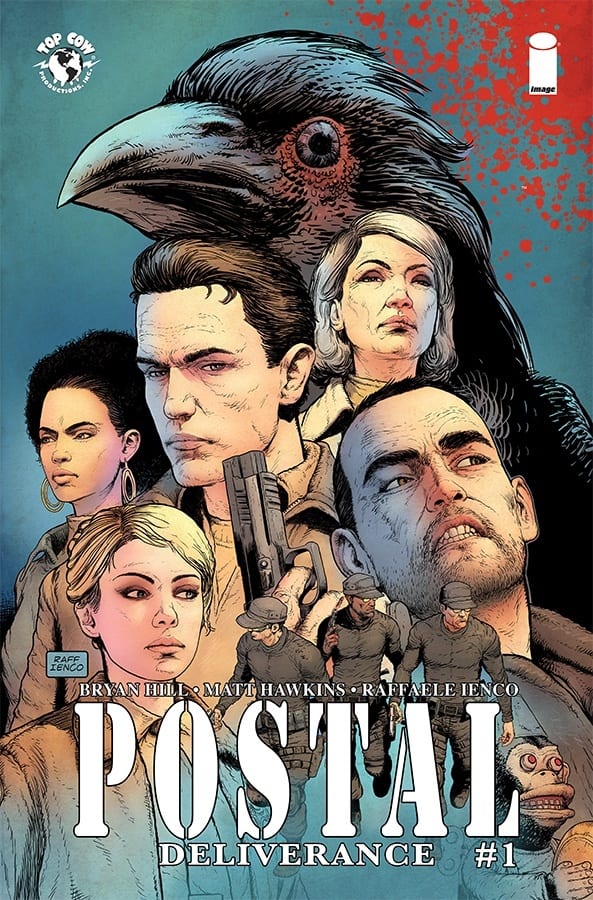
It has been over a year but finally Top Cow are returning to Eden with Postal: Deliverance. Byran Hill and Matt Hawkins return to the series to revisit the characters they created in 2015. Picking up after the events of the two PostalSpecials from 2018, the Shiffron family have moved on, taking new roles in and out of the town of Eden. However, trouble is never too far away and both Mark and Laura seem to attract it like moths to a flame.
Postal Deliverance #1 Credit: Top Cow
The opening of Postal Deliverance introduces a new character to the readers. Eric Cayman enters the Edenverse in a hail of bullets and surrounded by tragedy. Bryan Hill uses the introduction to set the tone of this first issue and to remind the reader about the complexities of the characters. One of the strongest elements if Postal was the contrasting natures of the characters; neither good nor evil.
Cayman is the epitome of this concept. His first appearance is violent and desperate but contains elements of a normal life. As the story unfolds the reader gets to see Cayman in number of different lights. Good guy or bad? The jury is still out.
The story then shifts physically and tonally thanks to the Raffaele Ienco’s coloring. The coldness created by the dark blues in the opening are replaced by the bright sun light of Florida. The retired Mayor of Eden, Laura Shiffron, is bored living her new life. This is made clear instantly by the bleached colors and framing of Laura and Magnum on the page. In each panel there is something separating them, a visual divider reflecting Laura’s mood.
Elsewhere Mark and Maggie appear contented in their new roles in Eden. They have as close to a normal family life as possible juxtaposing the earlier scenes with Cayman’s family. The normality of the setting helps the reader to focus on the conversation which portrays the characteristics of Mark and Maggie. Long-time readers can see how they have changed from the last series while new readers get to know the central cast.
Postal Deliverance #1 Credit: Top Cow
One of the criticisms aimed at the original series of Postal was that the art was inconsistent. The same cannot be said for Ienco’s work. He has a highly detailed style which is suited to this type of storytelling. With thin line work and tight compositions, Ienco packs a lot of information into a panel while at the same time creating a sense of drama.
He also uses the progression of panels to simulate a camera movement on a number of pages. The reader gets the impression that the camera is slowly tracking from a close up to a wide shot, emphasising the moment and slowing the passage of time. In other scenes, there a number of close ups like quick snapshots which increase the pacing without losing focus.
Between them Hill and Ienco have produced a comic of conflicts; physical conflicts between characters, emotional conflicts, and storytelling conflicts. The narrative is captivating and tense, even in the more sedate scenes and the art work adds a level of realism.
Postal Deliverance #1 Credit: Top Cow
Postal Deliverance is a welcome return to the Edenverse with familiar characters and intriguing new personalities delivering a thrilling come back. Postal was populated by morally ambiguous characters and situations and this new series is already following suit.
If you enjoyed the original run there is no reason you shouldn’t pick this up. It contains everything that the original did but presented in a more confident manner. The creators know this time they have a comic that can work, so they come out swinging.
Postal Deliverance is for anyone who enjoys thrillers or smart action movies. It gets the adrenaline pumping and the mind working overtime. A clever use of coloring sets up tonal shifts and the structure of the narrative provides a great set up for the series.
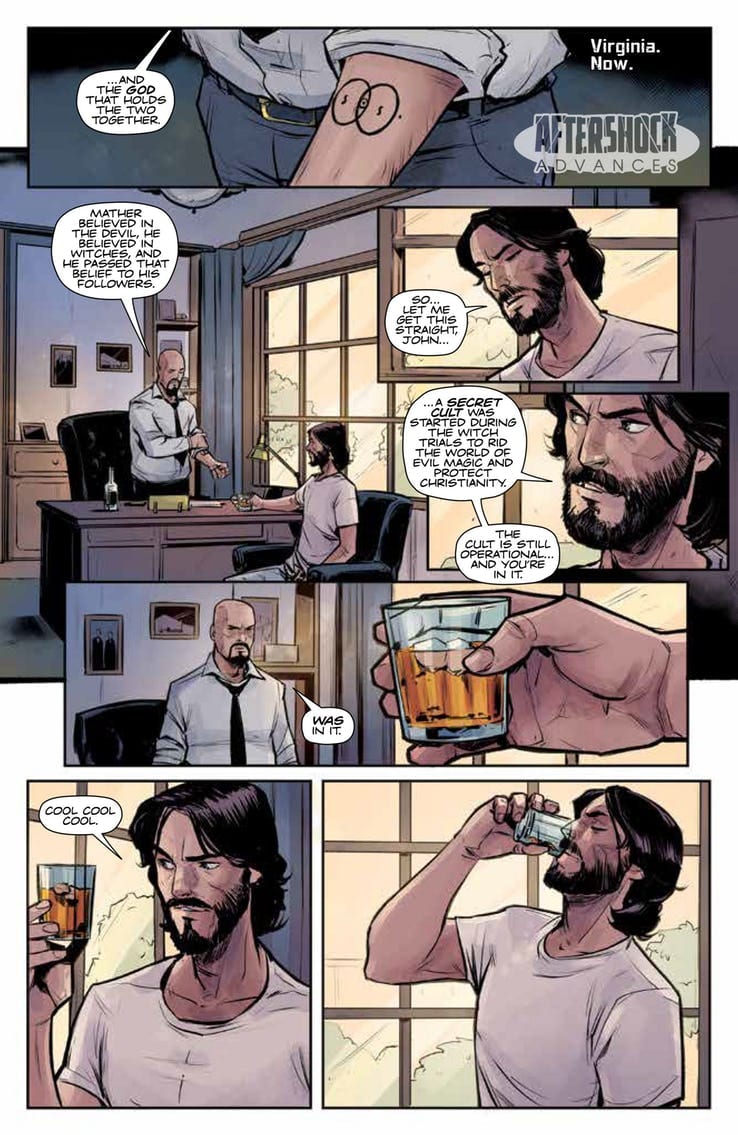
Witches, cults and assassinations, what more could you ask for? Descendent #3 has them all, and more besides. AfterShock Comics’ commitment to great storytelling means that there is already a high expectation when picking up one of their publications, luckily Descendent delivers on all fronts.
The mystery at the heart of the first two issues is starting to unravel and in issue three a number of the pieces fall into place. Stephanie Phillips pushes the plot forward significantly in this issue while beginning to tie all of the different threads together. The conspiracy that was the background for the first two issues, driving the characters in their decisions, has become the central force of the narrative.
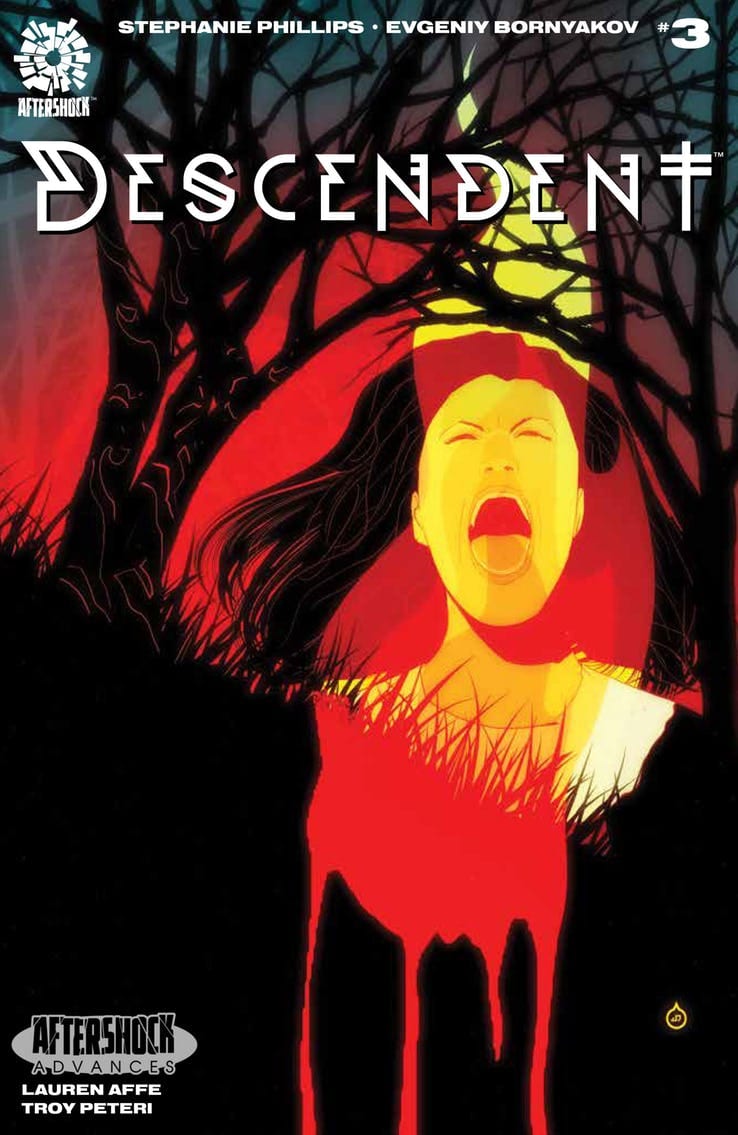
Descendent #3 Credit: AfterShock Comics
The opening sequence in this issue acts as another part of the conspiracy but also explains some of the mysterious elements from previous issues. Phillips is allowing the story to grow naturally and reveal hidden secrets in a timely manner. There is enough mystery to keep the reader interested but not too much that the reader gives up due to lack of understanding. The secrets are there to move the story forward and give the characters a common foundation to work on. How they react to the conspiracy or their involvement in it determines their actions.
Phillips has given the reader a character to lead them through the twisting story, Agent Hernandez. She is like Scully from the X-Files, she is outside the weirdness and is pragmatic in her actions; she has a job to do. However, she is also becoming involved in the greater picture despite herself, just like the reader. Phillips makes her the steady rock at the centre of a spiralling world of uncertainty, the best place to witness the actions of all the other characters.
Descendent #3 Credit: AfterShock Comics
The links to real events and people is an interesting and risky decision. Phillips weaves the reality with the fiction brilliantly so that you can’t see the seams. As noted in previous reviews, the name dropping in the narrative has a knock on effect that it encourages the audience to venture beyond the comic and research these people themselves. Be prepared to get lost in an internet hole dedicated to the Salem Witch Trials.
The art work is rooted in a realism that sets the scene and gives the narrative credibility. The majority of this issue is set in two locations, neither of which are particularly interesting in themselves. However, Evgeniy Bornyakov gives each locale its own character and by doing so contrasts the two timeframes. This helps to highlight the link between the Witch Trials and the modern day conspiracy.
Bornyakov has mastered the art of character acting in comics. The emotional responses, especially in the facial work, is amazing. Bornyakov focuses on small moments and employs the use of close ups to elaborate a character trait or emotion. His clean, steady line work allows him to build layers into the panels, distinguishing the backgrounds from the foreground. Then a subtle change in these layers focuses the reader subconsciously onto a particular moment or action, emphasising the relevance of the action.
Descendent #3 Credit: AfterShock Comics
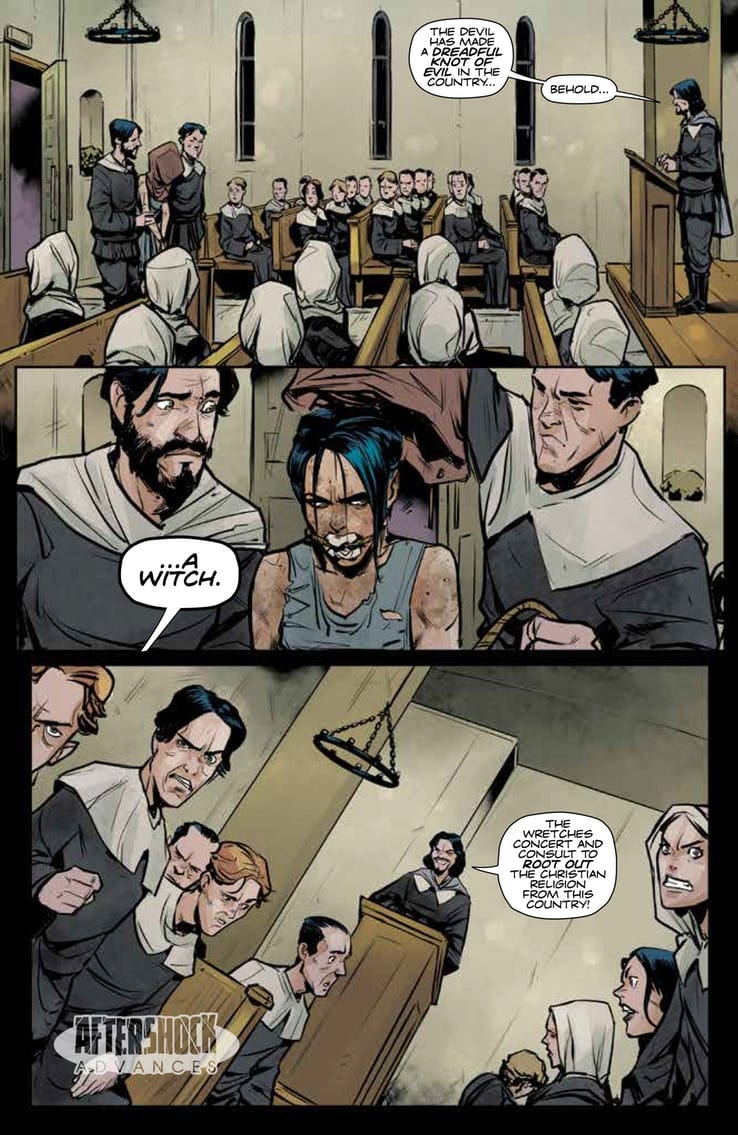
The color work by Lauren Affe helps to create the layers that Bornyakov uses to tell the story. The coloring is naturalistic however the contrast between the characters and the scenery produces that layering effect. Affe works with mostly light and dark contrasts so that the characters are wearing clothing that stands out against the background. In Salem the characters wear dark clothes in a white, puritanical church whereas the modern day setting has mainly white clothing for a grey, office environment.
In a comic like Descendent where there is a need for a lot of exposition, it is pleasing to see that the letterer varies the text and speech balloons. Troy Peteri changes the font size to give certain moments added impact. See, for example, when the witch first enters the church in the opening sequence. He also includes bolded text, and in some cases bolded speech balloons, in order to add a changing rhythm to the speech. The reader can almost hear the pitch changes in the character’s voices as they speak.
Descendentstarted off as intriguing; another drop in a river of conspiracy stories. However, the complex story, engaging characters and ties to real world events and people, have turned it from run of the mill to a must read. With the plot expanding and the threads linking up, issue 3 is the best so far. Phillips draws you into the comic and then the artists trap you there; once you’re passed the first page you won’t be able to put this down.
We are officially halfway through 2019, and the Monkeys Fighting Robots’ team has compiled their picks for best comic of the year (so far)!
Our writers have put together a list that runs the gamut, from gritty, street-level stories to grand cosmic epics, and everything in between. And, of course, “best” is a completely subjective term and this list represents our personal opinions. There are countless comics that have come out this year that deserve a place on this list.
Read on for our selections, and then tweet at us and let us know yours!
SPIDER-MAN: LIFE STORY #1
Spider-Man Life Story: #1 by Chip Zdarsky and Mark Bagley is one of those comics that makes you ask, “why isn’t everyone else doing this?” The premise is fairly simple: after his debut in the ‘60s, Spidey ages in real time. Zdarsky strongly incorporates real-world events and this blend of the Marvel Universe with our reality is particularly captivating in the first issue. Peter Parker grapples with the responsibilities that come with being a superhero in war time. The subsequent issues are excellent, too, but seeing Peter have an emotional discussion with Captain America, who’s about to join the fight in Vietnam, can’t be topped.
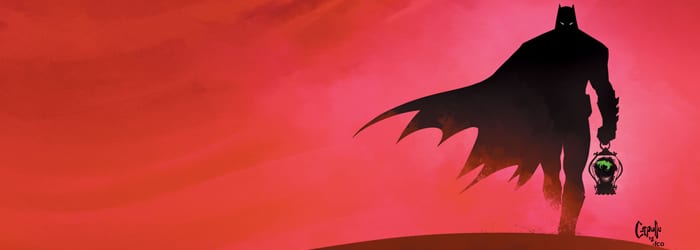
The way the first issue is written, you would almost expect Scott Snyder to retire from comics after the series ends, because the book feels unleashed as the writer pours his heart out on to every page. Then you have Greg Capullo, giggling with excitement as he gets to draw one of the most epic Batman stories ever, and then begging Synder to go bigger. Did we mention Batman is carrying around Joker’s head? The book is insane, and there are only a few first issues that come out swinging as hard as Last Knight On Earth. Snyder and Capullo have put together a blockbuster comic, the likes we haven’t seen years.
For the uninitiated, Middlewest from writer Skottie Young (I Hate Fairyland, Giant-Size Little Marvel) and artist Jorge Corona (Canto, No. 1 With a Bullet) follows “Abel, a teen who must make his way through an ancient, unforgiving landscape and face the sorcery lying beneath the scorched farmlands to unearth his family history.” From its opening pages, Middlewest grasps you with its bewitching artwork and haunting script. After the magnificent first issue, Abel and his loyal (albeit sardonic) Fox are on the run from his monstrous father.
In Middlewest #4, Abel and Fox make their way to a traveling carnival to find the mysterious Magdalina, a magical healer who just might be able to quell the storm within him. The fourth issue also introduces new characters Bobby, a skeptical carnival-worker, and Wrench, her mechanical assistant. Young’s world of Middlewest is opened up a little more in this issue, revealing more of its magic and secrets. Corona’s artwork is particularly stunning in this issue, bringing his unique style and detail to the amusement park backdrop. And the art is elevated to another level with Jean-Francois Beaulieu’s vivid color palette. In short, Middlewest #4 is a stunning example of story and artwork in comics, and is but a part of one of the most beautiful, powerful, and epic series on shelves today.
Hal Jordan, arguably the most popular Green Lantern, is known for his unbreakable willpower. But few storytellers have chosen to unpack his relationship with the thing that gives it life: the power ring. The dynamic duo Grant Morrison and Liam Sharp craft a beautiful tale of Hal’s relationship with the source that gives him his abilities. We learn this energy, the very essence of willpower itself, is his ultimate love. And the lengths he’s willing to go to protect it is nothing short of extraordinary. Seeing this unstoppable love, hope, and optimism play out in the story reminds us why Hal is such an inspiring character.
When Criminal was announced as becoming a monthly ongoing series I immediately knew it would be a must buy. A guaranteed visit to the interconnected underworld created by Ed Brubaker, Sean Phillips and Jacob Phillips? Book me and charge me, cause I’m in! And as amazing as the first issue was, it’s issue #2, the first part of the ‘Bad Weeknd’ arc, that has so far not only been the title’s best issue, it’s also one of the best single issues of 2019. Criminal #2 thrusts readers into a crime story that intersects with the world of comics and is the perfect example of why Ed Brubaker, Sean Phillips and Jacob Phillips are one of the premier sequential art teams in the history of the medium. It’s relentless in its narrative, inventive with plot, and filled with morally ambiguous characters that still manage to make you feel, care and root for them; and it’s all wrapped in gorgeously illustrated and colored pages from cover to cover. It’s also a HIGHLY accessible issue (despite heavy easter eggs and call backs for longtime fans) and a great way for new readers to check out the title out.
AfterShock Comics are gaining a reputation for producing genre challenging comics and this year there have published some outstanding work. Stronghold #1 by Phil Hester and Ryan Kelly is a genre busting take on a Superhero origin story. Fuelled by the modern obsession with voyeurism, Stronghold bonds the familiar superhero story with a cultish, disturbing conspiracy. On top of this the creators push the boundaries of comic book storytelling, employing techniques unique to this medium. If you want a new, modern take on the superhero genre, you need look no further than the exceptional Stronghold issue 1.
After his parents’ deaths, Bruce Wayne donned the cape and cowl and became Batman to fight crime. Everyone knows that much. A question many writers have struggled to answer, though, is why. What possessed him to be the Batman, and what still motivates his mission? In Detective Comics #999, writer Peter J. Tomasi and artist Doug Mahnke present the most compelling and personal, yet succinct exploration I’ve yet seen of what lies at the core of Batman’s motivation. It’s simple, but profound in that very simplicity. Batman pays the price to wear the cowl because he knows it is less than the price he would pay otherwise. This book was a fitting prelude to the landmark issue #1000. It sums up in very plain terms what makes Batman a compelling character, even 80 years after his debut.
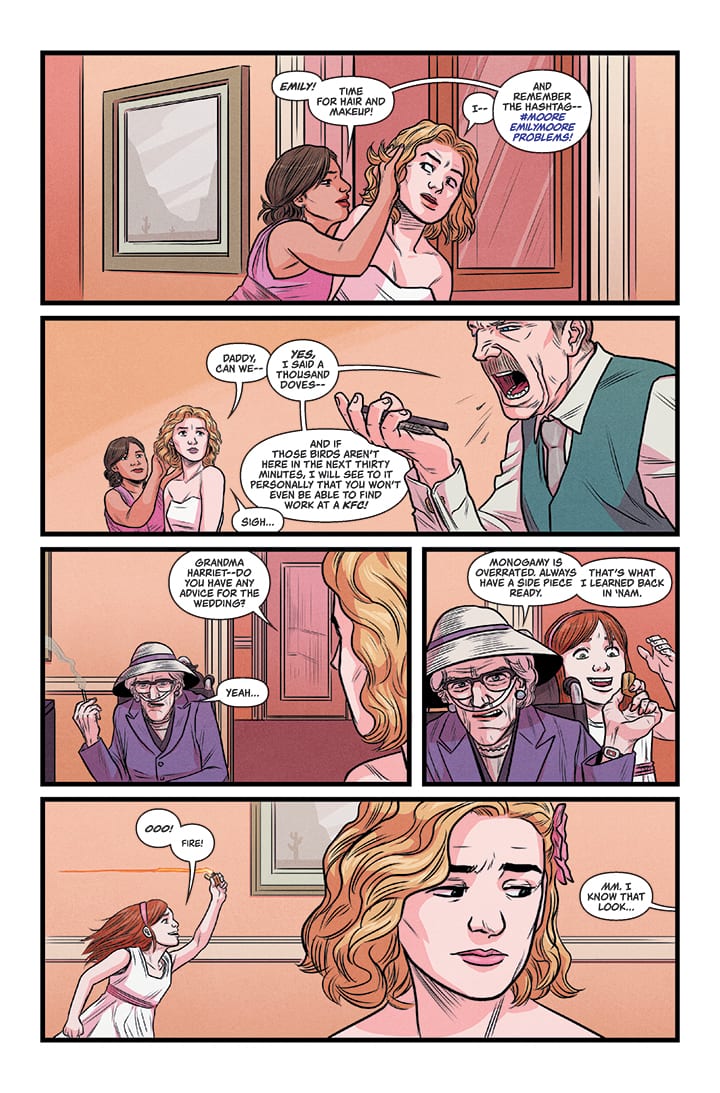
Going to the Chapel #1 hits stores September 4th from Action Lab: Danger Zone, but we got the chance to chat with writer David Pepose about how the series came together and what readers should expect.
Chapel has one of the best pitches you’ll see in comics today: it’s Die Hard meets Wedding Crashers by way of Quentin Tarantino. Pepose himself says it’s “if Julia Roberts starred in Dog Day Afternoon.” It’s about a gang of Elvis-themed bank robbers who decide to rob a wedding, and the bride who has to play both sides against the middle to get everyone out in one piece.
Joining Pepose on the series is artist Gavin Guidry, colorist Liz Kramer, and letterer Ariana Maher.
Cover by Gavin Guidry.
This is actually our third time interviewing Pepose (and it probably won’t be our last!). Previously, we’ve had the opportunity to discuss his Ringo-nominated series Spencer & Locke with him and artist Jorge Santiago, Jr., and more recently we spoke at MegaCon in Orlando about Chapel, Spencer & Locke, and the writer’s tips for aspiring comic creators.
Read on to see what Pepose has to say about Going to the Chapel:
(And make sure to read all the way to the end for an extended preview of the first issue!)
Monkeys Fighting Robots: So how does your girlfriend feel about you writing a comic with the tagline “love is the ultimate hostage situation?” I hope your couch is comfortable.
David Pepose: Did my mother put you up to this question? Blink once if yes, blink twice if the word “grandchildren” was used. (Laughs) No, I actually wrote GOING TO THE CHAPEL because I wanted to make a comic that delved into romance and heart and action and excitement — after being inspired after completely failing as Best Man at a friend’s wedding, I actually wrote this book with my girlfriend Claire in mind, to try to make something that could be considered the perfect “date night” comic for the two of us (and hopefully the rest of the Direct Market as well).
Our provocative tagline is just a teaser — but at the end of the day, GOING TO THE CHAPEL is a love story, through and through. But it’s one that doesn’t see romance as an endgame or as a prize, but as an ongoing journey filled with all sorts of twists and turns — and while Emily has more bumps in the road than most on her way there, when she does reach her final destination, it’s all the more satisfying because it’s so hard-won. So to take the long way back to your original question: Yes. I promise I’m safe. For now. At least until the next time I see my mom.
MFR: “Bank robbers invade a wedding” sounds like a great story in itself, but Going to the Chapel has a lot of other stuff going on as well involving family dysfunction. Why did you feel like this was an important element to include?
Pepose: I think group dysfunction is a key element of a lot of my favorite hostage thrillers — you look at Dog Day Afternoon, for example, and the line between Al Pacino and the bank employees he’s holding at gunpoint starts to blur very quickly, to the point where they’re all rooting for him as he’s shouting “Attica!” at the police. So with GOING TO THE CHAPEL, when Emily’s wedding is suddenly taken over by a gang of Elvis-themed bank robbers, I wanted to lean into the inherent absurdity of it all, rather than lean quite as dark as I did with SPENCER & LOCKE.
It’s that element of interpersonal comedy that is a straight throughline from Die Hard to Inside Man — when you’re trapped with a crowd for an extended period of time in an uncomfortable space, people start to get really weird, really fast. So establishing Emily’s bizarre, rich family in the vein of the Bluths from Arrested Development felt like a natural way to build out our supporting cast and get readers laughing. Like, when it comes to dysfunctional families, we’ve all been there, right? The Andersons are used to having things their way, so to have their cluelessness throw the Bad Elvis Gang’s smash-and-grab into such disarray is so fun to write.
Cover by Lisa Sterle.
MFR: Where did the idea come from to make the bank robbers in this story Elvis-themed specifically?
Pepose: The inspiration for that came from Point Break — I really wanted to give the bank robbers a theme like the Dead Presidents, and after talking it over with my friend Troy Brownfield, the idea of the Bad Elvis Gang felt like the perfect imagery. It really just evoked those dysfunctional quickie weddings in Las Vegas, and finding ways to differentiate the Elvises — particularly Romero, our zombie Elvis — really leaned into my comedic sensibilities. But moreover, Elvis was a heartthrob from the jump, and having that quality in this romance-driven action story felt like the right call, especially once we see how Emily and Tom’s unorthodox team-up plays out.
MFR: Going to the Chapel is about Emily Anderson, a bride with cold feet. How do you approach writing a female protagonist compared to a male one? Do you confer with the women in your life to make sure your character’s voice is authentic?
Pepose: This actually goes back to your first question — my girlfriend Claire is actually a magazine editor, and a voracious prose reader, and she’s been my first set of eyes and my storytelling compass since before SPENCER & LOCKE. So everything you like about my books and my writing, I learned from Claire, since I started writing scripts as a way of impressing her. (See, I’m a romantic at heart!) The thing is, I’m a huge comics reader, and Claire is not — which is a great way for me to make sure that my storytelling is accessible and is tapping into human, relatable themes, rather than falling into the trap of pouring on more spectacle at the cost of readership.
It’s also one of the reasons I wanted to make sure we had as many women on the creative team as possible, with colorist Liz Kramer, letterer Ariana Maher, and our murderer’s row of cover artists — I wanted to make sure that at every stage of the process, someone could ping me if I was missing the point. (And I will say, I have to give a special shout-out to my friend Sierra Kagen Zanghi, who gave me some great advice at the jump that really helped inform how we wanted to promote this series as far as our cover imagery was concerned.)
MFR: The comparisons to Die Hard and Tarantino flicks makes me think that the story is going to be largely confined to the chapel (outside of flashbacks). What are the benefits and drawbacks to telling a story with one main setting? I feel like that’s a prime way to build tension.
Pepose: Every time I start a new project, there’s usually a certain set of challenges I set for myself, and with GOING TO THE CHAPEL, it was not only figuring out how to juggle the largest, most diverse cast possible, but figuring out if it was possible to do it in just one location. (One of my favorite comedies, Death at a Funeral, did this nicely — it’s like GOING TO THE CHAPEL, only minus the guns and taking place at the world’s worst funeral.) And let me tell you… it was definitely a challenge! (Laughs)
There are some scripts that I write pretty loosely, like SPENCER & LOCKE 2, and others, like GRAND THEFT ASTRO, I have a pretty firm outline already in place, and CHAPEL was definitely in the latter category. I wrote and rewrote the initial treatment at least a dozen times, because when you’ve got a cast of 15 people, you need to know where they are at all times. My artist Gavin Guidry kept me honest in that regard, as he actually designed a fully rendered, three-dimensional chapel on SketchUp, which required us to really commit to all the major plot points early — but as a result, once it was locked, the scripts came together incredibly fast.
Cover by Maan House.
MFR: What kind of direction did you supply Gavin and Liz to capture the tone/atmosphere you had in mind, and how did they take Going to the Chapel from the idea you had in your head to the book readers will have in their hands?
Pepose: Gavin and I clicked pretty early on in terms of general visual influences — stuff like Reservoir Dogs, Breaking Bad, Baby Driver — but ultimately, I felt his style was going to be what sold so many of our comedic and action scenes. I wrote down some pretty detailed descriptions of each of the characters, with reference images for outfits, their personality traits, what actors they might be similar to, and he basically nailed it on the first try. Then we’d go back and forth just in terms of page layouts and composition, which was anchored by the digital chapel Gavin built — Gavin pencils digitally and inks traditionally, so it was a very streamlined and fast process.
Liz, meanwhile, really was the person who was going to make or break selling our tone — and I think she did a magnificent job at it. I’ve been impressed with her work since I read her comic Threader at C2E2 two years back, and she’s got such a wonderfully textured style. We talked a lot about Patricia Martin’s work over in Secret Weapons, as well as Matt Wilson’s work on Black Widow, but I think Liz did a superb job at making those palettes her own. I’m usually work pretty closely with my colorists to fine-tune our pages, but with Liz, I found myself just approving page after page with no notes. She’s going to be the next Laura Martin, I know it.
MFR: You’ve tackled neo-noir in Spencer & Locke, and now you’re in the rom-com/western space with Going to the Chapel. What other worlds are you itching to explore?
Pepose: As many worlds as possible! I’m hard at work on GRAND THEFT ASTRO, my upcoming sci-fi series with artist Jordi Perez over at Top Cow — we’ve been getting everyone’s schedules together, but I’m in the final stretch on the last scripts, and I’m really excited with how it’s coming together. Beyond that, I’m wrapping up promotion on my other Action Lab series, SPENCER & LOCKE 2, which you can preorder the trade paperback collection now — we might be able to share some cool news about that series very soon.
And beyond that, I’m just excited to keep stretching my muscles as a creator, and to keep exploring new genres and seeing what kind of stuff I can dig up — I’ve got an epic fantasy story in the works that is just crackling off the page, a pair of sci-fi pitches that I’m excited to find a home for, and a scrappy little horror concept that I’m hoping to find some time to dust off soon. And I’ve got another crime story that, if I can pull it off, might be the biggest book of my career. It’s exciting just to keep taking these big swings, and I think it ties into GOING TO THE CHAPEL a lot — it took me a long time and a lot of soul-searching to figure out my path in life, but thanks to having a wonderful partner at my side showing me the way (not to mention a top-tier art team), I’m on the path where I’m supposed to be, and I couldn’t be happier.
Are you planning to pick up GOING TO THE CHAPEL? Let us know in the comments! And pre-order the book today at your local comic shop using the following Diamond codes:
GOING TO THE CHAPEL #1 (OF 4) CVR A LISA STERLE – JUL191409
GOING TO THE CHAPEL #1 (OF 4) CVR B HOUSE – JUL191410
GOING TO THE CHAPEL #1 (OF 4) CVR C GUIDRY – JUL191411
After the resounding successes of Charles Soule and Giuseppe Camuncoli’s Star Wars: Darth Vader – Dark Lord of The Sith, as well as Kieron Gillen’s Star Wars: Darth Vader series, it only seems logical that Marvel would continue to pump out Vader stories. The question that arose was, is this necessary? How many more “Character-Defining” stories can one mostly silent menacing figure have? Unfortunately, the answer given in Greg Pak and Ramón Bachs’ Star Wars: Age Of Rebellion- Darth Vader #1 is not that inspiring. And the resulting book is an overall “meh” as an outcome.
Pak’s story revolves around Vader following the orders of Governor Ahr “to the letter.” Once Ahr realizes he has a killing machine at his disposal, he sends Vader on a variety of quests to destroy, and in some instances humiliate. Because why not? There is no way this relentless killing machine with the textbook definition of an evil leader will ever rebel against you right?
The main problem with this chapter is how little revolves around Vader’s thoughts. The reason Soule and Gillen’s scripts were so successful and impactful in the mythos of Vader was that they dealt with the tumult and emotions of an outwards emotionless, stagnant character. The only insight into Vader’s character in Pak’s script is that he hates kneeling to superiority, especially Palpatine. But anyone who has read a Star Wars comic or even watched a Star Wars movie can already figure that out for themselves.
Pak writes Vader as more of a tool to be used by the governor and the emperor than a character, which is fair because that is probably how these characters view him. Still, it feels like most readers have seen this utilization of Vader previously and more effectively. The story does end with Vader possibly taking control of himself at least reasserting his dominance over the Ahr, but it is worrisome that this is in the last panel. Hopefully, Pak runs with this newly politically dominant Vader in future chapters.
Vader’s back in charge
Bachs’ art is fairly mediocre as well. There are some panels in which he truly shines, like any time Vader is central to the panel, Bachs really nails how imposing of a figure Vader is. And the flashbacks into Vader’s past had an interesting panel arrangement, and the positioning of Vader against the memories spoke to when Anakin embraced the dark side.
The set pieces, however, really suffer in this chapter. Panels that could be colossal splash panels feel glossed over and lackluster. One of the first ones of Vader’s ship attacking the rebels has a surprising lack of detail in the background, even for moving at high speeds. There is a scene in which Vader descends on a war-torn planet to take care of essentially an army of wild droids, and Bachs liters the planet with only a couple of figures. Bachs could have had some real fun with interesting character designs or destroyed buildings, but instead, there are only a few droids and some dilapidated buildings that might as well be rubble.
There is potential in Star Wars: Age of Rebellion Darth Vader #1. Pak and Bachs inherit an iconic character with an immense presence, and they seem to hint at more of Vader in future issues. And it is a tad unfair to compare Pak and Bachs’ run to two of the most defining stories in the history of this character. Even when this is considered and Pak and Bachs’ run stands on its own, it simply is pretty underwhelming.
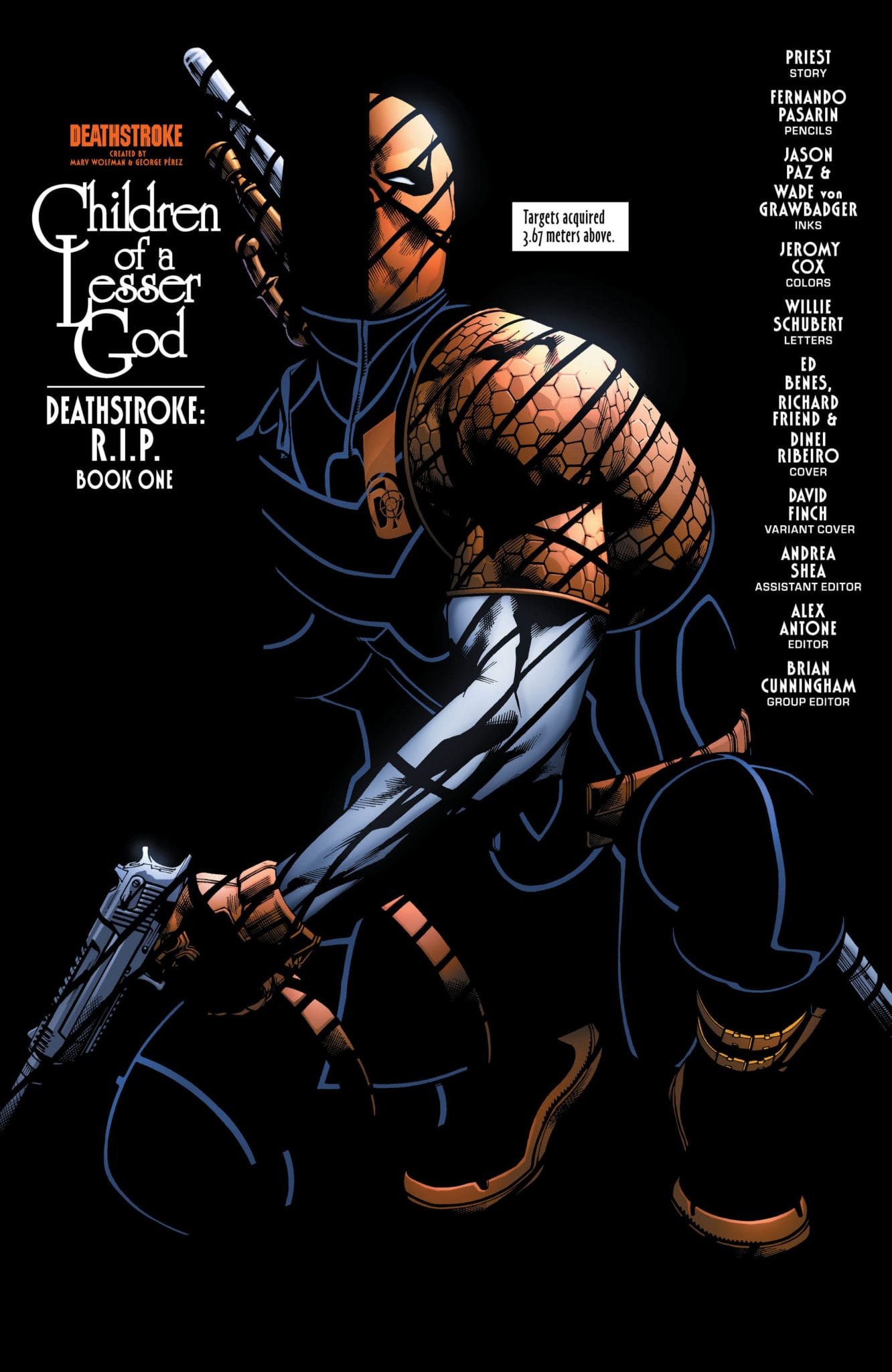
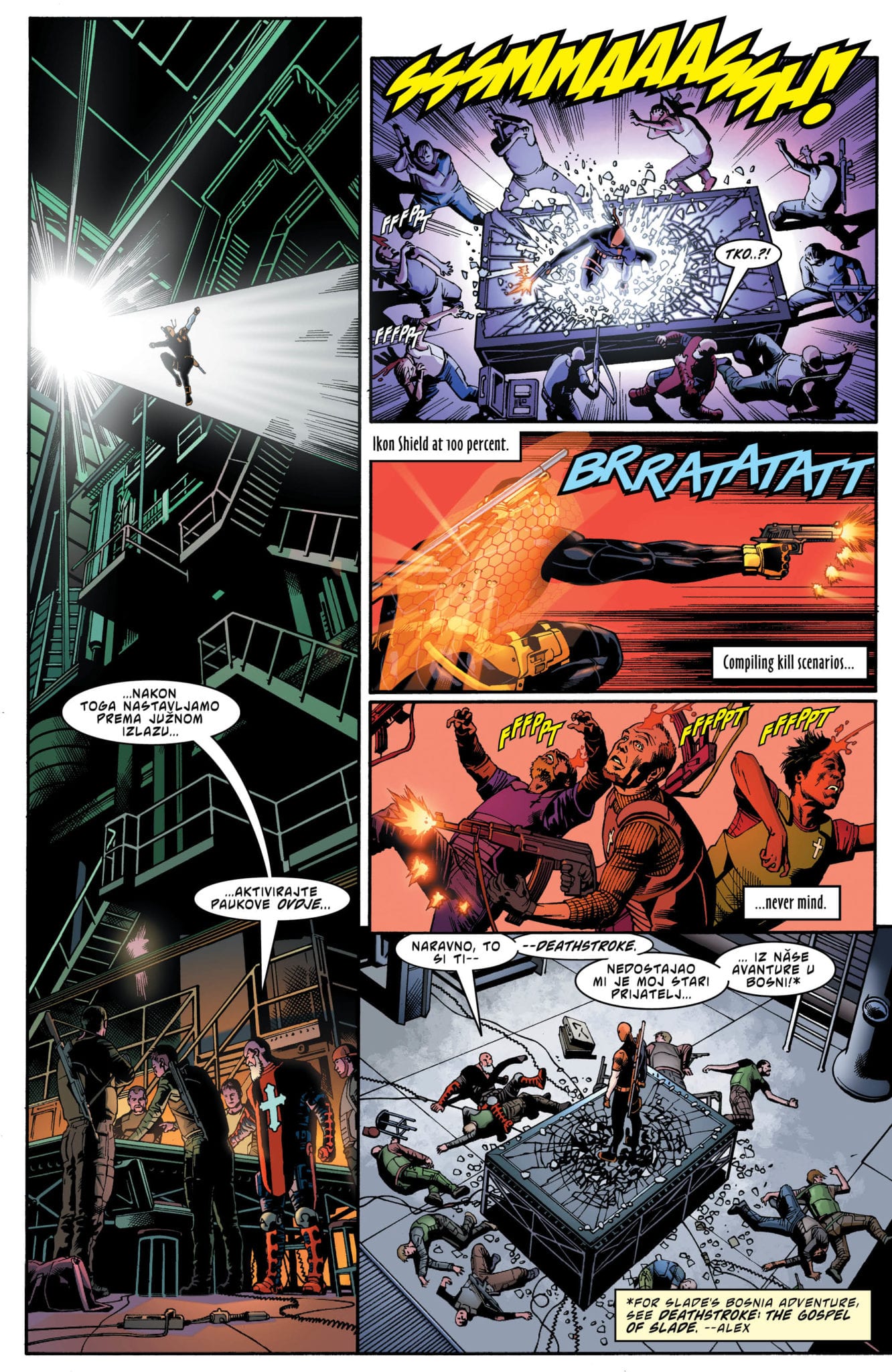
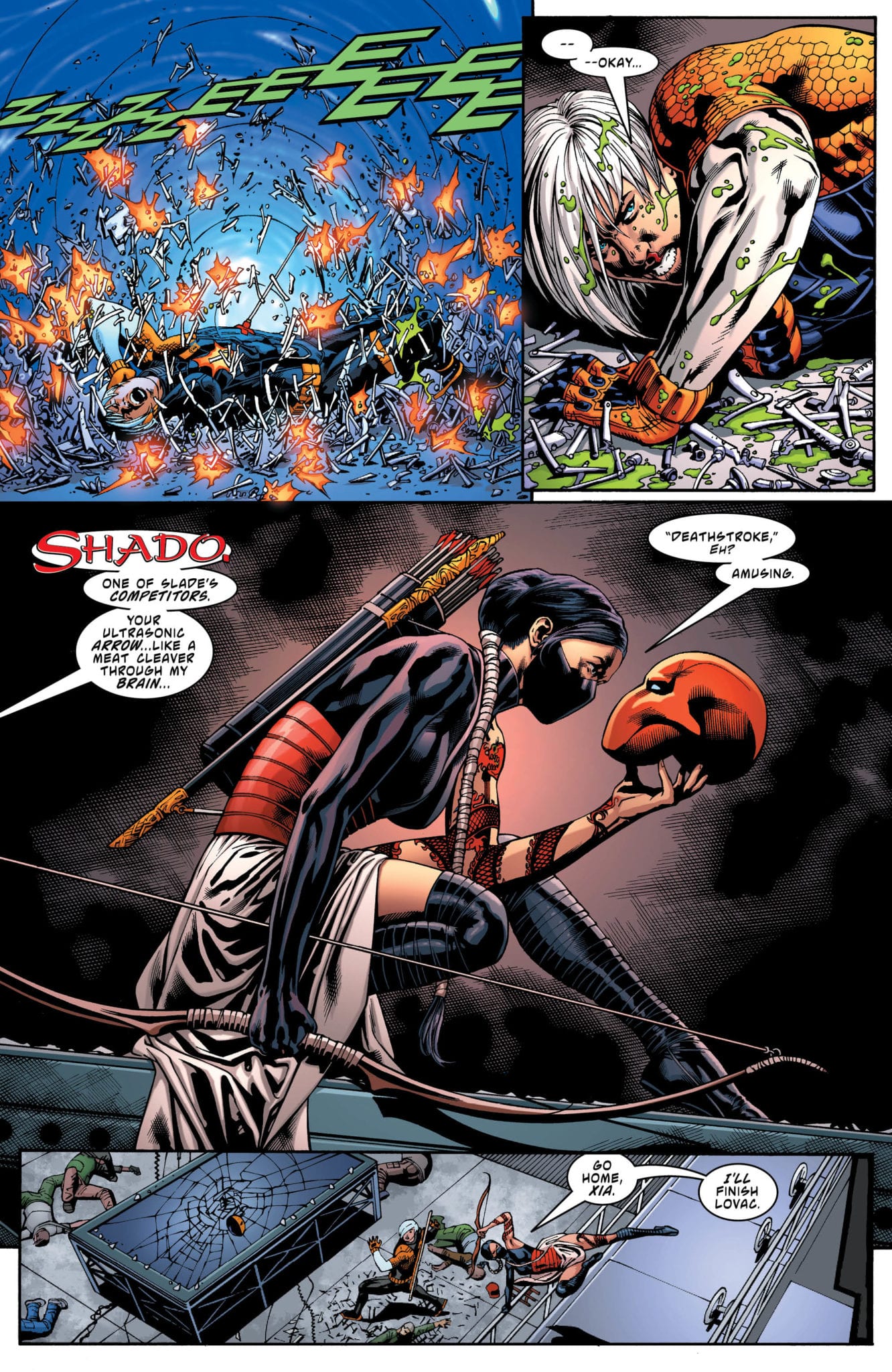
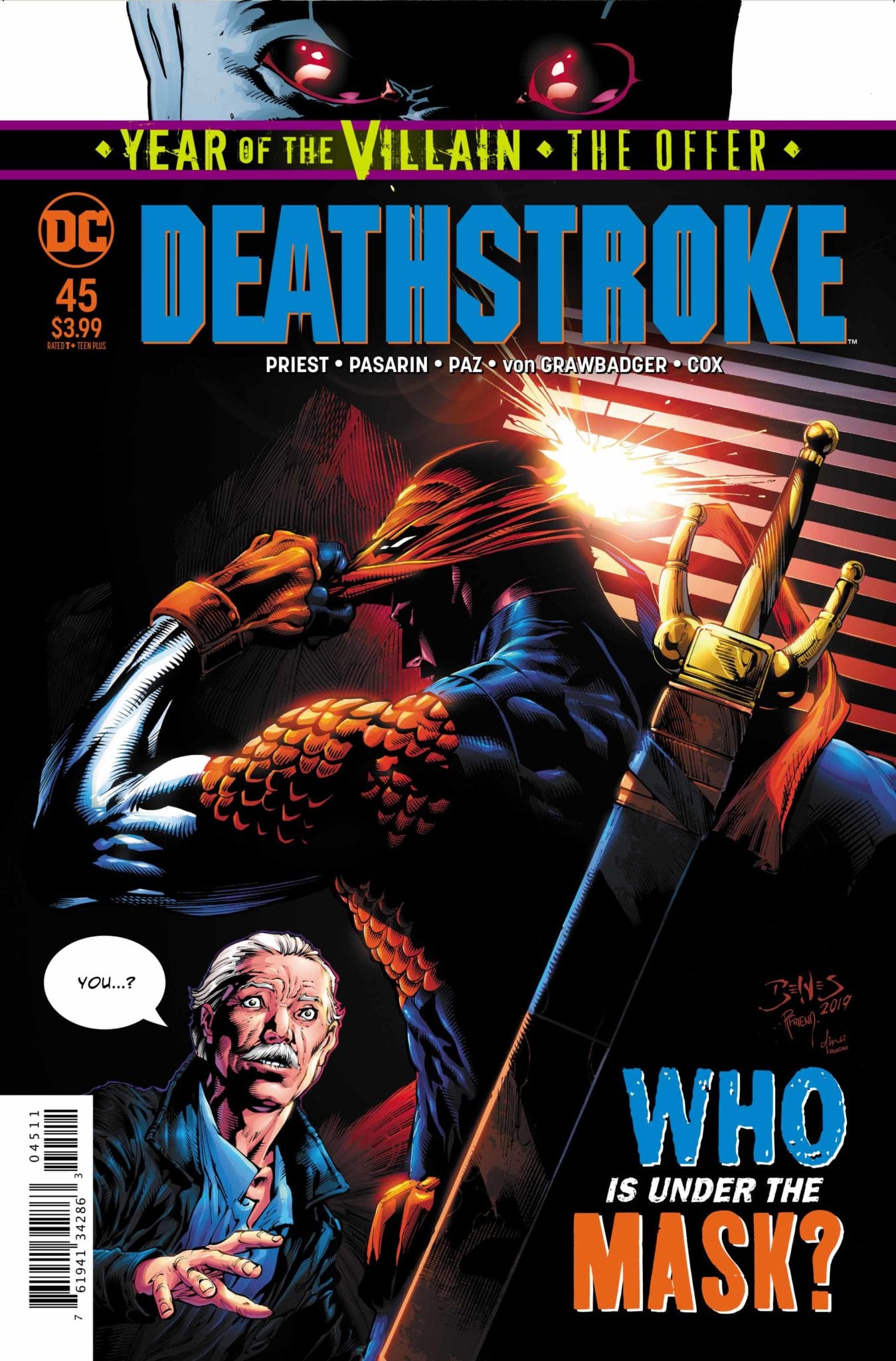
DEATHSTROKE #45 hits your local comic books store on July 3, but thanks to DC Comics, Monkeys Fighting Robots has an exclusive six-page preview of the issue to share with you.
DEATHSTROKE #45 is written by Christopher Priest, with art by Fernando Pasarin, Jason Paz & Wade von Grawbadger worked on inks, colors are by Jeromy Cox, with Willie Schubert’s letters. Ed Benes, Richard Friend, and Dinei Ribeiro worked on the cover; with a variant cover by David Finch.
About DEATHSTROKE #45:
In the wake of Slade Wilson’s death, a new Deathstroke has vowed to complete his last, unfinished assignment. But the master assassin Shado has plans of her own, looking to step in for the late, great World’s Greatest Assassin and usurp his place in villainous hierarchy. Meanwhile, Rose Wilson discovers the identity of the person responsible for her father’s death. Can her brother, Jericho, stop her from seeking vengeance?
Also, in this issue, Slade Wilson’s son Jericho accepts Lex Luthor’s offer of power—but he’s determined to use it as a force for good”…so why is Lex smiling?
Take your first look DEATHSTROKE #45:
What do you think of Priest’s run so far? Comment below with your thoughts.
For those worried that DC Comics was moving away from edgier material after last week’s Vertigo news, worry no more. Joe Hill, the mind behind NOS4A2 and IDW’s Locke & Key, is bringing his horror chops to DC for a new imprint called Hill House.
As part of DC’s press release, Hill had this to say:
“At Hill House Comics we aim to shock the senses and soak the page in red, with new, hooky horror from seasoned old hands and young masters of the field, all set free to share their most disturbing nightmares…for your pleasure! The books are backed by DC’s second-to-none comic book craftsmanship, and we’re working with the very best editors on parole from Arkham Asylum to craft unputdownable tales of menace and madness. I can’t wait to share some fresh scares with comic book readers everywhere. It’s going to be fun.”
Mark Doyle, formerly the guiding editor behind Vertigo, added:
“Joe is a modern master; his ability to blend visceral, high-concept horror with heartfelt characters is what has grabbed the attention (and throats!) of millions of readers. His vision and taste are unparalleled; you can see it in the incredible talent he’s assembled here, and the stories they’re crafting are bringing the next generation of horror to DC.”
Hill House will be part of DC’s Black Label, and will initially launch with five titles. You can read the whole press release here.
Check out the first wave of titles:
BASKETFUL OF HEADS
Written by: Joe Hill
Art by: Leomacs
Covers by: Reiko Murakami
The rain lashes the grassy dunes of Brody Island, and seagulls scream above the bay. A slender figure in a raincoat carries a large wicker basket, which looks like it might be full of melons…covered by a bloodstained scrap of the American flag.
This is the story of June Branch, a young woman trapped with four cunning criminals who have snatched her boyfriend for deranged reasons of their own. Now she must fight for her life with the help of an impossible 8th-century Viking axe that can pass through a man’s neck in a single swipe—and leave the severed head still conscious and capable of supernatural speech.
Each disembodied head has a malevolent story of its own to tell, and it isn’t long before June finds herself in a desperate struggle to hack through their lies and manipulations…racing to save the man she loves before time runs out.
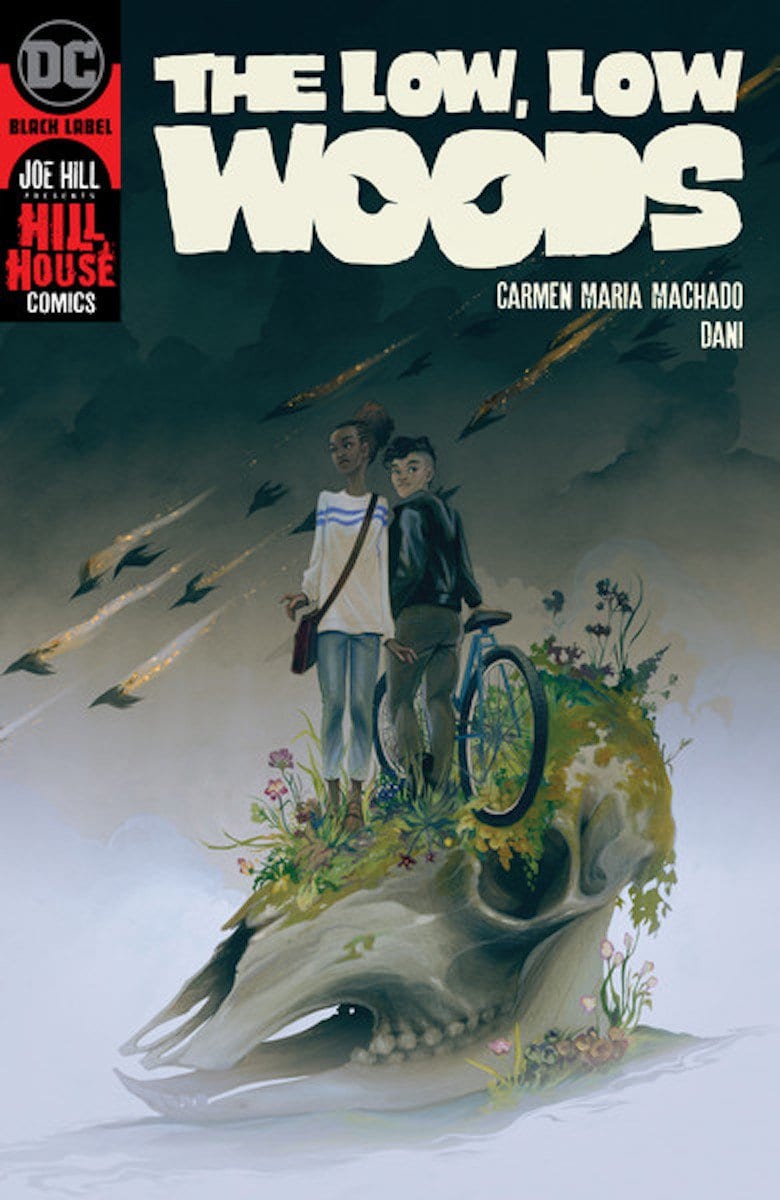
THE LOW, LOW WOODS
Written by: Carmen Maria Machado
Art by: Dani
Cover by: J.A.W. Cooper
A mysterious plague is afflicting the small mining town of Shudder to Think, Pennsylvania. It strikes seemingly at random, eating away at the memories of those suffering from it. From tales of rabbits with human eyes, to deer women who come to the windows of hungry girls at night, this town is one of those places where strange things are always happening. But no one ever seems to question why…
THE LOW, LOW WOODS is a gruesome coming-of-age body-horror mystery series about two teenage women trying to uncover the truth about the mysterious memory-devouring illness affecting them and the people of the small mining town they call home—and the more they discover, the more disturbing the truth becomes.
THE DOLLHOUSE FAMILY
Written by: Mike Carey
Art by: Peter Gross
Covers by: Jessica Dalva
On Alice’s sixth birthday, her dying great-aunt sends her the birthday gift she didn’t know she always wanted: a big, beautiful 19th-century dollhouse, complete with a family of antique dolls. In hardly any time at all, the dollhouse isn’t just Alice’s favorite toy…it’s her whole world.
Soon young Alice learns she can enter the house, to visit a new group of friends, straight out of a heartwarming children’s novel: the Dollhouse family. As the years pass, Alice finds herself visiting their world more frequently, slowly losing track of where reality ends and make-believe begins. What starts as play concludes in an eruption of madness and violence.
Childhood ends—but that little house casts a long shadow over Alice’s adult life. When the world becomes too much for her to bear, Alice finds herself returning to the dollhouse and the little folk within. The house can offer her a shelter from all her sorrows…but only if she gives it what it wants, and god help her if she tries to walk away again…
DAPHNE BYRNE
Written by: Laura Marks
Art by: Kelley Jones
Covers by: Piotr Jabłoński
In the gaslit splendor of late 19th-century New York, rage builds inside 14-year-old Daphne. The sudden death of her father has left her alone with her irresponsible, grief-stricken mother—who becomes easy prey for a group of occultists promising to contact her dead husband.
While fighting to disentangle her mother from these charlatans, Daphne begins to sense a strange, insidious presence in her own body…an entity with unspeakable appetites. And as she learns to wield this brutal, terrifying power, she wages a revenge-fueled crusade against the secret underworld that destroyed her life.
PLUNGE
Written by: Joe Hill
Art by: TBD
Covers by: Jeremy Wilson
In 1983 the Derleth disappeared, wiped out in a storm on the edge of the Arctic circle—the world’s most advanced research vessel in the hunt for oil, lost in the aftermath of a tsunami.
Almost 40 years later, the Derleth begins to transmit its distress signal once again, calling in to Alaska’s remote Attu Station from the most forlorn place on earth, a desolate ring island in the icy faraway. A US salvage team made up of experts, scientists, and mercenaries helicopter in just ahead of a storm—and the Russian competition—to find the abandoned wreck hung up on the island shores of the atoll. As a wintry blizzard clamps down, anomalies begin to surface: first the samples of an oil with unlikely properties, and then the sonar readings of a sunken prehistoric civilization just offshore. Still, nothing could prepare the salvage team for the reappearance of the Derleth’s crew from the island cave, no older than they were four decades ago, every one of them struck blind by an inexplicable infection…and yet capable of seeing in new ways, possessed of extraordinary powers and stripped of all but their last vestiges of humanity…
SEA DOGS (backup story)
Written by: Joe Hill
Art by: TBD
The Revolution is screwed.
In 1779 the pathetic American navy is a pile of smoldering wrecks choking the Penobscot River. Imperial Britain has amassed the mightiest fleet the world has ever known, led by the HMS Havoc, a 90-gun second rate that has sunk a forest of French, Spanish and American frigates, sketching a trail of devastation that stretches all the way from St. Kitts to Machias, Maine. The faltering Continental Congress can’t hope to match England’s sea power, and they’re just desperate enough to make a deal with the devil…or even three.
Spymaster Benjamin Tallmadge proposes allowing three lycanthropes to be pressed into British service aboard the Havoc. Three patriotic werewolves might be all it takes to butcher the ship from the inside out and paint the decks red. It’s true, their powers are infernal, their minds are mad and their loyalty can in no way be trusted. And yet what else can a desperate nation do…but let slip the dogs of war?
Are you ready for some new horror comics to hit the stands? Leave us a comment about which of these sounds the most interesting!
Fantastic Four: The Prodigal Sun #1 hits your local comic books store on July 3, but thanks to Marvel Comics, Monkeys Fighting Robots has an exclusive four-page preview of the issue to share with you.
Fantastic Four: The Prodigal Sun #1 is written by Peter David, with art by Francesco Manna, colors by Espen Grundetjern, Cory Petit’s letters, and Mico Suayan & Rain Beredo worked on the cover.
About Fantastic Four: The Prodigal Sun #1:
CHAPTER 1 OF 3! The first of three interconnected special issues featuring the FANTASTIC FOUR, the SILVER SURFER and the GUARDIANS OF THE GALAXY! Introducing PRODIGAL, a strange alien being who has crash-landed in the Savage Land. When he becomes worshipped by a race of swamp-dwelling barbarians, Ka-Zar and Shanna call upon the Fantastic Four to aid them in stopping the barbarians’ plans to conquer the entirety of their world. Join Prodigal on his lengthy journey to try to return home to settle old scores.
Take your first look Fantastic Four: The Prodigal Sun #1:
Review: A Driving Test Menaces The Team in FANTASTIC FOUR #11 “As with other issues of Dan Slott’s run, this installment focuses on the Fantastic Four’s family dynamic first and foremost. As long as Slott continues to do so in an enjoyable way, fans can consider the writer’s take on the First Family as a solid series that explores common domestic issues.” – Colin Tessier
Are you excited to see what David does with Marvel’s First Family in the Savage Land? Comment below with your thoughts.
In the grand scheme of things, Ft. Lauderdale, Florida is a new city. Established in 1911, there were cars before the place was made official, but even young cities have their ghosts. In this case, the phantom comes through the movie screen in the form of the Popcorn Frights Film Festival.
As legend has it, for five years the festival haunts South Florida. The cinema spirit was first sited at O Cinema in Miami, but now roams the historic Savor Cinema in Ft. Lauderdale. Audiences speak of horrific experiences resulting from viewing some of the best horror films around. Year after year, films like Terrifier and Anna and the Apocalypse made their mark in the memories of the faint-hearted. And in those five short years, the legend continues to grow and bring greater levels frightening fun.
The first big announcement from Co-Founders and Co-Directors Igor Shteyrenberg and Marc Ferman is the World Premiere of Haunt, a new film from Scott Beck & Bryan Woods, the writers of the smash-hit A Quiet Place. The dynamic duo will also be in attendance at the screening so you’ll get a chance to sit quietly watching a movie. See what I did there?
Popcorn Frights Wave One Announcements
THE DARE (World Premiere)
A rare family night for Jay takes a brutal twist when he awakens in a basement with three other prisoners. As their vengeful captor runs riot, Jay engages in a twisted battle to solve the puzzle to his past and save his family’s future. The Dare comes from the director of World of Darkness, Giles Anderson.
BIT
A transgender teenage girl on summer vacation in Los Angeles fights to survive after she falls in with four queer feminist vampires, who try to rid the city’s streets of predatory men.
SATANIC PANIC
From Chelsea Stardust (Into the Dark), a pizza delivery girl at the end of her financial rope has to fight for her life – and her tips – when her last order of the night turns out to be high society Satanists in need of a virgin sacrifice.
KNIVES AND SKIN
Jennifer Reeder’s (Signature Move) mystical teen noir that follows a young girl’s disappearance in the rural Midwest and its effect on teens and parents.
VILLAINS
After a pair of amateur criminals break into a suburban home, they stumble upon a dark secret that two sadistic homeowners will do anything to keep from getting out. The film stars Bill Skarsgard and Maika Monroe and features Kyra Sedgwick.
Depraved
From director Larry Fessenden (The Dead Don’t Die), a disillusioned field surgeon suffering from PTSD makes a man out of body parts and brings him to life in a Brooklyn loft.
Daniel Isn’t Real
A troubled college freshman, Luke, suffers a violent family trauma and resurrects his childhood imaginary friend Daniel to help him cope. Based on the novel In This Way I Was Saved by DeLeeuw the film stars Patrick Schwarzenegger, son of the Terminator himself, Arnold Schwarzenegger.
Paradise Hills
A mysterious boarding school perfectly reforms wayward girls to fit their surroundings’ exact desires. Emma Roberts (Scream Queens) and Eiza González (From Dusk Til Dawn Series) star.
Bliss
A brilliant painter facing the worst creative block of her life turns to anything she can to complete her masterpiece, spiraling into a hallucinatory hellscape of drugs, sex, and murder in the sleazy underbelly of Los Angeles.
The Sonata
A young violinist unravels her long lost father’s past, triggering dark forces that reach beyond her imagination. The film stars “tears in the rain” and Blind Fury legend Rutger Hauer.
Popcorn Frights begins August 8th and runs through the 16th.
Make your way to Ft. Lauderdale to join in the fun.
Are you excited by the films in the first wave of announcements
from the Popcorn Fights Film Festival?
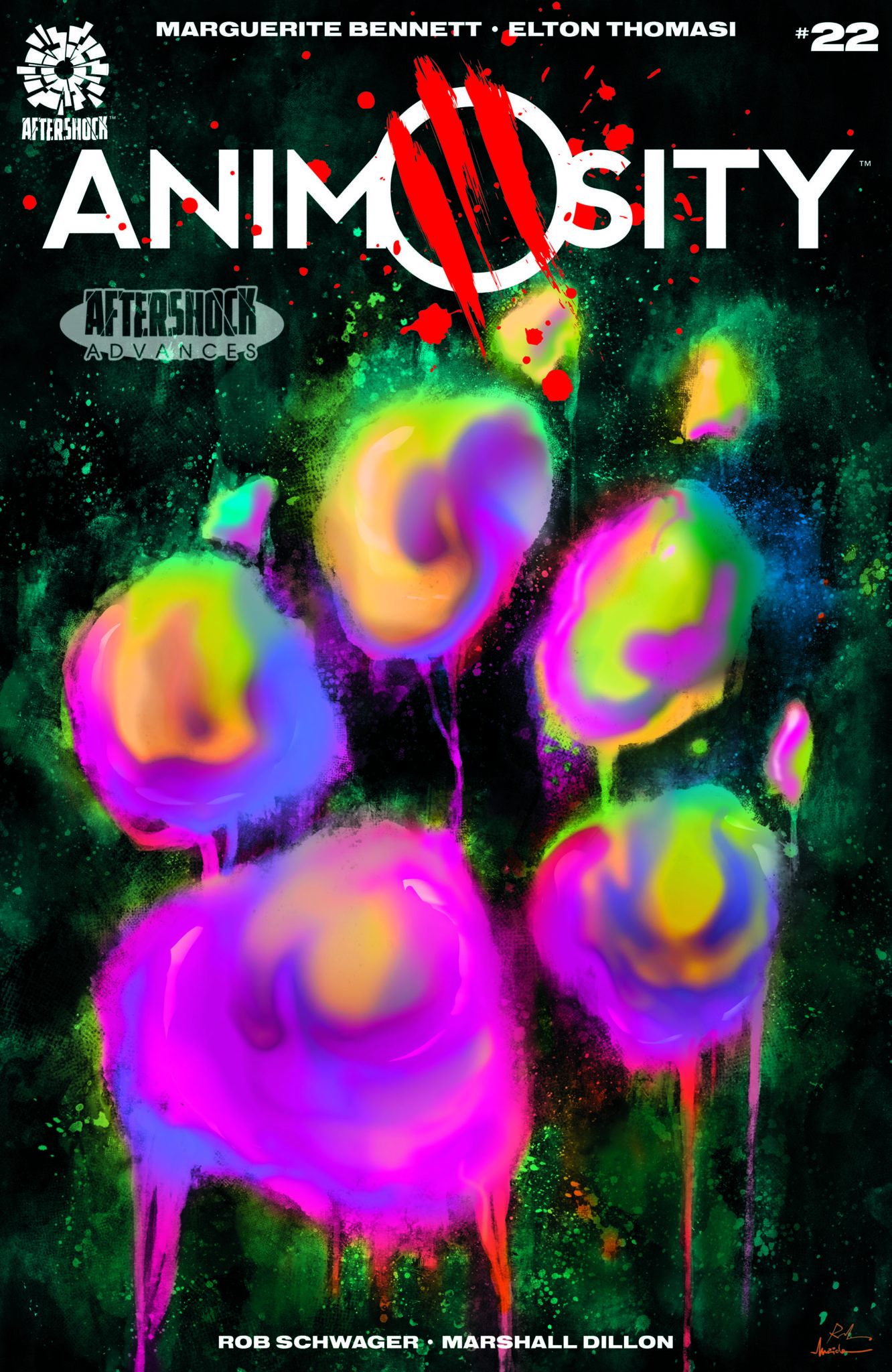
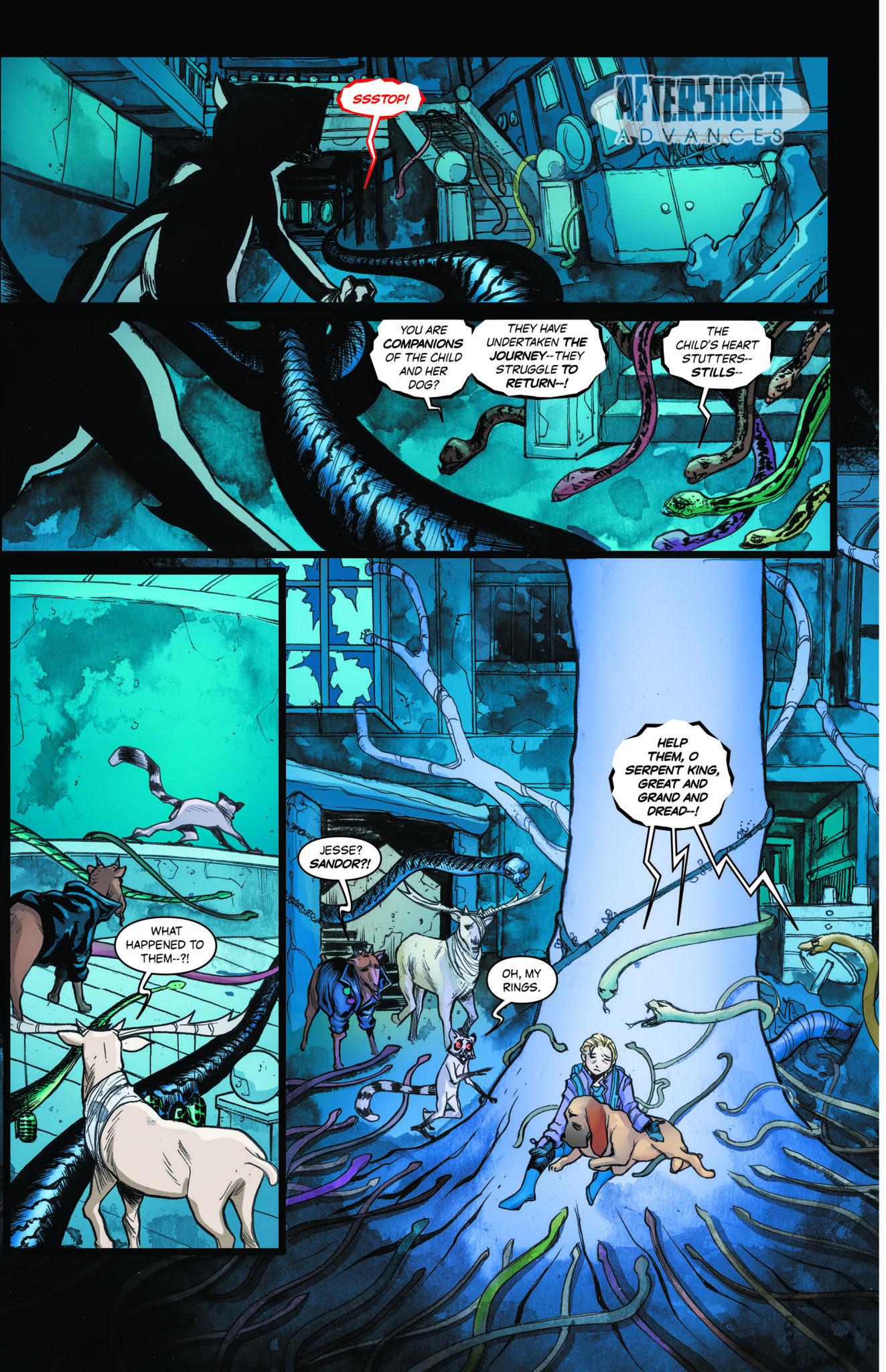
The 32-page book is written by Marguerite Bennett (INSEXTS, DC Comics Bombshells, Batwoman), with art by Elton Thomasi (Doctor Who), Rob Schwager handled colors, Marshall Dillon lettered the pages, with Rafael De Latorre (SUPERZERO) and Marcelo Maiolo’s work on the cover.
About ANIMOSITY #22:
One day, the Animals woke up. They started thinking. They started talking. They started taking revenge.
A new frontier beckons to the West, but before the survivors stand an obstacle, a monster – and a horrifying truth.
Animosity is AfterShock Comics longest running series.
Check out the preview below.
Do you have Animosity on your pull list? Comment below with your thoughts on the series.