Home Blog Page 407

Review: Entering The HELLMOUTH #1

Monkeys Fighting Robots

Two series, ten months of story, a host of familiar faces, all leading to this: BOOM! Studio’s Buffyverse crossover Hellmouth #1, hitting the shelves this week. Coming straight out of the story Jordie Bellaire has been crafting in the Buffy comic, and welcoming Angel fresh from his own series, Hellmouth ushers in the end days of Sunnydale. 

All the cast are assembled and the stage is set. Bring forth Armageddon and let Good fight Evil until only one is left standing. 
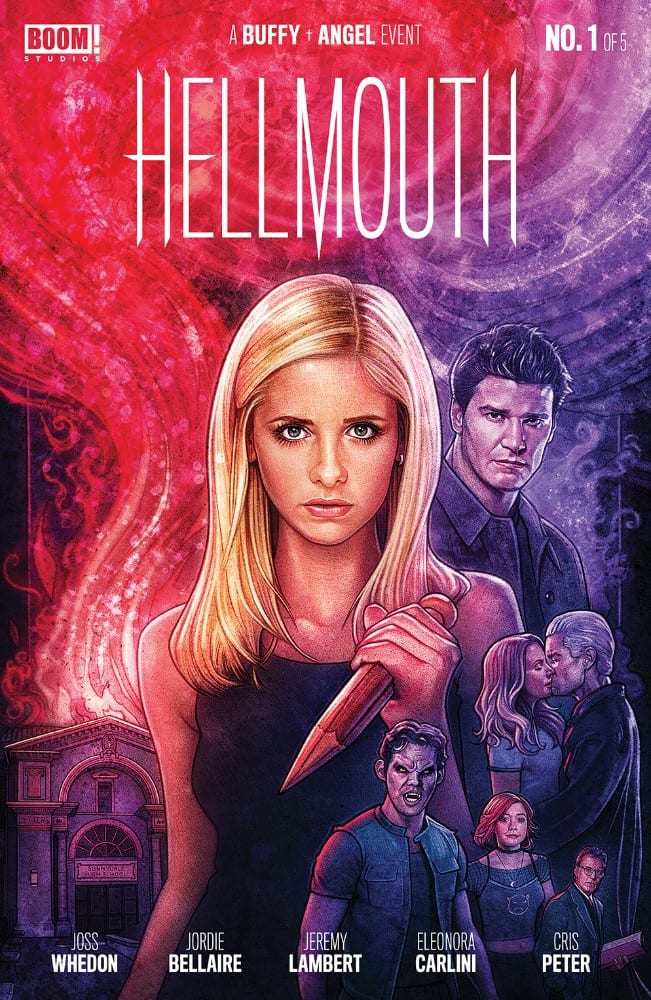
Entering The HELLMOUTH #1
Hellmouth #1 Variant Cover Credit: BOOM! Studios

Straight from Hell’s Mouth

This first issue in the crossover event is narrated by the ominous voice of the Hellmouth itself, or so it seems. As the town of Sunnydale shakes and shivers at the literal rising of Hell, the narration leads the reader through the chaos, focusing on small groups of the cast as they deal with the End Days. Some rush headlong into battle while others pack up and run in the opposite direction. In the centre, a whole host of civilians have no idea what they are supposed to do.

Jordie Bellaire is joined on writing duties by Jeremy Lambert for this event. The characterisation that Bellaire has built in the Buffy comic is paired with the outlandish scene building that Lambert is used to. For each scene this pairing works brilliantly. None of the characters are superfluous to the moment and there are some great moments of interaction.

However, nothing much actually happens. This first issue is a scene setter, placing the characters and constantly reminding the reader about the several levels of Hell that are attempting to burst through into Sunnydale. It seems like there should be a lot going on but, for the most part, it’s just people running through Chaos. There are moments of humour and action that make you adore the characters, such as Cordelia’s entrance into the library, but these scenes are too few and far between. 

The problem with the story is not so much what is there but what isn’t. The meeting between Buffy and Angel lacks any kind of spark, there isn’t any chemistry between the two which just feels wrong. There is also an absence of a serious threat. It’s true that the Hellmouth is opening, we the audience get told this time and time again, but the creatures that Buffy and the gang face don’t have any substantial presence on the page. Buffy punches a demonic rat in the face and bounces off the head of a giant snake. It’s all too pedestrian. 

This issue should have turned the threat level up to Eleven but, apart from the rumblings and the worried faces on half of the cast, there is virtually no threat here at all.

Entering The HELLMOUTH #1
Hellmouth #1 Credit: BOOM! Studios

Imagining The End 

Part of the problem with Hellmouth, the reason why it doesn’t have the impact you would expect, is that the artwork is too lighthearted. Eleonora Carlini uses a clean, delicate style for her inks. Thin black lines outline the characters and scenery with block shadows adding some level of depth to the panels. Her composition is exciting and she injects energy into the characters, but it is very playful. Quirky background characters add humorous elements to some of the pages and Carlini definitely captures the sassieness of characters like Cordi. However, none of this helps in building unease or tension which this particular chapter of the comic should be doing.  

Carlini’s best moment in the comic comes towards the end where the consequences of of the Hellmouths opening is made plain to Buffy. There is a touching scene, full of emotion and pain. It is only here that the reader gets any indication of what is really going on and the cost of the adventure. This scene is impressive but would have had so much more weight if the rest of the comic had build towards it with the same tone.

The colorist, Chris Peter, brings most of the tone to the comic. His use of color themes on certain scenes instantly prepares the reader for action, or drama, or occasionally comedy.  The color signifiers help to move the narrative on and make up for the emotion lost in the script and art. 

The lettering in turn builds something that the characterisation would otherwise be lacking. Ed Dukshire makes the speech distinctive between the characters and picks up on the nuances in the script. The voice of the Hellmouth itself is especially distinctive, you can tell from the shape and color of the caption boxes that there is evil at the heart of the speech, and in turn at the heart of the story. 

Entering The HELLMOUTH #1
Hellmouth #1 Variant Cover Art Credit: BOOM! Studios

Conclusion

In the original Buffy Television series the first time the Hellmouth opened, at the end of season 1, the special effects were a little underwhelming. The library got destroyed by rubber snakes on wires. But what made the episode so memorable was the character interactions and the sense of dread that fuelled the story.

With this re-imaging, in a comic book format, you would expect that the Hellmouth’s opening would be more spectacular. After all, they don’t have the budget constraints of the television series and, to be fair, the scope of the threat is much larger; the creators are able to show the reader how all of Sunnydale is effected. Unfortunately, the demons are no-more impressive than the rubber snakes and the emotional drama is somehow lost in the action sequences. Humour seems to have replaced personal drama and it isn’t until the end of the issue that any real danger or threat is expressed.

As an opening to a crossover event that Buffy and Angel fans have been looking forward to, this is lacking the emotionally gripping story that you expect. If you pick this up wanting to read about people running through burning buildings you won’t be disappointed. If anything, this comic proves that bigger isn’t always better. They have a high level of destruction but it comes at the cost of the character moments. Hellmouth isn’t the Buffy and Angel we’ve been reading over the last 10 months.

Monkeys Fighting Robots Youtube

Review: JOKER Offers A Fascinating Descent Into Self Destruction

Todd Phillips’s Joker has been receiving enormous attention since its debut at the Venice Film Festival earlier this year. The film received critical praise and even took home the Golden Lion for best film. Since then, the feedback has been divisive due to the films violent nature and many believing that it tries to portray villains in the wrong light. However, Joaquin Phoenix who stars as the titular character has been praised for his efforts. So, what does Joker have to offer audiences in regards to DC’s most well-recognized antagonist?

Set in 1981, Joker follows Arthur Fleck (Phoenix), a failed comedian who feels ostracized from society and lives with his mother. He also suffers from a condition that causes uncontrollable laughter frequently throughout his day. After being driven insane by the world around him and the never-ending ridicule, Arthur becomes the Joker. Joker doubles as both a character study and social commentary that will undoubtedly leave everyone questioning how their actions indirectly contribute to someone’s mental breakdown.

Joaquin Phoenix as Arthur Fleck in Warner Bros.’ JOKER

Directed by Phillips, who co-wrote the script with Scott Silver. The film stars Robert De Niro, Zazie Beets, Frances Conroy, Brett Cullen, Glenn Fleshler, Bill Camp, and Joaquin Phoenix. The story in Joker is well structured, engaging, and an overall great tale about a man who is seemingly nonexistent in society. The script is riddled with familiar themes of poverty, corruption, mental illness, and a broken society, all of which are handled decently from Silver and Phillips. The pacing is slow and methodical and audiences will feel sorry for the character of Arthur Fleck and understand his decision to become one of the most prominent villains ever. Phoenix balances it to where the feeling sorry will become a feeling of fear towards what Arthur ultimately becomes.

As mentioned above, Phoenix does a great job bringing the iconic villain to life in a way that rivals what Heath Ledger did in The Dark Knight. From his body movements, psychotic facial expressions, and the glorious laugh he gives one of the best portrayals of Joker to date. Whether or not he gets snubbed of an Oscar nomination has yet to be seen, but recognition is deserved for what he did in this film. Each scene is his and he allows viewers to develop a concern for the mentally ill Arthur Fleck, who has been abused for years and finally decides to give up on society.

Adding to that, Joker is one of the year’s better-crafted films. The cinematography from Lawrence Sher is amazing and the score done by Hildur guðnadóttir compliments every scene wonderfully. This is some of Phillips’ best camera work and combined with the film’s gritty retro setting it creates a visually pleasing treat to watch. However, a lot of Joker’s visual pleasures are due to the fact that it seems to borrow a lot from Taxi Driver. All films are inspired by something these days, but Joker’s inspiration is too apparent.

Joaquin Phoenix as Arthur Fleck in Warner Bros.’ JOKER

Regardless of that, this film will certainly have everyone talking for quite some time because of Phoenix’s efforts as the titular villain and the fact that it features an absent hero to oppose the Joker because Batman is nonexistent in this period. The absence of the hero allows viewers to become more concerned with asking what lead to all of this madness that Phoenix perfectly embodies. It isn’t making excuses for the actions of Arthur, but it leaves room to wonder what could have been done to avoid all of this after witnessing the life that he endures day to day.

Joker is a bold, thought-provoking film that many will be debating for years and the film will rub some individuals the wrong way. Despite that, it is a well-crafted piece of cinema that features one of the strongest character studies in recent memory and Phoenix should be proud of his performance as the titular villain because that truthfully is the film’s greatest asset.

Monkeys Fighting Robots Youtube

INTERVIEW: Carolina Costa Is A Rising Star Of Cinematography

Babenco: Tell Me When I Die is a film about Hector Babenco, a film director widely known for his Oscar-winning 80s film Kiss of the Spider Woman and the cinematographer behind the luscious black and white documentary is Brazilian-born Carolina Costa.

With more than 10 years of experience as a cinematographer, Carolina has contributed to more than 49 film and TV projects. These include everything from short films to documentaries to features. She recently lensed three projects, including the luscious black and white, critically-acclaimed documentary Babenco: Tell Me When I Die, about Hector Babenco, a film director widely known for his Oscar-winning 80s film Kiss of the Spider Woman.  In addition to Babenco, Carolina’s career has crossed paths with the likes of Jada Pinkett Smith for Hala, the horror remake of Suspiria, and the Mexican drama feature Workforce. In the near future, Carolina’s work will appear in three projects currently in post-production and two more in pre-production.

PopAxiom spent 20 minutes on the phone with Carolina as she was in Mexico and on her way to the next project.

hala-cinematographer-interview

Freeze Frame

You don’t do 50 projects in 10 years without getting an early start on your education. “I started working for a photographer when I was 14. He taught me how to use my first camera.”

Born in Brazil but raised in Rio, “I did quite a bit of writing but also photojournalism.” But the reporter life wasn’t “… exactly what I wanted …”

Photography was an undoubted passion. “I started working as a camera assistant. The first time I went on set, I was like ‘aww yeah’ this is definitely what I wanted to do.”

“It felt right.”

Docs To Fiction

In the early years, “I did a lot of docs all over Europe. Over the last few years, I’ve … geared my career to doing fiction narrative.”

For Carolina, narrative film became a more tangible “… way to connect with people.”

Carolina’s drive keeps her going from one project to the next, and docs are a bit more challenging to manage. “The timing is different. I could do two features in a year and still have time to do something else. With docs, you end up getting involved at the beginning, but there’s more in the air so it might take longer and someone else will pick it up later.”

About Babenco

Hector Babenco made dozens of acclaimed films and his wife, Barbara Paz, an actress and model, decided to make a movie of her own. She began assembling the pieces. “I had a movie named The Chosen One screening in Rio. She saw the movie and loved it. She had an idea for a movie about her husband. I was absolutely touched that I could be part of this.”

About Paz as a director: “She always knew that she wanted to do black and white and she had great ideas. So, we started to put together some references.”

Babenco’s last movie, Meu Amigo Hindu (My Hindu Friend), premiered in Sao Paolo, where Carolina “… met with him and spent time with him. It was great. So many fond memories of talking to him.”

For a legendary director like Babenco, the first Latin American nominated for Best Director at the Oscars, the production was equally legendary but also heartfelt. “We had a crane, dollies, and all that stuff. We took him to these train tracks to where he shot the ending to Pixote 30 years before. It was really emotional and beautiful.”

“We captured some incredible moments.”

Philosophy & Function

For Carolina, she was able to get a taste of Babenco’s point of view. “He talked about his philosophy of filmmaking. It was an incredible experience.”

She continues, “A little over a year later, he passed away. So, Barbara really pushed to finish the movie.“

However, time made things “… complicated. Barbara shot stuff, and we had other DPs doing work.”

What’s it like working with so many various people like that? “Depends on who you are working with. If it’s someone I’m familiar with we’ll talk about emotion and impact, and there are fewer notes.“

“I like to shoot a little safer so that there’s a little more flexibility in post. We’re human beings, and we change our mind all the time.”

Influences

What movie would you want to be the cinematographer on if it was getting a remake? “I saw the other day Boys Don’t Cry, and I hadn’t watched it in years. It’s so timely even today. I would love that. I’d be knocking on the door of that remake.”

Carolina’s films are often personal and not bombastic. What does she watch? “The movies I like to watch are smaller, intimate art-house films. But I do appreciate things like Black Panther which is so spectacular but also for the family.”

But in regards to the kinds of films she wants to make: “I want to be able to do it all.”

Carolina is influenced by “Everything shot by Sven Nykvist.”

She adds to her list of influences. “There’s a film from the late 80s called Betty Blue, which was the first movie where I understood how color was used on screen.”

One more film firmly rooted in her creative DNA: “A movie I watch over and over that I never get tired of is Apocalypse Now. The composition, lighting, everything is amazing.”

interview-cinematographer-carolina costa

Wrapping Up

The question of what’s next is complicated when you’re talking to Carolina who seemingly shoots many things at once. “I’m prepping to shoot a feature film here in Mexico. It’s a period piece in the 1900s. We’re about two weeks from going on an adventure.”

But, the question of what’s next also provides an intriguing answer. “I just shot a mini-series for Tinder called Swipe Night.” Yes, you read that right. Tinder is making content. “It’s kind of a ‘choose your own adventure.’ It was a lot of fun.” The show is now available on Tinder and will debut a new episode every Sunday when you open the app.

Up next, Carolina will direct and lense the original mystical, sci-fi The Reluctance of Time and Sense of Wonder which she also wrote. Keep up with Carolina’s most recent projects by following her on Instagram and checking out her website.

Thanks to Carolina Costa and Impact24 PR for making this interview possible.

Want to read more interviews like this? CLICK HERE.

Monkeys Fighting Robots Youtube

Interview: Stephanie Phillips Talks THE BUTCHER OF PARIS

Monkeys Fighting Robots

Monkeys Fighting Robots recently sat down with writer Stephanie Phillips to talk The Butcher of Paris, her upcoming true crime/horror comic with artist Dean Kotz.

About the series:
In 1944, as Swastikas flew over Paris, one of the most notorious serial killers in history turned the occupied city into his personal hunting ground. Under the guise of opportunity and freedom, Marcel Petiot preys on those desperate to flee . . . until a gruesome discovery alerts the police. In a city under siege, the hunt for a serial killer begins as a French detective races to bring the heinous villain to justice before the Nazis beat him to it.

Along for the ride with Phillips and Kotz are colorist Jason Wordie, letterer Troy Peteri, and cover artist Dave Johnson. Issue one hits your local comic shop on December 4th.

Monkeys Fighting Robots: Stephanie, thanks for taking the time to talk with us! Butcher of Paris is based on an actual serial killer, Marcel Petiot – what inspired you to tell this story?

Stephanie Phillips: I found the story about Marcel Petiot a few years ago and just couldn’t get it out of my mind. The more I learned about the case, the more I felt like this story needed to be told. Since Petiot was operating during WWII, I think his crimes are overshadowed by the larger world conflict. But, looking specifically at Petiot and his victims offers us a new approach to learn about the larger conflict. Posing as a resistance fighter to help Jews escape the occupied city, Petiot saw an opportunity that he exploited for years before being discovered by the police. Even then, police were unclear if Petiot really was a member of the resistance or if he was working with the Gestapo. All of the elements of this case offer a snapshot of life in an occupied city and what everyday horrors residents faced during War.

MFR: How did you come to work with artist Dean Kotz on this project? What about his art makes him the best collaborator to tell this story with?

Phillips: I had an idea in my mind of what I wanted the story to look like and when I saw some of Dean’s work on Twitter, I knew he was the perfect artist. Dean has made each page look even better that I imagined. Beyond being a great artist, Dean is also an incredible storyteller. Dean really picks up on small details of body language and how characters interact with one another that really elevates the story.

MFR: Aside from the gruesome and intriguing murder mystery, a big theme of Butcher of Paris seems to be “what price are you willing to pay for freedom?” Is that the message you’re hoping readers take away from this series?

Phillips: While that’s clearly an issue that Marcel is capitalizing on when he literally asks Jews to pay for their freedom out of the city, I think empathy is a much larger issue throughout the book. We are talking about a city that has been under occupied rule for years. The horrors of the Nazi regime are something residents are faced with on a daily basis. This kind of desensitization to the horrors of war can make it easy to lose perspective about the individual cost of this conflict. With over 85 million deaths due to war and genocide, I think we often study the War as numbers and statistics, versus actually talking and thinking about the individual loss of life. This is something we really try to highlight throughout the book – what happens when an entire city (or even the world as a whole) loses the ability to empathize?

MFR: Between DEVIL WITHIN, DESCENDENT, and now BUTCHER, all of your stories seem to have some kind of basis in history and true events. What draws you to these tales? Is it a kind of “real life is stranger/scarier than fiction” mindset?

Phillips: There is definitely an element where reality can often be more surprising and gruesome than anything our minds could invent, but I’m also just a history buff. I really enjoy stories that allow me to research and learn something new. I am interested in historical stories that kind of zoom in on an event and see a perspective that we wouldn’t normally get in history classes. Reading a book about WWII is really not the same as this more personal perspective that I think you get from learning about a specific event or person in the history of Paris’ occupation. This is what helps make the numbers and statistics human.

MFR: And do you find it challenging writing a detective/horror story based on true events? In a sense, the world already knows how this story ends (or they can Google it). How did you keep things intriguing and exciting?

Phillips: Yes, the readers can absolutely Google the ending to the book. Petiot’s fate is on Wikipedia (spoiler alert). However, I think this is what makes the ability to work with historical fiction really interesting and important. You can read all the facts of the case or the War, but you will still miss a lot of the elements that make this story worth reading about. Petiot is in this story and we do cover some of his history and crimes, but this is largely a story about the city, about how people reacted to Petiot, about what happens when we lose empathy, and what it means to be complicit in some of the most horrific crimes in human history. These human elements are things you can’t necessarily get from a textbook or Wikipedia page.

butcher of paris stephanie phillips interview dark horse comics

MFR: What can you tell us about Detective Georges-Victor Massu and his son Bernard?

Phillips: Both Massu and his son Bernard historically worked the Petiot case in 1944. Massu just stuck out to me as the perfect protagonist for this story. He was dubbed the French Sherlock Holmes and would take his son Bernard, a law student, to crime scenes to have a sounding board for the various cases. I really wanted to explore the father-son relationship in Butcher and how that relationship is clearly complicated by working under occupied rule and hunting a serial killer. Massu and his affection for Bernard (hopefully) humanize the entire story a bit.

MFR: And finally, October is officially upon us. I know you’re a horror fan from our previous interview. What are you watching, listening to, or reading to help ring in Spooky Season?

Phillips: I am currently reading Erik Larson’s In the garden of the Beasts about the American Ambassador in Nazi Germany. I guess that’s pretty scary! Halloween is usually time to re-watch my favorite of the horror films – Bela Lugosi’s Dracula – and catch up on a little Stephen King reading.


Thanks again to Stephanie Phillips for taking the time to chat with us!

Are you looking forward to Butcher of Paris? Sound off in the comments with your thoughts!

Monkeys Fighting Robots Youtube

Review: SPIDER-VERSE #1 Is Admirable, On The Verge Of Exceptional

Monkeys Fighting Robots

Usually, when books feature several contributing artists the results tend to be a jumbled mess; Spider-Verse #1 bucks this trend and the end product is a fun romp that celebrates the diverse tones and worlds of the relatively new Spider-Verse world. Sole writer Jed Mackay handles the script and does an admirable, if not exceptional, job at it. But the real stars of Spider-Verse #1 are the artists. Juan Frigeri, Stacey Lee, Arthur Adams, Federico Blee, James Harren, Dave Stewart, Dike Ruan, Carlos Lopez, and Sheldon Vella all contribute art and colors to Spider-Verse #1 and while all their universes are distinct and separate, it really is phenomenal how well they all blend together. With VC’s Joe Sabino’s letters tying the issue together Spider-Verse #1 is an energetic entry into a potentially fun web-slinging romp across the Spider-Verse.

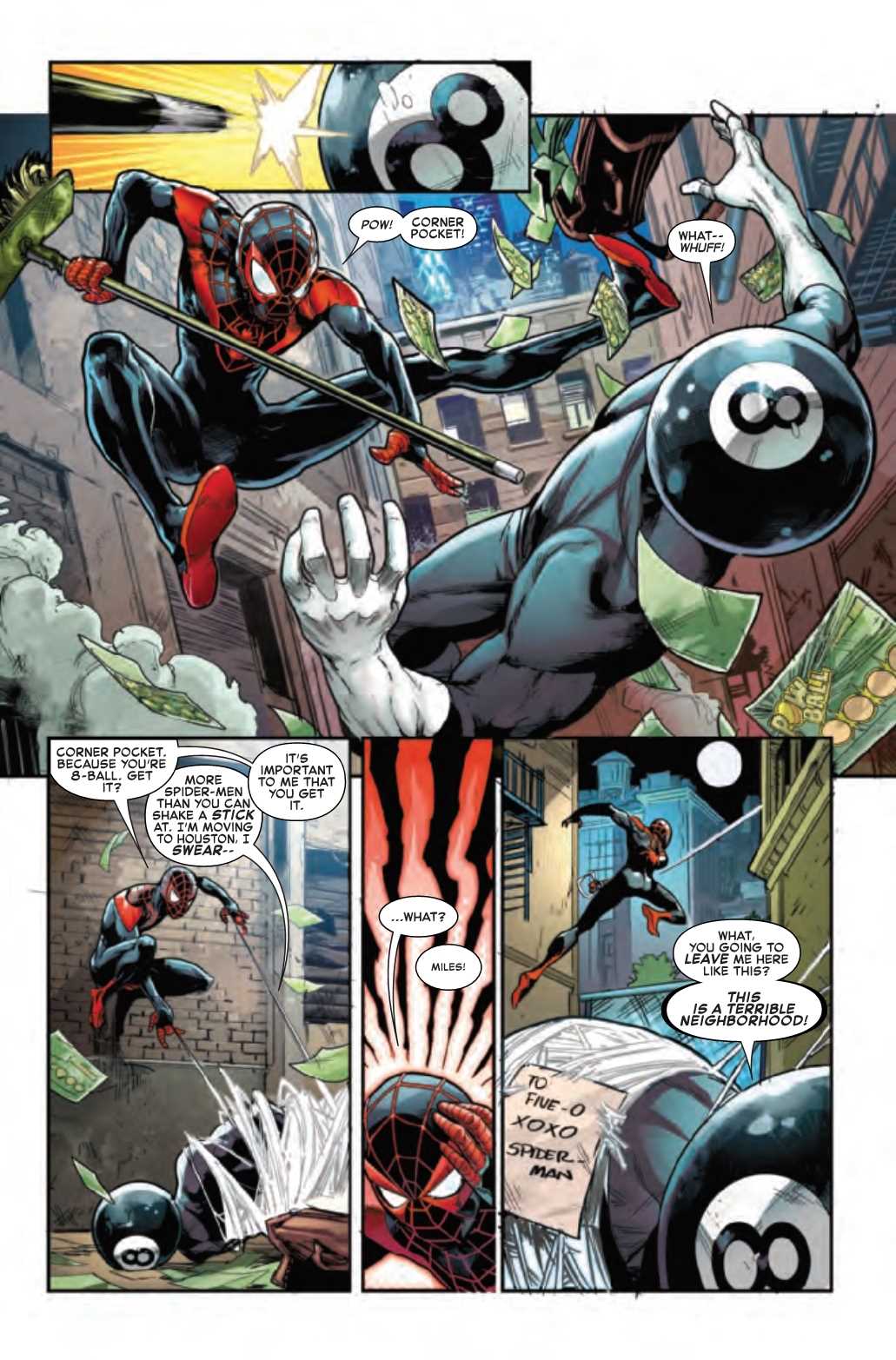
After quickly dispatching with a comically underused villain 8-ball, Spider-Verse #1 has recently appointed Spider-Man Miles Morales being pulled across the Spider-Verse by a mysterious voice. Mackay’s script is swift and witty. Miles Morales has quips for days regardless of the universe he is stuck in for the moment. And each of the other Spider-Men (or Spider-Monster) speaks accordingly with his allotted world.

While the story isn’t revelatory and is more an excuse to see the various Spider-Worlds, if there is one flaw to the script, it is the flimsy excuse for relying on Miles instead of Peter. Not that Miles is not an adequate hero, but when the fate of the Spider-Verse is on the line, wouldn’t you want the best, most experienced Spider-Man to protect it? The reasoning for this is simply, “This is our jobs now because we’re new and young, and so is the Spider-Verse.”

Due to a large amount of contributing artists and styles, the reader is also not given enough time to get acquainted with any of the worlds Miles visits. Surely some of these universes are one-offs that we’ll never revisit, but some of the worlds seemed significant enough, such as Spider-Punk’s scene. Perhaps Mackay will bring us back to him in a future issue, but more time will have to be spent here for it to feel purposeful and not like a distraction.

Spider-Man Fights The Dastardly.... 8-Ball?
Spider-Man Fights The Dastardly…. 8-Ball?

The highlight and main draw for Spider-Verse #1 is the flawless use of the humongous art team. Each team is tasked with drawing a separate universe, and they do so with glee and fanatic enthusiasm. It’s easy to tell the artists were clearly having a blast drawing silly universes like Monsterhattan, a version of Manhattan, except everyone is a horrifying Cronenbergian monster, including Spider-Man ( or Spider-Monster either/or) or a Mad Max: Fury Road inspired Spider-Man. Each universe is unique and could offer a fun new story to add to the Spider-Verse mythos.

Spider-Verse #1 treads a fine line. This book is clearly a celebration of the breadth of Universes you can put a Spider-Man into as well as the character itself. But writer Mackay will have to employ some balance in the future and spend some quality time in each of the universes to imbue some purpose in them besides being aesthetically pleasing. But you’re getting the book because of the art department, and they surely do not disappoint. Each universe is memorable and could launch a whole swath of stories, and VC’s Joe Sabino’s letters remain the stabilizing force tying all the universes together. If you like Spider-Man and The inherent goofiness of a multiverse of various Spider-Men Spider-Verse #1 is essential.

Monkeys Fighting Robots Youtube

Exclusive DC Comics Preview: SUPERGIRL #35

Monkeys Fighting Robots

Supergirl #35 hits your local comic book store next week, but thanks to DC Comics, Monkeys Fighting Robots has a five-page preview for you.

About the issue:
As Supergirl gets drawn deeper into Leviathan’s plans and the search for her foster parents, the newly sentient Brainiac-1 drone realizes the one thing he needs to unlock the power of millennia of Kryptonian science is the Girl of Steel herself! With her focus on her Earth family, will the distraction make her an easy target for the mad A.I.? And how will Leviathan respond as she gets closer and closer to their plans?

Supergirl #35 is written by Marc Andreyko, with pencils by Eduardo Pansica, Julio Ferreira inked the issue, Fco Plascencia dropped some colors, and letters by Tom Napolitano. Jesus Merino and Plascencia worked on the cover, and Drew Edward Johnson gave us the variant cover.

Check out the Supergirl #35 preview below:


Are still onboard with ‘Year of the Villain?’ Comment below with your thoughts.

Monkeys Fighting Robots Youtube

Image Comics/Top Cow Exclusive Preview: POSTAL: DELIVERANCE #4

Monkeys Fighting Robots

Postal: Deliverance #4 hits your local comic book store next week, but thanks to Image Comics and Top Cow, Monkeys Fighting Robots has an exclusive four-page preview for you.

About the issue:
Mark has a reckoning with the sociopath he maimed, the monster he may have just created. Laura creates her own monster in the mind of young Pascal, and both Mark and Laura will have to accept the horror—and the power—of their own natures.

Postal: Deliverance #4 is by writer Bryan Hill and artist Raffaele Ienco, with letterer Troy Peteri.

Check out the Postal: Deliverance #4 preview below:

postal deliverance exclusive preview image comics top cow

postal deliverance exclusive preview image comics top cow

postal deliverance exclusive preview image comics top cow

postal deliverance exclusive preview image comics top cow


Are you a Postal fan? Sound off in the comments!

Monkeys Fighting Robots Youtube

AfterShock Comics Exclusive Preview: ANIMOSITY #24

Monkeys Fighting Robots

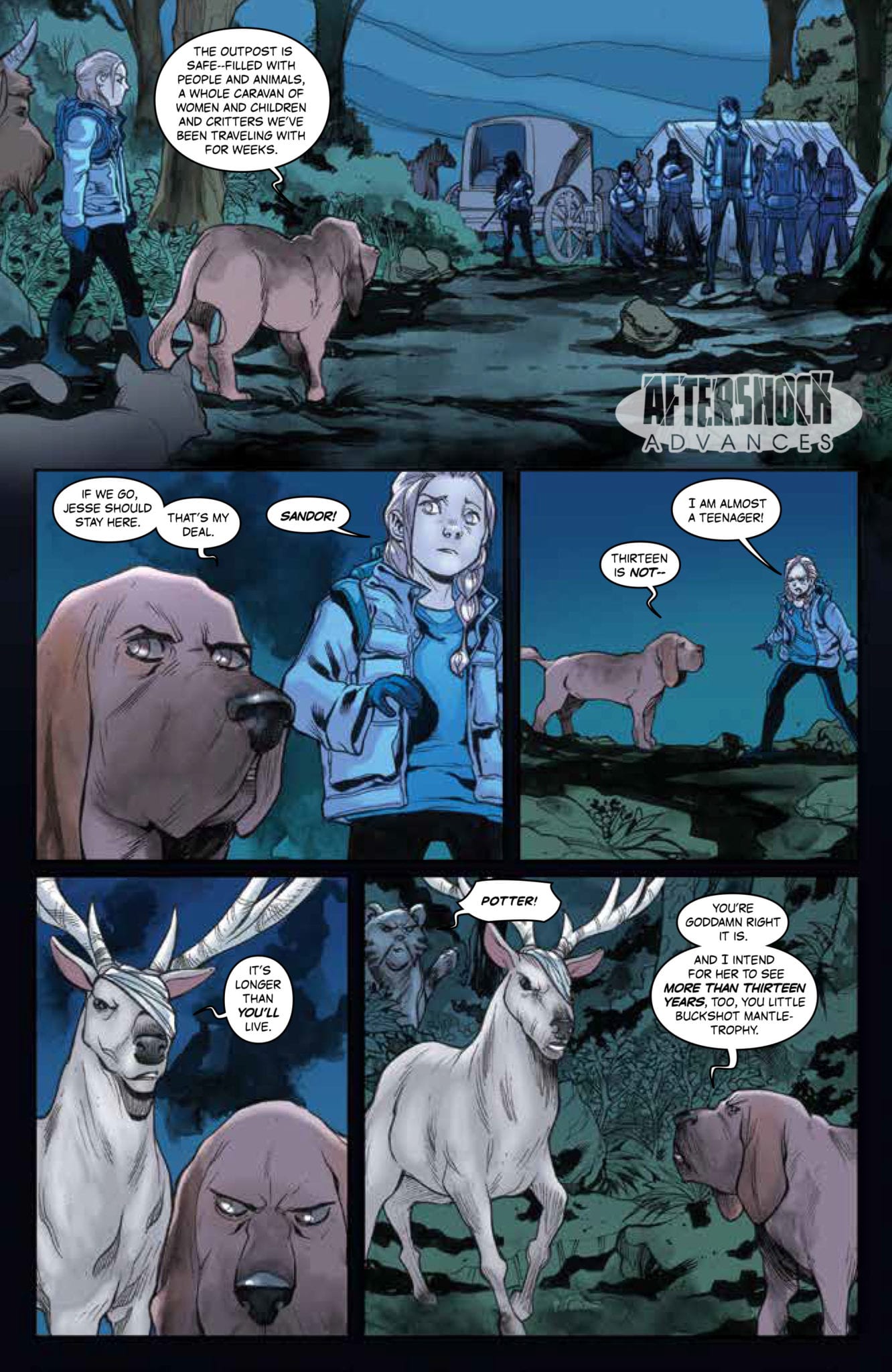
Animosity #24 hits your local comic book store next week, but thanks to AfterShock Comics, Monkeys Fighting Robots has an exclusive four-page preview for you.

About the issue:
The cruelest weapon is not a knife, or gun, or sword, or bow. The cruelest weapon…is a cage.

The series tells the story of a world where animals suddenly gain the ability to think and speak like humans…and they begin their revenge.

Animosity #24 is by writer Marguerite Bennett and artist Elton Thomasi, with Rob Schwager on colors and Taylor Esposito on letters. The cover is by Rafael De Latorre with Marcelo Maiolo.

Check out the Animosity #24 preview below:

animosity exclusive preview aftershock comics

animosity exclusive preview aftershock comics

animosity exclusive preview aftershock comics

animosity exclusive preview aftershock comics

animosity exclusive preview aftershock comics


Are you reading Animosity? What’s your favorite AfterShock title? Sound off in the comments below!

Monkeys Fighting Robots Youtube

Exclusive Preview: ABSOLUTE CARNAGE: MILES MORALES #3

Monkeys Fighting Robots

Absolute Carnage: Miles Morales #3 hits your local comic book store next week, but thanks to Marvel Comics, Monkeys Fighting Robots has an exclusive five-page preview for you.

About the issue:
THREATS WITHIN AND WITHOUT! A serial killer released from Ravencroft, the commands of Carnage, J. Jonah Jameson, and SILVER SABLE! Miles must wrestle all of these while his mind is not his own! Will a connection to the Cult of Carnage’s collective subconscious give him an edge that pays off in the greater war? Or will that two-way connection compromise Spider-Man–fatally?

Absolute Carnage: Miles Morales #3 is written by Saladin Ahmed, with art by Federico Vincentini, Clayton Crain is the cover artist, Erick Arciniega is the color artist, and Cory Petit is the letterer.

Check out the Absolute Carnage: Miles Morales #3 preview below:


What do you think of Absolute Carnage so far? Comment below with your thoughts.

Monkeys Fighting Robots Youtube

Preview: DCeased #6 – There Are Spoilers If You Look Hard Enough

Monkeys Fighting Robots

New York Comic-Con starts today, and DC Comics dropped a five-page preview of DCeased #6 this afternoon, the final issue of Tom Taylor’s tale.

“In this book, anyone can be taken off the table,” said Taylor.

About the issue:
DCeased, DC’s brutal blockbuster, reaches its chilling conclusion! Humanity is on the brink of extinction, and only a few remaining members of the Justice League stand between life and annihilation. As the remnants of humanity make their last gamble for survival, will there even be a planet left to call home when all is said and done?

DCeased #6
Written by Tom Taylor
Art by Trevor Hairsine, Neil Edwards and Stefano Guadiano
Cover art by Mark Brooks
Variant cover art by Francesco Mattina and Yasmin Putri
In Shops: Oct 30, 2019
Final Orders Due: Oct 07, 2019
SRP: $4.99


According to the PR Department at DC Comics, there are spoilers in here if you look hard enough. Be careful if you don’t want the story spoiled for you.

Check out the DCeased #6 preview below:

Monkeys Fighting Robots Youtube