Home Blog Page 323

Longbox Legends: URTH 4 Holds A Key To Comics’ Future

Urth4 #1, Adams cover

Urth 4 is a superhero team book published by Continuity Comics, and their first issue solves a mystery about what’s been missing from comics for the last 30 years. What’s that? You’ve never heard of Urth 4 OR Continuity Comics? Is this going to be a boring history lesson? Let’s find out.

What the heck is Continuity Comics?

Good question. Way back in the decade of plastic, hairspray, and shoulder pads, (aka the 80’s) a new comic publishing company was formed by Neal Adams, the famed DC artist. Adams’ goal was to create a comics house where he could exercise more creative ownership and control over his own creations. Sound familiar? It’s the same model used by other creators to start companies such as Image. You can read much more about it here.

Alas, the dream only lasted a few years, and Continuity Comics folded in 1994. Many of the properties created in their 10-year existence disappeared into a dusty cabinet somewhere, or they were picked up by other publishers like Valiant. One such property, the subject of this post, is a little team known as Urth 4.

Tell me more about this Urth 4

Gladly. Urth 4 was a 4-person superhero team with powersets matching the basic elementals: Earth, Fire, Air, Water. The group was diverse in gender and ethnicity, and they interacted (at least in the first issue) as a coordinated team. In a way, this was Adams’ attempt at creating his own version of the Fantastic Four with a different origin spin and a general focus on environmentalism. You would expect to see similar story themes on an episode of Captain Planet, but the story structure catered to an action-oriented audience. In short, cross Captain Planet with the Fantastic Four and you get Urth 4.

Urth 4 ran for eleven issues in total. The team called themselves Urth 4 through the first four issues. They renamed themselves (and the book) to Earth 4 for the remaining seven. Neal Adams, co-founder of Continuity Comics, painted the debut issue’s cover, and the first issue’s art team is a cavalcade of who’s who from comics history:

  • Peter Stone – Lead writer
  • Trevor Von Eeden – Pencils
  • Ian Akin, Brian Garvey – Inks
  • Liz Berube – Colors
  • Ken Bruzenak – Letters

Was it the best superhero team book ever created? No

Does the first issue contain the best art ever seen on planet Earth up to that point? It’s good but not THAT good.

Does the story and dialog read like the second coming of Shakespeare? No. To be honest the dialog is clunky, and I found several typos.

How does this book hold the key to anything?

Ahh, the key is in the premise of the team’s origin. On page 17, we learn the team was gifted their powers by the entity that embodies the life force of the planet.

Don’t call her Mother Nature. She reprimands the team for calling her that.

She chooses the team to possess the elemental powers based on their collective strength of character and will. She believes these four are the best candidates to use elemental gifts to defend her body (Earth) for the betterment of all its inhabitants. In effect, the team is powered and assembled by a call from a greater, higher power.

The team doesn’t come together to fight for a mutual benefit, or to fulfill a promise, or to avenge a lost loved one. They are brought together by something greater than themselves as defenders and champions. And, that’s what’s been missing of late in so many story arcs from current publishers: A call to fight for some greater purpose.

Call it Fate. Call it Destiny. Call it God. Call it the Universe. Call it the Force. Call it whatever you like, but the idea is the source of an higher mind that has a greater view of our world and the struggles between good and evil. From this source comes the call to adventure that is referenced in every version of “the hero’s journey” that’s been the archetype of every legendary adventure story since the beginning of the written word.

Heroes Heed The Call, Everything Else Is Just Squabbling

When heroes fight against villains or worse, against each other, in many books that are published at the time of this writing, it’s usually in pursuit of a personal goal. That goal being a tribal interest (Marvel’s mutants), or a governmental interest (Marvel’s SHIELD), or a personal albeit altruistic interest (pretty much anything related to Batman). It’s rare to find any superhero these days that’s fighting in answer to a call. A call that comes from some higher power or ideal that’s greater than themselves; barring some staunch personal code.

Too often we’re finding superheroes who’s main focus is wrestling with their personal demons or at odds with their friends and foes in ideological conflicts. The fight of every hero has almost universally degenerated into the squabbling of mere mortals. Consider examples where popular heroes are either connected to, or in some way, beholden to a higher power and the opportunity that connection has opened up for more fertile storytelling:

  • The Flash has the Speed Force
  • Green Lantern has the Guardians of OA
  • Luke Skywalker has the Force
  • Every Marvel character has the One-Above-All

All good examples of this point in action, and there are not nearly enough of them.

In each of these examples, the connection to a higher, guiding influence not only gives the storytelling a larger scope to explore, but adds so much more diversity and complexity to the story ideas. Let’s face it, there’s only so many ways to explore the Bat/Cat relationship or Peter Parker/Osborn clan relationship before you start to think “This again?”

Hey, Publishers! Take a tip from a defunct superhero team. Give your old heroes something to fight for that’s greater than themselves, and watch the story well overflow.

Thank you, Urth 4! You left us too soon.


Author’s Note: Local Comic Shops (LCS) are going through a tough time right now with the pandemic outbreak of COVID-19. Comics fans of every flavor that care about his or her LCS should try to do what they can. So, here’s my part:

If you’re in Northern Delaware, South East Pennsylvania, or Southern New Jersey area, please take a moment to visit Captain Blue Hen Comics in Newark, DE. Say ‘hi,’ pick up a book, order a book (they’re on Comichub.com), and let them know you support them.

If you’re nowhere near that area, please find YOUR LCS using Comic Shop Locator and lend your support.

Thanks, and stay safe.
Monkeys Fighting Robots Youtube

Craig Sawyer: How 80s Buddy Cops Influenced MARS CITY VICE

Mars City Vice by Craig Sawyer

Craig Sawyer is an indie creator who’s not letting quarantine or Diamond’s crumbling empire stop his comic. Mars City Vice is a comic at the time of this post halfway through its funding goal. Monkeys Fighting Robots recently got into contact with Sawyer for some behind the scenes insight.

But before we do let’s give credit to the entire creative team of Craig Sawyer and Chris Webb as writers, penciler Deivid Deon, inker Sandro Rebeiro, colorist James Brown, and letterer Ed Dukeshire.

Craig Sawyer’s Mars City Vice

Straight from the Indiegogo campaign:

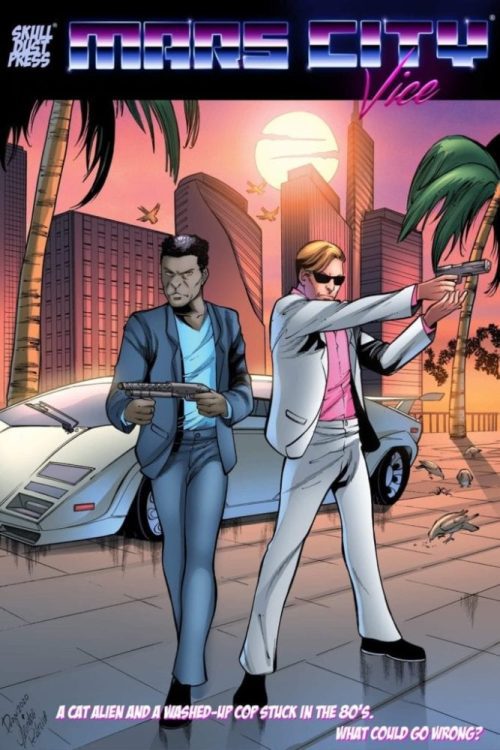
Mars circa 2089, humans live and play alongside various extraterrestrial races. Several planets in our solar system have been colonized for many years. The Moon has sprawling slums, while Mars has become a popular and exclusive theme park based on a super stylized version of 80’s Miami. Two unlikely police detectives, a human Maxwell ‘Moony’ Boone, and his new alien partner Tykar ‘Ty’ Baths try and overcome their differences, as they work undercover in a fake 1980’s Miami investigating a mysterious kingpin that is threatening to corrupt the solar system with a new drug made from a rare alien blood.

Time For The Testimony

Monkeys Fighting Robots: From the look of the images, there are a lot of homages to 80s buddy cops like Lethal Weapon and Miami Vice. What do you find so appealing about this genre and how will you try to make it different?

Craig Sawyer: I was in prime impressionable age when I saw the first Lethal Weapon, I was twelve. That film came out in 1987. The third season of Miami Vice had also debuted. Buddy cops and mega explosions were in full swing. Lethal Weapon‘s writer Shane Black infused LW with dark humor and helped birth the modern genre we know. The story is constantly dancing on the edge between cartoonish absurdity and the dark serious. It has emotional gravitas with Rigg’s suicidal tendencies, but also lots of dumb fun entertainment, plus the cast was great.

Miami Vice had a cultural aesthetic that had never been seen on TV, and my young self just thought it was damn cool. I mean, fast cars, shootouts, and hot women. Action cop shows become the new western in the 80s, but the line between the good guys and the bad guys had started to blur. The 80s saw the birth of the anti-hero.

Although Mars City Vice is strongly influenced by those action films and shows, we are trying to build in some deeper philosophical ideas into our story. The main theme being – nothing is as it seems, and what is reality?

MFR: Following up that, what is it about Miami that you wanted to include this replica as the setting? For that matter, aside from the presence of aliens what kind of culture encompasses this city?

Sawyer: The 80s seemed very sci-fi to me, plus it was a golden age for rad movies, TV shows. music, cartoons, toys and tech. The computer age was born in the 80’s. And what better place than Miami to be inspired by. , The TV Show Miami Vice was a big part of that time period’s look, using no earth tones in its color palette. The same colors we use to bring this world to life, and it makes for a great looking comic book. The 80’s MTV look, with Armani jackets and Ferragamo shoes, but with an outer space sci-fi twist. I thought it was a mash-up that was begging to be brought to life, and here it is in Mars City Vice the graphic novel.
MFR: The images and suggest something of a noir-like story with action; not unlike the video game Hotline Miami. Can fans and backers expect the over-the-top action from those influences?
Sawyer: Oh, there is real crime in bogus 80’s Miami Mars City, and tons of over the top violence. This book is for mature audiences. I’m a big fan of movies like Scarface and the humor of Deadpool. Hotline Miami looks like a very cool game, but I haven’t played it yet, I’ve been too busy writing! Our main protagonists, Boone and Baths, are a homage to Crockett and Tubbs from the old 80s TV show, but they are very different characters in our world. For example, Baths is a chameleon cat man from a race called Maldakiens, who’s blood has become a valuable commodity in the drug trade. Boone was excommunicated from his old job in Lunar P.D., and put out to pasture in this 80’s theme park, which he can’t stand. These two guys start out at odds until they realize they have similar agendas. The humor comes in from these guys living in 2089 having to go to a place where only 80’s tech is allowed.

MFR: Aside from the influences of the above titles, what exactly are the themes surrounding Mars City Vice?

Sawyer: Mars City Vice will have all the big explosions and car chases, but Chris Webb (my writing partner) and myself started with the series with an underlying deeper philosophical theme in the back of our minds. We wanted to explore the big existential question of what is real and what is not. This world we have built has many different levels of reality. What is reality? I mean, our lead characters are real cops, who play fake cops in a replica of 80s Miami, but who also pretend to be undercover cops that end fighting real criminals. The author Phillip K. Dick asked this very question with sci-fi novels like “Do Androids Dream of Electric Sheep? (became the film Blade Runner) and “A Scanner Darkly.” His fiction often explored alternate realities, simulacra, etc.

MFR: Which of your characters do you have the strongest affinity towards?

Sawyer: I gotta say, the more broken and on the fringe they are, the more I like them. The bigger the outcast, the better. Boone and Baths are both pretty broken and seeking redemption in their own ways. Family plays a big part in who these guys are too. It’s the one thing that keeps them being heroes. There has always been a thin line between those who break the law and those who uphold it. I love the quote from the TV series True Detective (the first season) where the character Rust Cohle says “The worlds needs bad men. We keep the other bad men from the door.” Props to writer Nic Pizzolatto for putting those words in that characters mouth. I think about that quote a lot while writing.

MFR: How would you consider the process of this series involving your creative team?

Sawyer: This has been a fun and challenging book. Some of my art team lived the 80’s and some didn’t. There have been a lot photo descriptions sent. I couldn’t ask for a more professional team. I have been really lucky to find these guys and work with them. A lot of these artists have worked for the big publishers Marvel and DC. It’s been good being able to keep artists working through this Covid craziness. That’s one of the main reasons for doing a Indiegogo fund raiser. The money raised to keeping artists working, we aren’t just burning this money.

MFR: Finally how many parts of this series will backers and fans be expecting?

Sawyer: This will be a five-issue arc that we are planning to release in a part one and two. If this first Indiegogo goes well, we will try and finish it all. I am also going back toe Kickstarter in late May with my other passion, my board game Secret Unknown Stuff: Escape from Dulce. I am also co-owner in Sentient Cow Games. Also (I’ve been busy in Quarantine – lol) look for a Hitchcockian short film ‘The Check’ I wrote and directed to be released on Youtube in the next week on my Craig Sawyer Channel (Not to be confused with Craig “Sawman” Sawyer’s channel).


Thanks again to Craig Sawyer for taking the time to interview with us. To join in on the Indiegogo campaign, click this link (or the above one) to help fund this series.

Monkeys Fighting Robots Youtube

EVIL ERNIE: How The Wild Youth Horror Became Tame

Evil Ernie doing something

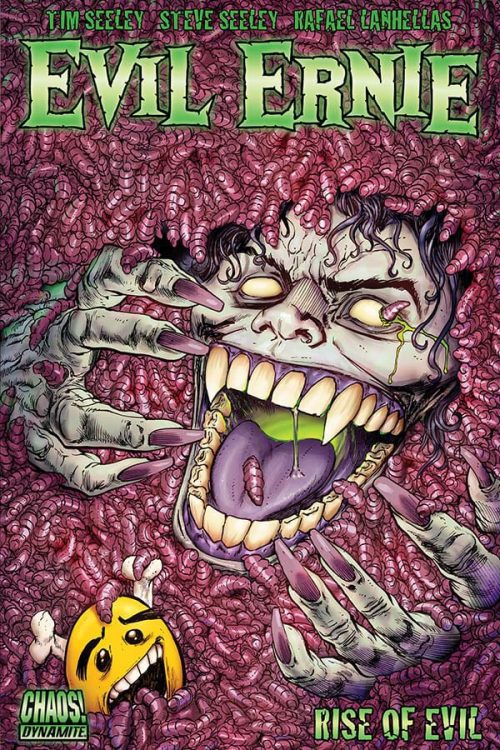
Evil Ernie is creator Brian Pulido’s earliest success in comics. A product of the Dark Age of comics, Ernie alongside Lady Death, brings about Chaos Comics. But who is Evil Ernie? And how did Ernie succeed during the 90s while his subsequent series are so lackluster? This is the research from the gutters.

Evil Ernie’s Eternity

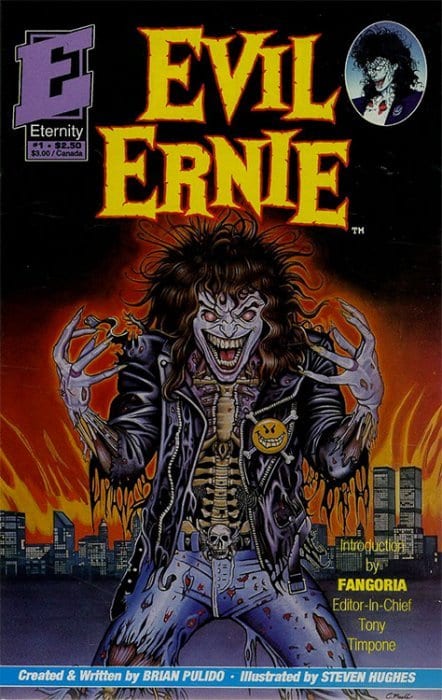
The Eternal coverEvil Ernie begins Pulido’s career in Eternity Comics, an indie publisher best remembered for translating manga like Captain Harlock. But during the one year of publishing Pulido gets a fanbase and decides to use Ernie again in his own company. Chaos Comics republishes and continues the story of Ernest Fairchild, a telepath abused by his parents. As a child, Ernie experienced early signs of his powers. Ernie could not only hear people’s thoughts; he could manifest his own directly into other people’s heads. His parents did not take this well and abused Ernie every night.
Eventually, the Fairchilds commit Ernie to some experimental psychosis treatment. This results in Ernie making contact with Lady Death. Feeling Ernie’s need for love, she agrees to love him if he kills all of the living. Ernie accepts when he hears the neighbors’ thoughts on being unwilling to help him. With Ernie’s parents being the first victims, he slaughters 35 people before he is committed to an asylum, under the guilt-ridden Leonard Pierce, the doctor behind the initial treatment. Ernie would spend years foreseeing his future as the ghoulish Evil Ernie.

A new doctor Mary Young who grew up in the same town as Ernie, tries a seemingly improved psychosis treatment. Unfortunately, the machine mixing with Ernie’s telepathic connection to Lady Death instead explodes, killing him. Only to resurrect as Evil Ernie with the ability to control the dead.

Evil Ernie Is Chaos!

Brian Pulido makes Evil Ernie a supernatural thriller story by instilling relatable horrors alongside the absurdity. Like Stephen King’s Carrie, we have a social outcast who can’t help being different. But their differences make them sensitive to the people around them. Teenagers have it the worst when they have bad childhoods filled with trauma. If you need a milder depiction of how childhood traumas affect people in the long run, look at Steven Universe Future. The fact Ernie needed an escape fantasy is very believable; Lady Death herself was initially just a figment of Ernie’s imagination. Such delusions often come from afflictions like schizophrenia. Even now, people have difficulties dealing with this affliction, and the wrong move can make things worse.

Such wrong moves affect Ernie in several ways. His parents are unable to deal with Ernie’s powers and the stress of their failing mill business. So they take all their frustrations out on him as a scapegoat. The initial treatments on Ernie can even be seen as analogous to lobotomization, a process where patients have been known to deteriorate with time. Such a lack of care or understanding leads an innocent boy into a life of mayhem.

Fear The Teens

What’s more interesting is how Erne’s retaliation against his parents is like a youthful rebellion. Heavy metal has often been a symbol of rebellion in teens, to the point of parents accusing it of Satanism. Given the album covers’ apocalyptic designs, it’s hard not to draw the parallel themes between the genre and Evil Ernie. Ernie’s early design even evokes heavy metal singer Blitz Ellsworth. Not to mention his debut story has the subtitle of Youth Gone Wild.

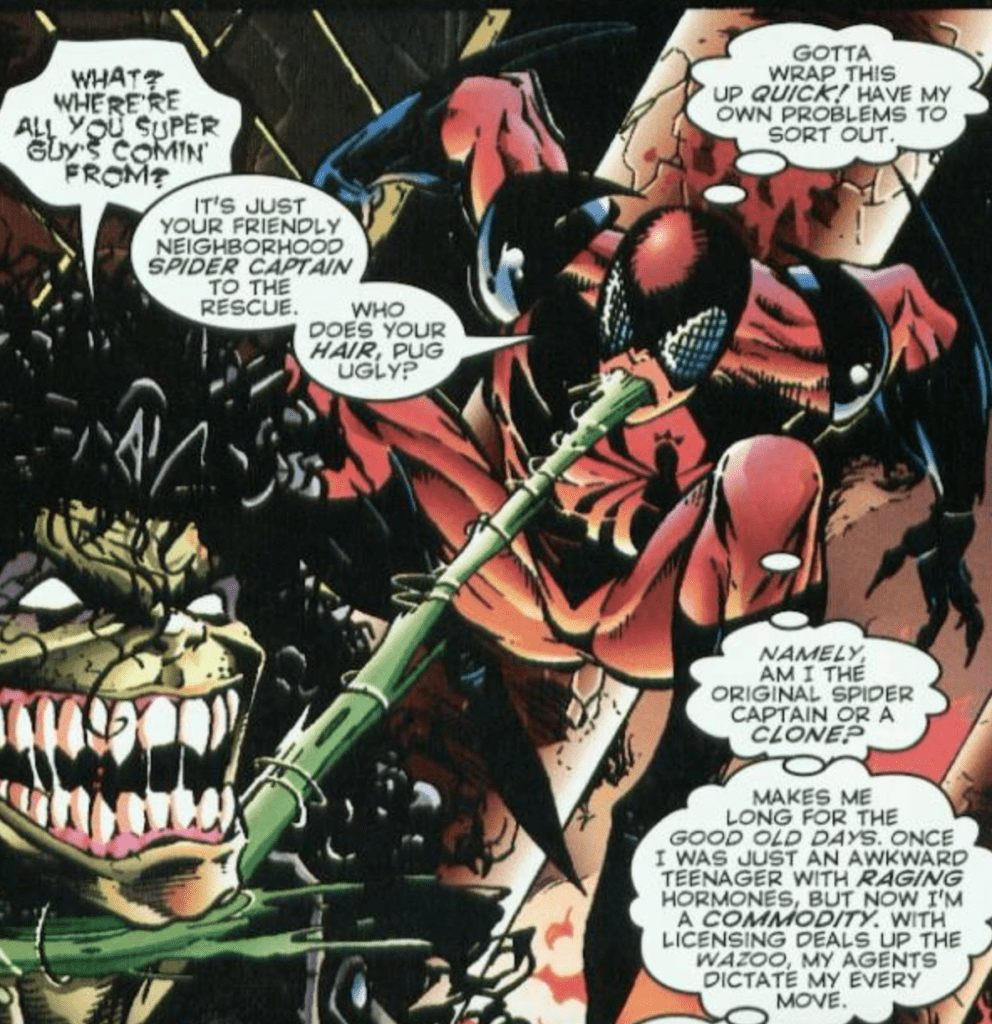
Evil Ernie dealing with the Clone Saga
Everybody hates the Clone Saga.

Perhaps in a meta-textual way, Ernie can even be a way of rebelling against mainstream comics. With so many people trying to make superheroes in the 90s, especially the dark and edgy kind, Evil Ernie murdering pastiches of these characters is the ultimate catharsis. Ernie also shows up these mainstream publishers by resisting events and inter-continuity by focusing on character. It’s only once the company is about to go into bankruptcy that Evil Ernie sets in motion a grand finale to Chaos Comics.

Pulido Pays The Devil’s Due

Unfortunately, by the turn of the century, Pulido all but leaves Ernie behind. With Chaos! Comics going bankrupt, all properties save for Lady Death go to Devil’s Due Entertainment. But why does Pulido leave Evil Ernie behind? At this point, the only hypothesis comes from Ernie’s nature as a character. Most of the fears surrounding Evil Ernie like teenage angst and Heavy Metal have more or less become a part of everyday life. With such tolerance, Ernie doesn’t seem all that scary.

What’s more, Ernie’s status as a force of nature only gives him two layers. He’s an abused child who lashes out at the world and desperately wants love. But strip Lady Death from him, and he’s just a bratty teenager.

Unlike Lady Death, who grows into a character of her own, Evil Ernie is rather one-note. Pulido likely ran out of ideas for Ernie and couldn’t find ways to reinvent him. So when the rights go to Devil’s Due, creators try to expand Ernie’s character. Unfortunately, this takes away aspects that make Ernie so interesting. Starting with how he kills Satanists for harming a child, this makes Ernie less… evil. Keep in mind that in his Chaos days, Ernie had no problem killing children.

Dynamite And Evil Ernie

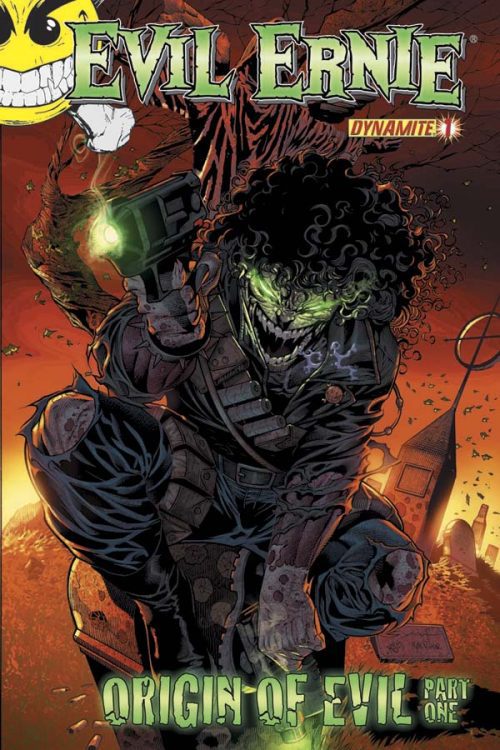
DynamiteOriginCoverWhen the rights of Evil Ernie go to Dynamite Publishing, creators double down on this depiction. This character, who was once the embodiment of evil, becomes a vigilante. Now Ernie’s killing urge stems from daddy issues involving his imprisoned foster father. The fact that he kills everyone with even a hint of evil in them while working for Archdemons makes him too similar to characters like Ghost Rider. What’s more, unlike the original Ernie, who had practically no escape from evil, this Ernie had a fairer chance of a better life.
This might seem more appealing than the character whose spotlight was stolen by Lady Death. But in the end, the moral ambiguity surrounding everything makes him so sympathetic, Evil Ernie is now just a title. In the end, he’s still a bratty teenager looking for attention—all the more worse by the fact he’s driven by pettiness.

Can Evil Ernie Resurrect Again?

Evil Ernie will be forever remembered as the series that brings about Lady Death. But for the titular character, his time may be very well long gone. Ernie was a product of the public’s perceptions of taboo topics like puberty, mental health, heavy metal, and the 90s comic industry. Trying to adapt such a thing in modern times however proves to be difficult. With people having a greater understanding of those subjects, how can anyone tolerate such an evil character?

One idea is to explore the very idea of evil. With Halloween managing to make a comeback in theaters, it might be good for Ernie to go in a similar direction. Rather than focusing on the abuse, gore, or demonic nature, it would be good to see how the presence of such evil affects the people around Ernie. Maybe a reboot focusing on Ernie snapping for no actual reason like in We Need To Talk About Kevin would be a good angle.

What do you think should be done about Evil Ernie? Leave your thoughts in the comments.

Monkeys Fighting Robots Youtube

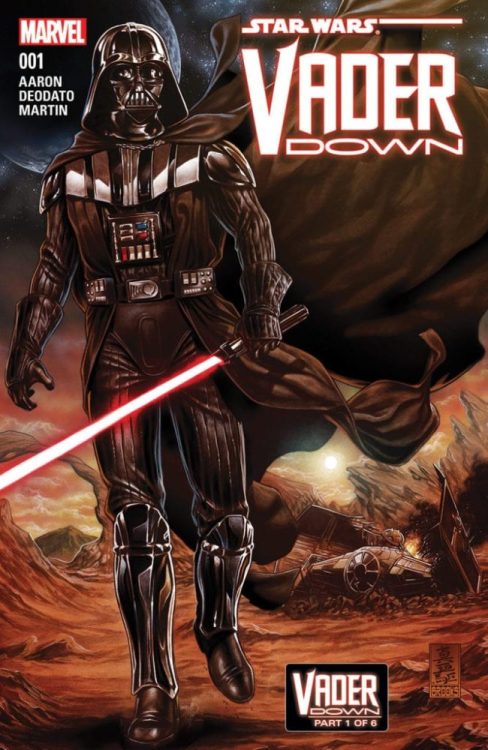
Longbox Legends: Remembering The Awe-Inspiring Battle In STAR WARS: VADER DOWN #1

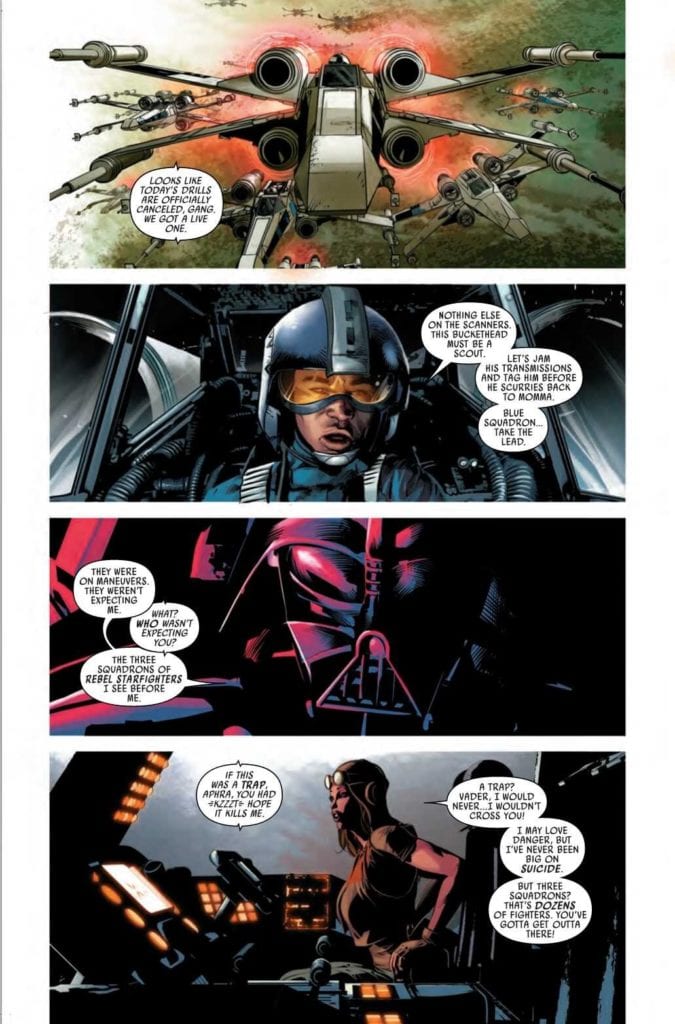
VADER DOWN #1 was one of many new titles to come out of Marvel to celebrate its revitalization of the Star Wars franchise in comic books. Written by Jason Aaron and illustrated by Mike Deodato Jr., Frank Martin, and Joe Caramagna, the 2015 issue was an ambitious cross-over event that honed in on Darth Vader in order to further explore his character. The villain, originally on a trip to Vrogas Vas in search of Luke Skywalker, finds himself surrounded by a Rebel Forces’ fleet. If anyone else were in Vader’s position they would have virtually no chance of survival. But as this issue will show us, the Sith Lord is a force of nature all his own.

Story

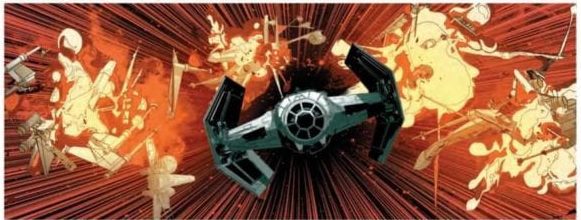
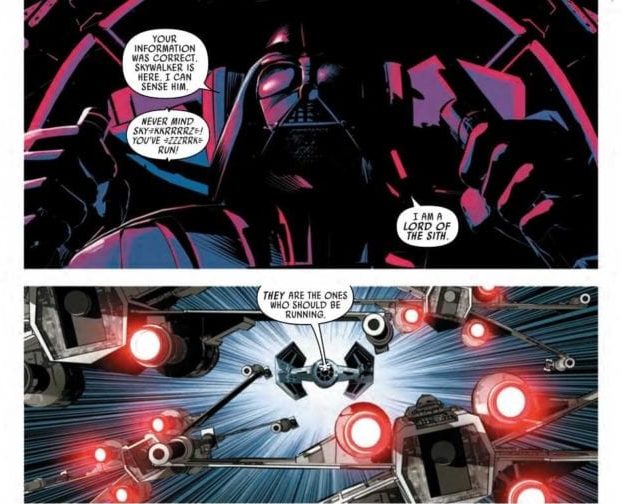
Receiving a tip from Doctor Aphra, Vader moves in on Luke’s location. Upon running into the fleet of Rebel X-Wing Starfighters, one would think the Dark Lord would attempt an evasive maneuver. But the confidence exuding from him would never permit him to do such a thing.

Star Wars fans know how egregious the sins of Vader are, but few can deny the draw to a character with such determination. We (regretfully) find ourselves almost routing for the villain. But once he lands on the planet, readers will see how Vader fairs against an armada of Rebels on the ground.

The beauty of Aaron’s narrative lies in his portrayal of Vader. His elegant ease in dismantling the Rebel forces makes one feel as if he’s a force of nature himself. It is the perfect setup for this storyline—casting the tyrant in an unstoppable position from the get-go leaves ample room for him to fall in the future.

Artwork

Deodato Jr.’s penciling and ink work, Martin’s coloring, Caramagna’s lettering were each integral pieces of this beautiful issue. The fighter ships are incredibly detailed, complete with dark grays for the side panels and intense reds to represent their explosive fire. The lettering used for the Rebel Fleet blends in which the explosions themselves—it’s as if their exclamations of fear were part of the visual landscape.

Conclusion

STAR WARS: VADER DOWN #1 was the perfect way to launch into a new era of Star Wars comics. Though we want our hero Luke to survive, we have to admit Vader’s unmatched power in the Force is nothing short of awe-inspring.

What was your favorite part of the issue? Let us know in the comments below!

Monkeys Fighting Robots Youtube

Longbox Legends: Warren Ellis and Bryan Hitch’s THE AUTHORITY

Superheroes in the most classical sense are designed to be the best possible versions of humanity to strive for. They are creations of myth used to serve as an example of ideal morality. Generally, their ideals align with the western world’s most common views of justice: no killing, and nothing that misaligns with what could be considered the “status quo” maintained by western governments. While superheroes are great and inspiring, the kinds of storytelling they undergo on a mainstream basis is maintained in the interests of any other mainstream media and its audience. Fortunately, there’s Warren Ellis and Bryan Hitch. Even more fortunately, they brought along The Authority, a superhero team dedicated to making the world a better place – by any means necessary. Almost in direct response to the trappings of mainstream heroes, The Authority voraciously goes after world-ending alien threats, criminal masterminds, and the interests of wealthy western government superpowers all with the same intensity; regardless of the consequences they may face.

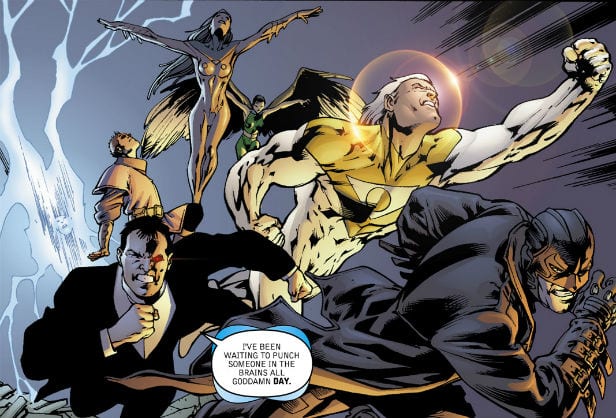
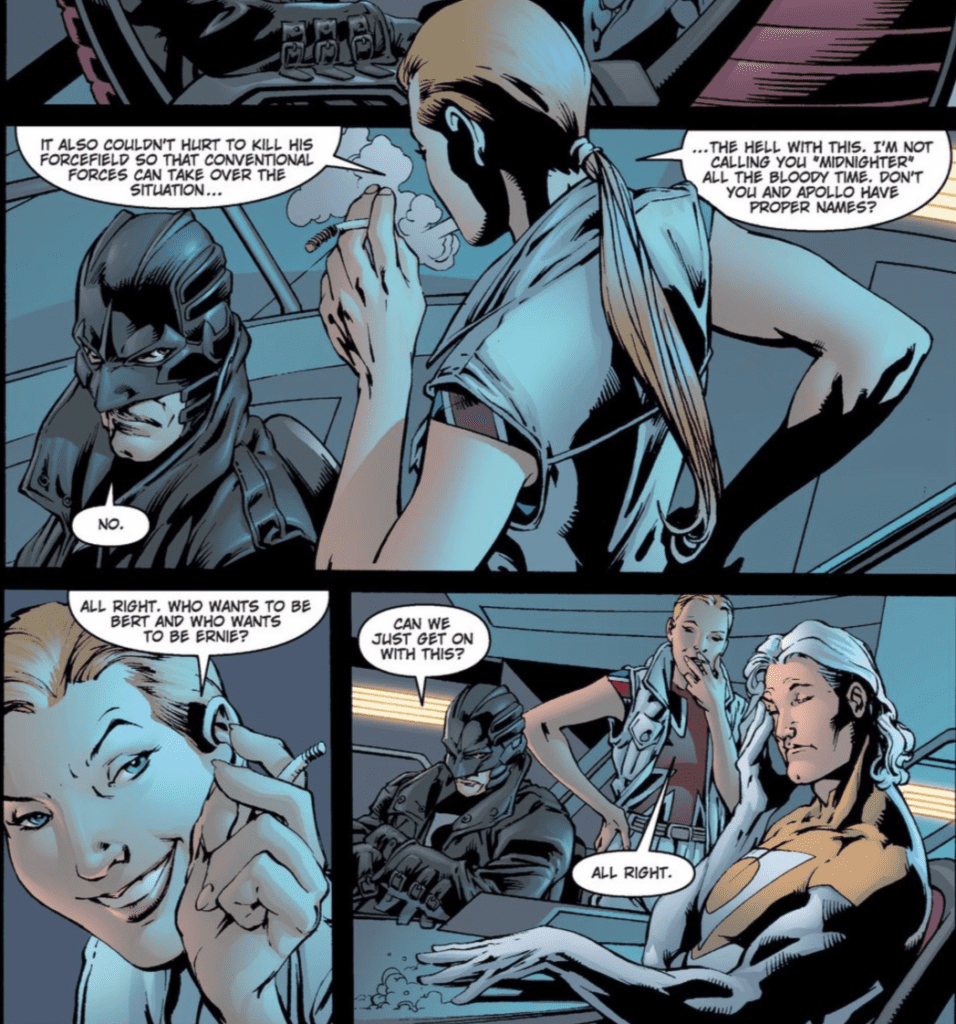
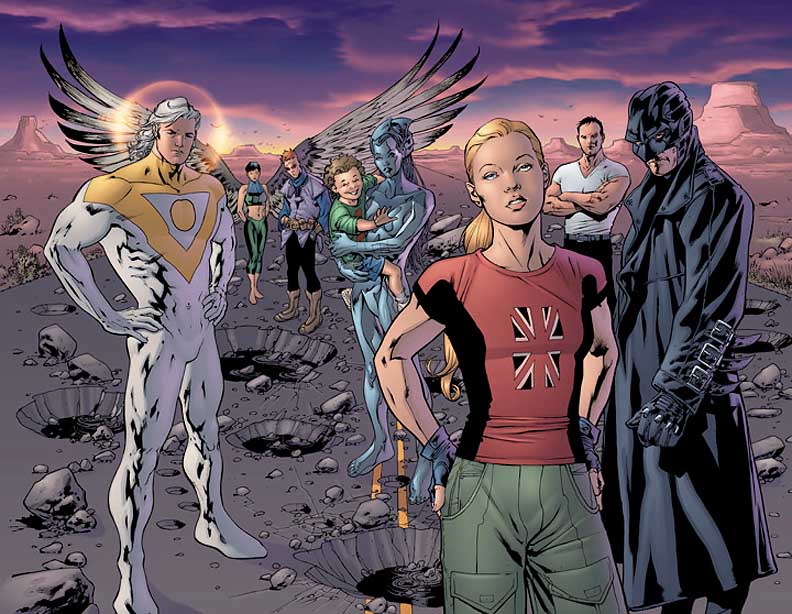
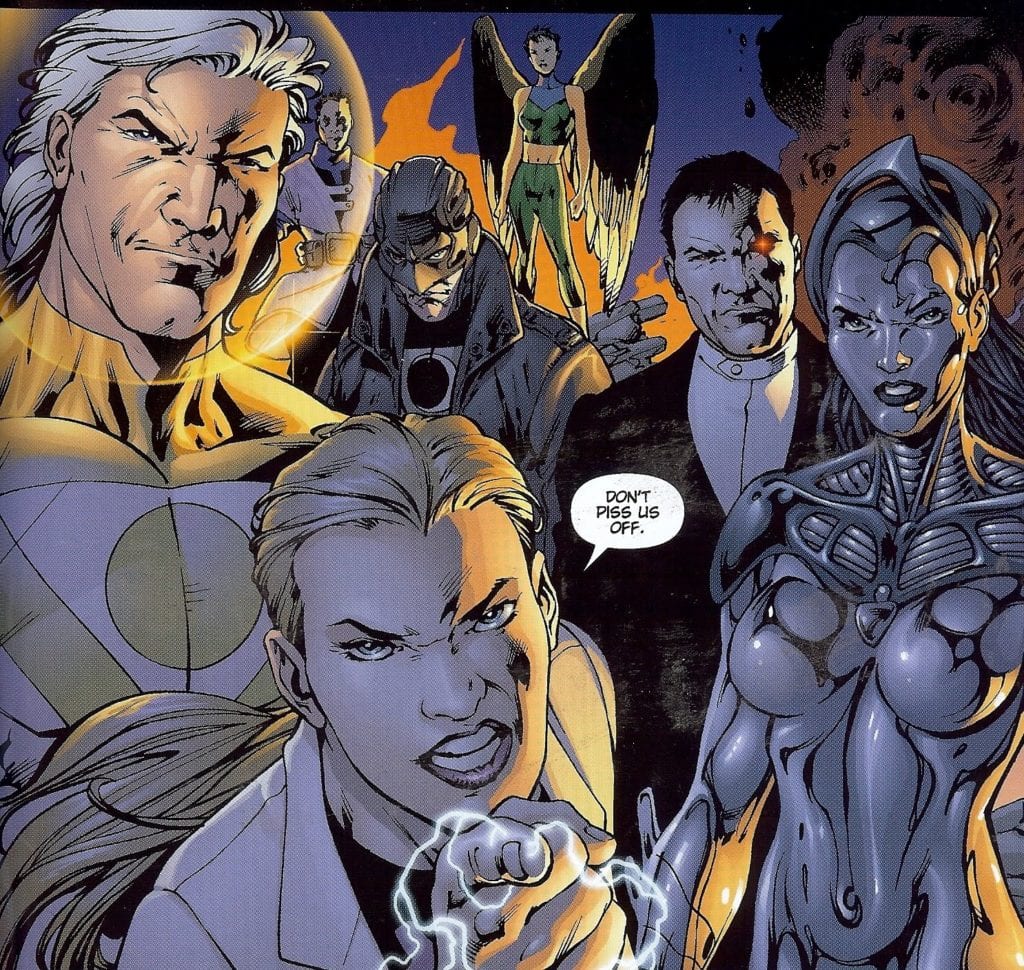
The Authority was originally published on DC’s Wildstorm imprint; an out of continuity publishing imprint that also housed WildC.A.T.S, Stormwatch, Gen13, and Planetary, just to name a few. This separate comic universe was used by writer Warren Ellis and co. as a playground for more serious, intelligent, and more conceivably “real” heroes than their DC counterparts. There’s a heavy integration of sci-fi and political intrigue alongside heightened and mature superhero hijinks that’s typical of Ellis’s creations up to this point. The team itself is made up by leader Jenny Sparks, the 100-year-old and non-aging “Spirit of the 20th century,” Apollo & Midnighter (government superweapons and absolute power couple), The Doctor (who communes with earth’s lifeforce), The Engineer (literally a supercomputer in the shape of a woman), Swift (genius with wings) and Jack Hawksmoor (who talks with cities as living, breathing organisms). Although The Authority takes place after the destruction of much of the original Stormwatch team (sorry, spoilers for that series), Ellis does a great job of ensuring that new readers do not need to have read that or any of the other Wildstorm series’ to enjoy this specific team.

The events of Ellis’ The Authority primarily follows Jenny Sparks’ creation and leadership of the team. It’s difficult to discuss the plot much without digging right into spoilers, but it’s carried by standard mainstream-hero book plot development. Ellis’ wit and intelligence are what sets this series apart, however. Even though the Transmetropolitan writer only built the frame and overall theme or the work, any further brilliance is inspired by the blueprint he set in the first 12 issues. Warren’s constant blend of physical and extra-dimensional science, politics, gallows humor and purposeful brutality aren’t quite as refined as they are in some of his less-mainstream works, but they are still entertaining as hell to take in. Witnessing Midnighter mentally then physically dismantle opponents with his augmented fight senses or reading how their own ship is a 50-mile long semi-sentient vessel floating outside of reality never gets old.

One of the most engaging aspects maintained by Ellis is the chemistry and banter among the team members. Each character is given a distinct voice and personality to such an extent that their quotes could be isolated from imagery and it would still be obvious who said it. From Jenny’s sarcastic leadership bravado, to Apollo’s undying enthusiasm and Angie Spica’s charmed analysis, these characters are never not fun to read. Ellis also knows when and how to change the tone of the team’s banter. Humor is kept in check when a serious turn of events happens, and characters are highly proficient at staying on task during a reality-threatening battle, so the suspension of disbelief that comes with incessant banter is warded off.

Warren Ellis’ vision is brought to life by the immensely talented Bryan Hitch. Hitch’s classical superhero polish brings beautiful mass-carnage and science-fiction detail of Ellis’ imagination to the exact kind of life it should have. The art makes these larger than life heroes interfaceable with the audience by being able to focus on expression and body language in the story’s quiet moments (which don’t happen to often). This is contrasted with Hitch’s ability to plot explosive action scenes on an often-massive scale. Sequences drip with fight choreography, urban destruction and sci-fi hijinks. For every brilliant idea Ellis scripts, Hitch answers in kind with visual work that absolutely nails the material at hand.

Warren Ellis’ The Authority is a high-budget and high-concept universe smashing thrill ride. It’s cast full of likable, unique characters and damnable villains. Its range of conflict and setting is massive and always has a feeling of gravity behind the smart-assery and bravado. The artistic vision of Bryan Hitch is visually stunning and wholly memorable. These first 12-issue that setup The Authority would go on to be continued by the likes of Mark Millar, Frank Quietly, Garth Ennis, Grant Morrison, and others in the spirit of maintaining this concept of science fiction heroes for the 21st century. While each run has its own merits, none can quite reach the heights of Ellis and Hitch’s original series.

Monkeys Fighting Robots Youtube

Kickstarter Spotlight: Stephan Franck Discusses PALOMINO

Kickstarter Spotlight: Stephan Franck's PALOMINO

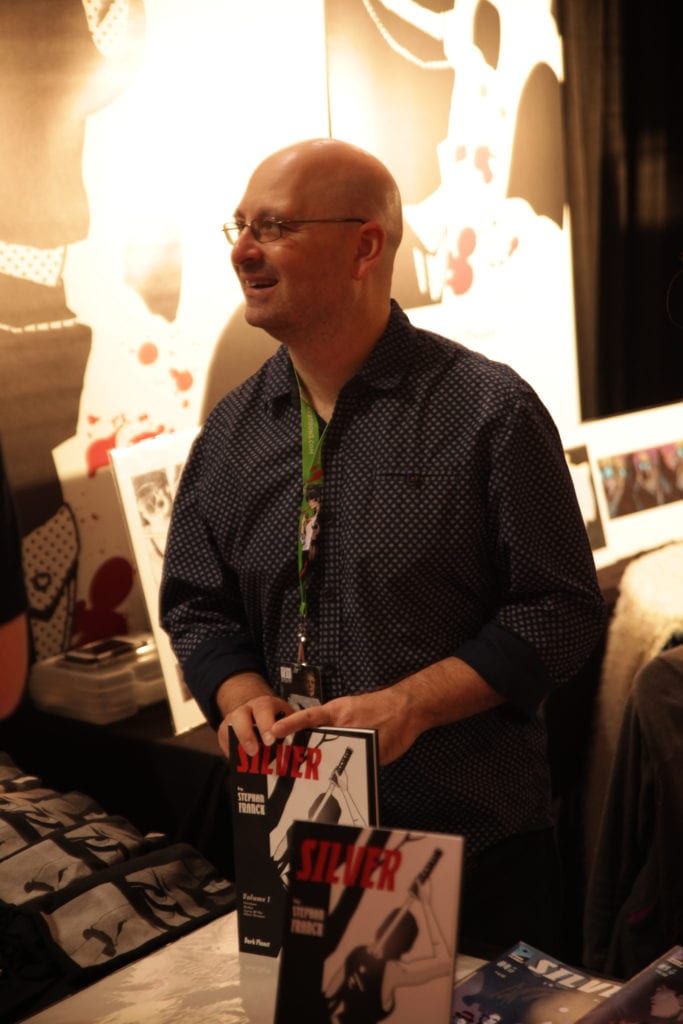
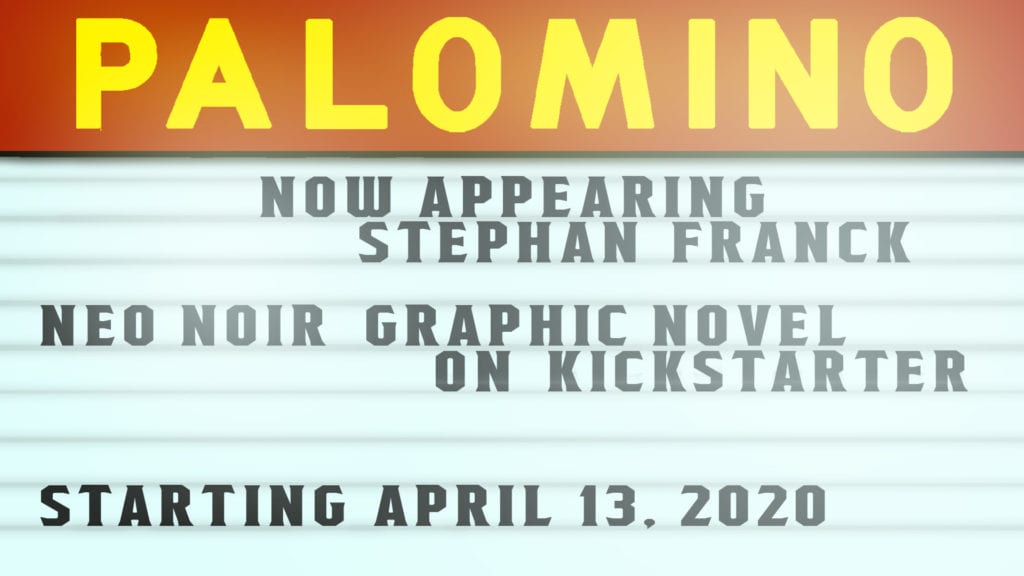
Stephan Franck launched a Kickstarter campaign Monday morning for his latest book, Palomino, and Monkeys Fighting Robots got a chance to talk with Franck about the book.

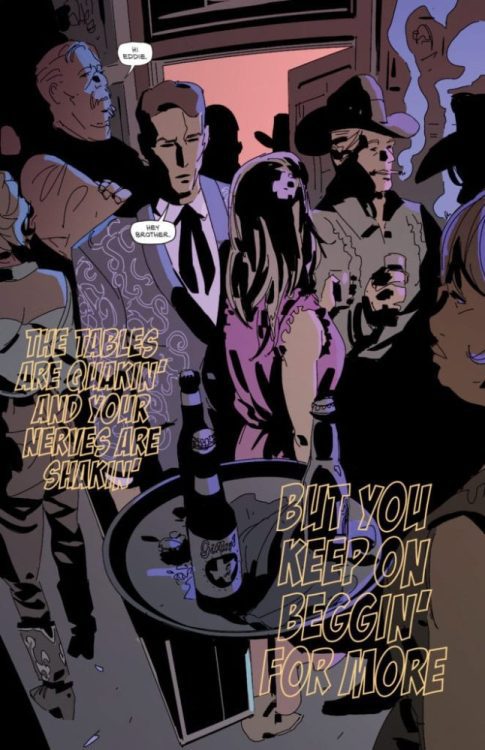
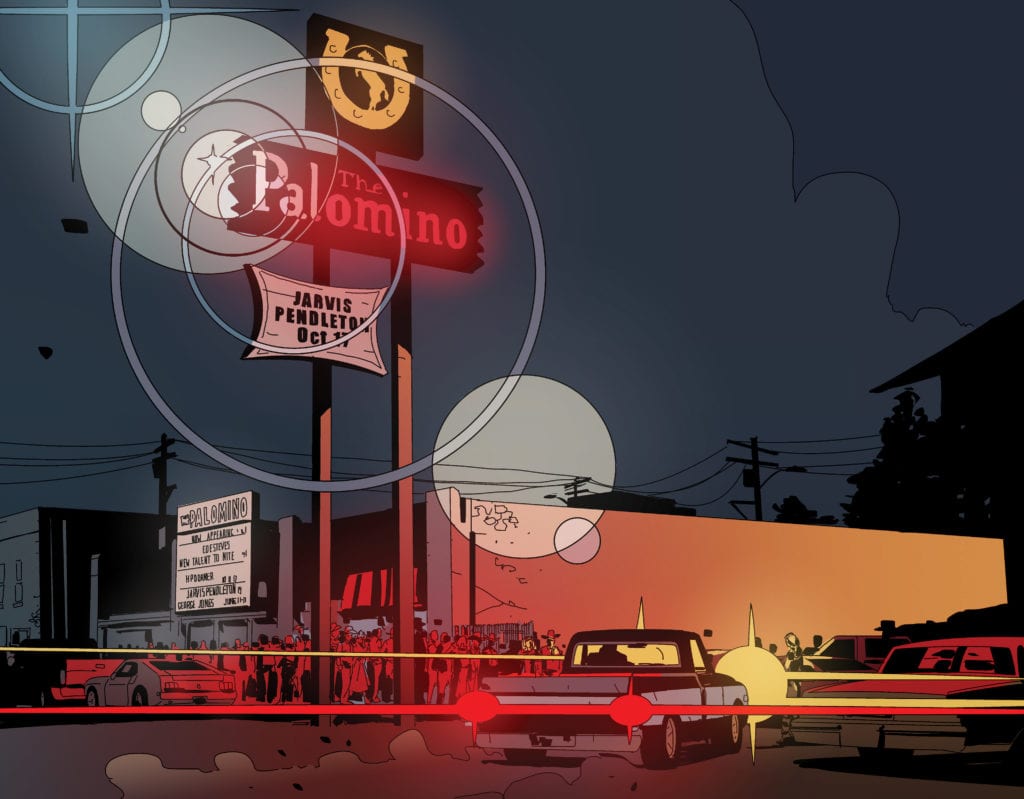
Palomino is a neo-noir graphic novel series, set in the lost culture of Los Angeles’ country music clubs. The age of urban cowboys is in full swing. Cowboy hats and rhinestone suits are all the rage. Kenny Rogers’ “Lady” is Billboard’s number three song of the year. Dolly Parton is a national icon. And across LA, six nights a week, working musicians, TV actors, stuntmen, cops, hustlers, and broken souls all play their part in the cultural myth-making. Most of them are just trying to survive—on the B-side of the City of Angels.

As an animator, Franck has worked on Spider-Man: Into the Spider-Verse and The Iron Giant. He currently is the Head of Animation on Marvel Studios’ WHAT IF? for Disney+.

Palomino is a passion project for Franck, as he is the writer, artist, colorist, letterer, and editor on the series. Enjoy the interview below and check out his Kickstarter campaign here: PALOMINO

Kickstarter Spotlight: Stephan Franck's PALOMINO

MFR: PALOMINO has a great set of compelling characters. Even Larry feels fully fleshed out. Can you talk about your process of building out the universe for PALOMINO?

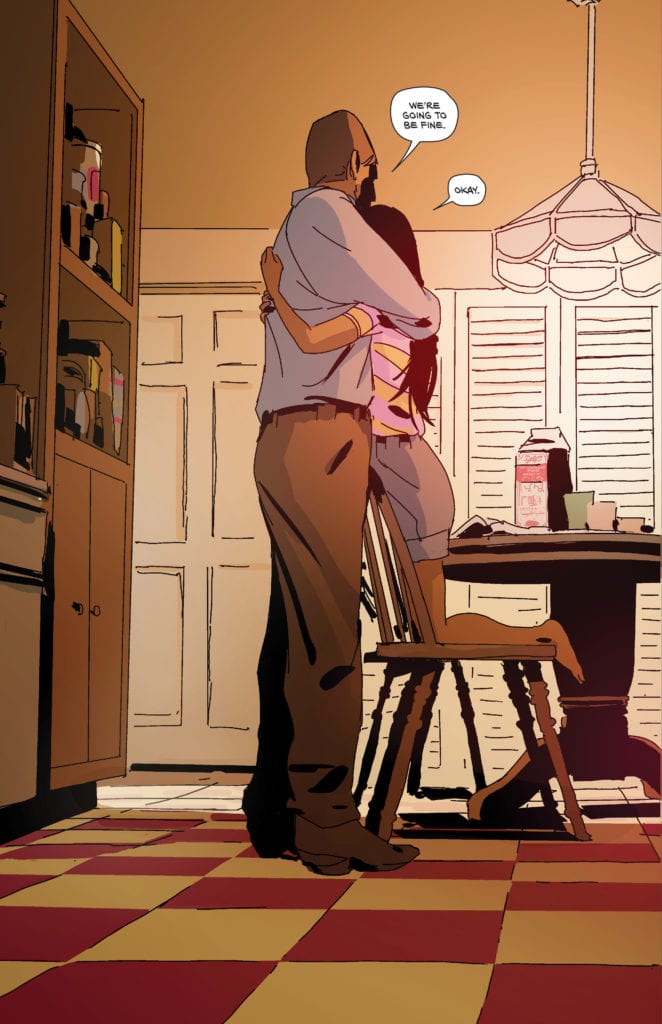
Franck: Thank you for saying that! The most central characters of the story are Eddie and Lisette Lang. Eddie is a classic noir figure–a disgraced cop who is now begrudgingly working as a PI. But there’s a unique twist: Eddie spends his nights as a working musician playing the pedal steel guitar in LA’s 1981 country music clubs. Most importantly, he is also full-time father to Lisette, his rebellious teenage daughter who is quite the hard-boiled chip off the old block herself. There is a profound and unbreakable bond between them, and the dry sense of humor that they share is hilarious and endearing, however, they are in a broken place. They are stuck under the shadow of a tragedy that befell their family, and they’re running out of chances to get their lives back on track.

As a father of two daughters myself, their relationship was my way into the story. They gave me a chance to take iconic characters and turn them into real people and to lead the reader into their world and their unique subculture and time period in an honest and authentic way. Then I started to populate the story around them.

I like to think of LA as a place that, on the surface, almost seems to be standing still, but where, in reality, everybody has ten different hustles and a million things going on. That’s the way I approached all the characters in PALOMINO. In fact, I went through the process of writing their sides of the whole story separately, almost like autonomous yet interconnected segments in an Altman movie. Of course, here, it is told as one linear story, but it’s infused with the various points of view of the people who lived it, in a way that celebrates their humanity–even the ones who are terrible humans, like Larry. They all bring their slice of life to the presentation of the story.

Kickstarter Spotlight: Stephan Franck's PALOMINO

MFR: PALOMINO is an intimate book; the reader has a very voyeuristic point of view. As the artist, can you talk about the camera angles you used and how they emotionally connect the reader?

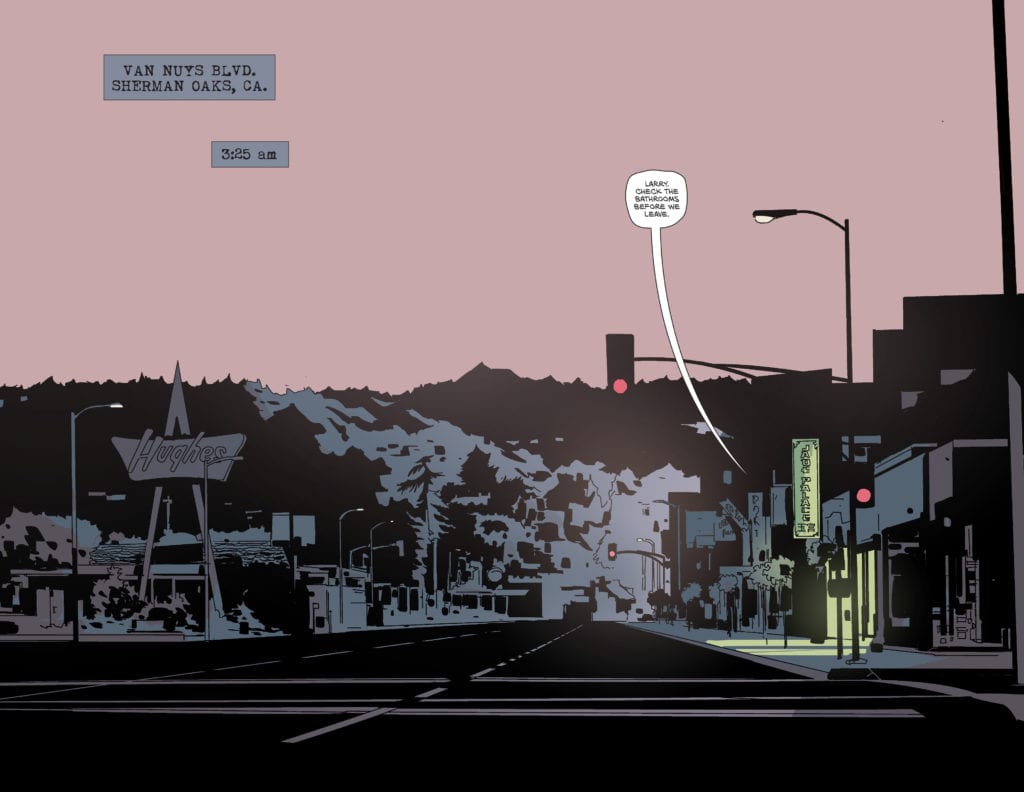
Franck: The storytelling in my comics is always informed by my work as a filmmaker, and I always think in terms of film language, which I try to combine with a sense of graphic design to make each page visually unique and unmistakably a comic book page. But the point of the cinematic approach is to deliver the moments as strongly as possible. It’s about clarity but also how something reads on an emotional and sometimes a visceral level. That’s why my panels typically “cut like a movie,” not in the sense that every panel is drawn in a film format– they’re not. But the camera, the POV, is an active participant in the creation of the moment and its attribution to a specific character’s experience.

SILVER, my previous series, was a more theatrical expressionist extravaganza, in which things emerged super dramatically from the darkness of black ink. But PALOMINO is fully lit by the California sun and sitting in plain view. Also, “Life in LA” in general has a certain feel, vibe, and pace, and I wanted the story to feel both lived-in and specific with its sense of time and place. For those reasons, I made the choice to lean on my filmmaking and animation background to build all the story’s important sets in CG. I was able not only to maintain consistency and specificity, but also to scout the locations to find unexpected angles and points of view that put the reader at the heart of it beyond what I could simply imagine.

This filmmaking-inspired approach was also helpful in having the ability to find compelling drama in small intimate moments, like a conversation in a tiny ranch-style house kitchen. Once the set is solid, you have a stage to block out your characters’ acting performance through the sequence. The space and their relationship to it becomes an active participant in the story.

For a double dose of geeking out, I would add two things: One, that all the CG is shot with a 2.4:1 anamorphic lens, which really gives you that 70’s cinema feel, and anchors the look of the period. Two, I am obsessed with translating photographic processes into graphic art, and seamlessly transforming CGI reference into a tasteful hand-drawn visual style, so that the various components never clash in a way that would hurt the esthetic or the storytelling.

Kickstarter Spotlight: Stephan Franck's PALOMINO

MFR: Four graphic novels is ambitious, and your audience is flooded with entertainment choices. How much pressure do you put on yourself to hook the reader with the first book?

Franck: The things that hook the reader are the same things that keep me motivated as the author/artist as I see the pages come together. I may be drawn into the series because of a certain attraction to genre or locale, but very quickly, it becomes about answering these basic questions–Do I like these characters? Do they feel like actual people to me? Am I believing their world, their lives, and do I care about their predicament? Most importantly, am I entertained by their unique way of going about things, and am I anxious to see what they’ll do next and spend more time with them? If the answer to those questions is YES–in other words, if my people become your people–then I know the reader will sign on to the adventure.

Kickstarter Spotlight: Stephan Franck's PALOMINO

MFR: How will the events of COVID-19 influence your writing moving forward?

Franck: This pandemic is only the latest event contributing to a feeling I’ve had since 9/11, which is that we are living in a time where day after day, truth is becoming stranger than fiction. Which poses an obvious challenge to writing fiction. So the fear that real life (or reality shows, for that matter), will upstage fictional storytelling is something that I’ve been thinking about for most of my career.

But I’ve come to the conclusion that past the fun and spectacle, the ultimate appeal of fiction is internal. It is the human condition, which, as one of the characters in Palomino says, hasn’t changed in 5000 years. So that’s the big secret–unlike other narratives, fiction doesn’t make you feel dirty in the end. Even when telling the stories of bad people, fiction opens a window on the moral universe, and puts things in their correct place within it. I think that’s our beat.

Kickstarter Spotlight: Stephan Franck's PALOMINO


What did you think of Franck’s comments? Give your thoughts below.

Monkeys Fighting Robots Youtube

INTERVIEW: Composer Thomas Roussel On Making The Music For Jumbo

Jumbo made its cinematic debut at Sundance in January from director Zoé Wittock (Red 2) and centers around a love story of sorts at an amusement park. Composer Thomas Roussel (Les aventures de Bill Billard, Rick et du troisième compagnon) weaves a melodic score into the fabric of Jumbo’s vibrant setting.

Noémie Merlant (Portrait of a Lady on Fire)plays Jeanne Tantois, the janitor of an amusement park. At the heart of this sea of lights and candy is Jumbo, a Ferris wheel. Jeanne and Jumbo start to form a bond that strengthens as the film plays out. From there, things get interesting, including oil slicks with deeper meanings. While it all might sound a little surreal, there’s no doubt the film was inspired by real-life people who fell in love with non-living things.

PopAxiom spoke with Thomas Roussel about his road to making music for film and television, coming to terms with the music that inspires him, and making Jumbo.

Violin, Piano, And Techno

Born in France, Thomas started learning about music from an early age: “… three years old.” It started thanks to “… my father, who taught me music.” Later, Thomas “… studied the violin and piano.”

Not too long after the lessons began, Thomas started “… to compose … around eight years old.”

Thomas’ musical cues blend several styles. “During the 90s, I grew up with the birth of techno music, and it’s very natural for me now to mix my different influences …”

jumbo-interview-thomas roussel

About Jumbo

Thomas and Zoé Wittock have been friends for nearly a decade. “She told me about her first movie eight years ago when we met on a train during Cannes. Since then, we’ve been good friends, and she knew I’d be there for her movie.”

Thomas explains the journey to making the score for Jumbo. “You have a lot of different emotions in this story: love, hate, dreams, arguments, moments of strong discomfort. So, we wanted to illustrate all of this in the music. For me, it was exciting to compose because there are so many different kinds of emotions.”

Thomas proposed a “… unique sound … strong and deep analog sounds for Jumbo’s character and soft, delicate strings with metallic sounds … for Jeanne’s character.” To take Jeanne’s themes into unique places, Thomas “… recorded a Cristal Baschet and an aluphone.”

The process of making a Ferris wheel feel through score wasn’t easy, but that’s part of the fun of being a composer. “… we tried different options, but I finally decided to be on the edge of sound design and music. Jumbo is very deep in the basses, with analog keyboards. Then the sound designer did a great job too to make him ‘speak!’”

Making Music

Connecting to a story is a vital part of the creative process for Thomas. “I try to say yes to a project only when I know that I’ll be able to be sincere.”

Additionally, Thomas loves to explore sounds. “I also try to keep a very good loop of production, with good musicians, orchestras, new instruments.”

What do you think is the ratio of “rough draft” music that doesn’t get used to the final score?

Composers typically create a lot of music for a film or television series. How much is generally left over? Thomas explains, “… the director has the final cut, it’s his/her movie. I would say that twenty percent is unused in the end.”

The essential nature of connecting to a story is no better stated than when Thomas, a composer, says, “… sometimes, silence is better than music for a scene.”

Wrapping Up

Thomas’ musical influences blend classic and techno. What inspires the composer and makes up his creative DNA? “… it’s very generational. I grew up with all the fantastic John Williams soundtracks and studied classical composition/orchestration. So when I started to compose 20 years ago, it was trying to sound like him.”

Time and experience breed wisdom. “But today I’ve accepted that I was also a kid from the 90s, with all the techno music, Daft Punk, Jeff Mills, and now, also with my solo project Prequell.

Blending such distinct styles wasn’t easy, but Thomas says, “I am more at peace with my two worlds — orchestral and electronic music — living together.”

In the age of remakes, what would Thomas love to be a part of? “It’s not totally a remake, but since I was a child, my dream is to compose for a James Bond film!”

What’s coming next from Thomas? A new Prequell album. I’ll record with the LSO soon at Abbey Road studio.”

Is Jumbo on your watch-list?

Want to read more interviews like this? CLICK HERE.

Monkeys Fighting Robots Youtube

Review: PINK LEMONADE #2 Is The Comic Book Thirst Quencher We Need

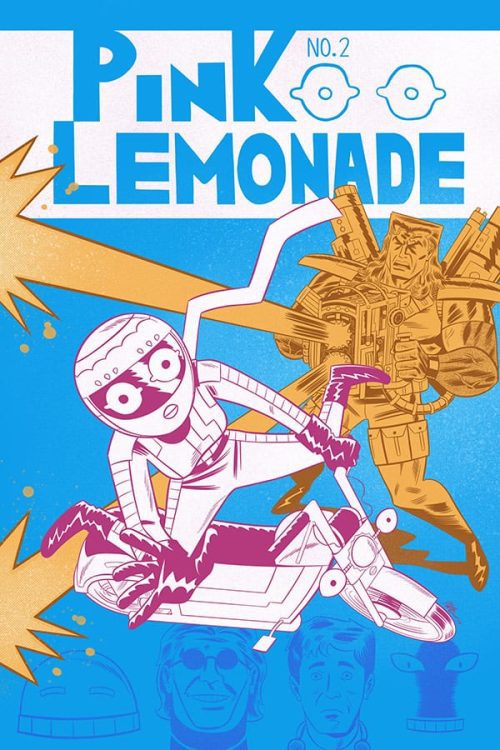
Pink Lemonade #2 by creator Nick Cagnetti and indie publisher It’s Alive! continues to deliver a vibrant, fun, gorgeous and energetic comic that is a love letter to the entire medium.

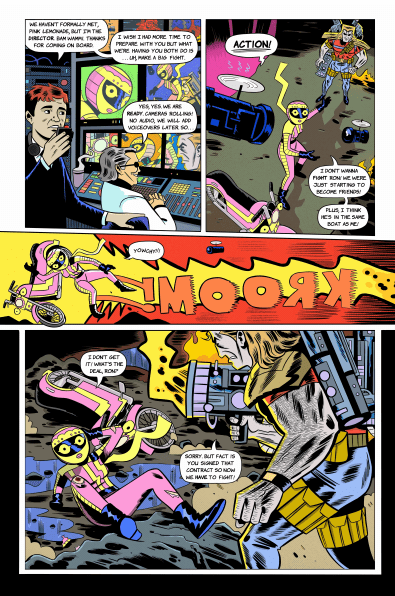
When footage of Pink Lemonade’s splashy balloon rescue stunt on a movie set gets leaked internally by hotshot movie producer Zavi Xarad, the public’s interest is piqued! They think Pink Lemonade is a new character in the new Ron Radical movie being filmed! Meanwhile, while attempting to bring back the original OJ-BOT, Pink Lemonade is tricked into signing a contract to co-star in a film with Ron Radical. Later, on the set of the new film, when the director yells action, Ron begins blasting Pink Lemonade. When she refuses to fight, Barzibelly Jr. (the strange being seen in her visions back in issue one) gives her control over what happens next in the film… and you don’t wanna miss what happens next!

Pink Lemonade #2
‘Behind The Curtain’
Written, drawn, colored, inked and lettered by: Nick Cagnetti
Ron Radical co-created by: Tristen Bagnall

‘Free Day’
Written and Colored by: Nick Cagnetti
Art by: Don Simpson
Published by: It’s Alive!

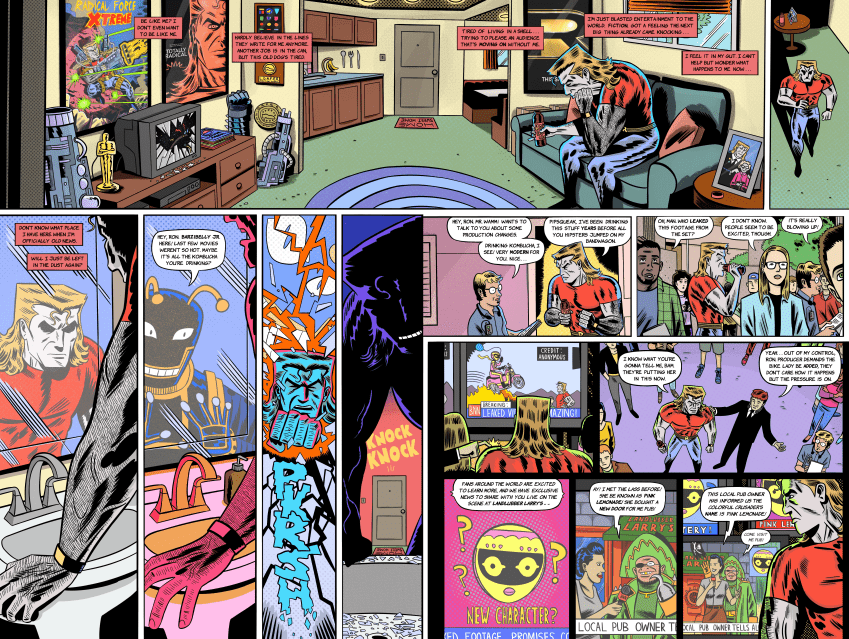
After a first issue that introduced a core concept and cast of characters, Pink Lemonade #2 jumps right into its story, with a particular focus on Ron Radical, the 90s comic character ‘parody’ we met in issue #1. Ron is the star of his own movie franchise, but we learn early on he is in the midst of an existential crisis about his identity. He narrates he has “lost his desire to please an audience that has moved on without me”. But producer Zavi Xarad (this comic is filled with great names like that!) has other plans and unbeknownst to the crew and stars, Xarad is under the thumb ff the Kirbyesque ‘villain’ Barzibelly Jr. Barzibelly wants to force the production into an endless fight between Pink Lemonade and Ron.  He almost succeeds, until Pink’s goodness and pureness affects Ron and unveils a softer, creative side the pumped-up hero. It seems Ron Radical likes to paint and he does so in the middle of a comic book fight. The whole issue basically revolves around Ron and in doing so he goes from a parody to celebration of 90s comics. It’s a great subtle move that continues to show how this comic is all about the love for comics.Pink Lemonade

The art in this book is just phenomenal. It’s vibrant, colorful and full of energy. The linework is crisp and clean, invoking a silver-age aesthetic with a modern sheen. It’s also fantastically designed and has amazing layouts. This book is also heavily influenced by Jack Kirby and Mike Allred and you would be hard-pressed to find a better combination of influences for a book like this. Just look at the pages included in this review and they literally will speak for themselves. It’s the kind of art you can just take in an absorb.

Pink Lemonade
Page from Pink Lemonade #2

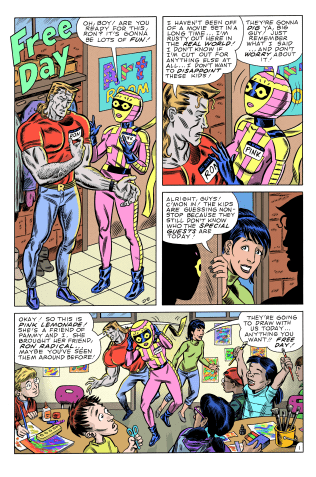
The back-up story, ‘Free Day’ also works as a great epilogue and features art by the great Don Simpson (Megaton Man). Seeing Simpson’s art on pages is always welcome and was a great surprise in the end.

Pink Lemonade
‘Free Day’ art by Don Simpson

You definitely need to grab Pink Lemonade #2 if you can. In this drought of new comics we are having during the current crisis, it’s the best comic book thirst quencher you will find. You can grab it from It’s Alive! Comics directly and if you mention your local comic shop at checkout, It’s Alive will give 50% of the proceeds to your shop! Just another reason to love this comic!


Monkeys Fighting Robots Youtube

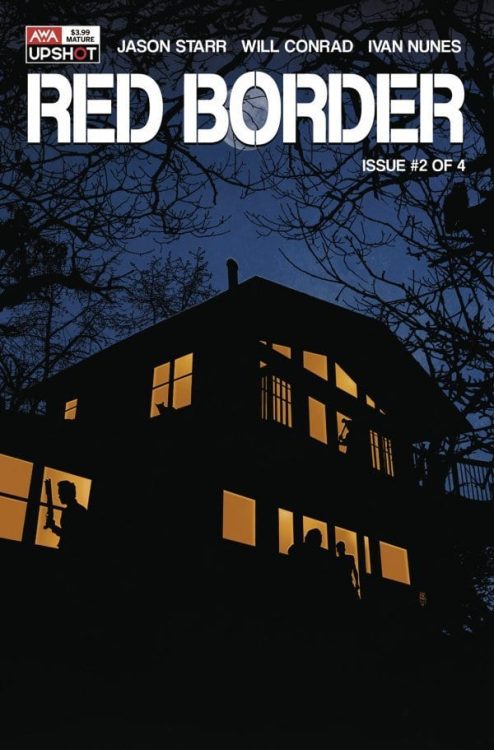
Review: Hospitality Turns to Horror in RED BORDER #2

Writer Jason Starr and artist Will Conrad return with the chilling second issue of their social thriller comic “Red Border,” with colors from Ivan Nunes and lettering by Sal Cipriano. This issue digs its heels a bit harder into its socio-politically divisive setting, and while its handling of such issues is a bit clumsy, its saved by taut pacing and stellar visual direction.

“A young Mexican couple narrowly escapes the Juarez Cartel by fleeing across the border into Texas, only to be run down in the desert by the Cartel’s most brutal thugs. Rescued by a mysterious local who takes them to the safety of his family’s ranch, the couple soon realize they are trapped in a house of horrors beyond their wildest imagination, and the army of assassins on their trail might be the least of their problems.”

Writing & Plot

Writer Jason Starr takes the unique put potentially controversial premise set in the first issue and drives hard at the socio-political issues this comic brings up. Immigration and border politics are still a hot-button issue, and any discussion about such an issue, even in the service of entertainment, requires complex levels of nuance to handle it appropriately. As such, it’s a bit odd that Starr has chosen to offer bits of commentary that end up validating the beliefs of his own uneducated psychopaths. While the protagonists obviously represent just the average Mexican citizen, the use of stereotypical drug cartel types ends up echoing the twisted perspective of the comic’s Texan uber-patriotic murderers. Outside of this bit of fumbling though, there’s still a show of writing chops in the form of tight pacing and naturalistic dialogue. The increasing unease as the protagonists learn of their Texan savior’s true intentions creates palpable tension. Each character has their own distinct voice within the story, and the relationships between the two protagonists is a solid source of characterization to make the pair more relatable as people. While the mishandling of the political aspects is a concern, there’s still a solid thriller to be had here.

Art Direction

The near-cinematic artwork of artist Will Conrad and colorist Ivan Nunes makes “Red Border” #2 an easy comic to interface with in terms of its pacing and characterization. Conrad’s lines are crisp and offer intricate detail in every aspect of the book, from character animations to environments and even the creases in an individual’s clothing. The inks and colors give dimension to an arid south-Texas landscape and its characters with a visual approach that borders on digital near-realism. It’s a look that truly only suits certain comics, so it’s fortunate that the style works so brilliantly here.

“Red Border” #2 is a tense second chapter to this thriller mini-series. Jason Starr’s script offers somewhat dodgy handling of a complex social problem but makes up for it with tension-rich pacing and a gruesome last page discovery. Will Conrad and Ivan Nunes’ visual work is gorgeous and crisp in a way that offers a cinematic styling to the exact kind of comic that benefits from such a look. If this sort of unique and complex thriller is your cup of tea, head over to webtoons.com to read this and other great projects from AWA Studios for free right now!

Monkeys Fighting Robots Youtube

JUSTICE LEAGUE INTERNATIONAL: Bravely Going Where We’ve Been Before

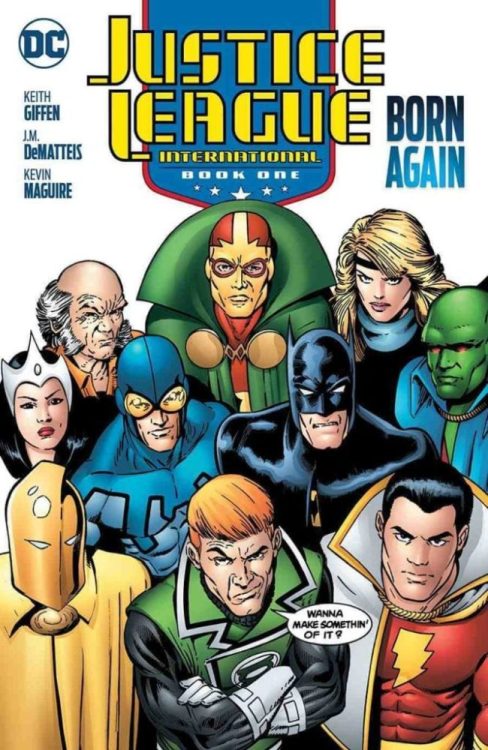
Justice League International Giffen

There is so much to love about the Justice League International series from 1987. Writers Keith Giffen and J.M. DeMatteis keep us readers on our toes from issue 1 to issue 60 by doing something simple and innovative: repeating the past. A year after Watchmen and The Dark Knight Returns rocked the comics world, “grit” and “gravitas” were the buzzwords of 1987. Yet Giffen and DeMatteis, with the help of brilliant artist Kevin Maguire, made their Justice League straight up hokey.

Comedy from the History Vaults

The whole of JLI is riotously funny, and all the jokes are things we’ve seen before. Instead of moving on from the storytelling missteps from early comics, Giffen and DeMatteis give readers a highlight reel of all the big industry blunders. They show a sincere appreciation of old comics, while also showing that they understand what makes old comics dated. From on-the-nose thought bubbles to cash-grabbing cliffhangers, this creative team relives comic book history to mine it for comedy gold.

Villains like Manga Khan, the gold-plated space tyrant, speak to themselves in eloquent soliloquies. We later learn that this is because he’s off his meds. He even opens up a drama school to teach others to be stereotypical supervillains who can’t shut up. Other villains are as ineffectual as ever, with a self-esteem and bank account to match. Meanwhile, the big-time superheroes are all too fast to take themselves seriously. You find yourself audibly sighing when Superman shows up, hoping we can get back to Rocket Red.

From JUSTICE LEAGUE AMERICA #48

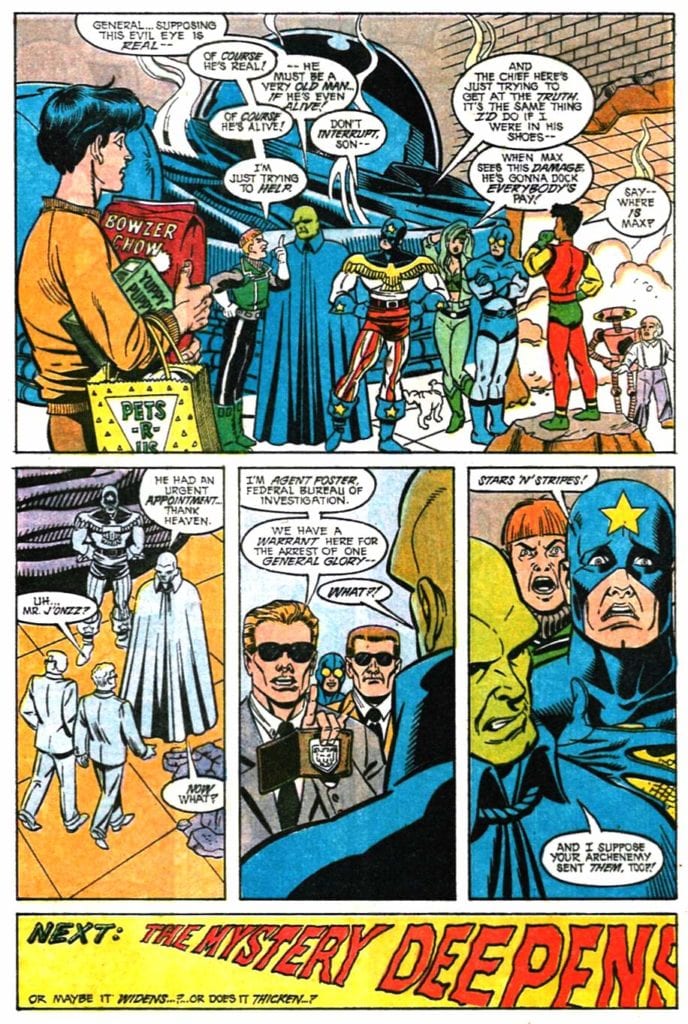
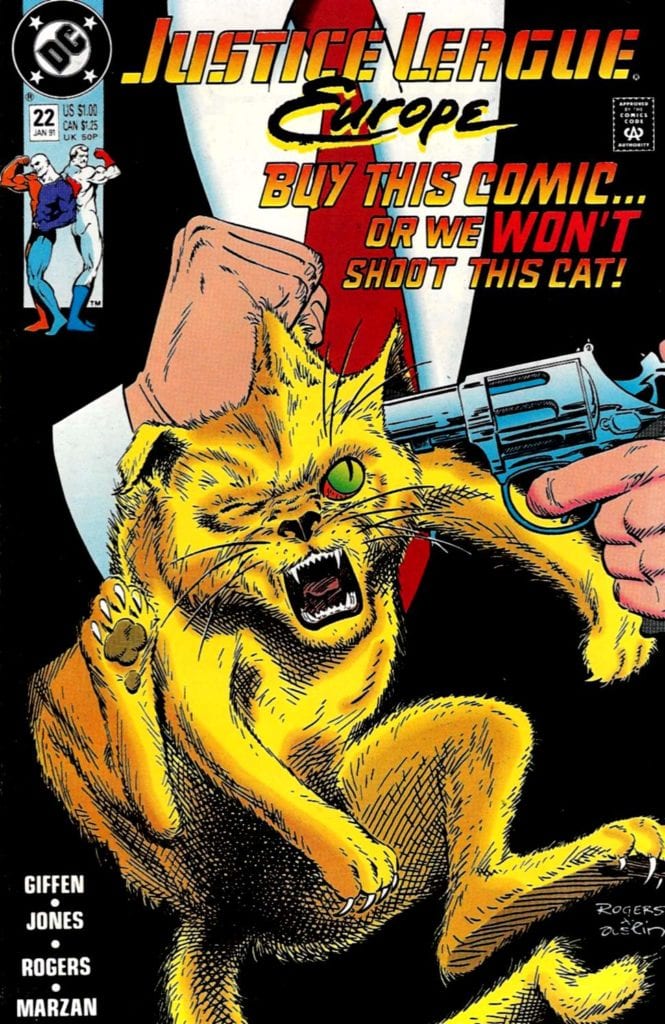
Issues end with stereotypical cliffhangers, followed by the usual press for the next issue, with a wink. One issue finishes saying: “NEXT: The Mystery Deepens… or maybe it widens…?… or does it thicken…?” So whether it’s Guy Gardner getting punched out by Batman, or Martian Manhunter’s growing addiction to Oreos, the series refuses to take itself seriously. Giffen and DeMatteis’ use of the comic industry’s rich, ridiculous history, with the occasional confession that they want your money, is the kind of fourth wall breaking that gives this series its charm.

The Faces of Justice League International

With a league that’s constantly quibbling, and too busy fighting each other to be a threat to any real enemies, it’s more like watching Seinfeld than reading Justice League. But it’s between the jokes, and often because of them, that this creative team accomplishes something brilliant. Somewhere along the line, these characters come down off the pedestal. Booster’s transparent selfishness and Blue Beetle’s struggles with his weight feel familiar. We are watching the lives of real people unfold. Half of them don’t even have any superpowers, for Pete’s sake.

And here’s where Kevin Maguire comes in. Maguire’s contorted faces look like pictures taken when the heroes weren’t ready. The stoicism is peeled back in favor of awkwardness. Because that’s always something we can relate to. And so gradually we become aware of the fact that we’re not dealing with heavy-hitters here. These are the outsiders, and each issue reminds us why. But they’re all desperately trying to prove everybody wrong and show that they’re worth something.

The cover of JUSTICE LEAGUE EUROPE #22, hilariously parodying the famous “National Lampoon’s” cover that said “If You Don’t Buy This Magazine, We’ll Kill This Dog.”

If you’re looking for the best version of the Justice League, look no further than the Justice League International run from 1987. In a time when serious stories were the way of the future, this creative team dug their heels in. They went for the hokey, funny, loveable tone of times gone by, and it all worked because they’d end with a wink. Giffen, DeMatteis, and Maguire gave us a team we could relate to. All in all, this Justice League is the last team you call in times of trouble, and the first you call to grab a beer.

Monkeys Fighting Robots Youtube