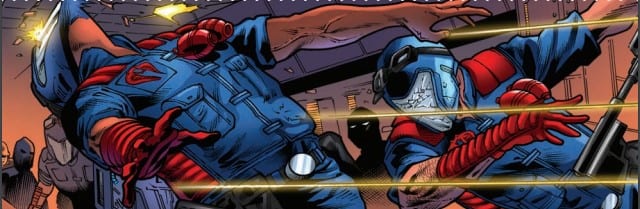
GI JOE #272, available now from IDW Publishing, finds the Joes — and a few COBRA Agents — coming together to rescue Snake Eyes from Cobra Commander and Dr. Mindbender. Larry Hama’s Avengers: Endgame-esque story calls on nearly every Joe imaginable, against the orders of their superiors, to save one of their own in a setup for the epic showdown.
Cover Art
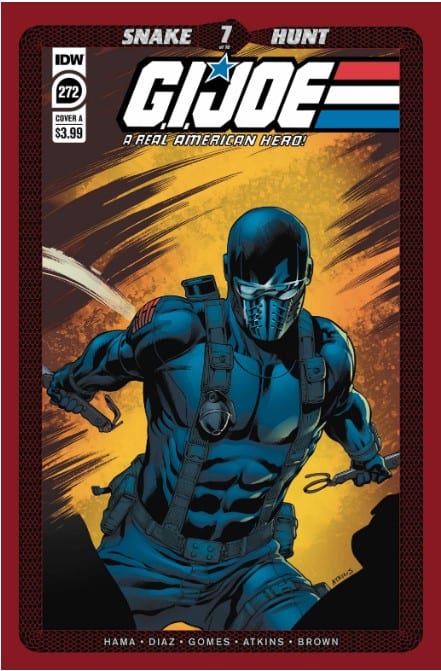
Brian Atkins’ cover looks right at home from the Hasbro action-figure toy packaging when the cartoon was relaunched in 1983. Snake Eyes is charging into action in a momentum-filled pose. The colors are appropriately bright and patriotic with the right amount of fiery background texture.
Writing
Larry Hama’s story is not so much a complete story, but rather an action-filled prelude to something bigger. It’s a collection of smaller vignettes where you learn the Joes have gone rogue to rescue Snake Eyes on their own time. Several COBRA enemies, including Destro and Zartan, have joined the Joes in opposition to Cobra Commander’s plan. Meanwhile, Snake Eyes uses every ninja trick at his disposal to escape before brainwashing can begin.
You get the distinct impression Hama is pulling out every character and settling every score to set up an all out war in Springfield. I referenced Avengers: Endgame in the introduction, and that’s exactly the vibe Hama creates by the end of the issue. The only thing missing was Duke standing in front of the eclectic army, ready for battle, and shouting “Yo, Joe!”
Pencils/Inks
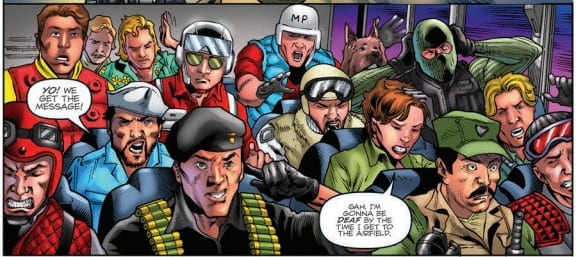
Thiago Gomes and Brian Atkins admirably succeed in the artwork for one reason above all others: there are so many characters! Not just a few key characters with crowds in the background. We’re talking about nearly every human Joe created since 1983 plus one dog and one eagle. Each character had to be drawn with their own unique costume. Ever panel had a different character saying at least one line that reflected their personality. It’s really quite astounding.
In addition to the sheer volume of diverse art Gomes and Atkins completed, the quality of the fight scenes, mostly involving Snake Eyes, didn’t suffer in any way. Snake Eyes’ action is stealthy when possible, brutal when necessary. Every Snake eyes panel puts him in a pose that’s as graceful as it is powerful. By the end of the issue, you’ll be wondering if Snake Eyes will actually need rescuing.
Coloring
J. Brown’s colors stand out for pure boldness. When drawing so many characters, a drab pallet would wash out the distinction between each Joe. To keep the characters separate and popping off the page, when they’re so crowded into each panel, the colors make all the difference.
Lettering
This issue is almost non-stop movement. The Joes are gathering. They’re meeting at rendezvous points, traveling incognito to make ready, and they’re getting into some hi-jinks with civilians along the way. Neil Uyetake’s lettering works well to keep the reader’s eye moving from panel to panel at break neck speed while still absorbing the dialog to understand what’s going on. The word balloons never crowd out the art; which is a tall order since every square inch of panel is used to render the literal army of characters.
Conclusion
GI JOE #272 is a massive buildup that promises an epic showdown with COBRA. The art team pulled off a minor miracle with the sheer volume of character work, and Hama’s story sets up a cinematic battle in the next issue. Perfect reading for every Joe fan.
KILLING RED SONJA #2, available now from Dynamite, finds Prince Cyril’s vengeance quest interrupted by hungry giants and foiled by bad intel. Writers Mark Russell and Bryce Ingman work with artist Craig Rousseau to continue the the young prince’s naive adventure and introduces an unexpected enemy.
How did we get here?
Prince Cyril’s adventure picks up immediately where issue #1 left off. (You can read our review of issue #1 here.) The group is overrun by man-eating giants, and the lack of confidence in the Prince’s leadership turns into a subtle mutiny. Meanwhile, a new enemy appears headed for a collision with the Prince’s return path home.
Cover Art
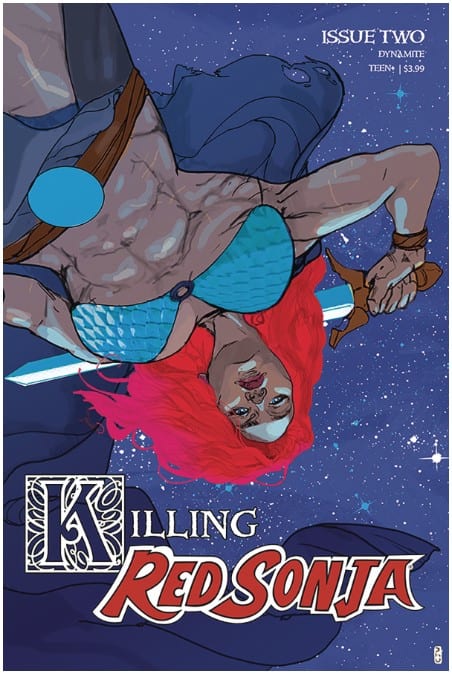
Christian Ward’s cover portrays the red-haired warrior in all her glory, looking down on you as though you were her latest victim of battle. It’s a unique perspective angle that doesn’t come across as distorted in any way. Ward’s color schemes matches perfectly with the interiors, and Red Sonja’s pose is both cavalier and formidable.
Writing
Russell and Ingman’s story continues the story of a boy-emperor who’s set out on an adventure that’s well over his head. The difference in this second issue of the arc is a little of the naivete from Prince Cyril has melted away. Not quite to the point of becoming an adult, but certainly waking him up to the fact that this mission is very dangerous. Death comes unexpectedly in this issue, and Prince Cyril is forced to confront reality very quickly.
Russell and Ingman infuse the characters, including Prince Cyril, with a lot of sincerity about their motivations and objectives. That sincerity gives each character a unique voice that strongly plays up the believability of the group.
Pencils/Inks
Craig Rousseau’s art is a little more defined here than last issue. Faces are clear and expressive when needed. Rousseau’s movement and action panels are deceptively realistic, and the character anatomy, especially for the giants, is surprisingly believable. The storybook simplicity of the art style works, again, to give the entire issue a vague semblance to a children’s book, and I suspect the increase in detail is partly intended to match the progression of Prince Cyril’s maturity. If not, it’s a happy accident to the issue’s benefit.
Coloring
Dearbhla Kelly’s coloring is given a little more to work with in this issue. There are a few sub-plot scenery changes where Kelly makes good use of filtering to denote the scene change. Also, the appearance of the the Bird Overlord and her many birds gives Kelly some more room to play with a wide arrange of plumage colors that stand out against the semi-barren landscapes. Great work here by Kelly.
Lettering
Hassan Otsmane-Elhaou stands out with his choice of tail designs. A typical word balloon has a simple triangular shaped tail directed at the speaker so you know which character said what. Here, Otsmane-Elhaou wisely uses rough, crayon-like strokes for a tail, further enhancing the storybook aesthetic of the issue. It’s a strong example of lettering that elevates the art rather than simply having words strategically slapped on the page.
Conclusion
KILLING RED SONJA #2 is a well-constructed chapter in the series that shows the characters evolving along with the quality of the art. It may seem odd to have a Red Sonja series without Red Sonja, but it’s keeping my attention…for now. Give it a try.
VENGEANCE OF VAMPIRELLA #8, available now from Dynamite, has Vampirella fighting for her life to get past Danse Macabre’s defenses and unlock their secret weapon. Thomas Sniegoski’s next chapter, combined with Michael Sta. Maria’s artwork, is filled with bloody action, snappy dialog, and a reveal that promises a turning of the tide in the war against Hell.
Cover Art
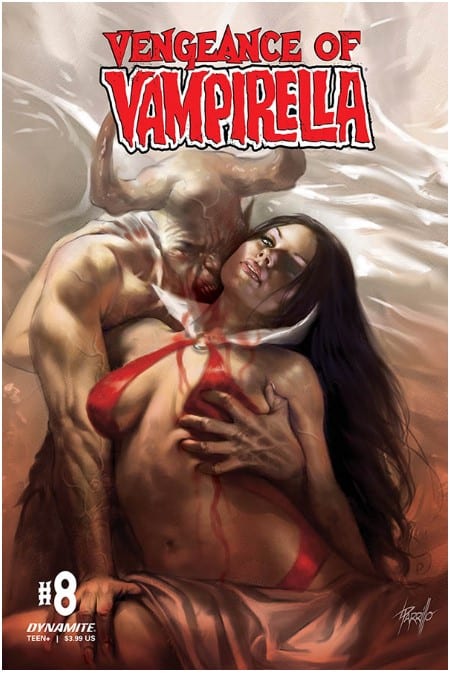
Lucio Parrillo’s cover art is nothing short of masterful. The soft lighting gives the scene a dreamy quality, and the demon’s rough embrace is both horrific and sensual. Parrillo is the go-to artist for many Dynamite titles exactly because he delivers such high quality paintings.
Writing
I can honestly say I never expected a hellhound to be witty.
Thomas Sniegoski kept the action and forward progress of the story with this issue and successfully added a touch of humor. When Vampirella learns the painful consequences of not being on “the list” to enter Danse Macabre’s lair, Balthazar the Hellhound is tasked with being the world’s most terrifying bouncer. Their banter, both during and after their fight, was laced with dry humor that I enjoyed quite a bit. Meanwhile, Nyx reveals the plan she’s been hatching for control of Earth since before cutting ties with her demon overlords.
This is a strong setup issue where the forces of good and evil begin marshaling their forces for the big showdown. Vampirella assembles the team of Danse Macabre agents, both old and new. Nyx sends her lieutenants to gather their evil brethren into an army. Sniegoski does an excellent job lining up the players with their respective teams and building anticipation for the coming war.
Pencils/Inks
Michael Sta. Maria’s art is consistently good throughout this arc. The amount of explosive action is turned up from prior issues with several full tier panels showcasing magical blasts, alien spells, and the gory destruction of the demon portal. Sta. Maria’s most impressive art in this issue is the fight scene between Vampirella and Balthazar. The fight scene panels are brimming with urgent perspective and power poses. You can feel the impact of every blow.
In addition, the drawing detail is much more refined than prior issues. You can see the quality of Sta. Maria’s precision rising with each new issue. The art in this issue reminds me of the best, earliest books Image produced when they first launched.
Favorite Panel/Page: Speaking of the hellhound battle, the favorite image is the full page panel of Vampirella landing a solid blow on Balthazar on page 11. The action lines are drawn perfectly, and Vampirella’s delivery pose is as graceful as it is deadly.
Coloring
Omi Remalante Jr’s coloring stands out in this issue for the background colors. The backgrounds are never really meant to be the focal point, but Ramalante Jr’s colors in the sunset and dusk gradients of the sky on several pages actually tie multiple scenes together to give the reader a sense of shared time. It seems obvious to say two or three scenes happening at the same time would have similar color schemes for the environment, but it’s another to see it executed so well when another colorist wouldn’t bother with that detail.
Lettering
Troy Peteri’s lettering is well executed here. As mentioned before, there’s a lot of explosive action that needs equally explosive sound effects to match. Add to that security alarms, mystical witch blasts, and a crowd of hissing vampires. Peteri seamlessly blends in the sound but keeps the lettering big to emphasize volume. There’s also quite a bit of narration in the beginning, so Peteri kept the action boxes tight and compact to not crowd out the art while maintaining clear readability.
Conclusion
VENGEANCE OF VAMPIRELLA #8 packs in a whole lot of monster fights, explosions, and a little bit of wit to build excitement for the demon war. The writing is solid and that art team is getting better with every issue. I’m anxious to see what happens next. Pick it up.
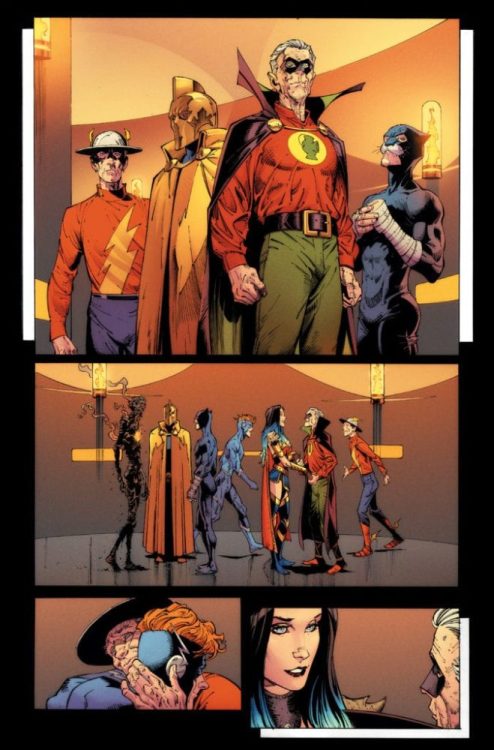
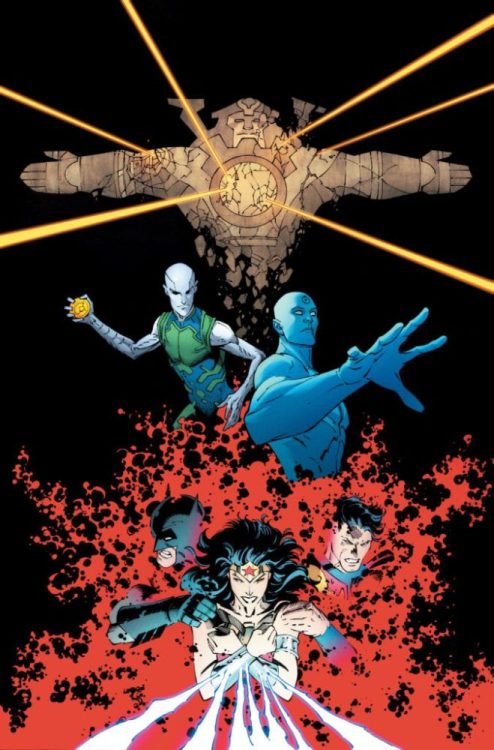
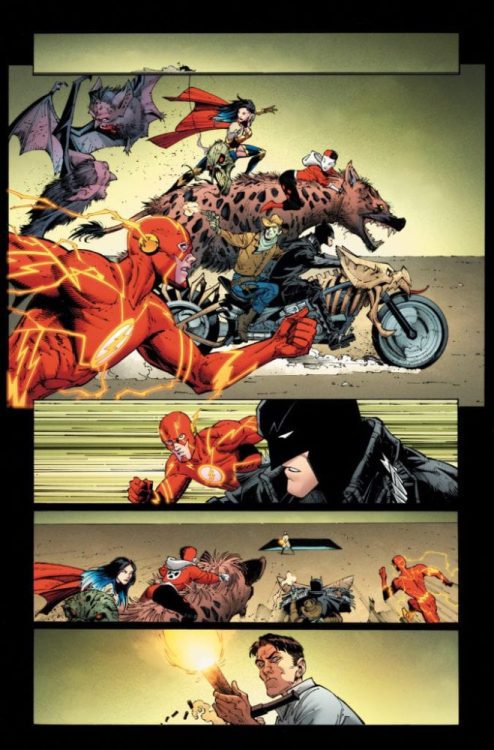
We’ve seen the first issue of Dark Nights: Death Metal, and its accompanying music video. Now comes a sneak peek at issue #2, which features a whole host of familiar faces from DC Comics history.
Here’s the press release and preview images:
Swamp Thing, Wonder Woman and The Flash Meet the Justice Society of America
in Dark Nights: Death Metal #2 First Look
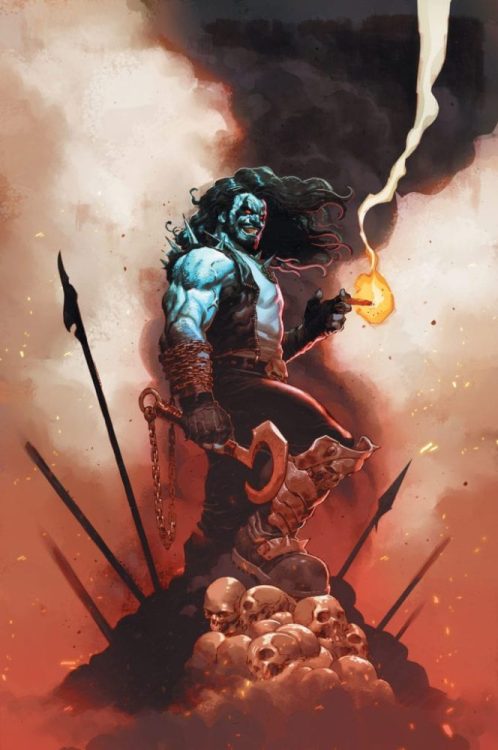
Plus, what’s Lobo doing in space, who is the Robin King, and when will the Darkest Knight appear?
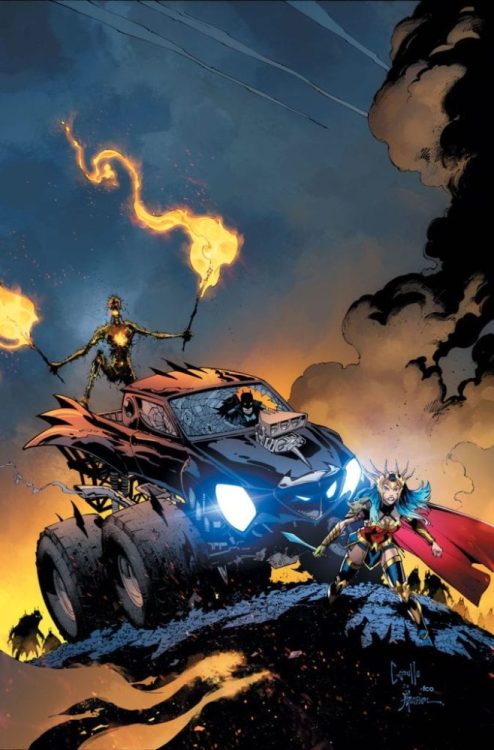
Get ready to scream…with excitement! More mysteries of the Dark Multiverse will be revealed in July’s Dark Nights: Death Metal #2! Along with a hallmark Jay Garrick and Wally West reunion, Wonder Woman and Swamp Thing will roar across the horrifying Dark Multiverse landscape alongside Batman, Jonah Hex and Harley Quinn! Can the remaining survivors of Perpetua’s grand design stand each other long enough to form a plan and take back the planet? Plus, what’s Lobo doing in space, who is the Robin King, and when will the Darkest Knight appear?
Don’t miss the second chapter of the wildest ride in the DC universe, hitting shelves on July 14 from the epic team of Scott Snyder, Greg Capullo, Jonathan Glapion and FCO Plascencia!
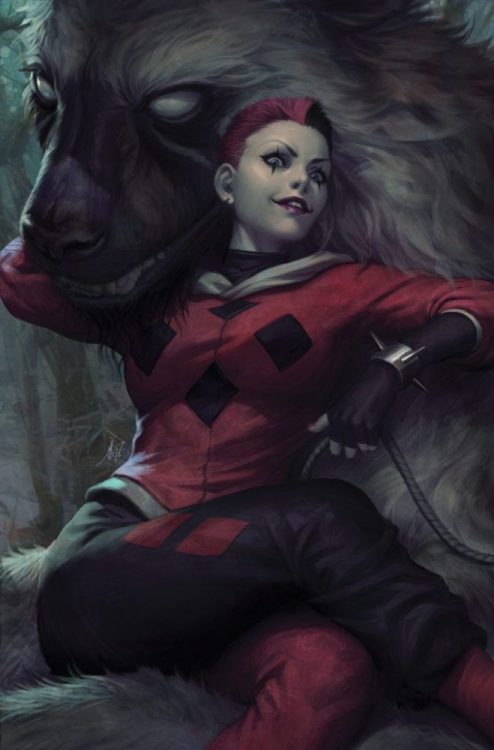
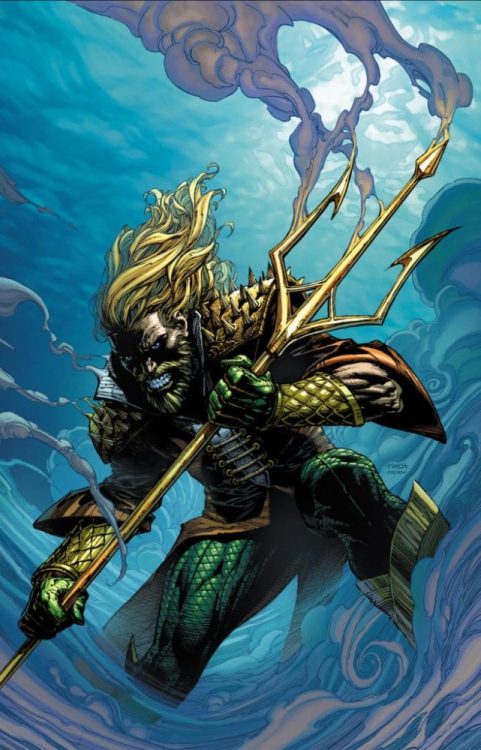
Dark Nights: Death Metal #2 written by Scott Snyder art by Greg Capullo, Jonathan Glapion and FCO Plascencia card stock foil cover by Greg Capullo, Jonathan Glapion and FCO Plascencia Aquaman variant cover by David Finch Lobo variant cover by Jerome Opeña Harley Quinn variant cover by Stanley “Artgerm” Lau 1:25 variant cover by Doug Mahnke 1:100 black and white variant cover by Greg Capullo and Jonathan Glapion ON SALE 07.14.20
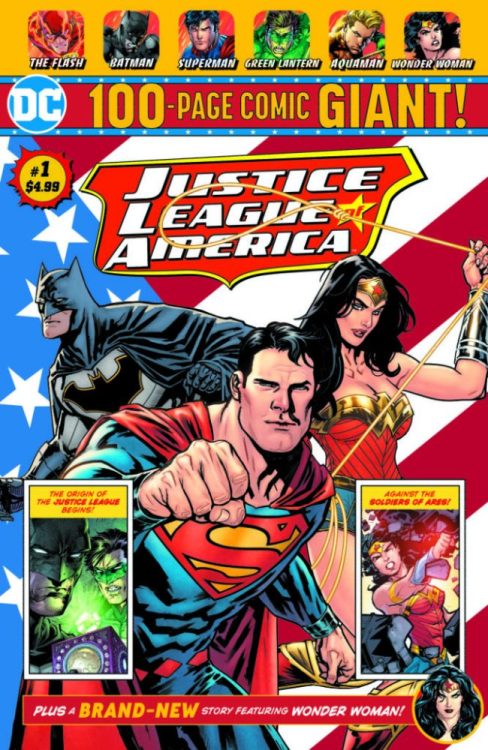
Two years, ago DC Comics first announced their partnership with Walmart. What began as the retailer selling 100 Page Giant comics has now further evolved to include new collections of DC books rather than single oversized issues.
Here’s the official word from the publisher:
DC 4-PACKS OF COMICS HEADED TO U.S. WALMART STORES NOW!
Shrink-Wrapped Collections of Recently Released DC Titles to Replace 100-Page GIANT Program
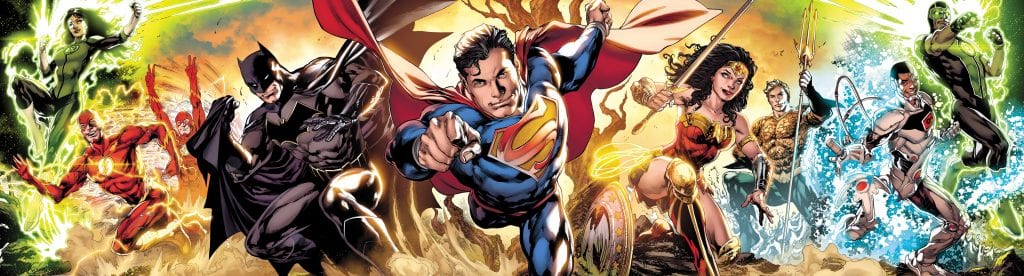
First Wave of Packs Feature Collectible Backing Boards that Join to Form the Justice League
In an evolution of DC’s strategy to bring the World’s Greatest Super Heroes to the masses, the publisher announced today that the Walmart 100-Page GIANT anthology titles will be replaced by shrink-wrapped collections of recent DC comic books from the DC universe. The first wave of titles has already begun shipping to stores and should arrive in the more than 2,900 U.S. Walmart locations by Sunday, June 21.
Each pack of four is priced at $8.98, and includes a collectible backing board featuring a different DC Super Hero. When joined together, they form an image of the Justice League by Ivan Reis.
“Walmart has been a great partner to work with and we’re incredibly excited about this new phase in our relationship,” said Nancy Spears, DC Vice President, Sales. “They continue to provide an excellent platform to deliver our characters and stories to a wider audience, an audience that continues to use movies, television, home video and video games as their gateways to superhero storytelling.”
DC is also working to make these 4-packs available to comic book stores by September 2020.
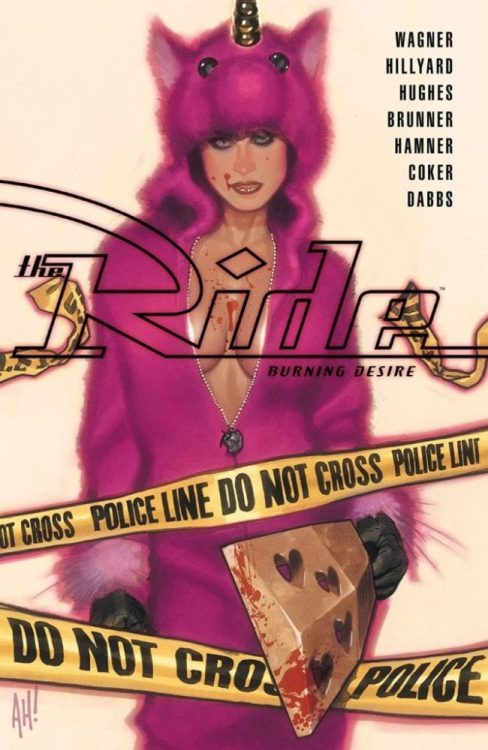
Just in time for the 15th anniversary of Gaijin Studio’s original The Ride series, writer Doug Wagner and artist Daniel Hillyard ( Plastic), along with a slew of guest artists and storytellers bring forth The Ride: Burning Desire. This 5-issue mini-series anthology from Image and 12-Gauge Comics serves as both a reintroduction and a sequel to the original story, and it spares none of over-the-top thematic craziness or surprisingly effective emotional beats one could expect from such an unhinged pulp-noir comic centered around a cursed ’68 Camaro
“After a 15-year stint in prison, disgraced former detective Samantha Vega works as a bouncer. But when she discovers the exotic dancers in her care are in danger, Vega must decide if she’s willing to risk her freedom to help the people with nowhere else to turn.”
Writing & Plot
Wagner and Hillyard do a great job of maintaining a sense of familiarity to these characters and this story for those who had read The Ride previously, while also crafting a story for readers whose point of entry is Burning Desire. The script offers brief but effective windows into Samanta Vega’s past and why she was in prison, but it never becomes a point of such focus that it detracts from the here and now. Vega herself is a kickass protagonist – flawed, but good-natured and always ready to finish a fight. Jumping into this world of Unicorn onesies, old grudges, and crooked cops (topical, eh?) is a simple blast of an experience due to the sharp storytelling and unrelenting humor. The um… unusual cast of characters that make up the crew of the Burning Desire are each noteworthy characters in their own right, not only aiding Vega in her mission to save a young girl from the demons of her past but as characters in their own stories. Each of the club’s dancers has their own short going over their background and how they got to the present, and each story is brought to life by a rotating team of guest artists and storytellers. This list of talent includes Adam Hughes, Cully Hamner, Tomm Coker, Chris Brunner, and Doug Dabbs, and each creator brings their own style to the table for an anthology that offers varied but fitting tales to the main story. Despite its obvious absurdity, this comic has a lot of heart as well. The attention paid to the whole cast makes them all almost instantly likable, and this ends up in scenes that can be wholesome, or cathartic, or sometimes emotionally devastating. If I had to pitch this comic to a friend, I’d say it’s like a neon-colored Sin City. I mean this in a completely positive manner, as this comic’s written delivery is a brilliant exercise in balancing effective character writing and absurd humor and wrapping it all up in a grindhouse-noir paint job.
Art Direction
The shifting visuals of The Ride: Burning Desire are brought to life by Daniel Hillyard and colorists Laura Martin and Charlie Kirchoff for the main story, as well as the previously mentioned list of guest artists for the character shorts. Hillyard’s pencils offer a simple, almost cartoonish sort of design that works very well for the kind of comic The Ride is. Anything more stylized would have robbed the serious moments of their gravity, while anything more geared towards realism would have made the tone harder to parse. There’s a focus on character in Hillyard’s art that makes interfacing with each character an easy task for the reader (the good guys look lovable, the bad guys look like assholes). The “Burning Desire” story looks superb, and this is all in part to the vibrant work of colorists Martin and Kirchoff (whose mid-series switch is impossible to notice).
Every bit of the guest art is superb as well, and all offer wildly different styles to separate themselves from both the main story and the work of the other artists. Adam Hughes work in “Sparkles” brings his usual gorgeous soft textured work to the table in what’s probably the outright “prettiest” art in the book. Chris Brunner and Rico Renzi’s “Ash” story offers excellent character detail and stark imagery to a story of childhood trauma. Cully Hamner and Nayoung Kim’s work in “Foo” (my favorite character) uses dark shades and Hammer’s heavily textured pencils to bring to life the most unsettling story in this mini-series. “Nun” from Tomm Coker is the most visually striking story of the bunch, using stark black and white imagery to tell a short grindhouse tale full of venom and attitude (I half expected Frank Miller’s Marv to come rumbling into frame at any moment here). Finally, Doug Dabbs’ art for “Arnie & Albert” is the most unconventional, and it works brilliantly for the completely out-of-left-field psychedelic trip this short is. This whole series is lettered by Ed Dukeshire (who also worked on Blacking Out), whose consistent lettering talent offers fantastic voice context for every scene and situation this comic covers.
The Ride: Burning Desire is a grindhouse comic with as much goofiness as it has heart. Underneath its cast of lovable weirdos and potentially cursed muscle cars, this is a noir story of bad people trying to do what’s right by the people they care about. Doug Wagner, Daniel Hillyard, and every other talented artist and storyteller that contributed to this mini-series have had their unique hand in creating a little gem of noir storytelling in comics. If this seems like your kind of ride, pick up the trade paperback now from your local comic shop.
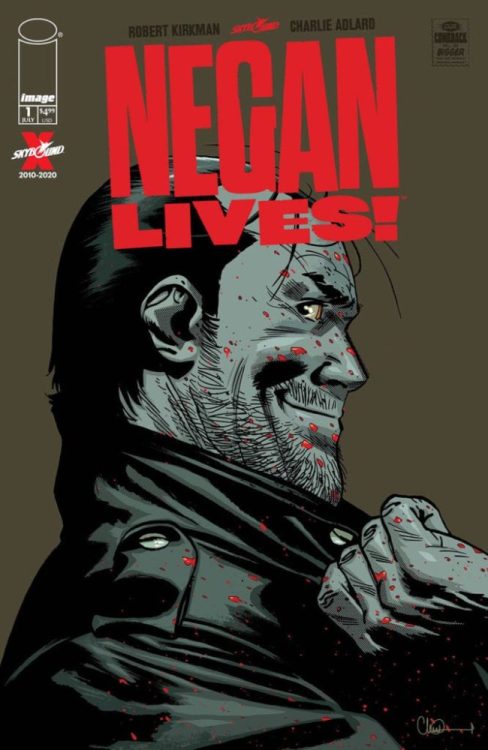
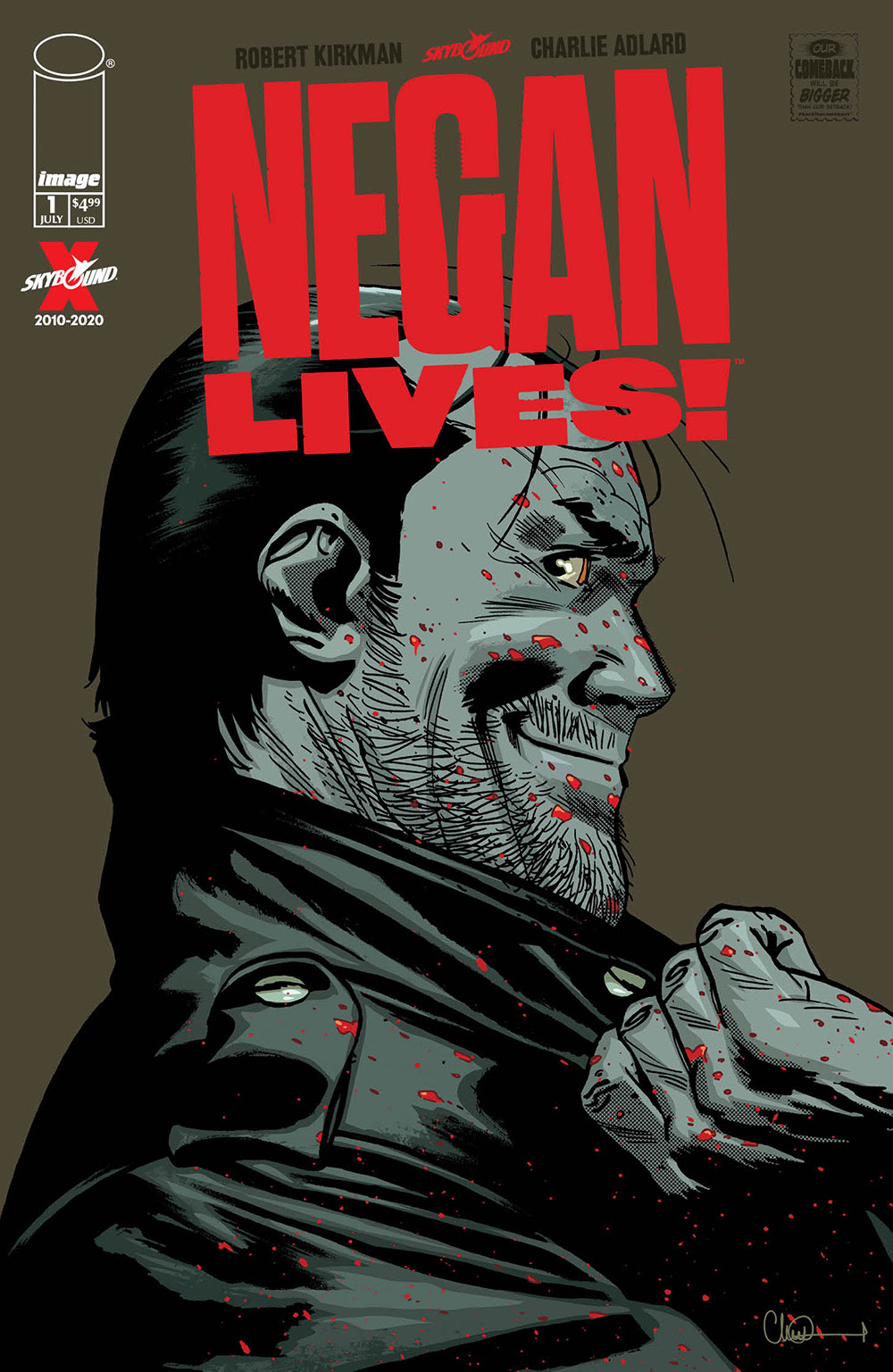
In a surprise press release from Image Comics, The Walking Dead will be returning to comic shops this July in a special one-shot titled NEGAN LIVES #1. Written by the series creator, Robert Kirkman, with art by Charlie Adlard, NEGAN LIVES #1 is an all-new story chronicling the titular character’s adventures since the events of THE WALKING DEAD #174.
This surprise one-shot is intended as a ‘thank you’ and show of support for comic shops hit hard by the COVID-19 lockdowns. The support is both symbolic and financial as all shipping costs by Diamond will be waived, and 100% of the sales go to the shops selling the book. You can read the press release in full below.
Is this the best surprise comic shops could have hoped for? Do you want to see other publishers follow suit? Let us know what you think in the Comments section, and share this post on social media using the links below.
THE WALKING DEAD WILL RISE AGAIN IN SPECIAL NEGAN LIVES #1 STORY THIS JULY
The surprise one-shot from Robert Kirkman & Charlie Adlard aims at generating new excitement for comic shops recovering from the COVID-19 crisis
PORTLAND, Ore. 06/18/2020 — The New York Times bestselling, award winning creative team behind The Walking Dead phenomenon—Robert Kirkman (Fire Power, Oblivion Song) and Charlie Adlard (Vampire State Building)—returns to the beloved series for a surprise one-shot story, Negan Lives #1, which will arrive in stores this July.
This shipment arriving in July will be without financial burden to receiving retailers—with no freight cost for them to worry about. “I’ve been inspired by Steve Geppi and Diamond’s efforts to shine a light on how essential the Direct Market is to our beloved industry with their #backthecomeback campaign,” said Kirkman. “While Charlie Adlard and I had laid the series to rest, this felt like something special we could do for the store owners who made our series a success to begin with. To that end, I’m happy to report that 100% of the revenue generated from this book will go to the stores selling it. The retailer community does backbreaking work to get comics into the hands of our loving fans, we should all be doing more in these trying times to show them how appreciated they are.”
Negan Lives #1 will not be available digitally and will be available exclusively at comic book shops. Fans interested in ordering a copy can find the comics store closest to them on Local Comic Shop locator. Many comic book shops are fulfilling orders online and via curbside pickup.
Spurned by a slowly rebuilding society, Negan lives a life of desperate isolation… or does he? In the tradition of Here’s Negan, this all-new story in Negan Lives #1 gives readers a glimpse into what has happened to one The Walking Dead‘s most popular characters in the time since his last appearance in The Walking Dead #174.
As long-time readers of the post-apocalyptic survival series will recall, The Walking Dead #174 proved to be a pivotal point for Negan, as he was tracked down and confronted by a vengeful Maggie, still heartbroken and furious over the murder of her husband, Glenn, in The Walking Dead #100.
Negan Lives #1 (Diamond Code MAR208199) is a 36-page, black and white comic book, available exclusively at comic book shops on Wednesday, July 1. There are extremely rare Gold (Diamond Code MAR208201) and Silver (Diamond Code MAR208200) foil variants of Negan Lives #1 in limited quantities, inquire with your local comic shop for availability and further details.
Negan Lives #1 hits comic book shops on the same day as the Fire Power, Vol. 1: Prelude original graphic novel and the FCBD Fire Power #1 free promotional comic, both by Kirkman and co-creator/artist Chris Samnee.
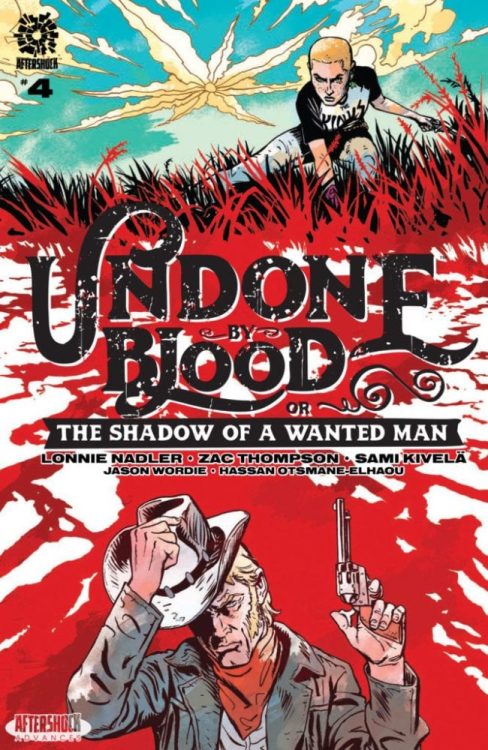
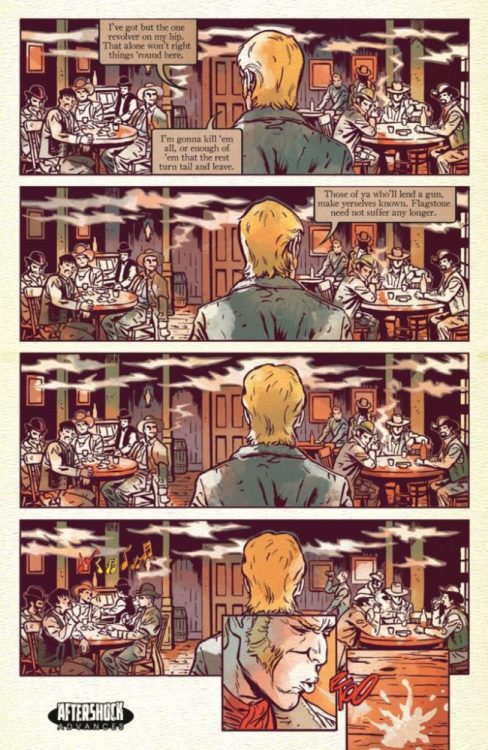
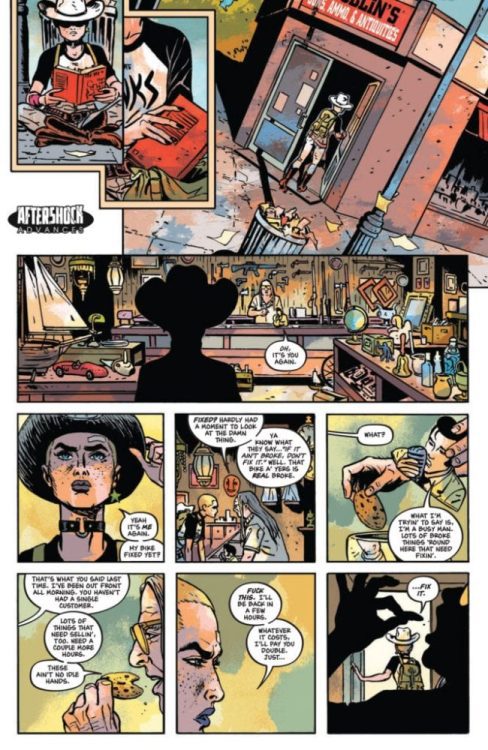
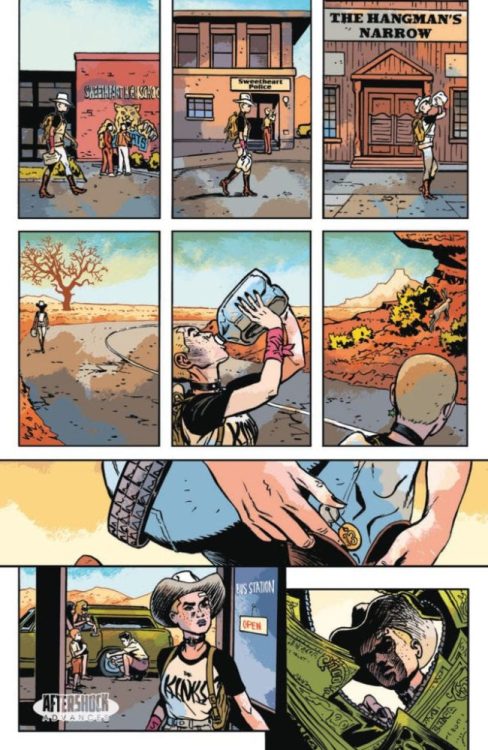
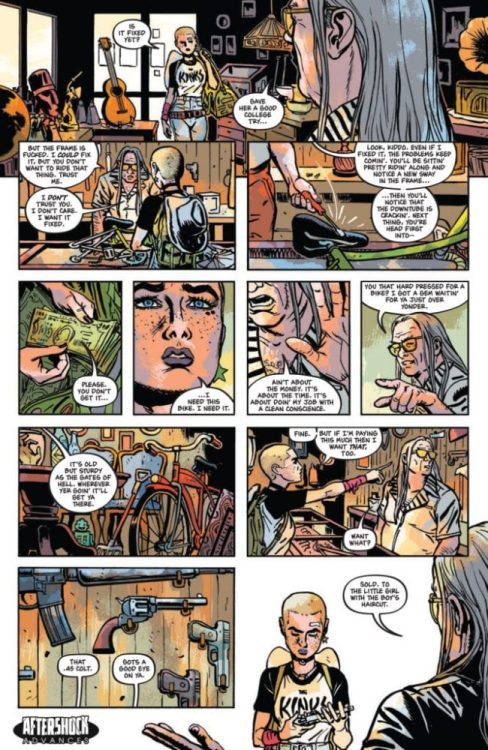
Undone by Blood or the Shadow of a Wanted Man #4 hits your local comic book store July 15, but thanks to AfterShock Comics, we have a four-page preview with a great look at Sami Kivela’s panel design.
The book is written by Lonnie Nadler & Zac Thompson, with art by Kivela, Jason Wordie drops some color, you will read Hassan Otsmane-Elhaou’s letters, and Kivela & Wordie designed the cover.
About Undone by Blood or the Shadow of a Wanted Man #4: As Ethel approaches the truth about the man who murdered her family, she’s discovering that the justice of the old West isn’t as glorious as fiction makes it out to be. Chasing one fickle lead after another has not paid off. No one can be trusted – a lesson she failed to learn from cowboy legend, Solomon Eaton. And Solomon is in his own heap of trouble, going up against a town full of men who will do anything to prevent him from saving his son.
“Kivela does not conform to any set panel layout. There isn’t an overriding pattern that can be discerned from reading each issue. There are no formulaic nine-panel grids here. Instead, Kivela chops and changes the layout page by page, choosing a structure that suits the scene.” – Darryll Robson
Enjoy the preview below.
What other AfterShock books are you reading? Comment below.
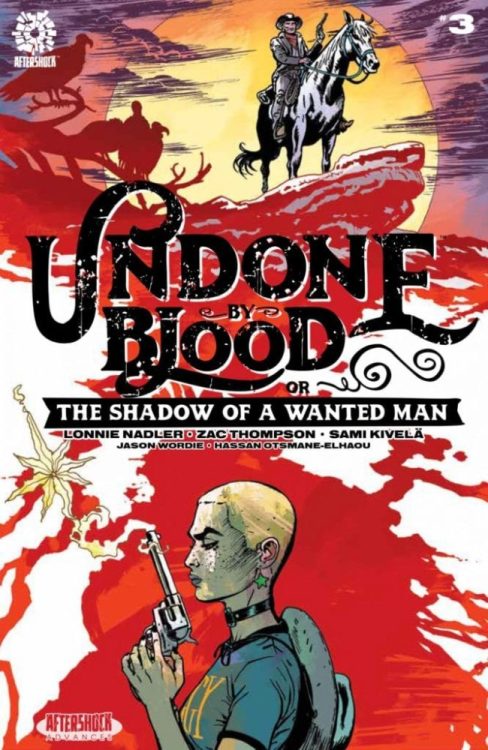
Undone By Blood #3 Cover Credit: AfterShock Comics
One of the things that is often said about comics is that you can do things you can’t do in any other medium. Often this isn’t always obvious because a large number of mainstream comics don’t tend to experiment too much with the format, instead mimicking other mediums to make themselves easier to access. However, there are plenty of comics, published by some of the big named publishers, that push the storytelling boat out. Undone By Blood from AfterShock Comics is one such title.
I have written previously about Undone By Blood and artist Sami Kivela’s clever use of the image to break one panel into many. However, this is only the tip of the iceberg when it comes to the creative techniques that are used in this comic.
Kivela does not conform to any set panel layout. There isn’t an overriding pattern that can be discerned from reading each issue. There are no formulaic nine-panel grids here. Instead, Kivela chops and changes the layout page by page, choosing a structure that suits the scene. On occasions, the narrative may warrant a character comparison, so the panel layouts on given pages will mirror or match previous pages. At other times there may be specific elements of the plot that need to be emphasized; small details that Kivela can zoom in on. There are also specific page transitions that need to be made for the story to flow easily.
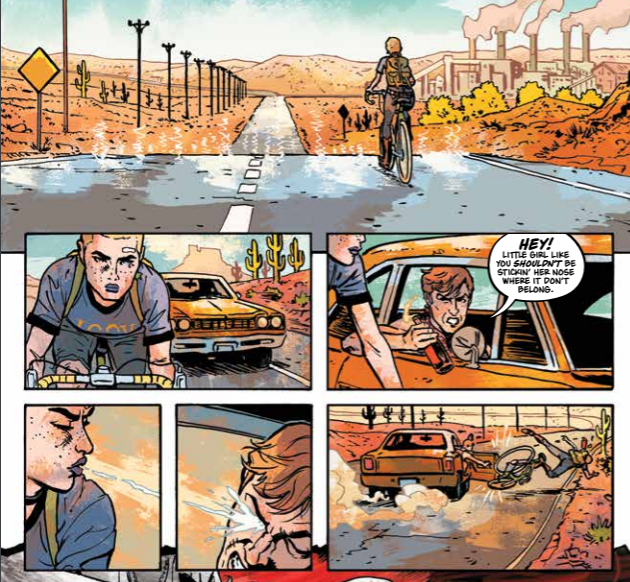
Undone By Blood #3 Page 9 Opening Credit: AfterShock Comics
Inserts and Overlays
One of the techniques used by Kivela to accomplish a number of different narrative tasks is to employ the use of inserts into larger panels or small panels that overlap gutters. These are not simply a quick succession of panels in a tier to increase the narrative pace, although he does do this on occasion (see example above).
The inserts that I am referring to are usually close-ups of an object or part of a scene. These close-ups draw the reader’s attention to something specific in the narrative that plays an important part in a particular scene. They also act as a narrative device themselves to inform the reader of some change either in place, time or as in the following example, a move from one fictional world to another.
The narrative within Undone By Blood is split between two stories; the first is about Ethel Lane, who is looking for her family’s killer; the second is the book that Ethel reads, entitled The Shadow of a Wanted Man. The shift from one narrative to the other is usually pretty clear, especially if you compare the artwork side by side. Kivela uses a different style to render the characters and backgrounds for each story, and the color, by Jason Wordie reflects the two different time periods.
The two concurrent stories do not appear on the same page, however, and occasionally the artist signals to the reader that a transition is coming. This signal prepares the reader before a page turn that the focus will shift from one character to another. It acts like a full stop, or paragraph break, and takes the form of a small square panel at the bottom of the page. The panel has a thick border, sometimes white or sometimes black, and the image bleeds to the right of the page. Its other distinguishing feature is that it overlaps the final panel on the page, becoming more prominent.
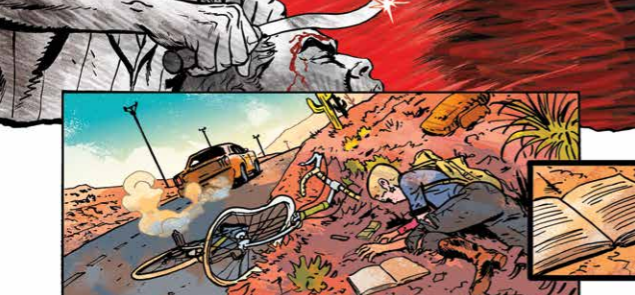
This form of page ending happens on several occasions in issue 3, and the example from Page 9 (above) highlights how it looks and functions. The page shows Ethel being attacked and knocked from her bike as she scrambles by the side of the road in that penultimate panel on the page the moment is interrupted by a close up of her book. It has fallen from her bag and lays open on the ground, the writing visible (but not legible) on the page. The thick black border makes the panel stand out because it is different from every other panel design on the page. The right of the panel bleeds away into the page turn and takes the narrative into the book on the next page.
Undone By Blood #3 Page 11 Inserts Credit: AfterShock Comics
Concentrated Detail
These small panels don’t just appear at the end of a scene or a page. Kivela enjoys placing them throughout the comic like a close up in a movie. Single beats that make a quick point, drawing the reader’s attention, and then back to the larger scene. There are three such panels on page 11 that are especially interesting as they work together to enhance an element of the narrative.
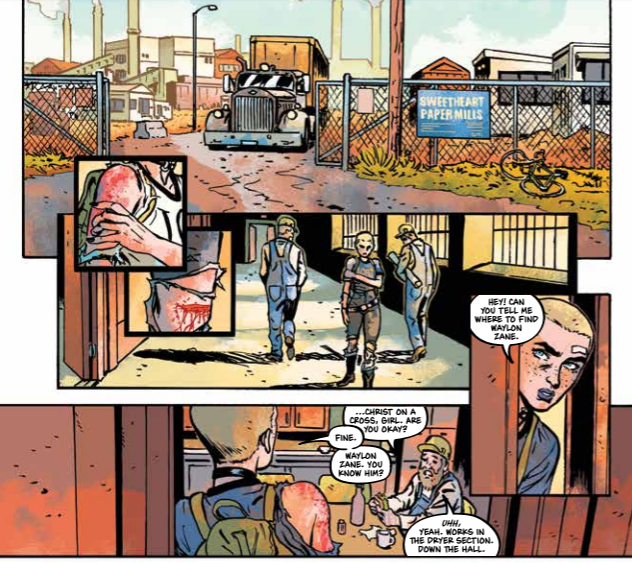
After being knocked down, Ethel has followed a lead to a Paper-mill in the hopes of meeting someone who can help her. As she enters the Mill, two overlapping square panels are very similar to the one discussed above. Each panel features a close up image and thick black borders. The difference is that they are solid on each side, contained images that do not lead to something. In essence, they act like bullet points highlighting, in this instance, the injuries that Ethel has sustained.
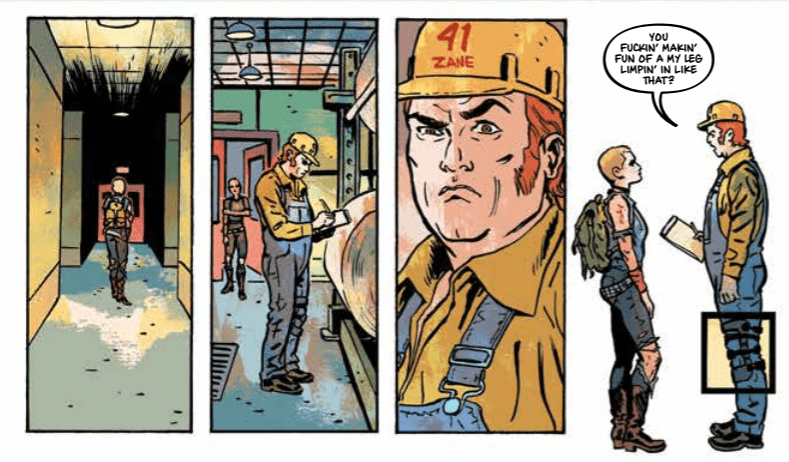
Her scraped shoulder and bleeding knee not only explain her stance in the panel that lays below, panel four if you will, but they also relate to a third, similar panel later on the page. This third panel is a true insert as it is situated completely in the final panel. It is designed in the same way with a thicker border and acts as a close-up image. The difference is that there is no zoom; it merely emphasizes an element of the image, inviting the reader to take note.
The image is of Waylon’s strapped up leg, denoting an injury of his own. The simple panel border that Kivela places around the leg reinforces part of the conversation that Waylon and Ethel are having but also refers to the top of the page and Ethel’s own injuries. It is making a contrast between the open wounds of the heroine and the old wounds of Waylon. The moment also makes a comment on the freedom of one character against the restraints of the other.
So much is inferred by the one overlapping panel and its relationship to the overall page.
The creative team of Undone By Blood is experimenting with the storytelling possibilities of the comic book medium. Each member of the team is pushing the boundaries of what they can do for the greater good of the comic and the story.
Kivela is not bound by rules, especially those that define other mediums, and instead demonstrates exactly what you can do with a page of panels and images. He thinks about the single panel image and what that has to convey, but he also considers the page and even beyond to the issue as a whole. When you read Undone By Blood, you get the impression that everything matters, and the creators are leading you through the pages, allowing significant clues to sneakily slip by in the background.
The majority of comics aim to engage the readers enough to pick up the next issue. Undone By Blood has so much going on it feels like it’s aim is to get you to instantly re-read it. There is so much to take in; Kivela’s use of small, close up panels is only a tiny fragment.
Undone by Blood #3 from AfterShock Comics is currently on sale at your Local Comic Book Shop.
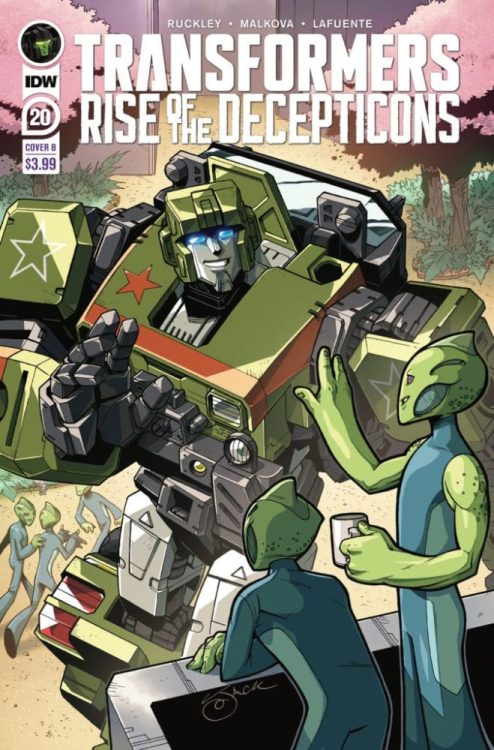
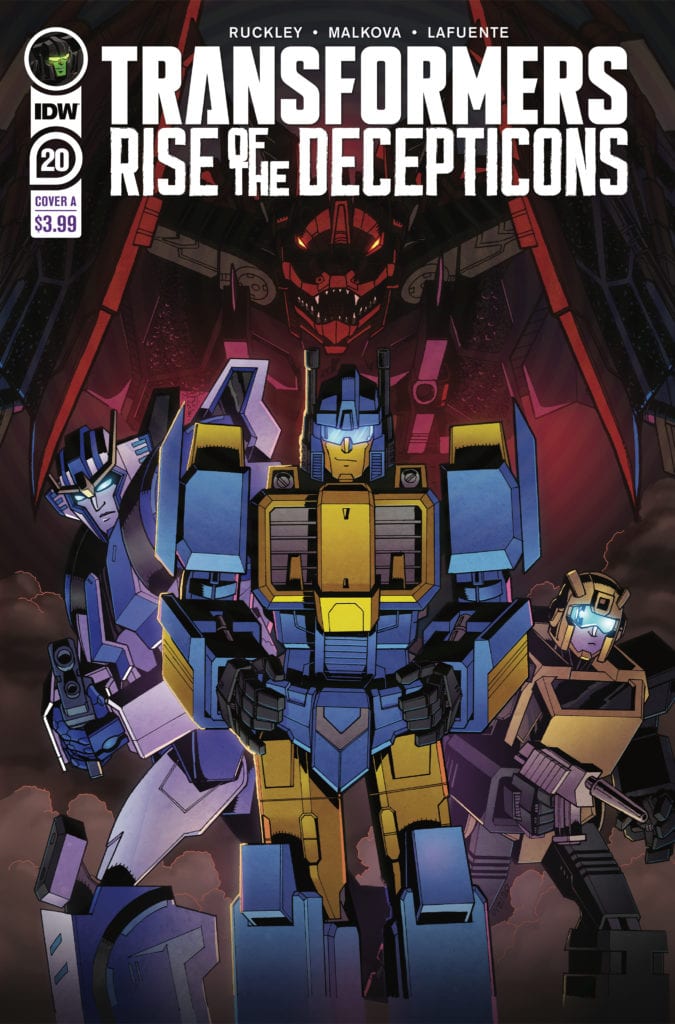
The Rise of the Decepticons event continues in Transformers #20 thanks to Brian Ruckley, Anna Malkova, Joanna LaFuente, and Jake M. Wood. The last issue seemed to lose the velocity from the previous issues. Will Transformers #20 reclaim the flow of recent events or cause it to further grind to a halt.
Prowl and his team need information and decide to investigate Swindle’s illegal operations for the answers they need.
Writing
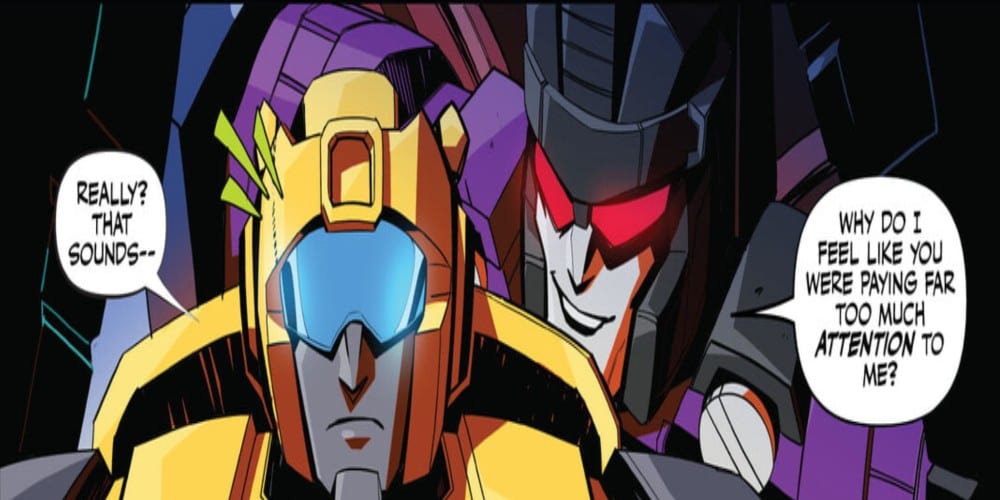
Something which immediately sticks out about this issue is how characters seem to actually have some amount of personality. Instead of being objects moving a plot forward actual glimpses of characters with conflicts and persona are coming forward. Details such as Prowl keeping a pet, Hound feeling remorse for innocent lives killed by recent events, and Sideswipe being eager to prove his worth display a depth needed in this series. It has often felt like we not getting the chance to connect with these characters and understand what they are like in this new installment of the franchise. Hopefully, more moments like this will be commonplace in the future.
There is a sense the story Brian Ruckley introduced back in issue #1 is moving towards wrapping up. Frankly, this ending is way overdue as the murder of Brainstorm seems less important than the other issues such as large scale destruction and widespread civil unrest have appeared since the first issue. The mystery of why Brainstorm was murdered needs to be solved so the audience can move onto bigger things.
Artwork
The art by Anna Malkova sells the stress and frustration the characters are under. Looks of pain and exhaustion are prominent on Prowl and Hound and illustrate just how much recent events pushed them to the breaking point. There also is a great splash page in Swindel’s illegal casino filled with some recognizable faces from previous incarnations of the series.
The colorwork by Joanna Lafuente suceeds in making the scenery pop. The darkness of the alleys where Prowls team meets, to the ominous golden glow from inside Swindle’s casino helps to make the energy of the setting come through much clearer. Also, the coloring nails the unnatural power Mindwipe has at his control.
The lettering by James M. Wood finds a way to meld perfectly with the artwork in many deceptive and impressive ways. Too often sound effects are thrown on and end up becoming more of a hindrance than adding to the action of the story. In this issue, Wood hides the effects in energy attacks and speed lines to not distract from the rest of the panel.
Conclusion
Transformers # 20 offers a bit of depth and a bit more progress in the overarching plot. Still, moments of promise have appeared before. The groundwork of setting up the tension of the world of Cybertron has been laid. From here on out, the fans deserve to see some powerful and truly fulfilling moments.




 phenomenon—Robert Kirkman (Fire Power, Oblivion Song) and Charlie Adlard (Vampire State Building)—returns to the beloved series for a surprise one-shot story, Negan Lives #1, which will arrive in stores this July.