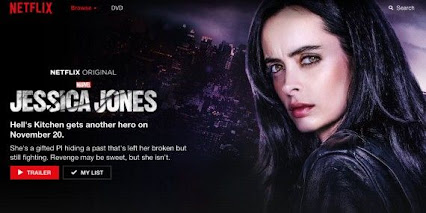
The pilot of Jessica Jones was pretty great, but ‘AKA Crush Syndrome’ had to prove that Jessica Jones can follow-up on that. Boy, does ‘AKA Crush Syndrome’ achieve that.
Review of Jessica Jones Episode 2 ‘AKA Crush Syndrome’
Let’s get the obvious out-of-the-way, the opening is simply fantastic, the colors are vivid (and mostly purple) the song starts off slow and somber before getting more and more intense (much like the show itself). The entire OST is pretty great as well, it gives the entire show an apt noir tone to it.
We get a couple of characters introduced to us, mostly neighbors. Like Malcolm, the high neighbor. Fun Fact: While bingeing Jessica Jones Malcolm got the nickname “High Guy,” it is he most memorable aspect after all. We also met Robin and Reuben, the twin neighbor, also known as Crazy Sister and Creepy Brother. We also meet Officer Clemons, otherwise known as Jessica Jones’ incarnation of Ben Urich.
Marvel’s Jessica Jones
If there is one thing Jessica Jones is great at so far, it’s the way Kilgrave has been handled so far. We see very little of him so far, a couple PTSD visions in the first episode, a flashback in this one, but his influence is everywhere. Hope’s actions are evidence enough, but we see more, Dr. Kurata and Jack, poor Jack.
Let’s talk about that for a bit, Jack is forced to help Kilgrave escape, donate both his kidneys, and get’s a stroke because of it. Jessica Jones is really a show built around moments, that scene that just makes you go crazy, and Jack has one of them.
“KIL-”
“Kilgrave, I know.”
“-L ME”
This was really the first moment that cemented Jessica Jones ability to deliver these, of course, this is far from the last.
Jessica Jones also loves giving us a sense of paranoia, the feeling that anything can happen, that everything will happen. This is most notable when Jessica beats on a poor door guy. Kilgrave could show up at any moment, and Jessica Jones wants us to know it.
All of this builds up to our first real glimpse of Kilgrave, and boy does this scene also deliver. While its impact was significantly lessened due to the fact that it was released online days before, it still sent shivers. David Tenant delivers a perfect, chilling, performance as the psychopathic uncaring killer. Making even harmless actions like walking into someones house near nightmare inducing.
Hope is not all lost however (ha ha, name puns), Luke is freaking awesome (A saw to his stomach did nothing!?) and Jessica in on the move. Two episodes in and we’ve already found Kilgrave’s weakness, though Sufentanil seems a little overkill, all that’s left is to find the drug and apply it.
A few other developments include: Trish learning how to fight (that’ll keep the comic fans happy), Jeri learning about Jessica’s personal involvement, and Jessica kinda ruining things with Luke and Andre’s wife (come on lady, your marriage was over thanks to your affairs).
Jessica Jones has a surprising tone of humor, the dialogue is witty, and that fight scene was pretty hilarious. Jessica Jones has a found a great balance between humor and paranoia.
However, ‘AKA Crush Syndrome’ isn’t without its flaws. Despite the hype it’s gotten before release, the chemistry between Jessica and Luke was pretty nonexistent. That was an obvious choice in the first episode (there was no love in that sex scene), but it has yet to develop yet.
Regardless, ‘AKA Crush Syndrome’ was a fantastic follow-up to ‘Ladies Night’, we can only hope it will continue.
This morning Warner Bros. Pictures announced principal photography has started on Wonder Woman starring Gal Gadot in the role of Diane Prince/Wonder Woman. An official announcement was also made about the cast joining Gadot in her first feature role. The film also stars Chris Pine (the Star Trek films) as Captain Steve Trevor, Robin Wright, Danny Huston, David Thewlis, Ewen Bremner, Saïd Taghmaoui, Elena Anaya, and Lucy Davis. To celebrate the start of principal photography, Gal Gadot posted the first photo directly from the set of the highly anticipated picture.
The film is being produced by Charles Roven, Zack Snyder and Deborah Snyder, with Richard Suckle, Stephen Jones, Wesley Coller, Geoff Johns and Rebecca Roven serving as executive producers.
Joining Jenkins behind the camera are director of photography Matthew Jensen (“Chronicle,” “Fantastic Four,” HBO’s “Game of Thrones”), Oscar-nominated production designer Aline Bonetto (“Amélie,” “A Very Long Engagement,” “Pan”), and Oscar-winning editor Martin Walsh (“Chicago,” “Jack Ryan: Shadow Recruit,” “V for Vendetta”), and Oscar-winning costume designer Lindy Hemming (“The Dark Knight” trilogy, “Topsy-Turvy”).
Principal photography will take place on location in the UK, France and Italy.
Set to open in 2017, the Wonder Woman feature film is based on characters created by William Moulton Marston, appearing in comic books published by DC Entertainment. It will be distributed worldwide by Warner Bros. Pictures, a Warner Bros. Entertainment Company.
Jonathan Levine’s The Night Before is yet another example of Seth Rogen playing the manchild dealing with pending adulthood and learning that friendship can survive the journey to maturity. Throughout the rowdy, raucous, drug-fueled comedy, Rogen’s character talks to his friends about this being the absolute last time they are going to go through their Christmas ritual. It made me wonder if Rogen and his team of writers were in a room with director Levine taking bong rips and thinking out loud, “dude …. You know what we did in Neighbors … we should totally do that again.” The Night Before is a well-intentioned comedy, but ultimately it’s a bad film.
It opens with a literal Christmas storybook animation, narrated by Tracy Morgan in a way that only he would. We learn of three good Friends – Ethan (Joseph Gordon Levitt), Isaac (Seth Rogen) and Chris (Anthony Mackie) who have been spending Christmas together for over a decade – since Ethan lost his parents – doing their best to have the time of their lives. Essentially, they like to act like idiots. From blowing up snowmen to getting high and looking at the Rockefeller Christmas Tree, they are willing to do whatever needs to be done to keep Ethan positive around the holidays. However, the annual event is starting to strain as each of them inches closer towards adulthood. Isaac is about to become a dad for the first time, Chris is dealing with the realization that he now needs to use steroids to help him perform on the football field, and Ethan is dealing with a breakup from his longtime girlfriend, Diana (Lizzy Caplan). As the boys get ready for the big night, Issac’s wife gives him an early Christmas gift, a box of drugs to help him party that night. Isaac gets extremely messed up, allowing Rogen to display some truly horrific behavior after he mixes molly, coke, and weed from his box of goodies.
The one highlight of this film would have to be Micheal Shannon, who plays Mr. Green (The drug dealer/life coach). Every time Mr. Green pops up he gnashes the scenery and generates the film’s biggest laughs. Micheal Shannon never really struck me as much of a comedic actor, but this certainly has altered my perception of him going forward. Other than Shannon, The Night Before was one failed bit after another.
Mindy Kaling (who I’m guessing is in this film as favor to either Rogen or his writing partner Evan Goldberg) plays Diana’s best friend, and is in a scene where Isaac’s nose drips “cocaine blood” into her drink that isn’t quite as funny as it should be. Ethan (Gordon-Levitt) also picks a fight with a couple of drunk guys dressed as Santa Claus that simply falls flat. Johnathan Levine has shown his talent before, directing films like 50/50, but one can’t help but wonder if he was the right for this type of “wacky buddy comedy.” Comedy is about balance and timing, and you can’t go from stealing a horse-drawn carriage (really) to yet another short-lived introspective moment in a manner of moments. The Night Before suffers from an identity crisis. Itattempts to be both poignant and funny and fails miserably at both. Maybe if Johnathan Levine and Evan Goldberg had taken the time to smooth out the imbalances in the script, The Night Before would have been a far more enjoyable film.
Jessica Jones has finally hit Netflix and its first episode set the show’s haunting mood that sets itself apart from all other Marvel adaptations. “A.K.A Ladies Night” kicks off the series with our heroine Jessica Jones working on a case to find a missing girl. Her investigation leads her to a man from her past who has the ability to take control of people’s minds, The Purple Man. Jones is absolutely terrified to confront him due to their past relationship, but she knows that she’s going to have to in order to finally put an end to her PTSD.
And that is all of the story that can be said in order to keep this review spoiler free. From the get go, Jessica Jones is a phenomenal show, dripping with tense atmosphere, emotional conflict, and disturbing imagery. To talk anymore about its story would be doing you a disservice as it would be a distilled version of this show’s brilliance.
Much like Marvel’s other Netflix series, Daredevil, Jessica Jones has heavy shadows, creative angles, and a noir aesthetic that fits the dark content well. Unlike Daredevil the conflict is less external, the pacing is slow, and the action is minimal. Matt Murdock’s story focused on violence and its consequences when dealing with crime. Jessica Jones is focusing more on the internal struggles of trauma and deciphering the ramifications that come with it. This allows Jessica Jones to be a slow burn; meaning we can focus on the emotional complexity of our main lead.
The acting is superb with Kristen Ritter perfectly nailing down the sardonic, tough as nails Jessica Jones. Carrie Anne-Moss plays a mysterious, and slick Jeryn Hogarth, Rachael Taylor is a caring Patricia Walker, and Mike Colter shines as future Defender Luke Cage. But, David Tennant steals the show as the terrifying, Purple Man. He’s barely in the episode, and pretty much only through flashback, but he leaves a haunting impression of what’s to come. His soft accent is somehow both soothing, and strong at the same time.
The show is very mature, full of realistic sex scenes, excessive drinking, and even some nudity. So this is definitely not for younger audiences. And while the narrative is very strong, at times it does feel a little scattered, but that could just be setting up the mystery element of the show. Keeping the audience in the dark about certain aspects of it keeps us coming back for more.
Overall while it is a much slower show than Daredevil, Jessica Jones shows a darker side to the world of the MCU, and we’re excited to call of work in order to binge watch the series. Check Monkeys Fighting Robots later this week for a full season recap. And let us know in the comics what you guys think of the series?
Early on in Spotlight, Tom McCarthy’s incredible newspaper film about the exposure of child abuse running through the veins of the Catholic church in Boston and beyond, a local priest, addressing his open-faced congregation, explains, “knowledge is one thing, faith is another.” It is the crux of this film. Spotlight is a journalism film, first and foremost, the most complete of its kind in forty years, yet it deals with community. There is the community of The Boston Globe, and the Spotlight team who uncovers the sprawling scandal. There is the community of Boston, steeped in religion, the very community the Globe serves. And there is the seedy community of the archdiocese, one of the most powerful and disturbing organized crime rackets in all of human history. This film flows through these communities, all interacting with one another in a push and pull of morality, despair, sadness, and truth.
The Spotlight team at the Globe, a small team of investigative journalists, is led by Walter “Robby” Robinson (Michael Keaton, stellar as usual). The Globe is, like most newspapers in 2001, in a state of flux. The Internet is creeping into the physical media of the times, and a new editor is coming in from out of town. He is Marty Baron (Liev Schreiber, subdued brilliance here), a Jewish outsider from South Florida who, when Robby meets him for the first time, is reading The Curse of The Bambino to try and get a feel for the city. Though he doesn’t care for baseball. It would be easy to expect this new editor, charged with trimming some fat from the Globe in these modern times, would be that character who gums up the works and impedes progress in the investigation into the Catholic church. Quite the opposite. Baron’s outsider status is what pushes the investigation forward, unwrapping the bigger story here. These Boston-bred reporters, ingrained in the city (still a very small town in a lot of ways, one character is careful to note) as much as in their jobs as journalists, are reluctant to dig deep into a scandal that has always existed as nothing more than a whisper. Better to turn the other way than upset their overly-Catholic readership. Baron thinks those readers will take note.
Reluctantly, Robby and his team being to investigate accusations against a priest here and a priest there, accused of molesting young boys and girls in their congregation. Only their investigation begins to expose a much larger threat, and as the threat grows larger, the accounts grow more intimate. A few priests grows into a dozen, then almost 90, touching the lives of these reporters. This is where Spotlight absolutely sings, as we pound the pavement in a world of reporting that is practically dead in 2015. Robby’s team includes Mike Rezendes, played by Mark Ruffalo as an energetic, quick-twitch nuisance in the best ways imaginable. Ruffalo has the market cornered on characters loaded with idiosyncrasies, and he is stellar here, worthy of awards. Rachel McAdams is Sacha Pfeiffer, who has a more personal local connection to the church. And there is Brian d’Arcy James as Matt Carroll, who has the greatest moment of personal reveal in the middle of the picture. Beyond the Spotlight team, the film is filled to the edges with the likes of John Slattery, Stanley Tucci, Billy Crudup, and all manner of character players who weave a wonderful tapestry of convincing, lived-in performances.
McCarthy and Josh Singer’s screenplay is smart, quick, and doesn’t slow down to explain what would never be explained in real conversations. These are newspaper men and women who live these lives, so exposition is what needs to be said for these people, not the audience. Compared to Truth, another journalism film earlier this year that was rote and embarrassing to the profession, Spotlight is its photo negative. This world is real, un-glamorous and utilitarian. It is convincing and captivating.
As a narrative, Spotlight is all about reveals, and they are handled perfectly. Regarding the aforementioned personal reveal from Matt Carroll, it happens just as the scope of this abuse scandal is being uncovered by the team. Carroll is scanning a list of priests who have been “reassigned,” spots a name, and panics. He runs out his front door, down the street, and around the corner, where he stops and stares at a home mere feet from his front door. It is a home where two of these pedophiles still live, and it brings the immediacy of the situation home for Carroll, who ha children to consider. “Stay away from this house” his note says on the fridge. The scene is a wonderful moment in the film, shot with immediacy but not flash. None of this film is flashy, a perfect decision from Masanobu Takayanagi, who allows the actors and their settings room to breathe.
Despite its procedural structure and importance on the inner workings of journalism, Spotlight is not short on emotion. As the investigation begins to expand, the weight of the situation presses down hard on these reporters. There are tough moments with victims – “survivors,” as they are more aptly described since many of the children who are abused were felled by drugs, alcohol, and suicide later in life – as they describe their encounters. Each of the Spotlight reporters get their moment to consider the gravity of the story they are uncovering, and each of these moments pull us into the story even further. Churches and religious decorum loom large in the background more often than not, emphasizing even more the power the church has over the community.
An interesting thing happens two-thirds of the way in. 9/11 happens, and it subtly shifts the tone of the entire film. While the attacks are mentioned, shown on television, and subsequently noted, McCarthy never strays from his story too much. He simply changes the language of his characters. Now, nobody wants to hear about priests molesting children, because these people need their religion now more than ever. “This isn’t the time for such a story” is uttered, in so many words, more than once. It is a quiet shift in the film, but a bold transition at the same time. Just another reason why this is a masterpiece.
Perfect films are rare birds. Even the best films of any given year can show their warts. I believe Spotlight is as close to perfect as 2015 has gotten, and it is unquestionably the best film this year. It is a smart and fluid story, loaded top to bottom with wonderful and convincing performances. The true power of a film is its ability to be tactile, to stick in your gut and linger in your mind. 12 Years A Slave did that to me two years ago, and a film has not done that since. Until now.
Star Wars fans have only seen a glimpse of Luke Skywalker and R2-D2 in the trailers for Star Wars: The Force Awakens, and it appears that BB-8 is our droid for a new genration.
Yet a UK prmotional event from O2 Priority brings the two droids together for the first time.
Episode VII in the Star Wars Saga, Star Wars: The Force Awakens, opens in theaters December 18, 2015.
Star Wars: The Force Awakens, directed by J.J. Abrams from a screenplay by Lawrence Kasdan & Abrams, features a cast including actors John Boyega, Daisy Ridley, Adam Driver, Oscar Isaac, Andy Serkis, Academy Award winner Lupita Nyong’o, Gwendoline Christie, Crystal Clarke, Pip Andersen, Domhnall Gleeson, and Max von Sydow. They will join the original stars of the saga, Harrison Ford, Carrie Fisher, Mark Hamill, Anthony Daniels, Peter Mayhew, and Kenny Baker.
In 2001, The Boston Globe uncovered a massive cover-up of the archdiocese of the Catholic Church in Boston, revealing 90 priests in several parishes were caught molesting children, facing no reparations for it. In 2015, Spotlight comes along to tell the tragic tale. The title Spotlight refers to the investigative journalism part of the Boston Globe, headed by Walter “Robby” Robinson. Some may be confused that Spotlight is about sexual abuse, but it’s every bit about the power of investigative journalism. Without question, Spotlight is the best journalism movie since All The President’s Men and one of the very best films of 2015.
Michael Keaton leads this film and the cast with a phenomenal performance. After Keaton’s incredible performance in “Birdman,” there was a chance that his next role would be a disappointment, but Keaton steps up to the challenge leaving no doubt that he’s big time star. Mark Ruffalo does what Mark Ruffalo does, churning out another fantastic performance as Mike Rezendes, a Spotlight reporter tasked with dealing with the prosecuting attorney, Mitchell Garabedian played by Stanley Tucci. Live Schreiber puts forth a significantly understated performance as The Boston Globe editor Marty Baron. Rachel McAdams rounds out the cast as Sacha Pfeiffer, the Spotlight reporter who had the task of interviewing the most of the sexual abuse victims.
Spotlight director Tom McCarthy had one major hurdle to overcome, creating an authentic newsroom environment, and he nails it. McCarthy gets everything right on the money, from the pressed shirts and pleated khakis worn by Globe male reporters to the process reporters have to go through to pull up old clips. McCarthy creates an environment for the audience that feels as if you’re shoulder to shoulder with Keaton (Walter “Robby” Robinson) and his team as they break the biggest scandal in the history of the Catholic Church. McCarthy and screenwriter Josh Singer revisited how the reporters went about breaking the story and revealed The Boston Globe had an opportunity to break the story in 1993. Cinematographer Masanobu Takayanagi played a huge part in the success of Spotlight. His decision to create a subtle washed out background for the film and his insistence to pull the camera back at times that allowed the actors to play off of each other. It’s Spotlight’s precision, modesty, and restraint that makes this film so refreshing. McCarthy isn’t seeking to mythologize TheBoston Globe; rather he takes a disciplined approach that gives the film an honesty, which the audience will appreciate.
McCarthy has made Spotlight an ensemble piece rather than showcasing anyone star in particular. He wanted to ensure we knew this was a team of reporters that were working together to get the story right. Keaton, Ruffalo, and McAdams disappear into their respective roles. Spotlight is more about how the team interacts with one another and making sure they get the story right. If Truth, showed us the dangers of rushing a story, Spotlight shows us how to get a story right (even while fully embracing all the bureaucratic hurdles most journalists deal with on a daily basis).
In the end, Spotlight is a slow, steady burn. McCarthy doesn’t make the mistake of trying to advance the plot too quickly; rather he allows the events to unfold at a realistic pace. By doing this, the audience is allowed to process fully the magnitude of how intricate and horrific the scandal truly was in 2001.
Spotlight is in a class all by itself in 2015, from its brilliant performances to outstanding storytelling. Come February 28, Spotlight is sure to win a few awards.
The Dixie Chicks are touring! The Dixie Chicks are touring! Don’t you just want to shout it from the roof tops?!
It has been ten LONG years and lots of waiting, but the Dixie Chicks are going back on tour next year. A little earlier this year we learned that they had scheduled many dates in Europe, but then didn’t hear a peep about any in the US. On November 16 an anticipated event, not unlike the arrival of new music from Adele, FINALLY happened – U.S. dates were announced and their “real” fans are rejoicing.
The Dixie Chicks – Natalie Maines, Emily Robison, and Martie Maguire – will launch their first headlining US tour in a decade beginning on June 10, 2016 in Cincinnati, Ohio. But will country music, and more importantly fans, accept them and bring them out of the exile from which the genre that they helped crossover into the mainstream success put them in?
What young woman in the mid to late 1990s hadn’t heard of the song, “Wind Open Spaces”? The coming of age story of a young girl moving away from the family and life she has always known to stake her own claim in the world?
Now, I’ll let you in on a little secret: This writer wasn’t really into country music at the time, but that song was a John Hughes film in musical form. That song and many of their others connected with an audience that wondered if anyone else was experiencing those same “growing pains”…just like Hughes. These chicks sang anthems that empower young women across color, ethnic, political ideology, and socioeconomic lines.
We’re all aware of the controversy that drove some fanatics – many of which were/are their fellow country musicians, fans, and radio personalities alike – to level a blacklist campaign against them. Some went so far as to have Chicks paraphernalia destroying rallies akin to those of the 70s Disco backlash.
Although chatter against them has all but quieted on country airwaves and media, it continues to be an unspoken rule that you shy away from ANYTHING Chick related. It is 12, freaking, years later people! And one negative comment made by lead singer Natalie Maines about the then president of the United States, George W. Bush, set the Chicks world afire and destroyed their place in the genre they loved so much.
The comment: “Just so you know, we’re on the good side with y’all. We don’t want this war, this violence, and we’re ashamed that the President of the United States is from Texas.” This simple statement to an audience on foreign soil, at the Shepherd’s Bush Empire Theatre in 2003, sparked off anti-Dixie Chicks rhetoric – even from the beloved Reba McEntire. And EVERYONE remembers the barrage of anti-Chicks hate filled speech that poured from the tongue of Toby Keith and the back and forth barbs that he and Maines traded.
In 2011, on Fox and Friends, Hank Williams, Jr. likened our current President Barack Obama to Hitler (see here). After these comments ESPN yanked his opening song from the Monday Night Football opening where it had played for over 20 years. At the Iowa State Fair Grandstand, in 2012, he stated, “We’ve got a Muslim president who hates farming, hates the military, hates the U.S., and we hate!” These comments were followed by a round of applause from the audience. Mr. Williams also said in an interview with Rolling Stone Magazine, “We’ve got a president that does a call to the Koran (Qu’ran) or Mecca or whatever.” In that same story when asked if he believed the President actually hated America he is quoted as saying, “I don’t know about that, but it’s kind of obvious. I guess when you take a world tour, a world tour, to apologize for America.”
Hank Williams, Jr. has made SEVERAL openly disparaging remarks about OUR sitting President Barack Hussein Obama and the country music community has stood by him. On the Country Music Awards in 2011 Brad Paisley and Carrie Underwood made it a point to acknowledge Hank’s faux pas and firing from Monday Night Football, and then there was a “surprise” appearance by the censured country star (seen here). He was met with applause from the audience. When asked was he sorry about what he said, he simply stated, “No.” Upon his exit from the stage he was enveloped in applause. Without saying the words, country music told their “kin” – Brad and Carrie’s word – that they support him no matter what. His MANY disparaging remarks about the country’s president was OK. But where was/is that same support for the Dixie Chicks? Aren’t they country music kin?
Two years after the comment that would forever be associated with Maines and Chicks, they emerged back on the scene as a united front and released the album Taking the Long Way. It was met with critical acclaim and fell on harden hearts of many country music fans. While Taking the Long Way went to No. 1 and the song “Not Ready to Make Nice,” was Top 40 hit. This pivotal song dealt with the ladies banishment from country music and gave a resounding middle finger to those who expected them to apologize for vocalizing their opinions. These little ladies were NOT going to take their black listing sitting down.
The platinum selling album Taking the Long Way coupled with “Not Ready to Make Nice,” and the title single “Taking the Long Way,” catapulted these three blue grass musicians onto the world stage. The lines:
My friends from high school, Married their high school boyfriends; Moved into houses, In the same zip codes where their parent’s live; No I, I could never follow…It’s been a long time gone now, Since the Top of the World came crashing down; And I’m getting by on my feet now, By taking the long way…
And take the long way these ladies have! The 2006 documentary Dixie Chicks: Shut Up and Sing chronicles the scrutiny that these three women were subjected to – by by fans, corporate sponsors, and conservatives – over a three year period. These women have endure death threats, name calling, blacklisting, and the shunning from the community that they called home. They were forced to forge a new path in the music industry when the one that they had dedicated some much time and energy turned its back on them. But they came out on the other side, more successful in the mainstream and dismissed by their country brethren.
After the success Long Way, and the stress of the backlash, Nathalie Maines needed to take a break from music and understandably so. The treatment that they received from many of their fans, big corporations, conservation politicians & organization, and ‘country’ left a bad taste in her mouth.
The two sisters of the super group, Emily Robison and Martie Mcguire, formed the band Court Yard Hounds during the Dixie Chicks hiatus. Robison and Mcguire wanted to return to the studio and Maines was not ready – they have released two albums as duo. Court Yard Hounds has experienced some critical. In 2013 Nathalie Maines release her solo album Mother (co-produced by Ben Harper), which has received a lot of positive critical acclaim. But none of these ventures have reached the success of the Dixie Chicks as a complete unit.
It will definitely be interesting to see what the Chicks have in store for us in the new year. They are/were never as strong apart as they are together. These three musicians have a rare ability to compliment each other that cannot taught – not unlike Brooks and Dunn. It will great to see these STRONG, OUTSPOKEN women out on tour in 2016…and let’s hope we have some new music to go along with the tour.
Spectre has been a big hit at the box-office, making $545.2 Million worldwide and rising. With Casino Royale making $600 Million and Skyfall having a haul of over $1 Billion and all four of Daniel Craig’s Bond movies having positive ratings on Rotten Tomatoes it has been a very successful era for the series.
Spectre has received mixed reviews, dividing audiences into people who loved it or hated it. People who have seen Spectre know it’s a homage to the Bond movies of the 60s and 70s and it was a much lighter affair to the previous Craig movies. They also know that it did feel like the end of the Craig era.
Sam Mendes has also stated that Spectre will be his last movie for the franchise and it looks likely the next Bond flick will be a reboot of the series. So we at Monkeys Fighting Robots will look at 15 directors who can move the series forward, looking at both directors who can continue the darker, realistic tone of the Craig Bond movies and ones who could revert back to the lighter adventure approach.
Anton Corbijn Music photography turned director Anton Corbijn is a man who knows how to make a thriller – having The American and A Most WantedMan. Both movies would be well suited to the Bond universe: The American tells of the lonely assassin and gunsmith who travels to a small Italian town for one last job, while A Most Wanted Man – based on a John le Carré novel – is about a German spy in Hamburg leading an operation to bring down a terrorist financier whilst having an internal conflict between doing good and the harsh realities of being a spy. Both movies on a character level would serve as a model for making James Bond more like that character written in Ian Fleming’s novels.
The American and A Most Wanted Man are both much slower paced movies: The American can easily be described as an anti-action movie, deliberately underplaying the action, making it more grounded. If Corbijn did get the Bond gig he would need to pick up the pace.
Corbijn’s movies have been blessed with excellent acting and as you would expect from his background, great cinematography. He could easily do more with a bigger budget and visit fantastic locations and because of Corbijn’s connections in the music industry ensure a great band or singer to perform the title song.
Joe Cornish
Joe Cornish has only made one movie as a director, but it was one hell of a fun movie, the horror-comedy Attack the Block. On a limited budget of £8 Million, Attack the Block was an impressive feat of special effects and had strong action and comedy – making the movie a cult delight. Cornish has since been linked to A Good Day to Die Hard and the King Kong prequel Kong: Skull Island.
Although Cornish only has one directing credit to his name he has plenty of experience as a writer – writing and starring in the sketch show The Adam and Joe Show and working with Edgar Wright on The Adventures of Tintin: Secret of the Unicorn and Ant-Man, both very entertaining romps.
It would be unlikely that Cornish would be handed on the directing reigns, but it is not impossible. Editor Peter R. Hunt and editor/second unit director made their directorial debuts with On Her Majesty’s Secret Service and For Your Eyes Only respectively. Both movies being held in high regard by Bond fans. Matthew Vaughn was also considered to direct Casino Royale after his directorial debut Layer Cake.
Gareth Evans Welshman Gareth Evans has had an unusual route towards becoming a director, moving to Indonesia to fulfil his dream: and the results were magnificent, giving us two of the best pure action movies in recent years – The Raid: Redemption and The Raid 2. Although The Raid: Redemption was light on plot it excelled at being an action experience, having some fantastic martial arts fights – and its sequel being even bigger regarding action and plot. The Raid 2 was as much a crime epic like The Infernal Affairs trilogy and The Godfather movies as well as being a great action movie. Evans was able to expand the form of action with the sequel, having car chases as well as fights.
Evans could be even more creative with his action sequences if given a Bond level budget as he showed with The Raid 2 he can handle more elaborate plots. Evans is pretty much his generation’s John Woo. Plus his “Raid” series star Iko Uwais would make an awesome assassin or henchman.
Tom Hooper Oscar winning director Tom Hooper has been in EON’s sights to direct to a Bond movie, being shortlisted to direct Spectre when Sam Mendes stated his intention to leave the series. Hooper has shown himself to be a prestige director, making The King’s Speech, Les Misérables and the upcoming The Danish Girl and his refined approach would easily fit for a character known for his tastes for expensive suits, exclusive casinos, high culture events and high end champagne. Mendes has a similar filmography of prestige and if EON wants a movie like Skyfall then Hooper would be a good fit to repeat that approach.
Though Hooper is famous for his historical movies, he started out as a television director, working on series like the Newcastle-Upon-Tyne set teen programme, Byker Cake, East London soap Eastenders, the police-procedural drama Prime Suspect and HBO’s John Adams, so knows how to stay within certain constrains that franchise filmmaking requires. Hooper has also worked on commercials, including one of Jaguar where Mark Strong, Ben Kingsley and Tom Hiddleston revelled in their villainy and Britishness.
Kim Jee-woon Kim Jee-woon is the first of two Korean directors to make it on this list, a celebrated filmmaker in his homeland. Kim is a man who has had a very eclectic career, making dark psychological thrillers like A Bittersweet Life and I Saw the Devil, horror in the form of A Tale of Two Sisters and the comedy Western The Good, the Bad, the Weird. Kim has also made an English-language actioner, the Arnold Schwarzenegger led The Last Stand.
Kim can easily make a dark psychological Bond movie, the premise of I Saw the Devil is a spy getting revenge against a serial killer by capturing and torturing him before releasing him and repeats the process over and over again. While with The Good, the Bad, the Weird Kim shows he can make something more light-hearted and any Bond director should be able to mix both approaches.
Maybe Kim could give a role to his regular actor Lee Byung-hun.
Baltasar Kormákur Starting his career as an actor Baltasar Kormákur has become one of Iceland’s biggest named directors – working in both his native land and in Hollywood. Kormákur is a man who has worked in a number of genres, ranging from dark dramas and thrillers like with Jar City, comedy-dramas and action-thrillers.
English language audiences will know Kormákur for Contraband (a remake of his own thriller Reykjavik-Rotterdam), the action-comedy 2 Guns and the recently released Everest. Although his English-language movies have been met with decent, if unremakeable reviews, Kormákur has shown himself to be a capable action director and worked with top-of-the-range special effects. 2 Guns was particularly praised for the Mark Wahlberg/Denzel Washington team up.
Kormákur’s Icelandic work has been critically praised and his style of action could fit a Bond movie. To use another example of Bond directors – Martin Campbell and Roger Spottiswoode’s best work as filmmakers has been on Bond series and Kormákur could follow in their footsteps.
Christopher Nolan Christopher Nolan is a fanboys favorite and they would love to see him direct or reboot any franchise or property, so getting him to direct would be more fantasy then reality. But there are signs of hope, Nolan is a self-confessed Bond fan and has stated that On Her Majesty’s Secret Service is his favourite movie in the series. The Bond series has also influenced Nolan’s filmmaking; he hired stunt co-ordinators from the Bond series when directing BatmanBegins and the mountain chase action sequence in Inception was based on his love for Bond films. Back in 2013 Nolan was on a shortlist to replace Sam Mendes to direct Spectre after Mendes initially stated he was not going to return to the series. Nolan’s dark style that looks at psychological themes would make him a good match for the Bond series and his influence on the series he loves has already been felt on Casino Royale and Skyfall.
Park Chan-wook With a filmography that includes Oldboy, J.S.A: Joint Security Area and Stoker, Park Chan-wook is easily one of the best, if not the best filmmaker to come from South Korea, developing a cult following in the West because of it. Park is known for making dark movies, the ending of Oldboy attests to that, yet still includes a sense of dark comedy. Park has ventured into comedy, making I’m a Cyborg, But That’s OK and Stoker was his first English-language movie. Park is an English-speaker and he was linked to direct the spy thriller Tinker, Tailor, Soldier, Spy, but turned it down.
Park has plenty of experience working in the crime and thriller genres, making the Vengeance Trilogy, a tense atmospheric psychological thriller with Stoker that has a Kubrickian style and J.S.A: Joint Security Area was both an investigation story and a personal drama, set to the backdrop of the international tensions between North and South Korea.
Just imagine if Park could replicate a scene like the hammer fight in Oldboy for a Bond movie.
Guy Ritchie
Back in 2013 when it looked like Sam Mendes might not return to direct Spectre, bookmakers William Hill made Guy Ritchie the favorite to replace him. At the time it seemed like a mismatch because Skyfall was a darker, serious take on the Bond series and Ritchie is known for having a lighter touch. But after seeing Spectre being more of a homage to the Sean Connery and Roger Moore era, a Guy Ritchie directed Bond movie does not seem so ridiculous.
Ritchie is a flashy director, known for quick editing and dialogue and disjoined of time. HIS fans love him, his distracters say he is a poor-man’s Quentin Tarantino. Yet Ritchie has been able to resurrect his career as a top action director after the failure that was Revolver. His Sherlock Holmes movies are entertaining action flicks, having some well staged sequences, plenty of wit between its two leads and a lot of intrigue and twists: good ingredients for a Bond movie. Ritchie also directed The Man From U.N.C.L.E. which gives us a taste of what a Guy Ritchie Bond movie could be. Maybe Henry Cavill could be Ritchie’s Bond.
Morten Tyldum Norwegian director Morten Tyldum is a man well acquainted with the thriller, making Headhunters and the historical drama The Imitation Game. Though Tyldum was nominated for an Oscar for The Imitation Game, it’s his works on Headhunters that puts him in good stead to direct a Bond movie.
Headhunters is a thriller based on a novel by Jo Nesbø and is the highest grossing Norwegian movie to date. It is also a movie that has some of the features you would want from a Bond movie, its hero is a ruthless womanizer, it is set in the world of fine art and the villain played by Nikolaj Coster-Waldau was a very suave, determined ex-Special Forces soldier. Headhunters also had a surprising amount of humor while also maintaining a constant level of suspense.
Nicolas Winding Refn Since making movies like Bronsan and Drive, Danish Nicolas Winding Refn has become a fan favorite to direct many franchise films, including the Bond series. He was even on the shortlist to direct Spectre with Nolan and Hooper.
Since Winding Refn’s early days as a director in Denmark, he has shown a prehensility for crime movies, from the very realistic and downbeat look of The Pusher Trilogy, a surrealist approach for Bronsan and the neon lit, neo-noir world of Drive. The Shanghai assassination scene in Skyfall had a similar look to Drive due to its use of lighting.
Winding Refn has worked with some great actors in his career, including Tom Hardy who is a popular fan’s choice to replace Daniel Craig and the Dane could easily handle action sequences like car chases and shoot-outs. But Winding Refn does have art-house sensibility and some of his movies like Valhalla Rising and Only God Forgives have divided audiences.
Edgar Wright Since bursting onto British television screens with Spaced, Edgar Wright has been known as one of Britain’s brightest directing talents. Over the years, Edgar Wright has developed a big fanbase for his work with Simon Pegg and Nick Frost on The Cornetto Trilogy and the cult movie Scott Pilgrim vs. The World. Edgar Wright has shown himself to be an accomplished comedy and action director, his movies being known for their witty dialogue exchange, quick cutting and camera pans and well staged and choreographed action sequences.
Edgar Wright is a man who knows about genre filmmaking, deconstructing types of movies while paying homage to them. Shaun of the Dead was dubbed a romantic comedy with zombies, while lampooning George A. Romaro’s Living Dead series (earning him and Simon Pegg a cameo in Land of the Dead) and Hot Fuzz took the very American genre of the buddy cop genre and placed it in a small English village, resulting in blood and hilarity. Hot Fuzz, Scott Pilgrim vs. The World and The World’s End are masterclasses on how to film action sequences and it would great to see him work again with cinematographer Bill Pope. It would be easy to see Edgar Wright getting to play around with the tropes of the Bond series such as gadgets, guns and girls. The Bond series would be a great canvass for his talents and if the series continues to go down a lighter, more retro route Edgar would be very suited to sit in the director’s chair.
However there is a word of caution regarding Edgar Wright; he was famously linked to write and direct Ant-Man for Marvel but ended up leaving the project because of studio interference. He was also linked to direct Mission: Impossible – Ghost Protocol before Brad Bird got the job.
Joe Wright The other Mr. Wright to make it onto this list is London-born Joe Wright. Joe Wright is best known for making period dramas like Pride and Prejudice and Atonement. Yet it is his work on the cult actioner Hanna that put Joe Wright in good standing for the Bond gig. Hanna is an excellent action movie, taking the silly premise of a 16-year-old girl being raised in the wilderness to be the world’s best assassin and played it straight. Hanna’s three stars, Sairose Ronan as the girl thrown into a world that she has learned about in books, but never experienced in real life, Eric Bana as her bad-ass secret agent father and Cate Blanchett being the villainess of the piece gave great performances. Hanna was a stunning little action movie with its highlight being a two minute tracking shot before Bana kills four CIA goons.
Joe Wright has also shown himself to be a master technician during his career, making visually distinctive movies and having a love for long continuous shoots. Atonement has a brilliant one set on the beaches of Dunkirk, lasting five minutes and Anna Karenina’s dancing sequence, showcasing everything it needed to without a word of dialogue.
Even when Joe Wright stumbles like with Pan, he still shows himself to be a director with a scene of audacity. The introduction into Neverland in Pan was a mine full of slave children being forced to see “Smells like Teen Spirit”; a moment people either love or hate.
Matthew Vaughn Matthew Vaughn is often a fans favorite for many upcoming projects, including whenever the Bond series requires a new director. There is precedent for this, Vaughn’s directional debut Layer Cake helped Daniel Craig land the Bond gig and he was approached to direct Casino Royale before Martin Campbell was hired.
Ever since making Layer Cake, Vaughn has become known as A director who uses bright cinematography and art direction – having comedy and emotional dramatic moments and incredible action sequences. Vaughn is also a director who has a strong understanding of genre and subverts it: he did it with superhero genre in Kick-Ass and the spy-action genre with Kingsman: The Secret Service. Vaughn also shows appreciation for the genres.
Earlier this year Vaughn’s Kingsman: The Secret Service which was a very adult version of the Bond movies of the 60s and 70s, having spies with fancy gadgets, international travel and a megalomaniac villain who has boundless resources and his own mountain lair. Vaughn also injects a few Bond references into X-Men: First Class, such as when Moria MacTaggert infiltrates the Hellfire Club meeting.
Vaughn was able to reboot the X-Men series with his signature style, surely he could do the same with Bond.
Denis Villeneuve Hailing from Québec, French-Canadian director Denis Villeneuve has had a meteoric rise as a director in recent years. Since 2011 his mystery drama Incendies was nominated for an Academy Award for Best Foreign Language Film and his English language movies, Prisoners, Enemy and Sicario have all been critically highly praised.
Villeneuve has shown himself to be able to make complex thrillers with a dark psychology edge, which would make him a great fit for the Bond series. He showed earlier this year’s Sicario that he can handle action sequences. When Villeneuve spoke to Coming Soon he stated that he loved the Bond series and would want to make a Bond film.
Villeneuve is also becoming a very in-demand director, he was linked to Terminator Genisys before Alan Taylor got the gig and he is currently attached to direct a sequel to Blade Runner.
I wouldn’t hesitate to call this one of Glass Mask‘s weaker episodes. It functions mostly as a transition into the really meat of the show. But that doesn’t stop it from giving us some great character insights.
Review of Glass Mask Episode 4 ‘The Stairs of Fire’
The episode starts off with Ayumi. Many would assume after her initial introduction that she never really earned her fame. Her mother is a famous actress, her father is a critically acclaimed director, she was born with a silver spoon in her mouth. But Ayumi is careful not to let this define her, the episode begins with the narrator trying to prove this wrong. As the show continues you’ll see that Ayumi works very hard to determine her own identity, and step out of her parents shadow. I’d also suspect that Ayumi is addicted to rivalries, she immediately starts one with Maya (proof will come next week), and sets up one against her own mother.You can even see this at the end of the episode, “No, I’ll become an actress even better than my mother.” Man, Ayumi is pretty dang ambitious.
We don’t see too much of Hayami and Onodera, but what little we do see is quite revealing. Hayami mentions that it’s his father’s life goal to produce another showing of The Scarlet Angel. Last episode he said it was his and his fathers goal. Hayami’s goals are not his own. This will be further explored later, perhaps even next episode, so I won’t divulge much, but keep that in mind while watching the rest of the series. Also when Hayami pictures Maya when thinking about this actress Tsukikage is going to train proves the point I made last week about snatching Maya when he had the chance.
This episode we are introduced to the rest of the crew. Get familiar, because you’ll be seeing a lot of these characters, but I have to admit, Sayaka is a lot more bratty than I remember. I mean, she’s always been the least likable of the group, but man, gossiping about Maya, doubting her skills, and with what happens later on… keep an eye out on Sayaka, is all I’m saying.
Speaking of when Sayaka doubted Maya, let’s analyse that scene a bit. First, Maya chooses Ramen as her food, this reveals (in case you didn’t figure it out) that Maya is a plain, simple girl, she’s really down to earth (also I can’t believe she isn’t sick of that stuff, she practically lived around it). Later when ‘eating’ everyone is shocked when watching Maya eat. This goes back to the pantomime scene from episode 3. Most people when acting, consciously think about the actions they are making, they are trying to replicate what it would look like. But you don’t consciously think about that when actually eating, neither does Maya. Maya doesn’t ‘act’ she lives her characters. It just so happens that this character is just Maya, eating some Ramen. (Side note: Maya slurps A LOT, this is a cultural thing, everyone slurps in Japan)
By far the most intense moment of the show so far was that showdown between Tsukikage and Maya’s Mom, dang, that was tense. I’d like to comment on a few things before analyzing another great moment. First, we have further proof that Maya’s Mom is emotionally abusive, like really badly. “A talentless girl like you can never become an actress.” Geez, mothers are supposed to love, not hate right? When Tsukikage slaps Maya’s Mom, that was wonderful, I replayed that scene multiple times. I just really wish Tsukikage did it again when she chucked boiling water at her face, let’s not forget just how serious that is.
The best moment in the episode though, was as Tsukikage and Maya’s Mom’s argument got more and more heated, the show cut back to a tea kettle, which also got more and more heated. Now this is a common technique in film, but what truly makes this moment special is when the tea kettle became more than just a representation of the circumstances, it became a weapon. Now I don’t think this moment is thematically deep or anything, but that moment when the technique was broken by Maya’s Mom, I don’t know, it was just really good. I’m hesitant to call it a subversion or deconstruction of that motif, but it still added something to that moment.
A shocking, and seemingly amateur writing moment was later when Maya’s Mom seemed to immediately get over what had just happened. But it makes sense when you consider her motive. Mom (let’s just call her that from now on) loves Maya immensely, now she shows this love by abusing Maya both physically and mentally, but nonetheless she loves Maya. Mom’s action against Tsukikage is a combination of being worried about Maya’s future (let’s face it, acting doesn’t usually pan out) and not wanting to lose her daughter. After calming down and realizing that there is nothing she can do about it, Mom has no choice but to support and love Maya from afar. Where she can’t abuse her.
Of course this doesn’t change the fact that Mom is a horrible, abusive parent that should have been separated from Maya regardless, but it gives us an insight into her motives. Mom is a broken, multi-layered character, like a sympathetic villain, you love and hate them at the same time. Of course, this repentance from Mom is totally rejected by Tsukikage, but there’s a good reason for that, and I’ll cover it in just a second.
The theme here is clearly determination: Maya is determined to become an actress, Tsukikage is determined to mold Maya into that actress, Mom is determined to protect her child, Ayumi is determined to become a world-famous actress, Hayami and Onodera are determined to get The Scarlet Angel, determination is key. Early into the episode Tsukikage tests Maya’s determination, making sure it’s up to par (good thing for Maya determination is her biggest character quality). Ayumi develops her skill through determination. At the end of the episode, when Tsukikage burns Maya’s clothes, she is forcing Maya to full invest in her future.
Even what Tsukikage tells Maya, “Talent means believing in yourself.” Talent is having the determination to overcome whatever obstacle is in your way, to believe that you can overcome it. Talent is believing in yourself.
Spoilers
Just a quick note for all you who have watched Glass Mask before. This show really likes flipping your opinion on characters. Sayaka is a terrible person at first, but lovable toward the end. You hate Hayami with a passion, until you don’t (if you know what I mean?). Maya’s Mom is despicable, yet when she shows up later you can’t help but pity her. There are plenty of other examples, but I think I’ll stop there, I don’t want to spoil anything else.
Conclusion
And that, is ‘The Stairs of Fire’ This episode is a weak episode by Glass Mask standards, which proves that Glass Mask has insanely high standards. Because by another other standards this episode is nearly perfect. I just… I love this show.
But what did you think about this episode? Did you like it? What does ‘Stairs of Fire’ even mean? Let me know in the comments! And don’t forget to watch the next episode at Crunchyroll.