This episode of Sakurako-san, ‘Grandmother’s Pudding’, gives us old ladies and pudding. But the episode itself..? Meh, it had some good points, many bad ones.
Review of Sakurako-san Episode 9 ‘Grandmother’s Pudding’
I’m going to try to stay positive throughout this review. This show has garnered a lot of perhaps unearned hate from me, and this review will try to rectify that. In order to achieve that kind of mood let’s get a lot of the negative things out-of-the-way first.
The body proportions are all kinds of messed-up looking here
Yuriko is kind of annoying this episode.
The line”But isn’t that too simplistic of a choice?” would insinuate that Yuri’s grandmother is trying to make it hard to find, even though if things had gone according to plan that wouldn’t be necessary. I mean, why would Shoutaro even say this? What do you think you live in… a mystery show?
The painting references go as such: reference to Yuri’s name, nice hidden meaning to their relationship has girl and grandmother, and… is kind related to some random poem.
The music choices are oddly suspenseful at times, the whole scene was really.
“You didn’t want the doll did you?”
*Yuriko clenches her fists*
“Sakurako-san! Don’t accuse people of such things!”
Sakurako rants about love for about two minutes and concludes with “And that’s why I can’t help you.” Wait… why? Because you don’t know anything about love? I’m confused.
Shoutaro’s line”There are things you value because they are pointless.” Makes literally no sense.
Why is Yuri even trying to find this painting in the first place? I thought her Grandmother would have given it to her for her wedding… so why look now? Doesn’t that seem a bit mean-spirited to search for it now? With not regard for the original plan for it?
“I thought I’d visit my grandmother’s grave.”
“You are so simple-minded, boy.”
WHAT!? That is so offensive! How could Sakurako say such a thing! Seriously! Just because Shoutaro is feeling sentimental about his own grandmother he’s simple-minded?
Whew, ok, with that out-of-the-way I can focus on the positive!
Um… well… I like the visuals of the story Sakurako was telling, that was nice.
Gran is a way better detective than Sakurako-san, so the detective work is actually pretty nifty this episode.
Finally, the episode seems to promise that the actual storylines (hinted at in either Episode 2 or Episode 4) are actually going to come. This being Sakurako’s little brother ‘Soutaro’ or the thing with her uncle.
There aren’t many episodes yet, and it’s clear the show is treating this as the ‘meat’ of the show. So either the Uncle storyline will be saved for a later season, or they’ll be connected. Unless they try to squeeze both in, which I do expect better from Sakurako-san than that.
The only worrisome thing is that at the very end we have a clear suicide, probably related to the teacher guy. It makes sense, he has a big spot in the OP, but really the focus should be on the Uncle and Soutaro.
Overall episode nine of Sakurako-san ‘Grandmother’s Pudding’ is just an okay episode. There have been worse, there have been better.
In the 12 days leading up to the release of Star Wars Episode VII: The Force Awakens, we take a step onto the larger world of Star Wars by examining the novels, games, comics, albums, TV series and audio dramas that have fed our imaginations over the years. Some of these you may be aware of and some you won’t, but regardless we hope that you seek out some of these works and give them the appreciation they deserve. May the Force be with you.
A long time ago in galaxy far, far away, there was the Expanded Universe (EU) . For over 20 years, games, books, comics etc all informed the universe that was Star Wars. Until the dark times, until Disney bought the rights. In a great purge only comparable to the Empire’s mass slaughter of the Jedi Order, Disney wiped the slate clean and established a new canon consisting of the films, The Clone Wars TV show, Rebels and any work subsequently approved by the new Lucasfilm Story Group . The old EU was labeled the “Legends” timeline and its stories relegated to the realm of “what ifs”.
Two key texts kick-started what is now known as the “Legends” timeline. Dark Empire (written by Tom Veitch and illustrated Cam Kennedy) ; dealt with a revived Emperor Palpatine tempting Luke Skywalker to the Dark Side. An interesting premise, no doubt. If you are curious as to why Luke would fall to the Dark Side, the answer is that the plot demands it and tries to pass it off as all part of cunning plan. As you could reasonably predict the young Jedi is redeemed thanks to the love of his sister; Leia Organa. The story-line was sloppily executed despite featuring some important long-lasting plot points such as the birth of Han and Leia’s son; Anakin, but the less said about it the better. The real powerhouse and re-vitaliser of the franchise, however, came in the form of Timothy Zahn’s Heir to the Empire.
Set five years after Return of the Jedi, we are shown that despite
the victory at Endor, the Alliance has struggled to establish the New Republic as the bastion of hope and democracy that it so desired. The remnants of the Empire maintain a strong grip over much of the galaxy. Luke is struggling to find his place in the galaxy and desires to create a New Jedi Order. Meanwhile, the Imperials, led by Grand Admiral Thrawn search for their own trump card; a Dark Jedi to bolster their significant military might and restore the Empire to it’s former glory.
For many, Heir to the Empire and the Thrawn Trilogy as a whole served as the de facto sequel trilogy. The characters develop naturally and experience internal conflicts largely unexplored by the films. It’s also one of the first works to acknowledge that true political revolution doesn’t occur overnight and that the Battle of Endor was merely to first step. People often chastise the prequels and expanded universe for focusing too much on the politics of intergalactic war, but to ignore it would be a mistake. Zahn handles the issue quite well and makes the political context in which the novel takes place as compelling a setting as the conflict itself.
It’s not perfect in any respect. Leia is one of the characters who should benefit most from the space and character development opportunities a novel provides. Instead, her main role in the plot is as a goal for the Empire. By capturing Leia, the Empire captures her unborn twins which can then be manipulated into serving the Dark Side. Focusing on Leia as a protective mother is fine, but a missed opportunity. Were her story-line to center on the conflicting role as both diplomat and military commander, it would make for a more compelling piece. As it stands, despite having some stand-out moments, it hard to not feel that she is side-lined.
Early in the novel we get our last glimpse at Old Ben Kenobi as the Jedi Master reminds his pupil to pass on what he has learned noting that he isn’t the last of the old Jedi, but rather the first of the new. We get some interesting insights into the nature of the Force which suggests that Force Ghosts cannot maintain themselves in perpetuity. Once again demonstrating that Kenobi was exaggerating his claim of becoming “more powerful than you could possible imagine”. The lose of his mentor’s guidance further sends Luke into depression and an identity crisis of sorts which will continue to be explore throughout the trilogy. This is the first time he is truly alone and its central to his character development.
It also, to my knowledge, marks the first use of “Battle Meditation” a Force power which allows the user to improve their army’s combat-effectiveness through increased morale, stamina and battle-prowess. As abilities goes, the notion that the Force allows Jedi and Sith to co-ordinate fleets and troops as if they were one entity is fascinating. It arguably one of the most useful and intriging Force powers and explains somewhat why Jedi, in particular, were deemed to be suitable military commanders. It would be further explored to great effect in later works such as Knights of the Old Republic and Legacy of the Jedi.
Now for what you’ve all been waiting for. Heir to the Empire introduces the reader to Grand Admiral Thrawn; one of the greatest villains in the Star Wars universe. To say he isn’t your typical Star Wars villain is an understatement of Death Star proportions. He isn’t physically powerful, he isn’t Force sensitive and he, most importantly, isn’t Vader.
If he is to be compared to any of the established on-screen villains it would be Grand Moff Tarkin; a military strategist grounded in the world ofrealpolitik more so than ancient religions. Ideologically speaking, Thrawn doesn’t care about the Dark Side or the Force as a whole. The motivations of the Emperor mean nothing to him. He supports the Empire because he sees it as a source of stability and order within the galaxy. The use of Dark Jedi is merely a mean to an end for him. If it increases the effectiveness of the Empire’s military might then he will exploit it as such, no more and no less. In a universe where everyone is seemingly vying to be the next Dark Lord of the Sith, this is a welcome change of pace.
One of the most interesting aspects of his character is his appreciation for art. For Thrawn, to understand a culture’s art is to understand the culture itself. From this understanding, he is able to create military plans specifically designed to tackle that culture based on their values and social systems. He is Sherlock Holmes turned warlord with a fleet of Star Destroyers at his command.
There are other intriguing plot-points surrounding the character’s race and how that played into the xenophobic hierarchical structure of the Imperial Navy. There are not the primary focus of the piece and are explored more thoroughly in later works. Simply put, Thrawn knew that he was facing a glass ceiling and made himself so indispensable to the Empire that Palpatine could not but recognise his worth and grant him the title of “Grand Admiral”.
Just in case you haven’t twigged it, Thrawn is widely loved within the Star Wars fan community. Lucasfilm and Disney could probably appease many the EU fan by including a Thrawn cameo in one of their forthcoming movies. Indeed, if he happened to be played by Benedict Cumberbatch, then all would be forgiven.
The other major EU character who gets their introduction here is Mara Jade; a bounty hunter/smuggler with a grudge against Luke. In reality, Mara is a former Emperor’s Hand; an elite assassin trained in the ways of the Force by Palpatine himself. It’s probably best not to ask how many people Vader or the Emperor were training on the side because we’ll be here all day. To be honest, there isn’t much to say about Mara in this book, her primary goal is to kill Luke Skywalker thereby avenging the Emperor. The two have some nice dialogue exchanges, bur that’s really it. Its interesting from an indoctrinee viewing the Emperor as father figure perspective, but her character is fleshed out much better in the subsequent books of the Thrawn Trilogy.
There are a couple of ways that you can experience Heir to the Empire. You could, of course, read the book itself. The audio-book, like all Star Wars novels, greatly enhances the experience by providing suitably background music and sound effects to really immerse you in the action. Dark Horse also released a six-issue comic adaptation which is currently available through Marvel Unlimited. The disadvantage of that version is that you miss out on some of the inner monologues and beautiful descriptions which characterise Zahn’s work. Heir to the Empire has compelling villains, a gripping plot which takes its characters to their next level and cracking dialogue. If you are taking your first step into a larger world there is no better place to begin than Heir to the Empire.
Join us tomorrow for the next installment of the 12 Days of Star Wars; Jedi Outcast.
August 22. 2013. The day Ben Affleck was announced as Batman for Batman v Superman: Dawn Of Justice. This announcement was met with much consternation, gnashing of fanboy teeth, and cries of ‘Batfleck’ as an insult. There was even a Change.org petition to bar him from playing Batman (or any other hero) for 200 years. The White House denied the petition, just in case anyone had any ideas about going that route.
Why?
Is it because Affleck has starred in some high profile failures? Because of Daredevil? Because your significant other made you sit through Gigli, Forces Of Nature, or Bounce? These are all decent reasons. Gigli was the cinematic equivalent of trying to make ‘fetch’ happen. So yes, while Ben Affleck has had missteps, like Reindeer Games, he has also shown that he has learned from them. Solid, and in some cases award-winning, performances in films like Hollywoodland, The Company Men, The Town, State Of Play, and Gone Girl showcase his ability to turn in a good to great performance in a variety of films.
Not convinced yet? Understandable. Let’s talk about Argo. Affleck produced, starred in and directed the 2012 film about how the C.I.A. smuggled American embassy workers out of Iran during the 1979-1981 hostage crisis using a fake science fiction film. After all was said and done, Affleck came home with an Oscar for Best Picture to go with his BAFTA awards for Best Director and Best Actor and a number of other accolades for the movie.
Affleck accepts Oscar for Argo Photo: ABC/ACMPAS
So how is a two-time Oscar winner not fit enough in some eyes to don the cape and cowl of the Dark Knight?
Because you didn’t like him in Daredevil?
Affleck’s involvement in Dawn Of Justice does a number of things. It puts a big name in one of Warner Bros. biggest films in recent years, and that will put butts in seats. Yes, these movies have to make money so we can get more of them, and maybe even some different DC characters down the road.
Henry Cavill is solid as Clark Kent/Superman but he can not carry a film this big and important on his own. It also gives Cavill an excellent foil in Affleck. There is an age difference of 11 years between the actors, Cavill is 32 and Affleck is 43, and this difference looks to be at play in the film. While Superman has only been in the hero game a short time, Batman has been down in the trenches of Gotham City for a decade or more and has every reason to be distrustful of a being as powerful as Superman.
Without the mask, we get a chance to see what could be the right balance of Bruce Wayne in a film. Seen by many as the shallow, old money, billionaire playboy who thinks way too highly of himself, all of the previous actors to don the cowl did ok with Bruce Wayne, but they were just ok. Bruce Wayne is a great character on his own, but showing that on film has been a challenge, from Michael Keaton to Christian Bale. Affleck can bring that no limit self-assured bravado that we have seen flashes of, but not fully realized to Gotham’s favorite son.
Bruce Wayne (Affleck) in Batman v Superman: Dawn Of Justice Photo: Warner Bros
Warner Bros. is also giving Affleck the reigns for a Batman solo flick, release date sometime in 2018, which he will be starring and directing. So we will have an Oscar-winning director helming a superhero film. Not bad, right?
You may not like him, and no argument will convince you that ‘Batfleck’ is worthy of playing Batman. Your reasons may be marginally valid, be it the failure of Daredevil, Gigli, or Pearl Harbor or that you just don’t like his face. Here’s the thing, it doesn’t invalidate that he has more successes than failures, that he has done great films and knows what makes a movie good. The success of Batman v Superman will dictate the future of the DC slate going forward and like it or not, Batfleck is a part of that. Affleck will be donning the Batsuit not only in Dawn Of Justice, but in the upcoming Suicide Squad, and Justice League films.
Agree? Disagree? Think I am soft in the head? Leave a comment below
Batman v Superman: Dawn Of Justice releases March 25, 2016
“Heaven Sent” is an example of Doctor Who at its best. A dark, compelling and character driven episode and working as an introspective about The Doctor. It is one of the best episodes of the Nu-Doctor Who series and easily Peter Capaldi’s best episode.
After the events of “Face the Raven”, The Doctor is teleported to a mysterious castle in the middle of a sea that is one light-year away from Earth. All around him are clues on what he needs to do and is surrounded by memories of his past. Even worse, The Doctor is being chased by a creature in a white cloak, having to avoid it while he figures out who put him in the castle and why.
“Heaven Sent” is a truly bold episode, working as an intense mystery and psychological drama with Capaldi excelling in the role, having to work alone for most of the episode. This episode shows The Doctor suffering from grief and is in pain and despair. We get to see more insight into the The Doctor’s mind, particularly his fears and doubts – linking back to the Season 9 openers. The script is based on The Doctor being forced to reveal a dark secret so he can move onto the next part of the puzzle or to save his life. This is The Doctor at his lowest ebb and it is an emotional moment, relying on a pep talk from a character from his past to get him out of this point. The phrase “get off your arse and win” needs to become a meme.
The mystery in “Heaven Sent” was well crafted, with the information given to us in small doses. There are little clues littered throughout regarding the endgame of the episode but it only really comes together at the end when everything is revealed. It will not be spoiled here, but it was a cracker as it shows how all these little clues were signalling the ending without being too obvious. It is beautifully tied together and “Heaven Sent” has a fantastic montage at the end, having plenty of gravity to it. This episode show’s Steven Moffatt’s writing at its best, being tight and concise as it ties everything together and works on an emotional level.
Rachel Talalay returns to direct the final two episodes of Doctor Who. Her direction is exemplary, capturing the somber tone of Moffat’s writing and The Doctor’s despair and isolation. There are dark moments, whether it is The Doctor reflecting to himself, falling into a sea of skulls and constantly being chased by The Veil – forcing The Doctor to make personal revelations. Like Moffat’s writing, Talalay’s direction ties the twist to the preceding events together perfectly. If “Sleep No More” is an example of Doctor Who trying to be inventive and failing, “Heaven Sent” is a Doctor Who episode being different and succeeding.
Murray Gold also supplies some of the best music ever for the show, which is a massive achievement considering his work for Doctor Who. It is the best music from this season, sharing some similar beats to Mozart’s “Requiem”. It gives “Heaven Sent” an operatic feel which best describes the episode as a whole, having grand moments – when all the floors of the castle movie like sliding puzzle and showcasing The Doctor’s personal turmoil. The music was a perfect reflection to the episode as a whole.
“Heaven Sent” is deserving of all the praise it has been receiving and it will go down as a classic Doctor Who episode. “Heaven Sent” stands alongside “Blink” for quality and invention.
This episode of iZombie, wonderfully titled ‘The Hurt Stalker’, is quite wonderful itself. Brimming with great lines, Supermax development, struggles for Liv and Major, Gilda being Gilda, and Liv in jail.
Review of iZombie Season Two Episode 8 ‘The Hurt Stalker’
The most noticeable focus in this episode is definitely the long-awaited tension between Gilda and Liv, book-ending the episode. The brain featured this episode, an obsessive wedding planner, is the perfect opportunity to bring in the drama.
The largest of which is between Liv and Major. With Liv getting into Majors phone (Reason #528 not to use the fingerprint scanner), good thing ‘Rita’ didn’t text about Major’s night jogging. What’s interesting is primarily at the end of the episode, with Liv in Major’s phone, while Gilda texts a sexy photo. While the plan is almost assuredly going to work at first, Major won’t be happy about this. It will be clear that Gilda is trying to break him and Liv apart, and if she doesn’t have a good excuse for it, things could end badly for… someone.
Additionally, this stalker-brain-worried-about-Major-cheating almost led to Liv finding out about Major’s jogging routine. This leads us to the biggest flaw of the episode, which is the false tension brought here. Everyone was led to believe that Liv would find out, because last we saw the safe had Major’s hunting supplies, but much to everyone’s surprise it had been switched out with the engagement ring, yay… If I were writing iZombie (which I clearly am under-qualified for), I would have this interrupted, by Ravi or a case development, and played out for a few episodes longer. Even when Liv is off the stalker brain, she wants to know what’s inside, she isn’t obsessive enough to force Major again, but is suspicious. This would have removed the false tension in the scene, and wouldn’t have broken immersion, resulting in much more of a perfect episode.
Aside from this one moment, ‘The Hurt Stalker’ was spot-on. Supermax got some long-overdue screen-time, more about Clive was known, and the mystery was pretty great too.
The first Supermax development seen is when zombies get their hands on it. The subject then turns from a Dawn of the Dead shambling zombie to the sprinting zombies of 28 Days Later. Perhaps the more interesting moment is when Du Clark tests Supermax on himself. It did indeed boost his performances, though the violent tendencies haven’t quite been normalized yet. We can only hope no one is nearby when Major inevitably drinks one.
Despite not being involved in the investigation of this case, Clive really was the star of this episode. Much was learned about this man, from his food taste to idea of entertainment. The sad aspect of it however, is that this is not the first time Clive has been suspected of… shady dealings, last season there was a similar episode based around casting doubt on Clive’s character. Though Liv this time was more loyal to Clive’s word, it’s a little sad the only way we get to learn about Clive is if he’s accused of something.
The murder featured this episode was quite enjoyable as well. A nice touch to introduce the victim last episode, usually the best episodes of iZombie had their victims introduced prior. While the investigation was entertaining, the standout moment is when Liv is behind bars. Giving off a strong Orange is the New Black vibe along with the tension from a lack of brains gave this sequences equal parts humor and suspense.
The most curious moment was when the police captain was revealed to have cheated on his wife. This seems like an unnecessary addition, all it contributed was a reason the scrapbook was stolen (which itself is unnecessary), and give Clive an opportunity to jab at the captain. One can only hope this will develop into something later, (perhaps another crooked captain?) otherwise that was nothing more than a waste.
Overall, ‘The Hurt Stalker’ was another example of iZombie in top-form. The second season took a while to get going, but at this pace season two is leading up to an unforgettable climax.
As we are less than two weeks away from the release of Star Wars: The Force Awakens, the news cycle will quickly turn Star War: Episode VIII.
Who survived The Force Awakens? From the trailers, it looks like at least one person dies in The Force Awakens.
Where is Luke Skywalker?
Who is returning to Episode VIII?
What new characters will be added to Episode VIII?
Turn back now, spoilers ahead.
We know that Andy Serkis’ character Supreme Leader Snoke is a major villian throughout the new Star Wars trilogy.
This week we found out that Gwendoline Christie’s Captain Phasma will return for Episode VIII.
Kennedy told the LA Times she has big plans for Phasma and confirmed that the captain will carry on into the next movie. “She’s an important character, a baddie in the best sense of the word.”
So know we some of the villains that will return, but what about the heroes?
Star Wars: Episode VIII is directed by Rian Johnson and will be in theaters on May 26, 2017.
Some of the most anticipated shows during this Christmas season, and every season, are It’s Christmas Charlie Brown, How The Grinch Stole Christmas, and A Very Murray Christmas.
Wait what?!
That last title probably raised eyebrows. What’s A Very Murray Christmas? Why, that would be Netflix’s nod to televised yule fabrications of Christmases past (think Bing Crosby and Dean Martin) starring Bill Murray. Yes, Bill Murray now his very own Christmas special for all the world to stream on Netflix. Before anyone starts to speculate that Murray just makes a cameo in the special, let me be first to tell you he’s all over the fifty-six minute special. He’s a laconically dominant presence amid a cast that includes George Clooney, Amy Poehler, Chris Rock, and Miley Cyrus (just to name few). Is the special cheesy? Yes, but aren’t most Christmas specials cheesy? But make no mistake that this special is much more than cheese – it’s funny , touching, and strikes the right balance for what audiences want to check out over the holiday season.
A Very Murray Christmas presents Murray as a T.V. version of himself, a famous person who somehow was talked into doing a live Christmas Eve Special by very talkative producers (Amy Poehler and Julie White). He isn’t happy about this at all. Anybody who likes Murray being “Bill Murray” – extremely self-effacing with a desire to try and be sincere while always being the smartest person in the room – will think this is brilliant. A Very Murray Christmas is not for those overly chipper holiday T.V. viewers (we all have one or ten of them in our family). It’s for people who just want an escape from holiday stress.
Now that you all have a good idea of what you are getting yourselves into it, the show opens with Murray and his piano player, Paul Shaffer (he was also Nick’s piano player during Murray’s lounge singer act on Saturday Night Live), doing a soulful, but relatively dead-pan “Christmas Blues” in his suite at New York’s Carlyle Hotel. Murray laments “God hates me,” as a snowstorm seems to have disrupted plans for his Christmas Eve special.
Murray seems to be a dislocated man trapped in a fancy hotel, very similar to the character he played in Lost in Translation. This was no coincidence. The special’s director is Sofia Coppola and she co-wrote the script with Murray. Mitch Glazer (Scrooged) rounded out the writing team.
Various plot twists include Micheal Cera as an agent trying to sign Bill Murray, Phoenix (the band that features Coppla’s husband Thomas Mars), and Rashida Jones as bride whose wedding has been ruined. Murray is at the pinnacle of snarkiness when he suggests to the distraught Jones that she should take a picture with him because “that really seems to cheer people up.”
Everybody but Micheal Cera sings in A Very Murray Christmas. George Clooney even belts out a few notes with Miley Cyrus in a very elaborate dream sequence. The most effective performances during the special is Maya Rudolph singing “Christmas ( Baby Please Come Home)” and Rilo Kiley dueting with Murray on “ Baby, It’s Cold Outside.”
Overall, A Very Murray Christmas isn’t some deep Christmas special, but it really shouldn’t have been to begin with. Murray is fun, engaging, and quite the showman on stage. Will A Very Murray Christmas become a time honored classic ? Maybe … Maybe not. But later on that night when you are frantically stuffing those stockings by the chimney with care, and you hear a raspy voice trudging through “Do You Hear What I Hear?” you will immediately ask your better half, “Is Bill Murray singing Christmas Carols with Chris Rock?” And the answer will be, “Yes.” It will be at that point that you experience the magic of A Very Murray Christmas.
Back in October we published a report that filmmaker Ryan Coogler, who made a name for himself with Fruitville Station and just released Creed, is being pursued by Marvel to direct Black Panther, according to Heroic Hollywood.
Since then, Creed has made $51 million in its first full week of release, with a $35 million budget. Now, Birth.Death.Movies is reporting that talks are heating up between Coogler and Marvel Studios.
No official comment has been made by Marvel Studios or Coogler’s representative.
Earlier this year director Ava DuVernay passed on the project because of creative differences.
Joe Robert Cole is rumored to be the one Marvel wants to write the script.
All we know for sure is that Chadwick Boseman has the lead in the film that will be out on February 16, 2018.
DAREDEVIL (2015) #1
Published: December 02, 2015
Rating: Rated T+
Writer: Charles Soule
Artist: Ron Garney
Back in black and on his home turf, Daredevil begins again in New York City as a new enemy emerges. Meanwhile his alter ego, Matt Murdock, is on a new side of the law in the District Attorney’s office. Fighting crime in the shadows, prosecuting bad guys in the light, it’s a whole new chapter for our man without fear—including the arrival of the devil’s advocate. Welcome to Hell, Blindspot.
Daredevil has had a new slew of popularity thanks to his excellent new Netflix series. Like most comic book superheroes, the comics will make changes to the character to make him more like their current media adaptation. And now Daredevil’s outing in the “Post Secret Wars” Marvel Universe (which is ironic, because Secret Wars is STILL not over) has made its debut. It’s a darker, grittier, “noir” soft reboot of The Man Without Fear that’s more akin to the Netflix Series than his last series. However, how does the new book hold up? Is it a good step for the character’s evolution? Or has Daredevil taken a blind leap back?
I’d like to make a few disclaimers about this review, as I’d like to reveal any and all biases I may have before I get into the actual review.
First, Daredevil is my favorite Marvel character of all time. Quite possibly my favorite comic book character ever. So, I hold his comics to a higher standard than I do with most other comics. This is just how I am, and how I treat the character. I imagine that most superhero fans have that one character that they are the most anxious about, and have the most love (and criticisms) towards.
Second, I have not read the new Secret Wars crossover event, and I absolutely refuse to read it. I know people have said that it’s pretty good, but it doesn’t interest me at all. So, if there’s any specific information revealed in Secret Wars about Daredevil or the new universe Marvel created, then I don’t know what it is.
Third and last disclaimer. I was a HUGE fan of Mark Waid’s previous ongoing series, and will be referring to that as this new series is supposedly a continuation of that Daredevil. So there will be a lot of spoilers ahead. With all that being said, let’s take a look at Daredevil #1 written by Charles Soule and drawn by Ron Garney and Matt Milla.
YOU HAVE TO READ THIS COMIC!
Spoilers Ahead
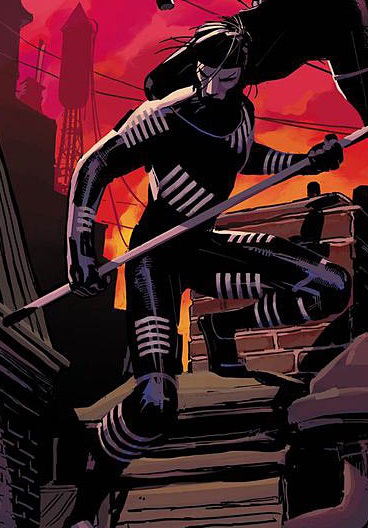
The first thing to note about the book is the artwork. While I’m not a huge fan of Daredevil’s new black and red costume (what is with the spikes on his emblem?) and a lot of the characters look the same in their facial features, Ron Garney, and Matt Milla’s art is fantastic. It’s a nice change of pace from most of Marvel’s current cartoonish style (which isn’t bad by any means) by creating a grainy muted look. It looks like how an old pulp, noir story should look. The backgrounds are specific and unique, there’s a great use of negative space in certain scenes, and the color red is highlighted to give an artistic pop to the dreary atmosphere the book creates.
However, my praise for the book begins and ends with the art.
The story is cluttered, confusing, and raises so many questions. This where I have to go back to the Mark Waid run of Daredevil, because there’re a lot of inconsistencies with the current story. At the end of Mark Waid’s run, Matt Murdock revealed his identity to the world, and even wrote an autobiography detailing his life as a costumed vigilante. He embraced both sides of his identity and worked hard to beat his depression. Foggy Nelson beat cancer, and strengthened his friendship with Matt Murdock even further. He even had a fun, intelligent, and hilarious new girlfriend Kristen McDuffie, who won the “I dated Daredevil and didn’t go insane or die” award.
So. In this new book, Daredevil has his secret identity again, Kristen McDuffie is gone, and Foggy Nelson is at odds with Murdock. Now if this were a new universe with new rules (à la DC’s “New 52”), I wouldn’t have any questions, because hey it’s a new universe. But, this book has a scene with Foggy and Daredevil talking about how Daredevil somehow got his secret identity back.
Foggy is not happy.
So, what the hell happened?
Did Daredevil make some deal with Mephisto? Did something happen in Secret Wars? Did the editors get drunk and stop caring about established continuity? Charles Soule never gives us a straight answer (possibly because Marvel’s editors haven’t figured out the story yet), and I wouldn’t harp on this so much if Marvel’s editorial didn’t constantly mention that everything that has happened after Secret Wars is not a reboot. So since this a continuation of Matt Murdock’s story, then it seems like it would be wise to give long reading fans some information that fill in the gaps.
I don’t mean to add fire to the ever-burning “Marvel vs. DC” fire, but DC did something similar and a lot better with one of their crossover events. After the book Infinite Crisis ended, all the current issues jumped one year in the respective DC timeline. However, they showed what happened in that year with the excellent 52, which not only filled in all the gaps, but told a fantastic story that focused on most of DC’s smaller characters. Perhaps Marvel should have done something similar with Secret Wars.
But, admittedly everything written about the continuity is just coming one bitter fan. And established continuity isn’t always the deciding factor with a comic in most cases. Hell, I would be disappointed if Charles Soule didn’t try his own unique story with the character. That’s exactly what Mark Waid did. (Although he did take the established continuity into account, I digress).
So, instead let’s look at this book as a potential jumping off point for new readers. Perhaps readers who were huge fans of the show Daredevil. This book still doesn’t work as it creates an unlikeable Matt Murdock who is no longer a defense attorney, but an assistant district attorney. His outlook seems colder and uninterested in the lives of those who may be affected by crime. And as mentioned before, Daredevil’s friendship with Foggy Nelson is nonexistent. It’s a complete contrast to what’s been set up in the show, and the only real connection at this point is that the artists smartly designed Matt Murdock to look like Charlie Cox.
Also, I just can’t help, but think his design is really boring.
There’s also a new vigilante named Blindspot, who has like three lines of dialogue altogether and the ability to turn invisible and is being trained by Daredevil. A new generic Asian themed gang, and a big reveal at the end that Blindspot has something to do with the villains, we’re not sure who he is as a character, so it doesn’t really have any weight behind it. And while the story may move on, it doesn’t really feel like it’s going anywhere at this moment. There’s not much else to say about this comic, because it just doesn’t feel like it’s doing anything different or evolving the character of Daredevil. And if the point of this book is to introduce Blindspot (which would be awesome to introduce a new Asian superhero into the market) then it failed at that too, because Blindspot was blander than the color of my living room in this book. Diversity and representation are important guys, so don’t half-ass it!
It feels like Charles Soule is trying to go back to the grim and gritty style Daredevil is known for, but it feels like something is holding him back from making this his own work. Maybe it’s because of the continuity earlier, or the Secret Wars mumbo jumbo, or that everything that’s supposed to be unique about the book just come off as generic and uninteresting. The new vigilante is dull and underused, the villains have no weight behind their threats or actions, and the conflict between Daredevil and Matt just feels random. While this could have been a unique story that brought in new readers, it just feels off-putting as it references past stories without giving enough details, changes the public consciousness of the character, and reimagines him as an unlikeable, boring, vigilante with nothing new for him.
Overall, this comic has great art, but not a great plot to work with and definitely needs some changes to keep new readers.
Shane Black is back behind the camera with The Nice Guys, a noir comedy thriller starring Ryan Gosling and Russell Crowe as a pair of mismatched detectives. This first trailer for the Kiss Kiss, Bang Bang and Iron Man 3 director (and writer of Lethal Weapon and Hawkins in Predator and so many other great things) is most certainly NSFW, but it is the funniest thing you will see all day.
Without further delay, The Nice Guys:
Here is a synopsis as well:
“The Nice Guys” takes place in 1970s Los Angeles, when down-on-his-luck private eye Holland March (Gosling) and hired leg-breaker Jackson Healy (Crowe) must work together to solve the case of a missing girl and the seemingly unrelated death of a porn star. During their investigation, they uncover a shocking conspiracy that reaches up to the highest circles of power.
I can’t decide which part of the trailer is my favorite, but the scene with Gosling on the toilet is the leader in the clubhouse right now. The Nice Guys hits theaters May 20.




 Set five years after Return of the Jedi, we are shown that despite