HBO has picked up Bill Hader’s new half-hour hitman comedy series, Barry. Deadline has a description of the project and some of the impressive cast:
Co-written by Hader and Silicon Valley executive producer Alec Berg, Barry centers on an ex-Marine (Hader) who works as a low-rent hitman in the Midwest. Lonely and dissatisfied in his life, he begrudgingly travels to Los Angeles to kill someone and ends up finding an accepting community in a group of eager hopefuls within the LA theater scene.
Bill Hader as an ex-Marine is funny in and of itself. And he plays a hitman who falls in with the LA theater scene? Goodness! The cast includes Henry Winkler, Sarah Goldberg, and Stephen Root. It’s great seeing Hader land a quality role after leaving SNL. He’s been win things here and there, lending his voice to animated films from tie to time, teaming up with Fred Armisen, and wonderfully playing the straight man in Trainwreck last year. But his talents belong front and center in something like this.
The team of Paul Thomas Anderson and Daniel Day-Lewis – responsible for what is, in my opinion, the pound-for-pound greatest film of the 2000s in There Will Be Blood – may be reuniting for another period drama. Everyone should will this to happen.
The plot of the film, produced by Annapurna, is mostly unknown at this point. But the report in Variety says “The film will be set in 1950s New York and revolve around the fashion industry, although the plot is under wraps.” This is still incredibly early as no studio is attached. This is usually the setback for PTA’s films for some strange reason; The Master took some time before a studio backed the project.
Daniel Day-Lewis, a notoriously private man who mostly stays away from Hollywood, hasn’t made a film since his last Best Actor turn, 2012’s Lincoln. Anderson, who recently directed a video for Radiohead, has been mulling this and other projects for a few years. His last film was the 70s PI comedy Inherent Vice.
The new Cinemax series Outcast premiered last Saturday (May 23rd) on the premium cable network. While I wouldn’t call the melancholy opening action packed, it was definitely interesting. The beautifully shot pilot of this dramatic thriller is superbly constructed by modern horror maestro Adam Wingard. Lets take a look at 5 key moments from episode 1, A Darkness Surrounds Him.
5. Squish!
The series opens on a slightly dysfunctional family unit. A mother and daughter argue over a busted curfew while were shown a little boy named Joshua in a bedroom down the hall. The child watches a cockroach crawl up his wall until suddenly, he slams his head against the wall obliterating the insect’s insides all over his face before biting off his own finger. This is our first sign of what’s to come.
4. Mommy Dearest.
We’re introduced to our main character Kyle Barnes (Patrick Fugit) around the eight minute mark. Through several chronologically oblivious flashbacks we quickly understand that Barnes is a man with a dark and haunted past. Soon after we’re given a shocking glimpse of Kyle’s possessed mother who ushers in a fierce onslaught of abuse towards her son.
3. The Good Father
Reverend Anderson (Phillip Glenister) is presented to us on as a card playing man of God with a warm sense of humor. The Reverend is called across town to see Joshua, the possessed child from the opening sequence. Once the good Father arrives he delves directly into a bruising physical battle with the entity inside Joshua. This scene leaves us with great concern about Reverend Anderson’s character and his brutal methods of ritual.
2. “You Hurt Your Little Girl”
Kyle is tricked by his sister in to attending an impromptu family dinner. It’s clear that both his brother-in-law and his niece want nothing to do with him. Kyle is sitting alone in the living room when his niece enters and states, “You hurt your little girl and now you’re not her daddy anymore”. The words destroy him completely and almost instantly. The scene leaves us with both questions of what has occurred and a subtle understanding that Kyle was likely not as responsible as we’re initially led to believe.
1. Exorcism Stories
This pilot episode is a long setup of mostly unanswered questions about Kyle’s supernatural past. When Barnes is eventually drawn to Joshua and Reverend Anderson we realize that he is something special, a living weapon forged to fight the demonic darkness of our world. As Kyle faces off with the possessed boy we’re given more information about his past and about his strange abilities. After this harrowing ordeal we finally understand Kyle’s true struggle and how it’s affected those close to him.
There you have it fright fans. Outcast is original and deceptively intelligent. It’s also slightly frustrating as it chooses to show us its story at its own pace instead of loading the viewer down with lazy exposition. I’ll be back next week to talk about the 5 key moments from episode 2, see you next time Horror Hounds.
If there were a Mt. Rushmore for B-movie all time greats, Maniac Cop would certainly claim a spot. The 1988 thriller is an exercise in grisly violence and slapdash production design, not to mention the fact the flick is loaded with some of the most legendary B-movie greats. But beyond its credentials as a midnight drive-in legend, Maniac Cop still feels eerily relevant today given its subject matter. Of course out of control cops these days aren’t gigantic cut up monsters stalking innocent civilians at night, but the notion of policemen abusing power has sadly never faded.
A nutcase in a police uniform is murdering innocents on New York City streets, seemingly without rhyme or reason. We see him first pick up a woman and snap her neck like a breadstick, then knife a driver with his billy-club blade. The murders draw the attention of detective Frank McCrae (Tom Atkins, the first in a cavalcade of shlock legends), who figures out in short order – because we don’t have the budget to stretch this thing beyond 90 minutes – the murderer is a former cop.
News gets out that this stalking psycho is a cop and the general public – represented by scant few extras because, again, budget stuff – goes berserk with paranoia and fright. A policeman has his head blown off during a traffic stop; if you look closely you can see the murdered patrolman is Ron Eldard. The police chief, played by Richard Roundtree (midnight marquee legend #2), implores McCrae to look elsewhere, but he is undeterred.
Then there is the case of the falsely accused officer, played by Bruce Campbell (#3). And speaking of Bruce Campbell, look closely and you’ll spot Sam Raimi as a reporter. None other than Jake LaMotta plays a detective. This thing is loaded with a specific kind of talent! McCrae’s investigation leads us into the backstory of our killer cop, Matt Cordell, a trigger-happy flatfoot who was sent to prison and subsequently attacked, sliced up, and left for dead. Only he didn’t die, he lived, and was reborn with an insatiable rage. The late, great Robert Z’Dar plays Cordell, and the guy’s chin is the stuff of legend. Z’Dar, a towering beast of a man, is silent and absolutely perfect, a low-rent version of Jason Vorhees or Michael Myers.
Maniac Cop is thrown together without much regard for sets, costume design, or art direction of any kind. The police station looks like an abandoned office building from a construction site, the costumes look thrown together from Goodwill, and the lighting is all fluorescent and weird. But all these elements make it perfectly imperfect. The haphazard nature of the film is the key element of its indelible charm. And the climactic showdown takes place in the middle of the day, a strange twist for films like these which exist primarily in the shadows. Perhaps that speaks again to budget constraints, but seeing Cordell in the light is also quite unsettling.
In 1988, the corruption of large metropolitan police departments had been rightfully exposed, so distrust was the status quo. Sadly, in most large cities, police confidence remains shaky at best, with unwarranted shootings dominating news cycles from time to time. Maniac Cop played off the disdain society had with The Force, but did so with such unbridled energy and camp violence it was able to separate itself from the headlines while still tapping into the paranoia-fueled undercurrent.
Two sequels sprang from the success of Maniac Cop, and Robert Z’Dar returned for both. And both sequels welcomed the wonderfully slimy Robert Davi into the fold (There’s a fourth out there, at least I think there is. Good luck finding it). A remake is also allegedly on its way in 2017, though very little has been said or done with it. Not that a remake needs more than a few weeks to get done.
With a little over two weeks to go before WWE Money In The Bank, it’s a great opportunity to examine the storylines heading into the June pay-per-view.
In this edition, we’ll take a look at the World Heavyweight Title match between Roman Reigns and Seth Rollins.
When Seth Rollins made his shocking return last month at WWE Extreme Rules and delivered a pedigree to Roman Reigns, we knew there’d be a confrontation the next night on Raw. Despite the cheers and positive interaction from the crowd, Rollins quickly re-established himself as a heel. Shane McMahon booked the title match for Money In The Bank and we finally had the feud we were supposed to have before Rollins injured his knee in November.
Fast-forward to this past Monday on Raw, and Reigns and Rollins did very little to progress their storyline.
Seth Rollins’ new slogan is “Redesign. Rebuild. Reclaim.” He’ll get a chance to reclaim the title in a few weeks but to this point he hasn’t redesigned or rebuilt who he is. In fact, it’s more of the same act we got from him before his injury. Those “cowardly” tactics worked when he had The Authority backing him and it justified his unwillingness to confront his opponent before a PPV match without a surprise attack. But alone, and without the title he never lost, Rollins didn’t show the fire and intensity someone in his position should. WWE’s intention was to portray Rollins as someone playing mind games with Reigns but the segment fell flat. It was a missed opportunity on Monday to further elevate Rollins’ desire and obsession to reclaim the title at WWE Money In The Bank.
As for Roman Reigns, it was more of the same. What should be an angry and vengeful champion, is in turn a laid-back, nonchalant champion who continues to tell the WWE Universe what kind of “Guy” he is (Spoiler Alert: He’s THE Guy).
It’s not like Reigns isn’t capable of carrying a feud. When done right, Reigns can generate the type of reaction WWE is looking for.
With that said, Reigns and Rollins will get two more weeks to build their feud and the opportunity to confront one another in the ring. Seth Rollins is likely to have something up his sleeve and a surprise attack seems inevitable. Let’s hope it plays out better than it did this past Monday. And let’s hope it sparks a fire under Roman Reigns and it leads to a great culmination at WWE Money In The Bank.
I used to laugh at people who wrote things like “Michael Bay raped my childhood” about the 2007 Transformers movie, partially because I liked the first one. It was about a young boy getting his first car to impress a girl, something that I could relate to…and then there were cool sci-fi elements. And even with the abysmal sequels the Transformers, to me growing up in the 80’s, were just cool toy robots that turned into cool toy cars. When I was a few years older, it was Teenage Mutant Ninja Turtles that I really formed an emotional attachment to as characters. TMNT is about brothers who bicker with each other and who come together in times of trouble. And, yeah, Michael Bay raped my childhood again with TMNT: Out of The Shadows. Or at least liposuctioned things from it that neither he, nor the people he works with as producers and directors, fully understand.
First, the positive elements. TMNT: Out of the Shadows makes the turtles a couple heads smaller than they were in the 2014 reboot. They are less the hulking monstrosities you remember from the previous film. Does this make them better ninjas, better able to sneak around like they did in the 1990 film? It does not. They are still smacking normal, human-sized bad guys into walls with one punch, saving their actual ninja fighting for larger, equally monstrous characters, which this movie has in abundance. Second, the movie does focus more on the turtles themselves. The personalities, teasing and interaction between the four turtles was the one thing the previous movie got right and I am happy to say that there is more of it here.
But the rest of it…a bunch of visually impressive action scenes, made watchable by the aforementioned brotherly interaction of the turtles duct taped together with a story that makes no sense, gives the human characters something to do, and does not explain many of the admittedly cool things that are in it. There are many lazy explanations for more complicated sci-fi elements in this movie, especially when we get to the laughably underused Krang and how Donatello figures out inter-dimensional travel and what he is up to. It is stuff that would be better explained in a better script. Even Ant-Man had more believable explanations for a guy in a suit who shrinks.
The dialogue in this movie is horrible. Say what you will about how dated the 1990’s Jim Henson Ninja Turtle suits look and how Mikey talked like a surfer, but Splinter had better dialogue and more emotion in 1990 than in this film. “I have tried to channel your anger, Raphael, but more remains. Anger clouds the mind.” Yeah, you remember that scene. The Ninja Turtles taught me that it was okay for a man to cry when I was 11.
And then there’s Casey Jones. I have no problem with him being better looking than he is in other versions. He is an ex-hockey player who got hit in the face with a few hockey pucks, so it makes more sense if he’s not that pretty. My problem with Casey Jones in this movie is the same I had with Jesse Eisenberg as Lex Luthor. Great actor. Cool character, but such a drastic deviation from previous versions of said character that you don’t know what THAT character is supposed to be. This Casey Jones is a prison security guard who only wears his hockey mask and fights with a hockey stick in one scene. And the next time he fights somebody, he uses roller blades with no hockey mask so the moms who took their kids to see this movie can gawk at his handsome mug. He is not crazy. He forms no friendship with Raphael and actually seems more buddy-buddy with Mikey. And he’s underused and underdeveloped just like Krang, Bebop, Rocksteady and Baxter Stockman. Was Karai in this? Yeah, I think she was. And the ending is just stupid for a bunch of reasons I won’t spoil here.
I’ve written articles about how I feel about these new turtle movies. Real fans know the best versions of TMNT are always combinations of the more serious indie comic book and the more humorous 1987 cartoon (the 1990 movie, the 2003 cartoon, the 2012 Nick cartoon, the current IDW series). The 1987 cartoon was, like most cartoons in the 80’s, based on the toy line and NOT the comics that the toy line was taken from. This movie tries to be an adaptation of the cartoon only, going for that mindless nostalgia factor when the only elements taken from the comics were the letters T.C.R.I. and Baxter being black. And it fails miserably at being a good adaptation of the cartoon.
But the saddest part is, there are people who grew up with the 1987 cartoons, who consider themselves die-hard Ninja Turtle fans who know nothing of the comics. Try talking to them about Fugitoid or the Triceratons (or even Eastman and Laird) and get blank stares. They think TMNT is supposed to be silly, because the cartoon was the only version they are familiar with. They don’t think something like TMNT: Out of The Shadows has the potential to be a more adult sci-fi thing, (Men in Black meets Avengers). Well, those are the people who going to make this movie a hit. And Platinum Dunes will make more of them and until hopefully, Michael Bay loses the rights to someone who understands this franchise. I just have to accept it and go catch up on some good Ninja Turtles, watching season four of the Nick cartoon.
What did you think of TMNT: Out of The Shadows? Did you like the 2014 reboot? How about Armaggon on the Nick cartoon? Isn’t he awesome? Sharknado meets Boba Fett. He’s from the old ArchieTMNT series y’know? Comment below.
Considering the title of this episode, many fans were hoping for the appearance of Yellow Diamond, the Gem World leader and for an epic battle to take place. Sadly, this isn’t exactly the final confrontation many believed it to be. Instead, just as the description says, Steven plays baseball but even without a nail biting battle, this is still a very entertaining episode.
The vessel from the previous episode is revealed to be filled with Rubies, the grunt soldier class of Gems. The main focus of the episode is watching the entire team try to come together to play as a team to beat the Rubies. The gems even use new identities to not give away who they really are. Lapis Lazuli as “Bob” is hilarious just for the lack of apathy she seems to display the entire episode. Her lack of any actual energy and laid back personality resembles MTV’s Daria, which would be a great way to distinguish her from the rest of the cast. She’ll be the sarcastic one who is simply going along for the ride with rest of the team’s crazy and outlandish behavior. Or then again it could just be the “Bob” personality she created to play game. Future episodes will show which is true.
The episode is filled with lots of humor and adorable moments as Ruby and Sapphire spend most of it flirting with each other. Maybe it wasn’t the intense skirmish fans were hoping for but still it was very enjoyable watching Steven and the Crystal Gems playing America’s favorite past time. Now if only those Rubies can find Jasper and then maybe the fans will get to see a brawl.
‘Ninja Turtles 2‘ Has Potential But Is Weighed Down By Too Many Characters
There’s something about Michelangelo, Donatello, Leonardo, and Raphael that brings joy to their fans. Maybe it’s the fact they love pizza or kick-ass but even a messy film like ‘Teenage Mutant Ninja Turtles 2: Out Of Shadows‘ has charm to it.
I’m not the target demographic for this Nickelodeon/Ninja Turtles movie but as a critic, I still have to point out the flaws. There is praises for the film like the wonderful characterizations & striking visual effects. I also appreciate the creators stopping all the unneeded nostalgia but ‘Ninja Turtles 2‘ still needs some work.
Below are three things the movie could’ve done to helped reach every demographic!
Bigger Action Sequences
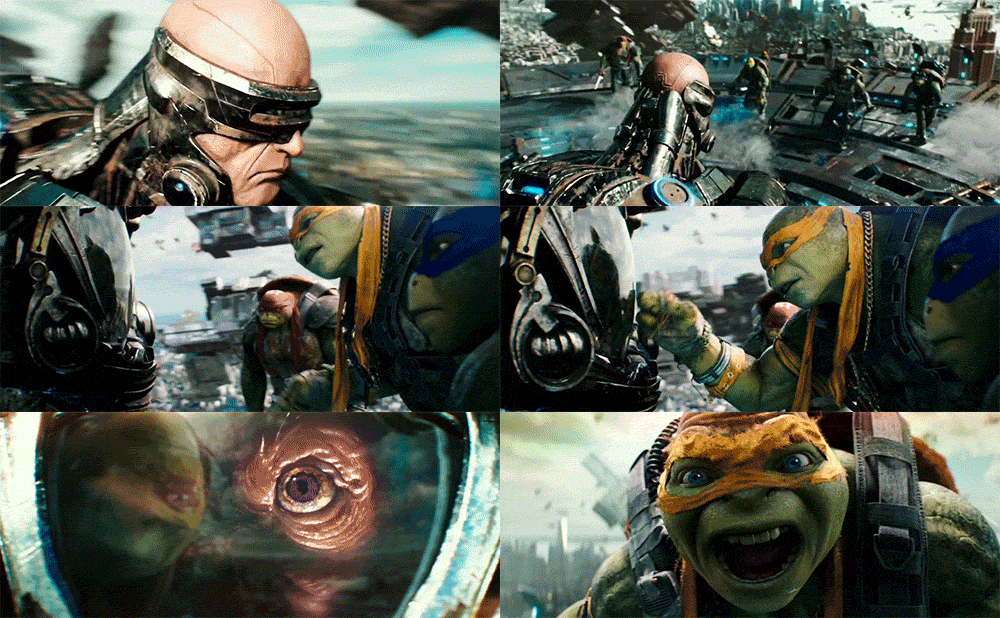
-For a Michael Bay-produced film, I would expect grander action sequences. Aside from the awesome plane scene, the turtles mostly had lackluster encounters. With these live-action adaptions, you’d think you’d get constant fighting. Alas, there isn’t much fighting unless it’s between the brothers. What really let me down was the end fight; it was basically a re-hash from the previous film. Only Krang didn’t make the impact Shredder did. Tweak this fight and it would have changed so much.
Way Less Characters
-I find the characters in the ‘Ninja Turtles‘ universe to be interesting so it’s enjoyable to see a variety within the film. If only the new characters got some screen-time, it wouldn’t have felt like they were lost in the shuffle. The hockey-mask wearing vigilante Casey Jones played by Stephen Amell was reduced to almost nothing. The movie also had too many bad-guys. You couldn’t even invest in one of them. Between Be-bop/Rocksteady,Shredder, and Krang, there is too many lame threats.
Focus More On The Brother’s Relationship
-When forced fighting isn’t happening, the bond between the 4 turtles was so organic. All actors involved embody their characters. Noel Fisher as Mikey is a real standout. While Alan Ritchson’sRaphael gets stuck being just a brute, the orange turtle Mikey shows comedic chops and some heart. If we had more of them working together and being funny, the film would have been easier to get into it.
I’ll totally be there to see ‘Teenage Mutant Ninja Turtles 3‘, my only hope is the films can keep improving. The kids enjoy it but some of the “big kids” wanna have fun to.
Will you be seeing the Ninja Turtles this weekend?
What a difference a couple hours and a planted rumor can make. Earlier today every major entertainment news outlet (even I) was reporting that actor Kirk Acevedo was currently doing makeup testing and auditioning for the role of Pennywise in the upcoming remake of Stephen King’s It. Well hold that thought, just hours later The Hollywood Reporter is confirming that actor Bill Skarsgård (Hemlock Grove, Divergent: Alliegant) is final negotiations with New Line for the role. Bill is the son of actor Stellan Skarsgard and the younger sibling of actor Alexander Skarsgard.
Two years ago True Detective show runner Cary Fukunaga quit the project due to creative differences almost completely killing the film. The actor cast at that time to play the dancing clown was Will Poulter. It became clear however that as Poulter’s career trajectory skyrocketed over the last 24 months, he most likely wouldn’t stay attached to the effect heavy role. Director Andrés Muschietti seems to have discovered his own vision of the demonic dancing clown in young Skarsgard.
This year marks the 30th anniversary of the best selling Stephen King novel. That makes all this news about the film even more interesting as the titular monster is said in the book to return every 27 to 33 years to feed on human prey. The new film will be two parts with the first being slated for a September 8, 2017 theatrical release.