When talking about the current generation of video game consoles, the Nintendo Wii U is often the butt of many jokes. Whether it be the console’s abnormal controller, lacking hardware, or ‘kiddish’ feel, many gamers simply don’t take the system seriously. Speaking as someone who owns a Wii U, Xbox One and moderately powerful gaming PC, I’m here to tell you that contrary to popular belief, the Nintendo Wii U is not only a great system, but will also leave a legacy similar to that of the Sega Dreamcast.
With the Super Mario 3D World bundle currently sitting at an impressive $244.97 on Gamestop.com, the console is the cheapest on the market by roughly $50. In the current day and age of new video games being $60, often coming incomplete and relying on $50 DLC to get the full game experience, having a low price is worth more than it ever has.
Getting away from the price point for a bit, I must mention that the biggest factor that makes the Wii U great is the thing that matters most in gaming – the games. For one reason or another, the Wii U is thought to not have many games of quality, which simply isn’t the case. The console has many amazing titles that will surely be regarded as classics in years to come, including Pokken Tournament, Super Mario Maker, Super Smash Bros. 4, Splatoon, Donkey Kong Country: Tropical Freeze, Mario Kart 8, Pikmin 3, and many others. With so many quality titles in the system’s library, I truly don’t grasp the concept or idea that the Wii U doesn’t have any games, because said statement is objectively incorrect.
Often times people criticize the gamepad before actually using it. Yes, even me, the die-hard Nintendo fanboy was skeptical when they first showed it off, but over years of using my gamepad, I can honestly say that it’s one of the better controllers to hit the market in the past ten years. While the controller is comfortable when playing the Wii U’s vast array of platformers, shooters, RPG’s or other solo adventures, it’s utilized perfectly with Splatoon’s gyroscope controls, giving it an experience different to that of any other shooter on the market today.
While the Nintendo Wii U is on its last leg, not likely to see any first party titles past The Legend of Zelda: Breath of the Wild in 2017, I strongly urge you to get out and buy this console while you can. It may be the joke of the current gaming generation, but its vast array of amazing titles will remain classics worth revisiting in five, ten, twenty years and beyond.
A man who dedicated his adult life reminding the world the horrors that scared his childhood has passed away today. Elie Wiesel, who passed away at eighty-seven years of age. His life shows the strength of the human spirit in spite of terrible tragedies. And the resilience of one to never give in to their inner demons.
Born in what is now Romania, his life took a turn in 1944 when he and his family were taken to the concentration camp, Auschwitz. Exposed to daily horrors, and forced to revert to a primal state of living to survive, Wiesel found it difficult to return to a world that took his parents
The years following his ordeal, Wiesel found his purpose in telling his story to the world. Writing many works on the Holocaust, including the seminal work, Night. Having read the book myself as a young man, recalling the harrowing scenes of Wiesel’s youth still gives me a cold shiver running up my spine.
Wiesel explored themes regarding how one continues living in a world after such trauma, why human beings could resort to such barbarity, and how one does live on when their faith in God is shattered.
Wiesel’s key causes in life was to keep the world from forgetting what happened to him and millions of victims during the Second World War. This effort has not been without opposition, including an attack by a Holocaust denier back in 2007.
His achievements later in life did not ease the pain of the Holocaust, openly stating suffering from nightmares, continual feelings of insecurity and other similar afflictions. Yet, this did not stop his drive to preserve the memory of all victims of Nazi atrocities.
Wiesel never claimed to be a flawless character, but his example is one that we should emulate, in lieu of the plethora of false idols and figures who share the spotlight in our modern age. In the face of adversity and depravity, it is the will of men and women such as Wiesel that show us how to achieve a greater purpose, and find tranquility in the world’s turbulent madness.
Elie Wiesel is survived by his wife and son. And his influence will never be forgotten.
The Vans Warped Tour invaded Vinoy Park in St. Petersburg, Florida on a hot Friday afternoon. The Warped Tour is the largest traveling music festival in the United States, and the longest-running touring music festival in North America (est. 1995).
Less Than Jake, Sum 41, and Yellowcard rocked the bay. Coldrain, a metal group from Japan was by far the loudest band of the day. Vinoy Park provided a reliable venue to watch 80-plus bands in ten hours. The acoustics were set up well as the different stages didn’t overpower each other. The Warped Tour is a great festival to meet your favorite band as every group fought for your attention at tent city.
Cody Rhodes Guest-Stars On ‘Arrow’! Who Could He Be?
Coming off his requested release from WWE, Cody Rhodes is staying busy. He has convention appearances and many upcoming wrestling shows; including the infamous PWG’s BOLA! Early on July 2nd, ‘Arrow‘ star Stephen Amell tweeted out Rhodes will be guest-starring on the fifth season of the show.
When Rhodes and Amell squared off in a WWE ring, Rhodes was the villainous but campy Stardust character while Amell was obviously Green Arrow. Their match at 2015’s WWE Summerslam was hyped amazingly well and surprised wrestling fans by being quite memorable. During that time, Rhodes shined as this comic book-style villain. Could he want to bring that to the ‘Arrow‘ set?
My vote is for Cody to play iconic Green Arrow rogue Onomatopoeia!
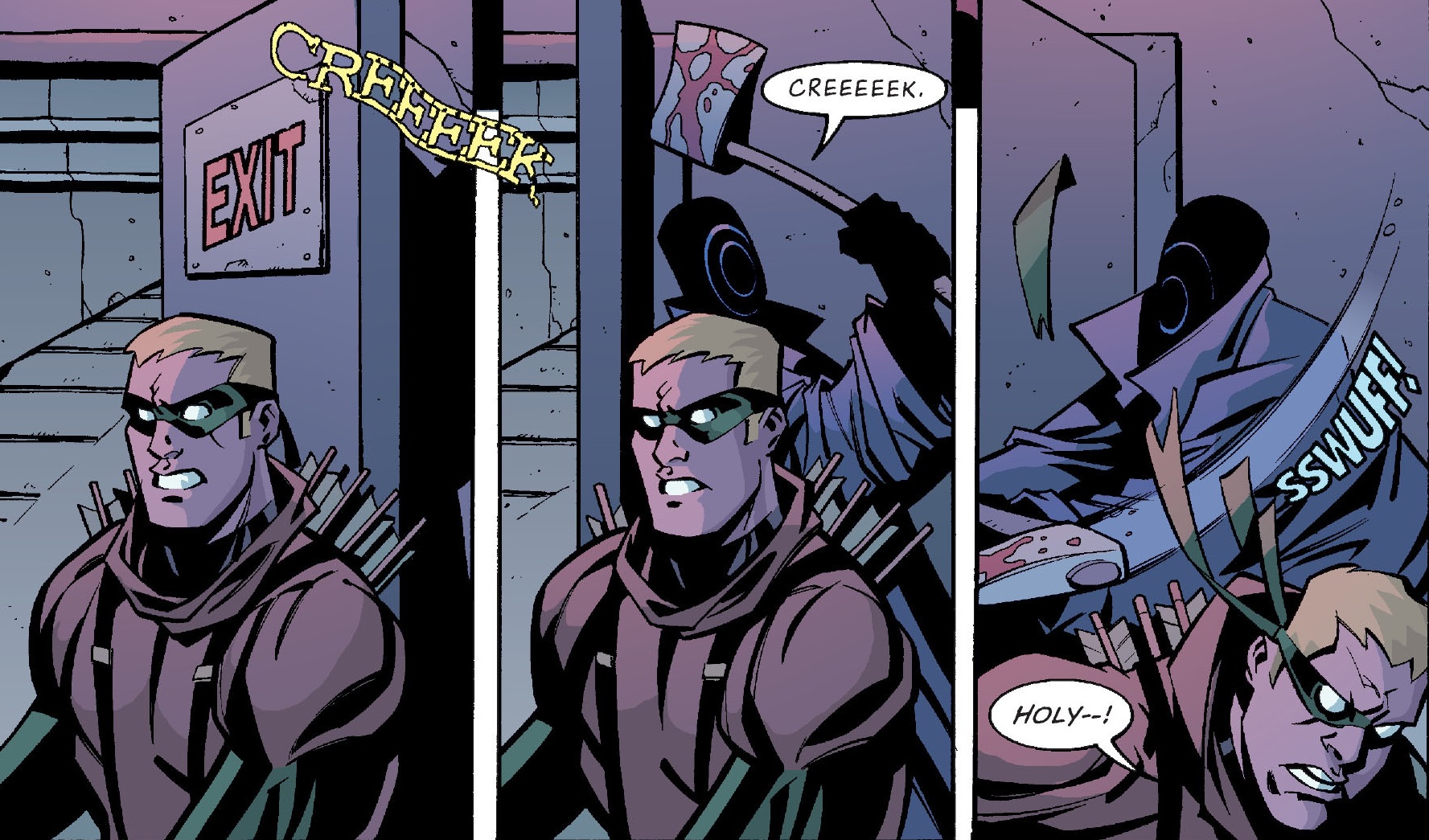
Onomatopoeia is a masked serial killer. He’s been known to fight against Batman but is most famously known as a modern Arrow villain. Onomatopoeia is truly bizarre and deadly. Something Cody Rhodes perfected during his time in WWE.
Also, Onomatopoeia creator and film director Kevin Smith recently talked about wanting to bring him onto ‘Arrow‘. Smith has been confirmed to be working on an episode of ‘Arrow‘ in Season 5 so the stars are starting to align.
Who do you think Cody Rhodes should star as next season on ‘Arrow‘?
Recently, while talking to Entertainment Weekly about Kung Fu Panda 3, Commissioner Gordon actor J.K. Simmons was asked about his approach to playing the character in Justice League.
“People of my generation remember Commissioner Gordon as this jolly, ineffectual Santa Claus type, and I think over the years in the comics there’s definitely much more of a badass side to him. One of the things that’s interesting to me is investigating hopefully a little bit more of that badass [side]…You’re living in a universe where it’s pretty tough to be a badass compared to somebody like Batman, but in the universe of non-superheroes I like the idea of Commissioner Gordon as a guy that can take care of himself, a guy that’s a real partner to Batman, not just a guy that turns on the bat signal and goes, ‘Help! Help, Batman!”
Simmons also expressed interest in playing the character for years to come, saying:
“It’s been a fun experience, and knock wood, if it continues, then I’ll hopefully get to play Commissioner Gordon in a handful of movies.”
Although there’s been no confirmation of Simmons playing Gordon in any other DC film other than Justice League, I’m sure we’ll see him pop up in the Ben Affleck led Batman film, among others.
Are you excited to see Simmons’ portrayal of Commissioner Gordon in next year’s Justice League film? Let us know in the comment section down below.
Justice League hits theaters on November 17, 2017.
Talented yet stubborn, Cimino was a maverick filmmaker
Oscar-winning director-producer Michael Cimino is dead. He is believed to have been 77 at the time of his passing.
According to Variety, Thierry Fremaux, the Cannes Film Festival director, tweeted the news, and he confirmed the director died on Saturday. He writes, “Michael Cimino died peacefully, surrounded by his family and the two women who loved him. We loved him too.”
Cimino is the subject of many stories and myths
Beginning in 1971, Cimino got his Hollywood break as the screenwriter of Silent Running, starring Bruce Dern. He next wrote Magnum Force, which was the second film in the Dirty Harry series. Camino would direct Clint Eastwood in 1974’s Thunderbolt and Lightfoot.
Cimino’s magnus opus is The Deer Hunter, starring Robert De Niro, Christopher Walken and Meryl Streep. The 1978 war drama proved to be controversial, because critics accused the portrayal of the Viet Cong as racist. Another issue concerned the film’s depiction of Russian roulette on prisoners of war.
Michael Cimino’s Oscar win for The Deer Hunter is one of the more controversial in film history
Despite these criticisms, The Deer Hunter became a commercial success. It won five Academy Awards, including Best Picture and Best Director. Christopher Walken also received the Oscar for Best Supporting Actor.
Cimino’s next film was Heaven’s Gate, starring Kris Kristofferson, Walken, Jeff Bridges, and Isabelle Huppert. The movie went vastly over budget, ran nearly four hours, and practically sank United Artists. Although it was a box office flop, Heaven’s Gate has since been restored and praised as a technical achievement.
Despite being overlong, Cimino’s 1980 western Heaven’s Gate is a technical achievement
Following Heaven’s Gate, Cimino became a pariah in Hollywood. He managed to direct films such as Year of the Dragon, The Sicilian and Sunchaser. Although they were completed on time and on budget, none of them proved to be successful. Despite these setbacks, Cimino is said to have kept planning more movies. His last work is the 2007 short film No Translation Needed.
“Who can take a sunrise and wrap it in a bow?” Why, Willy Wonka can and has for the last 45 years. Now, it’s time to take a look back at this whimsical cult classic and see if it’s as scrumdiddlyumptious as many remember.
Writing
Thought it was dismissed by its creator, Roald Dahl, the story of the film still reflects the plot of the original novel very closely. Willy Wonka (Gene Wilder), a reclusive candy maker known throughout the world holds a contest to allow people into his factory. He distributes five golden tickets and those who find them will be allowed into his factory. A young boy named Charlie (Peter Ostrum) dreams of winning one of the tickets, but is impoverished and unable to buy enough truly participate in the contest. Until he buys one candy bar and finds the last golden ticket inside.
The story is solid and has a lot of themes which serve as great lessons to not only children but parents as well. The plot focuses on the importance of imagination, honesty, and doing what is right. Values which are still integral today. It’s light, yet powerful storytelling is part of what has made this film a favorite of many.
Directing
The director’s changes to the book are what led to this movie being disowned the first place. Changes such as making Slugworth into a spy and the infamous boat scene were his call to make. Thought the first could be forgiven the scene with the boat is unnecessary nightmare fuel in an otherwise pleasant and whimsical film. The director needs to be held accountable for scarring many children for life. Yet at the same time he introduced the scene where Wonka makes Charlie think he doesn’t get the lifetime supply of chocolate, which featured one of the best rants ever by an actor in a film. This one is kind of a toss up.
Music
The music of this film is iconic in many ways. Even songs like “Golden Ticket,” sung by Grandpa Joe (Jack Albertson) thought he doesn’t have the best voice ever truly has found its place in history. Just staying the line, “Who can take a sunrise,” will get easily cause a majority of those nearby to immediately recall the song “The Candyman” in an instant. This movie has some of the most memorable songs ever and are so essential, owning the soundtrack is a necessity for fans of not only the film but of musicals as well.
Acting
The acting in this film is spot on. Ostrum’s performance as Charlie makes him feel like a real kid instead of an actor pretending they know how a child acts. The other four Golden Ticket winners act as obnoxious as possible to the point when their unique punishments occur, the audience is glad to see them leave.
The person who really steals the show is Wilder’s performance as Willy Wonka. He comes off as a mixture between an artist, a con man, and a genius all at the same time. When he starts to act odd his behavior models a supervillain, yet everyone is put at ease moments later as he shows off a new invention or concoction to them. It’s a shame he was never nominated for an Academy Award for the performance he gives.
Production
The production of this film perfectly contracts the difference between the imaginative world of Willy Wonka’s factory and the drab world of the mundane. It offers a feeling of being in a dreamworld, much like the scene in The Wizard of Oz when Dorothy opens the door and finds the world filled with color and life. Entering into Wonka’s factory feels like something out of a storybook, complete with candy growing on trees, chocolate rives, and tiny magical creatures to help make it all possible.
The film is cult classic for a good reason. It possesses just as much fun and joy as it did when it debuted back in 1971. It is a film which is truly integral viewing for all who enjoy a heartfelt story filled with candy, catchy songs, and a feeling of a golden ticket being right around the corner waiting for them.
Willy Wonka And The Chocolate Factory was presented by Fathom Events as part of their TCM Big Screen Classics event.
The Season three premiere of Outlander airs on Starz tonight, September 10th. For those who don’t remember, Outlander Season 2 saw some serious changes to the show’s formula. Outlander started out as a show about a woman out of time, but it has steadily developed into a show about the ongoing exploits of a time traveler attempting to right historical wrongs (emphasis on “attempting”).
Since Outlander has covered so much ground in its 13-episode second season, I present the Complete Guide to Outlander Season 2 for those who need a refresher. Read on, fellow Jacobites …
Claire and Frank see the new world in Outlander Season 2
Outlander Season 2 started off with an unexpected visit to the 20th century. Claire stumbles out of the forest and into a paved road. A car nearly hits her. The driver informs Claire that it’s 1948 and the English won the Battle of Culloden. Claire’s reunion with Frank proves tense but he agrees to raise her and Jamie‘s unborn son. Frank demands that Claire never investigate the life of Jamie Fraser. The reunited couple fly to the US and Claire has a flashback to her time in France (where Season 1 left off). Jamie and Claire take up residence in Jamie’s uncle’s house. They become wine merchants who seek to covertly undermine the Jacobite uprising. We meet le Comte St. Germain and Claire demands that the authorities burn his smallpox-infested ship and cargo.
Jamie has night terrors involving Black Jack Randall. As a result, he’s unable to be intimate with Claire. Claire learns the intricacies of running an 18th-century house. We meet Mary Hawkins, a freshly waxed Louise de La Tour, Master Raymond, Charles Stuart, and Alexander Randall in this episode, all characters that figure largely in Outlander Season 2. Jamie and Murtagh‘s first meeting with Stuart confirms their suspicions: he is a ponce who won’t accept good counsel. The Frasers secure an invitation to King Louis XV‘s court in order to try to curry favour with the French king.
We see Louis attempting to take a dump and Jamie suggests the king eat porridge. Claire spurns the flirtations of Joseph Duverney the French finance minister. He begs to help her in order to keep his extra-marital advances secret from his wife. We see the return of the Duke of Sandringham who reveals to Claire that Black Jack is still alive after his run in with a herd of cattle in Season 1.
Jamie and Murtagh develop a plan for stopping the Jacobite uprising and Claire realizes that the stammering Mary Hawkins is actually her 20th-century husband Frank‘s ancestor. Claire’s inner monologue describing the implications of Mary Hawkins’s lineage represents another brief return for Outlander to the Fantasy genre, back from Romantic Historical Fiction. And, Claire and company meet Mother Hildegarde (Frances de la Tour), the harpsichord-playing nun with a keen medicinal sense, and her dog Bouton who can apparently smell infections (woof). Oh, and Claire tastes pee.
Jamie Fraser goes full Riker, hoisting Claire up like she weighs nothing at all
“La Dame Blanche” contained a revelation of royal adultery and a long-awaited sex scene featuring a pregnant Claire. “La Dame Blanche” also covered some disturbing ground, specifically Mary Hawkins’s rape at the hands of a Parisian brigand. Also, viewers finally saw Jamie and Claire form a concrete plan on stopping the Jacobite rebellion: they want to discredit Charles Stuart in front of his recently revealed potential financier, the Duke of Sandringham. Unfortunately, things don’t go according to plan and Jamie is arrested while St. Germain suggests to Stuart that they retire to a less boisterous environment.
“Untimely Resurrection” featured the long-awaited return of Black Jack Randall. Jamie and the duke discuss “horses”. Claire and Jamie both suspect St. Germain is responsible for Mary Hawkins’s rape but, as a whim of Charles Stuart’s demands, Jamie and St. Germain are now the most begrudging of business partners. And, Claire tells Jamie that Frank is Black Jack’s descendant. She bargains with Jamie to allow Randall to live for one year.
I lost my wine, I lost my money, and my wig is itchy!
“Best Laid Schemes” threw viewers some curveballs. Murtagh learns the origin of Claire’s unique perspective on 18th century life. Claire has her first real conversation with M. Forez who describes the process of drawing and quartering to her. Claire comes up with a concoction that will make it look like another of St. Germain’s shipments has been infected with smallpox. Murtagh successfully stages a robbery of St. Germain’s shipment of wine and we see Stuart break into tears at the thought of returning to Poland. Fergus learns the hard way not to go anywhere near Black Jack Randall, and Jamie, avenging his young ward, duels with Randall. As a result of the duel, Jamie is arrested and Black Jack is stabbed in the groin. A miscarrying Claire watches from the sidelines, screams, and keels over.
“Faith” exposed the hypocrisy of King Louis XV’s sorcery trials, ended the life of Season Two’s de facto villain St. Germain, presented a moment in Claire’s 20th-century life, and showed an emotionally overwrought Claire mourning the death of her stillborn baby. Claire gets it on with the constipated king in order to secure Jamie’s release from the Bastille (also an orange). And, with Jamie exonerated, the Frasers are able to return to Scotland. Jamie and Claire say a tear-filled farewell to their unlucky firstborn at her grave and set their sights on Lallybroch.
“The Fox’s Lair” gave viewers a break from Outlander’s regular fare of misery. Although “The Fox’s Lair” did contain threats of rape and execution, standard fare in Outlander, no one was actually attacked in this episode aside from Lord Lovat‘s seer Maisri, and that was just yer run-o-the-mill servant whooping. It seems that, unsurprisingly, Fergus may have abandonment issues. And, still very much in love with him, Laoghaire MacKenzie craves forgiveness from Jamie after having accused Claire of practicing witchcraft in Season One. An unforgiving Claire takes advantage of Laoghaire’s guilt: Claire, seeking to embolden Lord Lovat’s son Simon Fraser, instructs Laoghaire to show some interest in young Simon.
Young Simon, emboldened by a flash of Laoghaire’s boobs, stands up to his father and demands that he pledge men to the Jacobite rebellion. And, though Colum succeeds in convincing him to sign a neutrality pact, Lord Lovat unofficially provides a small force to help his son fight in the rebellion.
“Je Suis Prest” operated as an intermediary between the events of Seasons one and two. We saw some old friends who stayed behind in Scotland while Jamie, Claire, and Murtagh went to France. The battle tactics and pecking order of Jamie’s troops were challenged by one of those familiar faces. And, viewers were given a rare look at Claire’s time as a World War II combat nurse by way of a her reliving those events through PTSD flashbacks.
“Prestonpans,” contained some long-awaited action. The battle scene gave viewers a graphic sense of what being involved in this early-morning raid may have been like, and a couple of characters introduced in Season One didn’t make it through the battle. Fergus‘s mental health is at no risk of spontaneously improving, having just gotten a taste of what being involved in a Highland charge is like. It was bloody. It was gory. It was Prestonpans.
Murtagh used a bit of the ultra-violence to wrap up a loose end in “Vengeance Is Mine”. Wrapping up that loose end, though, involved Murtagh doing away with one of Outlander’s best guest stars. Claire and Jamie seem to be no closer to stopping the Battle of Culloden: the other generals disagree with Jamie’s (and Claire’s) advice to push on to London rather than retreat to Scotland until spring. And, Rupert‘s in a bad way. Already mourning the death of Angus at Prestonpans, Rupert sustains a potentially fatal injury at the hands of the redcoats.
“Hail Mary,” featured the inevitable return of the complicated villain Black Jack Randall. “Hail Mary” also cleared up a question viewers may have had about Claire’s 20th-century husband Frank‘s lineage. And, viewers said goodbye to two recurring characters in this episode, one who’s been around since Season One and one who appeared in Season Two.
“Can we clone Highlanders from this and open a theme park?”
Claire and her daughter Brianna meet Roger Wakefield at his father Reverend Wakefield’s wake. Brianna and Roger get close as the episode goes on, and Roger is eventually revealed as the descendant of Gaellis Duncan, who Claire and viewers previously saw burnt at the stake in the 18th century. But with no visible signs of having been burnt alive, Gaellis appears in 1968 calling herself Gillian Edgars! Claire, after proving by way of a DNA test that Roger is actually Gaellis’s (Gillian’s) descendant, resolves to try to stop Gillian from passing through the stones. On top of trying to stop her from being burnt alive after traveling back in time, Claire also discovers that Gillian intends to sacrifice someone in order to make the trip back.
In the 18th century, Jamie’s got his own problems after murdering his own uncle to cover up his conspiracy to kill Charles Stuart — Claire and Jamie hatched the ill-fated plot in an effort to prevent the Battle of Culloden. Sigh, life’s tough for a Scottish revolutionary and his time-traveling wife.
Briann’s skepticism about her mother’s mystical time travel story vanishes upon seeing Gillian disappear into the stone after lighting a man on fire. So with her faith in her mother restored, Roger and Brianna show Claire a document that implies that Jamie Fraser survived the Battle of Culloden. Credits roll as Claire gazes optimistically at the stones.
Next Steps …
I’m interested to see where season three takes us. Will Claire be the same age she was during the Season Two finale, or will she somehow revert back to the age she was before she traveled back to the 20th century? Will Roger or Brianna travel back in time as well? What’s going on with Fergus? Will Jamie and Claire get to meet up or will viewers be forced to wait until the Season Three finale for their reunion? These and other questions will hopefully be answered this season, but, as usual, I’m sure other questions will pop up along the way.
Old Style’s unique label is rife with history … and bunnies!
It’s Canada Day weekend! Celebrations may vary from town to town but it’s a safe bet that a few Canadians will drink a beer or two this long weekend. And, what better beer to drink on Canada’s 149th birthday than a beer that’s 90 years old itself? Though it can’t be considered a craft beer, Old Style Pilsner is a well-made brew that, as its website states, hasn’t changed much since Fritz Sick first brewed it in 1926.
One change that Old Style did go through was its purchase by Molson in 1958. According to wikipedia, Molson Coors continues to use Sick’s Breweries Ltd.’s original formula to make Old Style Pilsner. I picked up a 24 of this tasty Canadian brew in an effort to be frugal, ten dollars less expensive than a 24 of my usual beer. But Old Style isn’t just good on the pocket-book, it’s just good.
Old Style Pilsner – First Sip
Old Style Pilsner is nearly clear with a lot of carbonation (similar to the kölsch I reviewed last week). An inch-thick layer of foam forms as I pour it into my pint glass. I don’t notice a strong smell as I take a big gulp of this brew. Old Style has a noticeable taste though. Best described as an acquired taste, it has a smooth grainy taste with a tart finish. And, Old Style Pilsner’s relatively high carbonation level strengthens its watery mouthfeel.
Old Style Pilsner – Last Sip
Although some picky beer drinkers may turn their noses up at this 5% ABV macro-brew, I recommend it over lots of other similarly priced beers. Old Style plays the sweet-and-sour angle well. I like to drink Old Style from a glass but you’ll enjoy Old Style directly from the bottle or can. Pouring into a pint glass allows Old Style Pilsner’s frothy head to dissipate a bit. Enjoyed straight from the bottle, the foam can overpower Old Style’s flavour.
The Neon Demon composer will write the score for the new Wolverine movie
Film composer and musician Cliff Martinez is branching out into comic book movies. He will create the score for Twentieth Century Fox’s Wolverine sequel.
According to Collider, Martinez is confirmed to be writing the film score for the X-Men spin-off. He replaces Marco Beltrami, who scored Mangold’s 2013 flick The Wolverine. Harry Greyson-Williams did the score for 2009’s X-Men Origins: Wolverine.
Martinez’s body of work includes Steve Soderbergh’s Solaris, Nicolas Winding Refn’s Drive, and The Neon Demon. He also composes music for The Knick. His current projects include Martin Campbell’s The Foreigner and Todd Phillips’ War Dogs.
As a composer, Martinez is known for his layered textures and rhythmic sounds. His scores use ambient sounds and audio manipulation. He is a Rock and Roll Hall of Fame inductee because of his drumming work on two Red Hot Chilli Peppers albums.
Can Cliff Martinez create a score appropriate for Wolverine? Snikt!
Mangold’s Wolverine sequel is now filming. It will be a loose adaptation of Old Man Logan. The plot is currently unknown, but it is said to take place in the distant future of the X-Men universe. Reports indicate the flick might be a revenge movie, because Wolverine wants to shut down the Weapon X program for good.
Hugh Jackman says this is the last time he plays Wolverine. The movie’s cast also includes Patrick Stewart, Boyd Holbrook, Richard E. Grant and Elizabeth Rodriguez. Liev Schreiber is reported to be in talks to reprise the role of Victor “Sabretooth” Creed.
The Wolverine sequel is set for release on March 3, 2017.
Less than one year to go until we see Wolverine again