


Writer/artist Wes Craig (co-creator of Deadly Class and The Gravediggers Union) is no stranger to Superman, as he wrote and drew a short story in Superman: Red & Blue #1. Craig is now taking The Man of Steel back to his early days in Superman: The Stranger, a new DC Black Label series that draws inspiration from the publisher’s Golden Age and presents a stripped-down version of the hero, one without the numerous abilities and colorful characters that have become the status quo in recent years. The six-issue miniseries will examine Clark Kent’s fight for a better tomorrow, with colorist Jason Wordie and letterer Tom Napolitano rounding out the creative team. Craig recently discussed the book with us.
Check out the conversation below and grab Superman: The Stranger #1 when it comes out this Wednesday, September 2nd, 2026:
Monkeys Fighting Robots: You previously did a story about Superman’s early days in Superman: Red & Blue #1. Why is this time period in Superman’s history so appealing for you? Why is this the right time to return to it?
Wes Craig: It’s a very different story, honestly. The story I told in Superman: Red & Blue used the “in-continuity” Superman. The Superman in The Stranger has a lot of the same DNA, of course, but there are also some major differences. Thinking about it now, though, I guess The Stranger and my story in Red & Blue share one common thread in that I like to think of superheroes as inspiration for us as people to work for a better world. But I think we get in trouble when we look to other people as “saviors” or heroes that will do everything for us. That’s one of the recurring concerns I have when I write these kinds of stories, so both stories take on that idea in different ways. As for setting the story in Superman’s early years, the early life of these characters (and their end, too) is always an interesting place to set a story, since superheroes spend most of their time in the endless “second act” of serialized stories.
MFR: What was the first thing about Superman that you wanted to redefine or explore when you began working on Superman: The Stranger?
WC: A few things, but one aspect that always kind of bothered me was the idea that he’s only really acting under the wishes of his father, Jor-El, in some stories, or under Pa Kent in others, or sometimes both, like the Christopher Reeve movies. I get the reasons for those. In the Reeve movies, it was a kind of Jesus-dynamic with the heavenly father and the salt-of-the-earth upbringing. But to me, I want Clark to make his own decisions. In the original story in Action Comics, he’s raised in an orphanage, which changes everything, right? He still becomes the Superman we all know, but in this story he had to find his own way, and he doesn’t know he’s an alien. So under the surface, in hopefully subtle ways, I think that makes him different. He fights his fight because of what he’s seen in the city and what he’s lived. He was raised in the underclass, and that’s what shapes him.
MFR: How did you approach balancing the iconic imagery of Superman with your own artistic style?
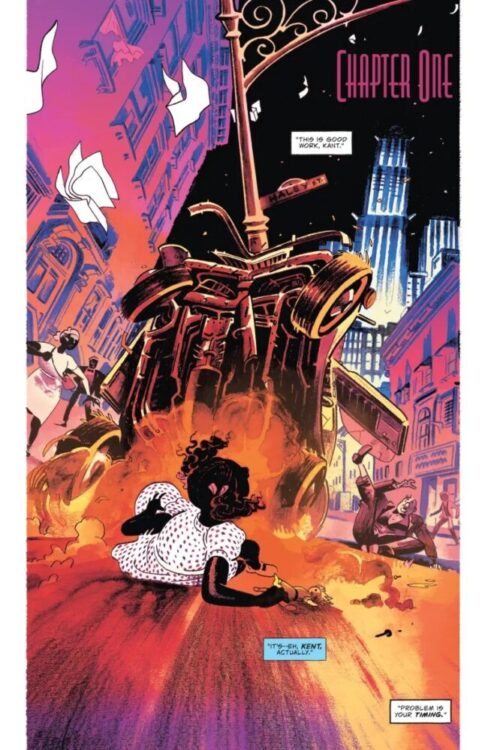
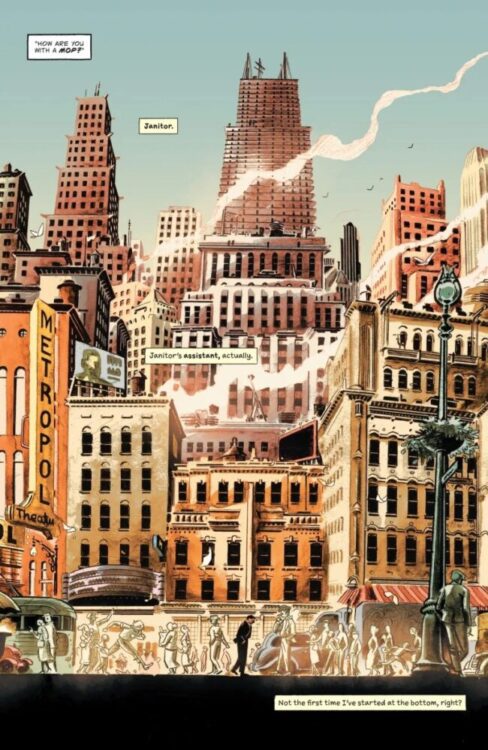
WC: I think at this point in my career, I just draw how I draw. I don’t overthink it as much as I used to. But I do like to take influences on whatever I’m working on and let them be a kind of extra layer on top of my drawing. With Deadly Class, it was 80’s comics and punk rock posters. With Kaya, it’s fantasy paperbacks and 70’s animation. With The Stranger, it’s Art Deco and the Fleischer Studio Superman serials.
MFR: Superman is one of the most legendary characters in comics. Was there a particular aspect of his personality or history that you found especially exciting or challenging to put your own spin on?
WC: I just really wanted to take what I saw as his original personality when he first appeared in 1938 — a brash young man fighting for social justice — and contrast that with the more fatherly character he’s become. There have been other stories that take this approach, most notably Grant Morrison and Rags Morales on Action Comics during DC’s New 52 and the current Absolute Superman run. These go back to his roots. This story has similarities, but I think it stands on its own because of the era it’s based in. And we’re different creators, so we’re going to bring different approaches. The words “social justice” have a certain connotation now, but I really just mean that his early adventures involved real-world problems, like saving someone from death row, intimidating a slum lord, threatening a man beating his wife, etc. I think Superman’s creators, Jerry Siegel and Joe Shuster, saw these social ills and created a character they wished could just fix all this stuff with brute strength. My approach has something to do with that, but presenting that idea in a more mature fashion. That’s what I’m going for, at least.
MFR: In the announcement about the series, you said the original version of Superman is the one you love the most and the one that reflects the modern world the best. Could you expand on that?
WC: I really love a few different versions. I love Christopher Reeve’s portrayal. That was huge for me and my brother when we were kids. I love All-Star Superman, and John Byrne’s years on the character were a major influence on me, too. But I think the original version is such a different character, so I find him a lot of fun. It’s like Superman’s wild twenties. He’s outgrown that time in his life, but man, they were a lot of fun. I wanted to take that character and really make him feel real and human, with all his mistakes, his yearnings, internal conflicts, and all the stuff we all feel each day. We think of Superman, generally, as being kind of “perfect,” like he always makes the right decision. But this Superman is flawed, headstrong, and looks before he leaps (over a tall building in a single bound). As for how the 1930s reflect our current times, the jingoism, growing fascist support, and a bunch of egomaniacs fighting over the title “world’s richest man” while trying to keep average people from unionizing or earning a fair wage. The list goes on and on, unfortunately.
MFR: In that same announcement, you noted that the story you wanted to tell strips Superman of Ma and Pa Kent, as well as Krypton and Smallville, focusing it on the story of a young man with incredible powers battling corruption. What appealed to you most about Superman in this context?
WC: I guess there was just something about him being on his own that excited me — a stranger, an invisible man, in a big city. Also, Superman as an urban legend, a rumor, something that would be almost impossible to do in modern times, with a million cameras recording in every direction. A lot of times these ideas can begin with a single image, and for me, it was Superman alone on a rooftop, looking up at the stars and not knowing where he came from or how he got these incredible powers. I’m not sure why, but that really hit me. I wanted to tell that guy’s story.
MFR: How did you and the rest of the creative team approach making the world of Superman: The Stranger feel both unmistakably Superman and unlike a typical Superman story?
WC: We include Superman, Lois, and Luthor. I don’t think you need much more to make it a Superman story than that. Actually, Luthor is one of the elements that’s not in Action Comics #1. I gave myself a rule that I was writing this book like nothing else existed after Superman’s first appearance, but I had to cheat a little; Luthor had to be in there; he’s too perfect for the story.
MFR: The series draws from DC’s Golden Age of comic books and the Fleischer Studios Superman cartoons; how did they influence the look or atmosphere?
WC: The look of the Fleischer cartoons is a big influence, definitely. His dark blue, almost black costume looks so cool. I lean into that more as the series goes on just because I think it looks so good. I think colorist Jason Wordie and I are very in sync with that approach. But another major influence from when I first saw those cartoons was Superman’s physicality. When he jumped into the air, he felt like he was using all his strength to bound up over the skyline, not just floating up. That’s the same approach they used if he was stopping a train or fighting a robot or punching a laser beam. He felt like he could be hurt, and his powers took effort. That stuck with me.
MFR: When readers finish Superman: The Stranger, what’s the one idea or feeling you hope stays with them?
WC: It’s tough because there’s a message, but I don’t want to hit people over the head with it (even though I probably do). I don’t think I can write anything worth writing if there’s not something in there that I care about. So yeah, I hope people have a good time reading it. But if there’s a message, I’d say it applies to anything: We have to stick together, and we have to keep fighting.
Thanks again to Wes Craig for taking the time to chat with us. Superman: The Stranger #1 is out this Wednesday, September 2nd.
