


There’s a long tradition of putting out spooky specials around Halloween, but it’s not something that you see so much these days, especially in comics. So the arrival of the Dick Tracy Halloween Special on October 29 is something worth getting excited for. The ongoing series from Mad Cave Studios about the famous detective in a yellow trench coat and matching hat has so far been a roller-coaster ride of excitement and fan baiting. The Valentine Special released in February was a wonderful exploration of the characters outside of the main continuity. And this Halloween Special is more of the same, just with added Halloween masks.
The special is by writers Alex Segura, Michael Moreci, & Chantelle Aimée Osman, artists Craig Cermak & Emiliana Pinna, colorists Mark Englert & Warnia Sahadewa, and letterers Jim Campbell & Jodie Troutman.
Credit: Mad Cave Studios
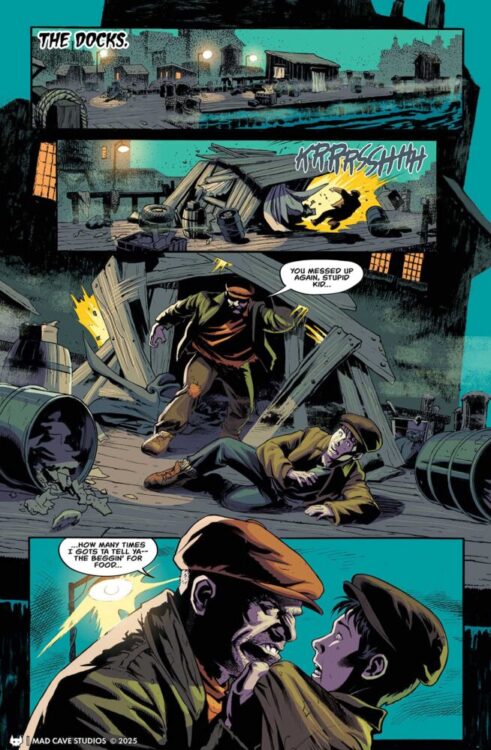
Opening on the docks at night, the story starts with the violence that has become synonymous with Dick Tracy: the Kid is getting slapped around by Steve the Tramp over the younger one’s inability to con money from their chosen marks. The fight escalates but is soon joined by a third person: the titular detective. Or is it?
The opening sequence of this comic highlights the writers’ approach to the Dick Tracy series as a whole. They have taken elements from the history of the character, from across mediums, and merged them with a contemporary ethos to retell stories that have been told many times before, but with a new and often surprising twist. The confrontation between the Kid, Steve, and Tracy is the entrance story for Junior Tracy into the detective’s world, and has been in numerous iterations. In this version, the initial fight is reminiscent of the 1990 Warren Beatty movie version, but the writers give the ending of the sequences a kick that, despite the title of this comic, you might not see coming.
From this point onwards, the Halloween Special becomes another chapter in the excellent Mad Cave Studios continuity of Dick Tracy. By this point, nearly two years into the run, the writers have a sturdy grip on the main characters and their personalities. This allows the story to flow at a rapid pace, centering on action for the main scenes, while the characterization happens in the brief moments between. A single panel interaction tells the readers enough about the relationship between Dick and Tess, for example, without the need for long, drawn out conversations. This economy of storytelling not only allows the story to progress quickly, but it calls back to the original comic strips produced by Chester Gould. At its height in the 1940s, the Dick Tracy comic strip could do more in a few daily, single rows of panels, than some modern comics can do in an entire 26 page issue. Gould understood the need to grab a reader’s attention and instill in their minds an image or story beat that they would remember for several weeks or months, depending on the duration of any particular story. There was no going back, no flicking to early weeks to re-read the strips to pick out important plot points; the newspaper strips were read and discarded within the same day. And this style of storytelling is evident in the current Dick Tracy comics, despite the fact that most people will be keeping these comics for a very long time.
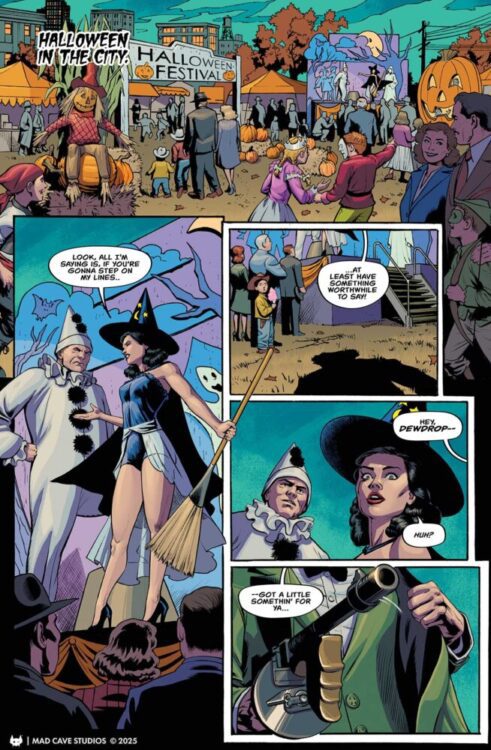
There is an urgency to the narrative that forces the story onto the reader, and allows the writers to tell a full, complete story in this single issue, with room for a back up story that is both quaint and humorous. A gang of witches stealing jewels in order to perform a magical ritual? Why not? This back up strip lets Tess do what she does best in these comics: stand on her own two feet. In fact, one of the most pleasing moments in the main story is that Tess and the Kid don’t sit around waiting to be rescued by the hard hitting detective. They take their fate into their own hands and fight back against the villain. They even take a moment to mock the killer which says a lot about the characters of both Tess and the Kid.
Credit: Mad Cave Studios
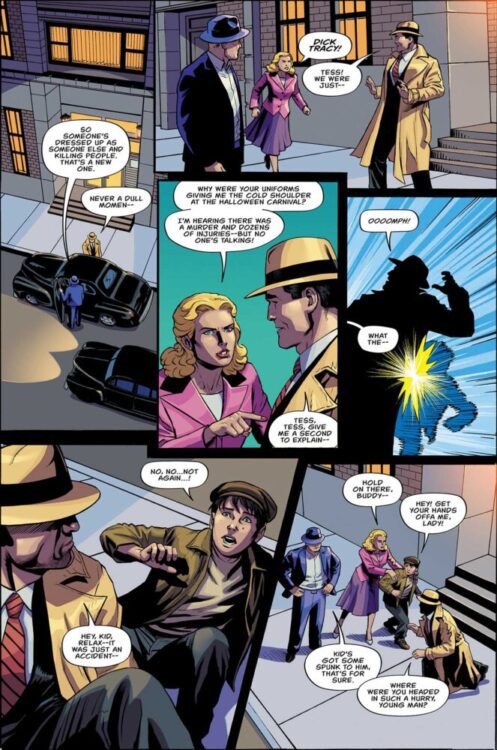
The artwork is as exciting as the narrative, with strong characters and perfectly executed action sequences. The violence, which is at the heart of so many Dick Tracy stories, is especially shocking in this issue. There is something disturbing about the way that the effects of the violence are shown in the panel, as it happens. As a reader, you are as much a witness as the poor bystanders in the comic itself. The coloring choices add to the shock value, with bright, solid backgrounds emphasizing the foreground action. There is a definite, deliberate, visual change when a scene shifts from relative safety to one of violence. It is a jarring experience to read, as well it should be. Brutal, cruel, and uncaring. This is the kind of comic book that would have been banned in the 1950s.
While the artwork within the panels is wonderful, it is actually the panel layouts that are the most exciting part of the visuals in this comic. Although they follow a standard grid pattern for most of the pages, it is the distortion of the grid lines that make the story impactful. Some panels bend and twist in reaction to the force of the punches inflicted onto the characters the panels contain. Elsewhere, the gutters are crossed and broken as the violence cannot be contained. Even something as innocuous as a witches broom crosses panels to highlight a story moment. The way that the page is broken up and the action distributed across the panels is an absolute delight in this comic.
Credit: Mad Cave Studios
A special mention needs to go to the letters for this particular comic. The nature of the story requires several distinctive characters’ voices to be distinguishable from those around them, The lettering for their speech changes style and font to represent the characters as they confront other members of the cast. In this issue, more noticeably than in the regular monthly series, the speech forms a part of the personalities in the same way that the facial disfigurements do. This is a perfect example of the comic form enhancing the reading experience. In film you would get accents, audible ticks, something which is much harder to do on the printed page, but the letterers here have demonstrated, successfully, that such a thing is possible.
The Dick Tracy Halloween Special is a magnificent read and a perfect entry point into the Mad Cave Studios Dick Tracy universe. While this comic stands on its own, with no prior knowledge required to enjoy it, it is clearly setting up future story-lines for the main monthly title, just like the Valentines Special did at the start of the year. There have been some ups and downs with Dick Tracy comics in recent decades, but the team over at Mad Cave are currently producing an exceptional series that is both modern and nostalgic without alienating any readers. That is a difficult task to pull off.
Pick up the Dick Tracy Halloween Special when it is released at the end of October.
