Home Blog Page 499

JUPITER’S MOON REVIEW: A Mind-Bending Film About A Boy Who Can Fly

From Hungary, the indie science fiction film Jupiter’s Moon follows the story of Aryan, a Syrian refugee played by Zsombor Jéger who is shot to death but doesn’t die and instead discovers he has the incredible power of flight. The indie film, also produced via France and Germany, won Best Film at STIGES and best director at Fantastic Fest and with good reason. Read on!

Jupiter’s Moon: Man or Monster

Is Aryan an angel or a demon? There’s a bit of that debate at the heart of Jupiter’s Moon, a film that starts off big, discussing the many moons of Jupiter. It slowly narrows us down to one, Europa, a celestial body thought to house the potential for life. The film focuses in even more, on a rooster; perhaps a subtle joking wink, as if asking ‘what came first?’ And then we meet Aryan, his father, and a caravan of refugees seeking asylum in Europe. The opening sequence features a Cuaron-esque extended single take of immigrants running for their lives. It’s beautiful and immediately makes you take notice of director Kornél Mundruczó’s (White Dog) technical mastery.

jupiter moon-indie-film-review

As the story progresses, Jupiter’s Moon reminds us over and over of Aryan’s power. It gives us glimpses into how it plays into the lives of the people who witness the gravity-defying ascent of this super-human. The FX in each case are mind-bending and flawlessly executed in much the same ways as Nolan’s Inception. Aryan’s power is represented in a swim-like rise through the air and accompanied by a lovely theme from composer Jed Kurzel.

Matters are made far worse when …

Aryan is the “super-hero” here, but Jupiter’s Moon closely follows Doctor Gabor Stern (Merab Ninidze) who oversees healthcare at a refugee camp and lets a few escape for the right price. It’s an unspoken arrangement allowed to go on by local law enforcement lead by László (György Cserhalmi). However, when the good doctor witnesses the power of Aryan, his anti-religious nature sees the light and it’s made of money. Later, László sees Aryan hovering and will stop at nothing to get the young man back.

Doctor Stern helps Aryan escape the camp, and together they begin a life of blowing people’s minds for money. The doctor sells a possibility and Aryan makes people a believer by gliding up, like an angel. The arrangement is working well, but Aryan is conflicted. Matters are made far worse when one of the men is framed in a terrorist attack.

jupiter moon-movie-review-hungary

Those visuals, man …

The film consistently dazzles with how it uses Aryan’s power to fly. There is no shortage of creativity when it comes to how they show Aryan’s gliding power. One sequence takes us down from an apartment building rooftop. Aryan’s shadow is cast on the wall as we witness the day-to-day lives of random people who are unaware of the magic happening just outside.

From a visual point of view, Jupiter’s Moon is a must-see. The special effects are flawless and used to advance the story in each and every case. It’s not spectacle for the sake of it and for cinephiles, the sheer mastery of timing for some sequences is wonderful.

Jupiter’s Moon’s major problem lies in a story that’s a little unfocused at times. It gets bogged down by its snail pace and lack of bite when it comes to the things that could be questioned here. It feigns a more profound religious argument then backs away. Neither Stern or Aryan are particularly interesting and suffer from muddled motivations. However, as things start to get dull, those visuals, man, they just do something mesmerizing.
Monkeys Fighting Robots Youtube

[Review] THE LIFE OF CAPTAIN MARVEL #5 is a Masterpiece

Monkeys Fighting Robots

I can’t decide whether I’m lucky or unlucky to review The Life of Captain Marvel #5. I went in with high expectations for the conclusion to Margaret Stohl’s incredible run on the series. But, simply put, I don’t know if I—or any reviewer, for that matter—can really do it justice. This book is simply amazing.

The issue focuses on Carol and her mother’s climactic showdown against the Kree Kleaner. More than that, it delves into the depths of who Carol is as a character, providing a truly touching finale.

The Writing

Margaret Stohl is a true master storyteller. Setting out with the goal of reinventing an established character’s origin is ambitious on its own. However, to do so in such an emotionally powerful and satisfying way is nothing short of brilliance.

Over the course of the series Stohl demonstrates the value of strength in vulnerability. Carol faced the anxieties that first drew her back home, bringing her on a voyage through a lot of painful emotional baggage toward self-discovery over these last four issues. Throughout the series, we’ve seen the narrative split intermittently with flashbacks to Carol’s past (the literal “life of Captain Marvel”). These flashbacks gradually merge into the present, and with The Life of Captain Marvel #5, we see the culmination.

At the crux of this issue, though, is Carol’s relationship with her mother. It’s tough to talk about without getting into spoiler territory. However, suffice to say that Mari-Ell and Carol’s moments together here are heart-wrenching, yet ultimately affirming.

Even once the main conflict is resolved, the epilogue of The Life of Captain Marvel #5 retains a true poetic sensibility. It’s equal parts tragic and hopeful, and brilliantly set the stage for Captain Marvel’s next adventure. My only concern: how can they possibly top it?

The Artwork

The artwork is handled by Carlos Pacheco and Rafael Fonteriz in the present-day sequences, with colors by Marcio Menyz and Federico Blee. Marguerite Sauvage handles all art duties for the flashbacks. While clearly different, a sense of minimalism permeates both time streams. We get intricate and gorgeously-detailed character designs set against sparse backgrounds. This helps the artwork to flow seamlessly from page to page, eventually merging triumphantly at the book’s halfway point.

I really enjoy the softer, more muted look employed by Sauvage in the flashbacks. They have a unique, timeless look, helping sell the images as flashbacks throughout The Life of Captain Marvel #5.

Of course, that doesn’t undercut the work of the present-day crew. Images are sharp, dynamic, and dominated by warm, fiery colors to underscore the intensity of the battle.

Final Thoughts

Why are you still reading a review? Get out there and buy The Life of Captain Marvel #5 now.

Monkeys Fighting Robots Youtube

Review: FREEDOM FIGHTERS #1 Reintroduces Readers to Earth X

Monkeys Fighting Robots

The Freedom Fighters Step Into the Spotlight!


The multiverse is full of possibilities for storytelling. This is seen in Grant Morrison’s Multiversity miniseries, which shows a collection of Earths. One of these Earths, Earth X, has Superman’s pod landing in Germany where he is adopted by Adolf Hitler. This leads to the Nazis winning World War II and taking over the world. While they marched on America, a team of metahuman rebels rose up to fight. The Freedom Fighters became the equivalent of the Justice League on that Earth. They now have a new maxi-series of their adventures in that world. Do the Freedom Fighters have a place in the modern world?

Freedom Fighters 1 cover

**Some Spoilers Below**

Story:

We open the comic in 1963, where Nazis have taken over America. The Freedom Fighters, consisting of Human Bomb, Doll Man, and Black Condor, are meeting with fellow rebels. Lead by Olympic athlete, Jesse Owens; the group prepares another attack against the regime. They are interrupted, however, by one of the Fuhrer’s meta forces, the Plasstic Men. While they put up the good fight, each of the members is quickly defeated. As Jesse is sent to a hard labor camp, the Freedom Fighters are publicly executed. Uncle Sam, the leader of the Fighters, watches this and vanishes into thin air. Decades pass, and while the Regime continues to lead, a new version of the Freedom Fighters is born.

This comic is an excellent example of how to start a maxi-series. The issue gives us the context of the world without too much exposition, cool characters, and sets up the story. It presents what happened to the original Freedom Fighters, but also gives us the ones we met in the Multiversity. It would have been easy to stick to the new team, but I do enjoy the past being included. It’s a way to keep the history of the characters connected and makes the world feel alive.

There is one major flaw in this story, however. While the characters look cool, we don’t know much about them. All we know is that they fight the Nazis to try and free America. There is still time to fix that, but it has to be in the next two issues. Any later, it could interfere with the story.

freedom fighters 1 p3

Art:

The art style can be summed up in one word: disturbing. From the creepy smiles of the Plasstic Men to the horrific public executions, each panel becomes more disturbing than the last. This does not mean that it’s a bad thing. This rule perfectly captures the themes of the Earth. There are also some creative designs for the Nazi soldiers. If this is the style we’ll be sticking with for the rest of the series, we’re in for a dark, entertaining ride.

Conclusion:

This is a solid opening for this maxi-series. It properly introduces readers to Earth X and its heroes. By the time I finished, I was hungry for the next chapter. If you haven’t heard of this team before now, I highly recommend you pick this up and join the Freedom Fighters’ fight.

Monkeys Fighting Robots Youtube

Why SHE-HULK By Soule & Pulido Is Unlike Any Other Superhero Comic

Monkeys Fighting Robots

She-Hulk By Soule & Pulido: The Complete Collection is finally out, and it’s probably the best $35 you’ll spend this week.

The paperback collects She-Hulk (2014) issues #1-12, as well as Wolverines #13 and material from Gwenpool Special #1. It’s written by Charles Soule and drawn mostly by Javier Pulido, with Muntsa Vicente on colors and Clayton Cowles on letters. Ron Wimberly drew issues 5 and 6, with Rico Renzi’s colors on issue 5.

she-hulk soule pulido marvel comics

This is a much beloved run on Jennifer Walters, and for very good reason. It doesn’t feel like a typical superhero book, even though it stars a character who’s been a member of both the Avengers and the Fantastic Four. It’s something special.

In issue one, Jen leaves her job at a big law firm and opens up her own shop. The rest of the series focuses on her trying to succeed and her various cases. And, of course, there’s plenty of superhero action mixed in (one of her first cases is helping Doctor Doom’s son receive asylum in the United States!). The overall story is about Jen finding a balance between her two lives, but her law career takes center stage.

she-hulk giant doom soule pulido marvel comics

Charles Soule is a practicing attorney, in addition to being one of the most prolific comic book writers working today (at one point, the man had something like seven titles out each month). He brings his knowledge to She-Hulk, making this one of the most honest looks at our legal system in comics. He shows readers the behind-the-scenes stuff, what a lawyer’s day-to-day life is actually like, and damn is it funny – because you know it’s all true. Soule seemingly vents all of his frustrations with this book, frustrations with the system, with difficult clients, and with other lawyers. She-Hulk shows the power of lawyers, both good and bad. It’s both cynical and optimistic, making this one of the most complex and intelligent comics of the past decade, as well as one of the most fun.

“Being a lawyer is like being strong. It’s a superpower. You can do what you want with it. Some people use their power to help, and other people…well, they’re like you. Ugly. Just…poison.” – Jen Walters

She-Hulk is a story about justice, and about helping those who can’t help themselves. It’s about compassion and friendship, and doing things the right way, no matter how hard that is. That all adds up to a powerful superhero comic, but told through a real world lens, which only makes it more powerful.

Perhaps the best example of these concepts is “The Good Old Days”, a three part story told between issues 8, 9, and 10, where Jen represents Steve Rodgers, Captain America, in a wrongful death suit. This arc is the heart of Soule and Pulido’s run. It embodies everything the team is trying to say, and if you only read these three issues, it’s still worth the price of the collection.

“I think the best super hero stories are aspirational. They aren’t just thrill rides – they’re mirrors, showing us what we might be, if we become our best selves. And the best super hero stories are the ones where the heroes themselves aspire to reach that same goal too…and every once in a while, after great sacrifice and incredible effort, they get there. That’s Jennifer Walters to a T, if you ask me.” – Charles Soule, in his farewell letter to the series

Javier Pulido and Muntsa Vicente’s art is like nothing you’ll see in traditional superhero comics. It’s pop art, full of bright, vibrant, flat colors, unique panel layouts and transitions, and whimsical lettering (I’m unsure if Clayton Cowles did 100% of the lettering, or if Pulido handled some of the sound effects himself, but they’re A+ either way). Take one look at this comic and you’ll know that you’re in for something special. Fans of Rich Tommaso’s style or the tone of David Aja’s Hawkeye will find a similar experience reading She-Hulk.

she-hulk soule pulido marvel comics

Pulido’s work is nothing short of artistic sorcery. He uses such simple techniques to add a sense of motion to the action. It feels like it shouldn’t work – that these images should just look stagnant, because again, they don’t utilize the techniques we’re accustomed to seeing in superhero comics – and yet it works so well that the characters seem to literally burst off of the page with energy. The art is what’s going to have you revisiting this book time and time again.

she-hulk soule pulido marvel comics

The best part about this series is that it’s completely self-contained. You can pick up these 12 issues and enjoy them on their own, without having to worry about tie-ins, crossovers, or the scope of the Marvel Universe at large. Stories like this come too few and far between in today’s superhero comics. The landscape has become more and more concerned with events, and tying everything together. There’s something peaceful and refreshing about being able to pick up a book and read a complete story. It’s fulfilling. If you’ve become jaded with the Big Two, and maybe even sworn off superhero comics as a whole, give She-Hulk a chance. It’s probably exactly what you’ve been looking for.

She-Hulk by Soule & Pulido is a perfect storm of comic book awesomeness. The story is complex and interesting, the art is unique and powerful, and it will leave you with a smile on your face. Great stories are ones that you want to revisit instead of reading once and then letting them collect dust on your shelf. As previously stated, you’ll be re-reading She-Hulk, guaranteed.

Monkeys Fighting Robots Youtube

[Review] BATMAN #61 Sees the Waynes Avenged…Or Are They?

Monkeys Fighting Robots

Batman #61 retells of perhaps the most thoroughly-covered event in comics history: the murders of Thomas and Martha Wayne. Only this time, the investigation gets some help from none other than Batman himself.

Of course, DC gives away the twist ending in their solicitation for the issue. However, I like to go into a story while knowing as little as possible beforehand. So without spoiling it, I’ll say Batman #61 reintroduces a surprise villain brought in earlier in King’s run on the series. It’s the beginning of a new story arc, Knightmares, the title of which makes sense by the issue’s end.

The Writing

King did a good job of catching me off guard in Batman #61. We have Batman investigating his own parents’ murders alongside the young Bruce Wayne. I thought at first we might be going in a more esoteric, supernatural direction, similar to what Kurt Busiek is doing with Batman: Creature of the Night.

That said, keeping your readers in the dark throughout most of an issue is a gamble. Maybe a more astute mind could pick up on hints of what’s going on throughout the book. I, however, was more just along for the ride, waiting for the story to make sense by its end. When we get to the story’s last three pages, though, I’m tempted to put on my best Shyamalan impression and shout “What a twist!”

Still, Batman #61 is an engaging read, and everything comes together coherently in the end, so I won’t complain about it too much.

The Artwork

Travis Moore’s artwork is detailed and expressive. Rather than opting for a shadowy, noir vibe in this old-school detective story, the scenery is surprisingly bright throughout the book. As a result, those more dark, stylized images jump out and seem to have more presence when they show up.

The page layout in Batman #61 is very straightforward. The panels are arrayed in evenly-spaced squares, so while it’s not the most exciting presentation, it gets the job done.

Finally, the colors by Tamra Bonvillain work in much the same way. They’re not the most inventive, but they are well-suited to the style of the book, and are expertly applied. There are enough moments where the ink and colors meld to create a truly striking image.

Final Thoughts

Batman #61 is an intriguing opener to the new story arc. I look forward to seeing where it’s headed, and I think most Batman fans will, too.

Monkeys Fighting Robots Youtube

[Review] SPIDER-GEDDON #5 is a Frantic, Yet Fitting Finale

Monkeys Fighting Robots

Spider-Geddon #5 presents the culmination of the year’s big Spider-event. The Inheritors and the Spider-army faceoff for a climactic battle, with ramifications that will impact—and spawn—multiple Marvel titles heading into 2019.

With Spider-Geddon, reading the tie-ins coming out each week has been pretty integral to the story. That is certainly true here, with the plot of Spider-Geddon #5 relying heavily on the Spider-Girls, Spider-Force, and Vault of Spiders limited series. Though the story wraps up neatly, it can feel overwhelming with with so much information flying at you.

The Writing

The writing in Spider-Geddon #5 is on-par with Christos Gage’s work on the series up to now. The first third of the book focuses on Octavius’s plan to sacrifice Scarlet Spider…and how that pans out for Jennix, who gets the pleasure of digesting years of convoluted Clone Saga continuity.

The bulk of the issue consists of the final battle sequence, in which Gage is just throwing everything at us. With so much story to wrap-up in a single issue, the pace is set to full-throttle throughout. That’s not necessarily a bad thing, but it does have its downsides. The finale can feel a bit anticlimactic with the pace at which it’s wrapped up. For an event pitched on the scope that Spider-Geddon was, the end seems to come with a lack of fanfare.

One of the more interesting points of Spider-Geddon #5, though, involves a member of the main spider-cast who ends up crossing a line you’d never expect. It’s hard to see how this could have ended any other way. However, there’s a clear sense of moral conflict in the act. It will be interesting to see how this impacts the character’s development going into post-event continuity.

The Artwork

No fewer than six different artists contributed pencil and ink work for Spider-Geddon #5. However, the team manages to pull together to produce a solidly cohesive look.

The work is kinetic throughout, clearly conveying the action in each sequence. With so much on the page, it could be easy to get lost in the chaos. You never feel like you’re unsure of what’s conveyed, though. Panels are arrayed in a dynamic manner, but they flow smoothly from page to page.

The colors provided by David Curiel are similarly on-point. Rather than sticking to a consistent palette, there’s a wide range of approaches and techniques on display in Spider-Geddon #5. We get gray and muted tones, vibrant, eye-catching pops of brightness, and everything in between. This helps underscore the vibrant line work and fast-paced storyline, without giving us a sense that tones are clashing.

Final Thoughts

Spider-Geddon #5 is a fitting send-off to the big event. While not perfect, I’m content with the finale. Plus, I look forward to how the ramifications play-out in ongoing series.

Monkeys Fighting Robots Youtube

EXTERMINATION #5: The End Of An Era

Monkeys Fighting Robots

Ed Brisson sends the time displaced X-Men teens back to their own timeline for good. Extermination ends in an explosive and exciting fashion, marking the end of an era for X-Men comics.

extermination 5 cvr

***SPOILERS LIE AHEAD***


After making a huge mess and murdering his own future self, Young Cable completes his mission and sends the original X-Men teens home–avoiding Ahab’s mutant murder party of the future. As always, there are a few lingering elements going forward and a HUGE reveal at the end.

Ed Brisson did a wonderful job crafting a story to not only send the kids back home, but also put the modern X-Men in a good place to build on. Extermination succeeds as a hug X-Men crossover story where others have failed. This story leaned heavily on the Cable-timeline-surgery that has made X-Men comics great and frustrating for so many years.

Ahab’s plot to wipe out mutants, utilizing two powerful French kids, could’ve easily been stale. However, setting up the bare bones we needed to buy-in and just racing off into the fun made this a pleasure to read. Not being dragged done by bloated plot or trying to dress-up a simple antagonist plot made the story feel honest and wholesome.

Brisson had a task, send the teens home. He and the creative team turned that simple endgame into an exciting adventure. This was as an examination of the X-Men, Cable, mutants, hatred, and the idea that brought the kids here in the first place. It also helps that this didn’t just end up as a launching pad for a bunch of new X-Men titles that’ll be cancelled within a year.

Artist Pepe Larraz and colorist Marte Gracia were absolute rock stars throughout this story. Extermination #5 is an extremely satisfying finale for your eye balls. There’s so much to appreciate about every panel on every page.

You could get lost in the backgrounds of panels for hours, just admiring the action and showdowns. It’s not just a bunch of faceless mutant fodder blasting each other, each card-carrying X-Men is on display in the most glorious fashion. This action sequences are nerve-racking as they burst off of the page, keeping this from ever feeling generic or half-assed.

Letterer Joe Sabino gets to shine as well, there is a massive amount of texture and swagger to the lettering choices.

Going forward for X-Men comics, Young Cable is an interesting character to follow. This is uncharted territory for Nathan Summers, it’ll be a joy to see him develop in Ed Brisson’s upcoming Uncanny X-Force. Not to mention that HIS F*CKING DAD IS BACK.

It was the ultimate cliffhanger reveal to see Cyclops appear at the end of Extermination. Having Scott come back while his son is still at an impressionable age makes for some potentially great X-Men stories. That final page will make any dedicated X-Fan drool at the mouth despite having seen that Scott’s return was imminent from Marvel’s Previews.

Extermination #5 wraps up a quietly monumental X-Men event that will find itself among the “essential X-Men reading” lists in no time. Ed Brisson was the right man for the job, his X-Men credibility continues to grow. Larraz, Gracia and Sabino make this a comic book that you’ll not soon forget. It’s definitely worth a second read immediately for the art alone.

This story will make you want to read all the X-Men titles that follow, that’s a big win for Marvel and this stellar creative team.

Monkeys Fighting Robots Youtube

Spidey & Jonah Put To The Test In AMAZING SPIDER-MAN #12

Monkeys Fighting Robots

Spider-Man and J. Jonah Jameson put their friendship and partnership to the test in AMAZING SPIDER-MAN #12. They’re in over their heads facing off against a parade of JJJ’s troubled past in the form of a death trap by Arcade.

AMAZING SPIDER-MAN 12 cvr

***SPOILERS LIE AHEAD***


J. Jonah Jameson has been one of the most interesting characters in Spider-Man’s web over the last few years. He’s gone through some dramatic changes and developments, most of them leading to some unforgettable and enjoyable storytelling. Nick Spencer has picked up the thread and furthered JJJ’s growth as well.

Amazing Spider-Man #12 takes us through Jonah’s tragic history. A rare glimpse at the other side of the equation. We always see how Jonah makes Parker feel, but never get to see why exactly he’s prone to those activities. Any more time spent with Jonah is time well spent so this issue is loaded up.

There’s actually not a lot of Pete in this issue, outside of a few lines of banter and slick fighting moves. Ryan Ottley’s coming back from break didn’t exactly explode into our brains, but it’s still a damn good read. It’s easily the least Ottley has had to do so far on the series.

With a number of a blank, white backgrounds within Arcade’s JJJ History Death Trap, Ottley must’ve had an easy week. The pencils that we do get are flawless. Silly cartoon expressions blend perfectly with the sleek design and movement of action sequences. It’s nice to see Scorpion back in his classic, dull suit.

Story wise, there isn’t a lot of new information or development here. If you’re a decently well-read Spidey fan, the key moments covered here are common knowledge. The enjoyment comes from seeing Ottley illustrate the classic moments.

The writing may be on the wall for Jonah and Pete’s possible breakup of partnership. Amazing Spider-Man #12 is a major stress test for the two New Yorkers. How they come out of this death trap will either ruin or strengthen their relationship. Hopefully strengthen because I cannot stress enough how crucial JJJ has been to Spidey comics recently.

Outside of the few busy pages, colorist Laura Martin doesn’t have a whole lot to do either. The pages with Jonah’s past bursting out and chasing the two explode with color. Inker Cliff Rathburn might have been the busiest art team member given that JJJ is wearing a black tux the whole time.

In no way is the art lacking in this issue, there’s just a noticeably lesser amount of art being displayed. Our journey so far with Spencer & Ottley’s Amazing Spider-Man has been one fully loaded with gorgeous superhero art. After coming out that strong, issues like this will stand out, it’s not a big deal.

Nick Spencer does a great job briefly touching on all of the plot points here. All the many balls he’s currently juggling in the air, he doesn’t miss a beat as far as furthering a narrative. He also provides splendid commentary along the way, whether it be from Peter or the narration itself. He’s always got a way to poke fun at what’s happening without taking us out of the story.

There’s a lot to like about Amazing Spider-Man #12, this arc is all about Jonah and Peter’s relationship and history–and that’s fine with me!

Monkeys Fighting Robots Youtube

Review: Shifting Paradigms in PLANET OF THE APES: THE SIMIAN AGE #1

Monkeys Fighting Robots

Fans of the award-winning Planet of the Apes franchise will be excited to pick up the one-shot series PLANET OF THE APES: THE SIMIAN AGE, celebrating the 50th anniversary of the release of the first movie. This inaugural issue features both old and new events in the franchise canon, exploring the underlying motivations and paradigms of the characters.

STORY

The story is divided into three parts with each taking place at a different point in the franchise timeline.

amy examines man

Mother of Exiles, written by Jeff Jensen, introduces us to Amy, a former chimpanzee doctor who lives on the outskirts of society in an abandoned lighthouse. She and her mate are estranged from the gorilla-led order for opposing their militaristic regime against the humans. But a chance encounter with an injured human leads Amy to question her motivations for living this way: Is it fear or courage that drives her?

Matt Kindt gives us Apex, which details the daily life of a gorilla soldier of the same name. Trained from birth to fight against the humans, Apex has his own life-changing experience when sent on a mission to investigate one of their encampments. Seeing the humans’ ingenuity in creating traps gives Apex a paradigm-shifting idea that could impact human/ape relations forever.

apex meets a human

Ryan Ferrier writes the last of the three stories, Cloud and Rain, which serves as an epic prequel to the movie Rise of the Planet of the Apes. The story focuses on two young apes who run across an injured human. They attempt to help him out of curiosity but are threatened by their leader Koba. Koba claims humans care nothing for apes, and thus the two groups cannot coexist. This nationalistic ideology grows throughout the ape’s group, but Cloud begins to question whether fighting solely for your own kind is enough.

cloud and rain find human

ART

Jared Cullum’s illustrations in Mother of Exiles show us beauty in a bleak setting. The watercolor-like coloring helps each figure fit in with the abandoned landscapes. In a similar way, Lalit Kumar Sharma and Gabriel Cassata’s illustrations and coloring for Cloud and Rain use wavy lines and mixed colors to draw the reader into its jungle environment.

In contrast, Apex showcases Matt Smith’s sharply defined borders and Joana Lafuente’s solid colors. These give the reader a sense of the disciplined, straight-forward nature of the militaristic setting.

Ed Dukeshire’s lettering blends with each of the stories for the most part but gets slightly confusing when reading the conversations in Cloud and Rain. This may be due to its proliferation of thought and speech bubbles.

Conclusion

This issue is a great introduction to the wider canon of Planet of the Apes. It’s able to tie three distinct stories together by exploring each character’s established paradigm and watching them unravel though new experiences. I’m excited to see where the series heads next.

Did you like how this issue handled the Planet of the Apes greater story? Let us know in the comments below!

Monkeys Fighting Robots Youtube

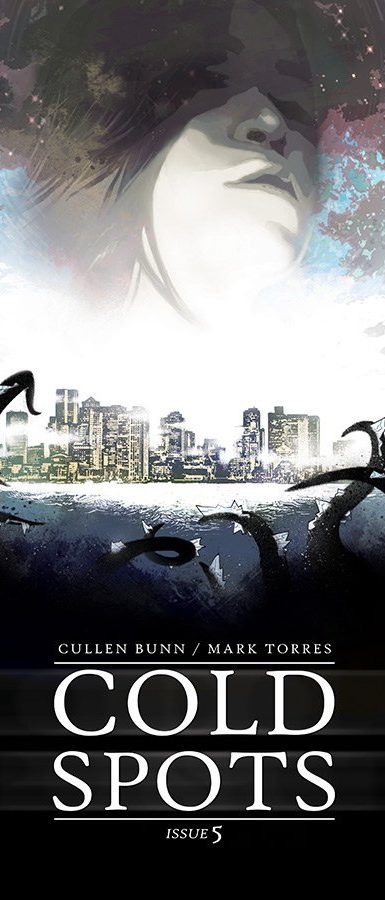
Review: Unsettling Hauntings In The Climax of COLD SPOTS #5

Monkeys Fighting Robots

The final issue of Cullen Bunn and Mark Torres’ horror comic Cold Spots sends a shiver down your spine while revealing who is really in charge of the supernatural onslaught.

After the first four issues of world building in the Image comics mini-series, where the reader has followed Dan on his journey to find and rescue his daughter, the Evil has finally been released, and the world is inundated with ghosts and spectres. Alyssa and Dan are imprisoned in the eerie house while their daughter Grace is used to awaken demonic forces. There is a twist, however, which becomes apparent during a daring escape attempt and the tragic consequences are felt by all of the central characters.

Image Comics

The previous issues have all been leading to this dramatic ending. Each, in turn, has encapsulated a different element of a horror story; driving with a mystery, through an indulgent ghost story, and on to Satanic worship. This final issue of the run focuses on visual horror but also the character development of the central cast. Bunn brings the situation to a head so that he can force the characters to show their true faces. The cruelty and desperation of Samuel and Henrietta play out as they realize exactly what it is they have unleashed. Alyssa breaks under the guilt of allowing her daughter to be used.

Up to this point, Bunn has slowly paced the narrative, edging the reader into his ghost story but in this issue, the pace picks up. There is a lot of action and the inclusion of so many new elements. Despite this, Bunn manages to keep the narrative easy to follow without being overwhelming. He also manages to introduce a number of shocks which keep you on your toes to the very last page.

The Beast that is raised is brilliantly designed to be both visually horrific but also mentally challenging. It works as an instant physical threat, which Torres illustrates to great effect, but also represents a growing, unstoppable evil that Dan can only run away from. Even at this point when he has finally learned to take responsibility for his life, Bunn places Dan in a situation that is too overwhelming. Dan has to run; he has no choice. As the character grows, he is unfortunately taken further out of his depth.

This aspect of the narrative is an intrinsic part of any good horror. The hero must continually strive to survive, but with each step forward a greater obstacle is faced. Nancy had this problem in the originally Nightmare on Elm Street; Rick faces this during each story arc of The Walking Dead; and Christine couldn’t escape the escalation of terror in Winnebago Graveyard.

Image Comics

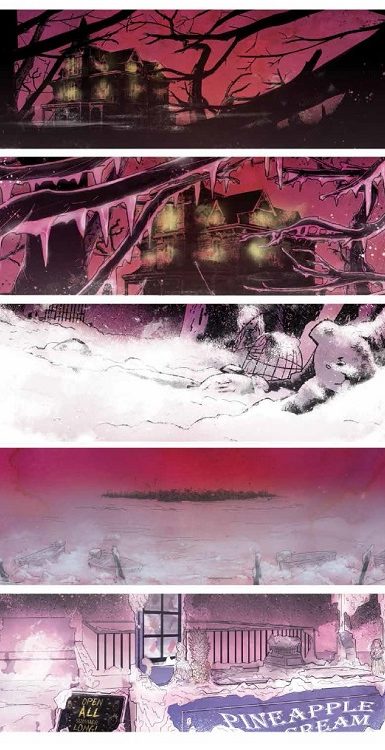
Another aspect of any good horror story is its ability to build an atmosphere. Luckily Cold Spots has Torres on Art duties. The combination of watercolor washes and often heavy shadowed characters creates an unsettling aesthetic. The lack of striking panel borders also gives each page the impression that the images are melding into one as if the panels themselves are ghosting, blurring the lines between two worlds.

Torres uses a fairly straightforward layout on each page, with only an occasion overlapping panel or gutter break but the organized chaos within the panels creates the impression that Torres is breaking all of the rules. The artwork unbalances the reader which has the subconscious effect of slowing down the pace. Even in the moments where the characters are running for their lives, the reader is forced to read at an uncomfortably slow pace, allowing the fear to build. In previous issues, this has caused some of the pacing to be slightly off, but in this final issue, it is spot on.

One of the true highlights of this comic has to be the design of the ghosts. Whenever they are on a page, you can almost feel the temperature drop. The barely visible shadows of former people are eerie and disturbing. To see them interact with the world around them is terrifying and much more effective than grotesque monsters and over the top violence. To look into the pure white spots of the ghost’s eyes fills the reader with unnerving dread.

Image Comics

Simon Bowland has a difficult job of keeping the narrative flowing at the correct speed. His lettering adds a sense of importance and urgency to the proceedings. Whether it’s through the use of black speech balloons with white text for the beast or by breaking up blocks of speech into joined but distinct balloons to extend the speaking time, Bowland manages to draw the reader across the page while building the characters. Where Torres creates the atmosphere, Bowland creates the emotional content. The anger and fear all come through the lettering.

Between them, Bunn, Torres, and Bowland have produced an unsettling and surprisingly original horror comic. It has a disturbing surface story with an equally disturbing underbelly. If you enjoy the works of Raw Fawkes or Steve Niles, then Cold Spots is definitely for you. And, if the final word from Bunn proves to be correct, we haven’t seen the last of this disturbing world.

Monkeys Fighting Robots Youtube