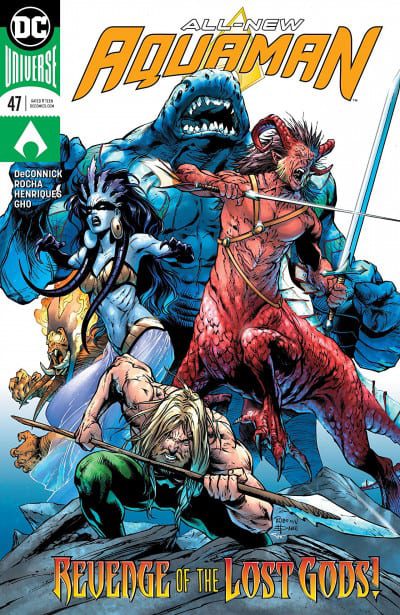
Aquaman’s journey with the Old Gods finally comes to an end in AQUAMAN #47. Mother Salt, the co-creator of the ocean, is mustering up her primordial powers to flood the earth with her bitter salt water. Aquaman (now known as “Andy” after losing his memories) calls out to every sea creature to take on the deity. But will it be enough to defeat her in the final part of the “Unspoken Water” storyline?
Story
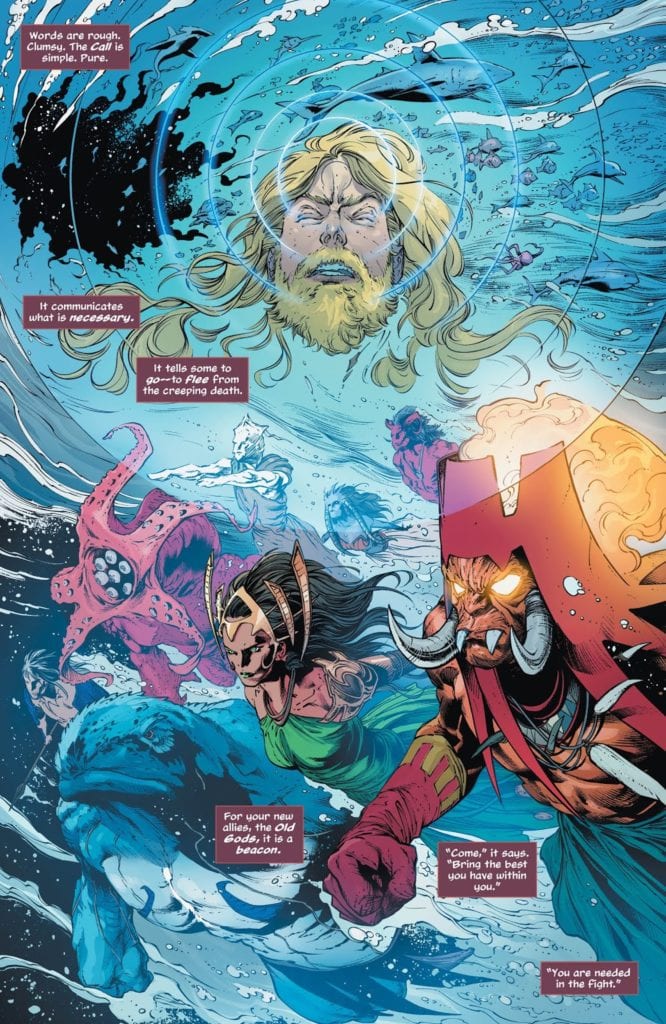
Andy’s famous “Call” ability to enlist the help of sea creatures is known to turn the tide of many a battle. The only difference this time is who answers. And lo and behold, it’s the Old Gods in their fully realized forms.
The beauty of Kelly Sue DeConnick’s writing lies in its fluidity. Much like the water this story is set in, the scene transitions are incredibly smooth. This is an effective technique that keeps the reader engaged when a lot of separate events are taking place at the same time. We’re able to follow the events in a connected trail instead of bits and pieces of action.
With the Old Gods at his side, Andy prepares for a battle with a power that formed the sea. Readers are pulled into his anticipation of the fight like a tide. But with this anticipation comes the fear of what would happen to the world if they fail.
Art
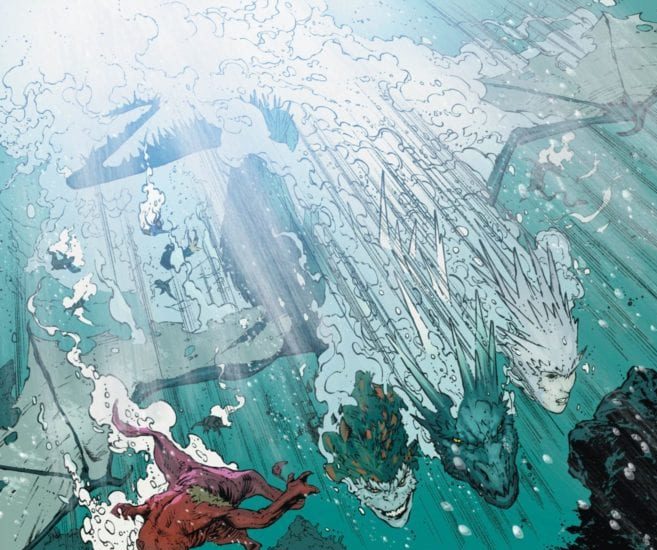
Sunny Gho, Robson Rocha, Clayton Cowles, and Daniel Henriques produced stunning visuals for this issue. Rocha’s penciling and Henriques’ inking combine to create solid lines to define the characters in the midst of wavy haze of sea. This meshes quite well with Gho’s aquatic hues, setting the scene of this story’s torrential battle.
Clayton Cowles’ lettering provides effective differentiation through character dialogue. The varied shapes of speech balloons emphasizes the intensity of dialogue, such as Mother Salt’s jagged font style to help readers imagine her shrieks.
Rocha, Henriques, and Alex Sinclair’s work on the main cover fits perfectly with the story inside. The artwork showcases Andy and the Old Gods in their fighting stances as they prepare for battle. In addition, Joshua Middleton’s variant cover offers a hyper-realistic depiction of the aquatic hero to remind us how human he feels after losing his memories.
Conclusion
AQUAMAN #47 offers a thrilling conclusion to the “Unspoken Water” storyline. It’s filled with the drama and intrigue readers expect from such climatic battles.
Did you like the conclusion to “Unspoken Water?” Let us know in the comments below!
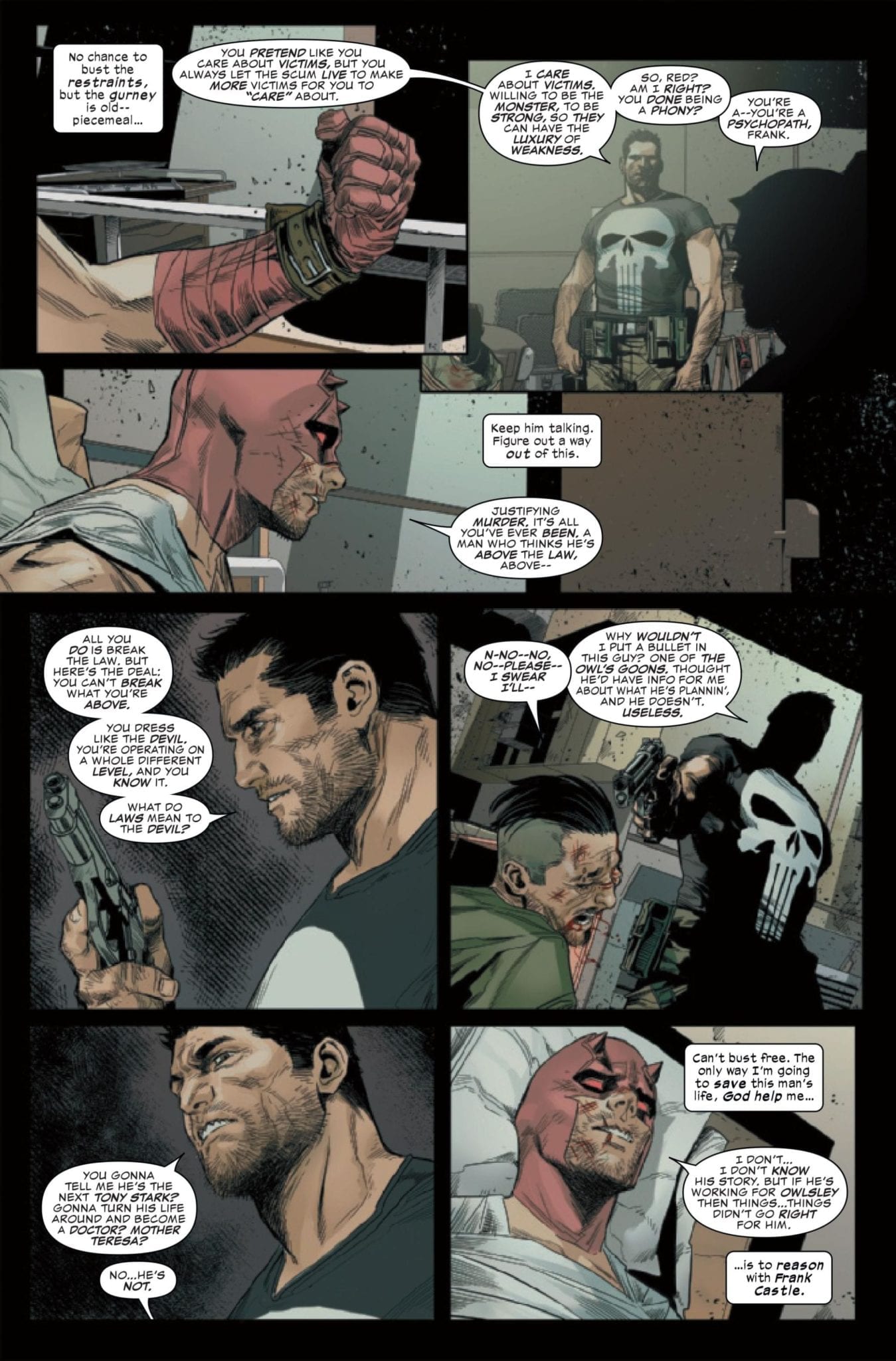
Matt Murdock has been doing some soul searching lately. Last issue saw the grim vigilante accidentally kill a man while fighting a gang in Hell’s Kitchen. This devastating news makes Matt question whether he’s ultimately fighting for the victims or simply for the sake of unleashing his rage upon criminals. These introspective questions come to a head when The Punisher, a.k.a. Frank Castle, confronts him in DAREDEVIL #4.
Story
While attempting to investigate the scene where the murder took place in DAREDEVIL #3, Matt was attacked by Detective Cole North, who attempts to arrest him. The ensuing conflict leaves Matt with a gunshot wound. It’s here the reader is invited into the mind of the hero as he contemplates his predicament.
Chip Zdarsky’s writing beautifully brings the readers into Matt’s internal consciousness. We follow along this internal investigation of his surroundings, sensing the nearby heartbeats. But just then Frank the murderer/vigilante appears in all his moralizing glory.
It is here Frank claims Matt is turning into a killer. The murdered gang member and recent fight with the police speak for themselves, but Matt responds with outrage. One can feel the emotion laced in his words.
Matt is left to contemplate what he’s become while Frank tortures a criminal he captured. Caught between these dilemmas, the Devil of Hell’s Kitchen will need to figure out who he is before another man’s blood is on his hands.
Art
Julian Totino Tedesco’s main cover sums up the issue’s central theme in it’s melding of The Punisher’s image with Matt’s face. It places focus on the notion of identity and whether Matt will be able to distinguish himself from Frank.
John Romita Jr. and Richard Isanove’s variant edition depicts Matt swinging through the city and capturing crooks. It serves as a direct contrast to main cover, helping the reader see how far Matt’s gone from his former identity.
The art style in the “No Fear” run is a big improvement for Daredevil stories. Sunny Gho’s faded reds and blacks and Marco Checchetto’s penciling offers a realism fitting of the character’s Netflix series.
VC’s Clayton Cowles’ lettering adds to the suspense, especially in the scene where Matt’s gathering his thoughts in the dark. The placement of each thought balloon slows one’s reading down to the slow pace of his regaining of consciousness.
Conclusion
DAREDEVIL #4 succeeds at its deep dive into morality and self-image. Through Matt’s internal dialogue and confrontation with Frank, it asks us to examine the difference between our actions and our idealized selves.
Do you think Matt is turning into an even nastier version of The Punisher? Let us know in the comments below!
Jason Aaron’s massive epic WAR OF THE REALMS continues in the explosive second issue. The heroes of Marvel’s universe are all that remains against Malekith’s crusade to rule all realms.
***SPOILERS LIE AHEAD***
“It’s like a Dungeons & Dragons bomb went off!” says Iron Man as he soars through the battleground that is Manhattan. War Of The Realms #2 jumps right back into the street-level action, constantly one-upping itself with every page turn.
Jason Aaron’s monumental story is full of all the elements that made Marvel events matter in the first place. His script throws every bit of action you can handle right at your face while effortlessly showcasing hilarious and charming character moments.
There isn’t a character in the 616 universe that Aaron doesn’t have a handle on, he flexes his Marvel muscle in almost every scene by delivering witty and often hilarious exchanges. He’s also single-handedly molding the Robbie Reyes Ghost Rider into a very charismatic character between his work on Avengers and War Of The Realms.
Doctor Strange’s helpful spell that was a bit too helpful was a memorable turn that sets in motion the story lines taking place away from the front lines. Malekith’s televised slaughter is legitimately brutal and disturbing as our heroes watch in terror. There’s so much going on in this war but it’s delivered in a cohesive package that won’t lose you.
Whether it’s Captain America bursting through a top story window to bash the face of a giant or Odin and the Valkyries arriving to provide backup, Russell Dauterman dazzles. There’s a massive scale that’s felt at every turn, the destruction is awesome and majestic.
Every character’s concern and determination is illustrated flawlessly. The drama unfolds in Dauterman’s art while Jason Aaron keeps things light upfront with the dialogue and story. This creative team is absolutely dynamite once again.
Colorist Matthew Wilson perfectly elevates Dauterman’s art to the next level with an impressive and satisfying display. There’s so much life and chaos flooding your eyes on every page thanks to the chemistry Wilson and Dauterman have established.
War Of The Realms nails the scale and execution needed to make this event live up to the hype created by Jason Aaron’s longtime run with Thor. There’s plenty of comic book crossover event cliches but they’re deployed in clever ways and you’re having way too much fun to even notice any familiarity.
This is shaping up to be the best Marvel crossover event in years and we’ve barely just begun. Giving Jason Aaron the keys and and control to so much of Marvel’s crucial properties was a very wise decision to get the universe back on track.
There’s a healthy dose of humor, action, violence, drama, and cheese all wrapped up in a beautiful looking package.
War Of The Realms is the real deal. If you’ve taken a break from Marvel events, now might be the time to come back.
Donny Cates and Geoff Shaw pit Guardians against Guardians as the intergalactic dysfunction continues. GUARDIANS OF THE GALAXY #4 brings Gamora back into the fold.
***SPOILERS LIE AHEAD***
The race for Gamora leads to a fight between both teams of Guardians and one Peter Quill makes the ultimate sacrifice…again. We get a glimpse at Rocket and his killer battle fortress before Gladiator and company wipe the floor with our heroes.
Donny Cates continues to slowly develop his lineup of galaxy guardians but they’re nowhere near fully formed. This is still very much a dysfunctional family that seems to grow farther apart the more they venture forward.
Gamora is the only one who sees that Thanos’ posthumous threat is merely another game but she gets dragged into the chaos regardless. She throws herself into the mix, leading to Star-Lord taking a possibly fatal shot for her.
It seems like Peter Quill sacrifices himself to save a teammate every six issues or so that he’s featured in, it’s getting rather stale. This time in particular feels hollow as Peter hasn’t really had any time to shine or charm yet in this young series.
He’s also sacrificing himself for somebody who was just a straight-up villain in Gerry Duggan’s Infinity Wars. It’s comics, we know this obviously isn’t the end for Quill but it should still matter a tiny bit that he’s willing to pay the ultimate price for his former teammate.
Donny Cates has quickly put together an impressive run of great comic book series, however this one may not be fully cooked yet. It has a lot going for it; the lineup, creative team, antagonists, dilemma, and concept. Guardians Of The Galaxy is still just missing something, maybe that’ll change once Rocket emerges from his fortress inevitably.
If we’ve learned anything from the brilliant Abnett & Lanning run, it’s the more Nova the better. Richard Rider brings the fight to our team’s front door and the ensuing battle is brief but beautiful. What this issue lacks in character up front, it makes up for in style and action.
Geoff Shaw and colorist David Curiel keep the edge of this book sharp. Groot’s mo-hawk isn’t the only punk thing about Guardians Of The Galaxy; it’s the atmosphere and attitude as well. The aesthetics established early on work wonders, we just need to inject some charm into some of these characters.
This may not be the finest hour of Donny Cates so far but it’s far from being a bad read. It’s still a solid cosmic Marvel tale and gives us most of our favorite Guardians, there just needs to be more heart and intent throughout. Having Star-Lord be down in the dumps drags the entire experience down a peg.
Beta Ray Bill has been the standout star so far. Cates knows how to extract what he needs from the hammer-wielding horse without going too far or saying too much. Despite it still being weird that he’s speaking full sentences, Groot has been the biggest source of joy. He reluctantly serves as the reader, desperate to get the family back together fully formed.
Guardians Of The Galaxy #4 is a solid read that’s still figuring itself out as we head towards some more exciting cosmic chaos. We’ve come to expect nothing but instant classics from Donny Cates, maybe this time around it’s going to take a bit longer for his vision to become clear.
Like Mary Shelley, many real people have been featured in works of historical fiction, taking these historical figures on supernatural adventures that were never documented in the public record. The most notable is the 2011 novel (and its 2012 film adaptation) Abraham Lincoln: Vampire Hunter. Other noteworthy individuals have similar “untold stories,” such as Edgar Allan Poe, William Shakespeare, Queen Victoria, and even Lizzie Borden.
Mary Shelley: Monster Hunter #1, from AfterShock Comics, is the latest tale to fit nicely into this sub-subgenre. However, not only does the book divulge the secret life of the infamous horror writer, it puts a new spin on Shelley’s own masterpiece, Frankenstein; or, The Modern Prometheus.
** Some Spoilers Below **
Story
For nearly two centuries, scholars have wondered how on earth Mary Shelley, a nineteen-year-old girl, was able to conjure one of the most frightening and enduring horror stories of all-time: Frankenstein.
But with the recent discovery of Mary Shelley’s secret memoir, the truth is finally revealed: Mary Shelley didn’t just write Frankenstein, she lived it. Traveling back to that historic Geneva winter of 1816, Mary, her fiancé Percy, sisters Claire and Fanny, and the celebrated poet Lord Byron, find themselves guests of the eerie Frankenstein Estate.
Writing
Though the title would suggest otherwise, readers will not find any monster hunting in this first issue. Instead, scribes Adam Glass and Olivia Cuartero-Briggs opt for a slow burning introduction to the setting and characters. Kudos must be given to the writers for using Victorian era English in Mary Shelley: Monster Hunter’s captions and dialogue.
However, their decision to include two prologues felt unnecessary. Particularly in the second, with a tour in the final home of Mary Shelley. The missing manuscript found mere moments after the guide spoke about it feels forced. Furthermore, it seems unlikely that the story will ever return to that time, as it doesn’t seem relevant to the overall tale. The readers would have come to the understanding that they are reading an unaccounted for part of Shelley’s life on their own.
Art
Artist Hayden Sherman illustrates a chilling world that is bleak and minimal. The architecture is narrow and angular, with rough and jagged lines. All these elements work together to craft this air of dread and chaos while flipping through the pages.
The colors are splotchy, like oil paints that poured out of its container and onto the page. Hayden also only uses shades of red and blue, minimal coloring, to round out the book’s otherworldly atmosphere.
Conclusion
Overall, the team behind Mary Shelley: Monster Hunter #1 have crafted a satisfactory setup for their horror adventure. Readers won’t find any actual monsters until the final pages. However, it is still intriguing enough to see what happens now that Mary has met her mysterious host.
Which historical figure could you see as a monster hunter, like Mary Shelley? Let us know in the comments!
Conspiracies; Alien Invaders; Superhero actions; Stronghold #3 from AfterShock Comics has it all. Continuing to dig into the ‘Alien among us’ concept, the creators pull out all the stops and expand their world view.
Stronghold keeps getting bigger and bigger, and going to places the reader would not expect.
Stronghold #3 Credit: AfterShock Comics
Writing/Story
After the massacre at the stadium, the Stronghold rally to control the situation and keep the Primacy out of the action. But the best laid plans don’t stand a chance against the ingenuity of Michael and his mission to find Claire.
With his emerging new powers and a villain to confront, how will Michael react to the deaths of so many innocent people?
Phil Hester opens this issue with a bang. It’s big and it’s bold. He does not apologise from the harshness of the scene but at the same time he does not wallow in the violence. The Adversary is a larger than life character and an obvious villain but one of the brilliant aspects of Hester’s script is that, as the story unfolds, the villain becomes sympathetic. The obvious black and white elements of the narrative are quickly muddied, just as in previous issues, so that the reader is not sure who or what to believe.
Hester creates a world where the reader instantly wants to root for the superhero character but he then makes the reader question this choice. What do we know about him? Where does he come from? Why are the Stronghold so obsessed with controlling his environment? All of these questions are raised and, to a certain point, Hester leaves the answers up to the reader.
Stronghold is about character’s getting manipulated and the consequences of that. It is also a comment on how mainstream comic’s handle their hero’s. So often superhero stories are straightforward, the reader knows who to stand behind even when things go awry. There is comfort in them, knowing who the hero is. With Stronghold Hester is challenging that conception. He uses elements from the format to create a world of grey areas. There is a large element of control and manipulation by various characters throughout the comic making this relevant to today’s world.
If comics like Superman and Captain American represented the need for Hope in the 1940’s then Stronghold represents the need for information in the modern world. It highlights the dangers of accepting everything at face value but also the reasons why it is easier or more appealing to do this.
Stronghold #3 Credit: AfterShock Comics
Art
Ryan Kelly has a firm grasp on a sense of the dramatic. Each of the pages of Stronghold is packed with bold images and dynamic composition. Kelly creates a cinematic staging of the scenes using the panels like a camera, following the action and focusing on characters in slow zoom like movement. The intensity of a moment is heightened by the pacing in the panels: a slow turn followed by a stepped close up, for example, produces a menacing moment and enhances the threatening behaviour.
There is a tone set by the coloring throughout Stronghold. For a large part of the comic, Dee Cunniffe uses mostly a blue hue across the pages. This reflects the twilight setting for much of the comic but also makes the reader uncomfortable, as it portrays a coldness penetrating the narrative. It also allows Cunniffe to highlight one element of a scene and make it easy to follow across the panels.
Simon Bowland excels in giving the speech some punch. He spreads the speech across linked balloons to create a rhythm which he punctuates with the use of bold text. The text directs the way that the reader digests the images around it, giving moments set beats and a reading pattern. This in turn dictates the pace of each page and the transition between panels. The gutters work to identify the tone of a scene but it is Bowland’s lettering that gives each page it’s pace.
Stronghold #3 Credit: AfterShock Comics
Conclusion
Stronghold has layers. There are stories and concepts over lapping and weaving together to form a complex and challenging work of fiction. The art work gives the narrative depth and tone. It also packs an emotional punch. There are disturbing scenes and touching scenes, each containing the same intensity.
AfterShock have produced some outstanding comics in the last few years and Stronghold is one of their best. It delves into the ethos of modern superhero comics to produce a piece of work that is both part of the mainstream and a critique of it at the same time.
The Star Trek franchise is currently experiencing a surge in popularity thanks to the successful ST: Discovery show on Netflix and the constant reports of various potential spin offs. So this is a prime opportunity for IDW Publishing to push it’s Start Trek comics, and what better way than with a universal cross over event.
Featuring the crews of two Enterprise’s, Voyager and the Defiant along with some of the most powerful beings in the franchise’s history, Star Trek The Q Conflict is an epic undertaking.
Star Trek The Q Conflict #3 Credit: IDW Publishing
Writing/Story
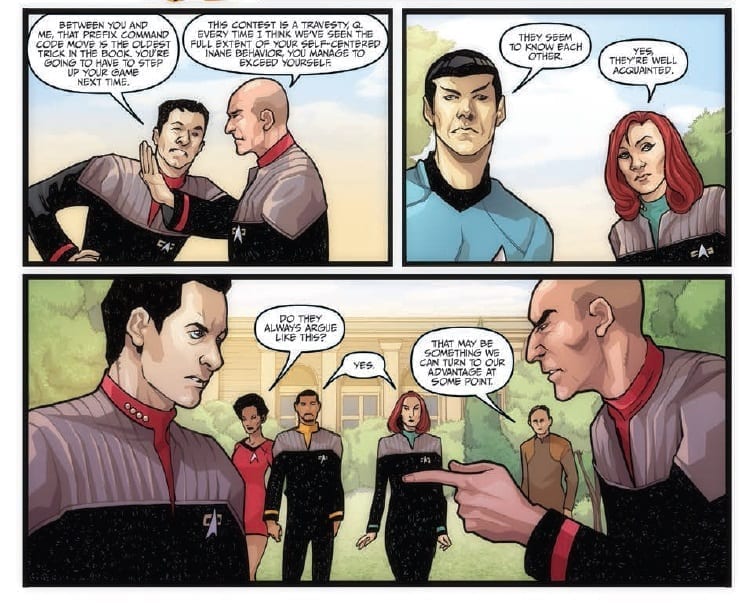
Continuing the interstellar game set by Q and the other god-like beings, the federation crews are pushed to their limits. After an initial loss in the first game, Q argues with Captain Picard over the importance of the situation.
Meanwhile the other captains take some time to dig for information about what is really going on.
All too soon the second game begins and someone bends the rules to add an element of danger to the proceedings.
With such a large cast writers Scott and David Tipton have to pick and choose the characters carefully for each scene. They have an advantage in that most readers will know the characters quite well: very few none Start Trek fans will be reading this comic. But this also leads to very little character building within the narrative. The characters are there to play a given part and nothing more, like the survivors in a 1970’s disaster movie who each have a single skill to help plot move forward but nothing more.
There is some great dialogue between a number of the characters, especially Picard and Q who the Tipton’s have got spot on. Unfortunately, a lot of the speech is exposition with no real character voice. Large sections of the dialogue could be spoken by any of the cast. With all of this exposition you would expect that the narrative to move on at a fast pace however, apart from the constant references to the war Q is raging, there is nothing new added to the overriding story.
Just like last issue, the game that the crews are forced to play is barely entertaining and over before it’s had a chance to get interesting. The whole escapade feels like an opportunity missed.
Star Trek The Q Conflict #3 Credit: IDW Publishing
Art
This comic’s saving grace is the artwork. The strong inking by Ellsabetta D’Amico defines the characters wonderfully giving them a presence on the page. There is a clearly defined foreground focusing the reader’s attention on the crew and the ships. The backgrounds are mere color washes that serve no purpose giving the entire story an air of unreality. This works well for The Q Conflict because much of the story is set in environments created by the God like beings.
Alessandra Alexakis’ color work successfully differentiates the foreground from the background. The cast have a uniformity to them but he still manages to separate each of the different crews, allowing the reader to instantly recognise who is who. Part of this is down to the pencil work and lay out design by David Messina who creates striking likenesses of the characters, even from a distance.
Unlike the rather mundane plot, the art has some expressive features and the cast display some emotional reactions to the world around them. There is an element of dynamism in the space battle but not enough plot for the art work to really shine.
Due to the amount of dialogue Neil Uyetake has a difficult time positioning the lettering in exciting or effective ways; there are moment’s where it feels that he has had to fill a space just to get the speech in. He does, however, employ a number of clever balloon framing techniques to emphasis the loudness of the speech. He presents whispers in the background and shouts in the foreground in subtly different ways that the reader subconsciously picks up.
Star Trek The Q Conflict #3 Credit: IDW Publishing
Conclusion
Star Trek The Q Conflict has a wonderful premise at the heart of it but because of the cast, or writers, insistence on no fighting there is a distinct lack of conflict. At most there is some heated bickering but this is not enough to make the comic a compelling read. Most of this issue is a half time locker room pep talk. And when the action does start it is over too quickly, losing any sense of threat that the situation may have held.
Overall this comic has more in common with the original 1960’s episodes of Star Trek than it does any of the newer incarnations. The other federation cast member’s seem out of place and lost in a narrative not suited to their characterisations.
The best way to sum The Q Conflict up is to quote Trelane from this very issue:
“Nothing is happening! This isn’t combat or strategy! There’s no stakes! I’m not feeling the excitement!”
COMICS ON KICKSTARTER is a new series we are starting at Monkeys Fighting Robots highlighting comic book Kickstarter campaigns. According to Kickstarter, $15.3 million was pledged to successfully funded comic book projects in 2018, up 27% from 2017. If you are working on a comic book related Kickstarter campaign, send us your information at info@monkeysfightingrobots.com.
What the heck is HAMSTER RAGE?
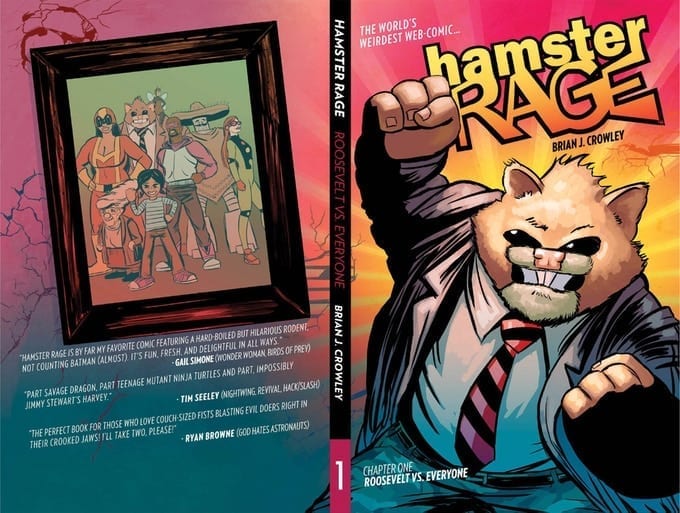
Brian Crowley’s Hamster Rage is the story of MegaBabe, leader of the super team Allied Force, and Roosevelt, her childhood pet hamster who’s now over eight feet tall, super-powered and has the mind of a hyperactive child.
The 160-page graphic novel collects the first four issues and has pinups and covers by Gene Ha, Tim Seeley, Tony Akins, Steve Seeley, Jenny Frison, Hilary Barta, Jim Terry, Ryan Browne, and Geof Darrow.
Watch the Kickstarter video for HAMSTER RAGE:
One of the things that potential backers look for on Kickstarter is a completed project, and the Ringling School of Art and Design graduate has said, Hamster Rage Chapter 1: Roosevelt VS Everyone is complete. The funds collected will be purely for printing and shipping the book to backers. Click on the widget below for more information and to grab yourself a copy.
What do you think? Is this the type of comic book project you want to see more of? Comment below with your thoughts.
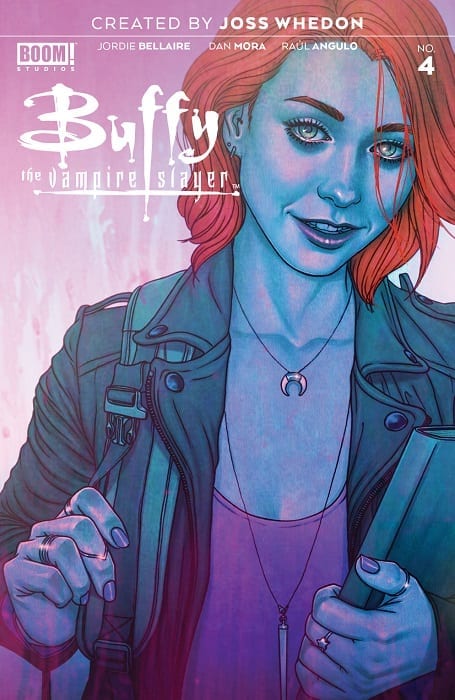
Issue 4 of Buffy The Vampire Slayer marks the end of the first story arc in BOOM! Studios new Buffy-verse. With the announcement of the surprise Angel comic, also out this week, certain elements of the plot may have been given away. Or have they?
The element of surprise has been an integral part of this series so far with the creators mixing up what the fans know about the characters and their relationships with each other. Nudging a character slightly to create a different dynamic has given this version of Buffy an edge over other tie-in comics in the franchise and this issue is no different.
Buffy The Vampire Slayer #4 Credit: BOOM! Studios
Writing/Story
In this issue Jordie Bellaire has slowed the plot down, producing a character driven issue. The emphasis of the narrative is on how the lives of the central characters have been affected by the appearance of the Slayer in Sunnydale.
It open’s with Buffy and the Scooby gang training. Giles warns of the dangers of ahead, referencing Drusilla’s appearance in previous issues, and then gives Buffy the night off to relax before the coming battle.
This element of the plot allows Bellaire to focus the story on Buffy and her friends. She is able to show them as the teenagers that they were before the craziness began and how they interacted with each other. It also allows for the narrative to compare who they were before with who they are now. Bellaire does this by highlighting the small changes in their interactions; for example, the moment when Xander is late and Willow expresses concern because he is never late.
The slow pace of the comic relaxes the readers and allows Bellaire to build up the momentum leading into the final pages. She lulls the reader into a false sense of security and then slowly takes that security aware. It is something that the TV show did really well and Bellaire does it beautifully here. Although the changes made earlier in the run to one of the characters may lead the reader to guess what is going to happen, or at least who it will happen to.
Buffy The Vampire Slayer #4 Credit: BOOM! Studios
Art
As ever the art work is brilliant. Dan Mora lays out each page with a simple goal in mind; relaying the story, and then fills each panel with dynamic images.
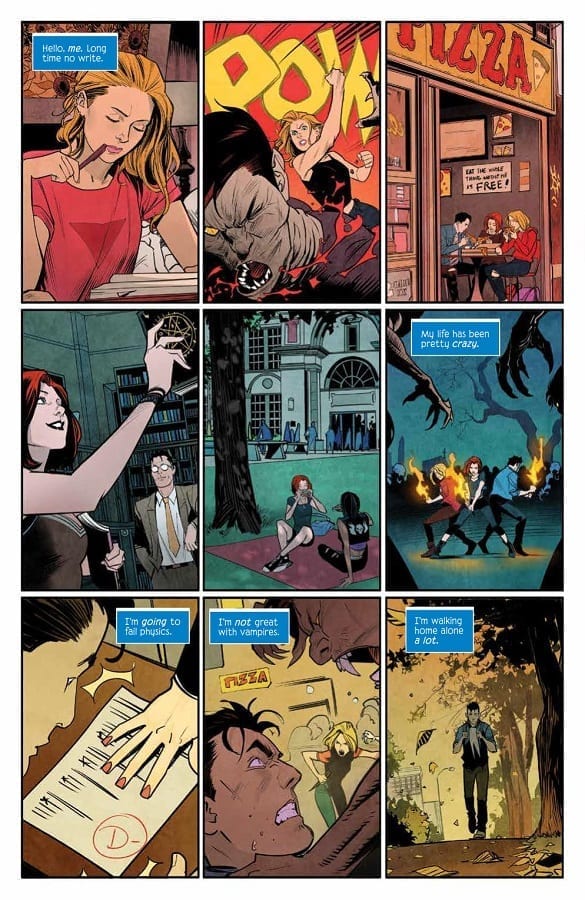
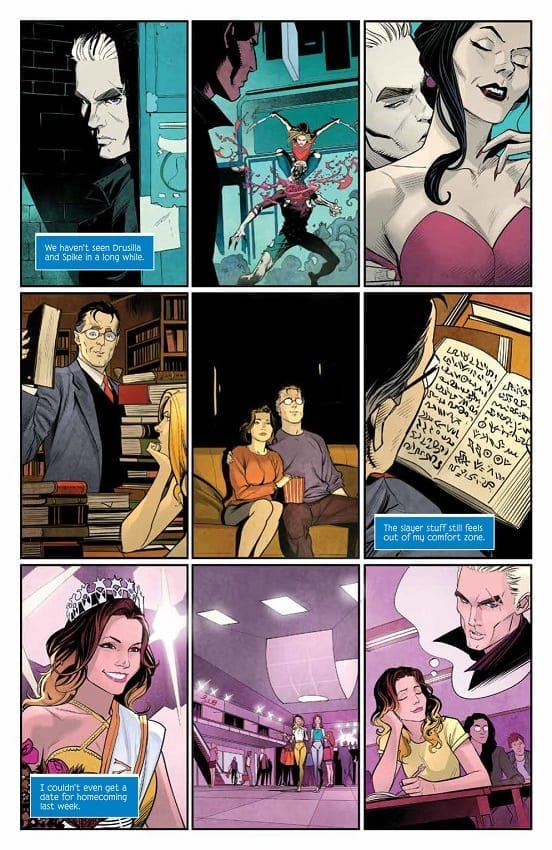
The opening pages are an example of how good Mora is at expressing character. He employs the 9 panel grid and dedicates one row of three panels to each central character. Then each panel represents a different aspect of the character; sometimes by portraying an act which has already happened in the comic or by glimpsing something that hasn’t been explained. Each three panel row adds depth to each character so that the opening two pages contain a plethora of information.
Raul Angulo gives each scene a different color theme to distinguish each one and set the tone for the scene. The school and home scenes are fairly muted with Buffy standing out in vibrant clothing because she is the focus of those scenes.
A more unnerving color palette is then used as the story progresses and a contrast between panels on the same page picks up the mood of the characters, forcing the reader to subconsciously compare them. There is one moment later in the comic when Angulo shifts the shading tone to a deep red just on one character and instantly the reader knows the danger this character is in. It is simple but extremely effective.
The lettering, by Ed Dukeshire, manages to capture the Buffy-speak that Bellaire employs throughout. The inflections and emphasis by the characters on words and phrases is perfectly captured by Dukeshire’s work. He also creates an ambiguity with the main caption boxes making the reader double guess who is speaking. Usually this would be a bad thing but in this instance it helps to keep the narrative moving while retaining an element of mystery.
One of the area’s where Dukeshire excels is in the texting conversations. He creates believable mobile screens with the text laid out in a realistic manner. As the character tilts the mobile phone, the text is also tilted to match. Just like the straightforwardness of some of the coloring, this obvious lettering technique makes the world of difference to the readability of the comic.
Buffy The Vampire Slayer #4 Credit: BOOM! Studios
Conclusion
This issue of Buffy The Vampire Slayer is both a wind down from the opening excitement and set up for the nightmare to come. The entire creative team painstakingly make so much of the action mundane and normal so that the reader can get to know the characters better. It also helps to set the right tone for the end of the issue. From the opening there is no indication of how the narrative will progress which is perfect for this type of story.
This first arc of Buffy The Vampire Slayer has been near perfect from start to finish. Bellaire has captured the essence of the characters and given them her own spin. In turn the entire art team have all pulled out their best work to make sure that this comic would be a hit.
The Cool Kids is an old-school, multi-camera sitcom on FOX and co-created by Charlie Day (It’s Always Sunny In Philadelphia) about four seniors living at a retirement home who act more like high schoolers than wizened elder folk and lacing the hilarity with the right music is composer, Cormac Bluestone.
The Cool Kids stars comedy legends David Alan Grier (The Big Sick), Martin Mull (A Futile and Stupid Gesture), Leslie Jordan (American Horror Story: Roanoke), and Vicki Lawrence (Hollywood Squares) who all live at Shady Meadows Retirement Community. Grier is Hank Henderson, the de facto leader of a group of four, however, when one of their clique passes on, a new member fills the slot whether Hank likes it or not. That new member is Margaret Flynn played by Vicki Lawrence who is a firebrand of a woman that ruffles feathers but is clearly meant to be part of this quartet.
PopAxiom had the chance to talk to Cormac Bluestone and pick his brain about making music for The Cool Kids, It’s Always Sunny In Philadelphia and the power of workflow.
Growing Up With Music
Cormac started playing the violin at three, switched to the piano at twelve, then guitar all the way through college “As long as I can remember I’ve been playing music.”
Movies are ubiquitous “I always had a love for music in film and television, so I was fortunate to end up in a place I wanted to be.”
Growing up in the 80s Cormac was exposed to electronic music early on by a sixth-grade teacher “I was writing music in DOS.” Cormac adds “I love tech.”
Cormac is a composer but don’t be fooled, perusing his IMDB will reveal credits as an actor, producer, and cinematographer “I really wanted to be a part of this industry somehow. But editing, camera work, all that stuff, it all kind of adds up to the same idea in today’s digital age and the way things work.”
The Nightman Cometh
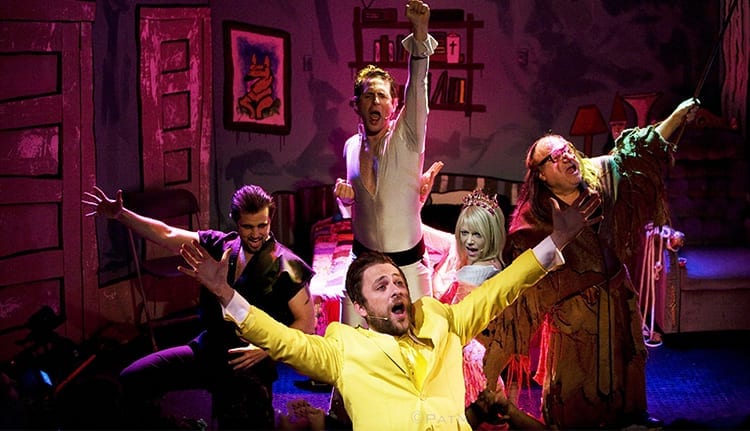
Cormac’s journey to The Cool Kids started with a beloved FX comedy “I have to say my first real break was It’s Always Sunny In Philadelphia and working on ‘The Nightman Cometh.’”
Cormac continues “That was my first real big TV job. I had been writing musical short one-acts for years in New York City. Me and my friends who had a theatre company would perform them in bars.”
The composer continues “The more we did, the more I thought, ‘how do we make a bigger show?’” And then came a move out west and one important Day “In L.A., we staged the ‘best-of-the-best’ and Charlie Day came to see it.”
Making The Cool Kids
What was Cormac’s first reaction to reading the script for The Cool Kids? “I loved it. I grew up in the 80s with multi-cam sitcoms, so I was so excited to get to work on a show like that. And then, you have the cast, plus guests like Jamie Farr (MASH).”
The Cool Kids is co-created by Charlie Day who shows up in a cameo in the pilot. Was it Cormac’s connection to Day that got him the gig? “Absolutely.”
Time is a significant factor in life, and when it comes to network sitcoms, there is a wildly varying amount of it “The turnaround really depends. Sometimes I get as long as a week to do an episode and sometimes it’s under 24 hours.”
But Cormac admits “Personally, I welcome the short deadlines. I’m about workflow.”
From the onset “Charlie and Paul Fruchbom who created the show, they were very clear on what they wanted. I think that’s what our audience has responded to. They know what they are going to get, but also know they’re going to be surprised.”
Musicals + Video Games
You cannot do an interview with Cormac and ignore an interesting list on his credits — Assassin’s Creed: The Musical “That was such a gem. A friend of mine was working for the YouTube channel Machinima. My friend asked me if I could do some music for this for the release of the game. The lyrics were perfect. So I made a couple tracks. The director they hired turned out to be an old friend of mine. We had some amazing singers.”
About making the short film, Cormac says, “It was an incredible experience.”
Of course, talk of video games begs the question, is Cormac a gamer? “I’ve played every Halo, every Madden. But I don’t get a lot of time to play these days.”
Cormac talks about the influence of video game music “But video game music …. today, it’s so much more cinematic too. Something like Red Dead Redemption is so incredible.”
Making Music
For Cormac, there is one crucial aspect to making music for him “I think you gotta start with a workflow. How is this going to get done? How do we do it in a way that’s comfortable?”
A part of the score-making workflow often includes temp tracks “My point of view on temp tracks is that I’ve been lucky. Some of the editors and producers I work with pick great temps.”
Cormac also thinks “But that’s a challenge too because if you have a great temp, then you have to ask ‘what can I bring to this?’”
However, he doesn’t see this as a negative “It’s a fun part of figuring that out. What is it about this piece of music that is appealing? And then how can I deliver something as good or better?”
Continuing the talk on temp tracks, there’s a reality to making movies and TV “It’s hard to edit without music.” So temp tracks are necessary, but not necessarily evil as they are sometimes portrayed.
For Cormac “The only real negative is if a project sits too long and people fall in love with a temp. But TV moves so fast these days it’s hard for that to happen.”
In regards to his current show “The Cool Kids, we did 22 episodes this season, and the temp tracks at this point are all my music from before.”
Wrapping Up
Who would you say is part of your musical DNA? “Oh, man.”
Cormac begins “I have to say Mark Mothersbaugh (Thor: Ragnarok).”
Cormac delves deeper into his first answer “[Mothersbaugh] Came from one of the biggest 80s acts — Devo. His versatility. But when I saw Rushmore in theaters, his instrumentation on it was so different than a big score, but it feels like a big score and punctuates the comedy. I learned so much about comedy.”
It might seem a bit common for musical artists to turn to composing since people like Trent Reznor, Thom Yorke, and Johnny Greenwood are making music for films and television. But in the 70s and 80s, it was rare, but another of Cormac’s picks had a similar start “One of my true favorite composers is Danny Elfman. He was part of [70s/80s new wave band] Oingo Boingo. I don’t even think he wanted to be a composer, but he got to work with Tim Burton.” And the rest is history.
More of the musical DNA comes together “Of course, various other artists. I grew up listening to Van Halen, John Williams … Alan Silvestri. It’s a real mixed bag.”
Cormac adds one more name to his list “Mike Post was someone I loved growing up, and he produced Van Halen’s Van Halen 3. It’s a great album, and you can hear what Post brings and how it marries what Van Halen does, and Gary Cherone is a fantastic singer.”
Cormac’s work is not done “We’re finishing up The Cool Kids. We’re in the very last stages.” Keep an ear out for more from the composer, because The Cormac Cometh, ahh-ah-ahhhhh!
Thanks to Cormac Bluestone and Impact24 PR for making this interview possible.