Home Blog Page 320

Brian K. Vaughan and Tony Harris’ EX MACHINA: Where Heroism Goes to Die

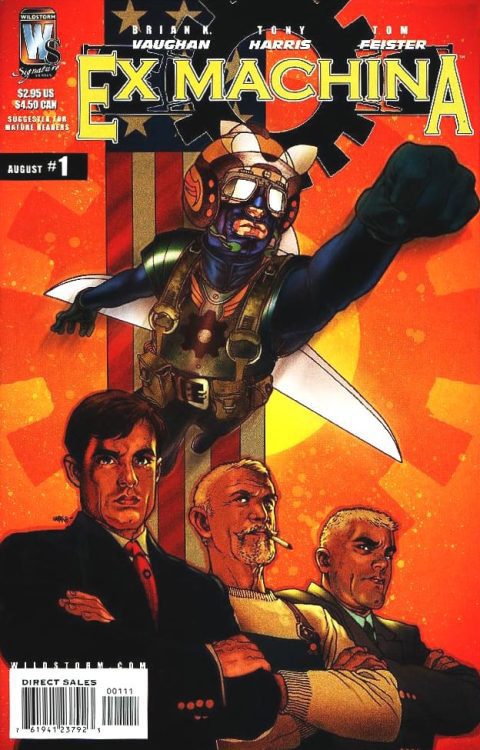
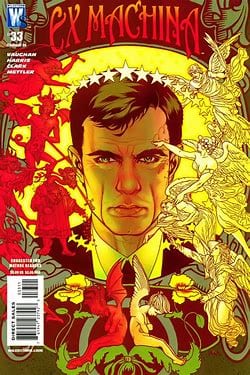
Brian K. Vaughan and Tony Harris’ Ex Machina ran on DC Comics’ WildStorm imprint from 2004 to 2010, and sits as one of the more divisive comics of the past 20 years. The often-used trope of placing a superhero in the real world is supported by a heavily political parallel plot.  Ex Machina is a series about political opportunism and its corruption of morality. It is also the most complex comic now-icon Brian K. Vaughan has ever written. With brilliant artwork from Tony Harris,  Ex Machina is a series recommended to those who like their comics thought-provoking, if not necessarily emotionally satisfying.
Writing & Plot

Mitchell Hundred is a civil engineer turned vigilante hero after coming into contact with an “alien” device that enables him to talk to machines. After earning a reputation as “The Great Machine,” he successfully runs a campaign to become the mayor of New York City. From here, both the ins and outs of political actions and the consequences of his powers become the day to day for the Mayor and his allies. This is a story that mixes American politics and interdimensional conspiracies and tests the true moral character of Hundred himself.

Writer Brian K. Vaughan himself admits that he prefers stories with a focus on character over themes, which is part of what makes  Ex Machina such an odd series in his bibliography. While the slick dialogue and unique characterization found in Vaughan’s other works are here (albeit muted), there is a clear focus on political and moral concepts. Hundred is in conflict with nearly everyone around him, including his most trusted allies. He clashes with his friends who supported him through his time as The Great Machine in an effort to distance himself from his vigilante past. He butts heads with his political allies over making the right moves on a litany of divisive key issues. As Hundred becomes further wrapped in his political career, he kicks harder and harder against his past. The plots dips back and forth between the “present” with Hundred as the mayor of NY, and a few years prior during his time as The Great Machine. He doesn’t just secretly fight against the rising threats from his power’s origin, but against the very people who have helped him along the way. The most shocking element of  Ex Machina is how Vaughan is able to create a protagonist that is understandable and compelling as a character but is also devastating to watch. Hundred’s descent from hero to jaded opportunist is a brutal journey, and lead to one of the most disturbing finales to a long-form story in recent memory.
It doesn’t sound like I’ve given much reason to pick this series up, but I assure you that this isn’t my intention. This is a BKV work after all, so although it may be a bit dour, it’s still immensely compelling. The dialogue is sharp and highly varied among a large cast of recurring characters. While there is a considerable amount of political jargon in the text, it’s supported by a knowledgeable intent and personality unique to Vaughan’s writing style. Note too that this series started in 2004, so many of the exact political events the comic references could be considered a little dated. On the other hand, they could be considered a window through time to a different political era (like watching  All the President’s Men in 2020). The events that transpire in Hundred’s life, from personal, to political, and to the supernatural, serve to zero in on his conflicted morality and often pained decision-making. The discoveries about his powers take a backseat to how Hundred handles them within his political career. While the circumstances around the Mayor’s ability have a decent story that becomes more complex as the series continues, it pales in comparison to Hundred’s steady transition to a political opportunist. Before long it becomes clear that his friends and allies are just items he “handles” for gain. It isn’t a sudden and malicious change, however. Hundred’s ideals and reasons for getting into politics are all presented to be for the right reasons. He’s amicable and trustworthy to the people around him for the large majority of the series. The slow transition from hero to opportunist is subtle, so much so that by the series’ end you’re left slack-jawed by Hundred’s cold actions, even if you aren’t surprised by them.
Art Direction

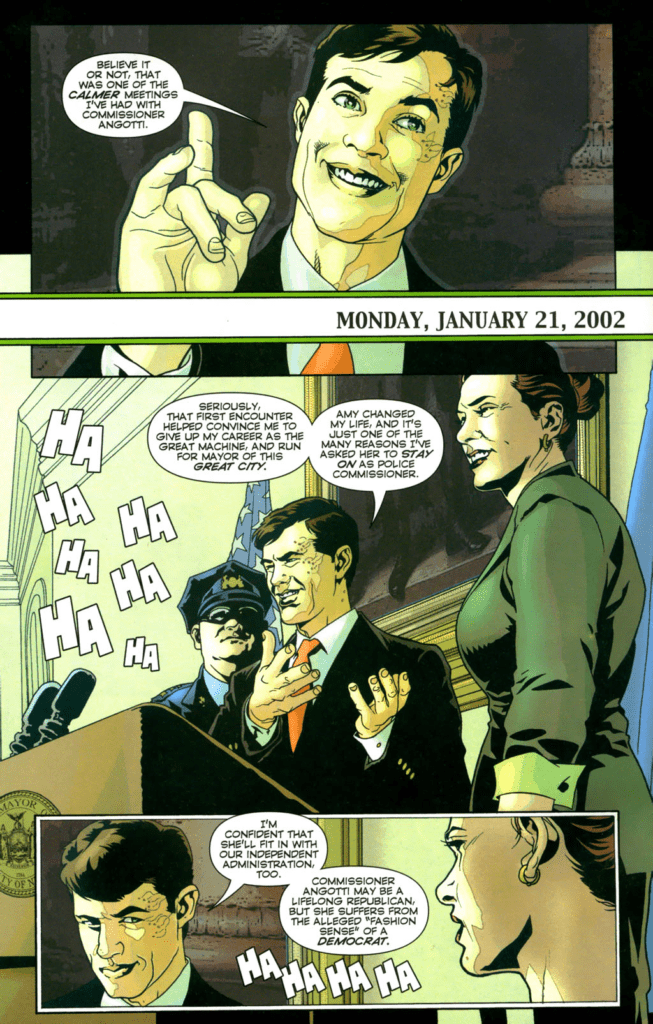
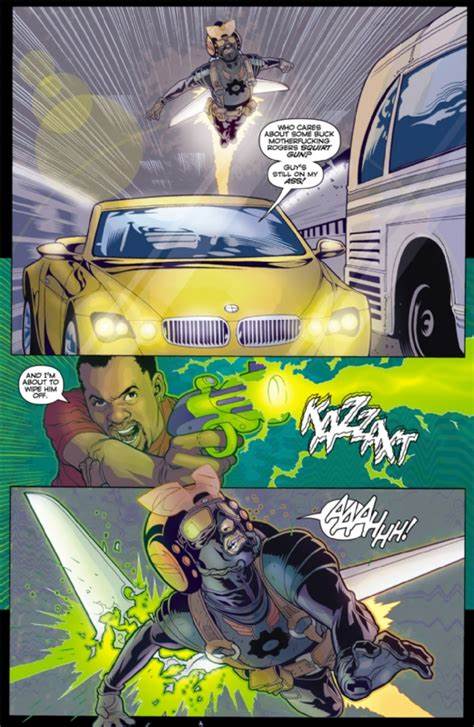
Arguably the real star of  Ex Machina is Tony Harris‘ phenomenal artwork. Take the awe-inspiring but certainly human artistic style of his  Starman covers and apply them to fifty-issues of character-focused political drama, and you have this comic’s aesthetic. The attention to detail in both the wide cast of characters and the urban environment of NYC is staggering. This series looks and feels like a high-budget television drama, and this is largely due to Harris’ work. His work here sits among the most consistently great-looking long-form series ever published. The level of craftsmanship needed to keep this kind of visual integrity up for the entire span of the run is mind-boggling, and I honestly believe it’s the single most impressive facet of this comic. Of course, much of this is aided by an immensely talented team of inkers, who provide dimension and atmosphere to Harris’ pencils. The art is brought to life with J.D. Mettler’s interesting use of colors. Outside of the usual detail coloring, Mettler will bathe entire pages and sequences in a unique color palette. Bright yellows, moody violets, rusty brown sunsets and eerie greens will tint whole scenes with thematic intent. It’s details such as this that make Harris & Co.’s work of  Ex Machina such a visual marvel in the comics medium.
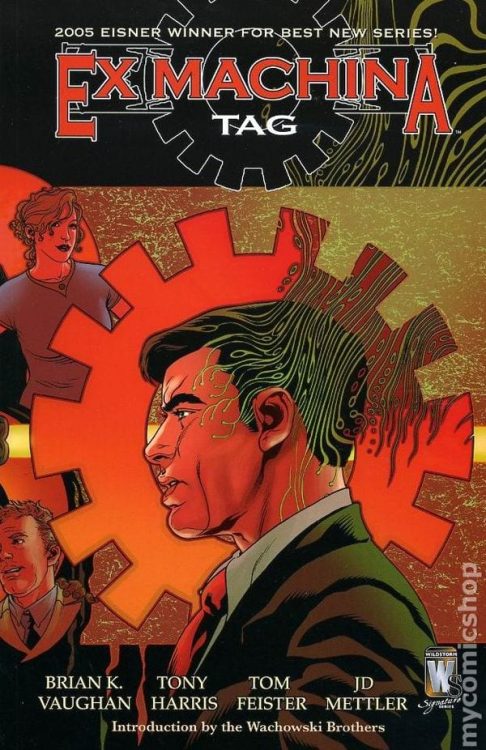
Ex Machina is a difficult comic to recommend. It’s a fantastic piece of the comics medium, and a riveting story about the evolution and death of a man’s desire to do the right thing to satiate his newfound political opportunism. The political and interpersonal writing overshadow the supernatural plot, but this I expect more and more is by design. It also has one of the most brutally dour endings to a long-form story in recent memory, but it actually sticks the landing in terms of how such an ending is approached. It’s written with every bit of craft one would expect from a Brian K. Vaughan work, but it focuses more on themes and concepts than character drama. The visual work from Tony Harris & Co. is some of the finest seen in a long-running series from the past twenty years. Again, this is not a story for everyone. However, if the tragic demoralizing of a likeable character and political intrigue are up your alley, then I cannot recommend this series enough.


Monkeys Fighting Robots Youtube

INTERVIEW: Composer Christian Davis Puts the Sonic Frights Into Horror Film ‘Behind You’

Christian Davis scores the fantasy-comedy Dwight in Shining Armor, but in Behind You, the composer crawls under the viewer’s skin to make the haunted house horror film come to creepy life.

Behind You stars Addy Miller (Secret Life of Bees) as Olivia and Elizabeth Birkner (The Outpost) as her younger sister Claire. The siblings are staying with their estranged aunt in her old home. As the sisters explore the house, they find all the mirrors are covered up. When one of the sisters uncovers a particular mirror, she unknowingly unleashes a demon that terrorizes everyone in the home.

PopAxiom talked with Christian Davis about his road to making music in the film and television industry, Dwight in Shining Armor, and the way he used his own house to make Behind You that much scarier.

christian davis-composer-interview

Almost A Dentist

Christians’ musical connection began with guitar lessons. “Music came into my life when I was young. I played in some grunge rock bands in high school, I sang in a school choir. It was fun.”

About Christian’s grunge rock sound, he says, “We were kinda like grunge punk, Nirvana and Green Day type stuff. A little Blink 182.”

However, trying to become the next Nirvana was mostly a hobby. “In college, I was pre-dental and hated it. I discovered they had this media music major with a scoring emphasis, and I thought ‘that sounds cool.’ It’s two things I’m passionate about music and movies. I hadn’t thought about it as a career until then. I switched majors then shipped off to LA after I graduated.”

In Los Angeles, Christian found work as an assistant.” That’s the thing you do as you’re starting. You’re an assistant to established composers. Doing anything from fixing computers to writing music.”

From his time as an assistant, Christian points to two people as vital to his growth as a composer. “My two mentors Rupert Gregson-Williams (Wonder Woman, Aquaman), I worked with him for four years … Kevin Kiner (Star Wars: Rebels, Star Wars: The Clone Wars).

dwight in shining armor-composer-interview-christian

Bagpipes & Punk Rock

Christian’s days as an assistant are now a thing of the past as we talk about his own show Dwight in Shining Armor. “It’s a really fun show. I think of it like The Princess Bride meets the Disney Channel. It’s geared towards a younger audience, but it makes me laugh. Parents will enjoy it too.”

In his words, Christian explains the show. “Dwight is this geeky kid who kisses awake a sleeping princess who is now in charge to keep her safe from all her enemies. It’s middle-earth meets middle-America. It’s comedy, action, adventure, it’s sentimental.”

In regards to creating the music, Christian says, “It’s a fun show to write. I used bagpipes, some Celtic punk rock, and epic orchestra.”

christian davis-composer-interview

About Behind You

Behind You features a small cast in a confined space. The music is this subtle pressure that builds for the runtime. The film is directed by duo and first-time directors and writers Andrew Mecham and Matthew Whedon. How did Christian connect with them for the gig? “It was a cold email. I saw some friends of mine that were working on it. They were posting these cool set pictures on Facebook. I found the director’s email and said I’d love to demo for this. So I sent him some music, we had some meetings, and I got the gig.”

Cold calls and emails are common but don’t have a high chance of success. However, you miss 100 percent of shots you don’t take. “It was a shot in the dark. And you usually don’t get anything. But in this case, I was lucky.”

Christian shares a bit of the process from meetings to music. “Andrew and Matthew didn’t really have too much of a super-clear vision, which is great. Sometimes you go into a movie, and an editor has cut in some other things soundtrack like Stranger Things … then the filmmakers want things to sound like that, and you’re stuck trying to make them happy but also make something original.”

On Behind You, things were different. “They didn’t have much of that. I came in and watched the movie and said they had a very traditional ‘haunted house’ scary movie. I didn’t think they should go too contemporary like an orchestra or anything too modern. We tried stuff. They said the one thing they wanted to do in the score was making the house a character in the movie. They said ‘Is there a way you can create and give the house its own sound?’”

In Behind You, Christian succeeds in making the house come to life. But how? “What I did was went around my house and recorded different sounds. I have things like dropped silverware sounds, tea kettles instead of violins … more organic sounds from around my own house. So, it’s a bit of the traditional orchestra mixed with house sounds.”

For every project, Christian has his process, which is simple and low-tech. “I definitely have a notepad next to me because ideas are going to come. You don’t have time to execute all the ideas, but I don’t say no to any ideas. I watched the rough cut with my notepad thinking ‘what about this or what about that’”

The composer puts a lot of stock in that first viewing. “I think those first gut reactions, your instincts, are usually the best ones and the right ones. The first time you watch a movie and the way you react to it, you’re only going to get that once. I only get that opportunity once also, so I try to write down all the thoughts and reactions I have to the movie.”

Wrapping Up

Christian reveals his ever-shifting sources of inspiration. “I always go through phases. Some new movie comes out, and I’m like ‘whoa, that score is so cool!’ The most recent one was from Ben Salisbury and Geoff Barrow (Ex-Machina, Annihilation) and the show Devs on FX. They did the most exciting stuff with synths and sound design. I listen to all their stuff lately. But, two months from now, it might be someone else.”

Christian is an 80s/90s kid, and there are a lot of movies from that era coming back to the big or small screen. What would the composer love to score if it were remade? “I’m going to go with Dumb and Dumber. There are so many great ones. Jurassic Park, Titanic, The Matrix, but Dumb and Dumber I never stop quoting.”

Behind You is VOD, and the soundtrack album is available on iTunes. So, what’s next? “I’m working on Dwight, season three is airing right now with new episodes airing every Sunday. Another horror movie I did comes out in May, it’s called The Voices.”

Will you be watching Behind You?

Thanks to Christian Davis and Impact24 PR
for making this interview possible.

Want to read more interviews like this? CLICK HERE.

Monkeys Fighting Robots Youtube

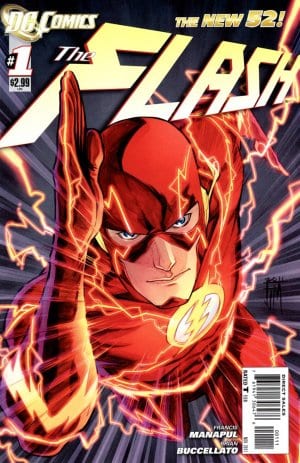
Longbox Legends: How THE FLASH (2011) #1 Reminded Us Why We Love Barry Allen

THE FLASH (2011) #1, released in 2011, signaled the first solo story for Barry Allen after his return to the DC landscape. It was met with great adoration from longtime fans as well as newcomers. Francis Manapul, the writer and main artist of the issue, shows readers just how much he loves the character of Barry Allen, capturing the optimism and determination that makes him enjoyable.

Story

Fresh out of the Speed Force and placed in the midst of Central City, Barry finds himself picking up with a reworked life from his pre-New 52 counterpart. But instead of being in a romantic relationship with Iris West, our hero is happily dating Patty Spivot of the Central City Police Department. And the peace doesn’t last long when a mysterious gunman attacks their headquarters.

After apprehending the threat, Barry finds that the gunman is none other than Manuel, his best friend and roommate from college. And it looks like the Scarlet Speedster will have to embody both the hope and determination that readers love him for.

Manapul’s depiction of Barry in this issue is suitable for old and new readers alike. Readers experience the care their hero feels for his former roommate, yet see his determination to protect people from the damage he’s caused.

Artwork

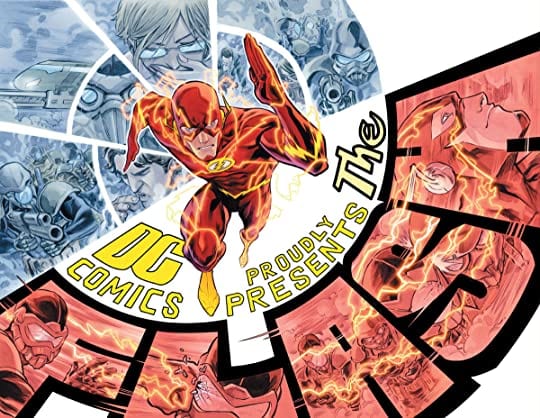
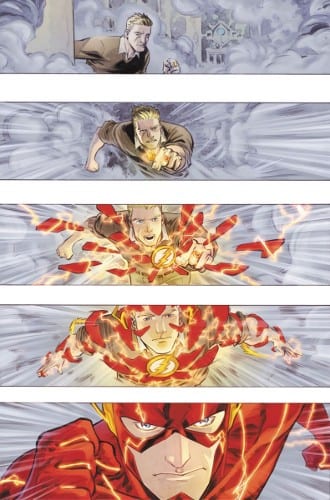
One of the greatest aspects of this comic is the fact that Manapul both wrote and illustrated its contents. Along with Brian Buccellato’s coloring and Sal Cipriano’s lettering, THE FLASH (2011) #1 makes for a visual treat for any fan of the character. The penciled lines give Barry definition while at the same time creating a sense of movement. And the coloring complements this beautifully with clean strokes of yellow, red, and orange. What’s more, the lettering placements are fitting for this artwork; it looks like the lighting bolts themselves are creating the word bubbles.

Conclusion

THE FLASH (2011) #1 was one of the best comics to come out of the New 52. It gave Barry a fantastic new story to firmly place him back in the DC landscape for years to come.

Did you enjoy the characterization of Barry in this issue? Let us know in the comments below!

Monkeys Fighting Robots Youtube

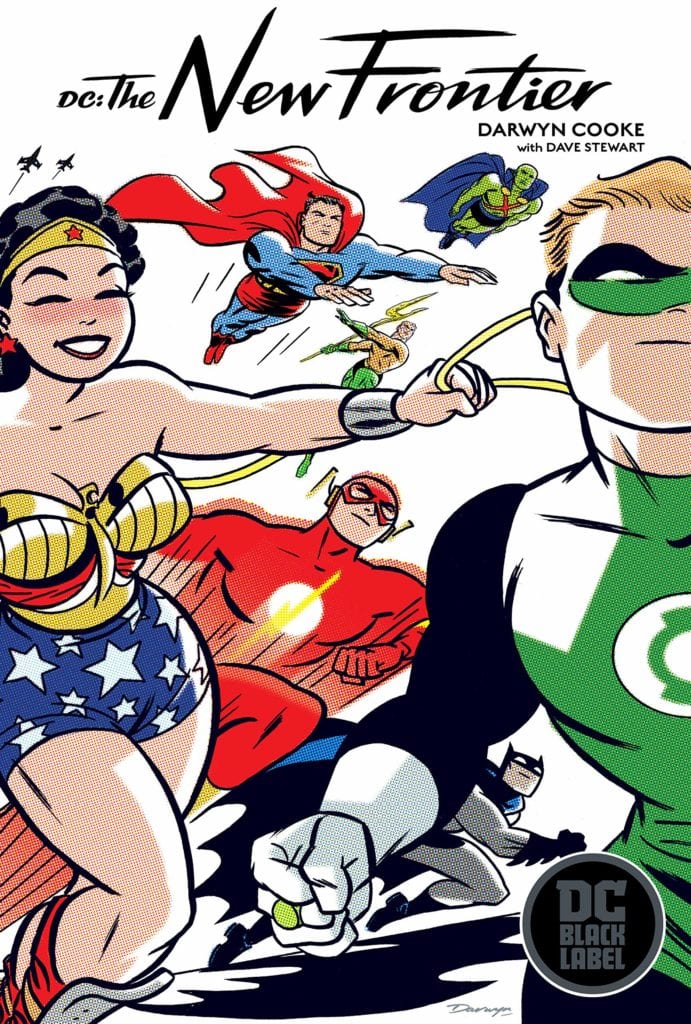
DC: THE NEW FRONTIER is a Wonderful Callback to the Silver Age

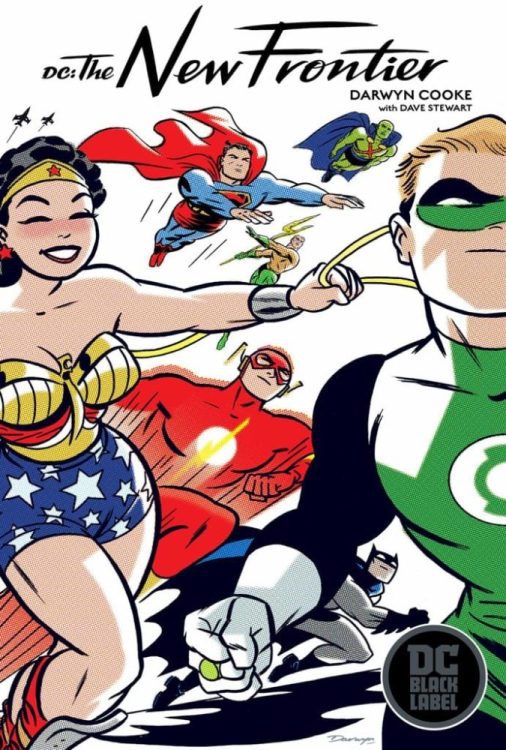
DC The NewFrontier cover

The Silver Age of DC Reborn

The late Darwin Cooke is famous for his fantastic art style. He usually was called in for stories published by DC Comics, such as Catwoman and Batman Ego. In 2004, He was approached to make a Justice League story that would bridge the Golden Age of Comics to the Silver Age. He quickly got to work in creating this story, and soon DC: The New Frontier was born. How does this take on the transitional era hold up?

DC The NewFrontier cover

**Some Spoilers Below**

Story:

Due to the size of the story, focusing on the age, we follow three protagonists closely. The first is J’onn J’onzz, who, after being brought to Earth on accident, seeks to find his way home. With rising tensions of the Cold War, he worries he’ll be found out as he goes about his daily life. However, it’s not just J’onn as Barry Allen also tries to find a peaceful existence in a world where masks are frowned upon.

The last character we follow is Hal Jordan, a former air force pilot, as he is recruited for a space mission to Mars alongside Task Force X. The group learns of J’onn’s existence and worries his people will end up a threat to the world.

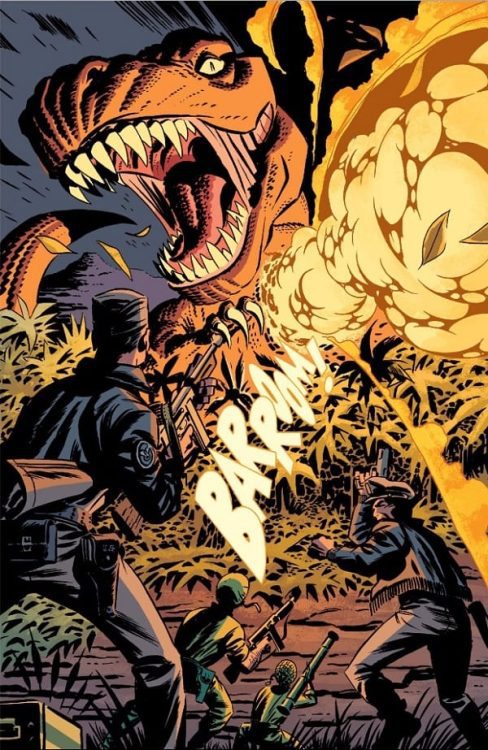
DC the new frontier p1

This story is big, and even that is an understatement. While the summary may focus on three characters, it truly focuses on the period between the Gold and Silver ages of comics. We see Golden Age DC heroes such as Superman, Batman, and Wonder Woman adapting to a world that questions their intent. At the same time, the Justice Society of America is put on trial. It’s genuinely fascinating to see how this time period looked to their heroes as one war ended and a new one began.

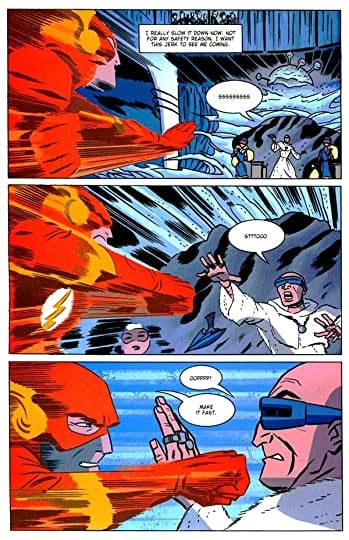
Out of the three listed above, Barry’s story is shown the least, yet it is the most intriguing. While Jonn’s evolution from visitor to cop to hero is very well done, Barry goes through a bit of growth himself. He takes the name of The Flash and does his part to help Central City and is appreciated for it. When the government tries to capture him, Barry begins questioning his position. Should he continue down this path when the government would try to vilify him? While it’s obvious what he chooses, Barry’s story is a prime example of the real issues of this time.

DC the new frontier p2

Art:

Darwyn Cooke is well known for his fantastic art style, and it fits perfectly here. He captures an old school feel, calling back to the style of the legendary Jack Kirby. To keep up with the authenticity, he looked to design the heroes as close to their original looks as possible. Superman is designed to match his old cartoons, Batman and Jonn match their original comic appearance, even an explanation of why Hal wears his Green Lantern mask. 

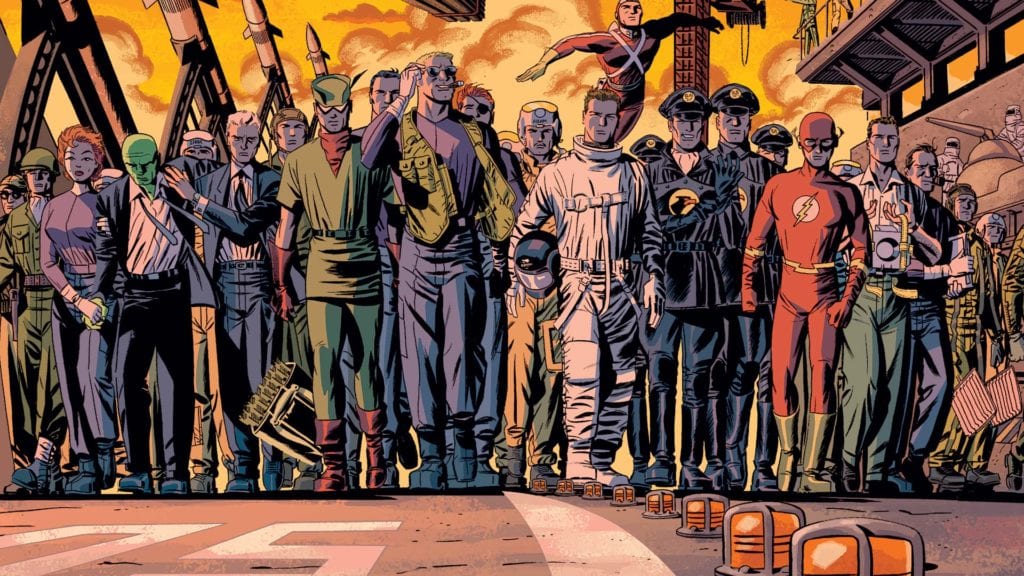
Cooke also manages to include a variety of references to the period. Television personalities, celebrities like Cassius Clay and Frank Sinatra, and even C-List heroes by the time the final battle comes around. This DC world of a time long past looks excellent even by today’s standards.

Conclusion:

DC: The New Frontier presents a fantastic recreation of a time long past. This world is full of references to the history of these characters we’ve grown to love. The art matches this world perfectly, calling back to the comics of yesteryear. The issue, sadly, is it’s too big to enjoy fully. The story is good, but the amount of hopping around we have to do detracts from the plot. Darwyn Cooke created more than just a story when he made this series. He made a world where legends were born.

DC the new frontier p3

Monkeys Fighting Robots Youtube

Longbox Legends: BOOSTER GOLD #5 Goes To Hell And Back

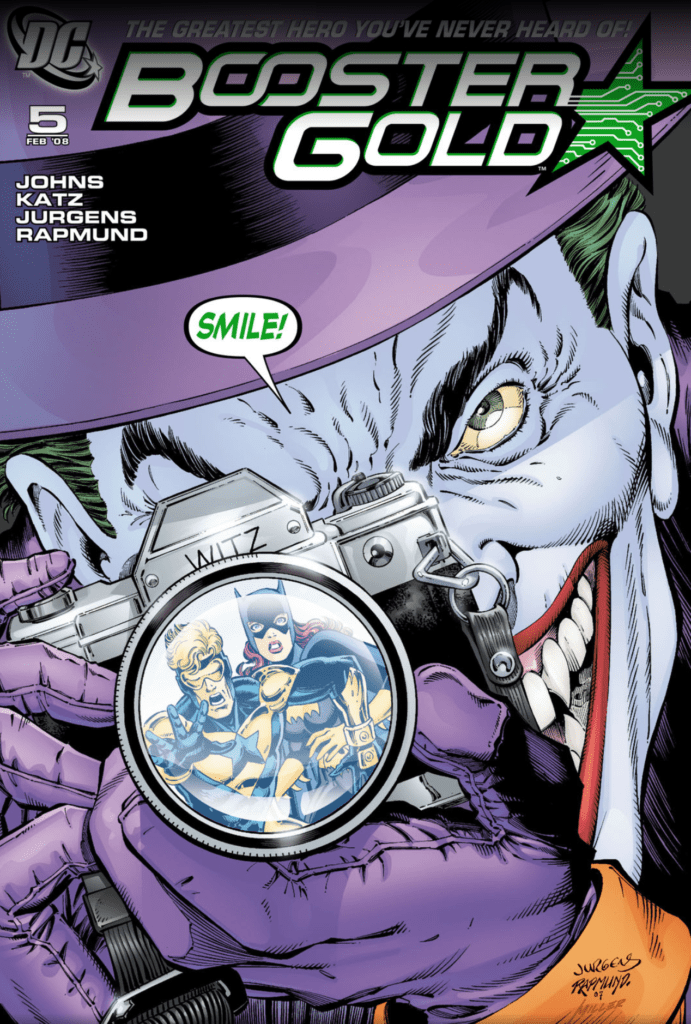
Booster Gold may seem like a complete imbecile on the outside who’s only chasing fame, but Booster Gold (VOL. 2) #5 shows just how much of a hero he truly is.

To get the full story, we need to look back at Countdown to Infinite Crisis, 52, and the first few issues of Booster Gold (VOL. 2) #5; hereafter, dubbed Booster Gold #5.

Spoilers for issues leading to Booster Gold  #5 and Countdown to Infinite Crisis, 52 follow.


BLUE AND GOLD

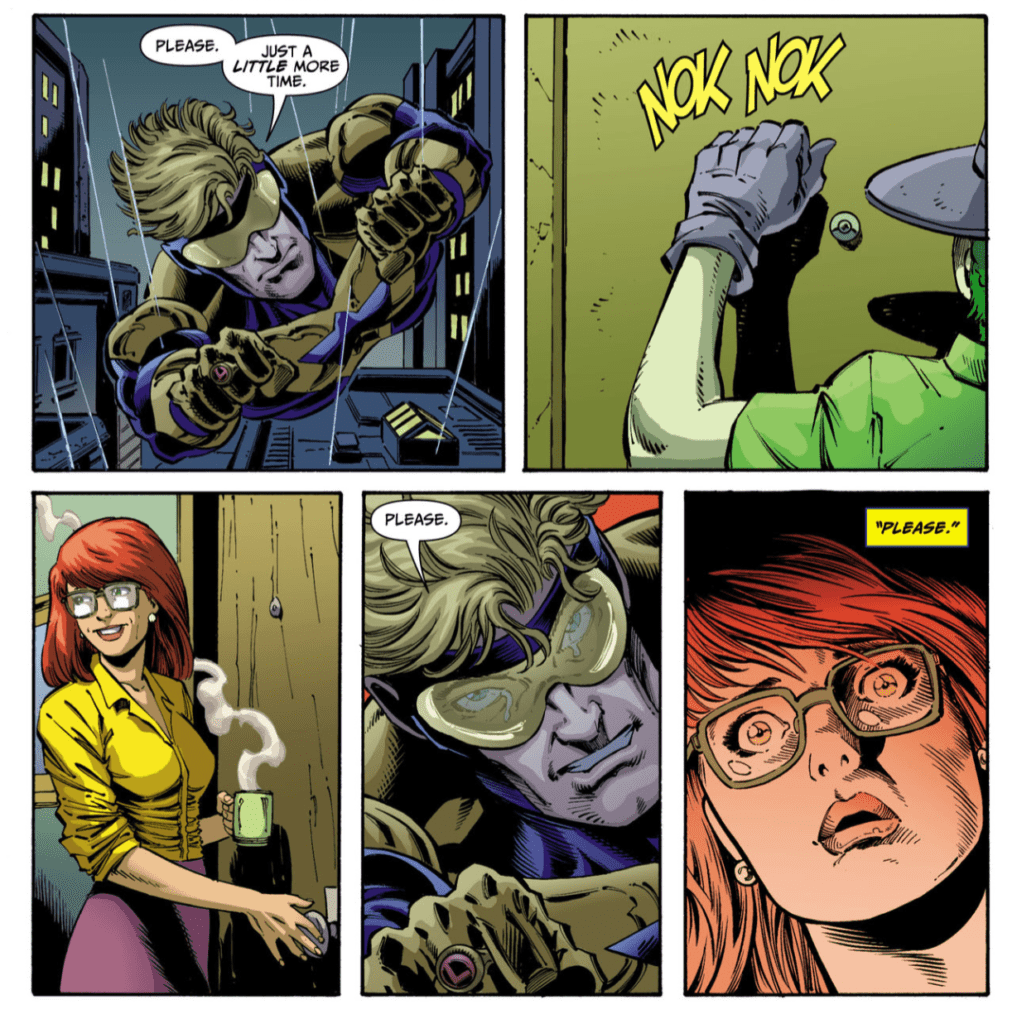
Ever since their meeting in the 80’s Justice League, Booster Gold and Blue Beetle (Ted Kord) became inseparable friends, dubbed Blue and Gold. The two went on to rely on each other for nearly everything, while completely understanding one another. When no one respected them or their opinions, they had their friendship—the type of friendship everyone wants. But during Countdown to Infinite Crisis, Blue Beetle learned of Maxwell Lord’s plans with the Omacs and went to stop him. Blue Beetle was shot dead. Booster Gold lost more than a friend.

Following this, Booster Gold went and saved the Multiverse in 52, but with such knowledge, he couldn’t tell anyone. This made him “The Greatest Hero You’ve Never Heard Of.” The second volume’s fantastic tagline. Nonetheless, he constantly had the death of Blue Beetle in the back of his mind, especially after learning it was a dear friend that killed him. These plot points become a driving force for the first few issues of his solo series, where he deals with the death of a friend.

Writing by Geoff Johns, Jeff Katz. Art by Dan Jurgens, Norm Rapmund. Colors by HI-FI, Lee Loughridge. Lettering by Nick J. Napolitano

BOOSTER GOLD VOL. 2

Now in his solo series, Booster Gold believes he deserves to be back in the spotlight after saving the Multiverse. He isn’t wrong. He spent most of the series fighting for and fixing the Multiverse in the background with Rip Hunter, another time traveler. The thing is the Multiverse is always in trouble and Rip returns needing his help. After all the Crises, some wormholes need to be closed, especially now that someone is trying to stop multiple heroes’ origins.

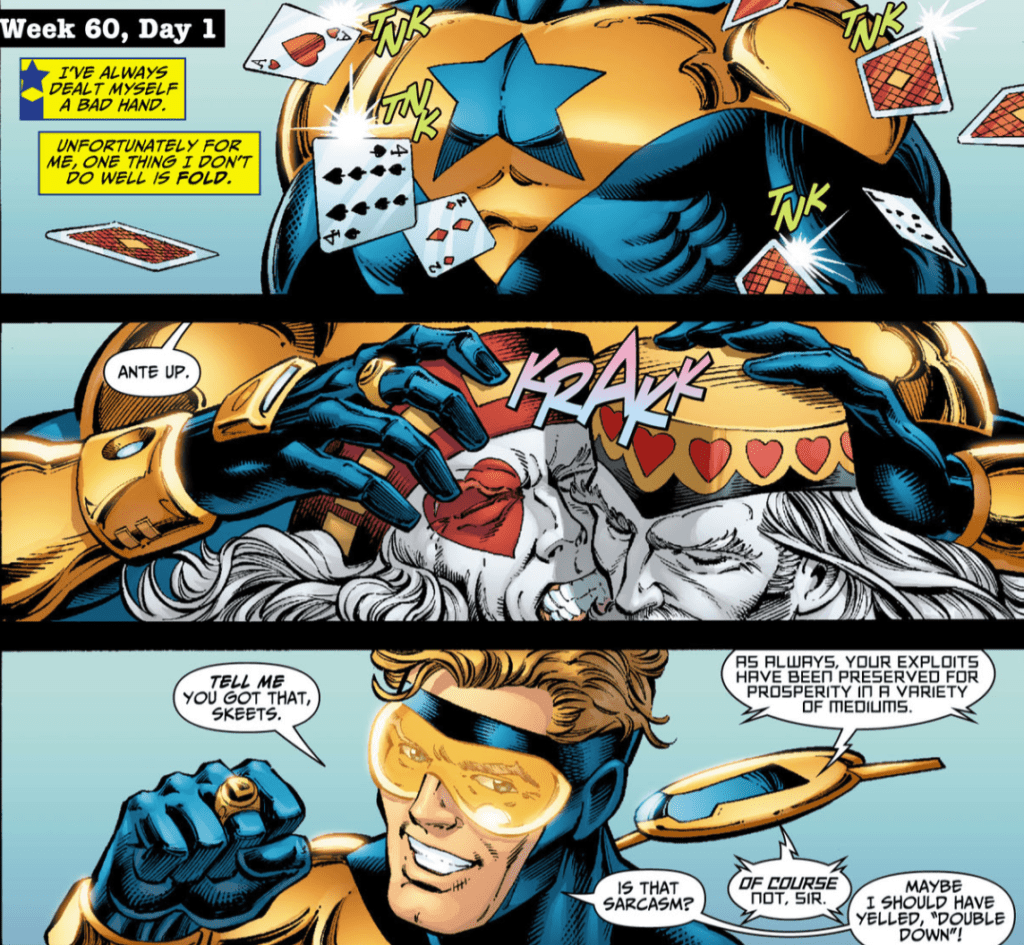
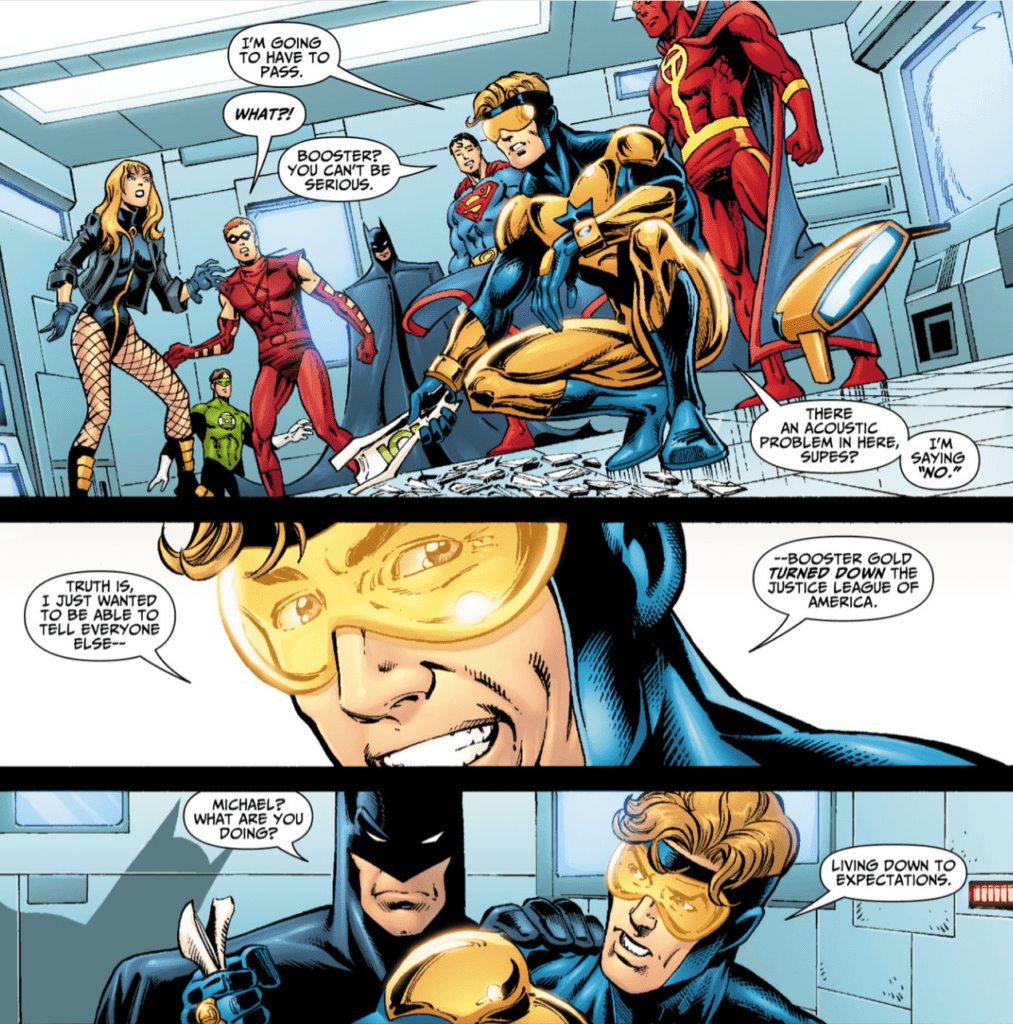
But the catch is he has to do it all in the background without others knowing. He has to continue to play the moron who only wants fame, riches, and fun. Having just received membership in the Justice League, he has to decline. He does this in a loud fashion saying he only did it so he can decline them. Granted, the readers know this isn’t true. After saving multiple origins, it’s finally time for Booster Gold to save his best friend.

Writing by Geoff Johns, Jeff Katz. Art by Dan Jurgens, Norm Rapmund. Colors by HI-FI, Lee Loughridge. Lettering by Nick J. Napolitano

A HARD LESSON LEARNED

Having told him from the start that messing with time could cause a Butterfly Effect and that he should know better, Booster Gold presses on. Seeing no other option, Rip lies and tells him that he needs to save Barbara Gordon. Supposedly she was never to be paralyzed in The Killing Joke. Knowing after this he can get his friend back, he goes to save Barbara. What transpires is one of the best Booster Gold issues and a heart-wrenching look at time travel.

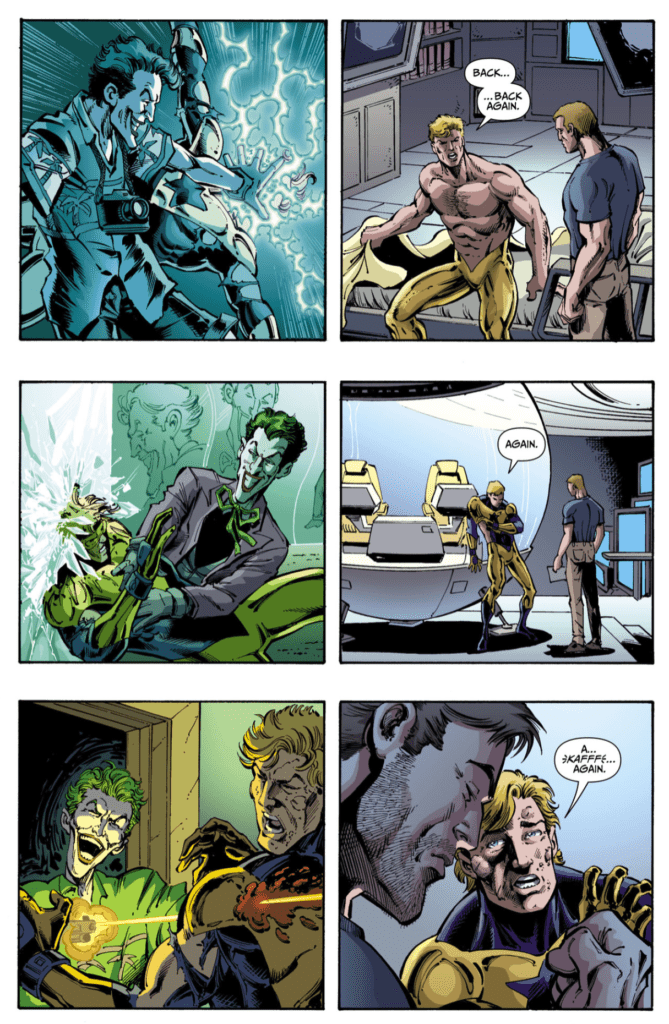
Writers Geoff Johns and Jeff Katz have Booster Gold repeatedly fail, just to get back up to try again. Although this could be seen as him only doing it so he can later save his friend, it isn’t. He constantly has tears in his eyes and a strained face trying to save Barbara from being shot. Throughout the series, humor has been added in with amazing fashion, per usual with the character. But for Booster Gold #5 Johns and Katz keep it a consistent tone throughout, showcasing how dire it is. You start to feel the pain Booster Gold does when all he wants is to save someone’s life. But, it all comes to a head when Rip tells him the truth.

Having lied to him, Rip explains Solidified Time and how Blue Beetle and others that are dead can’t come back. Seeing the usual cheerful, prankster Booster Gold defeated in such a manner hits hard from the story that transpires, but also from the art.

Writing by Geoff Johns, Jeff Katz. Art by Dan Jurgens, Norm Rapmund. Colors by HI-FI, Lee Loughridge. Lettering by Nick J. Napolitano

BOOSTERRIFIC ART

Joining on art is Booster Gold creator, Dan Jurgens who throughout the years usually has a hand with the character interpretations. Helping Jurgens on art is Norm Rapmund credited as finished art. Throughout the following issues, the team has kept consistent quality art that is realistic. The same can be said with Booster Gold #5, where it works perfectly with the story told. Their style compliment Brian Bolland’s from The Killing Joke. Even a few panels look straight from the original.

Nonetheless, the strongest point is the duos work on Booster Gold’s face and the pain he shows. While he is making his way to save Barbara and failing, there is a constant strain of pain on his face. This is due to him knowing he won’t make it. But, the strained face isn’t enough, as tears run down his face. Jurgens and Rapmund are able to portray such a horrid face in one panel, that makes you feel for the character. Then to rub salt in the wound they show a brutal fight between Booster Gold and Joker.

Writing by Geoff Johns, Jeff Katz. Art by Dan Jurgens, Norm Rapmund. Colors by HI-FI, Lee Loughridge. Lettering by Nick J. Napolitano

COLORS/LETTERS OF EMOTION

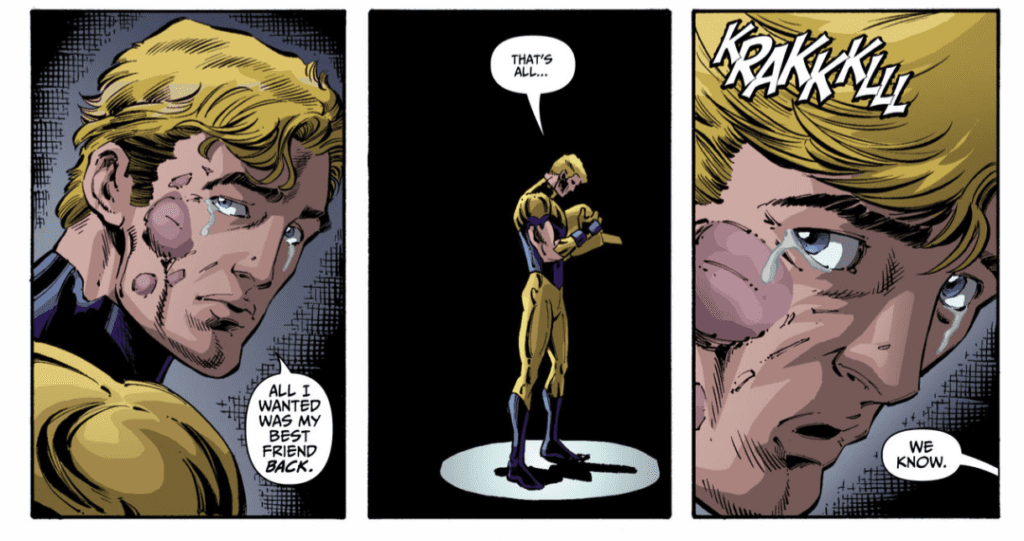
As Booster Gold #5 takes place in Gotham the colors are darker. This is mind, HI-FI, and Lee Loughridge, do keep the bright colors seen in the series for some moments, but for Gotham, they keep it dark. The contrast of a bright Booster Gold in a nasty looking Gotham is interesting and the team does it well. Yet, the highlight of the colors occurs towards the end. Walking away Booster Gold announces he is done helping Rip. But before he leaves, he grabs Skeets, cries, and declares, “All I wanted was my best friend back.” This is Booster at his lowest, just wanting a friend. HI-FI and Loughridge drop all the background and put Booster Gold in an ever encompassing black. The team even goes as far as to put him in a spotlight when a full shot is shown, so all of your focus is on him and his pain.

Writing by Geoff Johns, Jeff Katz. Art by Dan Jurgens, Norm Rapmund. Colors by HI-FI, Lee Loughridge. Lettering by Nick J. Napolitano

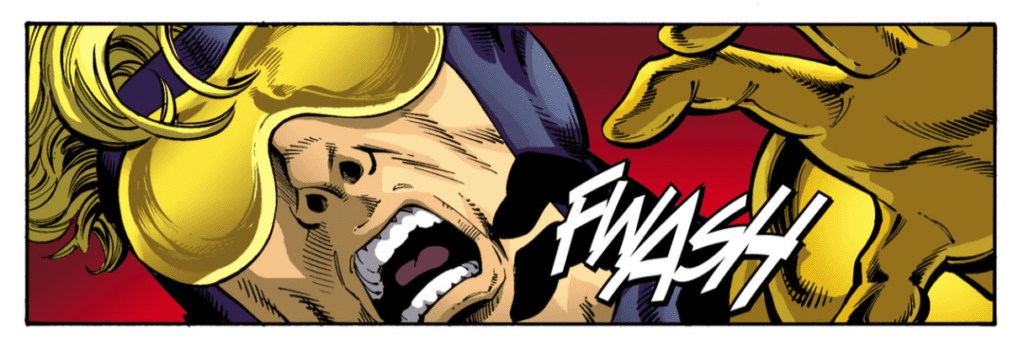
Letterer Nick J. Napolitano was at the top of his game with Booster Gold (VOL. 2) #5. Throughout, Napolitano adds in some great science fiction sound effects, yet when it comes to the fight, he adds in Joker’s constant laugh. Between these laughs and Joker taking pictures off-panel with a “FWASH” showing up, you can feel Booster Gold’s pain.
Writing by Geoff Johns, Jeff Katz. Art by Dan Jurgens, Norm Rapmund. Colors by HI-FI, Lee Loughridge. Lettering by Nick J. Napolitano

THE FUTURE, THE PAST

Booster Gold is an interesting character. In the DC-Universe, citizens and other heroes think he is an idiot who can’t do anything right and only wants fame. Then you have readers who’ve only read him in cameo instances or have seen him in media and think the same. Yet, this is what makes the character so great, the writers have done what they set out to do; make him such an idiot, you’d never believe his feats. Nonetheless, once you read the first few issues of Booster Gold (VOL. 2) you see a character with a lot more to give and love. This especially rings true in its fifth issue.

If you’ve never read the character before, Booster Gold #5 will change your mind on him. Plus, it may make you sad as hell.

Monkeys Fighting Robots Youtube

Self-Published Spotlight: THE CELERY STALKS By Patrick Ian Rooks

Welcome to Self-Published Spotlight, a regular interview column where I will be highlighting self-published comics and the creators and small print publishers who make them.


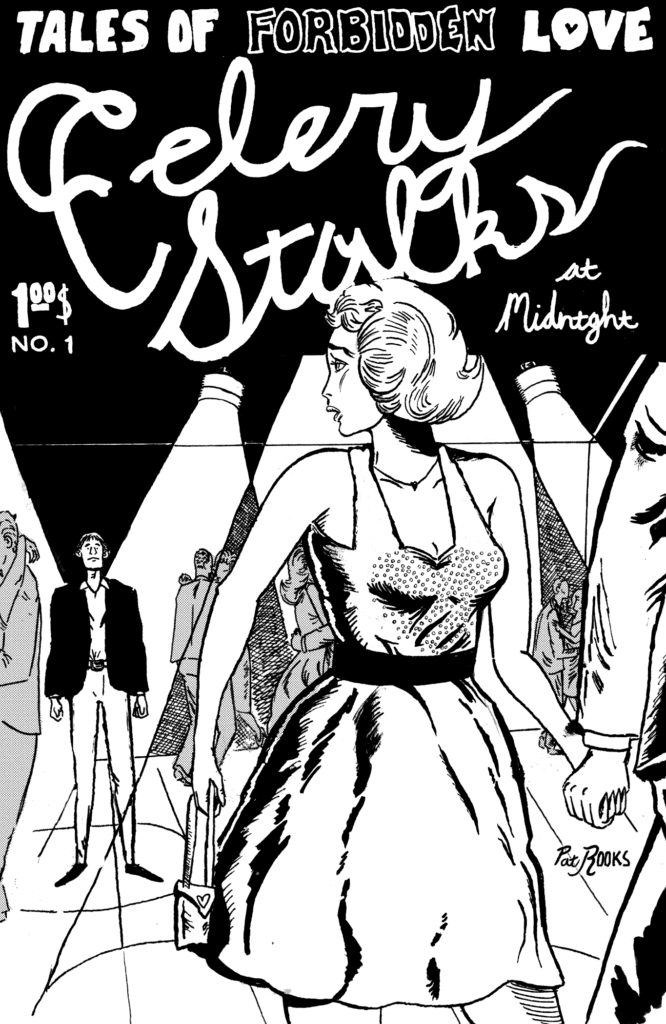
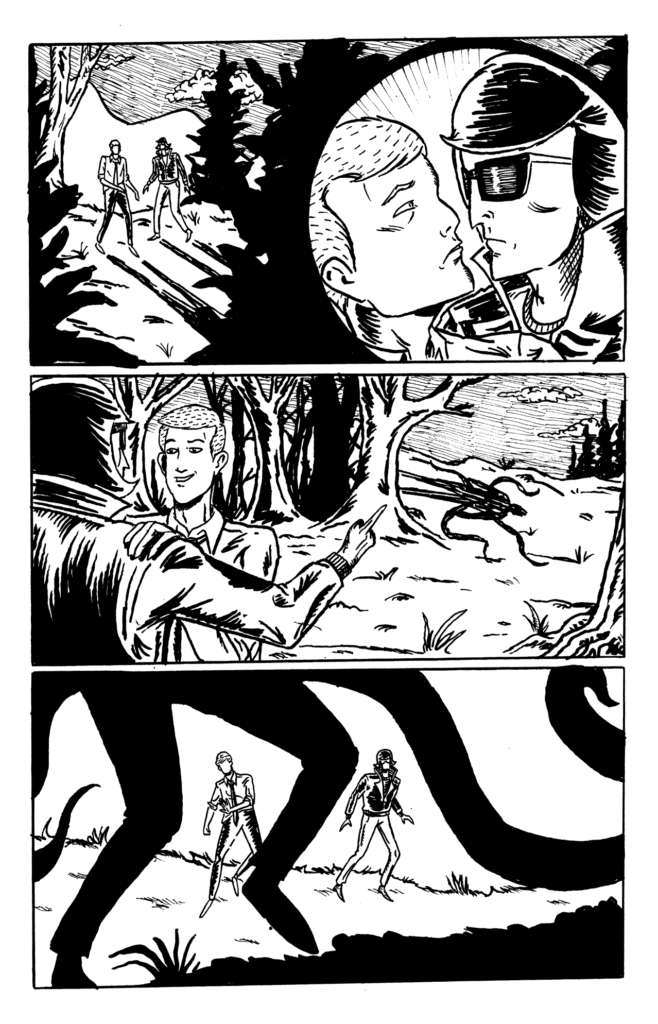
This inaugural column is going to focus on Patrick Ian Rook and his mini-comic, The Celery Stalks. I discovered Pat’s work on his Instagram and was immediately taken by his linework and style; it’s equal parts indie comics (think Chester Brown), horror comics, romance comics, Steve Ditko and a whole lot more. It’s best to let the art and artist speak for themselves so read on for a chat with Pat and a look at some of the pages from The Celery Stalks.

Celery Stalks
Cartoonist Patrick Ian Rooks

Monkeys Fighting Robots: Okay, so first off Patrick thanks for taking the time to talk to us over at MFR.
Patrick Ian Rooks: Glad to be here!

MFR: Just because I feel I have to ask everyone, how are you holding up during the Covoid 19 crisis? You and yours doing ok?
Rooks: I’m well! It’s a cliche all the cartoonists are using, but quarantine is a lot like an average day for me haha! I’m not a huge fan of going out, so I’m not missing anything.

MFR: Ha. Very true. I’ve been talking to a bunch of cartoonists and they all seem to agree on that.
Rooks: It’s tedious work. I’d say to anyone who wants to make comics the same thing people are saying in these trying times “stay home!”

MFR: That’s actually really solid advice! So now that we’re talking comics, why not tell our readers a bit about your latest, ‘The Celery Stalks’.
Rooks: Yeah, so it’s the comic I serialize monthly. So far I’m focusing on doing about 6 a year. It’s sort of a B Movie horror/romance/adventure strip. Basically each issue is heavily influenced by whatever sort of story I want to tell that month, while still telling a big picture story over a bunch of years.

MFR: Oh I can totally see all those influences in there. Like the cover for issue 5 really made me think of ’50s romance comics. The interior of that issue too. Like with the heavy use of thought balloons and the narration. I loved it! Who would you say are some of your cartooning influences? Because I see a bit of Chester Brown in your work, a little Charles Burns too.
Rooks: Ah, thank you! I’m pretty happy with issue 5, and I’m glad all of that translated. It’s funny you’d say that I come from more golden age/ silver age influence. My alt collection is pretty lacking. In fact, I just got my very first Robert Crumb comics like a week ago. I like what I’ve seen of Brown and Burns, but I’ve only read the latter once. Celery Stalks specifically has an unhealthy amount of Ditko influence. Specifically his work with Creepy & Eerie magazines and his Spiderman Run. Besides him would be your Romitas (Jr and Sr), Miller and Janson, Johnny Craig to name a few.

Celery Stalks
Cover to The Celery Stalks #1

MFR: Yeah, I can totally see the Ditko in your work. I feel like Ditko is a lot weirder of an artist that some people think. And a lot of the indie/underground artists always cite him as a big influence. So the edition I have of The Celery Stalks is the collected version. I absolutely love the size of the book. Were the comics themselves the same size and dimensions? I just love smaller formats like this.
Rooks: Thanks. Umm right off I can’t think of the exact measurement, but the mini-comic versions were just a little bigger. I wanna say 7″ by 4.5″. I like small format stuff for sure. And I always had that small paper book size in mind when I started working on the collection. I love old sci-fi paperbacks a lot.

MFR: Do you also create at those dimensions, or do you draw bigger then scale it down? And speaking of process, what’s yours? Like do you start with detailed writing, sketches, layouts, thumbnails, or whatever?
Rooks: I drew this stuff bigger and shrunk it down. The boards got bigger with each issue, but I’m shrinking them back to like 11″ by 7″ for the next run of issues. I can go a lot quicker at that size. So when I started Celery Stalks I just grabbed your classic college rule spiral-bound notebook and filled it with drawings until the story sort of became clear, at least what happens in that first and second issue. My process was different for pretty much each issue, but basically, I’ll write a script that’s really just dialogue-less layouts on folded graph paper and then go from there.

Celery Stalks
Page from The Celery Stalks by Patrick Ian Rooks

MFR: I take notes on graph paper too. I use these small ‘field books’. There’s just something about how they look. Have you always wanted to be a cartoonist?Rooks: Pretty much as long as I can remember. When I was like 16-17 I changed my mind and thought it would be a good idea to become a famous screenwriter and then use that to leverage my way into comics haha. Now I find that idea to be outlandish. After a year at film school, I pretty much decided comics was where I belong.
MFR: What made you decide to self-publish?
Rooks: Well mainly because I wanted my stuff out and my work was not ready for major publication. In my opinion, it’s still not, but self-publishing gives me the opportunity to build an audience while I get better at the craft.

MFR: I think some of the best comics come from the self-published world these days and it’s on the rise like me, you’re sort of part of the whole Cartoonist Kayfabe community that has sprung up around CK podcast. I see so much creativity and support for each other coming out of that network. Why do you think a community like that resonates so much?
Rooks: Hmmm that’s a good question. I’m not really sure how involved in that community I am. They’ve been supportive to me and I’ve done some promoting of my work through that network so that’s all positive! The way I look at it, Jim and Ed were on the shortlist of pros I was sending all my stuff to years before they had a youtube thing, but I like seeing that it’s gotten a lot of people talking about comics in a way that makes sense to me and not just about which superhero would win in a fight or something.

MFR: Yeah. It really is about a love of the craft, which is what I love about the underground/indie/self-published world. So where can people get your work? What’s the best outlet to check out what you are doing?
Rooks: So you can buy whatever I have in print at patrooks.bigcartel.com and I’m about to launch a Patreon for issues 7-12 of Celery Stalks that’s gonna be the only place the minis will be available until they’re collected next year. You can find that at https://www.patreon.com/patrickianrooks. I’ve got a really exciting artist doing the back cover to issue 7, so you don’t wanna miss that. If you just wanted to see what I’m up to my Instagram is patrickianrooks. That’s where I’m most active.

MFR: Awesome man. Now you’ve got me hyped and I can’t wait. Is there anything else you are working on you want to mention?
Rooks: Nope! Just working hard on that new Celery Stalks run! I didn’t mention it but that starts in July!

MFR: And that’s right around the corner! Awesome! Anyway thanks again for talking to us Pat, let’s do this again when the new issues start to hit.
Rooks: It would be my pleasure! Thanks for having me


Monkeys Fighting Robots Youtube

Longbox Legends: SPIDER-MAN/DEADPOOL #14 Showed Us Spidey At His Limit

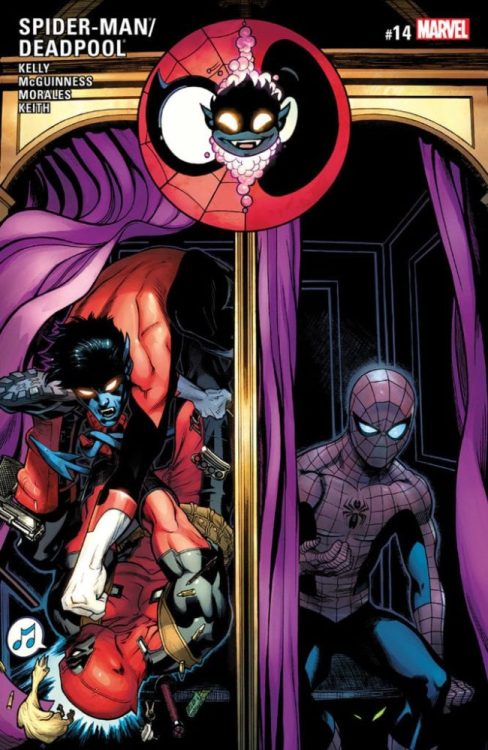
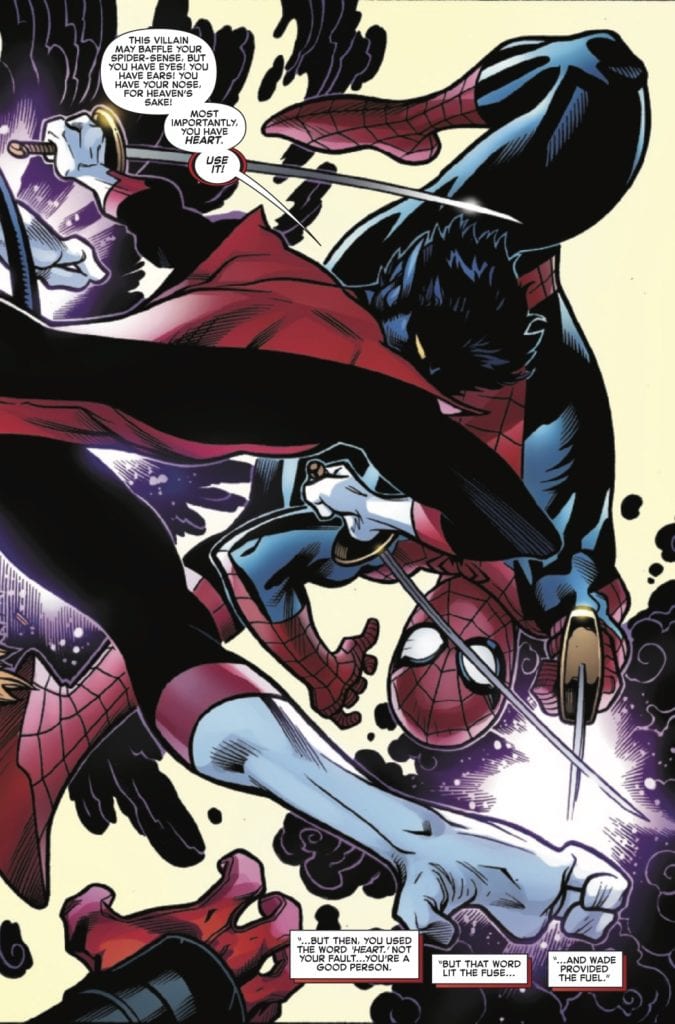
SPIDER-MAN/DEADPOOL #14, published back in February 2017, takes place in the midst of writer Joe Kelly’s Itsy Bitsy storyline. But unlike most mid-act story arcs, this issue cuts to the heart of the plot in grandeur. Spidey and Deadpool fans will remember the intriguing plot: an unknown antagonist used the two heroes’ cells to create Itsy Bitsy, a being more powerful than both of them. And the duo learns she could easily kill thousands of people. While Deadpool learns to seek alternative ways to combat the creature than his usual M.O., Spidey finds himself drawn to the ever-looming temptation of killing the menace.

Story

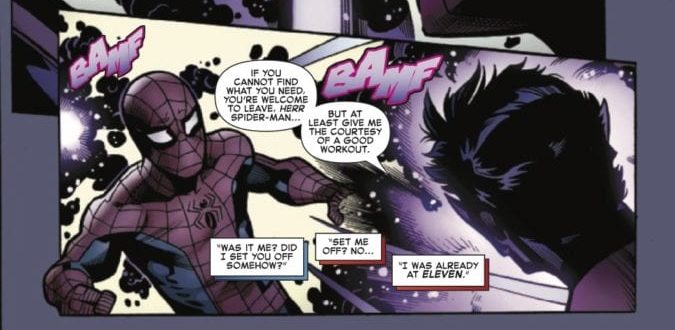
In order to prepare for the next Itsy Bitsy attack, Spidey and Deadpool meet with their X-Men ally Kurt Wagner, a.k.a. Nightcrawler. The webbed hero recently lost the ability to tap in his Spidey sense, so Kurt agrees to help him train. However, Kurt notices how much anger Spidey holds and attempts to get to the heart of his frustration.

Kelly’s narrative isn’t told in chronological order. Though the training with Kurt takes place first, the reader experiences these events as memories in Spidey’s head. These scenes are diagnosed by none other than Kurt himself, acting as Spidey’s personal priest for the issue. After some probing, we soon learn the hero is debating breaking his “no kill rule” due to the immense threat Itsy Bitsy poses. We get to see his personal rationalizations while receiving caring yet firm pushback from Kurt.

Readers find themselves contemplating the ethics of the right to take life alongside their favorite arachnid themed superhero. Kelly helps them get inside Spidey’s head through the confessional framework, showing him locked in a war against his very identity.

Artwork

Ed McGuinness’s penciling, along with Mark Morales’s ink work, Jason Keith’s coloring, and VC’s Joe Sabino’s lettering worked together beautifully. The characters are defined with solid borders, yet retain a sense of fluidity to create a sense of movement. In addition, the coloring gives readers a sense that our three heroes are connected through the use of similar red shading on their outfits. And, to top it all off, the lettering is placed in a way to compliment the action, giving the appearance that the characters are moving around the boxes themselves.

Conclusion

SPIDER-MAN/DEADPOOL #14 did a fantastic job of pushing Spidey to his limits. But we, the reader, had the opportunity to join our hero in the emotional turmoil. We highly recommend revisiting this issue.

Did you enjoy Nightcrawler’s guest appearance? Let us know in the comments below!

Monkeys Fighting Robots Youtube

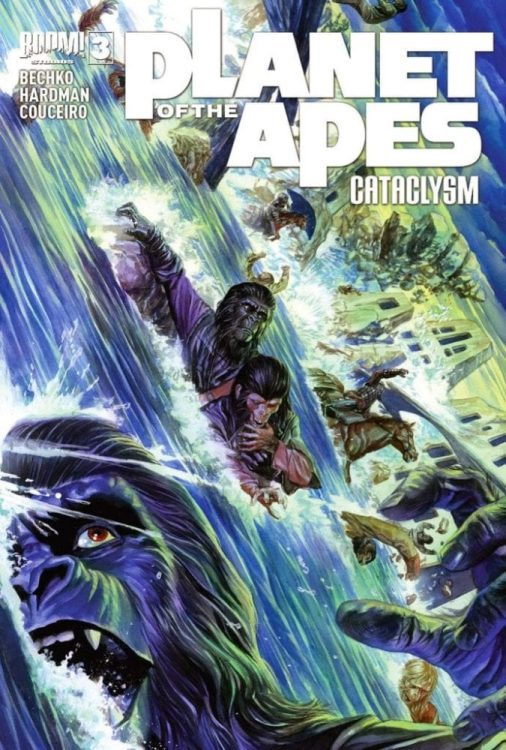
Unpacking The Destruction On The PLANET OF THE APES

Planet of the Apes Cataclysm
Planet of the Apes Cataclysm #3 Cover Credit: BOOM! Studios

The Planet of the Apes franchise has achieved a lot considering the entire planet, and all of its inhabitants, was destroyed at the end of the second movie. In fact the entire series, books and comics included, is packed with violence and destruction.

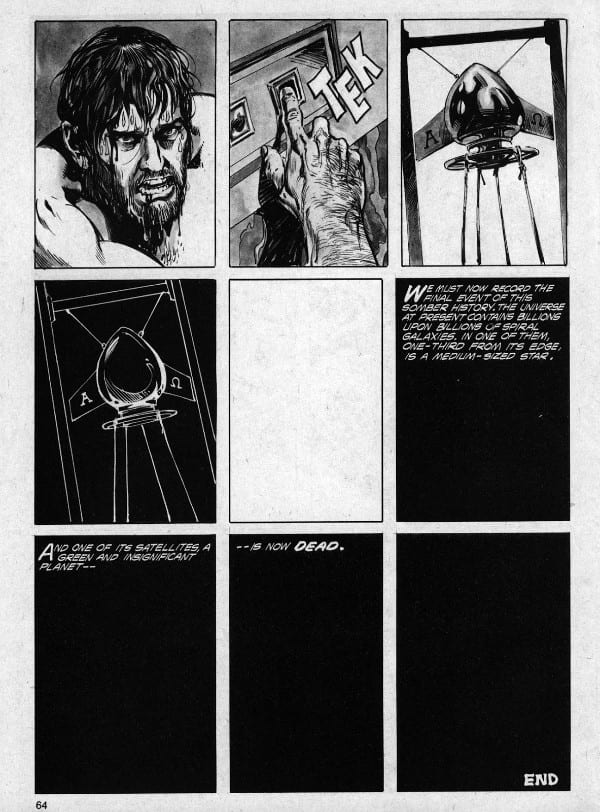
Despite all of the devastation within the Ape stories, it is not necessarily this aspect that people associate with the franchise. People remember the Statue of Liberty, the Alpha/Omega bomb, the hoards of apes charging into battle against a militarised human outpost, however, it is the themes behind these sequences that resonate with the audience.

So, the question becomes, why so much destruction in the first place?

Planet of the Apes
Beneath the Planet of the Apes Credit: Marvel Comics

Resolution on the Planet of the Apes

The ending of the second movie, Beneath, has the largest destructive force unleashed anywhere in the Ape Franchise but it is not the first example of utter destruction. That award would go to the ending of the first movie and the implications that the scene makes. As Taylor, the astronaut out of time played by Charlton Heston, rides into the wilderness looking for Truth he finds the remains of the Statue of Liberty and the remnants of his past.

The scene illustrates the destructive force of the Humans and annihilation that Taylor feared would come from the outset of the movie. Taylor was a pessimist, he was running away from his own kind because he saw nothing good in them. His journey across the Planet of the Apes rekindled some of his softer feelings for what he left behind. This made the shock of his true predicament that much worse. Taylor was in the process of being redeemed but it turned out to be too little too late.

The ending of the first movie was a warning against turning a blind eye, against hiding and hoping that someone else would clear up the mess. It was also about bringing a story to an end. The discovery of the Statue of Liberty closed the chapter on Taylor’s hope for the Human race. There was no saving his people, no redemption. The original ending, as written by Rod Serling, took this idea one step further.

Planet of the Apes
Planet of the Apes Visionaries Credit: BOOM! Studios

Original Endings

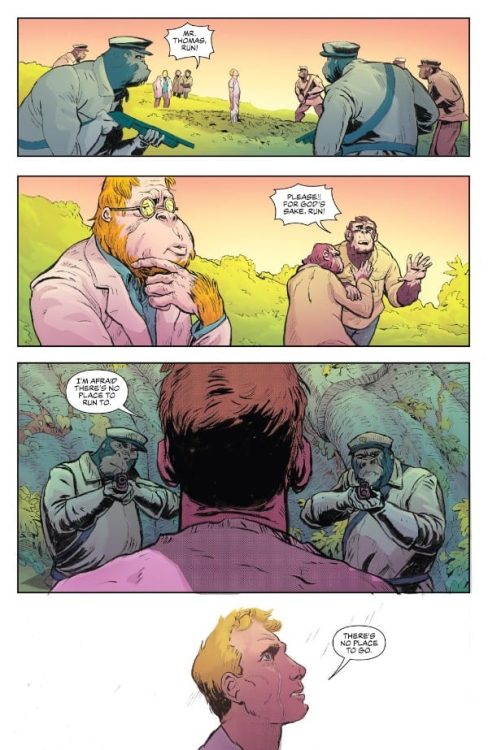
In the original script, which was released in Graphic Novel form by Boom! Studios in 2018, the man Thomas discovered the same remains as his counterpart Taylor. The build up shows Thomas running through the fields, chased by Police Gorillas and followed by the Chimpanzees he had befriended. Suddenly he stops and stares into the foreground. Despite his friends shouting for him to run he simply stands still, in awe of something the reader can’t yet see. His last words “There’s no place to go,” signifies the remains of his hope leaving him and, with a tear on his face, he is gunned down. Only then is it revealed what he was staring at, the now famous Statue of Liberty remains.

This ending is in some ways more upsetting than the filmed version. This is partially because the character of Thomas is less pessimistic than his movie counterpart. He embraces his situation with more vigour and fights not only for survival but for his way of life. Therefore, when he comes face to face with the destruction caused by his own kind, his spirit is destroyed as completely as the world he came from.

In the graphic novel adaptation by Dana Gould, illustrated by Chad Lewis and David Wilson, Thomas is shown running into the wilderness, the ‘Thup thup thup’ of a helicopter in the background like the sound of a beating heart. This ominous air is replaced by a shadow falling across the panels, finally to cast Thomas in darkness while the background behind him is showered in light.

On the following two pages Lewis and Wilson depict a man losing his will to live. The panel with his last words is devoid of any background, the only panel in this sequence to be displayed in this manner, and it emphasises the moment. This is the point where the effects of all of the destruction is best realised. Even before the reveal, Thomas’ spirit is broken in that single moment. He gives up and almost welcomes the hail of bullets that end his life.

What Serling was suggesting here is that the cost of all of Human Kind’s hatred, greed and intolerance is the destruction of the soul, of the spirit. In the end, things come and go, but once Hope has been destroyed there is no redemption, no coming back, there is only the end.

Planet of the Apes Cataclysm
Planet of the Apes Cataclysm Credit: BOOM! Studios

A New Cataclysm

It’s not just the Human’s who are victims of destruction, the Apes suffer too. Throughout the movies and the comic series, the Apes are often persecuted, hunted, and killed at the behest of the Humans.

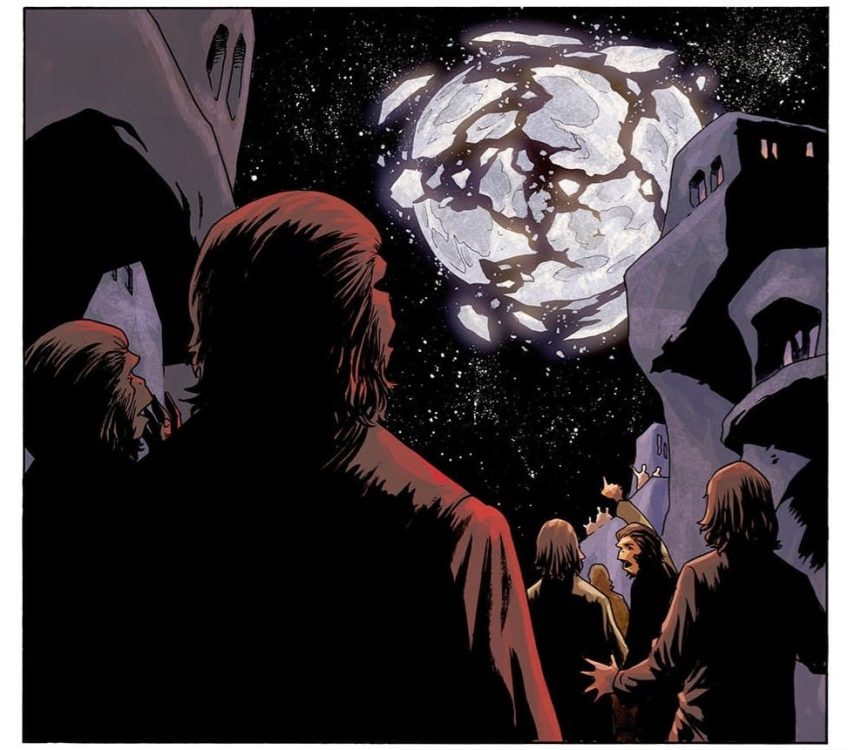
In the Boom! Studios prequel tale Planet of the Apes Cataclysm, a biblical epic unfolds over the eight years before Taylor arrives from the past. Corinna Bechko and Gabriel Hardman start their story off with the destruction of the moon and the events that follow read like the 10 plagues of Egypt. Meteor showers, floods, and starvation face the Apes as they try to adapt to their new climate.

The devastation and subsequent trials are merely plot devices, however, for Bechko and Hardman’s examination of Ape society and some of the characters that live within it. Cataclysm tells the backstory of the major ape players from the original film; Zaius, Cornelius, and Zira. It follows them through the turbulent times as they meet and get to know each other.

In contrast to the destructive ending of Taylor and the Human Race’s story, in Cataclysm, it heralds in the beginning of the characters so beloved of the franchise.

Planet of the Apes Cataclysm
Planet of the Apes Cataclysm Credit: BOOM! Studios

Character Breaking

The tragic events depicted at the beginning of Cataclysm affect the characters featured in a number of different ways. Sometimes the result is for the better, others not so much. At times it leaves you wondering what would the characters have become under different circumstances.

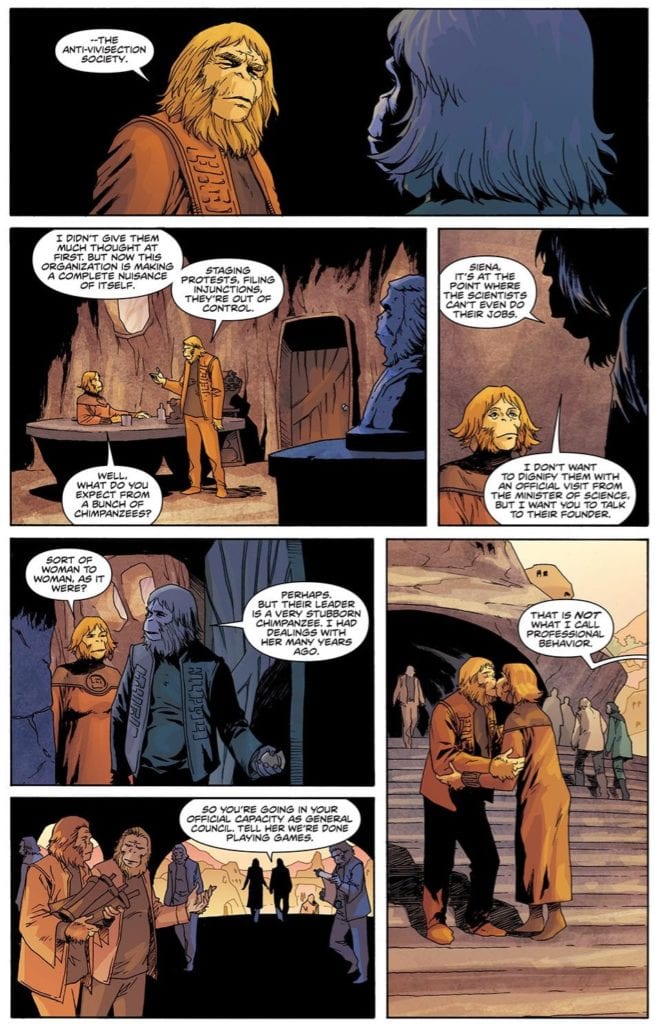
Take Doctor Zaius as an example. The destruction of the moon has the greatest impact on his life. At the start of the series the orangutan is depicted as a loving father and husband. He shows compassion towards other Apes and extends the hand of friendship towards those who stand against him. In the opening issue Zaius sends his wife, Siena, to talk to the leader of The Anti-Vivisection Society as a way of appeasing an awkward situation instead of antagonising it.

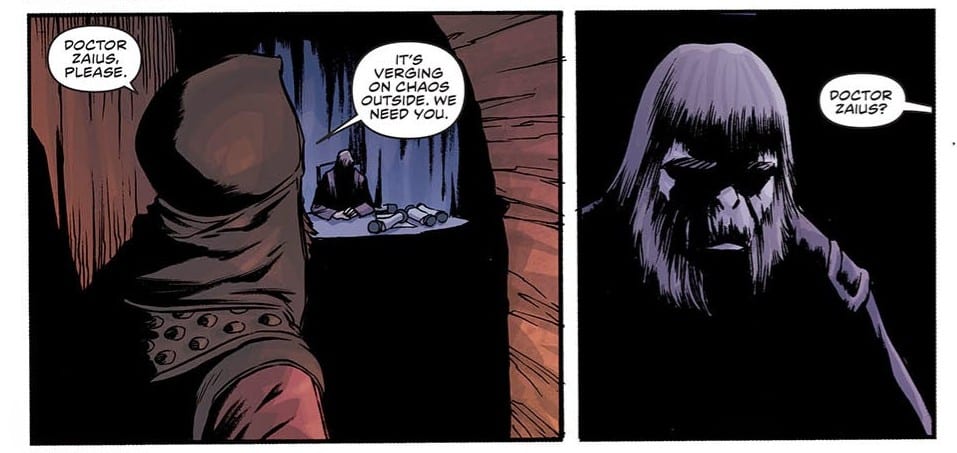
This is when disaster strikes and over the course of the series, Zaius becomes more like the suspicious, keeper of secrets that we all know and love. Through the reign of destruction he is forced into the role of Leader of the Council when he witnesses the death of the other council members. He also loses his daughter, who dies giving birth in the middle of the chaos, and his wife is nearly killed.

As the new leader he has to make a number of decisions under difficult situations. Making this harder is a Brother of the Faith who turns out to be a human mutant in disguise, manipulating the Apes minds but also Zaius’ decisions.

Damien Couceiro’s depiction of Zaius changes across the run. To start with he is always shown in a positive light, standing up straight with his head in the air. The reader sees him as a strong, reliable figure of the community. As fire rains down and Ape City is torn apart, so too Zaius’ stature is diminished. He becomes down beat as if the weight of the world is on his shoulders. Colorist Darrin Moore uses darker tones and shadows creep across his face and body.

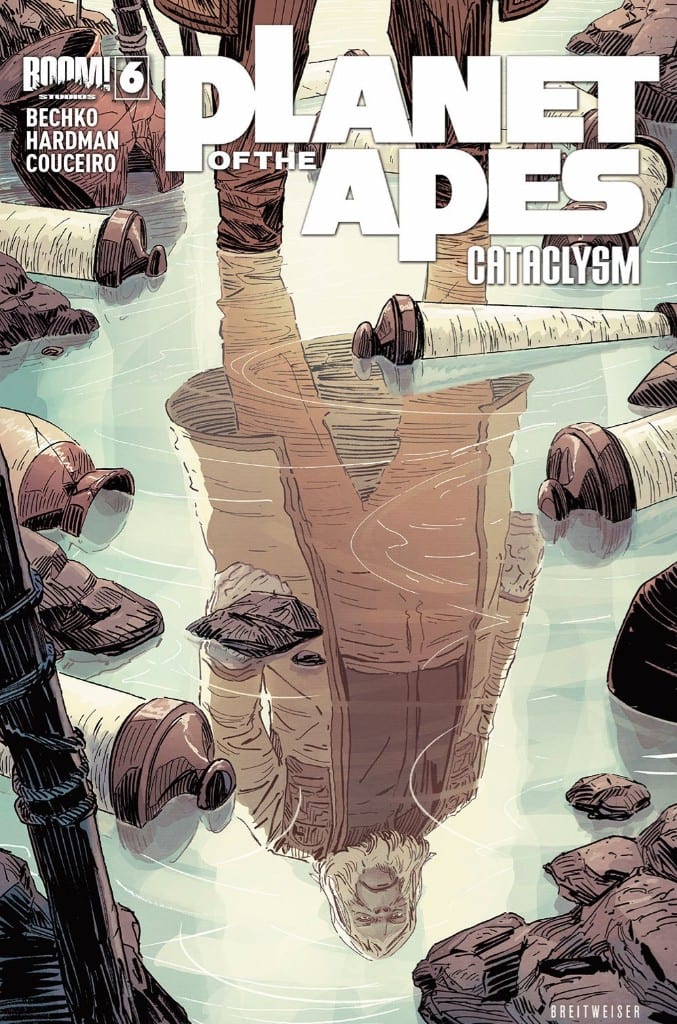
With each new disaster that threatens Ape City, Zaius is broken a little bit more. He soon becomes cynical, distant from family and the needs of community. Ultimately he becomes like Taylor at the start of the first movie: bitter and broken. The front cover of issue 6, drawn by Mitch Breitwiser, sums the character up perfectly. Zaius has become a mere reflection of his former self, lost in the debris of the once great city.

Planet of the Apes Cataclysm
Planet of the Apes Cataclysm #6 Cover Credit: BOOM! Studios

Hope in the Chaos

Each of the major characters in Bechko and Hardman’s Planet of the Apes tale is directly affected by the violence and destruction around them. It is easy to argue that without the disasters the characters wouldn’t become who they are. The chimpanzees would not have a need to challenge the authority of the Council. Zaius would not have travelled the path towards a war of self-righteousness. Cornelius would not have met Zira.

The stories within the franchise are driven by the need for survival and striving against the odds. From the very beginning a destructive adversity has formed the foundations of Planet of the Apes. From Caesar’s parents being mercilessly gunned down by order of the American President’s Science Adviser, to the violent uprising of the Apes, and through to the mindless war with the mutants. But a foundation is all that it is: everything that makes the world and the stories so engaging are built upon the back of this. The characters grow and take their full shape in response and reaction to the very worst circumstances possible.

The history of literature is littered with violence and destruction with some of the most famous stories centred around these themes. As a species we are drawn to these types of stories so it goes without saying that Planet of the Apes would capture the imagination of fans for decades. However, the true brilliance of stories like Cataclysm is not the action or the devastation but the characters that grow and survive within the hostile environment.

Various volumes of BOOM! Studios’ Planet of the Apes comics are currently available to buy.

Planet of the Apes Cataclysm
Planet of the Apes Cataclysm Credit: BOOM! Studios
Monkeys Fighting Robots Youtube

INTERVIEW: Composer David E. Russo Scores The Odyssey ‘Windows On The World’

David E. Russo’s music is featured in Gotham and its spin-off Pennyworth, and in the new film Windows on the World from director Michael Olmos, the soundscape takes viewers along an emotional odyssey of lives changed by the horrific events of September 11, 2001.

Starring Ryan Guzman (9-1-1) as Fernando, Windows on the World centers on the character’s journey from Mexico to New York in search of his father. The latter may have died at ground zero. Fernando’s father, Balthazar, played by the legendary Edward James Olmos (Miami Vice, Battlestar Galactica), is an undocumented busboy working at Windows on the World, a complex of venues atop the north tower. The film is a journey full of hope, love, and hard lessons.

PopAxiom spoke with David E. Russo about Sicilians, the rise of technology, and underscoring the film Windows on the World.

Sicilian Sounds

David’s career spans three decades. His earliest IMDB credit is for fun alien comedy Spaced Invaders. How did music play a role in his life before it became a career? “I came from a family of disgruntled Sicilian immigrants, all of whom were musicians. My grandfather used to play guitar on the radio in the 1920s in New York. No one ever made any money, and it was never really possible as a career.”

David continues to share his early years. “I grew up in a house full of Sicilians singing, and there was always music and fighting and yelling, but it never occurred to me there was a living to be made at it.”

A realization later in life prompted David to start working on what would become his lifelong passion. “It wasn’t until after college, where I had no idea what I was going to do, that I kinda woke up and realized the only thing I had any ability in was music.”

Truer words are rarely spoken. “Fear is a tremendous motivating factor, and it got me moving.”

Beyond Belief

More films and TV followed, including scoring 28 episodes of the Beyond Belief: Fact Or Fiction. “That kept me afloat. In the early days, it’s pretty touch and go. That kept me alive.”

About Beyond Belief, David says it was “… an ultra low budget series. The options you had as a composer those days were very limited on a low budget. Now, we can do full orchestras, and it’s pretty convincing. Back then, it was heavy lifting to get things to sound decent.”

Like most artists, David is his own worst critic. “It’s really cringe-worthy when I look back on it. But I was fortunate to have the job.”

edward james olmost-film-vix

About Windows on the World

Windows of the World is available on streaming service Vix. The composer’s relationship with the film begins long before filming began. ”I’ve had a deep friendship with [writer/producer], Robert Anderson, for 15 or 20 years now. He’s a remarkable guy. He’d written this script with his cousin [Zack Anderson], and I had read it years before. It was a moving story.”

David heaps praise on Robert. “I’ve done one other film with him. I just love being around him and working with him. It’s incredibly creative.”

So, for David, he “… knew the story intimately long before I met Michael.”

Film-making is a massive collaborative artistic process. David says, “When Michael came in, he had a particular vision that was clear and emotional.”

The music for Windows on the World came about in a particular way for David. “For this one, I wrote an entire suite of pieces based on my feeling about the film. For me, it was clear from the beginning. It was a film about family. There was a theme for the family and a theme for the main character’s odyssey as he travels.”

A significant influence on a film and its score are the locations. “… the difference between going from Mexico to New York. Trying to musically express the differences in cultures and energy. How he comes to this foreign place and deals with the craziness of New York.”

Ryan Guzman-vix-film-windows on the world

David wrote, “… a bunch of pieces based on what I imagined.” So, how much of that music was in the final cut? “Almost all of it.”

However, David shares the story about one piece that didn’t make it to the end. “Robert has deep relationships with jazz musicians, he’s won Grammy’s for producing jazz albums … I did one piece for New York with saxophone and jazz that he hated. It was summarily trashed. He went to Grammy award-winning David Sánchez, who wrote a piece for New York that was far, far better than what I’d done.”

The script, the settings, the director, and producer all contributed to the energy David used to create the music. But there was one more influence with a significant impact. “The film has these interstitial paintings by artist Sandow Birk, those were really inspirational. The kid is reading Don Quixote, and it’s about this odyssey. There’s this little mythic element that undercuts the film that I was tapping into. I was trying to emotionally connect with what those drawings say and the idea of this journey.

Get the soundtrack!

Music 2.0

Computers are now a vital part of the film scoring process. David shares his thoughts on the good and the bad of working with technology. “The challenge now is, if you’re working on TV … there’s a time crunch. You’ve got seven to twelve days to make music for an episode. Gotham, let’s say, was 42 minutes of the show after commercials, and we had 38 minutes of music every week. So, the computer enables you to physically get it down. The shows I’ve been doing involve full orchestras, which is impossible in the time frame to do it without these tools.”

The drawback to this technology is that “… everyone seems to have the same toolkit. So, the challenge is to create something that serves the story and is sonically distinctive in the time that you have. I’ve always struggled with the machines trying to bring life to them. That’s the biggest challenge, trying to create something that is true to the story and is not just generic.”

More tools never hurt, though, and neither does taking the time to blend the old and new school. “Computers are really good at taking a sound and manipulating it endlessly to become something else. I found that I spend much more time these days putting a microphone up and trying to record stuff; capture performances and sound.”

In the end, scoring a film or TV series requires an approach that’s “… essentially the same … it’s trying to get a feeling for what the spirit of the thing is and trying to come up with a sound palette to express that. And limiting yourself to a particular palette in a certain sense to find a unified expression for what this show is about.”

About his own process, David says, “I’m never theoretical about stuff. It’s always about emotion and what feels true. If I feel like I’m lying, I know it’s not true. It’s not an intellectual process at all.”

Wrapping Up

As humans, we acquire inspiration from all manner of sources. For an artist, being around other artists provides a creative energy boost, unlike anything else. “The first job I got out of college was at Paramount Studios as a secretary in the music department. At that time, this was in the early 80s, they had this recording studio, Stage M, that was really vibrant. I saw everybody work. John Williams, James Horner, Bill Conti, everybody who was doing big stuff. That was really inspiring to me.”

David reveals who is his personal number, one composer. “Ennio Maricon is the sensai. I love John Barry too. But Maricon inspires me more than anybody.”

In the age of remakes, what movie would David love to score? “There was a really cheesy movie from the 70s called Logan’s Run. That would be a great film. The story is pretty interesting and the dehumanization of society and over-population. It could be great.”

Windows on the World is available on Vix. What’s coming next from David? “I’m contributing to a documentary. It’s from Michael Webber, I scored something for him a few years ago called The Elephant In the Living Room. He’s been working on this new one called The Conservation Game. That’s going to be a good one.”

Is Windows on the World on your watch-list?

Thanks to David E. Russo and Costa Communications
for making this interview possible.

Want to read more interviews like this? CLICK HERE.

Monkeys Fighting Robots Youtube

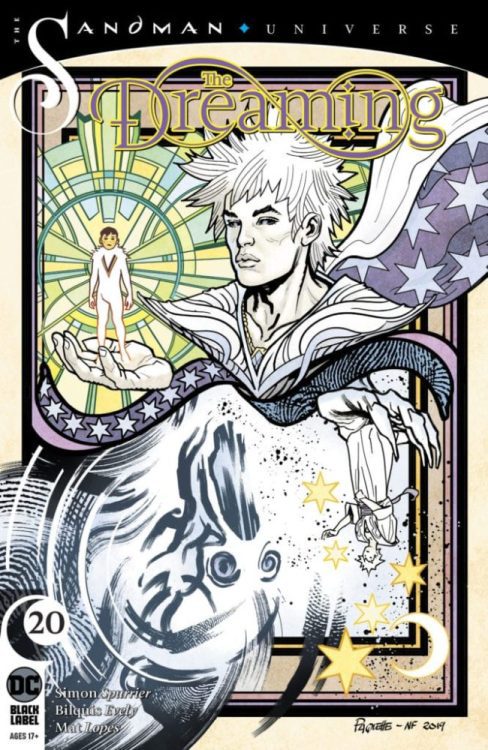
Review: THE DREAMING #20: The Point is Simply to Feel

Writer Si Spurrier and Artist Bilquis Evely, along with colorist Mat Lopes and letterer Simon Bowland finally bring their saga to a conclusion with  The Dreaming #20. Spurrier’s complex, intelligent, and emotional script collides with the jawdropping visual work of Evely and Lopes to craft not only an incredible ending to their story but one of the most memorable chapters in this universe’s entire publishing history.

“The citizens of the Dreaming make their final play against the artificial intelligence that seeks to replace them with cold rationality…and the fate of Dream is revealed!”

Writing & Plot

Si Spurrier‘s handling of interwoven plotlines both new and old are much of what carries the success of  The Dreaming all the way to his final script. The outcome of every character plot, from Matthew the Raven, Cain & Abel, Lucian the Librarian, Wan, and of course the Dreamlord himself, are intertwined seamlessly and given proper attention to become weighty additions to the overall plot. The inclusion of Rose Walker is an element that not only works as a nostalgic throwback to classic Sandman fans but as a brilliant subplot that effectively ends a plot thread some thirty years in the making. As is in keeping tradition with Gaiman’s Sandman universe, the manner through which this story resolves is somewhat vague and complicated, but it’s presented with such grace and emotion that this hardly hampers the experience. The dialogue and narration are as varied as ever, with some characters’ naturalistic dialogue blending with others’ more poetic prose-like speech as has always been done in great Sandman universe comics. Si Spurrier has proven himself a worthy custodian of what Neil Gaiman started back in 1987, and his work on this series will be missed.

Art Direction 

Bilquis Evely‘s pencils have been an artistic wonder for each issue of The Dreaming she’s illustrated, but she’s saved her best for the final 20th issue. Her usual levels of immense character and dreamy environmental detail are here, but turned up to unbelievable levels. There a multiple two-page spreads of wildly unique and insanely detailed artistic vision that may be the most impressive work this universe has ever seen. Much of this beauty is the work of Mat Lopes’ colors, which once again bring this dream-world to life with blending tones from every piece of the color spectrum. Topping off the aesthetic is the lettering of Simon Bowland, who has had the unenviable job of maintaining the  Sandman universe’s varied fonts and styles for each character. He has proven more than up to the task these past 20 issues and offered the exact voice that this comic needs to be read in seamlessly. The visual talent behind this series has been second to none, offering up some of the best artwork hitting stands for its entire duration.

The Dreaming  #20 brings this stellar run to a poignant finish. Si Spurrier’s complex and emotional script is full of satisfying finishes and heartfelt goodbyes. Bilquis Evely and Mat Lopes saved their best work for last, adorning this issue with unbelievable visuals on a massive scale that still cater to the individual characters and their most intimate moments. This final chapter will go down as one of the most memorable comics in  Sandman’s long history and caps off a brilliant run worthy of this wonderful universe. As sad as it is to see this top notch creative team leave the series, I’m curious and excited for what G. Willow Wilson and Nick Robles have in store for their follow-up. If you’re a  Sandman fan such as myself, this issue will be a must-buy when it releases on 4/28 at your local comic shop.


Monkeys Fighting Robots Youtube