This just in: Peter Criss, a founding member of the super group KISS, will be in attendance at the FANGORA-sponsored 2016 Texas Frightmare Weekend! This event is will go on Friday, 29 April 2016 to Sunday, 1 May 2016 in Dallas, Texas.
Criss, as well as KISS, have forever been associated with the macabre – which often manifests itself in the horror genre – so when former Fangoria editor Chris Alexander talked about his love for the legendary “shock rock” band this sparked the idea of incorporating them [KISS] into the event.
In 2014 Ace Frehley made an appearance at ‘Frightmare’ and after that the con had an overwhelming request for an appearance from Mr. P Criss. After much effort his attendance at this event has been secured. Texas Frightmare Weekend founder Loyd Cryer noted, “Our event has always been about fulfilling fans’ requests and we are honored that Peter has agreed to attend.”
Peter Criss will appear at the event all three days providing fans with many opportunities for photo-ops and autographs. Premiums Passes and Tickets are available now and can be purchased at: www.texasfrightmareweekend.com.
This year’s ‘Frightmare’ should prove to be a premiere event. It will be filled with appearances, screenings, photo-ups, signings, parties, and vendors GORE-lore! If you live in the Dallas-Fort Worth area, or a fan that “Will Travel for Horror,” check out the horror con voted the 2015 “Horror Convention of the Year” by iHorror.com.
There is a new rumor circulating the Internet that Victoria “Posh Spice” Beckham will be joining the Spice Girls Reunion Tour…but only for a few London dates. Mrs. David Beckham is being quite hush-hush about the details of her ‘return’ but fans – myself included – are optimistic that she will get the bug and decide to perform in more dates.
For those of you that have been on another planet or under a rock, the Spice Girls are/were the 1990s IT girl-power group.
The ‘Girls’ are also composed of Melanie “Scary Spice” Brown, Geri “Ginger Spice” Halliwell, Melanie “Sporty Spice” Chisholm, Victoria “Posh Spice” Beckham, and Emma “Baby Spice” Bunton. These five women burst onto the scene in 1996 with their debut single “Wannabe” which went number one in over 37 countries. Their first album, Spice, sold more than 30 million copies worldwide. Their sophomore album, Spiceworld, and tour were also hugely successful and established this quintet as revenue machine.
The Spice Girls have sold over 80 million records worldwide and are the best-selling female group of all times – they are also one of the best-selling groups in history. This ‘Girl Power’ group is/was the biggest British pop group since the Beatles.
The success of the Spice Girls can be measured the in the international record sales, tours (including their first reunion tour in 2007-2008), icon status in fashion, merchandising, and championing of the “girl power” movement. It is rumored that in marketing alone they women were earning upwards of$75 million per year – it is estimate that they grossed $500 – 800 million worldwide from 1996 – 1998. Woowza!
Now even though reports are saying that Victoria will participate in the London dates, may are hoping that she will get the performance bug of old and stay on for a few extra dates.
We got a little taste of what we can expect from these ladies during the 2012 Summer Olympics Closing Ceremony.
I guess we’ll have to just wait and see. Viva Forever, y’all!
CBS plans to pull all their CW content from Netflix in the near future, according to the Business Insider.
CBS and Time Warner have plans to create their own stand-alone services that would cost $2 to $4 a month and would offer a “live feed” of shows as well as on-demand watching, according to Bloomberg.
Shows like The Flash, Arrow, iZombie, Jane the Virgin, Crazy Ex-Girlfriend, Supernatural, Charmed and Buffy the Vampire Slayer would no longer be available on Netflix.
Netflix has more than 65 million subscribers, and this could be a bad move on the part of CBS and Time Warner.
What do you think? Will you cut the cord and pay for a stand-alone service from The CW?
And these children that you spit on as they try to change their worlds;
Are immune to your consultations, They are quite aware of what they are
going through.” -David Bowie
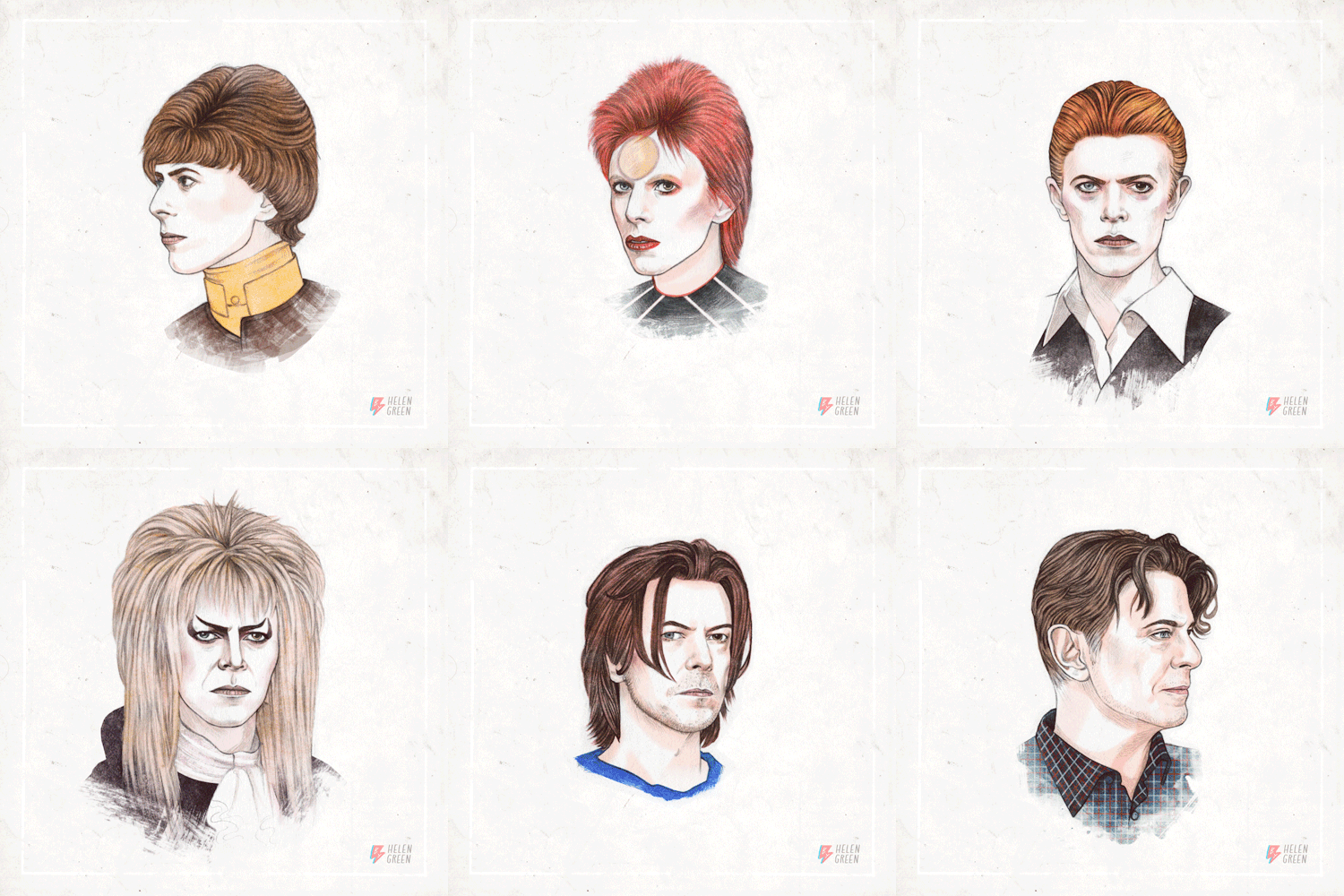
On Sunday, 10 January 2016 the voice of prolific, influential, and beloved singer/songwriter/record producer/actor/musician David Bowie was silenced after an 18-month battle with cancer just two days after his 69th birthday. Bowie is survived by his wife Iman and his children, Duncan Jones and Alexandria ‘Lexi’ Zahra Jones – he is also survived by adoring fans all over globe. Bowie will be remembered for his cutting edge look and music and his ability to change and evolve as an artist.
He was born David Robert Jones in Brixton, London, England on 8 January 1947, to Margaret ‘Peggy’ Jones, a waitress, and Hayward “John” Jones, a promotions officer for a children’s charity Barnadardos. While attending Stockwell Infants School he gained the reputation of being gifted and single-minded. When he [Bowie] was in junior school his voice was judged as “adequate” for the choir, but his creativity was undeniable and was acknowledge when his school introduced a music and dance class. His instructors noted that when he moved they saw him as “vividly artistic” and noted that his grace and poise at such a young age what out almost unknown. Little did these folks know who he would become.
His father further fed his interest in music when he bought his son a collect of 45s that included such groups as, Frankie Lymon and the Teenagers, Elvis Presley, and Little Richard to name a few. Bowie once remarked that he “heard God,” when he listened to “Tutti Frutti.” When he saw a cousin of his jump up and dance to “Hound Dog” he was moved because he had never seen anything that affected her in such a way. The ability of music to move and affect people fascinated.
David Bowie’s love of music led him to take up the tea-chest bass and ukulele and to play skiffle music with friends. He would later start playing piano and even performed Chuck Berry and Elvis Presley tunes for his local scout group. Ever a student and convert of music, Terry Burns, David’s half-brother, introduced him to modern jazz and his love of John Coltrane and others. His enthusiasm for the gene led his mum to give him a plastic alto sax and lesions with a local musician. You can hear all of his musical influences in the music that he made.
At the age of 15 he formed his how band, The Konrads, which played guitar laden rock. His band-mates’ lack of ambition led him to leave the group and join the King Bees. He wrote to John Bloom, an entrepreneur, to ask for his support and for him to “do what Brian Epstein” did for the Beatles. Though Mr. Bloom did not answer, he did refer him to Dick James and Leslie Conn which lead to his first management contract.
Leslie Conn began to promote his music. Jones [Bowie] debuted the single, “Liza Jane”, with the King Bees soon after and it along with many of his first singles did not achieve commercial success. He moved from band to band. In the mid-sixties he was often confused with Davy Jones of the Monkees so he changed his name to David Bowie to assuage confusion. He chose the surname ‘Bowie’ after the American frontiersman Jim Bowie and the knife that he made famous.
In 1967 Bowie released his solo single, “The Laughing Gnome,” using sped-up high-pitched vocals and it was commercial failure – weeks later he would release the album David Bowie which met the same fate. It wasn’t until her met Lindsey Kemp and started taking dance classes with him that his interest in performance and image developed. Kemp was a theatrical person and his every day lived-life was evidence of this. He introduced Bowie to the avant-garde that would define his style and persona as an artist.
The 1970s found Mr. Bowie taking full advantage of his androgynous appearance and making people question sexuality and societal norms. Perhaps his most infamous persona, Ziggy Stardust, was developed and cultivated in the early 70s as an amalgamation of the look and feel of Iggy Pop and, what as he envisioned, the music of Lou Reed. This fire engine red coiffed and elaborately costumed character would forever be a defining moment in his career and is musical performance. David Bowie put ‘glam rock’ on the map and no one has EVER done it better. Many artists and actors of the past and present like Adam Lambert, Annie Lennox, Boy George, Tilda Swinton, and Grace Jones, to name a few, have followed his gender-bending ways.
The best thing about Bowie was his ability to grow and reinvent himself as an artist and continue to be a driving force in the genre. When he started making music he first learned towards guitar-based rock. Soon after that he was part of bands whose sounds were folk and bluesy with a soul influence. This ‘art-rock’ god would then move into psychedelic folk style that would garner such classics as Space Oddity, Life on Mars, The Man Who Sold the World, and – a personal favorite – Changes in the 1970s.
The mid-70 he fused soul and funk to create hits Young Americans and Golden Years. In late 70s Bowie moved to West Berlin, became influence by their minimalist music where he produced a trilogy of albums, Low, Heroes, and Lodger. Probably the most notable of the three efforts is Heroes and its title track. It was pop and rock hit with a message about the Cold War and continues to speak to masses. In the 1980’s he embraced ‘New Wave’ and ‘Pop’ and produced such hits as, Ashes to Ashes, China Girl, Let’s Dance, and Modern Love.
In the early 1990s Bowie was a part of the hard rock quartet Tin Machine which was met with initial success, but soon found some critics because of its politicized content. The first world tour of ‘Machine‘ was a commercially a success, but fans of Bowie were not content to experience him as just another band member. After this disbandment of the group he experimented with electronic music releasing a Black Tie White Noise and the hit song, “Jump They Say.” During this time he also wrote the music for the computer game Omikron as well as voiced one of the characters along with his wife Iman.
On his 66th birthday Bowie announced that he would be releasing a new album titled, The Next Day. It was his first hit on the UK charts in ten years. His final album offering, Blackstar, came to us on his 69th birthday, 8 January 2016, just two days before his death. The album is dark and reflective which is clearly illustrated in songs like the title track Blackstar, Lazarus, and I Can’t Give Everything Away. It would seem, from listening to this music, that he was quite aware of his mortality and that he was not long for this world.
So, farewell sweet prince and thank you for your legacy of music, art, films, and style that you left behind. You absence will be felt forever.
At Wizard World New Orléans over the weekend, directors Joe and Anthony Russo were discussing the upcoming Avengers: Infinity War Part One and Two. During the discussion they had this to say “We have so many characters, we’re dealing with. We’re breaking ground on Avengers: Infinity War. We have a board with 67 characters on it.”
67 characters gives fans a lot of ammunition for speculating who this could include. I decided to do some speculating of my own and below are five characters I would really like to see appear.
Moon Knight
Moon Knight’s alter ego is a man named Marc Spector who, after being left to die following a fight, has a vision of the Egyptian moon god Khonshu. Khonshu gives Spector a second chance of life, if he agrees to be the god’s avatar on Earth. Spector takes the offer and awakens and returns to America with the statue of Khonshu. Deciding to become a crime fighter with his second chance of life, Spector creates a silver cloaked costume, and becomes the Moon Knight.
Spector gains superhuman abilities once paired with the moon god Khonshu. Moon Knight’s strength, endurance and reflexes become enhanced depending on the phases of the moon. The fuller the moon is, the more strength Moon Knight can draw from it. Due to his multiple personalities, he is resistant to some psychic attacks.
On top these enhanced abilities, he is also an excellent hand-to-hand combatant and skilled with most weapons. He is particularly skilled with throwing weapons.
Black Bolt
Black Bolt is the ruler of the Inhumans, a race of genetically altered superhumans who received their powers through a process called Terragenesis. The Inhumans will be getting their own movie in July 2019, which makes Infinity War a great way for the characters introduction. Black Bolt’s signature power is his voice. His ability is to harness electrons, which is linked to the speech center of his brain. Because of this and the amount of power that he controls, he maintains complete silence and communicates through sign language and or a spokesperson. He has undergone training so that even in his sleep he remains silent. His power is so great that even a whisper could rock a battleship, and at full force, he can destroy a planet.
Through Terragenesis, Black Bolt has strength, stamina, durability and reflexes which are well above that of a typical Inhuman. He also has increased speed and agility.He is able to fly by changing his electrons into anti-electrons. He is able to reach speeds of up to 500mph for as long as six hours.
All of the above makes him a fantastic character for the MCU, and I can’t wait to see him if not in Avengers:Infinity War, then the Inhumans.
Medusa
I couldn’t have Black Bolt on the list and not his wife could I?
Medusa is the Queen of the Inhumans and the wife of Black Bolt, and acts as his interpreter due to being able to communicate via sign and body language. She was exposed to the Terrigan Mist as a child and went through Terragenesis. As a result, of this her hair has been altered on the molecular level. It now has increased tensile strength and elasticity. She can psychically control her hair to extend to almost twice its normal length (it’s six feet long when relaxed), and can lift heavy objects up to one ton in weight.
Medusa can also manipulate her hair so it can whip through the air at the speed of sound, pick locks, bind enemies and shuffle a deck of cards. Due to Black Bolt not speaking, Medusa acts as his voice when commanding the Inhumans.
I think the super-powered couple are a dead cert for upcoming Inhuman film, and really hope they appear in Infinity War.
Carnage
This is a character I have wanted to see on-screen for a long time. Now that Sony has agreed to Marvel using Spider-Man, I hope it means they will allow more of their characters to be used. Especially if it helps wipe the memory of the awful version of Venom we had in Spider-man 3.
Carnage is the offspring of the symbiote Venom, and bonded to a serial killer called Cletus Kasady who was in prison with Eddie Brock (original host of Venom). Kasady was in prison as he is a serial killer, and due to his mindset, the symbiote has only intensified his already damaged mind.
Carnage’s abilities are greater than Spider-Man’s and Venom’s combined. He can produce a web-like substance from any part of his body to form weaponry, and allows him to plant thoughts into people’s minds using a symbiote tendril. The symbiote also allows Kasady to see in any direction, and gives him a spider-sense similar to Spider-Man. The main difference to Venom is that he can launch parts of his symbiote at enemies in the form solid weapons such as spears, knives, darts and axes.
Like Venom, he’s weakened by sound, but on a smaller scale and affected more strongly by heat than Venom is.
Where Venom’s fixation is getting revenge on Peter Parker/Spider-Man, Kasady is out for revenge against the world. He sees chaos, unpredictability and violence as reality. Because of this, it has increased the symbiotes power and makes him one of the most dangerous enemies that Spider-Man has.
Taskmaster
If this character appears in Avengers: Infinity War, it would be one of the most interesting ones to appear in the MCU. The Taskmaster’s abilities allow him to mimic any physical attribute a person has. This makes him a dangerous opponent as he can expect your next move. He can mimic any sort of weaponry, whether it be Captain America’s shield or Hawkeye’s bow and arrow. If he were to watch a video on fast forward of someone’s abilities, then he could do them at superhuman speed as it links into his muscle memory.
Taskmaster has often worked for different organisations to impersonate various heroes in the past by mimicking their body movements and their voices. Interestingly, the only person he can’t mimic is Deadpool due to his unconventional and irregular behaviour.
Due to his skills, he can normally be found carrying a sword, a replica of Captain America’s shield, a bow and quiver of arrows, nunchaku and various firearms.
If Taskmaster does appear in the Avengers: Infinity War, it will be interesting to see who they cast. I would prefer it was someone who could impersonate people instead of getting the actors to repeat their performances.
So that’s my picks. Do you agree with them? Or have you got different choices you feel would like in there. As always please comment and let me know.
James Wan’s Aquaman is assembling its cast, and Amber Heard is in consideration to play Mera, the Queen of Atlantis. While Aquaman is still two plus years away from its 2018 release, Mera and Jason Momoa’s Aquaman will certainly make an appearance Justice League prior to the standalone film.
Heard, most recently seen in Magic Mike XXL and The Danish Girl, is closing in on the Mera role according to The Hollywood Reporter. Mera is the future Queen of Atlantis and the ruler of Xebel, as well as Aquaman’s love interest in the comics. Amber Heard is a solid fit for the role, though we still aren’t sure what sort of tone Aquaman will aim for in the big-screen adaptation.
There are currently two scripts being worked on for Aquaman. One is from The Conjuring 2 screenwriter David Leslie Johnson. Justice League: Part One is slated for a November 17, 2017 release, and we still have big-screen films for The Flash, Wonder Woman, and Suicide Squad ahead of Aquaman; not to mention March’s Batman v. Superman: Dawn of Justice.
“Parrot” starts off with a plane crash that leads Clark Kent to be stranded on the ocean, only to find a party yacht belonging to no other than Bruce Wayne. But with no one knowing what Bruce Wayne looks like, Clark is mistaken for him and must keep appearances until he gets to shore. What follows is a sexy, funny and even romantic adventure for the Kansas farmboy.
In line with the other two issues of the series so far, even when it seems like it might go off the rails, “Parrot” has its heart in the right place. In the middle of all the booze, bikini-clad ladies and dance music, writer Max Landis finds the opportunity to give Clark a chance for introspection and connecting to people. If the covers for this issue made it seem like we would get a Jordan Belfort-type of Clark, this is not the case at all. The idea of a kinda dorky, naïve and good-hearted guy like Clark finding himself in the middle of this kind situation is what provides the story with its humor.
There are a couple of great cameos in the story from beginning to end, not just for fans of Superman, but for any lover of the DC Universe. Compared to the earlier issues, I found this one to be more evenly paced. If anything, Landis proves that there’s plenty of comedy and dramatic fodder for this kind of situation, one can almost imagine it as a feature-length movie. That’s not to say that the issue missed dramatic or comedic opportunities, just that it almost feels limited by its short length.
In fact, there’s a certain very minor character that plays a bit of an important role in the story that just vanishes. Perhaps this vanishing is meant to be played for laughs, but it’s not clear. And given that Clark takes most of the story’s point of view, it’s understandable, but a little jarring. Other than that, it’s not really a blunder.
The art by Joëlle Jones fills the story in bright pastel colors, fitting for the party atmosphere, but even so, the art is never one-note. When it needs to match the romance of the story or capture the Caribbean night-sky, it excels. It’s beautiful to look at as well. It’s another great addition to the excellent art that has been a part of this series.
“Parrot” continues the streak of wonderful Superman stories that has accompanied American Alien so far. It’s a fun read with a surprising amount of heart. If the last issue was too dark for your own taste, this is a good palate cleanser. And if you’re a fan of the DC Universe, you will find even more to love here.
You can get “Parrot” at your favorite comic book store or digitally right here.
2015 was one of the stronger years for film in recent memory, so I suspect the Academy will have a full slate of ten Best Picture nominees. The nominee list should cover the gamut of films big and small in scope, with crowdpleasers and important pictures fully represented. Without further ado, let’s get to the hopefuls and the ten nominees:
Best Picture
Mad Max: Fury Road has gained enough momentum, and has picked up a number of end-of-the-year awards thus far to find itself not only in the Best Picture pool, but a legitimate contender to win the whole thing. Other large-scale films, box-office giants from the year that was, include Ridley Scott’s The Martian and the survival epic, and massively-polarizing film, The Revenant. Hate it if you will, but the craftsmanship of Inarritu and Lubezki is deserving of notice, no matter how nauseating the media campaign might have been for months.
Taking a step down in scale, but not in quality, is the late-surging Adam McKay housing crisis dramedy, The Big Short. This is a sleeper pick, but one that has gained serious traction recently. And then there is F> Gary Gray’s docudrama Straight Outta Compton. I fully expect a Best Picture nod for the story of NWA, and the notice is well deserved. Bridge of Spies may have seemed like a lock in October, but the film has been all but forgotten aside from the performance of Mark Rylance. Expect it to be on the outside looking in. Ryan Coogler’s massive hit and franchise semi-reboot/sequel Creed will take its spot. As it should. The academy loves quality boxing stories.
On the smaller scale is Tom McCarthy’s Spotlight, which still holds on to the slightest sliver of category favorite. Then there is the 50s New York combination of Carol and Brooklyn; both will be nominated, and undoubtedly split votes. The tenth and final spot will recognize animation, as the academy is want to do when it is deserved. Inside Out is one of Pixar’s finest films, and will be recognized as such. We will see tomorrow morning when nominations are announced.
It’s confession time. I’ve never been able to fully get on board with Wonder Woman’s comic incarnation. As a character, she is fantastic, and her depiction in Bruce Timm’s Justice League animated series went a long way towards establishing Diana of Themyscira as one of the most compelling female characters I’d encountered. Indeed, where placed in the capable hands of writers title like Gail Simone and Greg Rucka, then the Princess of the Amazons shows us all why her character has endured for nearly 75 years. Sadly, this has tended to be the exception rather than the rule. With Wonder Woman set to make her live-action film debut in Batman v. Superman: Dawn of Justice, it was only natural that DC would seek to push the character in a big way. The Legend of Wonder Woman is a retelling of the character’s mythological origins and hopes to show everyone that Xena isn’t the only warrior princess deserving of your attention.
The Legend of Wonder Woman is a nine-issue limited series written and drawn by Renae De Liz (The Last Unicorn, Womanthology) with colouring, inking and lettering by RayR Dillon. It’s rare that you see this kind of auteur sensibility in mainstream comics anymore that would allow one creative mind to write and draw the comic. This singular vision provides the creator with the rare free ability to demonstrate their vision of the piece, but it also denies the opportunity to bounce ideas off others. Comics are a team effort, and some of the best ideas come from artists working with their writers to maximise the story’s potential or to highlight underdeveloped ideas. As such, these solo endeavors often lie on the extremes of quality. If DC were taking a gamble, then they chose the appropriate form for it. The Legend of Wonder Woman is a digital first series released on a weekly basis with this inaugural print issue collecting the first three chapters. DC has been pioneering this format for quite some time with standout titles including Batman Beyond 2.0, Batman ’66 and Injustice.
The first third of this issue is entirely without dialogue. Instead, important plot details and character motivations are relieved to us by an omnipotent narrator as if it were a folktale. Focusing on Diana’s mother; Hippolyta, we are given a whistle-stop tour of her life and in particular, the leadership that won her the favour of the Gods, granted her immortality and denied her the opportunity to have a child. The narrator hammers home the sorrow that fills Hippolyta as a result. At one point she betrays her people for the potential of having a child sired by a demi-god. No doubt, her turmoil at being unable to conceive a child of her own is immense, but it is unfortunate that the story does not go into more depth about why having a child is so important to her. Throughout the issue, the omnipotent narrator tells us of the ” vast emptiness” that she feels in comparison to other Amazon’s who have daughters. The problem is that information is told to us as opposed to shown, the Queen of the Amazons has no voice of her own. It risks essentializing Hippolyta’s status as a woman and does not do just to the multifaceted nature of her character. This is something that would seem opposed to the spirit of the Wonder Woman mythology. The whole point is that Amazonian culture subverts stereotypical notions regarding gender, but this issue denies Hippolyta to chance to voice her grievances herself. Obviously, Hippolyta isn’t the main character of this story, and we want to move beyond the birth of Diana as quick as we can, but there It is not a death knee for the comic, but it was immediately noticeable upon my initial reading. The artwork saves this potential problematic section of the issue, by helping to convey some of those raw emotions. De Liz’s interiors assure us that the hurt is all too real even if her thought process isn’t. It’s only disappointing because the rest of the issue demonstrates that De Liz can do better, and this section detracts from what is otherwise a fine first issue. Should DC or De Liz be interested in publishing a mini-series about Hippolyta’s backstory, rest assure that I would be the first in line for it.
Following this, we are introduced to Diana as a young princess, unhappy with her place in the world. Unlike her Amazonian sisters, her mother prevents her from training in combat. Hippolyta expects Diana to fulfill her role as a diplomat, not a warrior. Naturally, Diana rejects these constraints placed on her and seeks a more active method of protecting those she loves. De Liz’s highlights the distance between mother and daughter. There’s a strained relationship, defined by almost formal bonding sessions and it’s evident that they don’t truly know each other. The artwork does a fantastic job at showing us the pain that this impersonal approach causes for both of them and the impact it has on their lives. Diana’s evolving relationship with her mother as she eventually grows into her role as Wonder Woman has the potential to serve as the heart of the series, and hopefully, the coming issues will explore this more.
The constraints placed on Diana by her role as princess are indicative of a wider trend among the Amazons. The societal make up of Themyscira is fascinating, albeit disconcerting, operating on an almost caste system whereby each citizen is assigned a pre-determined role in life by the Greek Gods. Some are warriors, some are mothers, and some are priestesses. Each has a destiny that tradition demands they fulfill in line with the will of the Gods. It’s an interest subversion of the preconceived notions that some may have about the Utopian society that Diana’s island paradise is meant to represent. Utopia is always to some degree authoritarian. Indeed, it would seem glass ceilings exist even matriarchal societies.
The mythological-fantasy basis of this story provides an interesting background for those more personnel moments, particularly between Diana and her soon-to-be mentor Alcippe. The undercurrent throughout the issue is that there is something rotten in the state of Themyscira. Diana and Alcippe are the only one’s noting a dark sickness being to infect the island and the creatures on it. There are vague environmental concerns underpinning this notion of a foreign darkness polluting the island, but it is an interesting call to action for our young heroine. It reflects the mythology that inspired it and this issue has set itself up as an epic in the original sense of the word. This is Wonder Woman invoking the Iliad.
The artwork is gorgeous; De Liz is well suited to the sword and sorcery setting of Themyscira. There is a subtlety to her rendering of characters that comes from having a single authorial mind working on the issue. As writer and artist, De Liz understands the motivations and eccentricities of the characters on a fundamental level. As a result, her renderings of them are more true to the characters than if it were drawn by another. Sometimes there is a benefit to cutting out the middle man, and the result is an accurate representation of the author’s vision for the project. Dillon’s colouring and inking is also to be commended for allowing the stunning pencil work to pop from the page. It is refreshingly one of the brightest and more vibrant comics that I’ve read in quite some time. Although not overly similar to Mark Bagley’s work, the energy and dynamism that De Liz’s displays invokes the same feelings within me. For someone who will be relatively unknown to most of the mainstream comic audience, I suspect she will be getting a lot of work after this series has completed. Simply put, I’ve a new artist crush and its Renae De Liz.
In a time where the character has struggled to maintain relevance, this is classic Wonder Woman, born from clay, and the series is all the better for it. I care about Diana and her struggles because they are those that we all face as a result of societal and parental constraints places on us throughout our lives. The references to legendary figures, battles and the Greek pantheon of Gods may confuse some readers, but it serves to show the depth and richness of the world that we are entering. This lore heavy approach is what Wonder Woman should be. Part-Greek epic, part-costume drama, The Legend of Wonder Woman is worthy of title and has the potential to serve as one of the definitive runs on the character. Let’s hope that De Liz sticks the landing.
One of my earliest memories of being taken to the cinema was to see a movie that would forever ingrain the lyrics “Go go Power Rangers” in my head. Mighty Morphin’ Power Rangers is nothing short of a cultural phenomenal that along with Pokemon provided a common language for people of my generation. For those who weren’t in the loop, you know a series was popular over here back then when the national broadcaster dubbed into Irish. So when Boom! Studios announced that there bringing the original Mighty Morphin’ Power Rangers back for their own ongoing series; I’ll admit that I was skeptical. The Power Rangers are characters dear to my heart, but I understand what those original series were and what they weren’t. They were cheesy, fun superhero stories that often invoked the G.I. Joe school of morality lessons. In spite of that, it was the compelling characters that allowed the series to endure and last over twenty years with multiple seasons of albeit dubious quality. Could a modern comic series bring the classic rangers into the 21st-century method of storytelling or would it be one of those properties that should have remain nostalgia? Upon hearing that Kyle Higgins (Nightwing, Batman Beyond 2.0, C.O.W.L.) and Hendry Prasetya (Power Girl, Green Lantern) were to headline the series, and all those fears went away. This would be a series that mixed the modern sensibilities of its audience with the charm of the 90s. Mighty Morphin’ Power Rangers #0 sets up a sincere character-driven narrative examined through the lens of six teenagers with attitude tasked with the near-impossible burden of defending the world from an intergalactic witch. What’s not to love?
Those familiar with Mighty Morphin’ Power Rangers should know the premise, but for those of you who haven’t had the pleasure, the series is about teenagers gifted with the ability to morph into brightly coloured superheroes and their never-ending battle against Japanese stock footage Rita Repulsa and her forces of evil. This series picks up shortly after the “Green with Evil” story arc which saw the introduction of Tommy Oliver; the Green Ranger. Tommy, under Rita’s control, begins as an antagonist and nearly kills the Rangers on multiple occasions. The Power Rangers eventually break Rita’s hold over Tommy, and he joins the team, swiftly becoming a fan favourite character. As the longest-serving Ranger in the franchise, he would ultimately dawn the mantles of the White, Red and Black Rangers, but that’s a story for another time.
Tommy’s acts as our point of view character for the issue and rightly so. He is new to Angel Grove and doesn’t know the other characters overly well. He is learning how to work within a team, while also struggling to find his place within the group dynamic and trying to adjust to a role that was thrust upon him. He never choose the Ranger life, but given the opportunity to help people he rises to the challenge. Easier said then done, as Tommy suffers from the fallout of Rita’s mind control. He struggles to come to terms with what he did under her control and what he could have done had the Rangers not saved him. In many ways, he is dealing with a form of PTSD as he’s about to embark on another war. A part of Rita still exists within him and it eats at his confidence. This spectre, a metaphysical manifestation of his anxiety and depression prevents him from meaningfully engaging with the rest of the Rangers. This treats the violation of Tommy’s agency with the seriousness it deserves and allows us to empathise with the character in a way we haven’t in the past. Tommy was always the coolest Ranger, and now he is relatable. It is a natural extension of what has come before and takes his story to its next logical step. Higgins takes times to engage in some poignant character moments in the midst of action-fueled Megazord battles that prove why we should care about these characters even today. It lovingly captures the spirit of the original in its fight scenes, but the character drama is where the true action is.
This issue is an example of why Kyle Higgins is one of the best writers in comics at the moment. His ability to write young characters struggling through life is unparalleled by his contemporaries. He perfectly captures what it is like to struggle with anxiety, depression and not knowing your place in the world. His characterisation of Tommy, perfectly encapsulates that nagging feeling of never knowing whether you are good enough or if you friends are on your side. The last time someone was able to channel the experiences of young people, as both teenagers and young adults, this well and turn that into engaging stories was Marv Wolfman when he worked on New Teen Titans. That’s a comparison, not lightly made, but this series is an opportunity for Higgins to prove I’m right.
The artwork by Hendry Prasetya is quite impressive. It’s worth noting that the designs of the Power Rangers do not resemble their TV counterparts completely. Indeed, much effort has been made to update their clothing styles to a more modern aesthetic. While the characters are readily identifiable, their likeness to the original actors is suspect. Furthermore, they characters seem overly bulky in comparison to their TV counterparts which would seem to be inconsistent with their martial arts fighting styles, but these are minor issues at best. He manages to turn villains and monsters that looked cheap even by 90s standards and given them a more sinister twist. Rita Repulsa and her monsters are more fearsome than before, even if there are still questionable things going on with the Queen of Darkness’ outfit. Zordon, Alpha-5 and the Command Centre are only featured briefly, but what has been revealed is quite true to the fantastical source material. The highlight of the issue was the opening page, a nightmare realm in which the other Power Rangers lie lifeless at Tommy’s feet, is both harrowing and beautifully constructed. It is an accurate representation of the inner turmoil that Tommy faces throughout the issue, the fear of what he was and what he could become again. Towards the end of the issue, we are treated to a tense action scene featuring the Megazords. It manages to convey the energy and excitement of the original Megazord battles including the clunky movement of the Zords themselves, My eyes lit up when I saw his rendering of the Dragonzord, it takes a lot of talent to properly draw mechas of this calibre and Prasetya knocks it out of the park.
The issue also features two backup stories. One is a short two-page strip featuring Bulk and Skull, the series lovable comic relief and essentially the Rosencrantz and Guildenstern of Power Rangers. It’s an entertaining romp written by Steve Orlando and illustrated by Corin Howell; it’s Bulk and Skull being themselves with their crude exterior betraying kinder souls that long to be heroes. The second; “What Time is it?!” (written by Mairghread Scott and illustrated by Daniel Bayliss) is a short-story was originally released as part of a special preview given to those who attended San-Diego Comic Con is more evocative of the style of writing featured in the show than the main story. It is a charming piece, but very much is a classic representation of what 90’s cheese was all about, so measure your expectations accordingly.
This issue being a #0 is set-up, but if this is what we can expect from the rest of the series, then readers will be in for a treat. In a world, where the gritty reboot reigns supreme, Mighty Morphin’ Power Rangers #0 strikes the perfect balance between remembering what made the original a success and updating it in line with modern storytelling techniques. Don’t expect something akin to Joseph Khan’s Power/Rangers, but rather a deep story that retains the original’s charm. There may be a temptation to pass this off as a cash-in on the upcoming movie or a nostalgia-fueled money grab, but the creative team have created a comic that stands on its on independent of a source material. Indeed, it does what a good licensed work should do and enhance our enjoyment of that material. It’ll be interesting to see how much they are beholden to the established canon and how much scope there is for deviation. The series begins in earnest in March and I can’t wait to return to the world of Angel Grove because this series does for Power Rangers what Mark Waid and Fiona Staples did for Archie. Kyle Higgins and Hendry Prasetya have made it abundantly clear that after twenty years, “it’s Morphin’ Time”. Go go Power Rangers!