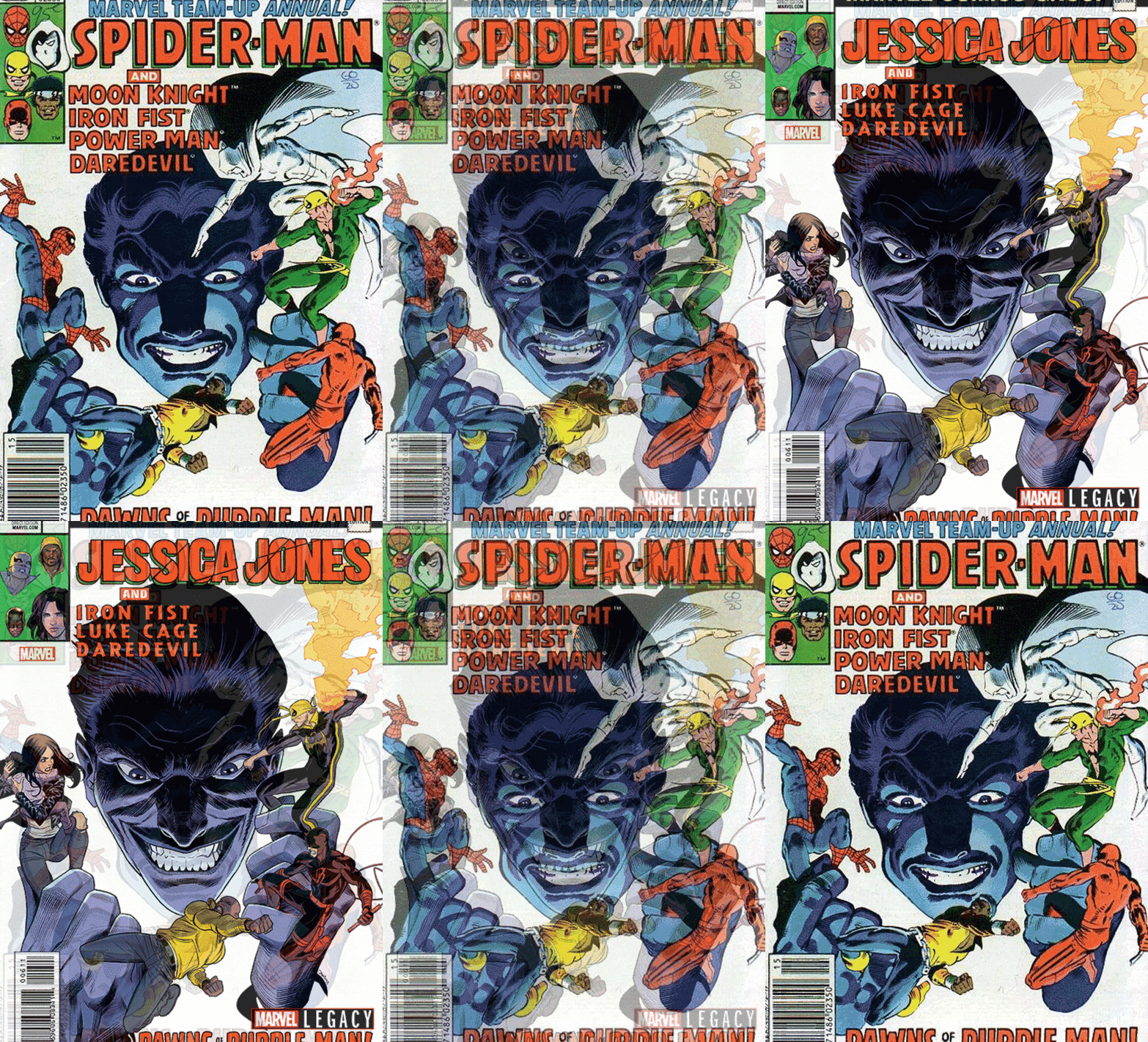
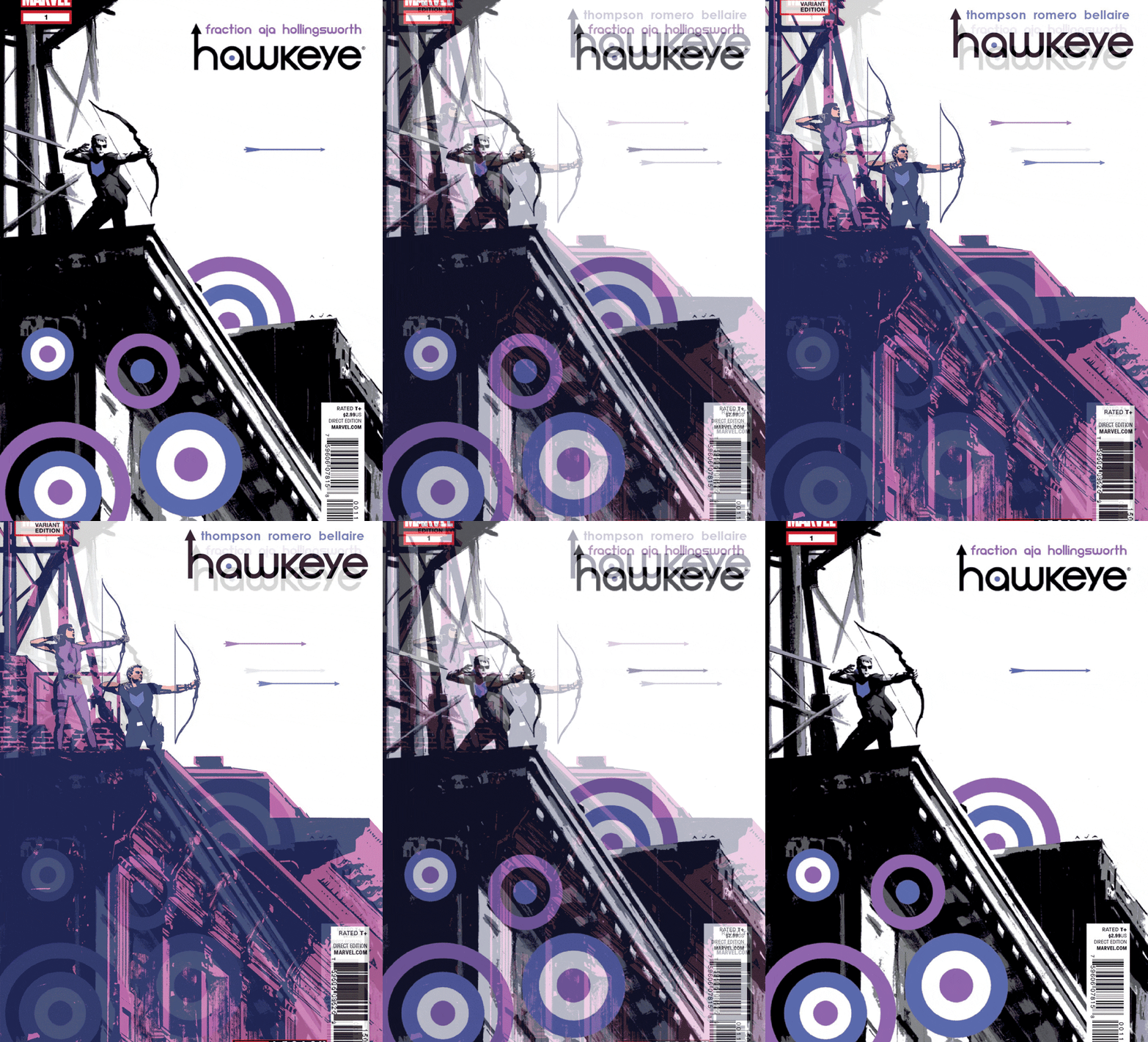
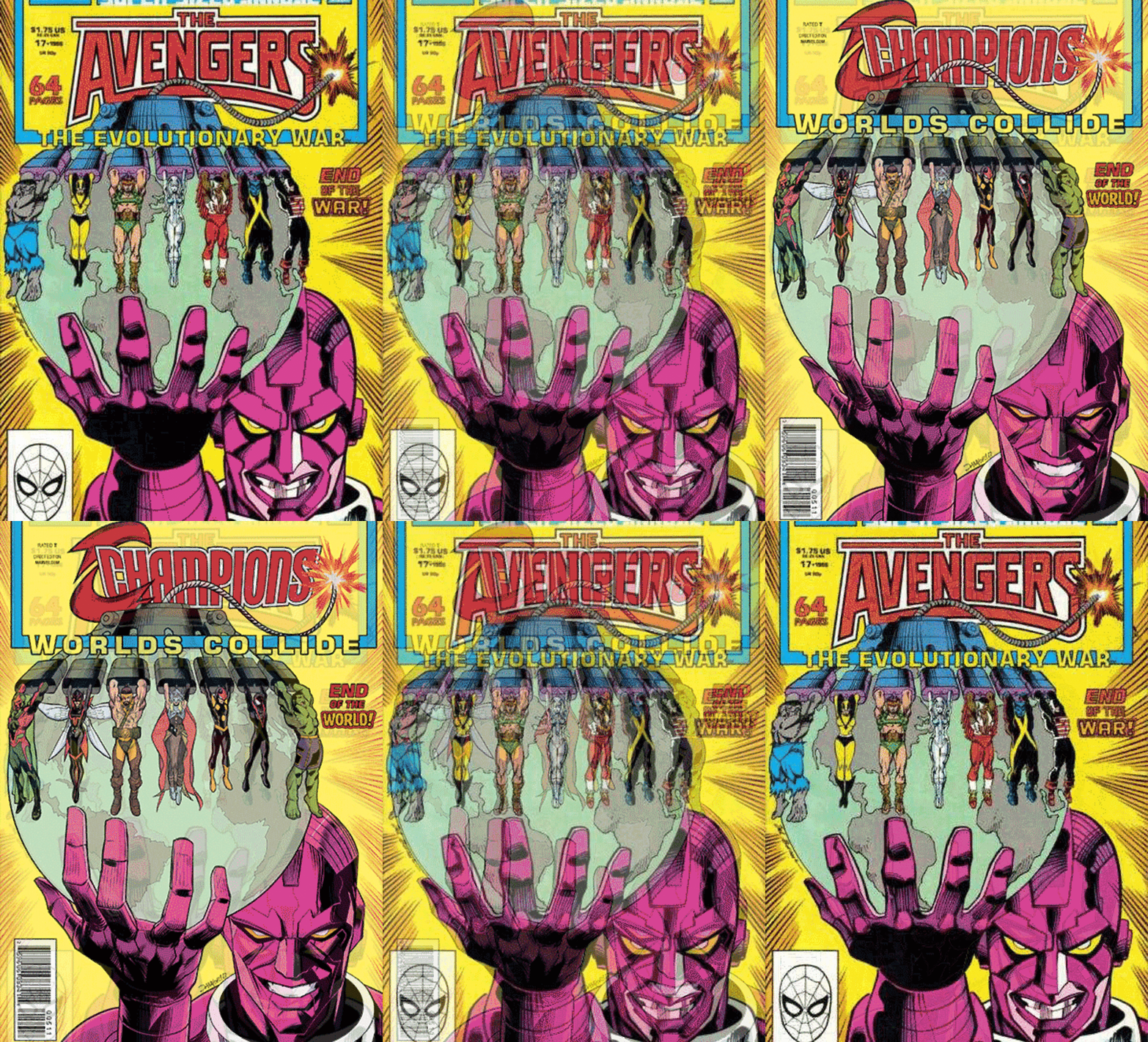
Marvel Entertainment released five more animated covers, Friday afternoon that ties into Marvel Legacy in an attempt to pay homage to classic covers, these were via SYFY Wire.
“A new initiative that will take things back to our iconic history, with a firm eye on the future, MARVEL LEGACY will present stories that remind everyone — newcomers and longtime fans alike — why Marvel stands as the premier name in fiction,” said Editor in Chief Axel Alonso. “Our titles will unearth gems from Marvel’s rich history, remind readers of connections between characters, and usher in the return of some major characters who’ve been missed. Above all else, we want to inject our comics with a massive dose of fun!”
Cover artists:
US Avengers (cover artist: Christian Ward)
Hawkeye (cover artist: Greg Smallwood)
Jessica Jones (cover artist: Daniel Mora)
Champions (cover artist: Daniel Mora)
Spider-Man (cover artist: Giuseppe Camuncoli)
Guardians (cover artist: Ron Lim)
MARVEL LEGACY #1 hits you local comic book store in September, with an over-sized 50-page one-shot.
How do you feel about British humor? That’s the question anyone scrolling through Netflix should ask themselves when they stop on Mindhorn. The people from England have a peculiar brand of humor that not everyone vibes with. It’s often dark, dry, and subtle. It goes over the heads of some and makes others roll their eyes. However, for a select group (myself included) British humor is, in a word, awesome. Mindhorn is decidedly British, and that’s either a good thing or a bad thing depending on where you stand on the question posed at the start of this paragraph.
Mindhorn is the story of Richard Thorncroft (Julian Barratt), an actor who once starred in a popular 80s action show called Mindhorn. Thorncroft’s Mindhorn was a tough detective with a bionic eye that let him “see the truth.” Twenty-five years later and Thorncroft’s career has gone as far as starring in embarrassing commercials. Thorncroft returns to the Isle of Man, where Mindhorn filmed when a police investigation gives him a chance to reignite his career.
“The Benedict Cumberbatch backlash has begun!” – Mindhorn
The premise of Mindhorn forms a rock-solid foundation for a comedy. Like Hot Fuzz, The film is unabashedly having fun with the great action of the 80s. In this case, it’s with TV shows like The Six Million Dollar Man, Starsky & Hutch, and Knight Rider. There’s no doubt that David Hasselhoff is a big influence on the movie. In fact, the movie seems to built around the idea of “What if David Hasselhoff’s career went deep down south after Knight Rider?”
The thrust of the film centers around a police investigation into a murder. The only suspect, Melly (Russell Tovey), will only speak to Detective Mindhorn. It’s here that Thorncroft sees an opportunity to prove how awesome he is. Melly turns out to be such a huge fan of the show that his home is like a comic book store dedicated to the one show.
The funniest bits are gut-busting, but they come few and far between.
At its best, Mindhorn produces some seriously hilarious moments. The best stuff coming from the footage of the TV show which looks cheese-tactically 80s. Viewers are even treated to the classic action show intro that explains the entire premise of the show. The filmmaker’s don’t forget the soundtrack, offering up one of the funniest things in the movie “You Can’t Handcuff The Wind” a song recorded by Thorncroft after the show ended. It’s another wink and nod to the career of The Hoff.
Along for the film’s ride is The Babadook’s Essie Davis who plays Thorncroft’s former co-star and lover, Patricia Deville. Patricia has moved on, becoming a successful journalist, and is now living with Clive, a former stuntman, played by Simon Farnaby. Cue the love triangle, though this one is not your typical and makes way for a moment in which Farnaby explains how often he “drives Mindhorn’s car” from the show. In case it’s not clear, Clive lets Thorncroft know he’s talking about driving Patricia.
Co-Producer Steve Coogan(with Ridley Scott of all people) also makes a cameo as Peter Eastman, a former co-star on Mindhorn. Eastman’s “Windjammer” character spun off into its own show that’s now in its 16th season. Windjammer is so popular that it produces a line of weather resistant clothing, a subtle joke that defines British comedy. Eastman holds no love for his former co-star, and neither does Kenneth Branagh who appears as himself.
Mindhorn is ultimately a mixed bag. The funniest bits are gut-busting, but they come few and far between. There’s an unevenness to the film, and it feels underwritten. At the same time, it’s a fun ride watching Barrett’s Mindhorn learn just what an asshole he is.
Amazing direction, stellar cinematography, fantastic casting, mind-blowing stunts, excellent writing, and rock solid performances make Baby Driver one of the best films of the year.
Summary
The film centers around a getaway driver named Baby (Ansel Elgort). He works for an Atlanta Crime Boss named Doc (played by Kevin Spacey) who he’s known since his mother and father passed away some time ago. The crooks in Doc’s crew find him to be slightly awkward. Griff (Jon Bernthal) asks if he’s mental? It’s a fair question because what driver can do what he does on the road at the speeds he goes at while keeping earbuds in his ear so he can listen to his favorite mixes.
Baby leads a simple life (beyond that whole getaway driver thing). He loves taking care of his foster dad who is deaf but knows full well what he has been up to. His world is turned on its ear when he meets Debora (Lily James), a waitress who loves music but appears to love him more. It’s the first time that he sees the light at the end of this dark tunnel of crime. Reality begins to crash in as Doc tracks him down and threatens his loved ones if he doesn’t agree to this next job. He quickly finds himself back in a room with Buddy (Jon Hamm), Darling (Eiza González), and a psychopath named Bats (Jamie Foxx). Plans are devised for the heist that will change their lives.
What Worked
The film’s chase sequences are exquisitely choreographed to Edgar Wright’s carefully selected soundtrack. The audience quickly forgets they’re watching a car chase and begins to marvel at the artistic quality of the synchronicity in this full throttle high-octane fest through downtown Atlanta. It’s a symphony of sound, a sight to behold, and a feast for the senses. ‘Baby Driver’ is Wright’s love letter to the great heist movies of the past.
Bill Pope, who is best known for his work on The Matrix, has a gift for framing action sequences allowing for the most impact. Who could forget the scene where Keanu Reeves bends back in slow motion as Agent Smith fires multiple shots at him that miss completely? Every time there’s a chase sequence in Baby Driver, Pope makes sure to keep the getaway car entirely in the frame. This allows us to see every tire squeal, every impossible turn, and indeed the deft ability of Baby’s driving.
The casting decisions in the film were outstanding. Ansel Elgort was a perfect choice for the lead being that he can project the right amount of innocence mixed with a certain degree of edge. The character of Doc needed to be someone who could command the room and who better to do that than Kevin Spacey? Jon Hamm and Jamie Foxx both stepped away from their usual leading man status to take on more supporting role and boy did they both kill it. Foxx walked that fine line between humor and being psychotic in the role of Bats. The biggest surprise to me was how well Hamm did in the film. This role is the furthest that I’ve ever seen him venture from his infamous role of Don Draper. His performance was nuanced and refreshing to see. One can only hope he’ll continue taking on this types of characters. Jon Bernthal did what he’s done for years, and that looks menacing. Eiza González added the right mix of sex appeal and psychotic behavior to the narrative.
Loved the relationship dynamic between Buddy and Darling. There are conversations those two have that add another comedic layer to the narrative. Seeing them talk about the outlandish ideas they had for their cut of the money was a nice break from the edginess of the film.
Loved the themes the narrative introduced. In the beginning, Baby didn’t think about these heists as they were a means to an end. Debora enters his life, and he’s enamored by not only by her beauty but also by what a great person she is. It’s at this point that he seriously ponders the morality of what he’s doing. Is it right to be getting out of debt with someone even if it means shattering hundreds of lives in the process?
Overall
Baby Driver is an intoxicating orgy of violence, speed, passion, and music that’s choreographed with such precision that the final product comes as something more than just a heist movie. This is Edgar Wright’s pièce de résistance, a cinematic equivalent to Beethoven’s 5th symphony. In an era in which Transformers: The Last Knight exists, it gives me hope that directors like Wright are breathing originality into a world filled with sequels, reboots, and superhero films. Baby Driver not only is one of the best releases of the summer movie season, but it is also one of the best of films of the year period. Do yourself a favor and see just how wonderful this picture truly is.
Marvel Entertainment released five more animated covers, Friday morning that ties into Marvel Legacy in an attempt to pay homage to classic covers, these were via Comic Vine.
“A new initiative that will take things back to our iconic history, with a firm eye on the future, MARVEL LEGACY will present stories that remind everyone — newcomers and longtime fans alike — why Marvel stands as the premier name in fiction,” said Editor in Chief Axel Alonso. “Our titles will unearth gems from Marvel’s rich history, remind readers of connections between characters, and usher in the return of some major characters who’ve been missed. Above all else, we want to inject our comics with a massive dose of fun!”
Cover artists:
Michael Ryan
Alan Davis
Dave Johnson
Cameron Stewart
Dave Johnson
MARVEL LEGACY #1 hits you local comic book store in September, with an over-sized 50-page one-shot.
Marvel Entertainment released six covers, Friday morning that tie into Marvel Legacy in an attempt to pay homage to classic covers, according to comicbook.com.
“A new initiative that will take things back to our iconic history, with a firm eye on the future, Marvel Legacy will present stories that remind everyone — newcomers and longtime fans alike — why Marvel stands as the premier name in fiction,” said Marvel Editor In Chief Axel Alonso.
Cover artists:
Incredible Hulk – Mike Deodato
America – Benjamin Caldwell
X-Men: Blue – David Lopez
Moon Girl & Devil Dinosaur – Felipe Smith
Amazing Spider-Man: Renew Your Vows – Khary Randolph
Astonishing X-Men: John Cassaday
MARVEL LEGACY #1 hits you local comic book store in September, with an over-sized 50-page one-shot.
The purpose of You Should Be Reading… is to shine a spotlight on self-published creators who release their work in print or digital and creators who work for publishers that don’t rank in the top 10.
We’re in a golden age of comics right now and in an age of geek none of us could have ever imagined, but with the good comes the bad. As our geek news sites become more corporate they tend to focus less on comics and in some cases less on independent creators. Which is why this series exists. My goal is to never shy away from giving a soapbox to those starting out and trying to carve a niche for themselves.
Today I am interviewing the awesome Chuck Collins. Chuck is a Cartoonist/Illustrator based in NYC. He’s worked professionally for various animation studios throughout the city over the past decade or so. He’s also worked as a bouncer in the city and as he puts it via his site. It’s had its good times and headaches…. lots of headaches. Most of those headaches turned into stories and I slapped some comedy on to it and made my webcomic BOUNCE! I’ve been doing it for two years and I’ve never been happier producing art.
And here’s a bit about the comic itself.
Welcome to the world of The Bouncer and his childhood friend Yemaya, two sci-fi and movie geek bouncers that deal with New York’s craziest bar patrons. This webcomic tackles everything from politics to relationships all through a satirical, blerd, New York lens. Winner of three 2016 GLYPH Awards including Best Webcomic, Fan Award for Best Work and the Rising Star Award.
Now let’s get on with the interview.
Marco: First off thanks for letting me interview you. I’m ashamed to admit that I’ve only been reading your webcomic recently. But I’ve always loved the strips you post on your personal page and think you have a fantastic art style and a great sense of humor.
So, to start us off why don’t you tell the readers what made you fall in love with comics and how you started your career in animation and how Bounce! came to fruition.
Chuck: I think the first comic I read was Spider-Man. This was back in 1981. I must have been about 6. I just loved the art. But my true love came when I was in junior high and bought my first black and white indie comic which was 2000 AD. It was so different from the traditional superheroes I knew up until that point. The art wasn’t the standard mainstream art. It was different and edgy! I loved that!
I kind of fell into animation. I was a student of Aaron Augenblick. He had just opened his new studio in Dumbo back in 2000. I interned for him and didn’t get my first paying gig until 2 years after. I learned a lot from my experience there. I moved on to other studios after that, but I keep in contact with Aaron. Great animation mentor.
Bounce! was born out of frustration and comedy. I was a bouncer for almost a decade on the Lower East Side in NYC. I’ve worked in many seedy dives bars so I was exposed to the underbelly of humanity at its inebriated worst! (laughing) I told people about my stories working in the nightlife and they thought it was funny. I got told numerous times to make a comic about it. At first, I didn’t take it seriously because I didn’t think anyone would get it. But one day after kicking out an annoying patron, I got off work and had a few drinks and designed “The Bouncer” in my sketchbook. After more drinks, I must have written about 150 ideas for stories in the bar that night. The next day I drew it up and just posted it, then it blew up my Facebook page. Been doing it ever since.
Marco: I think one of my favorite strips. Probably one of my top 3 is Bounce! S3-06 where Dragonblack slaps the melanin off the drunk Ben Carson fanboy. It had me rolling. When you started this comic strip was it always your intention to mix political humor with nerd humor and your experiences as a bouncer? Or is that something that evolved as it went along?
Also given how exaggerated the strip is does every story have a kernel of truth in it from your experiences?
Chuck: I’d say about 60 percent of the comic is based on real life conversations I’ve had with people. It’s only political because I dealt with that on a nightly basis with over privileged bar patrons. Racists, misogynists, homophobes, xenophobes… the list goes on. The more they drank, the more of their deranged doctrines would spew out of their mouths. My job was to remain intellectually and logically superior to them at all times. As a bouncer, fighting is the last resort. 99.9% of this job is psychological. So, my rebuttals were snarky and geek driven. Lol. It kept things fun. I decided to bring that to the comic. To give the reader a sense of what it’s like to ask a guy to leave for pissing in the corner, while he explains why he’s right for doing so. It’s sad for that guy, but comedy for me.
Marco: Most creator-owned comics tend to have a beginning, middle and an end. Do you see that for Bounce! or is this something you feel could go on for years? You’ve already been at this for two years if I am not mistaken.
Also given your pedigree in animation might we see something there with Bounce!? I’ve been paying attention to you on Facebook so you know.
Chuck: I’ve been thinking about animating it for quite some time. This month I’m finally taking the plunge. I’m currently writing a script for a one minute short. I have a few talented friends that still work in animation that are willing to help. Hopefully, I can get something done by the fall.
Marco: I want to talk influence. Besides your days as a bouncer what else has influenced this series? I’m seeing the Street Fighter influence. Especially with the arc dealing with Max.
And outside of Bounce! are you working on any other comic book properties? Collaborating with others? Maybe something you can tell us a little bit about?
Chuck: One of the first animated films I saw was Rock and Rule back in 87. I remembered as a kid seeing this movie inspired me to create my own characters. Years later I started watching anime and was intrigued with the fact that the stories had a beginning and end. Unlike American franchise comics that have Peter Parker being 25 years old for about 30 years. (laughing) Video games like Street Fighter and Fatal Fury inspired me to create crazy fight scenes that I never saw before. So, I try to give them tribute in my comic.
Currently I’m revamping an old sci-fi post-apocalyptic story I did years ago called Dread Society X. It’s a lot different from Bounce! I’ll announce more the further I get along with designs.
Marco: And here we are at the end. I want to thank you again for letting me interview you Chuck. It’s been awesome. I got a lot of respect for what you do but before you go this is your moment to PIMP YOUR WORK. Right here is where you passionately explain to the readers why they should check out your work and where they can buy physical (and or digital) copies of your work.
Chuck: I’m very honored and humbled that you reached out to me for this interview. Thank you!
Bounce! comes from a passion to create something outside of the norm based on my life experiences. While I think the superhero genre has a lot of great stories, a lot of the time I need a break from it. Bounce! provides an escape from that world with comedy, action, and social commentary. Everyone loves to have a drink and go to a bar once in while. So I suggest you get your favorite bottle of whiskey and read my comic. You won’t be disappointed!
Also if you want to support the production of the animation, you can subscribe to my Patreon.
And that’s the end of that. I hope you all enjoyed this edition of You’ve Never Heard Of. Don’t forget to check out Bounce! online and pledge to his Patreon if you can.
And last but not least. MAKE AWESOME COMICS HAPPEN!
We’re in a golden age of comics right now and in an age of geek none of us could have ever imagined, but with the good comes the bad. As our geek news sites become more corporate they tend to focus less on comics and in some cases less on independent creators. My goal is to never shy away from giving a soapbox to those starting out, the independent, the unsung and the creators trying to carve a niche for themselves.
For today’s edition of Lettering with Style I am interviewing the awesome, the amazing (and I maybe bias because he’s lettered for me) DC Hopkins. In case you wanted to know a bit about DC before reading the interview here’s a little something on him.
DC Hopkins is a professional letterer for publishers such as IDW, Lion Forge, BlackMask, Disney, Tor, Red 5, and a staff letterer at AndWorld Design. He is also the Co-host of two fantastic podcasts, Hideous Energy and Eerie, International.
Austin Wilson & Seth T. Hahne
Now let’s get on with that interview.
Marco: So, to start us off I’m going to ask you a question designed to let the reader get to know you a little. What made you fall in love with comics and how did you get your start in this business?
DC: When I was a kid, my mom taught me to read at a very early age. Around the age of two, I was starting to put together small, three-letter words on our refrigerator using these multicolored letter magnets that she bought for me to learn from. This lead to reading those simple “See Spot Run” style books, and my parents struck a deal with me: for every one of those books I would read on my own, they would buy me a comic book issue.
This turned out to be a great motivator and my love of comics began at this point – the bright colors, the dynamic characters, and the genre elements all captured my imagination. The Darkwing Duck cartoon combined with the 1989 Batman film reinforced it even further, and I’ve been a comic reader ever since.
In terms of my start in the business, it’s much like everyone else’s story about breaking in: a ton of false starts, rejections, and grinding away at work until opportunity knocked. I did a lot of work for Bluewater and if the whole Malcolm Gladwell 10,000 hours thing holds any truth, I got a TON of practice and bad pages out of my system while working there. It was a big learning experience.
Eventually, I started getting bigger and better gigs (and ones that paid too!), and my first big publication was the graphic novel Johnny Hiro: The Skills To Pay The Bills by Fred Chao, published by Tor. A year or two after that, Deron Bennett asked me if I was interested in doing work for his studio, AndWorld Design, and my career really took off from there. Deron offered to teach and mentor me to help me take my work to the next level, and I immediately accepted.
Marco: I recently asked Micah Myers this question and I also asked Marshall Dillon the same question (for two upcoming interviews). Now I don’t plan to ask any other letterers I interview in the future but I will ask you because we’ve worked together and I’m curious as to your answer.
What are some of the misconceptions you’ve run across as a letterer in this business and if you could what’s something you would like to see changed or improved upon when it comes to letterers in this business?
DC: Perhaps the biggest misconception is that the lettering just “happens” or that the writer does it. I’ve yet to meet a letterer who hasn’t experienced the challenge of trying to get the average person to understand exactly what it is that we do. My usual elevator pitch is that I essentially do graphic design for comic books. It’s a little broad and not 100% accurate, but it gets the job done and people start to understand I’m not the writer or illustrator. Beyond that, I think some other common misconceptions are that we write all of the sound effects (we don’t, usually), that balloons are called “bubbles,” and that lettering is just an afterthought tacked on at the end.
Comic book lettering is an art, and something that letterers and editors take very seriously. It’s the backbone of a comic in many ways, and we aim to make the relationship between the visual components and the reader work as seamlessly as possible.
In terms of wanting to see something changed, I think the biggest thing that’s weighed on my mind lately is this idea that “lettering should be invisible.” Deron has written about this for the AndWorld social media pages, and we’ve discussed it a lot. With comic book lettering, there’s been a common comparison to film editing in that if a film is edited properly, you don’t notice it, and that comic lettering should be the same.
While I understand where this thought is coming from since bad lettering can jolt a reader right out of the book, I disagree that lettering shouldn’t be noticed. Good lettering should be noticed, and the reader should enjoy seeing well-balanced placements, and visually striking sound effects, and creative title designs. It’s a vital part of the presentation of the comic, and I love seeing letterers like Deron, Rus Wooton, and Aditya Bidikar put their stamp on a book and take it to another level. Those are just a few of the letterers working right now who are trying to push the boundaries of what lettering can be, and I try to do the same in my work whenever possible.
Jehanzeb Hasan & Mauricio Caballero
Marco: Let’s talk about AndWorld Design and your start there. What’s it like working for and with a lettering and design studio? Also tell us a bit about how you approach a book when you’re brought on board.
DC: Oh man, AndWorld is the best. Deron is everything you could hope for in a boss in that he’s super nice and laid back, but extremely driven and ambitious. He’s constantly pushing for us to put out our best possible work, and is very hands-on when it comes to suggesting tweaks and adjustments so that our pages go out in top form. With Deron at the helm, working for the studio is a breeze. There are roughly 7 or 8 of us, and we run the gamut across different styles and skills. Some of us work exclusively on design work, some do primarily manga, while others do a combination of everything.
I’ve jumped at every opportunity to learn from Deron on working with each of these skills, and because of that I’ve learned how to letter manga which is a completely different animal altogether. Since we’re not a brick-and-mortar studio, we communicate mostly using Slack and email and stay connected easily. It’s a lot of fun being a part of a larger team.
In terms of my approach on an AndWorld book, it’s mostly the same as a freelance book I’d work on my own, with the biggest difference being that Deron is there as a facilitator. He’s already worked with the clients and gathered all the necessary materials we need to work on the project. If the client has very specific ideas and directions in terms of style, he’ll send that over to us, otherwise the first step is landing on what style we’ll be using for the project. I’ll letter a few panels with what I’m thinking would mesh well with the book stylistically and send it over to Deron. He’ll then make suggestions or alterations if needed and then we’ll communicate it to the client and run from there.
Marco: What are you working on presently? If you’re able to tell us and what do you have coming down the pipeline? Also do you have any other comic book pursuits outside of lettering?
DC: Right now I’m doing a lot of work through AndWorld on some fun Lion Forge projects, primarily ACCELL for their “Catalyst Prime” universe. The universe that Joe Illidge and co. are building over there is super (no pun intended) interesting, and I love that diversity and representation is a HUGE part of it, not just when it comes to race, but also sexual orientation and characters with intellectual disabilities in the case of SUPERB. I’m also working on THE CASTOFFS for their Roar imprint which is a blast. And VOLTRON is coming back soon so we’re working on volume 2 of that.
Beyond AndWorld stuff, I’m working on a bunch of other freelance projects at the moment, but most of it is under wraps in terms of announcements until a later date. I’m doing a larger graphic novel for Dynamite which should be out later this year, and I’m also the letterer on the ongoing series HELM which was just nominated in the Best Digital Comic category at this year’s Eisner Awards.
I have many other goals and pursuits in comics, but they’re all pretty much connected to lettering and design in some way. The biggest one is the desire to learn how to hand letter and translate that into creating and customizing my own fonts. It’s time consuming though, and a big part of the modern lettering industry in 2017 is that you have to push completed pages out as quickly as possible, leaving little room for extracurricular stuff, even as it relates to lettering. But in terms of writing or illustrating or editing comics…nah. I’m a letterer, and I love being a letterer.
Don Handfield, Richard Rayner, & Leno Carvalho
Marco: All good things must end and as sad as I am to have to wrap this up I’m going to give you a moment to PIMP YOUR WORK! This is your time to shine and to tell the readers why they should check out the books you’re working on, what you have coming up and anything else you have whether in comics or outside. So, have at it!
DC: Besides the stuff I mentioned above, people should also check out the DARKWING DUCK comic book that we did over at Joe Books/Disney. As I mentioned in the question about how I got into comics at an early age, Darkwing was a big part of that, so it was a surreal dream come true to work with Aaron Sparrow and James Silvani on that one. There are two trades out now that collect the entire run.
Beyond that, I lettered most of the recently collected THE RIFT series for Red 5 and had a lot of fun on that one too. Over at Alterna Comics, they’ve been getting a lot of buzz on their newsprint line, and one of the big hits has been TRESPASSER which I lettered and did the logo for. Justin M. Ryan wrote that one and he has been one of my favorite creators to work with so far in my career. Not only is he a fantastic writer, but he understands and respects the lettering process in a huge way. Publishers should take note of him and snag him now while they still can!
I’m also the letterer on the ongoing TART series written by Kevin Joseph. Kevin is another amazing guy who is insanely passionate about making comics, and the work he does over at Kechal Comics showcases that. And last but not least, I’d be remiss to not mention the digital comics I’ve lettered for you, Marco, over at Atomic Rex! We’ve worked on some truly outstanding stories there with some incredibly talented artists and it’s one of the first places I point people toward when it comes to checking out great free comics content online.
And finally, one last thing. I co-host/produce two podcasts hosted at over at FanOff, one called HIDEOUS ENERGY about comic books and another called EERIE, INTERNATIONAL about the horror genre.
I’ve been recording podcasts for about 8 years now and it’s become such an important part of my week, creatively speaking. Through HIDEOUS ENERGY, my co-host (Austin Wilson, writer of Magnetic Press’ RE•PRO•DUCT: SELF APPLIED) and I have also been able to make some free digital comics people can check out via our Patreon
and IMGUR.
And that’s the end of that. I want to thank DC Hopkins for letting me interview him and I hope you all enjoyed this edition of Lettering with Style. Check out his website and don’t forget to follow DC via twitter.
Krysten Ritter, Jessica Jones herself, has shared a new poster from The Defenders. Check it out below.
The show unites Daredevil, Jessica Jones, Luke Cage, and Iron Fist all on the screen together for the first time in television history. Following each character’s individual season, or seasons, The Defenders will be a wrap up of Netflix’s MCU phase one.
“Marvel’s The Defenders” follows Daredevil, Jessica Jones, Luke Cage and Iron Fist. A quartet of singular heroes with one common goal – to save New York City. This is the story of four solitary figures, burdened with their own personal challenges, who realize they just might be stronger when teamed together.”
Are you excited for the show? Comment below, let us know.
Edgar Wright’s Baby Driver opens everywhere June 28th, and there are a hundred reasons why you need to go see it. There’s the sharp and quick-witted dialogue that audiences have come to expect from Wright. There’s his patented camerawork and editing that creates a visual experience few filmmakers today can match. The chase scenes are about some of the best ever put to film. And you have to appreciate the standout performances from the veteran actors and newbies alike. But the real reason to see Baby Driver – the reason everyone is going to be talking about – is the sound. This is hands down one of the best uses of sound/music in a movie ever.
*Warning – Mild Spoilers Ahead For Baby Driver*
(But Nothing That Ruins The Plot)
Ansel Elgort plays Baby, a getaway driver working to pay off some debt. Baby is one of the best in the biz, but he comes with a quirk: he’s constantly listening to music. “Constantly” as in every waking moment (unless he has to speak to someone). The music very much becomes a character in itself, and Wright weaves it in so seamlessly with the story that there’s no way the film doesn’t receive a nomination for Best Sound Mixing and/or Editing. The music blends with the environment so that not a single sound is wasted. Car sounds, people talking, construction, explosions, even ATM machines, all play in tune with Baby’s music. The city of Atlanta becomes a symphony.
Shooting script cover art by Oscar Wright.
So why the emphasis on the sound? On a simple level, Baby is just trying to drown out his tinnitus. On a slightly deeper level, he wants to remember his mom, an amateur singer who introduced him to music. But by the film’s end, you realize that it was always so much deeper than even that. Wright used the music and sound to tell the audience who Baby was, and how his story was going to play out, from the start.
We meet Baby in the film’s opening scene during a bank heist. He’s sitting in the getaway car – a boosted red Subaru – while Jon Hamm, Jon Bernthal, and Eliza González go to work. He’s jamming out to “Bellbottoms” by The Jon Spencer Blues Explosion. And by “jamming out,” I mean jamming the f*ck out. Dancing, singing at the top of his lungs, the whole nine yards. In that moment, thanks to the music, we know who Baby is. He’s calm, cool, and composed when other drivers would be anxious. He’s groovy.
As Baby Driver progresses, we learn that our hero records everyday sounds and voices and mixes them together to make sick tracks like this one:
So Baby isn’t only a fan of music, but he also creates it. He’s not just an outsider looking in; he’s one with the music.
And therein lies the rub. Look at the first page of the Baby Driver script, which Edgar Wright shared:
“You are the music while the music lasts.” We’ve established that Baby is one with the music, but how long will that last? Well his music never ends, remember? He plays it constantly. It just keeps going, and that implies how he wants to live. He just wants to move forward, blending in with the symphony of the world as his music does. The script’s second quote echoes this sentiment as well. It’s a line from “Baby Driver,” the song from which the film borrows its title, which is all about a man who “hit[s] the road” and is gone. To further this point, the soundtrack places a heavy emphasis on jazz, which is infamously about freedom and living without restrictions.
And there you have it. We just broke down the essence of Baby Driver while only barely discussing the plot or characters. That’s why the use of sound and music in the film is so masterful. Wright takes a visual medium and uses audio to make his point. You can close your eyes and still hear a story about freedom, and about breaking off the shackles of your life. You can join the symphony of the world around you, if you only listen and go with your groove.
F is for Family is one of those rare Netflix shows that seems to fly under most people’s radar. The first season, consisting of six episodes, debuted quietly on December 18th, 2015 to generally favorable reviews, but besides myself, I personally knew only one other friend who watched it. Compare that to Netflix’s other animated comedy, the critically acclaimed BoJack Horseman, which everybody seems to know about even if they’ve never seen it. While both are made for adults, perhaps it’s BoJack’s slightly more intelligent, far less vulgar sensibilities that give it a broader appeal compared to F is for Family’s truly vulgar and loud brand of comedy.
Despite its boorish brand of humor, however, there is a flowing sentimentality that serves as an undercurrent beneath the surface of F is for Family, in addition to something truly relatable about its main character, Frank Murphy. Both of these traits are on full display in season two, which premiered on May 30th, and help to make the comedy’s sophomore year a roaring success.