What will one young girl do to protect her brother?
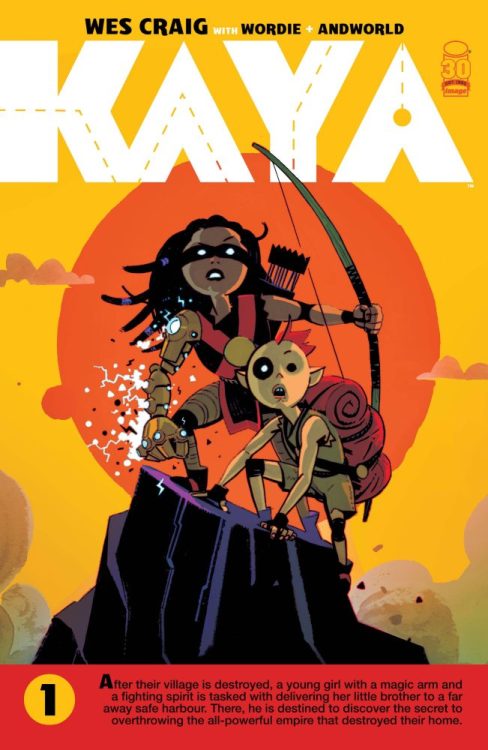
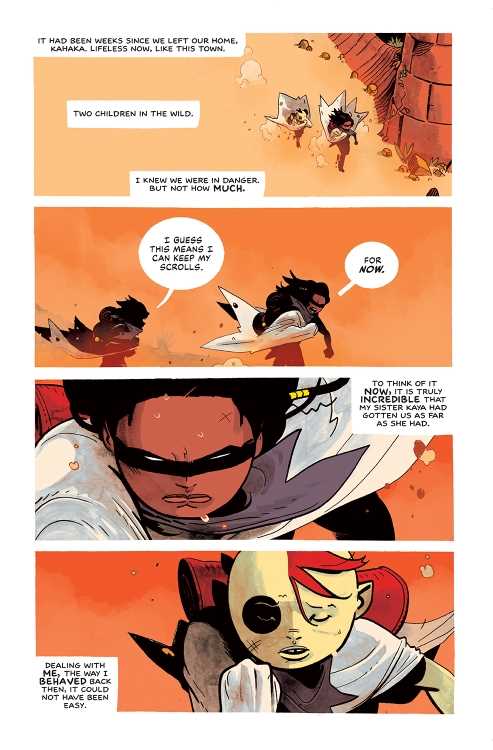
Image Comics’ newest adventure is about to begin in Kaya #1. Written and illustrated by Wes Craig (Deadly Class), this is the story of a young girl named Kaya, her magical arm, and a quest to safeguard her little brother.
Decisions must be made if they want to survive in this world.
If you’re still lamenting the conclusion of Deadly Class, then I have some good news for you. The mind behind the series, Wes Craig, has been working on a new project for some time now, and it’s finally ready for the public. That new project is Kaya. The series promises to be one part fantasy and one part struggling for survival, portraying the lengths one girl will go to fulfill her vow.
Kaya #1 kicks off the series with an oversized issue, giving readers plenty of time to get used to this new world. It’s a grim world, but it’s exactly what we’re looking for right now. And don’t forget to look out for that Jack Kirby-inspired variant cover; it’s incredible.
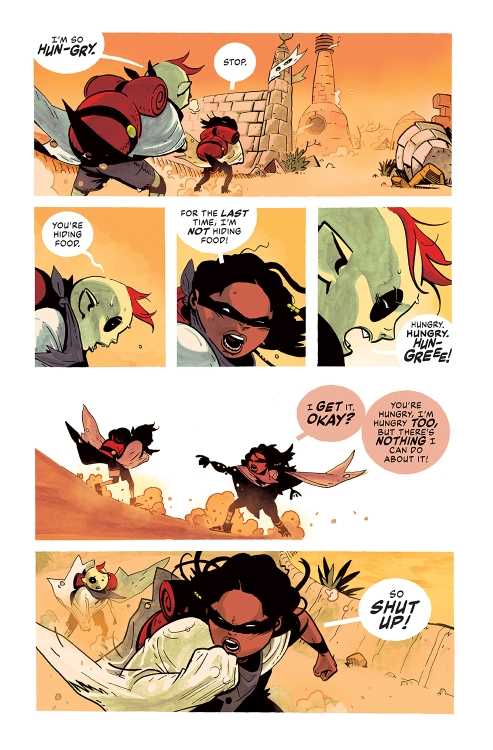
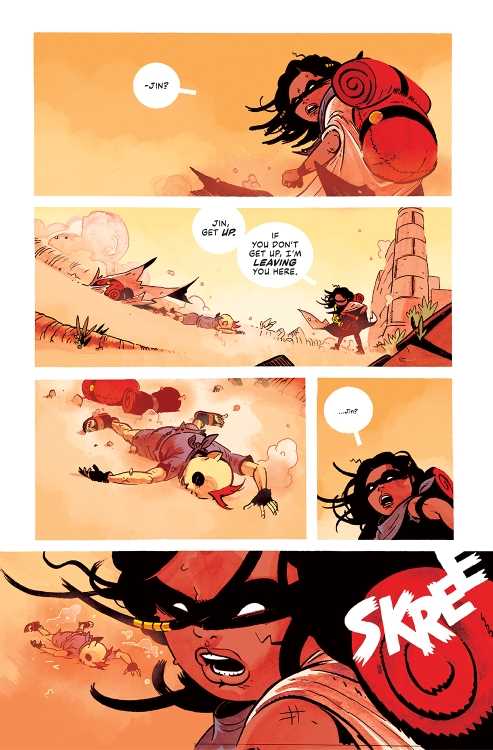
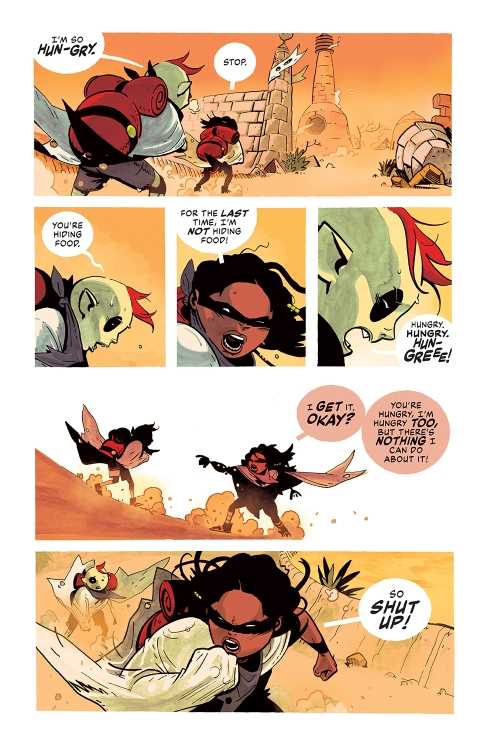
The little prince is hungry.
Writing
There is something so incredibly exciting about diving into a new series. It’s like picking up a bundle of endless potential. Of course, the fact that this series happens to come from somebody with so much industry experience makes it all the more exciting.
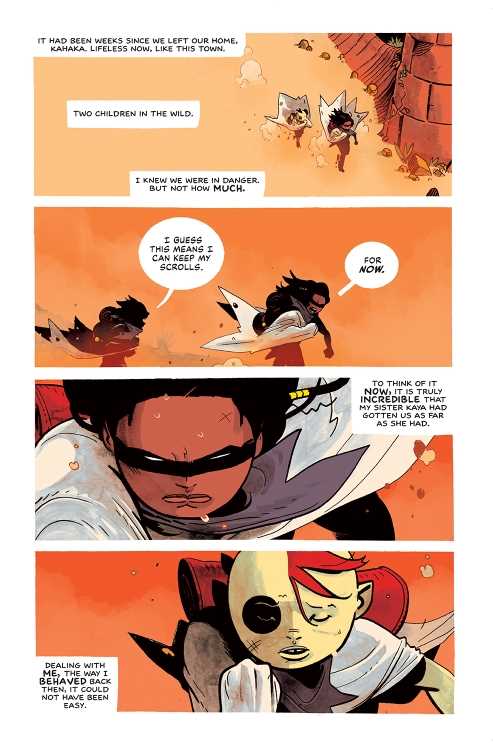
Perhaps the most interesting decision thus far is Wes Craig’s choice of narrator. The guiding voice of this story is not the title character, Kaya, but rather her younger brother. This fact has some potential implications, but it is too soon to start down that road of theory-crafting.
Just one issue in, and it’s already clear how difficult this adventure will get. This is a desolate and dry world, devastated by enemies and their actions. Yet, despite this somber setting, there’s a spark of hope. This spark grows stronger, eventually leaving us with a promise for something more. It should be enough to get most readers coming back for more.
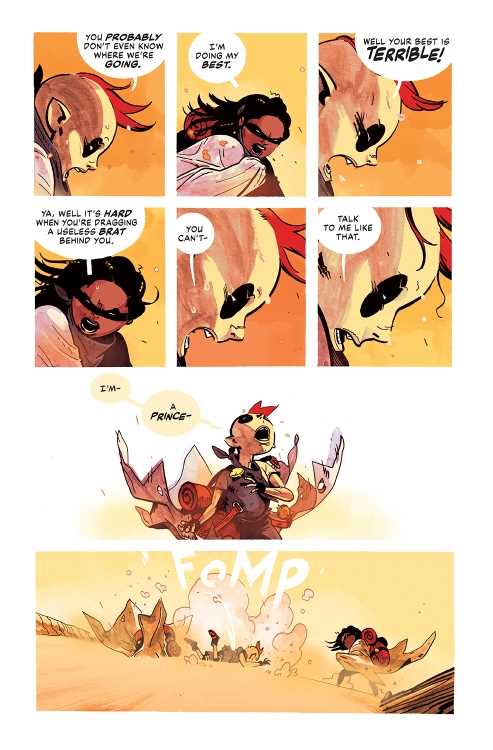
They say there are two sides to every dispute.
Artwork
The artwork in Kaya #1 is worth writing home about. Craig’s style is in full force here, with descriptive characters, vibrant colors, and punctuated lettering. It all adds to the world’s atmosphere.
The deserts of Craig’s world appear as infernos, because of Jordan Wordie’s colors, with flaming sunsets and nothing but sand for miles. The heat and dryness practically wave off the pages. One thing is clear – this would not be a fun place to visit.
The consistent setting allowed the characters to take center stage, primarily Kaya. Her design is bold, pulling eyes to her every time she appears. In stark contrast is her brother – his appearance tells a different story.
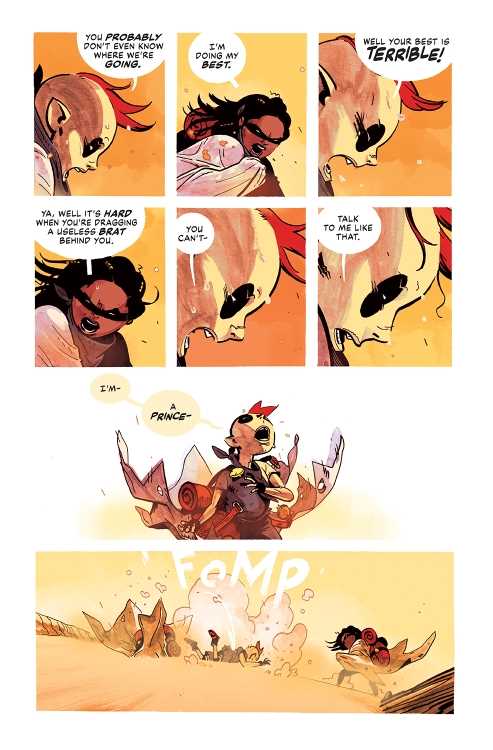
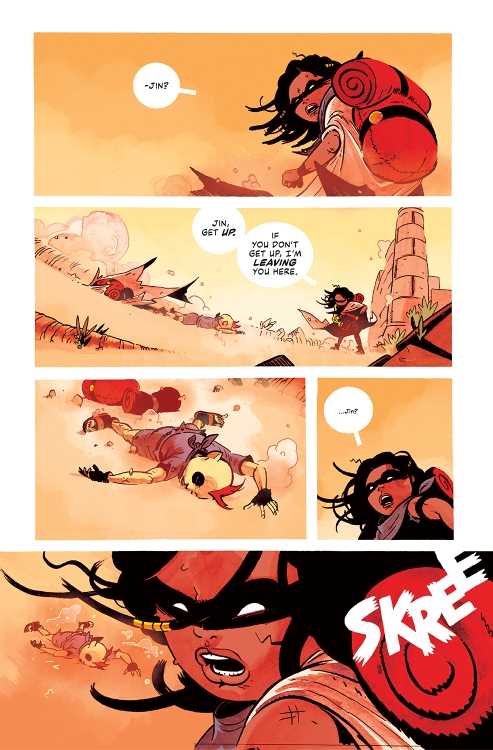
Many details help bring the artwork (and the story) together. The lettering by Tom Napolitano did wonders to bring many of these details to life—everything from the complaints of a hungry child to the ripping of a net.
Trouble added to more trouble.
Conclusion
Kaya #1 is a solid start to the series. It promises us a story that will be full of danger, determination, and change. In other words, this is the perfect story to dive into right now. Kaya #1 hits your local comic book shop on October 5.
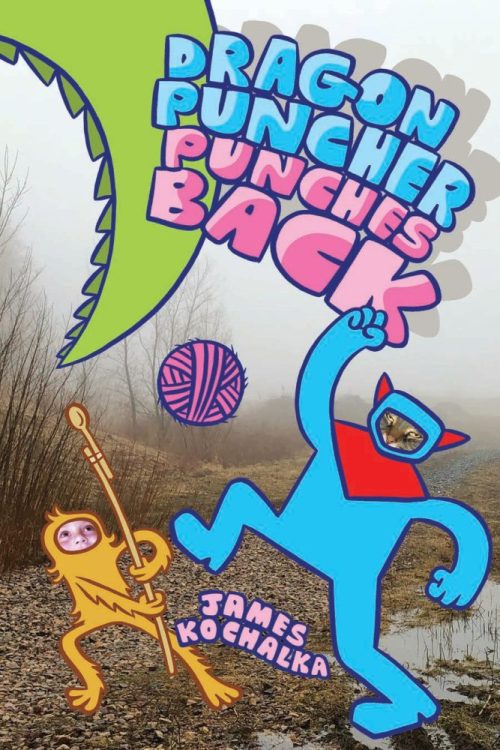
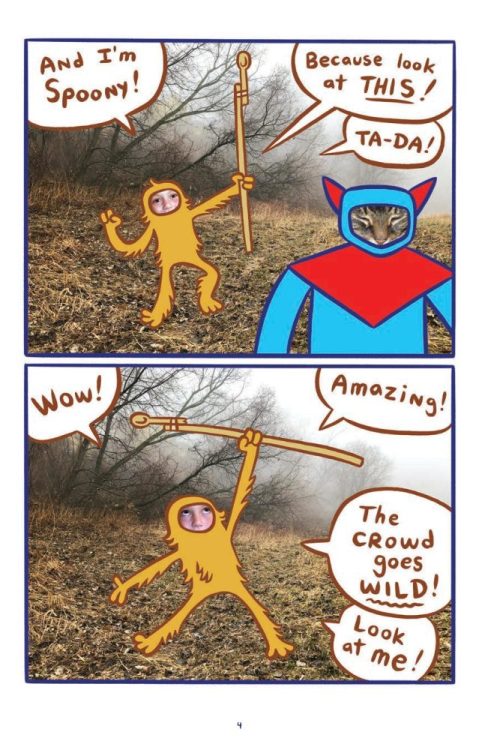
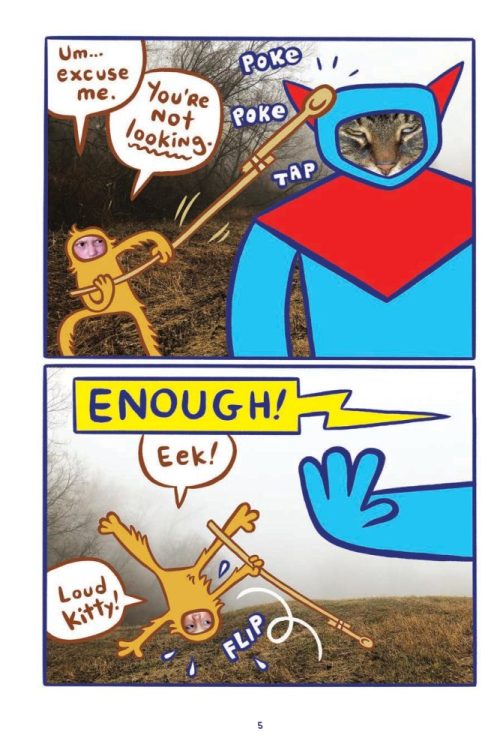
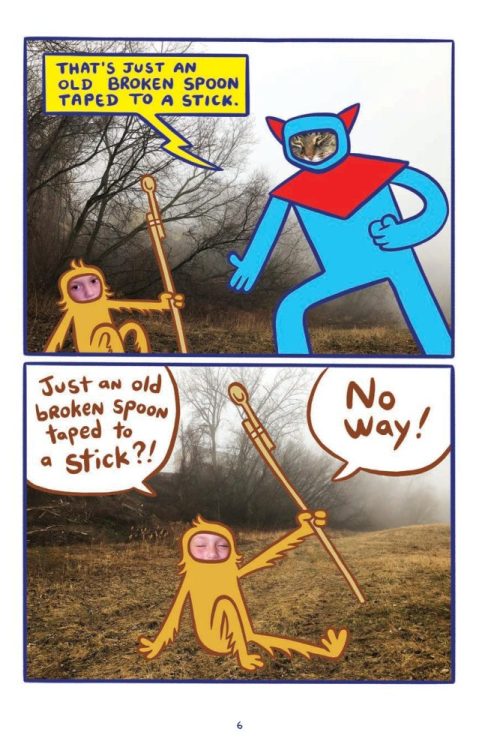
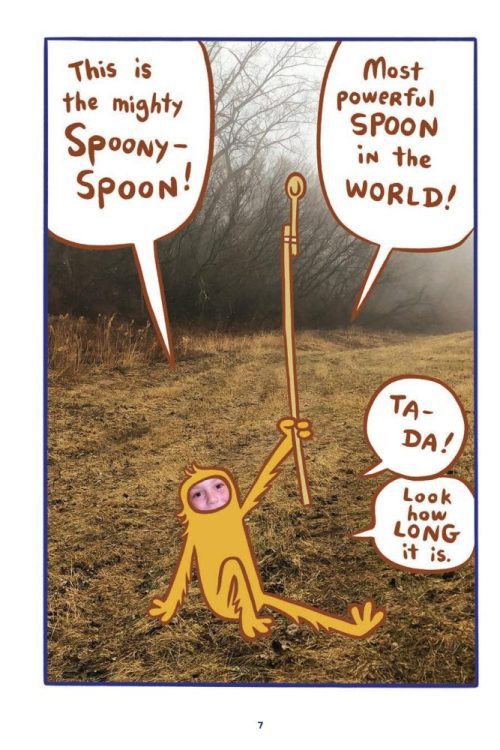
James Kochalka’s Dragon Puncher (Book 3): Dragon Puncher Punches Back hits your local book store on September 20, but thanks to Top Shelf Productions, Monkeys Fighting Robots has a five-page preview for our readers.
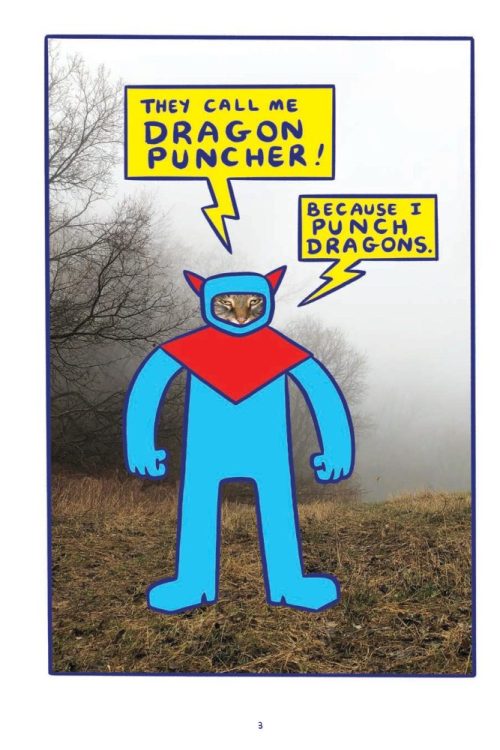
About the book: The world’s cutest book series about a cat who punches stuff just got even cuter, because this time the dragon is a big cute baby one! Dragon Puncher’s human sidekick Spoony has got his fuzzy monster pajamas and a new and improved extra-long spoon, so he’s ready for anything. But Dragon Puncher mistakes a big ball of yarn for an evil dragon, which attracts the attention of a real dragon. Still, it doesn’t matter who started it. If you punch Dragon Puncher then Dragon Puncher punches back!
Enjoy the preview below.
About James Kochalka: James Kochalka is, without question, one of the most unique and prolific alternative cartoonists working in America today. His comics have been published internationally by nearly everyone from the smallest alternative publishers to some of the largest publishing houses on earth; He’s recorded several music albums under the name James Kochalka Superstar (in 2016, his Song “Britney’s Silver Can” was named one of the 10 greatest songs of the year by Rolling Stone); and he’s developed animated cartoons for Nickelodeon and Cartoon Hangover. He is the first official Cartoonist Laureate of the state of Vermont, appointed in 2011. Among his best-known works are the Monkey vs. Robot series, the beloved children’s series Johnny Boo, Dragon Puncher, Glork Patrol, and Banana Fox, and his magnum opus, the 14-year span of daily diary comics known as American Elf.
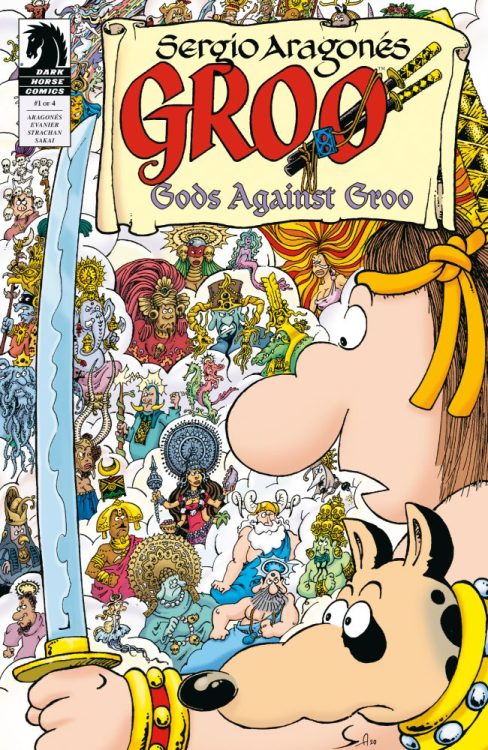
Monkeys Fighting Robots is excited to announce that Eisner Award-winning creators Sergio Aragonés and Mark Evanier are teaming up once again to conclude the epic storyline of Groo and the gods in GROO: GODS AGAINST GROO, beginning this December from Dark Horse Comics.
The new series will cap off the saga that began in GROO: FRAY OF THE GODS and continued with GROO: PLAY OF THE GODS. Evanier and Aragonés will co-write the series, with Aragonés working as penciller and inker. The two will be joined by Carrie Strachan on colors, and Stan Sakai on letters.
About GODS AGAINST GROO: The bumbling barbarian Groo has made quite a name for himself, traveling the land and cleaving a path of destruction and cheese dip. He is either so greatly feared or favored wherever he goes, Groo’s earthly reputation causes a Groo deity to arise in the heavens! While Earthbound Groo hungers, his Divine Groo alter ego unleashes chaos! Plus, Sergio’s legendary back cover Rufferto strips return!
GROO: GODS AGAINST GROO #1 (of 4) will hit your local comic book store on December 21st, and is available for pre-order starting this week.
Praise for the Groo and the gods saga: “This fray is fraught with fights, fancy, and fun. Aragonés and his collaborators have created another masterpiece guaranteed to please readers of all ages. Highest possible recommendation.” – SciFi Pulse
“Groo is a beloved and wonderful character and Sergio’s work bringing his adventures to life over the years will never stop being excellent.” –PopCult HQ
“Groo’s as good as it’s ever been.” —Slings and Arrows
Are you excited for the upcoming GROO series? Sound off in the comments!
Bloodshot Unleashed #1 hits your local comic book shop on September 21 from Valiant Entertainment. Bloodshot was created in 1992 by Kevin VanHook, Don Perlin, and Bob Layton when Valiant comics burst onto the scene. He was instantly one of Valiant’s most popular characters and, to date, the only one to get a live-action movie. However, after several successful runs with various writers, Bloodshot needed a fresh start. Enter Bloodshot Unleashed. With writer Deniz Camp taking over, we get another installment to the Bloodshot mythos. Jon Davis-Hunt is the artist. Jordie Bellaire lays down the colors, and Hassan Otsmane-Elhaou does the lettering.
WRITING
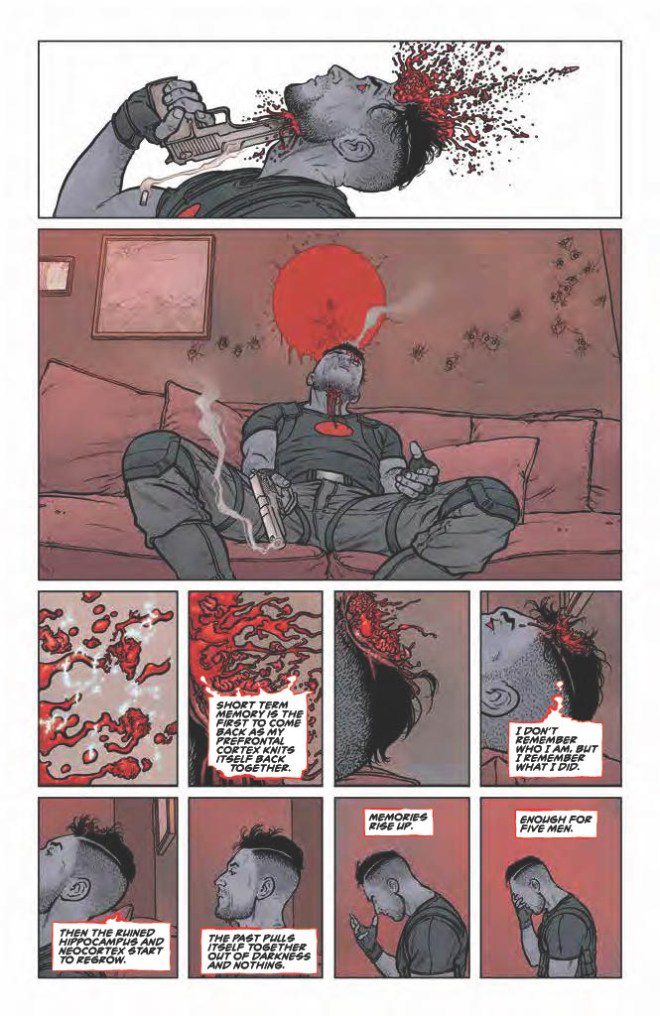
Deniz Camp brings his take on Bloodshot with this new series. This version works because it deals with Bloodshot overcoming his PTSD. Camp tells this story through two different points in Bloodshot’s life; the past and the present. In the past, Bloodshot is suicidal with no purpose. As we move to the present, Camp gives us the Bloodshot we’ve all come to know. He’s back to being the killing machine taking down villains. Camp almost makes it seem like we’re dealing with two different characters. Past Bloodshot is destroyed by his guilt over the loss of his family. He can’t move past this, understandably, and it consumes him. Present Bloodshot is a man with a mission again. He’s deadly and ready to fight. Camp gives us a good story that feels fresh for the character. It will be interesting to see where things go from here.
ART
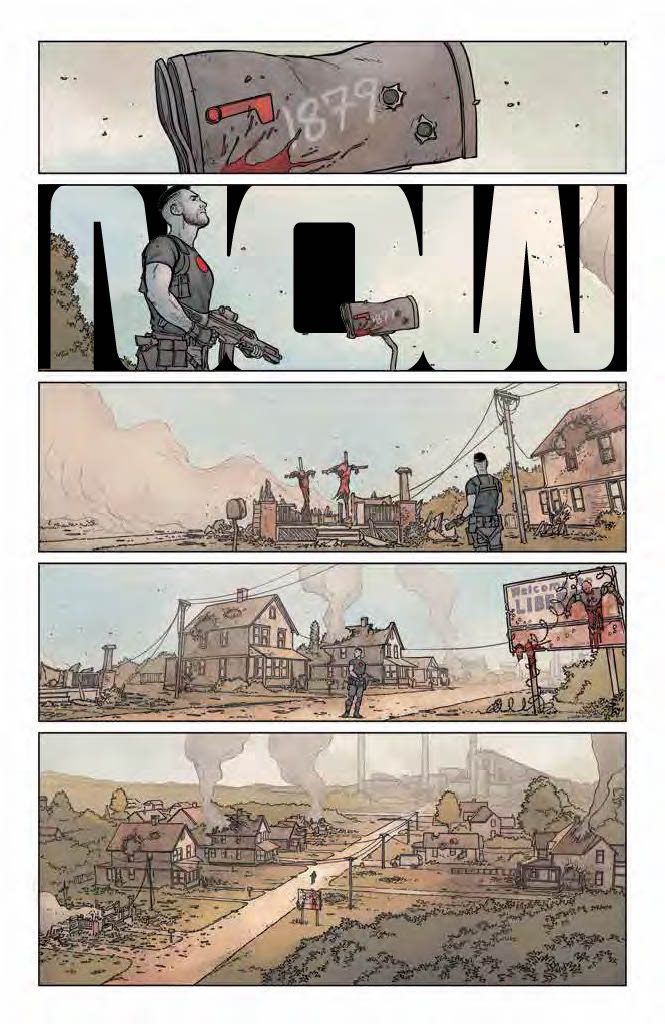
Jon Davis-Hunt handles the pencils in this issue. What stands out with the pencils in this issue is the number of panels used per page. Davis-Hunt gives us several pages with multiple little panels. These are effective for conveying the surroundings of a character. For example, in one section, we see bodies and blood as Bloodshot scans an area. As a reader, it feels like we’re seeing what Bloodshot sees; quick glances at the destruction that has been happening. Davis-Hunt also has many graphic panels in this issue. Seeing someone get shot in half and then re-congeal is always cool. Davis-Hunt gets the opportunity to draw a ton of gruesome panels, and he knocks it out of the park.
The colors by Jordie Bellaire are amazing, as always. Bellaire used a darker color palette for the panels in the past. This could signify a darker time in Bloodshot’s life. The walls are dark red; the sky is also darker. When we move into the present, Bellaire colors the sky lighter. The present is definitely a better time in Bloodshot’s life, and the colors reflect that. Bellaire colors him with more energy in his face as Bellaire lights up the page as bright yellow explosions rip across an abandoned city. This shouldn’t be a shock, but Bellaire is one of the best colorists in the comics industry. She consistently brings her A game to every book she touches. Bloodshot Unleashed #1 is another example of this.
The letters by Hassan Otsmane-Elhaou are integral to the story. Otsmane-Elhaou uses big clear letters to signify the past and present. These are also transparent, so we can see the panel. Otsmane-Elhaou makes great use of sound effects. As Bloodshot battles a foe in the streets of an abandoned city, we get a “THKK” as Bloodshot throws a grenade. A masterfully lettered panel has an establishing panel of a house split in two. As a gunshot goes off, Otsmane-Elhaou uses the “BANG” to bridge the gap between the broken house.
CONCLUSION
Bloodshot Unleashed packs enough action and emotion to make Michael Bay jealous. Deniz Camp writes a compelling first issue that gives readers a relatable and compassionate hero. The art delivers and makes looking at this issue an absolute delight. Again, Bloodshot Unleashed#1 hits your local comic book shop on September 21.
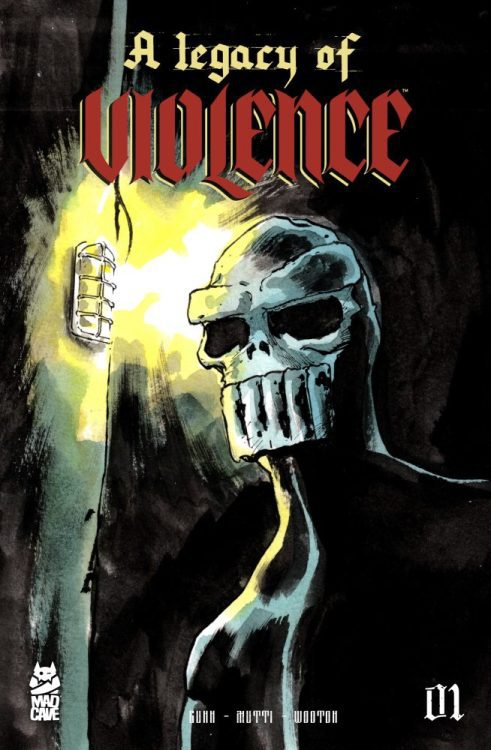
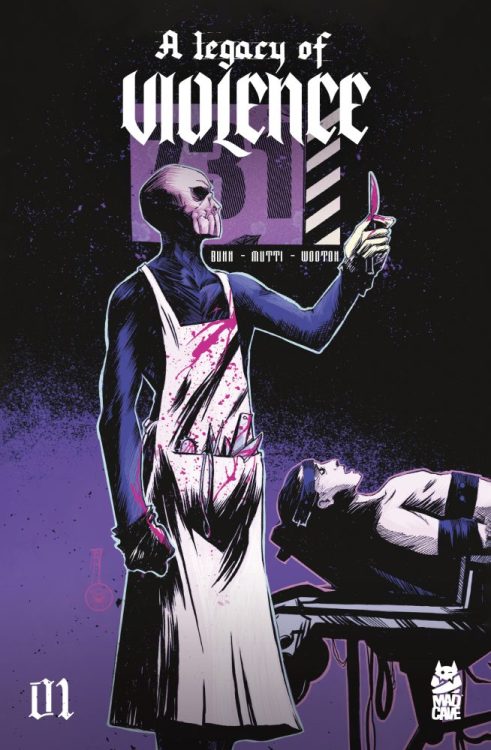
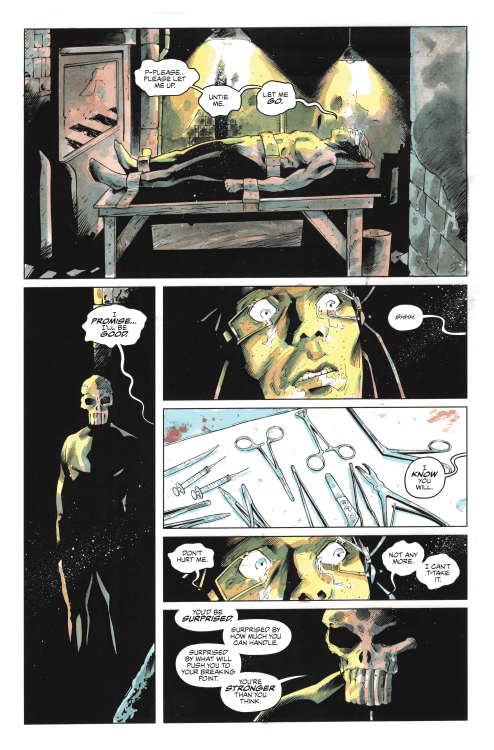
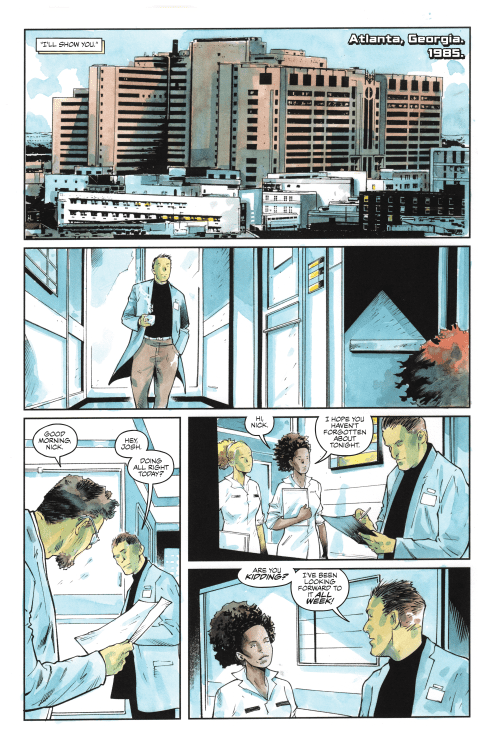
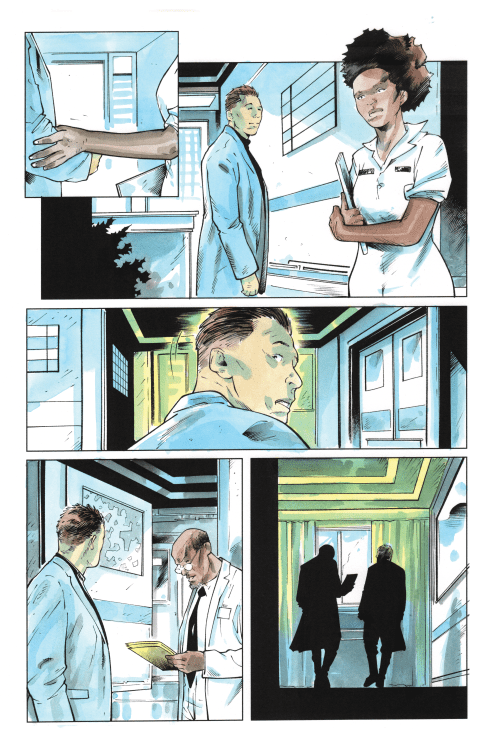
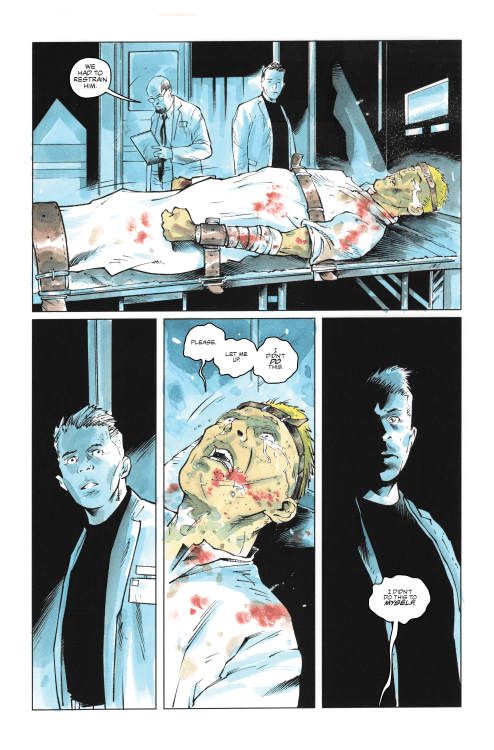
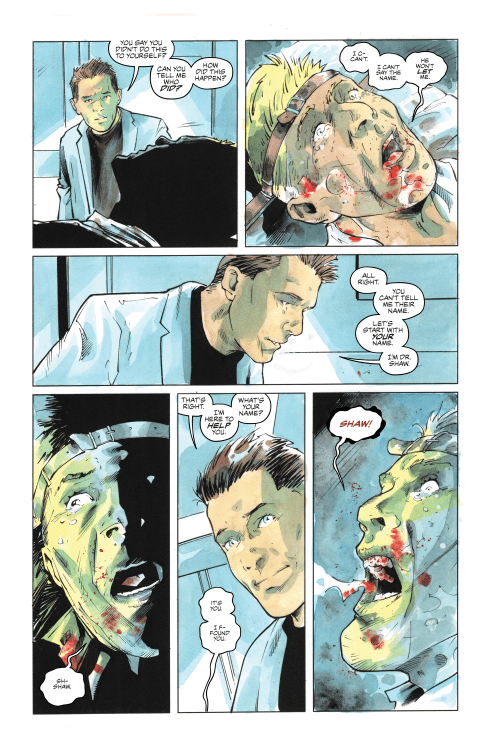
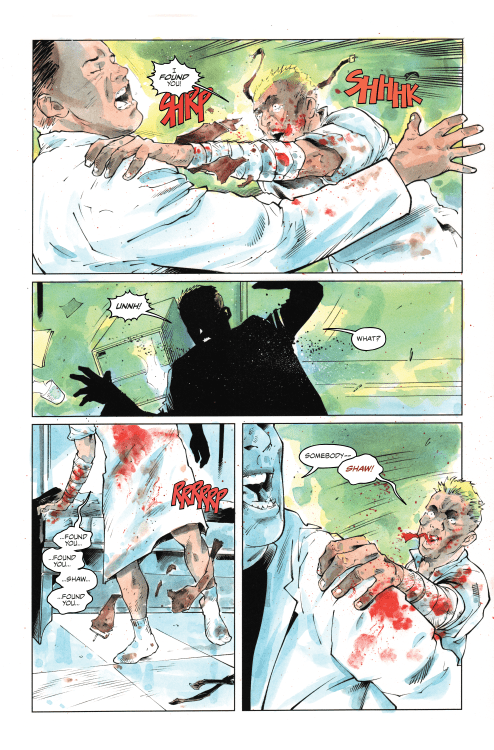
A LEGACY OF VIOLENCE hits your local comic book store on October 5, but Monkeys Fighting Robots has a six-page preview for our readers, thanks to Mad Cave Studios. The issue is written by Cullen Bunn, with art by Andrea Mutti, and you will read Rus Wooton’s letter work.
About A LEGACY OF VIOLENCE 01: When Dr. Nicholas Shaw joins a humanitarian medical outfit in Honduras, he hopes to recover from a recent traumatic event and actually help those in need. But something sinister has followed Dr. Shaw, something that wants to put his medical skills to ghastly tests, something connected to the young doctor’s past… and to untold horrors that occurred long before he was born.
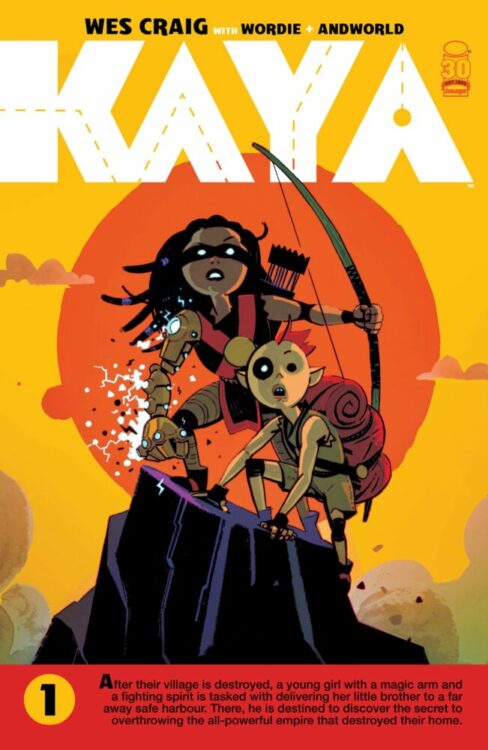
KAYA #1 is an excellent read with an emotional story, gritty art, exciting panel layouts, spectacular colors, and clean letter work. This week, Monkeys Fighting Robots talked with the creator of KAYA, Wes Craig (DEADLY CLASS and GRAVEDIGGERS UNION). Craig handles art and story on KAYA, with colors by Jason Wordie and letter work by Tom Napolitano. The new ongoing series from Image Comics hits your local comic book shop on October 5, with a final cut-off for pre-orders on September 12.
About KAYA #1: After the destruction of their village, a young girl with a magic arm and a fighting spirit is tasked with delivering her little brother to a faraway safe haven. There he’s destined to discover the secret to overthrowing the all-powerful empire that destroyed their home. This is an astonishing, immersive story about siblings surviving in a world full of monsters and mutants.
Enjoy the interview below.
MFR: Wes, thank you for taking the time to talk with me.
CRAIG:No problem, thanks for having me.
MFR: I read the first issue and then found the prologue during my research. How do you want a new reader to experience KAYA?
CRAIG:Yeah, the prologue is up on Webtoons as a quick introduction to the world. I wanted something out there for free that people could easily check out. If they like that, they can pre-order KAYA #1 at their comic shop or online now. That begins a longer story that takes place over the first five issues.
MFR: What does your script look like when you are the artist and the writer?
CRAIG:Pretty traditional but with some weird quirks, I guess. For one thing, I write it all out by hand. I find the ideas come easier when they’re written out on paper instead of on a computer screen. I make two columns, one for panel descriptions and one for dialogue. It’s all pretty spelled out for me by the time I get to doing the real drawing. But unlike working with a writer, there’s a lot of adjustment throughout the process since I don’t have to check with anyone else. Lots of adding and subtracting dialogue and images.
MFR: I was impressed with how emotionally invested I was by the end of the first issue. Can you talk about your writing process and how you developed the main characters?
CRAIG:That’s great to hear. I’ve been slowly building up this world while drawing Deadly Class, so some of the development is a distant memory at this point. But I’d say finding an emotional connection to the characters is vital. And figuring out what the reader reacts to emotionally. It’s embarrassing to say because this should have occurred to me much earlier, but I didn’t used to take the reader into account. I used to just write the story I wanted to write, for myself. But if I’m just writing it for myself, what am I doing really? I write stories to share them. It should be a back and forth between writer and reader. So you always have to think about their experience, emotionally, intellectually, etc. And hopefully make characters that are three-dimensional enough that they stand up and walk on their own and aren’t just slaves to your plot. I think that’s what Kaya and her little brother Jin do.
MFR: Kaya’s design is badass. Did it take you several iterations to get to her final look?
CRAIG:I’d say she was pretty fully formed from the beginning. Her metal super-powered arm, the dreads and black across her eyes. But originally, way, WAY earlier in the development of the world, she was an adult. Eventually, I thought, if she was a young girl, that’d just make everything that much harder for her. And making things harder for your main character is always a good idea. Haha.
MFR: What were the conversations like with Jason Wordie deciding on a color palette for the universe of KAYA?
CRAIG:We talked it over a bit and I sent him some images of the desert at different times of day to show him what I had in mind. And pointing out where the color becomes more subjective than objective, usually because one of the characters is going through some intense emotion.
But also trying to leave Jason room to explore and have fun. I think at first there’s more “direction” as you’re feeling each other out. But that becomes smoother as you get comfortable with each other.
MFR: The panel layout in the book works well to communicate the story, the action, and especially the emotion from Jin. Can you talk about the panel layout of the first page and what you were trying to accomplish?
CRAIG:I think it was just trying to pull out to see how stark this land is that they’re dealing with for the first issue (that landscape will continue to change as Kaya and Jin continue their journey), and how unforgiving it is. Jason REALLY brings that intense heat to life in his colors. And then pulling in tight on the characters to experience how that heat’s affecting them. With a new comic, I don’t feel like you have very long to hook the reader, so I needed Kaya and Jin to be in deep trouble right away. I wanted the reader to wonder, “how will they get out of this?” almost from the beginning.
MFR: The letter work by Andworld is very clean. Was that the plan from the start? (The all-white Onomatopoeias works so well.)
CRAIG:Yeah, that’s something I do in Deadly Class too, with colorist Lee Loughridge. Those sound effects are hand drawn. And for the lettering, Tom Napolitano from AndWorld Design is handling that and he blows me away. We’re working together to make something that’s open, easy and fun to read. Between him and Jason’s colors, it looks so good. I feel very lucky to have them with me.
MFR: With a new issue like KAYA, how do you measure success?
CRAIG:Well, unlike Deadly Class, I don’t have Rick Remender’s name on this one, so I’ll try not to measure it to that level in terms of how many copies I sell. But from the little bit I’ve put out there so far people seem to really dig it, so that’s amazing to hear. I feel successful on a personal level because I think the characters are very real, and the story is strong, and I LOVE drawing it. Now all that’s left is the financial side of it. Will it be successful enough to do the comic for as long as I want? I’m doing my best to get the word out about it. But at the end of the day, a lot of that is out of my hands. So I’d say, if I can pay the rent and continue to do this comic for as long as I’d like (a few years), then that’s success. Anything beyond that is just gravy.
MFR: A year from now, you have a table at a convention, and you see someone cosplaying as KAYA; what will your reaction be?
CRAIG:Oh my god, I haven’t even thought of that. That would be so cool. I’d probably have to give them something from off my table, at least.
MFR: Wes, thank you again for your time, and best of luck with the series.
CRAIG:Thanks a lot! You can pre-order KAYA #1 until September 12, and the first issue comes out OCTOBER 5. For more on all that, you can follow me online at @WesCraigComics.
Do you plan on adding KAYA to your pull list? Comment on social media.
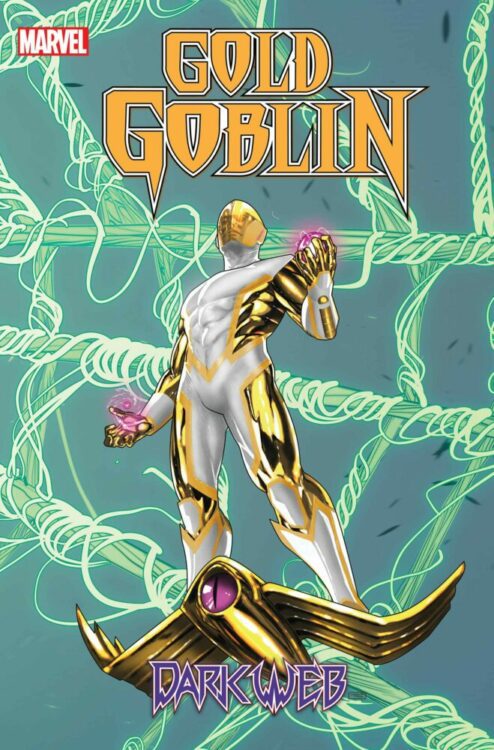
GOLD GOBLIN #2 is coming to your local comic book store in December, but thanks to Marvel Comics, Monkeys Fighting Robots has the exclusive first look at the issue!
The series will spin out of “Dark Web”, the upcoming Spider-Man/X-Men/Venom crossover. AMAZING SPIDER-MAN readers will know that Norman Osborn has turned over a new leaf recently, and GOLD GOBLIN will focus on the former villain’s turn as a hero.
About the issue: BEING A HERO ISN’T FOR EVERYONE…
Norman Osborn faced Chasm in DARK WEB #1 and has to face another terrifying opponent in this issue!
Norman’s only been a super hero for a few days…but his tenure might be quite short!
The issue is by writer Christopher Cantwell and artist Lan Medina; the main cover is by Taurin Clarke.
Get your first look at Clarke’s GOLD GOBLIN #2 cover here:
Are you reading AMAZING SPIDER-MAN? Sound off in the comments!
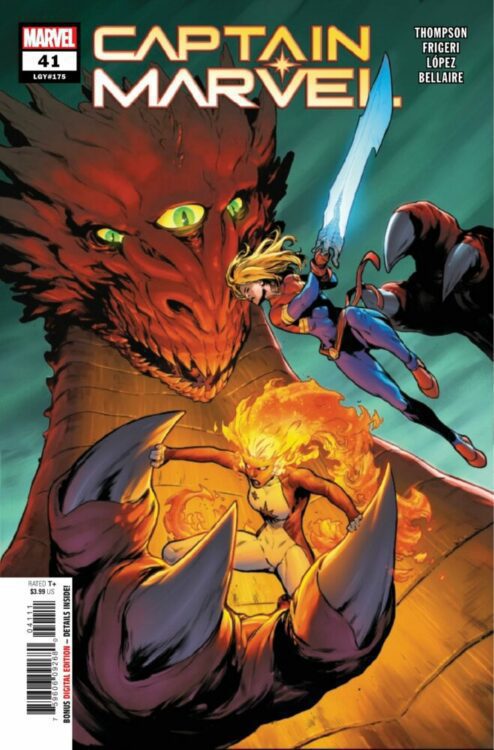
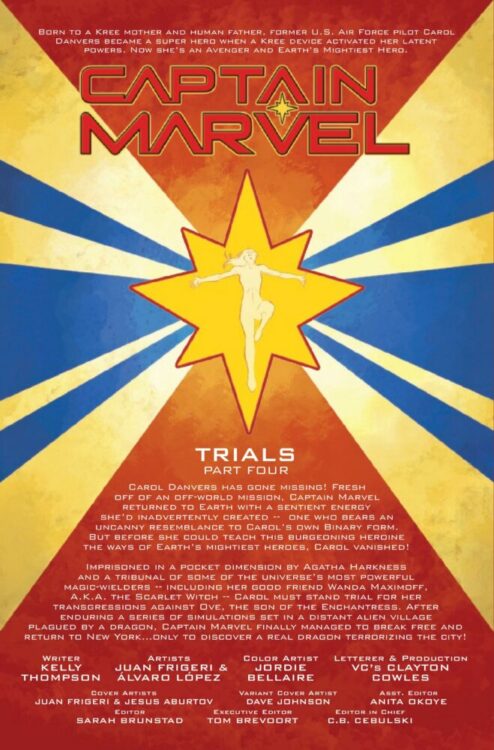
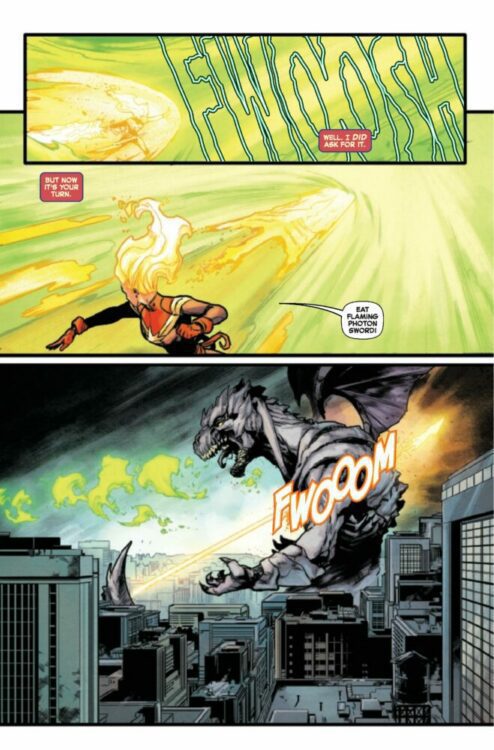
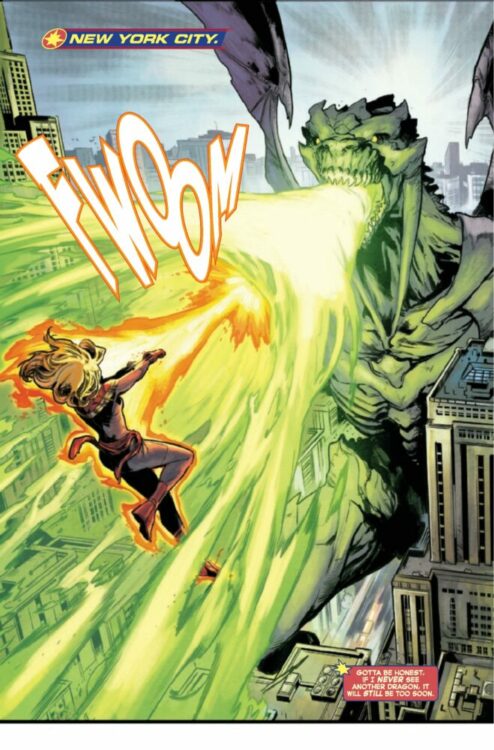
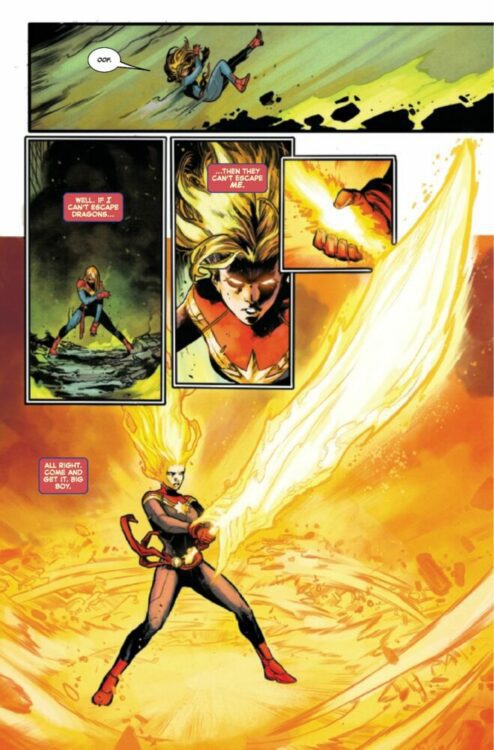
CAPTAIN MARVEL #41 hits your local comic book store next week, but thanks to Marvel Comics, Monkeys Fighting Robots has an exclusive four-page preview for our readers. The book is written by Kelly Thompson, with art by Juan Frigeri & Alvaro López, Jordie Bellaire drops the color, and you will read Clayton Cowles’ letter work.
About CAPTAIN MARVEL #41 (LEGACY #175): HELL HATH NO FURY LIKE A WITCH SCORNED! While Captain Marvel has managed to break free from her magical prison, she hasn’t broken free of Enchantress’s rage and thus finds an even worse problem waiting for her in New York. It’s a problem all too familiar, but with a deadly secret at its heart—one that could destroy Carol if she makes the wrong move. And what about Lauri-Ell vs. Binary? We haven’t forgotten about that!
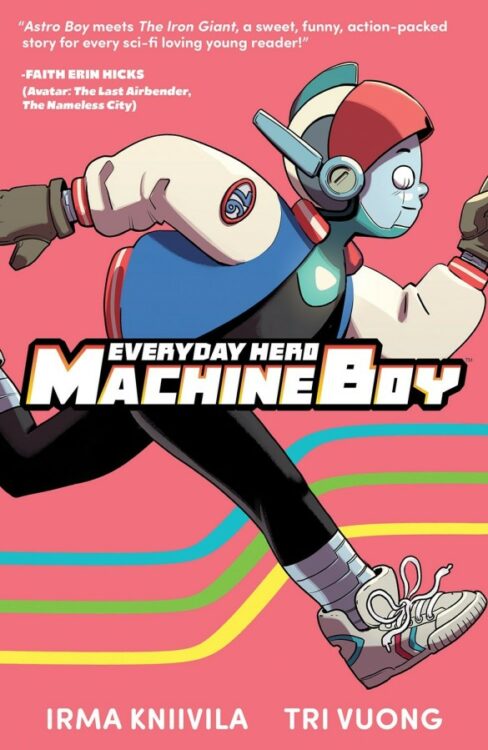
From Irma Kniivila and Tri Vuong comes a joyful comic full of karate, spaghetti, and a robot-boy from space in Everyday Hero Machine Boy. A mixture of Astro Boy, Dragon Ball, and The Karate Kid, this graphic novel from Image/Skybound is a delightful, if not very simplistic, all-ages story for those looking for that Saturday morning cartoon vibe.
“When Machine Boy falls from the sky into the domed city of Mega 416, he leaves a wake of destruction in his path… until Karate Grandpa is able to turn on his heart. Now, Machine Boy wants nothing more than to become a hero! Whether he is fighting giant bugs in the school’s basement, rescuing cats from trees, or making the perfect spaghetti sauce, Machine Boy is always looking for the best way to help others. But when his heart begins to interact dangerously with other debris from space, Machine Boy wonders if he can be a power for good after all.”
Writing & Plot
Everyday Hero Machine Boy warms audiences with a simple story full of heart and clever humor. The main plot is derived from a lot of very obvious influences. I mean, a powerful alien/robot boy crashes to Earth leaving devastation in his wake only to be turned nice by a cool grandpa? This isn’t a jab in any way. Just the opposite, as right off the plot alone sets a sort of expectation for the audience – and will no doubt get classic manga and anime fans on board. Machine Boy is very much a love letter to some classic hero stories, from Dragon Ball to Ultraman. It stands on its own, however, with its smart dialogue and unique character presentation. Every featured character brings something memorable to the table. This is due to Kniivila and Vuong’s style of dialogue and comedic timing. Again, there is a very Saturday morning cartoon blended with classic Shonen manga feeling here that just feels excellent to read. The relationships that bloom between Machine Boy and other characters, such as his grandma and new friends at school, feel natural and are fun to watch. This is a relatively short graphic novel that attempts to cover a lot of ground, and as such it can feel rushed at points. Major plot events can sometimes breeze by without much time for the audience to take in what’s happening. The big discoveries, such as clues to Machine Boy’s origin, end up suffering sometimes because of this. At the end of the day though, these flaws are easily covered up by just how much of a delight this story is to experience.
Art Direction
The vast majority of what makes Everyday Hero Machine Boy so delightful is Kniivila and Vuong’s artistic approach. The thick lines and soft, rounded style achieve a modern YA style while still having this graphic novel appear unique. The character designs and approach to the setting in Machine Boy are what set this book apart. Machine Boy’s design is the creators wearing their influences on their sleeves, sure – he’s basically a combination of Astro Boy and a Kamen Rider character. Like everything in this book though, this look is crafted with a level of likable charm that, when combined with his animations, makes Machine Boy unique in his own right. This world he inhabits and helps protect is also filled with anthropomorphic animals and safeguarded by a superpowered boy band. With Kniivila and Vuong’s design language and bright, neon-esque color gradient wraps readers up in this story’s lighthearted and fun yet still compelling atmosphere.
Verdict
Everyday Hero Machine Boy is a delightfully fun and exciting OGN that wears its influences on its sleeve while staying true to itself. While the main plot can feel a bit rushed at times, the heart and humor overcome any flaws to deliver a story that is still compelling. The visuals craft the perfect atmosphere for this futuristic hero-story, combining elements of Saturday morning cartoons and classic manga with a modern art style to deliver a reading experience that will be remembered for some time to come. Be sure to grab this graphic novel when it hits shelves on September 13th!
Old Dog #1 hits your local comic book shop on September 28, but thanks to Image Comics, we have an advance review for our readers.
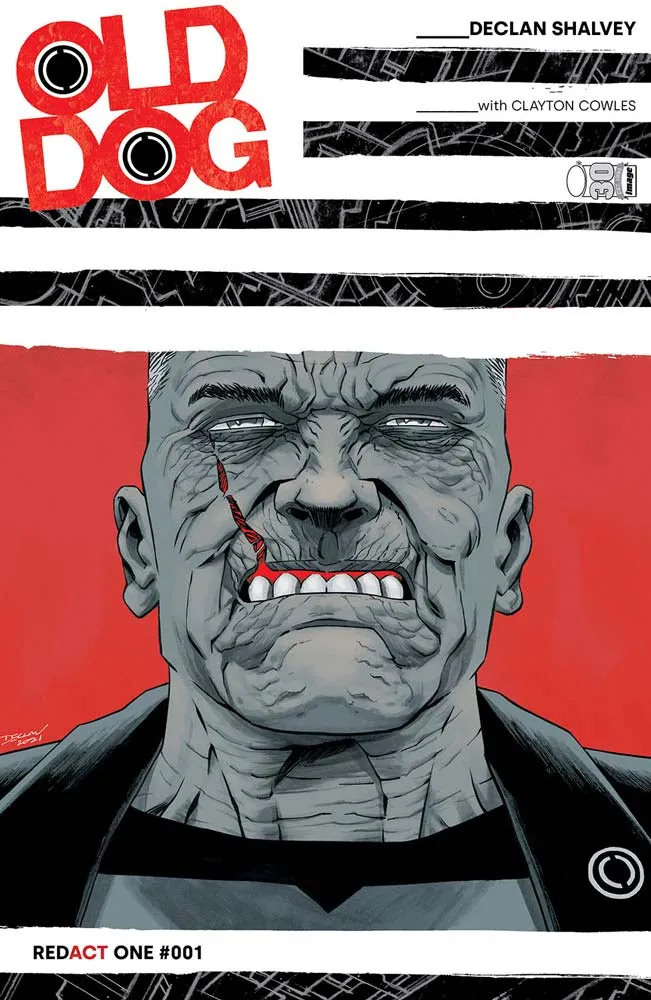
The cover of Old Dog #1 is a face strained into a snarl, sagging skin, and pockmarks contrasted with bulging neck veins and narrowed focused eyes. Age has made him slower but no less angry. That’s our main character. But for all his intensity, Jack Lynch has been benched by the CIA, left to stew in frustration and regret. So, of course, he’ll jump at a second chance to get back on the front lines. Creator Declan Shalvey and Letterer Clayton Cowles team up to put a spring back in Lynch’s step. However, his new lease on life might come from an unexpected source. And an even more unexpected partner.
Lynch is a CIA operative well past his prime. After a mission went horribly wrong 15 years ago, he’s been reassigned to menial desk work and late-night surveillance. The jobs nobody else wants, in other words. But some much-needed excitement comes when a routine night watch shift brings him into contact with a mysterious lab. Meanwhile, the comic occasionally cuts to a side-story about a spy mission starring who appears to be a much younger Lynch. As the comic continues, the connection between the threads becomes clear. And by the time the two stories meet, Lynch will find himself with a new partner.
Shalvey approaches the first issue of Old Dog as a fun little mystery as the reader slowly discovers the comic’s premise. To keep his new spy thriller from focusing squarely on a bitter desk jockey, Shalvey cuts back and forth between a story about Lynch’s washed-up career and a story featuring him in his prime. Or at least someone who looks like him. But sporting a large scar on his cheek. No dates are offered to plant either narrative in a firm timeline, making things feel slightly off-balance and hazy. Nevertheless, ambiguity grants the issue a lot of tension and keeps the narrative propulsive, even though slower dialogue scenes.
But that pace does come at the cost of character. Splitting the issue between two different narratives means neither gets time to let the reader sit with the cast. So much of what we learn about Lynch is well-trodden ground, between his regrets over a mission gone wrong and a fierce, taciturn approach to his work from years of experience. What gives him specificity is Shalvey’s art. It’s in the lovingly detailed creases and wrinkles that cover his face, neck, and even his ears. His is a face I want to see Shalvey draw a lot. So hopefully, as the series continues, the reader can get a better feeling of who Lynch is. Fingers crossed that his new partner helps by giving him someone to bounce off of.
The art of Old Dog combines grounded character work with backgrounds mired in shadow and thick brushstrokes. Shalvey’s storytelling is measured and precise, relying on grids and long, rectangular panels that take up the entire length of the page. Old Dog is a comic starring professionals, so action scenes are a play-by-play focused on each deliberate action the characters take. This means less focus on wind-up, follow-through, or reaction shots. Each action, whether a punch, kick, or shot, takes precisely one panel.
Colors throughout the issue dominate each page with a single hue, helping set the moody tone. Lynch’s mundane surveillance work is rendered in somber blues and greys, shifting to a sickly green when he infiltrates the underground lab. The younger Lynch gets more variety in colors, primary yellows and reds, lending his adventures more vitality and excitement.
Complimenting Shalvey’s clean precision is the lettering work of Clayton Cowles. He goes for an understated, simple style that mixes capital and lowercase letters. The single sound effect in the entire book is in light blue bubble letters, barely occupying the page’s space. His letters are also present in the book’s bombastic double-page spread, intentionally contrasting the art by being small and simple.
VERDICT
Old Dog #1 teases the reader, slowly revealing the characters and premise the book will revolve around. After that, it’ll be up to future issues to help ground those characters and endear them to the reader. But for now, the intrigue is enough to keep us interested in the second issue. Old Dog #1 is out on September 28, talk to your local comic book shop to add it to your pull.