“Killmonger is a tragedy. It’s a tragedy because revenge is inherently tragic.” So says writer Bryan Hill in the afterword of Killmonger #1, the first chapter in a new five-part Marvel story. Hill’s words cut right to the heart of what this book, and the character himself, are about.
Most people reading this will have some familiarity with the T’Challa’s great antagonist (at least since the box-office smash Black Panther earlier this year). But, what really makes Killmonger tick? What helped shape the calculating figure he becomes?
Following the young N’Jadaka after he is kidnapped from Wakanda, the book explores the adult Killmonger’s quest for revenge against Klaue and the country he believes abandoned him. It’s the story of a man whose flaws will ultimately lead to his own destruction.
The Writing
Bryan Hill shows himself to be a true master dramatist with this book. Killmonger #1 is the first act of a tragedy in the Shakespearean sense. And, like any good protagonist in a story like this, Erik has tragic flaws.
Throughout the book, we see him overplay his hand and allow his confidence to sabotage his plans. Then, of course, there is his single-minded obsession with revenge. We witness Erik’s first steps down the path that will define him, going so far as to quote Moby Dick as he meditates on his hatred. And like Captain Ahab, this is what will ultimately take him down.
Hill suggests the true root of Erik’s desire, even beneath his justified resentment of Wakanda for their silence in the face of injustice, lies in his own fear. “Erik, despite all his power and ability, won’t allow himself to face his fears,” Hill says. “And that’s why this ends the way we all know it will.”
But, even though we know how this story will end, it’s fascinating to watch it unfold.
The Artwork
Artist Juan Ferreyra employs a softly focused style for Killmonger #1. The work has an illustrator-like quality, which comes through strongest in close-ups of characters. There is a level of fine detail present throughout, though, with gorgeous yet minimal backgrounds and designs.
Everything has a sense of motion and energy to it. There are few static panels. Even in quieter moments, you feel the tense weight of the story carry through.
Ferreyra’s art is a pleasure to look at throughout Killmonger #1, even in some of the most brutal sequences. For example, there’s one part of the story in which a character has a particularly nasty encounter with a window. But there’s a sense of refinement even among the gore of the scene.
Final Thoughts
Killmonger #1 is brilliant storytelling, pure and simple. It’s the story of a man consumed by his desire for revenge; a classic drama in contemporary setting. Highly recommended.
Winter Soldier #1 hits your local comic book store on December 5 with a great setup and an over the top cliffhanger.
The book is written by Kyle Higgins with art by Rod Reis and letters by Clayton Cowles. Winter Soldier #1 is an excellent introduction to the character, as Higgins hits the ground running with a new story but feeds you enough information so you know Bucky’s backstory. Reis’ artwork is what makes Winter Soldier #1 a MUST READ; the Bill Sienkiewicz influence really stand out on several pages.
In 1972, a crack commando unit was sent to prison by a military court for a crime they didn’t commit. These men promptly escaped from a maximum security stockade to the Los Angeles underground. Today, still wanted by the government, they survive as soldiers of fortune. If you have a problem, if no one else can help, and if you can find them, maybe you can hire… The A-Team.
The above script is from the A-Team, but it works to describe the plot of Winter Soldier #1. Where the plot deviates is with Higgins’ focus on redemption. Bucky is a broken hero and will forever try to repent for his sins. Higgins understands this is a Marvel Comic book and there are lighthearted moments, but when the story gets dark, it gets dark. The book has the feel of a Nightwing or Daredevil title. Heroes you love, but you know they’re destined to be beaten down because of their moral compass.
As mentioned above, Reis’ art is brilliant. It’s a style that’s extremely appealing to me as it’s both modern and retro-experimental all at the same time (my head exploded coming up with the adjective). When the bullets fly in this issue, you’ll get ripped apart by the emotion on the faces of the people being shot. The violence is raw, and Reis’ work becomes unpolished, but it works for the action. The final page is a cliffhanger, and Reis does his best John Romita Jr. impression, and the angle of the panel is perfect to put you in the point of view of Bucky. Clayton Cowles does a great job with the lettering of the book, complimenting Reis’ retro-experimental style in the action sequences too.
Overall, Winter Soldier #1 is a must-read because of its self-contained narrative and intimate artwork by Reis.
Are you going to add Winter Soldier to your pull list? Comment below, and thank you for reading.
Marvel’s Star Wars: Age of Republic anthology series kicks off this week with Qui-Gon Jinn #1. The one-shot is written by Jody Houser, with art by Cory Smith, inks by Walden Wong, colors by Java Tartaglia, and letters by Travis Lanham.
About the issue: Jedi Master Qui-Gon Jinn feels tension between what the Jedi Order is and how it is viewed by the galaxy. He sets out to find balance.
First off, Jody Houser was born to write Star Wars comics. She spoke on a panel at last year’s Celebration, and you could just feel her passion for this world. Houser nails the character voices and understands the complexities of the mythology. The Star Wars prequels gets a bad rap, but the Republic era is a source for great stories if put in the right hands. This issue feels much more like a story out of The Clone Wars than Attack of the Clones.
Qui-Gon Jinn #1 is a character study as opposed to an action-driven story. It’s all about Qui-Gon’s conflicted feelings regarding the Jedi Order, and a brief quest he takes to sort them out. It’s admittedly a simple and light tale, but there’s only so much you can do in 20 pages.
That being said, Qui-Gon is one of the most interesting characters to come out of the Republic era, so a simple story of his still allows for a lot. Even in The Phantom Menace, we see him butting heads with the rest of the Order. In doing a deeper study of him, Houser is able to explore the complexities and contradictions of the Jedi, and show how wise Jinn was. This series should make even the most jaded fans rethink their stance on the potential of the prequel era.
Some of the modern Star Wars comics have opted for a more photorealistic art style, and it doesn’t always land. It takes you out of the comic. However, Cory Smith and Walden Wong’s work leans more towards traditional comic art, and it’s for the better. It allows you to sink into the story and just enjoy it. Their character depictions are spot on, as is the way they draw these things and places we’ve seen in so many movies and TV shows. This feels like Star Wars. Plus, what action we do get is dynamic and full of energy. Java Tartaglia’s sunsets are majestic, just like the way he colors alien worlds.
The Star Wars: Age of Republic series starts off on a slow but stimulating note. This galaxy allows writers and artists to tap into their inner child and have fun, and you can feel that in Qui-Gon Jinn #1.
A new original graphic novel from BOOM! Studios will capture a woman’s exploration as she navigates through pain and loss in the upcoming, Waves.
In a story that will, no doubt, tug at your heartstrings, a young woman and her wife finally announce their pregnancy, only to have one of the most-important times in their lives stripped away in pure heartbreak. While understandably drowning in sorrow, the young couple start on a journey to learn how to live and love again.
The book is penned by Ingrid Chabbert, in her graphic novel debut, with art by Carole Maurel. Chabbert has authored almost 60 children’s books, while Maurel most-recently created the critically-acclaimed book, Luisa: Now and Then.
Print copies of Waves will go on sale on May 1, 2019, and then launch on May 7 across bookstores nationwide, including at digital providers, and at BOOM! Studios’ webstore.
Click HERE for the official press release from BOOM! Studios, including a sneak peek at some of the interior pages for the upcoming graphic novel.
What do you think, are you prepared to cry after reading a graphic novel? What other kinds of original graphic novels would you like to see from BOOM! Studios? Does the world need more stories like this in its graphic novels? Let us know in the comments section below.
There’s no question that 2019 is shaping up to be the year of Captain Marvel, with the release of her standalone film, but now also thanks to a relaunched series as well.
The new series, rom the creative duo of Kelly Thompson and Carmen Carnero comes a brand new story in the life of Carol Danvers. The story starts where we find her having spent the last few months in space, protecting Earth from alien threats. Now it’s time to return to the planet, specifically New York City. It’s a fresh start, but she won’t be able to kick her feet up for long. Mahkizmo, has taken over Roosevelt Island, turning it into a wasteland and cutting it off from the rest of the world. Danvers will soon have to organize the likes of Spider-Woman, Echo, Hazmat and some guy named, Som, to help free the island’s civilians.
Keep an eye out for Captain Marvel #1, which lands on shelves and digital on January 2, 2019, but also for the awesome Adam Hughes variant (below). The second issue, which will highlight the assembled team, goes on sale in February.
Click HERE for the official Marvel announcement, including an interview with the creative team and a look at Carnero’s character sketches.
What do you think, are you ready for the year of Captain Marvel? How awesome of a team does Carol Danvers assemble for the second issue? Let us know in the comments section below.
When Saturday, March 23, 2019, rolls around, be prepared to celebrate with Dark Horse and Mike Mignola, the creator of Hellboy, on what will now and forever be, ‘Hellboy Day’.
It has been 25 years since the publisher first-released Hellboy: Seed of Destruction, introducing Mignola’s most-epic creation to what would become a now crazed-fanbase. In what has been dubbed the ‘Mignolaverse’, the publisher has expanded it to include such fan-favorites as, Abe Sapien, B.P.R.D., Crimson Lotus, Frankenstein Underground, Lobster Johnson and Witchfinder, among many others.
To celebrate, Dark Horse is inviting comic shops to partake in the milestone of the ‘greatest paranormal investigator by holding events and sales. In addition, it will create promotional materials for retailers, including tattoo sheets, bookmarks, double-sided posters of the ‘Mignolaverse’, window clings and signage. The publisher will release a promotional edition of the first issue of Seed of Destruction, featuring a new cover by Mignola, which will be given away at participating comic shops around the country.
It’s going to be a big year for the ‘Right Hand of Doom’. In April of 2019, the rebooted Hellboy will release in theaters, starring David Harbour, as the man, himself, and Milla Jovovich, as Nimue, the Blood Queen.
Click HERE for the official release, including a Mignola interview, from Dark Horse.
What do you think, are you excited for the reboot of Hellboy in theaters? Are you anticipating awesomeness for the 25th anny next year? Let us know in the comments section below.
January 8-16, 2019, will see an eight-day celebration, in honor of Mister Fantastic, Invisible Woman, Human Torch and Thing, with Fantastic Four: World’s Greatest Week.
The event will launch on Jan. 8 with a special livestream, giving fans a sneak peek as to what’s next for Reed Richards, Susan Storm, her brother, Johnny Storm, and Ben Grimm. In conjunction with This Week in Marvel and Earth’s Mightiest Show, the week will cover everything Fan4 with special episodes, exclusive interviews, trivia, reading lists and much, much more!
Loyalists of the team will also have an opportunity to order limited-edition Fantastic Four apparel and, in celebration of over 50 years of Marvel’s ‘First Family’, the publisher will be releasing a series of variant covers highlighting some of the team’s most-memorable antiheroes, which will span over 20 select titles across the MU library.
The week will culminate on Jan. 16 with the release of the first (of four) ‘mystery variants’, which will launch with the release of Fantastic Four #6, ‘The Herald of Doom’.
In August, the publisher brought the Fantastic Four back with its critically-acclaimed Fantastic Four #1. Fans propelled the book to one of the top-selling comics of the year! So, it’s not just about Captain Marvel in 2019, as Marvel clearly has big plans for this legendary team.
Click HERE for more from Marvel about the Fantastic Four: World’s Greatest Week event.
What do you think, is it about time Marvel reunited this epic team? Are you excited for the ‘fantastic festivities’? What do you hope 2019 rings in for the Fan4? Let us know in the comments section below.
This has been an exceptionally apocalypse-obsessed decade in terms of fiction. Maybe it’s the toxic political climate, or the ever-looming threat of climate change. Hell, it could be one of hundreds of other existential threats and anxieties confronting us every day. Either way, the apocalyptic fiction field is getting crowded. Fortunately, The Freeze #1 from writer Dan Wickline presents a new and refreshing take on the genre.
A mysterious event causes everyone on Earth except our protagonist, Ray, to freeze in time. It’s up to Ray and those he revives to decide how they can—and if they should—bring everyone back.
The Writing
What makes The Freeze #1 stand out is that it isn’t your standard viral mass extinction or global war scenario. This is a much quieter and more novel brand of global cataclysm. At the same time, the power to restore the world lies in the hands of one individual. This risks dragging us into “chosen one” territory, but at this stage, there’s no explicit indication that’s where Wickline is headed.
The book does a good job of relaying information to the reader without handing out exposition. For example, frequent and deliberate glimpses of clocks and phone screens throughout show the passing of time, cueing us into the fact that time isn’t frozen…it’s the people that are.
The dialog throughout is well-written and believable. That’s a challenge to pull-off given the book’s unique premise, but reactions feel genuine and believable. And in terms of plotting, it was a smart idea to start-off with an action sequence that works as a framing device for the beginning of the story.
Without giving anything away, The Freeze #1 starts out with a hook, and doesn’t let go. This is the kind of story you’d like to see unfold slowly.
The Artwork
The art provided by Phillip Sevy has a distinctly soft, almost pastel vibe. Lines feel slightly sketchy, which actually works well with the artist’s style. It feels refined, while standing out from the polished work you’d see in a lot of major press titles.
The Freeze #1 is dominated by contrasting color palettes. Warm oranges and yellows dominate the more animated panels, while icier blues represent the frozen figures.
I have no complaints at all about the line work. My only nitpick is that, at certain points, the washed-out colors feel almost unfinished. It doesn’t necessarily look bad, and it’s clearly a deliberate stylistic choice, so not a pressing complaint.
Final Thoughts
The Freeze #1 is an intriguing opening chapter to this new story. Readers looking for something new from the sci-fi or apocalyptic fiction genres should definitely pick it up.
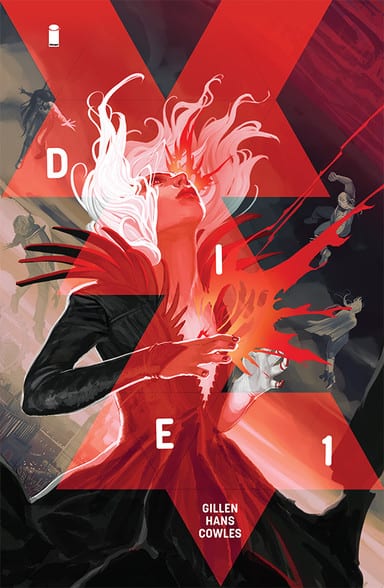
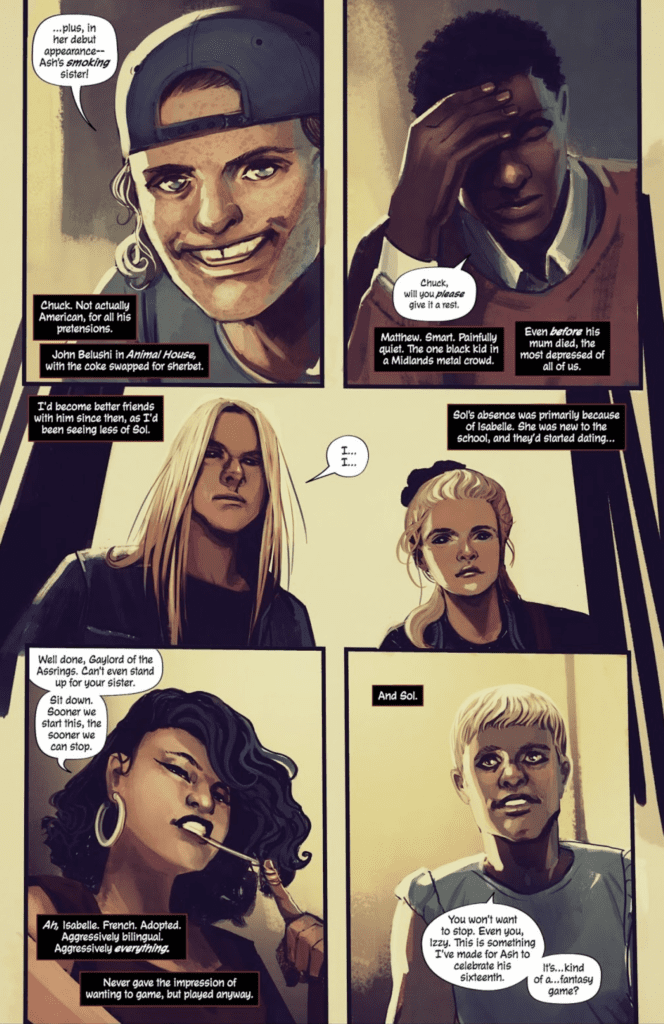
Writer Kieron Gillen and artist Stephanie Hans are pushing the envelope with their insane new series DIE, published by Image Comics.
About the series – DIE is a pitch-black fantasy where a group of forty-something adults have to deal with the returning unearthly horror they barely survived as teenage role-players. If Kieron’s in a rush, he describes it as “Goth Jumanji.” That only captures a sliver of what you’ll find in oversized debut issue—where fantasy gets all too real.
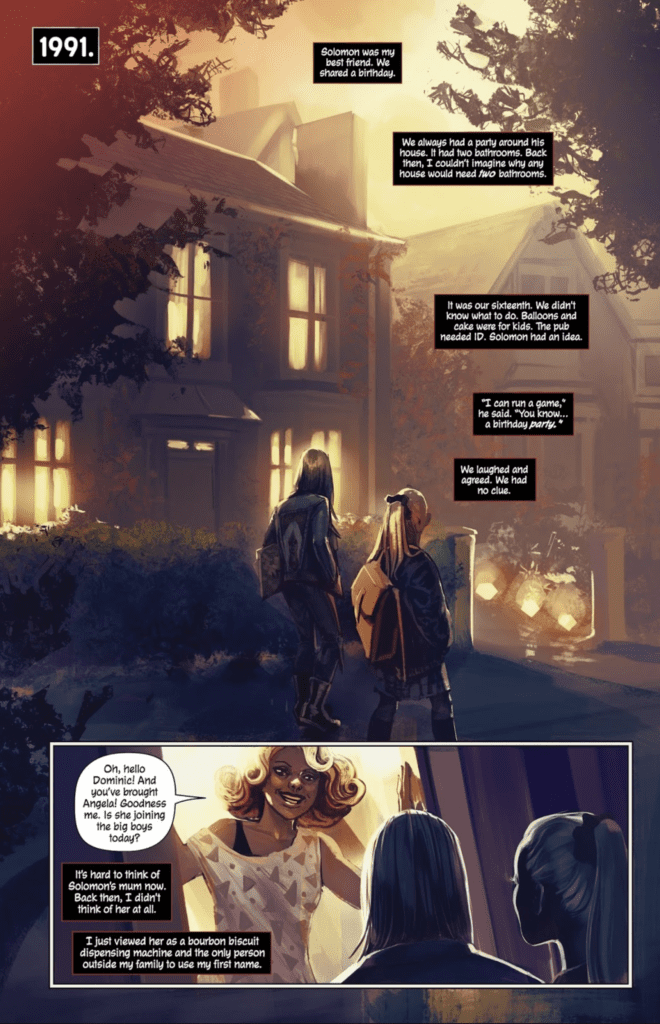
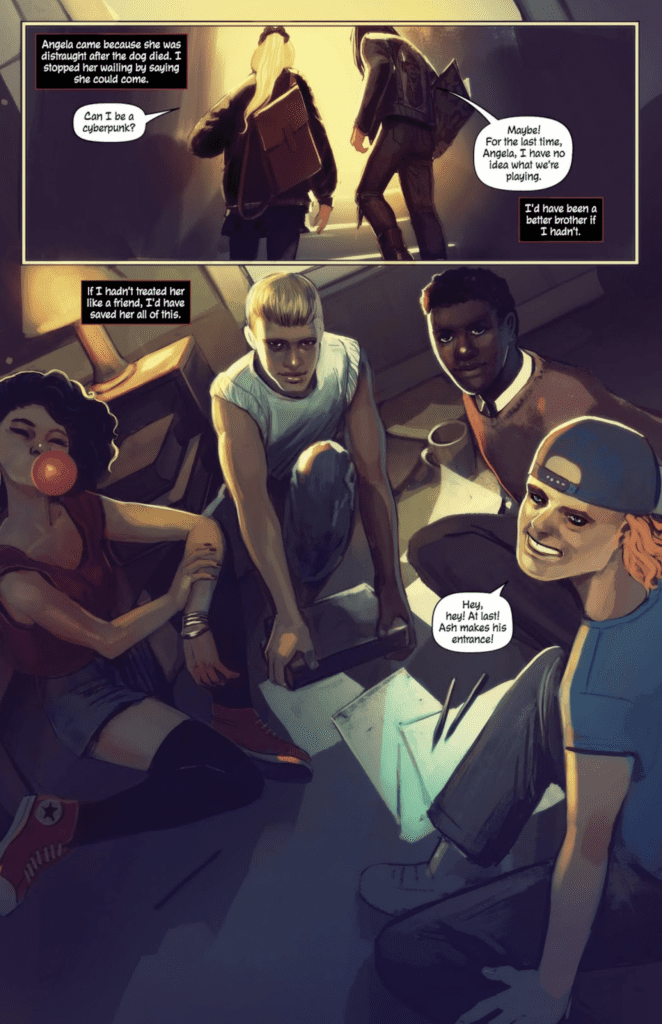
DIE #1 hits your local comic book store on December 5. Gillen and Hans spoke with Monkeys Fighting Robots for a behind-the-scenes look at the new ongoing series. Don’t miss the BONUS MATERIAL after the interview: three unlettered pages from the first issue to really appreciate Hans’ art style, and boy does the color pop.
Monkeys Fighting Robots:Kieron, a 2009 survey found that the Bourbon biscuit was the fifth most popular biscuit in the UK to dunk into tea. Where does it rank on your list?
KIERON GILLEN: Relatively low for me, actually. As a child, a custard cream tops it, and a Jammie Dodger reigns supreme over them all. As an adult, the humble Digestive is a beast, and an easy way to see how flush I am feeling is whether I buy a Chocolate HobNobs or plain hobnobs.
Clearly, Dominic feels differently, which was a huge stretch for me as a writer, but I made these sacrifices for fictions.
MFR:I have this theory that the current generation in his or her 40s was not prepared for the 40s. We’re having kids later, so we don’t have time for a mid-life crisis. Now, if you put 20 years in at a corporate job you’re probably going to get fired and replaced with someone younger and cheaper. The roadmap has changed significantly compared to previous generations.
KIERON: I think you capture a bunch of stuff here. I mean, this is one of my things – I’m interested how we can see cycles of life repeating time and time over (hence, some people say “nothing changes”) while the specifics change almost entirely (hence, some people say “everything changes”). Neither is true, and both are true, being the point. In this case, I have been fascinating watching creators of the generation just before me doing their own take on what it’s like to pass through this stage in life – watching Trainspotting 2 and The World’s End was fascinating for me.
So, yes, I think it’s a book which is about all those trends – the difficulty of jobs, the impermanence, the extension of adolescence and youth culture and all that. I mean, in terms of Mid-life crisis stuff, I suspect it’s less that it doesn’t happen and more the emotions which provoked that behavior come out in other ways.
But, as you say – how many people do you know who have worked in the same place for 20 years now?
MFR:The characters in DIE are in his or her 40s. What are your feelings on being in your 40s, and how does it influence your writing?
STEPHANIE HANS: If I may, you better make time for your mid-life crisis, because ready or not, it will come. But It can also bring a lot of happiness if you listen to yourself. Sometimes you need a change of paradigm.
KIERON: One thing I knew about whatever I did after WicDiv – I didn’t want it to star young people. I wanted to write about people at least as old as I am. That I somehow wandered into being known as someone who writes young people is this really odd quirk of my career – Journey into Mystery (where I inherited Loki as a kid – my original plan was an Elric-styled Loki), Young Avengers (which was a book I had to literally be talked into doing) and WicDiv (which had various reasons, but primarily realpolitik after YA’s success.) It’s a quirk, but also one which I knew I had little interest in doing again, at least in the same way. I’ve spent my time in the last few years turning down anyone who offered me a teen character.
How do I feel about being in my 40s? Still working it out, really. DIE is certainly part of that. WicDiv was really my midlife crisis book. DIE is a book about living with it, in some way.
MFR:Stephanie, DIE #1 is tense, how do convey this with your art? Do you use different visual angles?
STEPHANIE: It’s simple sequential art. You use angles to imply doom, action, silence, tension. And in my case, I also use light and shadows a lot.
MFR:How do you approach panel design for a book like DIE? The overlapping panel design on a page for me gives the book a more movement.
STEPHANIE: I tend to have a very strict sequencing. I don’t really like when things get out of panels if I do it, it needs to have some sense. The only fancy thing I allow myself is the tilting of panels for dynamism in action scenes. Chaotic action gives chaotic panels.
I see the panels a lot like notes of music, so they follow the rhythm of the story. Quick sequence: short panels
MFR: Kieron, did you need to write this book or did you want to write this book?
KIERON: Are you angling for me to quote the Watchmen Rorschach bit? “We do not do this thing because it is permitted. We do it because we have to. We do it because we are compelled.”
I used to think like that, and that it’s what Rorschach says should have been the tell that something is off. When I had the idea of DIE, it jumped to the top of my to-do list. It so clearly something that spoke to me deeply and created a painful emotional response. That may imply a need over a want. There was no other choice…
However, now I’m asked as cleanly as you have, it makes me sit back and re-examine it. I lean existentialist. Just because the desire and the compulsion are there, saying you “needed” to do it is letting yourself off the hook. Of course, it was a choice. I needed to do this, I wanted to do this and I chose to follow those impulses. And that’s appropriate, innit? To paraphrase Sid Meier, games are a series of interesting choices.
MFR:Stephanie, how did you decide your color palette for the DIE world?
STEPHANIE: I always try to use simple color palettes in my work. I like to assign a general mood /color to a scene and stick to it. If there is some action implied, the color palette becomes more radical, with less nuances. Because when there is an action, you get focused and the background and everything that is not important becomes vague, as in real life.
I use the gradient map tool on photoshop to build a base for each sequence and then work more steadily on details.
I also apply some simple reasoning to the construction of the colors. Some kind of passed instagrammy colors for the past, with brownish undertones, shaper but bleak colors for real life, vivid colors for the other world. Then there are also flashbacks, which are a bit different too.
MFR:Kieron, the first issue is very depressing; do we get to a heroic point in the series? (Does Dominic ever get a haircut?)
KIERON: Oh, rest assured, the equivalent of orcs getting stabbed. And then we unpack the concept of orcs, as we just can’t help ourselves.
It’s a bleakly heroic kind of book. We’re all about stabbing and emotions.
Dominic’s future haircut is clearly the most spoilerific of all spoilers.
MFR:DIE is an ongoing series, how far out do you have the outline?
KIERON: I’m a systemic writer. I write towards conclusions. As in, I know where we end up, and the dramatic poles that all the arcs follow. However, like WicDiv, there’s lots of space in terms of execution. It’s a big world, in every way, and I want space to dig into things my research turns up. I mean, I’ve finally worked out the perfect place to get Lovecraft in, and it’s the fourth arc.
MFR:Independent comics is a tough business, how do you both define success?
STEPHANIE: It is my first creator-owned and my first ongoing. I have nothing to lose. I work with a team that I trust and chose, and the story we are working on is truly a work of love. Neither of us need to work on this book for other reasons than because we really want to. Seeing it published, seeing people loving it, it is already a huge thing for me.
We talked about mid-life crisis earlier. Mine taught me to enjoy the ride.
KIERON: There are two sides of it. Success is actually reaching the people a story is meant to reach and move. I’ve been enormously lucky with my books. I’m someone whose life was changed by art. I wanted to do the same for other people. That I have is absolutely the impossible success.
The other side of it is purely practical – success is getting to do this. I just realized I’ve crossed my twentieth year of being a full-time writer, in various media and mode. I worked building sites when I was a teen. That was hard work. Me not having to do that is completely all the success I need. I’m very lazy.
MFR:How long would each of you last in the DIE world?
STEPHANIE: I am pretty sure I would do great there. Certainly wouldn’t want to leave. Honestly, if we find a way to bring WIFI, I’ll be good.
Also, most of the characters I ever played were chaotic neutral and I always thought that those were the most adapted to survival.
KIERON: Conversely, one of the Fallen will have ripped me apart in about five minutes.
MFR:In the first issue, the reader only sees a glimpse of the DIE world. What type of monsters can we expect?
KIERON: The monsters always speak to the world and the players. The monsters are really about a chance for the characters to be monsters in DIE.
Stepping aside from the metaphysical handwaving, I promised Stephanie a dragon by issue 3, and she totally gets her dragon, and it’s just a wonder.
What did you think of the interview? Are you going to add DIE to your pull list? Comment below, and thank you for reading.
Happy Death Day 2U from Blumhouse and Universal Pictures return us to the murderous time-loop with the first film’s star Jessica Rothe reprising her roles as Theresa “Tree” Gelbman. The film is set for release on February 14th –yeap, Valentine’s Day — of 2019. Genius.
About Happy Death Day 2U
Official Description: Two years after the events of the first film, “Tree” Gelbman unexpectedly re-enters the time loop and discovers that Lori Spengler, the original killer, has been murdered. “Tree” must face the new killer to uncover their identity and break free of the time loop once and for all.
Star Jessica Rothe says the sequel “… elevates the movie from being a horror movie into a ‘Back to the Future’ type of genre film where the sequel joins us right from where we left off, it explains a lot of things in the first one that didn’t get explained, and it elevates everything.” Fans of the original indeed ignored the time loopy potholes that seem to naturally stem from the abstract concept of time travel.
Happy Death Day 2U features a cast that includes …
Jessica Rothe as Theresa “Tree” Gelbman
Israel Broussard as Carter Davis
Suraj Sharma as Samar Ghosh
Sarah Yarkin as Dre Morgan
Ruby Modine as Lori Spengler
Rachel Matthews as Danielle Bouseman
Phi Vu as Ryan Phan
Steve Zissis as Dean Bronson
I’m convinced Blumhouse has actually figured out time-travel but only able to see glimpses. They use it to figure out which movie to make next. Happy Death Day cost an estimated five million and made 122 million in its theatrical run. That’s the Blumhouse special, spending smartly, producing wisely, and making an incredible return on the investment. Will Happy Death Day 2U continue the long-standing trend? I predict yes. But if this changes to a ‘no’ tomorrow, you’ll know I’m stuck in the loop. Help!
Did this trailer get you excited for Happy Death Day 2U? Leave your comments below!