Fans of the award-winning Planet of the Apes franchise will be excited to pick up the one-shot series PLANET OF THE APES: THE SIMIAN AGE, celebrating the 50th anniversary of the release of the first movie. This inaugural issue features both old and new events in the franchise canon, exploring the underlying motivations and paradigms of the characters.
STORY
The story is divided into three parts with each taking place at a different point in the franchise timeline.
Mother of Exiles, written by Jeff Jensen, introduces us to Amy, a former chimpanzee doctor who lives on the outskirts of society in an abandoned lighthouse. She and her mate are estranged from the gorilla-led order for opposing their militaristic regime against the humans. But a chance encounter with an injured human leads Amy to question her motivations for living this way: Is it fear or courage that drives her?
Matt Kindt gives us Apex, which details the daily life of a gorilla soldier of the same name. Trained from birth to fight against the humans, Apex has his own life-changing experience when sent on a mission to investigate one of their encampments. Seeing the humans’ ingenuity in creating traps gives Apex a paradigm-shifting idea that could impact human/ape relations forever.
Ryan Ferrier writes the last of the three stories, Cloud and Rain, which serves as an epic prequel to the movie Rise of the Planet of the Apes. The story focuses on two young apes who run across an injured human. They attempt to help him out of curiosity but are threatened by their leader Koba. Koba claims humans care nothing for apes, and thus the two groups cannot coexist. This nationalistic ideology grows throughout the ape’s group, but Cloud begins to question whether fighting solely for your own kind is enough.
ART
Jared Cullum’s illustrations in Mother of Exiles show us beauty in a bleak setting. The watercolor-like coloring helps each figure fit in with the abandoned landscapes. In a similar way, Lalit Kumar Sharma and Gabriel Cassata’s illustrations and coloring for Cloud and Rain use wavy lines and mixed colors to draw the reader into its jungle environment.
In contrast, Apex showcases Matt Smith’s sharply defined borders and Joana Lafuente’s solid colors. These give the reader a sense of the disciplined, straight-forward nature of the militaristic setting.
Ed Dukeshire’s lettering blends with each of the stories for the most part but gets slightly confusing when reading the conversations in Cloud and Rain. This may be due to its proliferation of thought and speech bubbles.
Conclusion
This issue is a great introduction to the wider canon of Planet of the Apes. It’s able to tie three distinct stories together by exploring each character’s established paradigm and watching them unravel though new experiences. I’m excited to see where the series heads next.
Did you like how this issue handled the Planet of the Apes greater story? Let us know in the comments below!
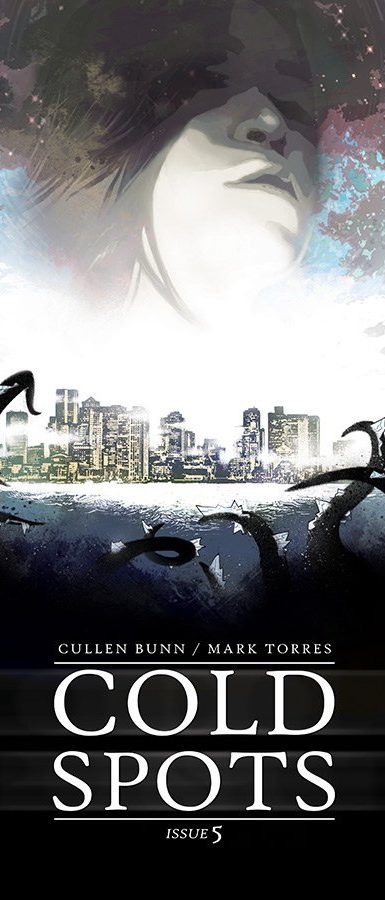
The final issue of Cullen Bunn and Mark Torres’ horror comic Cold Spots sends a shiver down your spine while revealing who is really in charge of the supernatural onslaught.
After the first four issues of world building in the Image comics mini-series, where the reader has followed Dan on his journey to find and rescue his daughter, the Evil has finally been released, and the world is inundated with ghosts and spectres. Alyssa and Dan are imprisoned in the eerie house while their daughter Grace is used to awaken demonic forces. There is a twist, however, which becomes apparent during a daring escape attempt and the tragic consequences are felt by all of the central characters.
The previous issues have all been leading to this dramatic ending. Each, in turn, has encapsulated a different element of a horror story; driving with a mystery, through an indulgent ghost story, and on to Satanic worship. This final issue of the run focuses on visual horror but also the character development of the central cast. Bunn brings the situation to a head so that he can force the characters to show their true faces. The cruelty and desperation of Samuel and Henrietta play out as they realize exactly what it is they have unleashed. Alyssa breaks under the guilt of allowing her daughter to be used.
Up to this point, Bunn has slowly paced the narrative, edging the reader into his ghost story but in this issue, the pace picks up. There is a lot of action and the inclusion of so many new elements. Despite this, Bunn manages to keep the narrative easy to follow without being overwhelming. He also manages to introduce a number of shocks which keep you on your toes to the very last page.
The Beast that is raised is brilliantly designed to be both visually horrific but also mentally challenging. It works as an instant physical threat, which Torres illustrates to great effect, but also represents a growing, unstoppable evil that Dan can only run away from. Even at this point when he has finally learned to take responsibility for his life, Bunn places Dan in a situation that is too overwhelming. Dan has to run; he has no choice. As the character grows, he is unfortunately taken further out of his depth.
This aspect of the narrative is an intrinsic part of any good horror. The hero must continually strive to survive, but with each step forward a greater obstacle is faced. Nancy had this problem in the originally Nightmare on Elm Street; Rick faces this during each story arc of The Walking Dead; and Christine couldn’t escape the escalation of terror in Winnebago Graveyard.
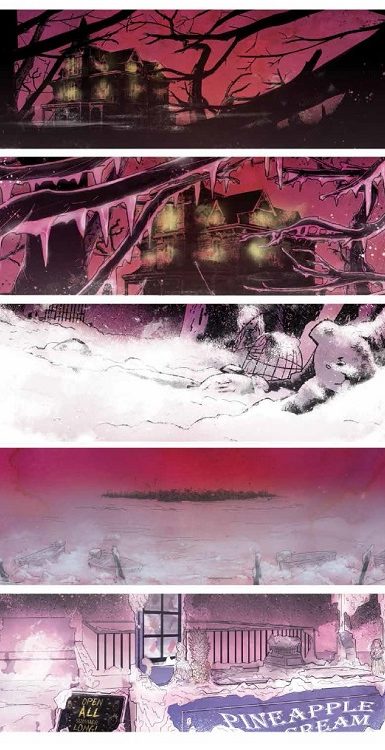
Another aspect of any good horror story is its ability to build an atmosphere. Luckily Cold Spots has Torres on Art duties. The combination of watercolor washes and often heavy shadowed characters creates an unsettling aesthetic. The lack of striking panel borders also gives each page the impression that the images are melding into one as if the panels themselves are ghosting, blurring the lines between two worlds.
Torres uses a fairly straightforward layout on each page, with only an occasion overlapping panel or gutter break but the organized chaos within the panels creates the impression that Torres is breaking all of the rules. The artwork unbalances the reader which has the subconscious effect of slowing down the pace. Even in the moments where the characters are running for their lives, the reader is forced to read at an uncomfortably slow pace, allowing the fear to build. In previous issues, this has caused some of the pacing to be slightly off, but in this final issue, it is spot on.
One of the true highlights of this comic has to be the design of the ghosts. Whenever they are on a page, you can almost feel the temperature drop. The barely visible shadows of former people are eerie and disturbing. To see them interact with the world around them is terrifying and much more effective than grotesque monsters and over the top violence. To look into the pure white spots of the ghost’s eyes fills the reader with unnerving dread.
Simon Bowland has a difficult job of keeping the narrative flowing at the correct speed. His lettering adds a sense of importance and urgency to the proceedings. Whether it’s through the use of black speech balloons with white text for the beast or by breaking up blocks of speech into joined but distinct balloons to extend the speaking time, Bowland manages to draw the reader across the page while building the characters. Where Torres creates the atmosphere, Bowland creates the emotional content. The anger and fear all come through the lettering.
Between them, Bunn, Torres, and Bowland have produced an unsettling and surprisingly original horror comic. It has a disturbing surface story with an equally disturbing underbelly. If you enjoy the works of Raw Fawkes or Steve Niles, then Cold Spots is definitely for you. And, if the final word from Bunn proves to be correct, we haven’t seen the last of this disturbing world.
A new and revamped Transformers series via, IDW Publishing, will give fans a look as to what exactly led to the fall of Cybertron.
The comic, which will release twice-a-month, comes via the creative team of writer Brian Ruckley and illustrators Angel Hernandez and Ron Joseph. The series will serve as an explanation as to why Cybertron crumbled, thus dissecting the idyllic society that prospered for thousands of years, before finally making way for the end of a single life. Readers will journey through the eyes of a younger Bumblebee and his friends. The series will feature conspiracies, harmony becoming conflict and witness the civilization of Cybertron falling apart.
“Bringing Transformers fans this story is a real privilege,” said Ruckley. “But just as important, it’s an amazing opportunity for new readers to discover and explore one of the biggest universes – and one of the best casts of characters – that science fiction has to offer, and to get in right at the start of a truly epic saga.”
Transformers #1, which will launch with multiple variants, is set to hit shelves in March, 2019.
Click HERE for the official release from IDW Publishing.
What do you think, are you ready to jump into what and why Cybertron fell? Are you excited to literally start from the beginning? Let us know in the comments section below.
The synopsis for the story focuses on the world’s (former) greatest hitman, who has a ‘hit’ out on him. So he opts to hire 20 of the best assassins in the world to serve as his bodyguards. They must now all learn to work together to keep the boss safe and figure out who wants him dead.
“I’m so excited for this book,” said Henderson. “Kyle and I have been wanting to work together for as long as we’ve been friends. It’s great to finally make that happen. There aren’t a lot of comics with Kyle’s action and comedy sensibilities, so it’s just been a blast. On top of that, it’s nice to work in other genres. My professional career has been largely all-ages media so it’s been REALLY fun to get some gore and explosions in there too. Assassin Nation is great fun, but NOT for the whole family.”
The first issue is set to release on Wednesday, March 13, 2019.
Click HERE for the official release from Image, including some interiors, and HERE for Skybound’s presser.
What do you think, are you excited for this creative duo to finally work together? Will the series be as gut-busting and gore-filled as promised? Let us know in the comments section below.
From creators Tim Seeley and Corin Howell, via AfterShock Comics, comes a story that focuses on the life of a vampire on the other side of the fence, in a brand new series titled, Dark Red.
The story is centered on Charles ‘Chip’ Ipswich, a vampire, who is one of the ‘forgotten men’ in the United States. He has a dead end job, with no prospects, in the middle of the country, until a mysterious and special woman comes to town.
Seeley uses his main character for the series as a metaphor, having grown up in a rural town, himself. Knowing that vampires have been portrayed as glamorous phenomenons, he wanted to give readers a new take on the genre.
“He has to make sure his shift is over before the sun comes up,” Seeley told The Hollywood Reporter. “It’s a pretty miserable existence, because he doesn’t have access to any of the flourishes and community urban vampires do. It’s a story influenced by current events, but told with a down-on-his-luck vampire and a cast of some of the best characters I’ve ever managed to make up.”
Dark Red #1 hits shelves on March 20, 2019, both in comic shops and on digital.
Click HERE for the official interview with the creative team by THR, which broke the story, including a few of Howell’s character pencils.
What do you think, is the world ready for a down-on-his-luck vampire? Are you going to add this book to your pull? Let us know in the comments section below.
DC Comics announced Tuesday morning details surrounding the 1,000th issue of DETECTIVE COMICS hitting your local comic book store on March 27, 2019. The issue includes 11 all-new stories with a wraparound cover by artist Jim Lee, inker Scott Williams, and colorist Alex Sinclair.
“Batman is one of the most enduring characters in popular culture, and his debut in DETECTIVE COMICS represented a pivotal moment in comics and pioneered a new type of superhero that would appeal to every generation. Batman continues to have an impact on entertainment worldwide and the 1,000th issue of DETECTIVE COMICS is a testament to the creative genius of Bob Kane and Bill Finger and is a fitting tribute to Batman on his 80th anniversary,” said DC Publisher Dan DiDio.
According to DC Comics, DETECTIVE COMICS #1000 is highlighted by an original story from the team of writer Peter J. Tomasi and artist Doug Mahnke that not only launches a new story arc but introduces a new version of the Arkham Knight to DC comics canon. The issue also features a two-page spread spotlighting the current state of the Batman universe by Jason Fabok. Listed below are the creative teams involved on the book.
Kevin Smith and Jim Lee
Brian Michael Bendis and Alex Maleev
Warren Ellis and Becky Cloonan
Paul Dini and Dustin Nguyen
Denny O’Neil and Steve Epting (a sequel to O’Neil’s 1976 DETECTIVE COMICS story “There’s No Hope in Crime Alley”)
Christopher Priest and Neal Adams
Geoff Johns and Kelley Jones
Tom King, Tony Daniel and Joëlle Jones
Scott Snyder and Greg Capullo
James Tynion IV and Alvaro Martinez
DC Comics has a plethora of variant covers for the issue too, check the cover out below by Steve Rude, Michael Cho, Jim Steranko, Bernie Wrightson, Frank Miller, Tim Sale, Jock, and Greg Capullo. Bruce Timm’s variant will feature an homage to Jerry Robinson’s cover of November 1942’s DETECTIVE COMICS #69.
Are you excited for DETECTIVE COMICS #1000? Comment below with your thoughts.
Grant Morrison’s mind-bending, alternative take on Santa Claus returns this week with Klaus and the Crying Snowman, with art by Dan Mora and letters by Ed Dukeshire.
About the issue: Klaus (Santa) teams up with Father Frost and Master Yule-Goat to stop the Nightborn, giants who defeated the Norse Gods and brought about Ragnarok 1500 years ago. Along the way, he also picks up an amnesiac man-turned-snowman and helps him learn an important Christmas lesson.
BOOM! Studios is billing this series as “the best holiday tradition in comics,” and they’re not wrong. Morrison’s Klaus stories are epic tales of magic and action, and the fact that they only come once a year makes them all the more special. They’re Christmas treats, like the TV specials you wait all year for. But where Rudolph and Frosty are going to tell you the same stories every December, Klaus has new ones for you.
Think of Klaus as the story of Santa Claus on acid. It’s exactly the kind of Santa story you would expect from Grant Morrison’s mind, complete with aliens, time travel, dragons, and more. And while all of that is badass and cool, what truly makes these stories special is the spirit of Christmas that’s injected into each one.
Dan Mora’s art is a huge reason why Klaus is so wonderful. That’s not “wonderful” in the simple, cliched way either; these comics are literally full of wonder. Mora’s colors are bright, vibrant, and at times trippy, creating the series’ otherworldly, magical atmosphere. His line work is more cartoony – which makes the story more fun and lighthearted – and yet incredibly detailed. The action scenes are full of explosive energy, and the emotional moments only land because Mora is able to execute them so well. Morrison may get top billing and the “created by” credit on Klaus, but Mora is the reason it’s worth the purchase.
Crying Snowman is admittedly pretty light on plot. Santa has to stave off Surtr’s forces and save Christmas. The way he does it is through some pretty convenient dues ex machina means, and even Klaus himself agrees, calling it “cheating.”
That’s not the point, though. It’s more about the journey, and the lessons learned than the actual plot. Heck, Morrison basically tells you how the story ends on the first page so that you can focus on the deeper parts. The ultimate message is beautiful and heartwarming. This is a story about kindness, understanding, and second chances. The holiday season is a time to reflect on what’s important in life, and Klaus and the Crying Snowman allows you to do just that.
Plus, the premise is absolute gold, even if the plot itself is somewhat basic. Santa Claus fighting back Surtr to prevent another Ragnarok? Ideas like this are why Klaus is one of the most fresh and original titles out there, despite only coming once a year.
Moon Knight Epic Collection Volume 3 is out this week, entitled “Final Rest”, and it concludes Doug Moench and Bill Sienkiewicz’s run on the Fist of Khonshu.
The paperback includes issues #24-38 of Moon Knight’s first ongoing solo series, originally published between 1982 and 1984. In addition to Moench and Sienkiewcz, other writers/pencillers featured in this volume include Steven Grant, Alan Zelentz, Tony Isabella, Denny O’Neil, Steve Ringgenberg, Joe Brozowski, Kevin Nowlan, (takes deep breath), Bo Hampton, Keith Pollard, Michael Bair, Marc Silvestri, Richard Howell, and Bob McLeod, along with a slew of inkers, colorists, and letterers.
Now, although this is volume 3, feel free to pick it up and jump right in, even if you haven’t read volumes 1 and 2. Marvel designs their Epic Collections to each stand on their own as an accessible, easily digestible book. The company doesn’t even publish them in consecutive order! Completionists may cringe at the thought of this, but nonetheless it makes for a fun, carefree reading experience.
Moon Knight is the definition of a cult character, but he’s also a fan-favorite. Marc Spector is an interesting, complex character, and his dissociative identity disorder makes him all the more unique. If you’re looking to get into the character, Moench and Sienkiewicz is a great place to start. This volume is a great primer for what Moon Knight has to offer: you get a good look at his rogues gallery, including a rematch with Werewolf by Night (whose title Moony first appeared in), as well as appearances by Marvel icons like Doctor Strange. But perhaps the best thing you get is the art clinic by Sienkiewicz and company.
This book holds some of the best comics art that the 80s had to offer. Moon Knight is a street level hero, akin to Daredevil or Luke Cage, and his stories are dark and gritty. The art perfectly reflects that. Sienkiewicz is famous for his rough, edgy style, and his successors on Moon Knight carry that feeling over. There’s a raw, unsettling atmosphere that permeates this book from start to finish, which is great because Moon Knight is – in many ways – a horror comic. Final Rest feels like old-school, late 80s/early 90s Vertigo; open to any page and you’ll see.
The 80s were a big decade for change in comics. Stories were getting darker, more adult, and if you’re looking for a snapshot of the period, definitely check out Moon Knight Epic Collection Volume 3: Final Rest.
The Sentry: Man of Two Worlds is out Wednesday, and it balances epic superhero action with a complex, philosophical look at the nature of man.
The trade paperback collects issues #1-5 of the series, and is written by Jeff Lemire with art by Kim Jacinto (#1-4) and Joshua Cassara (#2-5). Rain Beredo did the colors, and Travis Lanham did letters.
Bob Reynolds is the Sentry, one of the most powerful heroes the world has ever seen. Bob is also the Void, his own archnemesis and an unstoppable destructive force. Long story short, Doctor Strange helped Bob lock both personas away in the recesses of his mind, but it left Bob wondering, “who am I?”
When it was announced Lemire would be writing a Sentry series, fans roared with excitement. Who better to take on the Golden Guardian of Good than the man whose work has been defined by rich, flawed characters searching for identity and their place in the world?
“How do you measure a man’s life?”
These words kick off The Sentry, setting the tone for the story that follows. It’s going to be heavy.
Bob feels like half man, or even less. He’s no longer the hero he once was, and he’s struggling to figure out who he is now. This feels real. Superheroes aren’t real, but everyone loses track of themselves at some point in their life. And everyone wonders how they can get back to the place where they were before. Bob, like many people, feels like if he bides his time, he’ll figure out a way to return to his former glory.
In a particularly poignant moment from issue one, he thinks,
“This is just the way it is for now. I have to believe I’ll eventually find a way to come to peace with this. Eventually I’ll find a way to bring these two lives together and be whole again. Until then, I just stick to the routine.”
But is he right?
It feels like Bob is living in the past, pining for the return of his glory days instead of embracing his reality. He could be forging a new path for himself, living in the now, but instead he’s lying in wait for something that may never come.
Again, this feels like a very real struggle, and the question of “is Bob right?” will haunt the reader throughout the whole story. Reynolds is our protagonist – our hero – so we expect him to be right. He’s the titular character. But, as with most Lemire titles, things are never so black and white.
With the villains of the story, things are a little more clear-cut (because they’re the villains, duh). Like Bob, they too yearn to return to their past glory days. They’re jealous of Bob and the power he once held, and want to reclaim it for themselves. But the big red flag here is that their motivations mirror our supposed hero’s.
Pyeong Jun Park’s variant cover to THE SENTRY #1, conveying Bob’s dual nature.
To defeat his enemies, Bob ultimately reconciles his two identities. He joins the Void with the Sentry and becomes something entirely new. In doing so, he’s able to save the day. The message, according to Bob, seems to be that the only way to become whole is to embrace our inner darkness.
But. Is. He. Right?
Sure, Bob claims this is for the better. Suddenly he believes he deserves this power, something he was denying just a few pages prior. But at the same time, he battles the Avengers. He throws She-Hulk at Captain America. Now, the Avengers are not always correct. But how many characters have you seen attack Captain America and be in the right?
Bob’s “goodness” is left up in the air by the end of the story, but it feels like he pushed so hard to return to his past that he took a sinister turn. He could have just enjoyed the memories he had, accepted they were gone, and moved on. Instead he became this dark version of his former self.
This seems to be the true message in The Sentry: we must accept the nature of time, lest we become a corruption of what we once were. We don’t need to embrace the darkness within to become whole; we just need to embrace who we are.
That’s one of the messages, anyway. Part of what makes this miniseries so great is how many layers there are to it. You can spend hours dissecting these five issues.
Lemire subverts the typical superhero story with his Sentry. He’s teaching a lesson through the titular hero’s failure instead of his success, even though Bob does technically defeat his enemies. And the writer had the perfect team to do it with. Jacinto and Cassara’s art, coupled with Beredo’s muted colors, give the Marvel Universe a grittier, real world atmosphere. There’s true pain in the characters’ faces, pain the reader can relate to. Then there’s such explosive energy and motion in the action sequences, because this is a superhero book after all, and it all gels. Wherever the Sentry ends up now that this series is over, hopefully this creative team is there.
If you like superhero books that try to break the mold, deal with real world complicated problems, and play in the gray area of morality, definitely grab The Sentry this Wednesday.
AfterShock Comics has learned from the Image Comics model, and is using the medium of comics to tell great stories. One of those tales is The Lost City Explorers, an homage to the big screen youthful explorers of the 80s. Written by Zack Kaplan with art by Alvaro Sarraseca, the first story arc wrapped up in October with the trade paperback hitting your local comic book store on January 16. FOC (Final Order Cut-off) is this Monday, December 17th, so be sure to call your local comic shop ASAP and tell them you want it!
Kaplan talked with Monkeys Fighting Robots about life, music, storytelling, and influences, as we reflected on the first five issues of the series.
MFR: Zack, I loved your introduction to your The Lost City Explorers trade. Turning the mirror yourself, who encouraged you to explore? Did you listen?
Kaplan: Wow, we’re going deep right off the bat. The honest truth, I don’t know that I’m an explorer at heart. I love exploring ideas, worlds, and stories, in the safety of my office chair, and many teachers and writing mentors have helped to cultivate that intellectual exploration, but if I found the beginnings of a real-life adventure like this, the chance to go looking for a lost city underground by dodging subway trains, slugging through sewers, running from mercenaries, well, I would probably respond more like the cautious Homer Coates than his brave, wanderlust sister Hel. I’ve always struggled with taking risks and doing the dangerous thing, and so I think if anything, this story is a wish fulfillment for me, the chance to vicariously live out the desire to go exploring down the road less traveled. I think we all get wrapped up in that same daily routine and responsibilities, and we forget to look around us, and find more meaning, more depth and just explore life. Maybe our little graphic novel will allow others to enjoy a little adventure and exploration.
MFR: In the first issue, you have the main characters doing pretty mundane stuff while having a conversion. Why are these elements essential in storytelling?
Kaplan: Yes, early on we see Hel and Maddi as they enjoy a night out at the rock show, in the bathroom, grabbing a late night snack from a food truck, riding the subway, and making their way home. Other times, we see them eating churros at the museum. I think it’s important in an adventure story, especially an adventure story about taking a risky, dangerous journey into an uncharted world, it’s important to establish a mundane, boring atmosphere. That’s why we meet Hel behind the railing, behind bars, and despite being at a super fun rock show, she feels trapped and unfulfilled. I think those early scenes are important to establish the ordinary status quo of our character, the pacing creates the staccato rhythm of routine and sets up how even a rather incredible night out can be quite void of meaning to our heroine.
MFR: Also, in the first issue, you start the series with “I Wanna Get Better” by the Bleachers. What song would play for the last page of the trade, and why?
Kaplan: Well, Hel’s a teenage girl, she’s tough, edgy, a still bit pissed off, and at the end, she’s motivated now, so she needs an anthem. A girl anthem. And since I already went with Jack Antonoff from Bleachers, I’ll go with Lorde (music fans will get that connection) and pick Green Light.
MFR: From our previous conversation, I know you did a ton research about Atlantis – What was the coolest fact or myth you found out about the lost city?
Kaplan: The coolest things were the details about Manhattan. This island is the most strategical location on the entire American seaboard, which is why the Dutch settled there and why it became such a powerful location throughout our country’s history. Manhattan was originally very hilly and had streams and ponds. There were even wooly mammoths that roamed the area. The entire area actually suffered a lot of tectonic activity. All of this lent itself perfectly to supposing that the city of Atlantis was in fact actually located on the island of Manhattan. Because Atlantis was actually located on Manhattan!
MFR: The first trade of The Lost City Explorers is an origin story. How far do you have the series outlined?
Kaplan: Oh man, just wait! If we get a chance to do more, I’ve got a killer second arc planned out that definitely takes the volume one and goes ten times harder. The first volume was always meant to be a fun, fulfilling adventure and an introduction to the characters, the truth about Atlantis and the beginnings of this adventure, but it simply was not enough room to do everything I wanted to do. So I definitely saw the first trade as a chapter one, an origin story for Hel and her friends, but there’s enough left unresolved at the end, that we definitely need to rejoin our heroes and go a bit deeper with them both into Atlantis and into some other lost cities as well. There’s just so much more here to explore.
MFR: What is your favorite panel or page from the trade and why?
Kaplan: That’s a tough one. I’ll give two. One of my favorite pages is the funeral in Issue #1. It’s silent — no dialogue. All amazing visual storytelling by Alvaro Sarraseca, and he just captures Hel’s pain so beautiful, and that close up really does it for me. And the final moment of three panels all getting closer and closer to Hel when she finally discovers the truth about her father in the end. It’s a heart-breaking moment, and I just love those close-ups. It’s funny, but despite all of the amazing underground locations and fun thrilling set pieces and supernatural phenomenons, it’s the quiet emotional character moments, especially with Hel, that means the most. I never wanted this to be an easy journey for her, and to be honest, I think it’s a very bittersweet ending for her, but even though she doesn’t find fulfillment the way she wanted, I think she finds it in a way she needed, and that’s the most important. Hel Coates is just one of my favorite characters of all time. I love her close-ups.
MFR: You mentioned that the GOONIES was a huge influence on The Lost City Explorers. Mikey has his epic “This is our time” speech. Does your main character, Hel Coates have that type of speech in her?
Kaplan: Early on, Hel gives us a pretty good explanation as to why Atlantis might be under New York City, why her father’s research might actually hold water, but I think the entire adventure she’s advocating for why they should do this. I decided actually to flip it. There’s a moment in our journey where the teenagers have to choose whether they are essentially going all the way or not, and it’s a pivotal moment. But rather than having Hel give them one more “this is our time” argument, that felt repetitive, and that this had to be the moment where she owned her pain, she took responsibility for her actions, and instead her friends rallied, and the whole group comes together. A bit of a flip, but this story is about rescuing a missing father, not recovering pirate treasure. But maybe I’ll write that speech in the next arc!
MFR: Is there any update on the television adaption of the series?
Kaplan: We’re just getting started, but we should have more news next year!
What did you think of the Kaplan interview? Comment below with your thoughts.
About the series
THE LOST CITY EXPLORERS, Vol 1: Odyssey
Writer: Zack Kaplan
Artist: Alvaro Sarraseca
Colorists: Dee Cunniffe & Chris Blythe
Letters: Marshall Dillon
Cover: Rafael De LaTorre & Marcelo Maiolo
Lost cities aren’t the stuff of myth! They exist right under our feet. When her archaeologist father goes missing, teenager Hel Coates rallies her friends and brother to find him. They’ll have to dodge a shady corporation, mercenaries, and speeding subway trains while they follow the trail deep into the tunnels under Manhattan—and what they find down there will change their lives forever. Follow Hel and her friends on a coming-of-age journey through subterranean tunnels, and ultimately to the holy grail of lost cities: Atlantis!
Zack Kaplan (Eclipse, Port of Earth) and Alvaro Sarraseca (Magnus, Turok) bring you an adventure story unlike any other, collecting the whole series (issues 1-5)
TPB / $14.99 / Full Color/ 120 pages / ON SALE 1.16.2019 / FOC 12.17.2018