Home Blog Page 236

Review: DUNE HOUSE ATREIDES #1 The First Grain In A Massive Desert

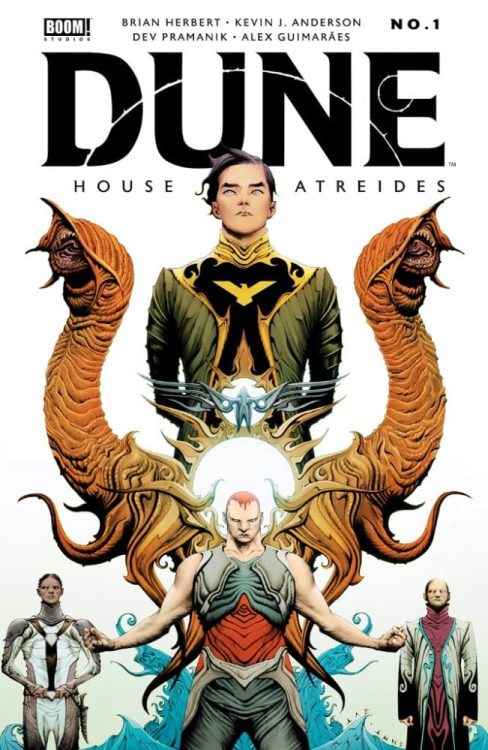
Dune cover
Dune House Atreides #1 Credit: Boom! Studios

Boom! Studios would like to welcome you to Arrakis, also known as Dune, the political centre of the universe and home to the Spice. With a new movie on the horizon, and trailers currently wowing audiences across the globe, there’s no better time for comics to return to the sprawling landscape created by Frank Herbert in 1965. A world of wonder, intrigue, and danger awaits anyone who visits the barren landscape.

Dune House Atreides is a prequel to the original novel and was written by Brian Herbert and Kevin J Anderson, who have adapted it for this comic release. Expanding on the world created by Frank Herbert, House Atreides builds on the family history of the main characters while introducing a new, mostly reprehensible, cast. The worlds and the people are brought to life by artists Dev Pramanik and Alex Guimaraes.

At this point Dune House Atreides, the novel, is 21 years old. Since it was released Brian Herbert and Kevin J Anderson have worked on numerous prequels, sequels, and whatever the word is for books set at the same time as the original. Their engagement with the Dune universe is all encompassing, basing so much of their novels on the notes made by Frank Herbert before he passed away. In short, the writers know this world inside and out, and the depth of their knowledge is woven into the script of this comic.
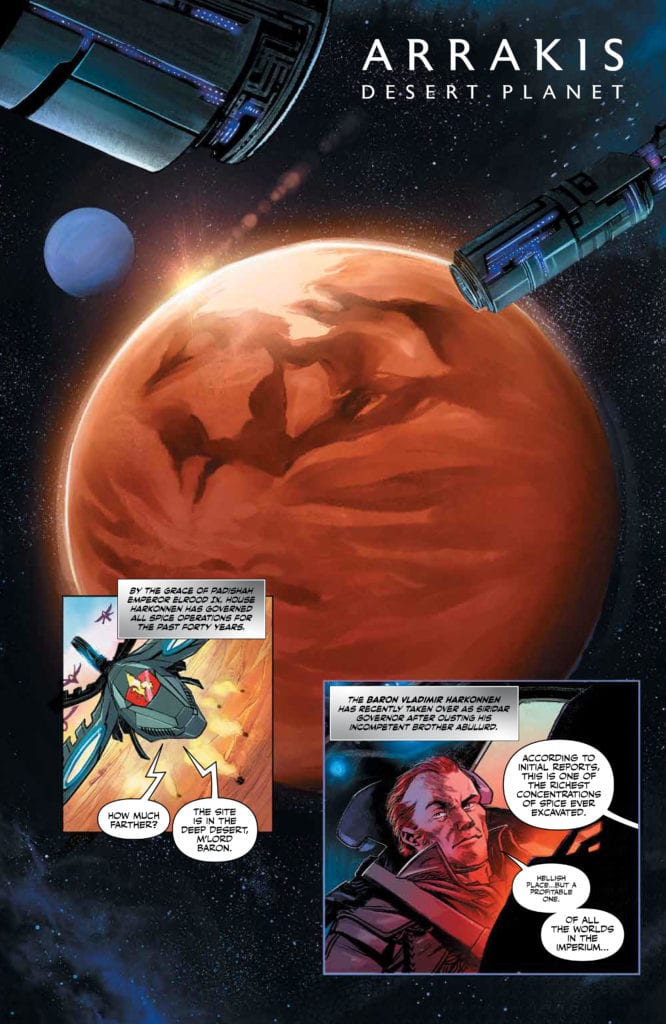
Dune
Dune House Atreides #1 Credit: Boom! Studios

A Quick Anecdote.

At a recent, well organised and socially distanced screening of Akira, I sat in awe as the trailer for the new Dune movie was played out in front of us. Behind me a young lad turned to his friend and said “the book is really difficult to get into”. I had an urge to turn around and disagree with him: the novel is a gorgeous, poetic narrative full of the most amazing imagery and character. Then I remembered that not everyone felt like that, not everyone enjoyed the hyper-political, religious dystopia that Frank Herbert had painstakingly created. So I did the right thing, I kept my opinions to myself and watched 4K Japanese madness.

The point is that Dune, like many such stories, has an ardent following of fans who are as engrossed in the novels as the writers are but also, the mysteries of Arrakis remain just that to a large number of people who try to engage with the novels. You cannot deny that Herbert’s original is a masterpiece of science-fiction but it’s not for everyone and the following series of books become less appealing if you can’t engage with the first.

This adaptation of Dune House Atreides is no different. I feel as though I should write two reviews, one for fans of the series and one for those coming to this fresh, possibly in anticipation of the new movie. Each will have a different experience with this comic.
Dune
Dune House Atreides #1 Credit: Boom! Studios

The Story and The Art

Set 35 years before the events of the Dune, House Atreides unravels the histories of the older generation from the original. It contains references from the past and the future, highlighting the vast universe that Herbert and Anderson have helped create over the last 21 years through their 13 novels. House Atreides was their first collaboration but this adaptation of it shows two writers comfortable within their world. The characters are vivid and enter the story fully formed, their histories seeping through their speech.

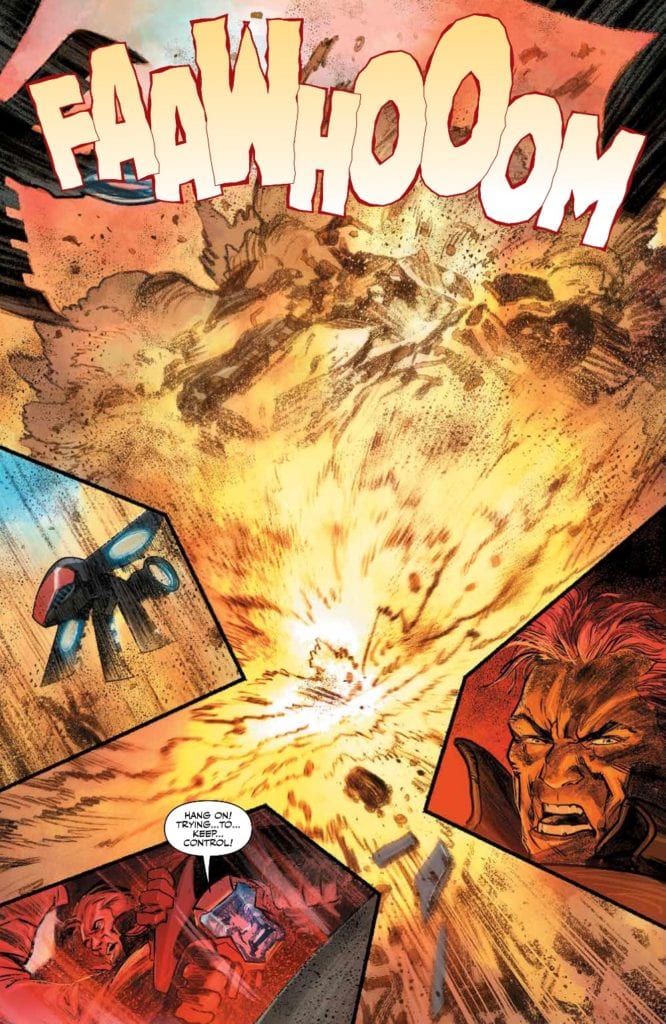
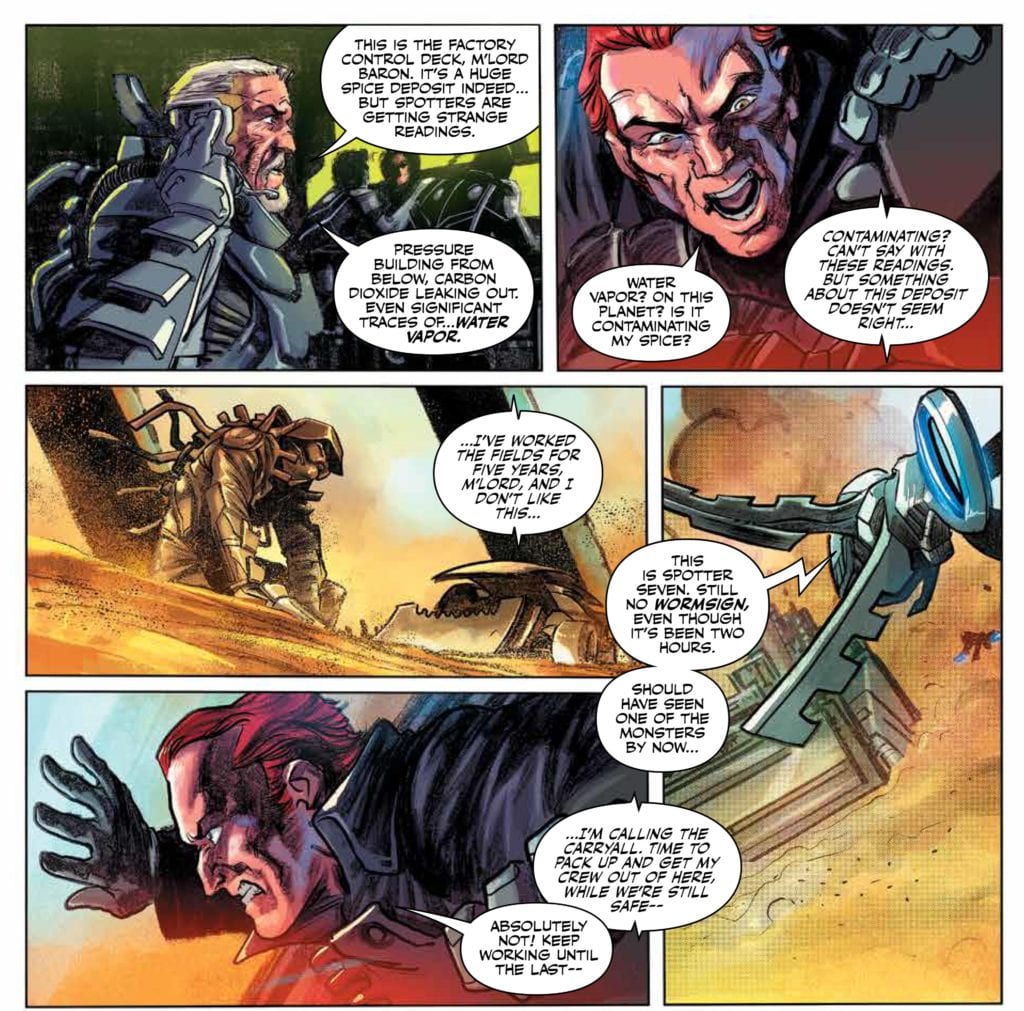
Much of the visual world building comes from the art, with Pramanik and Guimaraes interpreting the unbelievable vistas to produce awe inspiring, alien worlds for the complex characters to inhabit. The changing color palettes signify the different planets and their environments, not just physical but also political. Arrakis is a wasteland, harsh and dangerous, but it is also the most important planet in the universe. There is a contrast between the uncomfortable reds and oranges burning across the page and the allure of the gold representing the wealth within the planet. Danger, risk, reward: this concept is plain within the artwork.

The more complex political intrigues are represented through the interactions between the characters. On occasions this appears clumsy upon the page, with the characters over acting their parts. The scene where the Planetologist Kynes meets with the Emperor is a litany of over exaggerated facial expressions that could be read as character building but is too comical to be taken seriously.
Dune
Dune House Atreides #1 Credit: Boom! Studios

The Old and The New

The artwork for Dune House Atreides will be the biggest divider between fans and non-fans. Coming at the comic with no prior knowledge will allow the reader to discover the world through Pramanik and Guimaraes’ eyes, undisturbed by years of expectation from reading the novels. If, like me, you are a big fan of all things Dune, the artwork will be more problematic. The style adopted here reminds me of Claudio Sanchez’s The Amory Wars; which is a classic comic book style. This works for telling the story and the panel design leads you through some difficult to follow conversations.

Of course a large part of the design is the placement of the speech balloons by the talented Ed Dukeshire. The flow of the narrative is almost 100% dictated by the flow of the speech. Dukeshire has a great skill for staging conversations and emphasising as little as possible while making the greatest impact. He even manages to give the inner monologues a unique look and feel so that the reader immediately associates the dislocated speech with a particular character. The inner monologues, which are synonymous with Dune, are underused in this comic but Dukeshire proves within a few instances that they could be a major feature of the comic.

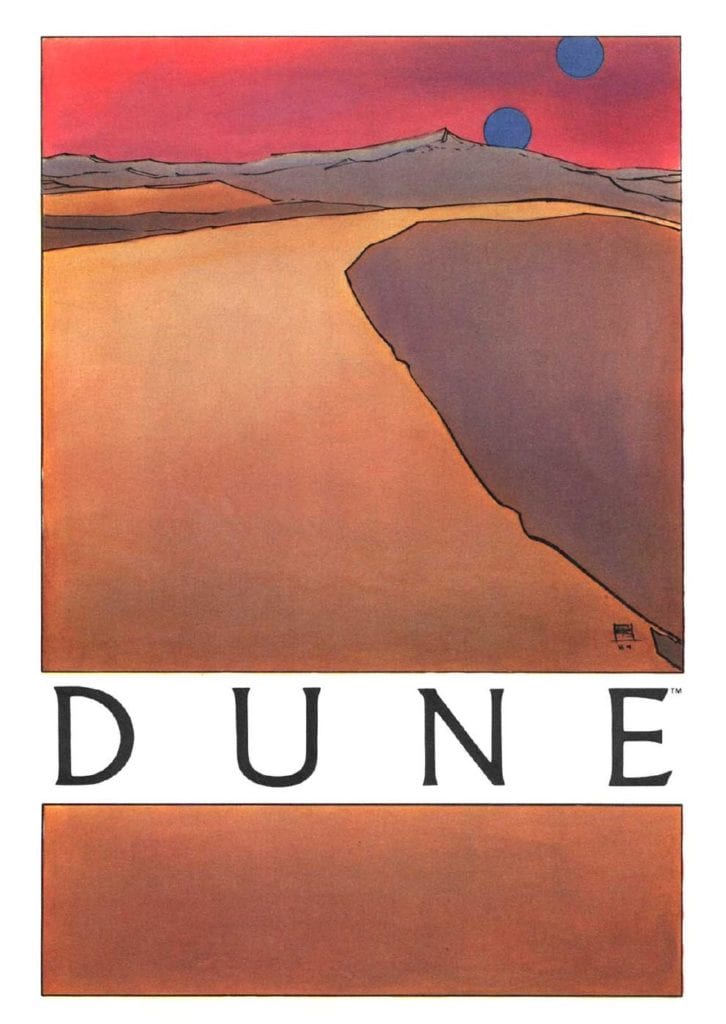
The main problem is not with what is in the comic but what could have been. Dune is an exceptional world, with exceptional stories, and it is a shame that the direction the comic has taken is classic in style. A quick look at the work Bill Sienkiewicz did on the original movie adaption (see below) shows you what the world of Dune could look like. At a time when the comic industry is branching out in different directions and the ‘superhero’ format of comics is not seen as the only way to do things, it is a shame that more experimentation didn’t go into this comic. Sienkiewicz created vast spaces of empty space that pulled the reader in before bombarding them with intense characters and relationships. That sense of awe, of being lost in a world barely imaginable, is missing from House Atreides. From a fan point of view, I wanted more visually than this comic offers.
Dune
Dune Title Page by Bill Sienkiewicz for Marvel Comics in 1985

Conclusion

Dune House Atreides is a magnificent introduction to the web like narrative of the Dune saga and a great first issue for a new series. It has everything that a new reader would want from a new sprawling science-fiction comic: action, adventure, intrigue, a host of references that have no grounding in the story but are waiting to be revealed or discovered at a later time. This will also be an interesting re-read after seeing the movie, as you can revisit the characters and relate them to their future actions.

It’s main drawback comes from a personal point of view, but is one that I believe will be felt by a number of Dune fans: it is too safe. The artwork doesn’t push the boundaries far enough or challenge the reader in the way the novels do. The complex character relationships feed off the environment and unfortunately that intensity is missing from these pages. The technical skills of the artist and colorist are not in doubt but, for me, a more experimental approach to the visuals would have suited this world better, and Dukeshire’s lettering would still have worked as a guide through the narrative.

I enjoyed this comic and most people who read it will also enjoy it. Unfortunately my expectations were higher, I wanted to be in awe of this and be challenged on every page. That did not happen for me but maybe it will for you.

Monkeys Fighting Robots Youtube

SONATA VOLUME 2: THE CITADEL – Progress Meets Futility

Sonata Volume 2: The Citadel cover

Sonata Volume 2: The Citadel is this week’s release from Image Comics’ Shadowline imprint. Anomaly Productions‘ writer David Hine, co-writer and artist Brian Haberline, colorist Geirrod Van Dyke, and letterer Francis Takenaga close out this Cosmic Steampunk series.

Background

Sonata Volume 2: The Citadel comes off the last six issues where two human races attempt to colonize a planet. The titular Sonata of the Ran tries to live in peace with the native Lumani, only to encounter Pau of the militant Tayan. But the “gods” all races worship seem to have other plans.

Sonata Volume 2: The Citadel Story

Sonata Volume 2: The Citadel continues to combine elements of steampunk (progress and colonization) with cosmic horror. In this case, how people’s ideas of civilization cause them to be seen as a “Master Race.” The Tayans who value power above all else are at war with each other for ownership of the planet. Even then, Pau’s father isn’t content with this, wishing to enslave the other races with the “god’s” weaponry. The “Old Gods” themselves still have power over everyone in the long run despite their weakening states from some “falling illness.” Specifics would be spoilers. If anything, this series main theme is the futility of domination or peace as there is always something stronger in its way. Something that would evoke feelings of rage into hopelessness. David Hine and Brian Haberline seem to like the themes of H.P. Lovecraft as their other series, Marked suggests.

Although the way they tell this story can be jarring with how incoherent some of the issues are. Especially if returning readers find the death of an important character where the context comes issues later. The shifting points-of-view between characters can also get a little jarring. If this can be a point-of-view each chapter rather than focusing mostly on Sonata’s, it would be easier to follow. Even then, the ending feels lackluster, given how abrupt it is. That’s not even mentioning what looks like a sequel hook at the end. But the chances of a sequel for some form of closure seem just as futile.

Art

Haberline’s artwork presents a lot of intricate detail where Perdita’s setting steals the readers’ attention. This intricate alien world feels both mesmerizing and desolate with floating rocks above piles of bones. Many of the characters resemble 3D models against a rough and fading background. This allows the reader to focus on what the characters do and where to follow instead of getting distracted, which can happen very easily, given how intricate the designs are, like straw huts and trees.

Geirrod Van Dyke, as the colorist, does his parts to give more life to these pictures. The characters, in contrast to the mostly muted background colors, provide just enough differences to follow. Even then, the backgrounds are practically the same colors. Without defining the character models, some like the flying creatures would blend in with a matching yellow sky. Otherwise, most objects would blend in too easily unless something convenient like an energy blast occurs.

Francis Takenaga’s lettering is, for the most part, very uniform in Sonata Volume 2: The Citadel. Everything remains in a panel or in the same space as panels to view the changes in perspectives. This helps in the cinematic viewing of events. What really stands out are color-coded thought balloons that people can communicate with. At one point, a new character Kah-Lee’s purple thought captions, serve as foreshadowing to a plot-twisting development. Yet, in one instance, there is an odd occurrence that Pau’s usually green thoughts are red, which are normally Sonata’s. Which really only adds to the problem of shifting POVs.

Take Or Leave Sonata Volume 2: The Citadel

If you like the idea of where Steampunk’s age of technological revolution in societal collisions with Cosmic Horror, this might be where to start. Sonata Volume 2: The Citadel is far from perfect, but a glimpse can inspire people to look beyond the surface of things. Especially since these ideas can lead people to the brand of Anomaly Productions. Although for this trade, that can be difficult for how jarring the coloring and shifting points-of-view are.

Monkeys Fighting Robots Youtube

INTERVIEW: Editor Nina Helene Hirten Cut Her Way Into The Comedy Duncanville

Saturday Night Live alum and Parks and Rec star Amy Poehler unleashed hilarity last TV season in the form of Duncanville, an animated comedy about a teenage boy named Duncan, his vivid imagination, and a host of weird, quirky characters. The show’s fast-paced laughs come together thanks to editor Nina Helene Hirten.

Duncan is a 15-year-old kid who’s excited about closing in on adulthood because he thinks it means freedom. However, Duncan’s reality is anything but a glamorous life as he deals with an over-protective mom, an over-eager dad, and a self-centered sister. Duncan’s not an athlete, a top tier student, or a social butterfly either, to make things a little more unexciting. His only real talent is a wild imagination, which gives rise to one wild show.

PopAxiom spoke with Nina about doing a little bit of everything, animation dreams, and becoming the editor for Duncanville.

Duncanville-Interview-editor

Animation

Most every job on a movie set originated from the theatre. But the editor is unique. How did Nina decide that putting together cinematic puzzles was her calling? “I fell into it. I initially wanted to be an animator. I was always doing animations.”

However, animation as Nina was growing up evolved. “Animation moved away from 2D into the 3D look. I looked into it, and 3D was much more technical and mathematical.”

“In high school,” Nina says, “I went to a forward-thinking, media-friendly school where a lot of the book reports I did were animations. Some of the assignments included making documentaries. That’s where I started editing.”

For Nina, she “learned a lot about timing and pacing and how to chop up footage to tell a story.”

“I still wanted to be an animator and a director,” Nina recalls, “but when I got to film school, I realized I loved editing. You’re the puzzle master of this giant Tetris board, and it’s really fun. I enjoy finishing things too.”

“When I was younger,” Nina says, 17 editing credits (plus 24 credits in other roles) into her career, “I would rush through things because I think that’s what you do when you’re young. But now, I look back on things and think ‘I wish I’d done …’ but I think that’s part of the creative curse.”

Nina continues, “Artists, musicians, editors, we get to the point where we say ‘Okay, this is done.’ Then we put it out to the world and always think, ‘Oh, man, I could’ve done this or that!'”

“Maybe that’s the perfectionist in me talking,” Nina laughs.

Switching

Nina lived in San Francisco, then moved to Toronto to attend Ryerson University’s film school. “I decided to move to Vancouver,” Nina recalls after finishing school, “which is known as ‘Hollywood North.'”

“I was active in the post-production community,” Nina says, “and to make ends meet, I opened up my production studio. I took out a loan, bought a camera, and became a one-woman machine for about five or six years. I mostly did promotional stuff, corporate videos, travel, music videos, that sort of stuff. Lots of music videos.”

Nina looked for work editing for film and television. “I would cut short films and a lot of indie stuff.”

“My focus has always been editing,” Nina says, then shares a tip learned from experience, “but I managed to do a lot of other stuff. I think anyone who wants to work in film should do some level of production.”

Nina landed a job at Bardel Entertainment in their animation department as a coordinator. “I was brought in as a coordinator, but the idea was to move me over to editorial when a position was available.”

“I never did get switched over,” Nina recalls. “But the connections I made there gave me connections in Los Angeles, so I made a similar deal at The Third Floor where I would come on as a coordinator/production manager and moved over to editorial as soon as there was a position open.” This time, the move happened.

Duncanville-interview-editor-nina helene

About Duncanville

How did Nina join the Duncanville team? “I was ramping down on Curious George, and I enjoyed working with that team. It was super-fun. I was looking for hiatus work because I was coming back for the next movie. I looked for something to tie me over for a few months, and I saw a listing for a union editor. I tossed my resume into the mix to see what that was about.”

Talent is great, but “In this industry, it’s all about meeting people and making connections. So, even if the production timing doesn’t work out, or maybe I’m not a good fit for the show, they’ve met me, and they have my resume. And, who knows, there might be something in the future.”

In Duncanville‘s case, Nina’s resume caught the eye of producers who brought her in for an interview. “That’s where I learned the show was from Amy Poehler and The Scully’s, and I was like, ‘Oh, this is major television. I have no TV experience. I’m not getting this.’ So, I chatted everyone up and talked about what I’ve done in the past and what I’m capable of doing. Whatever I did, I got a second interview and got the job!”

Nina’s first TV editing gig came with an unexpected “learning curve.” She says, “I’d never done a sitcom before, and they wanted a specific, fast pace for this. Curious George is aimed at young kids, so it’s very flowy and smooth. Every character finishes their sentences. That franchise is so well-established that they know exactly what they want to see.”

“Coming right off of Curious George to this fast-paced show was an adjustment,” Nina says, “It took me a couple of episodes to find the right rhythm.”

However, with one season complete, she says, “now we’re so much faster to get things done. In season two, I’m working with the same directors for the most part, and they know the drill. It’s a well-oiled machine.”

Making Duncanville

Amy Poehler’s behind dozens of projects and doesn’t work on Duncanville on a day-to-day basis. “She watches all of our output and gives notes which are usually mixed in with The Scully’s notes and the network’s notes. She has a big creative role in how the show goes and how it’s written.”

“The directors put together a rough version,” Nina says of the production process for Duncanville, “and once they go through a few rounds of notes and approvals, they make a cleaner version, and that’s when it comes to me.”

Nina works her magic from there. “I get it as tight as possible. If a shot’s not working, I’ll fix it. I’ll send notes suggesting a different shot or a change to make something funnier.”

From there, Nina says, “It goes back to the directors and artists who do another pass. Then we screen it for the writers who usually tear it apart. That’s when we do re-writes. It’s a lot of back and forth collaboration.”

Nina’s smile beams through the phone. “It’s a fun show to work on and a fun show to watch. We’re working on season two right now!”

Duncanville-interview-editor-FOX

Favorite Parts

Like any other professional art form, Editing requires the creators to “know your audience first and foremost. You have to know what is going to entice them to keep watching.”
“You have to understand what is the goal of the show,” Nina says. “In the case of Curious George, for example, you have to know this is for young kids, and so you hold on shots longer and make sure they’re clear.”

Nina contrasts that with Duncanville, which is “so fast-paced, you have to find the balance between the clarity of the image and the clarity of the jokes or line-read. Would that character say it that, and is it funny if they say it that way?”

To a certain degree, Nina says, “it’s the audience that’s going to inform the pacing.”

Nina shares some of her processes when landing a new gig. “Some of the first questions I ask on a new project: Who is this going to? What’s the style? And I’ll even ask for references too. If there’s another show, they want to emulate or have a similar feel. If I haven’t seen those things, I’ll do some research.”

“It’s one of my favorite parts of the job,” Nina joyfully proclaims, “because every show is different, it’s never boring. You never know what the next project is going to be or what it’s going to be like.”

Duncanville-comedy-interview

Wrapping Up

Nina spreads the love to fellow editors who hold a special place in her heart. “Paul Hirsch, who did Ferris Bueller’s Day Off, Carrie, and Star Wars. He’s a big one for me. Walter Murch is a classic. Thelma Schoonmaker is another. So many great editors out there. There’s something to be learned from every one of them.”

What remake would you love to edit? “I’m going to have to marinate on that one.”

Duncanville season one is available on Hulu, and season two is in the works. So, what else does Nina have rendering for the future? “I’m editing a low-budget live-action feature called The Second Age Of Aquarius. That’s on my weekends. I have a living room full of props for a music video that’s been postponed because of the pandemic. I’ve always got two or three projects happening at once.

Is Duncanville on your watch list?

Thanks to Nina Helene Hirten for making this interview possible.

Want to read more interviews? CLICK HERE.

Monkeys Fighting Robots Youtube

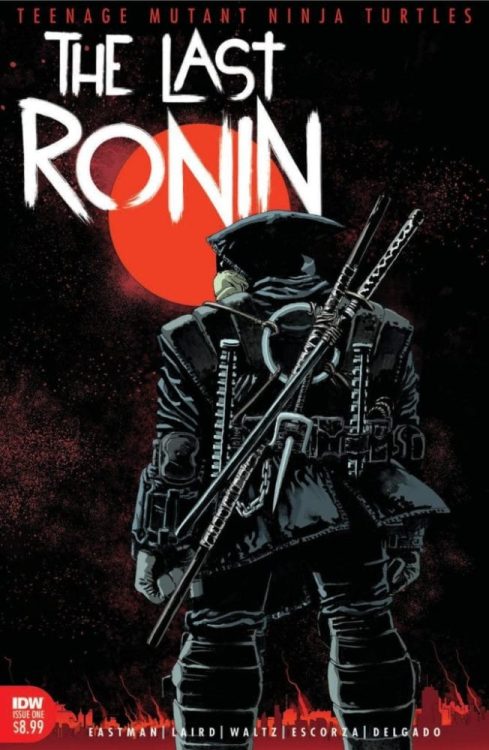
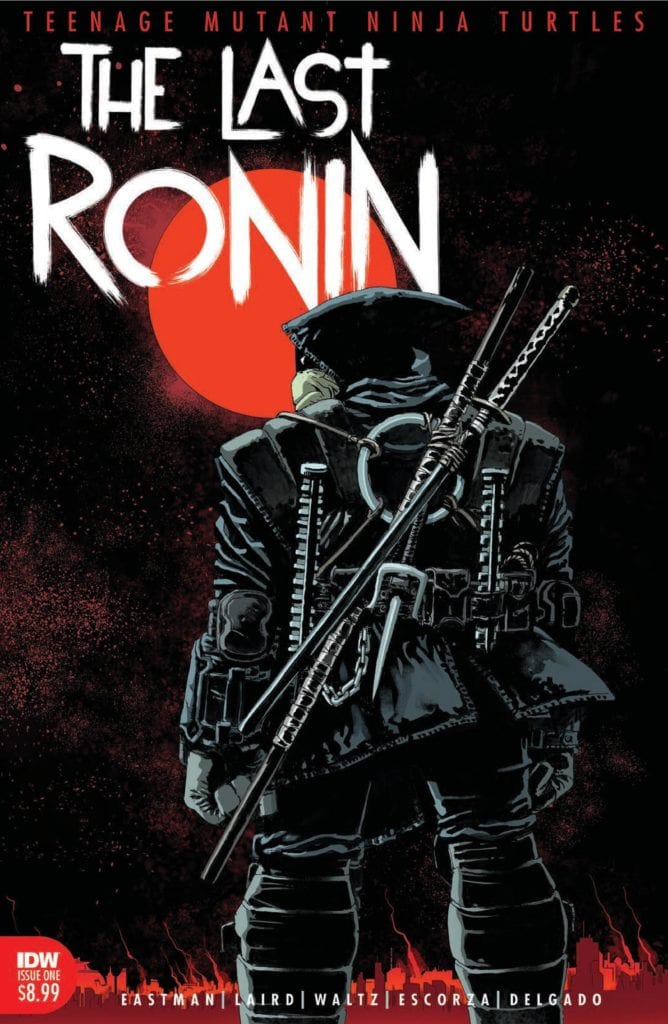
Advance Review: TEENAGE MUTANT NINJA TURTLES: THE LAST RONIN (Spoiler Free)

5-Page Preview: TEENAGE MUTANT NINJA TURTLES: THE LAST RONIN #1

The Last Ronin #1 by Kevin Eastman, Peter Laird, Tom Waltz, Esau & Isaac Escorza, Luis Antonio Delgado and Shawn Lee is a must-read for both new and old TMNT fans; moody, noirish narrative, several mysteries and gritty and striking art.

5-Page Preview: TEENAGE MUTANT NINJA TURTLES: THE LAST RONIN #1

Teenage Mutant Ninja Turtles: The Last Ronin
Story: Kevin Eastman, Peter Laird and Tom Waltz
Script: Tom Waltz and Kevin Eastman
Layouts: Kevin Eastman  Pencils/Inks: Esau & Issac Escorza
Colors: Antonio Delgado  Letters: Shawn Lee

In a future NYC far different than the one we know today, a lone surviving Turtle goes on a seemingly hopeless mission to obtain justice for his fallen family and friends.

There is no getting around the hype this book has. It’s been on the radar for months, and with its hardcore flex of a 69 variant cover release, IDW is certainly putting a lot behind this. So is the book all hype? No, the book certainly delivers. I will avoid spoilers because the various reveals are important, but the narrative is strong and although the hook is, of course, WHO the remaining Turtle is (you do get an answer at the end of the issue), there are still several other plots unfolding and a decent amount of world-building as well. There is a bit of exposition here and there, but it’s a small fault and the narrative’s even pace keeps everything going toward a solid ending that certainly has me wanting to keep reading.Last Ronin

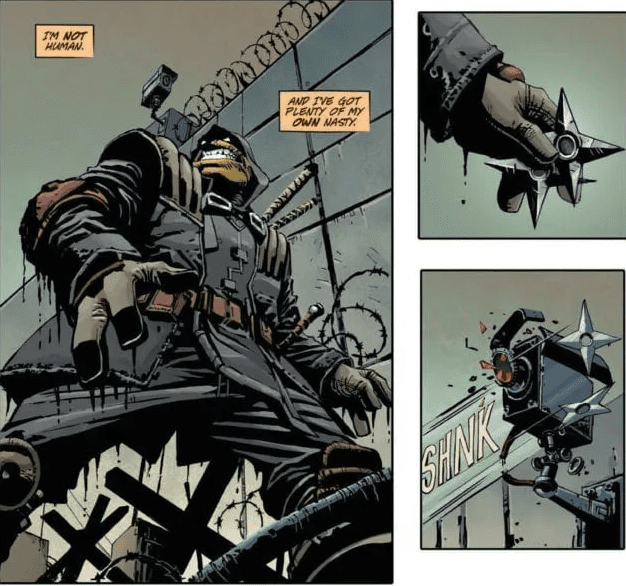
This is also a very good looking book. It’s gritty, all thick, heavy lines, very much full of ‘weight’ on the page. It’s also very detailed; think Dark Knight Returns and Frank Miller’s Ronin (both obvious influences here). The color palette is heavy on the deep blacks and muted primaries, creating pages that pop without having to be dayglow colored. There is also solid lettering throughout, with a great font and strong use of subtle “sound effects”.

So, yes, believe the hype and buy this book when it’s out on October 28th. As a lapsed TMNT fan I loved it and it piqued my interest enough to dive back into the franchise as well.


Check out our 5-Page Preview of The Last Ronin right here!

Monkeys Fighting Robots Youtube

Top 5 Geeky Spots To Visit in Washington, DC

Top 5 Geeky Spots To Visit in Washington, DC

Washington, DC, is a major tourist destination, but if you’re a comic book fan, where are the city’s hidden gems when it comes to geekdom? Below are the Top Five Geeky Spots in Washington, DC, and each one offers a virtual experience for those who can not make it to DC in the current times.

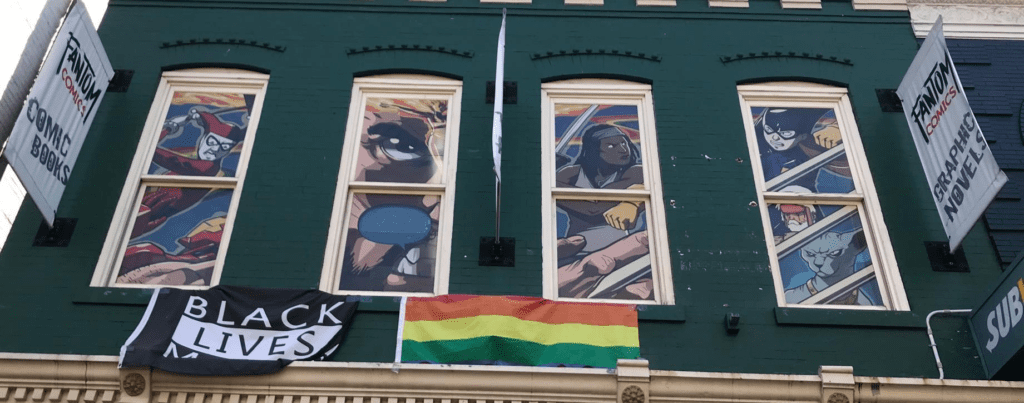
Fantom Comics

The DMV (District of Columbia, Maryland, Virginia) is littered with amazing comic book shops, but Fantom has stolen my heart. The shop boasts a great collection of single issues and an amazing library of collected editions and original graphic novels. If you are planning your trip, make sure to check out their Facebook page, as they often host some amazing panels and creator forums. (These events are still going on in the virtual space. So make sure to check them out even if you are at a distance.)

Website: https://stores.comichub.com/fantom_comics

Address: 2010 P St NW, Washington, DC 20036

The Mansion on O Street

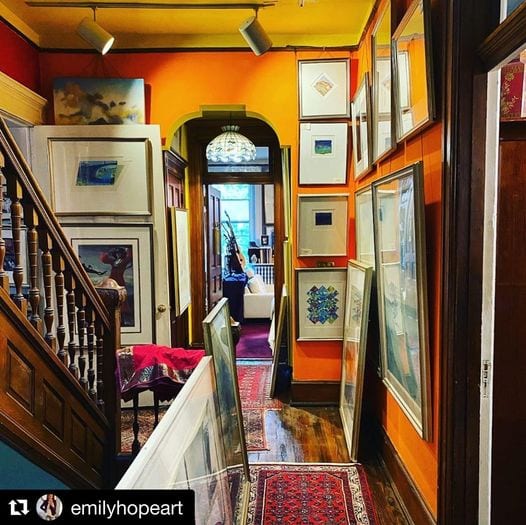
If you have wet your whistle for comics at Fantom and are looking for more to do within walking distance, you should check out the Mansion on O Street. This event space, escape room, pop culture museum, and hotel is one of DC’s most unique stops. The mansion was founded by HH Leonards Spero to house an amazing collection of pop culture memorabilia and provide lodging for artists looking for a place to be inspired. Everything in the house is for sale. The house also has several secret doors and passageways that patrons can look for while on a tour of the incredible home.

Website: https://omansion.com/

Address: 2020 O St NW, Washington, DC 20036

Labyrinth Games and Puzzles

This shop is located in the Eastern Market neighborhood of DC. If you are into board games, puzzles, Legos, and a great atmosphere, this store should be on your list of places to check out in DC. The shop hosts a plethora of events and even partners with other local businesses for various game night events.

Website: https://www.labyrinthgameshop.com/

Address: 645 Pennsylvania Ave. SE, Washington, DC 20003

Catacombs of Washington, DC

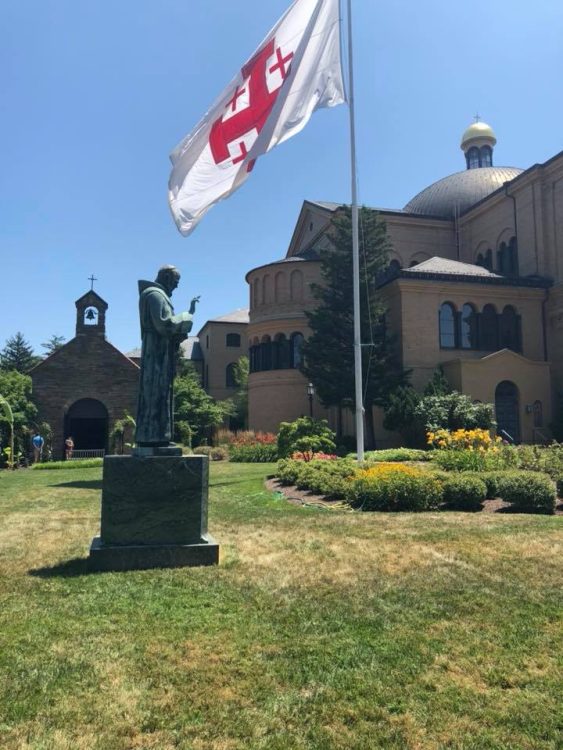
Did you know that Washington, DC has a replica of Rome’s catacombs, complete with fake graves and one real skeleton from the second century? The Franciscan Monastery of the Holy Land was built at the end of the 19th century to provide pilgrims who could not afford the opportunity to travel to Rome to experience a facsimile of the Holy Land. Tour groups (currently not allowed due to the covid-19 pandemic, but the website does offer virtual tours of the facility) are allowed to tour the facility, including the underground replica of Rome’s catacombs.

Website: https://myfranciscan.org/

Address: 1400 Quincy St NE, Washington, DC 20017

Smithsonian National Air and Space Museum

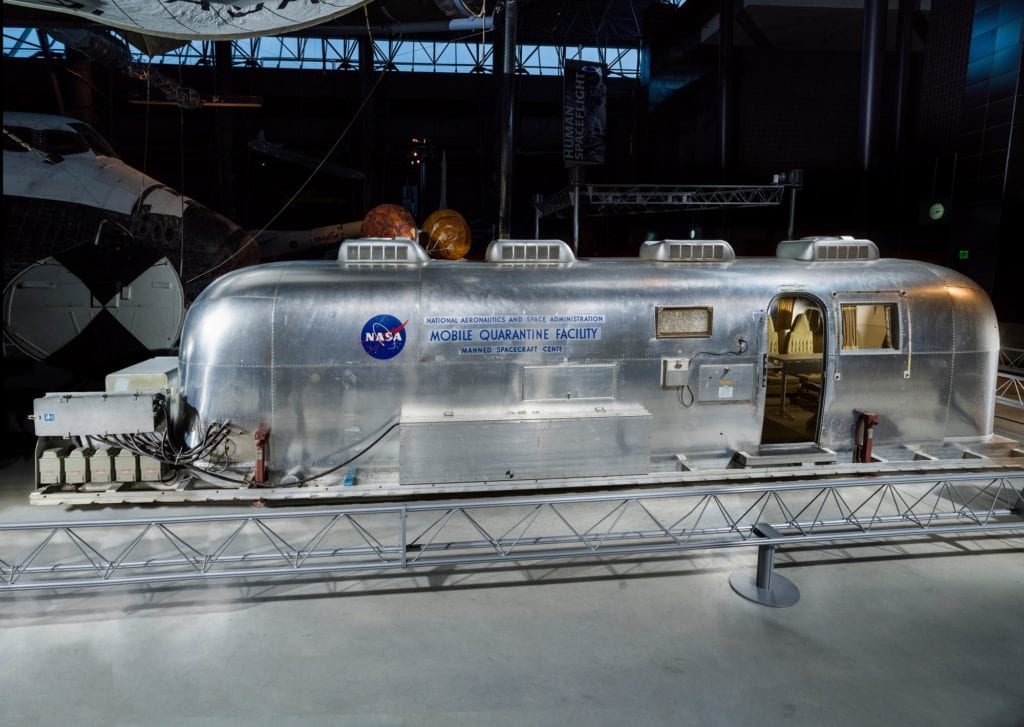
The Smithsonian National Air and Space Museum should be considered the holiest of holies for Nerds in the United States of America. The museum houses a tour-able Skylab replica and a vast cornucopia of air and space travel relics. However, the collection’s prized item is the actual model of the USS Enterprise from the original Star Trek series. This prized object also features a great exhibit on Nichelle Nichols’ works with NASA to recruit people of color to the space program. (The Museum is currently under renovation, so some pieces are not of view at the moment but can be seen on their website.)

Website: https://airandspace.si.edu/

Address: 600 Independence Ave SW, Washington, DC 20560


What is your favorite geeky place to visit in Washington, DC? Comment below with your thoughts so we can add to this list. Enjoy your travels!

Monkeys Fighting Robots Youtube

Comics Studies: An Emerging Academic Field

comic studies
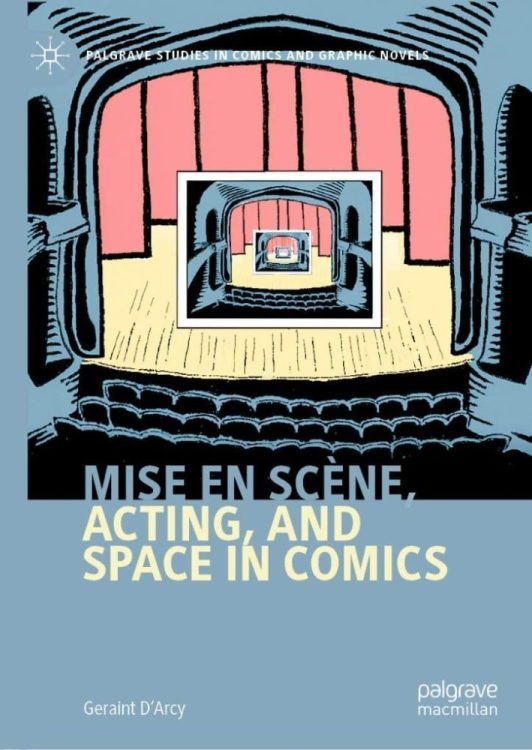
Mise en Scene, Acting, and Space in Comics Book Cover.

Recently I have started to question what I understand of the term ‘Comics Studies.’ By this, I don’t mean that I am looking for a definition of what a Comic is or what makes a product, drawing, text, specifically a ‘Comic’ over something like an illustrated book. That is a separate conversation that begins with Scott McCloud and ends with warring factions fighting it out like the Cat People of Red Dwarf and their belief system based on what color hats should be worn in the Temple of Food. Instead, I refer to what is meant by the term ‘Comics Studies,’ with a capital c and capital s. What exactly are we studying, and where does the study sit within the world of Academia?

Image representing Academia (Stock photo)

The easy answer is ‘Literary Studies.’ Easy, yes, but also problematic because the term is woefully inadequate to cover all aspects of the Comic (with a capital c).

You could extend it to take in the best of Film Studies mixed with the best of literary studies, but this still leaves gaps in our understanding and examinations. Film Studies can give us terms to use, names to apply to aspects of a comic but can it explain how an image is composed within a panel and across a page, taking into account the sweeping page layouts?

Literature can give us the mechanisms for breaking down narrative structure and the meanings behind the semiotics used on the page, but can it explain the intricacies of publication, printing, and the large history of continuity that holds precedent, especially in North America where a Collectors mentality has a huge influence on the industry?

If you look at the writing across the Monkeys Fighting Robots website, you will find several different approaches to looking at Comics. Narrative and character development play a big role in the reviews of monthly floppies, which lends itself to Literary Studies. However, draughtsmanship and illustrative styles are also important, which is a craft-based skill. The composition, not only of images but the page and even the entire comic layout, lends itself to a greater tradition of Fine Art and Graphic Design. But the construction of the images and the flow of the narrative storytelling is very much associated with Film Studies, especially in how we, as critics, discuss the processes used.

I’ve yet to mention the historical and sociological aspects of Comics, taking into account the production and distribution of the format, which plays a massive part in understanding the medium.

And what of Theatre? The staging and audience manipulation of a comic have more in common with theatrical studies than it does with Film or the Novel.

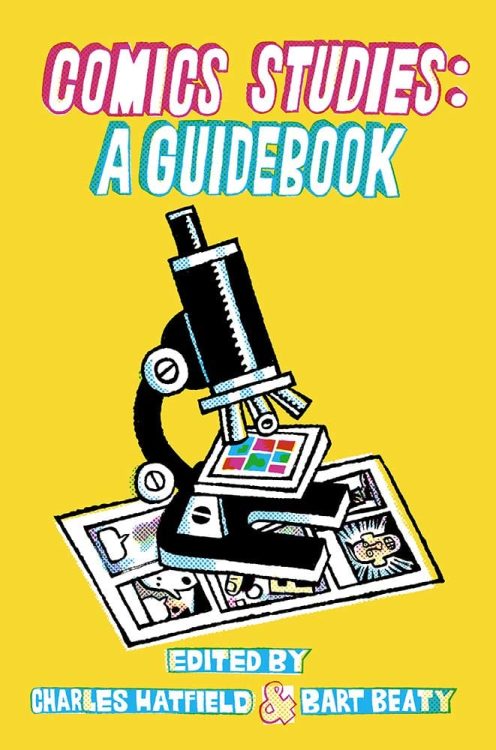
Cover to Comics Studies: A Guidebook

A number of great books, such as Mise en Scene, Acting, And Space in Comics by Geraint D’Arcy and Comics Studies: A Guidebook edited by Charles Hatfield and Bart Beaty, are changing the way we think about Comics. They are also making an impact on the academic study of Comics, bringing together isolated scholars who have been working in different fields but with Comics as a feature of their studies. As the discipline grows, that is to say, that more academic voices become heard, the very notion of Comics Studies changes. Maybe it’s time to stop trying to fit Comic Studies into an established discipline’s pigeon hole and create a new area of study and discourse, merging theories from elsewhere and producing new, Comic specific terminology and ideals.

Whatever your view on Comics is, whether you read for pure entertainment, are interested in the history of the narrative, become absorbed in the Visual Art, or, like me, are fascinated by the very function of comics in Society, one thing is true for us all: it is an exciting time to be a part of the Comics World.

What do you think about ‘Comics Studies’ as an idea and a subject? Or do you think we shouldn’t study comics at all and leave it as simply pure entertainment? Let us know in the comments below.

Monkeys Fighting Robots Youtube

INTERVIEW: Hannu Salonen & Felix Cramer On Mixing Genres For Oktoberfest: Beer And Blood On Netflix

Oktoberfest: Beer & Blood is a Netflix series about passions driving people to make drastic decisions that will change the lives of everyone around them. Director Hannu Salonen and Cinematographer Felix Cramer made a layered six-episode story that mixes period pieces, horror, and westerns.

The overarching theme of Oktoberfest: Beer And Blood is Curt Prank’s (Mišel Matičevićdesire) to build a giant tent at this year’s festival in Munich. However, the idea is unheard of and impossible because all the other vendor stalls stand in the way. Curt’s extreme idea requires extreme measures to accomplish. Caught up in Curt’s plan is his daughter, Clara (Mercedes Müller), who begins relationships that will threaten her father’s ambitions. Oktoberfest brews a mix of Murder, mayhem, and love with the slightest hint of humor into a compelling Netflix narrative.

PopAxiom hopped on Zoom for a chat with Hannu and Felix about becoming filmmakers and making Oktoberfest: Beer and Blood.

Becoming Filmmakers

What roads did Hannu and Felix take to get into the film and television industry?

Felix: “I was not really into filmmaking when I was young. I started making movies because of my father. He was a teacher and made a documentary about the guy who made charcoal. He did a one-shot movie. He placed a camera at one angle, and then he shot the whole documentary over several days like that. I told him, ‘That doesn’t work at all.’ I made my first documentary with my father, and I suddenly knew exactly what I had to do. Afterward, I went to film school …”

Hannu: “I come from Finland. I was always into magical things. I grew up near the graveyards of a group of Vikings. It was a few hundred meters away in some woods with a lake. My life as a child was a magic one. Around 12 or 13, I understood that movies could convey this feeling — the magic. That’s when I decided I needed to be a director and make movies. I went to a film academy in Germany at around 19 or 20.”

oktoberfest-netflix-film-interview

Influences

Combining their work in their respective role, Hannu and Felix have 76 credits. Who influences their work?

Felix: It’s hard to say just one. I love movies from Stanley Kubrick and Roger Deakins … so many great artists.”

Hannu: “I was born in 1972, so Kubrick, Scorcese, and the like were at the top of their game. I saw movies from Andrei Tarkovsky that influenced me when I was around 13. If this guy can create these kinds of worlds, then that’s amazing.”

Felix: “For me, it’s also music. I wanted to study music before I came into the film business. I love classical music. So hearing and feeling the music and the different rhythms help me. But there are so many influences, photographers, painters, and more.”

Hannu: “I also started with music. A lot of classical, but a lot of heavy music. Darker, northern heavy sound. But my youth was more the 80s. Michael Mann, Miami Vice, Oliver Stone’s Platoon. I was an exchange student for a year in the United States, and my host father was a Vietnam vet.”

oktoberfest-interview-director-cinematographer

About Oktoberfest: Beer And Blood

Hannu and Felix worked together once before. How did the director and cinematographer reunite in Oktoberfest?

Hannu: “I was editing my Nordic series, Arctic Circle in Finland. I got a call from one of the producers, and he pitched me Oktoberfest. At first, I got images of drunk people. But then he said something about favelas, these poor little huts and this guy with this big dream. I got excited. Then I read the outlines, and it was great. It has everything that I want to do, all the predicaments, conflicts, and these characters of Shakespeare and nature.”

Hannu: “That’s when I came to Felix. He’s so great. He knows how to plan things so well. But he also reacts to things and does things instead of thinking of them or trying to show off his ego.”

Felix: “Thank you for the flowers.”

Hannu: “You’re welcome.”

What was Felix’s reaction to the initial pitch for Oktoberfest?

Felix: “When Hannu asked me to do this, I was extremely surprised. I thought it was about Oktoberfest, but it’s more like a historical piece. It takes place in the early 20th century, and we tried to stay as accurate as possible, but on the other side, the feeling of the story is absolutely modern. It borrows elements from westerns and horror. When I read it, I thought it was so completely different from other period pieces. I started talking with Hannu, and we had all these creative ideas, and I fell in love with the project. I couldn’t say no.”

Making Oktoberfest: Beer And Blood

Oktoberfest is equal parts gritty series with a western vibe and period drama. But there’s a thread of humor tying it all together. Or am I crazy?

Hannu: “Funny what you’re talking about because it’s not necessarily being understood in Germany. I saw a chance at mixing different genres and tonality. A little bit of irony. German audiences, particularly journalists, don’t see that and take it totally seriously.”

Hannu and Felix share a vision of finding rhythms within stories. How did the rhythm for Oktoberfest come about?

Felix: “It starts from the script. In the case of Oktoberfest, we story-boarded a lot of the scenes. So, we knew exactly what we wanted to do in every scene with very concrete shot designs.

Hannu: “In Oktoberfest, we have these quickly edited scenes, and on the other side, we have very long takes. We tried to find the right rhythm for each scene. I think it’s great if you have a chance to achieve that.”

Felix: “From my perspective, Hannu is a great director because he dares to do these one-shots. There are not that many directors willing to do that.”

Hannu: “Editing was so important. Our editor, Ronny Mattas, brought everything together, and he’s also extremely into music. He’s great at rhythm.”

oktoberfest-netflix-interview

Felix: “It was great shooting. Every day we had a lot of fun. The crew was so passionate. It’s this modern story on this Oktoberfest island where everything is reflected, the social life and artists. It’s an interesting time between late-romantic art and expressionists. And a time where people used gas lamps and candles to electric lamps.”

Hannu: “We were a little over-budget, and one of the producers said, ‘C’mon, man, it’s just a soap!’ There are soap opera elements, just like there were in Shakespeare, but Felix and I wanted this look to it that we fought for to go beyond a soap.”

The slight budget issue caused another issue — a lack of time.

Hannu: “They promised us 70 or 80 shooting days, but in the end, we had 66. We survived.”

What did Oktoberfest creators Christian Limmer, Ronny Schalk, and Alexis Wittgenstein first discuss for the show’s look and feel?

Felix: “The creators had many period pieces in mind like Peaky Blinders, The Nick, and Godless. We watched all these kinds of movies to figure out if we could use them as a guideline. But we realized Oktoberfest was so different that we turned more to the art and the period; its music and colors. The creators also wanted it to look modern. They did not want to use filters to blow everything out. We wanted things like the slow camera movement you’ll see in a horror movie or the high angle, low angle of Westerns.”

Hannu: “I got to read outlines from the creators and writers which had a lot of the tonality.”

How did planning help tighten the production?

Hannu: “We were shooting in three countries, and getting this all to work, it had to be well planned. In Prague, we were bringing 300 to 400 extras on buses.”

Felix: “There’s a great toothache scene. The same character is also conducting his band. It was written pretty simple in the script. We put it on the storyboard, and it looked completely different. This idea was transferred to the script.”

Hannu: “The actors were happy that we were sticking to the script. We could improvise, but we didn’t have to because the scripts were so great.

oktoberfest-netflix-interview

Wrapping Up

Oktoberfest delivers dozens of attractive, vivid characters. But who are the other characters that Hannu and Felix think about?

Felix: “Hannu says it a lot, the camera is its own character.”

Hannu: “The setting is its own character. Also, the sound design and the music are commenting on certain things and conveying a different perspective. All these means of storytelling do not hide. They say, ‘I’m here and taking part in the event.’ They’re not passive, but taking part in the storytelling. Especially in the mix of genres we had.”

Felix: “I love these kinds of things, and they already have to be in the screenplay a little bit.”

What’s a dream project for Hannu and Felix?

Hannu: “For me, it’s really about strong characters in visual fictional worlds.”

Felix: “I would love to do a Zorro movie right now. I would love to do a horror movie or science fiction. I’d love to fly into the future.”

Oktoberfest: Beer And Blood is out on Netflix. So, what’s next for the director and cinematographer?

Felix: “COVID changed a lot. Hannu and I were on a project together, and it was just postponed. I’m working on a history movie in Poland.”

Hannu: “Forget 2020, the silver lining now is about taking the time to develop several projects. One of them is science fiction, by the way, Felix. We can dig a bit deeper than when we’re busy shooting all the time. So, it’s been good in that sense. But I can’t talk much about those projects. We’re in talks. So, something will be coming.”

Is Oktoberfest: Beer And Blood on your watch list?

Thanks to Hannu Salonen and Felix Cramer and Impact24 PR
for making this interview possible.

Want to read more interviews? CLICK HERE.

Monkeys Fighting Robots Youtube

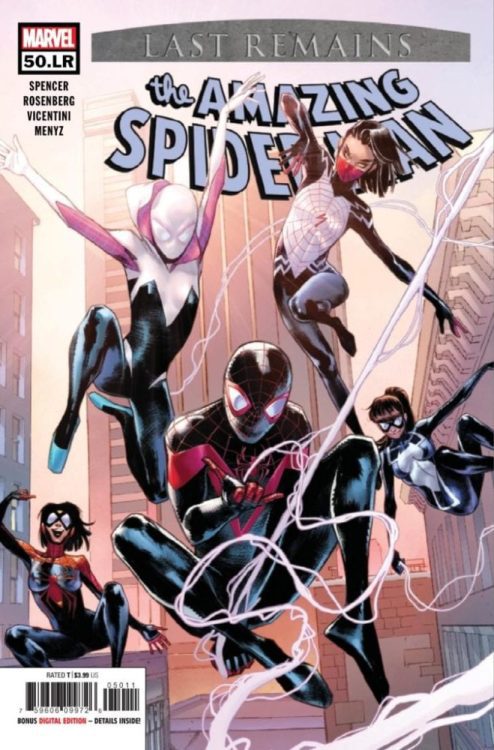
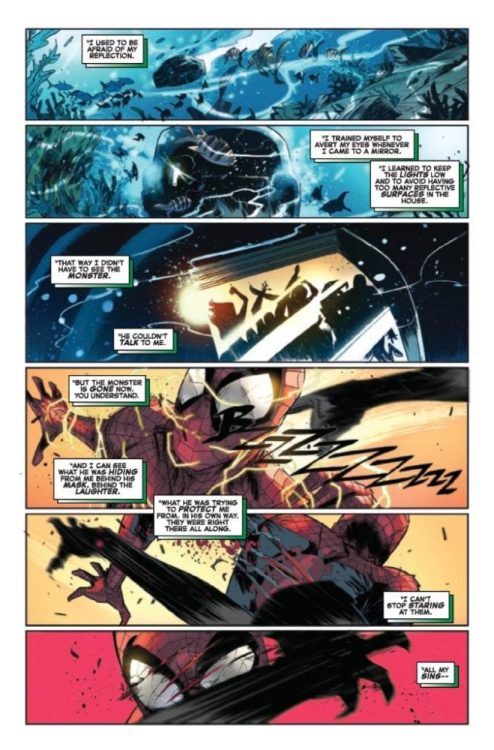
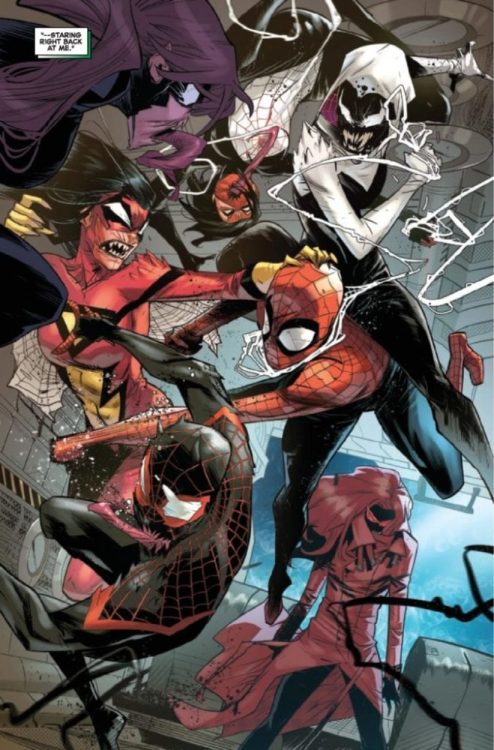
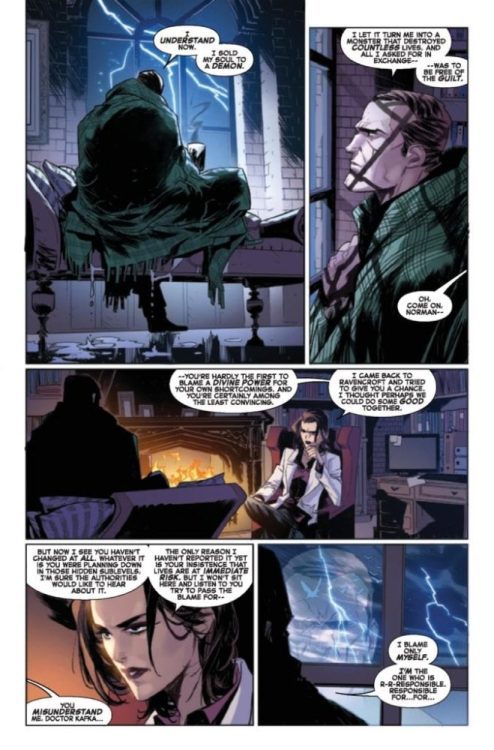
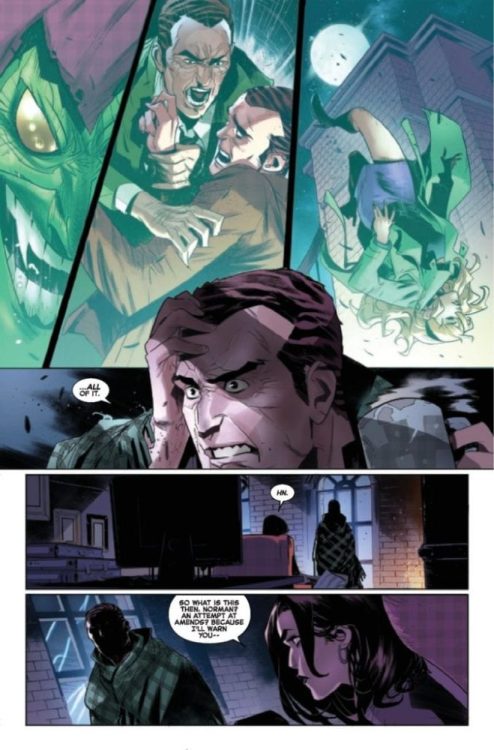
Exclusive Marvel Comics Preview: AMAZING SPIDER-MAN #50.LR – “LAST REMAINS”

Exclusive Marvel Comics Preview: AMAZING SPIDER-MAN #50.LR

AMAZING SPIDER-MAN #50.LR hits your local comic book shop on October 21, but thanks to Marvel Comics, Monkeys Fighting Robots has an exclusive preview for our readers.

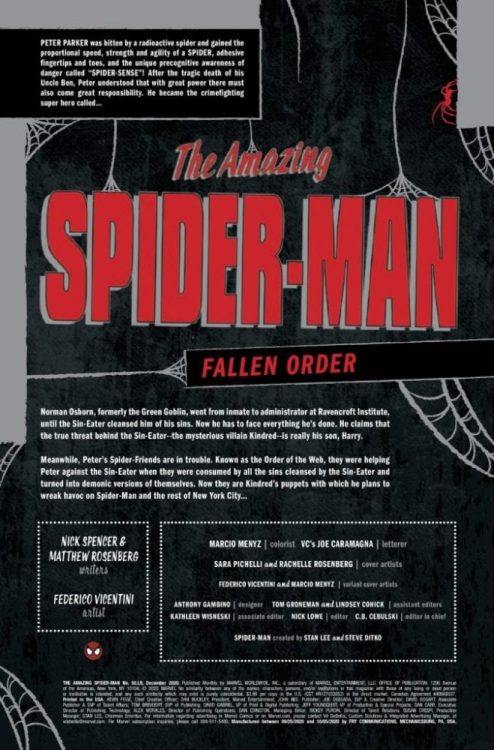
The book is written by Nick Spencer & Matthew Rosenberg, with brillant artwork by Federico Vicentini, Marcio Menyz drops the colors, and you will read Joe Caramagna’s letter work. Sara Pichelli and Rachelle Rosenberg brought the cover to life.

About AMAZING SPIDER-MAN #50.LR:
“LAST REMAINS” is so huge it cannot be contained within the pages of AMAZING SPIDER-MAN. Kindred’s assault is so epic, it’s going to sweep the other Spider-Heroes of the Marvel Universe up in its wake. All this and the bombshell dropped at the end of ASM #49 rolls toward one of Marvel fandom’s favorite characters.


Enjoy The Preview Below:

Monkeys Fighting Robots Youtube

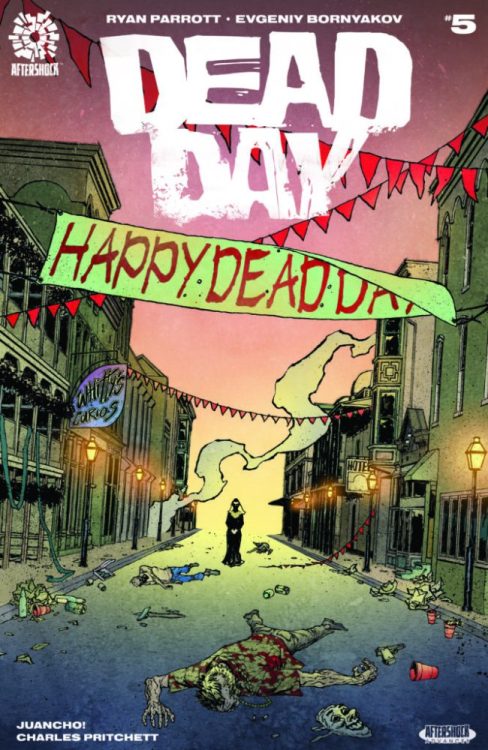
Exclusive AfterShock Preview: “Happy” DEAD DAY #5

Exclusive AfterShock Preview: DEAD DAY #5

DEAD DAY #5 hits your local comic book shop on November 18, but thanks to AfterShock Comics, Monkeys Fighting Robots has an exclusive four-page preview for our readers.

About the book:
With nowhere else to run, Jeremy and the Haskin family find themselves under siege, caught in between the Lifers and the Revivalists…and not everyone will escape Dead Day alive. Witness the emotional conclusion to the supernatural holiday in a world where death isn’t the end and secrets never stay buried.


DEAD DAY #5 is written by Ryan Parrott, with art by Evgeniy Bornyakov, Juancho! drops the colors, and you will read Charles Pritchett’s letter work. Andy Clarke, with Jose Villarrubia, worked on the cover.

Enjoy The Preview Below

Monkeys Fighting Robots Youtube

DC Announcement: The Future Of DC FUTURE STATE Is Revealed

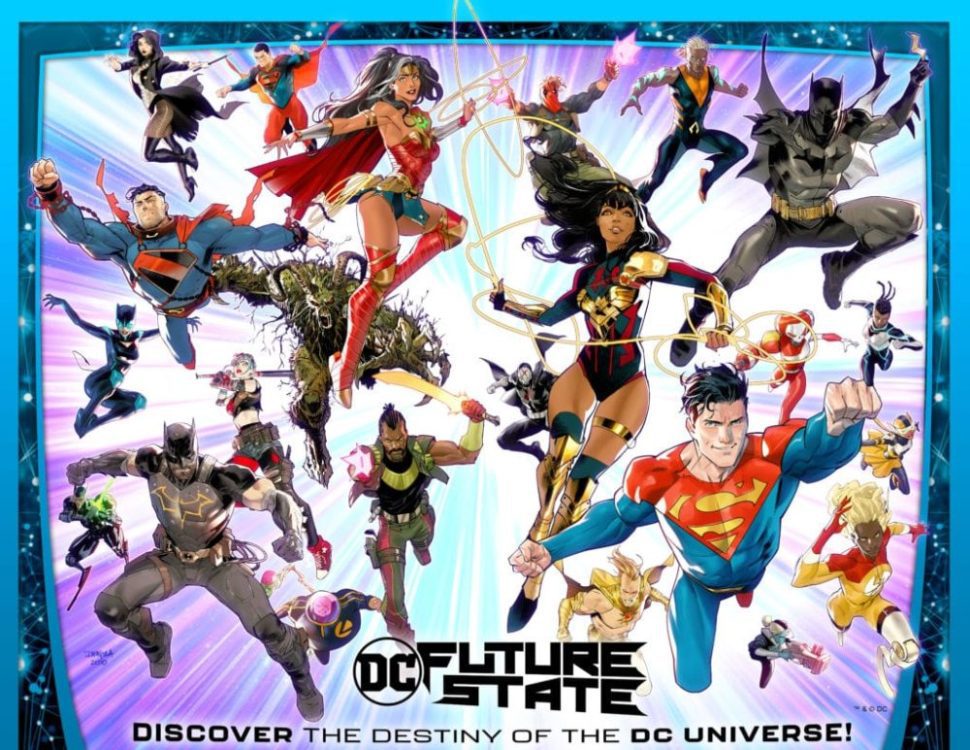
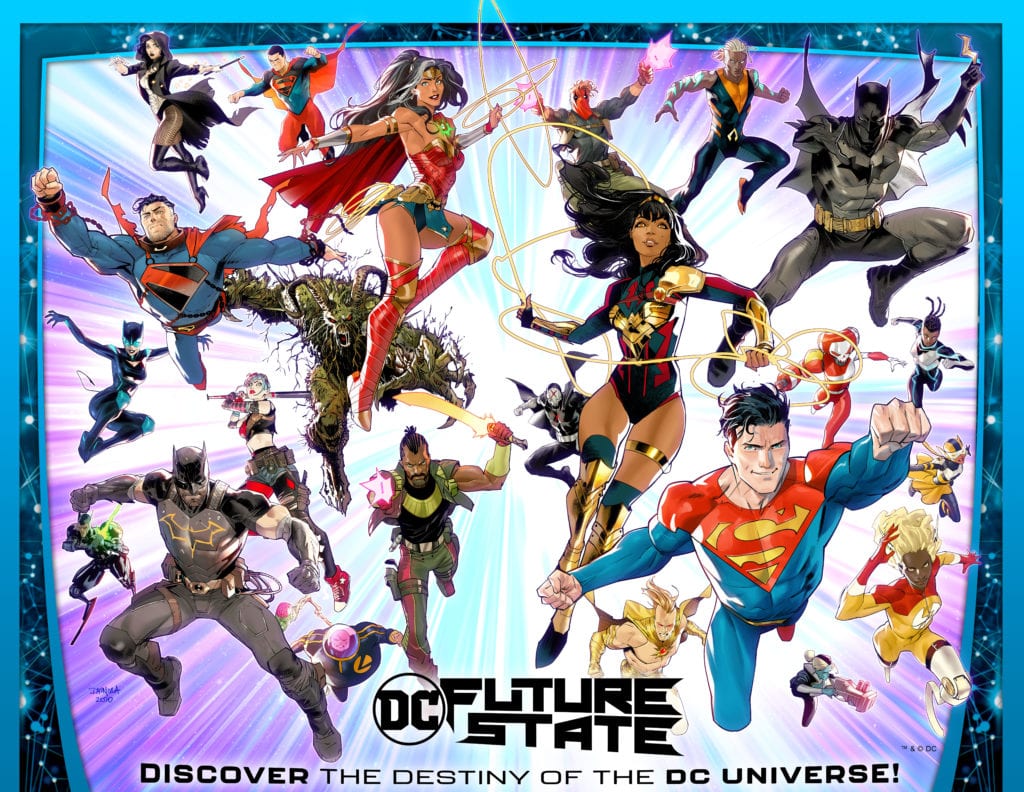
Future-State-Promo-piece-final_R1 (002)

DC Comics has finally revealed details about their mysterious new project – DC FUTURE STATE – that begins in January 2021. There’s been some speculation that Future State was originally conceived as Dan DiDio’s defunct 5G project, but this new announcement confirms a much more limited scope event.

Says DC about Future State’s main subject: “DC Future State spotlights the World’s Greatest Super Heroes in fresh new roles, with all-new characters taking up their iconic mantle.”

You can read the full breakdown of Future State issues and read the full DC press release below.

What are your theories about the long-term impact to DC with this limited-run event? Let us know what you think in the Comments section, and please share this post on social media using the links below.

Future-State-Promo-piece-final_R1 (002)

DC FUTURE STATE GIVES FANS A LOOK AT THE FUTURE OF THE DC UNIVERSE THIS JANUARY!

BURBANK, CA (October 15, 2020) – DC is starting 2021 off with a bang, giving fans a glimpse into futures both near and far, full of current and new characters as the publisher announced plans today for DC Future State, a two-month, line-wide event beginning in January. Through February 2021, the full title lineup will feature a combination of monthly and twice-monthly oversize anthologies, as well as a monthly schedule of miniseries and one-shots.

DC Future State spotlights the World’s Greatest Super Heroes in fresh new roles, with all-new characters taking up their iconic mantles. DC Future State features an incredible array of creative talent, combining award-winning writers and artists with new voices from the worlds of TV, movies and animation. In March 2021, the regular DC title lineup resumes, continuing existing story lines from 2020 and introducing new arcs for the year.

In DC Future State, the Multiverse has been saved from the brink of destruction, but the triumph of DC’s heroes has shaken loose the very fabric of time and space! The final chapter of Dark Nights: Death Metal (on sale January 5, 2021)  brings new life to DC’s Multiverse, kicking off this glimpse into the unwritten worlds of DC’s future!

“The DC Universe has always been fertile ground for new and refreshing takes on our characters, and DC Future State definitely contributes to this legacy,” said DC Executive Editor Marie Javins. “When the event begins in January, some savvy readers will not only pick up on some of the breadcrumbs that have already been tossed out in our current titles, but they will also find new hints and clues of what’s to come in 2021.”

A stellar array of writers and artists are on hand to deliver this unique look at beloved DC characters, including fan favorites such as Mariko Tamaki, Brian Michael Bendis, Gene Luen Yang, Joëlle Jones, Joshua Williamson, Nicola Scott, Cully Hamner and John Timms, along with new voices such as award-winning screenwriter John Ridley (12 Years A Slave), Brandon Vietti (Young Justice), Meghan Fitzmartin (SupernaturalDC Super Hero Girls), Brandon Easton (Thundercats, Transformers: War for Cybertron), Alitha Martinez (REPRESENT! It’s A Bird!), L.L. McKinney (Nubia: Real One), Paula Sevenbergen (Stargirl) and Siya Oum (Lola XOXO), among others.

Batman Family

In this future, Gotham City is controlled by the Magistrate. This villainous regime has taken control of the city, now under constant surveillance. All masked vigilantes have been outlawed and Batman has been killed. But led by an all-new Batman, a new assembly of Gotham’s guardians rise to give hope to all of those who lost it!

Oversized Comics:

  • Future State: The Next Batman #1-4
    • The Next Batman, by John Ridley, Nick Derington and Laura Braga
    • Outsiders, by Brandon Thomas and Sumit Kumar
    • Arkham Knights, by Paul Jenkins and Jack Herbert
    • Batgirls, by Vita Ayala and Aneke
    • Gotham City Sirens, by Paula Sevenbergen and Emanuela Lupacchino
  • Future State: Dark Detective #1-4
    • Dark Detective, by Mariko Tamaki and Dan Mora
    • Grifters, by Matthew Rosenberg and Carmine di Giandomenico
    • Red Hood, by Joshua Williamson and Giannis Milonogiannis

Monthly Miniseries:

  • Future State: Batman/Superman, by Gene Luen Yang and Ben Oliver
  • Future State: Catwoman, by Ram V and Otto Schmidt
  • Future State: Harley Quinn, by Stephanie Phillips and Simone Di Meo
  • Future State: Nightwing, by Andrew Constant and Nicola Scott
  • Future State: Robin Eternal, by Meghan Fitzmartin and Eddy Barrows

Superman Family

Due to his involvement in an international crisis happening in the near future, Clark Kent has been rejected by Earth, causing him to focus his lifesaving efforts outside his adopted home. He travels to Warworld to rise through the ranks of gladiatorial combat in order to defeat Mongul with the help of some unlikely heroes. Back in Metropolis, Clark’s son Jon has taken on the mantle of Superman. After seeing the horrors that befell Gotham, he bottles Metropolis in order to keep it safe, putting him at odds with Supergirl.

Connecting the two oversized Future State: Superman titles, Shilo Norman, the man known as Mister Miracle, finds himself caught between the city he grew up in and the battle-torn planet that could be his downfall.

Meanwhile in the Amazon rainforest, Yara Flor is chosen to be the new Wonder Woman. Years later, the new Superman and Wonder Woman join forces to save their cities in a new superhero team-up the likes of which the world has never seen.

Oversized Comics:

  • Future State: Superman of Metropolis #1-2
    • Superman of Metropolis, by Sean Lewis and John Timms
    • The Guardian, by Sean Lewis and Cully Hamner
    • Mister Miracle, by Brandon Easton and Valentine De Landro
  • Future State: Superman: Worlds of War #1-4
    • Superman: Worlds of War, by Phillip Kennedy Johnson and Mikel Janin
    • Midnighter, by Becky Cloonan, Michael W. Conrad and Gleb Melnikov
    • Black Racer, by Jeremy Adams and Siya Oum
    • Mister Miracle, by Brandon Easton and Valentine De Landro
  • Future State: Immortal Wonder Woman #1-2
    • Immortal Wonder Woman, by Becky Cloonan, Michael W. Conrad and Jen Bartel
    • Nubia, by L.L. McKinney, Alitha E. Martinez and Mark Morales

Monthly Miniseries and One-Shots

  • Future State: House of El, by Phillip Kennedy Johnson and Scott Godlewski (one-shot on sale February)
  • Future State: Kara Zor-El, Superwoman, by Marguerite Bennett and Marguerite Sauvage
  • Future State: Legion of Super-Heroes, by Brian Michael Bendis and Riley Rossmo
  • Future State: Superman/Wonder Woman, by Dan Watters and Leila del Duca
  • Future State: Superman vs. Imperious Lex, by Mark Russell and Steve Pugh (3-issue series ending March 2021)
  • Future State: Wonder Woman, by Joëlle Jones

Justice League Family

A thread of great change runs through the Justice League heroes: a new League is built upon secret identities (even from each other), but an old and evolved enemy will use these secrets to try and overthrow the world. For the supernatural heroes of Justice League Dark, the very fabric of reality has shifted, and heroes are being hunted.

For Flash, Shazam, and the Teen Titans, it all begins when the four Riders of the Apocalypse unleash hell in a battle at Titans Academy, Barry Allen is cut off from the Speed Force, a Famine-controlled Wally West may be beyond saving, and Billy Batson makes a deal with the devil that will change Shazam forever. Off-world, John Stewart and the remaining Green Lanterns are stranded in the shadow of a dead power battery; Jackson Hyde and Andy Curry are separated across the galaxy; and Amanda Waller executes her ultimate plan with a new but terrifyingly familiar Suicide Squad on Earth-3.

At the end of time, Swamp Thing reveals its true intention, ruling supreme until a remnant of humanity launches a rebellion, and Black Adam looks to the past as the only way to save the future of the Multiverse. 

Oversized Comics:

  • Future State: Justice League #1-2
    • Justice League, by Joshua Williamson and Robson Rocha
    • Justice League Dark, by Ram V and Marcio Takara
  • Future State: Green Lantern #1-2
    • Last Lanterns, by Geoffrey Thorne and Tom Raney
    • Tales of the Green Lantern Corps, by Josie Campbell, Ryan Cady and Ernie Altbacker, with Sami Basri and Clayton Henry
  • Future State: Suicide Squad #1-2
    • Suicide Squad, by Robbie Thompson and Javi Fernandez
    • Black Adam, by Jeremy Adams and Fernando Pasarin

Monthly Miniseries:

  • Future State: Aquaman, by Brandon Thomas and Daniel Sampere
  • Future State: The Flash, by Brandon Vietti and Dale Eaglesham
  • Future State: Teen Titans, by Tim Sheridan and Rafa Sandoval
  • Future State: SHAZAM!, by Tim Sheridan and Eduardo Pansica
  • Future State: Swamp Thing, by Ram V and Mike Perkins

For the latest information on DC Future State and the World’s Greatest Super Heroes, please visit the DC Comics website at www.dccomics.com and follow on social media @DCComics and @thedcnation.

Monkeys Fighting Robots Youtube