The WWE made this statement terminating the contract of Hulk Hogan.
“WWE terminated its contract with Terry Bollea (aka Hulk Hogan). WWE is committed to embracing and celebrating individuals from all backgrounds as demonstrated by the diversity of our employees, performers and fans worldwide.”
It was an interesting day to have WWE Super Star Daniel Bryan phone in to promote his book “YES!: My Improbable Journey to the Main Event of WrestleMania.” The Internet exploded just hours before with reports of a Hulk Hogan racial tirade and his complete removal from the WWE.
Bryan, just finding out about Hogan situation during the interview is surprised but had no comment. He did discuss his injury and that he hasn’t been cleared to wrestle by the doctors at the WWE. Bryan also talked about what it means to be a role model in the WWE and that he would like to go back and train with Shawn Michaels to learn the finer points of the sport.
“I think anybody whose in the public eye should consider themselves as potentially a role model. Regardless of whether you want to be one or not kids are looking at you. I take that responsibility very seriously. I think a lot of people within the WWE do, because we so many kids watching our product and I think that is one of the highest priorities for me,” said Bryan.
Bryan’s book “YES!: My Improbable Journey to the Main Event of WrestleMania” is available now.
With so many video game movies coming up in the next few years, I set out to find out what are the key factors that could make them successful.
Adam Sandler is back this week in theaters with yet another atrocity. And maybe the movie itself might not be a total cringe-fest, but his acting skills (or lack thereof) are — read our review. Now, could Pixels be considered a video game adaptation? No, it only brings video game characters like Pac-Man and Donkey Kong to life and a sense of nostalgia that we can also appreciate from Space Invaders and Tetris. But is that enough to succeed? Clearly not, without some kind of story or specific tone that stems from the proper video games.
From Tomb Raider (2001) with Angelina Jolie to the upcoming Assassin’s Creed (2016) with Michael Fassbender and Marion Cotillard, we know that movies based on video games attract interest, both from the public and from A-list actors who want to be associated with a large money-making (possible) franchise. Certainly, some of the bigger titles can end up taking in hundreds of millions. Still, are they actual good movies? Not really.
I reached out to Jake Baldino (Pretty Much It, BecauseVideoGames, Gameranx), and he identified what makes video game movies great adaptations: the type of story, the actual narrative and the tone of the game.
“Myself and many game fans believe that, like superhero movies, video game movies can take many liberties with story and characters so long as it uses the name well — captures what the game stood for or the message it conveyed in the first place. It needs to keep the thing that made the game special.”
All in all, three aspects related between them that can make or break video game movies and that Hollywood studio executives should have in mind when creating them. Baldino states that the closest movie to success based on the previously mentioned characteristics was Silent Hill (2006), but most others have failed terribly. We’re looking at you, Resident Evil. In terms of box office, Jake Gylllenhaal’s Prince of Persia (2010) “had a huge budget and big stars but fell just short of greatness and flopped”.
Another element that I thought could play an important part when adapting video games into movies is the type of game they are based on. Pixels incorporated arcade games into the movie, in the same funky way Jumanji could have featured Crash the bandicoot, maybe. But the point of an adaptation is to make a feature film somewhat close to the actual game. Baldino says:
“I think any type of game could work as a movie, but ultimately one with a story, characters, or world is best.”
And this is why we’re getting movies like Warcraft and Uncharted, but Hollywood also has a very bad habit of putting popular titles to movies that don’t have a lot to do with the concept, like Need for Speed. Why make racing, platform and shooter game-based movies have a narrative that any “original” movie with a different title could have? Ever seen The Fast and The Furious?
Apart from that, how important is it to hire not only well-known actors, but also a capable director? Pixels was decently led by Chris Columbus on his part; the movie adaptation of Metal Gear Solid, for example, is close to being directed by Jordan Vogt-Roberts, who signed the acclaimed Kings of Summer (2013), and Duncan Jones, director of the fantastic Moon (2009), is manning Warcraft. These last two could be on trend with hiring indie directors for big movies, but they could also turn out to be brilliant choices, if they can pull it off.
Finally I wonder, now that video games are becoming more and more cinematic and we have access to virtual reality gadgets, what is the point of video game movies like The Last of Us? While it might get close to hitting the three aspects fans look for, we can already experience it for hours and hours, with it being a strongly story-driven game. And for sure it won’t actually sell more copies, in Baldino’s words:
“Video game companies don’t often jump shipping a game when a movie based on the name is releasing. They’re often starkly apart in communication and everything — the rights are usually just sold off completely.”
This might be happening to reach a different target audience. Gamers already know that in the game there’s a (potentially) superior version of the story from the movie, but they’d still want to compare them, whereas general audiences might go for the zombie apocalypse appeal, no matter what title the movie has.
What do you enjoy about video game movies? Let’s discuss in the comments!
The WWE is preemptively cutting ties with Hulk Hogan after a rumored racial tirade caught on audio or video tape according to Complex.
The WWE removed Hulk Hogan’s WWE page, Hall of Fame page, and merchandise from their website. Hogan is also no longer listed as a judge for WWE Tough Enough.
MediaOutTake is reporting that the interview in question is in a legal fight between Gawker and Hogan.
Hulk Hogan tweeted this at 1:17 am this morning.
In the storm I release control,God and his Universe will sail me where he wants me to be,one love. HH
The WWE is preemptively cutting ties with Hulk Hogan after a rumored racial tirade caught on audio or video tape according to Complex. Hogan in an interview apparently called The Rock the N-word.
The WWE removed Hulk Hogan’s WWE page, Hall of Fame page, and merchandise from their website. Hogan is also no longer listed as a judge for WWE Tough Enough.
I haven't gotten confirmed audio yet, but the transcripts that I've seen have Hogan calling The Rock the "N-word" and "sambo" among others.
Snow White with the Red Hair has certainly come a ways from its premiere episode–and I liked that one quite a bit. The series has developed Shirayuki into one of the strongest female characters in anime, outside of those that carry loaded guns and act like men, of course. This third episode does so much to prove Shirayuki’s gumption in the face of external powers who should have a strong level of control over her, simply because of their position in the world. In the face of all this, Shirayuki proves to be made of the stuff that most of us can only aspire to.
The episode, “Shining Time of Promise”, revolves around Shirayuki’s growing friendship and companionship with Prince Zen, and the reaction that various members of the castle’s ecosystem have to it. This ranges from guards who think Shirayuki is just the swellest, to Lord Haruka–a member of the court elite–who finds Shirayuki’s social status to be a disservice to Prince Zen.
With that foundation, “Shining Time of Promise” becomes more than just a manifesto on what it means to be a strong woman, but also what it means to believe in one’s self in the face of society’s class confines. Shirayuki never hesitates to see her future self as an equal of Prince Zen, in spite of what her lower class distinction would make the upper class think of her. At one point she tells Prince Zen,
I want to one day be able to go through the gates [of the castle] by myself and come be your ally.
Of course, she finds opposition to her true wishes. The majority of the episode revolves around Lord Haruka believing that he can pressure and intimidate Shirayuki into exiling herself from the castle–and from Prince Zen, more specifically. Haruka fails to see the strength of self that lies at Shirayuki’s core, instead viewing her as a silly girl that has tricked Prince Zen into giving her a higher social status than she deserves. At every turn, however, Shirayuki deftly proves this to be a falsity of epic proportions. In the face of physically violent threats, Shirayuki pushes forward to join Prince Zen as a friend and an equal.
One of my favorite moments of the episode sees Shirayuki face-to-face with Lord Haruka, he with a sword to her chest in the hopes that she will turn away out of fear. Instead, Shirayuki wears her resolve on her sleeve and pushes forward, forcing Haruka back in fear of Shirayuki actually falling on his blade. It’s a terrific scene that feels of a piece with any moment of “civil disobedience” throughout history. I was immediately reminded of the bravery of the members of the Civil Rights movement, standing up against a society that would have them believe they were “lesser than”, all to say that “we are human beings, we are equal”. Clearly that was a much more important statement than this girl saying that she has a right to be friends with the Prince, but they each speak to the frailty of society’s divisions once those divisions are questioned by the right people; people who are willing to give their lives in the name of true freedom. It’s a message that’s increasingly needed in a time when societal confines are just as strong as ever, but much less considered or openly talked about. Alright, so hopefully that’s not too grandiose, but clearly Snow White with the Red Hair stirred something inside of me this time around.
Aside from commenting on the quintessential meaning of personhood, Snow White with the Red Hair is a cool little cartoon. The animation is still on the money, for my tastes, capturing the majesty of the court through vibrant colors and brightly lit scenes. The world outside the walls, however, is even more beautifully animated–and much less barren–reminding us, as it does Prince Zen, that the castle isn’t the only thing in the country and probably isn’t even the best thing. The combination between the quality of the art, the commentary on societal norms and the general sweetness that exists within Snow White with the Red Hair still vaguely gives me a Studio Ghibli vibe, as if this is the show that famed studio would make were it ever to venture into television–that’s right, I’m completely disowning Ronia the Robber’s Daughter, sorry Gorō. Obviously, Snow White doesn’t quite hit the upper echelon that certain Ghibli films do, but it’s certainly inspired by them.
Snow White with the Red Hair is a true gem that’s relatively easy to overlook in our current age of media consumption, because it’s not hard and gritty like Gangsta, Ranpo Kitan or God Eater. While all those shows do have worth in their individual messages, those messages simply don’t resound as well–at least not for me–as this story about a strong woman who refuses to be told what her role in the world is.
If you’re looking for more fantasy series, give Jennifer’s summer anime roundup a look-see.
Runner Up: Classroom Crisis – Ep. 3
Was there any doubt that if Snow White could finally topple Classroom Crisis for me, it’d only be to knock it down a peg? Of course not, because Classroom Crisis is still at peak performance, doing what it does best with both character development and world building.
This week’s episode finds Kaito and crew being put through even more paces than last week, with a new accountant being brought in by Nagisa who turns their world upside down. Is she there to destroy A-TEC or to do what she can to save it?
The power of this week’s Classroom Crisis lies in its point-of-view on community, and the importance of said community in surviving hard times. As we’ve seen in previous episodes, Nagisa and his brothers–those that run the Kirishina Corporation–continue to come to a head this episode, putting their sibling rivalry on full display at the top of a wobbling corporate infrastructure. In contrast, while the A-TEC crew certainly suffers some losses–both of physical resources and human resources–they tend to feel like more of a family, with their common goal keeping them going. At one point, Kaito finds himself at a bar, drinking his cares away with his old chief–the one that was relieved in the first episode. Kaito reminisces on all the time he’s put into A-TEC, saying,
…all that hard work we put in, half-killing ourselves along the way… What was all that for? Just because of a slight change in company policy, they’re denying all our achievements til now, calling us good-for-nothings, and now we have nowhere to go.
Kaito is a man with a family who’s been kicked out of their home, at a loss with what he can do to steer things back on the right path. But in all of this, Kaito never puts himself–the I–before the group–the we. It’s never his accomplishments, but their accomplishments. In stark contrast, Nagisa and his brothers seem to only speak in their own individual strengths–usually in comparison with each other to see who’s the strongest–rather than as a cohesive collective. It’s moments like this that give the audience hope for the A-TEC crew and makes Classroom Crisis a truly enjoyable underdog tale.
Biggest Surprise: Ranpo Kitan – Ep. 3
Much like last week, a handful of shows surprised me in this week’s viewings, from God Eater‘s charmingly gritty second outing to Gangsta‘s thoughtful development of its one-eyed badass, Worick. But it was Ranpo Kitan, with its harsh look at child abduction, that bumped it from last week’s biggest disappointment to this week’s biggest surprise for me.
No, the characters don’t seem any more well defined this week–in fact Akechi’s dressing up like a girl felt like blatant fan service for the cross-dressing crowd, and didn’t do much of anything for his character–but Ranpo Kitan was able to set a mood in this episode hitherto unseen. Between the Shadow-Man, a truly creepy-seeming character, and the child abductions, Ranpo felt much closer to creepy anime mainstays like Paranoia Agent and Boogiepop Phantom, than the CSI procedural vibe I was getting off the last two episodes. Granted, Ranpo is never as interesting or as interested in the human condition as those other two series are, but the fact that it can channel them tone-wise, puts it ahead of the crowd in a relatively arid genre. I’m interested to see where the series goes from here. I don’t necessarily need episodes that are as dark as this one, but I would like to see Ranpo Kitan continue to be just as unsettling.
Biggest Disappointment: Charlotte
I’ve been decidedly mum on Charlotte so far this season for a few reasons. First off, I didn’t find anything interesting about it from the beginning, except for maybe the animation, and it felt like the perfect show for the hardcore otaku who likes to pick fights. Secondly, there’s nothing outright awful about Charlotte–unlike Overlord and Aoharu x Machinegun and countless others this season–so I wanted to give it the requisite three-episode try, for fear of missing out on something that got better as it went on. Sad to say, for a series from an animation studio with as beautiful an output as P.A. Works, Charlotte has to be one of the most vanilla series airing this summer. Its characters all feel similarly bland and I generally have a hard time remembering what I watched just a day after tipping my toes into the world of Charlotte. That’s disappointing considering some of the work that P.A. Works has done in the past.
Shirobako was a great watch–one of the best in the last few years–and though it’s on my shame list–series I still need to check out–The Eccentric Family has been equally heralded amongst anime fandom. Sure, Glasslip didn’t really go anywhere, and its characters were equally vanilla as here, but it was gorgeous beyond belief. Charlotte doesn’t seem to even bring the same level of consistent animation as Glasslip had. Certain scenes are beautiful–mainly the action scenes–but static character shots often feel lacking. I really wanted to like Charlotte, but its just not pushing my buttons the way that it does for hundreds of others. I’m just hoping that P.A. Works hits it out of the park with their next project. They’re certainly a studio that’s proven themselves in the past.
If you’re still interested in Charlotte, keep up with Logan’s weekly episode reviews of the popular series.
Predictions for Next Week
The broken record spins again because I’m still holding out for a truly great episode of Gangsta. Maybe my expectations are too high, and I’m sure many think the series has been incredible all the way through, but I still can’t help but feel that Gangsta lacks an emotional intelligence that its obvious forefathers–Cowboy Bebop, Outlaw Star, Samurai Champloo to name a few–have in spades. Elsewhere, I’ve got a good feeling about Ranpo Kitan, now that I have a better idea of what to expect from the series; all mood and little substance, which is fine because we could always use more anime mood pieces. I’m a little more dubious about GATE–which has certainly been off and on so far–and Seiyu’s Life–which seems to have become much less purposeful with this week’s episode. Aside from that, I’m still stoked that the summer season seemingly salvaged itself, with series like Classroom Crisis and Snow White with the Red Hair dropping some quality on the anime audience while Prison School and God Eater are doing interesting things–sometimes with character and storytelling, sometimes with animation–whether you truly enjoy either series or not. Tune in next time to see where things stand in the week in anime. I’m crossing my fingers, Gangsta.
Survivors of the Week
Classroom Crisis Snow White with the Red Hair Monster Musume Gangsta Ranpo Kitan: Game of Laplace Seiyu’s Life GATE Prison School God Eater My Love Story Ninja Slayer: from Animation
So as I’ve been watching Monster Girls this season, I’ve come to the realization that this is the first Harem show that I have watched in a long time. For those of you who don’t know, Harem is a sub-genre in mostly Anime where the story revolves around a group of girls all vying for one boys affection. Now I know that there are shows that have Harem elements and aren’t quite fully Harem shows. So for the sake of this article keep in mind that I am referring to Harem specific show. Also keep in mind that while not everything I talk about is in every Harem, it shows up in the majority. So now with that disclaimer, let’s get a little context on me and Harems. To let you sort of get where I’m coming from.
My formative years and Harems
My formative anime years occurred during my early teens, so about 2004-2008. During this time just anything that was anime would do. I didn’t really have a source to look up what anime was good or not. And I was just so enthralled by the concept of anime I thought anything with the label was amazing. So as I look back on those years I see that most of the anime I watched back then was Harem shows. And for me going through puberty it was the best thing ever. The screen was always being flooded with cute girls who all were DTF. And a good amount of their screen time consisted of them being naked of half-naked. And if not that they were getting caught in some sort of suggestive position. And to top it off, every now and then you would get to see a nipple. Nipples in anime, that was like mixing chocolate and peanut butter to me. But once I let my hormones slow down some and the allure of anything anime wore off I started to get bored with harems. As a teen I thought it had something to do with my tastes getting more mature or something. And while some of that is true, I didn’t really know why else for a long time. But now revisiting a Harem show in Monster Girls, I think I’ve finally grasped why the genre just doesn’t do it for me anymore, and here’s some reasons why.
Scenarios so easy, an infant could write them
One of the few luxuries from seeing so many Harem anime is that I was able to pick up patterns that spread across the whole sub-genre. Among these patterns is the concept that the male character is almost always a MacGuffin. The only reason he is there is to get these girls who probably wouldn’t be hanging out together, and to get them all together. In doing this you are able to get characters who most likely have conflicting personalities together and naturally hijinks will ensue. And since you have the MacGuffin of the male lead there doesn’t have to be another reason for them to be together. Having girls all be in love with the same guy usually will naturally take care of the plot, story, setting, and sequence of events. At that point it just becomes a matter of showing the viewer what they want to see. Which is genius in a way. Why would you want to sit through characters getting to know each other and them forming relationships naturally? That would take too long. Instead if they all are interested in the same guy they will be forced to hang out, and the only explanation needed is the Harem factor. And isn’t that all the we want from a Harem? to see girls hanging out and being sexy.
The girls are actually the main characters
The term “milk-toast” is often used to describe a male character who is bland and basic. People equate this kind of character to being a blank slate that the viewer can project themselves on. But recently I have come to the conclusion that the reason the male leads are so “milk-toast” is so they don’t take the attention away from the girls. I mean it would be a distraction if the male character was interesting. If they chose to develop the main male they would take away screen time from all the girls who are vying for his affection. Also if the main character were developed it would mostly be unimportant to the story. Because ultimately the story is about the Harem, all other plot lines are irrelevant and just there to fill up air time. As soon as the show starts becoming about something other than these super hot girls that the viewer wants to bang, it stops doing its job. This makes the scenarios that can happen rather repetitive and predictable.
Repeating things over and over
Most Harem shows fall into a formula of a set number of tropes. These tropes are there for two reason. The first is to get the girls into positions where they are being sexy and/or nude. While the other is to stop the story from progressing at all. Lets start off with the first. Girls who are clumsy and girls who are sexual deviants will almost always exist. These traits almost count as a twofer because usually when they aren’t bumping or rubbing on the main character, they are doing that to another female character. For example, a clumsy girl can fall on the smart girl and they both end up in a position with their asses up in the air. Another repeating formula is that almost every girl the male character meets will fall for him. This allows the show to seem fresh since it will add new girl characters and personalities into the fray. And like I said before, this doesn’t need any development since the only reason they need is because they are in love with the male character.
Now for the second kind of trope. Everyone will either live in the same house or very very close to each other. And if neither of these are the case, it will be almost impossible to find the male alone with a girl for long. The thing I’m getting at is there must be more than one girl in the situation all the time, even if at first it seems like the boy and a certain girl are alone. And that is for one reason, to cock block the main male character. If things are getting hot and heavy between one set of characters than that could lead to favoritism. To stop this another girl almost always pops in to stop the sexual tension, usually in a comedic fashion. All this is to ensure that the status quo is kept and that the Harem will continue. This is also the reason the main character is always so indecisive about his feelings. Sure maybe sometimes he will start to prefer on girl over another, but he will always return to the status quo. Because that’s just the way it has to be. Normally the only time this changes is the finale of a show where the status quo doesn’t need to be kept anymore. Of course 90% of those situations are still left sort of ambiguous.
So again, my feeling towards harem shows
Have you ever eaten so much of one food that it just becomes bland. Whether it be macaroni, or ramen noodles, it usually is a pretty plain food. I mean I don’t think anyone is getting bored with steak or bacon no matter how much they eat. I know I could eat bacon for every meal and still not get bored with it. But the reason that things like ramen and macaroni become bland is because they were always bland in the first place. It’s just that due to the sheer repetition of eating something your brain becomes aware of this and you stop enjoying it. That’s why you never really get bored with things that have a lot of flavor no matter how much you eat. And Harems are sort of the same way for me. They are bland by nature, comparable to junk food. There is little flavor and almost never any substance. And if I compare it to a show that has flavor and substance, I start to think, why would I ever want to go back to a Harem? The only real way I can justify watching a Harem now is by it having monster girls as the catch. But even if they came out with another Harem show with monster girls in it, I probably would have to say no. And until they stop coming out with good quality shows, I probably won’t be watching many Harems.
This past weekend I got to see Ant-Man, and overall, I enjoyed it. The humor was constant, the conflict was interesting, and the action was clever. It was a good service to the characters Scott Lang and Hank Pym, and I was happy I saw it. It wasn’t nearly as good as Guardians of the Galaxy, or Winter Soldier, but it was definitely a great way to beat the heat. However, as I left the theater, I came to a strange realization. I could not remember a single bit of dialogue from the antagonist, Darren Cross. The only thing I could remember is that he was played by Corey Stoll (and the only reason I remember that was because Corey Stoll is kind of weird-looking).
Sadly I wish this was just a problem associated with Ant-Man, but no, the villains in the MCU are at best mildly interesting, but at worst completely forgettable. (With one exception, but we’ll get to him later). This is a problem that needs to be addressed, because it’s hard for audiences to care about the hero winning the conflict if the villain isn’t interesting enough to offer legitimate stakes to the conflict.
The Marvel Cinematic Universe (MCU) has spent the past seven years making fantastic superhero movies. From the snarky Iron-Man to the loveable loser Ant-Man, they’ve created a whole universe of funny, dynamic, and interesting heroes that are making billions. And, I, like so many fans, keep going to see their films. Even the ones that are bad (Thor 2, Iron Man 3) offer some entertainment. They are great at building these heroes, but ever since the first Iron Man movie they have had weak villains.
His super power is over compensating.
Spoilers Ahead
Looking at Ant-Man we have this great lead character, Scott Lang. He’s funny, likeable, and has a great motivation with wanting to do what’s right for his daughter. And then we have Darren Cross, who could be a really fascinating villain. He was a former apprentice to Hank Pym, and the film could have explored the resentment he feels toward his mentor. But, instead of examining the possible psychological issues that Cross has, and what his yearning is in life that led him to villainy, we as an audience are simply told, “Oh he’s just crazy, because of the Pym Particles. That’s why he’s evil.”
That isn’t satisfying for the audience. So when we see Ant-Man kill Darren Cross (who became the Yellow Jacket) we don’t really care. It’s not the same feeling of seeing a hero triumphantly defeat his enemy. It’s the same feeling of seeing a friend finally take out the trash in his living room. It’s good to see him finally do it, but it’s not a worthwhile viewing experience, which is a shame, because almost everything else in Ant-Man is fun, and entertaining. It just has a boring villain.
Though admittedly his costume is a lot better than the original.
Looking at a few other examples can show the MCU how to create a great villain. The original Sam Raimi Spider-Man trilogy did a great job showing off very sympathetic, and intriguing villains. Willem Dafoe’s Norman Osborn was a likeable, funny, and intimidating man. We as an audience got to see all the different lairs of him falling deeper into his insanity, before he fully embraced the identity of The Green Goblin. And this was not done at a sacrifice to Peter Parker’s development as a character; they were both given even amounts of screen time. In fact almost all the villains in the Raimi Spider-Man trilogy are given a lot of fascinating character development to make them interesting villains. Except for Topher Grace as Venom.
But, there are more superhero movies that understood how to create interesting villains. The Dark Knight, X-Men, and even the ever so controversial Man of Steel had great bad guys that were just as important to the movie. Heath Ledger’s Joker wanted to watch the world burn with his unique blend of urban terrorism, and sick humor. Ian McKellen’s Magneto wanted to make the world a safer place for mutants by eradicating humans. Michael Shannon’s General Zod felt that his only duty was to save the Kryptonian race by making Earth their new home. These are antagonists with clear wants, goals, and in some cases sympathies. That is more than what I can say for MCU’s display of bad guys.
Most of their villains overall lack any real depth, or complexity with their actions. Whiplash, Iron Monger, Abomination, The Mandarin, Aldrich Killian, Red Skull, Baron Von Strucker, and Ronan are all motivated by revenge, money, or trying to take over the world for whatever reason. They aren’t there to be a real challenge to the hero; they are there to fill out the bad guy checkbox and then move on. Most of them die anyway and can’t be reused for later films; part of this is probably because the writers and producers aren’t interested in bringing them back to flesh out their characters. It’s easier to kill them off.
While that mind-set of killing the bad guy off might work for lesser villains, it’s becoming a big problem for the bigger ones. Alexander Pierce from the Captain America: The Winter Soldier could have been a great character to come back to. Imagine Captain America having to interrogate him for more information about Hydra in a Silence of the Lambs style. But, no it was simpler to kill him off, so they wouldn’t have to go back to him. Ultron’s another character they could have easily brought back in many ways to create more conflict. But, again they killed him off.
And the award for most disappointing villain goes to…
The only villain they’ve kept alive and brought back for reuse is Loki. Who, at first, had a lot of interesting moral dilemmas as the lesser brother trying to prove himself worthy as a king. But, after a while his desires and conflicts just boiled down to, “I just want to rule something. I don’t care what it is anymore.”
And that leads to the biggest problem of the MCU; most of their villains suck. Loki just amounts to a whiney kid, Ronan was a religious fanatic angry over a conflict we as an audience didn’t get to see or understand, Ultron’s character was completely ruined to satisfy Joss Whedon’s dialogue of witticisms as opposed to the menacing robotic genocidal maniac that’s genuinely threatening, and can any of you remember anything about Malekith or what he did in Thor 2?
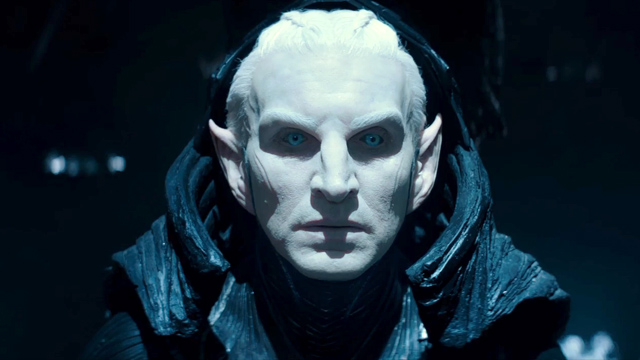
Man what a waste of a Christopher Eccleston. They don’t go on trees you know!
Now you might be wondering, “Wait a minute, what about Thanos. Surely the Mad Titan will be a major threat to the Avengers once The Infinity War Movies come around.” My response to that is simply, “Sure, if he actually does something.” Thanos has been built up so much that he can no longer intimidate us based on his design. He needs to actually do something that’s worth his anticipation. And now, I’m not seeing it. Especially considering Guardians of the Galaxy had the perfect opportunity to show off his destructive habits, but neglected to do so. Sure, it could have been because of time, but having him sit around saying what he might do to a character we aren’t invested in does nothing to build up his villain credibility. Now once the movies come out, then maybe Thanos will be as devastating as they make him out to be, but he’s just a vague adversary that’s coming eventually.
“I’m sorry, what’s my motivation?”
This is one instance where DC’s movies do have an advantage over Marvel’s. The Suicide Squad film is setting up villains that we’re going to see more of. We’ll see what makes them laugh, cry, and the struggles they go through. So, if and when we see them in the future, we’re going to have more of a connection to them. We may even feel sympathy towards them when Batman punches them, or we’ll get to see them in action. Say what you want about Joker’s face tattoos, his five seconds in the trailer was much more intimidating and memorable than most of the MCU villains. The movie might be shitty, but we’ll be able to see him in action, and actually cause some damage, which will make him a more viable threat.
That’s one terrifying Jared Leto.
However, there is one case where I am very happy to say, Marvel created a perfect villain. Wilson Fisk in Daredevil was fascinating on so many levels. He was sympathetic, he was intimidating, he took action, and it was impossible to tell how he was going to react to whatever situation was given to him. He was a great villain for the hero to overcome, and fight against. He had a love in his life that was heartbreaking to see get torn apart. He also didn’t die, and there are many stories and ways to bring him back, not just in the Netflix Marvel pocket, but the entire MCU. Vincent D’Onofrio did a great job giving this character a much more depth, and complexity than any of the MCU villains. Because, the audience cares about him, and is frightened by him; he creates an emotional reaction out of people.
I think we can all agree this made everyone shit their pants.
Now in all fairness Daredevil had thirteen episodes to build up the characters, even the side characters, and the movies only have two and half hours at max, so obviously things need to be cut. But, that doesn’t mean the bad guy’s motivation, or struggle should be simplified to a point where they are two-dimensional cutouts.
Marvel is great at creating good super heroes that are emotionally complex, have internal struggles, and are not cookie cutter boy scouts. Even Captain America isn’t perfect. But, when they keep fighting the same boring, dull villains that bring nothing new to the table and then get killed off, there isn’t much reason to keep coming back to root for them.
We at Monkeys Fighting Robots are not sure if this is a really or fake Twitter account but the internet is starting to rumble with these photos of potential Spider-Man costume elements.
The Russo brothers are currently filming Captain America: Civil War and these photos could give us clue as to what the feel Peter Parker and Spider-Man might have. Will Peter Parker have a makeshift costume and then Avenger up to the traditional red and blue costume with the help of Tony Stark?
Again these photos could all be fake! What do you think?
Chris Pratt and Bryce Dallas Howard will return to ‘Jurassic World’ on Friday, June 22, 2018 Universal announced Thursday. Colin Trevorrow and Derek Connolly will write the script.


 All in all, three aspects related between them that can make or break video game movies and that Hollywood studio executives should have in mind when creating them. Baldino states that the closest movie to success based on the previously mentioned characteristics was Silent Hill (2006), but most others have failed terribly. We’re looking at you, Resident Evil. In terms of box office, Jake Gylllenhaal’s Prince of Persia (2010) “had a huge budget and big stars but fell just short of greatness and flopped”.