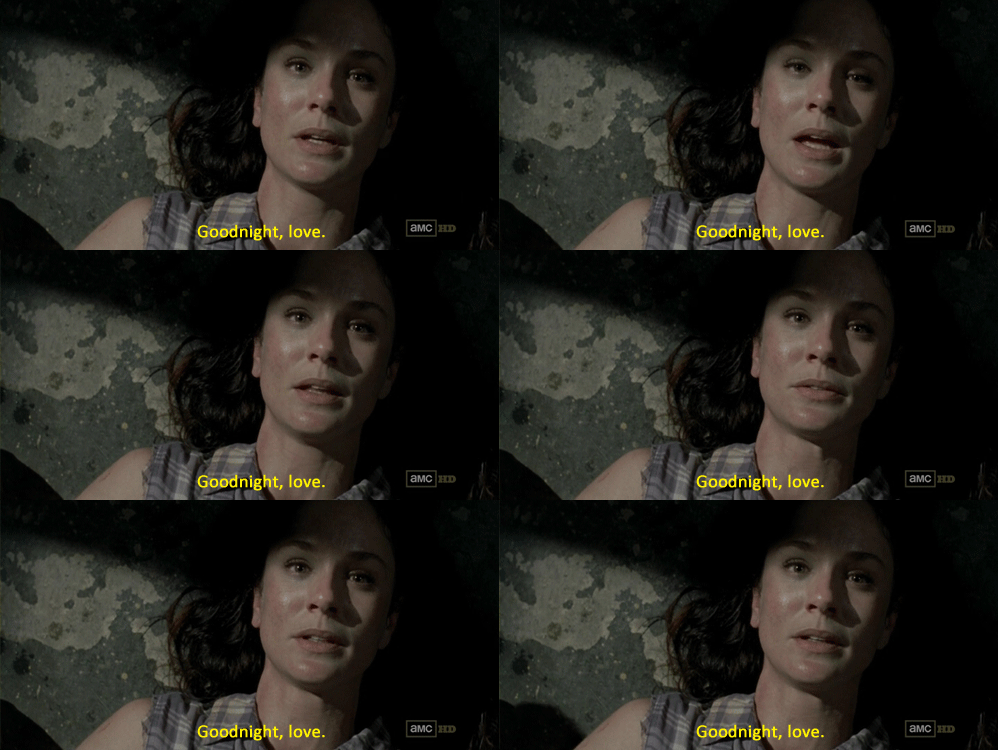
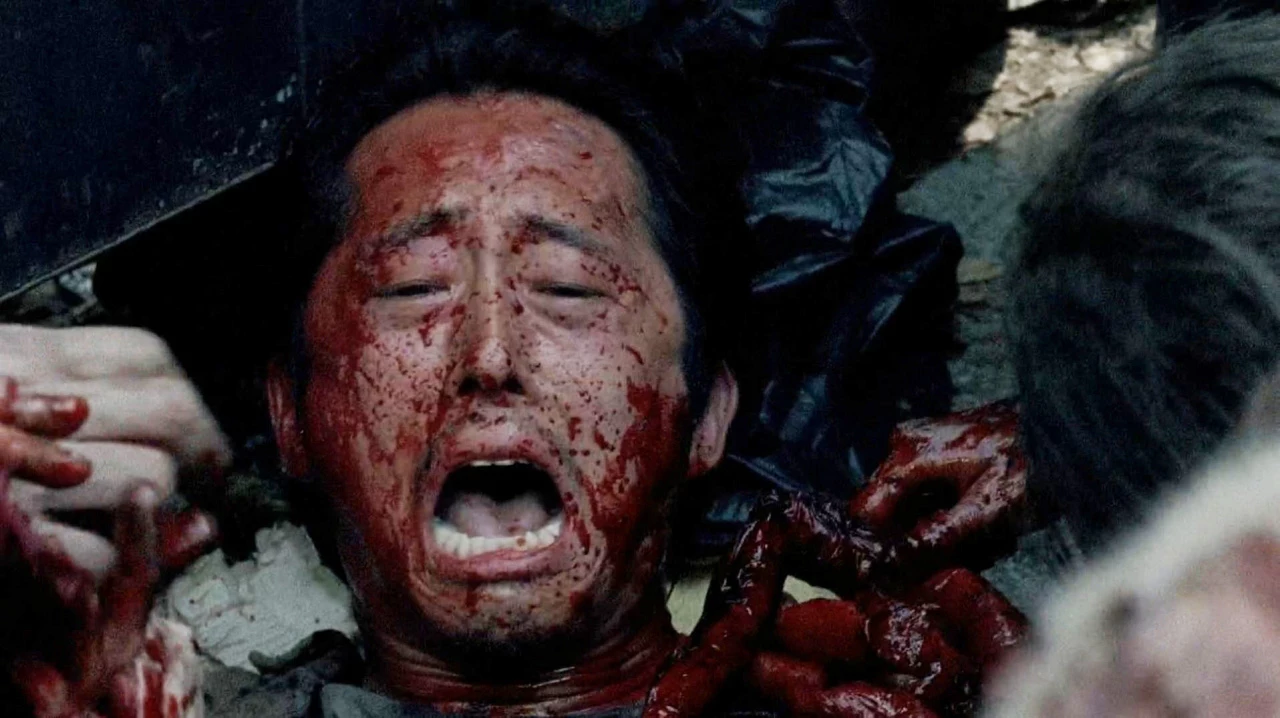
As AMC’s The Walking Dead inches ever closer to the dreaded first appearance of Negan, Rick and his group of survivors have a decision to make, and depending on that choice not everyone will make it out alive.
There are a few things that remain constant in The Walking Dead. One of those things is that Rick Grimes & the group are not good at making friends. In “Knots Untie,” Jesus leads them to his own group, which of course leads to squabbling. Jesus makes himself out to be a nice, trustworthy person by the end of the episode, but his friends aren’t quite as welcoming – particularly their leader, the snobby and creepy Gregory. Lots of characters crack wise, and a couple characters think about their romantic future and prospects.
We’ve still not seen Negan, but we do know he’s a mean fella, and that he’s not afraid to beat people to death. We also now know about Jesus’s people, and their role in the universe. Jesus, as it turns out, it not with The Saviors, but is instead with a group at Hilltop, which Rick’s group will almost certainly have destroyed by the end of the season. Maggie managed to keep a cool and level head when dealing with the creepy Gregory, snagging half of their food & medicine. Rick, on the other hand, stabbed a man’s throat out. Slightly different tactics, but both are in tone for the way The Walking Dead have been building their characters. But now, the group has promised to help Hilltop by taking out Negan, so we’re getting closer to the main non-zombie villain of the season. Or maybe next season, at this point.
We also see a lot more relationship building from the group. Abraham for the first time since the flashbacks, and he’s not doing great. Sure, his personality has hardly changed, but he’s had a change of heart – namely, he’s still with Rosita, but still finds himself feeling for Sasha. Rick and Michonne have now been exposed quite literally to the group, but everyone seems more or less okay with it. They’re a bit too cutesy in this beginning, which I hope isn’t going to be true for the rest of their relationship, but they are still clearly capable fighters. Glenn and Maggie are trying to have a child, and while that doesn’t seem smart based off what happened to the last pregnant mother, maybe things will be different. If Glenn is unkillable, maybe Maggie is too, especially as she’s really diving into the New Deanna role.
The biggest strengths of this The Walking Dead episode are that they set up future conflict. By bringing in the likely doomed Hilltop settlement, we have the leads invested in the conflict with Negan, as well as a readily expendable cast of side characters. This episode is more expositional than stand-alone, but it did do enough for itself to push things along. The added depth to Abraham, and better understanding of Jesus, made the episode feel worth it, as we know more about our bigger characters as well as our Hilltop zombie fodder. Overall, a slightly more lighthearted episode, which likely means the episodes to come this season will have things getting very dark, very quickly.
Warner Bros. and DC Entertainment are about to be disappointed. (Again.)
The record-breaking weekend box office number that Deadpool put up over Valentine’s Day weekend 2016? It’s going to stay at the top for comic book/superhero movies for a while, probably through the rest of the year.
How much did Deadpool make again?
According to BoxOfficeMojo.com, Deadpool, R-rating and all, brought in $132,464,639 in North America in its initial three days of release, including early Thursday night showings and IMAX showings. For the sake of keeping this analysis and projection as close to apples-to-apples as possible, this is the box office number to keep in mind, not the $150,000,000 four-day holiday weekend total often pointed to when talking about the film’s record-smashing success.
Hope you’re wearing brown pants!
The reason for this is simple: two of 2016’s remaining major superhero films — Batman v. Superman: Dawn of Justice, and Captain America: Civil War — do not open on weekends where Monday is a national holiday. Deadpool benefited from opening not only on Valentine’s Day weekend, traditionally a weekend when “date night” movie attendance goes up, but also on President’s Day weekend, so Monday business was more robust than it might have been otherwise. Yes, B v. S opens over Easter weekend this year, and Civil War has Mother’s Day weekend, but those holidays traditionally aren’t credited for boosting weekend box office take.
Giving Mr. Pool (and the studio behind him) his due
Credit Fox for a number of creative and marketing decisions that made Wade Wilson’s raunchy action romp such a juggernaut (apologies to Cain Marko) at cineplexes worldwide. The most important of these was, of course, the decision to trust in the dogged determination of those within the production, particularly Ryan Reynolds, who believed the product needed to carry an R-rating to give the fans what they wanted.
To fan boys and girls, that decision may seem like a no-brainer, but to bean counters and studio execs thinking about investments and not faithfulness to source material, this is a big deal. Going for an R-rating in a genre film generally equates to much lower box office expectations, as you’re cutting out (at least on paper) an entire demographic thanks to age restrictions. Have R-rated sci-fi, fantasy, and superhero movies been blockbusters? Sure – The Matrix series, the original 300, and even The Crow way back in 1994 stand out in that regard. But it’s a relatively short list when compared to the number of highly profitable genre films that aimed instead for the PG-13 rating in order to keep families and the 13-and-under audiences in the mix when realistically projecting net revenue.
So yes, by showing some faith in the product and the view of the people in that product who knew it was only going to work if it was done a certain way, Fox positioned themselves to reap enormous benefits. Not only does Deadpool give fans what they want in terms of meeting source material expectations, it also provides a marked alternative in tone and content to the shinier, less bloody and less profane offerings coming from the other studios. Like it or not, Deadpool stands as evidence that there is a substantial market out there for ‘superheroes’ who turn profanity into an art form and leave large, bloody body counts in their wake via head shots and decapitations, something the others simply do not do.
So all that said, why won’t this year’s remaining tentpole superhero flicks match Deadpool‘s opening weekend success?
Bats and Supes in for uphill battle
You really need to lay off the onion bagels, Bruce. Ugh.
To be fair, Batman v. Superman: Dawn of Justice does have some elements working in its favor, perhaps the most important of which is anticipation. Audiences have been waiting now for two years plus to see Bruce Wayne and Clark Kent go at each other, and there’s the added bonus of finally seeing Wonder Woman come to life on the big screen. Also, B v. S will benefit at least somewhat from the success enjoyed by its predecessor, 2013’s Man of Steel, which set box office records of its own when it first bowed in theaters in June 2013.
But coming on the heels of Man of Steel also has some drawbacks. For all the money that film made in its North American theatrical run — $117 million in its opening weekend, $291 million over 98 days of release — audience reactions to the film were decidedly mixed. The complaints ranged from the film being too long, too violent, too destructive, and too belabored in its third act climax to the fact that Superman was being portrayed by a British actor. Put all that together and you have an audience base that looks back at that film with ambivalence — if people are looking forward to seeing Batman v. Superman, its usually not because Man of Steel left them dying for a sequel.
There’s also the”Batfleck” factor. Regardless of the fact that Ben Affleck in the last decade has won Oscars, starred in and directed box office winners, and in general steered clear of box office stinkers, he’s still arguably defined by the period of his career marked by such howlers as Reindeer Games, Gigli, Surviving Christmas, Jersey Girl, and yes, his first outing as a costumed superhero, the much-maligned 2003 Daredevil film. For many people, especially Batman fans who didn’t unanimously embrace even a celebrated (if tempermental) actor like Christian Bale in the role, it’s simply impossible to see Affleck as the Dark Knight or his non-cowled alter ego, the handsome and haunted billionaire basket case Bruce Wayne. Granted, that skepticism can lead to the kind of morbid curiosity that often drives audiences to see films just because they can’t help themselves, but just as often it can lead to a production being written off altogether, or relegated to future Netflix or RedBox viewing.
And finally, well, Warner Bros. doesn’t exactly have a great track record when it comes to bringing these projects to the success they seem bound for prior to release. To date, the only superhero property the studio has managed to deliver successfully on a consistent basis has been Batman. Yes, Man of Steel was a financial success, but its immediate predecessor, 2006’s Superman Returns, was considered a huge disappointment, and prior to that film the Superman film franchise was dormant for 19 years. Prior Wonder Woman feature films never got beyond the pre-production stage. The Ryan Reynolds Green Lantern film is so maligned that even Reynolds himself took shots at it in Deadpool. And the 2007 Justice League film, which had a cast and a script in place, was doomed by an untimely writer’s strike. The studio seems snakebit when it comes to caped characters, and now they’re clearly rushing to play catch-up with the seemingly-unstoppable Marvel Studios profit train.
And speaking of Marvel Studios …
Civil War set to disappoint?
Ready? Dodgeball!
Honestly, Captain America: Civil War in all likelihood will deliver six figures when it opens on May 6. Unlike Warner Bros. and their previous track record, Marvel Studios has done nothing but deliver money-maker after money-maker, even when the fan base comes away from a particular film in the series less than satisfied with the results.
But there are signs of franchise fatigue, a phenomenon which could hold back Civil War from yet more unparalleled heights of profitability. One only has to look at last summer’s Avengers: Age of Ultron to see those signs manifesting themselves.
Believe it or not, from a box office standpoint, Avengers: Age of Ultron, despite being the #3 box office earner of 2015 behind #1 Jurassic World and #2 Star Wars: The Force Awakens, has been called a disappointment. Remember that line from Glengarry Glen Ross, delivered so memorably by Alec Baldwin?
“As you all know, First Prize is a Cadillac El Dorado. Anybody want to see second prize? Second prize is a set of steak knives. Third prize is you’re fired.”
Prior to 2015, the idea that the Marvel profit machine could come in second, much less third, to any other genre property was unheard of. Yes, the might of the Star Wars phenomenon was undeniable, but how could the centerpiece of all of Marvel’s ambitions, the Avengers, fall short of beating out a dinosaur movie?
Franchise Fatigue
There’s also the fact that the first film did so well and raised expectations so high that Avengers: Age of Ultron was set up to fail by the very benchmarks it previously set. The film goes bigger, goes international, adds to the size of its ensemble, and, to be fair, does it all while maintaining the humor, balance of characterization, and eye-popping action that has been the hallmark of Marvel productions.
But the box office comparisons don’t lie: 2012’s Marvel’s The Avengers made $207 million in its opening weekend. Age of Ultron, with all the anticipation built up from the phenomenally successful Captain America: The Winter Soldier and Guardians of the Galaxy behind it, “only” managed $188 million in its opening frame.
The lifetime theatrical grosses in comparison are even more telling. Marvel’s The Avengers? $623 million. Age of Ultron? $459 million.
What does that have to do with Captain America: Civil War? Plenty, if you consider that since the film’s enormous ensemble cast was announced, fans of the series have dubbed it “Avengers 2.5.”
IF that were actually true, and the film executed more like an Avengers film, then its potential for box office glory might actually be higher. But in truth, despite all evidence to the contrary, the main story beats that are being emphasized in the film’s trailers seems to point to this being a “Captain America” film, meaning its driven by Cap — his code of ethics, his relationships, his choices. And while Winter Soldier was a phenomenal success critically and commercially, Captain America’s appeal as a character to wider audiences simply is not the equal of some of his peers, perhaps most notably the appeal of the guy in the metal suit that Cap’s set to face off with in Civil War. How motivated audiences will be to see Captain America: Civil War will be determined somewhat by their enthusiasm for the Marvel series in general, but also by how invested they are in Captain America and his storylines, specifically.
So do people care about Cap trying to save Bucky, or potentially finding a love interest in Sharon Carter/Agent 13, played by the returning Emily VanCamp? Do they care about the world’s greatest soldier facing a crisis of conscience and a choice between which friend or friends to support and which to fight?
The answer just isn’t as much a resounding “Yes!” as Marvel and Disney would like to believe.
And what of Deadpool’s fellow mutants, the X-Men, and their new movie, also coming in May?
Apocalypse Falling?
You get cable on this thing? Choice!
Fox’s “other” superhero offering this year (and isn’t it amazing that the X-Men franchise could be relegated to “other” status by a little movie starring the Merc with a Mouth) does have a few things going for it that B v. S and Civil War do not. For one, it opens on a bonafide four-day weekend, Memorial Day weekend, which may add to its Sunday totals as kids and families will be out a little later than they otherwise might be to see movies.
X-Men: Apocalypse also benefits from following up X-Men: Days of Future Past, a film that while its box office receipts fell short of franchise records was almost universally acclaimed by both critics and movie goers alike. DoFP currently stands at 91% on RottenTomatoes.com, and when it opened on Memorial Day Weekend in 2014 it delivered an impressive $90,823,660 three-day total in ticket sales. That may seem small in comparison with the six-figure takes we’ve been talking about thus far, but keep in mind that DoFP’s immediate predecessor, X-Men: First Class, only managed $55,101,604 during its opening in June 2011. In effect, DoFP almost doubled First Class‘s initial take, and went on double the earlier film’s worldwide take. In every measurable way, X-Men: Days of Future Past legitimized the rebound of the X-Men franchise started with First Class, a rebound now continued by Deadpool.
That said, Days of Future Past had one thing going for it that X-Men: Apocalypse does not: Hugh Jackman and his alter ego, Wolverine.
Though the Wolverine solo films have been a mixed bag in terms of box office success, there’s no denying that having the character at the forefront of the X-Men ensemble efforts has done nothing but boost the films’ profit potential. When he’s been absent, as he was in First Class (no, the funny cameo doesn’t count), audiences have been less inclined to show up.
Yes, Apocalypse boasts the presence of two 2016 Academy Award nominees in prominent roles — Jennifer Lawrence and Michael Fassbender — and perhaps more importantly to fan boys and girls will introduce fan favorite character Betsy Braddock, a.k.a. Psylocke to the franchise. It will also re-introduce “classic” X-Men Cyclops, Jean Grey, and Storm played by younger actors, as befitting the film’s 80’s time frame, which should lend some curiosity value to the incentive for rushing out and seeing the film opening weekend.
But will that be enough? Again, look at DoFP‘s opening weekend – crushed by Deadpool‘s number. Apocalypse, despite its huge cast and equally impressive budget, in all likelihood just doesn’t have the mojo to beat out ol’ Wade out of the gate, and don’t be surprised if its totals for the entirety of its run fail to match, either.
Deadpool Kills the Marvel Universe (and the DC one) … for now
Beat out Deadpool? Hoary hosts of Hoggoth – magic doesn’t work THAT way!
So when will Deadpool‘s impressive box office number be topped next by another comic book franchise film?
Not in 2016, for certain. If the three major releases discussed here don’t do it, it’s a given that Doctor Strange in November won’t do it, either. Suicide Squad from Warner Bros. and DC Entertainment stands a better chance when it hits theaters in August, as its grittier tone and focus on villains bears a superficial resemblance to Deadpool in terms of approach. But a six-figure opening weekend is unlikely, even with fan favorite characters Joker and Harley Quinn prominent in the film’s marketing.
Look to 2017’s Guardians of the Galaxy Vol. 2 to finally snatch bragging rights back to Marvel Studios from Wade Wilson’s lil’ bloody profane superhero movie that could.
Now if only the folks running Deadpool’s Twitter handle would keep up the snark and the gloating until then.
Ben Affleck dropped by Jimmy Kimmel Live after last night’s Oscars to deliver yet another look at Batman v Superman: Dawn of Justice. Rather than another trailer, Batfleck gave us an extended take of the battle between Superman and Batman in the rain. And it’s very late at night…
https://youtu.be/GqsDwASsGN8
This looks like serious business, and Batman and Superman look great. Even though it’s about as aesthetically dark as it could possibly be. We all know these two are gonna hug it out eventually, but it’s nice to see a little bit of the battle.
Batman v Superman: Dawn of Justice hits theaters March 25. Tickets went on sale this morning.
Being average may seem like no-effort-work, but it is far more difficult than it so appears. When there is nothing special, nothing truly significant about you, the feelings can weigh down. And when the slightest bit of X-traordinary light is shifted in your direction, something that could make you pop, you will grab hold like it is the most fantastical thing in the world. Or, in Bailey’s situation in Marvel’s newest X-series, X-Men: Worst X-Man Ever #1 (of 5), he will hold onto that new spark of difference like it is the last chance to be anything but “normal”.
Bailey has lived his life as an average kid, going to a normal school and making plans for rejection to his normal prom. Yet, when his parents drop an X-gene bomb in his lap, Bailey takes the near unimaginable news with… Excitement! A mutant? Him? Finally! Something that will make him stand-out. Or will it? When it is announced that his special ability could bring his life to an explosive end, Bailey must accept his own reality. He may just be the most normal mutant ever!
Though we don’t live in a world filled with super-powered heroes and psychopathic villains trying to take over the world on a day-to-day basis, being the definition of normal echoes in the real world. Marvel’s new limited series, X-Men: The Worst X-Man Ever, plays on our recognition of “average” by giving us a character that is recognizable both emotionally and mentally. A character who wishes to grow, but due to personal (and genetic) limitations, finds himself constantly running into a brick wall.
Say Anything frontman, Max Bemis, has been known to make statements within his books. With titles such as Polarity (Boom! Studios), the story of Timothy, a man who’s problems with mental illnesses is only surpassed by the new awareness of super-abilities. Once relieved form his medication, a whole new world opens up. But is mental strife worth super-power? Writing a book like X-Men: Worst X-Man Ever, makes sense. Though it is not as deep as mental illness, the reality of Worst X-Man is very sharp. Like Polarity, it tells a story that at its core can be related to by much of the audience.
In Worst X-Man a boy who has never known anything but the very middle is taken out of his safe zone and thrown into a world completely out of the ordinary. He deals with the incredible and unbelievable. All of which is then shattered with rejection and hardships. Minus the Marvel-izing with the mutant gene, that is pretty much the definition of the typical modern day, real world high school experience! One that many of us can recognize.
Michael Walsh (Secret Avengers), along with colorist Ruth Redmond (Deadpool vs. Thanos), takes an interesting artistic perspective of Bemis’s new X-story. His style seems like the intriguing mix of Fiona Staples outlines and coloring techniques mixed with Erica Henderson’s (Unbeatable Squirrel Girl) animated features. Broken inks that transition one color into the next. Bailey’s orange hair is just fluff atop his head. Though fun, the soft greens and pastel purples are meant to lighten moods when even the darkest events happen, yet rock the reader in and out of normalcy.
X-Men: The Worst X-Man Ever #1 (of 5) plays at the connections between the characters, the emotions and the real world audience. Invoking emotional rejection, loss and the ability to overcome. As well as feelings of simplicity. Of… Normal! And the ups and downs of living along the middle. He may not be super interesting, he may not have any noteworthy characters but Bailey will make a (probably accidental) X-citing new addition to the X-Men.
Make sure to stop by your local comics retailer and pick up X-Men: The Worst X-Man Ever #1 (of 5).
Diamond Thug is an indie-electric rock band from Cape Town, South Africa and the band released their new album ‘Monday Will Have To Wait’ on Friday.
The new album is sitting at number five on the Alternative charts in South Africa on iTunes.
Diamond Thug is made up of Chantel Van T – Vox/Synth/Guitar, Adrian Culhane – Backing Vox/Synth/Guitar/Production, Danilo Queiros – Backing Vox/Bass/Production, and Ted Buxton – Drums.
Diamond Thug was born as an experimental project by Chantel Van T and Danilo Queiros in the Spring of 2012. The band explored and combined various electronic genres, using only a computer and voice. In early 2013 Adrian Culhane joined the band as a composer and drummer, as they began to perform their compositions live. Adrian later took the role of guitarist, leaving space for Ted Buxton to join as a drummer in early 2015.
Oooh ooh ooh
I feel your desire.
Oooh ooh ooh
and I can’t hide it.
Have you felt the lift of the light?
Felt the shadow and drifted at night?
Have you felt the release of your physical bounds
and held the hand of someone you love?
Do you know how it feels?
Do you know what it feels to feel like love?
Do you know what it means to love?
Oooh ooh ooh
I feel your desire.
Oooh ooh ooh
I can’t hide it.
I feel, I feel, it’s what I feel now
You won’t be fulfilled being a seeking man,
so find your desire, well if you can.
Will you know what it feels to feel like then? Oh!
Do you know how it feels?
Will you know what it feels like then?
Will you know what it means to love?
Oooh ooh ooh
I feel your desire.
Oooh ooh ooh
I can’t hide it.
I feel, I feel it’s what I feel now.
Have you felt something truer than true?
Well my mind’s eye is keeping me to you.
Oooh ooh ooh
I feel your desire.
Oooh ooh ooh
I can’t hide it.
I feel, I feel it’s what I feel now
Ridley Scott’s Prometheus sequel, Alien: Covenant, and Shane Black’s The Predator now have official release dates. One makes sense, another is a little odd.
The Predator will be released March 2, 2018. That’s a somewhat solid date for a fourth film in a franchise that’s been absent for a while. It will presumably be the week after the Oscars, which is a pretty solid place on the calendar as Hollywood pushes forward and gets their heavy hitters going for the year.
Meanwhile, Alien: Covenant has been moved from its initial October 2017 release date back to August 4, 2017. Yes, this is a summer release date technically. But most of the time, the big tentpole summer blockbusters are beginning to thin out when the calendar moves to the dog days. October is much better, at least if feels that way to me. Maybe this is reading too much into release dates (it is), but release dates can say quite a bit about studio confidence.
Fox has scheduled PREDATOR for release on March 2, 2018.
Alien: Covenant has collected a diverse and intriguing cast, including Inherent Vice’s Katherine Waterston, Danny McBride, Billy Crudup, Demián Bichir, and Carmen Ejogo joining Michael Fassbender, the only returning star from Prometheus.
Oscars 2016 had a tough fight this year from the jump. With #OscarsSoWhite dominating the headlines leading into the night, racial inequality in the industry was sure to be a hot-button issue for host Chris Rock. Thankfully, Rock didn’t bow to the pressure and boycott himself, because his work here was important, amusing, and it inundated the telecast to the point where the sting was taken out of the negative press.
The Academy is making strides to ensure the outrage over Oscars 2016 was not a futile protest. It’s been time for change in the voting body for a while now; it’s sad it came to this, true, but at least now, moving forward, steps have been made. All that being said, Chris Rock handled the controversy with volume shooting, staying away from the edge but making enough clever quips and jabs along the way so everyone can hopefully move forward.
And now for the awards portion of our evening.
– The 88th Academy Awards was one of the better, more balanced ceremonies in a long time. Mad Max: Fury Road won six of its ten nominations, dominating the technical side of things. As it should have. Leonardo DiCaprio finally got his gold, and Alejandro Inarritu took home his second consecutive Best Director statue (the first time that’s happened since the 50s).
Some may scoff at Inarritu’s second win in as many years because of the relentless marketing campaign he mounted surrounding the grueling shoot of The Revenant. I preferred George Miller, but there is no denying the scope of his picture. It most certainly was a tough shoot, no matter how may times he thinks he has to tell us it was. I respect the work he and his team put in.
– And how about that DiCaprio acceptance speech? Great work Leo, we all know you had time to practice…
https://youtu.be/dyp_DVgT260
– It feels right that Spotlight won Best Picture. It’s been my favorite all along, as much as I loved Fury Road and enjoyed (yes, enjoyed) The Revenant. Spotlight is a grown-up picture about important things, told through a compelling lens of truth. Well deserved.
– Mark Rylance is fine in Bridge of Spies. But better than Stallone and Tom Hardy? I was in the Stallone camp, not just because he was due, but because he did great work in Creed. If it wasn’t him, I was pulling for Hardy, the best part of The Revenant. Alas, it went to Rylance, and he’s good. But not better.
– The most awkward moment of the night had to be Sam Smith winning Best Song for his dreadful Spectre tune, right after Lady Gaga (introduced by Joe Biden, no less) delivered a touching and emotionally devastating rendition of “Til it Happens to You” from The Hunting Ground. Gaga brought the house down – her specialty these days at awards shows – and then Sam Smith gets up there for an abysmal Bond theme? Bad move, Oscars.
– Not sure how the “In Memoriam” forgets Abe Vigoda.
– Louis C.K. and his intro of documentary short feature was great. Hilarious, and truthful, just like everything he does.
– I still don’t quite know what the Stacey Dash bit was about.
– I’m gonna miss Jacob Tremblay until he does another film.
Overall, despite the controversy surrounding it, Oscars 2016 delivered some wonderful balance to the winners, solid comedy, and memorable moments overall. I’m ready for next year, when we’ve hopefully corrected some of the diversity issues the industry faced this year and in decades past. It’s time.
When you think of the oldest examples of superheroes being translated to the movies or television, likely you think of a DC Comics character. And no wonder, because Marvel didn’t become a significant success until Fantastic Four in the 1960’s. Superman and Batman were in the comics in the late 1930’s and were quickly snatched up for movie serials, WWII war bond ads and, in the case of Superman and Captain Marvel, 1950’s TV. DC is credited with creating the superhero genre, having published the first superhero comic ever with Superman’s first appearance in 1938.
“I’m Stan Lee. This is Jack Kirby.”
Marvel, on the other hand, is credited with making comic book superheroes feel real. While DC’s characters are big, larger than life characters, loosely based on ancient mythology (with a sci-fi slant), Marvel’s characters, whether sci-fi or more mystical fantasy, were always characters you could relate to. They gave the secret (or not so secret) identities of these characters a life beyond waiting for something bad to happen to they could find a phone booth (or something) and become the costumed crime fighter in the front of the comic.
“Wanna watch Baywatch?”
Marvel was ‘late to the game”, so to speak, but they also upped the game, reinvigorating what was a dying art form at the time by creating real characters. To hear Stan Lee tell it, this all happened because he was sick of comics and tried to get fired by doing things his way. I wouldn’t recommend doing that at your job unless you have something to fall back on. But it worked for Stan Lee and the comic book medium as a whole because DC also started giving their secret identities more interesting private lives, in imitation of Marvel.
With movies it was the same way, DC was the first to put their characters on the big screen. It had been that way since the black and white movie serials. Christopher Reeve and Michael Keaton made us believe a man could either fly or play a dark Batman. Marvel was late to the game here too, having successes with The Incredible Hulk TV show and a few cartoon series, but watching DC get far more movie business from the 70s-90s.
Before he became a household name with his SpongeBob cameo.
But why didn’t Christopher Reeve ever hang out with Batman? Or Michael Keaton with Superman? Warner Bros. owns DC Comics. Adam West was a little older than Christopher Reeve. They could have done an older Batman in a Superman: The Movie follow-up, just like they’re doing now. Or recast. What did it take for DC Comics to do a shared universe in the movies, even after (thanks to Bruce Timm), they had a lot of success with that kind of thing in cartoons?
Well, Marvel did it. Just as DC Comics started the superhero genre so that Marvel could improve on it, now DC is scrambling to imitate the incredible success of the MCU with admittedly better-known characters than Iron Man. I don’t know if those Internet rumors about Warner execs being worried about Batman v. Superman and looking for a way to readjust by pushing a Ben Affleck Batman movie forward are true. But a good chunk of the reason that DC is pushing the Justice League movie forward first and then doing solo films is not to look like they’re imitating Marvel (again). They’re doing it backward, so it looks different, just like what some people do with copyrighted video on YouTube.
Or it could it be that someone who is in charge of these films pointed out that Iron Man, Guardians of the Galaxy and Ant-Man were once second or third-tier characters and figured out that they would be justified in rushing things a bit because everybody knows who Superman and Batman are. They can put the Superman/Batman logo on a movie poster or in a department store and people will recognize it easier than “that astronaut riding the ant or whatever.”
“Holy…is that David Hasselhoff?”
What do you think, Marvel and/or DC fanboys? Is DC Comics the jealous sibling that tries to imitate what his (younger?) brother does? And why did we never get the Adam West/Christopher Reeve/Lynda Carter Super Friends movie that I dreamed about when I was six? Sound off in the comments section.
One of the first trailers we saw for Captain America: Civil War brought back a familiar face from the early days of the MCU, from their second movie in 2008. It was General Ross, from The Incredible Hulk (starring Ed Norton). Up until this point, the only thing from that particular movie that made its way to the rest of the MCU was the Hulk himself (in The Avengers) and a brief reference to General Ross in Agents of S.H.I.E.L.D. Sure, they referenced the super soldier serum and S.H.I.E.L.D. in that movie before the first Captain America came out (and Tony Stark had a cameo), but being that Incredible Hulk was one of the lower-grossing MCU movies, a lot of the stuff they introduced got pushed aside. Later, we found out why.
“Because it was classified!”
I’ve always said that one of the reasons The Incredible Hulk didn’t do as well at the box office was because of the abysmal Ang Lee version, simply titled Hulk. Comic book fans were curious about this whole movie universe that Marvel was building, but mainstream audiences stayed away because the other Hulk movie sucked. They wanted something like the old TV show and instead got Hulk’s daddy issues and a lame battle with Hulk dogs. When the better version came out, the taste of that other movie was still in their mouths. So, they stayed away from a Hulk movie that blended the original comics and the Bill Bixby/Lou Ferrigno TV show very well while setting up better films.
Then, when The Avengers came out, THAT was when Hulk made his comeback, as he was one of the standout characters. Joss Whedon managed to make him funny without compromising who he is, the angry monster. The “rag doll” scene between him and Loki remains one of my favorite scenes in an MCU movie. (On a personal note, I met my wife the day The Avengers came out, and this scene was the first time she heard me laugh out loud.)
We know that Hulk will make his next appearance in Thor: Ragnarok and that he will team up with Thor. Fans are hoping for elements of the Planet Hulk and World War Hulk storylines from the comics in this film, which will take place mainly off-planet. We know that there is some kind of legal matter over Marvel sharing the rights with Universal (producers of the Ang Lee version) that would make a solo Hulk movie more expensive, not to mention the cost of keeping a CGI character on the screen for an extended period of time. The same reason the last TMNT movie focused on the human characters so much, as this film centered around four hulking monstrosities that couldn’t possibly be stealthy ninjas. I suspect Mark Ruffalo will shrink down to Banner or hide in the shadows a lot in Thor 3.
So, between the extra cost of CGI and the rights dispute with Universal, two characters from The Incredible Hulk have gotten brushed aside. Betty Ross, Hulk’s love interest/General Ross’ daughter, and Samuel Sterns, fellow scientist who, in the comics, turns into iconic villain The Leader.
Now, a hero’s girlfriend in a movie can very easily be written out of a series. James Bond has had twice as many “girlfriends” as he’s had movies. (cough…cough…Jane Foster.) Maybe there can be some dramatic reunion down the road, but they were apparently setting The Leader up to be the villain in a follow-up. And the last time we saw Samuel Sterns, he was on the ground with some of the gamma serum he had made from Hulk’s blood dripping into his head. His head was pulsating like a heart and a smile was spreading across his face as a knowing nod to the audience that he would be the villain in the sequel.
“I look better green.”
And he wasn’t. They never made another solo Hulk film or included him in anything else. Hulk will most likely not be in Civil War, and it’s unlikely that The Leader will show up in whatever planet or dimension that Thor: Ragnarok takes place. Now that General Ross is returning to the MCU, would you like to see a future Hulk movie (Phase Four? Five? Six?) where Bruce Banner is reunited with Betty Ross and fights The Leader? Let me know in the comments below.




 Being average may seem like no-effort-work, but it is far more difficult than it so appears. When there is nothing special, nothing truly significant about you, the feelings can weigh down. And when the slightest bit of X-traordinary light is shifted in your direction, something that could make you pop, you will grab hold like it is the most fantastical thing in the world. Or, in Bailey’s situation in