Batman v Superman: Dawn of Justice is on track for a massive opening weekend, despite incredibly mixed feelings about the footage we’ve seen so far. According to Deadline, the showdown between Bats and Supes is on track for a $140 million opening weekend stateside, matching that of Deadpool.
But that isn’t the whole story.
Batman v Superman is opening worldwide March 25, which also happens to be Easter weekend. With the global release, including China, BvS is on track for a $300-$340 million opening weekend. This should quell any concerns DC has about the film eventually being a success.
Rumors abound that Batman v Superman needs to earn a billion bucks to be consider a success. A $300 plus million opening weekend will go a long way to covering that. Then you have DVD releases and so on and so forth… Fans anticipating this film can stop worrying this will be the ruin of the DC Universe.
If BvS pulls in what is expected, it would be the fifth highest-grossing superhero flick after Avengers ($392.5M), Avengers: Age of Ultron ($392.5M), Spider-Man 3 ($381.7M) and Iron Man 3 ($372.5M).
In the meantime, Zack Snyder and Co. continue to drop TV spots and clips in this aggressive marketing campaign. Here is the latest TV spot, where Batman is ready to throw down:
The first trailer for the much anticipated (and ridiculously controversial) Ghostbusters reboot is finally here. This time around, gender roles are reversed, but Paul Feig’s new film seems to have an identity of its own and plenty of humor to boot.
Here it is:
Here is the official plot synopsis, which keeps everything pretty mysterious:
Ghostbusters makes its long-awaited return, rebooted with a cast of hilarious new characters. Thirty years after the beloved original franchise took the world by storm, director Paul Feig brings his fresh take to the supernatural comedy, joined by some of the funniest actors working today – Melissa McCarthy, Kristen Wiig, Kate McKinnon, Leslie Jones, and Chris Hemsworth. This summer, they’re here to save the world!
This new Ghostbusters has generated plenty of unwarranted controversy because, heaven forbid, the characters are females this time around. This does seem to be more of a reboot than the third entry of the franchise, or perhaps its a mixture of both similar to The Force Awakens. Paul Feig has built enough credibility, at least with me, so maybe this film deserves the benefit of the doubt, at least a little bit.
What do you think? The new Ghostbusters hits theaters July 15.
Speculation of a potential breakup was running ramped this week about the Foo Fighters since Dave Grohl’s Oscar performance Sunday. The New York Post’s Page Six reported there’s “tension” between band members Dave Grohl and Taylor Hawkins, citing an unnamed source, who claims Grohl is ramping up a solo career.
The Foo Fighters on Wednesday posted a Tweet they were going to make an official announcement.
Official band announcement tomorrow night. Stay tuned.
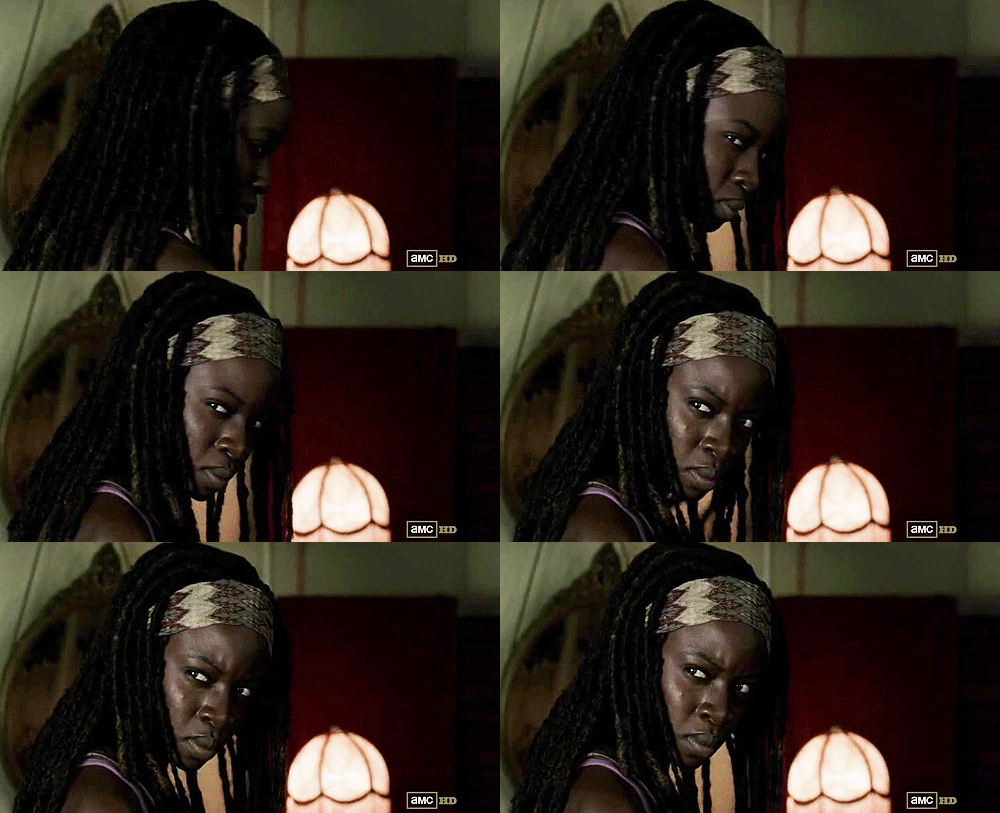
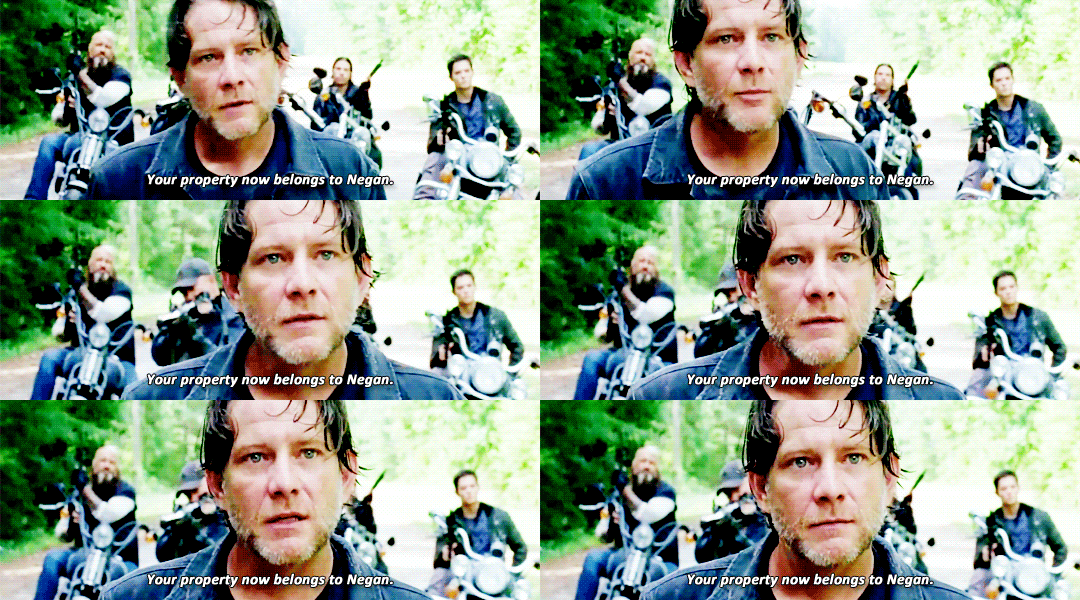
Would Michonne’s Death Caused By Negan Make Him Public Enemy #1?
Following 6 seasons of zombie-filled drama, ‘The Walking Dead‘ is in need of a major shakeup. Walking Dead was once on par with ‘Game Of Thrones’ for being known to kill off major characters whenever they felt like it. Now, they’ve off the expendable roles in mass qualities as an attempt to shock us. The desensitized viewers of television have come to expect a high-level of surprise & brutality and ‘The Walking Dead‘ is in desperate need to hit us where it hurts. They need to destroy everything we love.
This means the upcoming villain Negan has to kill fan-favorite Michonne!
Yes, comic fans…I know who is “supposed” to die if following the Walking Dead comics but that doesn’t mean we can’t have an all-out bloodbath as Negan’s introduction. The show has made drastic changes to stories from the comics and this could be a change for the better. It would also propel the character of Negan, played by Jeffery Dean Morgan, into infamy! This would instantly give the fans a reason to hate the villain; the hatred would run far deeper than one for previous villain The Governor. Not only would it anger the fans but it would throw multiple characters on the show off the deep-end.
Characters like Michonne’s new love interest Rick Grimes and his son Carl.
Lead character Rick isn’t allowed to have anything good happen to him. While he has a long-standing girlfriend in the comics, he has yet to have such luck on the show. His new romance with beautiful but bad-ass Michonne is a breath of fresh air. That’s why they need to suck the air from our lungs.
Danai Gurira, who plays Michonne, is also becoming quite the star in Hollywood and Broadway. It’s something she’d need to free up her hectic Walking Dead schedule for. Gurira is by no means doing a poor job on the show. She performs the role perfectly and is vital to the story. Her leaving would send the entire show for a loop & change the dynamic for the upcoming seventh season.
The fact is, Michonne is important to the fans & the characters. Her death would cause a rebellion. That’s why it has to be Negan that kills Michonne is his introduction & the sixth season finale!
The Boy Who Could Fly follows the story of a young girl and her family that have just moved into a new neighborhood. Quickly, she becomes fascinated by her neighbor: An autistic boy her age who seems to always be readying himself to fly. Why? Because he believes he can do it. For too long, The Boy Who Could Fly feels like it doesn’t have a particular focus, throwing in subplot after subplot about the family adjusting to their new life. But after a while it’s easy to realize that the movie isn’t so interested in the titular character, but rather, his effect on everyone around him. Writer and director Nick Castle establishes a sense of reality through the family drama, slowly bringing in the more fantastical elements.
With its touches of magical realism and focus on children, family and suburbia, the move joins the league of other “Amblin-esque” films of the 80s. That’s not to say that writer/director Nick Castle was attempting to imitate themm just that it feels right in line with the likes of E.T., The Monster Squad and The Goonies. The problem with this movie is that it feels like it needs a more assured director such as Spielberg or Richard Donner. The placement of music or emphasizing certain sentimental elements too much takes away from the movie, and it’s at these worst parts of the movie where it feels more like a wannabe rather than a sincere work. At the same time, in terms of visuals, the movie feels like it should be stronger. These feel like odd missteps for Castle given that his previous film The Last Starfighter falls under the same leagues, but has a confidence that this movie lacks, despite this being a much simpler, more grounded story.
Thankfully, the movie ends perfectly. It does go on for a bit longer than it should, but the ending is charming and surprising and everything comes perfectly together into place. Its flaws may be the reason why The Boy Who Could Fly hasn’t quite reached a classic status, but the movie has its fans and it’s easy to see why. It’s charming and even a little magical when it works.
When DC Comics started spreading #blackcanarymusic around Twitter-sphere yesterday, more than a few eyes were raised. If you haven’t being reading Brenden Fletcher and Annie Wu’s Black Canary then you’ve been missing out. For the uninitiated, it’s TheBlues Brothers crossed with the superhero antics of the Birds of Prey. Given how central music is to the title, many began to put together Spotify playlists inspired by Black Canary‘s punk rock and indie aesthetic. DC have no decided to cut out the middle man and released a three track album simply titled EP1 purportedly produced by Dinah Lance and her crew to co-incide with the release of Black Canary Volume 1: Kicking and Screaming. In reality, the songs are the collaborative efforts of Brenden Fletcher, Michelle Bensimon and Joseph Donovan.
The viral campaign has been quite impressive with the hashtag gaining quite the momentum over the last 24 hours. Additionally, DC announcing tour dates in fictional locations such as Gotham, Keystone and Star City, putting together a tie-in website and even ticket stubs. It’s one of the cleverest ways of promoting a book that I’ve seen in a long time and whats more is that they’ve managed to produce some damn fine music in the process. The music of the fictional Black Canary group has been aptly described by the in-universe music critiques that accompany the issues as “a blend of electronic beats and killer riffs”. The album contains two original tracks; “Fish out of Water” and “Old World” as well as a cover of “The Man with the X-Ray Eyes”. It’s very reminiscent of the work of Blondie, something I’m more than willing to get behind. All of the songs are available for streaming on Band Camp (which you can check out below) or can be purchased for $3.50.
The cynics among you may cry fowl, but Black Canary‘s is the louder cry. This isn’t a forced endeavor, but rather a recognition of the excellent job that the creative team of done in making the intersection between superheroism and music stardom feel like a natural evolution of Dinah Lance’s character. Plus, if we are being honest, Dinah’s classic Black Canary costume makes much more sense if she’s a rock-star, even if naming your band after your old code-name isn’t the best way to keep a low profile.
With the release of EP1, DC is following a long-tradition of inter-textuality between the music industry and comics. Back in the 60s and 70s, The Archies‘ “Sugar, Sugar” was ruling the charts and leading a new wave of bubblegum pop. Back in the disco era, Marvel and Casablanca Records attempted to launch Dazzler as multi-media super-star to no avail. Interestingly back in our review of the series itself, we noted “Annie Wu’s interiors resemble a living album cover….Music is the heart and soul of the book and it creeps into the very artwork itself, almost as if it panels themselves were a song”. Did we call this on some level? You may very well think that, but I couldn’t possibly comment. Now then, when can we expect EP2?
This is not you Daddy’s Superman… Or wait. Maybe it is? DC Comic’s new limited series Superman: The Coming of the Supermen, by comics legend Neal Adams, has been one of the most hotly anticipated series of the new year. But, as we have seen in the past, a name does not necessarily equate to a masterpiece.
Superman is the most powerful and, usually, most reliable superhero on the planet. But when a boom tube appears in the middle of downtown Metropolis he is nowhere to be found. As a horde of parademons appear in front of a LexCorp building followed by the arrival of Kalibak, the son of space tyrant Darkseid, three questions arise: Why are they attacking LexCorp? Where is Superman? And who the heck are those guys dressed in his uniform?
“In a lengthy interview of my own, I asked Adams what he thought his best work was, and he answered “Batman: Odyssey.” I paused. After some back and forth, I admitted I never made it to the end.” –Dan Greenfield (13th Dimension)
It seems odd to be quoting a review of a completely different book, but bear with me for a second.
The idea that Adams so proudly claimed Odyssey as a “best work” is rather impressive. Odyssey, in of itself, was panned by critics. The book was all over the place and consisted of events that were questionable of a Batman storyline. Though the art was tolerable, many believed it lacked the true talent once demonstrated by the legendary artist.
And now… The Coming of the Supermen.
“The question is, can I read your mind and give you the Superman that you want? [Laughs] When I first did Batman and sort of revolutionized Batman, everybody said, “This is the way Batman ought to be!” They didn’t want him the way that he was depicted in the television show. “Neal Adams has created Batman!” No, I didn’t. It was the same old Batman that everybody forgot. His cape flows, and he goes around at night. He’s Batman. Hello! It’s just that [at the time] nobody seemed to know what Batman was anymore…
“I’m not saying DC Comics has lost their vision of Superman, but he does seem to be flying off the mark in different directions. I liked what Joe Shuster and Jerry Siegel did with Superman: Superman!”
Comic Book Resources can really get down to business and Adams has never been one to not answer, in his personal opinion, honestly. In his mind he is giving us the Superman we want and need. A story that will reconnect us to the Superman we loved before.
In so many ways, yes, he has. Adams creates a world that classic comic readers can more easily relate. A Lois Lane so locked in the news that nothing else matters. The playful banter yet obvious and malicious rivalry between Superman and Lex Luthor. The simple language and the American-Boy-Scout attitude of Clark Kent’s Superman.
That story, just as it is, is something we have not seen in a while. The every-man Superman. But is that the Superman we need following the lackluster back and forth’s of the DC Comic’s New 52 series? Not exactly. For those who have kept up with Superman yet are having difficulty with the over-powered, super-saiyan-esque, god-like Superman, Coming of the Supermen will be a call-back to a different time. More a breath of fresh air or diversion. Not a necessity. Especially once you get to the storytelling.
Like Odyssey, it jumps from plot point to plot point, creating confusion from the very beginning. Three Supermen arrive on Earth then next thing we know they are trying to assist in stopping a parademon invasion. All while Superman is saving lives in the Middle East. Then, out of the blue, an alien appears and tells him he must temporarily take a child into his personal custody before returning to save the day in Metropolis. Who is this alien? And why is he playing the shy-knight who has “said too much”? And it only gets worse.
Issue #1’s are meant to create questions, build drama and indulge in curiosities. Adams, at least, got the first part correct. There are so many questions. But the problem arises that a six-part miniseries may not be able to clear up the pea-soup-thick-fog.
To divert away from the writing and looking more closely at the art. The cover is phenomenal. Reminding us of the true talent behind the ego that defines Neal Adams. The interiors, for the most part, match up. Classically epic battle scenes. Larger than life characters that explode off the page. If anything, Neal Adams’s images can be just as powerful now as they have ever been. And, though barely mentioned in any solicit, Alex Sinclair’s colors help build the classic drama that Adams is so hoping to recreate.
But the artwork greatly over shadows the story. In many books art can help built stronger interest in a moderately written book. But the action-packed, brightly colored sequences seems to only detract from the plot. If that is even possible. Your eyes lock at one brightly colored point and then dart to the next while the words just seem to fade into the background.
Even with the strange plot jumping, Coming of the Supermen was already on the “collector’s required reading list”. Neal Adams creates beautiful visuals that, do not necessarily support a better written book, are wonderful to read through. Hopefully, when the second issues arrives, set for an in-store release of March 16th, there will be a more defined storyline.
Make sure to stop by your local comics retailer and pick up Superman: The Coming of the Supermen #1 (of 6) today.
War is hell. And for those of us fortunate enough to have never faced the horrors of war first hand (and for those of us who have), Hollywood has tried to give us a glimpse of that hell on earth. War films have evolved over time, and while the majority of them try subtly – or not so subtly – to take a stance on the validity of historical conflicts, the best ones manage to tap into the core of humanity, and the way killing can affect us all on a very base level.
Here are a dozen essential war films everyone should see at least once. Shout out to close calls here, Tarantinos’ Inglorious Basterds, The Dirty Dozen, and Hamburger Hill.
12. Born on The Fourth of July (1989) – Oliver Stone’s second film in his unofficial Vietnam Trilogy is less a war film and more an aftermath tale of regret, anger, and desperation, the undercard of jingoism. Tom Cruise is Ron Kovic, an idealistic young soldier who is paralyzed in battle and spends a great deal of the rest of his time back home protesting Vietnam and seething internally (and externally). Stone’s film is powerful and heartbreaking, and put a new face on the horrors of combat.
11. Glory (1989) – Civil War films are few and far between, but Ed Zwick’s seminal 1989 film about a platoon of African American soldiers fighting for the North captured the dichotomy of race relations in this particular war. These were soldiers, fighting for a cause, but still had to fight against the establishment to find the respect they deserved. Matthew Broderick worked to shed his Ferris Bueller boyishness here, and Denzel Washington took home a much-deserved Best Supporting Actor Oscar.
10. The Longest Day (1962) – 36 years before Steven Spielberg revolutionized war films, John Wayne’s The Longest Day told the story of the D-Day invasion from the perspectives of both Americans and Germans. The balance of the film is what allows it to keep its relevance and power. Wayne was never as strong or convincing in his war films as he was in his westerns, but here he is a perfect fit. Keep an eye out for a young Sean Connery as Private Flanagan.
9. All Quiet on The Western Front (1930) – One of the earliest war films to reach for epic scope, Lewis Milestone’s All Quiet on the Western Front still retains some of its power almost 90 years later. It is also a rare look at World War I, which seemed to have been fought thousands of years before WWII given the great differences in combat styles and technology. This is the story of a young man disillusioned by the horrors of war, and is one of those war films from which all others were borne.
8. The Hurt Locker (2009) – Kathryn Bigelow’s Best Picture winner was one of the very early war films examining the Iraq war. Bigelow shed the jingoistic political landscape of the 2000s to show not how war can ruin a person, but consume them entirely. The most telling moment of the film comes at the end, when bomb technician William James (Jeremy Renner), back from the desert, stands in the cereal aisle of a grocery store. He is lost in this world, and only feels at home when he is on the other side of the planet.
7. The Deer Hunter (1978) – Michael Cimino’s Vietnam saga is perhaps more famous for the controversy surrounding its depiction of the war and the Vietnamese soldiers than it is on a cinematic level. But, when taken more as an allegory – which I feel was the idea all along – The Deer Hunter is a powerful, moving look into the pollution of the human mind from the nihilistic landscape of the battlefield. De Niro shines, and Christopher Walken’s transformation into a near catatonic shell of a human being is undeniably impactful.
6. The Bridge on The River Kwai (1957) – A British soldier (Alec Guinness) agrees to oversee construction of a bridge for his captors, the Japanese military. He is unaware of the allies’ plans to destroy the bridge once it’s complete, setting up a fascinating tale of alliances and bravery in the midst of a somewhat impossible situation. One of David Lean’s greatest achievements, The Bridge on The River Kwai dominated the Oscars, raking in 7 Academy Awards including Best Picture.
5. Platoon (1986) – Oliver Stone’ first foray into Vietnam is his crowning achievement, and a very personal look at the moral corruption that at least played a part in our loss in Asia. The film tells the story of division within a platoon, almost a pro and anti-war division among soldiers. Loaded with great performances form young stars like Willem Dafoe and Charlie Sheen, it is Tom Berenger who stands tall as the villain, a grizzled man of war who lost sight of his humanity long ago.
4. Paths of Glory (1957) – Hidden in the shadow of Bridge on The River Kwai was one of Stanley Kubrick’s earliest masterworks. It won no awards, was nominated for no awards, but has since become a classic in the genre. Kirk Douglas plays a general who refuses to send his troops into the mouth of certain death. After being accused of cowardice, he and his men must defend their decision. There is no bandying about here, Paths of Glory is an anti-war film, and remains one of the most important of all war films.
3. The Thin Red Line (1998) – Terrence Malick had been absent from Hollywood for over two decades when he gave us The Thin Red Line, a meditative look on the expansive horrors of war on both man and nature. Filled to the edges with extended cameos, the tale of the war in the South Pacific in the middle of WWII is hypnotizing. It also features some of Nick Notle’s finest work, namely the argument he and Elia Koteas have over the phone regarding an assault on a ridge. Powerful stuff.
2. Saving Private Ryan (1998) –The Thin Red Line was overshadowed in 1998 by Steven Spielberg’s WWII drama that is both intimate and epic in scope. It begins with the D-Day invasion – easily the most intense 20 minutes ever captured on film – and then gradually devolves into a very personal, small story about a group of men possibly sacrificing themselves to rescue one man whose brothers have all been killed. Saving Private Ryan is a perfectly-executed, well-balanced film, full of some of the greatest performances in the genre.
1. Apocalypse Now (1979) – Francis Ford Coppola’s journey into the mouth of madness (or the heart of darkness) just about drove him insane as well. Apocalypse Now is not just a film about Vietnam, but a film about insanity. Everyone here is insane, or they are on their way to insanity as they travel down the river to meet their end at the hands of Colonel Kurtz. It’s also one of those rarest of pictures, one that evolves over time and speaks to a different aspect of our own minds depending on when we watch it. The layers are seemingly endless, and the haunting performances unforgettable.
The 2016 campaign for Frank Underwood (FU ’16) sent an email out Wednesday thanking supporters. The email contained a video with a short clip from Season 4 of House of Cards.
What’s in the folder!?
“I’ve always said that unconditional loyalty does not go unnoticed. You put your support behind my campaign, and now we are in a position to truly push America forward. Please accept this personal message as my gratitude,” said Underwood.
House of Cards was created by Beau Willimon, the series stars Kevin Spacey, Robin Wright, and Michael Kelly.
The fourth season of House of Cards will be available to binge watch on March 4.
President Francis Underwood’s official presidential portrait is unveiled at the Smithsonian National Portrait Gallery in Washington, DC.
Superhero movies are actually driving people to pick up comics again, some for the first time since childhood, others for the first time ever! Tons of fans look to the source material in order to prepare for an upcoming flick, but where is the best starting place? Here is the essential reading for Captain America: Civil War.
Civil War
After superhero negligence leads to the death of hundreds, the United States government enacts the Superhero Registration Act, requiring masked heroes to register their secret identities and become employees of S.H.I.E.L.D.. The super community is split down the middle, with Iron Man leading the Pro-Registration side, and Captain America leading the underground rebellion. The film can’t adapt this story directly. Heroes in the MCU don’t really have secret identities, and half of the characters featured in the book are owned by different film studios (most notably the Fantastic Four). However, the themes of liberty, privacy, public safety, oversight, and fascism will all be present, and that keeps the core of the story the same. Civil War is seven issues long, but it barely scratches the surface of the story. So much happens “offscreen” that fleshes out the characters, their motivations, and the ramifications of the war. Most of it can be found in the various tie-in books; see Marvel’s Official Suggested Reading Order here.
Amazing Spider-Man: Civil War
Out of all the Civil War tie-in stories, this is the most essential. Amazing Spider-Man issues 529 through 531 are “The Road to Civil War,” and help set the stage for the main event. Peter accompanies Tony Stark to Washington to discuss the looming Superhero Registration Act, and it establishes their relationship leading into the war. Then, issues 532 through 538 center on Spider-Man’s role in the war itself. Civil War is a good read, but it’s a very broad story and action heavy. The Amazing Spider-Man tie-ins are much deeper than that. They focus on Peter’s inner turmoil, and explore the grey area between the two sides. Peter is meant to be an everyman, and his thoughts/feelings are much more accessible than those of Captain America or Iron Man. Writer J. Michael Straczynski breaks down the themes of Civil War on a very personal level. Amazing Spider-Man: Civil War may even be better than Civil War itself, especially for fans who prefer depth and inner conflict over shallow action blockbusters.
Black Panther, Volumes 3 & 4
Black Panther makes his big screen debut in Civil War, and these two volumes are the best resources to understand his character. Two volumes may sound like a lot, but it’s largely where the filmmakers are pulling from as source material. Volume 3 – Christopher Priest and Mark Texeira gave T’Challa his first solo series in ten years, and fleshed out his character tenfold. The film is probably going to pull heavily from this volume in particular; Martin Freeman’s character has recently been revealed to be Everett K. Ross, who was a staple in Priest’s Black Panther series. Volume 4 – Reginald Hudlin and John Romita Jr.’s volume built off of Priest’s and further developed the Panther mythology. This is also the volume that intersected with Civil War, so, if you’re just looking to cram, you can focus on the tie-in issues. Issue 18 is the Civil War Ceasefire, and issues 22-24 are the actual tie-ins.
Everyone knows Spider-Man’s origin story by now; it’s not even being addressed when he’s reintroduced in Civil War. After the two film series by Sam Raimi and Marc Webb, many casual fans may even consider themselves Spidey experts. However, film has yet to truly capture the essence of his whole character. With Peter Parker finally being brought into the MCU, now is the perfect time to read into his history and develop a standard to measure Tom Holland’s performance against. Luckily, the entirety of Stan Lee and Steve Ditko’s original run on Amazing Spider-Man is compiled into a single Omnibus. Simply put, it set the standard for every comic that came after it. Ultimate Spider-Man was Marvel’s way of rebooting the character for a new generation in 2000. It’s also excellent, keeping true to who Peter is while making his story more accessible. The filmmakers will probably borrow more from this era than the 60’s one, but both are worth reading.
Captain America by Ed Brubaker
The MCU version of Captain America is pulled heavily out of Ed Brubaker’s run on the comics. Brubaker is the genius writer who wrote Cap’s story for eight years, creating the Winter Solider in the process and dealing with the aftermath of Civil War. His run is long; it’s all worth it. But, if eight years of comics is too much for you, center in on the period surrounding Civil War (Captain America volume 5, issues 22-25). It focuses more on his surrounding cast, all of whom are in the film, and leads directly into the “Civil War Epilogue” in issue 25. The Epilogue ties up some loose ends from the main story, and is absolutely essential. The story arc then continues on through issue 30.
Iron Man: Civil War
It feels right to have something related to Iron Man on this list, and his Civil War tie-in (Volume 4, issues 13 and 14) are probably the most fitting. However, they don’t really fall under the “essential” category. The hope is that Tony Stark’s solo series would give more insight into his thought process during the event, which it does. It just doesn’t do it to the extent that it should have. The main Civil War book is what gives the best look at Iron Man during this time. The issues succeeding the Civil War tie-ins then deal with the aftermath and the changes to Tony’s life. — Captain America: Civil War is in theaters May 6, 2016.


 This is not you Daddy’s Superman… Or wait. Maybe it is?
  It seems odd to be quoting a review of a completely different book, but bear with me for a second.
 Comic Book Resources


 After superhero negligence leads to the death of hundreds, the United States government enacts the Superhero Registration Act, requiring masked heroes to register their secret identities and become employees of S.H.I.E.L.D.. The super community is split down the middle, with Iron Man leading the Pro-Registration side, and Captain America leading the underground rebellion. The film can’t adapt this story directly. Heroes in the MCU don’t really have secret identities, and half of the characters featured in the book are owned by different film studios (most notably the Fantastic Four). However, the themes of liberty, privacy, public safety, oversight, and fascism will all be present, and that keeps the core of the story the same. Civil War is seven issues long, but it barely scratches the surface of the story. So much happens “offscreen” that fleshes out the characters, their motivations, and the ramifications of the war. Most of it can be found in the various tie-in books;
  Out of all the Civil War tie-in stories, this is the most essential. Amazing Spider-Man issues 529 through 531 are “The Road to Civil War,” and help set the stage for the main event. Peter accompanies Tony Stark to Washington to discuss the looming Superhero Registration Act, and it establishes their relationship leading into the war. Then, issues 532 through 538 center on Spider-Man’s role in the war itself. Civil War is a good read, but it’s a very broad story and action heavy. The Amazing Spider-Man tie-ins are much deeper than that. They focus on Peter’s inner turmoil, and explore the grey area between the two sides. Peter is meant to be an everyman, and his thoughts/feelings are much more accessible than those of Captain America or Iron Man. Writer J. Michael Straczynski breaks down the themes of Civil War on a very personal level. Amazing Spider-Man: Civil War may even be better than Civil War itself, especially for fans who prefer depth and inner conflict over shallow action blockbusters.
 Black Panther makes his big screen debut in Civil War, and these two volumes are the best resources to understand his character. Two volumes may sound like a lot, but it’s largely where the filmmakers are pulling from as source material. Volume 3 – Christopher Priest and Mark Texeira gave T’Challa his first solo series in ten years, and fleshed out his character tenfold. The film is probably going to pull heavily from this volume in particular; Martin Freeman’s character has recently been revealed to be Everett K. Ross, who was a staple in Priest’s Black Panther series. Volume 4 – Reginald Hudlin and John Romita Jr.’s volume built off of Priest’s and further developed the Panther mythology. This is also the volume that intersected with Civil War, so, if you’re just looking to cram, you can focus on the tie-in issues. Issue 18 is the Civil War Ceasefire, and issues 22-24 are the actual tie-ins.
 Everyone knows Spider-Man’s origin story by now; it’s not even being addressed when he’s reintroduced in Civil War. After the two film series by Sam Raimi and Marc Webb, many casual fans may even consider themselves Spidey experts. However, film has yet to truly capture the essence of his whole character. With Peter Parker finally being brought into the MCU, now is the perfect time to read into his history and develop a standard to measure Tom Holland’s performance against. Luckily, the entirety of Stan Lee and Steve Ditko’s original run on Amazing Spider-Man is compiled into a single Omnibus. Simply put, it set the standard for every comic that came after it. Ultimate Spider-Man was Marvel’s way of rebooting the character for a new generation in 2000. It’s also excellent, keeping true to who Peter is while making his story more accessible. The filmmakers will probably borrow more from this era than the 60’s one, but both are worth reading.
 The MCU version of Captain America is pulled heavily out of Ed Brubaker’s run on the comics. Brubaker is the genius writer who wrote Cap’s story for eight years, creating the Winter Solider in the process and dealing with the aftermath of Civil War. His run is long; it’s all worth it. But, if eight years of comics is too much for you, center in on the period surrounding Civil War (Captain America volume 5, issues 22-25). It focuses more on his surrounding cast, all of whom are in the film, and leads directly into the “Civil War Epilogue” in issue 25. The Epilogue ties up some loose ends from the main story, and is absolutely essential. The story arc then continues on through issue 30.
 It feels right to have something related to Iron Man on this list, and his Civil War tie-in (Volume 4, issues 13 and 14) are probably the most fitting. However, they don’t really fall under the “essential” category. The hope is that Tony Stark’s solo series would give more insight into his thought process during the event, which it does. It just doesn’t do it to the extent that it should have. The main Civil War book is what gives the best look at Iron Man during this time. The issues succeeding the Civil War tie-ins then deal with the aftermath and the changes to Tony’s life. — Captain America: Civil War is in theaters May 6, 2016.