

Almost “Dark & Gritty”; ‘Jungle Book’ Isn’t So Lighthearted Anymore
2016 continues to be a year that Disney releases mature animal-themed films. Following the socially conscious ‘Zootopia‘, the latest re-telling of ‘The Jungle Book‘ is not the laugh-out-loud family film it once was. Replacing the laughs are straight-up murder & Mowgli’s attempts to stay alive.
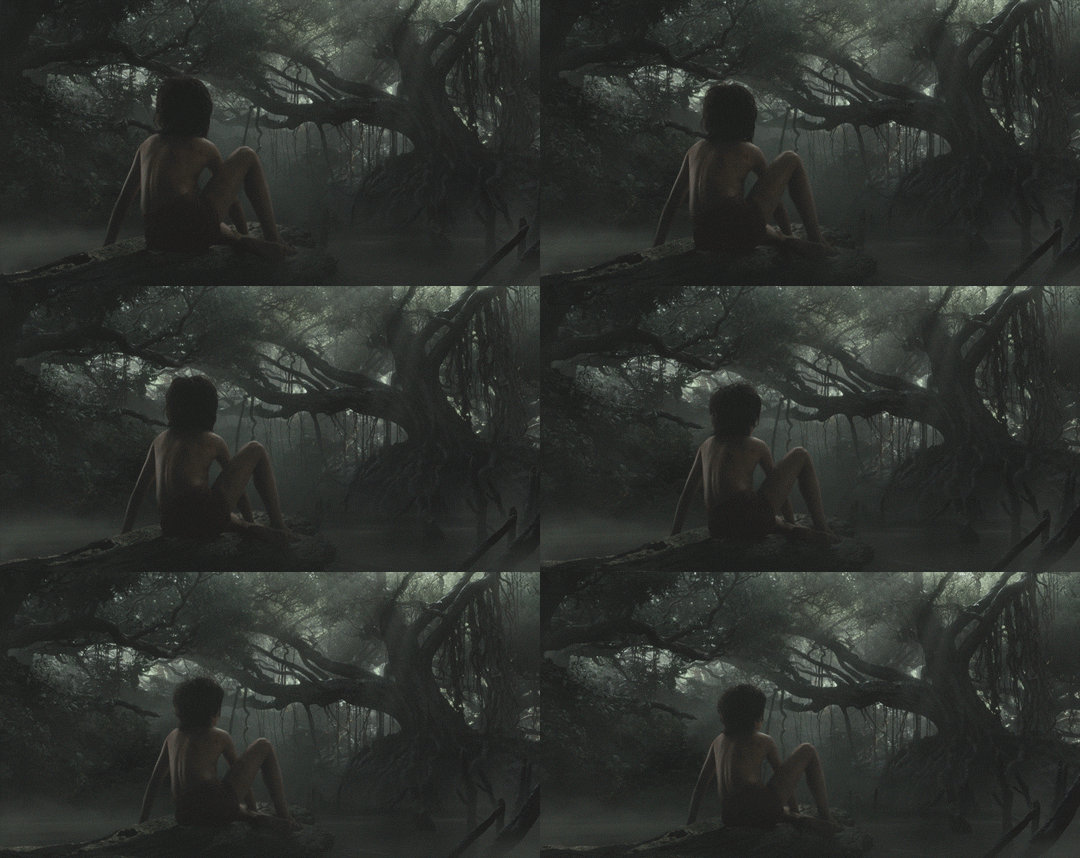
The changes from the original animated film to this are abundant. Jon Favreau’s ‘Jungle Book‘ skips the origin of Mowgli (Neel Sethi) and jumps right into the action. From there, we quickly make stops in various locations where Mowgli finds himself getting into trouble each time. One of the major complaints with the original film and this film is the lackluster story. It feels choppy & segmented; Mowgli’s story in film is told in chapters but never seems to flow into one another well. While the 2016 version transitions from one to another better than the 1967 version, the problem is still apparent.
One of the biggest changes that was brought to my attention is the lack of a chase. In the original, villainous tiger Shere Khan (Idris Elba) was constantly on the hunt for Mowgli. While in this film, Khan murders Mowgli’s adopted wolf father and impatiently waits for the message to get back to him. Although Mowgli was constantly in danger throughout the film but it wasn’t always due to Shere Khan expect for encounters at the beginning & the very end.
What stayed the same for me is Disney’s breathtaking visuals when it comes to this story. 67’s ‘Jungle Book‘ was an achievement for their animation and the recent rendition is a milestone for visual effects. The animals created by Moving Picture Company and Weta Digital were outstanding; each animal having such photorealism that you could count the hairs on their bodies.

The acting was another major positive for me. Neel Sethi’s Mowgli is far less annoying than his animated counterpart & he showed amazing range in the film. He was really the only source for humor to me. His comedic timing was on point but that didn’t take away from the passion he showed. I hope to see more of Sethi in the future. I was letdown with the character of Baloo though. While Bill Murray did his best Bill Murray impression, Baloo was watered down compared to the original. Also, Scarlett Johansson as Kaa is a wasted role. Only used for short exposition, the role felt forgettable by the film’s end. Even though Idris Elba’s Shere Khan had limited screen-time, he was terrifying when shown.
And to whoever put the cowbell in King Louie’s temple was genius. The Bornean orangutan voiced by Christopher Walken didn’t get the chance to ask for more cowbell though.
I’m usually an advocate of making things darker but there was a pure joy from the Disney animated ‘Jungle Book‘ that is missing with Disney’s live action version. Even the songs like ‘I Wan’na Be Like You‘ & ‘Bear Necessities‘ were half hearted karaoke versions of their former selves. Fun moments like Mowgli’s bond with a baby elephant and the happy ending of Mowgli seeing his first girl were removed for a more “serious” approach. If we wanted to make more gritty ‘Jungle Book‘, I want to see what a feral Mowgli would be like trying to live among man.
Give me something different…not less than what we previously had.


 ith Harley Quinn taking a backseat in favour of focusing on her gang, one would expect these characters to be somewhat endearing or be presented in a way that makes us want to learn more about them. The issue provides a quick encyclopedic summary of each member’s background, but nothing really distinguishes them from each other outside of their costumes which amount to little more than Power Ranger variants of Harley’s own design. The characters joke about being reduced to their stereotypical roles as the “Hindu” Harley, the “Jewish” Harley or the “Black” Harley as an interesting attempt to subvert expectations and engage in a bit of meta-commentary on how the internet reacts to certain changes to established characters. The problem is that these characters lack any sense of depth and present us with very little for the reader to care about. It’s all well and good to talk about these characters overcoming those labels that the fan-base may give them, but you have to actually follow through on that vision and present us something more than a roster of one note misanthropes. The only character who distinguishes themselves is Coach, an Oracle-like mentor, whose dry wit keeps the book bearable and shows herself to be one of the few competent members of the team. If the goal of the book was to prove that the Gang of Harleys were interesting in their own right, then DC may be shocked to learn that this first issue made me long for Harley-centric scenes so I didn’t have to deal with them anymore and could otherwise pretend they didn’t exist.Perhaps we could deal with shallow characterisation if the book delivered on the comedic twist its parent series has become known for, but sadly this isn’t the case. There is singular amusing joke throughout this entire inaugural issue and it centers around a confrontation between Harley and the “Hipster Mafia”. The concept of such a criminal gang is funny, but it’s ruined by each of the Harleys resorted to cheap potshots at Hipsters that as unoriginal as they are humourless. These jokes weren’t funny back when the anti-Hipster movement was at its peak a few years ago and not even the combined charm of


