Friday The 13th Revolutionized Not Only Slashers But Horror As A Whole!
The slasher genre started with ‘Peeping Tom‘ in 1960. The film introduced a sub-genre in horror that evolved over time. There was a major turning point for slashers in 1980: the bloody ‘Friday The 13th‘.
Hitting cinemas on May 9th, 1980; the movie was unlike anything mainstream audiences had seen before. Director Sean S. Cunningham took elements from slasher forefathers like ‘Halloween‘ and ‘Psycho‘ as well as a grindhouse picture that Cunningham worked on titled ‘Last House On The Left‘ to create something fresh.
Before there was even a script, a full-page print advertisement was published in Variety Magazine in which ‘Friday The 13th‘ was hailed “The Most Terrifying Movie Ever Made”. The genius marketing move was a way to see if they can attract interest to the project and see if there will be any copyright issues with the film’s title.
Bringing in writer Victor Miller and make-up master Tom Savini, Sean S. Cunningham started crafting together the events that would make Camp Crystal Lake such a memorable horror destination. From there, we got the story of a mother seeking revenge for the senseless killing of her young son. In the 1950’s, Pamela Voorhees lost her child Jason when he drowned in the lake because the camp consolers were having sex and ignoring him. Since that day, the summer camp where Jason died has been known to have a “death curse”. Ignoring that, someone attempts to re-open the camp under a new name. Mrs. Voorhees did not like that.
While ‘Halloween‘ strayed away from showing a lot of the gore, ‘Friday The 13th‘ rubbed your nose in their excessive violence. The camera rarely cuts away from one of the brutal murders of the teens; the iconic scene where Kevin Bacon gets an arrow through his throughout is proudly shown.
Facing harsh criticism from conservative critics, critic Gene Siskel famously called the film’s director “one of the most despicable creatures ever to infest the movie business”. What an amazing compliment for any shock-loving horror filmmaker. It always shocked me that critics and politicians seemed to put down the message of ‘Friday The 13th‘ when in reality, the film was condemning the exact same people they had issues with. If you smoked pot or had pre-marital sex, you’re dead!
Gore isn’t the only thing ‘Friday The 13th‘ brought to the horror genre. Since and after, most slashers are usually men. This movie gave me something totally unheard of at the time. The major twist in the 1980 film is that elderly women Pamela Voorhees has been behind all the gruesome murders. While her hockey masked son would later take over after her untimely beheading, Pamela being the killer shook horror to its core. The twist infiltrated horror and pop culture as a whole. You can even find this mentioned a few times in fellow horror franchise ‘Scream‘.
The importance & success of this film can be found in the numbers alone. The cult classic grossed over $50 million dollars on a $550,000 budget and has spawned 12 sequels/crossovers/reboots. It even spun-off to a brilliant graphic novel where Jason Voorhees fought Freddy Kruger and Ash from ‘Evil Dead‘. The franchise shows no signs of stopping as there is a crowd-funded video game and new film coming to us sometime soon.
Just like Jason, you can’t keep this franchise dead even after 36 years.
We live in the Golden Age of the superhero film. In a span of five months you can see Deadpool, Batman v Superman: Dawn of Justice, Captain America: Civil War, and now X-Men: Apocalypse. This is a blessing and a curse because not all superhero films are created equal. The road is even tougher for X-Men: Apocalypse as it follows Marvel’s big-budget tentpole. The Russo Bros. did a fantastic job balancing a huge cast with new introductions, all in the framework of an extremely tight, well-paced film. Bryan Singer has the same task with X-Men: Apocalypse, but the cleverness of the first two films gets lost in the scope of this third movie; the final product feels like short skits tied together to equal two hours and 24 minutes.
Apocalypse is released from his ancient tomb, and he quickly goes to work building his army to destroy and rebuild the world. This plot on paper sounds like a great film, but unfortunately, Simon Kinberg does not fill in the blank spaces and create rich characters. Also, the time periods in the first two films was such a wonderful aesthetic; it feels like an afterthought in this movie. The eighties was such a great era to portray visually on screen and Singer doesn’t take advantage of this the way he did in Days of Future Past. There are a few songs and some big hair, but the sets and the production design felt like 2016. Although Angel listening to ‘The Four Horsemen’ by Metallica was pretty sweet.
The biggest flaw in the script is no one is memorable; Kurt Wagner (Nightcrawler) is the only one that remotely stood out and with a better script Kodi Smit-McPhee might have stolen the show. Oscar Isaac, Jennifer Lawrence, Michael Fassbender are amazing actors, yet their characters never come to life. The times Fassbender does get screen time his skill level dominates the other actors. Singer should have unleashed Isaac and Fassbender to create two villainous heavyweights for the X-Men franchise. The X-Men villains are where Fox can be superior over the Marvel Cinematic Universe, but they miss their chance here.
There will be spoilers after the jump as we break cinematography of the film. There two insanely awesome scenes.
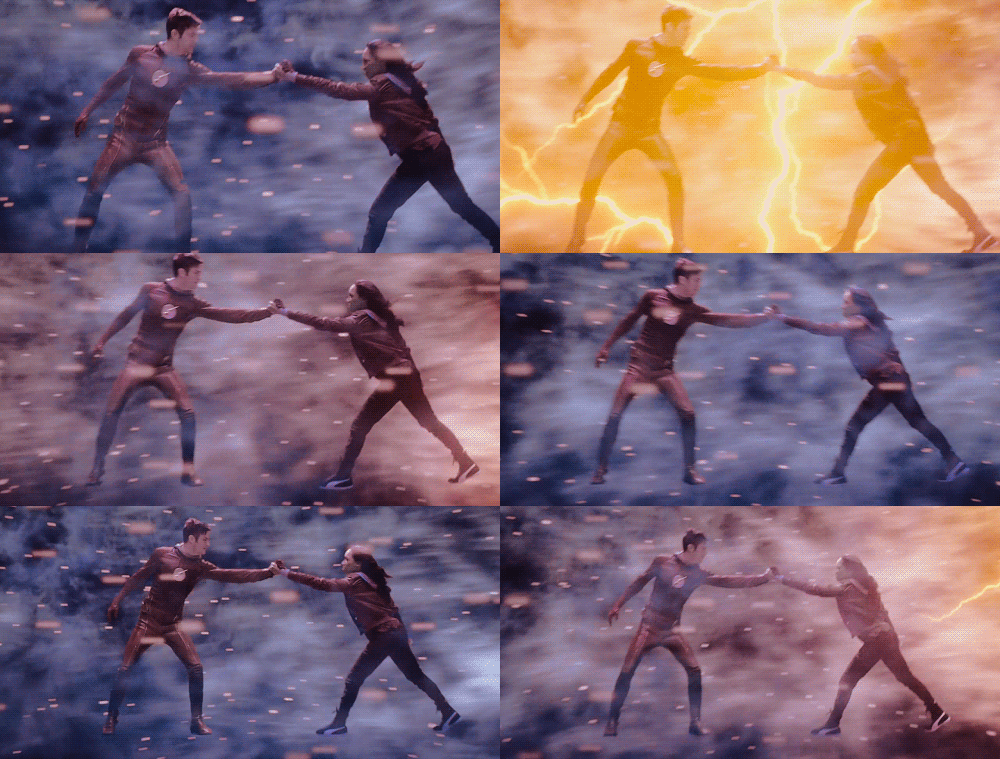
This wasn’t Singer’s best job tying a film together; there are great skits but not a cohesive product. The two best moments in the film are the visualisation of Quicksilver rescuing the student at Xavier’s mansion and Wolverine’s cameo destroying Col. William Stryker’s base. Evan Peters is brilliant again as Peter Maximoff, and the way Singer translates his speed on camera is so original and inspiring. The Flash is on the CW, so we see a speedster every week, but Singer takes the Flash to school with Quicksilver.
When you finally get to see Wolverine in X-Men: Apocalypse, if you are a fan of Weapon X in the comics, you’re going to jump out of your seat. Singer’s literal translation is perfect and Hugh Jackman’s five minutes of screentime gets you pumped for the third act of the film. The only problem with this cameo is it is a gratuitous attempt to shove Wolverine in the movie. These five minutes could have been used to develop Jean Grey, Scott Summers, and Nightcrawler.
The character development of the new X-Men introduced in the film may have been left on the cutting room floor as the mall scene was cut out of the final product. Which means no Taylor Swift Dazzler magic or screen time for Jubilee. There are no explosive energy “fireworks” from Lana Condor, and that is what every fan of 90s X-Men cartoon wanted to see.
The hope of the X-Men film franchise lies with Sophie Turner as the film has a big reveal in the final battle against Apocalypse. But no one character is able to break out of a weak script and flawed direction to give a memorable performance. X-Men: Apocalypse comes off flat which is a disappointment because of the great cast of characters and 80s potential. Adding insult to injury, there is no end credits scene. If there is a Rogue Cut of X-Men: Apocalypse hopefully Singer can put the heart back into the film that is missing from the theatrical version.
Comic book writer and artist, Todd McFarlane, has told his fans and news media, that he has written a hundred and thirty-two page treatment with the demonic anti-hero, Spawn. This would translate to a roughly two hour film if produced.
Credit: Image Comics
One of the biggest and iconic comic book characters to come out of the 90’s was Image’s Spawn. Spawn was a former member of the special forces who, after being murdered by his own unit, is sent to hell until making a pact with the Devil to return to earth to return to his wife, Wanda.
Back on earth, Spawn begins cutting his own path to redemption, defending those who cannot defend themselves. And he has an infinite amount of chains with extremely unfriendly hooks on them.
As the mascot for Image Comics and with a massive fan base, it was not long before Hollywood came knocking to make a major feature film. Of course, it also wasn’t long before the result of that endeavor began bearing unsavory fruits to the general public.
Credit: Image Comics
Not a complete failure as other comic book adaptations (and I personally felt some of the visual elements were amazing for the time), it did leave many wanting. Since then comic book movies have become a staple of summer and holiday blockbusters and with it many failed attempts are beginning to get another chance to enjoy some time in the limelight.
As such, McFarlane feels it is time to give Spawn another chance to make his mark on the silver screen. Added with recent successful reboots of comic book IP’s, this is not an unreasonable thought for McFarlane.
Whether or not this will be a better take on the hero remains to be seen. However, if a film is made, hopefully will avoid the potholes that doomed the previous production.
Breaking news: Ron Howard and Tom Hanks have made another Dan Brown adaptation, Inferno, to complete a trilogy of Catholic-Based Thrillers surrounding the exploits of the incredibly bland Robert Langdon (Hanks). If you’re thinking “wait, trilogy? There was a second one?” Yes, there was, it was called Angels & Demons. It came out some time in 2009. And somehow it made $133 million domestically.
Here’s the Inferno trailer:
Was there some burning desire from passionate fans of The Da Vinci Code to revisit this world? The Da Vinci Code was a worldwide success as a book and as a film, I get that. But tell me one thing that happened in The Da Vinci Code that you can remember aside from Hanks’ strange hairstyle. It was long, dull, un-engaging, and forgettable on a profound level. As for Angels & Demons, well, let me know if you find anyone who contributed to its $133 million.
Robert Langdon is quite possibly the most uninteresting, milquetoast character to anchor a chase/thriller/mystery movie, and Inferno looks like more of the same. This truly feels like a waste of time for Hanks, Howard (a filmmaker I’m genuinely concerned about these days), and the audience. Not to mention the fact that Angels & Demons made half the money of The Da Vinci Code, and it’s been seven years since the sequel. Haven’t audiences moved on?
But this one is about the end of the world! Finally, a fresh storyline…
Anyway, Inferno will hit theaters October 28, so by the time November rolls around hopefully we can collectively forget about the misadventures of Robert Langdon.
It’s hard to say exactly who was killed in The Walking Dead’s season six finale. The show runners purposefully made it an ambiguous ending, giving fans ample time to argue and debate about who’s head just had a violent encounter with villainous Negan and his trusty bat Lucille. And out of the 11 main characters that could have been taken out, what would it mean for the show moving forward?
Since the first episode, Rick Grimes has had one specific thing to fight for – his family. He’s had three love interests, an infant daughter, and a host of village people by his side, but above all of that, he has always had his son Carl. For a show that’s prided itself on spontaneous deaths and emotional blows, Rick has always been able to protect his son, even as he gets shot in the face. But The Walking Dead can’t coast off killing side-characters forever, hence Negan’s bloody arrival. If someone has to be dead, there’s one death that will crush Rick more than anything, changing the feel and dynamic of all the characters. And that’s the death of Carl.
If we’re being honest, Carl’s gotten away with a lot. He was shot back in season 2, bringing the gang to the barn, and in this past season he’s lost an eye. Both elements are taken from the comics, and it’s not that his survival is totally unbelievable. But it is two instances of him defying the odds and staying alive. Being a main character, especially the son of the show’s protagonist, gives him some understandable immunity from the death that’s stricken a lot of characters. But it’s not out of the realm of possibility – we’ve seen leads die before, including deaths of younger people like Beth, Sophia, and the two Samuels Sisters.
Those latter three also provide evidence as to what hits hardest about the show – the death, and how no one is immune, not even children. As gut-wrenching as many of the deaths on The Walking Dead have been, the death of a child is almost always going to have more gravity to it. Carl has grown up a lot over the course of the show, but he is still very much a kid. While the gang has lost many adults in war or walker herds, losing a boy to a bat-swinging maniac is its own kettle of fish. Think back to the death of Sophia in season two – she wasn’t stabbed, shot, or skewered. She ran away, and she was found as a zombie. It was a surreal moment of hopelessness, that their search was pointless, and that none of them could really be counted as safe. Imagine if they had to watch Carl died, while tied up and helpless. It would be horrifying. Maybe not “good” in the way of something fun to watch, but good narrative format and emotion.
And then there’s how the death would effect Rick. While The Walking Dead has embraced more of an ensemble cast since its beginning, the show is still centered around Rick, leading a group of survivors. One of Rick’s primary goals has been to protect his family, which is now limited to Carl and Judith. While the death of any of the captured characters would be huge (aside from maybe Rosita) Rick’s grief would be taken to a whole new level. If Carl were killed, Rick wouldn’t have just failed as a leader – he would have failed as a father. He couldn’t keep Lori alive, he had to let Jessie & the whole Anderson family die to protect Carl, the person he cares about the most. It’s possible he’d let anyone die to save Carl. If Carl were dead, then that primary objective would be gone, forcing Rick to struggle with a true familial loss, and the show runners to reshape his character, which could help galvanize the show even more.
Now based off what we did see in the season six finale, it seems very likely it wasn’t Carl. As Negan began swinging, he warned that if anyone stopped him, he’d have his boys rip out Carl’s other eye and feed it to Rick. It wouldn’t make sense for him to ask them to fish out Carl’s eye from the bloody puddle of Carl that would be left from Lucille’s rampage. But if it were to be Carl, it would cause the kind of despair and gravity The Walking Dead prided itself on in the beginning, and help reground the show for what is sure to be a bloody seventh season, once we find out who the smashed head really belongs to.
This article is part of a ‘The Walking Dead’ series. Read also about the benefits of the deaths of Daryl and Maggie.
If you’ve always wanted to see Thom Yorke walk through dozens of rooms on the big screen, you may have your chance soon. Paul Thomas Anderson’s hypnotic video for Radiohead’s test single, Daydreaming, is sending a 35MM copy of the video to theaters with appropriate projectors.
Here is the video, which works for me on a meditative level. Despite the fact literally nothing happens as Yorke walks from room to room, t’s a great way to clear your head on a Monday morning:
Radiohead has released their new album, A Moon Shaped Pool, and “Daydreaming” is already he second single from the album following Burn the Witch and it’s Wicker Man animated video.
Plus, this is new work from Paul Thomas Anderson, which I’ll take in any way, shape, or form. PTA has worked with Radiohead guitarist Johnny Greenwood, who did the brilliant scores for There Will Be Blood and The Master. Hopefully you’re near a theater with 35MM so you can take this in before a movie. And hopefully this will spur more theaters to start showing more original, interesting content ahead of their movies to create an experience again.
The viral campaign for Independence Day: Resurgence has been more interesting than any footage we’ve seen from the actual movie, and the new promo is pretty clever. Set up like a military propaganda ad (I almost expected “The Few, The Strong” at the end), this new promo asks you to join the Earth Space Defense team (ESD).
We always knew they were coming back. After INDEPENDENCE DAY redefined the event movie genre, the next epic chapter delivers global spectacle on an unimaginable scale. Using recovered alien technology, the nations of Earth have collaborated on an immense defense program to protect the planet. But nothing can prepare us for the aliens’ advanced and unprecedented force. Only the ingenuity of a few brave men and women can bring our world back from the brink of extinction.
It’s a convincing promo for sure, and it gives you hope that Independence Day: Resurgence could surprise audiences. And it’s always a good idea to promote William Fitchner if he’s in your film. We will see when it hits theaters June 24.
In response, we scoured social media and have compiled this list of the top six actresses most requested by fans to play Carol Danvers. Unfortunately, Ronda Rousey did not make the cut, despite the fact that she was vying for the role several months ago.
Sound off in the comments to let us know what you think, and to tell us who you would cast as “Earth’s Mightiest Hero.”
Natalie Dormer
Age: 34 Notable Work(s): Margaery Tyrell in Game of Thrones, Anne Boleyn in The Tudors, Cressida in The Hunger Games: Mockingjay Parts 1 & 2
Emily Blunt
There is currently no customized picture of Emily Blunt as Captain Marvel. Someone should fix that.
Age: 33 Notable Work(s): Rita Vrataski in Edge of Tomorrow, Emily Charlton in The Devil Wears Prada, Kate Macer in Sicario, The Baker’s Wife in Into the Woods
Yvonne Strahovski
Age: 33 Notable Work(s): Sarah Walker in Chuck, Hannah McKay in Dexter, Batwoman in Batman: Bad Blood
Charlize Theron
Age: 40 Most Notable Work(s): Aileen Wuornos in Monster, Imperator Furiosa in Mad Max: Fury Road, Josey Aimes in North Country
Katee Sackoff
Age: 36 Most Notable Work(s): Kara Thrace in Battlestar Galactica, Victoria Moretti in Longmire, Kimberly in the short fan film Power/Rangers
Kathryn Winnick
Age: 38 Most Notable Work(s): Lagertha in Vikings, Tabitha in Amusement, Hannah Burley in Bones
—
Avengers: Infinity War Part One will be released in 2018, while Captain Marvel is scheduled for 2019.
We take no credit for the custom images used in this article. Each custom image was found via Google Images.
[Author’s note: I am only supplying the actresses’ ages because they would be playing this role for years to come, and Marvel may not want someone who “ages out” too soon.]
At this point in Game of Thrones we have surpassed the stories as told by George R.R. Martin in his A Song of Ice and Fire books. Like Jon Snow’s return from death, we’ve broken the void and have seen into the ether. The show uses ‘Oathbreaker’ to comment upon the fact the stories we’ve all been told now mean nothing and are completely in the past. That doesn’t mean the past is to be trusted.
Ser Davos may be the most logical character on Game of Thrones. He believes only the things he’s seen and only the tales of those who are the exclusive authority on a subject. His face when confronted with the newly resurrected Jon Snow is one of disbelief and pragmatism. Davos wants to reason with Jon and ask questions about the worldly things he remembers; namely his murder.
Melisandre wants to know what’s beyond. The stories she believes in have been shaken to their cores after the failure of Stannis Baratheon to take Winterfell and become the chosen son of R’hllor. She chomps at the bits of Jon’s post-homicide memory and wants to know what he’s seen of the afterlife.
“Nothing. There was nothing at all.” – Jon Snow
The stories of Gods and the afterlife and The Great Stallion might be horseshit after all. But Jon’s back and Melisandre believes in that above all else. The Lord of Light has given her another miracle and Davos and the rest of the Wildlings and Night’s Watchmen have witnessed this as well. Some have even come to accept Jon Snow as some sort of God*.
In the continued past adventures of Bran Stark and The Three-Eyed Raven, more myths are undone as we finally see the famous battle between Ned Stark and Ser Arthur Dayne. One of the building blocks of Ned Stark’s tale of honorable courage has been his victory over the Sword of the Morning. Ned has always been more humble when recounting this story and for good reason, as Bran and the viewer see that Ned would have lost and been killed by Arthur if it hadn’t been for Howland Reed (father of Meera and Jojen) stabbing Dayne in the back (of his throat).
I’d like to give pause to the coherent thematic discussion to kneel at the feet of the fight choreographers for this particular sword fight. It wasn’t the flashiest or most tense battle we’ve seen on this show but that’s what makes it a slice of exciting genius. The fight is shot with minimal takes and from very wide angles. We can see each and every move of the combatants and the skill it takes to wield these heavy weapons. Arthur Dayne was fighting with two! This fight is one which might typically be forgotten when all the fireworks have exploded at the end of a season but it’s this sort of detail that makes Game of Thrones the best show on television.
Elsewhere, Tyrion continues to try to build his legend for people who couldn’t care less. His exchanges with Messandei and Grey Worm are priceless as he coins phrases left and right and exudes all the charms and stereotypical Tyrion-isms he is known for across the Narrow Sea. Unfortunately for Tyrion, Messandei and Grey Worm have zero need for this dwarf’s poeticism and parlor tricks.
Tyrion’s mythology is as useless in Meereen as Varys’s own legend turns out to be in The Red Keep. Until this point, Varys’s word and sources have been the most infallible on the show but we finally see who his little “birds” actually are and just how easy they can be turned against their allegiance, if they even had one in the first place. Maester Qyburn discovers that young children have been the bearers of the Spider’s news in Westeros and wins them over to his side with such simple things as sweets.
Dany is now beholden to her attachment to the deceased Khal Drogo amidst a group of other widowed Khaleesies. Her own created mythology may even come back to bite as her “Breaker of Chains”, “The Unburnt” and “Mother of Dragons” monikers will seem to the humble widows as highfalutin dressings to a woman who abandoned her rightful place in Dothraki culture.
This is the wild west when it comes to whose story will survive and which winner will wind up telling it.
The High Sparrow gets his own frightening moment in ‘Oathbreaker’ recounting the story of the godly Mother to Tommen when he demands that his actual mother be able to see the body of Myrcella. The fact that ‘Oathbreaker’ premieres on Mother’s Day is most definitely not lost amongst Benioff and Weiss and is a horrifically creepy touch of detail as we fear for Tommen’s safety in the mouth of Sparrow madness.
Arya believes in her own fake myth so greatly that Jaqen H’gar gives her back her eyes.
Back in the hellhole that has been Winterfell, Smalljon Umber comes to town to demand an alliance, refusing to believe the stories Ramsey Snow** purports about the death of his father. Umber breathes some fire in the court of Ramsey and his dissension against the word of this bastard is highly entertaining. Umber stands behind his brazen words because of the ace stashed deep in his sleeve. When denying fealty to Ramsey in the form of bowing or swearing loyalty, Umber presents two long-missing characters of the series in Osha and Rickon Stark. Welcome home, Rickon. I fear the hell you will likely be put through.
Rounding things off back at Castle Black, Jon Snow brings his murderers to justice on the hangman’s noose. This includes Ser Alliser Thorne, who actually dies with dignified words and the smallest bit of honor, and Olly, the young boy who stabbed Jon in the heart, ceasing its beating for good***. Olly’s arc has been an interesting one as the once protege of Jon, saving his life whilst killing Ygritte and eventually Jon himself in the coup. Olly is one of the saddest elements Game of Thrones has given its audience and the most telling sign that Jon Snow isn’t the man he was before he was killed.
In his previous life, Jon Snow would’ve taken Olly off the chopping block forgiving his sins and believing in a life under misleading circumstances. In this life, Jon Snow lets Olly hang for his crimes more likely for killing Ygritte than actually ending his own life.
Or is it from pure cold-hearted ambivalence? When Jon ends up giving Dolorous Edd the reigns to Castle Black and walks off into the wild, he has clearly lost belief in his oath to the Night’s Watch.
Or has he become more pragmatic? He’s already lived through his oath to the Watch, having died trying to protect The Wall and his brothers. This new life doesn’t bind him to that obligation and his willingness to leave his friends behind, destroying the lives of four sworn brothers shows this Jon Snow has a new agenda.
Or no agenda at all?
Jon Snow and the rest of the characters in Game of Thrones are forging new stories against a world that is facing a fresh start. Pasts cannot be trusted and only the bold will be proven to survive.
Or not?
“My watch has ended.” – Jon Snow
Check out my reviews of previous episodes of ‘Game of Thrones’:
After writing a review of Captain America: Civil War for this website, as I was posting it on social media, a lot of the comments that I got agreed with my sentiment that Marissa Tomei is the most attractive Aunt May that we’ve ever seen. George Constanza could not be reached for comment.
In the DVDStan Lee’s Mutants Monsters and Marvels, which came with my original 2002 Spider-Man DVD, Stan Lee mentioned that he created Aunt May for the comics so that Spider-Man could worry about her, giving him an additional challenge. If he goes east, he can stop the villain who is going to blow up the city, but Aunt May needs her medication and the pharmacy is west. It gave this relatable character an additional headache besides his crime-fighting and the bullies and the angry girlfriends and Mr. Jameson.
That was back in the 1960’s. Today, someone old enough to be someone’s aunt might have grown up in the 60’s and be a bit livelier than the doting grandmother-type. The Ultimate Spider-Man comic books did an excellent job of making Aunt May a bit more fun. She was an ex-hippie who was a bit more aware of what the young people were into. But she was still an older woman and the thing both of these versions had in common was that Aunt May was always looking out for Peter Parker. She was his conscience. And, like most superheroes, Spider-Man kept his identity a secret to protect those that he loved, harsh lessons he learned with both MJ and Gwen in multiple movie versions.
But does making May younger diminish the challenge that she once represented in Spider-Man’s life, that of having to take care of her in her old age? Will the producers of Spider-Man: Homecoming give Aunt May a health problem? Money has always been one of Peter’s challenges, a woman who just lost her husband (Uncle Ben is not mentioned in Civil War) and has to care for a teenaged boy would definitely have those problems. Of course, now Spidey has a rich friend in Tony Stark who is very generous with grants, so has Aunt May been reduced to just eye candy for Tony Stark and any audience member who likes the mature women? Comment below.