


Cartoonist Tony McMillen is no stranger to creating deeply moving narratives that connect readers back to their pasts and childhoods. Books like Serious Creatures and Atta Boy use pop culture like movies and video games to address issues like growing up and the power that the things you loved as a kid have on you, and always had some element of autobiography, albeit filtered through a fictional lens. But with his latest project, Two Kids in A Trench Coat, Tony is taking a much more direct approach and writing and drawing about what he calls his first non-fiction work about ” my adolescence, obsessed with R-rated movies, explicit music and extreme comics growing up in the 90s.” Tony is a good friend and I always want to talk to him about his latest project. So when he had some time, we sat down and talked about Two Kids in A Trench Coat. Check it out below and make sure to subscribe to Tony’s Patreon, where you can read the first chapter of Two Kids in A Trench Coat, and much, much more.
Monkeys Fighting Robots: Tony, it’s been a while since we last talked, so thanks for taking the time once again! So let’s start with the basics. Your new book is called Two Kids in a Trench Coat. Tell us what it’s about!
Tony McMillen: Thanks, it’s all about my adolescence, obsessed with R-rated movies, explicit music and extreme comics growing up in the 90s. Two Kids in a Trench Coat is my first major non-fiction work, a sorta graphic memoir (if I’m putting on airs), but it’s not a typical auto-bio comic either: I use the titular Two Kids in a Trench Coat characters as guides to walk us through all the pop culture and real life stuff I wanna explore with the book. Also — unlike my usual production method — I’m releasing the first 16 pages as a separate sort of extended preview before I finish the full book sometime next year. That’s a first for me, too.
MFR: That’s great. And having read some of these pages, I think this is something that will really resonate with readers, especially those from our generation. In a lot of ways, at least for me, these things you mentioned had a hand in raising me. I was especially taken aback by the sequence involving T2: Judgement Day.
TM: Thanks a lot! Yeah, I saw T2 in the theater as a kid, and it changed my life. I think about it all the time, including as I do in the comic, as a lens to look at my mother. My mom was a single mom and tough as hell. Sarah Conner always reminded me of my mom in a lot of ways.
MFR: Love that! So you mentioned that you’re releasing this in a way that is new for you, but are you approaching the art any differently from previous projects?
TM: I’m trying to! That’s part of why I wanna slow down and take my time with this. I want room to experiment. Maybe draw some pages using crayon and pencil? Maybe do some in watercolor? I’m already approaching things a little differently in the composing of pages by starting with writing little essays and then trying to find ways to turn those into comic narratives.
MFR: That sounds perfect. Like a slow pace allowing for introspection. Do you have a set length or page count in mind?
TM: Feels like 125-150 pages, 7 or 8 chapters. But it’s sorta early to tell. I’m very open to letting any project I work on tell me how long or short it needs to be.
MFR: Aside from the pages you have released, how are you thinking about getting this published? Are you looking at publishers, doing it yourself self or crowdfunding?
TM: I’m actively shopping it around right now. Which is another new approach for me: using this first chapter as a proof of concept to show publishers and agents what this book could be.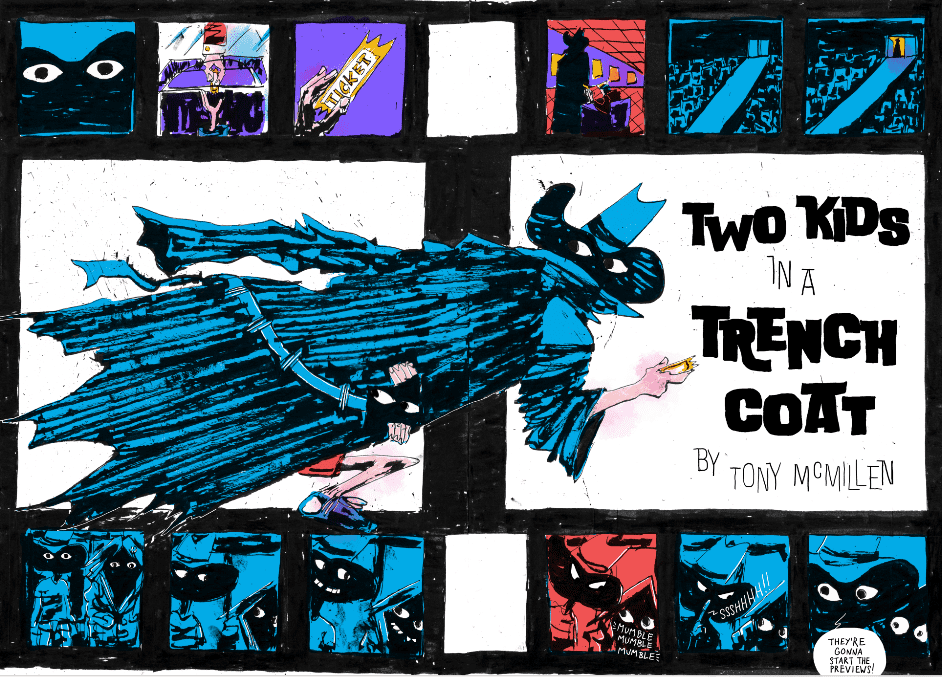
MFR: So, to back track a bit, when and why did you decide to finally do something more autobiographical?
TM: This particular project has been simmering in the background for a while. The first seed was a podcast I hosted with a friend of mine called Too Young for This Shit about growing up on action movies. That got me thinking about verboten and explicit material I enjoyed as a kid in general. The other big component was I have always including autobiographical elements in all my work; sometimes heavily shaded in allegory or metaphor, but it’s always about my feelings and mental state….what made me want to make a book without the usual trappings of fiction surrounding it was realizing how much I enjoy non-fiction memoirs that revolve around pop culture to tell a personal story. Most of Chuck Klosterman’s output, the Beastie Boys book, stuff like that. I realized a memoir of sorts was probably a good place for my musings on Deathlok and Spawn as absentee dad myths, or the generational shared trauma of watching the execution of Alex Murphy in Robocop.
MFR: Very spot on! I think I learned about death from watching Robocop.
TM: (Laughs) A hundred percent. Our entire generation started that movie as boys.
MFR: (Laughs). Damn, well put! What other movies or pop culture touchstones are you hitting on? Can you give us a hint?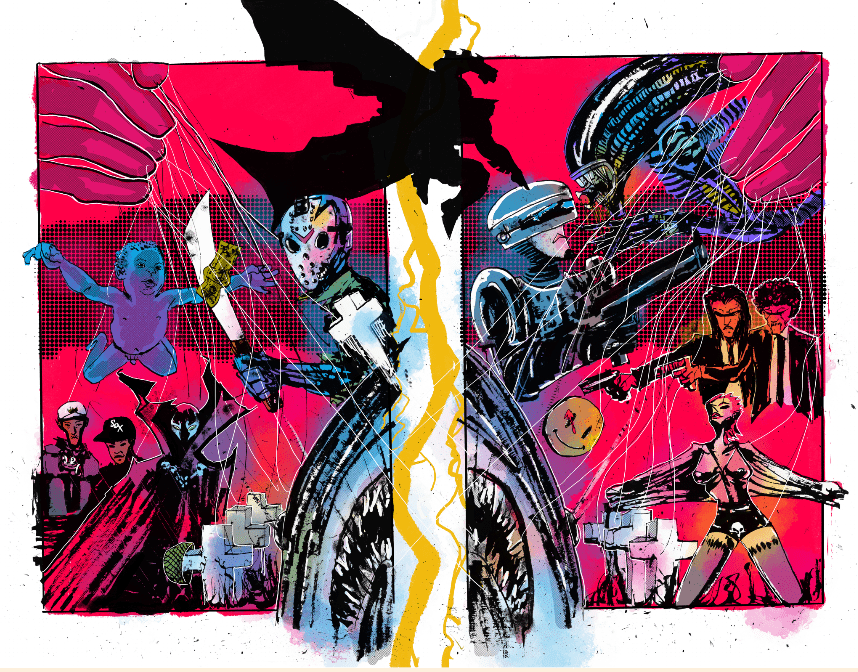
TM: Of course! The next chapter is on Friday the 13th and Christmas Day. From there we’re gonna cover the duality of gangsta rap and grunge. Image Comics, a Metallica laser light show, and Arnold Schwarzenegger’s impact. There’s a lot
MFR: Arnold was definitely a surrogate dad for a lot of us. So I guess to wrap it up, if you had to pick one movie, one comic book and one album that had the most impact on you from that era, what would they be?
TM: Ooh. Pulp Fiction, The Dark Knight Returns, Pearl Jam Vitalogy.
MFR: Awesome. Any final thoughts or anything else you want to plug?
TM: Thanks a lot, I always enjoy talking with you, and hopefully we get to do it in person again soon.
Subscribe to Tony McMillen’s Patreon here.
