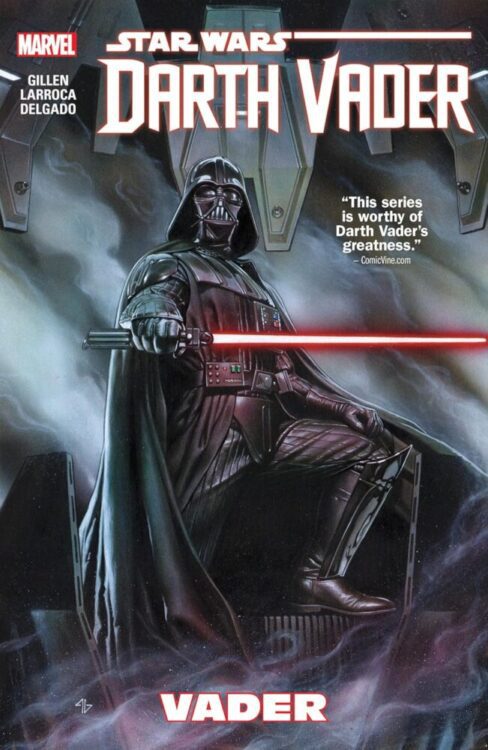
When Disney bought Lucasfilm in 2012 and Marvel regained the rights to publish Star Wars comics, the editorial team immediately set about filling in the gaps between the original trilogy of films. One of those creative teams was writer Kieron Gillen (The Wicked + The Divine, Young Avengers) and artist Salvador Larocca (X-Men, Alien) tell a story from the perspective of the legendary villain Darth Vader. Starting in 2015, Gillen and Larocca’s Star Wars: Darth Vader explores the villain’s frame of mind following the events of A New Hope. Featuring a fantastic cast of new characters and what are now considered some of the character’s best moments, this run has since become a must-read for Star Wars fans and one of the best comics Marvel has published in the last 15 years.
Some Spoilers Ahead
Gillen and Larocca’s Darth Vader run has readers joining the story right after the destruction of the first Death Star. Here, Vader is dealing with the immediate fallout of what many in the Empire are considering his own failure. He is being scrutinized more heavily by the remaining Imperial brass, and most importantly, his strength is being questioned by his master, The Emperor. Gillen’s script immediately starts painting a picture of Vader we haven’t seen before. His quality and effectiveness are being put into question, and he’s having to reassure his master – and to a lesser extent the Empire itself – that he is still the most effective weapon in the galaxy. As Palpatine makes plans that don’t include Vader, we get to see another side of the Sith Lord that hasn’t been revealed before. Vader employs the services of Bounty Hunters and makes his own investigations into both what Palpatine is planning and who was responsible for destroying the Death Star. These investigations lead to a pair of revelations that shape Vader as a character going forward. The first is that the Emperor is making contingencies is case of his apprentice’s continued failures. An eccentric scientist by the name of Cylo has spent years crafting enhanced operatives, using technology that mimics the force. Vader finds this notion blasphemous and appalling, and his already boundless rage grows to an even greater amount of contempt towards his master and the Empire as a whole. The second investigation yields the truth about the young pilot who destroyed the Death Star: a boy named Skywalker. With this revelation, Vader’s resolve increases tenfold, and the puzzle pieces that build up the rest of the original Star Wars trilogy begin to lock into place.
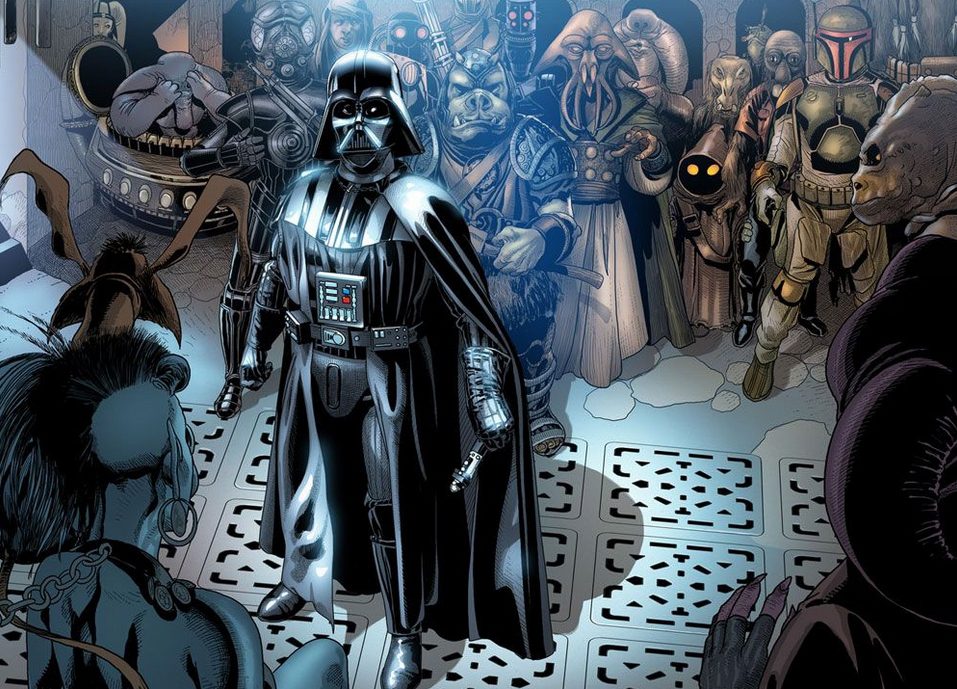
When we first meet Vader in A New Hope, he feels more like a powerful subordinate than a menacingly powerful warlord. While he’s still terrifying, it’s clear that he had to follow a chain of command headed up by uniformed Imperial officers and officials who handle most of the Empire’s military dealings. Vader himself feels more like a blunt instrument. Gillen effectively takes Vader from this point to the version of the character we meet in The Empire Strikes Back. In some ways, even almost 20 years after the fall of the Jedi Order, Vader still seems to be finding his foothold within his master’s Empire. The Sith Lord never says a word about it, but his hatred for Palpatine is apparent in every interaction between the two of them. The road that led him to the Dark Side effectively traps him in servitude to Sidious’s goals, the part of himself that he killed locking him in a place of servile anger. Gillen’s character work on the legendary Star Wars antagonist bridges the gap between Imperial weapon and merciless Supreme Commander. Through a series of trails, self-guided subterfuge plots, investigations, and even plotting a small-scale war, Vader proves himself as the true Dark Lord of the Sith that audiences view him as. Perhaps his most foreboding and terrifying form is shown in the pages of the crossover event Vader Down. Crafted alongside Jason Aaron’s excellent Star Wars run, this mini-series crossover event sees Vader shot down over a Rebel-controlled planet while searching for Luke. The story then becomes an almost slasher movie, with the Sith Lord hunting down and demolishing entire platoons of Rebel soldiers single-handedly. It’s a great addition to both Gillen and Aaron’s respective work in the franchise, and one of the most memorable Star Wars stories in the Disney era.
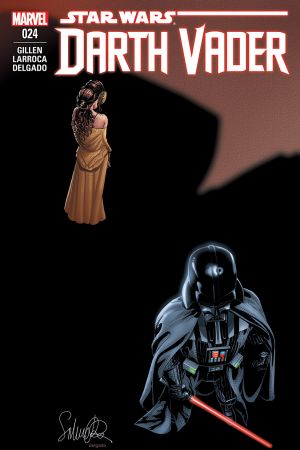
While the character-work with Darth Vader is the main feature of Gillen and Larocca’s run, a huge part of what makes this comic so memorable is the slate of new characters. Chief among the cast is snarky smuggler Doctor Aphra. She is “volunteered” by Vader after he witnesses her handiwork with deadly droids – two of which become more great additions to the modern Star Wars canon. Her spunky, fiery personality and casual attitude towards the leering Dark Lord made her an immediate fan-favorite character, to the point that Gillen got the greenlight to give her a spinoff series (which is also great and I highly recommend it). The droids Aphra helps bring to life include the sociopathic protocol droid 000 and the arsenal-toting Blastomech prototype BT-1. Like a dark Threepio and Artoo, these two fantasize about immense violence towards organic meat bags and their utter disappointed when they’re not allowed to kill anything. Every page they’re on is a delight, and Gillen’s concept about a dark side version of two of cinema’s favorite companion characters lands beautifully. They’re obviously also reminiscent of HK-47 from Knights of the Old Republic and any reference towards that game is an automatic won for me.
If there’s one weak point in Gillen and Larocca’s work on Star Wars: Darth Vader, it’s some of the artist’s hyper-realist character work. Generally speaking, Salvador Larocca and color artist Edgar Delgado craft a stunning representation of the Star Wars universe. The level of detail given to the settings in this universe – the hallways of starships, the desert plains of Tatooine, the lights of a gambling den, and many more – is staggering. There’s a high level of polish in the visual presentation of each issue of this series that matches how the other Star Wars comics of the era looked (and still look, from what I’ve seen). Larocca ‘s sequential direction carries the entire series along at a brisk pace that never skips out on the great character moments. Some of the most memorable panels in this run are expertly planted nods back to Anakin’s days as a Jedi and letting the audience remember just what Vader helped destroy to lead him to where he is now. Unfortunately, that eye for detail sometimes leads to a sort of uncanny visual presentation when it comes to character art. Larocca’s tendency to aim towards hyperrealism ends up making character expressions that are distractingly *off* feeling, like a still frame from a film or a photograph that as a digital art layer over the top of it. Again, there’s a lot of excellent visual work in this run, it’s just unfortunate that Laroccca’s approach to character art is the comic’s only real flaw.
Kieron Gillen and Salvador Larocca’s Star Wars: Darth Vader is one of the best pieces of storytelling in the history of this iconic franchise, and alongside Jason Aaron’s main Star Wars series, was a fantastic introduction for this legendary villain into the modern era of Marvel’s Star Wars comics. The added insight into Vader’s character and watching him use all of his skills and sheer determination to thwart his master’s tests and cement his own place within the Galactic Empire is, frankly, cool as hell. With a phenomenal blend of emotional weight, great character additions, and some absolute all-timer Darth Vader moments make this one of the definitive Star Wars stories on the modern era.