


Truth, justice, and the American way… These are all themes writer/letterer Julian Darius and artist/colorist/letterer Steven Legge explore in Martian Lit’s Necropolis: The Life & Death of Mark Hernandez #1. But their exploration isn’t one of wide-eyed curiosity or general intrigue. In many ways, it feels more like an autopsy.
Writing
Darius — returning to the world he created alongside Mike Phillips and Steven Legge in Necropolitan — reintroduces us to the series’ leading man, Mark Hernandez. From Necropolitan‘s main title, we know Mark is a few things. He’s a family man, he’s the famed Kraigslist Killer, and he’s ultimately a damned soul. And yet, we also know from snippets of conversations that even Mark’s killings had a sense of justice to them. He got his name for luring in and murdering child predators. The Life & Death of Mark Hernandez is Darius’ answer to the many questions plaguing us about Mark’s character. Perhaps, it will even answer the biggest question of all: why is Mark in Hell?
But to say that Mark’s descent into the Inferno is all this issue is about would be extremely reductive. As previously stated, this issue feels like the autopsy of the American Dream. When Mark signs up to fight in Afghanistan and Iraq after 9/11, we see his years as a soldier while his wife Jessica holds down the fort back home. In their conversations over the phone, Darius—through Jessica—recounts all of the troubling news reports that indicated US soldiers were committing atrocities during these wars. We watch as Mark fights to still believe in what he’s doing, while quiet disillusionment slowly creeps in as he realizes his own culpability.
Ultimately, this is really an analysis of the “War on Terror,” playing out in the lives of these characters. In some ways, the writing does occasionally feel more like a news crawl than a story. Jessica’s relaying of information over the phone to Mark has an on-the-nose quality to it. But in grounding the story in Mark’s life, and especially in hinting that it’s these years that turned him into a killer, Darius makes the problem personal. He asks us to consider the human cost — the devastation it created not only in the Middle East but in the very heart of American morality. How does a public move on from discovering they were the bad guys?
Art & Coloring
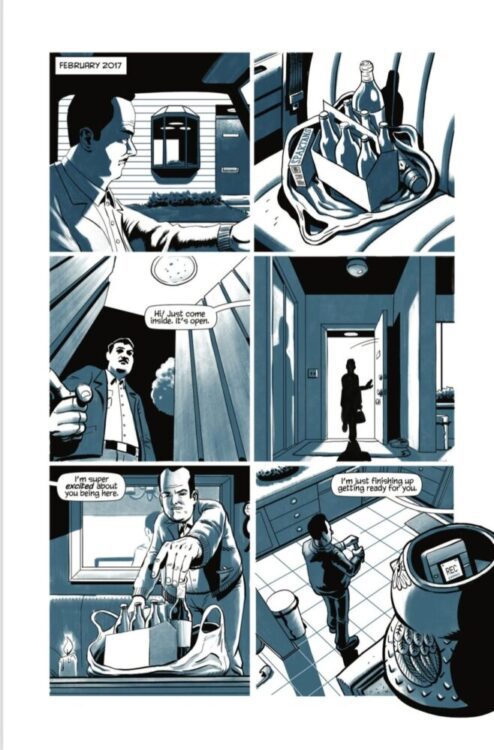
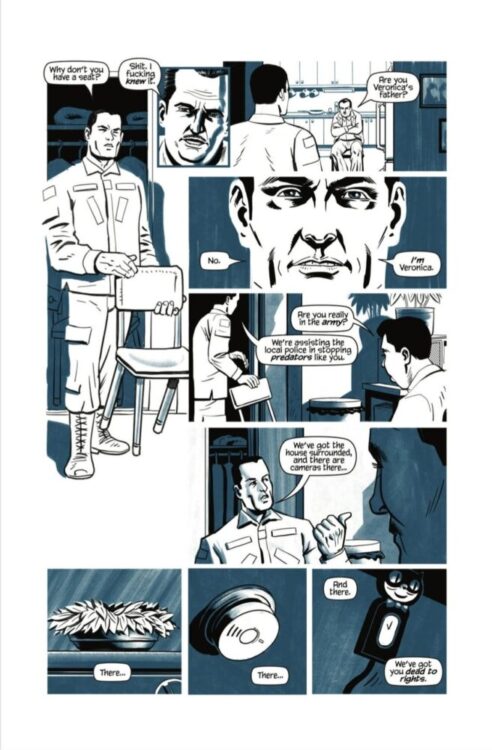
Legge’s work is extremely versatile and fresh. There’s so much subtlety and minimalism at work in these pages. On one page, two panels set in vastly different scenes are right next to each other, with Mark standing one one side but extending into the gutter between them. In Mark’s scene, he’s on the phone while his fellow soldiers march by outside in the hot sun. Mark, in contrast to the bright outdoors, appears as a black silhouette on the page. But his form extends into the scene of Jessica and his daughter calling him from home. The looks on their faces show that they feel his absence, and the black empty space that he’s supposed to be occupying highlights that fact beautifully.
The coloring is appears deceptively simple. Legge uses only two colors on each page: black, and either yellow or blue. The early pages all appear in blue, but once 9/11 happens and Mark ships off to Afghanistan, the pages turn yellow. The bold, brash, American coloring gives way to the faded yellow of the desert. And while the blues and yellows are often used to depict things in the background, Legge occasionally but very poignantly switches it up. When Jessica feels depressed, Legge colors her surroundings using the black ink usually reserved for main characters. Jessica, though, is depicted in yellow. It makes her seem unreal, invisible, and part of the background. It masterfully reflects her inner life in that moment.
Conclusion
Darius and Legge have a truly incredible prequel on their hands. They’re interested in more than just Mark Hernandez’s story, though: They’re interested in their shared history with the character. They show us the injustice, the lying, the callous ways in which Mark is used as a tool and not seen as a person. They show the twisted, fragmented world that he came up in. In doing so, it’s like they’re saying “Yes, this all drove Mark a little crazy. But doesn’t it do the same to you?” Martian Lit’s Necropolitan: The Life & Death of Mark Hernandez #1 is available on their website here, and it’s a must-read!
