


From Brazilian graphic novelist Marcello Quintanilha comes a tale of camaraderie, futbol, and naked convicts in The Lights of Niteroi. Published by Fantagraphics, this graphic novel transports readers back to 1950’s Brazil as we follow Helcio and Noel, a pair of adventurous teenagers looking to make some money. A string of unpredictable chaos ensues, and the end result is one of the most heartfelt and memorable comic stories released in recent memory. With clever writing and phenomenal visual work, The Lights of Niteroi is an especially poignant and human comic story.
“In 1950s Brazil, somewhere by the beach, not far from Rio, Hélcio, a young and promising soccer player, and his friend Noël, spot someone fishing with dynamite. They decide to take a boat and steal some of the dead fish to make some money. The boat trip turns into a perilous journey as the two thieves embark on an adventure that will challenge their friendship. Inspired by the life of Marcello Quintanilha’s father, Hélcio Quintanilha, this graphic novel is both a suspenseful thriller and a breathtaking story about friendship.”
Writing & Plot
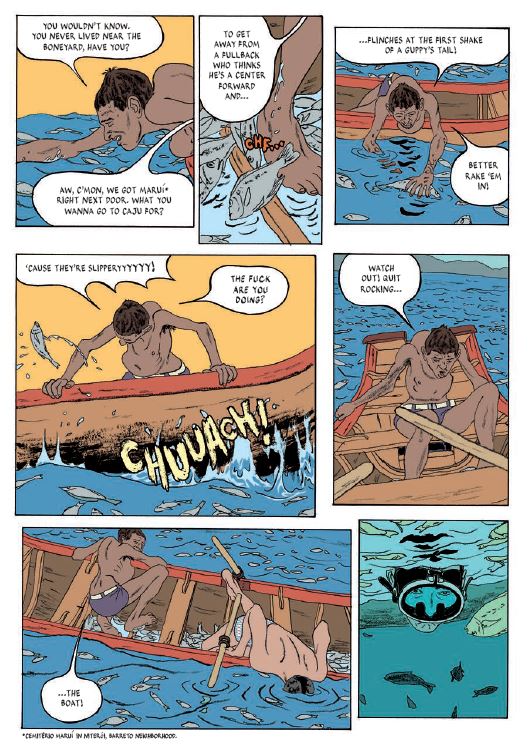
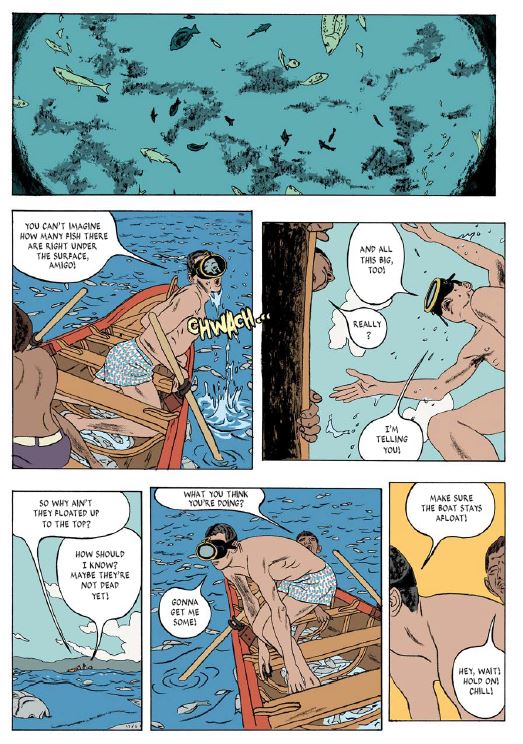
Marcello Quintanilha’s storytelling in The Lights of Niteroi feels so much like a lived experience that it is hard not to get sucked into the lives of these characters living in Rio De Janeiro. Helcio is a cocky up and coming soccer player who is constantly scheming for success. His friend Noel, often called “Turtle” due to a physical deformity, is more cautious but, like any young man, can be goaded with enough friendly banter and name calling. The pair see someone blowing up fish with dynamite and come up with a plan to grab the extra floaters and sell them at market for some easy money. From here, the story goes on a wild series of twists – from an island of nudists, to a storm, and to a penultimate soccer match. Quintanilha’s story veers in a few different directions as it goes on, but it all somehow feels natural to the story. Every event feels like it was pulled out of a memory, like one of those summer days you would have had when you were 17 and you and your buddy’s parents’ didn’t know where you were. Quintanilha’s dialogue writing is brilliant, with the speech feeling genuine and naturalistic. There are a lot of moments where the word balloons are overlapping due to so many people talking at once, each with a different intonation to capture the tone of each person in the room. There are a lot of arguments and banter, and Quintanilha manages to make it all feel so alive – and that’s not even getting into his visual approach. With everything that goes on in this graphic novel, there is still also a beating heart carrying through every sequence. Every moment is alive with emotion, and that range of emotion is all over the spectrum. It would also be remiss not to mention the additional localization work of Bruna Dantas Lobato, who assisted in translating The Lights of Niteroi into English from Portuguese. Quintanilha has written one of the most remarkably human stories in this medium I’ve read in recent memory.
Art Direction
As excellent as Quintanilha’s writing is, it is his visual work that makes The Lights of Niteroi absolutely sing. The Brazilian graphic novelist’s rendition of this 1950’s community on the Guanabara Bay is immediately visually arresting, pulling readers into a time and place with ease. His character designs and animations make every page feel alive, as the emotion of every person is easy to read and matches – or betrays – the words they speak. There is so much tiny detail in this graphic novel, in both environment and character, that it’s a bit staggering. Quintanilha’s sequential direction is masterful as well, as every scene is carried through with a pacing that could almost be called cinematic if it weren’t so specific to the comics medium. A heated argument in a thunderstorm on the sea is carried by large panel close-ups of faces in anger. Helcio following the girl of his dreams is broken up in pieces as he fights through the crowd to speak to her. All of Quintanilha’s work is tied together by his stellar color art. The heat of the Brazilian sun, the vibrancy of Niteroi’s streets, and the crystal blue of the sea are rendered in a stunning, light color palette that pulls the reader right into the page. Quintanilha’s lettering is right on par with the rest of his visual work here. His hand-drawn dialogue lettering carries all the character that the cast does, with their arguments and banter clashing in stacks of word balloons. His SFX word and one particular screaming match in the rain are absolutely incredible moments of lettering art in comics, and some of the best examples of what great lettering can be. Overall, The Lights of Niteroi is a beautifully composed graphic novel in every regard.
Verdict
The Lights of Niteroi is a beautiful and wonderfully human piece of graphic art. Every aspect of Marcello Quintanilha’s storytelling, from his naturalistic writing to his incredible visual work, is a masterclass in telling such character-driven stories in the comics medium. Bes sure to grab this original graphic novel when it hits shelves on March 31st!
