


“I thought of you a lot, while I was writing. All your ideas about… humanity, they have all been there to draw upon. If I ever doubted how much I’ve learned from you, I do not doubt it now.” From Mary Shelly by Helen Edmundson 2012 (pg 11)
I think it’s safe to say that there aren’t very many intellectual properties that are over 200 years old. People talk about the popularity of Star Wars, which first came out in 1977, but that’s a babe compared to Mary Shelley’s Frankenstein. Even Dracula is Frankenstein‘s annoying younger brother. You might even feel like bringing up Shakespeare, but I would argue that Frankenstein is more culturally significant to general modern audiences than the bard’s great works. Every decade or so, Frankenstein is reborn for a new generation, and there are a flurry of adaptations or works inspired by the 1818 classic.
We are currently in one of these periods. Guillermo Del Toro has recently released his version on Netflix, taking inspiration from the James Whale 1931 movie and mixing it with stylistic concepts from a broad range of Frankenstein offshoots, creating a Frankenstein’s monster of a movie, pierced together from Del Toro’s own experiences with the franchise’s legacy. Next year sees the release of The Bride, a more abstract examination of the text from the superb Maggie Gyllenhaal. There have recently been several theatrical performances* and a handful of comics, such as 2021’s The Modern Frankenstein by Paul Cornell and Emma Vieceli, and last year’s Universal Monsters Frankenstein by Michael Walsh.
Credit: Mad Cave Publishers
It’s difficult to escape the influence of Shelley’s novel and the early Universal films, as each have seeped into the modern popular zeitgeist and left trails throughout everything they have touched. But what is fascinating about the Frankenstein obsession is how often the original creator herself is featured in the retelling, adaptations, or in works inspired by her life. In The Bride of Frankenstein from 1935, Elsa Lanchester plays Mary Shelley recounting the next chapter in her infamous story, the part that had not been published. Doctor Who visits Mary Shelley at Lake Geneva where an encounter with the Cybermen becomes the inspiration for the Creature. There is a list as long as my arm of such instances, which brings us to the upcoming Mary Shelley: The Eternal Dream published by Mad Cave studios, written by Alessandro Di Virgilio and illustrated by Manuela Santoni.
The book was originally published by BeccoGiallo in 2019 and translated for Comixology Originals by Lucy Lenzi in 2023. So it is possible you may have come across this comic already, however, Mad Cave is releasing the first print edition of it in early January 2026 to a much wider audience.
The comic chronicles the early life of Mary Wollstonecraft Godwin, and touches on some of her heritage as she is drawn towards her destiny at the Villa Diodati and the creation of her famous creature. There is an interesting narrative voice throughout the comic, and it’s owner only becomes apparent at the end, although it is fairly easy to guess once you realise that the nature of the comic is a fictional retelling of historical events. The comic embraces a motif that has become popular with adaptations of older properties: It merges history with fiction. The novels of the past are embellished retellings of actual events and not simply flights of fancy, or the authors and creators are themselves fictions to be used to tell further tales. This allows for a more poetic retelling of Mary’s early life, giving Alessandro Di Virgilio the opportunity to fill the pages with recitals of famous poems and philosophical discussion.
Credit: Mad Cave Publishers
The cover of the book has Mary positioned like a sculpted bust with wild hair in the vein of the Bride of Frankenstein from the 1930s movies. Hanging over her is just visible the lower portion of the creature’s face. It is like the Sword of Damocles, ever present above the heroine. An inescapable fate, but it creates a contradiction. For Mary, the creature and the novel it inhabited was to prove to be her lasting legacy, whereas the creature in fictionalised form was a source of destruction and unhappiness. The cover of the book illustrates the significance of the creature but its intentions are unclear and this is not something that is satisfactorily resolved.
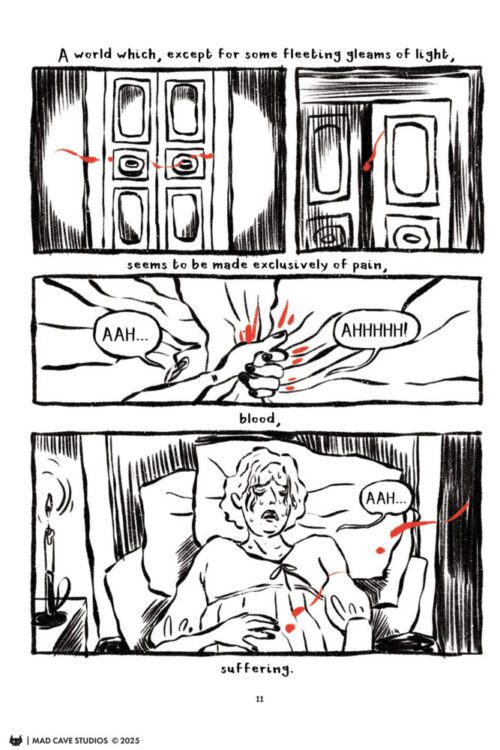
There is a duality to the creature that is represented through Mary’s life. It is like a winding path that is full of loss and pain, but also love and affection, and it is suggested that the creature is born from this. When the creature speaks of “our” world, he says it is “devoid of any rules,” “A world which […] seems to be made exclusively of pain, blood, suffering.” From the outset, the creature, as narrator, acknowledges the difficult life that Mary had and how this could lead her to create a story of such despair and destruction like Frankenstein. The opening scene is of her birth, and the heavy, black line drawings in the panels have a splattering of red, like a flick of paint, that visually represents the words of the narrator.
Credit: Mad Cave Publishers
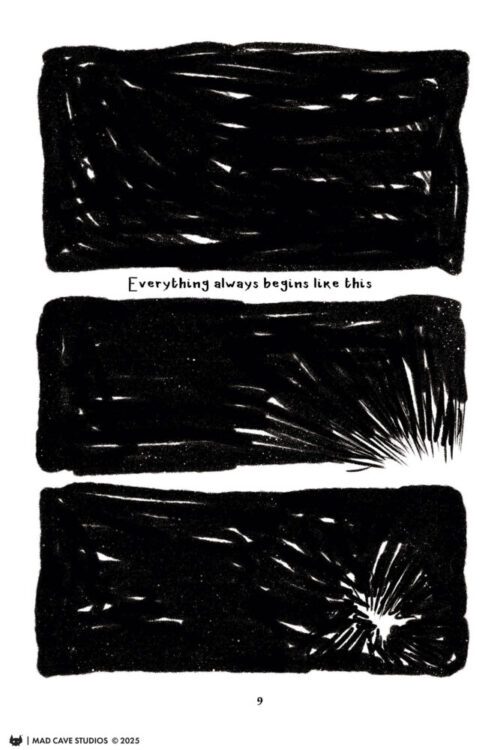
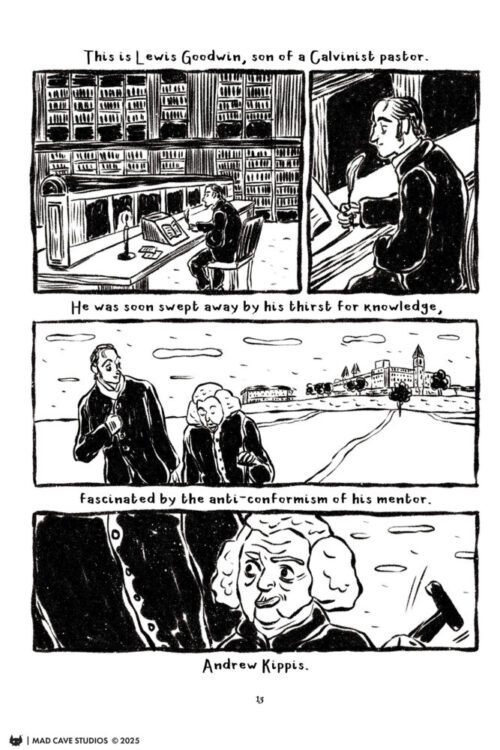
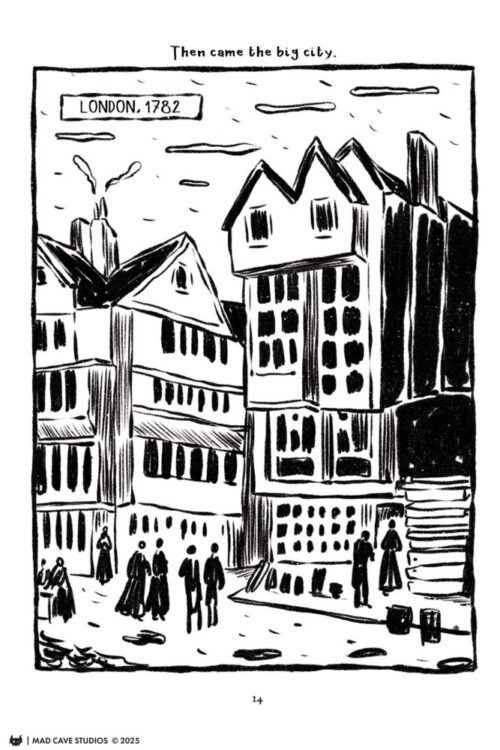
Manuela Santoni’s artwork is fascinating. It is not the clean cut, realistic renderings of most North American superhero comics. Instead, it favours an emotional expression of line and shade. The characters are created from shapes that fit the mood of each panel and scene, and are surrounded by hastily shaded backgrounds or deliberate lined shadows. Gaps in the inking creates clouds in the sky or shadows on characters’ clothes. Faces are quick line drawings with subtle inflections creating the emotional content. Sometimes this is lost within the heavy lines of a panel and can be easily overlooked if read too fast. But this comic is meant to be savoured, like a poem. The slow beats of the stanzas are dictated by the narrator’s words and splash pages herald a new verse. The classic poems recited by several characters within the comic are reflections of the artwork and storytelling style of this comic.
The Eternal Dream received some criticism when it was released by Comixology for lacking the complexity of Mary’s life, for not having a strong emotional connection to the central character. One review suggested that Mary was like a guest in her own story. I can see this, and understand it. However, I don’t entirely agree with it. The comic is not just about Mary Shelley; it is a history of the birth of the Frankenstein creature, and just as the creature is pierced together from various body parts, enlarged to make the surgery easier, so too the creature’s story is an embellishment of moments, exaggerated to fit its monstrous narrative. The Eternal Dream focuses on the early life of Mary and, in doing so, becomes an amalgamation of her ancestry and the influential, whether positive or not, people around her. The creators are presenting a life made up by the world around it, just as the creature is made up of different body parts. To see the young Mary, is to understand the anatomy of this world around her.
Credit: Mad Cave Publishers
The artwork is rough and ready. In places it appears barely formed, but in others, there is a majestic pattern to the design. The panel layouts are straightforward with only a few rows at most to each page but, again, this simplicity creates the poetry. Each page is a steady, deliberate pace that allows the reader time to digest the words and the images equally. It has the feel of a biographical comic, along the same lines as Maus or Persepolis, with the personal touch of the artist ever present on the page. The repeated intrusion of the red splashes and dashes signifies both extreme emotion and the approaching birth of the creature. The handcrafted nature of the artwork is an important part of the visual presentation; this is not a reflection of the real world but an interpretation of a world by the narrator, in this case a fictional creature. And the artwork allows the reader to see how the creature sees—and arguably how history sees—a creator like Mary Shelley. We want to romanticise her life because of the romanticism inherent in her work, but also we expect a buried darkness for the same reasons.
There are more in-depth examinations of Mary Shelley’s life, whether they are academic books such as In Search of Mary Shelley by Fiona Sampson, or elaborated histories like Mary: Or the Birth of Frankenstein by Anne Eekhout**. And in comparison, The Eternal Dream is more whimsical, as suggested by the title. However, there is still an engaging narrative with a consuming darkness buried beneath the surface, one that feeds the creature at the heart of this wonderfully enticing comic.
Mary Shelley: The Eternal Dream, published by Mad Cave Studios is due out in January 2026.
*In the UK at least. I know because I saw one and couldn’t get tickets for another.
**Both books that I would highly recommend.
