


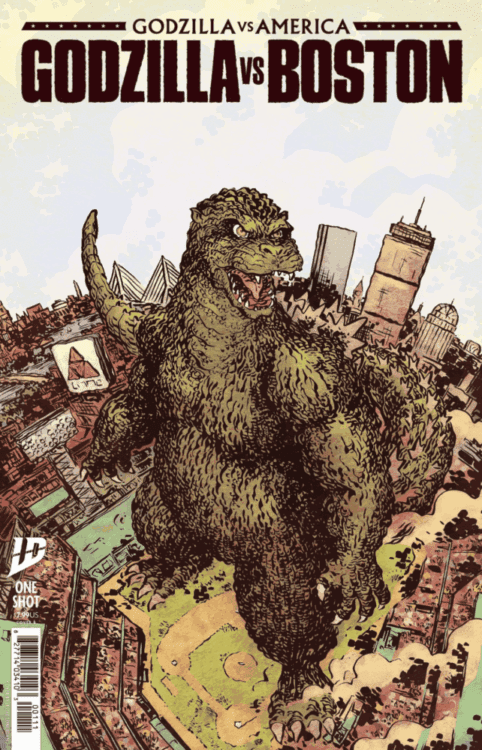
What happens when the King of the Monsters sets his sights on a place as independent and historically significant as Boston? IDW’s Godzilla vs. America: Boston answers this question with a quartet of imaginative and artistic stories.
This 48-page anthology is undeniably an appreciation of Boston, Godzilla, and comic book artistry. Edited by Jake Williams and Nicolas Niño, who deserve a special nod for keeping a cohesive tone amidst such diverse artistic voices, each of the stories is a self-contained expression of creativity, exploring the Godzilla mythos through lenses ranging from the epic to the absurd. For the new comic book reader, this is a perfectly accessible work. For the more narratively demanding, it will feel light, but the sheer spectacle and artistic creativity will likely compensate.
“The Great Gorilla Whale”
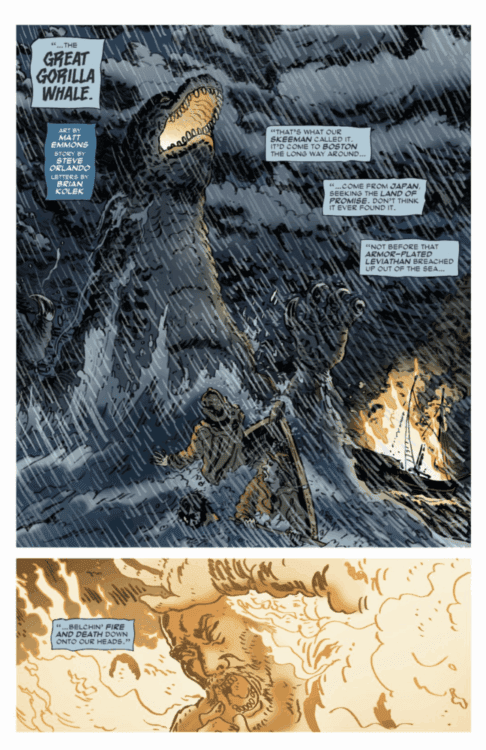
The first story, “The Great Gorilla Whale,” by writer Steve Orlando and artist Matt Emmons, with colors by Patricio Delpeche and letters by Brian Kolek, immediately throws us into the deep end with a Moby Dick-inspired narrative. While it strains credulity that a band of fishermen could truly stand up against Godzilla, Orlando wisely leans into the core characterization of Godzilla as a primal, destructive force of nature capable of mercy on its own time.
Emmons’ pencils and inks capture the inherent dangers of the open sea and the explosiveness of the classic Godzilla battle. The coloring by Delpeche is emotionally resonant, with traditional reds, oranges, and yellows for action sequences, balanced by blues that reflect fear. There’s an interestingly flat, softly gradient texture that gives the story a slightly cartoonish approach, which enhances the style of Emmons’ linework. Kolek’s lettering is particularly noteworthy; for a uniquely dialogue-heavy story, he understands when to allow the action to dominate. This story is certainly the most literary of the four.
“Godzilla Versus the Lobster That Attacked Boston”
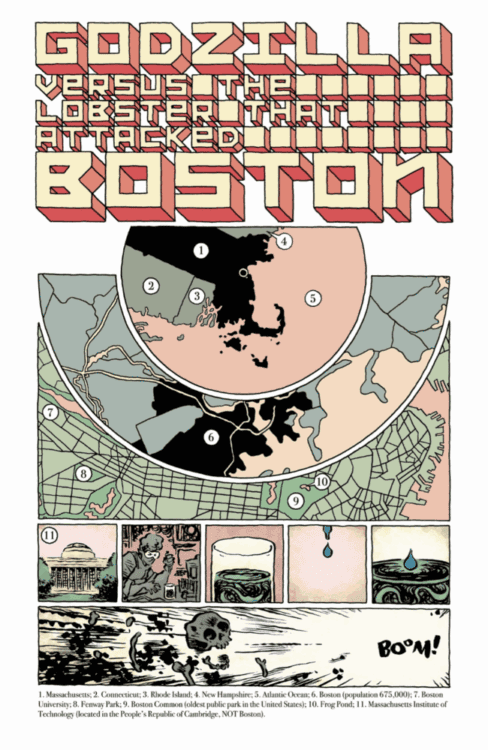
“Godzilla Versus the Lobster That Attacked Boston” is from writer/artist Jesse Lonergan. This is where the anthology truly begins to lean into the absurdity that has helped make Godzilla so enduring over the last seventy years. The premise itself is simply ironic and funny: a giant lobster attacks Boston. Lonergan’s choice to tell the story in a textbook-like style, pointing out panels as “figures” and aiming for geographical and scientific explanation (particularly around the logistics of cooking a giant lobster), is just brilliant.
Lonergan’s pencils and inks are intentionally crude and unpolished, with a newspaper comic strip style. The coloring further contributes to this unique aesthetic. You never knew you needed such a clinical, dispassionate description of Godzilla’s heat ray until you read it here.
“Make Way for Mothra”
The third story, “Make Way for Mothra,” from writer/artist Hanna Cha with lettering by Brian Kolek, is less a narrative and more a heartfelt, childlike love letter to Mothra.
Cha’s pencils and inks contribute directly to this childlike wonder. The drawing style feels pleasantly juvenile, reminiscent of those long hours spent in school filling notebooks with sketches. The coloring, also by Cha, plays to this same sense of youthfulness, giving a distinct color pencil look. This is a special story, reminding us just how vastly unique comic book art can be. The lettering by Brian Kolek showcases his dynamic range; here, completely different from “The Great Gorilla Whale,” it’s very much in the style of a picture book, as it should be. For those who view Mothra as a powerful kaiju, this soft touch might initially feel disappointing. However, Mothra is often depicted as a motherly figure before a monstrous one, and this story lovingly appreciates that gentler, more benevolent side of her character.
“The Green Line”
Finally, “The Green Line” is where absurdity and charm reach their peak. This story, from writer/artist Hayden Sherman with colors by Patricio Delpeche and letters by Brian Kolek, is the biggest thank you to Boston’s public transit system, and one that will undoubtedly charm fans of the middle Shōwa era of Godzilla films. (If you’re a devoted Godzilla fan, you might pick up on that hint as to who might make a surprise appearance here.) I had a lot of fun reading this story specifically, and it makes one wish the U.S. government appreciated public transit as much as the creative team behind this story clearly does.
Sherman’s pencils and inks embrace a classic golden age style. More traditional comic fans may very well prefer this less experimental approach in comparison to the other stories. The illustration of motion, particularly concerning the Green Line itself, is a standout. The train really feels like it could leap off the page. Delpeche’s coloring is standard and traditional as well. And Kolek’s versatile lettering rounds out the classic feel.
Conclusion
What makes Godzilla vs. America: Boston such a welcoming read is its fundamental understanding of what makes Godzilla important. This is a unique icon, capable of dually exploring and lamenting the impacts of war and trauma, while also allowing us the simple, visceral thrill of rooting for kaiju to absolutely wreak havoc.
Again, editors Jake Williams and Nicolas Niño deserve commendation for their oversight. Despite the vastly different artistic and narrative styles, they’ve maintained a cohesive tonal connection, allowing each unique artist to truly express their vision without the collection feeling disjointed. Each story is so short and punchy, making this a fantastic pick-up for casual readers seeking a great sense of spectacle with a diverse blend of art styles.
As for the Boston locals? Beantown is profoundly important to this book. I believe locals will find a wealth of easter eggs and entertaining details (especially within “The Green Line” story).
Godzilla vs. America: Boston is an appreciative work of creative expression and the enduring appeal of giant monsters. I encourage fans to pick up this issue and check the closing pages to see which American city Godzilla is heading to next. It might just be yours.
