


From acclaimed comics writer Rick Remender (Uncanny X-Force, F.E.A.R. Agent) and powerhouse artist Daniel Acuna (Avengers, X-Men) comes the most unique and brutal war comic since Ennis’s Marvel MAX work in Escape #1. Featuring letters by Rus Wooton, this anthropomorphic war story manages to slip past its odd appearance to make for a war comic that questions the morality of combat better than most stories like it is recent memory. With a tense, powerful script and absolutely phenomenal visual work, this is one of the best debut comic issues of the year so far.
“Milton Shaw is a battle-hardened bomber pilot, flying missions over a war-torn world ruled by a ruthless empire. But when his plane is shot out of the sky, Milton wakes up behind enemy lines—in the smoldering ruins of a city he helped burn. And in less than 24 hours, his own side is dropping the big one to finish the job.
Now, injured, unarmed, and being hunted through enemy streets, Milton’s only shot at escape comes from the unlikeliest place: a grieving father and his son—civilians shattered by the same fascist regime that rules this land with an iron claw. Enemies by blood. Allies by circumstance. Together, they’ll have to fight their way out before the bomb drops and erases everything…and everyone.”
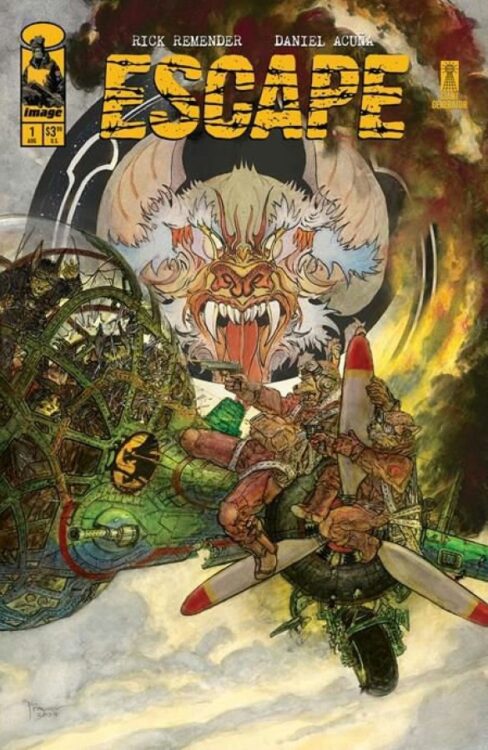
Writing & Plot
There aren’t many writers who could come up with an anthropomorphic World War II comic that brings the morality of combat into question and play it dead serious. Rick Remender happens to be one of the few, and this is exactly what he does with Escape #1. From the opening pages, Remender pens a war story that is as brutal as it is morally complicated – and it takes no time at all to get used to the fact that the main character is a talking bear. The concept of the war is basically the Bats (Germany) waging a brutal campaign against other species (the Allies). It only takes a few lines of dialogue to completely overlook the fact these are sentient animals and instead focus on the complicated morality of being a bomber crew. A huge focus from this opening chapter is the cost in collateral damage, and if the lives of countless civilians are worth ending a war. All of this is handled with Remender’s phenomenal naturalistic dialogue and narration, giving the comic a realistic yet pulpy reading tone. The grim subject matter and the brutality of loss make this one of the heaviest war comics to come out in years, and Remender’s characterization makes the story deeply compelling. Each character, even if they only have a couple of lines, feels like a fleshed out person due to their part in the opening conversation. As the combat opens up and the main chunk of the story going forward begins, the impact of loss and the stakes at hand hit the reader and drag them forward into the chaos. Escape is my favorite piece of Remender’s writing since F.E.A.R. Agent, and I cannot wait to see where the series goes next.
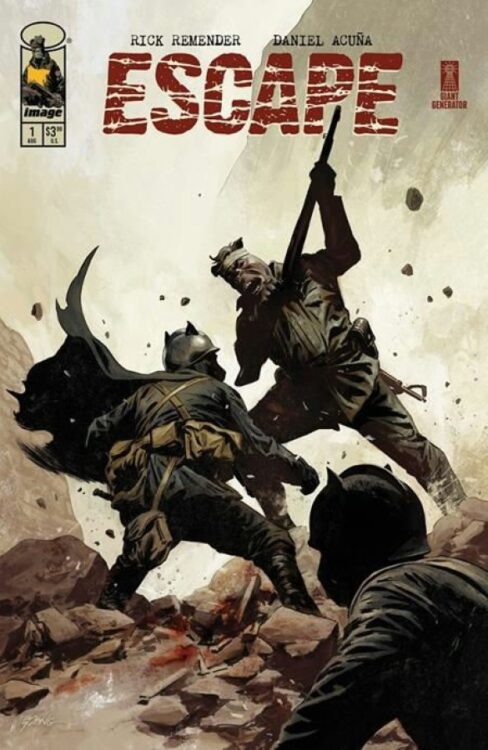
Art Direction
A concept such as what is offered in Escape #1 works so well due to Daniel Acuna’s phenomenal visual work. His heavily shaded and detailed work makes the comic feel like an old pulp war issue, but with modern visual touches. The sheer amount of detail work in Acuna’s work here is staggering. The facial animations of each character are brilliantly life-like, making all of their demeanors and personalities shine even when not considering their animal features. Acuna’s style makes the anthropomorphized world work seamlessly, matching Remender’s writing approach perfectly. The environmental details are also intricate, from the WWII bomber crew uniforms to the lights and gauges of the instrument clusters. The more fictionalized design elements – the Bats’ planes, for example – fit beautifully into this take on World War II; as if Wolfenstein took place in the Zootopia universe. Acuna’s sequential direction is another huge reason each character feels like a fleshed-out crewmember, as well as why the book feels so intense. Reaction shots are captured in small panels often in a backdrop of the chaos of the crew delivering their payload amidst antiair fire. Impacts and losses are given gravity amidst the bloody, explosive action, and each decision is focused on to make the weight of what this crew is doing felt by the reader. Acuna’s heavily shaded pencils are given life by his staggering colors, giving this comic a wholly unique visual approach. Every surface looks like its covered in oil and black powder, refining the wartime/industrial aesthetic that is often associated with WWII. The way Acuna lights up scenes with explosions and alarms is genius as well, creating some of the most memorable panels we’ve gotten in comics this year. Rus Wooton’s lettering fits into the visual style spectacularly well, especially his approach to SFX lettering. His hollowed-out SFX work blends in to the panel, highlighting the explosive chaos and mechanical clicking of the action in the bomber. The visual team is on an artistic tear with this opening issue, and it’s one of the best looking comics of 2025 thus far.

Verdict
Escape #1 is a brutal and brilliant war comic that just happens to have anthropomorphic animals. Rick Remender’s script is a brutal, morally complex snapshot of a fictional version of Word War II that is oddly full of humanity due to his stellar sense of characterization. The visuals from Daniel Acuna are absolutely staggering, with his unique visual approach making for one of the best looking comics of the year. Be sure to grab this debut issue when it hits shelves on August 20th!
