Home Blog Page 307

Review: JAMES BOND 007: THE WARREN ELLIS OMNIBUS Is Bond At His Finest

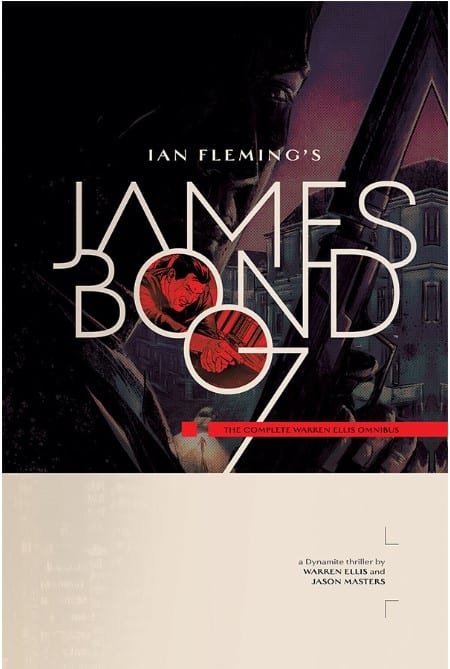
James Bond Warren Ellis Omnibus, Masters cover

JAMES BOND 007: THE WARREN ELLIS OMNIBUS, available today from Dynamite, is Warren Ellis’ take on the legendary super spy. The Omnibus is a collection of two story arcs: Vargr and Eidolon. In each arc, Bond encounters a bevvy of dangerous enemies and colorful allies, all in service to Her Majesty’s Secret Service. With decades worth of source material and pop culture iconography, does Ellis’ version of the titular character hold up?

Writing

Let’s just get this out of the way. In these collections, Warren Ellis has written peak James Bond. Bond is charming with a touch of scoundrel when interacting socially; deadly accurate and ruthless when facing the enemy. He’s a smart ass and yes, to use an old-fashioned phrase, he’s very much a ladies man. To put it simply, Ellis has taken all the best characteristics of Bond from the books and films and merged them into a dynamic and engaging personality.

In Vargr, Bond is assigned to hunt down the maker of a designer drug that’s killing it users. Bond eventually discovers the plot is bigger and more twisted than a simple drug dealer with bad product. The villains in Vargr just barely skim the line of cartoon-ish, but the action is tight, and the stakes are high for the entire island of Britain. What I appreciate most about Bond here is he takes more than a few lumps, true to his depiction in the original books. Bond doesn’t escape all attacks with perfect hair and a winning smile. when the fight scenes take place, Bond’s expertise saves the day at the cost of more than a few bruises. Excellent authenticity by Ellis.

In Eidolon, a insurgency cell connected to SPECTRE has infiltrated the highest levels of British Intelligence. Bond fights to survive assassination attempts from within his own ranks to uncover the traitors and save the agencies meant to protect Britain. There’s a bit of commentary from Ellis in this story as he raises the questions about how far we need to go for security before we trade one danger for another. Eidolon is the more paranoia-filled and tense of the two stories, and it’s imminently enjoyable as a spy thriller. The ending is not your typical smarmy-one-liner-before-he-kills-the-bad-guy ending, and big credit goes to Ellis for infusing the character with more depth than previous incarnations with the final fight.

One quick note about the female characters. Bond stories have received some criticism in the past for their depiction of female characters, either for coming across as agentless damsels-in-distress or as nothing more than a love interest for Bond. I was pleased to see that ALL the female characters in these collections are integral to the story and have complete agency when it comes to the romantic interactions with Bond. Again, kudos to Ellis for getting that bit right.

Overall, the omnibus is well-constructed, and the stories are mature without a a hint of camp in sight. This is probably the fastest omnibus I’ve ever read through. Not a single panel is wasted and the story moves.

Pencils/Inks

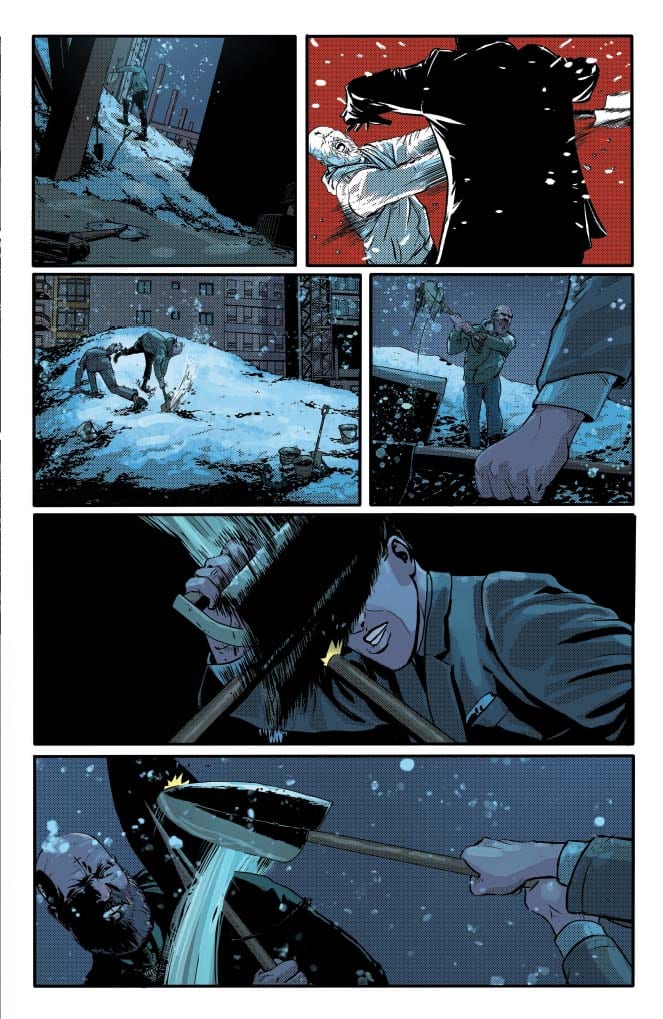
Jason Masters’ art in Vargr is cinematic. Every panel is rendered with enough detail as to look like a cell lifted straight form a Bond film. Masters’ realistic style lends an air of maturity to the material that keeps the far-fetched elements (an assassin with robot arms?) grounded.

Likewise in Eidolon, the realist art style intensifies the cinematic qualities of the story. Every character is distinct and well-rendered such that the art enhances the writing and dialog to create three-dimensional people, even with the lesser used side characters.

Extra kudos goes to Masters for the creation of the main villains. In typical Bond story fashion, the main villain is usually distinguished by some sort of scar or deformity. In both stories, Masters draws villains with their telltale scarring but does it in such a way as to add to the backstory of each character, giving them more depth.
James Bond Warren Ellis Omnibus, art sample

Favorite Panel/Page: Part of the Bond mythos is the endless ribbing he gets over his choice of personal firearm, the Walther PPK, On page 28, Q is inflicting just such a ribbing and suggests Bond choose a more meaty weapon with an appropriate shoulder holster to carry it. Without spoiling it, Bond’s comeback had me laughing at loud because it’s just such a perfect representation of the character in all the best ways.

Coloring

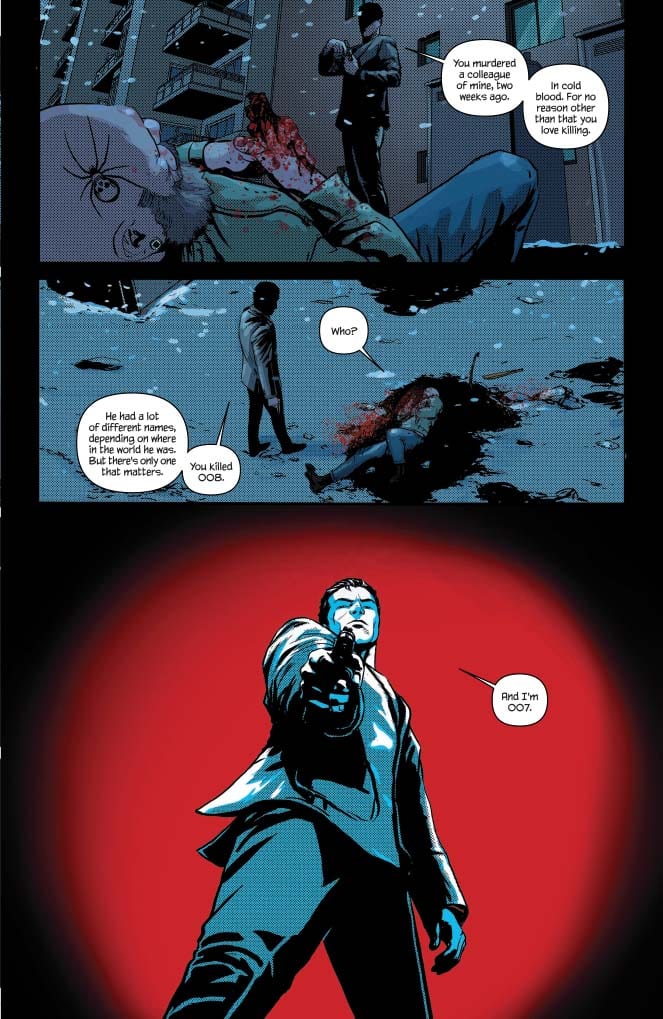
Guy Major’s coloring is chock full of mood, particularly in the more brutal death scenes when it’s one-on-one. For example, the opening scene of Eidolon depicts the death of a henchman who’s gotten “sloppy”. The entire sequence is bathed in hues of yellow and orange to reflect the sunset lighting from outside, but it also paints a sickening atmosphere of malignancy that takes a simple murder to something more sadistic…and therefore, impactful.
James Bond Warren Ellis Omnibus, color sample

Lettering

I mentioned earlier this was the fastest omnibus read through I’ve ever done. The writing, art, and lettering combine to practically sprint you through the pages. That’s in part to Simon Bowland’s lettering work. Bowland makes excellent use of background space to put in word balloons only when absolutely necessary. That’s also why the stories move along so quickly. In the first eight pages of Vargr, there are exactly eight word balloons, and even then, they all show up only on the last of the first eight. Sometimes less is more, and Bowland get it absolutely right by tucking in the letters in the sparsest of corners to let the stories fly.

Conclusion

JAMES BOND 007: THE WARREN ELLIS OMNIBUS is a collection of tense, taut, and thrilling James Bond adventures. The quality of stories, in both the writing and art, is on par with the best James Bond films and even better than some of the original novellas. Absolutely worth your time for the price.


Author’s Note: Local Comic Shops (LCS) are going through a tough time right now with the pandemic outbreak of COVID-19. Comics fans of every flavor that care about his or her LCS should try to do what they can. So, here’s my part:

If you’re in Northern Delaware, South East Pennsylvania, or Southern New Jersey area, please take a moment to visit Captain Blue Hen Comics in Newark, DE. Say ‘hi,’ pick up a book, order a book (they’re on Comichub.com), and let them know you support them.

If you’re nowhere near that area, please find YOUR LCS using Comic Shop Locator and lend your support.

Thanks, and stay safe.
Monkeys Fighting Robots Youtube

GUARDIAN #1 – Tom Carter’s Superhero Sneak Preview

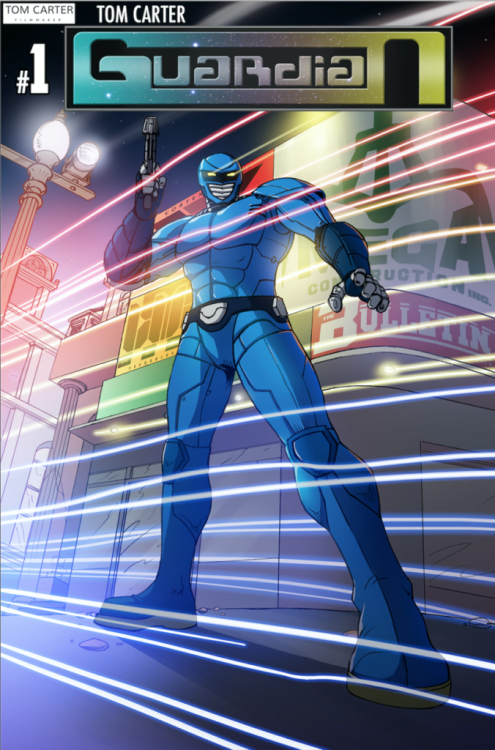
Guardian #1 Cover

Guardian #1 is a superhero indie comic by UK filmmaker Tom Carter, available via Comixology. This passion project has been in the works since his college days.

ABOUT THE BOOK:
Zack West, who just graduated returns home spending time with his family and girlfriend living his normal life ever day life until a mysterious alien symbiotic crash lands on earth; it fuses with Zack and together they become Guardian, the newest superhero and defender of earth.

Guardian #1 Introduction

Tom Carter’s Guardian #1 wastes no time introducing his title character… characters? The way Carter works with artist and letterer Jang Haryadi for introductions is pretty clever. Readers assume it’s the civilian identity of Zack West until later some context from the beginning reveal that it’s him and a symbiote. Think if Venom was more technological. What’s more, Zack is an everyman who surrounds himself with quirky yet down-to-earth characters like Guardian and his family. When you get down to everything, this is the ideal viewpoint of the reader to a new universe. Empathetic enough for a reader to latch onto, but not sympathetic enough to the point of pity. That’s certainly the way for Guardian who learns through Zack that there are already superheroes about.

Building Up Future Stories

With the universe building in the background, this generates interest for more content. However, the way Guardian #1 sets up future stories can be kind of lackluster. Their archenemy Mars The Destroyer and his presence combined with the disappearance of Zack’s family friend Sean Hunter advertises itself as a mystery. But to readers who pay attention, it’s actually pretty on the nose. Guardian’s conflict with the crime lord Maverick seems more interesting, especially with his skull-masked helper.

Guardian #1 Artwork

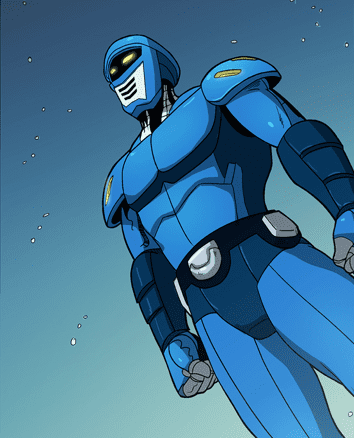
Meet Blue... uh.. Guardian. No not Blue Guardian just Guardian.
How popular is Blue Beetle (Ted Kord) in the UK?

Jang Haryadi does a very good job with how he handles penciling, inking, and lettering. The designs of his characters in Guardian #1 are diverse enough for readers to tell everyone apart. But it’s the designs of the heroes and villains that are the most praiseworthy. Guardian’s simple design not only makes it notable, but the trunks it features are a tribute to Silver Age superheroes. Villains like Mars, Maverick, and Skull all feature designs that fit their personalities. Mars is an over-the-top supervillain with a cape who ironically watches from the shadows, while Maverick is a large intimidating man in a suit. Skull’s mask with eyes that occasionally glow purple imply a mystical nature, all while dressing in a fedora and trench coat. This is a display of Maverick trying to cover all areas of superheroics including the more fantastical aspects that have yet to show up.

Lettering problem in Guardian #1
This looks better if you see the panels above this picture.

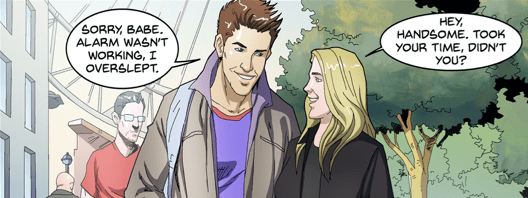
However, when it comes to Haryadi’s lettering, they range from being creative to chaotic. The captions, as mentioned earlier on Guardian’s introduction is some of the best in Guardian #1. Unfortunately, some of the word balloons and captions can be out of place. When Zack is speaking with his girlfriend Amy, her opening dialogue looks like it should be in one panel or happens too late. Otherwise, Zack’s apology looks awkward when reading from just the panel it takes place in.

Coloring by Papillon Studio seems to vary. They range from relatively simple like most of the series where Zack goes about the day to highly detailed where Guardian makes his debut. The background however doesn’t get much detail unless there are trees. Otherwise, the urban architecture looks kind of dull.

The First Step Of The Carterverse

Guardian #1 is far from perfect, but it has the potential to grow into something greater. You have characters who serve as the gateway into a bigger world of superheroes instead of being the first of an epic. Sure, Guardian’s building superhero career looks lackluster, but maybe Zack’s family can be a treat. Where else can you find superhero stories that can be fun and be a means of figuring out what to do with your life? Anybody trying to find their way can relate to that. Maybe you just need to wait and see where this all goes.

What do you all think? Is this series just another attempt at reinventing the superhero wheel? Or could something come out of this? Leave your thoughts in the comments.

Monkeys Fighting Robots Youtube

Review: Faithless II #1 – To Fill A Blank Canvas

This Wednesday, Brian Azzarello, Maria Llovet, and Andworld Design continue their tale of Faith’s rise in stardom through questionable means in BOOM! Studio’s Faithless II #1.

It’s been about a year since the first part of Faithless wrapped up, so refresh yourself with Darryll Robson’s reviews here! Then support your LCS and pick it up.

Faithless II #1 is for mature readers, so make sure you know that before jumping in. However, you need the background from Faithless, so that should come as a given.

FAITHLESS II #1 AND THE DAUNTING CANVAS

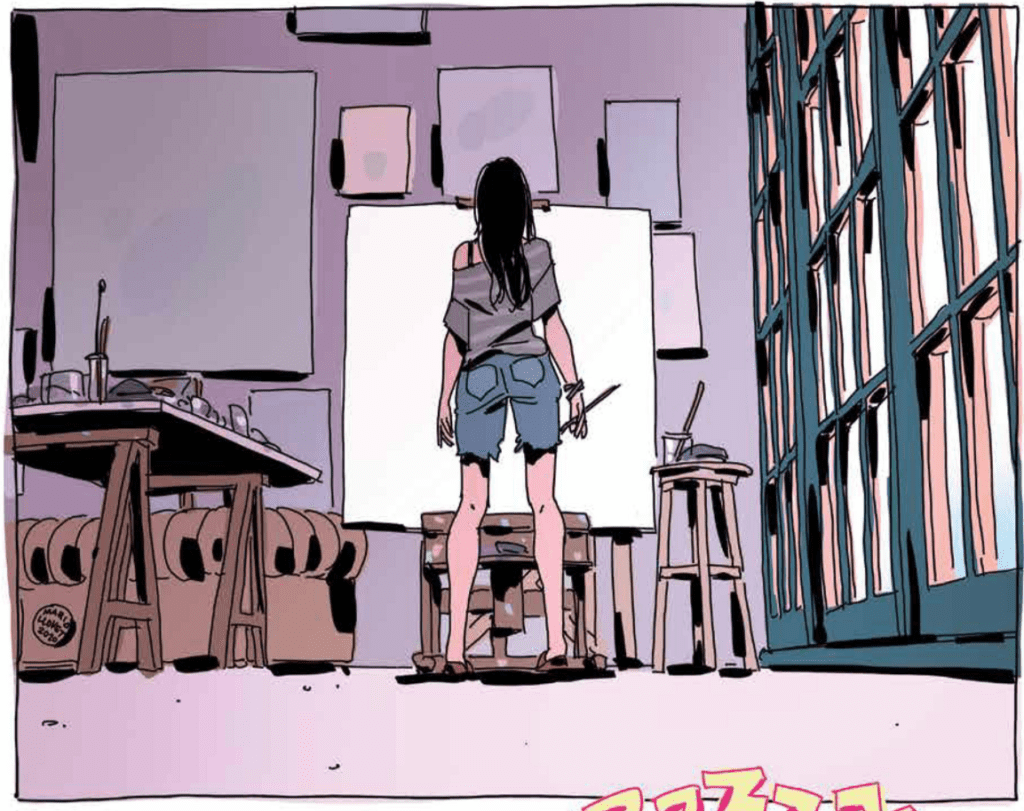
Azzarello reintroduces the cast we’ve gotten familiar with by having each interact with Faith, thus showing how they’ve progressed. Yet it doesn’t seem like it’s been that long since the previous story, as Faith is still getting called “the next big thing.” That and Faith feels like the character we left in the previous serious, still confused and not sure of herself. Instead of having her feeling confidant, she still doubts herself constantly; this is shown with a simple narrative—a blank paint canvas.

The blank paint canvas that haunts Faith throughout the first issue is great; it shows how she feels she still lacks something. Instead of skipping ahead, Azzarello continues at a slow, steady pace, showing that she is still evolving. The many changes Faith went through in Faithless was the highlight, and it seems Azzarello knows that, as she still has a way to go. Nonetheless, changes happen when Solomon enters the picture. Solomon was introduced in Faithless, yet was never delved into. It seems like he’ll play into Faith’s further transformation down the line.

An artist and her canvas.
Maria Llovet

A VISUAL TREAT

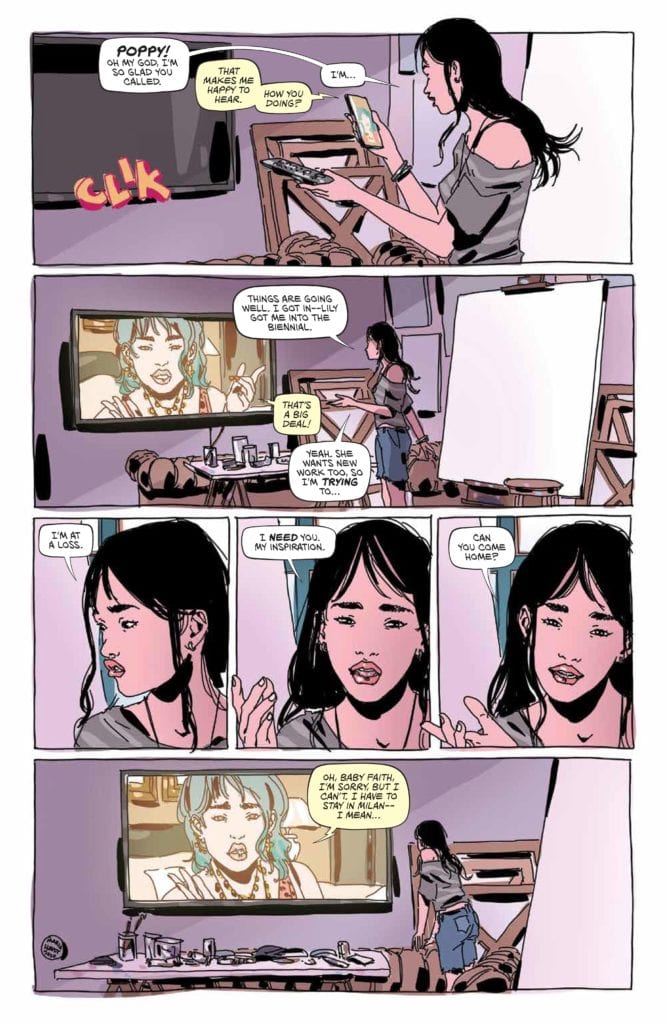
Faithless was a visual treat with a lot of the story riding on Llovet’s art, the same can be said on Faithless II #1. Not only does Llovet’s style perfectly fit Azzarello’s tale, but it also heightens it. This ability to take the story up a notch stems from her European art form, with uneven lines and styles of panel. Albeit her characters are emotional and her ability to showcase realistic feelings is great, her backgrounds are just as amazing. During some scenes, Llovet’s backgrounds are cluttered, showing the business of that location. While other locations are void, helping showcase the foreground. It helps that this genre is one Llovet transcends at.

However, her art isn’t the only phenomenal aspect, as her colors and fashion sense works wonders. This detail for fashion can be seen in her other works as well. Nonetheless, her colors fit the narrative quite well. Her color palette is subtle and realistic. At times Llovet will employ brighter colors, yet at no time does it outshine what is transpiring. Another neat aspect of her colors is how at times, they flow outside of the lines. In Faithless II #1, you’ll find objects and panels that include colors that aren’t in the pencils lines. It’s a small detail, yet simply beautiful.

Brian Azzarello, Maria Llovet, Andworld Design

WORDS OF PASSION

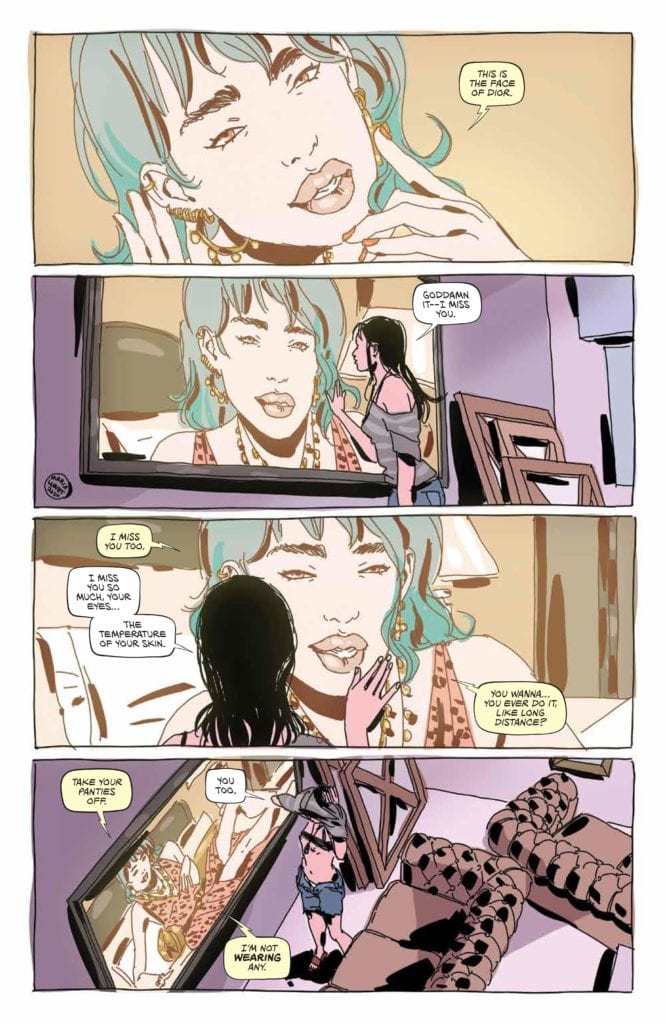
There are a few moments in Faithless II #1 where Llovet includes hand-drawn sound effects. When these occur, they look magnificent and later on help portray a great visual moment. Be that as it may, Andworld Design’s lettering is wonderful when teamed with Llovet’s art and Azzarello’s story. The word bubbles and font style seems to be more freehand then not, with Andworld Design changing the dimensions of the bubbles when needed. The font style used not only makes the story feel more realistic but is gorgeous to boot.

Brian Azzarello, Maria Llovet, Andworld Design

FAITHLESS II #1 CONCLUSION

Although there are some fun character moments in Faithless II #1 the reintroductions of the characters don’t do as well as their initial introductions. Nonetheless, Llovet’s art continues to be drop-dead gorgeous with Andworld Design’s lettering helping tell the story. If you enjoyed the first series, then you’ll want to check out the follow-up.

Fun Fact: Llovet does her comic work digitally.

Monkeys Fighting Robots Youtube

Review: IT EATS WHAT FEEDS IT Is A Story That’s Eerily Simple

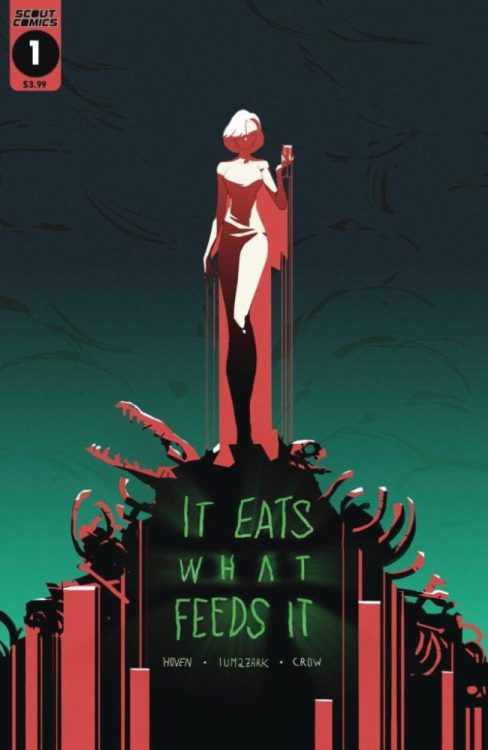
It Eats What Feeds It cover Scout Comics Lumazark

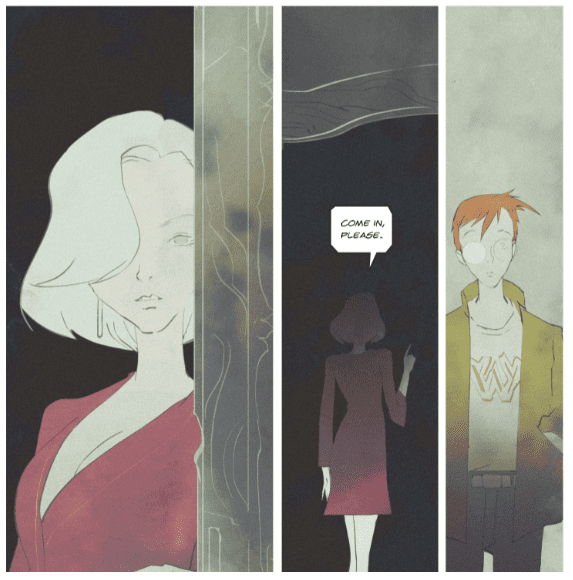
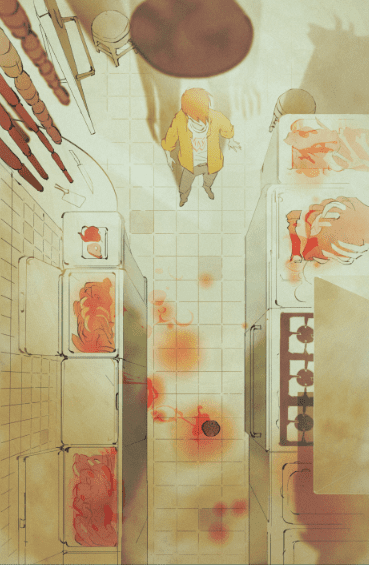
Scout Comics’ It Eats What Feeds It, written by Max Hoven and Aaron Crow, and illustrated by Gabriel Iumazark, tells a story that’s simple yet haunting. The story takes place in the Louisiana swamps. The dingy feeling and the fog in the air makes it feel like danger is around every corner. We follow Kenny, a young high school graduate who is responding to a want ad in the bayou. In a large, spooky house, the seductive Francois waits. She simply needs Kenny around to keep the place clean, keep her company, and ignore the blood splatters in the kitchen.

Writing

Hoven and Crow are building a world of characters from scratch. It’s natural to have a little bit of over-explaining, and some heavy exposition here and there. But somehow, Hoven and Crow dodge this pitfall and dive right into the story. Sure, Kenny isn’t exactly subtle. At one point he’s jumping on his bed saying “She wants me… she wants me hard!” But he’s a horny high school graduate, so the tone of his dialogue works perfectly. Hoven and Crow understand the character they’re writing. They know that if they dangle sex in Kenny’s face, they can then throw in as many red flags into the writing as they want. And so, the reader is warned with every page that something sinister is going on, while Kenny settles deeper and deeper into his dream life. This makes the tone of the comic both spooky and seductive at the same time. You’re lured into the beauty of the world they’ve created, despite that fact they’re screaming at you to run.

It Eats What Feeds It Lumazark Scout Comics

Art

Iumazark, in a way, takes on the role of Francois in this creative process. It’s his job to seduce us into the house, get us sitting comfortably and then scare the shit out of us. And Iumazark does it well. For one thing, much of the art seems to have a haze over it. Since this comic takes place in the Louisiana bayou, the foggy feel in the air is fitting. It’s like you can’t fully see what’s going on. It’s not clear. Iumazark is constantly shying away from detail. His minimalist approach often looks like a picture half-drawn. This brings everything into question. Are we really seeing what’s going on, or is this in Kenny’s head? It’s the uncertainty that becomes the most terrifying factor of the story. The very feeling that there is something between you and a clear picture creates a sense of panic.

Coloring

Iumazark’s coloring is where the balance of dread and seduction comes in. Somehow, scenes that are cast in a “golden days” kind of glow, don’t seem all that different from washed out scenes that suggest a coming doom. We do notice all the differences, but they’re subtle. The tinges of grey and yellow are replaced by a hint of green. But the changes are so subtle that we almost want to convince ourselves they aren’t there. Early on in the story, as Kenny first meets Francois in her dimly lit house, Iumazark’s color scheme manages to be both tempting and ominous at the same time. The dark room should feel scary, but the woman in the red dress makes it feel intimate instead. Maybe even sexual. It’s once Kenny discovers the blood and bones in the kitchen that Francois’ red dress begins to represent both sex and death. Kenny doesn’t seem to bothered once he realizes he might have a chance with Francois.

It Eats What Feeds IT Crow Scout Comics

Lettering

Iumazark’s letters seem out of place at first. The sharp edges of the square word balloons clash with the soft shapes of his pencilling. But something about it kind of works. The orderly, clean letters floating above a dark and messy world. It casts more doubt over the atmosphere. Doubt that things are alright, that things are as they seem. And Iumazark’s sound effects are always a tease. The garbled “Wheck! Whreeck! Wreeck!” flying out of the window in panicked letters is just Kenny jumping on his bed. Screams that echo through the halls are cries for attention, not cries of death. And so the lettering of this story is always convincing us it’s something that it’s not. Scary looking sound effects are actually associated with innocuous acts. Tidy word balloons hide the sinister intent of the words themselves.


It Eats What Feeds It, from Scout Comics, is a seemingly simple series. But the work Hoven, Crow and Iumazark have put in is anything but simple. We have none of the insecurities one often sees with creators introducing us to a new world. Instead, this creative team is confident. And with a story like this, they should be. It Eats What Feeds It #1 is out from Scout Comics July 8th!

Monkeys Fighting Robots Youtube

How SHADOW SHOW: STORIES IN CELEBRATION OF RAY BRADBURY Pays Tribute to the Sci-Fi Author

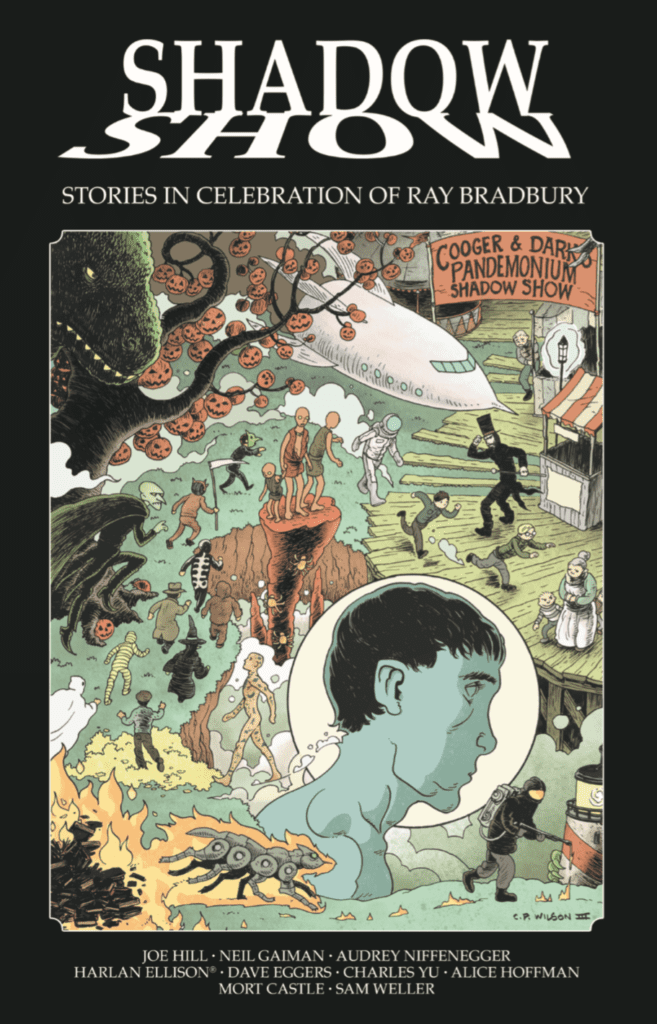
Cover of Shadow Show

Shadow Show: Stories in Celebration of Ray Bradbury is an anthology of short stories inspired by the late science fiction author. The stories included contain references and draw inspiration from many of Ray Bradbury’s short stories and novels, and we will look at how a few of the tales are linked to the timeless author.

Ray Bradbury is best known for writing novels such as Fahrenheit 451, Something Wicked this Way Comes, Dandelion Wine, and the Martian Chronicles. He also wrote hundreds of short stories, several stage plays, and some screenplays. While mostly known as a science fiction writer, Bradbury’s short stories touch on nearly every genre imaginable, and his unending creativity inspired countless of today’s authors. Shadow Show is just one of the many ways these authors have attempted to pay tribute to Bradbury and features an astounding variety of short stories that relate to Bradbury’s works through either topics or themes. Shadow Show was published in 2015 through IDW publishing and contains a total of nine stories that pay tribute to Bradbury.

Ray Bradbury

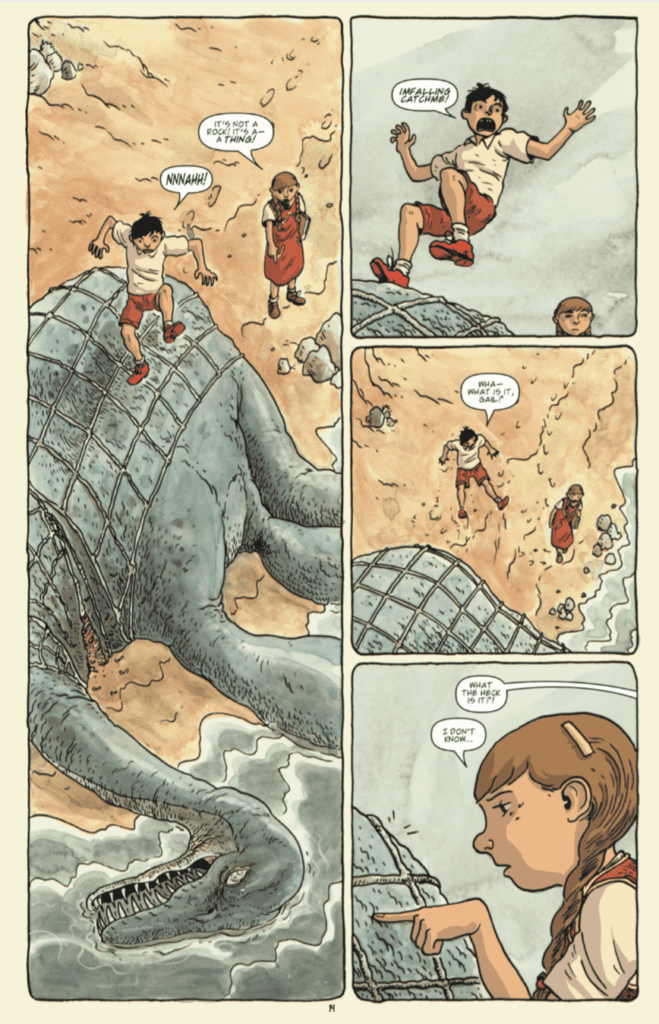
Shadow Show begins with an adaptation by Jason Ciaramella of a Joe Hill short story titled “The Silver Water of Lake Champlain.” It is illustrated by Charles Paul Wilson III and Jeremy Mohler. The story is about a young girl named Gail, who discovers a dead monster on the beach with a boy named Joel. The monster is similar to a giant aquatic dinosaur, and the children celebrate their discovery of the prehistoric creature. Those who have read the short story “The Fog Horn” by Ray Bradbury will be quick to realize that the creature in this story and Bradbury’s are incredibly similar, if not one in the same. This is clear from the foghorn noise that both creatures make. Another way that “The Silver Water of Lake Champlain” mirrors the works of Ray Bradbury is the young main characters. Many of Bradbury’s stories, such as Something Wicked This Way Comes and Dandelion Wine, feature children as the main characters and focus on this innocent time of life. It is difficult to capture the wonder of being a child in words or through art, but Joe Hill, Ray Bradbury, and everyone who worked on the adaptation to a comic book are able to do so successfully.

The Creature and Children from "The Silver Water of Lake Champlain"

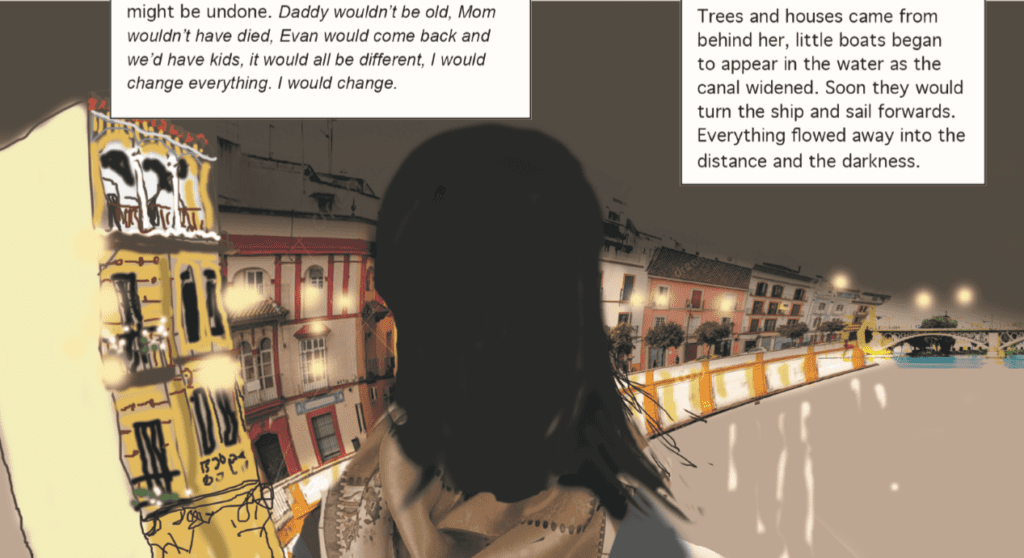
“Backwards in Seville” is a tale featured in Shadow Show that does not have a direct link to any of Bradbury’s stories. It does not feature a character from one of his short stories, an excerpt from one of his novels, or Bradbury himself as a character like other stories in the anthology do. Instead, “Backwards in Seville” relates to Bradbury purely through the themes covered in the story. “Backwards in Seville” is a story written by Audrey Niffenegger and illustrated by Eddie Campbell that follows a middle-aged woman named Helene on a cruise ship with her father and many other elderly passengers. It explores themes of life quickly going by, and how youth is wasted on the young. The story has a magical twist as well, despite most of the story appearing to be set in a realistic world. This is a staple of many of Ray Bradbury’s short stories and novels, such as Something Wicked this Way Comes. The topic of aging and growing old is also something that Bradbury was clearly fascinated with, and shows up in many of his stories, such as Dandelion Wine and “Season of Disbelief”. It would also be rude to continue without noting the beautiful and unique art style of “Backwards in Seville,” which causes Helene’s experience to seem as if she does not have a firm grasp on reality.

Artwork from Backwards in Seville

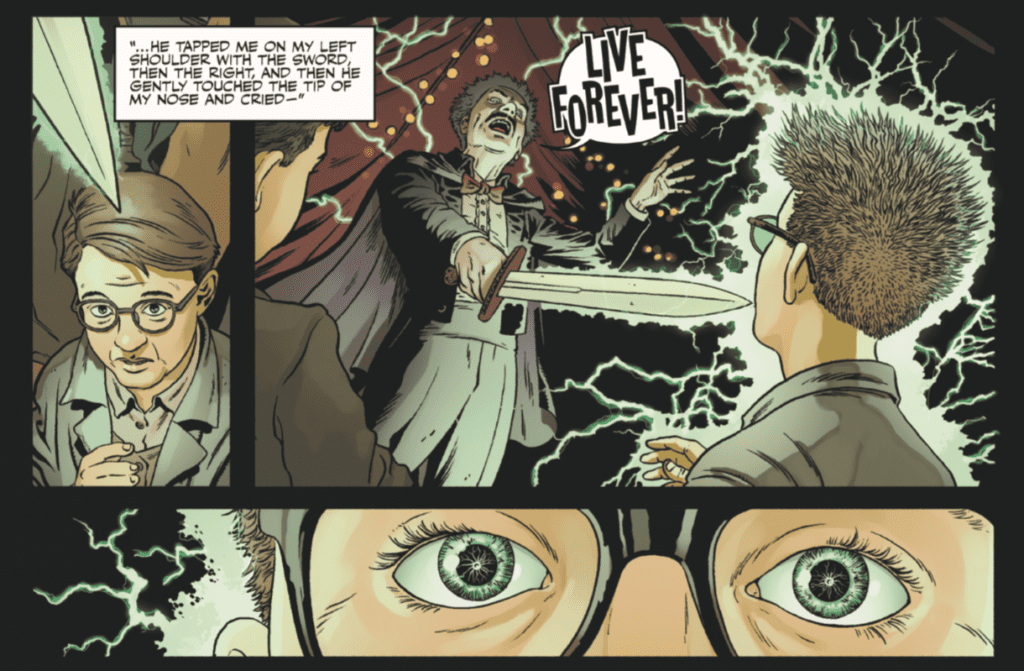
“Live Forever” is one of the most interesting stories told in Shadow Show, because Ray Bradbury himself is a character in it. Written by Sam Weller with art by Mark Sexton, “Live Forever” tells the story of a writer meeting his hero, Ray Bradbury, and talking about his history. The story almost seems it could be a real account when Ray Bradbury tells the writer a true story of when he was a child at a circus and was told by one of the performers to “live forever,” but soon after the story dips into the realm of fiction. Bradbury leads the writer to his basement, where many robot versions of Bradbury’s mentors are spending their time. These robots are indistinguishable from humans except for a very faint ticking noise, and are ripped directly from the Bradbury short story “Marionettes, Inc.” This story is a marvelous read because it helps illustrate just how deep of an impact Bradbury has had on many writers of today.

Scene Depicting the Time Ray Bradbury Was Told to Live ForeverShadow Show: Stories in Celebration of Ray Bradbury is a wonderful anthology, full of diverse topics and themes that truly capture the feeling of Bradbury’s writing. Although this article only covers a few of the stories in the anthology, Shadow Show still contains plenty of other wonderful stories that are worth looking into. I believe it would be difficult for someone to read this fantastic collection of stories and not be instantly motivated to explore the writing of Bradbury for themselves.


Are there other anthology comic books that you like? Let me know in the comments below!

Monkeys Fighting Robots Youtube

Review: MILES MORALES: SPIDER-MAN #17 Makes Miles A Friendly Neighborhood Hero

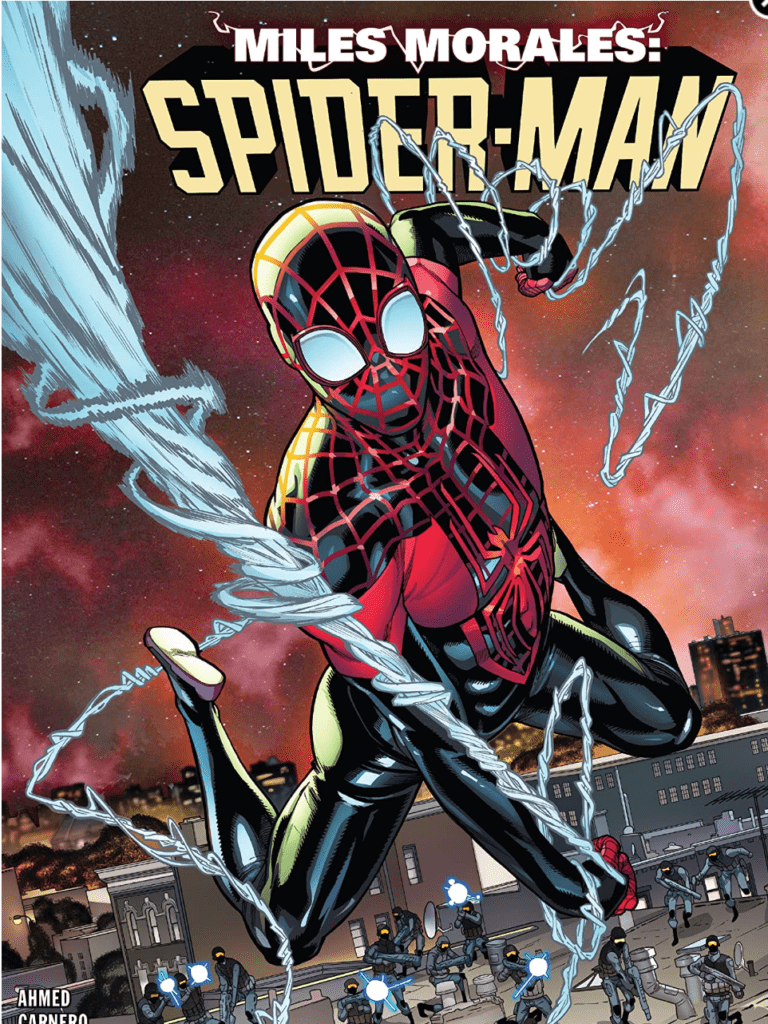
Miles Morales 17 Cover

In Miles Morales: Spider-Man #17, on sale June 10, writer Saladin Ahmed plunges Miles “Outlawed,” in which he’s a fugitive. From Miles’ confrontation with a governmental task force to a question-raising cliffhanger, Ahmed offers plenty of discussion points with this latest installment. But the most promising development is Miles demonstrating the true legacy of Spider-Man.

Miles Morales: Spider-Man #17

Writer: Saladin Ahmed

Penciler: Carmen Carnero

Color Artist: David Curiel

Letterer: VC’s Cory Petit

For teenage superheroes, there’s a lot going on in the Marvel Universe. Even if you ignore each defender’s individual responsibilities, “Outlawed” is making their jobs more difficult than ever. Thanks to Kamala’s Law, teenage heroes can’t operate without supervision. This legal restriction might put a damper on adolescents hoping to follow in the footsteps of icons like Iron Man and Captain Marvel. That’s why it’s so encouraging to see Miles Morales take the next step in his evolution and truly become the friendly neighborhood Spider-Man. 

In this week’s issue, Miles isn’t letting the chaotic world bring him down. Penciler Carmen Carnero and color artist David Curiel show Miles happily swinging through Brooklyn on a beautifully sunny day; few clouds invade Curriel’s peaceful baby blue sky. When Miles finds Kenneth, a troubled boy who has been beaten up by bullies, he kindly helps his fellow Brooklynite. Miles instantly sympathizes with Kenneth and reminds him that there’s still some good in the world.

By offering Kenneth a sympathetic ear and complementing his fashion sense ( the bullies’ target,) Miles acts as a guiding light for the young boy. “That jacket is pure fire, by the way,” Miles says, putting a smile on Kenneth’s bruised, frowning face. Miles goes above and beyond in his interaction with Kenneth. While the duo walks through Brooklyn, Miles gushes over Kenneth’s fashion sense and calls him, “the Reed Richards of fashion.” Miles even gives Kenneth a web-slinging ride through the city and delivers a video message on Kenneth’s social media: “You have beef with Kenneth, and I have beef with you.” Carnero and Curiel show Brooklyn soaring by behind the duo as they swing through the streets, capturing the importance of the neighborhood to the Spider-Man character. It also bears mentioning that Kenneth complements Miles; both characters represent the diverse society we see in real life every day, which is a refreshing sight. Ahmed doesn’t come right out and say it, but he subtly shows us why Miles and the new neighborhood are a natural fit. Kenneth is bullied for his nonnormative appearance and Miles both comforts and praises him for it. While Peter Parker may have embodied the ideals of the society in the past, Miles might be the perfect character for the modern world.

It’d be easy to focus on Miles’ tense confrontation with C.R.A.D.L.E., a task force who seek to stop all unauthorized teenage vigilantes. Or we could dig into the issue’s cliffhanger, which makes the reader feel as if they’re having double vision. There will be plenty of time to analyze “Outlawed” as the event progresses. Instead, let’s credit Ahmed for elevating Miles to the level of a genuine neighborhood Spider-Man. Now, Miles feels much closer to the greatness of his predecessor.

What’d you think of Miles Morales: Spider-Man #17? When it comes to “Outlawed,” whose side are you on?

Check out your local comic shop to see if you can pick this issue, and any others on your list, up there.


Monkeys Fighting Robots Youtube

Jorge Jimenez’s “Joker War” Covers Revealed

Jimenez Joker War

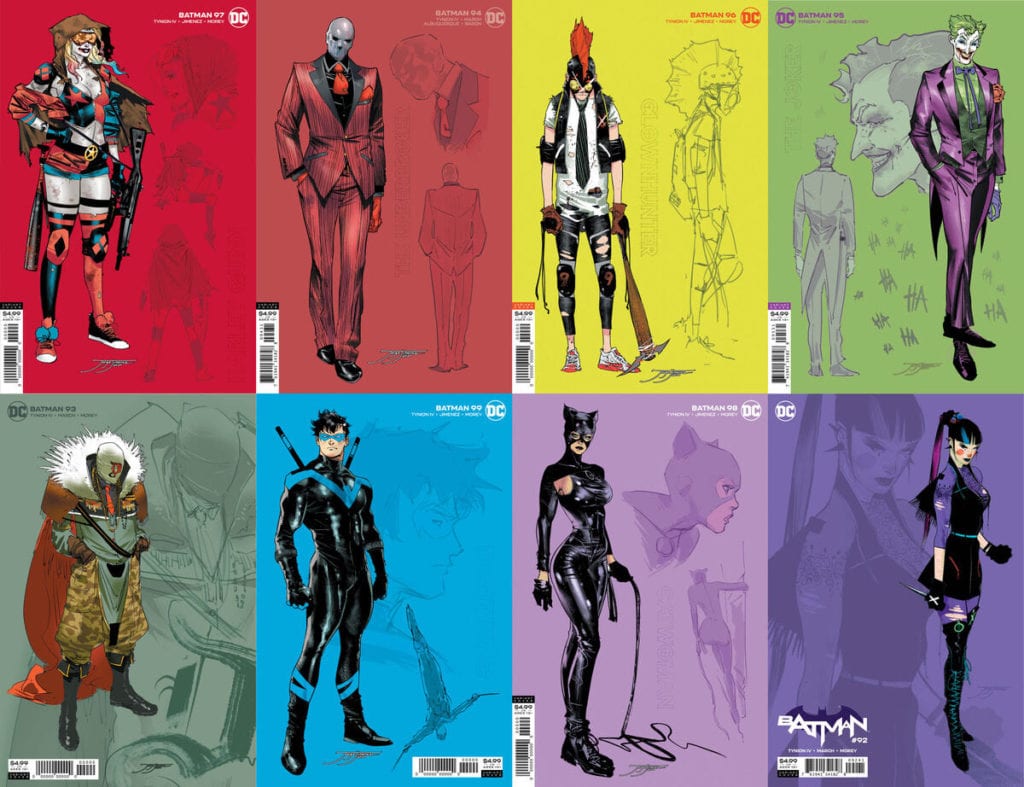
With the new “Joker War” storyline getting closer, DC Comics has revealed a group of Batman #92-100 covers by series artist Jorge Jimenez.

Here’s the official word from the publisher, along with the covers:

James Tynion IV, Jorge Jiménez and Guillem March’s Batman run has introduced novel new characters to the Batman mythos, and one of the most anticipated moments lands today in Batman #92, as Punchline comes face to face with Harley Quinn!

With “The Joker War” approaching, fans will meet even more new characters created by Tynion IV and Jiménez. Punchline, the Designer, the Underbroker, Clownhunter and more—new characters created for “The Joker War” by James Tynion IV and Jorge Jiménez—join Batman’s most famous friends and foes on 1:25 card stock variant covers of every issue from Batman #92 through #100! Each cover features Jiménez’s design work, showing off his process of crafting Gotham’s newest residents, or his distinct interpretations of its familiar faces.

The 1:25 covers feature Jiménez’s illustrations of the following characters:

  • Batman #92—Punchline
  • Batman #93—the Designer
  • Batman #94—the Underbroker
  • Batman #95—The Joker
  • Batman #96—Clownhunter
  • Batman #97—Harley Quinn
  • Batman #98—Catwoman
  • Batman #99—Nightwing
  • Batman #100—to be revealed!

Each cover is available to comic book retailers who order at least 25 copies of Batman #92 through #100, the climactic final issue of “The Joker War.” Batman #92 is on sale now, and “The Joker War” starts in July’s Batman #95. Check out the store near you to see what covers they’ll be ordering!

Jimenez Joker War

Monkeys Fighting Robots Youtube

Review: DEJAH THORIS #5 Surrounds You With Creepy Crawlies

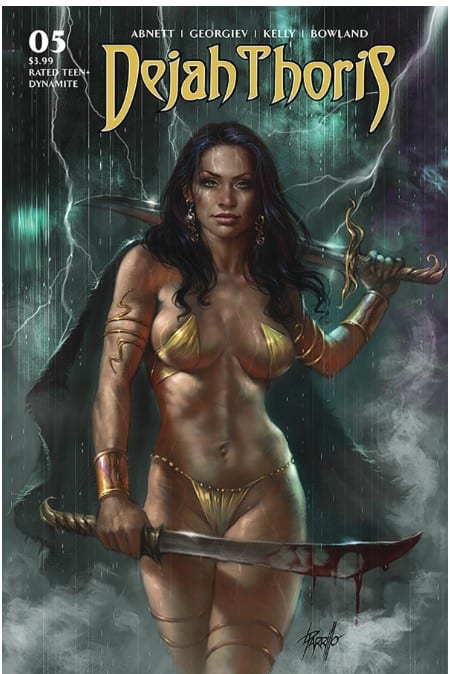
Dejah Thoris Vol. 3, #5, Parrillo cover

DEJAH THORIS VOL. 3, #5, available from Dynamite on June 10th, confronts Dejah and her crew with giant cave spiders and crawling brain bugs on her hunt to find Kurz Kurtos. Written by Dan Abnett and drawn by Vasco Georgiev, this issue boasts plenty of action, strong art, and a solid introduction to a new character.

Cover Art

Lucio Parrillo’s cover art immediately elevates the quality of any book. Dejah Thoris’ pose is both sensual and deadly. And despite the impossible design of her iconic outfit, Parrillo’s realism style gives the concept of “gravity defying” a whole new sense of believability.

Writing

Dan Abnett’s story has a lot going on with one main plot and two sub plots, but the issue doesn’t feel rushed or complicated. Dejah and her crew battle an army of cave spiders when they encounter an unexpected ally that has a telepathic bug for a head. It sounds weird. It is weird. And yet, it blends right in with the world Abnett has constructed.

Abnett’s writing is strongest when projecting a sense of urgency. Every character is either running away from something or running towards something; constantly confronting danger. That urgency keeps the pacing high and the tension tight, making this issue a fast read.

If there’s one area the writing doesn’t quite work, it’s in the dialog. Llana’s speaking style is so contemporary American that it doesn’t match her Martian warrior persona, and Morokh’s words read as determined or impassioned speeches in direct contradiction to his emotion-less character. The latter could be a result of the lettering, but the end result is a break in the story where it’s not intended.

Pencils/Inks

Vasco Georgiev’s art is excellent. It’s an even-handed mix of detail that’s pulp without looking cartoonish. Georgiev showcases the art well by intermixing a wide array of camera angles for each panel to keep the scenes moving when characters are sitting/standing around and simply talking. This issue is a great example of taking static scenes and giving them movement with an unexpected perspective.

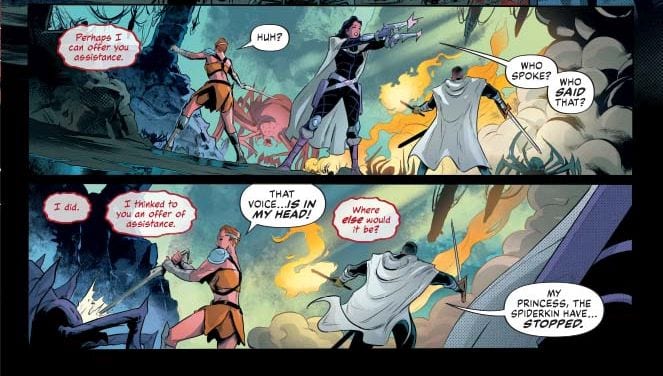
Favorite Page/Panel: For the favorite, I’ll point to a collection of panels that span pages 10 and 11. Let’s call it the “mounting” scene. Morokh’s brain crawls along its synth body and mounts itself to address Dejah’s group. It’s creepy, a bit gross, and well executed.

Coloring

Dearbhla Kelly’s coloring is remarkable for imagining what hues look like on an assortment of characters in a dark cave lit by pink (yes, pink) flame. Kelly adjusted skin tones, armor reflections and hair shine to match the ambient hue of pink flame. It must have taken a great deal of trial and error to match the flame colors with the lighting and surroundings without crating an ugly contrast.

Lettering

Simon Bowland’s lettering is as imaginative as Kelly’s coloring, in the sense that there’s no precedent for what kind of balloon to use when a bug brain is speaking telepathically. Bowland devised the right combination of bubble border color – again, matching the pink flame – and line style to help the reader suspend disbelief. The interesting use of colors really elevates Bowland’s lettering.

DEJAH THORIS VOL. 3, #5, lettering sample

Conclusion

DEJAH THORIS #5 has dynamic art, urgent and tense story pacing, and imaginative visuals. Strongly recommend you get this issue…unless you’re deathly afraid of spiders.


Author’s Note: Local Comic Shops (LCS) are going through a tough time right now with the pandemic outbreak of COVID-19. Comics fans of every flavor that care about his or her LCS should try to do what they can. So, here’s my part:

If you’re in Northern Delaware, South East Pennsylvania, or Southern New Jersey area, please take a moment to visit Captain Blue Hen Comics in Newark, DE. Say ‘hi,’ pick up a book, order a book (they’re on Comichub.com), and let them know you support them.

If you’re nowhere near that area, please find YOUR LCS using Comic Shop Locator and lend your support.

Thanks, and stay safe.
Monkeys Fighting Robots Youtube

Review: KISS ZOMBIES #5 Is Awesomely Weird

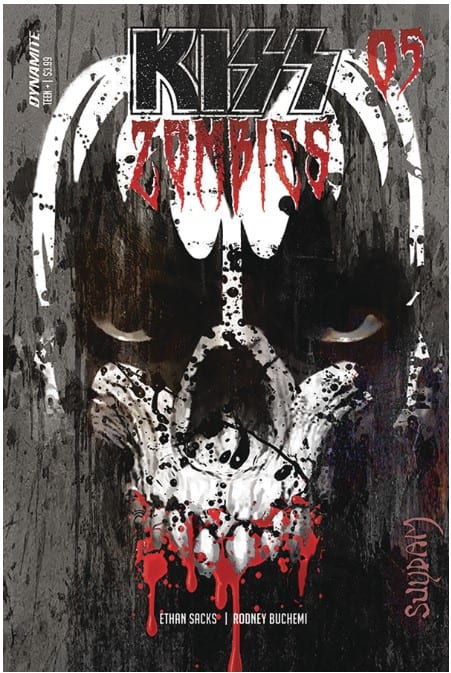
Kiss Zombies #5, Suydam cover

KISS ZOMBIES #5, available from Dynamite on June 10th, is the band’s next adventure roaming the zombie-infected wastelands of North America. Written by Ethan Sacks and drawn by Rodney Buchemi, the issue is played straight for horror but it’s too silly to take seriously. But what it lacks in grounding, the issue makes up for with buckets of charm.

Cover Art

Arthur Suydam’s cover work is excellent. It’s an impression of Gene Simmons’ ‘Demon’ makeup with a bloody maw. Suyden’s rough style is a cross between gritty spray-paint stenciling and Bill Sienkiewicz’s nightmare abstractionist aesthetic. The end result is both filthy and terrifying as a top-tier horror movie poster.

Writing

Ethan Sacks’s story is ludicrous and wholly entertaining at the same time. Zombies are attracted to noise, but KISS has discovered that excessively loud rock-and-roll overloads the zombie brain and kills it. They then roam the North American wastelands, moving from colony to colony, saving survivors from the zombie hoards with the power of rock-and-roll.

In this issue, Kiss is captured by an over-protective colony leader bent on stopping them before their music brings the zombies to overrun the town. In true Walking Dead fashion, the humans are just as, or more, dangerous than the zombies. Kiss manages to free themselves and overpower the hysterical leader just in time to put on a zombie-exploding concert that saves the day.

The story is weird, absurd, and nonsensical. And I had a smile on my face the entire time I was reading it.

Pencils/Inks

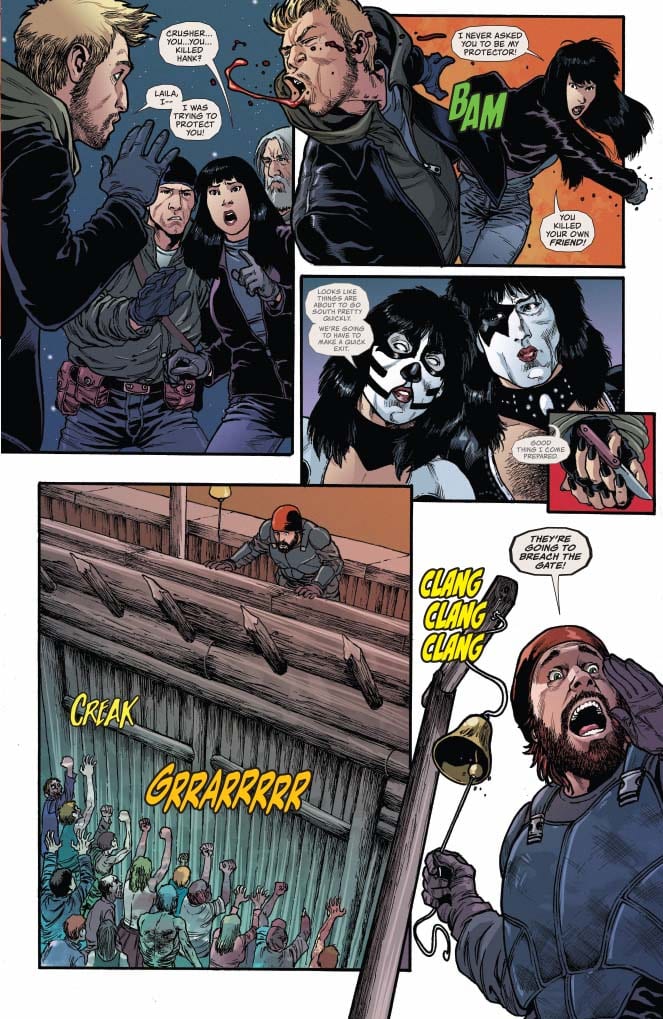
As absurd as the story is, Rodney Buchemi’s art is actually very solid. The issue works because of the contrast between the grim reality of the setup and the surrealism of the heroes. It wouldn’t work if the depiction of Kiss in full costume was overblown or made to look like they didn’t belong in the setting. Buchemi renders the heroes like a superhero team that fits right in with their surroundings and the civilian characters.

Favorite Page/Panel: There’s a flashback panel on page 6 where the leader describes how he lost his wife and son to the zombies. In any other book, this would be a heart-wrenching panel…except for the fact that the son’s tear-streaked face is wearing Kiss makeup. A true fan. This panel exemplifies every reason why this book – that should be awful in concept – succeeds in execution.

Kiss Zombies #5, favorite panel

Coloring

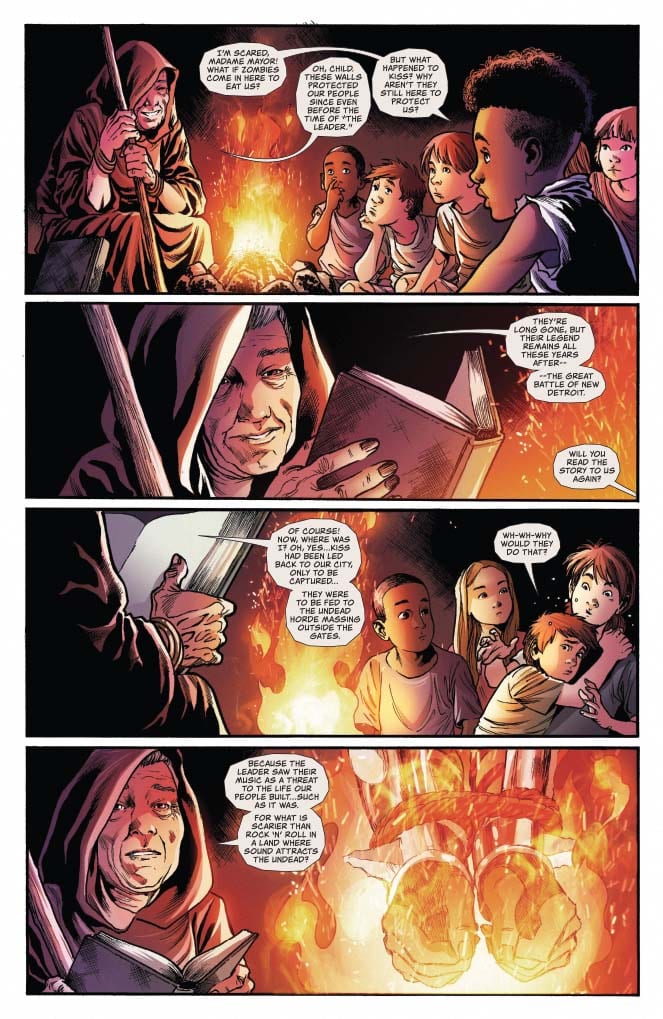
Dijjo Lima’s coloring is moody and effective. Most of the issue takes place at night and the scenes play out by firelight. Lima’s use of color applies the right mix of yellow and orange to bring “roughing it” authenticity to the environment.

Kiss Zombies #5, color sample

Lettering

Troy Peteri makes use of every millimeter of empty space in this issue. There’s a surprising amount of action going on, and neither the word balloons nor action boxes get in the way. It looks like the font is slightly smaller than typical to fit within the empty spaces more effectively (or my eyesight could be getting worse with age). If not, Peteri’s use of empty space is almost Houdini-like.

Kiss Zombies #5, lettering sample

Conclusion

KISS ZOMBIES #5, available from Dynamite on June 10th, pulls off the impossible by being completely entertaining despite its premise. The story is played straight in perfect contrast to the concept, and the art is solid all the way round. A pleasant surprise.


Author’s Note: Local Comic Shops (LCS) are going through a tough time right now with the pandemic outbreak of COVID-19. Comics fans of every flavor that care about his or her LCS should try to do what they can. So, here’s my part:

If you’re in Northern Delaware, South East Pennsylvania, or Southern New Jersey area, please take a moment to visit Captain Blue Hen Comics in Newark, DE. Say ‘hi,’ pick up a book, order a book (they’re on Comichub.com), and let them know you support them.

If you’re nowhere near that area, please find YOUR LCS using Comic Shop Locator and lend your support.

Thanks, and stay safe.
Monkeys Fighting Robots Youtube

Review: VAMPIRELLA/RED SONJA #8 In The Case Of The Mind-Controlled Moll

Vampirella-Red Sonja #8, Lee cover

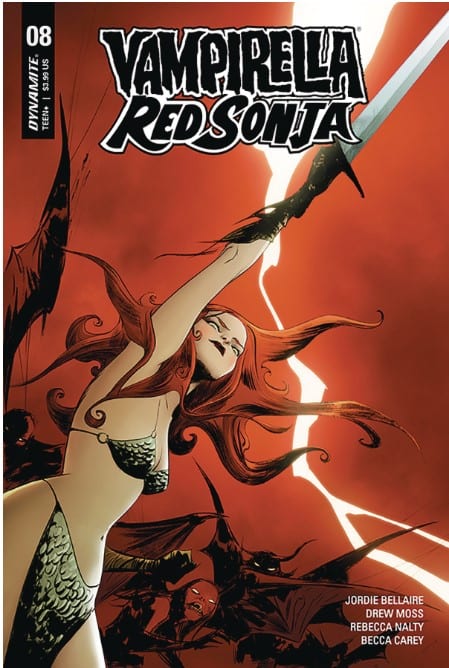
VAMPIRELLA/RED SONJA #8., available from Dynamite on June 10th, follows Detective Red Sonja in 1920’s New York on her search to find the missing Vampirella. Jordie Bellaire’s story is brimming with gumshoe goodness, noir atmosphere, tommy guns and a splash of demonic mischief.

Cover Art

Jae Lee’s covers are becoming a staple at Dynamite with good reason. There’s a special something about Lee’s covers that sets his style apart, and it’s in the way he handles thin points. In this issue’s cover, for example. Red Sonja’s hair doesn’t just flow in the wind. It curls and swirls as though it’s alive. Almost like tentacles. It gives the inanimate and lifeless a sense of organic life that’s simply eye-catching.

Writing

Jordie Bellaire’s story gets right to the point. The reader is tossed into the mix of a detective noir story with Red Sonja in the lead role. No scalemail bikinis or giant swords, and the reader is just supposed to accept it. And surprisingly, you do. Without getting into too many spoilers, there’s some planet-hopping, timey-wimey shenanigans going on. While this issue doesn’t play like a typical Red Sonja story, it works because the core of the character’s personality remains intact. Different clothes, different time, different place, and yet, you never doubt this is still the true Red Sonja. Big kudos to Bellaire for merging two genres successfully.

Pencils/Inks

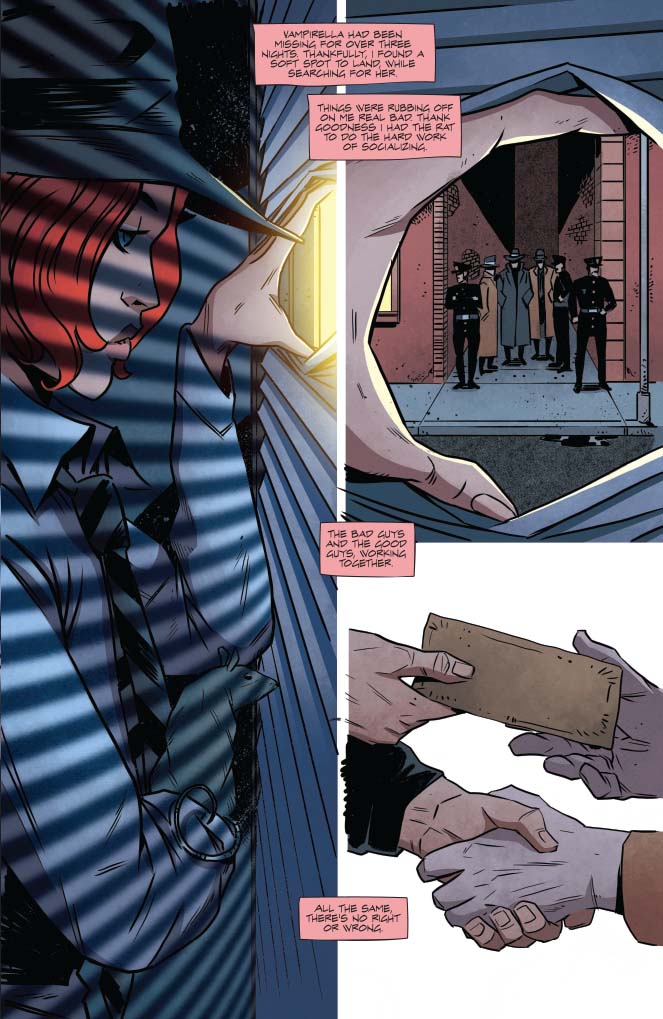
Drew Moss’ art is a mixed bag in this issue. For an artist to successfully pull off the noir aesthetic, the shadows have to become almost a character unto themselves. Right from the opening panel, Moss nails the shadows and the noir aesthetic to bring you right into a classic gangster film.

Vampirella-Red Sonja #8, art sample

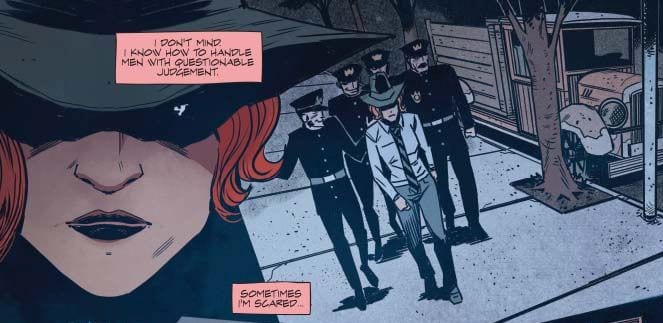
Where Moss’ art doesn’t work is in the character anatomy. Nearly every character on every panel is flat and two-dimensional in how they move and how they’re posed. On several panels, the characters look like wooden mannequins arranged to match the scene. Moss’ character composition is lifeless here.

Vampirella-Red Sonja #8, art sample2

Vampirella-Red Sonja #8, art sample3

Coloring

Most of the issue takes place in the dark; either nighttime outside or in a darkly lit night club. Rebecca Nalty’s coloring matches the overall look of heavy shadows and darkened locales to compliment the noir aesthetic. But, Nalty adds a pop of glow to the brightened eyes of demons (goblins) that are ultimately part of the reason for Vampirella’s disappearance. Without those little, magical pops, the issue would be fairly flat, so Nalty added surreal punch with the color to bring the issue up a notch.

Lettering

Compared to many books these days, there’s very little dialog or narration in this issue. The art tells the story. That said, Becca Carey’s lettering excellently continues the layers of noir aesthetic with the gumshoe narration in just the right spots. You can almost imagine Red Sonja narrating her own detective case. Carey’s choice of fonts and box fill color intuitively let you know you’re inside Red Sonja’s head. Nice work here by Carey.

Conclusion

VAMPIRELLA/RED SONJA #8 is a surprising detective noir story with the unlikeliest of detectives. The story is simple yet perfectly matched with classic gangster films. Despite some uneven character artwork, the visuals strongly compliment the story and the genre.


Author’s Note: Local Comic Shops (LCS) are going through a tough time right now with the pandemic outbreak of COVID-19. Comics fans of every flavor that care about his or her LCS should try to do what they can. So, here’s my part:

If you’re in Northern Delaware, South East Pennsylvania, or Southern New Jersey area, please take a moment to visit Captain Blue Hen Comics in Newark, DE. Say ‘hi,’ pick up a book, order a book (they’re on Comichub.com), and let them know you support them.

If you’re nowhere near that area, please find YOUR LCS using Comic Shop Locator and lend your support.

Thanks, and stay safe.

Monkeys Fighting Robots Youtube