


I know, “Hollywood Hell” is a bit of a stupid title for an article, but when in doubt: alliterate! At least that’s always been my rule of thumb. But all the writing cliches I have in my toolbelt just couldn’t prepare me for Image Comics’ The Knives — yet another brilliant entry into the Criminal canon by writer Ed Brubaker, artist Sean Phillips, and colorist Jacob Phillips. The Knives, like so many of their other works, feels too personal—and too powerful—to be covered in a simple run-of-the-mill review. This creative team, yet again, has me sitting in front of my laptop and staring at a blinking cursor, at a loss for how to begin.

You see, there’s something that happens when you write a review — when you experience a work of art that makes you feel a certain way. Someway, somehow, you want to transfer that feeling to the readers of your analysis. But then, of course, there are still plenty of boxes that you need to check if you’re doing your job half right. Every aspect of this vibrant, brilliant creative team needs to be discussed at length. They are all part of the final product, and artists, colorists, and letterers in particular are often left out in the cold when their works are reviewed. The publishers, the formatting, the search engine optimization of it all, it’s all got to fit into what you’re going to say.
Yet, by the time you’ve checked all the boxes, at least in my own case, I often find I’m left with yet another run-of-the-mill review. I wax eloquent where I can. There are fleeting traces of what it feels like to actually read the work I’m discussing. But only traces.
WRITING
It might seem like I have completely lost the plot here. Specifically, the plot of The Knives, which is what I’m supposed to be telling you about. Somehow, this is a little of what the book feels like, though. It feels like it’s a comic about comics, and art in general. Brubaker weaves two stories together: the story of Jacob Kurtz coming to Hollywood, and the story of Angie losing her adoptive father. But there’s a realness beneath the surface of it all. Brubaker isn’t talking to us from Jacob or Angie’s perspective, he’s talking to us from his own. It’s his own pain, frustration, and experiences that pen each word written on the page. Some of what drives Brubaker to these places is obvious, but other things only become apparent when you read his afterword to the book.
Amazon’s Criminal adaptation, for instance, casts a large shadow over The Knives. As Jacob Kurtz’s strength is sapped by working amongst phony Hollywood execs — all of whom consider themselves experts in storytelling because they read Save the Cat in college — you can’t help but picture Brubaker doing this same dance. Could he have watched in quiet frustration as he saw his characters being misunderstood, or perhaps this is just his way of processing his terror of what the adaptation could have become in some nightmarish version of events? Either way, there’s a real fear of losing one’s self that drives this plot forward. Jacob seems confused in whether he wants to fit in with the vapidly self-satisfied or whether he’s glad he’s different to them.
And yet the whole thing begs the question: is Jacob simply self-satisfied in his own way? Are these questions Brubaker had to answer for himself when he sat in a writer’s room? Was he wrestling his own ego and trying to figure out which battles to fight to protect his work? Was he trying to distinguish between his integrity and his pride? The sheer rawness of The Knives leaves you desperate for answers to these questions. Of course, there’s plenty more going on in this book than Brubaker’s own soul-searching. Once Angie — a down-on-her-luck orphan who has taken to cat burgling to make ends meet — shows up, Jacob’s life gets a lot more complicated. All the action, crime, and drama you want from a Criminal book still finds its way into this story in spades.

ART
I always struggle to put words to the art of a comic. I can tell you all about Sean Phillips’ inking — which somehow feels haphazard and precise at the same time — but you won’t know what I mean until you see the scribbled details of a face which, when brought together, create an expression that you can really feel. Or maybe you will know what I mean, and then that’s all you’ll see when you look at each page. You see, I can tell you about the dramatic faces of the Hollywood residents, and how that perfectly juxtaposes itself to Jacob Kurtz’s almost constant look of quiet concentration, but sometimes, it feels like I’m drawing the curtain back on something that was supposed to stay hidden. It feels like I’m taking a beautiful piece of artwork and analyzing it into oblivion. It’s as though the entire process has to occur as an autopsy — in order for me to be able to pick it apart, I have to kill some of the magic first. Because the beauty of Sean Phillips’ work is that it lures you in without you knowing it. And Jacob Phillips too, for that matter!
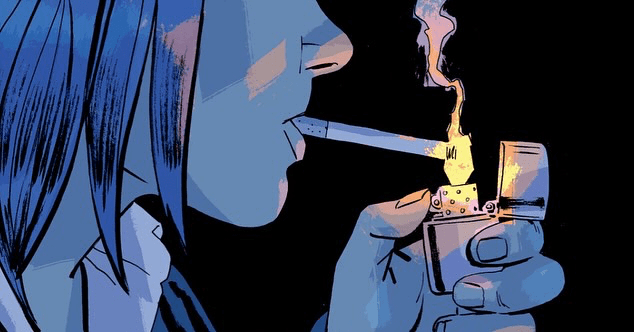
I hadn’t noticed at first that the colors in so many of the scenes amongst the Hollywood elite were really affected. They were seen as though through a painted lens. The deep purples, warm oranges, clear blues all dominate each panel, while Jacob Kurtz’s times over at his aunt’s house are realistic and simply colored. I couldn’t have told you this on my initial read — though I marveled at the beauty of the dramatic hues. I just knew that when the chapter was done that it felt like the only moments that were really real were when he went away to see his aunt. The idea had been placed in my head by the Phillipses, without me even noticing the two of them were creeping around up there. They put their work right under your nose, and yet you don’t see it. You don’t see the brushstrokes, the colors, the forms — you’re there in the page, experiencing the lives of their characters firsthand. At least that’s how it should be. But in pointing out their strategies as artists, I feel as though I’ve tainted their work. I experienced what they were doing on my first read. Now, with the curtain drawn back and the autopsy completed, it all risks becoming an exercise for your mind rather than an affair of the heart. But at the same time, their work is so brilliant, no matter how hard you try to look at it analytically, it’s bound to pull you in regardless.
Sean Phillips’ lettering is similarly a kind of covert operation. He has a toolbox that he returns to, and for good reason. His word balloons always look the same, so do his caption boxes and sound effects. But that’s so that the sound effects, bits of dialogue, and captions that need to stand out can. A truly brutal smack over someone’s head is written in large, scratchy block letters that fill the background of a panel. The quiet whisper of something under someone’s breath is miniscule compared to their usual words. It’s all invisible parts of the story until it’s not supposed to be. You notice the things Sean Phillips wants you to notice. The rest simply sneaks in through your eyes.
CONCLUSION
This was a book I truly loved to read. And yet the more that I put words to the brilliance I see within these pages, the more I wish I could just reach through your screen to you and place the book on your lap. Still, I hope there’s something here that pulls you in, like The Knives did me. When it comes right down to it, I still face the same problem. Brubaker, and Sean and Jacob Phillips have created a work that speaks for itself so powerfully, it’s hard to add anything to the conversation except that you should go read it. So if you take nothing else from me, take that.
The Knives: A Criminal Book arrives from Image Comics in comics stores on August 27th.
