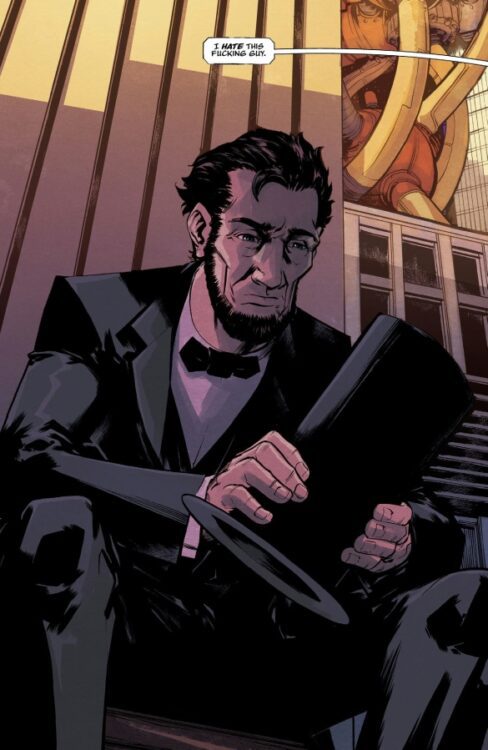
Writer Matthew Rosenberg is no stranger to dystopian, world-ending stories. He’s explored it in everything from What’s The Furthest Place From Here? to DC vs. Vampires and his excellent, underrated Multiple Man: It All Makes Sense in The End mini-series. Matthew is now reteaming with his Multiple Man artist, Andy MacDonald, and bringing in his brother, writer Mark Elijah Rosenberg, on If Destruction Be Our Lot (from Image Comics), a tale about an animatronic theme-park Abraham Lincoln robot looking for purpose in a world where humans have gone extinct, and only the robots and machines that served them remain. Like all of Matt’s stories, it’s filled with brilliant high-concepts, heartbreaking pathos, terrifying moments, and humor. Matt once again took time from his super busy schedule to chat with us about the book. Check it out below and make sure you grab If Destruction Be Our Lot when it comes out May 6th, 2026.
MFR: Your previous series to this one, We’re Taking Everyone Down With Us, also heavily featured a robot. What do you find fascinating about writing robots?
MR: Honestly? Nothing inherently. It’s really weird that I made back-to-back robot comics, I know. But a thing that I have figured out is that they’re a great vehicle for sort of imprinting a kind of refined version of humanity. When we see a human in a story, all the human traits that they have don’t necessarily feel like they have any intentionality behind them. Even when they obviously do. But when you present a reader with a robot, they immediately begin to examine every action and every nuance of the characterization. In those ways, we can sort of begin to highlight ideas about what it means to be human, and what qualities and flaws we want to focus on in our story. Also, robots are pretty cool, I guess.
MFR: So what was the origin of this story? Because it’s so high-concept, yet so layered with characters that seem to have relationships with each other, and a world that feels lived in, I wonder what came first? The idea for the Lincoln robot? Or the idea of this world and what happened to it?
MR: In a way, it was both. I’m a bit of a wanderer. I like to walk around my city late at night. When not many people are around, it lets me clear my head. One night, while I was out walking it occurred to me that it would be quite funny if it was an animatronic Abe Lincoln walking around a city with no people in it. That’s not normally how my brain works or how a story comes to me, but in this case, it did. So robot Abe and the post-human world began together. From there, it was just a question of finding a story worthy of this weird fever dream image I had in my head.
MFR: Why Abraham Lincoln?
MR: Well, in some ways, the answer is because that is what I first envisioned. But I guess the question I’ve been asking myself is, why did I think of it in the first place? And I think in part it’s because of what he represents. Obviously, he’s one of our most recognizable historical figures, and definitely one of the politicians people know the most about, which is handy. It’s handy in parts because assumptions are very helpful when telling a story. It means you have to take less time explaining things, but it also means you can subvert those expectations in fun ways. But more than that, Abe represents a lot of things that I think of as very fundamental to humanity. He was known to be a thoughtful person, empathetic, and generous to a fault. But also someone who felt the weight of the world. He was honest and caring. They’re not universal human traits, I guess. But they are aspirational ones, I hope. So having a lead character who is imbued with some of those qualities, but also somewhat removed from them, was the perfect vehicle for the story we wanted to tell. It’s a tricky headspace to be in because we don’t ever want to forget, or have the readers forget, that he’s not Lincoln. He doesn’t think he’s Lincoln. But he is a copy of him. So a lot of the things we know about the real Lincoln guided us and helped make him a more relatable character. But we have this added layer that our Abe is a man trapped between two worlds. He looks human but isn’t. He’s a copy of another person, so he has some issues around that. And, on top of all of that, he knows what happened to the real Abe and what came after he died. Which obviously would be traumatic and soul-crushing. So the real Lincoln is definitely a starting point, but animatronic Abe has become something very different and wonderful, too.
MFR: The title is an actual Abraham Lincoln quote. Lincoln had a ton of great speeches. What made you want to go with “If Destruction Be Our Lot” as the title?
MR: Yeah. Dude could talk. The title actually comes from Lincoln’s Lyceum Address in 1838. It’s a hell of a speech and well worth a read for anyone who doesn’t know it. It is also chillingly prescient. But for our purposes, we wanted something that sounded cool, which it does. It just happens to also be a speech about the destruction of America, which happened in our book, and about the ways we can be divided and turned against each other, which is a major theme. So once we had settled on the cool title, we were really happy to see that it also connected with our story.
MFR: You’re writing this with your brother Mark, who is also a writer. Was he involved from the start? What made you want to work with him on this project?
MR: Mark and I have been trying to write something together for a long time. He is primarily a screenwriter and director, though, so we did have some back and forth about what we’d be making. But when I told him about this idea about an animatronic Abe in a world without people, I think he was immediately as taken by it as I was. Since he’s a director too, sometimes he is more drawn to a visual than I am. But when we both locked onto this, we knew it was what we wanted to make. From there we just started building together.
MFR: What’s the advantage of working with someone so close to you? And were there any challenges?
MR: There are two big advantages, really. The first is how well we understand each other. Our frames of reference, our influences, all that stuff is inherently understood by each other. And just our communication works with an efficiency that really only exists in family. The other big advantage is that neither of us ever worries about screwing up the relationship, really. There is no creative argument we can have that means we won’t be seeing each other at Christmas. And realizing that is very liberating. It means there can be an honesty that would otherwise feel a little dangerous. As for challenges, yeah. I mean we have a lifetime of dumb bullshit that we do that gets on each other’s nerves. But honestly? It’s mostly been pretty excellent.
MFR: Do you guys write in person or remotely? What’s the writing process like?
MR: We mostly do it remotely. When we started, I would take the train out to his apartment in Brooklyn twice a week. Which, for productivity, was great. But the hour-plus train ride each way was too much for me. I haven’t had a job where I had to leave my house in more than a decade, and I’ve grown soft. So we tend to meet up every month or two, but most of the work is done in our own spaces. Usually, one of us writes a section of the book, then we send it off to the other to fix and add to, and we just repeat that until neither of us has any more notes. No set roles, we both do everything. And then we’ll have more regular Zooms and phone calls to discuss.
MFR: You’ve worked with Andy MacDonald before on Multiple Man (which ruled by the way!), but what about this particular project made him your choice as an artist?
MR: I think Andy is one of the best cartoonists working today. His imagination and his versatility make him a great artist for almost any book. But I also know that Andy loves to design things, loves details, and loves a challenge. All of that was in the DNA of the book. We needed to build a world. We need it to feel real, and unique, and exciting. And we needed people to fall in love with it. On top of that, Andy is just a wonderful person and a joy to hang out with, so I knew we’d have fun.
MFR: There are so many different-looking robots. How did Andy go about creating so many amazing looks?
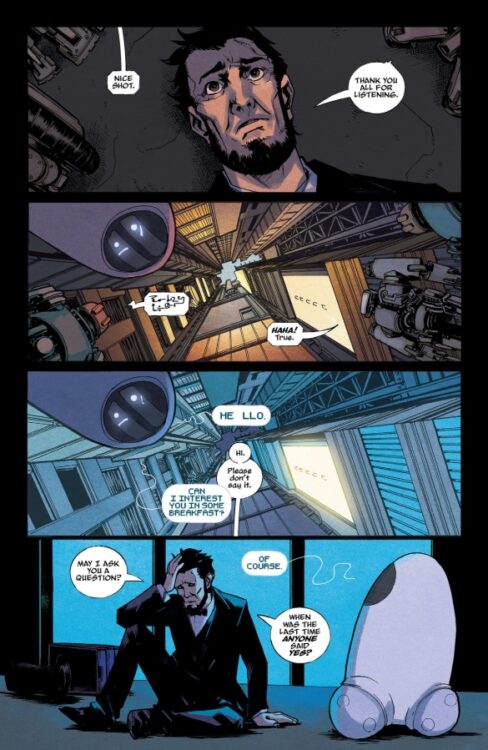
MR: He’s a lunatic. On our very first call, I explained to him that Abe is the only human-looking robot. He asked what the others looked like, and I paused because I knew my answer would make most artists hang up. I said, “They all look different.” Andy just quietly whispered, “fuck yeah,” and I knew we were going to make something awesome.
MFR: Do you have a favorite robot in the story so far?
MR: I mean, I do love Abe. He’s really a beautiful character full of so much pathos and heart. But that’s a cheap answer, right? If I had to pick another one, there is a robot named Speed that we will meet, and he becomes a big part of Abe’s journey. He’s the opposite of Abe in a lot of ways but just as lovable.
MFR: This story really seems to be digging deep into themes about purpose and identity. It really made me think. And there’s an underlying sadness I feel lingering underneath it all, but I was also struck by how fucking hysterical it is at times. Was having so much humor always part of the plan? Or did that evolve with the characters? What purpose did you want those genuine laughs to have?
MR: I don’t think you can tell truly honest human stories without having them speak to all different facets of the human condition. So I try to put heart and humor in my scary books as much as I put horror and pain into my fun ones. That’s just a sort of guiding principle for me. But also this is a book about a robot Abe Lincoln looking for a friend after the world ends. Hard to take that too seriously all the time.
MFR: This is an ongoing series. How far into it have you planned it?
MR: We’re already working on issue 13, so it’s going to be here for a while. We decided when we started to take our time, make the best book we could out of the eye of the public and the pressures of the release calendar. So now we’re well on our way before we’ve even started. Is it a smart business decision? Definitely not. Is it making the book better? Definitely.
MFR: When does the first issue drop?
MR: Issue #1 is in all good comic shops on May 6th. So go ask for a copy and get ready to join Abe on his little odyssey into the unknown.
MFR: I gotta end this on a punk/hardcore question. Any new albums or bands you have been digging and can recommend?
MR: Well, I don’t think anyone but you cares about my answer, but I have to give love to Home Front. They were kind enough to let us use a song for our trailer. They’re the easy frontrunners for album of the year for me. New LP is somehow better than the last, which was my favorite record of that year. Like New Order and Blitz had a baby together. I’m really excited for No Guard to record a full-length. Maybe the most optimistic I’ve been about a new hardcore band in a long time. The Recollection EP that came out last year was great, and I hope they do more and don’t just stay relegated to side project status. Makthaverskan is maybe my favorite post-punk/pop band of the last decade, and they just put out a new record after a really long break, and I could not be happier. Every year, I hope Mindforce will put out new music. They don’t. But we have new music from Crush Your Soul, and they rule.



